Chapter I · (continued 4)
Reading edition
October. Davis is joined by other Buccaneers. Whilst Davis and his men, in the Batchelor's Delight, were lying at the Island Plata, unsettled in their plans by the news they had received, they were, on October the 2d, joined by the Cygnet, Captain Swan, and by a small bark manned with a crew of buccaneers, both of which anchored in the road.
The Cygnet, Captain Swan. The Cygnet, as before noticed, was fitted out from London for the purpose of trade. She had put in at Baldivia, where Swan, seeing the Spaniards suspicious of the visits of strangers, gave out that he was bound to the East Indies, and that he had endeavoured to go by the Cape of Good Hope; but that meeting there with storms and unfavourable winds, and not being able to beat round that Cape, he had changed his course and ran for the Strait of Magalhanes, to sail by the Pacific Ocean to India. This story was too improbable to gain credit. Instead of finding a market at Baldivia, the Spaniards there treated him and his people as enemies, by which he lost two men and had several wounded. He afterwards tried the disposition of the Spaniards to trade with him at other places, both in Chili and Peru, but no where met encouragement. He proceeded Northward for New Spain still with the same view; but near the Gulf of Nicoya he fell in with some buccaneers who had come over the Isthmus and were in canoes; and his men (Dampier says) forced him to receive them into his ship, and he was afterwards prevailed on to join in their pursuits. Swan had to plead in his excuse, the hostility of the Spaniards towards him at Baldivia. These buccaneers with whom Swan associated, had for their commander Peter Harris, a nephew of the Peter Harris who was killed in battle with the Spaniards in the Bay of Panama, in 1680, when the Buccaneers were commanded by Sawkins and Coxon. Swan stipulated with them that ten shares of every prize should be set apart for the benefit of his owners, and articles to that purport were drawn up and signed. Swan retained the command of the Cygnet, with a crew increased by a number of the new comers, for whose accommodation a large quantity of bulky goods belonging to the merchants was thrown into the sea. Harris with others of the buccaneers established themselves in a small bark they had taken.
On their meeting with Davis, there was much joy and congratulation on all sides. They immediately agreed to keep together, and the separation of Eaton's ship was now much regretted. They were still incommoded in Swan's ship for want of room, therefore (the supercargoes giving consent) whatever part of the cargo any of the crews desired to purchase, it was sold to them upon trust; and more bulky goods were thrown overboard. Iron, of which there was a large quantity, was kept for ballast; and the finer goods, as silks, muslins, stockings, &c. were saved. At Isle de la Plata. Whilst they continued at La Plata, Davis kept a small bark out cruising, which brought in a ship from Guayaquil, laden with timber, the master of which reported that great preparations were making at Callao to attack the pirates. This information made a re-union with Eaton more earnestly desired, and a small bark manned with 20 men was dispatched to search along the coast Southward as far as to the Lobos Isles, with an invitation to him to join them again. The ships in the mean time followed leisurely in the same direction.
Cape Blanco, near Guayaquil; difficult to weather. On the 30th, they were off the Cape Blanco which is between Payta and the Bay of Guayaquil. Southerly winds prevail along the coast of Peru and Chili much the greater part of the year; and Dampier remarks of this Cape Blanco, that it was reckoned the most difficult to weather of any headland along the coast, the wind generally blowing strong from SSW or SbW, without being altered, as at other parts of the coast, by the land winds. Yet it was held necessary here to beat up close in with the shore, because (according to the accounts of Spanish seamen) 'on standing out to sea, a current is found setting NW, which will carry a ship farther off shore in two hours, than she can run in again in five.'
November. Payta burnt. November the 3d, the Buccaneers landed at Payta without opposition, the town being abandoned to them. They found nothing of value, 'not so much as a meal of victuals being left them.' The Governor would not pay ransom for the town, though he fed the Buccaneers with hopes till the sixth day, when they set it on fire.
At most of the towns on the coast of Peru, the houses are built with bricks made of earth and straw kneaded together and dried in the sun; many houses have no roof other than mats laid upon rafters, for it never rains, and they endeavour to fence only from the sun. From the want of moisture, great part of the country near the coast will not produce timber, and most of the stone they have, 'is so brittle that any one may rub it into sand with their finger.'
Payta had neither wood nor water, except what was carried thither. The water was procured from a river about two leagues NNE of the town, where was a small Indian village called Colan. Part of the Peruvian Coast where it never rains. Dampier says, 'this dry country commences Northward about Cape Blanco (in about 4° S latitude) whence it reaches to latitude 30° S, in which extent they have no rain that I could ever observe or hear of.' In the Southern part of this tract however (according to Wafer) they have great dews in the night, by which the vallies are rendered fertile, and are well furnished with vegetables.
Eaton had been at Payta, where he burnt a large ship in the road, but did not land. He put on shore there all his prisoners; from which circumstance it was conjectured that he purposed to sail immediately for the East Indies; and such proved to be the fact.
The vessel commanded by Harris, sailed badly, and was therefore quitted and burnt. Lobos de Tierra. Lobos de la Mar. On the 14th, the other Buccaneer vessels, under Davis, anchored near the NE end of Lobos de Tierra, in four fathoms depth. They took here penguins, boobies, and seals. On the 19th, they were at Lobos de la Mar, where they found a letter left by the bark sent in search of Eaton, which gave information that he had entirely departed from the American coast. The bark had sailed for the Island Plata expecting to rejoin the ships there.
Eaton sails for the East Indies; Stops at the Ladrones. Eaton in his route to the East Indies stopped at Guahan, one of the Ladrone Islands, where himself and his crew acted towards the native Islanders with the utmost barbarity, which Cowley relates as a subject of merriment.
On their first arrival at Guahan, Eaton sent a boat on shore to procure refreshments; but the natives kept at a distance, believing his ship to be one of the Manila galeons, and his people Spaniards. Eaton's men served themselves with cocoa-nuts, but finding difficulty in climbing, they cut the trees down to get at the fruit. The next time their boat went to the shore, the Islanders attacked her, but were easily repulsed; and a number of them killed. By this time the Spanish Governor was arrived at the part of the Island near which the ship had anchored, and sent a letter addressed to her Commander, written in four different languages, to wit, in Spanish, French, Dutch, and Latin, to demand of what country she was, and whence she came. Cowley says, 'Our Captain, thinking the French would be welcomer than the English, returned answer we were French, fitted out by private merchants to make fuller discovery of the world. The Governor on this, invited the Captain to the shore, and at their first conference, the Captain told him that the Indians had fallen upon his men, and that we had killed some of them. He wished we had killed them all, and told us of their rebellion, that they had killed eight Fathers, of sixteen which were in a convent. He gave us leave to kill and take whatever we could find on one half of the Island where the rebels lived. We then made wars with these infidels, and went on shore every day, fetching provisions, and firing upon them wherever we saw them, so that the greatest part of them left the Island. The Indians sent two of their captains to us to treat of peace, but we would not treat with them[47].'—'The whole land is a garden. The Governor was the same man who detained Sir John Narbrough's Lieutenant at Baldivia. Our Captain supplied him with four barrels of gunpowder, and arms.'
Josef de Quiroga was at this time Governor at Guahan, who afterwards conquered and unpeopled all the Northern Islands of the Ladrones. Eaton's crew took some of the Islanders prisoners: three of them jumped overboard to endeavour to escape. It was easy to retake them, as they had been bound with their hands behind them; but Eaton's men pursued them with the determined purpose to kill them, which they did in mere wantonness of sport[48]. At another time, when they had so far come to an accommodation with the Islanders as to admit of their approach, the ship's boat being on shore fishing with the seine, some natives in canoes near her were suspected of intending mischief. Cowley relates, 'our people that were in the boat let go in amongst the thickest of them, and killed a great many of their number.' It is possible that thus much might have been necessary for safety; but Cowley proceeds, 'the others, seeing their mates fall, ran away. Our other men which were on shore, meeting them, saluted them also by making holes in their hides.'
From the Ladrones Eaton sailed to the North of Luconia, and passed through among the Islands which were afterwards named by Dampier the Bashee Islands. The account given by Cowley is as follows: 'There being half a point East variation, till we came to latitude 20° 30′ N, where we fell in with a parcel of Islands lying to the Northward of Luconia. On the 23d day of April, we sailed through between the second and third of the Northernmost of them. We met with a very strong current, like the Race of Portland. Nutmeg Island, North of Luconia. At the third of the Northernmost Islands, we sent our boat on shore, where they found abundance of nutmegs growing, but no people. They observed abundance of rocks and foul ground near the shore, and saw many goats upon the Island.'
Cowley concludes the narrative of his voyage with saying that he arrived home safe to England through the infinite mercy of God.
Coast of Peru. Davis attempts Guayaquil. Slave Ships captured. To return to Edward Davis: At Lobos de la Mar, the Mosquito Indians struck as much turtle as served all the crews. Shortly after, Davis made an attempt to surprise Guayaquil, which miscarried through the cowardice of one of his men, and the coldness of Swan to the enterprise. In the Bay of Guayaquil they captured four vessels; one of them laden with woollen cloth of Quito manufacture; the other three were ships coming out of the River of Guayaquil with cargoes of Negroes.
The number of Negroes in these vessels was a thousand, from among which Davis and Swan chose each about fifteen, and let the vessels go. Dampier entertained on this occasion different views from his companions. 'Never,' says he, 'was put into the hands of men a greater opportunity to enrich themselves. We had 1000 Negroes, all lusty young men and women, and we had 200 tons of flour stored up at the Galapagos Islands. With these Negroes we might have gone and settled at Santa Maria on the Isthmus of Darien, and have employed them in getting gold out of the mines there. All the Indians living in that neighbourhood were mortal enemies to the Spaniards, were flushed by successes against them, and for several years had been the fast friends of the privateers. Add to which, we should have had the North Sea open to us, and in a short time should have received assistance from all parts of the West Indies. Many thousands of Buccaneers from Jamaica and the French Islands would have flocked to us; and we should have been an overmatch for all the force the Spaniards could have brought out of Peru against us.'
The proposal to employ slaves in the mines leaves no cause to regret that Dampier's plan was not adopted; but that was probably not an objection with his companions. They naturally shrunk from an attempt which in the execution would have required a regularity and order to which they were unaccustomed, and not at all affected.
Description of the Harbour of Guayaquil. The Harbour of Guayaquil is the best formed port in Peru. In the river, three or four miles short of the town, stands a low Island about a mile long, on either side of which is a fair channel to pass up or down. The Western Channel is the wildest: the other is as deep. 'From the upper part of the Island to the town is about a league, and it is near as much from one side of the river to the other. In that spacious place ships of the greatest burthen may ride afloat; but the best place for ships is near that part of the land on which the town stands. The country here is subject to great rains and thick fogs, which render it very unwholesome and sickly, in the vallies especially; Guayaquil however is not so unhealthy as Quito and other towns inland; but the Northern part of Peru pays for the dry weather which they have about Lima and to the Southward.'
Island Sta Clara. Shoals near its North Side. 'Ships bound into the river of Guayaquil pass on the South side of the Island Santa Clara to avoid shoals which are on the North side, whereon formerly ships have been wrecked. A rich wreck lay on the North side of Santa Clara not far from the Island, and some plate which was in her was taken up: more might have been saved but for the cat-fish which swarm hereabouts.
Cat Fish. 'The Cat-fish is much like a whiting; but the head is flatter and bigger. It has a wide mouth, and certain small strings pointing out on each side of it like cats' whiskers. It hath three fins; one on the back, and one on either side. Each of these fins hath a sharp bone which is very venemous if it strikes into a man's flesh. Some of the Indians that adventured to search this wreck lost their lives, and others the use of their limbs, by these fins. Some of the cat-fish weigh seven or eight pounds; and in some places there are cat-fish which are none of them bigger than a man's thumb; but their fins are all alike venemous. They are most generally at the mouths of rivers (in the hot latitudes) or where there is much mud and ooze. The bones in their bodies are not venemous, and we never perceived any bad effect in eating the fish, which is very sweet and wholesome meat[49].'
The 13th, Davis and Swan with their prizes sailed from the Bay of Guayaquil to the Island Plata, and found there the bark which had been in quest of Eaton's ship.
From Plata, they sailed Northward towards the Bay of Panama, landing at the villages along the coast to seek provisions. They were ill provided with boats, which exposed them to danger in making descents, by their not being able to land or bring off many men at one time; and they judged that the best places for getting their wants in this respect supplied would be in rivers of the Continent, in which the Spaniards had no settlement, where from the native inhabitants they might obtain canoes by traffic or purchase, if not otherwise. Dampier remarks that there were many such unfrequented rivers in the Continent to the Northward of the Isle de la Plata; and that from the Equinoctial to the Gulf de San Miguel in the Bay of Panama, which is above eight degrees of latitude, the coast was not inhabited by the Spaniards, nor were the Indians who lived there in any manner under their subjection, except at one part near the Island Gallo, 'where on the banks of a Gold River or two, some Spaniards had settled to find gold.'
The Land Northward of Cape San Francisco. The Cotton Tree and Cabbage Tree. The land by the sea-coast to the North of Cape San Francisco is low and extremely woody; the trees are of extraordinary height and bigness; and in this part of the coast are large and navigable rivers. The white cotton-tree, which bears a very fine sort of cotton, called silk cotton, is the largest tree in these woods; and the cabbage-tree is the tallest. Dampier has given full descriptions of both. He measured a cabbage-tree 120 feet in length, and some were longer. 'It has no limbs nor boughs except at the head, where there are branches something bigger than a man's arm. The cabbage-fruit shoots out in the midst of these branches, invested or folded in leaves; and is as big as the small of a man's leg, and a foot long. It is white as milk, and sweet as a nut if eaten raw, and is very sweet and wholesome if boiled.'
River of St. Jago. The Buccaneers entered a river with their boats, in or near latitude 2° N, which Dampier, from some Spanish pilot-book, calls the River of St. Jago. It was navigable some leagues within the entrance, and seems to be the river marked with the name Patia in the late Spanish charts, a name which has allusion to spreading branches.
Davis's men went six leagues up the river without seeing habitation or people. They then came in sight of two small huts, the inhabitants of which hurried into canoes with their household-stuff, and paddled upwards against the stream faster than they could be pursued. More houses were seen higher up; but the stream ran here so swift, that the Buccaneers would not be at the labour of proceeding. Island Gallo. They found in the two deserted huts, a hog, some fowls and plantains, which they dressed on the spot, and after their meal returned to the ships, which were at the Island Gallo.
'The Island Gallo is clothed with timber, and here was a spring of good water at the NE end, with good landing in a small sandy bay, and secure riding in six or seven fathoms depth[50].'
River Tomaco. They entered with their boats another large river, called the Tomaco, the entrance of which is but three leagues from the Island Gallo. This river was shoal at the mouth, and navigable for small vessels only. A little within, was a village called Tomaco, some of the inhabitants of which they took prisoners, and carried off a dozen jars of good wine.
1685. January. On the 1st of January, they took a packet-boat bound for Lima, which the President of Panama had dispatched to hasten the sailing of the Plate Fleet from Callao; the treasure sent from Peru and Chili to Old Spain being usually first collected at Panama, and thence transported on mules to Portobello. The Buccaneers judged that the Pearl Islands in the Bay of Panama would be the best station they could occupy for intercepting ships from Lima.
On the 7th, they left Gallo, and pursued their course Northward. An example occurs here of Buccaneer order and discipline. 'We weighed,' says Dampier, 'before day, and all got out of the road except Captain Swan's tender, which never budged; for the men were all asleep when we went out, and the tide of flood coming on before they awoke, we were forced to stay for them till the following tide.'
Island Gorgona. On the 8th, they took a vessel laden with flour. The next day they anchored on the West side of the Island Gorgona, in 38 fathoms depth clear ground, a quarter of a mile from the shore. Gorgona was uninhabited; and like Gallo covered with trees. It is pretty high, and remarkable by two saddles, or risings and fallings on the top. It is about two leagues long, one broad, and is four leagues distant from the mainland. It was well watered at this time with small brooks issuing from the high land. At its West end is another small Island. The tide rises and falls seven or eight feet; and at low water shell-fish, as periwinkles, muscles, and oysters, may be taken. At Gorgona were small black monkeys. 'When the tide was out, the monkeys would come down to the sea-shore for shell-fish. Their way was to take up an oyster and lay it upon a stone, and with another stone to keep beating of it till they broke the shell[51].' Pearl Oysters. The pearl oyster was here in great plenty: they are flatter than other oysters, are slimy, and taste copperish if eaten raw, but were thought good when boiled. The Indians and Spaniards hang the meat of them on strings to dry. 'The pearl is found at the head of the oyster, between the meat and the shell. Some have 20 or 30 small seed-pearl, some none at all, and some one or two pretty large pearls. The inside of the shell is more glorious than the pearl itself[52].'
Bay of Panama. Galera Isle. They put some of their prisoners on shore at Gorgona, and sailed thence on the 13th, being six sail in company; that is to say, Davis's ship, Swan's ship, three tenders, and their last prize. The 21st, they arrived in the Bay of Panama, and anchored at a small low and barren Island named Galera.
On the 25th, they went from Galera to one of the Southern Pearl Islands, where they lay the ships aground to clean, the rise and fall of the sea at the spring tides being ten feet perpendicular. The small barks were kept out cruising, and on the 31st, they brought in a vessel bound for Panama from Lavelia, a town on the West side of the Bay, laden with Indian corn, salt beef, and fowls.
Notwithstanding it had been long reported that a fleet was fitting out in Peru to clear the South Sea of pirates, the small force under Davis, Swan, and Harris, amounting to little more than 250 men, remained several weeks in uninterrupted possession of the Bay of Panama, blocking up access to the city by sea, supplying themselves with provisions from the Islands, and plundering whatsoever came in their way.
The Pearl Islands. The Pearl Islands are woody, and the soil rich. They are cultivated with plantations of rice, plantains, and bananas, for the support of the City of Panama. Dampier says, 'Why they are called the Pearl Islands I cannot imagine, for I did never see one pearl oyster about them, but of other oysters many. It is very pleasant sailing here, having the mainland on one side, which appears in divers forms, beautified with small hills clothed with woods always green and flourishing; and on the other side, the Pearl Islands, which also make a lovely prospect as you sail by them.'
The Buccaneers went daily in their canoes among the different Islands, to fish, fowl, or hunt for guanoes. One man so employed and straggling from his party, was surprised by the Spaniards, and carried to Panama.
February. In the middle of February, Davis, who appears to have always directed their movements as the chief in command, went with his ships and anchored near the City of Panama. He negociated with the Governor an exchange of prisoners, and was glad by the release of forty Spaniards to obtain the deliverance of two Buccaneers; one of them the straggler just mentioned; the other, one of Harris's men.
A short time after this exchange, as the Buccaneer ships were at anchor near the Island Taboga, which is about four leagues to the South of Panama, they were visited by a Spaniard in a canoe, who pretended he was a merchant and wanted to traffic with them privately. He proposed to come off to the ships in the night with a small vessel laden with such goods as the Buccaneers desired to purchase. This was agreed to, and he came with his vessel when it was dark; but instead of a cargo of goods, she was fitted up as a fire-ship with combustibles. The Buccaneers had suspected his intention and were on their guard; but to ward off the mischief, were obliged to cut from their anchors and set sail.
In the morning they returned to their anchorage, which they had scarcely regained when a fresh cause of alarm occurred. Dampier relates, Arrival of fresh bodies of Buccaneers from the West Indies. 'We were striving to recover the anchors we had parted from, but the buoy-ropes, being rotten, broke, and whilst we were puzzling about our anchors, we saw a great many canoes full of men pass between the Island Taboga and another Island, which at first put us into a new consternation. We lay still some time, till we saw they made directly towards us; upon which we weighed and stood towards them. When we came within hail, we found that they were English and French privateers just come from the North Sea over the Isthmus of Darien. We presently came to an anchor again, and all the canoes came on board.'
Grogniet and L'Escuyer. This new arrival of Buccaneers to the South Sea consisted of 200 Frenchmen and 80 Englishmen, commanded by two Frenchmen named Grogniet and L'Escuyer. Grogniet had a commission to war on the Spaniards from a French West-India Governor. The Englishmen of this party upon joining Davis, were received into the ships of their countrymen, and the largest of the prize vessels, which was a ship named the San Rosario, was given to the Frenchmen.
From these new confederates it was learnt, that another party, consisting of 180 Buccaneers, commanded by an Englishman named Townley, had crossed the Isthmus, and were building canoes in the Gulf de San Miguel; on which intelligence, it was determined to sail to that Gulf, that the whole buccaneer force in this sea might be joined. Grogniet in return for the ship given to the French Buccaneers, offered to Davis and Swan new commissions from the Governor of Petit Goave, by whom he had been furnished with spare commissions with blanks, to be filled up and disposed of at his own discretion. Davis accepted Grogniet's present, 'having before only an old commission which had belonged to Captain Tristian, and which, being found in Tristian's ship when she was carried off by Cook, had devolved as an inheritance to Davis.' The commissions which, by whatever means, the Buccaneers procured, were not much protection in the event of their falling into the hands of the Spaniards, unless the nation of which the Buccaneer was a native happened to be then at war with Spain. Instances were not uncommon in the West Indies of the Spaniards hanging up their buccaneer prisoners with their commissions about their necks. But the commissions were allowed to be valid in the ports of other powers. Swan however refused the one offered him, and rested his justification on the orders he had received from the Duke of York; in which he was directed, neither to give offence to the Spaniards, nor to submit to receive affront from them: they had done him injury in killing his men at Baldivia, and he held his orders to be a lawful commission to do himself right.
March. Townley and his Crew. On the 3d of March, as they approached the Gulf de San Miguel to meet the Buccaneers under Townley, they were again surprised by seeing two ships standing towards them. These proved to be Townley and his men, in two prizes they had already taken, one laden with flour, the other with wine, brandy, and sugar; both designed for Panama. Pisco Wine. The wine came from Pisco, 'which place is famous for wine, and was contained in jars of seven or eight gallons each. Ships which lade at Pisco stow the jars one tier on the top of another, so artificially that we could hardly do the like without breaking them: yet they often carry in this manner 1500 or 2000, or more, in a ship, and seldom break one.'
On this junction of the Buccaneers, they went altogether to the Pearl Islands to make arrangements, and to fit their prize vessels as well as circumstances would admit, for their new occupation. Among the preparations necessary to their equipment, it was not the last which occurred, that the jars from Pisco were wanted to contain their sea stock of fresh water; for which service they were in a short time rendered competent.
The 10th, they took a small bark in ballast, from Guayaquil. On the 12th, some Indians in a canoe came out of the River Santa Maria, purposely to inform them that a large body of English and French Buccaneers were then on their march over the Isthmus from the North Sea. This was not all; for on the 15th, one of the small barks which were kept out cruising, fell in with a vessel in which were six Englishmen, who were part of a crew of Buccaneers that had been six months in the South Sea, under the command of a William Knight. These six men had been sent in a canoe in chase of a vessel, which they came up with and took; but they had chased out of sight of their own ship, and could not afterwards find her. Davis gave the command of this vessel to Harris, who took possession of her with a crew of his own followers, and he was sent to the River Santa Maria to look for the buccaneers, of whose coming the Indians had given information.
This was the latter part of the dry season in the Bay of Panama. Hitherto fresh water had been found in plenty at the Pearl Islands; but the springs and rivulets were now dried up. The Buccaneers examined within Point Garachina, but found no fresh water. Port de Pinas. 25th. Taboga Isle. They searched along the coast Southward, and on the 25th, at a narrow opening in the mainland with two small rocky Islands before it, about seven leagues distant from Point Garachina, which Dampier supposed to be Port de Pinas, they found a stream of good water which ran into the sea; but the harbour was open to the SW, and a swell set in, which rendered watering there difficult and hazardous: the fleet (for they were nine sail in company) therefore stood for the Island Taboga, 'where,' says Dampier, 'we were sure to find a supply.'
April. Their boats being sent before the ships, came unexpectedly upon some of the inhabitants of Panama who were loading a canoe with plantains, and took them prisoners. One among these, a Mulatto, had the imprudence to say he was in the fire-ship which had been sent in the night to burn the Buccaneer ships; upon which, the Buccaneers immediately hanged him.
They had chocolate, but no sugar; and all the kettles they possessed, constantly kept boiling, were not sufficient to dress victuals for so many men. Whilst the ships lay at Taboga, a detachment was sent to a sugar-work on the mainland, from which they returned with sugar and three coppers.
More Buccaneers arrive. On the 11th of April, they went from Tabogo to the Pearl Islands, and were there joined by the Flibustiers and Buccaneers of whose coming they had been last apprised, consisting of 264 men, commanded by Frenchmen named Rose, Le Picard, and Des-marais. Le Picard was a veteran who had served under Lolonois and Morgan. In this party came Raveneau de Lussan, whose Journal is said to be the only one kept by any of the French who were in this expedition.
Lussan's Narrative is written with much misplaced gaiety, which comes early into notice, and shews him to have been, even whilst young and unpractised in the occupation of a Buccaneer, of a disposition delighting in cruelty. In the account of his journey overland from the West Indies, he relates instances which he witnessed of the great dexterity of the monkeys which inhabited the forests, and among others the following: 'Je ne puis me souvenir sans rire de l'action que je vis faire a un de ces animaux, auquel apres avoir tiré plusieurs coups de fusil qui lui emportoient une partie du ventre, en sorte que toutes ses tripes sortoient; je le vis se tenir d'une de ses pates, ou mains si l'on veut, a une branche d'arbre, tandis que de l'autre il ramassoit ses intestins qu'il se refouroit dans ce qui lui restoit de ventre[53].'
Ambrose Cowley and Raveneau de Lussan are well matched for comparison, alike not only in their dispositions, but in their conceptions, which made them imagine the recital of such actions would be read with delight.
The Buccaneers in the Bay of Panama were now nearly a thousand strong, and they held a consultation whether or not they should attack the city. They had just before learnt from an intercepted packet that the Lima Fleet was at sea, richly charged with treasure; and that it was composed of all the naval force the Spaniards in Peru had been able to collect: it was therefore agreed not to attempt the city at the present, but to wait patiently the arrival of the Spanish fleet, and give it battle. Chepo. The only enterprise they undertook on the main-land in the mean time, was against the town of Chepo, where they found neither opposition nor plunder.
The small Island Chepillo near the mouth of the river which leads to Chepo, Dampier reckoned the most pleasant of all the Islands in the Bay of Panama. 'It is low on the North side, and rises by a small ascent towards the South side. The soil is yellow, a kind of clay. The low land is planted with all sorts of delicate fruits.' The Islands in the Bay being occupied by the Buccaneers, caused great scarcity of provision and distress at Panama, much of the consumption in that city having usually been supplied from the Islands, which on that account and for their pleasantness were called the Gardens of Panama.
In this situation things remained till near the end of May, the Buccaneers in daily expectation of seeing the fleet from Lima, of which it is now time to speak.
CHAP. XV.
Edward Davis Commander. Meeting of the Spanish and Buccaneer Fleets in the Bay of Panama. They separate without fighting. The Buccaneers sail to the Island Quibo. The English and French separate. Expedition against the City of Leon. That City and Ria Lexa burnt. Farther dispersion of the Buccaneers.
1685. May. Bay of Panama. The Viceroy of Peru judged the Fleet he had collected, to be strong enough to encounter the Buccaneers, and did not fear to trust the treasure to its protection; but he gave directions to the Commander of the Fleet to endeavour to avoid a meeting with them until after the treasure should be safely landed. In pursuance of this plan, the Spanish Admiral, as he drew near the Bay of Panama, kept more Westward than the usual course, and fell in with the coast of Veragua to the West of the Punta Mala. Afterwards, he entered the Bay with his fleet keeping close to the West shore; and to place the treasure out of danger as soon as possible, he landed it at Lavelia, thinking it most probable his fleet would be descried by the enemy before he could reach Panama, which must have happened if the weather had not been thick, or if the Buccaneers had kept a sharper look-out by stationing tenders across the entrance of the Bay. The Lima Fleet arrives at Panama. In consequence of this being neglected, the Spanish fleet arrived and anchored before the city of Panama without having been perceived by them, and immediately on their arrival, the crews of the ships were reinforced with a number of European seamen who had purposely been sent over land from Porto Bello. Thus strengthened, and the treasure being placed out of danger, the Spanish Admiral took up his anchors, and stood from the road before Panama towards the middle of the Bay, in quest of the Buccaneers.
28th. May the 28th, the morning was rainy: the Buccaneer fleet was lying at anchor near the Island Pacheca, the Northernmost of the Pearl Islands. At eleven o'clock in the forenoon, the weather cleared up, when the Spanish fleet appeared in sight about three leagues distant from them to the WNW. The wind was light from the Southward, and they were standing sharp trimmed towards the Buccaneers.
Meeting of the two Fleets. Lussan dates this their meeting with the Spanish Fleet, to be on June the 7th. Ten days alteration of the style had taken place in France three years before, and no alteration of style had yet been adopted in England.
Force of the Buccaneer. The Buccaneer fleet was composed of ten sail of vessels, of different sizes, manned with 960 men, almost all Europeans; but, excepting the Batchelor's Delight and the Cygnet, none of their vessels had cannon. Edward Davis was regarded as the Admiral. His ship mounted 36 guns, and had a crew of 156 men, most of them English; but as he was furnished with a French commission, and France was still at war with Spain, he carried aloft a white flag, in which was painted a hand and sword. Swan's ship had 16 guns, with a crew of 140 men, all English, and carried a Saint George's flag at her main-topmast head. The rest of their fleet was well provided with small-arms, and the crews were dexterous in the use of them. Grogniet's ship was the most powerful, except in cannon, her crew consisting of 308 men.
Force of the Spanish Fleet. The Spanish fleet numbered fourteen sail, six of which were provided with cannon; six others with musketry only, and two were fitted up as fire-ships. The buccaneer accounts say the Spanish Admiral had 48 guns mounted, and 450 men; the Vice-Admiral 40 guns, and men in proportion; the Rear-Admiral 36 guns, one of the other ships 24, one 18, and one 8 guns; and that the number of men in their fleet was above 2500; but more than one half of them Indians or slaves.
When the two fleets first had sight of each other, Grogniet's ship lay at anchor a mile to leeward of his confederates, on which account he weighed anchor, and stood close upon a wind to the Eastward, intending to turn up to the other ships; but in endeavouring to tack, he missed stays twice, which kept him at a distance all the fore part of the day. From the superiority of the Spaniards in cannon, and of the buccaneer crews in musketry, it was evident that distant fighting was most to the advantage of the Spaniards; and that the Buccaneers had to rest their hopes of success on close fighting and boarding. Davis was fully of this opinion, and at three o'clock in the afternoon, the enemy's fleet being directly to leeward and not far distant, he got his vessels under sail and bore right down upon them, making a signal at the same time to Grogniet to board the Spanish Vice-Admiral, who was some distance separate from the other ships of his fleet.
Here may be contemplated the Buccaneers at the highest pitch of elevation to which they at any time attained. If they obtained the victory, it would give them the sole dominion of the South Sea; and Davis, the buccaneer Commander, aimed at no less; but he was ill seconded, and was not possessed of authority to enforce obedience to his commands.
The order given to Grogniet was not put in execution, and when Davis had arrived with his ship within cannon-shot of the Spaniards, Swan shortened sail and lowered his ensign, to signify he was of opinion that it would be best to postpone fighting till the next day. Davis wanting the support of two of the most able ships of his fleet, was obliged to forego his intention, and no act of hostility passed during the afternoon and evening except the exchange of some shot between his own ship and that of the Spanish Vice-Admiral.
When it was dark, the Spanish fleet anchored, and at the same time, the Spanish Admiral took in his light, and ordered a light to be shewn from one of his small vessels, which he sent to leeward. The Buccaneers were deceived by this artifice, believing the light they saw to be that of the Spanish Admiral, and they continued under sail, thinking themselves secure of the weather-gage. 29th. At daylight the next morning the Spaniards were seen well collected, whilst the buccaneer vessels were much dispersed. Grogniet and Townley were to windward of the Spaniards; but all the rest, contrary to what they had expected, were to leeward. At sunrise, the Spanish fleet got under sail and bore down towards the leeward buccaneer ships. The Buccaneers thought it not prudent to fight under such disadvantages, and did not wait to receive them. They were near the small Island Pacheca, on the South side of which are some Islands yet smaller. Among these Islands, Dampier says, is a narrow channel in one part not forty feet wide. Townley, being pressed by the Spaniards and in danger of being intercepted, pushed for this passage without any previous examination of the depth of water, and got safe through. Davis and Swan, whose ships were the fastest sailing in either fleet, had the credit of affording protection to their flying companions, by waiting to repulse the most advanced of the Spaniards. Dampier, who was in Davis's ship, says, she was pressed upon by the whole Spanish force. 'The Spanish Admiral and the rest of his squadron began to play at us and we at them as fast as we could: yet they kept at distant cannonading. They might have laid us aboard if they would, but they came not within small-arms shot, intending to maul us in pieces with their great guns.' After a circuitous chace and running fight, which lasted till the evening, the Buccaneers, Harris's ship excepted, which had been forced to make off in a different direction, anchored by the Island Pacheca, nearly in the same spot whence they had set out in the morning.
30th. On the 30th, at daylight, the Spanish fleet was seen at anchor three leagues to leeward. The breeze was faint, and both fleets lay quiet till ten o'clock in the forenoon. The wind then freshened a little from the South, and the Spaniards took up their anchors; but instead of making towards the Buccaneers, they sailed away in a disgraceful manner for Panama. Whether they sustained any loss in this skirmishing does not appear. The Buccaneer's had only one man killed outright. In Davis's ship, six men were wounded, and half of her rudder was shot away.
The two Fleets separate. It might seem to those little acquainted with the management of ships that it could make no material difference whether the Spaniards bore down to engage the Buccaneers, or the Buccaneers bore down to engage the Spaniards; for that in either case when the fleets were closed, the Buccaneers might have tried the event of boarding. But the difference here was, that if the Buccaneers had the weather-gage, it enabled them to close with the enemy in the most speedy manner, which was of much consequence where the disparity in the number of cannon was so great. When the Spaniards had the weather-gage, they would press the approach only near enough to give effect to their cannon, and not near enough for musketry to do them mischief. With this view, they could choose their distance when to stop and bring their broadsides to bear, and leave to the Buccaneers the trouble of making nearer approach, against the wind and a heavy cannonade. Dampier, who has related the transactions of the 28th and 29th very briefly, speaks of the weather-gage here as a decisive advantage. He says, "In the morning (of the 29th) therefore, when we found the enemy had got the weather-gage of us, and were coming upon us with full sail, we ran for it."
On this occasion there is no room for commendation on the valour of either party. The Buccaneers, however, knew, by the Spanish fleet coming to them from Panama, that the treasure must have been landed, and therefore they could have had little motive for enterprise. The meeting was faintly sought by both sides, and no battle was fought, except a little cannonading during the retreat of the Buccaneers, which on their side was almost wholly confined to the ship of their Commander. Both Dampier and Lussan acknowledge that Edward Davis brought the whole of the buccaneer fleet off safe from the Spaniards by his courage and good management.
June. On June the 1st, the Buccaneers sailed out of the Bay of Panama for the Island Quibo. They had to beat up against SW winds, and had much wet weather. In the middle of June, they anchored on the East side of Quibo, where they were joined by Harris.
Keys of Quibo. The Island Quibo. Quibo and the smaller Islands near it, Dampier calls collectively, the Keys of Quibo. They are all woody. Good fresh water was found on the great Island, which would naturally be the case with the wet weather; and here were deer, guanoes, and large black monkeys, whose flesh was esteemed by the Buccaneers to be sweet and wholesome food.
Rock near the Anchorage. A shoal which runs out from the SE point of Quibo half a mile into the sea, has been already noticed: a league to the North of this shoal, and a mile distant from the shore, is a rock which appears above water only at the last quarter ebb. Except the shoal, and this rock, there is no other danger; and ships may anchor within a quarter of a mile of the shore, in from six to twelve fathoms clear sand and ooze[54].
They stopped at Quibo to make themselves canoes, the trees there being well suited for the purpose, and some so large that a single trunk hollowed and wrought into shape, would carry forty or fifty men. Whilst this work was performing, a strong party was sent to the main-land against Pueblo Nuevo, which town was now entered without opposition; but no plunder was obtained.
Serpents. The Serpent Berry. Lussan relates that two of the Buccaneers were killed by serpents at Quibo. He says, 'here are serpents whose bite is so venemous that speedy death inevitably ensues, unless the patient can have immediate recourse to a certain fruit, which must be chewed and applied to the part bitten. The tree which bears this fruit grows here, and in other parts of America. It resembles the almond-tree in France in height and in its leaves. The fruit is like the sea chestnut (Chataines de Mer) but is of a grey colour, rather bitter in taste, and contains in its middle a whitish almond. The whole is to be chewed together before it is applied. It is called (Graine à Serpent) the Serpent Berry.'
July. Disagreements among the Buccaneers. The dissatisfaction caused by their being foiled in the Bay of Panama, broke out in reproaches, and produced great disagreements among the Buccaneers. Many blamed Grogniet for not coming into battle the first day. On the other hand, Lussan blames the behaviour of the English, who, he says, being the greater number, lorded it over the French; that Townley, liking Grogniet's ship better than his own, would have insisted on a change, if the French had not shewn a determination to resist such an imposition. Another cause of complaint against the English was, the indecent and irreverent manner in which they shewed their hatred to the Roman Catholic religion. Lussan says, 'When they entered the Spanish churches, it was their diversion to hack and mutilate every thing with their cutlasses, and to fire their muskets and pistols at the images of the Saints.' The French separate from the English. In consequence of these disagreements, 330 of the French joined together under Grogniet, and separated from the English.
Knight, a Buccaneer Commander, joins Davis. Before either of the parties had left Quibo, William Knight, a Buccaneer already mentioned, arrived there in a ship manned with 40 Englishmen and 11 Frenchmen. This small crew of Buccaneers had crossed the Isthmus about nine months before; they had been cruising both on the coast of New Spain and on the coast of Peru; and the sum of their successes amounted to their being provided with a good vessel and a good stock of provisions. They had latterly been to the Southward, where they learnt that the Lima fleet had sailed against the Buccaneers before Panama, which was the first notice they received of other Buccaneers than themselves being in the South Sea. On the intelligence, they immediately sailed for the Bay of Panama, that they might be present and share in the capture of the Spaniards, which they believed would inevitably be the result of a meeting. On arriving in the Bay of Panama, they learnt what really had happened: nevertheless, they proceeded to Quibo in search of their friends. The Frenchmen in Knight's ship left her to join their countrymen: Knight and the rest of the crew, put themselves under the command of Davis.
The ship commanded by Harris, was found to be in a decayed state and untenantable. Another vessel was given to him and his crew; but the whole company were so much crowded for want of ship room, that a number remained constantly in canoes. One of the canoes which they built at Quibo measured 36 feet in length, and between 5 and 6 feet in width.
Davis and the English party, having determined to attack the city of Leon in the province of Nicaragua, sent an invitation to the French Buccaneers to rejoin them. The French had only one ship, which was far from sufficient to contain their whole number, and they demanded, as a condition of their uniting again with the English, that another vessel should be given to themselves. The English could ill spare a ship, and would not agree to the proposition; the separation therefore was final. Jean Rose, a Frenchman, with fourteen of his countrymen, in a new canoe they had built for themselves, left Grogniet to try their fortunes under Davis.
In this, and in other separations which subsequently took place among the Buccaneers, it has been thought the most clear and convenient arrangement of narrative, to follow the fortunes of the buccaneer Commander Edward Davis and his adherents, without interruption, to the conclusion of their adventures in the South Sea; and afterwards, to resume the proceedings of the other adventurers.
Proceedings of Edward Davis. August. Expedition against the City of Leon. On the 20th of July, Davis with eight vessels and 640 men, departed from the Island Quibo for Ria Lexa, sailing through the channel between Quibo and the main-land, and along the coast of the latter, which was low and overgrown with thick woods, and appeared thin of inhabitants. August the 9th, at eight in the morning, the ships being then so far out in the offing that they could not be descried from the shore, Davis with 520 men went away in 31 canoes for the harbour of Ria Lexa. They set out with fair weather; but at two in the afternoon, a tornado came from the land, with thunder, lightning, and rain, and with such violent gusts of wind that the canoes were all obliged to put right before it, to avoid being overwhelmed by the billows. Dampier remarks generally of the hot latitudes, as Lussan does of the Pacific Ocean, that the sea there is soon raised by the wind, and when the wind abates is soon down again. Up Wind Up Sea, Down Wind Down Sea, is proverbial between the tropics among seamen. The fierceness of the tornado continued about half an hour, after which the wind gradually abated, and the canoes again made towards the land. At seven in the evening it was calm, and the sea quite smooth. During the night, the Buccaneers, having the direction of a Spanish pilot, entered a narrow creek which led towards Leon; but the pilot could not undertake to proceed up till daylight, lest he should mistake, there being several creeks communicating with each other.
Leon. The city of Leon bordered on the Lake of Nicaragua, and was reckoned twenty miles within the sea coast. They went only a part of this distance by the river, when Davis, leaving sixty men to guard the canoes, landed with the rest and marched towards the city, two miles short of which they passed through an Indian town. Leon had a cathedral and three other churches. It was not fortified, and the Spaniards, though they drew up their force in the Great Square or Parade, did not think themselves strong enough to defend the place. About three in the afternoon, the Buccaneers entered, and the Spaniards retired.
All the Buccaneers who landed did not arrive at Leon that same day. According to their ability for the march, Davis had disposed his men into divisions. The foremost was composed of all the most active, who marched without delay for the town, the other divisions following as speedily as they were able. The rear division being of course composed of the worst travellers, some of them could not keep pace even with their own division. They all came in afterwards except two, one of whom was killed, and the other taken prisoner. The man killed was a stout grey-headed old man of the name of Swan, aged about 84 years, who had served under Cromwell, and had ever since made privateering or buccaneering his occupation. This veteran would not be dissuaded from going on the enterprise against Leon; but his strength failed in the march; and after being left in the road, he was found by the Spaniards, who endeavoured to make him their prisoner; but he refused to surrender, and fired his musket amongst them, having in reserve a pistol still charged; on which he was shot dead.
The houses in Leon were large, built of stone, but not high, with gardens about them. 'Some have recommended Leon as the most pleasant place in all America; and for health and pleasure it does surpass most places. The country round is of a sandy soil, which soon drinks up the rains to which these parts are much subject[55].'
Leon burnt by the Buccaneers. The Buccaneers being masters of the city, the Governor sent a flag of truce to treat for its ransom. They demanded 300,000 dollars, and as much provision as would subsist 1000 men four months: also that the Buccaneer taken prisoner should be exchanged. These demands it is probable the Spaniards never intended to comply with; however they prolonged the negociation, till the Buccaneers suspected it was for the purpose of collecting force. Therefore, on the 14th, they set fire to the city, and returned to the coast. The town of Ria Lexa underwent a similar fate, contrary to the intention of the Buccaneer Commander.
Ria Lexa. Town of Ria Lexa burnt. Ria Lexa is unwholesomely situated in a plain among creeks and swamps, 'and is never free from a noisome smell.' The soil is a strong yellow clay; in the neighbourhood of the town were many sugar-works and beef-farms; pitch, tar, and cordage were made here; with all which commodities the inhabitants carried on a good trade. The Buccaneers supplied themselves with as much as they wanted of these articles, besides which, they received at Ria Lexa 150 head of cattle from a Spanish gentleman, who had been released upon his parole, and promise of making such payment for his ransom; their own man who had been made prisoner was redeemed in exchange for a Spanish lady, and they found in the town 500 packs of flour; which circumstances might have put the Buccaneers in good temper and have induced them to spare the town; 'but,' says Dampier, 'some of our destructive crew, I know not by whose order, set fire to the houses, and we marched away and left them burning.'
Farther Separation of the Buccaneers. After the Leon expedition, no object of enterprise occurred to them of sufficient magnitude to induce or to enable them to keep together in such large force. Dispersed in small bodies, they expected a better chance of procuring both subsistence and plunder. By general consent therefore, the confederacy which had been preserved of the English Buccaneers was relinquished, and they formed into new parties according to their several inclinations. Swan proposed to cruise along the coast of New Spain, and NW-ward, as far as to the entrance of the Gulf of California, and thence to take his departure for the East Indies. Townley and his followers agreed to try their fortunes with Swan as long as he remained on the coast of New Spain; after which they proposed to return to the Isthmus. In the course of settling these arrangements, William Dampier, being desirous of going to the East Indies, took leave of his commander, Edward Davis, and embarked with Swan. Of these, an account will be given hereafter.
CHAP. XVI.
Buccaneers under Edward Davis. At Amapalla Bay; Cocos Island; The Galapagos Islands; Coast of Peru. Peruvian Wine. Knight quits the South Sea. Bezoar Stones. Marine productions on Mountains. Vermejo. Davis joins the French Buccaneers at Guayaquil. Long Sea Engagement.
1685. August. With Davis there remained the vessels of Knight and Harris, with a tender, making in all four sail. August the 27th, they sailed from the harbour of Ria Lexa, and as they departed Swan saluted them with fifteen guns, to which Davis returned eleven.
Proceedings of the Buccaneers under Edw. Davis. Amapalla Bay. A sickness had broken out among Davis's people, which was attributed to the unwholesomeness of the air, or the bad water, at Ria Lexa. After leaving the place, the disorder increased, on which account Davis sailed to the Bay of Amapalla, where on his arrival he built huts on one of the Islands in the Bay for the accommodation of his sick men, and landed them. Above 130 of the Buccaneers were ill with a spotted fever, and several died.
Lionel Wafer was surgeon with Davis, and has given a brief account of his proceedings. Wafer, with some others, went on shore to the main land on the South side of Amapalla Bay, to seek for provisions. They walked to a beef farm which was about three miles from their landing. A hot River. In the way they crossed a hot river in an open savannah, or plain, which they forded with some difficulty on account of its heat. This river issued from under a hill which was not a volcano, though along the coast there were several. 'I had the curiosity,' says Wafer, 'to wade up the stream as far as I had daylight to guide me. The water was clear and shallow, but the steams were like those of a boiling pot, and my hair was wet with them. The river reeked without the hill a great way. Some of our men who had the itch, bathed themselves here, and growing well soon after, their cure was imputed to the sulphureousness or other virtue of this water.' Here were many wolves, who approached so near and so boldly to some who had straggled from the rest of their party, as to give them great alarm, and they did not dare to fire, lest the noise of their guns should bring more wolves about them.
Cocos Island. Davis remained some weeks at Amapalla Bay, and departed thence for the Peruvian coast, with the crews of his ships recovered. In their way Southward they made Cocos Island, and anchored in the harbour at the NE part, where they supplied themselves with excellent fresh water and cocoa-nuts. Wafer has given the description following: 'The middle of Cocos Island is a steep hill, surrounded with a plain declining to the sea. This plain is thick set with cocoa-nut trees: but what contributes greatly to the pleasure of the place is, that a great many springs of clear and sweet water rising to the top of the hill, are there gathered as in a deep large bason or pond, and the water having no channel, it overflows the verge of its bason in several places, and runs trickling down in pleasant streams. In some places of its overflowing, the rocky side of the hill being more than perpendicular, and hanging over the plain beneath, the water pours down in a cataract, so as to leave a dry space under the spout, and form a kind of arch of water. The freshness which the falling water gives the air in this hot climate makes this a delightful place. Effect of Excess in drinking the Milk of the Cocoa-nut. We did not spare the cocoa-nuts. One day, some of our men being minded to make themselves merry, went ashore and cut down a great many cocoa-nut trees; from which they gathered the fruit, and drew about twenty gallons of the milk. They then sat down and drank healths to the King and Queen, and drank an excessive quantity; yet it did not end in drunkenness: but this liquor so chilled and benumbed their nerves that they could neither go nor stand. Nor could they return on board without the help of those who had not been partakers of the frolick, nor did they recover under four or five days' time[56].'
Here Peter Harris broke off consortship, and departed for the East Indies. The tender sailed at the same time, probably following the same route.
At the Galapagos Islands. Davis and Knight continued to associate, and sailed together from Cocos Island to the Galapagos. At one of these Islands they found fresh water; the buccaneer Journals do not specify which Island, nor any thing that can be depended upon as certain of its situation. Wafer only says, 'From Cocos we came to one of the Galapagos Islands. At this Island there was but one watering-place, and there we careened our ship.' Dampier was not with them at this time; but in describing the Galapagos Isles, he makes the following mention of Davis's careening place. 'Part of what I say of these Islands I had from Captain Davis, who was there afterwards, and careened his ship at neither of the Islands that we were at in 1684, but went to other Islands more to the Westward, which he found to be good habitable Islands, having a deep fat soil capable of producing any thing that grows in those climates: they are well watered, and have plenty of good timber. Captain Harris came hither likewise, and found some Islands that had plenty of mammee-trees, and pretty large rivers. They have good anchoring in many places, so that take the Galapagos Islands by and large, they are extraordinary good places for ships in distress to seek relief at[57].'
Wafer has not given the date of this visit, which was the second made by Davis to the Galapagos; but as he stopped several weeks in the Gulf of Amapalla for the recovery of his sick, and afterwards made some stay at Cocos Island, it must have been late in the year, if not after the end, when he arrived at the Galapagos, and it is probable, during, or immediately after, a rainy season.
The account published by Wafer, excepting what relates to the Isthmus of Darien, consists of short notices set down from recollection, and occupying in the whole not above fifty duodecimo pages. He mentions a tree at the Island of the Galapagos where they careened, like a pear-tree, 'low and not shrubby, very sweet in smell, and full of very sweet gum.'
Davis and Knight took on board their ships 500 packs or sacks of flour from the stores which had formerly been deposited at the Galapagos. The birds had devoured some, in consequence of the bags having been left exposed.
1686. On the Coast of Peru. From the Galapagos, they sailed to the coast of Peru, and cruised in company till near the end of 1686. They captured many vessels, which they released after plundering; and attacked several towns along the coast. They had sharp engagements with the Spaniards at Guasco, and at Pisco, the particulars of which are not related; but they plundered both the towns. Peruvian Wine like Madeira. They landed also at La Nasca, a small port on the coast of Peru in latitude about 15° S, at which place they furnished themselves with a stock of wine. Wafer says, 'This is a rich strong wine, in taste much like Madeira. It is brought down out of the country to be shipped for Lima and Panama. Sometimes it is kept here many years stopped up in jars, of about eight gallons each: the jars were under no shelter, but exposed to the scorching sun, being placed along the bay and between the rocks, every merchant having his own wine marked.' It could not well have been placed more conveniently for the Buccaneers.
They landed at Coquimbo, which Wafer describes 'a large town with nine churches.' What they did there is not said. Wafer mentions a small river that emptied itself in a bay, three miles from the town, in which, up the country, the Spaniards get gold. 'The sands of the river by the sea, and round the whole Bay, are all bespangled with particles of gold; insomuch that in travelling along the sandy bays, our people were covered with a fine gold-dust, but too fine for any profit, for it would be an endless work to pick it up.'
Statistical accounts of the Viceroyalty of Peru, which during a succession of years were printed annually at the end of the Lima Almanack, notice the towns of Santa Maria de la Perilla, Guasca, Santiago de Miraflores, Cañete, Pisco, Huara, and Guayaquil, being sacked and in part destroyed by pirates, in the years 1685, 1686, and 1687.
At Juan Fernandez. Davis and Knight having made much booty (Lussan says so much that the share of each man amounted to 5000 pieces of eight), they went to the Island Juan Fernandez to refit, intending to sail thence for the West Indies: but before they had recruited and prepared the ships for the voyage round the South of America, Fortune made a new distribution of their plunder. Many lost all their money at play, and they could not endure, after so much peril, to quit the South Sea empty handed, but resolved to revisit the coast of Peru. Knight quits the South Sea. The more fortunate party embarked with Knight for the West Indies.
Davis returns to the Coast of Peru. The luckless residue, consisting of sixty Englishmen, and twenty Frenchmen, with Edward Davis at their head, remained with the Batchelor's Delight to begin their work afresh. They sailed from Juan Fernandez for the American coast, which they made as far South as the Island Mocha. By traffic with the inhabitants, they procured among other provisions, a number of the Llama or Peruvian sheep. Bezoar Stones. Wafer relates, that out of the stomach of one of these sheep he took thirteen Bezoar stones of several forms, 'some resembling coral, some round, and all green when first taken out; but by long keeping they turned of an ash colour.'
Marine Productions found on Mountains. In latitude 26° S, wanting fresh water, they made search for the River Copiapo. They landed and ascended the hills in hopes of discovering it. According to Wafer's computation they went eight miles within the coast, ascending mountain beyond mountain till they were a full mile in perpendicular height above the level of the sea. They found the ground there covered with sand and sea-shells, 'which,' says Wafer, 'I the more wondered at, because there were no shell-fish, nor could I ever find any shells, on any part of the sea-coast hereabouts, though I have looked for them in many places.' They did not discover the river they were in search of; but shortly afterwards, they landed at Arica, which they plundered; and at the River Ylo, where they took in fresh water. At Arica was a house full of Jesuits' bark. Vermejo. Wafer relates, 'We also put ashore at Vermejo, in 10° S latitude. I was one of those who landed to see for water. We marched about four miles up a sandy bay, which we found covered with the bodies of men, women, and children. These bodies to appearance, seemed as if they had not been above a week dead; but if touched, they proved dry and light as a sponge or piece of cork. We were told by an old Spanish Indian whom we met, that in his father's time, the soil there, which now yielded nothing, was well cultivated and fruitful: that the city of Wormia had been so numerously inhabited with Indians, that they could have handed a fish from hand to hand until it had come to the Inca's hand. But that when the Spaniards came and laid siege to their city, the Indians, rather than yield to their mercy, dug holes in the sand and buried themselves alive. The men as they now lie, have by them their broken bows; and the women their spinning-wheels and distaffs with cotton yarn upon them. Of these dead bodies I brought on board a boy of about ten years of age with an intent to bring him to England; but was frustrated of my purpose by the sailors, who had a foolish conceit that the compass would not traverse right whilst there was a dead body on board, so they threw him overboard to my great vexation[58].'
April. Near this part of the coast of Peru, in April 1687, Davis had a severe action with a Spanish frigate, named the Katalina, in which the drunkenness of his crew gave opportunity to the Spanish Commander, who had made a stout defence, to run his ship ashore upon the coast. They fell in with many other Spanish vessels, which, after plundering, they dismissed.
Shortly after the engagement with the Spanish frigate Katalina, Davis made a descent at Payta, to seek refreshments for his wounded men, and surprised there a courier with dispatches from the Spanish Commander at Guayaquil to the Viceroy at Lima, by which he learnt that a large body of English and French Buccaneers had attacked, and were then in possession of, the town of Guayaquil. May. The Governor had been taken prisoner by the Buccaneers, and the Deputy or next in authority, made pressing instances for speedy succour, in his letter to the Viceroy, which, according to Lussan, contained the following passage: 'The time has expired some days which was appointed for the ransom of our prisoners. I amuse the enemy with the hopes of some thousands of pieces of eight, and they have sent me the heads of four of our prisoners: but if they send me fifty, I should esteem it less prejudicial than our suffering these ruffians to live. If your Excellency will hasten the armament to our assistance, here will be a fair opportunity to rid ourselves of them.'
Davis joins other Buccaneers at Guayaquil. Upon this news, and the farther intelligence that Spanish ships of war had been dispatched from Callao to the relief of Guayaquil, Davis sailed for that place, and, on May the 14th, arrived in the Bay of Guayaquil, where he found many of his old confederates; for these were the French Buccaneers who had separated from him under Grogniet, and the English who had gone with Townley. Those two leaders had been overtaken by the perils of their vocation, and were no more. But whilst in their mortal career, and after their separation from Davis, though they had at one time been adverse almost to hostility against each other, they had met, been reconciled, and had associated together. Townley died first, of a wound he received in battle, and was succeeded in the command of the English by a Buccaneer named George Hout or Hutt. At the attack of Guayaquil, Grogniet was mortally wounded; and Le Picard was chosen by the French to succeed him in the command. Guayaquil was taken on the 20th of April; the plunder and a number of prisoners had been conveyed by the Buccaneers to their ships, which were at anchor by the Island Puna, when their unwearied good fortune brought Davis to join them.
The taking of Guayaquil by the Buccaneers under Grogniet and Hutt will be more circumstantially noticed in the sequel, with other proceedings of the same crews. When Davis joined them, they were waiting with hopes, nearly worn out, of obtaining a large ransom which had been promised them for the town of Guayaquil, and for their prisoners.
Near the Island Puna. The information Davis had received made him deem it prudent, instead of going to anchor at Puna, to remain with his ship on the look-out in the offing; he therefore sent a prize-vessel into the road to acquaint the Buccaneers there of his being near at hand, and that the Spaniards were to be expected shortly.
The captors of Guayaquil continued many days after this to wait for ransom. They had some hundreds of prisoners, for whose sakes the Spaniards sent daily to the Buccaneers large supplies of provisions, of which the prisoners could expect to receive only the surplus after the Buccaneers should be satisfied. At length, the Spaniards sent 42,000 pieces of eight, the most part in gold, and eighty packages of flour. The sum was far short of the first agreement, and the Buccaneers at Puna, to make suitable return, released only a part of the prisoners, reserving for a subsequent settlement those of the most consideration.
26th. Meeting between Spanish Ships of War and the Buccaneers. On the 26th, they quitted the road of Puna, and joined Davis. In the evening of the same day, two large Spanish ships came in sight. Davis's ship mounted 36 guns; and her crew, which had been much diminished by different engagements, was immediately reinforced with 80 men from Le Picard's party. Besides Davis's ship, the Buccaneers had only a small ship and a barca-longa fit to come into action. Their prize vessels which could do no service, were sent for security into shallow water.
A Sea Engagement of seven days. On the morning of the 27th, the Buccaneers and Spaniards were both without the Island Sta Clara. The Spaniards were the farthest out at sea, and had the sea-breeze first, with which they bore down till about noon, when being just within the reach of cannon-shot, they hauled upon a wind, and began a distant cannonade, which was continued till evening: the two parties then drew off to about a league asunder, and anchored for the night. On the morning of the 28th, they took up their anchors, and the day was spent in distant firing, and in endeavours to gain or to keep the wind of each other. The same kind of manœuvring and distant firing was put in practice on each succeeding day, till the evening of the 2d of June, which completed the seventh day of this obstinate engagement. The Spanish Commander, being then satisfied that he had fought long enough, and hopeless of prevailing on the enemy to yield, withdrew in the night. June. The Spaniards retire. On the morning of the 3d, the Buccaneers were surprised, and not displeased, at finding no enemy in sight.
During all this fighting, the Buccaneers indulged their vanity by keeping the Governor of Guayaquil, and other prisoners of distinction, upon deck, to witness the superiority of their management over that of the Spaniards. It was not indeed a post of much danger, for in the whole seven days battle, not one Buccaneer was killed, and only two or three were wounded.
It may be some apology for the Spanish Commander, that in consequence of Davis's junction with the captors of Guayaquil, he found a much greater force to contend with than he had been taught to expect. Fortune had been peculiarly unfavourable to the Spaniards on this occasion. Three ships of force had been equipped and sent in company against the Buccaneers at Guayaquil. One of them, the Katalina, by accident was separated from the others, and fell in with Davis, by whom she was driven on the coast, where she stranded. The Spanish armament thus weakened one-third, on arriving in the Bay of Guayaquil, found the buccaneer force there increased, by this same Davis, in a proportion greater than their own had been diminished. At the Island De la Plata. Davis and Le Picard left the choice of distance to the Spaniards in this meeting, not considering it their business to come to serious battle unless forced. They had reason to be satisfied with having defended themselves and their plunder; and after the enemy disappeared, finding the coast clear, they sailed to the Island De la Plata, where they stopped to repair damages, and to hold council.
They all now inclined homewards. The booty they had made, if it fell short of the expectations of some, was sufficient to make them eager to be where they could use or expend it; but they were not alike provided with the means of returning to the North Sea. Davis had a stout ship, and he proposed to go the Southern passage by the Strait of Magalhanes, or round Cape Horne. No other of the vessels in the possession of the Buccaneers was strong enough for such a voyage. All the French therefore, and many of the English Buccaneers, bent their thoughts on returning overland, an undertaking that would inevitably be attended with much difficulty, encumbered as they were with their plunder, and the Darien Indians having become hostile to them.
Almost all the Frenchmen in Davis's ship, left her to join their countrymen, and many of the English from their party embarked with Davis. All thoughts of farther negociation with the Spaniards for the ransom of prisoners, were relinquished. Le Picard had given notice on quitting the Bay of Guayaquil, that payment would be expected for the release of the remaining prisoners, and that the Buccaneers would wait for it at Cape Santa Elena; but they had passed that Cape, and it was apprehended that if they returned thither, instead of receiving ransom, they might find the Spanish ships of war, come to renew the attack on them under other Commanders. On the 10th, they landed their prisoners on the Continent.
Division of Plunder. The next day they shared the plunder taken at Guayaquil. The jewels and ornaments could not well be divided, nor could their value be estimated to general satisfaction: neither could they agree upon a standard proportion between the value of gold and silver. Every man was desirous to receive for his share such parts of the spoil as were most portable, and this was more especially of importance to those who intended to march overland. The value of gold was so much enhanced that an ounce of gold was received in lieu of eighty dollars, and a Spanish pistole went for fifteen dollars; but these instances probably took place in settling their gaming accounts. In the division of the plunder these difficulties were obviated by a very ingenious and unobjectionable mode of distribution. The silver was first divided: the other articles were then put up to auction, and bid for in pieces of eight; and when all were so disposed of, a second division was made of the silver produced by the sale.
Davis and his company were not present at the taking of Guayaquil, but the services they had rendered, had saved both the plunder and the plunderers, and gave them a fair claim to share. Neither Wafer nor Lussan speak to this point, from which it may be inferred that every thing relating to the division was settled among them amicably, and that Davis and his men had no reason to be dissatisfied. Lussan gives a loose statement of the sum total and of the single shares. 'Notwithstanding that these things were sold so dearly, we shared for the taking of Guayaquil only 400 pieces of eight to each man, which would make in the whole about fifteen hundred thousand livres.' The number of Buccaneers with Grogniet and Hutt immediately previous to the attack of Guayaquil, was 304. Davis's crew at the time he separated from Knight, consisted of eighty men. He had afterwards lost men in several encounters, and it is probable the whole number present at the sharing of the plunder of Guayaquil was short of three hundred and fifty. Allowing the extra shares to officers to have been 150, making the whole number of shares 500, the amount of the plunder will fall short of Lussan's estimate.
They separate to return home by different Routes. On the 12th, the two parties finally took leave of each other and separated, bound by different routes for the Atlantic.
CHAP. XVII.
Edward Davis; his Third visit to the Galapagos. One of those Islands, named Santa Maria de l'Aguada by the Spaniards, a Careening Place of the Buccaneers. Sailing thence Southward they discover Land. Question, whether Edward Davis's Discovery is the Land which was afterwards named Easter Island? Davis and his Crew arrive in the West Indies.
1687. Davis sails to the Galapagos Islands. Davis again sailed to the Galapagos Islands, to victual and refit his ship. Lionel Wafer was still with him, and appears to have been one of those to whom fortune had been most unpropitious. Wafer does not mention either the joining company with the French Buccaneers, or the plunder of Guayaquil; and particularises few of his adventures. He says, 'I shall not pursue all my coasting along the shore of Peru with Captain Davis. We continued rambling about to little purpose, sometimes at sea, sometimes ashore, till having spent much time and visited many places, we were got again to the Galapagos; from whence we were determined to make the best of our way out of these seas.'
At the Galapagos they again careened; and there they victualled the ship, taking on board a large supply of flour, curing fish, salting flesh of the land turtle for sea store; and they saved as much of the oil of the land turtle as filled sixty jars (of eight gallons each) which proved excellent, and was thought not inferior to fresh butter.
King James's Island. Captain Colnet was at the Galapagos Isles in the years 1793 and 1794, and found traces, still fresh, which marked the haunts of the Buccaneers. He says, 'At every place where we landed on the Western side of King James's Isle, we might have walked for miles through long grass and beneath groves of trees. It only wanted a stream to compose a very charming landscape. This Isle appears to have been a favourite resort of the Buccaneers, as we found seats made by them of earth and stone, and a considerable number of broken jars scattered about, and some whole, in which the Peruvian wine and liquors of the country are preserved. We also found daggers, nails, and other implements. The watering-place of the Buccaneers was at this time (the latter part of April or beginning of May) entirely dried up, and there was only found a small rivulet between two hills running into the sea; the Northernmost of which hills forms the South point of Fresh Water Bay. There is plenty of wood, but that near the shore is not large enough for other use than fire-wood. In the mountains the trees may be larger, as they grow to the summits. I do not think the watering-place we saw is the only one on the Island, and I have no doubt, if wells were dug any where beneath the hills, and not near the lagoon behind the sandy beach, that fresh water would be found in great plenty[59].'
Since Captain Colnet's Voyage, Captain David Porter of the American United States' frigate Essex, has seen and given descriptions of the Galapagos Islands. He relates an anecdote which accords with Captain Colnet's opinion of there being fresh water at King James's Island. He landed, on its West side, four goats (one male and three female) and some sheep, to graze. As they were tame and of their own accord kept near the landing-place, they were left every night without a keeper, and water was carried to them in the morning. 'But one morning, after they had been on the Island several days and nights, the person who attended them went on shore as usual to give them water, but no goats were to be found: they had all as with one accord disappeared. Several persons were sent to search after them for two or three days, but without success.' Captain Porter concluded that they had found fresh water in the interior of the Island, and chose to remain near it. 'One fact,' he says, 'was noticed by myself and many others, the day preceding their departure, which must lead us to believe that something more than chance directed their movements, which is, that they all drank an unusual quantity of water on that day, as though they had determined to provide themselves with a supply to enable them to reach the mountains[60].'
Davis and his men had leisure for search and to make every kind of experiment; but no one of his party has given any description or account of what was transacted at the Galapagos in this his third visit. Light, however, has been derived from late voyages.
The Island Sta Maria de l'Aguada, a Careening Place of the Buccaneers. It has been generally believed, but not till lately ascertained, that Davis passed most of the time he was amongst the Galapagos, at an Island which the Spaniards have designated by the name of Sta Maria de l'Aguada, concerning the situation of which the Spaniards as well as geographers of other countries have disagreed. A Spanish pilot reported to Captain Woodes Rogers that Sta Maria de l'Aguada lay by itself, (i. e. was not one of a groupe of Islands) in latitude 1° 20′ or 1° 30′ S, was a pleasant Island, well stocked with wood, and with plenty of fresh water[61]. Moll, DeVaugondy, and others, combining the accounts given by Dampier and Woodes Rogers, have placed a Sta Maria de l'Aguada several degrees to the Westward of the whole of Cowley's groupe. Don Antonio de Ulloa, on the contrary, has laid it down as one of the Galapagos Isles, but among the most South-eastern of the whole groupe. More consonant with recent information, Pascoe Thomas, who sailed round the world with Commodore Anson, has given from a Spanish manuscript the situations of different Islands of the Galapagos, and among them that of Sta Maria de l'Aguada. The most Western in the Spanish list published by Thomas is named Sta Margarita, and is the same with the Albemarle Island in Cowley's chart. The Sta Maria de l'Aguada is set down in the same Spanish list in latitude 1° 10′ S, and 19 minutes in longitude more East than the longitude given of Sta Margarita, which situation is due South of Cowley's King James's Island.
Captain Colnet saw land due South of King James's Island, which he did not anchor at or examine, and appears to have mistaken for the King Charles's Island of Cowley's chart. On comparing Captain Colnet's chart with Cowley's, it is evident that Captain Colnet has given the name of Lord Chatham's Isle to Cowley's King Charles's Island, the bearings and distance from the South end of Albemarle Island being the same in both, i. e. due East about 20 leagues. It follows that the Charles Island of Colnet's chart was not seen by Cowley, and that it is the Sta Maria de l'Aguada of the Spaniards. It has lately been frequented by English and by American vessels employed in the South Sea Whale Fishery, who have found a good harbour on its North side, with wood and fresh water; and marks are yet discoverable that it was formerly a careening place of the buccaneers. Mr. Arrowsmith has added this harbour to Captain Colnet's chart, on the authority of information communicated by the master of a South Sea whaler.
From Captain David Porter's Journal, it appears that the watering-place at Sta Maria de l'Aguada is three miles distant from any part of the sea-shore; and that the supply it yields is not constant. On arriving a second time at the Galapagos, in the latter part of August, Captain Porter sent a boat on shore to this Island. Captain Porter relates, 'I gave directions that our former watering-places there should be examined, but was informed that they were entirely dried up.'
Gallapagos Islands, Described by Ambrose Cowley in 1684. Larger.
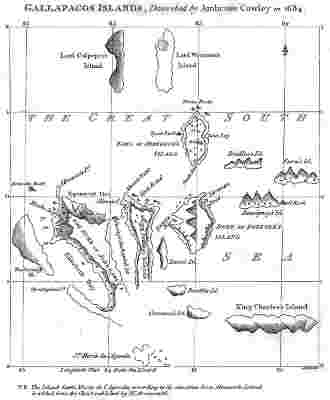
Cowley's chart, being original, a buccaneer performance, and not wholly out of use, is annexed to this account; with the insertion, in unshaded outline, of the Sta Maria de l'Aguada, according to its situation with respect to Albemarle Island, as laid down in the last edition of Captain Colnet's chart, published by Mr. Arrowsmith. This unavoidably makes a difference in the latitude equal to the difference between Cowley's and Captain Colnet's latitude of the South end of Albemarle Island. In Captain Colnet's chart, the North end of Sta Maria de l'Aguada is laid down in 1° 15′ S.
The voyage of the Essex gives reasonable expectation of an improved chart of the Galapagos Isles, the Rev. Mr. Adams, who sailed as Chaplain in that expedition, having employed himself actively in surveying them.
1687. Davis sails from the Galapagos to the Southward. When the season approached for making the passage round Cape Horne, Davis and his company quitted their retreat. The date of their sailing is not given. Wafer relates, 'From the Galapagos Islands we went again for the Southward, intending to touch no where till we came to the Island Juan Fernandez. In our way thither, being in the latitude of 12° 30′ S, and about 150 leagues from the main of America, about four o'clock in the morning, our ship felt a terrible shock, so sudden and violent that we took it for granted she had struck upon a rock. When the amazement was a little over, we cast the lead and sounded, but found no ground, so we concluded it must certainly be some earthquake. The sea, which ordinarily looks green, seemed then of a whitish colour; and the water which we took up in the buckets for the ship's use, we found to be a little mixed with sand. Some time after, we heard that at that very time, there was an earthquake at Callao, which did mischief both there and at Lima.'
Island discovered by Edw. Davis. 'Having recovered our fright, we kept on to the Southward. We steered SbE ½ Easterly, until we came to the latitude of 27° 20′ S, when about two hours before day, we fell in with a small low sandy Island, and heard a great roaring noise, like that of the sea beating upon the shore, right ahead of the ship. Whereupon, fearing to fall foul upon the shore before day, the ship was put about. So we plied off till day, and then stood in again with the land, which proved to be a small flat Island, without the guard of any rocks. We stood in within a quarter of a mile of the shore, and could see it plainly, for it was a clear morning. To the Westward, about twelve leagues by judgement, we saw a range of high land, which we took to be Islands, for there were several partitions in the prospect. This land seemed to reach about 14 or 16 leagues in a range, and there came thence great flocks of fowls. I, and many of our men would have made this land, and have gone ashore at it, but the Captain would not permit us. The small Island bears from Copiapo almost due East [West was intended] 500 leagues, and from the Galapagos under the line is distant 600 leagues[62].'
Dampier was not present at this discovery; but he met his old Commander afterwards, and relates information he received concerning it in the following words. 'Captain Davis told me lately, that after his departing from us at Ria Lexa, he went, after several traverses, to the Galapagos, and that standing thence Southward for wind to bring him about the Tierra del Fuego, in the latitude of 27° S, about 500 leagues from Copayapo on the coast of Chili, he saw a small sandy Island just by him; and that they saw to the Westward of it a long tract of pretty high land, tending away toward the NW out of sight[63].'
Question whether Edward Davis's Land and Easter Island are the same Land, or different. The two preceding paragraphs contain the whole which either in Wafer or Dampier is said concerning this land. The apprehension of being late in the season for the passage round Cape Horne seems to have deterred Davis from making examination of his discovery. The latitude and specified distance from Copiapo were particulars sufficient to direct future search; and twenty-five years afterwards, Jacob Roggewein, a Dutch navigator, guided by those marks, found land; but it being more distant from the American Continent than stated by Davis or Wafer, Roggewein claimed it as a new discovery. A more convenient place for discussing this point, which has been a lasting subject of dispute among geographers, would be in an account of Roggewein's voyage; but a few remarks here may be satisfactory.
Wafer kept neither journal nor reckoning, his profession not being that of a mariner; and from circumstances which occur in Davis's navigation to the Atlantic, it may reasonably be doubted whether a regular reckoning or journal was kept by any person on board; and whether the 500 leagues distance of the small Island from the American coast mentioned by Davis and Wafer, was other than a conjectured distance. They had no superior by whom a journal of their proceedings would be required or expected. If a regular journal had really been kept, it would most probably have found its way to the press.