Volume 3 / Part 2 / Book 3 — BOOK IV—MODERN LIFE (continued 2)
Henri Van Laun translation
He resembles him again by the purity and endurance of his moral principles. His amanuensis, Mr. Laidlaw, told him that he was doing great good by his attractive and noble tales, and that young people would no longer wish to look in the literary rubbish of the circulating libraries. When Walter Scott heard this, his eyes filled with tears: "On his deathbed he said to his son-in-law: 'Lockhart, I have but a minute to speak to you. My dear, be a good man—be virtuous, be religious—be a good man. Nothing else will give you any comfort when you come to lie here.'"[126] This was almost his last word. By this fundamental honesty, and this broad humanity, he was the Homer of modern citizen life. Around and after him, the novel of manners, separated from the historical romance, has produced a whole literature, and preserved the character which he stamped upon it. Miss Austen, Miss Brontë, Mrs. Gaskell, George Eliot, Bulwer, Thackeray, Dickens, and many others, paint, especially or entirely in his style, contemporary life, as it is, unembellished, in all ranks, often amongst the people, more frequently still amongst the middle class. And the causes which made the historical novel come to naught, in Scott and others, made the novel of manners, by the same authors, succeed. These men were too minute copyists and too decided moralists, incapable of the great divinations and the wide sympathies which unlock the door of history; their imagination was too literal, and their judgment too unwavering. It is precisely by these faculties that they created a new species of novel, which multiplies to this day in thousands of offshoots, with such abundance, that men of talent in this branch of literature may be counted by hundreds, and that we can only compare them, for their original and national spirit, to the great age of Dutch painting. Realistic and moral, these are their two features. They are far removed from the great imagination which creates and transforms, as it appeared in the Renaissance or in the seventeenth century, in the heroic or noble ages. They renounce free invention; they narrow themselves to scrupulous exactness; they paint with infinite detail costumes and places, changing nothing; they mark little shades of language; they are not disgusted by vulgarities or platitudes. Their information is authentic and precise. In short, they write like citizens for fellow-citizens, that is, for well-ordered people, members of a profession, whose imagination does not soar high, and sees things through a magnifying glass, unable to relish anything in the way of a picture except interiors and make-believes. Ask a cook which picture she prefers in the museum, and she will point to a kitchen, in which the stewpans are so well painted that a man is tempted to put soup and bread in them. Yet beyond this inclination, which is now European, Englishmen have a special craving, which with them is national and dates from the preceding century; they desire that the novel, like all other things, should contribute to their great work—the amelioration of man and society. They ask from it the glorification of virtue, and the chastisement of vice. They send it into all the corners of civil society, and all the events of private history, in search of examples and expedients, to learn thence the means of remedying abuses, succoring miseries, avoiding temptations. They make of it an instrument of inquiry, education, and morality. A singular work, which has not its equal in all history, because in all history there has been no society like it, and which—of moderate attraction for lovers of the beautiful, admirable to lovers of the useful—offers, in the countless variety of its painting, and the invariable stability of its spirit, the picture of the only democracy which knows how to restrain, govern, and reform itself.
Section V.—Philosophy Enters into Literature.—Wordsworth.—Shelley
Side by side with this development there was another, and with history philosophy entered into literature, in order to widen and modify it. It was manifest throughout, on the threshold as in the centre. On the threshold it had planted aesthetics: every poet, becoming theoretic, defined before producing the beautiful, laid down principles in his preface and originated only alter a preconceived system. But the ascendancy of metaphysics was much more visible yet in the middle of the work than on its threshold; for not only did it prescribe the form of poetry, but it furnished it with its elements. What is man, and what has he come into the world to do? What is this far-off greatness to which he aspires? Is there a haven which he may reach, and a hidden hand to conduct him thither? These are the questions which poets, transformed into thinkers, agreed to agitate; and Goethe, here as elsewhere the father and promoter of all lofty modern ideas, at once sceptical, pantheistic, and mystic, wrote in "Faust" the epic of the age and the history of the human mind. Need I say that in Schiller, Heine, Beethoven, Victor Hugo, Lamartine, and dc Musset, the poet, in his individual person, always speaks the words of the universal man? The characters which they have created, from Faust to Ruy Blas, only served them to exhibit some grand metaphysical and social idea; and twenty times this too great idea, bursting its narrow envelope, broke out beyond all human likelihood and all poetic form, to display itself to the eyes of the spectators. Such was the domination of the philosophical spirit, that, after doing violence to literature, or rendering it rigid, it imposed on music humanitarian ideas, inflicted on painting symbolical designs, penetrated current speech, and marred style by an overflow of abstractions and formulas, from which all our efforts now fail to liberate us. As an overstrong child, which at its birth injures its mother, so it has contorted the noble forms which had endeavored to contain it, and dragged literature through an agony of struggles and sufferings.
This philosophical spirit was not born in England, and from Germany to England the passage was very long. For a considerable time it appeared dangerous or ridiculous. One of the reviews stated even, that Germany was a large country peopled by hussars and classical scholars; that if folks go there, they will see at Heidelberg a very large tun, and could feast on excellent Rhine wine and Westphalian ham, but that their authors were, very heavy and awkward, and that a sentimental German resembles a tall and stout butcher crying over a killed calf. If at length German literature found entrance, first by the attraction of extravagant dramas and fantastic ballads, then by the sympathy of the two nations, which, allied against French policy and civilization, acknowledged their cousinship in speech, religion, and blood, German metaphysics did not enter, unable to overturn the barrier which a positive mind and a national religion opposed to it. It tried to pass, with Coleridge for instance, a philosophical theologian and dreamy poet, who toiled to widen conventional dogma, and who, at the close of his life, having become a sort of oracle, endeavored, in the pale of the Church, to unfold and unveil before a few faithful disciples the Christianity of the future. It did not make head; the English mind was too positive, the theologians too enslaved. It was constrained to transform itself and become Anglican, or to deform itself and become revolutionary; and to produce a Wordsworth, a Byron, a Shelley, instead of a Schiller and Goethe.
The first, Wordsworth, a new Cowper, with less talent and more ideas than the other, was essentially a man of inner feelings, that is, engrossed by the concerns of the soul. Such men ask what they have come to do in this world, and why life has been given to them; if they are right or wrong, and if the secret movements of their heart are conformable to the supreme law, without taking into account the visible causes of their conduct. Such, for men of this kind, is the master conception which renders them serious, meditative, and as a rule gloomy.[127] They live with eyes turned inwards, not to mark and classify their ideas, like physiologists, but as moralists, to approve or blame their feelings. Thus understood, life becomes a grave business, of uncertain issue, on which we must incessantly and scrupulously reflect. Thus understood, the world changes its aspect; it is no longer a machine of wheels working into each other, as the philosopher says, nor a splendid blooming plant, as the artist feels—it is the work of a moral being, displayed as a spectacle to moral beings.
Figure such a man facing life and the world; he sees them, and takes part in it, apparently like anyone else; but how different is he in reality! His great thought pursues him; and when he beholds a tree, it is to meditate on human destiny. He finds or lends a sense to the least objects: a soldier marching to the sound of the drum makes him reflect on heroic sacrifice, the support of societies; a train of clouds lying heavily on the verge of a gloomy sky, endues him with that melancholy calm, so suited to nourish moral life. There is nothing which does not recall him to his duty and admonish him of his origin. Near or far, like a great mountain in a landscape, his philosophy will appear behind all his ideas and images. If he is restless, impassioned, sick with scruples, it will appear to him amidst storm and lightning, as it did to the genuine Puritans, to Cowper, Pascal, Carlyle. It will appear to him in a grayish kind of fog, imposing and calm, if he enjoys, like Wordsworth, a calm mind and a quiet life. Wordsworth was a wise and happy man, a thinker and a dreamer, who read and walked. He was from the first in tolerably easy circumstances, and had a small fortune. Happily married, amidst the favors of government and the respect of the public, he lived peacefully on the margin of a beautiful lake, in sight of noble mountains, in the pleasant retirement of an elegant house, amidst the admiration and attentions of distinguished and chosen friends, engrossed by contemplations which no storm came to distract, and by poetry which was produced without any hinderance. In this deep calm he listens to his own thoughts; the peace was so great, within him and around him, that he could perceive the imperceptible. "To me, the meanest flower that blows, can give Thoughts that do often lie too deep for tears." He saw a grandeur, a beauty, a teaching in the trivial events which weave the woof of our most commonplace days. He needed not, for the sake of emotion, either splendid sights or unusual actions. The dazzling glare of lamps, the pomp of the theatre, would have shocked him; his eyes were too delicate, accustomed to quiet and uniform tints. He was a poet of the twilight. Moral existence is commonplace existence, such was his object—the object of his choice. His paintings are cameos with a gray ground, which have a meaning; designedly he suppresses all which might please the senses, in order to speak solely to the heart.
Out of this character sprang a theory—his theory of art, altogether spiritualistic, which, after repelling classical habits, ended by rallying Protestant sympathies, and won for him as many partisans as it had raised enemies.[128] Since the only important thing is moral life, let us devote ourselves solely to nourishing it. The reader must be moved, genuinely, with profit to his soul; the rest is indifferent: let us, then, show him objects moving in themselves, without dreaming of clothing them in a beautiful style. Let us strip ourselves of conventional language and poetic diction. Let us neglect noble words, scholastic and courtly epithets, and all the pomp of factitious splendor, which the classical writers thought themselves bound to assume, and justified in imposing. In poetry, as elsewhere, the grand question is, not ornament, but truth. Let us leave show, and seek effect. Let us speak in a bare style, as like as possible to prose, to ordinary conversation, even to rustic conversation, and let us choose our subjects at hand, in humble life. Let us take for our characters an idiot boy, a shivering old peasant woman, a hawker, a servant stopping in the street. It is the truth of sentiment, not the dignity of the folks, which makes the beauty of a subject; it is the truth of sentiment, not dignity of the words, which makes the beauty of poetry. What matters that it is a villager who weeps, if these tears enable me to see the maternal sentiment? What matters that my verse is a line of rhymed prose, if this line displays a noble emotion? Men read that they may carry away emotion, not phrases; they come to us to look for moral culture, not pretty ways of speaking. And thereupon Wordsworth classifying his poems according to the different faculties of men and the different ages of life, undertakes to lead us through all compartments and degrees of inner education, to the convictions and sentiments which he has himself attained.
All this is very well, but on condition that the reader is in Wordsworth's position; that is, essentially a philosophical moralist, and an excessively sensitive man. When I shall have emptied my head of all worldly thoughts, and looked up at the clouds for ten years to refine my soul, I shall love this poetry. Meanwhile the web of imperceptible threads by which Wordsworth endeavors to bind together all sentiments and embrace all nature, breaks in my fingers; it is too fragile; it is a woof of woven spider-web, spun by a metaphysical imagination, and tearing as soon as a hand of flesh and blood tries to touch it. Half of his pieces are childish, almost foolish;[129] dull events described in a dull style, one platitude after another, and that on principle. All the poets in the world would not reconcile us to so much tedium. Certainly a cat playing with three dry leaves may furnish a philosophical reflection, and figure forth a wise man sporting with the fallen leaves of life; but eighty lines on such a subject make us yawn—much worse, smile. At this rate we will find a lesson in an old tooth-brush, which still continues in use. Doubtless, also, the ways of Providence are not to be fathomed, and a selfish and brutal artisan like Peter Bell may be converted by the beautiful conduct of an ass full of fidelity and unselfishness; but this sentimental prettiness quickly grows insipid, and the style, by its factitious simplicity, renders it still more insipid. We are not over-pleased to see a grave man seriously imitate the language of nurses, and we murmur to ourselves that, with so many emotions, he must wet so many handkerchiefs. We will acknowledge, if you like, that your sentiments are interesting; yet there is no need to trot them all out before us.
We imagine we hear him say: "Yesterday I read Walton's 'Complete Angler'; let us write a sonnet about it. On Easter Sunday I was in a valley in Westmoreland; another sonnet. Two days ago I put too many questions to my little boy and caused him to tell a lie; a poem. I am going to travel on the Continent and through Scotland; poems about all the incidents, monuments, adventures of the journey."
You must consider your emotions very precious, that you put them all under glass! There are only three or four events in each of our lives worthy of being related; our powerful sensations deserve to be exhibited, because they recapitulate our whole existence; but not the little effects of the little agitations which pass through us, and the imperceptible oscillations of our every-day condition. Else I might end by explaining in rhyme that yesterday my dog broke his leg, and that this morning my wife put on her stockings inside out. The specialty of the artist is to cast great ideas in moulds as great; Wordsworth's moulds are of bad common clay, cracked, unable to hold the noble metal which they ought to contain.
But the metal is really noble: and besides several very beautiful sonnets, there is now and then a work, amongst others his largest, "The Excursion," in which we forget the poverty of the getting up to admire the purity and elevation of the thought. In truth, the author hardly puts himself to the trouble of imagining; he walks along and converses with a pious Scotch peddler; this is the whole of the story. The poets of this school always walk, look at nature and think of human destiny; it is their permanent attitude. He converses, then, with the peddler, a meditative character, who has been educated by a long experience of men and things, who speaks very well (too well!) of the soul and of God, and relates to him the history of a good woman who died of grief in her cottage; then he meets a solitary, a sort of sceptical Hamlet—morose, made gloomy by the death of his family, and the disappointments suffered during his long journeyings; then a clergyman, who took them to the village churchyard, and described to them the life of several interesting people who are buried there. Observe that, just in proportion as reflections and moral discussions arise, and as scenery and moral descriptions spread before us in hundreds, so also dissertations entwine their long thorny hedgerows, and metaphysical thistles multiply in every corner. In short, the poem is as grave and dull as a sermon. And yet, in spite of this ecclesiastical air and the tirades against Voltaire and his age,[130] we feel ourselves impressed as by a discourse of Théodore Jouffroy. After all, Wordsworth is convinced; he has spent his life meditating on these kind of ideas, they are the poetry of his religion, race, climate; he is imbued with them; his pictures, stories, interpretations of visible nature and human life tend only to put the mind in a grave disposition which is proper to the inner man. I enter here as in the valley of Port Royal: a solitary nook, stagnant waters, gloomy woods, ruins, gravestones, and above all the idea of responsible man and the obscure beyond, to which we involuntarily move. I forget the careless French fashions, the custom of not disturbing the even tenor of life. There is an imposing seriousness, an austere beauty in this sincere reflection; we begin to feel respect, we stop and are moved. This book is like a Protestant temple, august, though bare and monotonous. The poet sets forth the great interests of the soul:
"On Man, on Nature, and on Human Life, Musing in solitude, I oft perceive Fair trains of imagery before me rise, Accompanied by feelings of delight Pure, or with no unpleasing sadness mixed; And I am conscious of affecting thoughts And dear remembrances, whose presence soothes Or elevates the Mind, intent to weigh The good and evil of our mortal state. —To these emotions, whencesoe'er they come, Whether from breath of outward circumstance, Or from the Soul—an impulse to herself,— I would give utterance in numerous verse. Of Truth, of Grandeur, Beauty, Love, and Hope, And melancholy Fear subdued by Faith; Of blessed consolations in distress; Of moral strength, and intellectual Power; Of joy in widest commonalty spread; Of the individual Mind that keeps her own Inviolate retirement, subject there To Conscience only, and the law supreme Of that Intelligence which governs all— I sing."[131]
This intelligence, the only holy part of man, is holy in all stages; for this, Wordsworth selects as his characters a peddler, a parson, villagers; in his eyes rank, education, habits, all the worldly envelope of a man, is without interest; what constitutes our worth is the integrity of our conscience; science itself is only profound when it penetrates moral life; for this life fails nowhere;
"To every Form of being is assigned... An active principle:—howe'er removed From sense and observation, it subsists In all things, in all natures; in the stars Of azure heaven, the unenduring clouds, In flow'r and tree, in every pebbly stone That paves the brooks, the stationary rocks, The moving waters, and the invisible air. Whate'er exists hath properties that spread Beyond itself, communicating good, A simple blessing, or with evil mixed; Spirit that knows no insulated spot, No chasm, no solitude; from link to link It circulates, the Soul of all the worlds."[132]
Reject, then, with disdain this arid science:
"Where Knowledge, ill begun in cold remarks On outward things, with formal inference ends; Or, if the mind turn inward, she recoils, At once—or not recoiling, is perplexed—[133] Lost in a gloom of uninspired research.... Viewing all objects unremittingly In disconnexion dead and spiritless; And still dividing, and dividing still, Breaks down all grandeur."[134]
Beyond the vanities of science and the pride of the world, there is the soul, whereby all are equal, and the broad and inner Christian life opens at once its gates to all who would enter:
"The sun is fixed, And the infinite magnificence of heaven Fixed within reach of every human eye. The sleepless Ocean murmurs for all ears, The vernal field infuses fresh delight Into all hearts.... The primal duties shine aloft like stars, The charities that soothe and heal and bless Are scattered at the feet of man—like flowers."
So, at the end of all agitation and all search appears the great truth, which is the abstract of the rest:
"Life, I repeat, is energy of love Divine or human; exercised in pain, In strife and tribulation; and ordained, If so approved and sanctified, to pass Through shades and silent rest to endless joy."[135]
The verses sustain these serious thoughts by their grave harmony, as a motet accompanies meditation or prayer. They resemble the grand and monotonous music of the organ, which in the eventide, at the close of the service, rolls slowly in the twilight of arches and pillars.
When a certain phase of human intelligence comes to light, it does so from all sides; there is no part where it does not appear, no instinct which it does not renew. It enters simultaneously the two opposite camps, and seems to undo with one hand what it has made with the other. If it is, as it was formerly, the oratorical style, we find it at the same time in the service of cynical misanthropy, and in that of decorous humanity, in Swift and in Addison. If it is, as now, the philosophical spirit, it produces at once conservative harangues and socialistic utopias, Wordsworth and Shelley.[136] The latter, one of the greatest poets of the age, son of a rich baronet, beautiful as an angel, of extraordinary precocity, gentle, generous, tender, overflowing with all the gifts of heart, mind, birth, and fortune, marred his life, as it were, wantonly, by allowing his conduct to be guided by an enthusiastic imagination which he should have kept for his verses. From his birth he had "the vision" of sublime beauty and happiness; and the contemplation of an ideal world set him in arms against the real. Having refused at Eton to be a fag of the big boys, he was treated by boys and masters with a revolting cruelty; suffered himself to be made a martyr, refused to obey, and, falling back into forbidden studies, began to form the most immoderate and most poetical dreams. He judged society by the oppression which he underwent, and man by the generosity which he felt in himself; thought that man was good, and society bad, and that it was only necessary to suppress established institutions to make earth "a paradise." He became a republican, a communist, preached fraternity, love, even abstinence from flesh, and as a means the abolition of kings, priests, and God.[137] We can fancy the indignation which such ideas roused in a society so obstinately attached to established order—so intolerant, in which, above the conservative and religious instincts, Cant spoke like a master. Shelley was expelled from the university; his father refused to see him; the Lord Chancellor, by a decree took from him, as being unworthy, the custody of his two children; finally, he was obliged to quit England. I forgot to say that at eighteen he married a young girl of inferior rank, that they separated, that she committed suicide, that he undermined his health by his excitement and suffering,[138] and that to the end of his life he was nervous or ill. Is not this the life of a genuine poet? Eyes fixed on the splendid apparitions with which he peopled space, he went through the world not seeing the highroad, stumbling over the stones of the roadside. He possessed not that knowledge of life which most poets share in common with novelists. Seldom has a mind been seen in which thought soared in loftier regions, and more removed from actual things. When he tried to create characters and events—in "Queen Mab," in "Alastor," in "The Revolt of Islam," in "Prometheus"—he only produced unsubstantial phantoms. Once only, in the "Cenci," did he inspire a living figure (Beatrice) worthy of Webster or old Ford; but in some sort this was in spite of himself, and because in it the sentiments were so unheard of and so strained that they suited superhuman conceptions. Elsewhere his world is throughout beyond our own. The laws of life are suspended or transformed. We move in Shelley's world between heaven and earth, in abstraction, dreamland, symbolism: the beings float in it like those fantastic figures which we see in the clouds, and which alternately undulate and change form capriciously, in their robes of snow and gold.
For souls thus constituted, the great consolation is nature. They are too finely sensitive to find amusement in the spectacle and picture of human passions. Shelley instinctively avoided that spectacle; the sight reopened his own wounds. He was happier in the woods, at the sea-side, in contemplation of grand landscapes. The rocks, clouds, and meadows, which to ordinary eyes seem dull and insensible, are, to a wide sympathy, living and divine existences, which are an agreeable change from men. No virgin smile is so charming as that of the dawn, nor any joy more triumphant than that of the ocean when its waves swell and shimmer, as far as the eye can reach, under the lavish splendor of heaven. At this sight the heart rises unwittingly to the sentiment of ancient legends, and the poet perceives in the inexhaustible bloom of things the peaceful soul of the great mother by whom everything grows and is supported. Shelley spent most of his life in the open air, especially in his boat; first on the Thames, then on the Lake of Geneva, then on the Arno, and in the Italian waters. He loved desert and solitary places, where man enjoys the pleasure of believing infinite what he sees, infinite as his soul. And such was this wide ocean, and this shore more barren than its waves. This love was a deep Teutonic instinct, which, allied to pagan emotions, produced his poetry, pantheistic and yet full of thought, almost Greek and yet English, in which fancy plays like a foolish, dreamy child, with the splendid skein of forms and colors. A cloud, a plant, a sunrise—these are his characters: they were those of the primitive poets, when they took the lightning for a bird of fire, and the clouds for the flocks of heaven. But what a secret ardor beyond these splendid images, and how we feel the heat of the furnace beyond the colored phantoms, which it sets afloat over the horizon![139] Has anyone since Shakespeare and Spenser lighted on such tender and such grand ecstasies? Has anyone painted so magnificently the cloud which watches by night in the sky, enveloping in its net the swarm of golden bees, the stars:
"The sanguine sunrise, with his meteor eyes, And his burning plumes outspread, Leaps on the back of my sailing rack, When the morning star shines dead...[140] That orbed maiden with white fire laden, Whom mortals call the moon, Glides glimmering o'er my fleece-like floor, By the midnight breezes strewn."[141]
Read again those verses on the garden, in which the sensitive plant dreams. Alas! they are the dreams of the poet; and the happy visions which floated in his virgin heart up to the moment when it opened out and withered. I will pause in time; I will not proceed, as he did, beyond the recollections of his springtime:
"The snowdrop, and then the violet, Arose from the ground with warm rain wet, And their breath was mixed with fresh odor, sent From the turf, like the voice and the instrument. "Then the pied wind-flowers and the tulip tall, And narcissi, the fairest among them all, Who gaze on their eyes in the stream's recess, Till they die of their own dear loveliness. "And the Naiad-like lily of the vale, Whom youth makes so fair and passion so pale, That the light of its tremulous bells is seen Through their pavilions of tender green; "And the hyacinth purple, and white, and blue, Which flung from its bells a sweet peal anew Of music so delicate, soft, and intense, It was felt like an odor within the sense; "And the rose like a nymph to the bath addrest, Which unveiled the depth of her glowing breast, Till, fold after fold, to the fainting air The soul of her beauty and love lay bare; "And the wand-like lily, which lifted up, As a Mænad, its moonlight-colored cup, Till the fiery star, which is its eye, Gazed through the clear dew on the tender sky... "And on the stream whose inconstant bosom Was prankt, under boughs of embowering blossom, With golden and green light, slanting through Their heaven of many a tangled hue, "Broad water-lilies lay tremulously, And starry river-buds glimmered by, And round them the soft stream did glide and dance With a motion of sweet sound and radiance. "And the sinuous paths of lawn and of moss, Which led through the garden along and across, Some open at once to the sun and the breeze, Some lost among bowers of blossoming trees, "Were all paved with daisies and delicate bells, As fair as the fabulous asphodels, And flowerets which drooping as day drooped too, Fell into pavilions, white, purple, and blue, To roof the glow-worm from the evening dew."[142]
Everything lives here, everything breathes and yearns for something. This poem, the story of a plant, is also the story of a soul—Shelley's soul, the sensitive. Is it not natural to confound them? Is there not a community of nature amongst all the dwellers in this world? Verily there is a soul in everything; in the universe is a soul; be the existence what it will, uncultured or rational, defined or vague, ever beyond its sensible form shines a secret essence and something divine, which we catch sight of by sublime illuminations, never reaching or penetrating it. It is this presentiment and yearning which sustains all modern poetry—now in Christian meditations, as with Campbell and Wordsworth, now in pagan visions, as with Keats and Shelley. They hear the great heart of nature beat; they wish to reach it; they try all spiritual and sensible approaches, through Judea and through Greece, by consecrated doctrines and by proscribed dogmas. In this splendid and fruitless effort the greatest become exhausted and die. Their poetry, which they drag with them over these sublime tracks, is torn to pieces. One alone, Byron, attains the summit; and of all these grand poetic draperies, which float like banners, and seem to summon men to the conquest of supreme truth, we see now but tatters scattered by the wayside.
Yet these men did their work. Under their multiplied efforts, and by their unconscious working together, the idea of the beautiful is changed, and other ideas change by contagion. Conservatives contribute to it as well as revolutionaries, and the new spirit breathes through the poems which bless and those which curse Church and State. We learn from Wordsworth and Byron, by profound Protestantism[143] and confirmed scepticism, that in this sacred cant-defended establishment there is matter for reform or for revolt; that we may discover moral merits other than those which the law tickets and opinion accepts; that beyond conventional confessions there are truths; that beyond respected social conditions there are grandeurs; that beyond regular positions there are virtues; that greatness is in the heart and the genius; and all the rest, actions and beliefs, are subaltern. We have just seen that beyond literary conventionalities there is a poetry, and consequently we are disposed to feel that beyond religious dogmas there may be a faith, and beyond social institutions a justice. The old edifice totters, and the Revolution enters, not by a sudden inundation, as in France, but by slow infiltration. The wall built up against it by public intolerance cracks and opens: the war waged against Jacobinism, republican and imperial, ends in victory; and henceforth we may regard opposing ideas, not as opposing enemies, but as ideas. We regard them, and, accommodating them to the different countries, we import them. Roman Catholics are enfranchised, rotten boroughs abolished, the electoral franchise lowered; unjust taxes, which kept up the price of corn, are repealed; ecclesiastical tithes changed into rent-charges; the terrible laws protecting property are modified, the assessment of taxes brought more and more on the rich classes; old institutions, formerly established for the advantage of a race, and in this race of a class, are only maintained when for the advantage of all classes; privileges become functions; and in this triumph of the middle class, which shapes opinion and assumes the ascendancy, the aristocracy, passing from sinecures to services, seems now legitimate only as a national nursery, kept up to furnish public men. At the same time narrow orthodoxy is enlarged. Zoology, astronomy, geology, botany, anthropology, all the sciences of observation, so much cultivated and so popular, forcibly introduce their dissolvent discoveries. Criticism comes in from Germany, rehandles the Bible, rewrites the history of dogma, attacks dogma itself. Meanwhile, poor Scottish philosophy is dried up. Amidst the agitations of sects, endeavoring to transform each other, and rising Unitarianism, we hear at the gates of the sacred ark the continental philosophy roaring like a tide. Now already it has reached literature: for fifty years all great writers have plunged into it—Sydney Smith, by his sarcasms against the numbness of the clergy, and the oppression of the Catholics; Arnold, by his protests against the religious monopoly of the clergy, and the ecclesiastical monopoly of the Anglicans; Macaulay, by his history and panegyric of the liberal revolution; Thackeray, by attacking the nobles, in the interests of the middle class; Dickens, by attacking dignitaries and wealthy men, in the interests of the lowly and poor; Currer Bell and Mrs. Browning, by defending the initiative and independence of women; Stanley and Jowett, by introducing the German exegesis, and by giving precision to biblical criticism; Carlyle, by importing German metaphysics in an English form; Stuart Mill, by importing French positivism in an English form; Tennyson himself, by extending over the beauties of all lands and all ages the protection of his amiable dilettantism and his poetical sympathies—each according to his power and his difference of position; all retained within reach of the shore by their practical prejudices, all strengthened against falling by their moral prejudices; all bent, some with more of eagerness, others with more of distrust, in welcoming or giving entrance to the growing tide of modern democracy and philosophy in State and Church, without doing damage, and gradually, so as to destroy nothing, and to make everything bear fruit.
CHAPTER SECOND
Lord Byron
Section I.—His Life and Character
I have reserved for the last the greatest and most English of these literary men; he is so great and so English that from him alone we shall learn more truths of his country and of his age than from all the rest put together. His ideas were proscribed during his life; it has been attempted to depreciate his genius since his death. Even at the present day English critics are hardly just to him. He fought all his life against the society from which he was descended; and during his life, as after his death, he suffered the penalty of the resentment which he provoked, and the dislike to which he gave rise. A foreign critic may be more impartial, and freely praise the powerful hand whose blows he has not felt.
If ever there was a violent and madly sensitive soul, but incapable of shaking off its bonds; ever agitated, but yet shut in; predisposed to poetry by its innate fire, but limited by its natural barriers to a single kind of poetry—it was Byron's.
This promptitude to extreme emotions was with him a family legacy, and the result of education. His great-uncle, a sort of raving and misanthropical maniac, had slain in a tavern brawl, by candle-light, Mr. Chaworth, his relative, and had been tried before the House of Lords. His father, a brutal roisterer, had eloped with the wife of Lord Carmarthen, ruined and ill-treated Miss Gordon, his second wife; and, after living like a madman and a scoundrel, had gone with the remains of his wife's family property, to die abroad. His mother, in her moments of fury, would tear her dresses and her bonnets to pieces. When her wretched husband died she almost lost her reason, and her cries were heard in the street. It would take a long story to tell what a childhood Byron passed under the care of "this lioness"; in what torrents of insults, interspersed with softer moods, he himself lived, just as passionate and more bitter. His mother ran after him, called him a "lame brat," shouted at him, and threw fire-shovel and tongs at his head. He held his tongue, bowed, and none the less felt the outrage. One day, when he was "in one of his silent rages," they had to take out of his hand a knife which he had taken from the table, and which he was already raising to his throat. Another time the quarrel was so terrible that son and mother, each privately, went to "the apothecary's, inquiring anxiously whether the other had been to purchase poison, and cautioning the vendor of drugs not to attend to such an application, if made."[144] When he went to school, "his friendships were passions." Many years after he left Harrow, he never heard the name of Lord Clare, one of his old schoolfellows, pronounced, without "a beating of the heart."[145] A score of times he got himself into trouble for his friends, offering them his time, his pen, his purse. One day, at Harrow, a big boy claimed the right to fag his friend, little Peel, and finding him refractory, gave him a beating on the inner fleshy side of his arm, which he had twisted round to render the pain more acute. Byron, too small to fight the rascal, came up to him, "blushing with rage," tears in his eyes, and asked with a trembling voice how many stripes he meant to inflict. "Why," returned the executioner, "you little rascal, what is that to you? Because, if you please," said Byron, holding out his arm, "I would take half."[146] He never met with objects of distress without affording them succor.[147] In his latter days, in Italy, he gave away a thousand pounds out of every four thousand he spent. The upwellings of this heart were too copious, and flooded forth good and evil impetuously, and at the least collision. Like Dante, in his early youth, Byron, at the age of eight, fell in love with a child named Mary Duff.
"How very odd that I should have been so utterly, devotedly fond of that girl, at an age when I could neither feel passion, nor know the meaning of the word!... I recollect all our caresses,... my restlessness, my sleeplessness. My misery, my love for that girl were so violent, that I sometimes doubt if I have ever been really attached since. When I heard of her being married,... it nearly threw me into convulsions."[148]
At twelve years he fell in love with his cousin, Margaret Parker:
"My passion had its usual effects upon me. I could not sleep—I could not eat—I could not rest; and although I had reason to know that she loved me, it was the texture of my life to think of the time which must elapse before we could meet again, being usually about twelve hours of separation. But I was a fool then, and am not much wiser now."[149]
He never was wiser, read hard at school; took too much exercise; later on, at Cambridge, Newstead, and London, he changed night into day, rushed into debauchery, kept long fasts, led an unwholesome way of living, and engaged in the extreme of every taste and every excess. As he was a dandy, and one of the most brilliant, he nearly let himself die of hunger for fear of becoming fat, then drank and ate greedily during his nights of recklessness. Moore said:
"Lord Byron, for the last two days, had done nothing towards sustenance beyond eating a few biscuits and (to appease appetite) chewing mastic.... He confined himself to lobsters, and of these finished two or three to his own share,—interposing, sometimes, a small liqueur-glass of strong white brandy, sometimes a tumbler of very hot water, and then pure brandy again, to the amount of near half a dozen small glasses of the latter.... After this we had claret, of which having despatched two bottles between us, at about four o'clock in the morning we parted."[150]
Another day we find in Byron's journal the following words:
"Yesterday, dined tête-à-tête at the 'Cocoa' with Scrope Davies—sat from six till midnight—drank between us one bottle of champagne and six of claret, neither of which wines ever affect me."[151]
Later, at Venice:
"I have hardly had a wink of sleep this week past. I have had some curious masking adventures this carnival.... I will work the mine of my youth to the last vein of the ore, and then—good night. I have lived, and am content."[152]
At this rate the organs wear out, and intervals of temperance are not sufficient to repair them. The stomach does not continue to act, the nerves get out of order, and the soul undermines the body, and the body the soul.
"I always wake in actual despair and despondency, in all respects, even of that which pleased me over-night. In England, five years ago, I had the same kind of hypochondria, but accompanied with so violent a thirst that I have drank as many as fifteen bottles of soda-water in one night after going to bed, and been still thirsty,... striking off the necks of bottles from mere thirsty impatience."[153]
Much less is necessary to ruin mind and body wholly. Thus these vehement minds live, ever driven and broken by their own energy, like a cannon ball, which, when fired, turns and spins round quickly, but at the smallest obstacle leaps up, rebounds, destroys everything, and ends by burying itself in the earth. Beyle, a most shrewd observer, who lived with Byron for several weeks, says that on certain days he was mad; at other times, in presence of beautiful things, he became sublime. Though reserved and proud, music made him weep. The rest of his time, petty English passions, pride of rank, for instance, a vain dandyism, unhinged him: he spoke of Brummel with a shudder of jealousy and admiration. But small or great, the passion of the hour swept down upon his mind like a tempest, roused him, transported him either into imprudence or genius. Byron's own journal, his familiar letters, all his unstudied prose, is, as it were, trembling with wit, anger, enthusiasm; the smallest words breathe sensitiveness; since Saint Simon we have not seen more lifelike confidences. All styles appear dull, and all souls sluggish by the side of his.
In this splendid rush of unbridled and disbanded faculties, which leaped up at random, and seemed to drive him without option to the four quarters of the globe, one took the reins, and cast him on the wall against which he was broken.
"Sir Walter Scott describes Lord Byron as being a man of real goodness of heart, and the kindest and best feelings, miserably thrown away by his foolish contempt of public opinion. Instead of being warned or checked by public opposition, it roused him to go on in a worse strain, as if he said, 'Ay, you don't like it; well, you shall have something worse for your pains.'"[154]
This rebellious instinct is inherent in the race; there was a whole cluster of wild passions, born of the climate,[155] which nourished him: a gloomy humor, violent imagination, indomitable pride, a relish for danger, a craving for strife, that inner exaltation, only satiated by destruction, and that sombre madness which urged forward the Scandinavian Berserkirs, when, in an open bark, beneath a sky cloven with lightning, they abandoned themselves to the tempest, whose fury they had breathed. This instinct is in the blood: people are born so, as they are born lions or bull-dogs.[156] Byron was still a little boy in petticoats when his nurse scolded him roughly for having soiled or torn a new frock which he had just put on. He got into one of his silent rages, seized the garment with his hands, rent it from top to bottom, and stood erect, motionless, and gloomy before the storming nurse, so as to set more effectually her wrath at defiance. His pride mastered him. When at ten he inherited the title of lord, and his name was first called at school, preceded by the title dominas, he could not answer the customary adsum, stood silent amidst the general stare of his school-fellows, and at last burst into tears. Another time, at Harrow, in a dispute which was dividing the school, a boy said, "Byron won't join us, for he never likes to be second anywhere." He was offered the command, and then only would he condescend to take part with them. Never to submit to a master; to rise with his whole soul against every semblance of encroachment or rule; to keep his person intact and inviolate at all cost, and to the end against all; to dare everything rather than give any sign of submission,—such was his character. This is why he was disposed to undergo anything rather than give signs of weakness. At ten he was a stoic from pride. His foot was painfully stretched in a wooden contrivance whilst he was taking his Latin lesson, and his master pitied him, saying "he must be suffering. Never mind, Mr. Rogers," he said, "you shall not see any signs of it in me."[157] Such as he was as a child, he continued as a man. In mind and body he strove, or prepared himself for strife. Every day, for hours at a time, he boxed, fired pistols, practised sword-exercise, ran and leaped, rode, overcame obstacles. These were the exploits of his hands and muscles; but he needed others. For lack of enemies he found fault with society, and made war upon it. We know to what excesses the dominant opinions then ran. England was at the height of the war with France, and thought it was fighting for morality and liberty. In English eyes, at this time, Church and State were holy things: anyone who touched them became a public enemy. In this fit of natural passion and Protestant severity, whosoever publicly avowed liberal ideas and manners seemed an incendiary, and stirred up against himself the instincts of property, the doctrines of moralists, the interests of politicians, and the prejudices of the people. Byron chose this moment to praise Voltaire and Rousseau, to admire Napoleon, to avow himself a sceptic, to plead for nature and pleasure against cant and regularity, to say that high English society, debauched and hypocritical, made phrases and killed men, to preserve its sinecures and rotten boroughs. As though political hatred was not enough, he contracted, in addition, literary animosities, attacked the whole body of critics,[158] ran down the new poetry, declared that the most celebrated were "Claudians," men of the later empire, raged against the Lake school, and in consequence had in Southey a bitter and unwearied enemy. Thus provided with enemies, he laid himself open to attack on all sides. He decried himself through his hatred of cant, his bravado, his boasting about his vices. He depicted himself in his heroes, but for the worse; in such a way that no man could fail to recognize him, and think him much worse than he was. Walter Scott wrote, immediately after seeing "Childe Harold":
"'Childe Harold' is, I think, a very clever poem, but gives no good symptom of the writer's heart or morals... Vice ought to be a little more modest, and it must require impudence almost equal to the noble Lord's other powers, to claim sympathy gravely for the ennui arising from his being tired of his wassailers and his paramours. There is a monstrous deal of conceit in it, too, for it is informing the inferior part of the world that their little old-fashioned scruples of limitation are not worthy of his regard."[159]
"My noble friend is something like my old peacock, who chooses to bivouac apart from his lady, and sit below my bedroom window, to keep me awake with his screeching lamentation. Only, I own he is not equal in melody to Lord Byron."[160]
Such were the sentiments which he called forth in all respectable classes. He was pleased thereat, and did worse—giving out that in his adventures in the East he had dared a good many things; and he was not indignant when identified with his heroes. He said he should like to feel for once the sensations of a man who had committed a murder. Another time he wrote in his diary:
"Hobhouse told me an odd report—that I am the actual Conrad, the veritable Corsair, and that part of my travels are supposed to have passed in privacy. Um! people sometimes hit near the truth, but never the whole truth. He don't know what I was about the year after he left the Levant; nor does anyone—nor—nor—nor—however, it is a lie—'but I doubt the equivocation of the fiend that lies like truth.'"[161]
These dangerous words were turned against him like a dagger; but he loved danger, mortal danger, and was only at ease when he saw the points of all angers bristling against him. Alone against all, against an armed society; erect, invincible, even against common-sense, even against conscience—it was then he felt in all his strained nerves the great and terrible sensation, to which his whole being involuntarily inclined.
A last imprudence brought down the attack. As long as he was an unmarried man, his excesses might be excused by the overstrong passions of a temperament which often causes youth in England to revolt against good taste and rule; but marriage settles them, and it was marriage which in him completed his unsettling. He found that his wife was a kind of paragon of virtue, known as such, "a creature of rule," correct and without feelings, incapable of committing a fault herself, and of forgiving. His servant Fletcher observed, "It is very odd, but I never yet knew a lady that could not manage my Lord except my Lady."[162] Lady Byron thought her husband mad, and had him examined by physicians. Having learned that he was in his right mind, she left him, returned to her father, and refused ever to see him again. Thereupon he passed for a monster. The papers covered him with obloquy; his friends induced him not to go to a theatre or to Parliament, fearing that he would be hooted or insulted. The rage and pangs which so violent a soul, precociously accustomed to brilliant glory felt in this universal storm of outrage, can only be learned from his verses. He grew stubborn, went to Venice, and steeped himself in the voluptuous Italian life, even in low debauchery, the better to insult the Puritan prudery which had condemned him, and left it only through an offence still more blamed, his public intimacy with the young Countess Guiccioli. Meanwhile he showed himself as bitterly republican in politics as in morality. He wrote in 1813: "I have simplified my politics into an utter detestation of all existing governments." This time, at Ravenna, his house was the centre and storehouse of conspirators, and he generously and imprudently prepared to take arms with them, to strike for the deliverance of Italy:
"They meant to insurrect here, and are to honour me with a call thereupon. I shall not fall back; though I don't think them in force and heart sufficient to make much of it. But, onward.... What signifies self?... It is not one man nor a million, but the spirit of liberty which must be spread.... The mere selfish calculation ought never to be made on such occasions; and, at present, it shall not be computed by me.... I should almost regret that my own affairs went well, when those of nations are in peril."[163]
In the meantime he had quarrels with the police: his house was watched, he was threatened with assassination, and yet he rode out daily, and went into the neighboring pine-forest to practise pistol-shooting. These are the sentiments of a man standing at the muzzle of a loaded cannon, waiting for it to go off. The emotion is great, nay, heroic, but it is not agreeable; and certainly, even at this season of great emotion, he was unhappy. Nothing is more likely to poison happiness than a combative spirit. He writes:
"What is the reason that I have been, all my lifetime, more or less ennuyé?... I do not know how to answer this, but presume that it is constitutional,—as well as the waking in low spirits, which I have invariably done for many years. Temperance and exercise, which I have practised at times, and for a long time together vigorously and violently, made little or no difference. Violent passions did: when under their immediate influence—it is odd, but—I was in agitated, but not in depressed spirits.... Wine and spirits make me sullen and savage to ferocity—silent, however, and retiring, and not quarrelsome, if not spoken to. Swimming also raises my spirits; but in general they are low, and get daily lower. That is hopeless; for I do not think I am so much ennuyé as I was at nineteen. The proof is, that then I must game, or drink, or be in motion of some kind, or I was miserable."[164]
"What I feel most growing upon me are laziness, and a disrelish more powerful than indifference. If I rouse, it is into fury. I presume that I shall end (if not earlier by accident, or some such termination) like Swift, 'dying at top.'[165] Lega (his servant) came in with a letter about a bill unpaid at Venice which I thought paid months ago. I flew into a paroxysm of rage, which almost made me faint. I have always had une âme, which not only tormented itself, but everybody else in contact with it, and an esprit violent, which has almost left me without any esprit at all."[166]
A horrible foreboding, which haunted him to the end! On his death-bed, in Greece, he refused, I know not why, to be bled, and preferred to die at once. They threatened that the uncontrolled disease might end in madness. He sprang up: "There! you are, I see, a d—d set of butchers! Take away as much blood as you like, but have done with it,"[167] and stretched out his arm. Amidst such wild outbursts and anxieties he passed his life. Anguish endured, danger braved, resistance overcome, grief relished, all the greatness and sadness of the black warlike madness—such are the images which he needs must let pass before him. In default of action he had dreams, and he only betook himself to dreams for want of action. He said, when embarking for Greece, that he had taken poetry for lack of better, and that it was not his fit work. "What is a poet? what is he worth? what does he do? He is a babbler." He augured ill of the poetry of his age, even of his own; saying that, if he lived ten years more, they should see something else from him than verses. In reality, he would have been more at home as a sea-king, or a captain of a band of troopers during the Middle Ages. Except two or three gleams of Italian sunshine, his poetry and life, are those of a Scald transplanted into modern life, who in this over-well-regulated world did not find his vocation.
Section II.—The Style of Byron's Poetry
Byron was a poet, but in his own way—a strange way, like that in which he lived. There were internal tempests within him, avalanches of ideas, which found issue only in writing. He wrote: "I have written from the fulness of my mind, from passion, from impulse, from many motives, but not 'for their sweet voices.' To withdraw myself from myself has ever been my sole, my entire, my sincere motive in scribbling at all—and publishing also the continuance of the same object, by the action it affords to the mind, which else recoils upon itself." He wrote almost always with astonishing rapidity, "The Corsair" in ten days, "The Bride of Abydos" in four days. While it was printing he added and corrected, but without recasting: "I told you before that I can never recast anything. I am like the tiger. If I miss the first spring, I go grumbling back to my jungle again; but if I do it, it is crushing."[168] Doubtless he sprang, but he had a chain: never, in the freest flight of his thoughts, did he liberate himself from himself. He dreams of himself, and sees himself throughout. It is a boiling torrent, but hedged in with rocks. No such great poet has had so narrow an imagination; he could not metamorphose himself into another. They are his own sorrows, his own revolts, his own travels, which, hardly transformed and modified, he introduces into his verses. He does not invent, he observes; he does not create, he transcribes. His copy is darkly exaggerated, but it is a copy. "I could not write upon anything," says he, "without some personal experience and foundation." We will find in his letters and note-books, almost feature for feature, the most striking of his descriptions. The capture of Ismail, the shipwreck of Don Juan, are, almost word for word, like two accounts of it in prose. If none but cockneys could attribute to him the crimes of his heroes, none but blind men could fail to see in him the sentiments of his characters. This is so true that he has not created more than one. Childe Harold, Lara, the Giaour, the Corsair, Manfred, Sardanapalus, Cain, Tasso, Dante, and the rest, are always the same—one man represented under various costumes, in several lands, with different expressions; but just as painters do, when, by change of garments, decorations, and attitudes, they draw fifty portraits from the same model. He meditated too much upon himself to be enamored of anything else. The habitual sternness of his will prevented his mind from being flexible; his force, always concentrated for effort and bent upon strife, shut him up in self-contemplation, and reduced him never to make a poem, save of his own heart.
What style would he adopt? With these concentrated and tragic sentiments he had a classical mind. By the strangest mixture, the books which he preferred were at once the most violent or the most proper, the Bible above all: "I am a great reader and admirer of those books (the Bible), and had read them through and through before I was eight years old; that is to say, the Old Testament, for the New struck me as a task, but the other as a pleasure."[169] Observe this word: he did not relish the tender, and self-denying mysticism of the gospel, but the cruel sternness and lyrical outcries of the old Hebrews. Next to the Bible he loved Pope, the most correct and formal of men:
"As to Pope, I have always regarded him as the greatest name in our poetry. Depend upon it, the rest are barbarians. He is a Greek Temple, with a Gothic Cathedral on one hand, and a Turkish Mosque and all sorts of fantastic pagodas and conventicles about him. You may call Shakspeare and Milton pyramids, but I prefer the Temple of Theseus or the Parthenon to a mountain of burnt brickwork.... The grand distinction of the under-forms of the new school of poets is their vulgarity. By this I do not mean they are coarse, but shabby-genteel."[170]
And he presently wrote two letters with incomparable vivacity and spirit to defend Pope against the scorn of modern writers. These writers, according to him, have spoiled the public taste. The only ones who were worth anything—Crabbe, Campbell, Rogers—imitate the style of Pope. A few others had talent; but, take them all together, those who had come last had perverted literature: they did not know their own language; their expressions are only approximate, above or below the true tone, forced or dull. He ranges himself amongst the corrupters,[171] and we soon see that this theory is not an invention, springing from bad temper and polemics; he returns to it. In his two first attempts—"Hours of Idleness, English Bards and Scotch Reviewers"—he tried to follow it up. Later, and in almost all his works, we find its effect. He recommends and practises the rule of unity in tragedy. He loves oratorical form, symmetrical phrase, condensed style. He likes to plead his passions. Sheridan tried to induce Byron to devote himself to eloquence; and the vigor, piercing logic, wonderful vivacity, close argument of his prose, prove that he would have taken the first rank amongst pamphleteers.[172] If he attains to it amongst the poets, it is partly due to his classical system. This oratorical form, in which Pope compresses his thought like La Bruyère, magnifies the force and swing of vehement ideas; like a narrow and straight canal, it collects and dashes them in their right direction; there is then nothing which their impetus does not carry away; and it is thus Lord Byron from the first, in the face of hostile criticisms, and over jealous reputations, has made his way to the public.[173]
Thus "Childe Harold" made its way. At the first onset every man who read it was agitated. It was more than an author who spoke; it was a man. In spite of his denial, the author was identified with his hero: he calumniated himself, but still it was himself whom he portrayed. He was recognized in that young voluptuous and disgusted man, ready to weep amidst his orgies, who
"Sore sick at heart, And from his fellow bacchanals would flee; 'Tis said, at times the sullen tear would start, But pride congeal'd the drop within his ee: Apart he stalk'd in joyless reverie, And from his native land resolved to go, And visit scorching climes beyond the sea; With pleasure drugg'd, he almost long'd for woe."[174]
Fleeing from his native land, he carried, amongst the splendors and cheerfulness of the south, his unwearying persecutor, "demon thought," implacable behind him. The scenery was recognized: it had been copied on the spot. And what was the whole book but a diary of travel? He said in it what he had seen and thought. What poetic fiction is so valuable as genuine sensation? What is more penetrating than confidence, voluntary or involuntary? Truly, every word here expressed an emotion of eye or heart:
"The tender azure of the unruffled deep.... The mountain-moss by scorching skies imbrown'd... The orange tints that gild the greenest bough."...[175]
All these beauties, calm or imposing, he had enjoyed, and sometimes suffered through them: and hence we see them through his verse. Whatever he touched, he made palpitate and live, because when he saw it, his heart had beaten and he had lived. He himself, a little later, quitting the mask of Harold, took up the parable in his own name; and who is not touched by an avowal so passionate and complete?
"Yet must I think less wildly:—I have thought Too long and darkly, till my brain became, In its own eddy boiling and o'erwrought, A whirling gulf of phantasy and flame: And thus, untaught in youth my heart to tame, My springs of life were poison'd. 'Tis too late! Yet am I changed: though still enough the same In strength to bear what time can not abate, And feed on bitter fruits without accusing Fate.... "But soon he knew himself the most unfit Of men to herd with Man; with whom he held Little in common; untaught to submit His thoughts to others, though his soul was quell'd In youth by his own thoughts; still uncompell'd, He would not yield dominion of his mind To spirits against whom his own rebell'd; Proud though in desolation, which could find, A life within itself, to breathe without mankind.... "Like the Chaldean, he could watch the stars, Till he had peopled them with beings bright As their own beams; and earth, and earth-born jars, And human frailties, were forgotten quite: Could he have kept his spirit to that flight He had been happy; but this clay will sink In spark immortal, envying it the light To which it mounts, as if to break the link That keeps us from yon heaven which woos us to its brink. "But in Man's dwellings he became a thing Restless and worn, and stern and wearisome, Droop'd as a wild-born falcon with clipt wing, To whom the boundless air alone were home: Then came his fit again, which to o'ercome, As eagerly the barr'd-up bird will beat His breast and beak against his wiry dome Till the blood tinge his plumage, so the heat Of his impeded soul would through his bosom eat."[176]
Such are the sentiments wherewith he surveyed nature and history, not to comprehend them and forget himself before them, but to seek in them and impress upon them the image of his own passions. He does not leave objects to speak of themselves, but forces them to answer him. Amidst their peace, he is only occupied by his own emotion. He attunes them to his soul, and compels them to repeat his own cries. All is inflated here, as in himself; the vast strophe rolls along, carrying in its overflowing bed the flood of vehement ideas; declamation unfolds itself, pompous, and at times artificial (it was his first work), but potent, and so often sublime that the rhetorical rubbish, which he yet preserved, disappeared under the afflux of splendors, with which it is loaded. Wordsworth, Walter Scott, by the side of this prodigality of accumulated splendors, seemed poor and dull: never since Æschylus was seen such a tragic pomp; and men followed with a sort of pang, the train of gigantic figures, whom he brought in mournful ranks before their eyes, from the far past;
"I stood in Venice, on the Bridge of Sighs; A palace and a prison on each hand: I saw from out the wave her structures rise As from the stroke of the enchanter's wand: A thousand years, their cloudy wings expand Around me, and a dying Glory smiles O'er the far times, when many a subject land Look'd to the winged Lion's marble piles, Where Venice sate in state, throned on her hundred isles! "She looks a sea Cybele, fresh from ocean, Rising with her tiara of proud towers At airy distance, with majestic motion, A ruler of the waters and their powers: And such she was!—her daughters had their dowers From spoils of nations, and the exhaustless East Pour'd in her lap all gems in sparkling showers. In purple was she robed, and of her feast Monarchs partook, and deem'd their dignity increased....[177] "Lo! where the Giant on the mountain stands, His blood-red tresses deep'ning in the sun, With death-shot glowing in his fiery hands, And eye that scorcheth all it glares upon; Restless it rolls, now fix'd and now anon Flashing afar,—and at his iron feet Destruction cowers, to mark what deeds are done; For on this morn three potent nations meet, To shed before his shrine the blood he deems most sweet. "By Heaven! it is a splendid sight to see (For one who hath no friend, no brother there) Their rival scarfs of mix'd embroidery, Their various arms that glitter in the air! What gallant war-hounds rouse them from their lair, And gnash their fangs, loud yelling for the prey! All join the chase, but few the triumph share; The Grave shall bear the chiefest prize away, And Havoc scarce for joy can number their array....[178] "What from this barren being do we reap? Our senses narrow, and our reason frail, Life short, and truth a gem which loves the deep, And all things weigh'd in custom's falsest scale; Opinion an omnipotence, whose veil Mantles the earth with darkness, until right And wrong are accidents, and men grow pale Lest their own judgments should become too bright, And their free thoughts be crimes, and earth have too much light. "And thus they plod in sluggish misery, Rotting from sire to son, and age to age, Proud of their trampled nature, and so die, Bequeathing their hereditary rage To the new race of inborn slaves, who wage War for their chains, and rather than be free, Bleed gladiator-like and still engage Within the same arena where they see Their fellows fall before, like leaves of the same tree."[179]
Has ever style better expressed a soul? It is seen here laboring and expanding. Long and stormily the ideas boiled within this soul like bars of metal heaped in the furnace. They melted there before the strain of the intense heat; they mingled therein their heated mass amidst convulsions and explosions, and then at last the door is opened; a slow stream of fire descends into the trough prepared beforehand, heating the circumambient air, and its glittering hues scorch the eyes which persist in looking upon it.
Section III.—Byron's Short Poems
Description and monologue did not suffice Byron; and he needed, to express his ideal, events and actions. Only events try the force and elasticity of the soul; only actions display and regulate this force and elasticity. Amidst events he sought for the most powerful, amidst actions the strongest; and we see appear successively "The Bride of Abydos, The Giaour, The Corsair, Lara, Parisina, The Siege of Corinth, Mazeppa," and "The Prisoner of Chillon."
I know that these sparkling poems have grown dull in forty years. In their necklace of Oriental pearls have been discovered beads of glass; and Byron, who only half loved them, judged better than his judges. Yet he judged amiss; those which he preferred are the most false. His "Corsair" is marred by classic elegancies: the pirates' song at the beginning is no truer than a chorus at the Italian opera; his scamps propound philosophical antitheses as balanced as those of Pope. A hundred times ambition, glory, envy, despair, and the other abstract personages, whose images in the time of the first Empire the French used to set upon their drawing-room clocks, break in amidst living passions.[180] The noblest passages are disfigured by pedantic apostrophes, and the pretentious poetic diction sets up its threadbare frippery and conventional ornaments.[181] Far worse, he studies effect and follows the fashion. Melodramatic strings pull his characters at the right time, so as to obtain the grimace which shall make his public shudder:
"Who thundering comes on blackest steed, With slacken'd bit and hoof of speed! ... Approach, thou craven crouching slave, Say, is not this Thermopylæ?"
Wretched mannerisms, emphatic and vulgar, imitated from Lucan and our modern Lucans, but which produce their effect only on a first perusal, and on the common herd of readers. There is an infallible means of attracting a mob, which is, to shout out loud; with shipwrecks, sieges, murders, and combats, we shall always interest them; show them pirates, desperate adventurers—these distorted or raging faces will draw them out of their regular and monotonous existence; they will go to see them as they go to melodramas, and through the same instinct which induces them to read novels in penny numbers. Add, by way of contrast, angelic women, tender and submissive, beautiful as angels. Byron describes all this, and adds to these seductions a bewitching scenery, oriental or picturesque adornments; old Alpine castles, the Mediterranean waves, the setting suns of Greece, the whole in high relief, with marked shadows and brilliant colors. We are all of the people, as regards emotion; and the great lady, like the waiting-woman, sheds tears, without cavilling with the author as to the means he uses.
And yet, after all, there is a great deal of truth in Byron's poems. No; this man is not a mere arranger of effects or an inventor of phrases. He has lived amidst the spectacles he describes; he has experienced the emotions he relates. He has been in the tent of Ali Pacha, and relished the strong savor of ocean adventure and savage manners. He has been a score of times near death—in the Morea, in the anguish and the solitude of fever; at Suli, in a shipwreck; at Malta, in England, and in Italy, in the dangers of a duel, plots of insurrection, commencements of sudden attacks, at sea, in arms, on horseback, having seen assassinations, wounds, agonies close to, him, and that more than once. "I am living here exposed to it (assassination) daily, for I have happened to make a powerful and unprincipled man my enemy; and I never sleep the worse for it, or ride in less solitary places, because precaution is useless, and one thinks of it as of a disease which may or may not strike."[182] He spoke the truth; no one ever held himself more erect and firm in danger. One day, near the Gulf of San Fiorenzo, his yacht was thrown on the coast; the sea was terrific, and the rocks in sight; the passengers kissed their rosaries, or fainted with horror; and the two captains being consulted, declared shipwreck inevitable. "Well," said Lord Byron, "we are all born to die; I shall go with regret, but certainly not with fear." And he took off his clothes, begging the others to do the same, not that they could save themselves amidst such waves; but "it is every man's duty to endeavour to preserve the life God has given him; so I advise you all to strip: swimming, indeed, can be of little use in these billows; but as children, when tired with crying, sink placidly to repose, we, when exhausted with struggling, shall die the easier..." He then sat down, folding his arms, very calm; he even joked with the captain, who was putting his dollars into his waistcoat pocket.... The ship approached the rocks. All this time Byron was not seen to change countenance. A man thus tried and moulded can paint extreme situations and sentiments. After all, they are never painted otherwise than by experience. The most inventive—Dante and Shakespeare—though quite different, yet do the same thing. However high their genius rose, it always had its feet on observation; and their most foolish, as well as their most splendid pictures, never offer to the world more than an image of their age, or of their own heart. At most, they deduce; that is, having derived from two or three features the inward qualities of the man within themselves and of the men around them, they draw thence, by a sudden ratiocination of which they have no consciousness, the varied skein of actions and sentiments. They may be artists, but they are observers. They may invent, but they describe. Their glory does not consist in the display of a phantasmagoria, but in the discovery of a truth. They are the first to enter some unexplored province of humanity, which becomes their domain, and thenceforth supports their name like an appanage. Byron found his domain, which is that of sad and tender sentiments: it is a heath, and full of ruins; but he is at home there, and he is alone.
What an abode! And it is on this desolation that he dwells. He muses on it. See the brothers of Childe Harold pass—the characters who people it. One in his prison, chained up with his two remaining brothers. Their father and three others had perished fighting, or were burnt for their faith. One by one, before the eyes of the eldest, the last two languish and fade: a silent and slow agony amidst the damp darkness into which a beam of the sickly sun pierces through a crevice. After the death of the first, the survivors "begged as a boon" that he shall at least be buried on a spot "whereon the day might shine." The jailers
"Coldly laugh'd—and laid him there: The flat and turfless earth above The being we so much did love; His empty chain above it leant."[183]
Then the youngest "faded" daily
"With all the while a cheek whose bloom Was as a mockery of the tomb, Whose tints as gently sunk away As a departing rainbow's ray."[184]
But the pillars to which they are chained are too far apart—the elder cannot approach his dying younger brother; he listens and hears the failing sighs; he cries for succor, and none comes. He bursts his chain with one strong bound: all is over. He takes that cold hand, and then, before the motionless body, his senses are lost, his thoughts arrested; he is like a drowning man, who, after passing through pangs of agony, lets himself sink down like a stone, and no longer feels existence but by a complete petrifaction of horror. Here is another brother of Childe Harold, Mazeppa, bound naked on a wild horse, rushing over the steppes. He writhes, and his swollen limbs, cut by the cords, are bleeding. A whole day the course continues, and behind him the wolves are howling. The night through he hears their long monotonous chase, and at the end his energy fails.
"... The earth gave way, the skies roll'd round, I seem'd to sink upon the ground; But err'd, for I was fastly bound. My heart turn'd sick, my brain grew sore, And throbb'd awhile, then beat no more; The skies spun like a mighty wheel; I saw the trees like drunkards reel, And a slight flash sprang o'er my eyes, Which saw no further: he who dies Can die no more than then I died.... I felt the blackness come and go, And strove to wake; but could not make My senses climb up from below: I felt as on a plank at sea, When all the waves that dash o'er thee, At the same time upheave and whelm, And hurl thee towards a desert realm."[185]
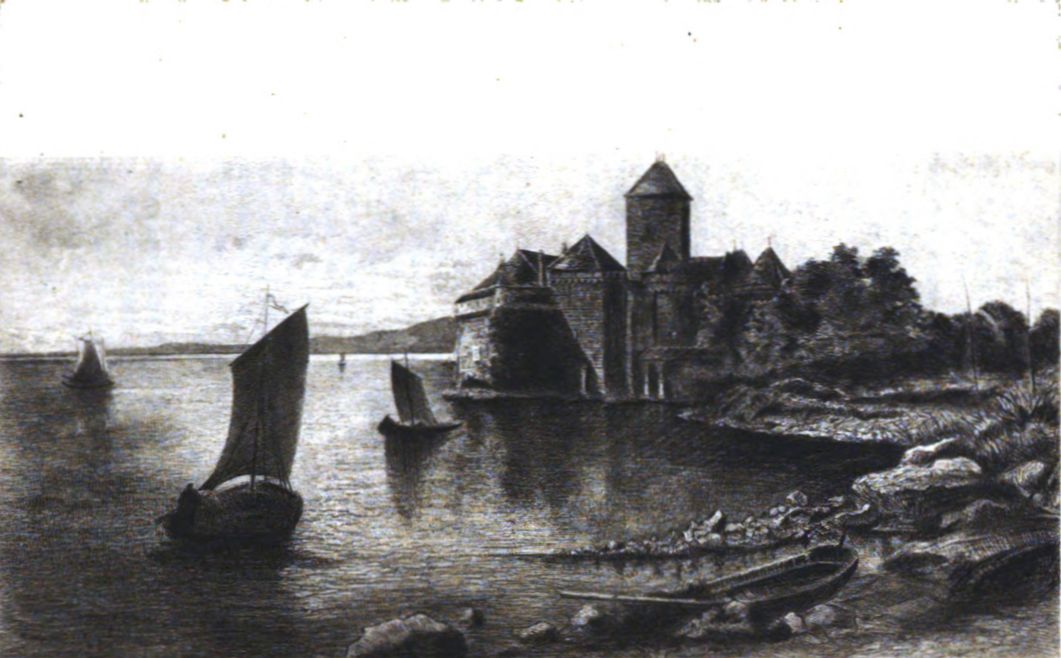
THE CASTLE OF CHILLON Photogravure from an etching.
Shall I enumerate them all? Hugo, Parisina, the Foscari, the Giaour, the Corsair. His hero is always a man striving with the worst anguish, face to face with shipwreck, torture, death—his own painful and prolonged death, the bitter death of his well-beloved, with remorse for his companion, amidst the gloomy prospects of a threatening eternity, with no other support but innate energy and hardened pride. These men have desired too much, too impetuously, with a senseless swing, like a horse which does not feel the bit, and thenceforth their inner doom drives them to the abyss which they see, and cannot escape from. What a night was that of Alp before Corinth! He is a renegade, and comes with the Mussulmans to besiege the Christians, his old friends—Minotti, the father of the girl he loves. Next day he is to lead the assault, and he thinks of his death, which he forebodes, the carnage of his own soldiers, which he is preparing. There is no inner support, but rooted resentment and a firm and stern will. The Mussulmans despise him, the Christians execrate him, and his glory only publishes his treason. Dejected and fevered, he passes through the sleeping camp, and wanders on the shore:
"'Tis midnight: on the mountains brown The cold, round moon shines deeply down; Blue roll the waters, blue the sky Spreads like an ocean hung on high, Bespangled with those isles of light.... The waves on either shore lay there Calm, clear, and azure as the air; And scarce their foam the pebbles shook, But murmured meekly as the brook. The winds were pillow'd on the waves; The banners droop'd along their staves.... And that deep silence was unbroke, Save where the watch his signal spoke, Save where the steed neighed oft and shrill,... And the wide hum of that wild host Rustled like leaves from coast to coast...."[186]
How the heart sickens before such spectacles! What a contrast between his agony and the peace of immortal nature! How man stretches then his arms towards ideal beauty, and how impotently they fall back at the contact of our clay and mortality! Alp advances over the sandy shore to the foot of the bastion, exposed to the fire of the sentinels; and he hardly thinks of it:
"And he saw the lean dogs beneath the wall Hold o'er the dead their carnival, Gorging and growling o'er carcase and limb; They were too busy to bark at him! From a Tartar's skull they had stripped the flesh, As ye peel the fig when its fruit is fresh; And their white tusks crunched o'er the whiter skull, As it slipped through their jaws, when their edge grew dull, As they lazily mumbled the bones of the dead, When they scarce could rise from the spot where they fed; So well had they broken a lingering fast With those who had fallen for that night's repast. And Alp knew, by the turbans that roll'd on the sand, The foremost of these were the best of his band: Crimson and green were the shawls of their wear, And each scalp had a single long tuft of hair, All the rest was shaven and bare. The scalps were in the wild dog's maw, The hair was tangled round his jaw. But close by the shore on the edge of the gulf, There sat a vulture flapping a wolf, Who had stolen from the hills, but kept away, Scared by the dogs, from the human prey; But he seized on his share of a steed that lay, Pick'd by the birds, on the sands of the bay."[187]
Such is the goal of man; the hot frenzy of life ends here; buried or not, it matters little: vultures or jackals, one gravedigger is as good as another. The storm of his rages and his efforts have but served to cast him to these animals for their food, and to their beaks and jaws he comes only with the sentiment of frustrated hopes and insatiable desires. Could any of us forget the death of Lara after once reading it? Has anyone elsewhere seen, save in Shakespeare, a sadder picture of the destiny of a man vainly rearing against inevitable fate? Though generous, like Macbeth, he has, like Macbeth, dared everything against law and conscience, even against pity and the most ordinary feelings of honor. Crimes committed have forced him into other crimes, and blood poured out has made him glide into a pool of blood. As a corsair, he has slain; as a cut-throat, he assassinates; and his former murders which haunt his dreams come with their bat's-wings beating against the portals of his brain. He does not drive them away, these black visitors; though the mouth remains silent, the pallid brow and strange smile bear witness to their approach. And yet it is a noble spectacle to see man standing with calm countenance even under their touch. The last day comes, and six inches of iron suffice for all this energy and fury. Lara is lying beneath a lime tree, and his wound "is bleeding fast from life away." With each convulsion the stream gushes blacker, then stops; the blood flows now only drop by drop, and his brow is already moist, his eyes dim. The victors arrive—he does not deign to answer them; the priest brings near the absolving cross, "but he look'd upon it with an eye profane." What remains to him of life is for his poor page, the only being who loved him, who has followed him to the end, and who now tries to stanch the blood from his wound:
"He scarce can speak, but motions him 'tis vain, He clasps the hand that pang which would assuage, And sadly smiles his thanks to that dark page.... His dying tones are in that other tongue, To which some strange remembrance wildly clung.... And once, as Kaled's answering accents ceased, Rose Lara's hand, and pointed to the East: Whether (as then the breaking sun from high Roll'd back the clouds) the morrow caught his eye, Or that 'twas chance, or some remember'd scene, That raised his arm to point where such had been, Scarce Kaled seem'd to know, but turn'd away, As if his heart abhorr'd that coming day, And shrunk his glance before that morning light, To look on Lara's brow—where all grew night.... But from his visage little could we guess, So unrepentant, dark, and passionless.... But gasping heaved the breath that Lara drew, And dull the film along his dim eye grew; His limbs stretch'd fluttering, and his head droop'd o'er."[188]
All is over, and of this haughty spirit there remains but a poor piece of clay. After all, it is the desirable lot of such hearts; they have spent life amiss, and only rest well in the tomb.
A strange and altogether northern poetry, with its root in the Edda and its flower in Shakespeare, born long ago under an inclement sky, on the shores of a stormy ocean—the work of a too wilful, too strong, too sombre race—and which, after lavishing its images of desolation and heroism, ends by stretching like a black veil over the whole of living nature the dream of universal destruction: this dream is here, as in the Edda, almost equally grand:
"I had a dream, which was not all a dream. The bright sun was extinguish'd, and the stars Did wander darkling in the eternal space, Rayless, and pathless, and the icy earth Swung blind and blackening in the moonless air; Morn came and went—and came, and brought no day.... Forests were set on fire—but hour by hour They fell and faded—and the crackling trunks Extinguish'd with a crash—and all was black.... And they did live by watchfires—and the thrones, The palaces of crowned kings—the huts, The habitations of all things which dwell, Were burnt for beacons; cities were consumed, And men were gathered round their blazing homes To look once more into each other's face.... The brows of men by the despairing light Wore an unearthly aspect, as by fits The flashes fell upon them; some lay down And hid their eyes and wept; and some did rest Their chins upon their clenched hands, and smiled; And others hurried to and fro, and fed Their funeral piles with fuel, and look'd up With mad disquietude on the dull sky, The pall of a past world; and then again With curses cast them down upon the dust, And gnash'd their teeth and howl'd: the wild birds shriek'd, And, terrified, did flutter on the ground, And flap their useless wings; the wildest brutes Came tame and tremulous; and vipers crawl'd And twined themselves among the multitude, Hissing, but stingless—they were slain for food: And War, which for a moment was no more, Did glut himself again; a meal was bought With blood, and each sate sullenly apart Gorging himself in gloom: no love was left; All earth was but one thought—and that was death, Immediate and inglorious; and the pang Of famine fed upon all entrails—men Died, and their bones were tombless as their flesh; The meagre by the meagre were devour'd, Even dogs assail'd their masters, all save one. And he was faithful to a corse, and kept The birds and beasts and famish'd men at bay, Till hunger clung them, or the drooping dead Lured their lank jaws; himself sought out no food, But with a piteous and perpetual moan, And a quick desolate cry, licking the hand Which answer'd not with a caress—he died. The crowd was famish'd by degrees; but two Of an enormous city did survive, And they were enemies: they met beside The dying embers of an altar-place Where had been heap'd a mass of holy things For an unholy usage; they raked up, And shivering scraped with their cold skeleton hands The feeble ashes, and their feeble breath Blew for a little life, and made a flame Which was a mockery; then they lifted up Their eyes as it grew lighter, and beheld Each other's aspects—saw, and shriek'd, and died— Even of their mutual hideousness they died."[189]
Section IV.—Manfred
Amongst these unrestrained and gloomy poems, which incessantly return and dwell on the same subject, there is one more imposing and lofty than the rest, "Manfred," twin-brother of the greatest poem of the age, Goethe's "Faust." Goethe says of Byron: "This singular intellectual poet has taken my Faustus to himself, and extracted from it the strongest nourishment for his hypochondriac humour. He has made use of the impelling principles in his own way, for his own purposes, so that no one of them remains the same; and it is particularly on this account that I cannot enough admire his genius." The play is indeed original. Byron writes: "His (Goethe's) 'Faust' I never read, for I don't know German, but Matthew Monk Lewis, in 1816, at Coligny, translated most of it to mevivâ voce, and I was naturally much struck with it; but it was the 'Steinbach' and the 'Jungfrau' and something else, much more than Faustus, that made me write 'Manfred.'"[190] Goethe adds: "The whole is so completely formed anew, that it would be an interesting task for the critic to point out not only the alterations he (Byron) has made, but their degree of resemblance or dissimilarity to the original." Let us speak of it, then, quite freely: the subject of "Manfred" is the dominant idea of the age, expressed so as to display the contrast of two masters, and of two nations.
What constitutes Goethe's glory is, that in the nineteenth century he did produce an epic poem—I mean a poem in which genuine gods act and speak. This appeared impossible in the nineteenth century, since the special work of our age is the refined consideration of creative ideas, and the suppression of the poetic characters by which other ages have never failed to represent them. Of the two divine families, the Greek and the Christian, neither seemed capable of re-entering the epic world. Classic literature dragged down in its fall the mythological puppets, and the ancient gods slept on their old Olympus, whither history and archaeology alone might go to arouse them. The angels and saints of the Middle Ages, as strange and almost as far from our thoughts, slept on the vellum of their missals and in the niches of their cathedrals; and if a poet, like Chateaubriand, tried to make them enter the modern world,[191] he succeeded only in degrading them, and in making of them vestry decorations and operatic machinery. The mythic credulity disappeared amid the growth of experience, the mystic amid the growth of prosperity. Paganism, at the contact of science, was reduced to the recognition of natural forces; Christianity, at the contact of morality, was reduced to the adoration of the ideal. In order again to deify physical powers, man should have become once more a healthy child, as in Homer's time. In order again to deify spiritual powers, man should have become once more a sickly child as in Dante's time. But he was an adult, and could not ascend again to civilizations or epics, from which the current of his thought and of his life had withdrawn him forever. How was he to be shown his gods, the modern gods? how could he reclothe them in a personal and visible form, since he had toiled to strip them precisely of all personal and sensible form, and had succeeded in this? Instead of rejecting legend, Goethe took it up again. He chose a mediaeval story for his theme. Carefully, scrupulously, he tracked old manners and old beliefs; an alchemist's laboratory, a sorcerer's conjuring-book, coarse villagers, students' or drunkards' gayety, a witches' meeting on the Brocken, a mass in church; we might fancy we saw an engraving of Luther's time, conscientious and minute: nothing is omitted. Heavenly characters appear in consecrated attitudes after the text of Scripture, like the old mysteries: the Lord with his angels, then with the devil, who comes to ask permission to tempt Faust, as formerly he tempted Job; heaven, as St. Francis imagined it and Van Eyck painted it, with anchorites, holy women and doctors—some in a landscape with bluish rocks, others above in the sublime air, hovering in choirs about the Virgin in glory, one tier above another. Goethe affects even to be so orthodox as to write under each her Latin name, and her due niche in the Vulgate.[192] And this very fidelity proclaims him a sceptic. We see that if he resuscitates the ancient world, it is as a historian, not as a believer. He is only a Christian through remembrance and poetic feeling. In him the modern spirit overflows designedly the narrow vessel in which he designedly seems to enclose it. The thinker percolates through the narrator. Every instant a calculated word, which seems involuntary, opens up glimpses of philosophy, beyond the veils of tradition. Who are they, these supernatural personages—this god, this Mephistopheles, these angels? Their substance incessantly dissolves and re-forms, to show or hide alternately the idea which fills it. Are they abstractions or characters? Mephistopheles, a revolutionary and a philosopher, who has read "Candide," and cynically jeers at the Powers—is he anything but "the spirit of negation"?
The angels
"Rejoice to share The wealth exuberant of all that's fair, Which lives, and has its being everywhere! And the creative essence which surrounds, And lives in all, and worketh evermore. Encompass... within love's gracious bounds; And all the world of things, which flit before The gaze in seeming fitful and obscure. Do... in lasting thoughts embody and secure."[193]
Are these angels, for an instant at least, anything else than the ideal intelligence which comes, through sympathy, to love all, and through ideas, to comprehend all? What shall we say of this Deity, at first biblical and individual, who little by little is unshaped, vanishes and, sinking to the depths, behind the splendors of living nature and mystic reverie, is confused with the inaccessible absolute? Thus is the whole poem unfolded, action and characters, men and gods, antiquity and Middle Ages, aggregate and details, always on the confines of two worlds—one visible and figurative, the other intelligible and formless; one comprehending the moving externals of history or of life, and all that hued and perfumed bloom which nature lavishes on the surface of existence, the other containing the profound generative powers and invisible fixed laws by which all these living beings come to the light of day.[194] At last we see our gods: we no longer parody them, like our ancestors, by idols or persons; we perceive them as they are in themselves, and we have no need, in order to see them, to renounce poetry, nor break with the past We remain on our knees before the shrines where men have, prayed for three thousand years; we do not tear a single rose from the chaplets with which they have crowned their divine Madonnas; we do not extinguish a single candle which they have crowded on the altar steps; we behold with an artist's pleasure the precious shrines where, amidst the wrought candlesticks, the suns of diamonds, the gorgeous copes, they have scattered the purest treasures of their genius and their heart. But our thoughts pierce further than our eyes. For us, at certain moments, these draperies, this marble, all this pomp vacillates; it is no longer aught but beautiful phantoms; it vanishes in the smoke, and we discover through it and behind it the impalpable ideal which has set up these pillars, lighted these roofs, and hovered for centuries over the kneeling multitude.