Volume 9 — CHAPTER I—THE IRANIAN CONQUEST (continued 4)
M. L. McClure translation
* Mention of some new wars is made towards the end of the inscription, but the text here is so mutilated that the sense can no longer be easily determined.
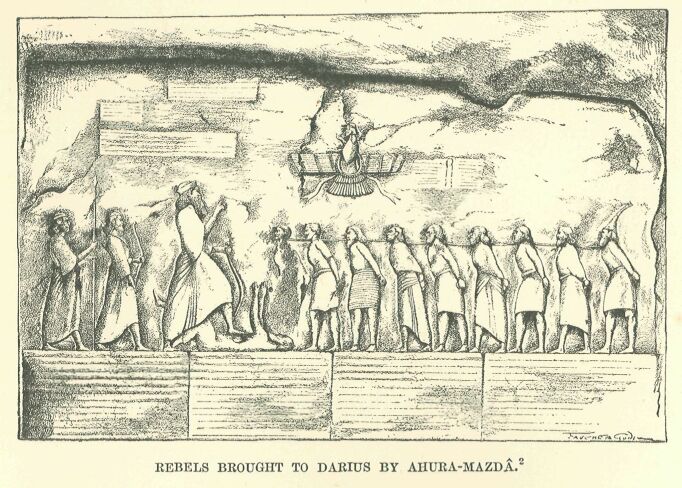
After consummating his victories, Darius caused an inscription in commemoration of them to be carved on the rocks in the pass of Bagistana [Behistun], one of the most frequented routes leading from the basin of the Tigris to the tableland of Iran.
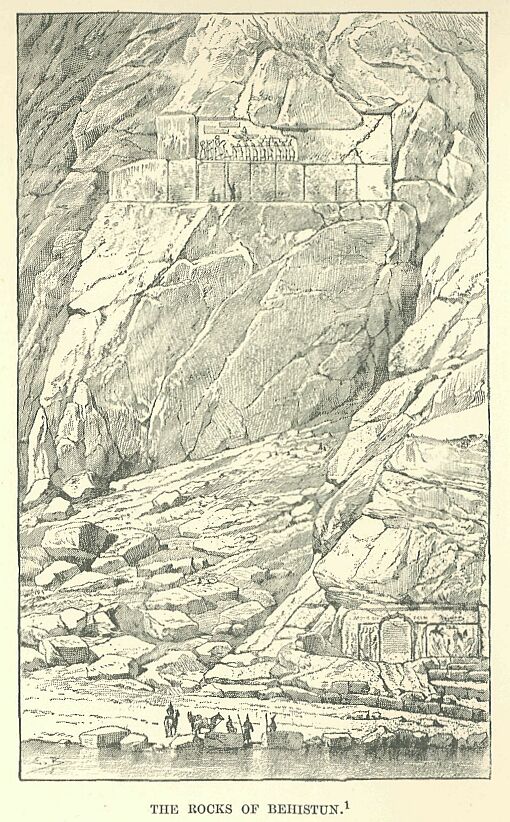
Drawn by Boudier, from Flandin and Coste.
There his figure is still to be seen standing, with his foot resting on the prostrate body of an enemy, and his hand raised in the attitude of one addressing an audience, while nine figures march in file to meet him, their arms tied behind their backs, and cords round their necks, representing all the pretenders whom he had fought and put to death—Athrîna, Nadinta-bel, Khshatrita, Vahyazdâta, Arakha, and Chitrantakhma; an inscription, written in the three official languages of the court, recounts at full length his mighty deeds. The drama did not, however, come to a close with the punishment of Vahyazdâta, for though no tribe or chieftain remained now in open revolt, many of those who had taken no active share in the rebellion had, by their conduct during the crisis, laid themselves open to grave suspicions, and it seemed but prudent to place them under strict surveillance or to remove them from office altogether. Orotes had been summarily despatched, and his execution did not disturb the peace of Asia Minor; but Aryandes, to whose rule Cambyses had entrusted the valley of the Nile, displayed no less marked symptoms of disaffection, and deserved the same fate. Though he had not ventured to usurp openly the title of king, he had arrogated to himself all the functions and rights of royalty, and had manifested as great an independence in his government as if he had been an actual Pharaoh. The inhabitants of Gyrene did not approve of the eagerness displayed by their tyrant Arkesilas III. to place himself under the Persian yoke: after first expelling and then recalling him, they drove him away a second time, and at length murdered him at Barca, whither he had fled for refuge. Pheretimô came to Egypt to seek the help of Aryandes, just as Laarchos had formerly implored the assistance of Amasis, and represented to him that her son had fallen a victim to his devotion to his suzerain. It was a good opportunity to put to ransom one of the wealthiest countries of Africa; so the governor sent to the Cyrenaica all the men and vessels at his disposal. Barca was the only city to offer any resistance, and the Persian troops were detained for nine months motionless before its walls, and the city then only succumbed through treachery. Some detachments forced their way as far as the distant town of Euesperides,* and it is possible that Aryandes dreamt for a moment of realising the designs which Cambyses had formed against Carthage. Insufficiency of supplies stayed the advance of his generals; but the riches of their ally, Cyrene, offered them a strong temptation, and they were deliberating how they might make this wealth their own before returning to Memphis, and were, perhaps, on the point of risking the attempt, when they received orders to withdraw. The march across the desert proved almost fatal to them. The Libyans of Marmarica, attracted by the spoils with which the Persian troops were laden, harassed them incessantly, and inflicted on them serious losses; they succeeded, however, in arriving safely with their prisoners, among whom were the survivors of the inhabitants of Barca. At this time the tide of fortune was setting strongly in favour of Darius: Aryandes, anxious to propitiate that monarch, despatched these wretched captives to Persia as a trophy of his success, and Darius sent them into Bactriana, where they founded a new Barca.**
* This is the town which later on under the Lagidæ received the name of Berenice, and which is now called Benghazi. ** It is doubtless to these acts of personal authority on the part of Aryandes that Darius alludes in the Behistun Inscription, when he says, “While I was before Babylon, the following provinces revolted against me—Persia and Susiana, the Medes and Assyria, and the Egyptians...”
But this tardy homage availed him nothing. Darius himself visited Egypt and disembarrassed himself of ‘his troublesome subject by his summary execution, inflicted, some said, because he had issued coins of a superior fineness to those of the royal mint,* while, according to others, it was because he had plundered Egypt and so ill-treated the Egyptians as to incite them to rebellion.
* It is not certain that Aryandes did actually strike any coinage in his own name, and perhaps Herodotus has only repeated a popular story current in Egypt in his days. If this money actually existed, its coinage was but a pretext employed by Darius; the true motive of the condemnation of Aryandes was certainly an armed revolt, or a serious presumption of revolutionary intentions.
After the suppression of this rival, Darius set himself to win the affection of his Egyptian province, or, at least, to render its servitude bearable. With a country so devout and so impressed with its own superiority over all other nations, the best means of accomplishing his object was to show profound respect for its national gods and its past glory. Darius, therefore, proceeded to shower favours on the priests, who had been subject to persecution ever since the disastrous campaign in Ethiopia. Cambyses had sent into exile in Elam the chief priest of Sais—that Uza-harrîsnîti who had initiated him into the sacred rites; Darius gave permission to this important personage to return to his native land, and commissioned him to repair the damage inflicted by the madness of the son of Cyrus. Uzaharrîsnîti, escorted back with honour to his native city, re-established there the colleges of sacred scribes, and restored to the temple of Nît the lands and revenues which had been confiscated. Greek tradition soon improved upon the national account of this episode, and asserted that Darius took an interest in the mysteries of Egyptian theology, and studied the sacred books, and that on his arrival at Memphis in 517 B.C., immediately after the death of an Apis, he took part publicly in the general mourning, and promised a reward of a hundred talents of gold to whosoever should discover the successor of the bull. According to a popular story still current when Herodotus travelled in Egypt, the king visited the temple of Pthah before leaving Memphis, and ordered his statue to be erected there beside that of Sesostris. The priests refused to obey this command, for, said they, “Darius has not equalled the deeds of Sesostris: he has not conquered the Scythians, whom Sesostris overcame.” Darius replied that “he hoped to accomplish as much as Sesostris had done, if he lived as long as Sesostris,” and so conciliated the patriotic pride of the priests. The Egyptians, grateful for his moderation, numbered him among the legislators whose memory they revered, by the side of Menés, Asykhis, Bocchoris, and Sabaco.
The whole empire was now obedient to the will of one man, but the ordeal from which it had recently escaped showed how loosely the elements of it were bound together, and with what facility they could be disintegrated. The system of government in force hitherto was that introduced into Assyria by Tiglath-pileser III., which had proved so eminently successful in the time of Sargon and his descendants; Babylon and Ecbatana had inherited it from Nineveh, and Persepolis had in turn adopted it from Ecbatana and Babylon. It had always been open to objections, of which by no means the least was the great amount of power and independence accorded by it to the provincial governors; but this inconvenience had been little felt when the empire was of moderate dimensions, and when no province permanently annexed to the empire lay at any very great distance from the capital for the time being. But this was no longer the case, now that Persian rule extended over nearly the whole of Asia, from the Indus to the Thracian Bosphorus, and over a portion of Africa also. It must have seemed far from prudent to set governors invested with almost regal powers over countries so distant that a decree despatched from the palace might take several weeks to reach its destination. The heterogeneity of the elements in each province was a guarantee of peace in the eyes of the sovereign, and Darius carefully abstained from any attempt at unification: not only did he allow vassal republics, and tributary kingdoms and nations to subsist side by side, but he took care that each should preserve its own local dynasty, language, writing, customs, religion, and peculiar legislation, besides the right to coin money stamped with the name of its chief or its civic symbol. The Greek cities of the coast maintained their own peculiar constitutions which they had enjoyed under the Mernmadas; Darius merely required that the chief authority among them should rest in the hands of the aristocratic party, or in those of an elective or hereditary tyrant whose personal interest secured his fidelity. The Carians,* Lycians,** Pamphylians, and Cilicians*** continued under the rule of their native princes, subject only to the usual obligations. of the corvée, taxation, and military service as in past days; the majority of the barbarous tribes which inhabited the Taurus and the mountainous regions in the centre of Asia Minor were even exempted from all definite taxes, and were merely required to respect the couriers, caravans, and armies which passed through their territory.
* Herodotus cites among the commanders of the Persian fleet three Carian dynasts, Histiseus, Pigres, and Damasithymus, besides the famous Artemisia of Halicarnassus. ** In Herodotus where a dynast named Kyberniskos, son of Sika, is mentioned among the commanders of the fleet. The received text of Herodotus needs correction, and we should read Kybernis, son of Kossika, some of whose coins are still in existence. *** The Cilician contingent in the fleet of Xerxes at Salamis was commanded by Syennesis himself, and Cilicia never had a satrap until the time of Cyrus the younger.
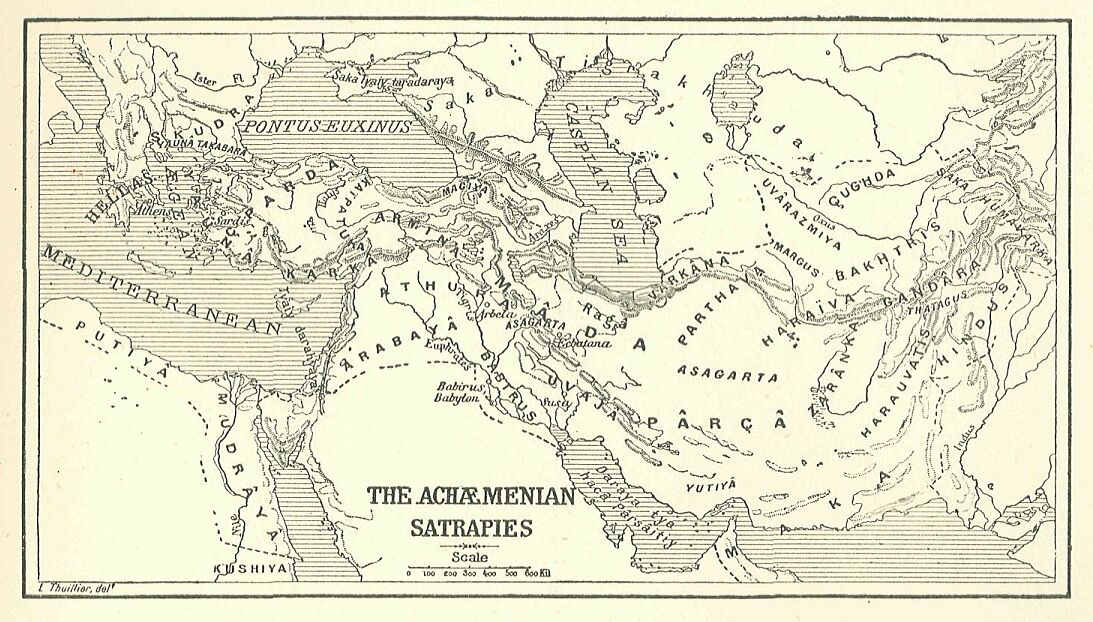
Native magistrates and kings still bore sway in Phoenicia* and Cyprus, and the shêkhs of the desert preserved their authority over the marauding and semi-nomadic tribes of Idumasa, Nabatsea, Moab, and Ammon, and the wandering Bedâwin on the Euphrates and the Khabur. Egypt, under Darius, remained what she had been under the Saitic and Ethiopian dynasties, a feudal state governed by a Pharaoh, who, though a foreigner, was yet reputed to be of the solar race; the land continued to be divided unequally into diverse principalities, Thebes still preserving its character as a theocracy under the guidance of the pallacide of Amon and her priestly counsellors, while the other districts subsisted under military chieftains. Our information concerning the organisation of the central and eastern provinces is incomplete, but it is certain that here also the same system prevailed. In the years of peace which succeeded the troubled opening of his reign, that is, from 519 to 515 B.C.,** Darius divided the whole empire into satrapies, whose number varied at different periods of his reign from twenty to twenty-three, and even twenty-eight.***
* Three kings, viz. the kings of Sidon, Tyre, and Arvad, bore commands in the Phoenician fleet of Xerxes. ** Herodotus states that this dividing of the empire into provinces took place immediately after the accession of Darius, and this mistake is explained by the fact that he ignores almost entirely the civil wars which filled the earliest years of the reign. His enumeration of twenty satrapies comprises India and omits Thrace, which enables us to refer the drawing up of his list to a period before the Scythian campaign, viz. before 514 B.C. Herodotus very probably copied it from the work of Hecatseus of Miletus, and consequently it reproduces a document contemporary with Darius himself. *** The number twenty is, as has been remarked, that given by Herodotus, and probably by Hecatæus of Miletus. The great Behistun Inscription enumerates twenty-three countries, and the Inscription of Nakhsh-î-Rustem gives twenty-eight.
Persia proper was not included among these, for she had been the cradle of the reigning house, and the instrument of conquest.*
* In the great Behistun Inscription Darius mentions Persia first of all the countries in his possession. In the Inscription E of Persepolis he omits it entirely, and in that of Nakhsh-î-Rustem he does not include it in the general catalogue.
The Iranian table-land, and the parts of India or regions beyond the Oxus which bordered on it, formed twelve important vice-royalties—Media, Hyrcania, Parthia, Zaranka, Aria, Khorasmia, Bactriana, Sogdiana, Gandaria, and the country of the Sakae—reaching from the plains of Tartary almost to the borders of China, the country of the Thatagus in the upper basin of the Elmend, Arachosia, and the land of Maka on the shores of the Indian Ocean. Ten satrapies were reckoned in the west—Uvayâ, Elam, in which lay Susa, one of the favourite residences of Darius; Babirus (Babylon) and Chaldæa; Athurâ, the ancient kingdom of Assyria; Arabayâ, stretching from the Khabur to the Litany, the Jordan, and the Orontes; Egypt, the peoples of the sea, among whom were reckoned the Phoenicians, Cilicians, and Cypriots, and the islanders of the Ægean; Yaunâ, which comprised Lycia, Caria, and the Greek colonies along the coast; Sparda, with Phrygia and Mysia; Armenia; and lastly, Katpatuka or Cappadocia, which lay on both sides of the Halys from the Taurus to the Black Sea. If each of these provinces had been governed, as formerly, by a single individual, who thus became king in all but name and descent, the empire would have run great risk of a speedy dissolution. Darius therefore avoided concentrating the civil and military powers in the same hands. In each province he installed three officials independent of each other, but each in direct communication with himself—a satrap, a general, and a secretary of state. The satraps were chosen from any class in the nation, from among the poor as well as from among the wealthy, from foreigners as well as from Persians;* but the most important satrapies were bestowed only on persons allied by birth** or marriage with the Achæmenids,*** and, by preference, on the legitimate descendants of the six noble houses. They were not appointed for any prescribed period, but continued in office during the king’s pleasure. They exercised absolute authority in all civil matters, and maintained a court, a body-guard,**** palaces and extensive parks, or paradises, where they indulged in the pleasures of the chase; they controlled the incidence of taxation,^ administered justice, and possessed the power of life and death.
* Herodotus mentions a satrap chosen from among the Lydians, Pactyas, and another satrap of Greek extraction, Xenagoras of Halicarnassus. ** The most characteristic instance is that of Hystaspes, who was satrap of Persia under Oambyses, and of Parthia and Hyrcania under his own son. One of the brothers of Darius, Artaphernes, was satrap of Sardes, and three of the king’s sons, Achemenes, Ariabignes, and Masistes, were satraps of Egypt, Ionia, and Bactriana respectively. *** To understand how well established was the custom of bestowing satrapies on those only who were allied by marriage to the royal house, it is sufficient to recall the fact that, later on, under Xerxes I., when Pausanias, King of Sparta, had thoughts of obtaining the position of satrap in Greece, he asked for the hand of an Achæmenian princess. **** We know, for example, that Orcotes, satrap of Sardes under Cyrus, Cambyses, and Darius, had a body-guard of 1000 Persians. ^ Thus, Artaphernes, satrap of Sardes, had a cadastral survey made of the territory of the Ionians, and by the results of this survey he regulated the imposition of taxes, “which from that time up to the present day are exacted according to his ordinance.”
Attached to each satrap was a secretary of state, who ostensibly acted as his chancellor, but whose real function was to exercise a secret supervision over his conduct and report upon it to the imperial ministers.* The Persian troops, native militia and auxiliary forces quartered in the province, were placed under the orders, moreover, of a general, who was usually hostile to the satrap and the secretary.** These three officials counterbalanced each other, and held each other mutually in check, so that a revolt was rendered very difficult, if not impossible. All three were kept in constant communication with the court by relays of regular couriers, who carried their despatches on horseback or on camels, from one end of Asia to the other, in the space of a few weeks.***
* The rôle played by the secretary is clearly indicated by the history of Orotes, satrap of Sardes. ** While Darius appoints his brother Artaphernes satrap of Lydia, he entrusts the command of the army and the fleet to Otanes, son of Sisamnes. Similarly several generals are met with at the side of Artaphernes in the Ionic revolt. *** Xenophon compares their speed in travelling to the flight of birds. A good example of the use of the camel for the postal service is cited by Strabo, on the occasion of the death of Philotas and the execution of Parmenion under Alexander.
The most celebrated of the post-roads was that which ran from Sardes to Susa through Lydia and Phrygia, crossing the Halys, traversing Cappadocia and Cilicia, and passing through Armenia and across the Euphrates, until at length, after passing through Matiênê and the country of the Cossæans, it reached Elam. This main route was divided into one hundred and eleven stages, which were performed by couriers on horseback and partly in ferry-boats, in eighty-four days. Other routes, of which we have no particular information, led to Egypt, Media, Bactria, and India,* and by their means the imperial officials in the capital were kept fully informed of all that took place in the most distant parts of the empire. As an extra precaution, the king sent out annually certain officers, called his “eyes” or his “ears,” ** who appeared on the scene when they were least expected, and investigated the financial or political situation, reformed abuses in the administration, and reprimanded or even suspended the government officials; they were accompanied by a body of troops to support their decisions, whose presence invested their counsels with the strongest sanction.*** An unfavourable report, a slight irregularity, a mere suspicion, even, was sufficient to disqualify a satrap. Sometimes he was deposed, often secretly condemned to death without a trial, and the execution of the judgment was committed even to his own servants.
* Ctesias at the end of his work describes the route leading from Ephesus to Bactriana and India. It is probable that the route described by Isidorus of Charax in his Stathma Parthica already existed in the times of the Achæmenids, and was traversed by their postal couriers. ** Mention of the Eye of the king occurs in Herodotus, in Æschylus, and in Plutarch, of the Ear in Xenophon; cf. the Persian proverb, according to which “The king has many eyes and many ears.” *** Xenophon affirms that these inspections were still held in his day.
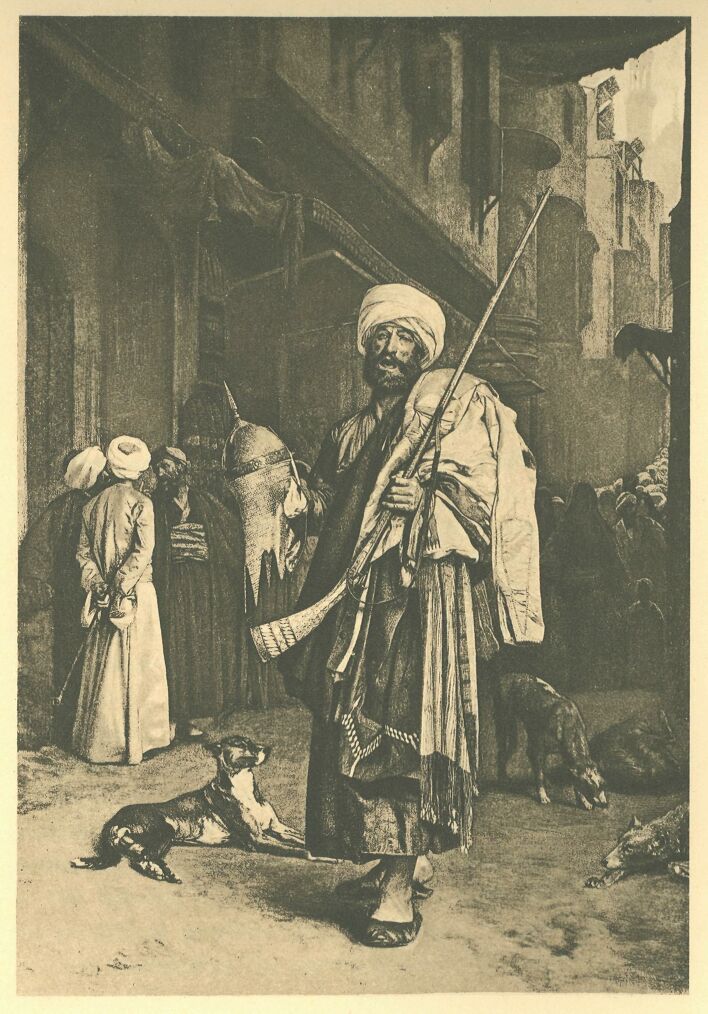
A messenger would arrive unexpectedly, and remit to the guards an order charging them to put their chief to death—an order which was promptly executed at the mere sight of the royal decree.
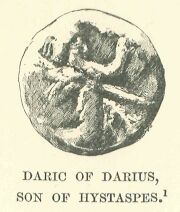
Drawn by Faucher-Gudin, from a specimen in the Bibliothèque Nationale.
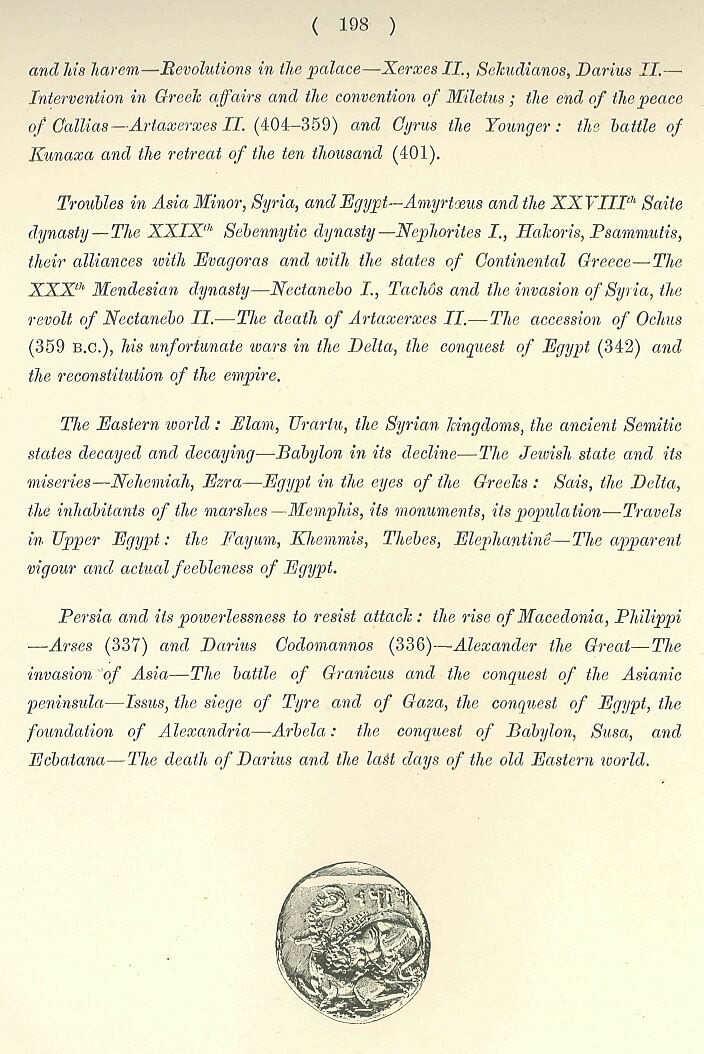
This reform in the method of government was displeasing to the Persian nobles, whose liberty of action it was designed to curtail, and they took their revenge in sneering at the obedience they could not refuse to render. Cyrus, they said, had been a father, Cambyses a master, but Darius was only a pedler greedy of gain. The chief reason for this division of the empire into provinces was, indeed, fiscal rather than political: to arrange the incidence of taxation in his province, to collect the revenue in due time and forward the total amount to the imperial treasury, formed the fundamental duty of a satrap, to which all others had to yield. Persia proper was exempt from the payment of any fixed sum, its inhabitants being merely required to offer presents to the king whenever he passed through their districts. These semi-compulsory gifts were proportioned to the fortunes of the individual contributors; they might consist merely of an ox or a sheep, a little milk or cheese, some dates, a handful of flour, or some vegetables. The other provinces, after being subjected to a careful survey, were assessed partly in money, partly in kind, according to their natural capacity or wealth. The smallest amount of revenue raised in any province amounted to 170 talents of silver—the sum, for instance, collected from Arachosia with its dependencies Gedrosia and Grandara; while Egypt yielded a revenue of 700 talents, and the amount furnished by Babylon, the wealthiest province of all, amounted to 1000 talents. The total revenue of the empire reached the enormous sum of.£3,311,997, estimated by weight of silver, which is equivalent to over £26,000,000 of modern English money, if the greater value of silver in antiquity is taken into consideration. In order to facilitate the collection of the revenue, Darius issued the gold and silver coins which are named after him. On the obverse side these darics are stamped with a figure of the sovereign, armed with the bow or javelin. They were coined on the scale of 3000 gold darics to one talent, each daric weighing normally.2788 oz. troy, and being worth exactly 20 silver drachmae or Medic shekels; so that the relative value of the two metals was approximately 1 to 13 1/2|.
The most ancient type of daric was thick and irregular in shape, and rudely stamped, but of remarkable fineness, the amount of alloy being never more than three per cent. The use of this coinage was nowhere obligatory, and it only became general in the countries bordering on the Mediterranean, where it met the requirements of international traffic and political relations, and in the payment of the army and the navy. In the interior, the medium of exchange used in wholesale and retail commercial transactions continued to be metals estimated by weight, and the kings of Persia themselves preferred to store their revenues in the shape of bullion; as the metal was received at the royal treasury it was melted and poured into clay moulds, and was minted into money only gradually, according to the whim or necessity of the moment.*
* Arrian relates that Alexander found 50,000 talents’ weight of silver in the treasury at Susa; other hoards quite as rich were contained in the palaces of Persepolis and Pasargadæ.
Taxes in kind were levied even more largely than in money, but the exact form they assumed in the different regions of the empire has not yet been ascertained. The whole empire was divided into districts, which were charged with the victualling of the army and the court, and Babylon alone bore a third of the charges under this head. We learn elsewhere that Egypt was bound to furnish corn for the 120,000 men of the army of occupation, and that the fisheries of the Fayum yielded the king a yearly revenue of 240 talents. The Medes furnished similarly 100,000 sheep, 4000 mules, and 3000 horses; the Armenians, 30,000 foals; the Cilicians, 365 white horses, one for each day in the year; the Babylonians, 500 youthful eunuchs; and any city or town which produced or manufactured any valuable commodity was bound to furnish a regular supply to the sovereign. Thus, Chalybon provided wine; Libya and the Oases, salt; India, dogs, with whose support four large villages in Babylonia were charged; the Æolian Assos, cheese; and other places, in like manner, wool, wines, dyes, medicines, and chemicals. These imperial taxes, though they seem to us somewhat heavy, were not excessive, but taken by themselves they give us no idea of the burdens which each province had to resign itself to bear. The state provided no income for the satraps; their maintenance and that of their suite were charged on the province, and they made ample exactions on the natives. The province of Babylon was required to furnish its satrap daily with an ardeb of silver; Egypt, India, Media, and Syria each provided a no less generous allowance for its governor, and the poorest provinces were not less heavily burdened. The satraps required almost as much to satisfy their requirements as did the king; but for the most part they fairly earned their income, and saved more to their subjects than they extorted from them. They repressed brigandage, piracy, competition between the various cities, and local wars; while quarrels, which formerly would have been settled by an appeal to arms, were now composed before their judgment-seats, and in case of need the rival factions were forcibly compelled to submit to their decisions. They kept up the roads, and afforded complete security to travellers by night and day; they protected industries and agriculture, and, in accordance with the precepts of their religious code, they accounted it an honourable task to break up waste land or replant deserted sites. Darius himself did not disdain to send congratulations to a satrap who had planted trees in Asia Minor, and laid out one of those wooded parks in which the king delighted to refresh himself after the fatigues of government, by the exercise of walking or in the pleasures of the chase. In spite of its defects, the system of government inaugurated by Darius secured real prosperity to his subjects, and to himself a power far greater than that enjoyed by any of his predecessors. It rendered revolts on the part of the provincial governors extremely difficult, and enabled the court to draw up a regular budget and provide for its expenses without any undue pressure on its subjects; in one point only was it defective, but that point was a cardinal one, namely, in the military organisation. Darius himself maintained, for his personal protection, a bodyguard recruited from the Persians and the Medes. It was divided into three corps, consisting respectively of 2000 cavalry, 2000 infantry of noble birth, armed with lances whose shafts were ornamented below with apples of gold or silver—whence their name of mêlophori—and under them the 10,000 “immortals,” in ten battalions, the first of which had its lances ornamented with golden pomegranates. This guard formed the nucleus of the standing army, which could be reinforced by the first and second grades of Persian and Median feudal nobility at the first summons. Forces of varying strength garrisoned the most important fortresses of the empire, such as Sardes, Memphis, Elephantine, Daphnæ, Babylon, and many others, to hold the restless natives in check. These were, indeed, the only regular troops on which the king could always rely. Whenever a war broke out which demanded no special effort, the satraps of the provinces directly involved summoned the military contingents of the cities and vassal states under their control, and by concerted action endeavoured to bring the affair to a successful issue without the necessity of an appeal to the central authority. If, on the contrary, troubles arose which threatened the welfare of the whole empire, and the sovereign felt called upon to conduct the campaign in person, he would mobilise his guard, and summon the reserves from several provinces or even from all of them. Veritable hordes of recruits then poured in, but these masses of troops, differing from each other in their equipment and methods of fighting, in disposition and in language, formed a herd of men rather than an army. They had no cohesion or confidence in themselves, and their leaders, unaccustomed to command such enormous numbers, suffered themselves to be led rather than exercise authority as guides. Any good qualities the troops may have possessed were neutralised by lack of unity in their methods of action, and their actual faults exaggerated this defect, so that, in spite of their splendid powers of endurance and their courage under every ordeal, they ran the risk of finding themselves in a state of hopeless inferiority when called upon to meet armies very much smaller, but composed of homogenous elements, all animated with the same spirit and drilled in the same school.
By continual conquests, the Persians were now reduced to only two outlets for their energies, in two opposite directions—in the east towards India, in the west towards Greece. Everywhere else their advance was arrested by the sea or other obstacles almost as impassable to their heavily armed battalions: to the north the empire was bounded by the Black Sea, the Caucasus, the Caspian Sea, and the Siberian steppes; to the south, by the Indian Ocean, the sandy table-land of Arabia, and the African deserts. At one moment, about 512 B.C., it is possible that they pushed forward towards the east.*
* India is not referred to in the Behistun Inscription, but is mentioned in one of the Inscriptions of Persepolis, and in that of Nakhsh-î-Rustem. The campaign in which it was subjugated must be placed about 512 B.C.
From the Iranian plateau they beheld from afar the immense plain of the Hapta Hindu (or the Punjab). Darius invaded this territory, and made himself master of extensive districts which he formed into a new satrapy, that of India, but subsequently, renouncing all idea of pushing eastward as far as the Granges, he turned his steps towards the southeast. A fleet, constructed at Peukêla and placed under the command of a Greek admiral, Scylax of Caryanda, descended the Indus by order of the king;* subjugating the tribes who dwelt along the banks as he advanced, Scylax at length reached the ocean, on which he ventured forth, undismayed by the tides, and proceeded in a westerly direction, exploring, in less than thirty months, the shores of Gedrosia and Arabia.
* Scylax published an account of his voyage which was still extant in the time of Aristotle. Hugo Berger questions the authenticity of the circumnavigation of Arabia, as that of the circumnavigation of Africa under Necho.
Once on the threshold of India, the Persians saw open before them a brilliant and lucrative career: the circumstances which prevented them from following up this preliminary success are unknown—perhaps the first developments of nascent Buddhism deterred them—but certain it is that they arrested their steps when they had touched merely the outskirts of the basin of the Indus, and retreated at once towards the west. The conquest of Lydia, and subsequently of the Greek cities and islands along the coast of the Ægean, had doubtless enriched the empire by the acquisition of active subject populations, whose extraordinary aptitude in the arts of peace as well as of war might offer incalculable resources to a sovereign who should know how to render them tractable and rule them wisely. Not only did they possess the elements of a navy as enterprising and efficacious as that of the Phoenicians, but the perfection of their equipment and their discipline on land rendered them always superior to any Asiatic army, in whatever circumstances, unless they were crushed by overwhelming numbers. Inquisitive, bold, and restless, greedy of gain, and inured to the fatigues and dangers of travel, the Greeks were to be encountered everywhere—in Asia Minor, Egypt, Syria, Babylon, and even Persia itself; and it was a Greek, we must remember, whom the great king commissioned to navigate the course of the Indus and the waters of the Indian Ocean. At the same time, the very ardour of their temperament, and their consequent pride, their impatience of all regular control, their habitual proneness to civic strife, and to sanguinary quarrels with the inhabitants of the neighbouring cities, rendered them the most dangerous subjects imaginable to govern, and their loyalty very uncertain. Moreover, their admission as vassals of the Persian empire had not altered their relations with European Greece, and commercial transactions between the opposite shores of the Ægean, inter-marriages, the travels of voyagers, movements of mercenaries, and political combinations, went on as freely and frequently under the satraps of Sardes as under the Mermnadas. It was to Corinth, Sparta, and Athens that the families banished by Cyrus after his conquest fled for refuge, and every time a change of party raised a new tyrant to power in one of the Æolian, Ionian, or Doric communities, the adherents of the deposed ruler rushed in similar manner to seek shelter among their friends across the sea, sure to repay their hospitality should occasion ever require it. Plots and counterplots were formed between the two shores, without any one paying much heed to the imperial authority of Persia, and the constant support which the subject Greeks found among their free brethren was bound before long to rouse the anger of the court at Susa. When Polycrates, foreseeing the fall of Amasis, placed himself under the suzerainty of Cambyses, the Corinthians and Spartans came to besiege him in Samos without manifesting any respect for the great king. They failed in this particular enterprise,* but later on, after Oroetes had been seized and put to death, it was to the Spartans that the successor of Polycrates, Maaandrios, applied for help to assert his claim to the possession of the tyranny against Syloson, brother of Polycrates and a personal friend of Darius.**
* The date of the death of Polycrates must be placed between that of the conquest of Egypt and that of the revolt of Gaumâta, either in 524 or 523 B.C. ** The reinstatement of Syloson may be placed in 516 B.C., about the time when Darius was completing the reorganisation of the empire and preparing to attack Greece.
This constant intervention of the foreigner was in evident contradiction to the spirit which had inspired the reorganisation of the empire. Just when efforts were being made to strengthen the imperial power and ensure more effective obedience from the provincials by the institution of satrapies, it was impossible to put up with acts of unwarrantable interference, which would endanger the prestige of the sovereign and the authority of his officers. Conquest presented the one and only natural means of escape from the difficulties of the present situation and of preventing their recurrence; when satraps should rule over the European as well as over the Asiatic coasts of the Ægean, all these turbulent Greeks would be forced to live at peace with one another and in awe of the sovereign, as far as their fickle nature would allow. It was not then, as is still asserted, the mere caprice of a despot which brought upon the Greek world the scourge of the Persian wars, but the imperious necessity of security, which obliges well-organised empires to subjugate in turn all the tribes and cities which cause constant trouble on its frontiers. Darius, who was already ruler of a good third of the Hellenic world, from Trebizond to Barca, saw no other means of keeping what he already possessed, and of putting a stop to the incessant fomentation of rebellion in his own territories, than to conquer the mother-country as he had conquered the colonies, and to reduce to subjection the whole of European Hellas.