Volume 9 — CHAPTER II—THE LAST DAYS OF THE OLD EASTERN WORLD (continued 2)
M. L. McClure translation
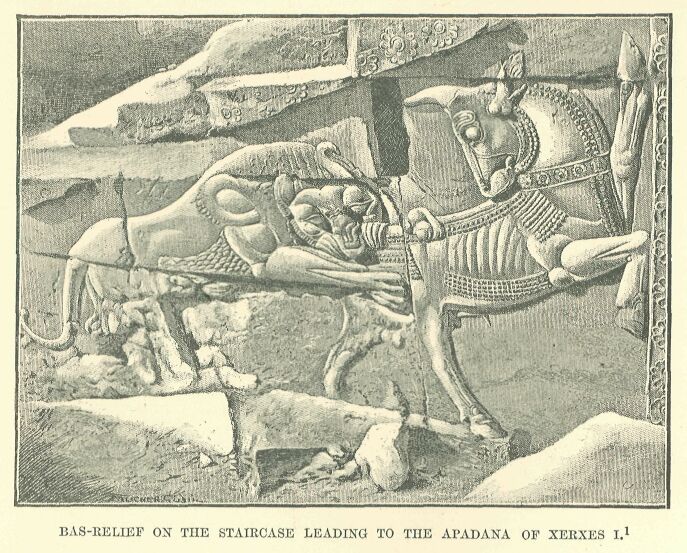
Drawn by Faucher-Gudin, from Marcel Dieulafoy.
At the hour appointed for the ceremonies, the great king took his seat in solitary grandeur on the gilded throne of the Achæmenids; at the extreme end of the colonnade his eunuchs, nobles, and guards ranged themselves in silence on either side, each in the place which etiquette assigned to him. Meanwhile the foreign ambassadors who had been honoured by an invitation to the audience—Greeks from Thebes, Sparta, or Athens; Sakae from the regions of the north; Indians, Arabs, nomad chiefs from mysterious Ethiopia-ascended in procession the flights of steps which led from the town to the palace, bearing the presents destined for its royal master.
Having reached the terrace, the curtains of the apadana were suddenly parted, and in the distance, through a vista of columns, they perceived a motionless figure, resplendent with gold and purple, before whom they fell prostrate with their faces to the earth. The heralds were the bearers of their greetings, and brought back to them a gracious or haughty reply, as the case may be. When they rose from the ground, the curtains had closed, the kingly vision was eclipsed, and the escort which had accompanied them into the palace conducted them back to the town, dazzled with the momentary glimpse of the spectacle vouchsafed to them.
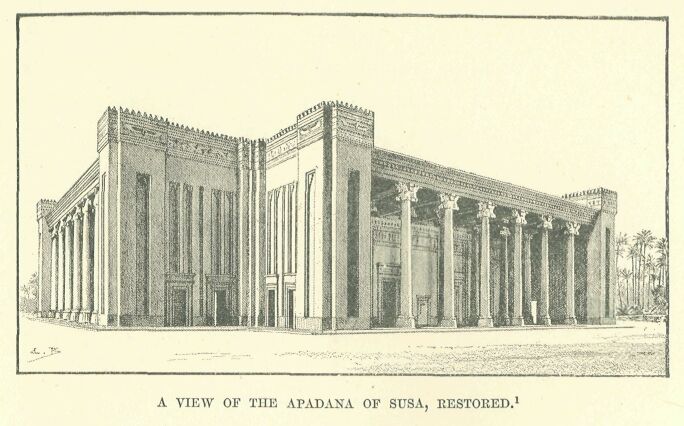
Drawn by Boudier, from the restoration by Marcel Dieulafoy.
The Achæemenian monarchs were not regarded as gods or as sons of gods, like the Egyptian Pharaohs, and the Persian religion forbade their ever becoming so, but the person of the king was hedged round with such ceremonial respect as in other Oriental nations was paid only to the gods: this was but natural, for was he not a despot, who with a word or gesture could abase the noblest of his subjects, and determine the well-being or misery of his people? His dress differed from that of his nobles only by the purple dye of its material and the richness of the gold embroideries with which it was adorned, but he was distinguished from all others by the peculiar felt cap, or kidaris, which he wore, and the blue-and-white band which encircled it like a crown; the king is never represented without his long sceptre with pommelled handle, whether he be sitting or standing, and wherever he went he was attended by his umbrella- and fan-bearers. The prescriptions of court etiquette were such as to convince his subjects and persuade himself that he was sprung from a nobler race than that of any of his magnates, and that he was outside the pale of ordinary humanity. The greater part of his time was passed in privacy, where he was attended only by the eunuchs appointed to receive his orders; and these orders, once issued, were irrevocable, as was also the king’s word, however much he might desire to recall a promise once made. His meals were, as a rule, served to him alone; he might not walk on foot beyond the precincts of the palace, and he never showed himself in public except on horseback or in his chariot, surrounded by his servants and his guards. The male members of the royal family and those belonging to the six noble houses enjoyed the privilege of approaching the king at any hour of the day or night, provided he was not in the company of one of his wives. These privileged persons formed his council, which he convoked on important occasions, but all ordinary business was transacted by means of the scribes and inferior officials, on whom devolved the charge of the various departments of the government. A vigorous ruler, such as Darius had proved himself, certainly trusted no one but himself to read the reports sent in by the satraps, the secretaries, and the generals, or to dictate the answers required by each; but Xerxes and Artaxerxes delegated the heaviest part of such business to their ministers, and they themselves only fulfilled such state functions as it was impossible to shirk—the public administration of justice, receptions of ambassadors or victorious generals, distributions of awards, annual sacrifices, and state banquets: they were even obliged, in accordance with an ancient and inviolable tradition, once a year to set aside their usual sober habits and drink to excess on the day of the feast of Mithra. Occasionally they would break through their normal routine of life to conduct in person some expedition of small importance, directed against one of the semi-independent tribes of Iran, such as the Cadusians, but their most glorious and frequent exploits were confined to the chase. They delighted to hunt the bull, the wild boar, the deer, the wild ass, and the hare, as the Pharaohs or Assyrian kings of old had done; and they would track the lion to his lair and engage him single-handed; in fact, they held a strict monopoly in such conflicts, a law which punished with death any huntsman who had the impertinence to interpose between the monarch and his prey being only abolished by Artaxerxes. A crowd of menials, slaves, great nobles, and priests filled the palace; grooms, stool-bearers, umbrella- and fan-carriers, havasses, “Immortals,” bakers, perfumers, soldiers, and artisans formed a retinue so numerous as to require a thousand bullocks, asses, and stags to be butchered every day for its maintenance; and when the king made a journey in full state, this enormous train looked like an army on the march. The women of the royal harem lived in seclusion in a separate wing of the palace, or in isolated buildings erected in the centre of the gardens. The legitimate wives of the sovereign were selected from the ladies of the royal house, the sisters or cousins of the king, and from the six princely Persian families; but their number were never very large, usually three or four at most.*
* Cambyses had had three wives, including his two sisters Atossa and Roxana. Darius had four wives—two daughters of Cyrus, Atossa and Artystônê, Parmys daughter of Srnerdis, and a daughter of Otanes.
The concubines, on the other hand, were chosen from all classes of society, and were counted by hundreds.
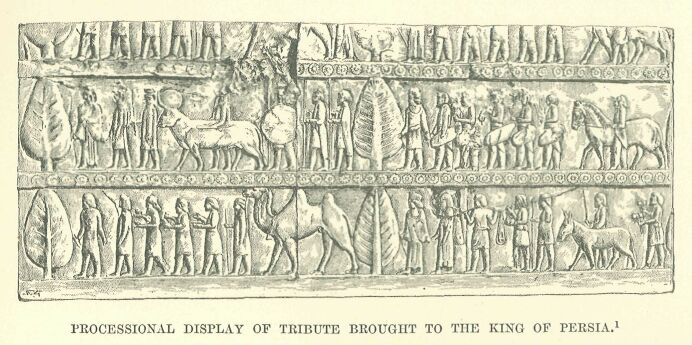
Drawn by Faucher-Gudin, from plates in Flandin and Coste.
They sang or played on musical instruments at the state banquets of the court, they accompanied their master to the battle-field or the chase, and probably performed the various inferior domestic duties in the interior of the harem, such as spinning, weaving, making perfumes, and attending to the confectionery and cooking. Each of the king’s wives had her own separate suite of apartments and special attendants, and occupied a much higher position than a mere concubine; but only one was actually queen and had the right to wear the crown, and this position belonged of right to a princess of Achæ-menian race. Thus Atossa, daughter of Cyrus, was queen successively to Cambyses, Gaumâta, and Darius; Amestris to Xerxes; and Damaspia to Artaxerxes. Besides the influence naturally exerted by the queen over the mind of her husband, she often acquired boundless authority in the empire, in spite of her secluded life.*
* Thus Atossa induced Darius to designate Xerxes as his heir-apparent.
Her power was still further increased when she became a widow, if the new king happened to be one of her own sons. In such circumstances she retained the external attributes of royalty, sitting at the royal table whenever the king deigned to dine in the women’s apartments, and everywhere taking precedence of the young queen; she was attended by her own body of eunuchs, of whom, as well as of her private revenues, she had absolute control. Those whom the queen-mother took under her protection escaped punishment, even though they richly deserved it, but the object of her hatred was doomed to perish in the end, either by poison treacherously administered, or by some horrible form of torture, being impaled, suffocated in ashes, tortured in the trough, or flayed alive. Artaxerxes reigned for forty-two years, spending his time between the pleasures of the chase and the harem; no serious trouble disturbed his repose after his suppression of the revolt under Megabyzos, but on his death in 424 B.C. there was a renewal of the intrigues and ambitious passions which had stained with bloodshed the opening years of his reign. The legitimate heir, Xerxes II., was assassinated, after a reign of forty-five days, by Secudianus (Sogdianus), one of his illegitimate brothers, and the cortège which was escorting the bodies of his parents conveyed his also to the royal burying-place at Persepolis. Meanwhile Secudianus became suspicious of another of his brothers, named Ochus, whom Artaxerxes had caused to marry Parysatis, one of the daughters of Xerxes, and whom he had set over the important province of Hyrcania. Ochus received repeated summonses to appear in his brother’s presence to pay him homage, and at last obeyed the mandate, but arrived at the head of an army. The Persian nobility rose at his approach, and one by one the chief persons of the state declared themselves in his favour: first Arbarius, commander of the cavalry; then Arxanes, the satrap of Egypt; and lastly, the eunuch Artoxares, the ruler of Armenia. These three all combined in urging Ochus to assume the Edaris publicly, which he, with feigned reluctance, consented to do, and proceeded, at the suggestion of Parysatis, to open negotiations with Secudianus, offering to divide the regal power with him. Secudianus accepted the offer, against the advice of his minister Menostanes, and gave himself up into the hands of the rebels. He was immediately seized and cast into the ashes, where he perished miserably, after a reign of six months and fifteen days.
On ascending the throne, Ochus assumed the name of Darius. His confidential advisers were three eunuchs, who ruled the empire in his name—Artoxares, who had taken such a prominent part in the campaign which won him the crown, Artibarzanes, and Athôos; but the guiding spirit of his government was, in reality, his wife, the detestable Parysatis. She had already borne him two children before she became queen; a daughter, Amestris, and a son, Arsaces, who afterwards became king under the name of Artaxerxes. Soon after the accession of her husband, she bore him a second son, whom she named Cyrus, in memory of the founder of the empire, and a daughter, Artostê; several other children were born subsequently, making thirteen in all, but these all died in childhood, except one named Oxendras. Violent, false, jealous, and passionately fond of the exercise of power, Parysatis hesitated at no crime to rid herself of those who thwarted her schemes, even though they might be members of her own family; and, not content with putting them out of the way, she delighted in making them taste her hatred to the full, by subjecting them to the most skilfully graduated refinements of torture; she deservedly left behind her the reputation of being one of the most cruel of all the cruel queens, whose memory was a terror not only to the harems of Persia, but to the whole of the Eastern world. The numerous revolts which broke out soon after her husband’s accession, furnished occasions for the revelation of her perfidious cleverness. All the malcontents of the reign of Artaxerxes, those who had been implicated in the murder of Xerxes II., or who had sided with Secudianus, had rallied round a younger brother of Darius, named Arsites, and one of them, Artyphios, son of Megabyzos, took the field in Asia Minor. Being supported by a large contingent of Greek mercenaries, he won two successive victories at the opening of the campaign, but was subsequently defeated, though his forces still remained formidable. But Persian gold accomplished what Persian bravery had failed to achieve, and prevailed over the mercenaries so successfully that all deserted him with the exception of three Milesians.
Drawn by Faucher- Gudin
Artyphios and Arsites, thus discouraged, committed the imprudence of capitulating on condition of receiving a promise that their lives should be spared, and that they should be well treated; but Parysatis persuaded her husband to break his plighted word, and they perished in the ashes. Their miserable fate did not discourage the satrap of Lydia, Pissuthnes, who was of Achæmenian race: he entered the lists in 418 B.C., with the help of the Athenians. The relations between the Persian empire and Greece had continued fairly satisfactory since the peace of 449 B.C., and the few outbreaks which had taken place had not led to any widespread disturbance. The Athenians, absorbed in their quarrel with Sparta, preferred to close their eyes to all side issues, lest the Persians should declare war against them, and the satraps of Asia Minor, fully alive to the situation, did not hesitate to take advantage of any pretext for recovering a part of the territory they coveted: it was thus that they had seized Colophon about 430 B.C., and so secured once more a port on the Ægean. Darius despatched to oppose Pissuthnes a man of noble birth, named Tissaphernes, giving him plenary power throughout the whole of the peninsula, and Tissaphernes endeavoured to obtain by treachery the success he would with difficulty have won on the field of battle: he corrupted by his darics Lycon, the commander of the Athenian contingent, and Pissuthnes, suddenly abandoned by his best auxiliaries, was forced to surrender at discretion. He also was suffocated in the ashes, and Darius bestowed his office on Tissaphernes.
But the punishment of Pissuthnes did not put an end to the troubles: his son Amorges roused Caria to revolt, and with the title of king maintained his independence for some years longer. While these incidents were taking place, the news of the disasters in Sicily reached the East: as soon as it was known in Susa that Athens had lost at Syracuse the best part of her fleet and the choicest of her citizens, the moment was deemed favourable to violate the treaty and regain control of the whole of Asia Minor. Two noteworthy men were at that time set over the western satrapies, Tissaphernes ruling at Sardes, and Tiribazus over Hellespontine Phrygia. These satraps opened negotiations with Sparta at the beginning of 412 B.C., and concluded a treaty with her at Miletus itself, by the terms of which the Peloponnesians recognised the suzerainty of Darius over all the territory once held by his ancestors in Asia, including the cities since incorporated into the Athenian league. They hoped shortly to be strong enough to snatch from him what they now ceded, and to set free once more the Greeks whom they thus condemned to servitude after half a century of independence, but their expectations were frustrated. The towns along the coast fell one after another into the power of Tissaphernes, Amorges was taken prisoner in lassos, and at the beginning of 411 B.C. there remained to the Athenians in Ionia and Caria merely the two ports of Halicarnassus and Notium, and the three islands of Cos, Samos, and Lesbos: from that time the power of the great king increased from year to year, and weighed heavily on the destinies of Greece. Meanwhile Darius II. was growing old, and intrigues with regard to the succession were set on foot. Two of his sons put forward claims to the throne: Arsaces had seniority in his favour, but had been born when his father was still a mere satrap; Cyrus, on the contrary, had been born in the purple, and his mother Parysatis was passionately devoted to him.* Thanks to her manouvres, he was practically created viceroy of Asia Minor in 407 B.C., with such abundant resources of men and money at his disposal, that he was virtually an independent sovereign. While he was consolidating his power in the west, his mother endeavoured to secure his accession to the throne by intriguing at the court of the aged king; if her plans failed, Cyrus was prepared to risk everything by an appeal to arms.
* Cyrus was certainly not more than seventeen years old in 407 B.C., evening admitting that he was born immediately after his father’s accession in 424-3 B.C.
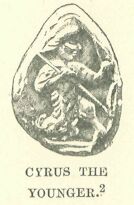
Drawn by Faucher- Gudin
He realised that the Greeks would prove powerful auxiliaries in such a contingency; and as soon as he had set up his court at Sardes, he planned how best to conciliate their favour, or at least to win over those whose support was likely to be most valuable. Athens, as a maritime power, was not in a position to support him in an enterprise which especially required the co-operation of a considerable force of heavily armed infantry. He therefore deliberately espoused the cause of the Peloponnesians, and the support he gave them was not without its influence on the issue of the struggle: the terrible day of Ægos Potamos was a day of triumph for him as much as for the Lacedaemonians (405 B.C.).
His intimacy with Lysander, however, his constant enlistments of mercenary troops, and his secret dealings with the neighbouring provinces, had already aroused suspicion, and the satraps placed under his orders, especially Tissaphernes, accused him to the king of treason. Darius summoned him to Susa to explain his conduct (405 B.C.), and he arrived just in time to be present at his father’s death (404), but too late to obtain his designation as heir to the throne through the intervention of his mother, Parysatis; Arsaces inherited the crown, and assumed the name of Artaxerxes.
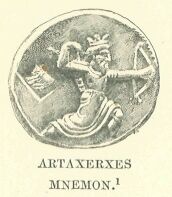
Drawn by Faucher-Gudin, from a coin in the Cabinet des Médailles. This coin, which was struck at Mallos, in Cilicia, bears as a counter-mark the figure of a bull and the name of the city of Issus.
Cyrus entered the temple of Pasargadae surreptitiously during the coronation ceremony, with the intention of killing his brother at the foot of the altar; but Tissaphernes, warned by one of the priests, denounced him, and he would have been put to death on the spot, had not his mother thrown her arms around him and prevented the executioner from fulfilling his office. Having with difficulty obtained pardon and been sent back to his province, he collected thirty thousand Greeks and a hundred thousand native troops, and, hastily leaving Sardes (401 B.C.), he crossed Asia Minor, Northern Syria, and Mesopotamia, encountered the royal army at Cunaxa, to the north of Babylon, and rashly met his end at the very moment of victory. He was a brave, active, and generous prince, endowed with all the virtues requisite to make a good Oriental monarch, and he had, moreover, learnt, through contact with the Greeks, to recognise the weak points of his own nation, and was fully determined to remedy them: his death, perhaps, was an irreparable misfortune for his country. Had he survived and supplanted the feeble Artaxerxes, it is quite possible that he might have confirmed and strengthened the power of Persia, or, at least, temporarily have arrested its decline. Having lost their leader, his Asiatic followers at once dispersed; but the mercenaries did not lose heart, and, crossing Asia and Armenia, gained at length the shores of the Black Sea. Up to that time the Greeks had looked upon Persia as a compact state, which they were sufficiently powerful to conquer by sea and hold in check by land, but which they could not, without imprudence, venture to attack within its own frontiers. The experience of the Ten Thousand was a proof to them that a handful of men, deprived of their proper generals, without guides, money, or provisions, might successfully oppose the overwhelming forces of the great king, and escape from his clutches without any serious difficulty. National discords prevented them from at once utilising the experience they thus acquired, but the lesson was not lost upon the court of Susa. The success of Lysander had been ensured by Persian subsidies, and now Sparta hesitated to fulfil the conditions of the treaty of Miletus; the Lacedæmonians demanded liberty once more for the former allies of Athens, fostered the war in Asia in order to enforce their claims, and their king Agesilaus, penetrating to the very heart of Phrygia, would have pressed still further forward in the tracks of the Ten Thousand, had not an opportune diversion been created in his rear by the bribery of the Persians. Athens once more flew to arms: her fleet, in conjunction with the Phoenicians, took possession of Cythera; the Long Walls were rebuilt at the expense of the great king, and Sparta, recalled by these reverses to a realisation of her position, wisely abandoned her inclination for distant enterprises. Asia Minor was reconquered, and Persia passed from the position of a national enemy to that of the friend and arbiter of Greece; but she did so by force of circumstances only, and not from having merited in any way the supremacy she attained. Her military energy, indeed, was far from being exhausted; but poor Artaxerxes, bewildered by the rivalries between his mother and his wives, did not know how to make the most of the immense resources still at his disposal, and he met with repeated checks as soon as he came face to face with a nation and leaders who refused to stoop to treachery. He had no sooner recovered possession of the Ægean littoral than Egypt was snatched from his grasp by a new Pharaoh who had arisen in the Nile valley. The peace had not been seriously disturbed in Egypt during the forty years which had elapsed since the defeat of Inarus. Satrap had peaceably succeeded satrap in the fortress of Memphis; the exhaustion of Libya had pre-vented any movement on the part of Thannyras; the aged Amyrtæus had passed from the scene, and his son, Pausiris, bent his neck submissively to the Persian yoke. More than once, however, unexpected outbursts had shown that the fires of rebellion were still smouldering. A Psammetichus, who reigned about 445 B.C. in a corner of the Delta, had dared to send corn and presents to the Athenians, then at war with Artaxerxes I., and the second year of Darius II. had been troubled by a sanguinary sedition, which, however, was easily suppressed by the governor then in power; finally, about 410 B.C., a king of Egypt had, not without some show of evidence, laid himself open to the charge of sending a piratical expedition into Phoenician waters, an Arab king having contributed to the enterprise.*
* The revolt mentioned by Ctesias has nothing to do with the insurrection of the satrap of Egypt which is here referred to, the date of which is furnished by the Syncellus.
It was easy to see, moreover, from periodical revolts—such as that of Megabyzos in Syria, those of Artyphios and Arsites, of Pissuthnes and Amorges in Asia Minor—with what impunity the wrath of the great king could be defied: it was not to be wondered at, therefore, that, about 405 B.C., an enemy should appear in the heart of the Delta in the person of a grandson and namesake of Amyrtæus. He did not at first rouse the whole country to revolt, for Egyptian troops were still numbered in the army of Artaxerxes at the battle of Cunaxa in 401 B.C.; but he succeeded in establishing a regular native government, and struggled so resolutely against the foreign domination that the historians of the sacred colleges inscribed his name on the list of the Pharaohs. He is there made to represent a whole dynasty, the XXVIIIth which lasted six years, coincident with the six years of his reign. It was due to a Mendesian dynasty, however, whose founder was Nephorites, that Egypt obtained its entire freedom, and was raised once more to the rank of a nation. This dynasty from the very outset adopted the policy which had proved so successful in the case of the Saites three centuries previously, and employed it with similar success. Egypt had always been in the position of a besieged fortress, which needed, for its complete security, that its first lines of defence should be well in advance of its citadel: she must either possess Syria or win her as an ally, if she desired to be protected against all chance of sudden invasion. Nephorites and his successors, therefore, formed alliances beyond the isthmus, and even on the other side of the Mediterranean, with Cyprus, Caria, and Greece, in one case to purchase support, and in another to re-establish the ancient supremacy exercised by the Theban Pharaohs.*
* This is, at any rate, the idea given of him by Egyptian tradition in the time of the Ptolemies, as results from a passage in the Demotic Rhapsody, where his reign is mentioned.
Every revolt against the Persians, every quarrel among the satraps, helped forward their cause, since they compelled the great king to suspend his attacks against Egypt altogether or to prosecute them at wide intervals: the Egyptians therefore fomented such quarrels, or even, at need, provoked them, and played their game so well that for a long time they had to oppose only a fraction of the Persian forces. Like the Saite Pharaohs before them, they were aware how little reliance could be placed on native troops, and they recruited their armies at great expense from the European Greeks. This occurred at the time when mercenary forces were taking the place of native levies throughout Hellas, and war was developing into a lucrative trade for those who understood how to conduct it: adventurers, greedy for booty, flocked to the standards of the generals who enjoyed the best reputation for kindness or ability, and the generals themselves sold their services to the highest bidder. The Persian kings took large advantage of this arrangement to procure troops: the Pharaohs imitated their example, and in the years which followed, the most experienced captains, Iphicrates, Chabrias, and Timotheus, passed from one camp to another, as often against the will as with the consent of their fatherland. The power of Sparta was at her zenith when Nephorites ascended the throne, and she was just preparing for her expedition to Phrygia. The Pharaoh concluded an alliance with the Lacedomonians, and in 396 B.C. sent to Agesilaus a fleet laden with arms, corn, and supplies, which, however, was intercepted by Conon, who was at that moment cruising in the direction of Rhodes in command of the Persian squadron. This misadventure and the abrupt retreat of the Spartans from Asia Minor cooled the good will of the Egyptian king towards his allies. Thinking that they had abandoned him, and that he was threatened with an imminent attack on the shore of the Delta, he assembled, probably at Pelusium, the forces he had apparently intended for a distant enterprise.
Matters took longer to come to a crisis than he had expected. The retreat of Agesilaus had not pacified the Ægean satrapies; after the disturbance created by Cyrus the Younger, the greater number of the native tribes—Mysians, Pisidians, people of Pontus and Paphlagonia—had shaken off the Persian yoke, and it was a matter of no small difficulty to reduce them once more to subjection. Their incessant turbulence gave Egypt time to breathe and to organise new combinations. Cyprus entered readily into her designs. Since the subjugation of that island in 445 B.C., the Greek cities had suffered terrible oppression at the hands of the great king. Artaxerxes I., despairing of reducing them to obedience, depended exclusively for support on the Phoenician inhabitants of the island, who, through his favour, regained so much vigour that in the space of less than two generations they had recovered most of the ground lost during the preceding centuries: Semitic rulers replaced the Achaean tyrants at Salamis, and in most of the other cities, and Citium became what it had been before the rise of Salamis, the principal commercial centre in the island. Evagoras, a descendant of the ancient kings, endeavoured to retrieve the Grecian cause: after driving out of Salamis Abdemon, its Tyrian ruler, he took possession of all the other towns except Citium and Amathus. This is not the place to recount the brilliant part played by Evagoras, in conjunction with Conon, during the campaigns against the Spartans in the Peloponnesian war. The activity he then displayed and the ambitious designs he revealed soon drew upon him the dislike of the Persian governors and their sovereign; and from 391 B.C. he was at open war with Persia. He would have been unable, single-handed, to maintain the struggle for any length of time, but Egypt and Greece were at his back, ready to support him with money or arms. Hakoris had succeeded Nephorites I. in 393 B.C.,* and had repulsed an attack of Artaxerxes between 390 and 386.**
* The length of the reign of Nephorites I. is fixed at six years by the lists of Manetho; the last-known date of his reign is that of his fourth year, on a mummy-bandage preserved in the Louvre. ** This war is alluded to by several ancient authors in passages which have been brought together and explained by Judeah; but unfortunately the detailed history of the events is not known.
He was not unduly exalted by his success, and had immediately taken wise precautions in view of a second invasion. After safeguarding his western frontier by concluding a treaty with the Libyans of Barca, he entered into an alliance with Evagoras and the Athenians.
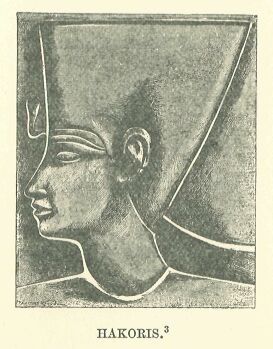
Drawn by Faucher-Gudin, from Lepsius.
He sent lavish gifts of corn to the Cypriots, as well as munitions of war, ships, and money while Athens sent them several thousand men under the command of Chabrias; not only did an expedition despatched against them under Autophradates fail miserably, but Evagoras seized successively Citium and Amathus, and, actually venturing across the sea, took Tyre by assault and devastated Phoenicia and Cilicia. The princes of Asia Minor were already preparing for revolt, and one of them, Hecatomnus of Caria, had openly joined the allies, when Sparta suddenly opened negotiations with Persia: Antalcidas presented himself at Susa to pay homage before the throne of the great king. The treaty of Miletus had brought the efforts of Athens to naught, and sold the Asiatic Greeks to their oppressors: the peace obtained by Antalcidas effaced the results of Salamis and Platsæ, and laid European Greece prostrate at the feet of her previously vanquished foes. An order issuing from the centre of Persia commanded the cities of Greece to suspend hostilities and respect each other’s liberties; the issuing of such an order was equivalent to treating them as vassals whose quarrels it is the function of the suzerain to repress, but they nevertheless complied with the command (387 B.C.), Artaxerxes, relieved from anxiety for the moment, as to affairs on the Ægean, was now free to send his best generals into the rebel countries, and such was the course his ministers recommended. Evagoras was naturally the first to be attacked. Cyprus was, in fact, an outpost of Egypt; commanding as she did the approach by sea, she was in a position to cut the communications of any army, which, issuing from Palestine, should march upon the Delta. Artaxerxes assembled three hundred thousand foot-soldiers and three hundred triremes under the command of Tiribazus, and directed the whole force against the island. At first the Cypriot cruisers intercepted the convoys which were bringing provisions for this large force, and by so doing reduced the invaders to such straits that sedition broke out in their camp; but Evagoras was defeated at sea off the promontory of Citium, and his squadron destroyed. He was not in any way discouraged by this misfortune, but leaving his son, Pnytagoras, to hold the barbarian forces in check, he hastened to implore the help of the Pharaoh (385 B.C.). But Hakoris was too much occupied with securing his own immediate safety to risk anything in so desperate an enterprise. Evagoras was able to bring back merely an insufficient subsidy; he shut himself up in Salamis, and there maintained the conflict for some years longer. Meanwhile Hakoris, realising that the submission of Cyprus would oppose his flank to attack, tried to effect a diversion in Asia Minor, and by entering into alliance with the Pisidians, then in open insurrection, he procured for it a respite, of which he himself took advantage to prepare for the decisive struggle. The peace effected by Antalcidas had left most of the mercenary soldiers of Greece without employment. Hakoris hired twenty thousand of them, and the Phoenician admirals, still occupied in blockading the ports of Cyprus, failed to intercept the vessels which brought him these reinforcements. It was fortunate for Egypt that they did so, for the Pharaoh died in 381 B.C., and his successors, Psamuthis IL, Mutis, and Nephorites IL, each occupied the throne for a very short time, and the whole country was in confusion for rather more than two years (381-379 B.c.) during the settlement of the succession.*
* Hakoris reigned thirteen years, from 393 to 381 B.C. The reigns of the three succeeding kings occupied only two years and four months between them, from the end of 381 to the beginning of 378. Muthes or Mutis, who is not mentioned in all the lists of Manetho, seems to have his counterpart in the Demotic Rhapsody. Wiedemann has inverted the order usually adopted, and proposed the following series: Nephorites I., Muthes, Psamuthis, Hakoris, Nephorites II. The discovery at Karnak of a small temple where Psamuthis mentions Hakoris as his predecessor shows that on this point at least Manetho was well informed.
The turbulent disposition of the great feudatory nobles, which had so frequently brought trouble upon previous Pharaohs during the Assyrian wars, was no less dangerous in this last century of Egyptian independence; it caused the fall of the Mendesian dynasty in the very face of the enemy, and the prince of Sebennytos, Nakht-har-habît, Nectanebo I., was raised to the throne by the military faction. According to a tradition current in Ptolemaic times, this sovereign was a son of Nephorites I., who had been kept out of his heritage by the jealousy of the gods; whatever his origin, the people had no cause to repent of having accepted him as their king. He began his reign by suppressing the slender subsidies which Evagoras had continued to receive from his predecessors, and this measure, if not generous, was at least politic. For Cyprus was now virtually in the power of the Persians, and the blockade of a few thousand men in Salamis did not draught away a sufficiently large proportion of their effective force to be of any service to Egypt: the money which had hitherto been devoted to the Cypriots was henceforth reserved for the direct defence of the Nile valley. Evagoras obtained unexpectedly favourable conditions: Artaxerxes conceded to him his title of king and the possession of his city (383 B.C.), and turned his whole attention to Nectanebo, the last of his enemies who still held out.
Nectanebo had spared no pains in preparing effectively to receive his foe. He chose as his coadjutor the Athenian Chabrias, whose capacity as a general had been manifested by recent events, and the latter accepted this office although he had received no instructions from his government to do so, and had transformed the Delta into an entrenched camp. He had fortified the most vulnerable points along the coast, had built towers at each of the mouths of the river to guard the entrance, and had selected the sites for his garrison fortresses so judiciously that they were kept up long after his time to protect the country. Two of them are mentioned by name: one, situated below Pelusium, called the Castle of Chabrias; the other, not far from Lake Mareotis, which was known as his township.*
* Both are mentioned by Strabo; the exact sites of these two places are not yet identified. Diodorus Siculus, describing the defensive preparations of Egypt, does not state expressly that they were the work of Chabrias, but this fact seems to result from a general consideration of the context.
Drawn by Faucher- Gudin
The Persian generals endeavoured to make their means of attack proportionate to the defences of the enemy. Acre was the only port in Southern Syria large enough to form the rendezvous for a fleet, where it might be secure from storms and surprises of the enemy. This was chosen as the Persian headquarters, and formed the base of their operations. During three years they there accumulated supplies of food and military stores, Phoenician and Creek vessels, and both foreign and native troops. The rivalries between the military commanders, Tithraustes, Datâmes, and Abrocomas, and the intrigues of the court, had on several occasions threatened the ruin of the enterprise, but Pharnabazus, who from the outset had held supreme command, succeeded in ridding himself of his rivals, and in the spring of 374 B.C. was at length ready for the advance. The expedition consisted of two hundred thousand Asiatic troops, and twenty thousand Greeks, three hundred triremes, two hundred galleys of thirty oars, and numerous transports. Superiority of numbers was on the side of the Persians, and that just at the moment when Nectanebo lost his most experienced general. Artaxerxes had remonstrated with the Athenians for permitting one of their generals to serve in Egypt, in spite of their professed friendship for himself, and, besides insisting on his recall, had requested for himself the services of the celebrated Iphicrates. The Athenians complied with his demand, and while summoning Chabrias to return to Athens, despatched Iphicrates to Syria, where he was placed in command of the mercenary troops. Pharnabazus ordered a general advance in May, 374 B.C.,* but when he arrived before Pelusium, he perceived that he was not in a position to take the town by storm; not only had the fortifications been doubled, but the banks of the canals had been cut and the approaches inundated. Iphicrates advised him not to persevere in attempting a regular siege: he contended that it would be more profitable to detach an expeditionary force towards some less well-protected point on the coast, and there to make a breach in the system of defence which protected the enemies’ front.
* As Kenrick justly observes, “the Persian and Athenian generals committed the same mistake which led to the defeat of Saint Louis and the capture of his army in 1249 A.D., and which Bonaparte avoided in his campaign of 1798.” Anyhow, it seems that the fault must be laid on Pharnabazus alone, and that Iphicrates was entirely blameless.
Three thousand men were despatched with all secrecy to the mouth of the Mendesian branch of the Nile, and there disembarked unexpectedly before the forts which guarded the entrance. The garrison, having imprudently made a sortie in face of the enemy, was put to rout, and pursued so hotly that victors and vanquished entered pell-mell within the walls.
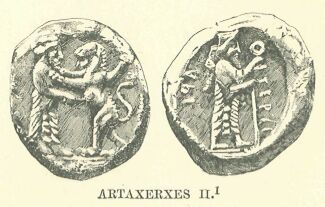
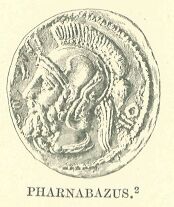
Drawn by Faucher-Gudin, from a silver stater in the Cabinet des Médailles.
After this success victory was certain, if the Persians pursued their advantage promptly and pushed forward straight into the heart of the Delta; the moment was the more propitious for such a movement, since Nectanebo had drained Memphis of troops to protect his frontier. Iphicrates, having obtained this information from one of the prisoners, advised Pharnabazus to proceed up the Nile with the fleet, and take the capital by storm before the enemy should have time to garrison it afresh; the Persian general, however, considered the plan too hazardous, and preferred to wait until the entire army should have joined him. Iphicrates offered to risk the adventure with his body of auxiliary troops only, but was suspected of harbouring some ambitious design, and was refused permission to advance. Meanwhile these delays had given the Egyptians time to recover from their first alarm; they boldly took the offensive, surrounded the position held by Pharnabazus, and were victorious in several skirmishes. Summer advanced, the Nile rose more rapidly than usual, and soon the water encroached upon the land; the invaders were obliged to beat a retreat before it, and fall back towards Syria. Iphicrates, disgusted at the ineptitude and suspicion of his Asiatic colleagues, returned secretly to Greece: the remains of the army were soon after disbanded, and Egypt once more breathed freely. The check received by the Persian arms, however, was not sufficiently notorious to shake that species of supremacy which Artaxerxes had exercised in Greece since the peace of 387. Sparta, Thebes, and Athens vied with each other in obtaining an alliance with him as keenly as if he had been successful before Pelusium. Antalcidas reappeared at Susa in 372 B.C. to procure a fresh act of intervention; Pelopidas and Ismenias, in 367, begged for a rescript similar to that of Antalcidas; and finally Athens sent a solemn embassy to entreat for a subsidy. It seemed as if the great king had become a kind of supreme arbiter for Greece, and that all the states hitherto leagued against him now came in turn to submit their mutual differences for his decision. But this arbiter who thus imposed his will on states beyond the borders of his empire was never fully master within his own domains. Of gentle nature and pliant disposition, inclined to clemency rather than to severity, and, moreover, so lacking in judgment as a general that he had almost succumbed to an attack by the Cadusians on the only occasion that he had, in a whim of the moment, undertaken the command of an army in person, Artaxerxes busied himself with greater zeal in religious reforms than in military projects. He introduced the rites of Mithra and Anâhita into the established religion of the state, but he had not the energy necessary to curb the ambitions of his provincial governors. Asia Minor, whose revolts followed closely on those of Egypt, rose in rebellion against him immediately after the campaign on the Nile, Ariobarzanes heading the rebellion in Phrygia, Datâmes and Aspis that in Cilicia and Cappadocia, and both defying his power for several years. When at length they succumbed through treachery, the satraps of the Mediterranean district, from the Hellespont to the isthmus of Suez, formed a coalition and simultaneously took the field: the break-up of the empire would have been complete had not Persian darics been lavishly employed once more in the affair. Meanwhile Nectanebo had died in 361,* and had been succeeded by Tachôs.**
* The lists of Manetho assign ten or eighteen years to his reign. A sarcophagus in Vienna bears the date of his fifteenth year, and the great inscription of Edfu speaks of gifts he made to the temple in this town in the eighteenth year of his reign. The reading eighteen is therefore preferable to the reading ten in the lists of Manetho; if the very obscure text of the Demotic Rhapsody really applies the number nine or ten to the length of the reign, this reckoning must be explained by some mystic calculations of the priests of the Ptolemaic epoch. ** The name of this king, written by the Greeks Teôs or Tachôs, in accordance with the pronunciation of different Egyptian dialects, has been discovered in hieroglyphic writing on the external wall of the temple of Khonsu at Karnak.
The new Pharaoh deemed the occasion opportune to make a diversion against Persia and to further secure his own safety: he therefore offered his support to the satraps, who sent Eheomitres as a delegate to discuss the terms of an offensive and defensive alliance. Having inherited from Nectanebo a large fleet and a full treasury, Tachôs entrusted to the ambassador 500 talents of silver, and gave him fifty ships, with which he cruised along the coast of Asia Minor towards Leukê. His accomplices were awaiting him there, rejoicing at the success of his mission, but he himself had no confidence in the final issue of the struggle, and merely sought how he might enter once more into favour with the Persian court; he therefore secured his safety by betraying his associates. He handed over the subsidies and the Egyptian squadron to Orontes, the satrap of Daskylium, and then seizing the insurgent chiefs sent them in chains to Susa. These acts of treachery changed the complexion of affairs; the league suddenly dissolved after the imprisonment of its leaders, and Arta-xerxes re-established his authority over Asia Minor.
Egypt became once more the principal object of attack, and by the irony of fate Pharaoh had himself contributed to enrich the coffers and reinforce the fleet of his foes. In spite of this mischance, however, circumstances were so much in his favour that he ventured to consider whether it would not be more advantageous to forestall the foe by attacking him, rather than passively to await an onslaught behind his own lines. He had sought the friendship of Athens,* and, though it had not been granted in explicit terms, the republic had, nevertheless, permitted Ghabrias to resume his former post at his side.
* The memory of this embassy has been preserved for us by a decree of the Athenian assembly, unfortunately much mutilated, which has been assigned to various dates between 362 and 358 B.C. M. Paul Foucart has shown that the date of the decree must be referred to one of three archon-ships— the archonship of Callimedes, 360-59; that of Eucharistus, 359-8; or that of Cephisodotus, 358-7^ Without entering into a discussion of the other evidence on the subject, it seems to me probable that the embassy may be most conveniently assigned to the archonship of Callimedes, towards the end of 360 B.C., at the moment when Chabrias had just arrived in Egypt, and was certain to endeavour to secure the help of Athens for the king he served.
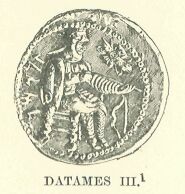
Drawn by Faucher- Gudin
Chabrias exhorted him to execute his project, and as he had not sufficient money to defray the expenses of a long campaign outside his own borders, the Athenian general instructed him how he might procure the necessary funds. He suggested to him that, as the Egyptian priests were wealthy, the sums of money annually assigned to them for the sacrifices and maintenance of the temples would be better employed in the service of the state, and counselled him to reduce or even to suppress most of the sacerdotal colleges. The priests secured their own safety by abandoning their personal property, and the king graciously deigned to accept their gifts, and then declared to them that in future, as long as the struggle against Persia continued, he should exact from them nine-tenths of their sacred revenues. This tax would have sufficed for all requirements if it had been possible to collect it in full, but there is no doubt that very soon the priests must have discovered means of avoiding part of the payment, for it was necessary to resort to other expedients. Chabrias advised that the poll and house taxes should be increased; that one obol should be exacted for each “ardeb” of corn sold, and a tithe levied on the produce of all ship-building yards, manufactories, and manual industries. Money now poured into the treasury, but a difficulty arose which demanded immediate solution. Egypt possessed very little specie, and the natives still employed barter in the ordinary transactions of life, while the foreign mercenaries refused to accept payment in kind or uncoined metal; they demanded good money as the price of their services. Orders were issued to the natives to hand over to the royal exchequer all the gold and silver in their possession, whether wrought or in ingots, the state guaranteeing gradual repayment through the nomarchs from the future product of the poll-tax, and the bullion so obtained was converted into specie for the payment of the auxiliary troops. These measures, though winning some unpopularity for Tachôs, enabled him to raise eighty thousand native troops and ten thousand Greeks, to equip a fleet of two hundred vessels, and to engage the best generals of the period. His eagerness to secure the latter, however, was injurious to his cause. Having already engaged Chabrias and obtained the good will of Athens, he desired also to gain the help of Agesilaus and the favourable opinion of the Lacedaemonians. Though now eighty years old, Agesilaus was still under the influence of cupidity and vanity; the promise of being placed in supreme command enticed him, and he set sail with one thousand hoplites. A disappointment awaited him at the moment of his disembarkation: Tachôs gave him command of the mercenary troops only, reserving for himself the general direction of operations, and placing the whole fleet under the orders of Chabrias. The aged hero, having vented his indignation by indulging a more than ordinary display of Spartan rudeness, allowed himself to be appeased by abundant presents, and assumed the post assigned to him. But soon after a more serious subject of disagreement arose between him and his ally; Agesilaus was disposed to think that Tachôs should remain quietly on the banks of the Nile, and leave to his generals the task of conducting the campaign. The ease with which mercenary leaders passed from one camp to the other, according to the fancy of the moment, was not calculated to inspire the Egyptian Pharaoh with confidence: he refused to comply with the wishes of Agesilaus, and, entrusting the regency to one of his relatives, proceeded to invade Syria. He found the Persians unprepared: they shut themselves up in their strongholds, and the Pharaoh confided to his cousin Nectanebo, son of the regent, the task of dislodging them. The war dragged on for some time; discontent crept in among the native levies, and brought treachery in its train. The fiscal measures which had been adopted had exasperated the priests and the common people; complaints, at first only muttered in fear, found bold expression as soon as the expeditionary force had crossed the frontier.
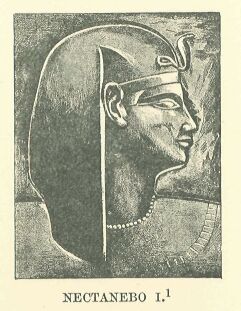
Drawn by Faucher- Gudin, from Lepsius.
The regent secretly encouraged the malcontents, and wrote to his son warning him of what was going on, and advised him to seize the crown. Nectanebo could easily have won over the Egyptian troops to his cause, but their support would have proved useless as long as the Greeks did not pronounce in his favour, and Chabrias refused to break his oaths. Agesilaus, however, was not troubled by the same scruples. His vanity had been sorely wounded by the Pharaoh: after being denied the position which was, he fancied, his by right, his short stature, his ill-health, and native coarseness had exposed him to the unseemly mockery of the courtiers. Tachôs, considering his ability had been over-estimated, applied to him, it is said, the fable of the mountain bringing forth a mouse; to which he had replied, “When opportunity offers, I will prove to him that I am the lion.” When Tachôs requested him to bring the rebels to order, he answered ironically that he was there to help the Egyptians, not to attack them; and before giving his support to either of the rival claimants, he should consult the Ephors. The Ephors enjoined him to act in accordance with the welfare of his country, and he thereupon took the side of Nectanebo, despite the remonstrances of Chabrias. Tachôs, deserted by his veterans, fled to Sidon, and thence to Susa, where Artaxerxes received him hospitably and without reproaching him (359 B.C.); but the news of his fall was not received on the banks of the Nile with as much rejoicing as he had anticipated. The people had no faith in any revolution in which the Greeks whom they detested took the chief part, and the feudal lords refused to acknowledge a sovereign whom they had not themselves chosen; they elected one of their number—the prince of Mendes—to oppose Nectanebo. The latter was obliged to abandon the possessions won by his predecessor, and return with his army to Egypt: he there encountered the forces of his enemy, which, though as yet undisciplined, were both numerous and courageous. Agesilaus counselled an immediate attack before these troops had time to become experienced in tactics, but he no longer stood well at court; the prince of Mendes had endeavoured to corrupt him, and, though he had shown unexpected loyalty, many, nevertheless, suspected his good faith. Nectanebo set up his headquarters at Tanis, where he was shortly blockaded by his adversary. It is well known how skilfully the Egyptians handled the pick-axe, and how rapidly they could construct walls of great strength; the circle of entrenchments was already near completion, and provisions were beginning to fail, when Agesilaus received permission to attempt a sortie. He broke through the besieging lines under cover of the night, and some days later won a decisive victory (359 B.C.). Nectanebo would now have gladly kept the Spartan general at his side, for he was expecting a Persian attack; but Agesilaus, who had had enough of Egypt and its intrigues, deserted his cause, and shortly afterwards died of exhaustion on the coast near Cyrene. The anticipated Persian invasion followed shortly after, but it was conducted without energy or decision. Artaxerxes had entrusted the conduct of the expedition to Tachôs, doubtless promising to reinstate him in his former power as satrap or vassal king of Egypt, but Tachôs died before he could even assume his post,* and the discords which rent the family of the Persian king prevented the generals who replaced him from taking any effective action.
* Ælian narrates, probably following Dinon, that Tachôs died of dysentery due to over-indulgence at dinner.
The aged Artaxerxes had had, it was reported, one hundred and fifteen sons by the different women in his harem, but only three of those by his queen Statira were now living—Darius, Ariaspes, and Ochus. Darius, the eldest of the three, had been formally recognised as heir-apparent—perhaps at the time of the disastrous war against the Cadusians* —but the younger brother, Ochus, who secretly aspired to the throne, had managed to inspire him with anxiety with regard to the succession, and incited him to put the aged king out of the way. Contemporary historians, ill informed as to the intrigues in the palace, whose effects they noted without any attempt to explore their intricacies, invented several stories to account for the conduct of the young prince. Some assigned as the reason of his conspiracy a romantic love-affair. They said that Cyrus the Younger had had an Ionian mistress named Aspasia, who, after the fatal battle of Cunaxa, had been taken into the harem of the conqueror, and had captivated him by her beauty. Darius conceived a violent passion for this damsel, and his father was at first inclined to give her up to him, but afterwards, repenting of his complaisance, consecrated her to the service of Mithra, a cult which imposed on her the obligation of perpetual chastity. Darius, exasperated by this treatment, began to contemplate measures of vengeance, but, being betrayed by his brother Ochus, was put to death with his whole family.**
* Pompeius Trogus asserts that such co-regencies were contrary to Persian law; we have seen above that, on the contrary, they were obligatory when the sovereign was setting out on a campaign. ** This is the version of the story given by Dinon and accepted by Pompoius Trogus. A chronological calculation easily demonstrates its unlikelihood. It follows from the evidence given by Justin himself that Artaxerxes died of grief soon after the execution of his son; but, on the other hand, that the battle of Cunaxa took place in 400 B.C.: Aspasia must then have been fifty or sixty years old when Darius fell in love with her.
By the removal of this first obstacle the crafty prince found himself only one step nearer success, for his brother Ariaspes was acknowledged as heir-apparent: Ochus therefore persuaded him that their father, convinced of the complicity of Ariaspes in the plot imputed to Darius, intended to put him to an ignominious death, and so worked upon him that he committed suicide to escape the executioner. A bastard named Arsames, who might possibly have aspired to the crown, was assassinated by Ochus. This last blow was too much for Artaxerxes, and he died of grief after a reign of forty-six years (358 B.C.).* Ochus, who immediately assumed the name of Artaxerxes, began his reign by the customary massacre: he put to death all the princes of the royal family,** and having thus rid himself of all the rival claimants to the supreme power, he hastened on preparations for the war with Egypt which had been interrupted by his father’s death and his own accession.
* This is the length attributed by Plutarch to this reign, and which is generally accepted. It was narrated in after- days that the king kept the fact of his father’s death hidden for ten months, but it is impossible to tell how much truth there is in this statement, which was accepted by Dinon. ** According to the author followed by Pompeius Trogus, the princesses themselves were involved in this massacre. This is certainly an exaggeration, for we shall shortly see that Darius III., the last king of Persia, was accounted to be the grandson of Darius II.; the massacre can only have involved the direct heirs of Artaxerxes.
The necessity for restoring Persian dominion on the banks of the Nile was then more urgent than at any previous time. During the half-century which had elapsed since the recovery of her independence, Egypt had been a perpetual source of serious embarrassment to the great king. The contemporaries of Amyrtseus, whether Greeks or barbarians, had at first thought that his revolt was nothing more than a local rising, like many a previous one which had lasted but a short time and had been promptly suppressed. But when it was perceived that the native dynasties had taken a hold upon the country, and had carried on a successful contest with Persia, in spite of the immense disproportion in their respective resources; when not only the bravest soldiers of Asia, but the best generals of Greece, had miserably failed in their attacks on the frontier of the Delta, Phoenicia and Syria began to think whether what was possible in Africa might not also be possible in Asia. From that time forward, whenever a satrap or vassal prince meditated revolt, it was to Egypt that he turned as a natural ally, and from Egypt he sought the means to carry out his project; however needy the Pharaoh of that day might be, he was always able to procure for such a suitor sufficient money, munitions of war, ships, and men to enable him to make war against the empire. The attempt made by Ochus failed, as all previous attempts had done: the two adventurers who commanded the forces of Nectanebo, the Athenian Diophantes and Lamius of Sparta, inflicted a disastrous defeat on the imperial troops, and forced them to beat a hasty retreat. This defeat was all the more serious in its consequences because of the magnitude of the efforts which had been made: the king himself was in command of the troops, and had been obliged to turn his back precipitately on the foe. The Syrian provinces, which had been in an unsettled condition ever since the invasion under Tachôs, flew to arms; nine petty kings of Cyprus, including Evagoras II., nephew of the famous prince of that name, refused to pay tribute, and Artabazus roused Asia Minor to rebellion. The Phoenicians still hesitated; but the insolence of their satrap, the rapacity of the generals who had been repulsed from Egypt, and the lack of discipline in the Persian army forced them to a decision. In a convention summoned at Tripoli, the representatives of the Phoenician cities conferred on Tennes, King of Sidon, the perilous honour of conducting the operations of the confederate army, and his first act was to destroy the royal villa in the Lebanon, and his next to burn the provisions which had been accumulated in various ports in view of the Egyptian war (351-350 B.C.).
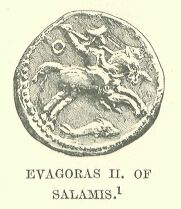
Drawn by Faucher- Gudin
Ochus imagined at the outset that his generals would soon suppress these rebellions, and, in fact, Idrieus, tyrant of Caria, supported by eight thousand mercenaries under the Athenian Phocion, overcame the petty tyrants of Cyprus without much difficulty; but in Asia Minor, Artabazus, supported by Athens and Thebes, held at bay the generals sent to oppose him, and Tennes won a signal victory in Syria. He turned for support to Egypt, and Nectanebo, as might be expected, put Greek troops at his disposal to the number of four thousand, commanded by one of his best generals, Mentor of Ehodes: Belesys, the satrap of Syria, and Mazseus, satrap of Cilicia, suffered a total defeat. Ochus, exasperated at their want of success, called out every available soldier, three hundred thousand Asiatics and ten thousand Greeks; the Sidonians, on their side, dug a triple trench round their city, raised their ramparts, and set fire to their ships, to demonstrate their intention of holding out to the end. Unfortunately, their king, Tennes, was not a man of firm resolution. Hitherto he had lived a life of self-indulgence, surrounded by the women of his harem, whom he had purchased at great cost in Ionia and Greece, and had made it the chief object of his ambition to surpass in magnificence the most ostentatious princes of Cyprus, especially Nicocles of Salamis, son of Evagoras. The approach of Ochus confused his scanty wits; he endeavoured to wipe out his treachery towards his suzerain by the betrayal of his own subjects. He secretly despatched his confidential minister, a certain Thessalion, to the Persian camp, promising to betray Sidon to the Persian king, and to act as his guide into Egypt on condition of having his life preserved and his royal rank guaranteed to him. Ochus had already agreed to these conditions, when an impulse of vanity on his part nearly ruined the whole arrangement. Thessalion, not unreasonably doubting the king’s good faith, had demanded that he should swear by his right hand to fulfil to the letter all the clauses of the treaty; whereupon Ochus, whose dignity was offended by this insistence, gave orders for the execution of the ambassador. But as the latter was being dragged away, he cried out that the king could do as he liked, but that if he disdained the help of Tennes, he would fail in his attacks both upon Phonicia and Egypt. These words produced a sudden reaction, and Thessalion obtained all that he demanded. When the Persians had arrived within a few days’ march of Sidon, Tennes proclaimed that a general assembly of the Phoenician deputies was to be held, and under pretext of escorting the hundred leading men of his city to the appointed place of meeting, led them into the enemy’s camp, where they were promptly despatched by the javelins of the soldiery. The Sidonians, deserted by their king, were determined to carry on the struggle, in the expectation of receiving succour from Egypt; but the Persian darics had already found their way into the hands of the mercenary troops, and the general whom Nectanebo had lent them, declared that his men considered the position desperate, and that he should surrender the city at the first summons. The Sidonians thereupon found themselves reduced to the necessity of imploring the mercy of the conqueror, and five hundred of them set out to meet him as suppliants, carrying olive branches in their hands. Bub Ochus was the most cruel monarch who had ever reigned in Persia—the only one, perhaps, who was really bloodthirsty by nature; he refused to listen to the entreaties of the suppliants, and, like the preceding hundred delegates, they were all slain. The remaining citizens, perceiving that they could not hope for pardon, barricaded themselves in their houses, to which they set fire with their own hands; forty thousand persons perished in the flames, and so great was the luxury in the appointments of the private houses, that large sums were paid for the right to dig for the gold and silver ornaments buried in the ruins. The destruction of the city was almost as complete as in the days of Esarhaddon. When Sidon had thus met her fate, the Persians had no further reason for sparing its king, Tennes, and he was delivered to the executioner; whereupon the other Phoenician kings, terrified by his fate, opened their gates without a struggle.
Once more the treachery of a few traitors had disconcerted the plans of the Pharaoh, and delivered the outposts of Egypt into the hands of the enemy: but Ochus renewed his preparations with marvellous tenacity, and resolved to neglect nothing which might contribute to his final success. His victories had confirmed the cities of the empire in their loyalty, and they vied with one another in endeavouring to win oblivion for their former hesitation by their present zeal: “What city, or what nation of Asia did not send embassies to the sovereign? what wealth did they not lavish on him, whether the natural products of the soil, or the rare and precious productions of art? Did he not receive a quantity of tapestry and woven hangings, some of purple, some of diverse colours, others of pure white? many gilded pavilions, completely furnished, and containing an abundant supply of linen and sumptuous beds? chased silver, wrought gold, cups and bowls, enriched with precious stones, or valuable for the perfection and richness of their work? He also received untold supplies of barbarian and Grecian weapons, and still larger numbers of draught cattle and of sacrificial victims, bushels of preserved fruits, bales and sacks full of parchments or books, and all kinds of useful articles? So great was the quantity of salted meats which poured in from all sides, that from a distance the piles might readily be mistaken for rows of hillocks or high mounds.” The land-force was divided into three corps, each under a barbarian and a Greek general. It advanced along the sea coast, following the ancient route pursued by the armies of the Pharaohs, and as it skirted the marshes of Sirbonis, some detachments, having imprudently ventured over the treacherous soil, perished to a man. When the main force arrived in safety before Pelusium, it found Nectanebo awaiting it behind his ramparts and marshes. He had fewer men than his adversary, his force numbering only six thousand Egyptians, twenty thousand Libyans, and the same number of Greeks; but the remembrance of the successes won by himself and his predecessors with inferior numbers inspired him with confidence in the issue of the struggle. His fleet could not have ventured to meet in battle the combined squadrons of Cyprus and Phoenicia, but, on the other hand, he had a sufficient number of flat-bottomed boats to prevent any adversary from entering the mouths of the Nile. The weak points along his Mediterranean seaboard and eastern frontier were covered by strongholds, fortifications, and entrenched camps: in short, his plans were sufficiently well laid to ensure success in a defensive war, if the rash ardour of his Greek mercenaries had not defeated his plans. Five thousand of these troops were in occupation of Pelusium, under command of Philophrôn. Some companies of Thebans, who were serving under Lacrates in the Persian army, crossed a deep canal which separated them from the city, and provoked the garrison to risk an encounter in the open field. Philophrôn, instead of treating their challenge with indifference, accepted it, and engaged in a combat which lasted till nightfall. On the following day, Lacrates, having drawn off the waters of the canal and thrown a dyke across it, led his entire force up to the glacis of the fortifications, dug some trenches, and brought up a line of battering-rams. He would soon have effected a breach, but the Egyptians understood how to use the spade as well as the lance, and while the outer wall was crumbling, they improvised behind it a second wall, crowned with wooden turrets. Nectanebo, who had come up with thirty thousand native, five thousand Greek troops, and half the Libyan contingent, observed the vicissitudes of the siege from a short distance, and by his presence alone opposed the advance of the bulk of the Persian army. Weeks passed by, the time of the inundation was approaching, and it seemed as if this policy of delay would have its accustomed success, when an unforeseen incident decided in a moment the fate of Egypt. Among the officers of Ochus was a certain Nicostratus of Argos, who on account of his prodigious strength was often compared to Heracles, and who out of vanity dressed himself up in the traditional costume of that hero, the lion’s skin and the club. Having imbibed, doubtless, the ideas formerly propounded by Iphicrates, Nicostratus forced some peasants, whose wives and children he had seized as hostages, to act as his guides, and made his way up one of the canals which traverse the marshes of Menzaleh: there he disembarked his men in the rear of Nectanebo, and took up a very strong position on the border of the cultivated land. This enterprise, undertaken with a very insufficient force, was an extremely rash one; if the Egyptian generals had contented themselves with harassing Nicostratus without venturing on engaging him in a pitched battle, they would speedily have forced him to re-embark or to lay down his arms. Unfortunately, however, five thousand mercenaries, who formed the garrison of one of the neighbouring towns, hastened to attack him under the command of Clinias of Cos, and suffered a severe defeat. As a result, the gates of the town were thrown open to the enemy, and if the Persians, encouraged by the success of this forlorn hope, had followed it up boldly, Nectanebo would have run the risk of being cut off from his troops which were around Pelusium, and of being subsequently crushed. He thought it wiser to retreat towards the apex of the Delta, but this very act of prudence exposed him to one of those accidental misfortunes which are wont to occur in armies formed of very diverse elements. While he was concentrating his reserves at Memphis, the troops of the first line thought that, by leaving them exposed to the assaults of the great king, he was deliberately sacrificing them. Pelusium capitulated to Lacrates; Mentor of Ehodes pushed forward and seized Bubastis, and the other cities in the eastern portion of the Delta, fearing to bring upon themselves the fate of Sidon, opened their gates to the Persians after a mere show of resistance. The forces which had collected at Memphis thereupon disbanded, and Nectanebo, ruined by these successive disasters, collected his treasures and fled to Ethiopia. The successful issue of the rash enterprise of Nicostratus had overthrown the empire of the Pharaohs, and re-established the Persian empire in its integrity (342 B.C.).*
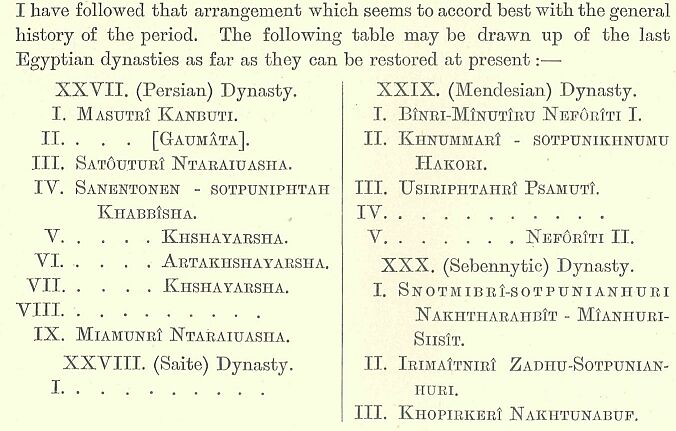
* The complete history of this war is related by Diodorus Siculus, who generally follows the narrative of Theopompus. The chronology is still sufficiently uncertain to leave some doubt as to the exact date of each event; I have followed that arrangement which seems to accord best with the general history of the period. The following table may be drawn up of the last Egyptian dynasties as far as they can be restored at present:—
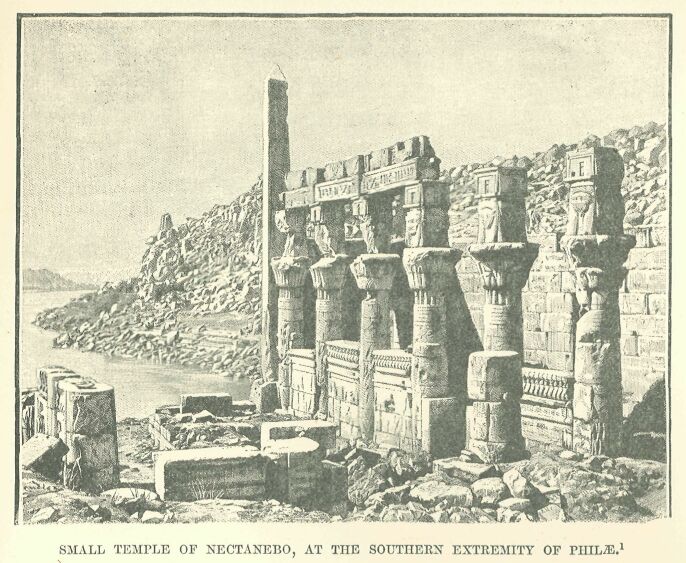
Egypt had prospered under the strong rule of its last native Pharaohs. Every one of them, from Amyrtous down to Nectanebo, had done his best to efface all traces of the Persian invasions and restore to the country the appearance which it had presented before the days of its servitude; even kings like Psamutis and Tachôs, whose reign had been of the briefest, had, like those who ruled for longer periods, constructed or beautified the monuments of the country. The Thebaid was in this respect a special field of their labours. The island of Philæ, exposed to the ceaseless attacks of the Ethiopians, had been reduced to little more than a pile of ruins.
Drawn by Boudier, from a photograph by Beato.
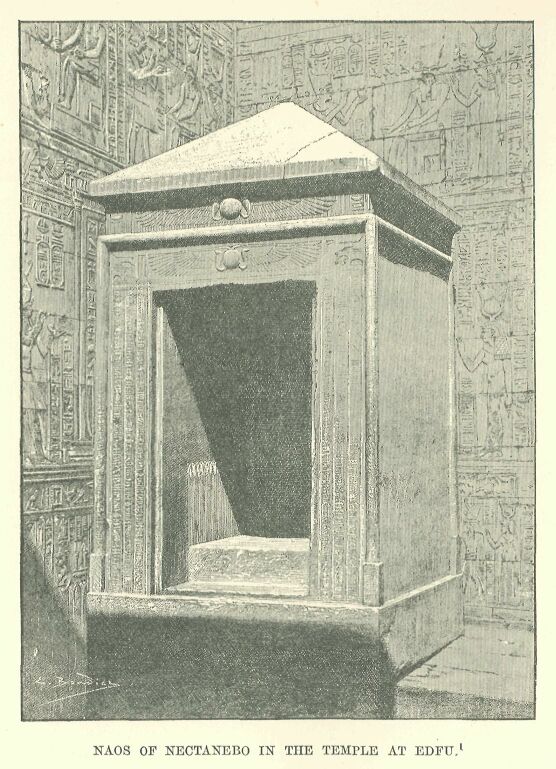
Nectanebo II. erected a magnificent gate there, afterwards incorporated into the first pylon of the temple built by the Ptolemies, and one at least of the buildings that still remain, the charming rectangular kiosk, the pillars of which, with their Hathor capitals, rise above the southern extremity of the island and mark the spot at which the Ethiopian pilgrims first set foot on the sacred territory of the bountiful Isis. Nectanebo I. restored the sanctuaries of Nekhabît at El-Kab, and of Horus at Edfu, in which latter place he has left an admirable naos which delights the modern traveller by its severe proportions and simplicity of ornament, while Nectanebo II. repaired the ancient temple of Mînu at Coptos; in short, without giving a detailed list of what was accomplished by each of these later Pharaohs, it may be said that there are few important sites in the valley of the Nile where some striking evidence of their activity may not still be discovered even after the lapse of so many centuries.
Drawn by Boudier, from a photograph by Beato.
It will be sufficient to mention Thebes, Memphis, Sebennytos, Bubastis, Pahabît, Patumu, and Tanis. Nor did the Theban oases, including that of Amon himself, escape their zeal, for the few Europeans who have visited them in modern times have observed their cartouches there.
Drawn by Boudier, from a photograph by Beato.
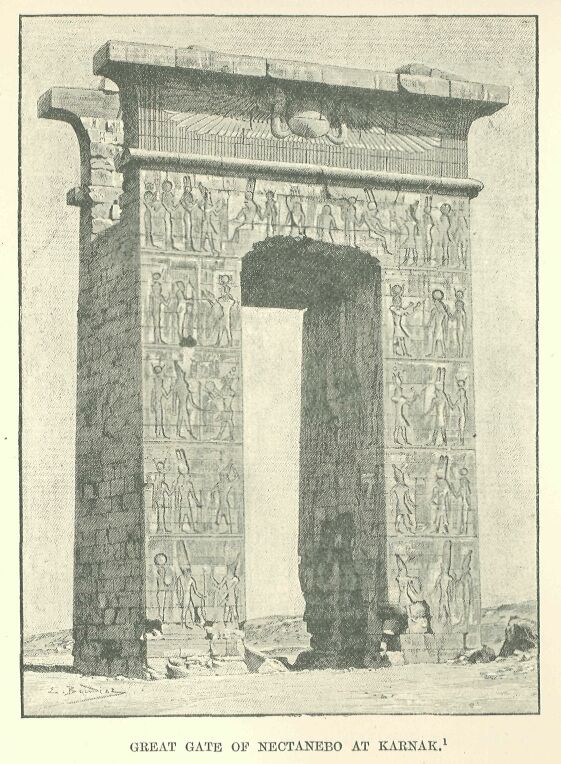
Moreover, in spite of the brief space of time within which they were carried out, the majority of these works betray no signs of haste or slipshod execution; the craftsmen employed on them seem to have preserved in their full integrity all the artistic traditions of earlier times, and were capable of producing masterpieces which will bear comparison with those of the golden age. The Eastern gate, erected at Karnak in the time of Nectanebo II., is in no way inferior either in purity of proportion or in the beauty of its carvings to what remains of the gates of Amenôthes III.
The sarcophagus of Nectanebo I. is carved and decorated with a perfection of skill which had never been surpassed in any age, and elsewhere, on all the monuments which bear the name of this monarch the hieroglyphics have been designed and carved with as much care as though each one of them had been a precious cameo.*
* The sarcophagus was for a long time preserved near the mosque of Ibn-Tulun, and was credited with peculiar virtues by the superstitious inhabitants of Cairo.
The basalt torso of Nectanebo II., which attracts so much admiration in the Bibliothèque Nationale in Paris for accuracy of proportion and delicacy of modelling, deserves to rank with the finest statues of the ancient empire. The men’s heads are veritable portraits, in which such details as a peculiar conformation of the skull, prominent cheekbones, deep-set eyes, sunken cheeks, or the modelling of the chin, have all been observed and reproduced with a fidelity and keenness of observation which we fail to find in such works of the earlier artists as have come down to us. These later sculptors display the same regard for truth in their treatment of animals, and their dog-headed divinities; their dogs, lions, and sphinxes will safely bear comparison with the most lifelike presentments of these creatures to be found among the remains of the Memphite or Theban eras. Egypt was thus in the full tide of material prosperity when it again fell under the Persian yoke, and might have become a source of inexhaustible wealth to Ochus had he known how to secure acceptance of his rule, as Darius, son of Hystaspes, had done in the days of Amasis.
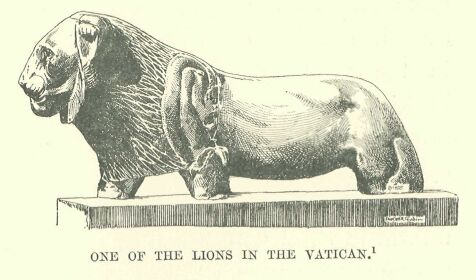
Drawn by Faucher-Gudin, from a photograph by Flinders Pétrie.
The violence of his temperament, however, impelled him to a course of pitiless oppression, and his favourite minister, the eunuch Bagoas, seems to have done his best to stimulate his master’s natural cruelty. In the days when they felt themselves securely protected from his anger by their Libyan and Greek troops, the fellahîn had freely indulged in lampoons at the expense of their Persian suzerain; they had compared him to Typhon on account of his barbarity, and had nicknamed him “the Ass,” this animal being in their eyes a type of everything that is vile. On his arrival at Memphis, Ochus gave orders that an ass should be installed in the temple of Phtah, and have divine honours paid to it; he next had the bull Apis slaughtered and served up at a set banquet which he gave to his friends on taking possession of the White Wall. The sacred goat of Mendes suffered the same fate as the Apis, and doubtless none of the other sacred animals were spared. Bagoas looted the temples in the most systematic way, despatched the sacred books to Persia, razed the walls of the cities to the ground, and put every avowed partisan of the native dynasty to the sword. After these punitive measures had been carried out, Ochus disbanded his mercenaries and returned to Babylon, leaving Pherendates in charge of the reconquered province.*
* It seems that a part of the atrocities committed by Ochus and Bagoas soon came to be referred to the time of the “Impure” and to that of Cambyses.
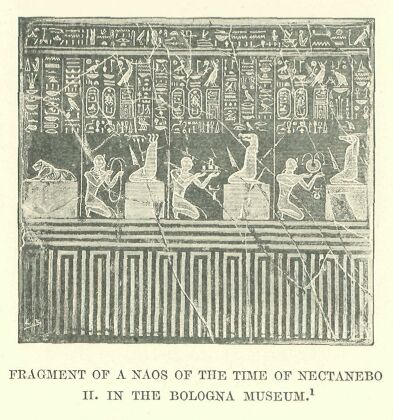
Drawn by Boudier, from a photograph by Flinders Pétrie.
The downfall of Egypt struck terror into the rebellious satraps who were in arms elsewhere. Artabazus, who had kept Asia Minor in a ferment ever since the time of Artaxerxes II., gave up the struggle of his own accord and took refuge in Macedonia. The petty kings of the cities on the shores of the Hellespont and the Ægean submitted themselves in order to regain favour, or if, like Hermias of Atarnasa, the friend of Aristotle, they still resisted, they were taken prisoners and condemned to death. The success of Ochus was a reality, but there was still much to be done before things were restored to the footing they had occupied before the crisis. We know enough of the course of events in the western provinces to realise the pitch of weakness to which the imbecility of Darius II. and his son Artaxerxes II. had reduced the empire of Darius and Xerxes, but it is quite certain that the disastrous effects of their misgovernment were not confined to the shores of the Mediterranean, but were felt no less acutely in the eastern and central regions of the empire. There, as on the Greek frontiers, the system built up at the cost of so much ingenuity by Darius was gradually being broken down with each year that passed, and the central government could no longer make its power felt at the extremities of the empire save at irregular intervals, when its mandates were not intercepted or nullified in transmission. The functions of the “Eyes” and “Ears” of the king had degenerated into a mere meaningless formality, and were, more often than not, dispensed with altogether. The line of demarcation between the military and civil power had been obliterated: not only had the originally independent offices of satrap, general, and secretary ceased to exist in each separate province, but, in many instances, the satrap, after usurping the functions of his two colleagues, contrived to extend his jurisdiction till it included several provinces, thus establishing himself as a kind of viceroy. Absorbed in disputes among themselves, or in conspiracies against the Achsemenian dynasty, these officials had no time to look after the well-being of the districts under their control, and the various tribes and cities took advantage of this to break the ties of vassalage. To take Asia Minor alone, some of the petty kings of Bithynia, Paphlagonia, and certain districts of Cappadocia or the mountainous parts of Phrygia still paid their tribute intermittently, and only when compelled to do so; others, however, such as the Pisidians, Lycaonians, a part of the Lycians, and some races of Mount Taurus, no longer dreamed of doing so. The three satrapies on the shores of the Caspian, which a hundred years before had wedged themselves in between that sea and the Euxine, were now dissolved, all trace of them being lost in a confused medley of kingdoms and small states, some of which were ready enough to acknowledge the supremacy of Persia, while others, such as the Gordiseans, Taochi, Chalybes, Colchi, Mosynoki, and Tibarenians, obeyed no rule but their own.
ENLARGE TO FULL SIZE
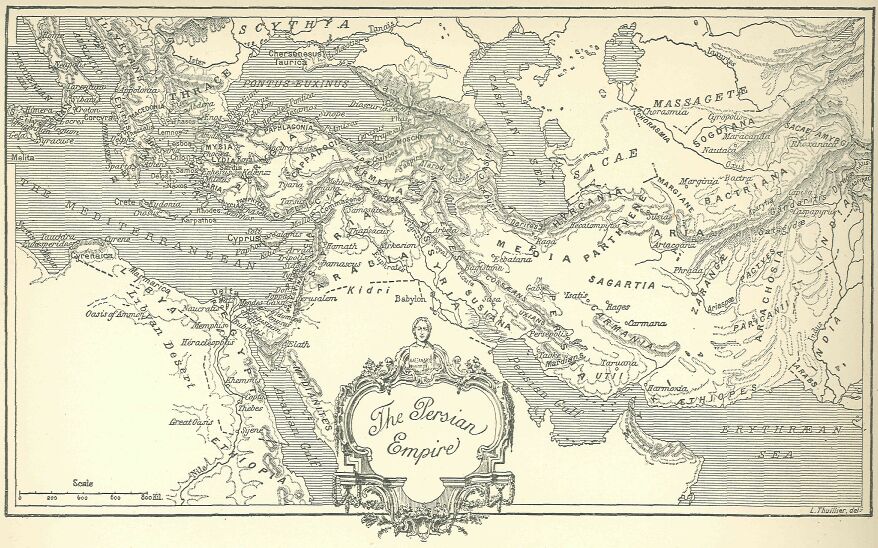
[Click on the Map to enlarge it to full size.]
All along the Caspian, the Cadusians and Amardians, on either side of the chain of mountains bordering the Iranian plateau, defied all the efforts made to subdue them.* India and the Sakse had developed from the condition of subjects into that of friendly allies, and the savage hordes of Gedrosia and the Paropamisus refused to recognise any authority at all.**
* They appear in the history of every epoch as the irreconcilable foes of the great king, enemies against whom even the most peacefully disposed sovereigns were compelled to take the field in person. ** The Sakæ fought at Arbela, but only as allies of the Persians. The Indians who are mentioned with them came from the neighbourhood of Cabul; most of the races who had formerly figured in Darius’ satrapy of India had become independent by the time Alexander penetrated into the basin of the Indus.
The whole empire needed to be reconquered and reorganised bit by bit if it was to exercise that influence in the world to which its immense size entitled it, and the question arose whether the elements of which it consisted would lend themselves to any permanent reorganisation or readjustment.
The races of the ancient Eastern world, or, at any rate, that portion of them which helped to make its history, either existed no longer or had sunk into their dotage. They had worn each other out in the centuries of their prime, Chaldæans and Assyrians fighting against Cossæans or Elamites, Egyptians against Ethiopians and against Hittites, Urartians, Armæans, the peoples of Lebanon and of Damascus, the Phoenicians, Canaanites and Jews, until at last, with impoverished blood and flagging energies, they were thrown into conflict with younger and more vigorous nations. The Medes had swept away all that still remained of Assyria and Urartu; the Persians had overthrown the Medes, the Lydians, and the Chaldæans, till Egypt alone remained and was struck down by them in her turn. What had become of these conquered nations during the period of nearly two hundred years that the Achæmenians had ruled over them? First, as regards Elam, one of the oldest and formerly the most powerful of them all. She had been rent into two halves, each of them destined to have a different fate. In the mountains, the Uxians, Mardians, Elymasans, and Cossæans—tribes who had formerly been the backbone of the nation—had relapsed into a semi-barbarous condition, or rather, while the rest of the world had progressed in civilization and refinement, they had remained in a state of stagnation, adhering obstinately to the customs of their palmy days: just as they had harried the Chaldæans or Assyrians in the olden times, so now they harried the Persians; then, taking refuge in their rocky fastnesses, they lived on the proceeds of their forays, successfully resisting all attempts made to dislodge them. The people of the plains, on the other hand, kept in check from the outset by the presence of the court at Susa, not only promptly resigned themselves to their fate, but even took pleasure in it, and came to look upon themselves as in some sort the masters of Asia. Was it not to their country, to the very spot occupied by the palace of their king, that, for nearly two hundred years, satraps, vassal kings, the legates of foreign races, ambassadors of Greek republics—in a word, all the great ones of this world—came every year to render homage, and had not the treasures which these visitors brought with them been expended, in part at any rate, on their country? The memory of their former prosperity paled before the splendours of their new destiny, and the glory of their ancestors suffered eclipse. The names of the national kings, the story of their Chaldæan and Syrian conquests, the trophies of their victories over the great generals of Nineveh, the horrors of their latest discords and of the final catastrophe were all forgotten; even the documents which might have helped to recall them lay buried in the heart of the mound which served as a foundation for the palace of the Achgernenides. Beyond the vague consciousness of a splendid past, the memory of the common people was a blank, and when questioned by strangers they could tell them nothing save legends of the gods or the exploits of mythical heroes; and from them the Greeks borrowed their Memnon, that son of Tithonus and Eôs who rushed to the aid of Priam with his band of Ethiopians, and whose prowess had failed to retard by a single day the downfall of Troy. Further northwards, the Urartians and peoples of ancient Naîri, less favoured by fortune, lost ground with each successive generation, yielding to the steady pressure of the Armenians. In the time of Herodotus they were still in possession of the upper basins of the Euphrates and Araxus, and, in conjunction with the Matieni and Saspires, formed a satrapy—the eighteenth—the boundaries of which coincided pretty closely with those of the kingdom ruled over by the last kings of Van in the days of Assur-bani-pal; the Armenians, on their side, constituted the thirteenth satrapy, between Mount Taurus and the Lower Arsanias.
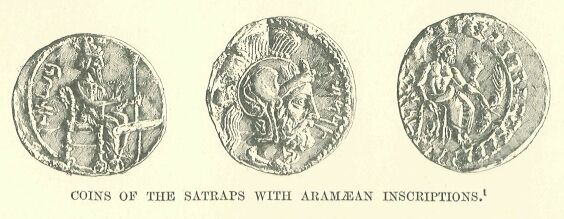
Drawn by Faucher-Gudin, from coins in the Cabinet des Médailles
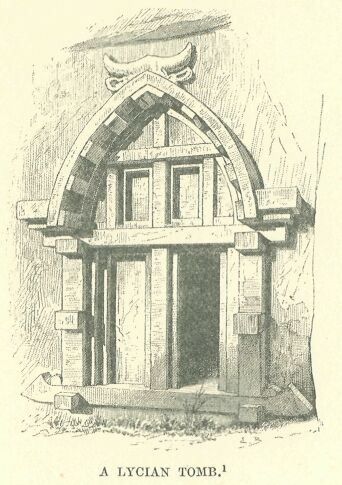
Drawn by Faucher-Gudin, from a woodcut in Bonndorff.
The whole face of their country had undergone a profound change since that time: the Urartians, driven northwards, became intermingled with the tribes on the slopes of the Caucasus, while the Armenians, carried along towards the east, as though by some resistless current, were now scaling the mountainous bulwark of Ararat, and slowly but surely encroaching on the lower plains of the Araxes. These political changes had been almost completed by the time of Ochus, and Urartu had disappeared from the scene, but an Armenia now flourished in the very region where Urartu had once ruled, and its princes, who were related to the family of the Achæmenides, wielded an authority little short of regal under the modest name of satraps. Thanks to their influence, the religions and customs of Iran were introduced into the eastern borders of Asia Minor. They made their way into the valleys of the Iris and the Halys, into Cappadocia and the country round Mount Taurus, and thither they brought with them the official script of the empire, the Persian and Aramaean cuneiform which was employed in public documents, in inscriptions, and on coins. The centre of the peninsula remained very much the same as it had been in the period of the Phrygian supremacy, but further westward Hellenic influences gradually made themselves felt.
The arts of Greece, its manners, religious ideals, and modes of thought, were slowly displacing civilisations of the Asianic type, and even in places like Lycia, where the language successfully withstood the Greek invasion, the life of the nations, and especially of their rulers, became so deeply impregnated with Hellenism as to differ but little from that in the cities on the Ionic, Æolian, or Doric seaboard. The Lycians still adhered to the ancient forms which characterised their funerary architecture, but it was to Greek sculptors, or pupils from the Grecian schools, that they entrusted the decoration of the sides of their sarcophagi and of their tombs.
Their kings minted coins many of which are reckoned among the masterpieces of antique engraving; and if we pass from Lycia to the petty states of Caria, we come upon one of the greatest triumphs of Greek art—that huge mausoleum in which the inconsolable Artemisia enclosed the ashes and erected the statue of her husband. The Asia Minor of Egyptian times, with its old-world dynasties, its old-world names, and old-world races, had come to be nothing more than an historic memory; even that martial world, in which the Assyrian conquerors fought so many battles from the Euphrates to the Black Sea, was now no more, and its neighbours and enemies of former days had, for the most part, disappeared from the land of the living.
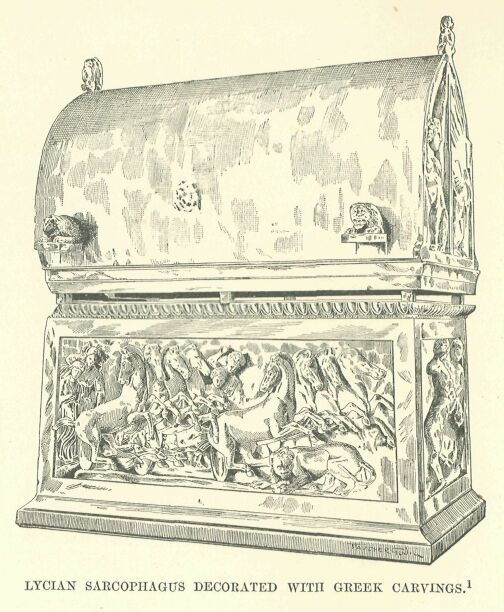
Drawn by Faucher-Gudin, from a photogravure published by Hamdy-Beg and Th. Reinach.
The Lotanu were gone, the Khâti were gone, and gone, too, were Carchemish, Arpad, and Qodshu, much of th§ir domain having been swallowed up again by the desert for want of hands to water and till it; even Assyria itself seemed but a shadow half shrouded in the mists of oblivion. Sangara, Nisibis, Resaina, and Edessa still showed some signs of vigour, but on quitting the slopes of the Masios and proceeding southwards, piles of ruins alone marked the sites of those wealthy cities through which the Ninevite monarchs had passed in their journeyings towards Syria. Here wide tracts of arid and treeless country were now to be seen covered with aromatic herbage, where the Scenite Arabs were wont to pursue the lion, wild ass, ostrich, bustard, antelope, and gazelle; a few abandoned forts, such as Korsortê, Anatho, and Is (Hit) marked the halting-places of armies on the banks of the Euphrates. In the region of the Tigris, the descendants of Assyrian captives who, like the Jews, had been set free by Cyrus, had rebuilt Assur, and had there grown wealthy by husbandry and commerce,* but in the district of the Zab solitude reigned supreme.** Calah and Nineveh were alike deserted, and though their ruins still littered the sites where they had stood, their names were unknown in the neighbouring villages. Xenophon, relying on his guides, calls the former place Larissa, the second Mespila.***
* This seems to be indicated by a mutilated passage in the Cylinder of Gyrus, where Assur is mentioned in the list of towns and countries whose inhabitants were sent back to their homes by Cyrus after the capture of Babylon. Xenophon calls it Esense, this being, possibly, a translation of the name given to it by its inhabitants. Nothing could be more natural than for exiles to call the villages founded by them on their return “new.” The town seems to have been a large and wealthy one. ** Xenophon calls this country Media, a desert region which the Ten Thousand took six days to cross. *** The name Larissa is, possibly, a corruption of some name similar to that of the city of Larsam in Chaldæa; Mespila may be a generic term. [Mespila is Muspula, “the low ground” at the foot of Kouyunjik; Larissa probably Al Resen or Res-eni, between Kouyunjik and Nebi Yunus.—Ed.]
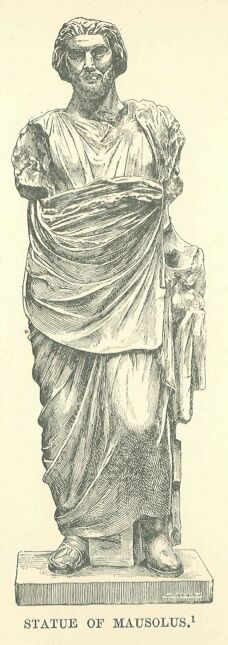
Drawn by Faucher- Gudin, from a photograph of the original in the British Museum.
Already there were historians who took the ziggurât at Nineveh to be the burial-place of Sardanapalus. They declared that Cyrus had pulled it down in order to strengthen his camp during the siege of the town, and that formerly it had borne an epitaph afterwards put into verse by the poet Choerilus of Iassus: “I reigned, and so long as I beheld the light of the sun, I ate, I drank, I loved, well knowing how brief is the life of man, and to how many vicissitudes it is liable.” Many writers, remembering the Assyrian monument at Anchialê in Cilicia, were inclined to place the king’s tomb there. It was surmounted by the statue of a man—according to one account, with his hands crossed upon his breast, according to another, in the act of snapping his fingers—and bore the following inscription in Chaldaic letters: “I, Sardanapalus, son of Anakyndaraxes, founded Anchialê and Tarsus in one day, but now am dead.” Thus ten centuries of conquests and massacre had passed away like a vapour, leaving nothing but a meagre residue of old men’s tales and moral axioms.
In one respect only does the civilisation of the Euphrates seem to have fairly held its own. Cossæa, though it had lost its independence, had lost but little of its wealth; its former rebellions had done it no great injury, and its ancient cities were still left standing, though shorn of their early splendour. Uru, it is true, numbered but few citizens round its tottering sanctuaries, but Uruk maintained a school of theologians and astronomers no less famous throughout the East than those of Borsippa. The swamps, however, which surrounded it possessed few attractions, and Greek travellers rarely ventured thither. They generally stopped at Babylon, or if they ventured off the beaten track, it was only to visit the monuments of Nebuchadrezzar, or the tombs of the early kings in its immediate neighbourhood. Babylon was, indeed, one of the capitals of the empire—nay, for more than half a century, during the closing years of Artaxerxes I., in the reign of Darius II., and in the early days of Artaxerxes IL, it had been the real capital; even under Ochus, the court spent the winter months there, and resorted thither in quest of those resources of industry and commerce which Susa lacked. The material benefits due to the presence of the sovereign seem to have reconciled the city to its subject condition; there had been no seditious movement there since the ill-starred rising of Shamasherîb, which Xerxes had quelled with ruthless severity. The Greek mercenaries or traders who visited it, though prepared for its huge size by general report, could not repress a feeling of astonishment as they approached it. First of all there was the triple wall of Nebuchadrezzar, with its moats, its rows of towers, and its colossal gateways. Unlike the Greek cities, it had been laid out according to a regular plan, and formed a perfect square, inside which the streets crossed one another at right angles, some parallel to the Euphrates, others at right angles to it; every one of the latter terminated in a brazen gate opening through the masonry of the quay, and giving access to the river. The passengers who crowded the streets included representatives of all the Asiatic races, the native Babylonians being recognisable by their graceful dress, consisting of a linen tunic falling to the feet, a fringed shawl, round cap, and heavy staff terminating in a knob. From this ever-changing background stood out many novel features calculated to stimulate Greek curiosity, such as the sick persons exposed at street-corners in order that they might beg the passers-by to prescribe for them, the prostitution of her votaries within the courts of the goddess Mylitta, and the disposal of marriageable girls by auction: Herodotus, however, regretted that this latter custom had fallen into abeyance. And yet to the attentive eye of a close observer even Babylon must have furnished many unmistakable symptoms of decay. The huge boundary wall enclosed too large an area for the population sheltered behind it; whole quarters were crumbling into heaps of ruins, and the flower and vegetable gardens were steadily encroaching on spaces formerly covered with houses. Public buildings had suffered quite as much as private dwellings from the Persian wars. Xerxes had despoiled the temples, and no restoration had been attempted since his time. The ziggurât of Bel lay half buried already beneath piles of rubbish; the golden statues which had once stood within its chambers had disappeared, and the priests no longer carried on their astronomical observations on its platform.*