Volume 9 — CHAPTER II—THE LAST DAYS OF THE OLD EASTERN WORLD (continued 3)
M. L. McClure translation
* Herodotus merely mentions that Xerxes had despoiled the temple; Strabo tells us that Alexander wished to restore it, but that it was in such a state of dilapidation that it would have taken ten thousand men two months merely to remove the rubbish.
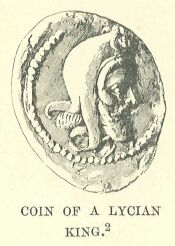
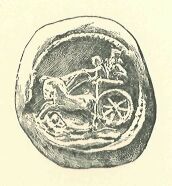
Drawn by Faucher-Gudin, from a silver stater in the Cabinet des Médailles. The king in question was named Deneveles, and is only known by the coins bearing his superscription. He flourished about 395 B.C.
The palaces of the ancient kings were falling to pieces from lack of repairs, though the famous hanging gardens in the citadel were still shown to strangers. The guides, of course, gave them out to be a device of Semiramis, but the well-informed knew that they had been constructed by Nebuchadrezzar for one of his wives the daughter of Oyaxares, who pined for the verdure of her native mountains. “They were square in shape, each side being four hundred feet long; one approached them by steps leading to terraces placed one above the other, the arrangement of the whole, resembling that of an amphitheatre. Each terrace rested on pillars which, gradually increasing in size, supported the weight of the soil and its produce. The loftiest pillar attained a height of fifty feet; it reached to the upper part of the garden, its capital being on a level with the balustrades of the boundary wall. The terraces were covered with a layer of soil of sufficient depth for the roots of the largest trees; plants of all kinds that delight the eye by their shape or beauty were grown there. One of the columns was hollowed from top to bottom; it contained hydraulic engines which pumped up quantities of water, no part of the mechanism being visible from the outside.” Many travellers were content to note down only such marvels as they considered likely to make their narratives more amusing, but others took pains to collect information of a more solid character, and before they had carried their researches very far, were at once astounded and delighted with the glimpses they obtained of Chaldæan genius. No doubt, they exaggerated when they went so far as to maintain that all their learning came to them originally from Babylon, and that the most famous scholars of Greece, Pherecydes of Scyros, Democritus of Abdera, and Pythagoras,* owed the rudiments of philosophy, mathematics, physics, and astrology to the school of the Magi.
* The story which asserts that Pythagoras served under Nergilos, King of Assyria, is probably based on some similarity of names: thus among the Greek kings of Cyprus, and in the time of Assur-bani-pal, we find one whose name would recall that of Pythagoras, if the accuracy of the reading were beyond question.
Yet it is not surprising that they should have believed this to be the case, when increasing familiarity with the priestly seminaries revealed to them the existence of those libraries of clay tablets in which, side by side with theoretic treatises dating from two thousand years back and more, were to be found examples of applied mechanics, observations, reckonings, and novel solutions of problems, which generations of scribes had accumulated in the course of centuries. The Greek astronomers took full advantage of these documents, but it was their astrologers and soothsayers who were specially indebted to them. The latter acknowledged their own inferiority the moment they came into contact with their Euphratean colleagues, and endeavoured to make good their deficiencies by taking lessons from the latter or persuading them to migrate to Greece. A hundred years later saw the Babylonian Berosus opening at Cos a public school of divination by the stars. From thenceforward “Chaldæan” came to be synonymous with “astrologer” or “sorcerer,” and Chaldæan magic became supreme throughout the world at the very moment when Chaldæa itself was in its death-throes.
Nor was its unquestioned supremacy in the black art the sole legacy that Chaldæa bequeathed to the coming generations: its language survived, and reigned for centuries afterwards in the regions subjugated by its arms. The cultivated tongue employed by the scribes of Nineve and Babylon in the palmy days of their race, had long become a sort of literary dialect, used in writings of a lofty character and understood by a select few, but unintelligible to the common people. The populace in town or country talked an Aramaic jargon, clumsier and more prolix than Assyrian, but easier to understand. We know how successfully the Aramæans had managed to push their way along the Euphrates and into Syria towards the close of the Hittite supremacy: their successive encroachments had been favoured, first by the Assyrian, later by the Chaldæan conquests, and now they had become sole possessors of the ancient Naharaîna, the plains of Cilicia, the basin of the Orontes, and the country round Damascus; but the true home of the Aramæans was in Syria rather than in the districts of the Lower Euphrates. Even in the time of the Sargonids their alphabet had made so much headway that at Nineveh itself and at Calah it had come into everyday use; when Chaldæan supremacy gave way to that of the Persians, its triumph—in the western provinces, at any rate—was complete, and it became the recognised vehicle of the royal decrees: we come upon it in every direction, on the coins issued by the satraps of Asia Minor, on the seals of local governors or dynasts, on inscriptions or stelæ in Egypt, in the letters of the scribes, and in the rescripts of the great king. From Nisib to Baphia, between the Tigris and the Mediterranean, it gradually supplanted most of the other dialects—Semitic or otherwise—which had hitherto prevailed. Phoenician held its ground in the seaports, but Hebrew gave way before it, and ended by being restricted to religious purposes, as a literary and liturgical language. It was in the neighbourhood of Babylon itself that the Judæan exiles had, during the Captivity, adopted the Aramaic language, and their return to Canaan failed to restore either the purity of their own language or the dignity and independence of their religious life. Their colony at Jerusalem possessed few resources; the wealthier Hebrews had, for the most part, remained in Chaldæa, leaving the privilege of repopulating the holy city to those of their brethren who were less plenteously endowed with this world’s goods. These latter soon learned to their cost that Zion was not the ideal city whose “gates shall be open continually; they shall not be shut day nor night; that men may bring unto thee the wealth of the nations;” far from “sucking the milk of nations and the breast of kings,” * their fields produced barely sufficient to satisfy the more pressing needs of daily life. “Ye have sown much, and bring in little,” as Jahveh declared to them “ye eat, but ye have not enough; ye drink, but ye are not filled with drink; ye clothe you, but there is none warm; and he that earneth wages earneth wages to put it into a bag with holes.” **
* An anonymous prophet in Isa. lx. 11-16. ** Hagg. i. 6.
They quickly relinquished the work of restoration, finding themselves forgotten by all—their Babylonian brethren included—in the midst of the great events which were then agitating the world, the preparations for the conquest of Egypt, the usurpation of the pseudo-Smerdis, the accession of Darius, the Babylonian and Median insurrections. Possibly they believed that the Achæmenides had had their day, and that a new Chaldæan empire, with a second Nebuchadrezzar at its head, was about to regain the ascendency. It would seem that the downfall of Nadintav-bel inspired them with new faith in the future and encouraged them to complete their task: in the second year of Darius, two prophets, Haggai and Zechariah, arose in their midst and lifted up their voices.
Zerubbabel, a prince of the royal line, governed Judah in the Persian interest, and with him was associated the high priest Joshua, who looked after the spiritual interests of the community: the reproaches of the two prophets aroused the people from their inaction, and induced them to resume their interrupted building operations. Darius, duly informed of what was going on by the governor of Syria, gave orders that they were not to be interfered with, and four years later the building of the temple was completed.*
* Ezra iv.-vi.; the account given by Josephus of the two expeditions of Zerubbabel seems to have been borrowed partly from the canonical book, partly from the Apocryphal writing known as the 1st Book of Esdras.
For nearly a century after this the little Jewish republic remained quiescent. It had slowly developed until it had gradually won back a portion of the former territories of Benjamin and Judah, but its expansion southwards was checked by the Idumæans, to whom Nebuchadrezzar had years before handed over Hebron and Acrabattenê (Akrabbim) as a reward for the services they had rendered.
On the north its neighbours were the descendants of those Aramaean exiles whom Sargon, Sennacherib, and Esar-haddon, kings of Assyria, had, on various occasions, installed around Samaria in Mount Ephraim. At first these people paid no reverence to the “God of the land,” so that Jahveh, in order to punish them, sent lions, which spread carnage in their ranks. Then the King of Assyria allotted them an Israelitish priest from among his prisoners, who taught them “the law” of Jahveh, and appointed other priests chosen from the people, and showed them how to offer up sacrifices on the ancient high places.*
* Kings xvii. 24-40. There do not seem to have been the continual disputes between the inhabitants of Judaea and Samaria before the return of Nehemiah, which the compilers of the Books of Ezra and Nehemiah seem to have believed.
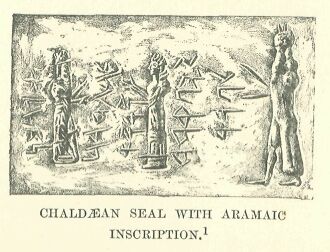
Drawn by Faucher- Gudin, from a photogravure published in Menant.
Thus another Israel began to rise up again, and, at first, the new Judah seems to have been on tolerably friendly terms with it: the two communities traded and intermarried with one another, the Samaritans took part in the religious ceremonies, and certain of their leaders occupied a court in the temple at Jerusalem. The alliance, however, proved dangerous to the purity of the faith, for the proselytes, while they adopted Jahveh and gave Him that supreme place in their devotions which was due to “the God of the land,” had by no means entirely forsworn their national superstitions, and Adrammelek, Nergal, Tartak, Anammelek, and other deities still found worshippers among them. Judah, which in the days of its independence had so often turned aside after the gods of Canaan and Moab, was in danger of being led away by the idolatrous practices of its new neighbours; intermarriage with the daughters of Moab and Ammon, of Philistia and Samaria, was producing a gradual degeneracy: the national language was giving way before the Aramaean; unless some one could be found to stem the tide of decadence and help the people to remount the slope which they were descending, the fate of Judah was certain. A prophet—the last of those whose predictions have survived to our time—stood forth amid the general laxity and called the people to account for their transgressions, in the name of the Eternal, but his single voice, which seemed but a feeble echo of the great prophets of former ages, did not meet with a favourable hearing. Salvation came at length from the Jews outside Judah, the naturalised citizens of Babylon, a well-informed and wealthy body, occupying high places in the administration of the empire, and sometimes in the favour of the sovereign also, yet possessed by an ardent zeal for the religion of their fathers and a steadfast faith in the vitality of their race. One of these, a certain Nehemiah, was employed as cupbearer to Artaxerxes II. He was visited at Susa by some men of Judah whose business had brought them to that city and inquired of them how matters fared in Jerusalem. Hanani, one of his visitors, replied that “the remnant that are left of the captivity there in the province are in great affliction and reproach: the wall of Jerusalem also is broken down, and the gates thereof are burned with fire.” Nehemiah took advantage of a moment when the king seemed in a jovial mood to describe the wretched state of his native land in moving terms: he obtained leave to quit Susa and authority to administer the city in which his fathers had dwelt.*
* Nehemiah i., ii.
This took place in the twentieth year of Artaxerxes, about 385 B.C. Nehemiah at once made his way to Jerusalem with such escort as befitted his dignity, and the news of his mission, and, apparently, the sentiments of rigid orthodoxy professed by him from the beginning, provoked the resentment of the neighbouring potentates against him: Sanballat the Horonite, Tobiah the Ammonite, chief of the Samaritans, and Geshem the Bedâwin did their best to thwart him in the execution of his plans. He baffled their intrigues by his promptitude in rebuilding the walls, and when once he had rendered himself safe from any sudden attack, he proceeded with the reforms which he deemed urgent. His tenure of office lasted twelve years—from 384 to 373 B.C.—and during the whole of that time he refused to accept any of the dues to which he was entitled, and which his predecessors had received without scruple. Ever since their return from exile, the common people had been impoverished and paralysed by usury. The poor had been compelled to mortgage their fields and their vineyards in order to pay the king’s taxes; then, when their land was gone, they had pledged their sons and their daughters; the moneyed classes of the new Israel thus absorbed the property of their poorer brethren, and reduced the latter to slavery. Nehemiah called the usurers before him and severely rebuking them for their covetousness, bade them surrender the interest and capital of existing debts, and restore the properties which had fallen into their hands owing to their shameful abuse of wealth, and release all those of their co-religionists whom they had enslaved in default of payment of their debts.* His high place in the royal favour doubtless had its effect on those whose cupidity suffered from his zeal, and prevented external enemies from too openly interfering in the affairs of the community: by the time he returned to the court, in 372 B.C., after an absence of twelve years, Jerusalem and its environs had to some extent regained the material prosperity of former days. The part played by Nehemiah was, however, mainly political, and the religious problem remained in very much the same state as before. The high priests, who alone possessed the power of solving it, had fallen in with the current that was carrying away the people, and—latterly, at any rate—had become disqualified through intermarriage with aliens: what was wanted was a scribe deeply versed in sacred things to direct them in the right way, and such a man could be found only in Babylonia, the one country in which the study of the ancient traditions still flourished. A certain Ezra, son of Seraiah, presented himself in 369 B.C., and, as he was a man of some standing, Artaxerxes not only authorised him to go himself, but to take with him a whole company of priests and Lévites and families formerly attached to the service of the temple.** The books containing the Law of God and the history of His people had, since the beginning of the captivity, undergone alterations which had profoundly modified their text and changed their spirit.
* Neh. v. ** Neh. xiii. 6: “in the two and thirtieth year of Artaxerxes, King of Babylon, I went unto the king.”
This work of revision, begun under the influence of Ezekiel, and perhaps by his own followers, had, since his time, been carried on without interruption, and by mingling the juridical texts with narratives of the early ages collected from different sources, a lengthy work had been produced, very similar in composition and wording to the five Books of Moses and the Book of Joshua as we now possess them.* It was this version of the Revelation of Jahveh that Ezra brought with him from Babylon in order to instruct the people of Judah, and the first impressions received by him at the end of his journey convinced him that his task would be no light one, for the number of mixed marriages had been so great as to demoralise not only the common people, but even the priests and leading nobles as well. Nevertheless, at a general assembly** of the people he succeeded in persuading them to consent to the repudiation of alien wives.
* This is the priestly revision presupposed by recent critics; here again, in order to keep within the prescribed limits of space, I have been compelled to omit much that I should have liked to add in regard to the nature of this work and the spirit in which it was carried out. ** Ezra, vii.-xi., where the dates given do not form part of the work as written by Ezra, but have been introduced later by the editor of the book as it now stands.
But this preliminary success would have led to nothing unless he could secure formal recognition of the rigorous code of which he had constituted himself the champion, and protracted negotiations were necessary before he could claim a victory on this point as well as on the other. At length, about 367 B.C., more than a year after his arrival, he gained his point, and the covenant between Jahveh and His people was sealed with ceremonies modelled on those which had attended the promulgation of Deuteronomy in the time of Josiah. On the first day of the seventh month, a little before the autumn festival, the people assembled at Jerusalem in “the broad place which was before the water gate.” Ezra mounted a wooden pulpit, and the chief among the priests sat beside him. He “opened the book in the sight of all the people... and... all the people stood up: and Ezra blessed the Lord, the great God. And all the people answered ‘Amen, amen!’ with the lifting up of their hands; and they bowed their heads and worshipped the Lord with their faces to the ground.” Then began the reading of the sacred text. As each clause was read, the Lévites stationed here and there among the people interpreted and explained its provisions in the vulgar tongue, so as to make their meaning clear to all. The prolix enumeration of sins and their expiation, and threats expressed in certain chapters, produced among the crowd the same effect of nervous terror as had once before been called forth by the precepts and maledictions of Deuteronomy. The people burst into tears, and so vehement were their manifestations of despair, that all the efforts of Ezra and his colleagues were needed to calm them. Ezra took advantage of this state of fervour to demand the immediate application of the divine ordinances. And first of all, it was “found written in the law, how that the Lord had commanded by Moses that the children of Israel should dwell in booths.” For, seven days Jerusalem was decked with leaves; tabernacles of olive, myrtle, and palm branches rose up on all sides, on the roofs of houses, in courtyards, in the courts of the temple, at the gates of the city. Then, on the 27th day of the same month, the people put on mourning in order to confess their own sins and the sins of their fathers. Finally, to crown the whole, Ezra and his followers required the assembly to swear a solemn oath that they would respect “the law of Moses,” and regulate their conduct by it.* After the first enthusiasm was passed, a reaction speedily set in. Many even among the priests thought that Ezra had gone too far in forbidding marriage with strangers, and that the increase of the tithes and sacrifices would lay too heavy a burden on the nation. The Gentile women reappeared, the Sabbath was no longer observed either by the Israelites or aliens; Eliashîb, son of the high priest Joiakim, did not even deprive Tobiah the Ammonite of the chamber in the temple which he had formerly prepared for him, and things were almost imperceptibly drifting back into the same state as before the reformation, when Nehemiah returned from Susa towards the close of the reign of Artaxerxes. He lost no time in re-establishing respect for the law, and from henceforward opposition, if it did not entirely die out, ceased to manifest itself in Jerusalem.**
* Neh. viii., ix., with an interpolation in ver. 9 of chap, viii., inserted in order to identify Nehemiah with the representative of the Persian government. ** Neh. xiii.
Elsewhere, however, among the Samaritans, Indumæans, and Philistines, it continued as keen as ever, and the Jews themselves were imprudent enough to take part in the political revolutions that were happening around them in their corner of the empire. Their traditions tell how they were mixed up in the rising of the Phoenician cities against Ochus, and suffered the penalty; when Sidon capitulated, they were punished with the other rebels, the more recalcitrant among them being deported into Hyrcania.
Assyria was nothing more than a name, Babylon and Phoenicia were growing weaker every day; the Jews, absorbed in questions of religious ethics, were deficient in material power, and had not as yet attained sufficient moral authority to exercise an influence over the eastern world: the Egypt indestructible had alone escaped the general shipwreck, and seemed fated to survive her rivals for a long time. Of all these ancient nations it was she who appealed most strongly to the imagination of the Greeks: Greek traders, mercenaries, scholars, and even tourists wandered freely within her borders, and accounts of the strange and marvellous things to be found there were published far and wide in the writings of Hecataeus of Miletus, Herodotus of Halicarnassus, and Hellanicus of Lesbos. As a rule, they entered the country from the west, as European tourists and merchants still do; but Eakôtis, the first port at which they touched, was a mere village, and its rocky Pharos had no claim to distinction beyond the fact that it had been mentioned by Homer. From hence they followed the channel of the Canopic arm, and as they gradually ascended, they had pointed out to them Anthylla, Arkandrupolis, and Gyna> copolis, townships dependent on Naucratis, lying along the banks, or situated some distance off on one of the minor canals; then Naucratis itself, still a flourishing place, in spite of the rebellions in the Delta and the suppressive measures of the Persians. All this region seemed to them to be merely an extension of Greece under the African sky: to their minds the real Egypt began at Sais, a few miles further eastwards. Sais was full in memories of the XXVIth dynasty; there they had pointed out to them the tombs of the Pharaohs in the enclosure of Nit, the audience hall in which Psammetichus II. received the deputation of the Eleians, the prison where the unfortunate Apries had languished after his defeat. The gateways of the temple of Nit seemed colossal to eyes accustomed to the modest dimensions of most Greek sanctuaries; these were, moreover, the first great monuments that the strangers had seen since they landed, and the novelty of their appearance had a good deal to do with the keenness of the impression produced. The goddess showed herself in hospitable guise to the visitors; she welcomed them all, Greek or Persian, at her festivals, and initiated them into several of her minor rites, without demanding from them anything beyond tolerance on certain points of doctrine.
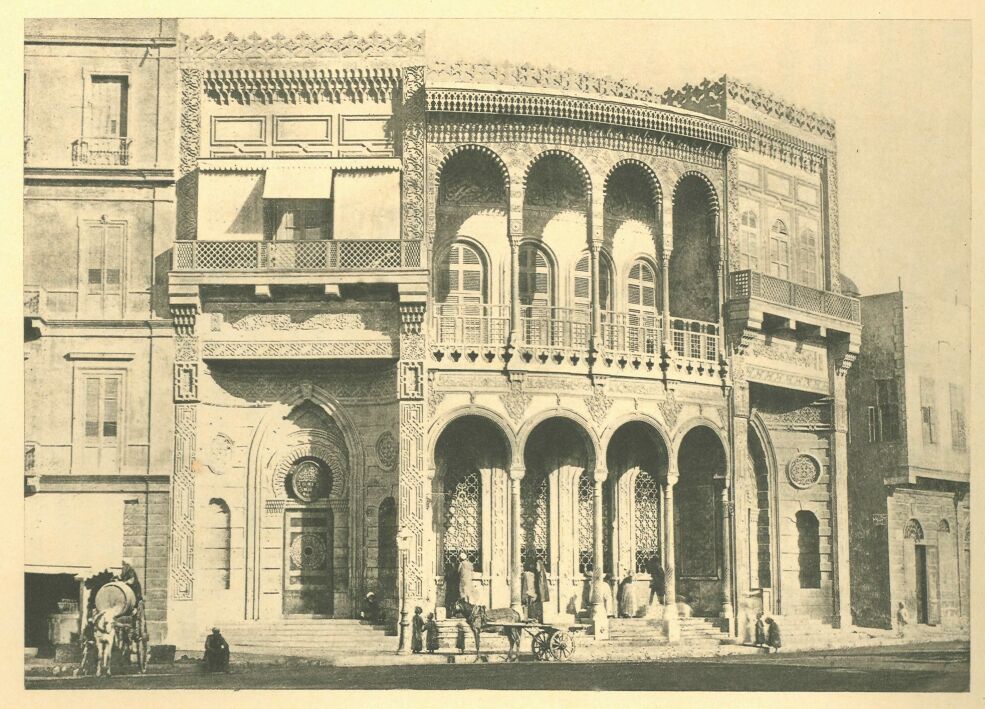

Her dual attributes as wielder of the bow and shuttle had inspired the Greeks with the belief that she was identical with that one of their own goddesses who most nearly combined in her person this complex mingling of war and industry: in her they Fountain and School of the Mother of Little Mohammed worshipped the prototype of their own Pallas. On the evening of the 17th day of Thoth, Herodotus saw the natives, rich and poor, placing on the fronts of their dwellings large flat lamps filled with a mixture of salt and oil which they kept alight all night in honour of Osiris and of the dead.*
* In my opinion it is not the festivals of Athyr that are here referred to, but those of the month of Thoth, when, as the inscriptions show, it was the practice to light the new fire, according to the ritual, after first extinguishing the fire of the previous year, not only in the temple of the god, but in all the houses of the city.
Drawn by Boudier, from a photograph by Gautier.
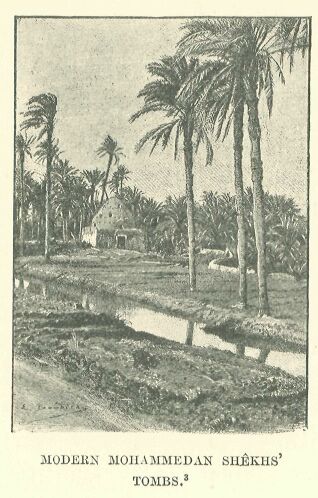
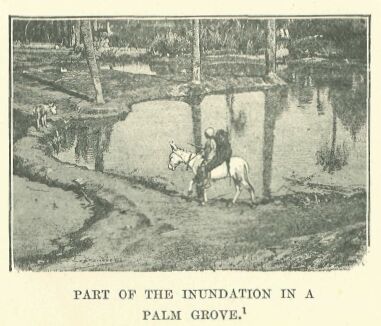
He made his way into the dwelling of the ineffable god, and there, unobserved among the crowd, he witnessed scenes from the divine life represented by the priests on the lake by the light of torches, episodes of his passion, mourning, and resurrection. The priests did not disclose their subtler mysteries before barbarian eyes, nor did they teach the inner meaning of their dogmas, but the little they did allow him to discern filled the traveller with respect and wonder, recalling sometimes by their resemblance to them the mysteries in which he was accustomed to take part in his own country. Then, as now, but little attention was paid to the towns in the centre and east of the Delta; travellers endeavoured to visit one or two of them as types, and collected as much information as they could about the remainder. Herodotus and his rivals attached little importance to those details of landscape which possess so much attraction for the modern tourist. They bestowed no more than a careless glance on the chapels scattered up and down the country like the Mohammedan shrines at the present day, and the waters extending on all sides beneath the acacias and palm trees during the inundation, or the fellahin trotting along on their little asses beside the pools, did not strike them as being of sufficient interest to deserve passing mention in an account of their travels.
They passed by the most picturesque villages with indifference, and it was only when they reached some great city, or came upon some exceptionally fine temple or eccentric deity, that their curiosity was aroused. Mendes worshipped its patron god in the form of a live ram,* and bestowed on all members of the same species some share of the veneration it lavished on the divine animal. The inhabitants of Atarbêkhis,** on the island of Prosopitis, gave themselves up to the worship of the bull.
* Herodotus says that both the goats and the god were named Mendes in Egyptian, but he is here confusing ordinary goats with the special goat which was supposed to contain the soul of Osiris. It was the latter that the Egyptians named after the god himself, Baînibdîduît, i.e. the soul of the master of the city of Diduît. ** The old explanation of this name as the City of Hathor has been rightly rejected as inconsistent with one of the elementary rules of hieroglyphic grammar. The name, when properly divided into its three constituent parts, means literally the Castle of horus the Sparrow-hawk, or Hat-har- baki
Drawn by Boudier, from a photograph by Gautier.
When one of these animals died in the neighbourhood they buried it, leaving one horn above the earth in order to mark the spot, and once every year the boats of Atarbêkhis made a tour round the island to collect the skeletons or decaying bodies, in order that they might be interred in a common burying-place.
The people of Busiris patronised a savage type of religion. During the festival of Isis they gave themselves up to fierce conflicts, their fanatical fury even infecting strangers who chanced to be present. The Carians also had hit upon a means of outdoing the extravagance of the natives themselves: like the Shiite Mohammedans of the present day at the festival of the Hassanên, they slashed their faces with knives amidst shrieks and yells. At Paprêmis a pitched battle formed part of the religious observances: it took place, however, under certain special conditions. On the evening of the festival of Anhurît, as the sun went down, a number of priests performed a hasty sacrifice in the temple, while the remainder of the local priesthood stationed themselves at the gate armed with heavy cudgels. When the ceremony was over, the celebrants placed the statue of the god on a four-wheeled car as though about to take it away to some other locality, but their colleagues at the gate opposed its departure and barred the way. It was at this juncture that the faithful intervened; they burst in the door and set upon the priests with staves, the latter offering a stout resistance. The cudgels were heavy, the arms that wielded them lusty, and the fight lasted a long time, yet no one was ever killed in the fray—at least, so the priests averred—and I am at a loss to understand why Herodotus, who was not a native of Paprêmis, should have been so unkind as to doubt their testimony.*
* The god whom the Greeks identified with their Ares was Anhurît, as is proved by one of the Leyden Papyri. So, too, in modern times at Cairo, it used to be affirmed that no Mohammedan who submitted to the dôseh was ever seriously injured by the hoofs of the horse which trampled over the bodies extended on the ground.
Drawn by Boudier, from a photograph by Haussoullier.
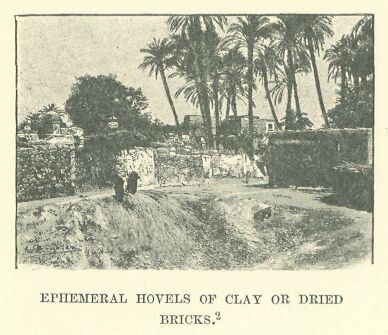
It is nearly always in connection with some temple or religious festival that he refers to the towns of the Delta, and, indeed, in most of the minor cities of Egypt, just as in those of modern Italy there is little to interest visitors except the religious monuments or ceremonies. Herodotus went to Tanis or Mendes as we go to Orvieto or Loretto, to admire the buildings or pay our devotions at a famous shrine. More often than not the place was nothing in itself, consisting merely of a fortified enclosure, a few commonplace houses occupied by the wealthy inhabitants or by government officials, and on mounds of ancient debris, the accumulation of centuries, a number of ephemeral hovels built of clay, or dried bricks, divided into irregular blocks by winding alleys. The whole local interest was centred in the sanctuary and its inmates, human and divine. The traveller made his way in as best he could, went into ecstasies over the objects that were shown to him, and as soon as he had duly gone the rounds, set out for the next place on his list, deeming himself lucky if he happened to arrive during one of the annual fairs, such as that of Bubastis, for instance. Bands of pilgrims flocked in from all parts of Egypt; the river craft were overflowing with men and women, who converted the journey into one long carnival. Every time the vessel put in to land, the women rushed on shore, amid the din of castanets and flutes, and ran hither and thither challenging the women of the place with abuse to dance against them with uplifted garments. To the foreigners there was little to distinguish the festival of Bastît from many other Egyptian ceremonies of the kind; it consisted of a solemn procession, accompanied by the singing of hymns and playing of harps, dancing and sacrifices, but for weeks before and after it the town was transformed into one vast pleasure-ground. The people of Bubastis took a certain pride in declaring that more wine was drunk in it during a single day than during the rest of the whole year. Butô enjoyed exceptional popularity among the Greeks in Egypt. Its patron goddess, the Isis who took refuge amid the pools in a moving thicket of reeds and lotus, in order that she might protect her son Horus from the jealousy of Typhon, reminded them of the story of Latona and the cycle of the Delian legends; they, visited her in crowds, and her oracle became to most of them what that of Delos was to their brethren in Europe. At Butô they found a great temple, similar to all Egyptian temples, a shrine in which the statues of the goddess continued her mysterious existence, and, in the midst of the sacred lake, the little island of Khemmis, which was said to float hither and thither upon the waters. Herodotus did not venture to deny this absolutely, but states that he had never seen it change its position or even stir: perhaps his incredulity may have been quickened by the fact that this miracle had already been inquired into by Hecatasus of Miletus, an author who was his pet aversion. The priests of Butô declared that their prophets had foretold everything that had happened for a long time past, and for each event they had a version which redounded to the credit of their goddess: she had shown Pheron how he might recover his sight, had foretold how long the reign of Mykerinos would last, had informed Psammetichus that he would be saved by men of brass rising out of the sea, and had revealed to Cambyses that he should die in a town named Ecbatana. Her priests had taken an active part in the revolt of Khabbîsha against Darius, and had lost a goodly portion of their treasure and endowments for their pains. They still retained their prestige, however, in spite of the underhand rivalry of the oracle of Zeus Ammon. The notaries of the Libyan deity could bring forward miracles even more marvellous than those credited to the Egyptian Latona, and in the case of many of the revolutions which had taken place on the banks of the Nile, a version of the legend in his honour was circulated side by side with the legends of Butô. The latter city lay on the very outskirts of one of those regions which excited the greatest curiosity among travellers, the almost inaccessible Bucolicum, where, it was said, no rebel ever failed to find a safe refuge from his alien pursuers. The Egyptians of the marshes were a very courageous race, but savage, poor, and ill fed. They drank nothing but beer, and obtained their oil not from the olive, but from the castor-oil plant,* and having no corn, lived on the seeds or roots of the lotus, or even on the stalks of the papyrus, which they roasted or boiled.
* It seems, moreover, that this custom was not confined to the Delta; Herodotus, in contrasting the custom of Bucolicum with that of the rest of Egypt, was evidently thinking of Sais, Memphis, and other great cities in which he had resided, where foreign olive oil obtained from Greece or Syria was generally used.
Fish was their staple article of food, and this they obtained in considerable quantity from Lake Menzaleh, the lagoons along the coast, and the canals or pools left by the inundation. But little was known of their villages or monuments, and probably they were not worth the trouble of a visit after those of the cities of the plain: endless stories were told of feats of brigandage and of the mysterious hiding-places which these localities offered to every outlaw, one of the most celebrated being the isle of Elbô, where the blind Anysis defied the power of Ethiopia for thirty years, and in which the first Amyrtasus found refuge. With the exception of a few merchants or adventurers who visited them with an eye to gain, most travellers coming from or returning to Asia avoided their territory, and followed the military road along the Pelusiac arm of the Nile from Pehisium to Daphno or Zalu, and from Daphnæ or Zalu to Bubastis. A little below Kerkasoron, near the apex of the Delta, the pyramids stood out on the horizon, looking insignificant at first, but afterwards so lofty that, during the period of inundation, when the whole valley, from the mountains of Arabia to those of Libya, was nothing but one vast river, a vessel seemed to sail in their shadow for a long time before it reached their base. The traveller passed Heliopolis on his left with its temple of the Sun, next the supposed sources of the Northern Nile, the quarries of the Red Mountain, and then entering at length the Nile itself, after a journey of some hours, came to anchor by the quays of Memphis.
To the Greeks of that time, Memphis was very much what Cairo is to us, viz. the typical Oriental city, the quintessence and chief representative of ancient Egypt. In spite of the disasters which had overwhelmed it during the last few centuries, it was still a very beautiful city, ranking with Babylon as one of the largest in the world. Its religious festivals, especially those in honour of Apis, attracted numberless pilgrims to it at certain seasons of the year, and hosts of foreigners, recruited from every imaginable race of the old continent, resorted to it for purposes of trade. Most of the nationalities who frequented it had a special quarter, which was named after them; the Phoenicians occupied the Tyrian Camp, the Greeks and Carians the Hellenic Wall and Carian Wall, and there were Oaromemphites or Hellenomemphites side by side with the native inhabitants. A Persian garrison was stationed within the White Wall, ready to execute the satrap’s orders in the event of rebellion, and could have held out for a long time even after the rest of the country had fallen into the hands of the insurgents. Animals which one would scarcely have expected to find in the streets of a capital, such as cows, sheep, and goats, wandered about unheeded in the most crowded thoroughfares; for the common people, instead of living apart from their beasts, as the Greeks did, stabled them in their own houses. Nor was this the only custom which must have seemed strange in the eyes of a newly arrived visitor, for the Egyptians might almost have been said to make a point of doing everything differently from other nation’s. The baker, seen at the kneading-trough inside his shop, worked the dough with his foot; on the other hand, the mason used no trowel in applying his mortar, and the poorer classes scraped up handfuls of mud mixed with dung when they had occasion to repair the walls of their hovels. In Greece, even the very poorest retired to their houses and ate with closed doors; the Egyptians felt no repugnance at eating and drinking in the open air, declaring that unbecoming and improper acts should be performed in secret, but seemly acts in public. The first blind alley they came to, a recess between two hovels, the doorstep of a house or temple, any of these seemed to them a perfectly natural place to dine in. Their bill of fare was not a sumptuous one. A sort of flat pancake somewhat bitter in taste, and made—not of corn or barley—but of spelt, a little oil, an onion or a leek, with an occasional scrap of meat or poultry, washed down by a jug of beer or wine; there was nothing here to tempt the foreigner, and, besides, it would not have been thought right for him to invite himself. A Greek who lived on the flesh of the cow was looked upon as unclean in the highest degree; no Egyptian would have thought of using the same pot or knife with him, or of kissing him on the mouth by way of greeting. Moreover, Egyptian etiquette did not tolerate the same familiarities as the Greek: two friends on catching sight of one another paused before they met, bowed, then clasped one another round the knees or pretended to do so. Young people gave way to an old man, or, if seated, rose to let him pass. The traveller recalled the fact that the Spartans behaved in the same way, and approved this mark of deference; but nothing in his home-life had prepared him for the sight of respectable women coming and going as they pleased, without escort and unveiled, carrying burdens on their shoulders (whereas the men carried them on their heads), going to market, keeping stalls or shops, while their husbands or fathers stayed comfortably at home, wove cloth, kneaded the potter’s clay or turned the wheel, and worked at their trades; no wonder that they were ready to believe that the man was the slave, and the wife the mistress of the family. Some historians traced the origin of these customs back to Osiris, others only as far as Sesostris: Sesostris was the last resource of Greek historians when they got into difficulties. The city was crowded with monuments; there was the temple of the Phoenician Astarte, in which priests of Syrian descent had celebrated the mysteries of the great goddess ever since the days of the XVIIIth dynasty; then there was the temple of Râ, the temple of Amon, the temple of Tamu, the temple of Bastît, and the temple of Isis.*
* This list is taken mainly from one of the mutilated letters found on the back of the Sallier Papyrus. The Phoenician Astarte, called a foreign Aphrodite by Herodotus, was regarded by the Egyptians as a counterpart of Bastît, lady of Onkhtoui.
The temple of Phtah, as yet intact, provided the visitor with a spectacle scarcely less admirable than that offered by the temple of the Theban Amon at Karnak. The kings had modified the original plan as each thought best, one adding obelisks or colossal statues, another a pylon, a third a pillared hall. Completed in this way by the labours of a score of dynasties, it formed, as it were, a microcosm of Egyptian history, in which each image, inscription and statue, aroused the attention of the curious. They naturally desired to learn who were the strangely dressed races shown struggling in a battle scene, the name of the king who had conquered them, and the reasons which had led him to construct this or that part of a monument, and there were plenty of busybodies ready to satisfy, as far as they could, the curiosity of visitors. Interpreters were at hand who bartered such information as they possessed, and the modern traveller who has had occasion to employ the services of a dragoman will have no difficulty in estimating the value of intelligence thus hawked about in ancient times. Priests of the lower class, doorkeepers and sacristans were trained to act as ciceroni, and knew the main outlines of the history of the temple in which they lived. Menés planned it, Moeris added the northern propylæ, Ehampsinitus those on the west, Psammetichus the south, Asychis those on the east, the most noteworthy of them all. A native of Memphis, born at the foot of the pyramids, had been familiar with the names of Menés and Cheops from childhood; he was consequently apt to attribute to them everything of importance achieved by the Pharaohs of the old days. Menés had built the temple, Menés had founded the city, Menés had created the soil on which the city stood, and preserved it from floods by his dykes. The thoughtful traveller would assent, for had he not himself observed the action of the mud; a day’s journey from the coast one could not let down a plummet without drawing it up covered with a blackish slime, a clear proof that the Nile continued to gain upon the sea. Menés, at all events, had really existed; but as to Asychis, Moris, Proteus, Pheron, and most of the characters glibly enumerated by Herodotus, it would be labour lost to search for their names among the inscriptions; they are mere puppets of popular romance, some of their names, such as Pirâui or Pruti, being nothing more than epithets employed by the story-tellers to indicate in general terms the heroes of their tales. We can understand how strangers, placed at the mercy of their dragoman, were misled by this, and tempted to transform each title into a man, taking Pruti and Pirâui to be Pharaoh Proteus and Pharaoh Pheron, each of them celebrated for his fabulous exploits. The guides told Herodotus, and Herodotus retails to us, as sober historical facts, the remedy employed by this unhistorical Pheron in order to recover his sight; the adventures of Paris and Helen at the court of Proteus,* and the droll tricks played by a thief at the expense of the simple Ehampsinitus.
* Some dragomans identified the Helen of the Homeric legend with the “foreign Aphrodite” who had a temple in the Tyrian quarter at Memphis, and who was really a Semitic divinity.
Drawn by Boudier, from a photograph by Haussoullier.
The excursions made by the Greek traveller in the environs of Memphis were very similar to those taken by modern visitors to Cairo: on the opposite bank of the Nile there was Heliopolis with its temple of Râ, then there were the quarries of Turah, which had been worked from time immemorial, yet never exhausted, and from which the monuments he had been admiring, and the very Pyramids themselves had been taken stone by stone.*
* These are “the quarries in the Arabian Mountain,” mentioned by Herodotus without indication of the local name.
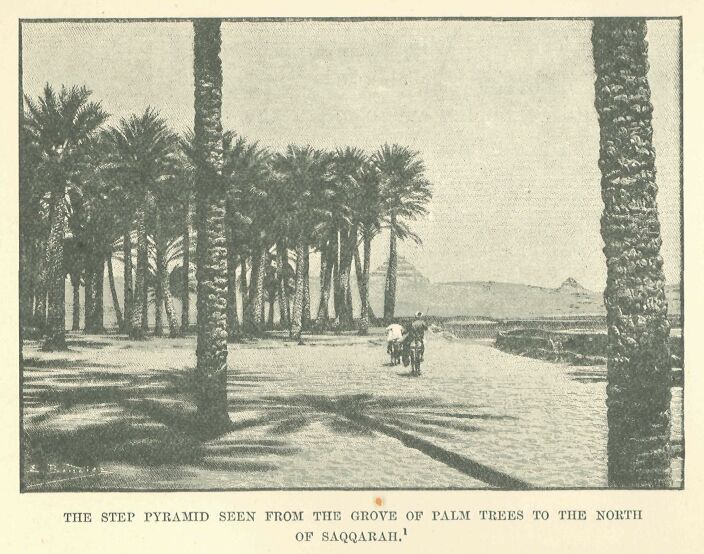
The Sphinx probably lay hidden beneath the sand, and the nearest Pyramids, those at Saqqarah, were held in small esteem by visitors;* they were told as they passed by that the step Pyramid was the most ancient of all, having been erected by Uenephes, one of the kings of the first dynasty, and they asked no further questions.
* Herodotus does not mention it, nor does any other writer of the Greek period.
Drawn by Boudier, from a photograph by Gautier.
Their whole curiosity was reserved for the three giants at Gizeh and their inmates, Cheops, Chephren, Mykerinos, and the fair Nitokris with the rosy cheeks. Through all the country round, at Heliopolis, and even in the Fayum itself, they heard the same names that had been dinned into their ears at Memphis; the whole of the monuments were made to fit into a single cycle of popular history, and what they learned at one place completed, or seemed to complete, what they had learned at another.
I cannot tell whether many of them cared to stray much beyond Lake Moris: the repressive measures of Ochus had, as it would appear, interrupted for a time the regular trade which, ever since the Saite kings of the XXVIth dynasty, had been carried on by the Greeks with the Oases, by way of Abydos. A stranger who ventured as far as the Thebaid would have found himself in the same plight as a European of the last century who undertook to reach the first cataract. Their point of departure—Memphis or Cairo—was very much the same; their destinations—Elephantine and Assuan—differed but little. They employed the same means of transport, for, excepting the cut of the sails, the modern dahabeah is an exact counterpart of the pleasure and passenger boats shown on the monuments. Lastly, they set out at the same time of year, in November or December, after the floods had subsided. The same length of time was required for the trip; it took a month to reach Assuan from Cairo if the wind-were favourable, and if only such stoppages were made as were strictly necessary for taking in fresh provisions. Pococke, having left Cairo on the 6th of December, 1737, about midday, was at Akhmîm by the 17th. He set sail again on the 18th, stayed at Thebes from the 13th of January, 1738, till the 17th, and finally moored at Assuan on the evening of January 20th, making in all forty-five days, fourteen of which were spent at various stopping-places. If the diary of a Greek excursionist or tourist had come down to us, we should probably find in it entries of a very similar kind.* The departure from Memphis would take place in November or December; ten or twelve days later the traveller would find himself at Panopolis;** from Panopolis to Elephantine, stopping at Coptos and Thebes, would take about a month, allowing time for a stay at Thebes, and returning to Memphis in February or March.
* Herodotus fixes twenty days for the voyage from Sais to Elephantine. This period of time must be probably correct, since at the present day dahabeahs constantly run from Cairo to the second cataract and back in two months, including stoppages of ten days to a fortnight for seeing the monuments. The twenty days of Herodotus represent the minimum duration of the voyage, without taking into account the stoppages and accidents which often delay sailing vessels on the Nile. Nine days, which Herodotus gives as the time for reaching Thebes, is not sufficient, if the voyage is undertaken in the usual way, stopping every evening for the night; but it would be possible if the navigation were uninterrupted day and night. This is now rarely done, but it might have been frequent in ancient times, especially in the service of the State. ** It would seem clear that Herodotus stopped at Panopolis and had communications with the people of the town. [Panopolis or Khemmis is the present Ekhmîm.—Tr.]
The greater part of the time was employed in getting from one point to another, and the necessity of taking advantage of a favourable wind in going up the river, often obliged the travellers to neglect more than one interesting locality.
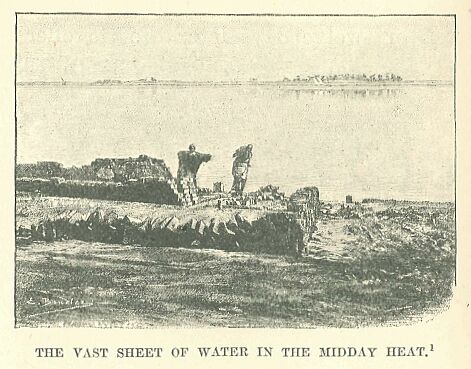
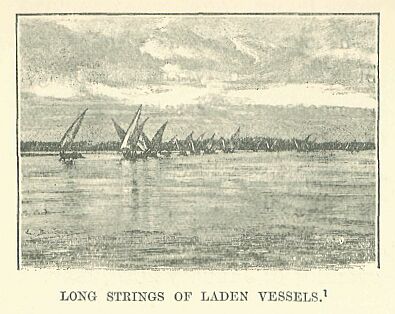
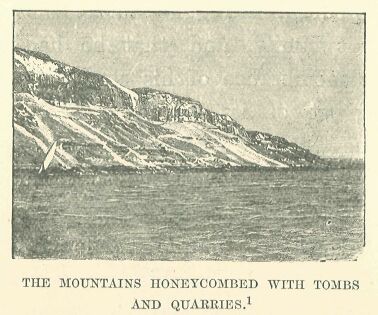
The Greek was not so keenly alive to the picturesqueness of the scenes through which he passed as the modern visitor, and in the account of his travels he took no note of the long lines of laden boats going up or down stream, nor of the vast sheet of water glowing in the midday sun, nor of the mountains honeycombed with tombs and quarries, at the foot of which he would be sailing day after day. What interested him above all things was information with regard to the sources of the immense river itself, and the reasons for its periodic inundation, and, according to the mental attitude impressed on him by his education, he accepted the mythological solution offered by the natives, or he sought for a more natural one in the physical lore of his own savants: thus he was told that the Nile took its rise at Elephantine, between the two rocks called Krôphi and Môphi, and in showing them to him his informant would add that Psammetichus I. had attempted to sound the depth of the river at this point, but had failed to fathom it. At the few places where the pilot of the barque put in to port, the population showed themselves unfriendly, and refused to hold any communication with the Greeks.
Drawn by Boudier, from a photograph by Gautier.
The interpreters, who were almost all natives of the Delta, were not always familiar with the people and customs of the Said, and felt almost as completely foreign at Thebes as did their employers. Their office was confined to translating the information furnished by the inhabitants when the latter were sufficiently civilised to hold communication with the travellers. What most astonished Herodotus at Panopolis was the temple and the games held in honour, so he believed, of Perseus, the son of Danaë. These exercises terminated in an attempt to climb a regular “greasy pole” fixed in the ground, and strengthened right and left by three rows of stays attached to the mast at different heights; as for Perseus, he was the ithyphallic god of the locality, Mînu himself, one of whose epithets—Pehresu, the runner—was confounded by the Greek ear with the name of the hero. The dragomans, enlarging on this mistaken identity, imagined that the town was the birthplace of Danaos and Lyncseus; that Perseus, returning from Libya with the head of Medusa, had gone out of his way to visit the cradle of his family, and that he had instituted the games in remembrance of his stay there. Thebes had become the ghost of its former self; the Persian governors had neglected the city, and its princesses and their ministers were so impoverished that they were unable to keep up its temples and palaces. Herodotus scarcely mentions it, and we can hardly wonder at it: he had visited the still flourishing Memphis, where the temples were cared for and were filled with worshippers. What had Thebes to show him in the way of marvels which he had not already seen, and that, too, in a better state of preservation? His Theban ciceroni also told him the same stories that he had heard in Lower Egypt, and he states that their information agreed in the main with that which he had received at Memphis and Heliopolis, which made it unnecessary to repeat it at length. Two or three things only appeared to him worthy of mention. His admiration was first roused by the 360 statues of the high priests of Amon which had already excited the wonder of his rival Hecataeus; he noted that all these personages were, without exception, represented as mere men, each the son of another man, and he took the opportunity of ridiculing the vanity of his compatriots, who did not hesitate to inscribe the name of a god at the head of their genealogies, removed by some score of generations only from their own. On the other hand, the temple servitors related to him how two Theban priestesses, carried off by the Phoenicians and sold, one in Libya and the other in Greece, had set up the first oracles known in those two countries: Herodotus thereupon remembered the story he had heard in Epirus of two black doves which had flown away from Thebes, one towards the Oasis of Ammon, the other in the direction of Dodona; the latter had alighted on an old beech tree, and in a human voice had requested that a temple consecrated to Zeus should be founded on the spot.*
* This indicates a confusion in the minds of the Egyptian dragomans with the two brooding birds of Osiris, Isis and Nephthys, considered as Zarait, that is to say, as two birds of a different species, according to the different traditions either vultures, rooks, or doves.
Herodotus is quite overcome with joy at the thought that Greek divination could thus be directly traced to that of Egypt, for like most of his contemporaries, he felt that the Hellenic cult was ennobled by the fact of its being derived from the Egyptian. The traveller on the Nile had to turn homewards on reaching Elephantine, as that was the station of the last Persian garrison. Nubia lay immediately beyond the cataract, and the Ethiopians at times crossed the frontier and carried their raids as far as Thebes. Elephantine, like Assuan at the present day, was the centre of a flourishing trade. Here might be seen Kushites from Napata or Meroë, negroes from the Upper Nile and the Bahr el-Ghazal, and Ammonians, from all of whom the curious visitor might glean information while frequenting the bazaars. The cataract was navigable all the year round, and the natives in its vicinity enjoyed the privilege of piloting freight boats through its difficult channel. It took four days to pass through it, instead of the three, or even two, which suffice at the present day. Above it, the Nile spread out and resembled a lake dotted over with islands, several of which, such as Phike and Biggeh, contained celebrated temples, which were as much frequented by the Ethiopians as by the Egyptians.
Drawn by Faucher- Gudin
Correctly speaking, it was not Egypt herself that the Greeks saw, but her external artistic aspect and the outward setting of Egyptian civilisation. The vastness of her monuments, the splendour of her tombs, the pomp of her ceremonies, the dignity and variety of her religious formulas, attracted their curiosity and commanded their respect: the wisdom of the Egyptians had passed into a proverb with them, as it had with the Hebrews. But if they had penetrated behind the scenes, they would have been obliged to acknowledge that beneath this attractive exterior there was hopeless decay. As with all creatures when they have passed their prime, Egypt had begun to grow old, and was daily losing her elasticity and energy. Her spirit had sunk into a torpor, she had become unresponsive to her environment, and could no longer adapt herself to the form she had so easily acquired in her youth: it was as much as she could do to occupy fully the narrower limits to which she had been reduced, and to maintain those limits unbroken. The instinct which made her shrink from the intrusion of foreign customs and ideas, or even mere contact with nations of recent growth, was not the mere outcome of vanity. She realised that she maintained her integrity only by relying on the residue of her former solidarity and on the force of custom. The slightest disturbance of the equilibrium established among her members, instead of strengthening her, would have robbed her of the vigour she still possessed, and brought about her dissolution.
She owed whatever activity she possessed to impulses imparted to her by the play of her ancient mechanism—a mechanism so stable in its action, and so ingeniously constructed, that it had still a reserve of power within it sufficient to keep the whole in motion for centuries, provided there was no attempt to introduce new wheels among the old. She had never been singularly distinguished for her military qualities; not that she was cowardly, and shrank from facing death, but because she lacked energy and enthusiasm for warlike enterprise. The tactics and armaments by which she had won her victories up to her prime, had at length become fetters which she was no longer inclined to shake off, and even if she was still able to breed a military caste, she was no longer able to produce armies fit to win battles without the aid of mercenaries. In order to be successful in the field, she had to associate with her own troops recruits from other countries—Libyans, Asiatics, and Greeks, who served to turn the scale. The Egyptians themselves formed a compact body in this case, and bearing down upon the enemy already engaged by the mercenaries, broke through his ranks by their sheer weight, or, if they could not accomplish this, they stood their ground bravely, taking to flight only when the vacancies in their ranks showed them that further resistance was impossible. The machinery of government, like the organisation of their armies, had become antiquated and degenerate.
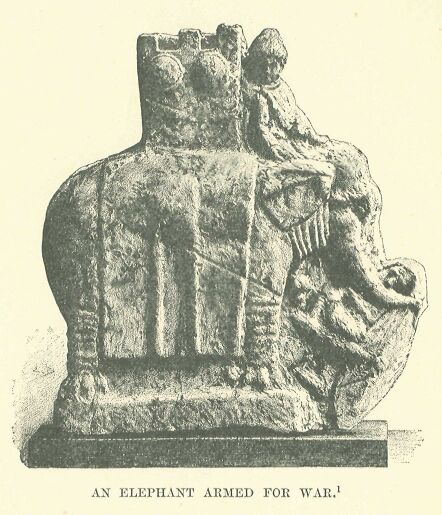
Drawn by Boudier, from a little terra-cotta group from Myrrhina now in the Louvre. This object dates from the time of the kings of Pergamos, and the soldier round whom the elephant winds his trunk in order to dash him to the ground is a Gaul of Asia Minor.
The nobility were as turbulent as in former times, and the royal authority was as powerless now as of old to assert itself in the absence of external help, or when treason was afoot among the troops. Religion alone maintained its ascendency, and began to assume to itself the loyalty once given to the Pharaoh, and the devotion previously consecrated to the fatherland. The fellahîn had never fully realised the degradation involved in serving a stranger, and what they detested in the Persian king was not exactly the fact that he was a Persian. Their national pride, indeed, always prompted them to devise some means of connecting the foreign monarch with their own solar line, and to transform an Achæmenian king into a legitimate Pharaoh. That which was especially odious to them in a Cambyses or an Ochus was the disdain which such sovereigns displayed for their religion, and the persecution to which they subjected the immortals. They accustomed themselves without serious repining to have no longer one of their own race upon the throne, and to behold their cities administered by Asiatics, but they could not understand why the foreigner preferred his own gods, and would not admit Amon, Phtah, Horus, and Râ to the rank of supreme deities. Ochus had, by his treatment of the Apis and the other divine animals, put it out of his power ever to win their good will. His brutality had made an irreconcilable enemy of that state which alone gave signs of vitality among the nations of the decaying East. This was all the more to be regretted, since the Persian empire, in spite of the accession of power which it had just manifested, was far from having regained the energy which had animated it, not perhaps in the time of Darius, but at all events under the first Xerxes. The army and the wealth of the country were doubtless still intact—an army and a revenue which, in spite of all losses, were still the largest in the world—but the valour of the troops was not proportionate to their number. The former prowess of the Persians, Medians, Bactrians, and other tribes of Iran showed no degeneracy: these nations still produced the same race of brave and hardy foot-soldiers, the same active and intrepid horsemen; but for a century past there had not been the improvements either in the armament of the troops or in the tactics of the generals which were necessary to bring them up to the standard of excellence of the Greek army. The Persian king placed great faith in extraordinary military machines. He believed in the efficacy of chariots armed with scythes; besides this, his relations with India had shown him what use his Oriental neighbours made of elephants, and having determined to employ these animals, he had collected a whole corps of them, from which he. hoped great things. In spite of the addition of these novel recruits, it was not on the Asiatic contingents that he chiefly relied in the event of war, but on the mercenaries who’ were hired at great expense, and who formed the chief support of his power. From the time of Artaxerxes II. onwards, it was the Greek hoplites and peltasts who had always decided the issue of the Persian battles. The expeditions both by land and sea had been under the conduct of Athenian or Spartan generals—Conon, Chabrias, Iphi-crates, Agesilas, Timotheus, and their pupils; and again also it was to the Greeks—to the Rhodian Mentor and to, Memnon—that Ochus had owed his successes. The older nations—Egypt, Syria, Chaldæa, and Elam—had all had their day of supremacy; they had declined in the course of centuries, and Assyria had for a short time united them under her rule. On the downfall of Assyria, the Iranians had succeeded to her heritage, and they had built up a single empire comprising all the states which had preceded them in Western Asia; but decadence had fallen upon them also, and when they had been masters for scarcely two short centuries, they were in their turn threatened with destruction. Their rule continued to be universal, not by reason of its inherent vigour, but on account of the weakness of their subjects and neighbours, and a determined attack on any of the frontiers of the empire would doubtless have resulted in its overthrow.
Greece herself was too demoralised to cause Darius any grave anxiety. Not only had she renounced all intention of attacking the great king in his own domain, as in the days of the Athenian hegemony, when she could impose her own conditions of peace, but her perpetual discords had yielded her an easy prey to Persia, and were likely to do so more and more. The Greek cities chose the great king as the arbiter in their quarrels; they vied with each other in obtaining his good will, his subsidies in men and vessels, and his darics: they armed or disarmed at his command, and the day seemed at hand when they would become a normal dependency of Persia, little short of a regular satrapy like Asiatic Hellas. One chance of escape from such a fate remained to them—if one or other of them, or some neighbouring state, could acquire such an ascendency as to make it possible to unite what forces remained to them under one rule. Macedonia in particular, having hitherto kept aloof from the general stream of politics, had at this juncture begun to shake off its lethargy, and had entered with energy into the Hellenic concert under the auspices of its king, Philip. Bagoas recognised the danger which threatened his people in the person of this ambitious sovereign, and did not hesitate to give substantial support to the adversaries of the Macedonian prince; Chersobleptes of Thrace and the town of Perinthus receiving from him such succour as enabled them to repulse Philip successfully (340). Unfortunately, while Bagoas was endeavouring to avert danger in this quarter, his rivals at court endeavoured to prejudice the mind of the king against him, and their intrigues were so successful that he found himself ere long condemned to the alternative of murdering his sovereign or perishing himself. He therefore poisoned Ochus, to avoid being assassinated or put to the torture, and placed on the throne Arses, the youngest of the king’s sons, while he caused the remaining royal children to be put to death (336).* Egypt hailed this tragic end as a mark of the vengeance of the gods whom Ochus had outraged. A report was spread that the eunuch was an Egyptian, that he had taken part in the murder of the Apis under fear of death, but that when he was sure of his own safety he had avenged the sacrilege. As soon as the poison had taken effect, it was said he ate a portion of the dead body and threw the remainder to the cats: he then collected the bones and made them into whistles and knife-handles.**
* Plutarch calls the successor of Ochus Oarses, which recalls the name which Dinon gives to Artaxerxes II. Diodorus says that Bagoas destroyed the whole family of Ochus, but he is mistaken. Arrian mentions a son of Ochus about 330, and several other members of the royal Achæmenian race are known to have been living in the time of Alexander. ** The body of the enemy thrown to the cats to be devoured is a detail added by the popular imagination, which crops up again in the Tale of Satni Khâmois.
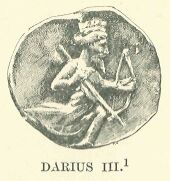
Ochus had astonished his contemporaries by the rapidity with which he had re-established the integrity of the empire; they were pleased to compare him with the heroes of his race, with Cyrus, Cambyses, and Darius. But to exalt him to such a level said little for their moral or intellectual perceptions, since in spite of his victories he was merely a despot of the ordinary type; his tenacity degenerated into brutal obstinacy, his severity into cruelty, and if he obtained successes, they were due rather to his generals and his ministers than to his own ability. His son Arses was at first content to be a docile instrument in the hands of Bagoas; but when the desire for independence came to him with the habitual exercise of power, and he began to chafe at his bonds, the eunuch sacrificed him to his own personal safety, and took his life as he had done that of his father in the preceding year (336). So many murders following each other in rapid succession had considerably reduced the Achsemenian family, and Bagoas for a moment was puzzled where to find a king: he at length decided in favour of Codomannos, who according to some was a great-grandson of Darius II., but according to others was not of the royal line, but had in his youth been employed as a courier. He had distinguished himself in the hostilities against the Casduians, and had been nominated satrap of Armenia by Ochus as a reward for his bravery. He assumed at his accession the name of Darius; brave, generous, clement, and possessed with an ardent desire to do right, he was in every way the superior of his immediate predecessors, and he deserved to have reigned at a time when the empire was less threatened. Bagoas soon perceived that his new protégé, whose conduct he had reckoned on directing as he pleased, intended to govern for himself, and he therefore attempted to get rid of him; Bagoas was, however, betrayed by his accomplices, and compelled to drink the poison which he had prepared for Darius. These revolutions had distracted the attention of the court of Susa from the events which were taking place on the shores of the Ægean, and Philip had taken advantage of them to carry into effect the designs against Persia which he had been long meditating. After having been victorious against the Greeks, he had despatched an army of ten thousand men into Asia under the command of Parmenion and Attains (336). We may ask if it were not he who formed the project of universal conquest which was so soon to be associated with the name of his son Alexander. He was for the moment content to excite revolt among the cities of the Ægean littoral, and restore to them that liberty of which they had been deprived for nearly a century. He himself followed as soon as these lost children of Greece had established themselves firmly in Asia. The story of his assassination on the eve of his departure is well known (336), and of the difficulties which compelled Alexander to suspend the execution of the plans which his father had made. Darius attempted to make use of the respite thus afforded him by fortune; he adopted the usual policy of liberally bribing one part of Greece to take up arms against Macedonia—a method which was at first successful. While Alexander was occupied in the destruction of Thebes, the Rhodian general Memnon, to whom had been entrusted the defence of Asia Minor, forced the invaders to entrench themselves in the Troad. If the Persian fleet had made its appearance in good time, and had kept an active watch over the straits, the advance-guard of the Macedonians would have succumbed to the enemy before the main body of the troops had succeeded in joining them in Asia, and it was easy to foretell what would have been the fate of an enterprise inaugurated by such a disaster. Persia, however, had not yet learnt to seize the crucial moment for action: her vessels were still arming when the enemy made their appearance on the European shore of Hellespont, and Alexander had ample time to embark and disembark the whole of his army without having to draw his sword from the scabbard. He was accompanied by about thirty thousand foot soldiers and four thousand five hundred horse; the finest troops commanded by the best generals of the time—Parmenion, his two sons Nikanor and Philotas, Crater, Clitos, Antigonus, and others whose names are familiar to us all; a larger force than Memnon and his subordinates were able to bring up to oppose him, at all events at the opening of the campaign, during the preliminary operations which determined the success of the enterprise.
The first years of the campaign seem like a review of the countries and nations which in bygone times had played the chief part in Oriental history. An engagement at the fords of the Granicus, only a few days after the crossing of the Hellespont, placed Asia Minor at the mercy of the invader (334). Mysia, Lydia, Caria, and Lycia tendered their submission, Miletus and Halicarnassus being the only towns to offer any resistance. In the spring of 333, Phrygia followed the general movement, in company with Cappadocia and Cilicia; these represented the Hittite and Asianic world, the last representatives of which thus escaped from the influences of the East and passed under the Hellenic supremacy.
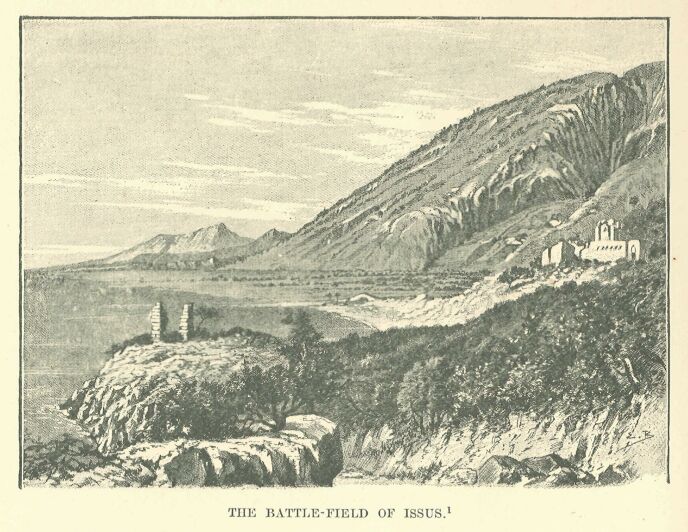
Drawn by Boudier, from a photograph by Lortet.
At the foot of the Amanus, Alexander came into conflict not only with the generals of Darius, but with the great king himself. The Amanus, and the part of the Taurus which borders on the Euphrates valley, had always constituted the line of demarcation between the domain of the races of the Asianic peninsula and that of the Semitic peoples.
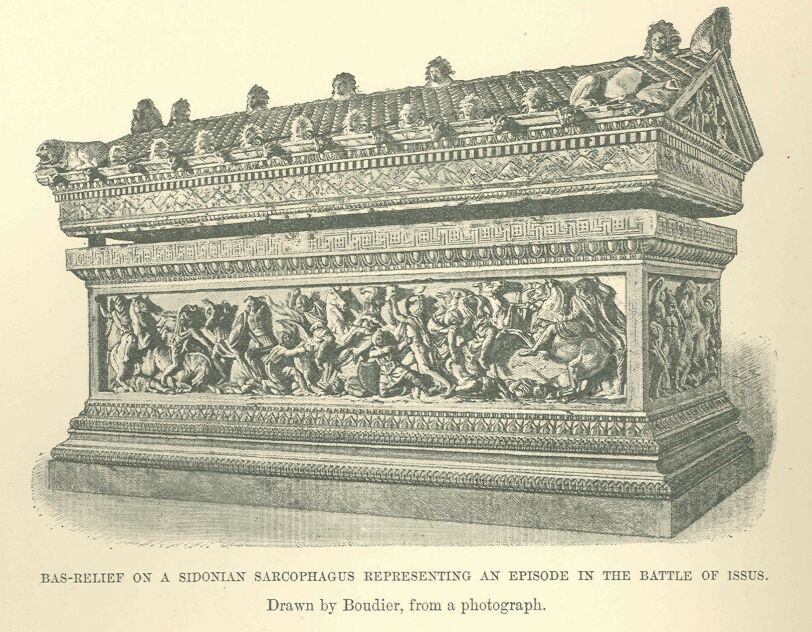
A second battle near the Issus, at the entrance to the Cilician gates, cleared the ground, and gave the conqueror time to receive the homage of the maritime provinces. Both Northern and Coele-Syria submitted to him from Samosata to Damascus.
Drawn by Boudier, from a sketch by Lortet.
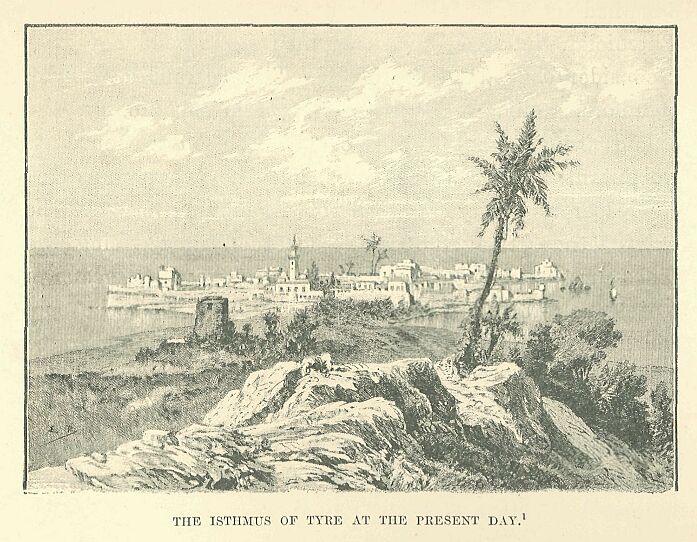
The less important towns of Phonicia, such as Arvad, Byblos, Sidon, and those of Cyprus, followed their example; but Tyre closed its gates, and trusted to its insular position for the preservation of its independence, as it had done of old in the time of Sennacherib and of Nebuchadrezzar. It was not so much a scrupulous feeling of loyalty which emboldened her to take this step, as a keen realisation of what her conquest by the Macedonian would entail. It was entirely-owing to Persia that she had not succumbed in all parts of the Eastern Mediterranean in that struggle with Greece which had now lasted for centuries: Persia had not only arrested the progress of Hellenic colonisation in Cyprus, but had given a fresh impulse to that of Tyre, and Phoenician influence had regained its ascendency over a considerable part of the island. The surrender of Tyre, therefore, would be equivalent to a Greek victory, and would bring about the decay of the city; hence its inhabitants preferred hostilities, and they were prolonged in desperation over a period of seven months. At the end of that time Alexander succeeded in reducing the place by constructing a dyke or causeway, by means of which he brought his machines of war up to the foot of the ramparts, and filled in the channel which separated the town from the mainland; the island thus became a peninsula, and Tyre henceforth was reduced to the rank of an ordinary town, still able to maintain her commercial activity, but having lost her power as an independent state (332). Phoenicia being thus brought into subjection, Judæa and Samaria yielded to the conqueror without striking a blow, though the fortress of Gaza followed the example set by Tyre, and for the space of two months blocked the way to the Delta. Egypt revolted at the approach of her liberator, and the rising was so unanimous as to dismay the satrap Mazakes, who capitulated at the first summons. Alexander passed the winter on the banks of the Nile. Finding that the ancient capitals of the country—Thebes, Sais, and even Memphis itself—occupied positions which were no longer suited to the exigencies of the times, he founded opposite to the island of Pharos, in the township of Eakotis, a city to which he gave his own name. The rapid growth of the prosperity of Alexandria showed how happy the founder had been in the choice of its site: in less than half a century from the date of its foundation, it had eclipsed all the other capitals of the Eastern Mediterranean, and had become the centre of African Hellenism. While its construction was in progress, Alexander, having had opportunities of studying the peculiarities and characteristics of the Egyptians, had decided to perform the one act which would conciliate the good feeling of the natives, and secure for him their fidelity during his wars in the East: he selected from among their gods the one who was also revered by the Greeks, Zeus-Amnion, and repaired to the Oasis that he might be adopted by the deity. As a son of the god, he became a legitimate Pharaoh, an Egyptian like themselves, and on returning to Memphis he no longer hesitated to adopt the pschent crown with the accompanying ancient rites. He returned to Asia early in the year 331, and crossed the Euphrates. Darius had attempted to wrest Asia Minor from his grasp, but Antigonus, the governor of Phrygia, had dispersed the troops despatched for this purpose in 332, and Alexander was able to push forward fearlessly into those regions beyond the Euphrates, where the Ten Thousand had pursued their victorious march before him. He crossed the Tigris about the 20th of September, and a week later fell in with his rival in the very heart of Assyria, not far from, the village of Gaugamela, where he took up a position which had been previously studied, and was particularly suited for the evolutions of cavalry.
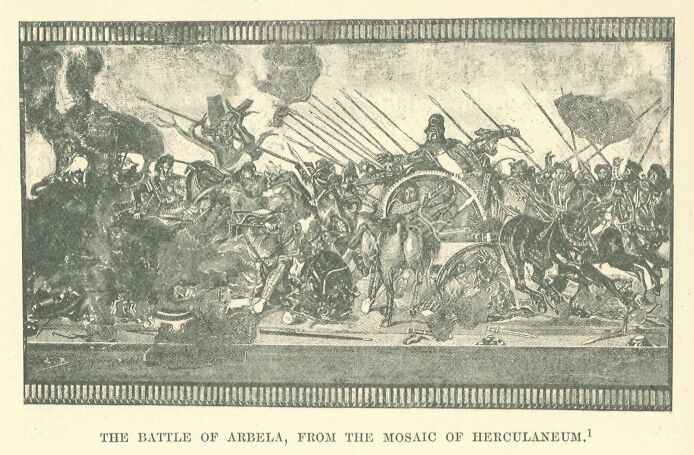
Drawn by Boudier, from a photograph.
At the Granicus and near Issus, the Greek element had played an important part among the forces which contested the field; on this occasion, however, the great king was accompanied by merely two or three thousand mercenaries, while, on the other hand, the whole of Asia seemed to have roused herself for a last effort, and brought forward her most valiant troops to oppose the disciplined ranks of the Macedonians. Persians, Susians, Medes, Armenians, Iranians from Bactriana, Sakae, and Indians were all in readiness to do their best, and were accompanied by every instrument of military warfare employed in Oriental tactics; chariots armed with scythes, the last descendants of the chariotry which had dominated all the battle-fields from the time of the XVIIIth Theban dynasty down to the latest Sargonids, and, employed side by side with these relics of a bygone day, were Indian elephants, now for the first time brought into use against European battalions. These picked troops sold their lives dearly, but the perfection of the Macedonian arms, and, above all, the superiority of the tactics employed by their generals, carried the day; the evening of the 30th of September found Darius in flight, and the Achæmenian empire crushed by the furious charges of Alexander’s squadrons. Babylon fell into their hands a few days later, followed by Susa, and in the spring of 330, Ecbatana; and shortly after Darius met his end on the way to Media, assassinated by the last of his generals.
With his death, Persia sank back into the obscurity from which Cyrus had raised her rather more than two centuries previously. With the exception of the Medes, none of the nations which had exercised the hegemony of the East before her time, not even Assyria, had had at their disposal such a wealth of resources and had left behind them so few traces of their power. A dozen or so of palaces, as many tombs, a few scattered altars and stelæ, remains of epics preserved by the Greeks, fragments of religious books, often remodelled, and issuing in the Avesta—when we have reckoned up all that remains to us of her, what do we find to compare in interest and in extent with the monuments and wealth of writings bequeathed to us by Egypt and Chaldæa? The Iranians received Oriental civilisation at a time when the latter was in its decline, and caught the spirit of decadence in their contact with it. In succeeding to the patrimony of the nations they conquered, they also inherited their weakness; in a few years they had lost all the vigour of their youth, and were barely able to maintain the integrity of the empire they had founded. Moreover, the great peoples to whom they succeeded, although lacking the vigour necessary for the continuance of their independent existence, had not yet sunk so low as to acquiesce in their own decay, and resign themselves to allowing their national life to be absorbed is that of another power: they believed that they would emerge from the crisis, as they had done from so many others, with fresh strength, and, as soon as an occasion presented itself, they renewed the war against their Iranian suzerain. Prom, the first to the latest of the sovereigns bearing the name of Darius, the history of the Achæmenids in an almost uninterrupted series of internal wars and provincial revolts. The Greeks of Ionia, the Egyptians, Chaldæans, Syrians, and the tribes of Asia Minor, all rose one after another, sometimes alone, sometimes in concert; some carrying on hostilities for not more than two or three years; others, like Egypt, maintaining them for more than half a century. They were not discouraged by the reprisals which followed each of these rebellions; they again had recourse to arms as soon as there seemed the least chance of success, and they renewed the struggle till from sheer exhaustion the sword fell from their hand. Persia was worn out by this perpetual warfare, in which at the same time each of her rivals expended the last relics of their vitality, and when Macedonia entered on the scene, both lords and vassals were reduced to such a state of prostration, that it was easy to foretell their approaching end. The old Oriental world was in its death-throes; but before it passed away, the successful audacity of Alexander had summoned Greece to succeed to its inheritance.