Volume 6 — CHAPTER II—THE RISE OF THE ASSYRIAN EMPIRE
M. L. McClure translation
Phoenicia and the northern nations after the death of Ramses III.—The first Assyrian empire: Tiglath-pileser I.—The Aramoans and the Khâti.
The cessation of Egyptian authority over countries in which it had so long prevailed did not at once do away with the deep impression which it had made upon their constitution and customs. While the nobles and citizens of Thebes were adopting the imported worship of Baal and Astartê, and were introducing into the spoken and written language words borrowed from Semitic speech, the Syrians, on the other hand, were not unreceptive of the influence of their conquerors. They had applied themselves zealously to the study of Egyptian arts, industry and religion, and had borrowed from these as much, at least, as they had lent to the dwellers on the Nile. The ancient Babylonian foundation of their civilization was not, indeed, seriously modified, but it was covered over, so to speak, with an African veneer which varied in depth according to the locality.*
* Most of the views put forth in this part of the chapter are based on posterior and not contemporary data. The most ancient monuments which give evidence of it show it in such a complete state that we may fairly ascribe it to some centuries earlier; that is, to the time when Egypt still ruled in Syria, the period of the XIXth and even the XVIIIth dynasty.
Phoenicia especially assumed and retained this foreign exterior. Its merchants, accustomed to establish themselves for lengthened periods in the principal trade-centres on the Nile, had become imbued therein with something of the religious ideas and customs of the land, and on returning to their own country had imported these with them and propagated them in their neighbourhood. They were not content with other household utensils, furniture, and jewellery than those to which they had been accustomed on the Nile, and even the Phonician gods seemed to be subject to this appropriating mania, for they came to be recognised in the indigenous deities of the Said and the Delta. There was, at the outset, no trait in the character of Baalat by which she could be assimilated to Isis or Hathor: she was fierce, warlike, and licentious, and wept for her lover, while the Egyptian goddesses were accustomed to shed tears for their husbands only. It was this element of a common grief, however, which served to associate the Phonician and Egyptian goddesses, and to produce at length a strange blending of their persons and the legends concerning them; the lady of Byblos ended in becoming an Isis or a Hathor,* and in playing the part assigned to the latter in the Osirian drama.
* The assimilation must have been ancient, since the Egyptians of the Theban dynasties already accepted Baalat as the Hathor of Byblos.
Drawn by Faucher-Gudin, from Prisse d’Avennes
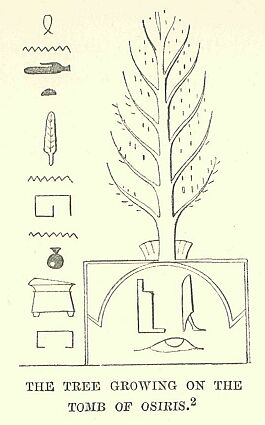
This may have been occasioned by her city having maintained closer relationships than the southern towns with Bûto and Mendes, or by her priests having come to recognise a fundamental agreement between their theology and that of Egypt. In any case, it was at Byblos that the most marked and numerous, as well as the most ancient, examples of borrowing from the religions of the Nile were to be found. The theologians of Byblos imagined that the coffin of Osiris, after it had been thrown into the sea by Typhon, had been thrown up on the land somewhere near their city at the foot of a tamarisk, and that this tree, in its rapid growth, had gradually enfolded within its trunk the body and its case. King Malkander cut it down in order to use it as a support for the roof of his palace: a marvellous perfume rising from it filled the apartments, and it was not long before the prodigy was bruited abroad. Isis, who was travelling through the world in quest of her husband, heard of it, and at once realised its meaning: clad in rags and weeping, she sat down by the well whither the women of Byblos were accustomed to come every morning and evening to draw water, and, being interrogated by them, refused to reply; but when the maids of Queen Astartê* approached in their turn, they were received by the goddess in the most amiable manner—Isis deigning even to plait their hair, and to communicate to them the odour of myrrh with which she herself was impregnated.
* Astartê is the name taken by the queen in the Phoenician version: the Egyptian counterpart of the same narrative substituted for it Nemanous or Saôsis; that is to say, the two principal forms of Hathor—the Hermopolitan Nahmâûît and the Heliopolitan lûsasît. It would appear from the presence of these names that there must have been in Egypt two versions at least of the Phoenician adventures of Isis—the one of Hermopolitan and the other of Heliopolitan origin.
Drawn by Faucher-Gudin, from an intaglio engraved in Cesnola. The Phoenician figures of Horus and Thot which I have reproduced were pointed out to me by my friend Clermont-Ganneau.
Drawn by Faucher-Gudin, after an intaglio engraved in M. de Vogué.
Their mistress came to see the stranger who had thus treated her servants, took her into her service, and confided to her the care of her lately born son. Isis became attached to the child, adopted it for her own, after the Egyptian manner, by inserting her finger in its mouth; and having passed it through the fire during the night in order to consume away slowly anything of a perishable nature in its body, metamorphosed herself into a swallow, and flew around the miraculous pillar uttering plaintive cries. Astartê came upon her once while she was bathing the child in the flame, and broke by her shrieks of fright the charm of immortality. Isis was only able to reassure her by revealing her name and the object of her presence there. She opened the mysterious tree-trunk, anointed it with essences, and wrapping it in precious cloths, transmitted it to the priests of Byblos, who deposited it respectfully in their temple: she put the coffin which it contained on board ship, and brought it, after many adventures, into Egypt. Another tradition asserts, however, that Osiris never found his way back to his country: he was buried at Byblos, this tradition maintained, and it was in his honour that the festivals attributed by the vulgar to the young Adonis were really celebrated. A marvellous fact seemed to support this view. Every year a head of papyrus, thrown into the sea at some unknown point of the Delta, was carried for six days along the Syrian coast, buffeted by wind and waves, and on the seventh was thrown up at Byblos, where the priests received it and exhibited it solemnly to the people.* The details of these different stories are not in every case very ancient, but the first fact in them carries us back to the time when Byblos had accepted the sovereignty of the Theban dynasties, and was maintaining daily commercial and political relations with the inhabitants of the Nile valley.**
* In the later Roman period it was letters announcing the resurrection of Adonis-Osiris that the Alexandrian women cast into the sea, and these were carried by the current as far as Byblos. See on this subject the commentaries of Cyril of Alexandra and Procopius of Gaza on chap, xviii. of Isaiah. ** It is worthy of note that Philo gives to the divinity with the Egyptian name Taautos the part in the ancient history of Phoenicia of having edited the mystic writings put in order by Sanchoniathon at a very early epoch.
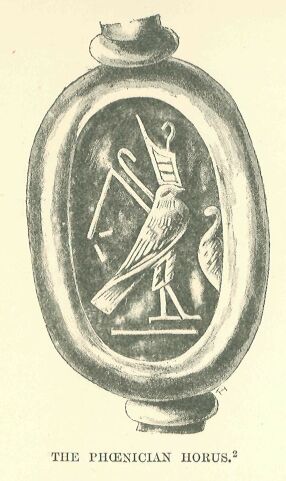
The city proclaimed Horus to be a great god.* El-Kronos allied himself with Osiris as well as with Adonis; Isis and Baalat became blended together at their first encounter, and the respective peoples made an exchange of their deities with the same light-heartedness as they displayed in trafficking with the products of their soil or their industry.
* This is confirmed by one of the names inscribed on the Tel el-Amarna tablets as being that of a governor of Byblos under Amenôthes IV. This name was read Rabimur, Anrabimur, or Ilrabimur, and finally Ilurabihur: the meaning of it is, “Muru is the great god,” or “Horus is the great god.” Muru is the name which we find in an appellation of a Hittite king, Maurusaru, “Mauru is king.” On an Aramoan cylinder in the British Museum, representing a god in Assyrian dress fighting with two griffins, there is the inscription “Horkhu,” Harmakhis.
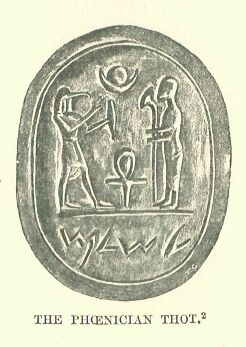
After Osiris, the Ibis Thot was the most important among the deities who had emigrated to Asia. He was too closely connected with the Osirian cycle to be forgotten by the Phoenicians after they had adopted his companions. We are ignorant of the particular divinity with whom he was identified, or would be the more readily associated from some similarity in the pronunciation of his name: we know only that he still preserved in his new country all the power of his voice and all the subtilty of his mind. He occupied there also the position of scribe and enchanter, as he had done at Thebes, Memphis, Thinis, and before the chief of each Heliopolitan Ennead. He became the usual adviser of El-Kronos at Byblos, as he had been of Osiris and Horus; he composed charms for him, and formulae which increased the warlike zeal of his partisans; he prescribed the form and insignia of the god and of his attendant deities, and came finally to be considered as the inventor of letters.*
* The part of counsellor which Thot played in connexion with the god of Byblos was described at some length in the writings attributed to Sankhoniathon.
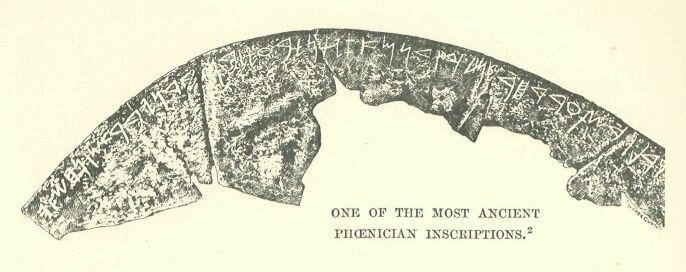
The epoch, indeed, in which he became a naturalised Phoenician coincides approximately with a fundamental revolution in the art of writing—that in which a simple and rapid stenography was substituted for the complicated and tedious systems with which the empires of the ancient world had been content from their origin. Tyre, Sidon, Byblos, Arvad, had employed up to this period the most intricate of these systems. Like most of the civilized nations of Western Asia, they had conducted their diplomatic and commercial correspondence in the cuneiform character impressed upon clay tablets. Their kings had had recourse to a Babylonian model for communicating to the Amenôthes Pharaohs the expression of their wishes or their loyalty; we now behold them, after an interval of four hundred years and more*—during which we have no examples of their monuments—possessed of a short and commodious script, without the encumbrance of ideograms, determinatives, polyphony and syllabic sounds, such as had fettered the Egyptian and Chaldæan scribes, in spite of their cleverness in dealing with them. Phonetic articulations were ultimately resolved into twenty-two sounds, to each of which a special sign was attached, which collectively took the place of the hundreds or thousands of signs formerly required.
* The inscription on the bronze cup dedicated to the Baal of the Lebanon, goes back probably to the time of Hiram I., say the Xth century before our era; the reasons advanced by Winckler for dating it in the time of Hiram II. have not been fully accepted up to the present. By placing the introduction of the alphabet somewhere between Amenôthes IV. in the XVth and Hiram I. in the Xth century before our era, and by taking the middle date between them, say the accession of the XXIs’dynasty towards the year 1100 B.C. for its invention or adoption, we cannot go far wrong one way or the other.
Drawn by Paucher-Gudin, from a heliogravure. This is the cup of the Baal of the Lebanon.
This was an alphabet, the first in point of time, but so ingenious and so pliable that the majority of ancient and modern nations have found it able to supply all their needs—Greeks and Europeans of the western Mediterranean on the one hand, and Semites of all kinds, Persians and Hindus on the other.
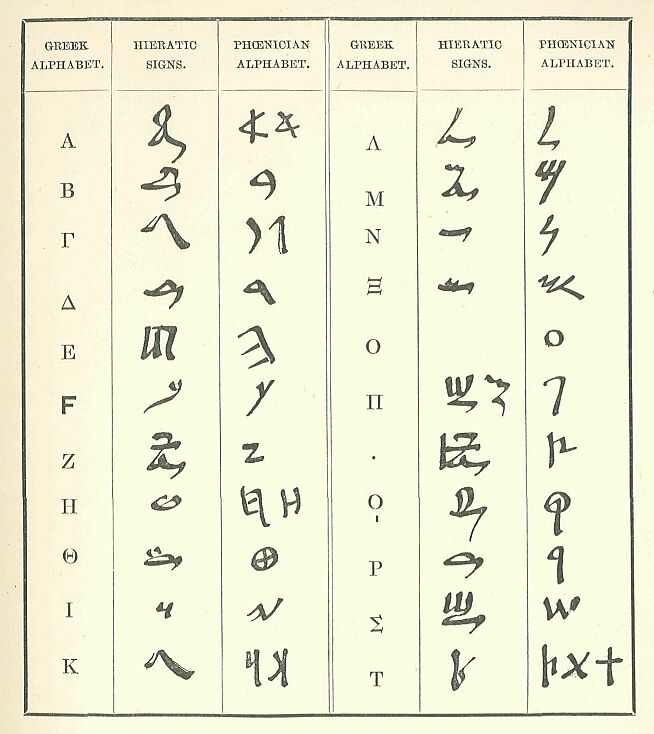
It must have originated between the end of the XVIIIth and the beginning of the XXIst dynasties, and the existence of Pharaonic rule in Phoenicia during this period has led more than one modern scholar to assume that it developed under Egyptian influence.*
* The hypothesis of an Egyptian origin, suggested casually by Champollion, has been ably dealt with by E. de Rougé. E. de Rougé derives the alphabet from the Hieratic, and his identifications have been accepted by Lauth, by Brugsch, by P. Lenormant, and by Isaac Taylor. Halévy would take it from the Egyptian hieroglyphics directly without the intervention of the Hieratic. The Egyptian origin, strongly contested of late, has been accepted by the majority of scholars.
Some affirm that it is traceable directly to the hieroglyphs, while others seek for some intermediary in the shape of a cursive script, and find this in the Hieratic writing, which contains, they maintain, prototypes of all the Phoenician letters. Tables have been drawn up, showing at a glance the resemblances and differences which appear respectively to justify or condemn their hypothesis. Perhaps the analogies would be more evident and more numerous if we were in possession of inscriptions going back nearer to the date of origin. As it is, the divergencies are sufficiently striking to lead some scholars to seek the prototype of the alphabet elsewhere—either in Babylon, in Asia Minor, or even in Crete, among those barbarous hieroglyphs which are attributed to the primitive inhabitants of the island. It is no easy matter to get at the truth amid these conflicting theories. Two points only are indisputable; first, the almost unanimous agreement among writers of classical times in ascribing the first alphabet to the Phoenicians; and second, the Phonician origin of the Greek, and afterwards of the Latin alphabet which we employ to-day.
To return to the religion of the Phoenicians: the foreign deities were not content with obtaining a high place in the estimation of priests and people; they acquired such authority over the native gods that they persuaded them to metamorphose themselves almost completely into Egyptian divinities.
Drawn by Faucher-Gudin, from a photograph reproduced in Clermont-Ganneau.
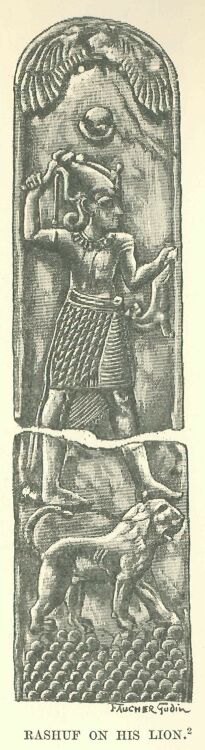
One finds among the majority of them the emblems commonly used in the Pharaonic temples, sceptres with heads of animals, head-dress like the Pschent, the crux ansata, the solar disk, and the winged scarab. The lady of Byblos placed the cow’s horns upon her head from the moment she became identified with Hathor.* The Baal of the neighbouring Arvad—probably a form of Bashuf—was still represented as standing upright on his lion in order to traverse the high places: but while, in the monument which has preserved the figure of the god, both lion and mountain are given according to Chaldæan tradition, he himself, as the illustration shows, is dressed after the manner of Egypt, in the striped and plaited loin-cloth, wears a large necklace on his neck and bracelets on his arms, and bears upon his head the white mitre with its double plume and the Egyptian uraaus.**
* She is represented as Hathor on the stele of Iéhav-melek, King of Byblos, during the Persian period. ** This monument, which belonged to the Péretié collection, was found near Amrîth, at the place called Nahr-Abrek. The dress and bearing are so like those of the Rashuf represented on Egyptian monuments, that I have no hesitation in regarding this as a representation of that god.
He brandishes in one hand the weapon of the victor, and is on the point of despatching with it a lion, which he has seized by the tail with the other, after the model of the Pharaonic hunters, Amenôthes I. and Thûtmosis III. The lunar disk floating above his head lends to him, it is true, a Phonician character, but the winged sun of Heliopolis hovering above the disk leaves no doubt as to his Egyptian antecedents.*
* The Phonician symbol represents the crescent moon holding the darkened portion in its arms, like the symbol reserved in Egypt for the lunar gods.
Drawn by Faucher-Gudin, from Renan.
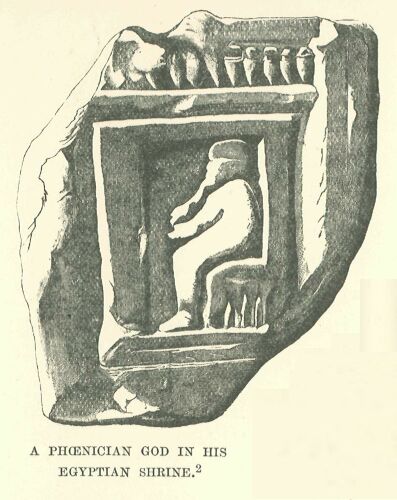
The worship, too, offered to these metamorphosed gods was as much changed as the deities themselves; the altars assumed something of the Egyptian form, and the tabernacles were turned into shrines, which were decorated at the top with a concave groove, or with a frieze made up of repetitions of the uraeus. Egyptian fashions had influenced the better classes so far as to change even their mode of dealing with the dead, of which we find in not a few places clear evidence. Travellers arriving in Egypt at that period must have been as much astonished as the tourist of to-day by the monuments which the Egyptians erected for their dead.
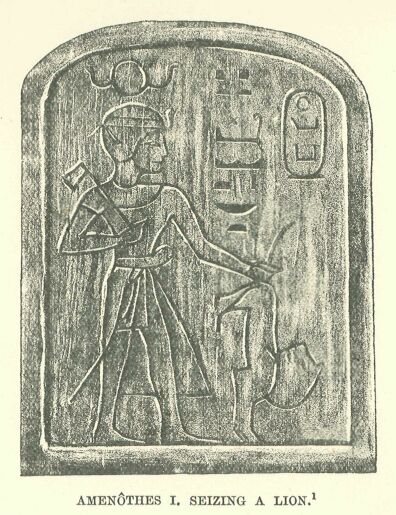
Drawn by Faucher-Gudin. This monument was in the Louvre Museum. Analogous figures of gods or kings holding a lion by the tail are found on various monuments of the Theban dynasties.
The pyramids which met their gaze, as soon as they had reached the apex of the Delta, must have far surpassed their ideas of them, no matter how frequently they may have been told about them, and they must have been at a loss to know why such a number of stones should have been brought together to cover a single corpse. At the foot of these colossal monuments, lying like a pack of hounds asleep around their master, the mastabas of the early dynasties were ranged, half buried under the sand, but still visible, and still visited on certain days by the descendants of their inhabitants, or by priests charged with the duty of keeping them up. Chapels of more recent generations extended as a sort of screen before the ancient tombs, affording examples of the two archaic types combined—the mastaba more or less curtailed in its proportions, and the pyramid with a more or less acute point. The majority of these monuments are no longer in existence, and only one of them has come down to us intact—that which Amenôthes III. erected in the Serapeum at Memphis in honour of an Apis which had died in his reign.
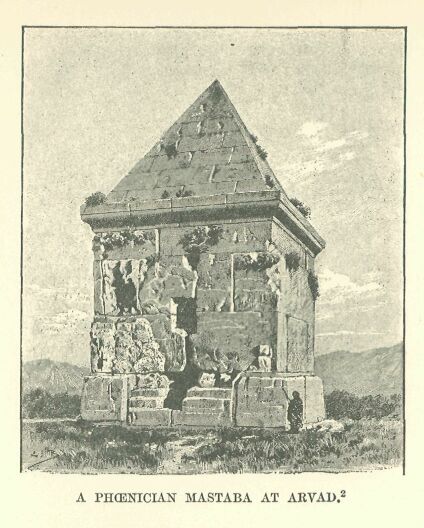
Drawn by Faucher-Gudin, from the restoration by Thobois, as given in Renan. The cuttings made in the lower stonework appear to be traces of unfinished steps. The pyramid at the top is no longer in existence, but its remains are scattered about the foot of the monument, and furnished M. Thobois with the means of reconstructing with exactness the original form.
Phoenicians visiting the Nile valley must have carried back with them to their native country a remembrance of this kind of burying-place, and have suggested it to their architects as a model. One of the cemeteries at Arvad contains a splendid specimen of this imported design.*
* Pietschmann thinks that the monument is not older than the Greek epoch, and it must be admitted that the cornice is not such as we usually meet with in Egypt in Theban times; nevertheless, the very marked resemblance to the Theban mastaba shows that it must have been directly connected with the Egyptian type which prevailed from the XVIIIth to the XXth dynasties.
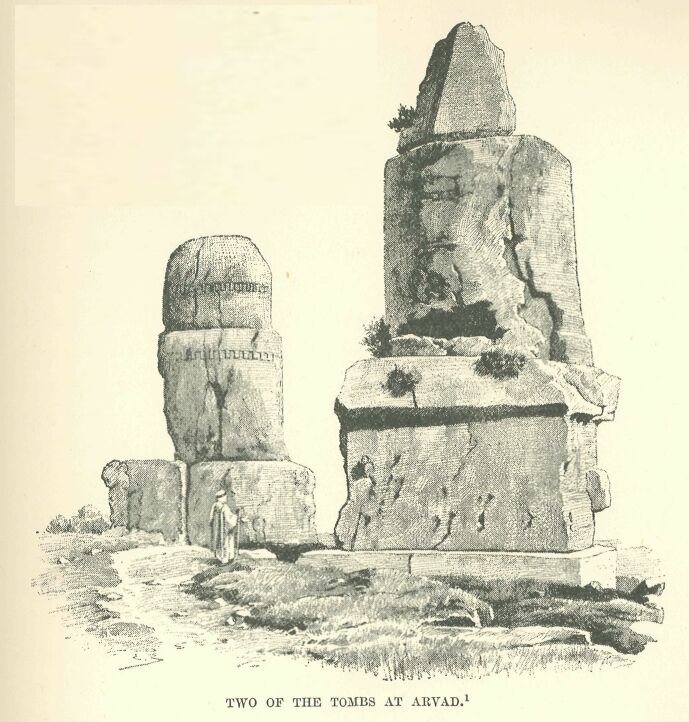
Drawn by Faucher-Gudin, from a water-colour by Thobois, reproduced in Renan.
It is a square tower some thirty-six feet high; the six lower courses consist of blocks, each some sixteen and a half feet long, joined to each other without mortar. The two lowest courses project so as to form a kind of pedestal for the building. The cornice at the top consists of a deep moulding, surmounted by a broad flat band, above which rises the pyramid, which attains a height of nearly thirty feet. It is impossible to deny that it is constructed on a foreign model; it is not a slavish imitation, however, but rather an adaptation upon a rational plan to the conditions of its new home. Its foundations rest on nothing but a mixture of soil and sand impregnated with water, and if vaults had been constructed beneath this, as in Egypt, the body placed there would soon have corrupted away, owing to the infiltration of moisture. The dead bodies were, therefore, placed within the structure above ground, in chambers corresponding to the Egyptian chapel, which were superimposed the one upon the other. The first storey would furnish space for three bodies, and the second would contain twelve, for which as many niches were provided. In the same cemetery we find examples of tombs which the architect has constructed, not after an Egyptian, but a Chaldæan model. A round tower is here substituted for the square structure and a cupola for the pyramid, while the cornice is represented by crenellated markings. The only Egyptian feature about it is the four lions, which seem to support the whole edifice upon their backs.*
* The fellahîn in the neighbourhood call these two monuments the Meghazîl or “distaffs.”
Arvad was, among Phoenician cities, the nearest neighbour to the kingdoms on the Euphrates, and was thus the first to experience either the brunt of an attack or the propagation of fashions and ideas from these countries. In the more southerly region, in the country about Tyre, there are fewer indications of Babylonian influence, and such examples of burying-places for the ruling classes as the Kabr-Hiram and other similar tombs correspond with the mixed mastaba of the Theban period. We have the same rectangular base, but the chapel and its crowning pyramid are represented by the sarcophagus itself with its rigid cover. The work is of an unfinished character, and carelessly wrought, but there is a charming simplicity about its lines and a harmony in its proportions which betray an Egyptian influence.
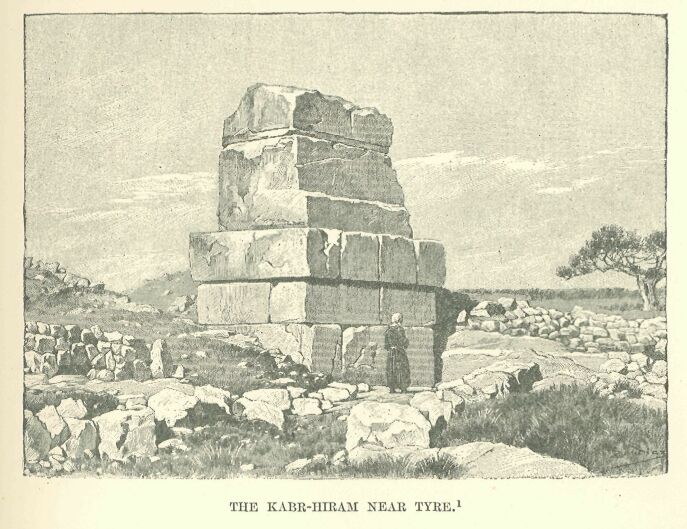
Drawn by Boudier, from a sketch by Thobois, reproduced by Renan.
The spirit of imitation which we find in the religion and architecture of Phoenicia is no less displayed in the minor arts, such as goldsmiths’work, sculpture in ivory, engraving on gems, and glass-making. The forms, designs, and colours are all rather those of Egypt than of Chaldæa. The many-hued glass objects, turned out by the manufacturers of the Said in millions, furnished at one time valuable cargoes for the Phoenicians; they learned at length to cast and colour copies of these at home, and imitated their Egyptian models so successfully that classical antiquity was often deceived by them.*
* Glass manufacture was carried to such a degree of perfection among the Phoenicians, that many ancient authors attributed to them the invention of glass.
Their engravers, while still continuing to employ cones and cylinders of Babylonian form, borrowed the scarab type also, and made use of it on the bezils of rings, the pendants of necklaces, and on a kind of bracelet used partly for ornament and partly as a protective amulet. The influence of the Egyptian model did not extend, however, amongst the masses, and we find, therefore, no evidence of it in the case of common objects, such as those of coarse sand or glazed earthenware. Egyptian scarab forms were thus confined to the rich, and the material upon which they are found is generally some costly gem, such as cut and polished agate, onyx, haematite, and lapis-lazuli. The goldsmiths did not slavishly copy the golden and silver bowls which were imported from the Delta; they took their inspiration from the principles displayed in the ornamentation of these objects, but they treated the subjects after their own manner, grouping them afresh and blending them with new designs. The intrinsic value of the metal upon which these artistic conceptions had been impressed led to their destruction, and among the examples which have come down to us I know of no object which can be traced to the period of the Egyptian conquest. It was Theban art for the most part which furnished the Phoenicians with their designs. These included the lotus, the papyrus, the cow standing in a thicket and suckling her calf, the sacred bark, and the king threatening with his uplifted arm the crowd of conquered foes who lie prostrate before him.
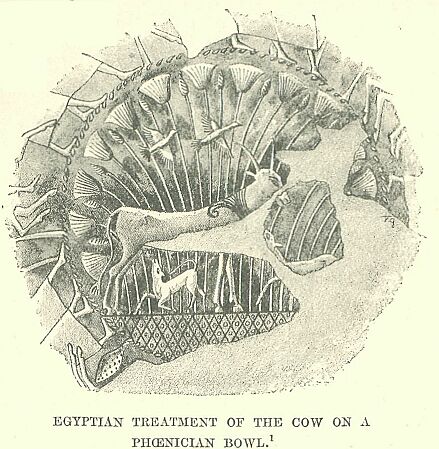
Drawn by Faucher-Gudin, after Grifi.
The king’s double often accompanied him on some of the original objects, impassive and armed with the banner bearing the name of Horus. The Phoenician artist modified this figure, which in its original form did not satisfy his ideas of human nature, by transforming it into a protective genius, who looks with approval on the exploits of his protégé, and gathers together the corpses of those he has slain. Once these designs had become current among the goldsmiths, they continued to be supplied for a long period, without much modification, to the markets of the Eastern and Western worlds. Indeed, it was natural that they should have taken a stereotyped form, when we consider that the Phoenicians who employed them held continuous commercial relations with the country whence they had come—a country of which, too, they recognised the supremacy. Egypt in the Ramesside period was, as we have seen, distinguished for the highest development of every branch of industry; it had also a population which imported and exported more raw material and more manufactured products than any other.
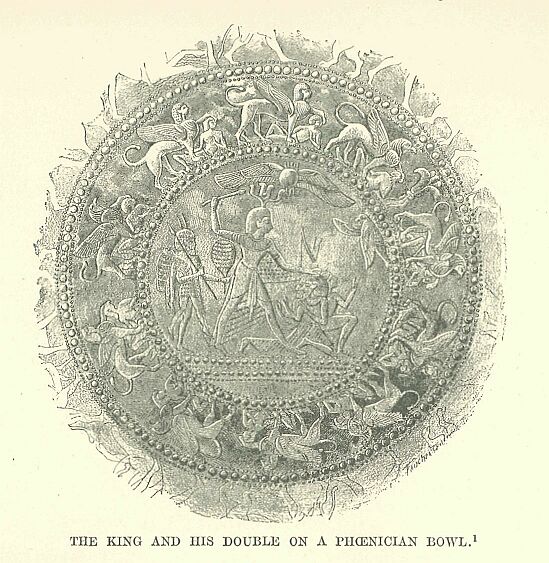
Drawn by Faucher-Gudin, from a sketch by Longpérier.
The small nation which acted as a commercial intermediary between Egypt and the rest of the world had in this traffic a steady source of profit, and even in providing Egypt with a single article—for example, bronze, or the tin necessary for its preparation—could realise enormous profits. The people of Tyre and Sidon had been very careful not to alienate the good will of such rich customers, and as long as the representatives of the Pharaoh held sway in Syria, they had shown themselves, if not thoroughly trustworthy vassals, at least less turbulent than their neighbours of Arvad and Qodshû. Even when the feebleness and impotence of the successors of Ramses III. relieved them from the obligation of further tribute, they displayed towards their old masters such deference that they obtained as great freedom of trade with the ports of the Delta as they had enjoyed in the past. They maintained with these ports the same relations as in the days of their dependence, and their ships sailed up the river as far as Memphis, and even higher, while the Egyptian galleys continued to coast the littoral of Syria. An official report addressed to Hrihor by one of the ministers of the Theban Amon, indicates at one and the same time the manner in which these voyages were accomplished, and the dangers to which their crews were exposed. Hrihor, who was still high priest, was in need of foreign timber to complete some work he had in hand, probably the repair of the sacred barks, and commanded the official above mentioned to proceed by sea to Byblos, to King Zikarbâl,* in order to purchase cedars of Lebanon.
* This is the name which classical tradition ascribed to the first husband of Dido, the founder of Carthage—Sicharbas, Sichaeus, Acerbas.
The messenger started from Tanis, coasted along Kharu, and put into the harbour of Dor, which then belonged to the Zakkala: while he was revictualling his ship, one of the sailors ran away with the cash-box. The local ruler, Badilu, expressed at first his sympathy at this misfortune, and gave his help to capture the robber; then unaccountably changing his mind he threw the messenger into prison, who had accordingly to send to Egypt to procure fresh funds for his liberation and the accomplishment of his mission. Having arrived at Byblos, nothing occurred there worthy of record. The wood having at length been cut and put on board, the ship set sail homewards. Driven by contrary winds, the vessel was thrown upon the coast of Alasia, where the crew were graciously received by the Queen Khatiba. We have evidence everywhere, it may be stated, as to the friendly disposition displayed, either with or without the promptings of interest, towards the representative of the Theban pontiff. Had he been ill-used, the Phoenicians living on Egyptian territory would have been made to suffer for it.
Navigators had to take additional precautions, owing to the presence of Ægean or Asiatic pirates on the routes followed by the mercantile marine, which rendered their voyages dangerous and sometimes interrupted them altogether. The Syrian coast-line was exposed to these marauders quite as much as the African had been during the sixty or eighty years which followed the death of Ramses II.; the seamen of the north—Achæans and Tyrseni, Lycians and Shardanians—had pillaged it on many occasions, and in the invasion which followed these attacks it experienced as little mercy as Naharaim, the Khâti, and the region of the Amorites. The fleets which carried the Philistines, the Zakkala, and their allies had devastated the whole coast before they encountered the Egyptian ships of Ramses III. near Magadîl, to the south of Carmel. Arvad as well as Zahi had succumbed to the violence of their attack, and if the cities of Byblos, Berytus, Sidon, and Tyre had escaped, their suburbs had been subjected to the ravages of the foe.*
* See, for this invasion, vol. v. pp. 305-311, of the present work.
Peace followed the double victory of the Egyptians, and commerce on the Mediterranean resumed once more its wonted ways, but only in those regions where the authority of the Pharaoh and the fear of his vengeance were effective influences. Beyond this sphere there were continual warfare, piracy, migrations of barbaric hordes, and disturbances of all kinds, among which, if a stranger ventured, it was at the almost certain risk of losing his life or liberty. The area of undisturbed seas became more and more contracted in proportion as the memory of past defeats faded away. Cyprus was not comprised within it, and the Ægeans, who were restrained by the fear of Egypt from venturing into any region under her survey, perpetually flocked thither in numerous bodies. The Achæans, too, took up their abode on this island at an early date—about the time when some of their bands were infesting Libya, and offering their help to the enemies of the Pharaoh. They began their encroachments on the northern side of the island—the least rich, it is true, but the nearest to Cilicia, and the easiest to hold against the attacks of their rivals. The disaster of Piriu had no doubt dashed their hopes of finding a settlement in Egypt: they never returned thither any more, and the current of emigration which had momentarily inclined towards the south, now set steadily towards the east, where the large island of Cyprus offered an unprotected and more profitable field of adventure. We know not how far they penetrated into its forests and its interior. The natives began, at length, under their influence, to despise the customs and mode of existence with which they had been previously contented: they acquired a taste for pottery rudely decorated after the Mycenean manner, for jewellery, and for the bronze swords which they had seen in the hands of the invaders. The Phoenicians, in order to maintain their ground against the intruders, had to strengthen their ancient posts or found others—such as Carpasia, Gerynia, and Lapathos on the Achæan coast itself, Tamassos near the copper-mines, and a new town, Qart-hadashât, which is perhaps only the ancient Citium under a new name.* They thus added to their earlier possessions on the island regions on its northern side, while the rest either fell gradually into the hands of Hellenic adventurers, or continued in the possession of the native populations. Cyprus served henceforward as an advance-post against the attacks of Western nations, and the Phoenicians must have been thankful for the good fortune which had made them see the wisdom of fortifying it. But what became of their possessions lying outside Cyprus? They retained several of them on the southern coasts of Asia Minor, and Rhodes remained faithful to them, as well as Thasos, enabling them to overlook the two extremities of the Archipelago;** but, owing to the movements of the People of the Sea and the political development of the Mycenean states, they had to give up the stations and harbours of refuge which they held in the other islands or on the continent.
* It is mentioned in the inscription of Baal of Lebanon, and in the Assyrian inscriptions of the VII century B.C. * This would appear to be the case, as far as Rhodes is concerned, from the traditions which ascribed the final expulsion of the Phoenicians to a Doric invasion from Argos. The somewhat legendary accounts of the state of affairs after the Hellenic conquest are in the fragments of Ergias and Polyzelos.
They still continued, however, to pay visits to these localities—sometimes in the guise of merchants and at others as raiders, according to their ancient custom. They went from port to port as of old, exposing their wares in the market-places, pillaging the farms and villages, carrying into captivity the women and children whom they could entice on board, or whom they might find defenceless on the strand; but they attempted all this with more risk than formerly, and with less success. The inhabitants of the coast were possessed of fully manned ships, similar in form to those of the Philistines or the Zakkala, which, at the first sight of the Phoenicians, set out in pursuit of them, or, following the example set by their foe, lay in wait for them behind some headland, and retaliated upon them for their cruelty. Piracy in the Archipelago was practised as a matter of course, and there was no islander who did not give himself up to it when the opportunity offered, to return to his honest occupations after a successful venture. Some kings seem to have risen up here and there who found this state of affairs intolerable, and endeavoured to remedy it by every means within their power: they followed on the heels of the corsairs and adventurers, whatever might be their country; they followed them up to their harbours of refuge, and became an effective police force in all parts of the sea where they were able to carry their flag. The memory of such exploits was preserved in the tradition of the Cretan empire which Minos had constituted, and which extended its protection over a portion of continental Greece.
If the Phoenicians had had to deal only with the piratical expeditions of the peoples of the coast or with the jealous watchfulness of the rulers of the sea, they might have endured the evil, but they had now to put up, in addition, with rivalry in the artistic and industrial products of which they had long had the monopoly. The spread of art had at length led to the establishment of local centres of production everywhere, which bade fair to vie with those of Phoenicia. On the continent and in the Cyclades there were produced statuettes, intaglios, jewels, vases, weapons, and textile fabrics which rivalled those of the East, and were probably much cheaper. The merchants of Tyre and Sidon could still find a market, however, for manufactures requiring great technical skill or displaying superior taste—such as gold or silver bowls, engraved or decorated with figures in outline—but they had to face a serious falling off in their sales of ordinary goods. To extend their commerce they had to seek new and less critical markets, where the bales of their wares, of which the Ægean population was becoming weary, would lose none of their attractions. We do not know at what date they ventured to sail into the mysterious region of the Hesperides, nor by what route they first reached it. It is possible that they passed from Crete to Cythera, and from this to the Ionian Islands and to the point of Calabria, on the other side of the straits of Otranto, whence they were able to make their way gradually to Sicily.*
* Ed. Meyer thinks that the extension of Phoenician commerce to the Western Mediterranean goes back to the XVIIIth dynasty, or, at the latest, the XVth century before our era. Without laying undue stress on this view, I am inclined to ascribe with him, until we get further knowledge, the colonisation of the West to the period immediately following the movements of the People of the Sea and the diminution of Phoenician trade in the Grecian Archipelago. Exploring voyages had been made before this, but the founding of colonies was not earlier than this epoch.
Did the fame of their discovery, we may ask, spread so rapidly in the East as to excite there the cupidity and envy of their rivals? However this may have been, the People of the Sea, after repeated checks in Africa and Syria, and feeling more than ever the pressure of the northern tribes encroaching on them, set out towards the west, following the route pursued by the Phoenicians. The traditions current among them and collected afterwards by the Greek historians give an account, mingled with many fabulous details, of the causes which led to their migrations and of the vicissitudes which they experienced in the course of them. Daedalus having taken flight from Crete to Sicily, Minos, who had followed in his steps, took possession of the greater part of the island with his Eteocretes. Iolaos was the leader of Pelasgic bands, whom he conducted first into Libya and finally to Sardinia. It came also to pass that in the days of Atys, son of Manes, a famine broke out and raged throughout Lydia: the king, unable to provide food for his people, had them numbered, and decided by lot which of the two halves of the population should expatriate themselves under the leadership of his son Tyrsenos. Those-who were thus fated to leave their country assembled at Smyrna, constructed ships there, and having embarked on board of them what was necessary, set sail in quest of a new home. After a long and devious voyage, they at length disembarked in the country of the Umbrians, where they built cities, and became a prosperous people under the name of Tyrseni, being thus called after their leader Tyrsenos.*
* Herodotus, whence all the information of other classical writers is directly or indirectly taken. Most modern historians reject this tradition. I see no reason for my own part why they should do so, at least in the present state of our knowledge. The Etrurians of the historical period were the result of a fusion of several different elements, and there is nothing against the view that the Tursha—one of these elements—should have come from Asia Minor, as Herodotus says. Properly understood, the tradition seems well founded, and the details may have been added afterwards, either by the Lydians themselves, or by the Greek historians who collected the Lydian traditions.
The remaining portions of the nations who had taken part in the attack on Egypt—of which several tribes had been planted by Ramses III. in the Shephelah, from Gaza to Carmel—proceeded in a series of successive detachments from Asia Minor and the Ægean Sea to the coasts of Italy and of the large islands; the Tursha into that region which was known afterwards as Etruria, the Shardana into Sardinia, the Zakkala into Sicily, and along with the latter some Pulasati, whose memory is still preserved on the northern slope of Etna. Fate thus brought the Phonician emigrants once more into close contact with their traditional enemies, and the hostility which they experienced in their new settlements from the latter was among the influences which determined their further migration from Italy proper, and from the region occupied by the Ligurians between the Arno and the Ebro. They had already probably reached Sardinia and Corsica, but the majority of their ships had sailed to the southward, and having touched at Malta, Gozo, and the small islands between Sicily and the Syrtes, had followed the coast-line of Africa, until at length they reached the straits of Gribraltar and the southern shores of Spain. No traces remain of their explorations, or of their early establishments in the western Mediterranean, as the towns which they are thought—with good reason in most instances—to have founded there belong to a much later date. Every permanent settlement, however, is preceded by a period of exploration and research, which may last for only a few years or be prolonged to as many centuries. I am within the mark, I think, in assuming that Phonician adventurers, or possibly even the regular trading ships of Tyre and Sidon, had established relations with the semi-barbarous chiefs of Botica as early as the XIIth century before our era, that is, at the time when the power of Thebes was fading away under the weak rule of the pontiffs of Amon and the Tanite Pharaohs.
The Phoenicians were too much absorbed in their commercial pursuits to aspire to the inheritance which Egypt was letting slip through her fingers. Their numbers were not more than sufficient to supply men for their ships, and they were often obliged to have recourse to their allies or to mercenary tribes—the Leleges or Carians—in order to provide crews for their vessels or garrisons for their trading posts; it was impossible, therefore, for them to think of raising armies fit to conquer or keep in check the rulers on the Orontes or in Naharaim. They left this to the races of the interior—the Amorites and Hittites—and to their restless ambition. The Hittite power, however, had never recovered from the terrible blow inflicted on it at the time of the Asianic invasion.
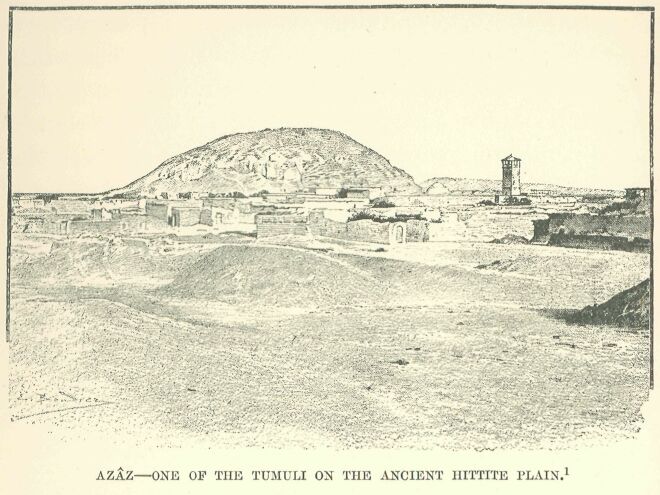
Drawn by Boudier, from a photograph by M. Barthélémy.
The confederacy of feudal chiefs, which had been brought momentarily together by Sapalulu and his successors, was shattered by the violence of the shock, and the elements of which it was composed were engaged henceforward in struggles with each other. At this time the entire plain between the Amanus and the Euphrates was covered with rich cities, of which the sites are represented to-day by only a few wretched villages or by heaps of ruins. Arabian and Byzantine remains sometimes crown the summit of the latter, but as soon as we reach the lower strata we find in more or less abundance the ruins of buildings of the Greek or Persian period, and beneath these those belonging to a still earlier time. The history of Syria lies buried in such sites, and is waiting only for a patient and wealthy explorer to bring it to light.* The Khâti proper were settled to the south of the Taurus in the basin of the Sajur, but they were divided into several petty states, of which that which possessed Carchemish was the most important, and exercised a practical hegemony over the others. Its chiefs alone had the right to call themselves kings of the Khâti. The Patinu, who were their immediate neighbours on the west, stretched right up to the Mediterranean above the plains of Naharairn and beyond the Orontes; they had absorbed, it would seem, the provinces of the ancient Alasia. Aramaeans occupied the region to the south of the Patinu between the two Lebanon ranges, embracing the districts of Hamath and Qobah.**
* The results of the excavations at Zinjirli are evidence of what historical material we may hope to find in these tumuli. See the account of the earlier results in P. von Luschan, Ausgrabungen in Sendschirli, 1893. ** The Aramaeans are mentioned by Tiglath-pileser I. as situated between the Balikh, the Euphrates, and the Sajur.
The valleys of the Amanus and the southern slopes of the Taurus included within them some half-dozen badly defined principalities—Samalla on the Kara-Su,* Gurgum** around Marqasi, the Qui*** and Khilakku**** in the classical Cilicia, and the Kasku^ and Kummukh^^ in a bend of the Euphrates to the north and north-east of the Khâti.
* The country of Samalla, in Egyptian Samalûa, extended around the Tell of Zinjirli, at the foot of the Amanus, in the valley of Marash of the Arab historians. ** The name has been read Gamgumu, Gaugum, and connected by Tom-kins with the Egyptian Augama, which he reads Gagama, in the lists of Thûtmosis III. The Aramaean inscription on the statue of King Panammu shows that it must be read Gurgumu, and Sachau has identified this new name with that of Jurjum, which was the name by which the province of the Amanus, lying between Baias and the lake of Antioch, was known in the Byzantine period; the ancient Gurgum stretches further towards the north, around the town of Marqasi, which Tomkins and Sachau have identified with Marash. *** The site of the country of Qui was determined by Schrader; it was that part of the Cilician plain which stretches from the Amanus to the mountains of the Kêtis, and takes in the great town of Tarsus. F. Lenor-mant has pointed out that this country is mentioned twice in the Scriptures (1 Kings x, 28 and 2 Chron. i. 16), in the time of Solomon. The designation of the country, transformed into the appellation of an eponymous god, is found in the name Qauîsaru, “Qauî is king.” **** Khilakku, the name of which is possibly the same as the Egyptian Khalakka, is the Cilicia Trachsea of classical geographers. ^ The country of Kashku, which has been connected with Kashkisha, which takes the place of Karkisha in an Egyptian text, was still a dependency of the Hittites in the time of Tiglath-pileser. It was in the neighbourhood of the Urumu, whose capital seems to have been Urum, the Ourima of Ptolemy, near the bend of the Euphrates between Sumeîsat and Birejik; it extended into the Commagene of classical times, on the borders of Melitene and the Tubal. ^^ Kummukh lay on both sides of the Euphrates and of the Upper Tigris; it became gradually restricted, until at length it was conterminous with the Commagene of classical geographers.
The ancient Mitanni to the east of Carchemish, which was so active in the time of the later Amenôthes, had now ceased to exist, and there was but a vague remembrance of its farmer prowess. It had foundered probably in the great cataclysm which engulfed the Hittite empire, although its name appears inscribed once more among those of the vassals of Egypt on the triumphal lists of Ramses III. Its chief tribes had probably migrated towards the regions which were afterwards described by the Greek geographers as the home of the Matieni on the Halys and in the neighbourhood of Lake Urmiah. Aramaean kingdoms, of which the greatest was that of Bit-Adîni,* had succeeded them, and bordered the Euphrates on each side as far as the Chalus and Balikh respectively; the ancient Harran belonged also to them, and their frontier stretched as far as Hamath, and to that of the Patinu on the Orontes.
* The province of Bît-Adîni was specially that part of the country which lay between the Euphrates and the Balikh, but it extended also to other Syrian provinces between the Euphrates and the Aprie.
It was, as we have seen, a complete breaking up of the old nationalities, and we have evidence also of a similar disintegration in the countries to the north of the Taurus, in the direction of the Black Sea. Of the mighty Khâti with whom Thûtmosis III. had come into contact, there was no apparent trace: either the tribes of which they were composed had migrated towards the south, or those who had never left their native mountains had entered into new combinations and lost even the remembrance of their name. The Milidu, Tabal (Tubal), and Mushku (Meshech) stretched behind each other from east to west on the confines of the Tokhma-Su, and still further away other cities of less importance contended for the possession of the Upper Saros and the middle region of the Halys. These peoples, at once poor and warlike, had been attracted, like the Hittites of some centuries previous, by the riches accumulated in the strongholds of Syria. Eevolutions must have been frequent in these regions, but our knowledge of them is more a matter of conjecture than of actual evidence. Towards the year 1170 B.C. the Mushku swooped down on Kummukh, and made themselves its masters; then pursuing their good fortune, they took from the Assyrians the two provinces, Alzi and Purukuzzi, which lay not far from the sources of the Tigris and the Balikh.*
* The Annals of Tiglath-pileser I. place their invasion fifty years before the beginning of his reign. Ed. Meyer saw a connexion between this and the invasion of the People of the Sea, which took place under Ramses III. I think that the invasion of the Mushku was a purely local affair, and had nothing in common with the general catastrophe occasioned by the movement of the Asiatic armies.
A little later the Kashku, together with some Aramaeans, broke into Shubarti, then subject to Assyria, and took possession of a part of it. The majority of these invasions had, however, no permanent result: they never issued in the establishment of an empire like that of the Khâti, capable by its homogeneity of offering a serious resistance to the march of a conqueror from the south. To sum up the condition of affairs: if a redistribution of races had brought about a change in Northern Syria, their want of cohesion was no less marked than in the time of the Egyptian wars; the first enemy to make an attack upon the frontier of one or other of these tribes was sure of victory, and, if he persevered in his efforts, could make himself master of as much territory as he might choose. The Pharaohs had succeeded in welding together their African possessions, and their part in the drama of conquest had been played long ago; but the cities of the Tigris and the Lower Euphrates—Nineveh and Babylon-were ready to enter the lists as soon as they felt themselves strong enough to revive their ancient traditions of foreign conquest.
The successors of Agumkakrimê were not more fortunate than he had been in attempting to raise Babylon once more to the foremost rank; their want of power, their discord, the insubordination and sedition that existed among their Cossæan troops, and the almost periodic returns of the Theban generals to the banks of the Euphrates, sometimes even to those of the Balikh and the Khabur, all seemed to conspire to aggravate the helpless state into which Babylon had sunk since the close of the dynasty of Uruazagga. Elam was pressing upon her eastern, and Assyria on her northern frontier, and their kings not only harassed her with persistent malignity, but, by virtue of their alliances by marriage with her sovereigns, took advantage of every occasion to interfere both in domestic and state affairs; they would espouse the cause of some pretender during a revolt, they would assume the guardianship of such of their relatives as were left widows or minors, and, when the occasion presented itself, they took possession of the throne of Bel, or bestowed it on one of their creatures. Assyria particularly seemed to regard Babylon with a deadly hatred. The capitals of the two countries were not more than some one hundred and eighty-five miles apart, the intervening district being a flat and monotonous alluvial plain, unbroken by any feature which could serve as a natural frontier. The line of demarcation usually followed one of the many canals in the narrow strip of land between the Euphrates and the Tigris; it then crossed the latter, and was formed by one of the rivers draining the Iranian table-land,—either the Upper Zab, the Radanu, the Turnat, or some of their ramifications in the spurs of the mountain ranges. Each of the two states strove by every means in its power to stretch its boundary to the farthest limits, and to keep it there at all hazards. This narrow area was the scene of continual war, either between the armies of the two states or those of partisans, suspended from time to time by an elaborate treaty which was supposed to settle all difficulties, but, as a matter of fact, satisfied no one, and left both parties discontented with their lot and jealous of each other. The concessions made were never of sufficient importance to enable the conqueror to crush his rival and regain for himself the ancient domain of Khammurabi; his losses, on the other hand, were often considerable enough to paralyse his forces, and prevent him from extending his border in any other direction. When the Egyptians seized on Naharaim, Assyria and Babylon each adopted at the outset a different attitude towards the conquerors. Assyria, which never laid any permanent claims to the seaboard provinces of the Mediterranean, was not disposed to resent their occupation by Egypt, and desired only to make sure of their support or their neutrality. The sovereign then ruling Assyria, but of whose name we have no record, hastened to congratulate Thûtmosis III. on his victory at Megiddo, and sent him presents of precious vases, slaves, lapis-lazuli, chariots and horses, all of which the Egyptian conqueror regarded as so much tribute. Babylon, on the other hand, did not take action so promptly as Assyria; it was only towards the latter years of Thûtmosis that its king, Karaîndash, being hard pressed by the Assyrian Assurbelnishishu, at length decided to make a treaty with the intruder.*
* We have no direct testimony in support of this hypothesis, but several important considerations give it probability. As no tribute from Babylon is mentioned in the Annals of Thûtmosis III., we must place the beginning of the relations between Egypt and Chaldæa at a later date. On the other hand, Burnaburiash II., in a letter written to Amenôthes III., cites Karaîndash as the first of his fathers, who had established friendly relations with the fathers of the Pharaoh, a fact which obliges us to place the interchange of presents before the time of Amenôthes III.: as the reigns of Amenôthes II. and of Thûtmosis IV. were both short, it is probable that these relations began in the latter years of Thûtmosis III.
The remoteness of Egypt from the Babylonian frontier no doubt relieved Karaîndash from any apprehension of an actual invasion by the Pharaohs; but there was the possibility of their subsidising some nearer enemy, and also of forbidding Babylonish caravans to enter Egyptian provinces, and thus crippling Chaldæan commerce. Friendly relations, when once established, soon necessitated a constant interchange of embassies and letters between the Nile and the Euphrates. As a matter of fact, the Babylonian king could never reconcile himself to the idea that Syria had passed out of his hands. While pretending to warn the Pharaoh of Syrian plots against him,* the Babylonians were employing at the same time secret agents, to go from city to city and stir up discontent at Egyptian rule, praising the while the great Cosssean king and his armies, and inciting to revolt by promises of help never meant to be fulfilled. Assyria, whose very existence would have been endangered by the re-establishment of a Babylonian empire, never missed an opportunity of denouncing these intrigues at head-quarters: they warned the royal messengers and governors of them, and were constantly contrasting the frankness and honesty of their own dealings with the duplicity of their rival.
* This was done by Kurigalzu I., according to a letter addressed by his son Burnaburiash to Amenôthes IV.
This state of affairs lasted for more than half a century, during which time both courts strove to ingratiate themselves in the favour of the Pharaoh, each intriguing for the exclusion of the other, by exchanging presents with him, by congratulations on his accession, by imploring gifts of wrought or unwrought gold, and by offering him the most beautiful women of their family for his harem. The son of Karaîndash, whose name still remains to be discovered, bestowed one of his daughters on the young Amenôthes III.: Kallimasin, the sovereign who succeeded him, also sent successively two princesses to the same Pharaoh. But the underlying bitterness and hatred would break through the veneer of polite formula and protestations when the petitioner received, as the result of his advances, objects of inconsiderable value such as a lord might distribute to his vassals, or when he was refused a princess of solar blood, or even an Egyptian bride of some feudal house; at such times, however, an ironical or haughty epistle from Thebes would recall him to a sense of his own inferiority.
As a fact, the lot of the Cossæan sovereigns does not appear to have been a happy one, in spite of the variety and pomposity of the titles which they continued to assume. They enjoyed but short lives, and we know that at least three or four of them—Kallimasin, Burnaburiash I., and Kurigalzu I. ascended the throne in succession during the forty years that Amenôthes III. ruled over Egypt and Syria.*
* The copy we possess of the Royal Canon of Babylon is mutilated at this point, and the original documents are not sufficiently complete to fill the gap. About two or three names are missing after that of Agumkakrimê, and the reigns must have been very short, if indeed, as I think, Agumka- krimî and Karaîndash were both contemporaries of the earlier Pharaohs bearing the name of Thûtmosis. The order of the names which have come down to us is not indisputably established. The following order appears to me to be the most probable at present:— Karaîndash. Kallimasin. Burnaburiash I. Kurigalzu I. Burnaburiash II. Karakhardash. Kadashmankiiarbê I. Nazibugas II.. Kurigalzu II. Nazimaruttasii. Kadashmanturgu. This is, with a slight exception, the classification adopted by Winckler, and that of Hilprecht differs from it only in the intercalation of Kudurturgu and Shagaraktiburiash between Burnaburiash II. and Karakhardash.
Perhaps the rapidity of this succession may have arisen from some internal revolution or from family disturbances. The Chaldæans of the old stock reluctantly rendered obedience to these Cosssean kings, and, if we may judge from the name, one at least of these ephemeral sovereigns, Kallimasin, appears to have been a Semite, who owed his position among the Cossoan princes to some fortunate chance. A few rare inscriptions stamped on bricks, one or two letters or documents of private interest, and some minor objects from widely distant spots, have enabled us to ascertain the sites upon which these sovereigns erected buildings; Karaîndash restored the temple of Nana at Uruk, Burnaburiash and Kurigalzu added to that of Shamash at Larsam, and Kurigalzu took in hand that of Sin at Uru. We also possess a record of some of their acts in the fragments of a document, which a Mnevite scribe of the time of Assurbanipal had compiled, or rather jumbled together,* from certain Babylonian chronicles dealing with the wars against Assyria and Elam, with public treaties, marriages, and family quarrels. We learn from this, for example, that Burnaburiash I. renewed with Buzurassur the conventions drawn up between Karaîndash and Assurbelnishishu. These friendly relations were maintained, apparently, under Kurigalzu I. and Assur-nadin-akhi, the son of Buzurassur;** if Kurigalzu built or restored the fortress, long called after him Dur-Kurigalzu,*** at one of the fords of the Narmalka, it was probably as a precautionary measure rather than because of any immediate danger. The relations between the two powers became somewhat strained when Burnaburiash II. and Assuruballît had respectively succeeded to Kurigalzu and Assur-nadin-akhi; **** this did not, however, lead to hostilities, and the subsequent betrothal of Karakhardash, son of Burnaburiash II., to Mubauîtatseruâ, daughter of Assuruballît, tended to restore matters to their former condition.
* This is what is generally called the “Synchronous History,” the principal remains of which were discovered and published by H. Rawlinson. It is a very unskilful complication, in which Winckler has discovered several blunders. ** Assur-nadin-akhi I. is mentioned in a Tel el-Amarna tablet as being the father of Assuruballît. *** This is the present Akerkuf, as is proved by the discovery of bricks bearing the name of Kurigalzu; but perhaps what I have attributed to Kurigalzu I. must be referred to the second king of that name. **** We infer this from the way in which Burnaburiash speaks of the Assyrians in the correspondence with Amenôthes IV.
The good will between the two countries became still more pronounced when Kadashmankharbê succeeded his father Karakhardash. The Cossæan soldiery had taken umbrage at his successor and had revolted, assassinated Kadashmankharbê, and proclaimed king in his stead a man of obscure origin named Nazibùgash. Assuruballît, without a moment’s hesitation, took the side of his new relatives; he crossed the frontier, killed Nazibugash, and restored the throne to his sister’s child, Kurigalzu II., the younger. The young king, who was still a minor at his accession, appears to have met with no serious difficulties; at any rate, none were raised by his Assyrian cousins, Belnirârî I. and his successor Budîlu.*
* The Synchronous History erroneously places the events of the reign of Rammân-nirâri in that of Belnirârî. The order of succession of Buzurassur, Assuruballît, Belnirârî, and Budîlu, has been established by the bricks of Kalah-Shergât.
Towards the close of his reign, however, revolts broke out, and it was only by sustained efforts that he was able to restore order in Babylon, Sippara, and the Country of the Sea. While the king was in the midst of these difficulties, the Elamites took advantage of his troubles to steal from him a portion of his territory, and their king, Khurbatila, challenged him to meet his army near Dur-Dungi. Kurigalzu accepted the challenge, gained a decisive victory, took his adversary prisoner, and released him only on receiving as ransom a province beyond the Tigris; he even entered Susa, and, from among other trophies of past wars, resumed possession of an agate tablet belonging to Dungi, which the veteran Kudurnakhunta had stolen from the temple of Nipur nearly a thousand years previously. This victory was followed by the congratulations of most of his neighbours, with the exception of Bammân-nirâri II., who had succeeded Budîlu in Assyria, and probably felt some jealousy or uneasiness at the news. He attacked the Cossæans, and overthrew them at Sugagi, on the banks of the Salsallât; their losses were considerable, and Kurigalzu could only obtain peace by the cession to Assyria of a strip of territory the entire length of the north-west frontier, from the confines of the Shubari country, near the sources of the Khabur, to the suburbs of Babylon itself. Nearly the whole of Mesopotamia thus changed hands at one stroke, but Babylon had still more serious losses to suffer. Nazimaruttash, who attempted to wipe out the disaster sustained by his father Kurigalzu, experienced two crushing defeats, one at Kar-Ishtar and the other near Akarsallu, and the treaty which he subsequently signed was even more humiliating for his country than the preceding one. All that part of the Babylonian domain which lay nearest to Nineveh was ceded to the Assyrians, from Pilaski on the right bank of the Tigris to the province of Lulumê in the Zagros mountains. It would appear that the Cossæan tribes who had remained in their native country, took advantage of these troublous times to sever all connection with their fellow-countrymen established in the cities of the plain; for we find them henceforward carrying on a petty warfare for their own profit, and leading an entirely independent life. The descendants of Gandish, deprived of territories in the north, repulsed in the east, and threatened in the south by the nations of the Persian Gulf, never recovered their former ascendency, and their authority slowly declined during the century which followed these events. Their downfall brought about the decadence of the cities over which they had held sway; and the supremacy which Babylon had exercised for a thousand years over the countries of the Euphrates passed into the hands of the Assyrian kings.
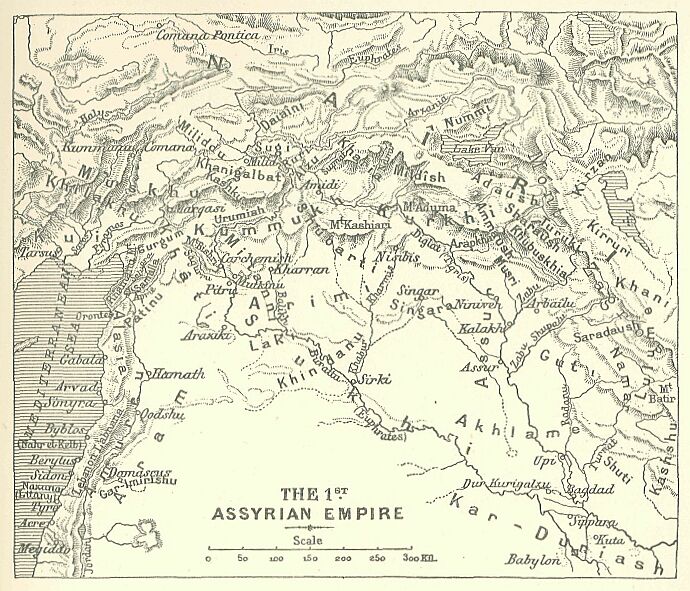
Assyria itself was but a poor and insignificant country when compared with her rival. It occupied, on each side of the middle course of the Tigris, the territory lying between the 35th and 37th parallels of latitude.*
* These are approximately the limits of the first Assyrian empire, as given by the monuments; from the Persian epoch onwards, the name was applied to the whole course of the Tigris as far as the mountain district. The ancient orthography of the name is Aushâr.
It was bounded on the east by the hills and mountain ranges running parallel to the Zagros Chain—Gebel Guar, Gebel Gara, Zerguizavân-dagh, and Baravân-dagh, with their rounded monotonous limestone ridges, scored by watercourses and destitute of any kind of trees. On the north it was hemmed in by the spurs of the Masios, and bounded on the east by an undefined line running from Mount Masios to the slopes of Singar, and from these again to the Chaldæan plain; to the south the frontier followed the configuration of the table-land and the curve of the low cliffs, which in prehistoric times had marked the limits of the Persian Gulf; from here the boundary was formed on the left side of the Tigris by one of its tributaries, either the Lower Zab or the Badanu. The territory thus enclosed formed a compact and healthy district: it was free from extremes of temperature arising from height or latitude, and the relative character and fertility of its soil depended on the absence or presence of rivers. The eastern part of Assyria was well watered by the streams and torrents which drained the Iranian plateau and the lower mountain chains which ran parallel to it. The beds of these rivers are channelled so deeply in the alluvial soil, that it is necessary to stand on the very edge of their banks to catch a sight of their silent and rapid waters; and it is only in the spring or early summer, when they are swollen by the rains and melting snow, that they spread over the adjacent country. As soon as the inundation is over, a vegetation of the intensest green springs up, and in a few days the fields and meadows are covered with a luxuriant and fragrant carpet of verdure. This brilliant growth is, however, short-lived, for the heat of the sun dries it up as quickly as it appears, and even the corn itself is in danger of being burnt up before reaching maturity. To obviate such a disaster, the Assyrians had constructed a network of canals and ditches, traces of which are in many places still visible, while a host of shadufs placed along their banks facilitated irrigation in the dry seasons. The provinces supplied with water in this manner enjoyed a fertility which passed into a proverb, and was well known among the ancients; they yielded crops of cereals which rivalled those of Babylonia, and included among their produce wheat, barley, millet, and sesame. But few olive trees were cultivated, and the dates were of inferior quality; indeed, in the Greek period, these fruits were only used for fattening pigs and domestic animals. The orchards contained the pistachio, the apple, the pomegranate, the apricot, the vine, the almond, and the fig, and, in addition to the essences common to both Syria and Egypt, the country produced cédrats of a delicious scent which were supposed to be an antidote to all kinds of poisons. Assyria was not well wooded, except in the higher valleys, where willows and poplars bordered the rivers, and sycamores, beeches, limes, and plane trees abounded, besides several varieties of pines and oaks, including a dwarf species of the latter, from whose branches manna was obtained.
This is a saccharine substance, which is deposited in small lumps, and is found in greater abundance during wet years and especially on foggy days. When fresh, it has an agreeable taste and is pleasant to eat; but as it will not keep in its natural state, the women prepare it for exportation by dissolving it in boiling water, and evaporating it to a sweetish paste, which has more or less purgative, qualities. The aspect of the country changes after crossing the Tigris westward. The slopes of Mount Masios are everywhere furrowed with streams, which feed the Khabur and its principal affluent, the Kharmis;* woods become more frequent, and the valleys green and shady.
* The Kharmis is the Mygdonios of Greek geographers, the Hirmâs of the Arabs; the latter name may be derived from Kharmis, or it may be that it merely presents a fortuitous resemblance to it.
The plains extending southwards, however, contain, like those of the Euphrates, beds of gypsum in the sub-soil, which render the water running through them brackish, and prevent the growth of vegetation. The effects of volcanic action are evident on the surface of these great steppes; blocks of basalt pierce through the soil, and near the embouchure of the Kharmis, a cone, composed of a mass of lava, cinders, and scorial, known as the Tell-Kôkab, rises abruptly to a height of 325 feet. The mountain chain of Singar, which here reaches its western termination, is composed of a long ridge of soft white limestone, and seems to have been suddenly thrown up in one of the last geological upheavals which affected this part of the country: in some places it resembles a perpendicular wall, while in others it recedes in natural terraces which present the appearance of a gigantic flight of steps. The summit is often wooded, and the spurs covered with vineyards and fields, which flourish vigorously in the vicinity of streams; when these fail, however, the table-land resumes its desolate aspect, and stretches in bare and sandy undulations to the horizon, broken only where it is crossed by the Thartar, the sole river in this region which is not liable to be dried up, and whose banks may be traced by the scanty line of vegetation which it nourishes.
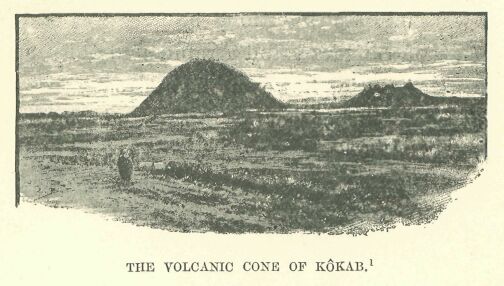
Drawn by Boudier, from the cut in Layard.
In a country thus unequally favoured by nature, the towns are necessarily distributed in a seemingly arbitrary fashion. Most of them are situated on the left bank of the Tigris, where the fertile nature of the soil enables it to support a dense population. They were all flourishing centres of population, and were in close proximity to each other, at all events during the centuries of Assyrian hegemony.*
* We find, for example, in the inscription of Bavian, a long enumeration of towns and villages situated almost within the suburbs of Nineveh, on the banks of the Khôser.
Three of them soon eclipsed their rivals in political and religious importance; these were Kalakh and Nina on the Tigris, and Arbaîlu, lying beyond the Upper Zab, in the broken plain which is a continuation eastwards of the first spurs of the Zagros.* On the right bank, however, we find merely some dozen cities and towns, scattered about in places where there was a supply of water sufficient to enable the inhabitants to cultivate the soil; as, for example, Assur on the banks of the Tigris itself, Singara near the sources of the Thartar, and Nazibina near those of the Kharmis, at the foot of the Masios. These cities were not all under the rule of one sovereign when Thûtmosis III. appeared in Syria, for the Egyptian monuments mention, besides the kingdom of Assyria, that of Singara** and Araphka in the upper basin of the Zab.***
* The name of Arbeles is written in a form which appears to signify “the town of the four gods.” ** This kingdom of Singara is mentioned in the Egyptian lists of Thûtmosis III. Schrader was doubtful as to its existence, but one of its kings is mentioned in a letter from the King of Alasia to Amenôthes IV.; according to Niebuhr, the state of which Singara was the capital must have been identical, at all events at one period, with the Mitanni of the Egyptian texts. *** The Arapakha of the Egyptian monuments has been identified with the Arrapakhitis of the Greeks.
Assyria, however, had already asserted her supremacy over this corner of Asia, and the remaining princes, even if they were not mere vicegerents depending on her king, were not strong enough in wealth and extent of territory to hold their own against her, since she was undisputed mistress of Assur, Arbeles, Kalakh, and Nineveh, the most important cities of the plain. Assur covered a considerable area, and the rectangular outline formed by the remains of its walls is still discernible on the surface of the soil. Within the circuit of the city rose a mound, which the ancient builders had transformed, by the addition of masses of brickwork, into a nearly square platform, surmounted by the usual palace, temple, and ziggurat; it was enclosed within a wall of squared stone, the battlements of which remain to the present day.* The whole pile was known as the “Ekharsagkurkurra,” or the “House of the terrestrial mountain,” the sanctuary in whose decoration all the ancient sovereigns had vied with one another, including Samsirammân I. and Irishum, who were merely vicegerents dependent upon Babylon. It was dedicated to Anshar, that duplicate of Anu who had led the armies of heaven in the struggle with Tiâmat; the name Anshar, softened into Aushar, and subsequently into Ashshur, was first applied to the town and then to the whole country.**
* Ainsworth states the circumference of the principal mound of Kalah-Shergât to be 4685 yards, which would make it one of the most extensive ruins in the whole country. ** Another name of the town in later times was Palbêki, “the town of the old empire,” “the ancient capital,” or Shauru. Many Assyriologists believe that the name Ashur, anciently written Aushâr, signified “the plain at the edge of the water”; and that it must have been applied to the town before being applied to the country and the god. Others, on the contrary, think, with more reason, that it was the god who gave his name to the town and the country; they make a point of the very ancient play of words, which in Assyria itself attributed the meaning “good god” to the word Ashur. Jensen was the first to state that Ashur was the god Anshâr of the account of the creation.
The god himself was a deity of light, usually represented under the form of an armed man, wearing the tiara and having the lower half of his body concealed by a feathered disk. He was supposed to hover continually over the world, hurling fiery darts at the enemies of his people, and protecting his kingly worshippers under the shadow of his wings. Their wars were his wars, and he was with them in the thick of the attack, placing himself in the front rank with the soldiery,* so that when he gained the victory, the bulk of the spoil—precious metals, gleanings of the battle-field, slaves and productive lands—fell to his share. The gods of the vanquished enemy, moreover, were, like their princes, forced to render him homage. In the person of the king he took their statues prisoners, and shut them up in his sanctuary; sometimes he would engrave his name upon their figures and send them back to their respective temples, where the sight of them would remind their worshippers of his own omnipotence.** The goddess associated with him as his wife had given her name, Nina, to Nineveh,*** and was, as the companion of the Chaldæan Bel, styled the divine lady Belit; she was, in fact, a chaste and warlike Ishtar, who led the armies into battle with a boldness characteristic of her father.****
* In one of the pictures, for instance, representing the assault of a town, we see a small figure of the god, hurling darts against the enemy. The inscriptions also state that the peoples “are alarmed and quit their cities before the arms of Assur, the powerful one.” ** As, for instance, the statues of the gods taken from the Arabs in the time of Esarhaddon. Tiglath-pileser I. had carried away twenty-five statues of gods taken from the peoples of Kurkhi and Kummukh, and had placed them in the temples of Beltis, Ishtar, Anu, and Rammân; he mentions other foreign divinities who had been similarly treated. *** The ideogram of the name of the goddess Nina serves to write the name of the town Nineveh. The name itself has been interpreted by Schrader as “station, habitation,” in the Semitic languages, and by Fr. Delitzsch “repose of the god,” an interpretation which Delitzsch himself repudiated later on. It is probable that the town, which, like Assur, was a Chaldæan colony, derived its name from the goddess to whom it was dedicated, and whose temple existed there as early as the time of the vicegerent Samsirammân. **** Belit is called by Tiglath-pileser I. “the great spouse beloved of Assur,” but Belit, “the lady,” is here merely an epithet used for Ishtar: the Assyrian Ishtar, Ishtar of Assur, Ishtar of Nineveh, or rather—especially from the time of the Sargonids—Ishtar of Arbeles, is almost always a fierce and warlike Ishtar, the “lady of combat, who directs battles,” “whose heart incites her to the combat and the struggle.” Sayce thinks that the union of Ishtar and Assur is of a more recent date.
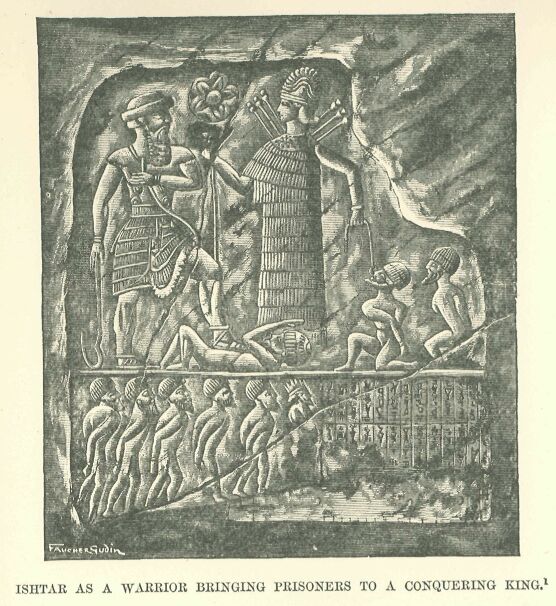
Drawn by Faucher-Gudin, from squeezes brought back by M. do Morgan.
These two divinities formed an abstract and solitary pair, around whom neither story nor myth appears to have gathered, and who never became the centre of any complex belief. Assur seems to have had no parentage assigned to him, no statue erected to him, and he was not associated with the crowd of other divinities; on the contrary, he was called their lord, their “peerless king,” and, as a proof of his supreme sovereignty over them, his name was inscribed at the head of their lists, before those of the triads constituted by the Chaldæan priests—even before those of Anu, Bel, and Ba. The city of Assur, which had been the first to tender him allegiance for many years, took precedence of all the rest, in spite of the drawbacks with which it had to contend. Placed at the very edge of the Mesopotamian desert, it was exposed to the dry and burning winds which swept over the plains, so that by the end of the spring the heat rendered it almost intolerable as a residence. The Tigris, moreover, ran behind it, thus leaving it exposed to the attacks of the Babylonian armies, unprotected as it was by any natural fosse or rampart. The nature of the frontier was such as to afford it no safeguard; indeed, it had, on the contrary, to protect its frontier. Nineveh, on the other hand, was entrenched behind the Tigris and the Zab, and was thus secure from any sudden attack. Northerly and easterly winds prevailed during the summer, and the coolness of the night rendered the heat during the day more bearable. It became the custom for the kings and vicegerents to pass the most trying months of the year at Nineveh, taking up their abode close to the temple of Nina, the Assyrian Ishtar, but they did not venture to make it their habitual residence, and consequently Assur remained the official capital and chief sanctuary of the empire. Here its rulers concentrated their treasures, their archives, their administrative offices, and the chief staff of the army; from this town they set out on their expeditions against the Cossæans of Babylon or the mountaineers of the districts beyond the Tigris, and it was in this temple that they dedicated to the god the tenth of the spoil on their return from a successful campaign.*
* The majority of scholars now admit that the town of Nina, mentioned by Gudea and the vicegerents of Telloh, was a quarter of, or neighbouring borough of, Lagash, and had nothing in common with Nineveh, in spite of Hommel’s assumption to the contrary.
The struggle with Chaldæa, indeed, occupied the greater part of their energies, though it did not absorb all their resources, and often left them times of respite, of which they availed themselves to extend their domain to the north and east. We cannot yet tell which of the Assyrian sovereigns added the nearest provinces of the Upper Tigris to his realm; but when the names of these districts appear-in history, they are already in a state of submission and vassalage, and their principal towns are governed by Assyrian officers in the same manner as those of Singara and Nisibe. Assuruballît, the conqueror of the Cossæans, had succeeded in establishing his authority over the turbulent hordes of Shubari which occupied the neighbourhood of the Masios, between the Khabur and the Balîkh, and extended perhaps as far as the Euphrates; at any rate, he was considered by posterity as the actual founder of the Assyrian empire in these districts.* Belnirâri had directed his efforts in another direction, and had conquered the petty kingdoms established on the slopes of the Iranian table-land, around the sources of the two Zabs, and those of the Badanu and the Turnât.**
* It is called, in an inscription of his great-grandson, Rammân-nirâri L, the powerful king “who reduced to servitude the forces of the vast country of Shubari, and who enlarged the territory and limits “of Assur. ** The inscription of Rammân-nirâri I. styles him the prince “who crushes the army of the Cossæans, he whose hand unnerves the enemy, and who enlarges the territory and its limits.” The Cossæans mentioned in this passage are usually taken to be the Cossæan kings of Babylon, and not the mountain tribes.
Like Susiana, this part of the country was divided up into parallel valleys, separated from each other by broken ridges of limestone, and watered by the tributaries of the Tigris or their affluents.
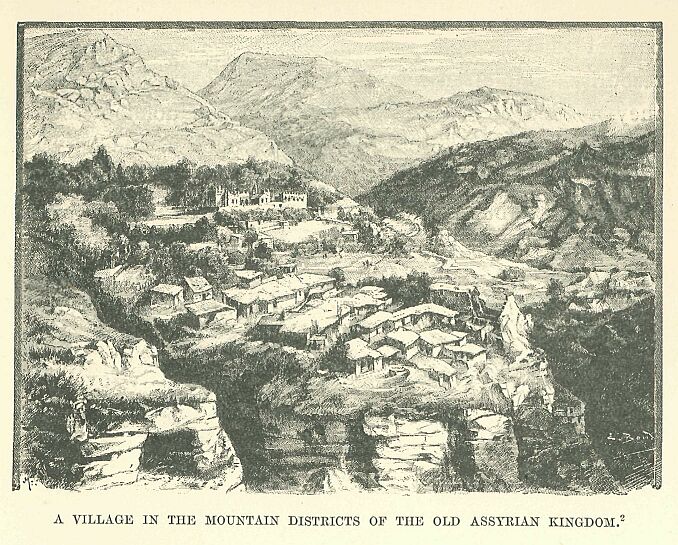
Drawn by Boudier, from a drawing by Père Durand.
It was thickly strewn with walled towns and villages; the latter, perched upon the precipitous mountain summits, and surrounded by deep ravines, owed their security solely to their position, and, indeed, needed no fortification. The country abounded in woods and pastures, interspersed with cornlands; access to it was gained by one or two passes on the eastern side, which thus permitted caravans or armies to reach the districts lying between the Erythræan and Caspian Seas. The tribes who inhabited it had been brought early under Chaldæan civilization, and had adopted the cuneiform script; such of their monuments as are still extant resemble the bas-reliefs and inscriptions of Assyria.* It is not always easy to determine the precise locality occupied by these various peoples; the Guti were situated near the upper courses of the Turnât and the Badanu, in the vicinity of the Kashshu;** the Lulumê had settled in the neighbourhood of the Batîr, to the north of the defiles of Zohab;*** the Namar separated the Lulumê from Elam, and were situated half in the plain and half in the mountain, while the Arapkha occupied, both banks of the Great Zab.
* Pinches has published an inscription of a king of Khani, named Tukultimir, son of Ilushaba, written in Chaldeo-Assyrian, and found in the temple of Shamash at Sippara, where the personage himself had dedicated it. Winckler gives another inscription of a king of the Guti, which is also in Semitic and in cuneiform character. ** The name is written sometimes Quti, at others Guti, which induced Pognon to believe that they were two different peoples: the territory occupied by this nation must have been originally to the east of the Lesser Zab, in the upper basins of the Adhem and the Diyaleh. Oppert proposes to recognise in these Guti “the ancestors of the Goths, who, fifteen hundred years ago, pushed forward to the Russia of the present day: we find,” (he adds), “in this passage and in others, some of which go back to the third millennium before the Christian era, the earliest mention of the Germanic races.” *** The people of Lulumô-Lullubi have been pointed out as living to the east of the Lesser Zab by Schrader; their exact position, together with that of Mount Padîr-Batîr in whose neighbourhood they were, has been determined by Père Scheil.
Budîlu carried his arms against these tribes, and obtained successes over the Turuki and the Nigimkhi, the princes of the Guti and the Shuti, as well as over the Akhlamî and the Iauri.*
* The Shutu or Shuti, who are always found in connection with the Guti, appear to have been the inhabitants of the lower mountain slopes which separate the basin of the Tigris with the regions of Elam, to the south of Turnât. The Akhlamê were neighbours of the Shuti and the Guti; they were settled partly in the Mesopotamian plain and partly in the neighbourhood of Turnât. The territory of the Iauri is not known; the Turuki and the Nigimkhi were probably situated somewhere to the east of the Great Zab: in the same way that Oppert connects the Goths with the Guti, so Hommel sees in the Turuki the Turks of a very early date.
The chiefs of the Lulumê had long resisted the attacks of their neighbours, and one of them, Anu-banini, had engraved on the rocks overhanging the road not far from the village of Seripul, a bas-relief celebrating his own victories. He figures on it in full armour, wearing a turban on his head, and treading underfoot a fallen foe, while Ishtar of Arbeles leads towards him a long file of naked captives, bound ready for sacrifice. The resistance of the Lulumê was, however, finally overcome by Rammân-nirâri, the son of Budilû; he strengthened the suzerainty gained by his predecessor over the Guti, the Cossæans, and the Shubarti, and he employed the spoil taken from them in beautifying the temple of Assur. He had occasion to spend some time in the regions of the Upper Tigris, warring against the Shubari, and a fine bronze sabre belonging to him has been found near Diarbekîr, among the ruins of the ancient Amidi, where, no doubt, he had left it as an offering in one of the temples. He was succeeded by Shalmânuâsharîd,* better known to us as Shalmaneser I., one of the most powerful sovereigns of this heroic age of Assyrian history.
Drawn by Faucher-Gudin, from the sketch published in the Transactions of the Bibl. Arch. Soc.

His reign seems to have been one continuous war against the various races then in a state of ferment on the frontiers of his kingdom. He appears in the main to have met with success, and in a few years had doubled the extent of his dominions.* His most formidable attacks were directed against the Aramaeans** of Mount Masios, whose numerous tribes had advanced on one side till they had crossed the Tigris, while on the other they had pushed beyond the river Balîkh, and had probably reached the Euphrates.***
* Shalmânu-âsharîd, or Shulmânu-âsharîd, signifies “the god Shulmânu (Shalmânu) is prince,” as Pinches was the first to point out. ** Some of the details of these campaigns have been preserved on the much-mutilated obelisk of Assur-nazir-pal. This was a compilation taken from the Annals of Assyria to celebrate the important acts of the king’s ancestors. The events recorded in the third column were at first attributed to the reign of Tiglath-pileser I.; Fr. Delitzsch was the first to recognise that they could be referred to the reign of this Shalmaneser, and his opinion is now admitted by most of the Assyriologists who have studied the question. *** The identity of the Arami (written also Armaya, Arumi, Arimi) with the Aramoans, admitted by the earlier Kammin- nikâbi Assyriologists.
He captured their towns one after another, razed their fortresses, smote the agricultural districts with fire and sword, and then turned upon the various peoples who had espoused their cause—the Kirkhu, the Euri, the Kharrîn,* and the Muzri, who inhabited the territory between the basins of the two great rivers;** once, indeed, he even crossed the Euphrates and ventured within the country of Khanigalbat, a feat which his ancestors had never even attempted.***
* The people of the country of Kilkhi, or Kirkhi, the Kurkhi, occupied the region between the Tigris at Diarbekîr and the mountains overlooking the lake of Urumiah. The position of the Ruri is not known, but it is certain that on one side they joined the Aramaeans, and that they were in the neighbourhood of Tushkhân. Kharrân is the Harrân of the Balikh, mentioned in vol. iv. pp. 37, 38 of the present work. ** The name of Muzri frequently occurs, and in various positions, among the countries mentioned by the Assyrian conquerors; the frequency of its occurrence is easily explained if we are to regard it as a purely Assyrian term used to designate the military confines or marches of the kingdom at different epochs of its history. The Muzri here in question is the borderland situated in the vicinity of Cilicia, probably the Sophene and the Gumathene of classical geographers. Winckler appears to me to exaggerate their importance when he says they were spread over the whole of Northern Syria as early as the time of Shalmaneser I. *** Khanigalbat is the name of the province in which Milid was placed.
He was recalled by a revolt which had broken out in the scattered cities of the district of Dur-Kurigalzu; he crushed the rising in spite of the help which Kadash-manburiash, King of Babylon, had given to the rebels, and was soon successful in subduing the princes of Lulumê. These were not the raids of a day’s duration, undertaken, without any regard to the future, merely from love of rapine or adventure. Shalmaneser desired to bring the regions which he annexed permanently under the authority of Assyria, and to this end he established military colonies in suitable places, most of which were kept up long after his death.*
* More than five centuries after the time of Shalmaneser I., Assurnazir-pal makes mention, in his Annals, of one of these colonies, established in the country of Diarbekîr at Khabzilukha (or Khabzidipkha), near to the town of Damdamua.
He seems to have directed the internal affairs of his kingdom with the same firmness and energy which he displayed in his military expeditions. It was no light matter for the sovereign to decide on a change in the seat of government; he ran the risk of offending, not merely his subjects, but the god who presided over the destinies of the State, and neither his throne nor his life would have been safe had he failed in his attempt. Shalmaneser, however, did not hesitate to make the change, once he was fully convinced of the drawbacks presented by Assur as a capital. True, he beautified the city, restored its temples, and permitted it to retain all its privileges and titles; but having done so, he migrated with his court to the town of Kalakh, where his descendants continued to reside for several centuries. His son Tukulti-ninip made himself master of Babylon, and was the first of his race who was able to claim the title of King of Sumir and Akkad. The Cossæans were still suffering from their defeat at the hands of Bammân-nirâri. Four of their princes had followed Nazimaruttash on the throne in rapid succession—Kadashmanturgu, Kadashmanburiash, who was attacked by Shalmaneser, a certain Isammeti whose name has been mutilated, and lastly, Shagaraktiburiash: Bibeiasdu, son of this latter, was in power at the moment when Tukulti-ninip ascended the throne. War broke out between the two monarchs, but dragged on without any marked advantage on one side or the other, till at length the conflict was temporarily suspended by a treaty similar to others which had been signed in the course of the previous two or three centuries.*
* The passage from the Synchronous History, republished by Winckler, contains the termination of the mutilated name of a Babylonian king... ashu, which, originally left undecided by Winckler, has been restored “Bibeiashu” by Hilprecht, in the light of monuments discovered at Nipur, an emendation which has since then been accepted by Winckler. Winckler, on his part, has restored the passage on the assumption that the name of the King of Assyria engaged against Bibeiashu was Tukulti-ninip; then, combining this fragment with that in the Pinches Chronicle, which deals with the taking of Babylon, he argues that Bibeiashu was the king dethroned by Tukulti-ninip. An examination of the dates, in so far as they are at present known to us from the various documents, seems to me to render this arrangement inadmissible. The Pinches Chronicle practically tells us that Tukulti-ninip reigned over Babylon for seven years, when the Chaldæans revolted, and named Rammânshumusur king. Now, the Babylonian Canon gives us the following reigns for this epoch: Bibeiashu 8 years, Belnadînshumu 1 year 6 months, Kadashmankharbe 1 year 6 months, Rammânnadînshumu 6 years, Rammânshumusur 30 years, or 9 years between the end of the reign of Bibeiashu and the beginning of that of Rammânshumusur, instead of the 7 years given us by the Pinches Chronicle for the length of the reign of Tukulti- ninip at Babylon. If we reckon, as the only documents known require us to do, seven years from the beginning of the reign of Rammânshumusur to the date of the taking of Babylon, we are forced to admit that this took place in the reign of Kadashmankharbe IL, and, consequently, that the passage in the Synchronous History, in which mention is made of Bibeiashu, must be interpreted as I have done in the text, by the hypothesis of a war prior to that in which Babylon fell, which was followed by a treaty between this prince and the King of Assyria.
The peace thus concluded might have lasted longer but for an unforeseen catastrophe which placed Babylon almost at the mercy of her rival. The Blamites had never abandoned their efforts to press in every conceivable way their claim to the Sebbeneh-su, the supremacy, which, prior to Kbammurabi, had been exercised by their ancestors over the whole of Mesopotamia; they swooped down on Karduniash with an impetuosity like that of the Assyrians, and probably with the same alternations of success and defeat. Their king, Kidinkhutrutash, unexpectedly attacked Belnadînshumu, son of Bibeiashu, appeared suddenly under the walls of Nipur and forced the defences of Durîlu and Étimgarka-lamma: Belnadînshumu disappeared in the struggle after a reign of eighteen months. Tukulti-ninip left Belna-dînshumu’s successor, Kadashmankharbe II., no time to recover from this disaster; he attacked him in turn, carried Babylon by main force, and put a number of the inhabitants to the sword. He looted the palace and the temples, dragged the statue of Merodach from its sanctuary and carried it off into Assyria, together with the badges of supreme power; then, after appointing governors of his own in the various towns, he returned to Kalakh, laden with booty; he led captive with him several members of the royal family—among others, Bammânshumusur, the lawful successor of Bibeiashu.