Volume 6 — CHAPTER II—THE RISE OF THE ASSYRIAN EMPIRE (continued 2)
M. L. McClure translation
This first conquest of Chaldæa did not, however, produce any lasting results. The fall of Babylon did not necessarily involve the subjection of the whole country, and the cities of the south showed a bold front to the foreign intruder, and remained faithful to Kadashmankharbe; on the death of the latter, some months after his defeat, they hailed as king a certain Bammânshumnadîn, who by some means or other had made his escape from captivity. Bammânshumnadîn proved himself a better man than his predecessors; when Kidinkhutrutash, never dreaming, apparently, that he would meet with any serious resistance, came to claim his share of the spoil, he defeated him near Ishin, drove him out of the districts recently occupied by the Elamites, and so effectually retrieved his fortunes in this direction, that he was able to concentrate his whole attention on what was going on in the north. The effects of his victory soon became apparent: the nobles of Akkad and Karduniash declined to pay homage to their Assyrian governors, and, ousting them from the offices to which they had been appointed, restored Babylon to the independence which it had lost seven years previously. Tukulti-ninip paid dearly for his incapacity to retain his conquests: his son Assurnazirpal I. conspired with the principal officers, deposed him from the throne, and confined him in the fortified palace of Kar-Tukulti-ninip, which he had built not far from Kalakh, where he soon after contrived his assassination. About this time Rammânshumnadîn disappears, and we can only suppose that the disasters of these last years had practically annihilated the Cossæan dynasty, for Rammânshu-musur, who was a prisoner in Assyria, was chosen as his successor. The monuments tell us nothing definite of the troubles which next befell the two kingdoms: we seem to gather, however, that Assyria became the scene of civil wars, and that the sons of Tukulti-ninip fought for the crown among themselves. Tukultiassurbel, who gained the upper hand at the end of six years, set Raminân-shumusur at liberty, probably with the view of purchasing the support of the Chaldæans, but he did not succeed in restoring his country to the position it had held under Shalmaneser and Tukulti-ninip I. The history of Assyria presents a greater number of violent contrasts and extreme vicissitudes than that of any other Eastern people in the earliest times. No sooner had the Assyrians arrived, thanks to the ceaseless efforts of five or six generations, at the very summit of their ambition, than some incompetent, or perhaps merely unfortunate, king appeared on the scene, and lost in a few years all the ground which had been gained at the cost of such tremendous exertions: then the subject races would rebel, the neighbouring peoples would pluck up courage and reconquer the provinces which they had surrendered, till the dismembered empire gradually shrank back to its original dimensions. As the fortunes of Babylon rose, those of Nineveh suffered a corresponding depression: Babylon soon became so powerful that Eammânshumusur was able to adopt a patronising tone in his relations with Assur-nirâri I. and Nabodaînâni, the descendants of Tukultiassurbel, who at one time shared the throne together.*
* All that we know of these two kings is contained in the copy, executed in the time of Assurbanipal, of a letter addressed to them by Eammânshumusur. They have been placed, at one time or another, either at the beginning of Assyrian history before Assurbelnishishu, or after Tigiath-pileser I., about the XIth or Xth, or even the VIIIth century before our era. It has since been discovered that the Rammânshumusur who wrote this letter was the successor of Tukulti-ninip I. in Chaldæa.
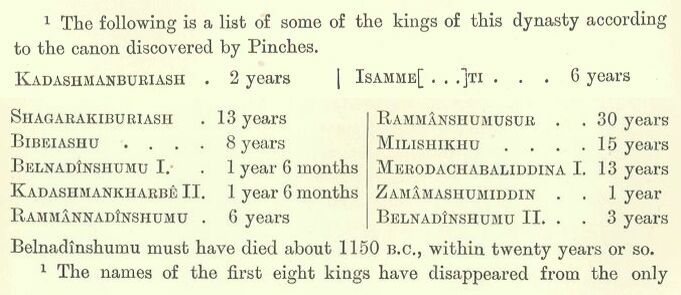
This period of subjection and humiliation did not last long. Belkudurusur, who appears on the throne not long after Assurnirâri and his partner, resumed military operations against the Cossæans, but cautiously at first; and though he fell in the decisive engagement, yet Bammân-shumusur perished with him, and the two states were thus simultaneously left rulerless. Milishikhu succeeded Bammânshumusur, and Ninipahalesharra filled the place of Belkudurusur; the disastrous invasion of Assyria by the Chaldæans, and their subsequent retreat, at length led to an armistice, which, while it afforded evidence of the indisputable superiority of Milishikhu, proved no less plainly the independence of his rival. Mero-dachabaliddina I. replaced Milishikhu, Zamâniashu-middin followed Merodachabaliddina: Assurdân I., son of Ninipahalesharra, broke the treaty, captured the towns of Zabân, Irrîa, and Akarsallu, and succeeded in retaining them. The advantage thus gained was but a slight one, for these provinces lying between the two Zabs had long been subject to Assyria, and had been wrested from her since the days of Tukulti-ninip: however, it broke the run of ill luck which seemed to have pursued her so relentlessly, and opened the way for more important victories. This was the last Cossæan war; at any rate, the last of which we find any mention in history: Bel-nadînshumu II. reigned three years after Zamâmashu-middin, but when he died there was no man of his family whom the priests could invite to lay hold of the hand of Merodach, and his dynasty ended with him. It included thirty-six kings, and had lasted five hundred and seventy-six years and six months.*
* The following is a list of some of the kings of this dynasty according to the canon discovered by Pinches.
It had enjoyed its moments of triumph, and at one time had almost seemed destined to conquer the whole of Asia; but it appears to have invariably failed just as it was on the point of reaching the goal, and it became completely exhausted by its victories at the end of every two or three generations. It had triumphed over Elam, and yet Elam remained a constant peril on its right. It had triumphed over Assyria, yet Assyria, after driving it back to the regions of the Upper Tigris, threatened to bar the road to the Mediterranean by means of its Masian colonies: were they once to succeed in this attempt, what hope would there be left to those who ruled in Babylon of ever after re-establishing the traditional empire of the ancient Sargon and Khammurabi? The new dynasty sprang from a town in Pashê, the geographical position of which is not known. It was of Babylonian origin, and its members placed, at the be ginning of their protocols, formula which were intended to indicate, in the clearest possible manner, the source from which they sprang: they declared themselves to be scions of Babylon, its vicegerents, and supreme masters. The names of the first two we do not know: the third, Nebuchadrezzar, shows himself to have been one of the most remarkable men of all those who flourished during this troubled era. At no time, perhaps, had Chaldæa been in a more abject state, or assailed by more active foes. The Elamite had just succeeded in wresting from her Namar, the region from whence the bulk of her chariot-horses were obtained, and this success had laid the provinces on the left bank of the Tigris open to their attacks. They had even crossed the river, pillaged Babylon, and carried away the statue of Bel and that of a goddess named Eria, the patroness of Khussi: “Merodach, sore angered, held himself aloof from the country of Akkad;” the kings could no longer “take his hands” on their coming to the throne, and were obliged to reign without proper investiture in consequence of their failure to fulfil the rite required by religious laws.*
* The Donation to Shamud and Shamaî informs us that Nebuchadrezzar “took the hands of Bel” as soon as he regained possession of the statue. The copy we possess of the Royal Canon. Nebuchadrezzar I.‘s place in the series has, therefore, been the subject of much controversy. Several Assyriologists were from the first inclined to place him in the first or second rank, some being in favour of the first, others preferring the second; Dolitzsch put him into the fifth place, and Winckler, without pronouncing definitely on the position to be assigned him, thought he must come in about half-way down the dynasty. Hilprecht, on taking up the questions, adduced reasons for supposing him to have been the founder of the dynasty, and his conclusions have been adopted by Oppert; they have been disputed by Tiele, who wishes to put the king back to fourth or fifth in order, and by Winckler, who places him fourth or fifth. It is difficult, however, to accept Hilprecht’s hypothesis, plausible though it is, so long as Assyriologists who have seen the original tablet agree in declaring that the name of the first king began with the sign of Merodach and not with that of Nebo, as it ought to do, were this prince really our Nebuchadrezzar.
Nebuchadrezzar arose “in Babylon,—roaring like a lion, even as Bammân roareth,—and his chosen nobles, roared like lions with him.—To Merodach, lord of Babylon, rose his prayer:—‘How long, for me, shall there be sighing and groaning?—How long, for my land, weeping and mourning?—How long, for my countries, cries of grief and tears? Till what time, O lord of Babylon, wilt thou remain in hostile regions?—Let thy heart be softened, and make Babylon joyful,—and let thy face be turned toward Eshaggil which thou lovest!’” Merodach gave ear to the plaint of his servant: he answered him graciously and promised his aid. Namar, united as it had been with Chaldæa for centuries, did not readily become accustomed to its new masters. The greater part of the land belonged to a Semitic and Cossæan feudality, the heads of which, while admitting their suzerain’s right to exact military service from them, refused to acknowledge any further duty towards him. The kings of Susa declined to recognise their privileges: they subjected them to a poll-tax, levied the usual imposts on their estates, and forced them to maintain at their own expense the troops quartered on them for the purpose of guaranteeing their obedience.*
* Shamuà and Shamaî “fled in like manner towards Karduniash, before the King of Elam;” it would seem that Rittimerodach had entered into secret negotiations with Nebuchadrezzar, though this is nowhere explicitly stated in the text.
Several of the nobles abandoned everything rather than submit to such tyranny, and took refuge with Nebuchadrezzar: others entered into secret negotiations with him, and promised to support him if he came to their help with an armed force. He took them at their word, and invaded Namar without warning in the month of Tamuz, while the summer was at its height, at a season in which the Elamites never even dreamt he would take the field. The heat was intense, water was not to be got, and the army suffered terribly from thirst during its forced march of over a hundred miles across a parched-up country. One of the malcontents, Eittimerodach, lord of Bitkarziabku, joined Nebuchadrezzar with all the men he could assemble, and together they penetrated as far as Ulaî. The King of Elam, taken by surprise, made no attempt to check their progress, but collected his vassals and awaited their attack on the banks of the river in front of Susa. Once “the fire of the combat had been lighted between the opposing forces, the face of the sun grew dark, the tempest broke forth, the whirlwind raged, and in this whirlwind of the struggle none of the characters could distinguish the face of his neighbour.” Nebuchadrezzar, cut off from his own men, was about to surrender or be killed, when Eittimerodach flew to his rescue and brought him off safely. In the end the Chaldæans gained the upper hand.*
* Donation to Rittimerodach, col. i. 11. 12-43. The description of the battle as given in this document is generally taken to be merely symbolical, and I have followed the current usage. But if we bear in mind that the text lays emphasis on the drought and severity of the season, we are tempted to agree with Pinches and Budge that its statements should be taken literally. The affair may have been begun in a cloud of dust, and have ended in a downpour of rain so heavy as to partly blind the combatants. The king was probably drawn away from his men in the confusion; it was probably then that he was in danger of being made prisoner, and that Rittimerodach, suddenly coming up, delivered him from the foes who surrounded him.
The Elamites renounced their claims to the possession of Namar, and restored the statues of the gods: Nebuchadrezzar “at once laid hold of the hands of Bel,” and thus legalised his accession to the throne. Other expeditions against the peoples of Lulurne and against the Cossæans restored his supremacy in the regions of the north-east, and a campaign along the banks of the Euphrates opened out the road to Syria. He rewarded generously those who had accompanied him on his raid against Elam. After issuing regulations intended to maintain the purity of the breed of horses for which Namar was celebrated, he reinstated in their possessions Shamuâ and his son Shamaî, the descendants of one of the priestly families of the province, granting them in addition certain domains near Upi, at the mouth of the Turnât. He confirmed Rittimerodach in possession of all his property, and reinvested him with all the privileges of which the King of Elam had deprived him. From that time forward the domain of Bitkarziabku was free of the tithe on corn, oxen, and sheep; it was no longer liable to provide horses and mares for the exchequer, or to afford free passage to troops in time of peace; the royal jurisdiction ceased on the boundary of the fief, the seignorial jurisdiction alone extended over the inhabitants and their property. Chaldæan prefects ruled in Namar, at Khalman, and at the foot of the Zagros, and Nebuchadrezzar no longer found any to oppose him save the King of Assyria.
The long reign of Assurdân in Assyria does not seem to have been distinguished by any event of importance either good or bad: it is true he won several towns on the south-east from the Babylonians, but then he lost several others on the north-west to the Mushku,* and the loss on the one side fully balanced the advantage gained on the other.
* Hommel has proved, by a very simple calculation, that Assurdân must have been the king in whose reign the Mushku made the inroad into the basin of the Upper Tigris and of the Balikh, which is mentioned in the Annals of Tiglath- pileser I. These Annals are our authority for stating that Assurdân was on the throne for a long period, though the exact length of his reign is not known.
His son Mutakkilnusku lived in Assur at peace,* but his grandson, Assurîshishî, was a mighty king, conqueror of a score of countries, and the terror of all rebels: he scattered the hordes of the Akhlamê and broke up their forces; then Ninip, the champion of the gods, permitted him to crush the Lulumê and the G-uti in their valleys and on their mountains covered with forests. He made his way up to the frontiers of Elam,** and his encroachments on territories claimed by Babylon stirred up the anger of the Chaldæans against him; Nebuchadrezzar made ready to dispute their ownership with him.
* Annals of Tiglath-pileser I. Mutakkilnusku himself has only left us one inscription, in which he declares that he had built a palace in the city of Assyria. ** Smith discovered certain fragments of Annals, which he attributed to Assurîshishî. The longest of these tell of a campaign against Elam. Lotz attributed them to Tiglath- pileser I., and is supported in this by most Assyriologists of the day.
The earlier engagements went against the Assyrians; they were driven back in disorder, but the victor lost time before one of their strongholds, and, winter coming on before he could take it, he burnt his engines of war, set fire to his camp, and returned home. Next year, a rapid march carried him right under the walls of Assur; then Assurîshishî came to the rescue, totally routed his opponent, captured forty of his chariots, and drove him flying across the frontier. The war died out of itself, its end being marked by no treaty: each side kept its traditional position and supremacy over the tribes inhabiting the basins of the Turnât and Eadanu. The same names reappear in line after line of these mutilated Annals, and the same definite enumerations of rebellious tribes who have been humbled or punished. These kings of the plain, both Ninevite and Babylonian, were continually raiding the country up and down for centuries without ever arriving at any decisive result, and a detailed account of their various campaigns would be as tedious reading as that of the ceaseless struggle between the Latins and Sabines which fills the opening pages of Roman history. Posterity soon grew weary of them, and, misled by the splendid position which Assyria attained when at the zenith of its glory, set itself to fabricate splendid antecedents for the majestic empire established by the latter dynasties. The legend ran that, at the dawn of time, a chief named Ninos had reduced to subjection one after the other—Babylonia, Media, Armenia, and all the provinces between the Indies and the Mediterranean. He built a capital for himself on the banks of the Tigris, in the form of a parallelogram, measuring a hundred and fifty stadia in length, ninety stadia in width; altogether, the walls were four hundred and eighty stadia in circumference. In addition to the Assyrians who formed the bulk of the population, he attracted many foreigners to Nineveh, so that in a few years it became the most flourishing town in the whole world. An inroad of the tribes of the Oxus interrupted his labours; Ninos repulsed the invasion, and, driving the barbarians back into Bactria, laid siege to it; here, in the tent of one of his captains, he came upon Semiramis, a woman whose past was shrouded in mystery. She was said to be the daughter of an ordinary mortal by a goddess, the Ascalonian Derketô. Exposed immediately after her birth, she was found and adopted by a shepherd named Simas, and later on her beauty aroused the passion of Oannes, governor of Syria. Ninos, amazed at the courage displayed by her on more than one occasion, carried her off, made her his favourite wife, and finally met his death at her hands. No sooner did she become queen, than she founded Babylon on a far more extensive scale than that of Nineveh. Its walls were three hundred and sixty stadia in length, with two hundred and fifty lofty towers, placed here and there on its circuit, the roadway round the top of the ramparts being wide enough for six chariots to drive abreast. She made a kind of harbour in the Euphrates, threw a bridge across it, and built quays one hundred and sixty stadia in length along its course; in the midst of the town she raised a temple to Bel. This great work was scarcely finished when disturbances broke out in Media; these she promptly repressed, and set out on a tour of inspection through the whole of her provinces, with a view to preventing the recurrence of similar outbreaks by her presence. Wherever she went she left records of her passage behind her, cutting her way through mountains, quarrying a pathway through the solid rock, making broad highways for herself, bringing rebellious tribes beneath her yoke, and raising tumuli to mark the tombs of such of her satraps as fell beneath the blows of the enemy. She built Ecbatana in Media, Semiramocarta on Lake Van in Armenia, and Tarsus in Cilicia; then, having reached the confines of Syria, she crossed the isthmus, and conquered Egypt and Ethiopia. The far-famed wealth of India recalled her from the banks of the Nile to those of the Euphrates, en route for the remote east, but at this point her good fortune forsook her: she was defeated by King Stratobates, and returned to her own dominions, never again to leave them. She had set up triumphal stelae on the boundaries of the habitable globe, in the very midst of Scythia, not far from the Iaxartes, where, centuries afterwards, Alexander of Macedon read the panegyric of herself which she had caused to be engraved there. “Nature,” she writes, “gave me the body of a woman, but my deeds have put me on a level with the greatest of men. I ruled over the dominion of Ninos, which extends eastwards to the river Hinaman, southwards to the countries of Incense and Myrrh, and northwards as far as the Sacaa and Sogdiani. Before my time no Assyrian had ever set eyes on the sea: I have seen four oceans to which no mariner has ever sailed, so far remote are they. I have made rivers to flow where I would have them, in the places where they were needed; thus did I render fertile the barren soil by watering it with my rivers. I raised up impregnable fortresses, and cut roadways through the solid rock with the pick. I opened a way for the wheels of my chariots in places to which even the feet of wild beasts had never penetrated. And, amidst all these labours, I yet found time for my pleasures and for the society of my friends.” On discovering that her son Ninyas was plotting her assassination, she at once abdicated in his favour, in order to save him from committing a crime, and then transformed herself into a dove; this last incident betrays the goddess to us. Ninos and Semiramis are purely mythical, and their mighty deeds, like those ascribed to Ishtar and Gilgames, must be placed in the same category as those other fables with which the Babylonian legends strive to fill up the blank of the prehistoric period.*
* The legend of Ninos and Semiramis is taken from Diodorus Siculus, who reproduces, often word for word, the version of Ctesias.
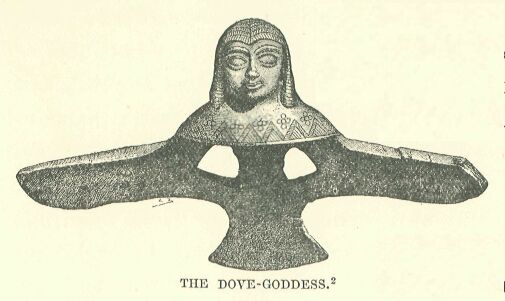
Drawn by Boudier, from the sketch published in Longpérier.
The real facts were, as we know, far less brilliant and less extravagant than those supplied by popular imagination. It would be a mistake, however, to neglect or despise them on account of their tedious monotony and the insignificance of the characters who appear on the stage. It was by dint of fighting her neighbours again and again, without a single day’s respite, that Rome succeeded in forging the weapons with which she was to conquer the world; and any one who, repelled by their tedious sameness, neglected to follow the history of her early struggles, would find great difficulty in understanding how it came about that a city which had taken centuries to subjugate her immediate neighbours should afterwards overcome all the states on the Mediterranean seaboard with such magnificent ease. In much the same way the ceaseless struggles of Assyria with the Chaldaeans, and with the mountain tribes of the Zagros Chain, were unconsciously preparing her for those lightning-like campaigns in which she afterwards overthrew all the civilized nations of the Bast one after another. It was only at the cost of unparalleled exertions that she succeeded in solidly welding together the various provinces within her borders, and in kneading (so to speak) the many and diverse elements of her vast population into one compact mass, containing in itself all that was needful for its support, and able to bear the strain of war for several years at time without giving way, and rich enough in men and horses to provide the material for an effective army without excessive impoverishment of her trade or agriculture.
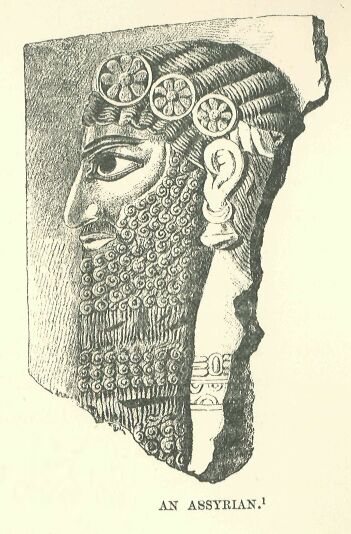
Drawn by Boudier, from a painted bas-relief given in Layard.
The race came of an old Semitic strain, somewhat crude as yet, and almost entirely free from that repeated admixture of foreign elements which had marred the purity of the Babylonian stock. The monuments show us a type similar in many respects to that which we find to-day on the slopes of Singar, or in the valleys to the east of Mossul.
The figures on the monuments are tall and straight, broad-shouldered and wide in the hips, the arms well developed, the legs robust, with good substantial feet. The swell of the muscles on the naked limbs is perhaps exaggerated, but this very exaggeration of the modelling suggests the vigour of the model; it is a heavier, more rustic type than the Egyptian, promising greater strength and power of resistance, and in so far an indisputable superiority in the great game of war. The head is somewhat small, the forehead low and flat, the eyebrows heavy, the eye of a bold almond shape, with heavy lids, the nose aquiline, and full at the tip, with wide nostrils terminating in a hard, well-defined curve; the lips are thick and full, the chin bony, while the face is framed by the coarse dark wavy hair and beard, which fell in curly masses over the nape of the neck and the breast. The expression of the face is rarely of an amiable and smiling type, such as we find in the statues of the Theban period or in those of the Memphite empire, nor, as a matter of fact, did the Assyrian pride himself on the gentleness of his manners: he did not overflow with love for his fellow-man, as the Egyptian made a pretence of doing; on the contrary, he was stiff-necked and proud, without pity for others or for himself, hot-tempered and quarrelsome like his cousins of Chaldæa, but less turbulent and more capable of strict discipline. It mattered not whether he had come into the world in one of the wretched cabins of a fellah village, or in the palace of one of the great nobles; he was a born soldier, and his whole education tended to develop in him the first qualities of the soldier—temperance, patience, energy, and unquestioning obedience: he was enrolled in an army which was always on a war footing, commanded by the god Assur, and under Assur, by the king, the vicegerent and representative of the god. His life was shut in by the same network of legal restrictions which confined that of the Babylonians, and all its more important events had to be recorded on tablets of clay; the wording of contracts, the formalities of marriage or adoption, the status of bond and free, the rites of the dead and funeral ceremonies, had either remained identical with those in use during the earliest years of the cities of the Lower Euphrates, or differed from them only in their less important details. The royal and municipal governments levied the same taxes, used the same procedure, employed the same magistrates, and the grades of their hierarchy were the same, with one exception. After the king, the highest office was filled by a soldier, the tartan who saw to the recruiting of the troops, and led them in time of war, or took command of the staff-corps whenever the sovereign himself deigned to appear on the scene of action.*
* We can determine the rank occupied, by the tartanu at court by the positions they occupy in the lists of eponymous limmu: they invariably come next after the king—a fact which was noticed many years ago.
The more influential of these functionaries bore, in addition to their other titles, one of a special nature, which, for the space of one year, made its holder the most conspicuous man in the country; they became limmu, and throughout their term of office their names appeared on all official documents. The Chaldæans distinguished the various years of each reign by a reference to some event which had taken place in each; the Assyrians named them after the limmu.* The king was the ex-officio limmu for the year following that of his accession, then after him the tartan, then the ministers and governors of provinces and cities in an order which varied little from reign to reign. The names of the limmu, entered in registers and tabulated—just as, later on, were those of the Greek archons and Roman consuls—furnished the annalists with a rigid chronological system, under which the facts of history might be arranged with certainty.**
* According to Delitzsch, the term limu, or limmu, meant at first any given period, then later more especially the year during which a magistrate filled his office; in the opinion of most other Assyriologists it referred to the magistrate himself as eponymous archon. ** The first list of limmu was discovered by H. Rawlinson. The portions which have been preserved extend from the year 893 to the year 666 B.C. without a break. In the periods previous and subsequent to this we have only names scattered here and there which it has not been possible to classify: the earliest limmu known at present flourished under Rammân-nirâri I., and was named Mukhurilâni. Three different versions of the canon have como down to us. In the most important one the names of the eponymous officials are written one after another without titles or any mention of important events; in the other two, the titles of each personage, and any important occurrences which took place during his year of office, are entered after the name.
The king still retained the sacerdotal attributes with which Cossæan monarchs had been invested from the earliest times, but contact with the Egyptians had modified the popular conception of his personality. His subjects were no longer satisfied to regard him merely as a man superior to his fellow-men; they had come to discover something of the divine nature in him, and sometimes identified him—not with Assur, the master of all things, who occupied a position too high above the pale of ordinary humanity—but with one of the demi-gods of the second rank, Shamash, the Sun, the deity whom the Pharaohs pretended to represent in flesh and blood here below. His courtiers, therefore, went as far as to call him “Sun” when they addressed him, and he himself adopted this title in his inscriptions.*
* Nebuchadrezzar I. of Babylon assumes the title of Shamash mati-shu, the “Sun of his country,” and Hilprecht rightly sees in this expression a trace of Egyptian influences; later on, Assurnazirpal, King of Assyria similarly describes himself as Shamshu kishshat nishi, the “Sun of all mankind.” Tiele is of opinion that these expressions do not necessarily point to any theory of the actual incarnation of the god, as was the case in Egypt, but that they may be mere rhetorical figures.
Formerly he had only attained this apotheosis after death, later on he was permitted to aspire to it during his lifetime. The Chaldæans adopted the same attitude, and in both countries the royal authority shone with the borrowed lustre of divine omnipotence. With these exceptions life at court remained very much the same as it had been; at Nineveh, as at Babylon, we find harems filled with foreign princesses, who had either been carried off as hostages from the country of a defeated enemy, or amicably obtained from their parents. In time of war, the command of the troops and the dangers of the battle-field; in time of peace, a host of religious ceremonies and judicial or administrative duties, left but little leisure to the sovereign who desired to perform conscientiously all that was required of him. His chief amusement lay in the hunting of wild beasts: the majority of the princes who reigned over Assyria had a better right than even Amenôthes III. himself to boast of the hundreds of lions which they had slain. They set out on these hunting expeditions with quite a small army of charioteers and infantry, and were often away several days at a time, provided urgent business did not require their presence in the palace. They started their quarry with the help of large dogs, and followed it over hill and dale till they got within bowshot: if it was but slightly wounded and turned on them, they gave it the finishing stroke with their lances without dismounting.
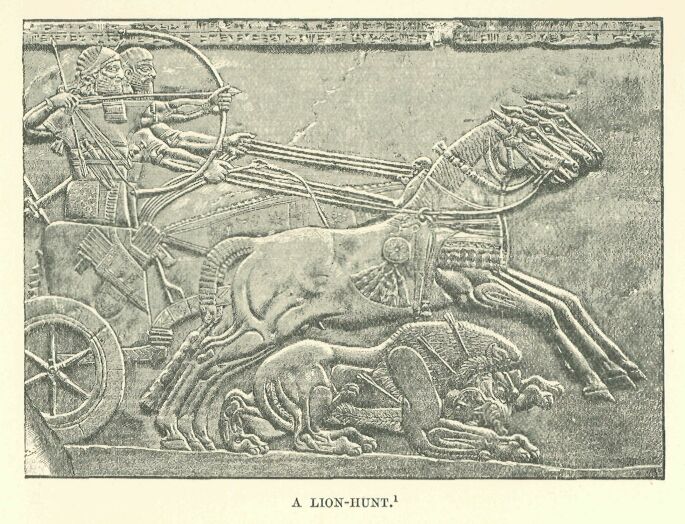
Drawn by Boudier, from a bas-relief in the British Museum.
Occasionally, however, they were obliged to follow their prey into places where horses could not easily penetrate; then a hand-to-hand conflict was inevitable. The lion would rise on its hind quarters and endeavour to lay its pursuer low with a stroke of its mighty paw, but only to fall pierced to the heart by his lance or sword.
Drawn by Boudier, from a bas-relief in the British Museum.
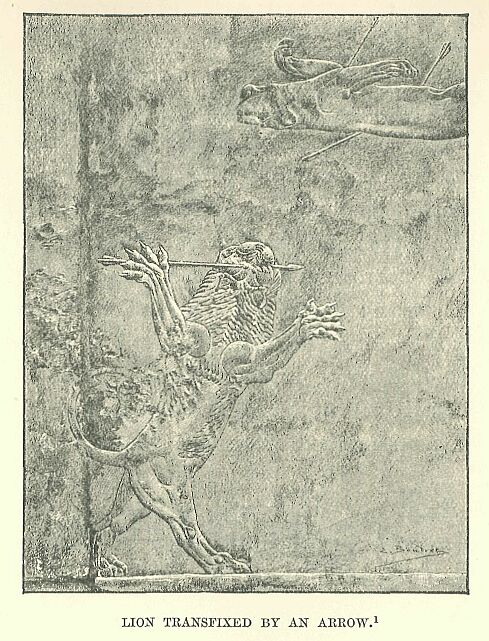
This kind of encounter demanded great presence of mind and steadiness of hand; the Assyrians were, therefore, trained to it from their youth up, and no hunter was permitted to engage in these terrible encounters without long preliminary practice. Seeing the lion as they did so frequently, and at such close quarters, they came to know it quite as well as the Egyptians, and their sculptors reproduce it with a realism and technical skill which have been rarely equalled in modern times. But while the Theban artist generally represents it in an attitude of repose, the Assyrians prefer to show it in violent action in all the various attitudes which it assumes during a struggle, either crouching as it prepares to spring, or fully extended in the act of leaping; sometimes it rears into an upright position, with arched back, gaping jaws, and claws protruded, ready to bite or strike its foe; at others it writhes under a spear-thrust, or rolls over and over in its dying agonies. In one instance, an arrow has pierced the skull of a male lion, crashing through the frontal bone a little above the left eyebrow, and protrudes obliquely to the right between his teeth: under the shock of the blow he has risen on his hind legs, with contorted spine, and beats the air with his fore paws, his head thrown back as though to free himself of the fatal shaft. Not far from him the lioness lies stretched out upon its back in the rigidity of death.
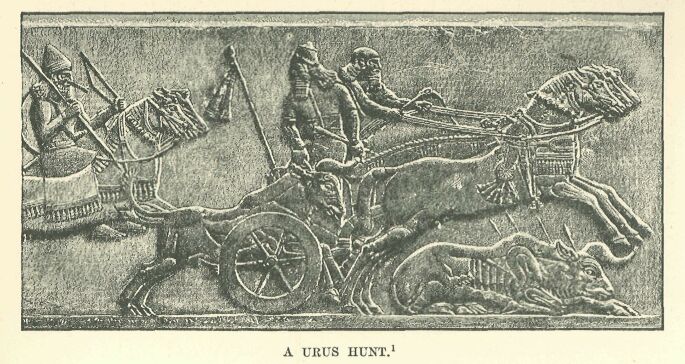
The “rimu,” or urus, was, perhaps, even a more formidable animal to encounter than any of the felido, owing to the irresistible fury of his attack. No one would dare, except in a case of dire necessity, to meet him on foot. The loose flowing robes which the king and the nobles never put aside—not even in such perilous pastimes as these—were ill fitted for the quick movements required to avoid the attack of such an animal, and those who were unlucky enough to quit their chariot ran a terrible risk of being gored or trodden underfoot in the encounter. It was the custom, therefore, to attack the beast by arrows, and to keep it at a distance. If the animal were able to come up with its pursuer, the latter endeavoured to seize it by the horn at the moment when it lowered its head, and to drive his dagger into its neck. If the blow were adroitly given it severed the spinal cord, and the beast fell in a heap as if struck by lightning. A victory over such animals was an occasion for rejoicing, and solemn thanks were offered to Assur and Ishtar, the patrons of the chase, at the usual evening sacrifice.
Drawn by Boudier, from a bas-relief in the British Museum.
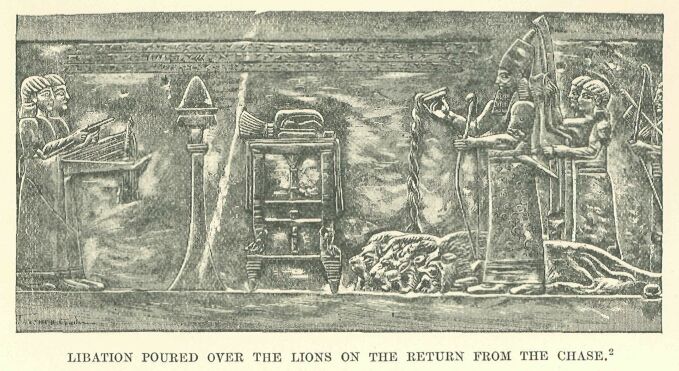
The slain beasts, whether lion or urus, were arranged in a row before the altar, while the king, accompanied by his flabella, and umbrella-bearers, stood alongside them, holding his bow in his left hand. While the singers intoned the hymn of thanksgiving to the accompaniment of the harp, the monarch took the bowl of sacred wine, touched his lips with it, and then poured a portion of the contents on the heads of the victims. A detailed account of each hunting exploit was preserved for posterity either in inscriptions or on bas-reliefs.*
* In the Annals of Tiglath-pileser I. the king counts the number of his victims: 4 urus, 10 male elephants, 120 lions slain in single combat on foot, 800 lions killed by arrows let fly from his chariot. In the Annals of Assurnazirpal, the king boasts of having slain 30 elephants, 250 urus, and 370 lions.
The chase was in those days of great service to the rural population; the kings also considered it to be one of the duties attached to their office, and on a level with their obligation to make war on neighbouring nations devoted by the will of Assur to defeat and destruction.
Drawn by Faucher-Gudin, from a photograph by Hommel.
The army charged to carry out the will of the god had not yet acquired the homogeneity and efficiency which it afterwards attained, yet it had been for some time one of the most formidable in the world, and even the Egyptians themselves, in spite of their long experience in military matters, could not put into the field such a proud array of effective troops. We do not know how this army was recruited, but the bulk of it was made up of native levies, to which foreign auxiliaries were added in numbers varying with the times.* A permanent nucleus of troops was always in garrison in the capital under the “tartan,” or placed in the principal towns at the disposal of the governors.**
* We have no bas-relief representing the armies of Tiglath- pileser I. Everything in the description which follows is taken from the monuments of Assurnazirpal and Shalmaneser II., revised as far as possible by the inscriptions of Tiglath-pileser; the armament of both infantry and chariotry must have been practically the same in the two periods. ** This is based on the account given in the Obelisk of Shalmaneser, where the king, for example, after having gathered his soldiers together at Kalakh [Calah], put at their head Dainassur the artan, “the master of his innumerable troops.”
Drawn by Faucher-Gudin.
The contingents which came to be enrolled at these centres on the first rumour of war may have been taken from among the feudal militia, as was the custom in the Nile valley, or the whole population may have had to render personal military service, each receiving while with the colours a certain daily pay. The nobles and feudal lords were accustomed to call their own people together, and either placed themselves at their head or commissioned an officer to act in their behalf.*
* The assembling of foot-soldiers and chariots is often described at the beginning of each campaign; the Donation of Bittimerodach brings before us a great feudal lord, who leads his contingent to the King of Chaldæa, and anything which took place among the Babylonians had its counterpart among the Assyrians. Sometimes the king had need of all the contingents, and then it was said he “assembled the country.” Auxiliaries are mentioned, for example, in the Annals of Assurnazirpal, col. iii. 11. 58-77, where the king, in his passage, rallies one after the other the troops of Bît-Bakhiâni, of Azalli, of Bît-Adini, of Garganish, and of the Patinu.
Drawn by Boudier, from a photograph by Mansell.
These recruits were subjected to the training necessary for their calling by exercises similar to those of the Egyptians, but of a rougher sort and better adapted to the cumbrous character of their equipment. The blacksmith’s art had made such progress among the Assyrians since the times of Thûtmosis III. and Ramses IL, that both the character and the materials of the armour were entirely changed.
Drawn by Faucher-Gudin, from G. Rawlinson.
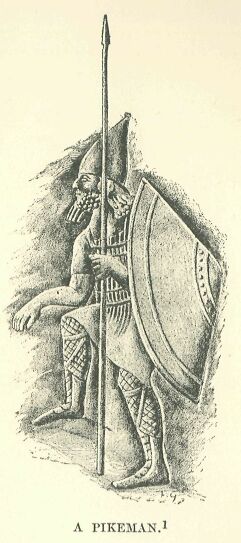
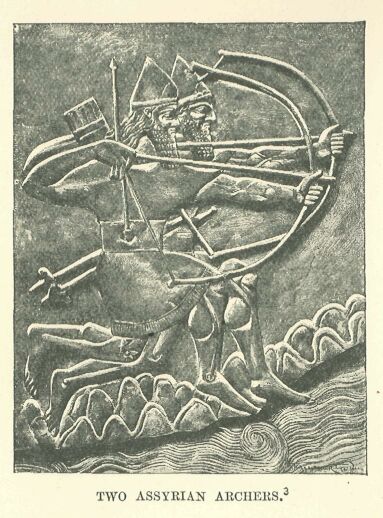
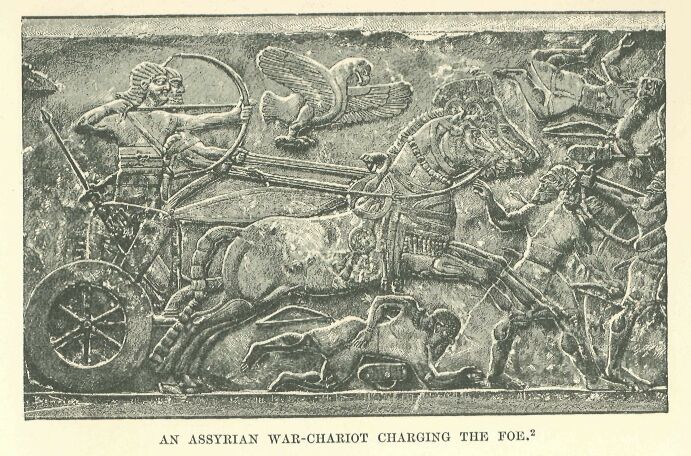
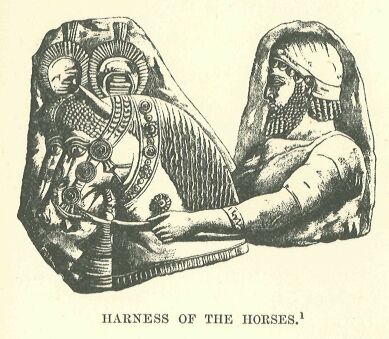
While the Egyptian of old entered into the contest almost naked, and without other defence than a padded cap, a light shield, and a leather apron, the Assyrian of the new age set out for war almost cased in metal. The pikemen and archers of whom the infantry of the line was composed wore a copper or iron helmet, conical in form, and having cheek-pieces covering the ears; they were clad in a sort of leathern shirt covered with plates or imbricated scales of metal, which protected the body and the upper part of the arm; a quilted and padded loin-cloth came over the haunches, while close-fitting trousers, and buskins laced up in the front, completed their attire. The pikemen were armed with a lance six feet long, a cutlass or short sword passed through the girdle, and an enormous shield, sometimes round and convex, sometimes arched at the top and square at the bottom. The bowmen did not encumber themselves with a buckler, but carried, in addition to the bow and quiver, a poignard or mace. The light infantry consisted of pikemen and archers—each of whom wore a crested helmet and a round shield of wicker-work—of slingers and club-bearers, as well as of men armed with the two-bladed battle-axe. The chariots were heavier and larger than those of the Egyptians. They had high, strongly made wheels with eight spokes, and the body of the vehicle rested directly on the axle; the panels were of solid wood, sometimes covered with embossed or carved metal, but frequently painted; they were further decorated sometimes with gold, silver, or ivory mountings, and with precious stones. The pole, which was long and heavy, ended in a boss of carved wood or incised metal, representing a flower, a rosette, the muzzle of a lion, or a horse’s head. It was attached to the axle under the floor of the vehicle, and as it had to bear a great strain, it was not only fixed to this point by leather thongs such as were employed in Egypt, but also bound to the front of the chariot by a crossbar shaped like a spindle, and covered with embroidered stuff—an arrangement which prevented its becoming detached when driving at full speed. A pair of horses were harnessed to it, and a third was attached to them on the right side for the use of a supplementary warrior, who could take the place of his comrade in case of accident, or if he were wounded. The trappings were very simple; but sometimes there was added to these a thickly padded caparison, of which the various parts were fitted to the horse by tags so as to cover the upper part of his head, his neck, back, and breast. The usual complement of charioteers was two to each vehicle, as in Egypt, but sometimes, as among the Khâti, there were three—one on the left to direct the horses, a warrior, and an attendant who protected the other two with his shield; on some occasions a fourth was added as an extra assistant. The equipment of the charioteers was like that of the infantry, and consisted of a jacket with imbricated scales of metal, bow and arrows, and a lance or javelin. A standard which served as a rallying-point for the chariots in the battle was set up on the front part of each vehicle, between the driver and the warrior; it bore at the top a disk supported on the heads of two bulls, or by two complete representations of these animals, and a standing figure of Assur letting fly his arrows. The chariotry formed, as in most countries of that time, the picked troops of the service, in which the princes and great lords were proud to be enrolled. Upon it depended for the most part the issue of the conflict, and the position assigned to it was in the van, the king or commander-in-chief reserving to himself the privilege of conducting the charge in person. It was already, however, in a state of decadence, both as regards the number of units composing it and its methods of manoeuvring; the infantry, on the other hand, had increased in numbers, and under the guidance of abler generals tended to become the most trustworthy force in Assyrian campaigns.*
* Tiglath-pileser is seen, for instance, setting out on a campaign in a mountainous country with only thirty chariots.
Notwithstanding the weight of his equipment, the Assyrian foot-soldier was as agile as the Egyptian, but he had to fight usually in a much more difficult region than that in which the Pharaoh’s troops were accustomed to manouvre.
Drawn by Faucher-Gudin, from Layard.
The theatre of war was not like Syria, with its fertile and almost unbroken plains furrowed by streams which offered little obstruction to troops throughout the year, but a land of marshes, arid and rocky deserts, mighty rivers, capable, in one of their sudden floods, of arresting progress for days, and of jeopardising the success of a campaign;* violent and ice-cold torrents, rugged mountains whose summits rose into “points like daggers,” and whose passes could be held against a host of invaders by a handful of resolute men.**
* Sennacherib was obliged to arrest his march against Elam, owing to his inability to cross the torrents swollen by the rain; a similar contretemps must have met Assurbanipal on the banks of the Ididi. ** The Assyrian monarchs dwell with pleasure on the difficulties of the country which they have to overcome.
Bands of daring skirmishers, consisting of archers, slingers, and pikemen, cleared the way for the mass of infantry marching in columns, and for the chariots, in the midst of which the king and his household took up their station; the baggage followed, together with the prisoners and their escorts.*
* Assurbanipal relates, for instance, that he put under his escort a tribe which had surrendered themselves as prisoners.
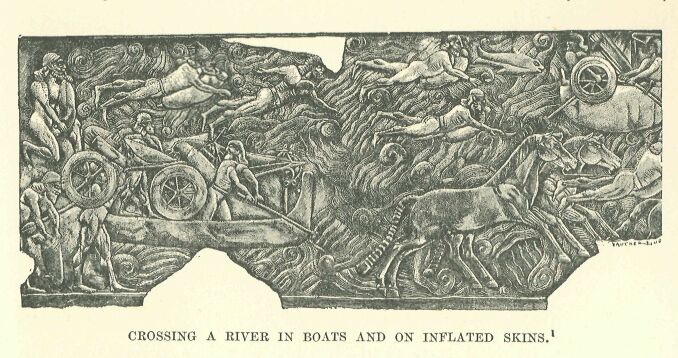
If they came to a river where there was neither ford nor bridge, they were not long in effecting a passage.
Drawn by Faucher-Gudin, from a bas-relief on the bronze gates of Balawât.
Each soldier was provided with a skin, which, having inflated it by the strength of his lungs and closed the aperture, he embraced in his arms and cast himself into the stream. Partly by floating and partly by swimming, a whole regiment could soon reach the other side. The chariots could not be carried over so easily.
Drawn by Faucher-Gudin, from one of the bas-reliefs on the bronze gates of Balawât.
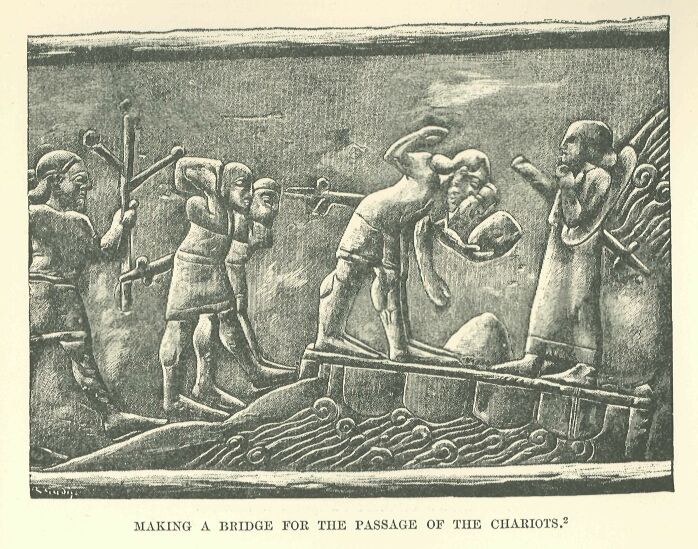
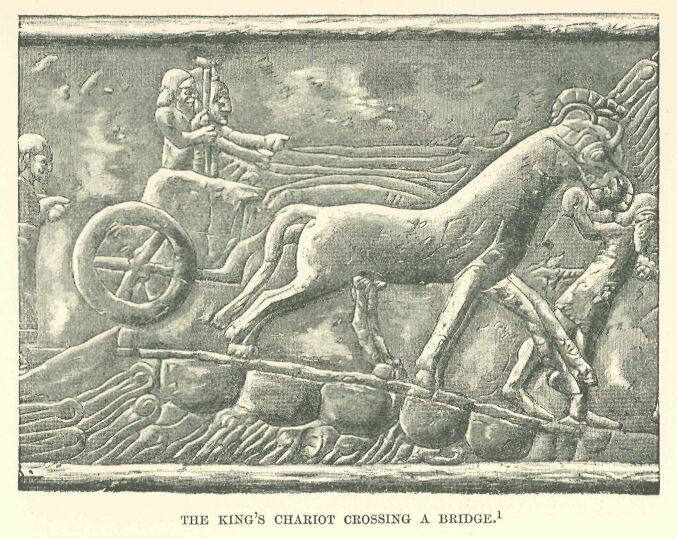
If the bed of the river was not very wide, and the current not too violent, a narrow bridge was constructed, or rather an improvised dyke of large stones and rude gabions filled with clay, over which was spread a layer of branches and earth, supplying a sufficiently broad passage for a single chariot, of which the horses were led across at walking pace.*
* Flying bridges, tîturâti, were mentioned as far back as the time of Tiglath-pileser I.
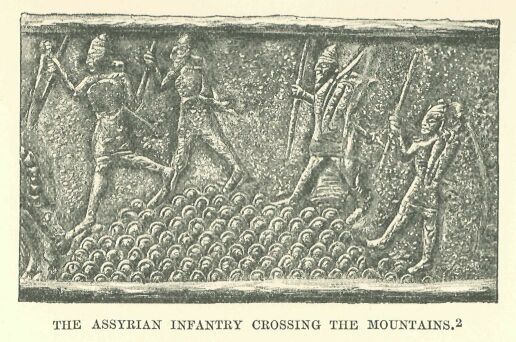
But when the distance between the banks was too great, and the stream too violent to allow of this mode of procedure, boats were requisitioned from the neighbourhood, on which men and chariots were embarked, while the horses, attended by grooms, or attached by their bridles to the flotilla, swam across the river.* If the troops had to pass through a mountainous district intersected by ravines and covered by forests, and thus impracticable on ordinary occasions for a large body of men, the advance-guard were employed in cutting a passage through the trees with the axe, and, if necessary, in making with the pick pathways or rough-hewn steps similar to those met with in the Lebanon on the Phoenician coast.**
* It was in this manner that Tiglath-pileser I. crossed the Euphrates on his way to the attack of Carchemish. ** Tiglath-pileser I. speaks on several occasions, and not without pride, of the roads that he had made for himself with bronze hatchets through the forests and over the mountains.
Drawn by Faucher-Gudin, from a bas-relief on the bronze gates of Balawât.
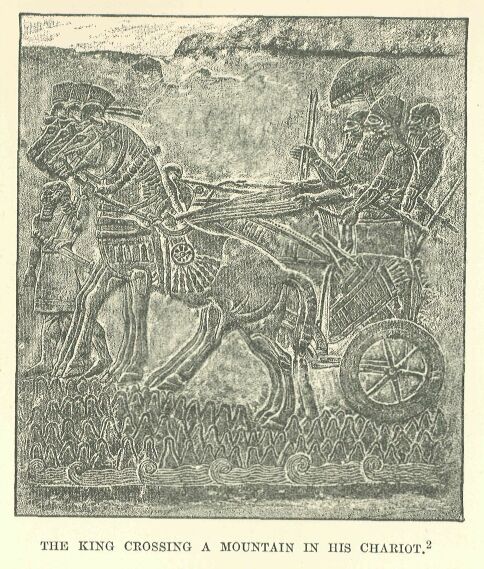
The troops advanced in narrow columns, sometimes even in single file, along these improvised roads, always on the alert lest they should be taken at a disadvantage by an enemy concealed in the thickets. In case of attack, the foot-soldiers had each to think of himself, and endeavour to give as many blows as he received; but the charioteers, encumbered by their vehicles and the horses, found it no easy matter to extricate themselves from the danger. Once the chariots had entered into the forest region, the driver descended from his vehicle, and led the horses by the head, while the warrior and his assistant were not slow to follow his example, in order to give some relief to the animals by tugging at the wheels. The king alone did not dismount, more out of respect for his dignity than from indifference to the strain upon the animals; for, in spite of careful leading, he had to submit to a rough shaking from the inequalities of this rugged soil; sometimes he had too much of this, and it is related of him in his annals that he had crossed the mountains on foot like an ordinary mortal.*
* The same fact is found in the accounts of every expedition, but more importance is attached to it as we approach the end of the Ninevite empire, when the kings were not so well able to endure hardship. Sennacherib mentions it on several occasions, with a certain amount of self-pity for the fatigue he had undergone, but with a real pride in his own endurance.
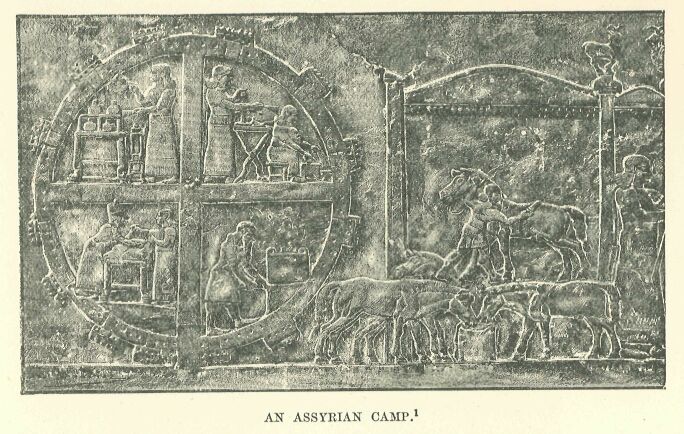
A halt was made every evening, either at some village, whose inhabitants were obliged to provide food and lodging, or, in default of this, on some site which they could fortify by a hastily thrown up rampart of earth. If they were obliged to remain in any place for a length of time, a regular encircling wall was constructed, not square or rectangular like those of the Egyptians, but round or oval.*
* The oval inclines towards a square form, with rounded corners, on the bas-reliefs of the bronze gates of Shalmaneser II. at Balawât.
Drawn by Boudier, from a photograph by Mansell, taken in the British Museum.
It was made of dried brick, and provided with towers like an ancient city; indeed, many of these entrenched camps survived the occasion of their formation, and became small fortified towns or castles, whence a permanent garrison could command the neighbouring country. The interior was divided into four equal parts by two roads, intersecting each other at right angles. The royal tents, with their walls of felt or brown linen, resembled an actual palace, which could be moved from place to place; they were surrounded with less pretentious buildings reserved for the king’s household, and the stables.
Drawn by Boudier, from Layard.
The tent-poles at the angles of these habitations were plated with metal, and terminated at their upper extremities in figures of goats and other animals made of the same material. The tents of the soldiers, were conical in form, and each was maintained in its position by a forked pole placed inside. They contained the ordinary requirements of the peasant—-bed and head-rest, table with legs like those of a gazelle, stools and folding-chairs; the household utensils and the provisions hung from the forks of the support. The monuments, which usually give few details of humble life, are remarkable for their complete reproductions of the daily scenes in the camp. We see on them, the soldier making his bed, grinding corn, dressing the carcase of a sheep, which he had just killed, or pouring out wine; the pot boiling on the fire is watched by the vigilant eye of a trooper or of a woman, while those not actively employed are grouped together in twos and threes, eating, drinking, and chatting. A certain number of priests and soothsayers accompanied the army, but they did not bring the statues of their gods with them, the only emblems of the divinities seen in battle being the two royal ensigns, one representing Assur as lord of the territory, borne on a single bull and bending his bow, while the other depicted him standing on two bulls as King of Assyria.* An altar smoked before the chariot on which these two standards were planted, and every night and morning the prince and his nobles laid offerings upon it, and recited prayers before it for the well-being of the army.
Military tactics had not made much progress since the time of the great Egyptian invasions. The Assyrian generals set out in haste from Nineveh or Assur in the hope of surprising their enemy, and they often succeeded in penetrating into the very heart of his country before he had time to mobilise or concentrate his forces. The work of subduing him was performed piecemeal; they devastated his fields, robbed his orchards, and, marching all through the night,** they would arrive with such suddenness before one or other of his towns, that he would have no time to organise a defence. Most of their campaigns were mere forced marches across plains and mountains, without regular sieges or pitched battles.
* It is possible that each of these standards corresponded to some dignity of the sovereign; the first belonged to him, inasmuch as he was shar kishshati, “king of the regions,” and the other, by virtue of his office, of shar Ashshur, “King of Assyria.” ** Assurnazirpal mentions several night marches, which enabled him to reach the heart of the enemy’s country.
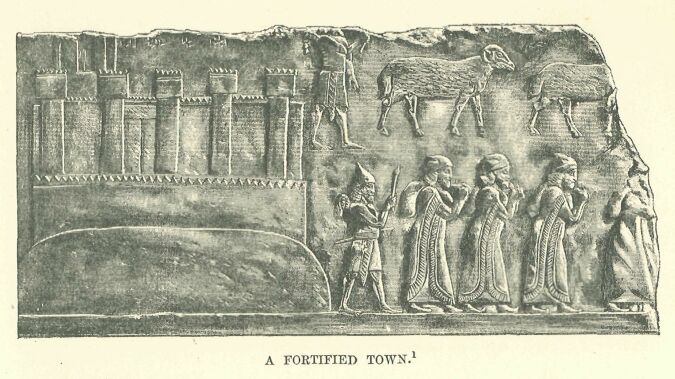
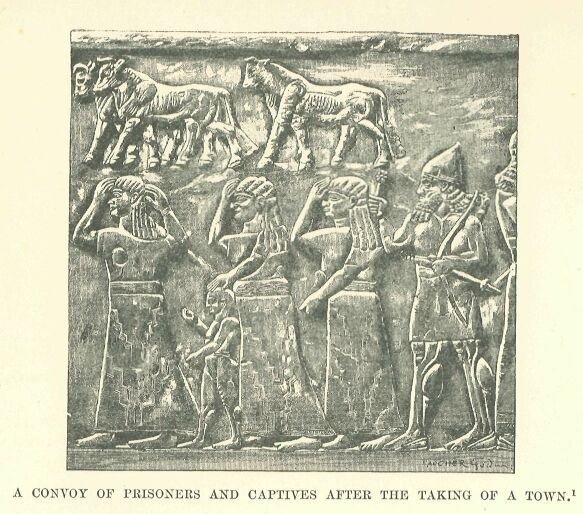
Drawn by Faucher-Gudin, from a photograph by Mansell. The inhabitants of the town who have been taken prisoners, are leaving it with their cattle under the conduct of Assyrian soldiers.
Should the enemy, however, seek an engagement, and the men be drawn up in line to meet him, the action would be opened by archers and light troops armed with slings, who would be followed by the chariotry and heavy infantry for close attack; a reserve of veterans would await around the commanding-general the crucial moment of the engagement, when they would charge in a body among the combatants, and decide the victory by sheer strength of arm.*
* Tiglath-pileser I. mentions a pitched battle against the Muskhu, who numbered 20,000 men; and another against Kiliteshub, King of Kummukh, in his first campaign. In one of the following campaigns he overcame the people of Saraush and those of Maruttash, and also 6000 Sugi; later on he defeated 23 allied kings of Naîri, and took from them 120 chariots and 20,000 people of Kumanu. The other wars are little more than raids, during which he encountered merely those who were incapable of offering him any resistance.
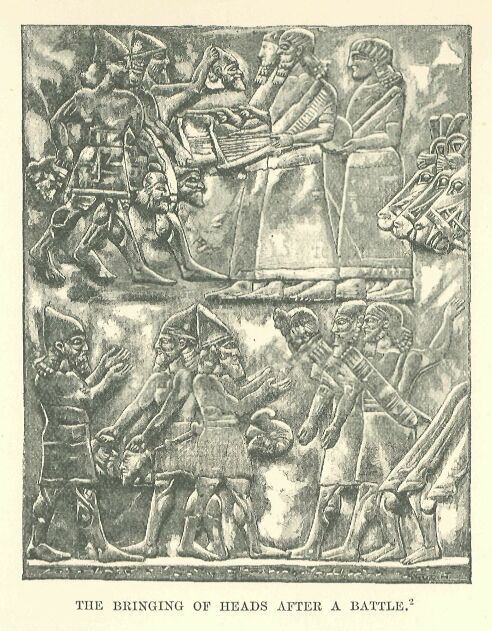
The pursuit of the enemy was never carried to any considerable distance, for the men were needed to collect the spoil, despatch the wounded, and carry off the trophies of war. Such of the prisoners as it was deemed useful or politic to spare were stationed in a safe place under a guard of sentries. The remainder were condemned to death as they were brought in, and their execution took place without delay; they were made to kneel down, with their backs to the soldiery, their heads bowed, and their hands resting on a flat stone or a billet of wood, in which position they were despatched with clubs. The scribes, standing before their tent doors, registered the number of heads cut off; each soldier, bringing his quota and throwing it upon the heap, gave in his name and the number of his company, and then withdrew in the hope of receiving a reward proportionate to the number of his victims.*
* The details of this bringing of heads are known to us by representations of a later period. The allusions contained in the Annals of Tiglath-pileser I. show that the custom was in full force under the early Assyrian conquerors.
When the king happened to accompany the army, he always presided at this scene, and distributed largesse to those who had shown most bravery; in his absence he required that the heads of the enemy’s chiefs should be sent to him, in order that they might be exposed to his subjects on the gates of his capital. Sieges were lengthy and arduous undertakings. In the case of towns situated on the plain, the site was usually chosen so as to be protected by canals, or an arm of a river on two or three sides, thus leaving one side only without a natural defence, which the inhabitants endeavoured to make up for by means of double or treble ramparts.*
* The town of Tela had three containing walls, that of Shingisha had four, and that of Pitura two.
Drawn by Faucher-Gudin, from Layard.
These fortifications must have resembled those of the Syrian towns; the walls were broad at the base, and, to prevent scaling, rose to a height of some thirty or forty feet: there were towers at intervals of a bowshot, from which the archers could seriously disconcert parties making attacks against any intervening points in the curtain wall; the massive gates were covered with raw hides, or were plated with metal to resist assaults by fire and axe, while, as soon as hostilities commenced, the defence was further completed by wooden scaffolding. Places thus fortified, however, at times fell almost without an attempt at resistance; the inhabitants, having descended into the lowlands to rescue their crops from the Assyrians, would be disbanded, and, while endeavouring to take refuge within their ramparts, would be pursued by the enemy, who would gain admittance with them in the general disorder. If the town did not fall into their hands by some stroke of good fortune, they would at once attempt, by an immediate assault, to terrify the garrison into laying down their arms.*
* Assurnazirpal, in this fashion, took the town of Pitura in two days, in spite of its strong double ramparts.
The archers and slingers led the attack by advancing in couples till they were within the prescribed distance from the walls, one of the two taking careful aim, while the other sheltered his comrade behind his round-topped shield. The king himself would sometimes alight from his chariot and let fly his arrows in the front rank of the archers, while a handful of resolute men would rush against the gates of the town and attempt either to break them down or set them alight with torches. Another party, armed with stout helmets and quilted jerkins, which rendered them almost invulnerable to the shower of arrows or stones poured on them by the besieged, would attempt to undermine the walls by means of levers and pick-axes, and while thus engaged would be protected by mantelets fixed to the face of the walls, resembling in shape the shields of the archers. Often bodies of men would approach the suburbs of the city and endeavour to obtain access to the ramparts from the roofs of the houses in close proximity to the walls. If, however, they could gain admittance by none of these means, and time was of no consideration, they would resign themselves to a lengthy siege, and the blockade would commence by a systematic desolation of the surrounding country, in which the villages scattered over the plain would be burnt, the vines torn up, and all trees cut down.
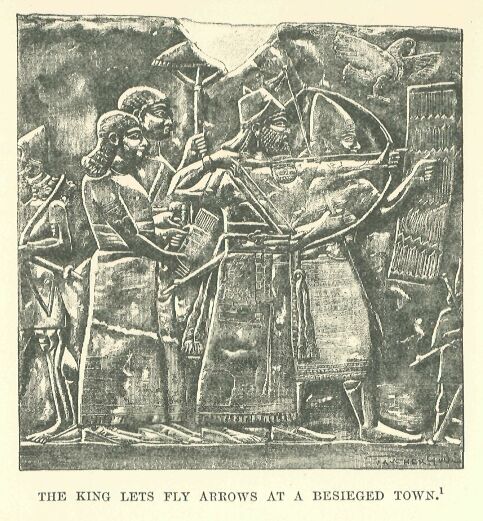
Drawn by Faucher-Gudin, from Layard.
The Assyrians waged war with a brutality which the Egyptians would never have tolerated. Unlike the Pharaohs, their kings were not content to imprison or put to death the principal instigators of a revolt, but their wrath would fall upon the entire population. As long as a town resisted the efforts of their besieging force, all its inhabitants bearing arms who fell into their hands were subjected to the most cruel tortures; they were cut to pieces or impaled alive on stakes, which were planted in the ground just in front of the lines, so that the besieged should enjoy a full view of the sufferings of their comrades.
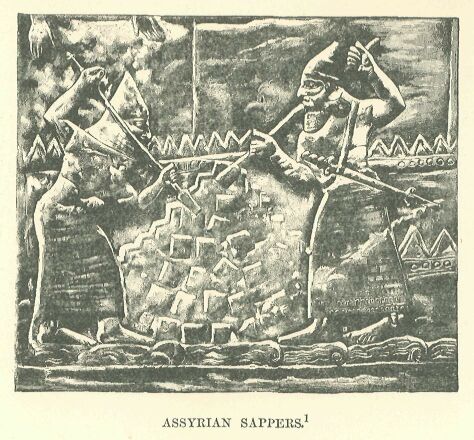
Drawn by Faucher-Gudin, from Layard.
Even during the course of a short siege this line of stakes would be prolonged till it formed a bloody pale between the two contending armies. This horrible spectacle had at least the effect of shaking the courage of the besieged, and of hastening the end of hostilities. When at length the town yielded to the enemy, it was often razed to the ground, and salt was strewn upon its ruins, while the unfortunate inhabitants were either massacred or transplanted en masse elsewhere. If the bulk of the population were spared and condemned to exile, the wealthy and noble were shown no clemency; they were thrown from, the top of the city towers, their ears and noses were cut off, their hands and feet were amputated, or they and their children were roasted over a slow fire, or flayed alive, or decapitated, and their heads piled up in a heap.
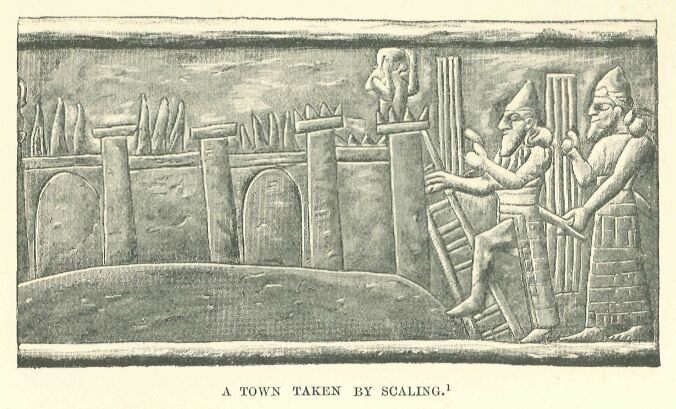
Drawn by Faucher-Gudin, from one of the bas-reliefs of the bronze gate at Balawât. The two soldiers who represent the Assyrian army carry their shields before them; flames appear above the ramparts, showing that the conquerors have burnt the town.
The victorious sovereigns appear to have taken a pride in the ingenuity with which they varied these means of torture, and dwell with complacency on the recital of their cruelties. “I constructed a pillar at the gate of the city,” is the boast of one of them; “I then flayed the chief men, and covered the post with their skins; I suspended their dead bodies from this same pillar, I impaled others on the summit of the pillar, and I ranged others on stakes around the pillar.”
Two or three executions of this kind usually sufficed to demoralise the enemy. The remaining inhabitants assembled: terrified by the majesty of Assur, and as it were blinded by the brightness of his countenance, they sunk down at the knees of the victor and embraced his feet.*
* These are the very expressions used in the Assyrian texts: “The terror of my strength overthrew them, they feared the combat, and they embraced my feet;” and again: “The brightness of Assur, my lord, overturned them.” This latter image is explained by the presence over the king of the winged figure of Assur directing the battle.
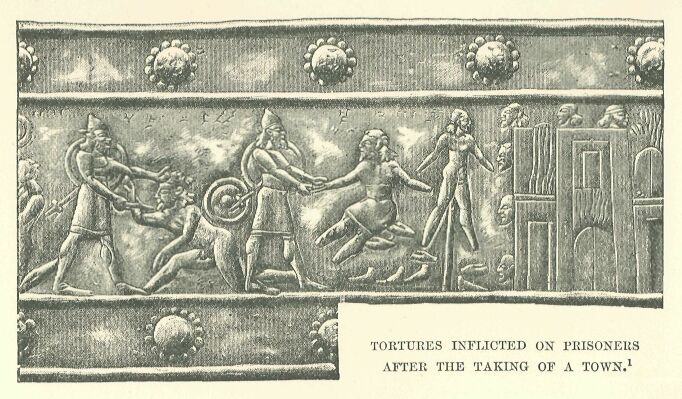
Drawn by Faucher-Gudin, from one of the bas-reliefs of the bronze gates of Balawât; on the right the town is seen in flames, and on the walls on either side hangs a row of heads, one above another.
The peace secured at the price of their freedom left them merely with their lives and such of their goods as could not be removed from the soil. The scribes thereupon surrounded the spoil seized by the soldiery and drew up a detailed inventory of the prisoners and their property: everything worth carrying away to Assyria was promptly registered, and despatched to the capital.
Drawn by Faucher Gudin, from Layard.
The contents of the royal palace led the way; it comprised the silver, gold, and copper of the vanquished prince, his caldrons, dishes and cups of brass, the women of his harem, the maidens of his household, his furniture and stuffs, horses and chariots, together with his men and women servants. The enemy’s gods, like his kings, were despoiled of their possessions, and poor and rich suffered alike. The choicest of their troops were incorporated into the Assyrian regiments, and helped to fill the gaps which war had made in the ranks;* the peasantry and townsfolk were sold as slaves, or were despatched with their families to till the domains of the king in some Assyrian village.* Tiglath-pileser I. in this manner incorporated 120 chariots of the Kashki and the Urumi into the Assyrian chariotry.
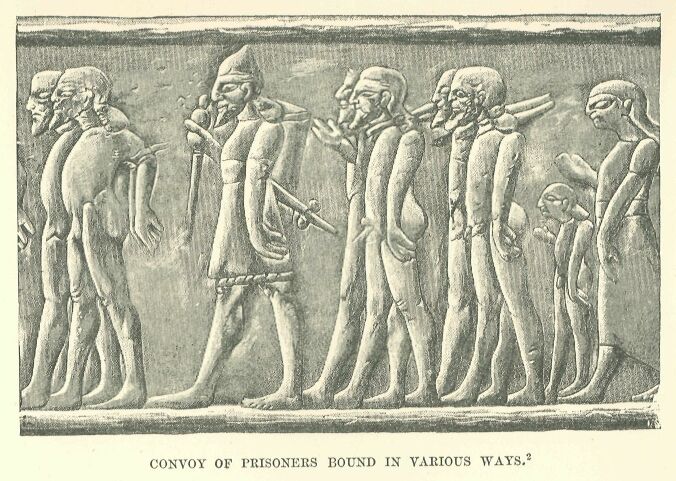
Drawn by Faucher-Gudin, from a bas-relief of one of the gates of Balawât.
The monuments often depict the exodus of these unfortunate wretches. They were represented as proceeding on their way in the charge of a few foot-soldiers—each of the men carrying, without any sign of labour, a bag of provisions, while the women bear their young children on their shoulders or in their arms: herds of cows and flocks of goats and sheep follow, chariots drawn by mules bringing up the rear with the baggage. While the crowd of non-combatants were conducted in irregular columns without manacles or chains, the veteran troops and the young men capable of bearing arms were usually bound together, and sometimes were further secured by a wooden collar placed on their necks. Many perished on the way from want or fatigue, but such as were fortunate enough to reach the end of the journey were rewarded with a small portion of land and a dwelling, becoming henceforward identified with the indigenous inhabitants of the country. Assyrians were planted as colonists in the subjugated towns, and served to maintain there the authority of the conqueror. The condition of the latter resembled to a great extent that of the old Egyptian vassals in Phoenicia or Southern Syria. They were allowed to retain their national constitution, rites, and even their sovereigns; when, for instance, after some rebellion, one of these princes had been impaled or decapitated, his successor was always chosen from among the members of his own family, usually one of his sons, who was enthroned almost before his father had ceased to breathe. He was obliged to humiliate his own gods before Assur, to pay a yearly tribute, to render succour in case of necessity to the commanders of neighbouring garrisons, to send his troops when required to swell the royal army, to give his sons or brothers as hostages, and to deliver up his own sisters and daughters, or those of his nobles, for the harem or the domestic service of the conqueror. The unfortunate prince soon resigned himself to this state of servitude; he would collect around him and reorganise his scattered subjects, restore them to their cities, rebuild their walls, replant the wasted orchards, and sow the devastated fields. A few years of relative peace and tranquillity, during which he strove to be forgotten by his conqueror, restored prosperity to his country; the population increased with extraordinary rapidity, and new generations arose who, unconscious of the disasters suffered by their predecessors, had, but one aim, that of recovering their independence. We must, however, beware of thinking that the defeat of these tribes was as crushing or their desolation as terrible as the testimony of the inscriptions would lead us to suppose. The rulers of Nineveh were but too apt to relate that this or that country had been conquered and its people destroyed, when the Assyrian army had remained merely a week or a fortnight within its territory, had burnt some half-dozen fortified towns, and taken two or three thousand prisoners.*
* For example, Tiglath-pileser I. conquers the Kummukli in the first year of his reign, burning, destroying, and depopulating the towns, and massacring “the remainder of the Kummukh” who had taken refuge in the mountains, after which, in his second campaign, he again pillages, burns, destroys, and depopulates the towns, and again massacres the remainder of the inhabitants hiding in the mountains. He makes the same statements with regard to most of the other countries and peoples conquered by him, but we find them reappearing with renewed vigour on the scene, soon after their supposed destruction.
If we were to accept implicitly all that is recorded of the Assyrian exploits in Naîri or the Taurus, we should be led to believe that for at least half a century the valleys of the Upper Tigris and Middle Euphrates were transformed into a desert; each time, however, that they are subsequently mentioned on the occasion of some fresh expedition, they appear once more covered with thriving cities and a vigorous population, whose generals offer an obstinate resistance to the invaders. We are, therefore, forced to admit that the majority of these expeditions must be regarded as mere raids. The population, disconcerted by a sudden attack, would take refuge in the woods or on the mountains, carrying with them their gods, whom they thus preserved from captivity, together with a portion of their treasures and cattle; but no sooner had the invader retired, than they descended once more into the plain and returned to their usual occupations. The Assyrian victories thus rarely produced the decisive results which are claimed for them; they almost always left the conquered people with sufficient energy and resources to enable them to resume the conflict after a brief interval, and the supremacy which the suzerain claimed as a result of his conquests was of the most ephemeral nature. A revolt would suffice to shake it, while a victory would be almost certain to destroy it, and once more reduce the empire to the limits of Assyria proper.
Tukultiabalesharra, familiar to us under the name of Tiglath-pileser,* is the first of the great warrior-kings of Assyria to stand out before us with any definite individuality.
* Tiglath-pileser is one of the transcriptions given in the LXX. for the Hebrew version of the name: it signifies, “The child of Esharra is my strength.” By “the child of Esharra” the Assyrians, like the Chaldæans, understood the child of Ninib.
We find him, in the interval between two skirmishes, engaged in hunting lions or in the pursuit of other wild beasts, and we see him lavishing offerings on the gods and enriching their temples with the spoils of his victories; these, however, were not the normal occupations of this sovereign, for peace with him was merely an interlude in a reign of conflict. He led all his expeditions in person, undeterred by any consideration of fatigue or danger, and scarcely had he returned from one arduous campaign, than he proceeded to sketch the plan of that for the following year; in short, he reigned only to wage war. His father, Assurîshishi, had bequeathed him not only a prosperous kingdom, but a well-organised army, which he placed in the field without delay. During the fifty years since the Mushku, descending through the gorges of the Taurus, had invaded the Alzi and the Puru-kuzzi, Assyria had not only lost possession of all the countries bordering the left bank of the Euphrates, but the whole of Kummukh had withdrawn its allegiance from her, and had ceased to pay tribute. Tiglath-pileser had ascended the throne only a few weeks ere he quitted Assur, marched rapidly across Eastern Mesopotamia by the usual route, through Singar and Nisib, and climbing the chain of the Kashiara, near Mardîn, bore down into the very heart of Kummukh, where twenty thousand Mushku, under the command of five kings, resolutely awaited him. He repulsed them in the very first engagement, and pursued them hotly over hill and vale, pillaging the fields, and encircling the towns with trophies of human heads taken from the prisoners who had fallen into his hands; the survivors, to the number of six thousand, laid down their arms, and were despatched to Assyria.*
* The king, starting from Assur, must have followed the route through Sindjar, Nisib, Mardîn, and Diarbekîr—a road used later by the Romans, and still in existence at the present day. As he did not penetrate that year as far as the provinces of Alzi and Purukuzzi, he must have halted at the commencement of the mountain district, and have beaten the allies in the plain of Kuru-tchaî, before Diarbekîr, in the neighbourhood of the Tigris.
The Kummukh contingents, however, had been separated in the rout from the Mushku, and had taken refuge beyond the Euphrates, near to the fortress of Shirisha, where they imagined themselves in safety behind a rampart of mountains and forests. Tiglath-pileser managed, by cutting a road for his foot-soldiers and chariots, to reach their retreat: he stormed the place without apparent difficulty, massacred the defenders, and then turning upon the inhabitants of Kurkhi,* who were on their way to reinforce the besieged, drove their soldiers into the Nâmi, whose waters carried the corpses down to the Tigris. One of their princes, Kilite-shub, son of Kaliteshub-Sarupi, had been made prisoner during the action. Tiglath-pileser sent him, together with his wives, children, treasures, and gods,** to share the captivity of the Mushku; then retracing his steps, he crossed over to the right bank of the Tigris, and attacked the stronghold of Urrakhinas which crowned the summit of Panâri.
* The country of the Kurkhi appears to have included at this period the provinces lying between the Sebbeneh-Su and the mountains of Djudî, probably a portion of the Sophene, the Anzanone and the Gordyenc of classical authors. ** The vanquished must have crossed the Tigris below Diarbekîr and have taken refuge beyond Mayafarrikîn, so that Shirisha must be sought for between the Silvan-dagh and the Ak-dagh, in the basin of the Batman-tchai, the present Nâmi.
The people, terror-stricken by the fate of their neighbours, seized their idols and hid themselves within the thickets like a flock of birds. Their chief, Shaditeshub, son of Khâtusaru,* ventured from out of his hiding-place to meet the Assyrian conqueror, and prostrated himself at his feet. He delivered over his sons and the males of his family as hostages, and yielded up all his possessions in gold and copper, together with a hundred and twenty slaves and cattle of all kinds; Tiglath-pileser thereupon permitted him to keep his principality under the suzerainty of Assyria, and such of his allies as followed his example obtained a similar concession. The king consecrated the tenth of the spoil thus received to the use of his god Assur and also to Rammân;** but before returning to his capital, he suddenly resolved to make an expedition into the almost impenetrable regions which separated him from Lake Van.
* The name of this chief’s father has always been read Khâtukhi: it is a form of the name Khâtusaru borne by the Hittite king in the time of Ramses II. ** The site of Urrakhinas—read by Winckler Urartinas—is very uncertain: the town was situated in a territory which could belong equally well to the Kummukh or to the Kurkhi, and the mention of the crossing of the Tigris seems to indicate that it was on the right bank of the river, probably in the mountain group of Tur-Abdîn.
This district was, even more than at the present day, a confused labyrinth of wooded mountain ranges, through which the Eastern Tigris and its affluents poured their rapid waters in tortuous curves. As hitherto no army had succeeded in making its way through this territory with sufficient speed to surprise the fortified villages and scattered clans inhabiting the valleys and mountain slopes, Tiglath-pileser selected from his force a small troop of light infantry and thirty chariots, with which he struck into the forests; but, on reaching the Aruma, he was forced to abandon his chariotry and proceed with the foot-soldiers only. The Mildîsh, terrified by his sudden appearance, fell an easy prey to the invader; the king scattered the troops hastily collected to oppose him, set fire to a few fortresses, seized the peasantry and their flocks, and demanded hostages and the usual tribute as a condition of peace.*
* The Mildîsh of our inscription is to be identified with the country of Mount Umildîsh, mentioned by Sargon of Assyria.
In his first campaign he thus reduced the upper and eastern half of Kummukh, namely, the part extending to the north of the Tigris, while in the following campaign he turned his attention to the regions bounded by the Euphrates and by the western spurs of the Kashiari. The Alzi and the Purukuzzi had been disconcerted by his victories, and had yielded him their allegiance almost without a struggle. To the southward, the Kashku and the Urumi, who had, to the number of four thousand, migrated from among the Khâti and compelled the towns of the Shubarti to break their alliance with the Ninevite kings, now made no attempt at resistance; they laid down their arms and yielded at discretion, giving up their goods and their hundred and twenty war-chariots, and resigning themselves to the task of colonising a distant corner of Assyria. Other provinces, however, were not so easily dealt with; the inhabitants entrenched themselves within their wild valleys, from whence they had to be ousted by sheer force; in the end they always had to yield, and to undertake to pay an annual tribute. The Assyrian empire thus regained on this side the countries which Shalmaneser I. had lost, owing to the absorption of his energies and interests in the events which were taking place in Chaldæa.
In his third campaign Tiglath-pileser succeeded in bringing about the pacification of the border provinces which shut in the basin of the Tigris to the north and east. The Kurkhi did not consider themselves conquered by the check they had received at the Nâmi; several of their tribes were stirring in Kharia, on the highlands above the Arzania, and their restlessness threatened to infect such of their neighbours as had already submitted themselves to the Assyrian yoke. “My master Assur commanded me to attack their proud summits, which no king has ever visited. I assembled my chariots and my foot-soldiers, and I passed between the Idni and the Ala, by a difficult country, across cloud-capped mountains whose peaks were as the point of a dagger, and unfavourable to the progress of my chariots; I therefore left my chariots in reserve, and I climbed these steep mountains. The community of the Kurkhi assembled its numerous troops, and in order to give me battle they entrenched themselves upon the Azubtagish; on the slopes of the mountain, an incommodious position, I came into conflict with them, and I vanquished them.” This lesson cost them twenty-five towns, situated at the feet of the Aîa, the Shuîra, the Idni, the Shizu, the Silgu, and the Arzanabiu*—all twenty-five being burnt to the ground.
* The site of Kharia must be sought for probably between the sources of the Tigris and the Batman-tchaî.
The dread of a similar fate impelled the neighbouring inhabitants of Adaush to beg for a truce, which was granted to them;* but the people of Saraush and of Ammaush, who “from all time had never known what it was to obey,” were cut to pieces, and their survivors incorporated into the empire—a like fate overtaking the Isua and the Daria, who inhabited Khoatras.**
* According to the context, the Adaush ought to be between the Kharia and the Saraush; possibly between the Batman- tchaî and the Bohtân-tchaî, in the neighbourhood of Mildîsh. ** As Tiglath-pileser was forced to cross Mount Aruma in order to reach the Ammaush and the Saraush, these two countries, together with Isua and Daria, cannot be far from Mildîsh; Isua is, indeed, mentioned as near to Anzitene in an inscription of Shalmaneser II., which obliges us to place it somewhere near the sources of the Batman-tchaî. The position of Muraddash and Saradaush is indirectly pointed out by the mention of the Lower Zab and the Lulumê; the name of Saradaush is perhaps preserved in that of Surtash, borne by the valley through which runs one of the tributaries of the Lower Zab.
Beyond this, again, on the banks of the Lesser Zab and the confines of Lulumô, the principalities of Muraddash and of Saradaush refused to come to terms. Tiglath-pileser broke their lines within sight of Muraddash, and entered the town with the fugitives in the confusion which ensued; this took place about the fourth hour of the day. The success was so prompt and complete, that the king was inclined to attribute it to the help of Rammân, and he made an offering to the temple of this god at Assur of all the copper, whether wrought or in ore, which was found among the spoil of the vanquished. He was recalled almost immediately after this victory by a sedition among the Kurkhi near the sources of the Tigris. One of their tribes, known as the Sugi, who had not as yet suffered from the invaders, had concentrated round their standards contingents from some half-dozen cities, and the united force was, to the number of six thousand, drawn up on Mount Khirikhâ. Tiglath-pileser was again victorious, and took from them twenty-five statues of their gods, which he despatched to Assyria to be distributed among the sanctuaries of Belît at Assur, of Anu, Bammân, and of Ishtar. Winter obliged him to suspend operations. When he again resumed them at the beginning of his third year, both the Kummukh and the Kurkhi were so peaceably settled that he was able to carry his expeditions without fear of danger further north, into the regions of the Upper Euphrates between the Halys and Lake Van, a district then known as Naîri. He marched diagonally across the plain of Diarbekîr, penetrated through dense forests, climbed sixteen mountain ridges one after the other by paths hitherto considered impracticable, and finally crossed the Euphrates by improvised bridges, this being, as far as we know, the first time that an Assyrian monarch had ventured into the very heart of those countries which had formerly constituted the Hittite empire.
He found them occupied by rude and warlike tribes, who derived considerable wealth from working the mines, and possessed each their own special sanctuary, the ruins of which still appear above ground, and invite the attention of the explorer. Their fortresses must have all more or less resembled that city of the Pterians which flourished for so many ages just at the bend of the Halys;* its site is still marked by a mound rising to some thirty feet above the plain, resembling the platforms on which the Chaldæan temples were always built—a few walls of burnt brick, and within an enclosure, among the débris of rudely built houses, the ruins of some temples and palaces consisting of large irregular blocks of stone.
* The remains of the palace of the city of the Pterians, the present Euyuk, are probably later than the reign of Tiglath- pileser, and may be attributed to the Xth or IXth century before our era; they, however, probably give a very fair idea of what the towns of the Cappadocian region were like at the time of the first Assyrian invasions.
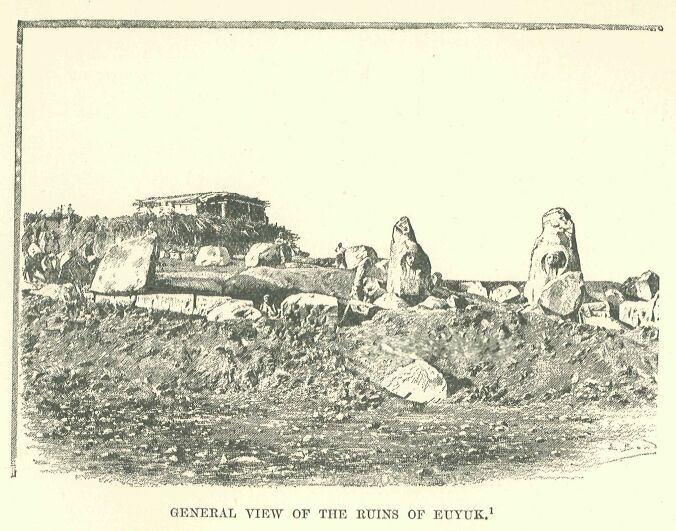
Drawn by Boudier, from a photograph.
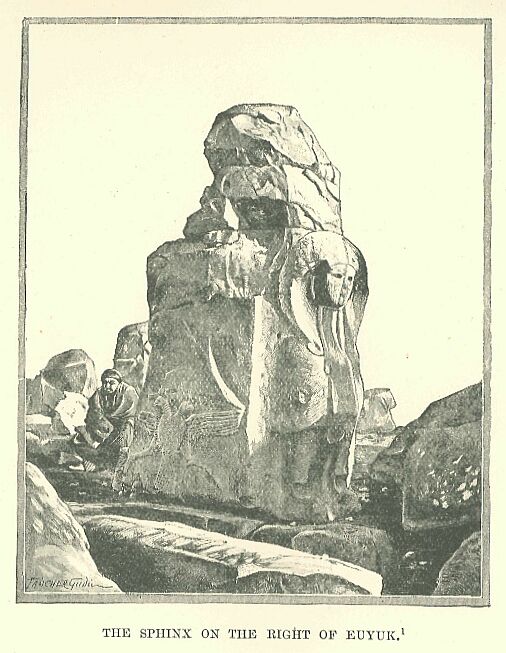
Drawn by Faucher-Gudin, from a photograph.
Two colossal sphinxes guard the gateway of the principal edifice, and their presence proves with certainty how predominant was Egyptian influence even at this considerable distance from the banks of the Nile. They are not the ordinary sphinxes, with a human head surmounting the body of a lion couchant on its stone pedestal; but, like the Assyrian bulls, they are standing, and, to judge from the Hathorian locks which fall on each side of their countenances, they must have been intended to represent a protecting goddess rather than a male deity. A remarkable emblem is carved on the side of the upright to which their bodies are attached; it is none other than the double-headed eagle, the prototype of which is not infrequently found at Telloh in Lower Chaldæa, among remains dating from the time of the kings and vicegerents of Lagash.
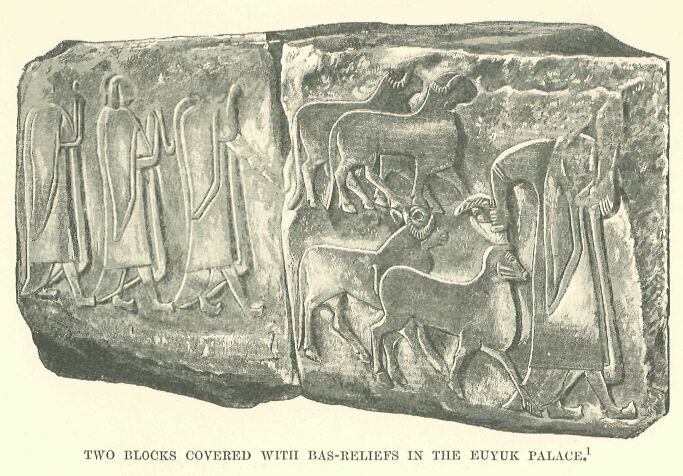
Drawn by Faucher-Gudin, from a photograph.
The court or hall to which this gate gave access was decorated with bas-reliefs, which exhibit a glaring imitation of Babylonian art; we can still see on these the king, vested in his long flowing robes, praying before an altar, while further on is a procession of dignitaries following a troop of rams led by a priest to be sacrificed; another scene represents two individuals in the attitude of worship, wearing short loin-cloths, and climbing a ladder whose upper end has an uncertain termination, while a third person applies his hands to his mouth in the performance of some mysterious ceremony; beyond these are priests and priestesses moving in solemn file as if in the measured tread of some sacred dance, while in one corner we find the figure of a woman, probably a goddess, seated, holding in one hand a flower, perhaps the full-blown lotus, and in the other a cup from which she is about to drink. The costume of all these figures is that which Chaldæan fashion had imposed upon the whole of Western Asia, and consisted of the long heavy robe, falling from the shoulders to the feet, drawn in at the waist by a girdle; but it is to be noted that both sexes are shod with the turned-up shoes of the Hittites, and that the women wear high peaked caps.
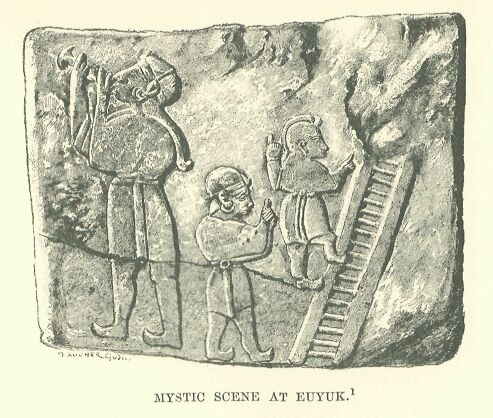
Drawn by Faucher-Gudin, from a photograph.
Drawn by Faucher-Gudin, from a photograph.
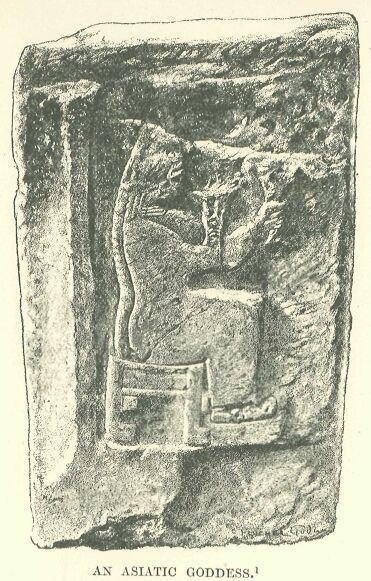
The composition of the scenes is rude, the drawing incorrect, and the general technique reminds us rather of the low reliefs of the Memphite or Theban sculptors than of the high projection characteristic of the artists of the Lower Euphrates. These slabs of sculptured stone formed a facing at the base of the now crumbling brick walls, the upper surface of which was covered with rough plastering. Here and there a few inscriptions reveal the name, titles, and parentage of some once celebrated personage, and mention the god in whose honour he had achieved the work.
The characters in which these inscriptions are written are not, as a rule, incised in the stone, but are cut in relief upon its surface, and if some few of them may remind us of the Egyptian hieroglyphs, the majority are totally unlike them, both in form and execution. A careful examination of them reveals a medley of human and animal outlines, geometrical figures, and objects of daily use, which all doubtless corresponded to some letter or syllable, but to which we have as yet no trustworthy key. This system of writing is one of a whole group of Asiatic scripts, specimens of which are common in this part of the world from Crete to the banks of the Euphrates and Orontes. It is thought that the Khâti must have already adopted it before their advent to power, and that it was they who propagated it in Northern Syria. It did not take the place of the cuneiform syllabary for ordinary purposes of daily life owing to its clumsiness and complex character, but its use was reserved for monumental inscriptions of a royal or religious kind, where it could be suitably employed as a framework to scenes or single figures.
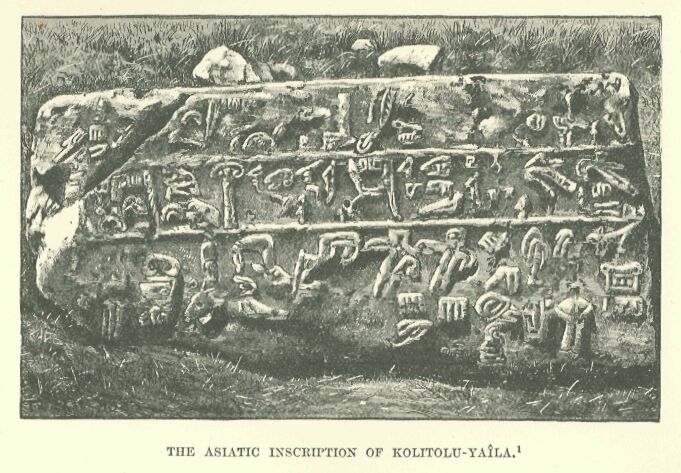
Drawn by Faucher-Gudin, from a photograph by Hogarth.
It, however, never presented the same graceful appearance and arrangement as was exhibited in the Egyptian hieroglyphs, the signs placed side by side being out of proportion with each other so as to destroy the general harmony of the lines, and it must be regarded as a script still in process of formation and not yet emerged from infancy. Every square yard of soil turned up among the ruins of the houses of Euyuk yields vestiges of tools, coarse pottery, terra-cotta and bronze statuettes of men and animals, and other objects of a not very high civilization. The few articles of luxury discovered, whether in furniture or utensils, were not indigenous products, but were imported for the most part from Chaldæa, Syria, Phoenicia, and perhaps from Egypt; some objects, indeed, came from the coast-towns of the Ægean, thus showing that Western influence was already in contact with the traditions of the East.
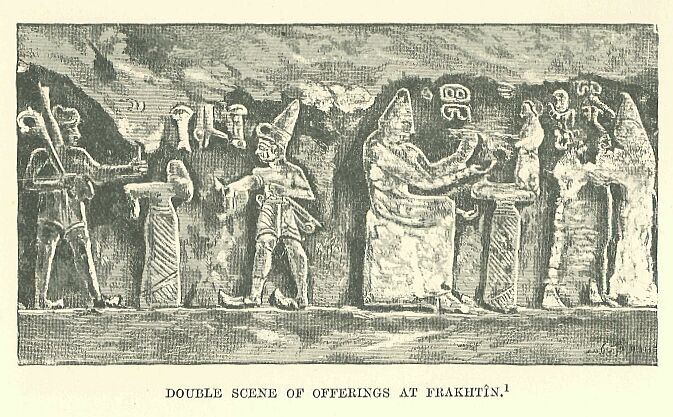
Drawn by Paucher-Gudin, from a photograph by Hogarth. It will be remarked that both altars are in the form of a female without a head, but draped in the Assyrian robe.
All the various races settled between the Halys and the Orontes were more or less imbued with this foreign civilization, and their monuments, though not nearly so numerous as those of the Pharaohs and Ninevite kings, bear, nevertheless, an equally striking evidence of its power. Examples of it have been pointed out in a score of different places in the valleys of the Taurus and on the plains of Cappadocia, in bas-reliefs, steke, seals, and intaglios, several of which must be nearly contemporaneous with the first Assyrian conquest.
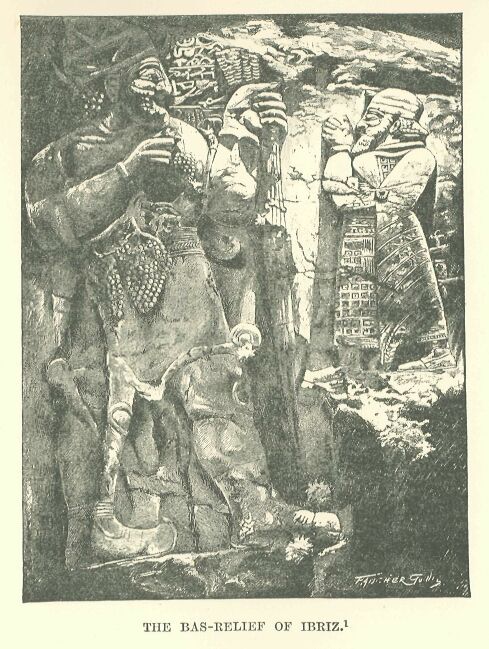
Drawn by Faucher-Gudin, from a photograph by Hogarth.
One instance of it appears on the rocks at Ibriz, where a king stands in a devout attitude before a jovial giant whose hands are full of grapes and wheat-ears, while in another bas-relief near Frakhtîn we have a double scene of sacrifice. The rock-carving at Ibriz is, perhaps, of all the relics of a forgotten world, that which impresses the spectator most favourably. The concept of the scene is peculiarly naïve; indeed, the two figures are clumsily brought together, though each of them, when examined separately, is remarkable for its style and execution. The king has a dignified bearing in spite of his large head, round eyes, and the unskilful way in which his arms are set on his body. The figure of the god is not standing firmly on both feet, but the sculptor has managed to invest him with an air of grandeur and an expression of vigour and bonhomie, which reminds us of certain types of the Greek Hercules.
Tiglath-pileser was probably attracted to Asia Minor as much by considerations of mercantile interest as by the love of conquest or desire for spoil. It would, indeed, have been an incomparable gain for him had he been able, if not to seize the mines themselves, at least to come into such close proximity to them that he would be able to monopolise their entire output, and at the same time to lay hands on the great commercial highway to the trade centres of the west. The eastern terminus of this route lay already within his domains, namely, that which led to Assur by way of Amid, Nisibe, Singar, and the valley of the Upper Tigris; he was now desirous of acquiring that portion of it which wound its way from the fords of the Euphrates at Malatîyeh to the crossing of the Halys. The changes which had just taken place in Kummukh and Nairi had fully aroused the numerous petty sovereigns of the neighbourhood. The bonds which kept them together had not been completely severed at the downfall of the Hittite empire, and a certain sense of unity still lingered among them in spite of their continual feuds; they constituted, in fact, a sort of loose confederation, whose members never failed to help one another when they were threatened by a common enemy. As soon as the news of an Assyrian invasion reached them, they at once put aside their-mutual quarrels and combined to oppose the invader with their united forces. Tiglath-pileser had, therefore, scarcely crossed the Euphrates before he was attacked on his right flank by twenty-three petty kings of Naîri,* while sixty other chiefs from the same neighbourhood bore down upon him in front. He overcame the first detachment of the confederates, though not without a sharp struggle; he carried carnage into their ranks, “as it were the whirlwind of Eammân,” and seized a hundred and twenty of the enemy’s chariots. The sixty chiefs, whose domains extended as far as the “Upper Sea,” ** were disconcerted by the news of the disaster, and of their own accord laid down their arms, or offered but a feeble resistance.
* The text of the Annals of the Xth year give thirty instead of twenty-three; in the course of five or six years the numbers have already become exaggerated. ** The site of the “Upper Sea” has furnished material for much discussion. Some believe it to be the Caspian Sea or the Black Sea, others take it to be Lake Van, while some think it to be the Mediterranean, and more particularly the Gulf of Issus between Syria and Cilicia. At the present day several scholars have returned to the theory which makes it the Black Sea.
Tiglath-pileser presented some of them in chains to the god Shamash; he extorted an oath of vassalage from them, forced them to give up their children as hostages, and laid a tax upon them en masse of 1200 stallions and 2000 bulls, after which he permitted them to return to their respective towns. He had, however, singled out from among them to grace his own triumph, Sini of Dayana, the only chief among them who had offered him an obstinate resistance; but even he was granted his liberty after he had been carried captive to Assur, and made to kneel before the gods of Assyria.*
* Dayani, which is mentioned in the Annals of Shalmaneser II., has been placed on the banks of the Murad-su by Schrader, and more particularly in the neighbourhood of Melasgerd by Sayce; Delattre has shown that it was the last and most westerly of twenty-three kingdoms conquered by Tiglath-pileser I., and that it was consequently enclosed between the Murad-su and the Euphrates proper.
Before returning to the capital, Tiglath-pileser attacked Khanigalbat, and appeared before Milidia: as the town attempted no defence, he spared it, and contented himself with levying a small contribution upon its inhabitants. This expedition was rather of the nature of a reconnaissance than a conquest, but it helped to convince the king of the difficulty of establishing any permanent suzerainty over the country. The Asiatic peoples were quick to bow before a sudden attack; but no sooner had the conqueror departed, than those who had sworn him eternal fealty sought only how best to break their oaths. The tribes in immediate proximity to those provinces which had been long subject to the Assyrian rule, were intimidated into showing some respect for a power which existed so close to their own borders. But those further removed from the seat of government felt a certain security in their distance from it, and were tempted to revert to the state of independence they had enjoyed before the conquest; so that unless the sovereign, by a fresh campaign, promptly made them realise that their disaffection would not remain unpunished, they soon forgot their feudatory condition and the duties which it entailed.
Three years of merciless conflict with obstinate and warlike mountain tribes had severely tried the Assyrian army, if it had not worn out the sovereign; the survivors of so many battles were in sore need of a well-merited repose, the gaps left by death had to be filled, and both infantry and chariotry needed the re-modelling of their corps. The fourth year of the king’s reign, therefore, was employed almost entirely in this work of reorganisation; we find only the record of a raid of a few weeks against the Akhlamî and other nomadic Aramæans situated beyond the Mesopotamian steppes. The Assyrians spread over the district between the frontiers of Sukhi and the fords of Carchemish for a whole day, killing all who resisted, sacking the villages and laying hands on slaves and cattle. The fugitives escaped over the Euphrates, vainly hoping that they would be secure in the very heart of the Khâti. Tiglath-pileser, however, crossed the river on rafts supported on skins, and gave the provinces of Mount Bishri over to fire and sword:* six walled towns opened their gates to him without having ventured to strike a blow, and he quitted the country laden with spoil before the kings of the surrounding cities had had time to recover from their alarm.