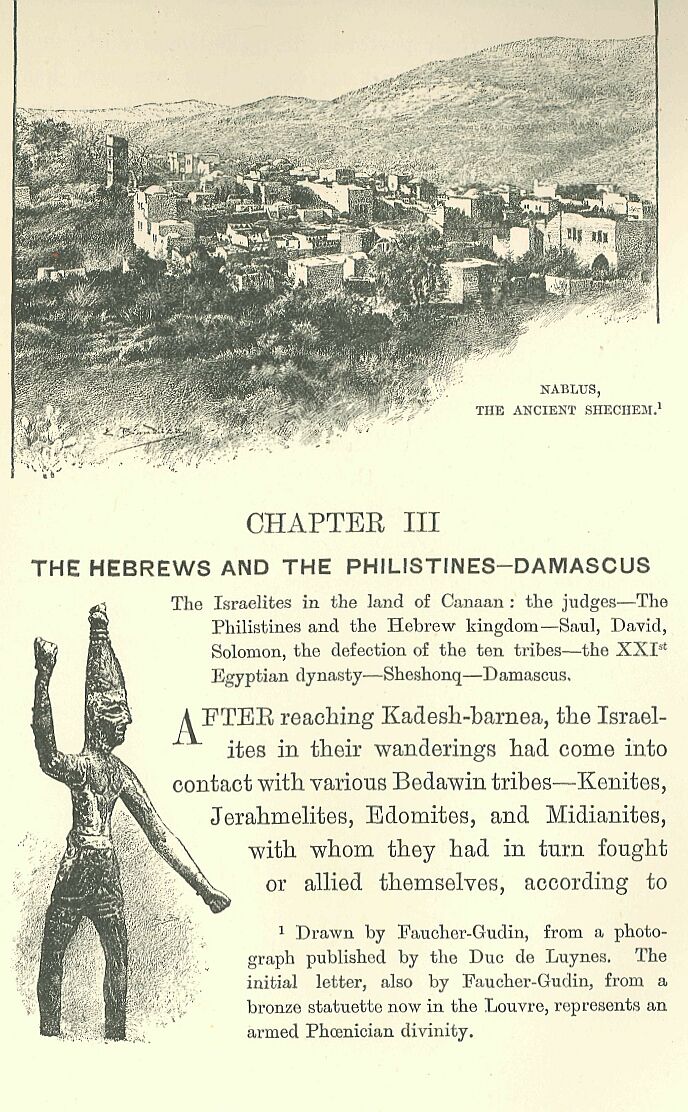
Volume 6 — CHAPTER II—THE RISE OF THE ASSYRIAN EMPIRE (continued 3)
M. L. McClure translation
* The country of Bishri was situated, as the Annals point out, in the immediate neighbourhood of Carchemish. The name is preserved in that of Tell Basher still borne by the ruins, and a modern village on the banks of the Sajur. The Gebel Bishri to which Hommel alludes is too far to the south to correspond to the description given in the inscription of Tiglath-pileser.
This expedition was for Tiglath-pileser merely an interlude between two more serious campaigns; and with the beginning of his fifth year he reappeared in the provinces of the Upper Euphrates to complete his conquest of them. He began by attacking and devastating Musri, which lay close to the territory of Milid. While thus occupied he was harassed by bands of Kumani; he turned upon them, overcame them, and imprisoned the remainder of them in the fortress of Arini, at the foot of Mount Aisa, where he forced them to kiss his feet. His victory over them, however, did not disconcert their neighbours. The bulk of the Kumani, whose troops had scarcely suffered in the engagement, fortified themselves on Mount Tala, to the number of twenty thousand; the king carried the heights by assault, and hotly pursued the fugitives as far as the range of Kharusa before Musri, where the fortress of Khunusa afforded them a retreat behind its triple walls of brick. The king, nothing daunted, broke his way through them one after another, demolished the ramparts, razed the houses, and strewed the ruins with salt; he then constructed a chapel of brick as a sort of trophy, and dedicated within it what was known as a copper thunderbolt, being an image of the missile which Eammân, the god of thunder, brandished in the face of his enemies. An inscription engraved on the object recorded the destruction of Khunusa, and threatened with every divine malediction the individual, whether an Assyrian or a stranger, who should dare to rebuild the city. This victory terrified the Kumani, and their capital, Kibshuna, opened its gates to the royal troops at the first summons. Tiglath-pileser completely destroyed the town, but granted the inhabitants their lives on condition of their paying tribute; he chose from among them, however, three hundred families who had shown him the most inveterate hostility, and sent them as exiles into Assyria.*
* The country of the Kumani or Kammanu is really the district of Comana in Cataonia, and not the Comana Pontica or the Khammanene on the banks of the Halys. Delattre thinks that Tiglath-pileser penetrated into this region by the Jihun, and consequently seeks to identify the names of towns and mountains, e.g. Mount Ilamuni with Jaur-dagh, the Kharusa with Shorsh-dagh, and the Tala with the Kermes-dagh; but it is difficult to believe that, if the king took this route, he would not mention the town of Marqasi-Marash, which lay at the very foot of the Jaur-dagh, and would have stopped his passage. It is more probable that the Assyrians, starting from Melitene, which they had just subdued, would have followed the route which skirts the northern slope of the Taurus by Albistan; the scene of the conflict in this case would probably have been the mountainous district of Zeitûn.
With this victory the first half of his reign drew to its close; in five years Tiglath-pileser had subjugated forty-two peoples and their princes within an area extending from the banks of the Lower Zab to the plains of the Khâti, and as far as the shores of the Western Seas. He revisited more than once these western and northern regions in which he had gained his early triumphs. The reconnaissance which he had made around Carchemish had revealed to him the great wealth of the Syrian table-land, and that a second raid in that direction could be made more profitable than ten successful campaigns in Naîri or upon the banks of the Zab. He therefore marched his battalions thither, this time to remain for more than a few days. He made his way through the whole breadth of the country, pushed forward up the valley of the Orontes, crossed the Lebanon, and emerged above the coast of the Mediterranean in the vicinity of Arvad.
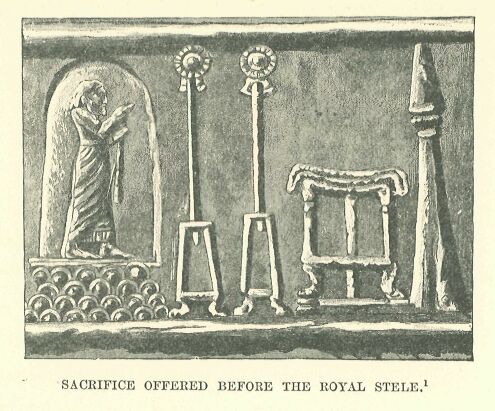
Drawn by Faucher-Gudin, from one of the bas-reliefs on the bronze gates of Balawât.
This is the first time for many centuries that an Oriental sovereign had penetrated so far west; and his contemporaries must have been obliged to look back to the almost fabulous ages of Sargon of Agadê or of Khammurabi, to find in the long lists of the dynasties of the Euphrates any record of a sovereign who had planted his standards on the shores of the Sea of the Setting Sun.*
*This is the name given by the Assyrians to the Mediterranean.
Tiglath-pileser embarked on its waters, made a cruise into the open, and killed a porpoise, but we have no record of any battles fought, nor do we know how he was received by the Phoenician towns. He pushed on, it is thought, as far as the Nahr el-Kelb, and the sight of the hieroglyphic inscriptions which Ramses had caused to be cut there three centuries previously aroused his emulation. Assyrian conquerors rarely quitted the scene of their exploits without leaving behind them some permanent memorial of their presence. A sculptor having hastily smoothed the surface of a rock, cut out on it a figure of the king, to which was usually added a commemorative inscription. In front of this stele was erected an altar, upon which sacrifices were made, and if the monument was placed near a stream or the seashore, the soldiers were accustomed to cast portions of the victims into the water in order to propitiate the river-deities.
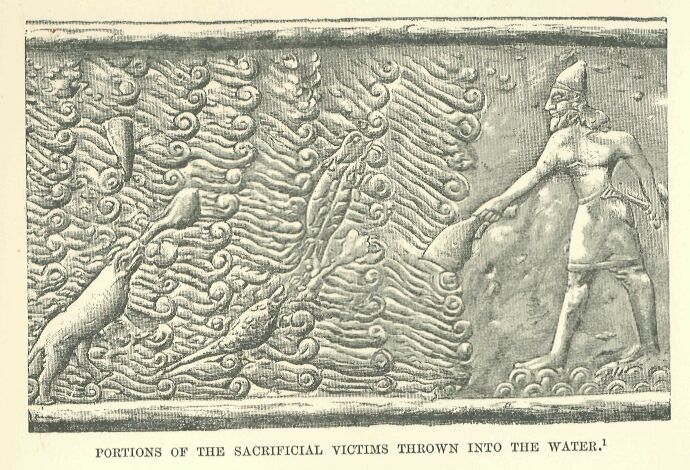
Drawn by Faucher-Gudin, from one of the bas-reliefs on the bronze gates of Balawât.
One of the half-effaced Assyrian stelæ adjoining those of the Egyptian conqueror is attributed to Tiglath-pileser.*
*Boscawen thinks that we may attribute to Tiglath-pileser I. the oldest of the Assyrian stelæ at Nahr el-Kelb; no positive information has as yet confirmed this hypothesis, which is in other respects very probable.
It was on his return, perhaps, from this campaign that he planted colonies at Pitru on the right, and at Mutkînu on the left bank of the Euphrates, in order to maintain a watch over Carchemish, and the more important fords connecting Mesopotamia with the plains of the Apriê and the Orontes.*
* The existence of these colonies is known only from an inscription of Shalmaneser II.
Drawn by Faucher-Gudin, from a sketch by P. Taylor, in G. Rawlinson.
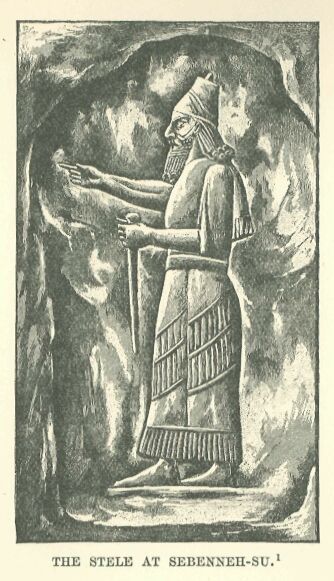
The news of Tiglath-pileser’s expedition was not long in reaching the Delta, and the Egyptian monarch then reigning at Tanis was thus made acquainted with the fact that there had arisen in Syria a new power before which his own was not unlikely to give way. In former times such news would have led to a war between the two states, but the time had gone by when Egypt was prompt to take up arms at the slightest encroachment on her Asiatic provinces. Her influence at this time was owing merely to her former renown, and her authority beyond the isthmus was purely traditional. The Tanite Pharaoh had come to accept with resignation the change in the fortunes of Egypt, and he therefore contented himself with forwarding to the Assyrian conqueror, by one of the Syrian coasting vessels, a present of some rare wild beasts and a few crocodiles. In olden times Assyria had welcomed the arrival of Thûtmosis III. on the Euphrates by making him presents, which the Theban monarch regarded in the light of tribute: the case was now reversed, the Egyptian Pharaoh taking the position formerly occupied by the Assyrian monarch. Tiglath-pileser graciously accepted this unexpected homage, but the turbulent condition of the northern tribes prevented his improving the occasion by an advance into Phoenicia and the land of Canaan. Naîri occupied his attention on two separate occasions at least; on the second of these he encamped in the neighbourhood of the source of the river Subnat. This stream, had for a long period issued from a deep grotto, where in ancient times a god was supposed to dwell. The conqueror was lavish in religious offerings here, and caused a bas-relief to be engraved on the entrance in remembrance of his victories.
He is here represented as standing upright, the tiara on his brow, and his right arm extended as if in the act of worship, while his left, the elbow brought up to his side, holds a club. The inscription appended to the figure tells, with an eloquence all the more effective from its brevity, how, “with the aid of Assur, Shamash, and Eammân, the great gods, my lords, I, Tiglath-pileser, King of Assyria, son of Assurîshishî, King of Assyria, son of Mutakkilnusku, King of Assyria, conqueror from the great sea, the Mediterranean, to the great sea of Naîri, I went for the third time to Naîri.”
The gods who had so signally favoured the monarch received the greater part of the spoils which he had secured in his campaigns. The majority of the temples of Assyria, which were founded at a time when its city was nothing more than a provincial capital owing allegiance to Babylon, were either, it would appear, falling to ruins from age, or presented a sorry exterior, utterly out of keeping with the magnitude of its recent wealth. The king set to work to enlarge or restore the temples of Ishtar, Martu, and the ancient Bel;* he then proceeded to rebuild, from the foundations to the summit, that of Anu and Bammân, which the vicegerent Samsirammân, son of Ismidagan, had constructed seven hundred and one years previously. This temple was the principal sanctuary of the city, because it was the residence of the chief of the gods, Assur, under his appellation of Anu.**
* “Bel the ancient,” or possibly “the ancient master,” appears to have been one of the names of Anu, who is naturally in this connexion the same as Assur. ** This was the great temple of which the ruins still exist.
The soil was cleared away down to the bed-rock, upon which an enormous substructure, consisting of fifty courses of bricks, was laid, and above this were erected two lofty ziggurâts, whose tile-covered surfaces shone like the rising sun in their brightness; the completion of the whole was commemorated by a magnificent festival. The special chapel of Bammân and his treasury, dating from the time of the same Samsirammân who had raised the temple of Anu, were also rebuilt on a more important scale.*
* The British Museum possesses bricks bearing the name of Tiglath-pileser I., brought from this temple, as is shown by the inscription on their sides.
These works were actively carried on notwithstanding the fact that war was raging on the frontier; however preoccupied he might be with warlike projects, Tiglath-pileser never neglected the temples, and set to work to collect from every side materials for their completion and adornment.
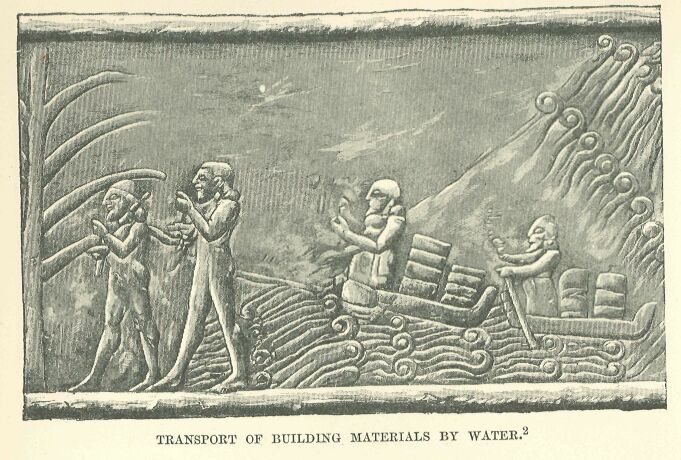
Drawn by Faucher-Gudin, from a bas-relief on the bronze doors at Balawât.
He brought, for example, from Naîri such marble and hard stone as might be needed for sculptural purposes, together with the beams of cedar and cypress required by his carpenters. The mountains of Singar and of the Zab furnished the royal architects with building stone for ordinary uses, and for those facing slabs of bluish gypsum on which the bas-reliefs of the king’s exploits were carved; the blocks ready squared were brought down the affluents of the Tigris on rafts or in boats, and thus arrived at their destination without land transport.
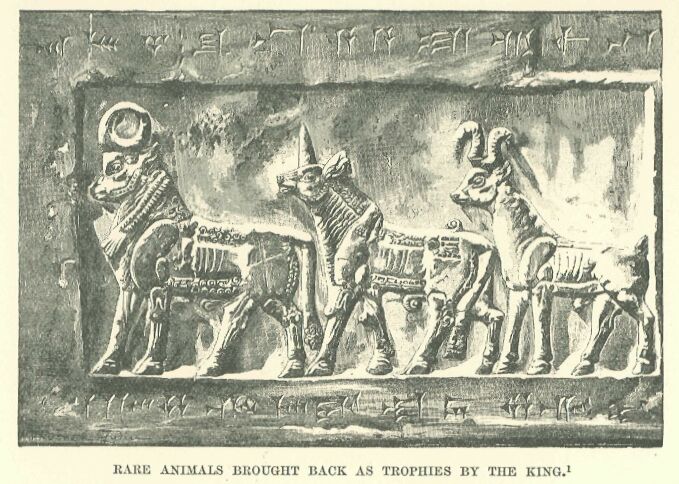
Drawn by Faucher-Gudin, from the cast in the Louvre. The original is in the British Museum.
The kings of Assyria, like the Pharaohs, had always had a passion for rare trees and strange animals; as soon as they entered a country, they inquired what natural curiosities it contained, and they would send back to their own land whatever specimens of them could be procured.
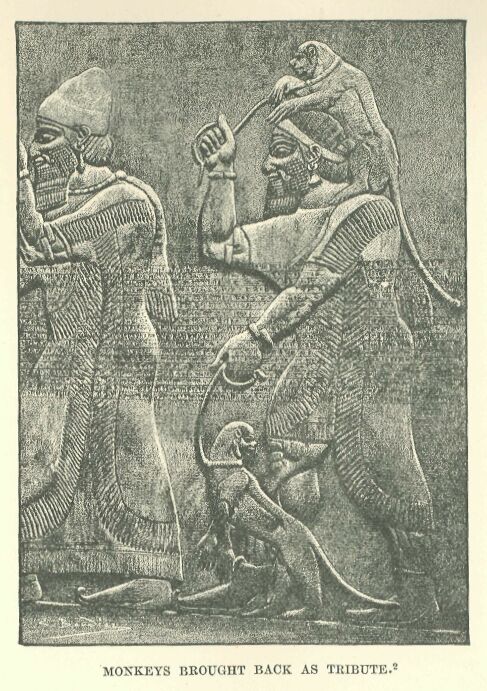
Drawn by Boudier, from the bas-relief in Layard.
The triumphal cortege which accompanied the monarch on his return after each campaign comprised not only prisoners and spoil of a useful sort, but curiosities from all the conquered districts, as, for instance, animals of unusual form or habits, rhinoceroses and crocodiles,* and if some monkey of a rare species had been taken in the sack of a town, it also would find a place in the procession, either held in a leash or perched on the shoulders of its keeper.
* A crocodile sent as a present by the King of Egypt is mentioned in the Inscription of the Broken Obelisk. The animal is called namsukha, which is the Egyptian msuhu with the plural article na.
The campaigns of the monarch were thus almost always of a double nature, comprising not merely a conflict with men, but a continual pursuit of wild beasts. Tiglath-pileser, “in the service of Ninib, had killed four great specimens of the male urus in the desert of Mitanni, near to the town of Arazîki, opposite to the countries of the Khâti;* he killed them with his powerful bow, his dagger of iron, his pointed lance, and he brought back their skins and horns to his city of Assur. He secured ten strong male elephants, in the territory of Harrân and upon the banks of the Khabur, and he took four of them alive: he brought back their skins and their tusks, together with the living elephants, to his city of Assur.” He killed moreover, doubtless also in the service of Ninib, a hundred and twenty lions, which he attacked on foot, despatching eight hundred more with arrows from his chariot,** all within the short space of five years, and we may well ask what must have been the sum total, if the complete record for his whole reign were extant. We possess, unfortunately, no annals of the later years of this monarch; we have reason to believe that he undertook several fresh expeditions into Nairi,*** and a mutilated tablet records some details of troubles with Elam in the Xth year of his reign.
* The town of Arazîki has been identified with the Eragiza (Eraziga) of Ptolemy; the Eraziga of Ptolemy was on the right bank of the Euphrates, while the text of Tiglath- pileser appears to place Arazîki on the left bank. ** The account of the hunts in the Annals is supplemented by the information furnished in the first column of the “Broken Obelisk.” The monument is of the time of Assur-nazir- pal, but the first column contains an abstract from an account of an anonymous hunt, which a comparison of numbers and names leads us to attribute to Tiglath-pileser I.; some Assyri-ologists, however, attribute it to Assur-nazir-pal. * The inscription of Sebbeneh-Su was erected at the time of the third expedition into Naîri, and the Annals give only one; the other two expeditions must, therefore, be subsequent to the Vth year of his reign.
We gather that he attacked a whole series of strongholds, some of whose names have a Cossæan ring about them, such as Madkiu, Sudrun, Ubrukhundu, Sakama, Shuria, Khirishtu, and Andaria. His advance in this direction must have considerably provoked the Chaldæans, and, indeed, it was not long before actual hostilities broke out between the two nations. The first engagement took place in the valley of the Lower Zab, in the province of Arzukhina, without any decisive result, but in the following year fortune favoured the Assyrians, for Dur-kurigalzu, both Sipparas, Babylon, and Upi opened their gates to them, while Akar-sallu, the Akhlamê, and the whole of Sukhi as far as Eapîki tendered their submission to Tiglath-achuch-sawh-akhl-pileser.
Drawn by Faucher-Gudin, from the heliogravure in Pr. Lenormant. The original is in the British Museum. It is one of the boundary stones which were set up in a corner of a field to mark its legal limit.
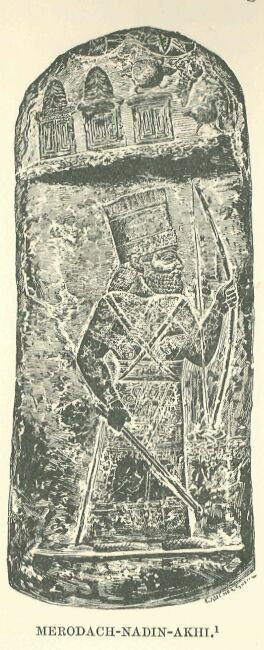
Merodach-nadin-akhi, who was at this time reigning in Chaldæa, was like his ancestor Nebuchadrezzar I., a brave and warlike sovereign: he appears at first to have given way under the blow thus dealt him, and to have acknowledged the suzerainty of his rival, who thereupon assumed the title of Lord of the four Houses of the World, and united under a single empire the valleys of the Tigris and Euphrates. But this state of things lasted for a few years only; Merodach-nadin-akhi once more took courage, and, supported by the Chaldæan nobility, succeeded in expelling the intruders from Sumir and Akkad. The Assyrians, however, did not allow themselves to be driven out without a struggle, but fortune turned against them; they were beaten, and the conqueror inflicted on the Assyrian gods the humiliation to which they had so often subjected those of other nations. He took the statues of Eammân and Shala from Ekallati, carried them to Babylon, and triumphantly set them up within the temple of Bel. There they remained in captivity for 418 years.* Tiglath-pileser did not long survive this disaster, for he died about the year 1100 B.C.,** and two of his sons succeeded him on the throne. The elder, Assur-belkala,*** had neither sufficient energy nor resources to resume the offensive, and remained a passive spectator of the revolutions which distracted Babylon.
* We know this fact from the inscription of Bavian, in which Sennacherib boasts of having brought back these statues to Assyria after they had been 418 years in the possession of the enemy. I have followed the commonly received opinion, which places the defeat of Tiglath-pileser after the taking of Babylon; others think that it preceded the decisive victory of the Assyrians. It is improbable that, if the loss of the statues preceded the decisive victory, the Assyrian conquerors should have left their gods prisoners in a Babylonian temple, and should not have brought them back immediately to Ekallati. ** The death of Tiglath-pileser must have followed quickly on the victory of Babylon; the contents of the inscription of Bavian permit us to fix the taking of Ekallati by the Chaldæans about the year 1108-1106 B.C. We shall not be far wrong in supposing Tiglath-pileser to have reigned six or eight years after his defeat. *** I followed the usually received classification. It is, however, possible that we must reverse the order of the sovereigns.
Merodach-nadin-akhi had been followed by his son Merodach-shapîk-zîrîm,* but this prince was soon dethroned by the people, and Bammân-abaliddîn, a man of base extraction, seized the crown.
* The name of the Babylonian king has been variously read Merodach-shapîk-zirat, Merodach-shapîk-kullat, Merodach- shapîk-zirmâti and Merodach-shapîk-zîrîm.
Assur-belkala not only extended to this usurper the friendly relations he had kept up with the legitimate sovereign, but he asked for the hand of his daughter in marriage, and the rich dowry which she brought her husband no doubt contributed to the continuation of his pacific policy. He appears also to have kept possession of all the parts of Mesopotamia and Kammukh conquered by his father, and it is possible that he may have penetrated beyond the Euphrates. His brother, Samsi-rammân III., does not appear to have left any more definite mark upon history than Assur-belkala; he decorated the temples built by his predecessors, but beyond this we have no certain record of his achievements. We know nothing of the kings who followed him, their names even having been lost, but about a century and a half after Tiglath-pileser, a certain Assurirba seems to have crossed Northern Syria, and following in the footsteps of his great ancestor, to have penetrated as far as the Mediterranean: on the rocks of Mount Amanus, facing the sea, he left a triumphal inscription in which he set forth the mighty deeds he had accomplished. This is merely a gleam out of the murky night which envelops his history, and the testimony of one of his descendants informs us that his good fortune soon forsook him: the Aramaeans wrested from him the fortresses of Pitru and Mutkînu, which commanded both banks of the Euphrates near Carchemish. Nor did the retrograde movement slaken after his time: Assyria slowly wasted away down to the end of the Xth century, and but for the simultaneous decadence of the Chaldaeans, its downfall would have been complete. But neither Rammân-abaliddîn nor his successor was able to take advantage of its weakness; discord and want of energy soon brought about their own ruin. The dynasty of Pashê disappeared towards the middle of the Xth century, and a family belonging to the “Countries of the Sea” took its place: it had continued for about one hundred and thirty-two years, and had produced eleven kings.*
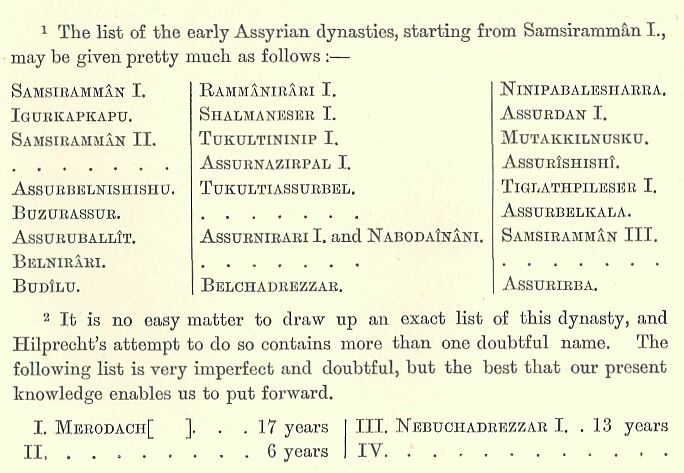
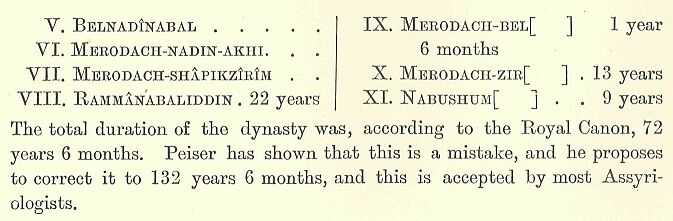
* It is no easy matter to draw up an exact list of this dynasty, and Hilprecht’s attempt to do so contains more than one doubtful name. The following list is very imperfect and doubtful, but the best that our present knowledge enables us to put forward.
What were the causes of this depression, from which Babylon suffered at almost regular intervals, as though stricken with some periodic malady? The main reason soon becomes apparent if we consider the nature of the country and the material conditions of its existence. Chaldæa was neither extensive enough nor sufficiently populous to afford a solid basis for the ambition of her princes. Since nearly every man capable of bearing arms was enrolled in the army, the Chaktean kings had no difficulty in raising, at a moment’s notice, a force which could be employed to repel an invasion, or make a sudden attack on some distant territory; it was in schemes which required prolonged and sustained effort that they felt the drawbacks of their position. In that age of hand-to-hand combats, the mortality in battle was very high, forced marches through forests and across mountains entailed a heavy loss of men, and three or four consecutive campaigns against a stubborn foe soon reduced an army to a condition of dangerous weakness. Recruits might be obtained to fill the earlier vacancies in the ranks, but they soon grew fewer and fewer if time was not given for recovery after the opening victories in the struggle, and the supply eventually ceased if operations were carried on beyond a certain period.
The total duration of the dynasty was, according to the Royal Canon, 72 years 6 months. Peiser has shown that this is a mistake, and he proposes to correct it to 132 years 6 months, and this is accepted by most Assyri-ologists.
A reign which began brilliantly often came to an impotent conclusion, owing to the king having failed to economise his reserves; and the generations which followed, compelled to adopt a strictly defensive attitude, vegetated in a sort of anaemic condition, until the birth-rate had brought the proportion of males up to a figure sufficiently high to provide the material for a fresh army. When Nebuchadrezzar made war upon Assurîshishî, he was still weak from the losses he had incurred during the campaign against Elam, and could not conduct his attack with the same vigour as had gained him victory on the banks of the Ulaî; in the first year he only secured a few indecisive advantages, and in the second he succumbed. Merodach-nadin-akhi was suffering from the reverses sustained by his predecessors when Tiglath-pileser provoked him to war, and though he succeeded in giving a good account of an adversary who was himself exhausted by dearly bought successes, he left to his descendants a kingdom which had been drained of its last drop of blood. The same reason which explains the decadence of Babylon shows us the cause of the periodic eclipses undergone by Assyria after each outburst of her warlike spirit. She, too, had to pay the penalty of an ambition which was out of all proportion to her resources. The mighty deeds of Shalmaneser and Tukulti-ninip were, as a natural consequence, followed by a state of complete prostration under Tukultiassurbel and Assurnîrarî: the country was now forced to pay for the glories of Assurîshishî and of Tiglath-pileser by falling into an inglorious state of languor and depression. Its kings, conscious that their rule must be necessarily precarious as long as they did not possess a larger stock of recruits to fall back on, set their wits to work to provide by various methods a more adequate reserve. While on one hand they installed native Assyrians in the more suitable towns of conquered countries, on the other they imported whole hordes of alien prisoners chosen for their strength and courage, and settled them down in districts by the banks of the Tigris and the Zab. We do not know what Eammânirâni and Shalmaneser may have done in this way, but Tiglath-pileser undoubtedly introduced thousands of the Mushku, the Urumseans, the people of Kummukh and Naîri, and his example was followed by all those of his successors whose history has come down to us. One might have expected that such an invasion of foreigners, still smarting under the sense of defeat, might have brought with it an element of discontent or rebellion; far from it, they accepted their exile as a judgment of the gods, which the gods alone had a right to reverse, and did their best to mitigate the hardness of their lot by rendering unhesitating obedience to their masters. Their grandchildren, born in the midst of Assyrians, became Assyrians themselves, and if they did not entirely divest themselves of every trace of their origin, at any rate became so closely identified with the country of their adoption, that it was difficult to distinguish them from the native race. The Assyrians who were sent out to colonise recently acquired provinces were at times exposed to serious risks. Now and then, instead of absorbing the natives among whom they lived, they were absorbed by them, which meant a loss of so much fighting strength to the mother country; even under the most favourable conditions a considerable time must have passed before they could succeed in assimilating to themselves the races amongst whom they lived. At last, however, a day would dawn when the process of incorporation was accomplished, and Assyria, having increased her area and resources twofold, found herself ready to endure to the end the strain of conquest. In the interval, she suffered from a scarcity of fighting men, due to the losses incurred in her victories, and must have congratulated herself that her traditional foe was not in a position to take advantage of this fact.
The first wave of the Assyrian invasion had barely touched Syria; it had swept hurriedly over the regions in the north, and then flowed southwards to return no more, so that the northern races were able to resume the wonted tenor of their lives. For centuries after this their condition underwent no change; there was the same repetition of dissension and intrigue, the same endless succession of alliances and battles without any signal advantage on either side. The Hittites still held Northern Syria: Carchemish was their capital, and more than one town in its vicinity preserved the tradition of their dress, their language, their arts, and their culture in full vigour. The Greek legends tell us vaguely of some sort of Cilician empire which is said to have brought the eastern and central provinces of Asia Minor into subjection about ten centuries before our era.*
* Solinus, relying on the indirect evidence of Hecatseus of Miletus, tells us that Cilicia extended not only to the countries afterwards known as Cataonia, Commagene, and Syria, but also included Lydia, Media, Armenia, Pamphylia, and Cappadocia; the conquests of the Assyrian kings must have greatly reduced its area. I am of opinion that the tradition preserved by Hecatous referred both to the kingdom of Sapalulu and to that of the monarchs of this second epoch.
Is there any serious foundation for such a belief, and must we assume that there existed at this time and in this part of the world a kingdom similar to that of Sapalulu? Assyria was recruiting its forces, Chaldæa was kept inactive by its helplessness, Egypt slumbered by the banks of its river, there was no actor of the first rank to fill the stage; now was the opportunity for a second-rate performer to come on the scene and play such a part as his abilities permitted. The Cilician conquest, if this be indeed the date at which it took place, had the boards to itself for a hundred years after the defeat of Assurirba. The time was too short to admit of its striking deep root in the country. Its leaders and men were, moreover, closely related to the Syrian Hittites; the language they spoke was, if not precisely the Hittite, at any rate a dialect of it; their customs were similar, if, perhaps, somewhat less refined, as is often the case with mountain races, when compared with the peoples of the plain. We are tempted to conclude that some of the monuments found south of the Taurus were their handiwork, or, at any rate, date from their time. For instance, the ruined palace at Sinjirli, the lower portions of which are ornamented with pictures similar to those at Pteria, representing processions of animals, some real, others fantastic, men armed with lances or bending the bow, and processions of priests or officials. Then there is the great lion at Marash, which stands erect, with menacing head, its snarling lips exposing the teeth; its body is seamed with the long lines of an inscription in the Asiatic character, in imitation of those with which the bulls in the Assyrian palaces are covered. These Cilicians gave an impulse to the civilization of the Khâti which they sorely needed, for the Semitic races, whom they had kept in subjection for centuries, now pressed them hard on all the territory over which they had formerly reigned, and were striving to drive them back into the hills.
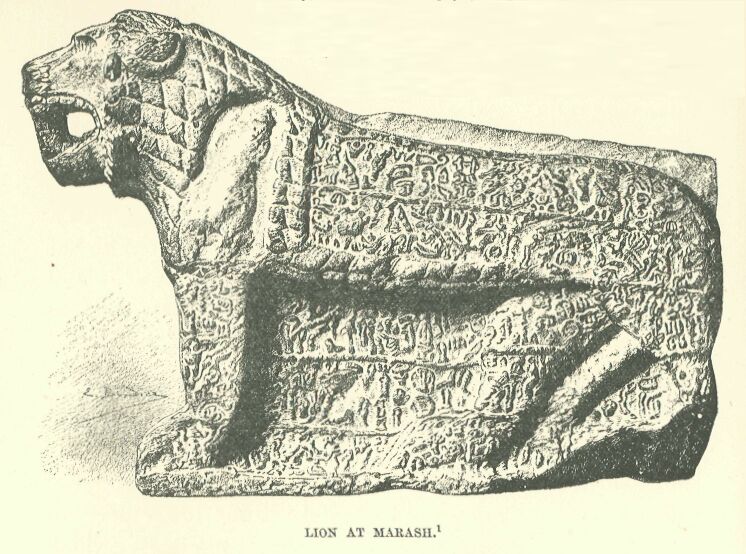
Drawn by Boudier, from a photograph of the cast shown at the Paris Exhibition of 1889.
The Aramæans in particular gave them a great deal of trouble. The states on the banks of the Euphrates had found them awkward neighbours; was this the moment chosen by the Pukudu, the Eutu, the Gambulu, and a dozen other Aramaean tribes, for a stealthy march across the frontier of Elam, between Durilu and the coast? The tribes from which, soon after, the Kaldi nation was formed, were marauding round Eridu, Uru, and Larsa, and may have already begun to lay the foundations of their supremacy over Babylon: it is, indeed, an open question whether those princes of the Countries of the Sea who succeeded the Pashê dynasty did not come from the stock of the Kaldi Aramaeans. While they were thus consolidating on the south-east, the bulk of the nation continued to ascend northwards, and rejoined its outposts in the central region of the Euphrates, which extends from the Tigris to the Khabur, from the Khabur to the Balîkh and the Apriê. They had already come into frequent conflict with most of the victorious Assyrian kings, from Eammânirâri down to Tiglath-pileser; the weakness of Assyria and Chaldæa gave them their opportunity, and they took full advantage of it. They soon became masters of the whole of Mesopotamia; a part of the table-land extending from Carchemish to Mount Amanus fell into their hands, their activity was still greater in the basin of the Orontes, and their advanced guard, coming into collision with the Amorites near the sources of the Litany, began gradually to drive farther and farther southwards all that remained of the races which had shown so bold a front to the Egyptian troops. Here was an almost entirely new element, gradually eliminating from the scene of the struggle other elements which had grown old through centuries of war, and while this transformation was taking place in Northern and Central, a similar revolution was effecting a no less surprising metamorphosis in Southern Syria. There, too, newer races had gradually come to displace the nations over which the dynasties of Thûtmosis and Ramses had once held sway. The Hebrews on the east, the Philistines and their allies on the south-west, were about to undertake the conquest of the Kharu and its cities. As yet their strength was inadequate, their temperament undecided, their system of government imperfect; but they brought with them the quality of youth, and energies which, rightly guided, would assure the nation which first found out how to take advantage of them, supremacy over all its rivals, and the strength necessary for consolidating the whole country into a single kingdom.
THE HEBREWS AND THE PHILISTINES—DAMASCUS
THE ISRAELITES IN THE LAND OF CANAAN: THE JUDGES—THE PHILISTINES AND THE HEBREW KINGDOM—SAUL, DAVID, SOLOMON, THE DEFECTION OF THE TEN TRIBES—THE XXIst EGYPTIAN DYNASTY—SHESHONQ OR SHISHAK DAMASCUS.
The Hebrews in the desert: their families, clans, and tribes—The Amorites and the Hebrews on the left bank of the Jordan—The conquest of Canaan and the native reaction against the Hebrews—The judges, Ehud, Deborah, Jerubbaal or Gideon and the Manassite supremacy; Abimelech, Jephihdh.
The Philistines, their political organisation, their army and fleet—Judah, Dan, and the story of Samson—Benjamin on the Philistine frontier—Eli and the ark of the covenant—The Philistine dominion over Israel; Samuel, Saul, the Benjamite monarchy—David, his retreat to the desert of Judah and his sojourn at Zilclag—The battle of Gilboa and the death of Saul—The struggle between Ish-bosheth and David—David sole king, and the final defeat of the Philistines—Jerusalem becomes the capital; the removal of the ark—Wars with the peoples of the East—Absalom’s rebellion; the coronation of Solomon.
Solomon’s government and his buildings—Phoenician colonisation in Spain: Hiram I. and the enlargement of Tyre—The voyages to Ophir and Tarshish—The palace at Jerusalem, the temple and its dedication: the priesthood and prophets—The death of Solomon; the schism of the ten tribes and the division of the Hebrew kingdom.
The XXIst Egyptian dynasty: the Theban high priests and the Tanite Pharaohs—The Libyan mercenaries and their predominance in the state: the origin of the XXIInd (Bubastite) dynasty—Sheshonq I. as king and his son Aûpûti as high priest of Amon; the hiding-place at Deîr el-Baharî—Sheshonq’s expedition against Jerusalem.
The two Hebrew “kingdoms”; the fidelity of Judah to the descendants of Solomon, and the repeated changes of dynasty in Israel—Asa and Baasha—The kingdom of Damascus and its origin—Bezon, Tabrimmon, Benhadad I.—Omri and the foundation of Samaria: Ahab and the Tyrian alliance—The successors of Hiram I. at Tyre: Ithobaal I.—The prophets, their struggle against Phonician idolatry, the story of Elijah—The wars between Israel and Damascus up to the time of the Assyrian invasion.