Volume 6 — CHAPTER III—THE HEBREWS AND THE PHILISTINES—DAMASCUS
M. L. McClure translation
The Israelites in the land of Canaan: the judges—The Philistines and the Hebrew kingdom—Saul, David, Solomon, the defection of the ten tribes—the XXIst Egyptian dynasty—Sheshonq—Damascus.
After reaching Kadesh-barnea, the Israelites in their wanderings had come into contact with various Bedawin tribes—Kenites, Jerahmelites, Edomites, and Midianites, with whom they had in turn fought or allied themselves, according to the exigencies of their pastoral life. Continual skirmishes had taught them the art of war, their numbers had rapidly increased, and with this increase came a consciousness of their own strength, so that, after a lapse of two or three generations, they may be said to have constituted a considerable nation. Its component elements were not, however, firmly welded together; they consisted of an indefinite number of clans, which were again subdivided into several families. Each of these families had its chief or “ruler,” to whom it rendered absolute obedience, while the united chiefs formed an assembly of elders who administered justice when required, and settled any differences which arose among their respective followers. The clans in their turn were grouped into tribes,* according to certain affinities which they mutually recognised, or which may have been fostered by daily intercourse on a common soil, but the ties which bound them together at this period were of the most slender character. It needed some special event, such as a projected migration in search of fresh pasturage, or an expedition against a turbulent neighbour, or a threatened invasion by some stranger, to rouse the whole tribe to corporate action; at such times they would elect a “nasi,” or ruler, the duration of whose functions ceased with the emergency which had called him into office.**
* The tribe was designated by two words signifying “staff” or “branch.” ** The word nasi, first applied to the chiefs of the tribes (Exod. xxxiv. 31; Lev. iv. 22; Numb. ii. 3), became, after the captivity, the title of the chiefs of Israel, who could not be called kings owing to the foreign suzerainty (Esdras i. 8).
Both clans and tribes were designated by the name of some ancestor from whom they claimed to be descended, and who appears in some cases to have been a god for whom they had a special devotion; some writers have believed that this was also the origin of the names given to several of the tribes, such as Gad, “Good Fortune,” or of the totems of the hyena and the dog, in Arabic and Hebrew, “Simeon” and “Caleb.” * Gad, Simeon, and Caleb were severally the ancestors of the families who ranged themselves under their respective names, and the eponymous heroes of all the tribes were held to have been brethren, sons of one father, and under the protection of one God. He was known as the Jahveh with whom Abraham of old had made a solemn covenant; His dwelling-place was Mount Sinai or Mount Seîr, and He revealed Himself in the storm;** His voice was as the thunder “which shaketh the wilderness,” His breath was as “a consuming fire,” and He was decked with light “as with a garment.” When His anger was aroused, He withheld the dew and rain from watering the earth; but when His wrath was appeased, the heavens again poured their fruitful showers upon the fields.***
* Simeon is derived by some from a word which at times denotes a hyena, at others a cross between a dog and a hyena, according to Arab lexicography. With regard to Caleb, Renan prefers a different interpretation; it is supposed to be a shortened form of Kalbel, and “Dog of El” is a strong expression to denote the devotion of a tribe to its patron god. ** Cf. the graphic description of the signs which accompanied the manifestations of Jahveh in the Song of Deborah (Judges v. 4, 5), and also in 1 Kings xix. 11-13. *** See 1 Kings xvii., xviii., where the conflict between Elijah and the prophets of Baal for the obtaining of rain is described.
He is described as being a “jealous God,” brooking no rival, and “visiting the iniquity of the fathers upon the children unto the third and fourth generation.” We hear of His having been adored under the figure of a “calf,” * and of His Spirit inspiring His prophets, as well as of the anointed stones which were dedicated in His honour. The common ancestor of the nation was acknowledged to have been Jacob, who, by his wrestling with God, had obtained the name of Israel; the people were divided theoretically into as many tribes as he had sons, but the number twelve to which they were limited does not entirely correspond with all that we know up to the present time of these “children of Israel.” Some of the tribes appear never to have had any political existence, as for example that of Levi,** or they were merged at an early date into some fellow-tribe, as in the case of Reuben with Gad;*** others, such as Ephraim, Manasseh, Benjamin, and Judah, apparently did not attain their normal development until a much later date.
* The most common of these animal forms was that of a calf or bull (Exod. xxxii.; Deut. ix. 21; and in the kingly period, 1 Kings xii. 28-30; 2 Kings x. 29); we are not told the form of the image of Micah the Ephraimite (Judges xviii. 14, 17, 18, 20, 30, 31). ** Levi appears to have suffered dispersion after the events of which there are two separate accounts combined in Gen. xxxiv. In conjunction with Simeon, he appears to have revenged the violation of his sister Dinah by a massacre of the Shechemites, and the dispersion alluded to in Jacob’s blessing (Gen. xlix. 5-7) is mentioned as consequent on this act of barbarism. *** In the IXth century Mesha of Moab does not mention the Reubenites, and speaks of the Gadites only as inhabiting the territory formerly occupied by them. Tradition attributed the misfortunes of the tribe to the crime of its chief in his seduction of Bilhah, his father’s concubine (Gen. xlix. 3, 4; cf. xxxv. 22)
The Jewish chroniclers attempted by various combinations to prove that the sacred number of tribes was the correct one. At times they included Levi in the list, in which case Joseph was reckoned as one;* while on other occasions Levi or Simeon was omitted, when for Joseph would be substituted his two sons Ephraim and Manasseh.** In addition to this, the tribes were very unequal in size: Ephraim, Gad, and Manasseh comprised many powerful and wealthy families; Dan, on the contrary, contained so few, that it was sometimes reckoned as a mere clan.
* As, for instance, in Jacob’s blessing (Gen. xlix. 5-7) and in the enumeration of the patriarch’s sons at the time of his journey to Egypt (Gen. xlvi. 9-26). ** Numb. i. 20, et seq., where the descendants of Levi are not included among the twelve, and Deut. xxxiii. 6-25, where Simeon is omitted from among the tribes blessed by Moses before his death.
The tribal organisation had not reached its full development at the time of the sojourn in the desert. The tribes of Joseph and Judah, who subsequently played such important parts, were at that period not held in any particular estimation; Reuben, on the other hand, exercised a sort of right of priority over the rest.*
* This conclusion is drawn from the position of eldest son given to him in all the genealogies enumerating the children of Jacob. Stade, on the contrary, is inclined to believe that this place of honour was granted to him on account of the smallness of his family, to prevent any jealousy arising between the more powerful tribes, such as Ephraim and Judah (Ges. des Vollces Isr., vol. i. pp. 151, 152).
The territory which they occupied soon became insufficient to support their numbers, and they sought to exchange it for a wider area, such as was offered by the neighbouring provinces of Southern Syria. Pharaoh at this time exercised no authority over this region, and they were, therefore, no longer in fear of opposition from his troops; the latter had been recalled to Egypt, and it is doubtful even whether he retained possession of the Shephelah by means of his Zakkala and Philistine colonies; the Hebrews, at any rate, had nothing to fear from him so long as they respected Gaza and Ascalon. They began by attempting to possess themselves of the provinces around Hebron, in the direction of the Dead Sea, and we read that, before entering them, they sent out spies to reconnoitre and report on the country.* Its population had undergone considerable modifications since the Israelites had quitted Goshen. The Amorites, who had seriously suffered from the incursions of Asiatic hordes, and had been constantly harassed by the attacks of the Aramæans, had abandoned the positions they had formerly occupied on the banks of the Orontes and the Litany, and had moved southwards, driving the Canaanites before them; their advance was accelerated as the resistance opposed to their hordes became lessened under the successors of Ramses III., until at length all opposition was withdrawn. They had possessed themselves of the regions about the Lake of Genesareth, the mountain district to the south of Tabor, the middle valley of the Jordan, and, pressing towards the territory east of that river, had attacked the cities scattered over the undulating table-land. This district had not been often subjected to incursions of Egyptian troops, and yet its inhabitants had been more impressed by Egyptian influence than many others.
Drawn by Paucher-Gudin, from the squeezes and sketches published in the Zeitschrift ties Palcistina-Vereins.
Whereas, in the north and west, cuneiform writing was almost entirely used, attempts had been made here to adapt the hieroglyphs to the native language.
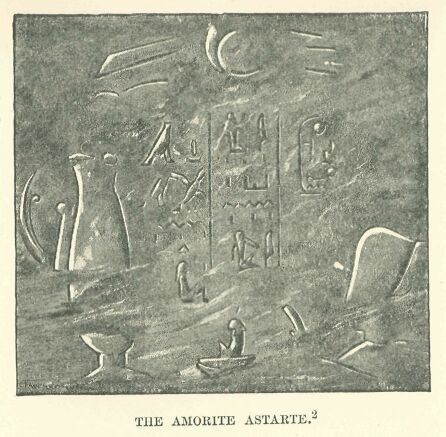
The only one of their monuments which has been preserved is a rudely carved bas-relief in black basalt, representing a two-horned Astarte, before whom stands a king in adoration; the sovereign is Ramses II., and the inscriptions accompanying the figures contain a religious formula together with a name borrowed from one of the local dialects.*
*This is the “Stone of Job” discovered by Strahmacher. The inscription appears to give the name of a goddess, Agana- Zaphon, the second part of which recalls the name of Baal- Zephon.
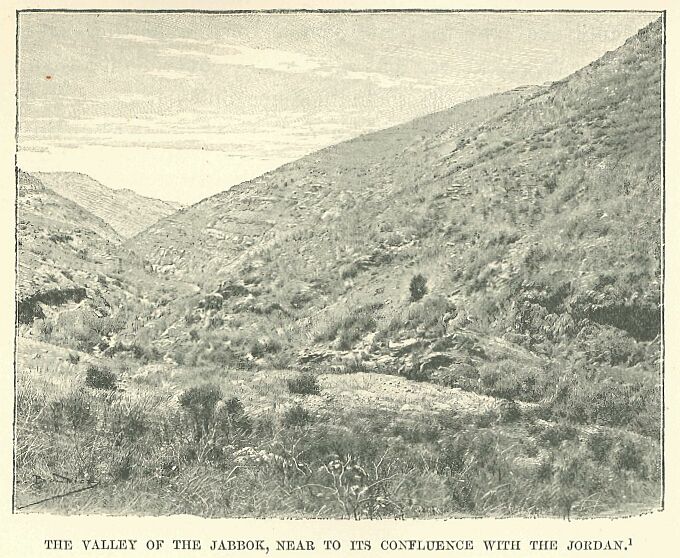
The Amorites were everywhere victorious, but our information is confined to this bare fact; soon after their victory, however, we find the territory they had invaded divided into two kingdoms: in the north that of Bashan, which comprised, besides the Haurân, the plain watered by the Yarrnuk; and to the south that of Heshbon, containing the district lying around the Arnon, and the Jabbok to the east of the Dead Sea.* They seem to have made the same rapid progress in the country between the Jordan and the Mediterranean as elsewhere. They had subdued some of the small Canaanite states, entered into friendly relation with others, and penetrated gradually as far south as the borders of Sinai, while we find them establishing petty kings among the hill-country of Shechem around Hebron, on the confines of the Negeb, and the Shephelah.** When the Hebrew tribes ventured to push forward in a direct line northwards, they came into collision with the advance posts of the Amorite population, and suffered a severe defeat under the walls of Hormah.*** The check thus received, however, did not discourage them. As a direct course was closed to them, they turned to the right, and followed, first the southern and then the eastern shores of the Red Sea, till they reached the frontier of Gilead.****
* The extension of the Amorite power in this direction is proved by the facts relating to the kingdoms of Sihon and Og Gent. i. 4, ii. 24-37, iii. 1-1.7. ** For the Amorite occupation of the Negeb and the hill- country of Judah, cf. Numb. xiii. 29; Bent. i. 7, 19-46; Josh. x. 5, 6, 12, xi. 3; for their presence in the Shephelah, cf. Judges i. 34-36. *** See the long account in Numb, xiii., xiv., which terminates with the mention of the defeat of the Israelites at Hormah; and cf. Bent. i. 19-46. **** The itinerary given in Numb. xx. 22-29, xxxi., xxxiii. 37-49, and repeated in Bent, ii., brings the Israelites as far as Ezion-geber, in such a manner as to avoid the Midianites and the Moabites. The friendly welcome accorded to them in the regions situated to the east of the Dead Sea, has been accounted for either by an alliance made with Moab and Ammon against their common enemy, the Amorites, or by the fact that Ammon and Moab did not as yet occupy those regions; the inhabitants in that case would have been Edomites and Midianites, who were in continual warfare with each other.
There again they were confronted by the Amorites, but in lesser numbers, and not so securely entrenched within their fortresses as their fellow-countrymen in the Negeb, so that the Israelites were able to overthrow the kingdoms of Heshbon and Bashan.*
* War against Sihon, King of Heshbon (Numb. xxi. 21-31; Beut. ii. 26-37), and against Og, King of Bashan (Numb. xxi. 32-35; Beut. iii. 1-13).
Drawn by Boudier, from photograph No. 336 of the Palestine Exploration Fund.
Gad received as its inheritance nearly the whole of the territory lying between the Jabbok and the Yarmuk, in the neighbourhood of the ancient native sanctuaries of Penuel, Mahanaim, and Succoth, associated with the memory of Jacob.* Reuben settled in the vicinity, and both tribes remained there isolated from the rest. From this time forward they took but a slight interest in the affairs of their brethren: when the latter demanded their succour, “Gilead abode beyond Jordan,” and “by the watercourses of Reuben there were great resolves at heart,” but without any consequent action.** It was not merely due to indifference on their part; their resources were fully taxed in defending themselves against the Aramæans and Bedawins, and from the attacks of Moab and Ammon. Gad, continually threatened, struggled for centuries without being discouraged, but Reuben lost heart,*** and soon declined in power, till at length he became merely a name in the memory of his brethren.
* Gad did not possess the districts between the Jabbok and the Arnon till the time of the early kings, and retained them only till about the reign of Jehu, as we gather from the inscription of Mesa. ** These are the very expressions used by the author of the Song of Deborah in Judges v. 16, 17. *** The recollection of these raids by Reuben against the Beduin of the Syrian desert is traceable in 1 Citron, v. 10, 18-22.
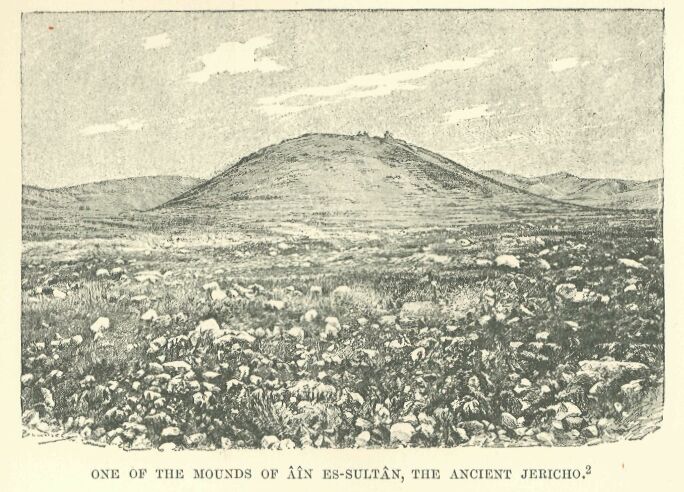
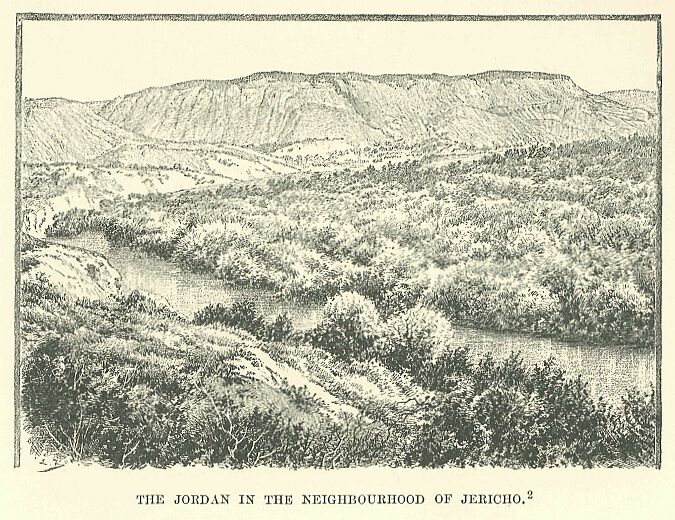
Two tribes having been thus provided for, the bulk of the Israelites sought to cross the Jordan without further delay, and establish themselves as best they might in the very heart of the Canaanites. The sacred writings speak of their taking possession of the country by a methodic campaign, undertaken by command of and under the visible protection of Jahveh* Moses had led them from Egypt to Kadesh, and from Kadesh to the land of Gilead; he had seen the promised land from the summit of Mount Nebo, but he had not entered it, and after his death, Joshua, son of Nun, became their leader, brought them across Jordan dryshod, not far from its mouth, and laid siege to Jericho.
* The history of the conquest is to be found in the Book of Joshua.
The walls of the city fell of themselves at the blowing of the brazen trumpets,* and its capture entailed that of three neighbouring towns, Aï, Bethel, and Shechem. Shechem served as a rallying-place for the conquerors; Joshua took up his residence there, and built on the summit of Mount Ebal an altar of stone, on which he engraved the principal tenets of the divine Law.**
* Josh, i.-vi. ** Josh, vii., viii. Mount Ebal is the present Gebel Sulemiyeh.
Drawn by Boudier, from a photograph brought back by Lortet.
The sudden intrusion of a new element naturally alarmed the worshippers of the surrounding local deities; they at once put a truce to their petty discords, and united in arms against the strangers. At the instigation of Adoni-zedeck, King of Jerusalem, the Canaanites collected their forces in the south; but they were routed not far from Gibeon, and their chiefs killed or mutilated.* The Amorites in the north, who had assembled round Jabin, King of Hazor, met with no better success; they were defeated at the waters of Merom, Hazor was burnt, and Galilee delivered to fire and sword.**
* Josh. x. The same war is given rather differently in Judges i. 1-9, where the king is called Adoni-bezek. ** Josh. xi. As another Jabin appears in the history of Deborah, it has
Drawn by Boudier, from a photograph in Lortet.
The country having been thus to a certain extent cleared, Joshua set about dividing the spoil, and assigned to each tribe his allotted portion of territory.* Such, in its main outlines, is the account given by the Hebrew chroniclers; but, if closely examined, it would appear that the Israelites did not act throughout with that unity of purpose and energy which they [the Hebrew chroniclers] were pleased to imagine. They did not gain possession of the land all at once, but established themselves in it gradually by detachments, some settling at the fords of Jericho,** others more to the north, and in the central valley of the Jordan as far up as She-chem.***
* The lot given to each tribe is described in Josh, xiii.- xxi. It has been maintained by some critics that there is a double rôle assigned to one and the same person, only that some maintain that the Jabin of Josh. xi. has been transferred to the time of the Judges, while others make out that the Jabin of Deborah was carried back to the time of the conquest. ** Renan thinks that the principal crossing must have taken place opposite Jericho, as is apparent from the account in Josh, ii., iii. *** Carl Niebuhr believes that he has discovered the exact spot at the ford of Admah, near Succoth.
Drawn by Boudier, from a photograph in Lortet.
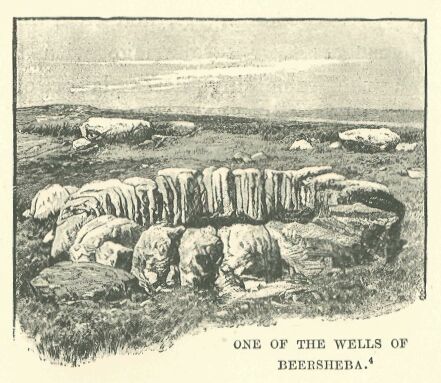
The latter at once came into contact with a population having a higher civilization than themselves, and well equipped for a vigorous resistance; the walled towns which had defied the veterans of the Pharaohs had not much to fear from the bands of undisciplined Israelites wandering in their neighbourhood. Properly speaking, there were no pitched battles between them, but rather a succession of raids or skirmishes, in which several citadels would successively fall into the hands of the invaders. Many of these strongholds, harassed by repeated attacks, would prefer to come to terms with the enemy, and would cede or sell them some portion of their territory; others would open their gates freely to the strangers, and their inhabitants would ally themselves by intermarriage with the Hebrews. Judah and the remaining descendants of Simeon and Levi established themselves in the south; Levi comprised but a small number of families, and made no important settlements; whereas Judah took possession of nearly the whole of the mountain district separating the Shephelah from the western shores of the Dead Sea, while Simeon made its abode close by on the borders of the desert around the wells of Beersheba.*
* Wellhausen has remarked that the lot of Levi must not be separated from that of Simeon, and, as the remnant of Simeon allied themselves with Judah, that of Levi also must have shared the patrimony of Judah.
The descendants of Rachel and her handmaid received as their inheritance the regions situated more to the centre of the country, the house of Joseph taking the best domains for its branches of Ephraim and Manasseh. Ephraim received some of the old Canaanite sanctuaries, such as Ramah, Bethel, and Shiloh, and it was at the latter spot that they deposited the ark of the covenant. Manasseh settled to the north of Ephraim, in the hills and valleys of the Carmel group, and to Benjamin were assigned the heights which overlook the plain of Jericho. Four of the less important tribes, Issachar, Asher, Naphtali, and Zebulon, ventured as far north as the borders of Tyre and Sidon, behind the Phoenician littoral, but were prevented by the Canaanites and Amorites from spreading over the plain, and had to confine themselves to the mountains. All the fortresses commanding the passes of Tabor and Carmel, Megiddo, Taanach, Ibleam, Jezreel, Endor, and Bethshan remained inviolate, and formed as it were an impassable barrier-line between the Hebrews of Galilee and their brethren of Ephraim. The Danites were long before they found a resting-place; they attempted to insert themselves to the north of Judah, between Ajalon and Joppa, but were so harassed by the Amorites, that they had to content themselves with the precarious tenure of a few towns such as Zora, Shaalbîn, and Eshdol. The foreign peoples of the Shephelah and the Canaanite cities almost all preserved their autonomy; the Israelites had no chance against them wherever they had sufficient space to put into the field large bodies of infantry or to use their iron-bound chariots. Finding it therefore impossible to overcome them, the tribes were forced to remain cut off from each other in three isolated groups of unequal extent which they were powerless to connect: in the centre were Joseph, Benjamin, and Dan; in the south, Judah, Levi, and Simeon; while Issachar, Asher, Naphtali, and Zebulon lay to the north.
The period following the occupation of Canaan constituted the heroic age of the Hebrews. The sacred writings agree in showing that the ties which bound the twelve tribes together were speedily dissolved, while their fidelity and obedience to God were relaxed with the growth of the young generations to whom Moses or Joshua were merely names. The conquerors “dwelt among the Canaanites: the Hittite, and the Amorite, and the Perizzite, and the Hivite, and the Jebusite: and they took their daughters to be their wives, and gave their own daughters to their sons, and served their gods. And the children of Israel did that which was evil in the sight of the Lord their God, and served the Baalim and the Asheroth.” *
[Click on image to enlarge to full-size]
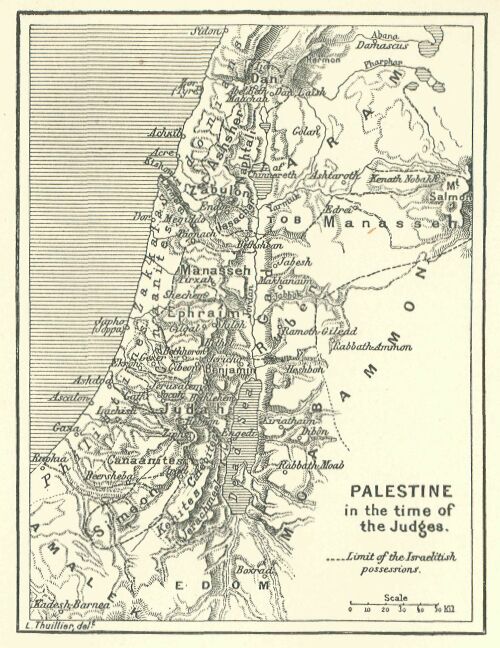
When they had once abandoned their ancient faith, political unity was not long preserved. War broke out between one tribe and another; the stronger allowed the weaker to be oppressed by the heathen, and were themselves often powerless to retain their independence. In spite of the thousands of men among them, all able to bear arms, they fell an easy prey to the first comer; the Amorites, the Ammonites, the Moabites, and the Philistines, all oppressed them in turn, and repaid with usury the ills which Joshua had inflicted on the Canaanites. “Whithersoever they went out, the hand of the Lord was against them for evil, as the Lord had spoken, and as the Lord had sworn unto them: and they were sore distressed. And the Lord raised up judges, which saved them out of the hand of those that spoiled them. And yet they hearkened not unto their judges, for they went a-whoring after other gods, and bowed themselves down unto them: they turned aside quickly out of the way wherein their fathers walked obeying the commandments of the Lord; but they did not so. And when the Lord raised them up judges, then the Lord was with the judge, and saved them out of the hand of their enemies all the days of the judge: for it repented the Lord because of their groaning by reason of them that oppressed them and vexed them. But it came to pass, when the judge was dead, that they turned back, and dealt more corruptly than their fathers, in following other gods to serve them, and to bow down unto them; they ceased not from their doings, nor from their stubborn way.” * The history of this period lacks the unity and precision with which we are at first tempted to credit it.
* Judges ii. 15-19.
The Israelites, when transplanted into the promised land, did not immediately lose the nomadic habits they had acquired in the desert. They retained the customs and prejudices they had inherited from their fathers, and for many years treated the peasantry, whose fields they had devastated, with the same disdain that the Bedawin of our own day, living in the saddle, lance in hand, shows towards the fellahîn who till the soil and bend patiently over the plough. The clans, as of old, were impatient of all regular authority; each tribe tended towards an isolated autonomy, a state of affairs which merited reprisals from the natives and encouraged hatred of the intruders, and it was only when the Canaanite oppression became unendurable that those who suffered most from it united themselves to make a common effort, and rallied for a moment round the chief who was ready to lead them. Many of these liberators must have acquired an ephemeral popularity, and then have sunk into oblivion together with the two or three generations who had known them; those whose memory remained green among their kinsmen were known by posterity as the judges of Israel.*
* The word “judges,” which has been adopted to designate these rulers, is somewhat misleading, as it suggests the idea of an organized civil magistracy. The word “shophet,” the same that we meet with in classical times under the form suffetes, had indeed that sense, but its primary meaning denotes a man invested with an absolute authority, regular or otherwise; it would be better translated chief, prince, captain.
These judges were not magistrates invested with official powers and approved by the whole nation, or rulers of a highly organised republic, chosen directly by God or by those inspired by Him. They were merely local chiefs, heroes to their own immediate tribe, well known in their particular surroundings, but often despised by those only at a short distance from them. Some of them have left only a name behind them, such as Shamgar, Ibzan, Tola, Elon, and Abdon; indeed, some scholars have thrown doubts on the personality of a few of them, as, for instance, Jair, whom they affirm to have personified a Gileadite clan, and Othnîel, who is said to represent one of the Kenite families associated with the children of Israel.* Others, again, have come down to us through an atmosphere of popular tradition, the elements of which modern criticism has tried in vain to analyse. Of such unsettled and turbulent times we cannot expect an uninterrupted history:** some salient episodes alone remain, spread over a period of nearly two centuries, and from these we can gather some idea of the progress made by the Israelites, and observe their stages of transition from a cluster of semi-barbarous hordes to a settled nation ripe for monarchy.
* The name Tola occurs as that of one of the clans of Issachar (Gen. xlvi. 13; Numb. xxvi. 23); Elon was one of the clans of Zebulon (Gen. xlvi. 14; Numb. xxvi. 26) ** Renan, however, believes that the judges “formed an almost continuous line, and that there merely lacks a descent from father to son to make of them an actual dynasty.” The chronology of the Book of Judges appears to cover more than four centuries, from Othnîel to Samson, but this computation cannot be relied on, as “forty years” represents an indefinite space of time. We must probably limit this early period of Hebrew history to about a century and a half, from cir. 1200 to 1050 B.C.
The first of these episodes deals merely with a part, and that the least important, of the tribes settled in Central Canaan.* The destruction of the Amorite kingdoms of Heshbon and Bashan had been as profitable to the kinsmen of the Israelites, Ammon and Moab, as it had been to the Israelites themselves.
* The episode of Othnîel and Cushan-rishathaim, placed at the beginning of the history of this period (Judges iii. 8- 11), is, by general consent, regarded as resting on a worthless tradition.
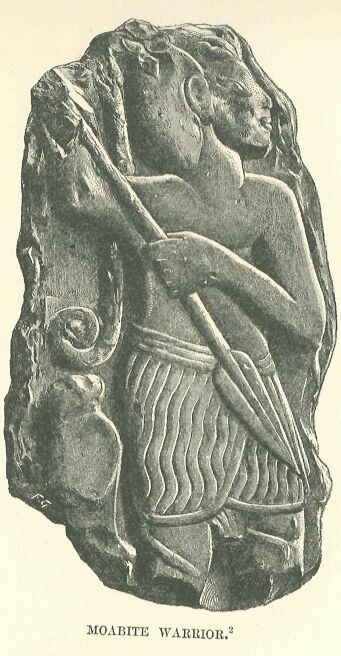
The Moabites had followed in the wake of the Hebrews through all the surrounding regions of the Dead Sea; they had pushed on from the banks of the Arnon to those of the Jabbok, and at the time of the Judges were no longer content with harassing merely Reuben and Gad.
They were a fine race of warlike, well-armed Beda-wins. Jericho had fallen into their hands, and their King Eglon had successfully scoured the entire hill-country of Ephraim,* so that those who wished to escape being pillaged had to safeguard themselves by the payment of an annual tribute.
* The text seems to infer (Judges iii. 13-15) that, after having taken the Oily of Palm Trees, i.e. Jericho (Deut. xxxiv. 3; 2 Ghron. xxviii. 15), Eglon had made it his residence, which makes the story incomprehensible from a geographical point of view. But all difficulties would disappear if we agreed to admit that in ver. 15 the name of the capital of Eglon has dropped out.
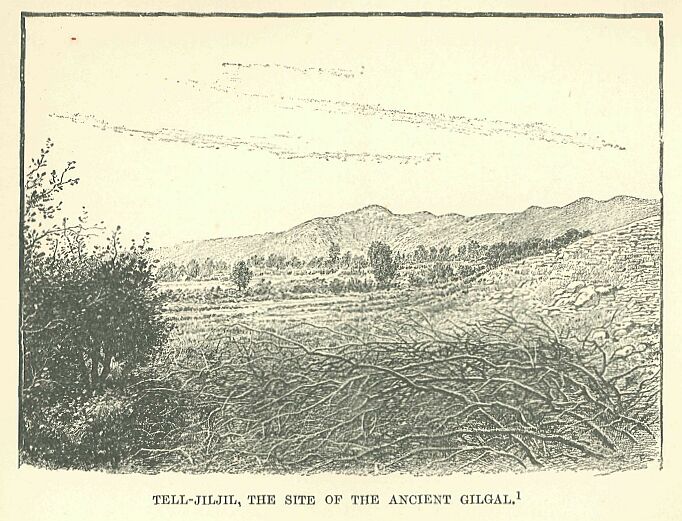
Ehud the Left-handed concealed under his garments a keen dagger, and joined himself to the Benjamite deputies who were to carry their dues to the Moabite sovereign. The money having been paid, the deputies turned homewards, but when they reached the cromlech of Gilgal,* and were safe beyond the reach of the enemy, Ehud retraced his steps, and presenting himself before the palace of Eglon in the attitude of a prophet, announced that he had a secret errand to the king, who thereupon commanded silence, and ordered his servants to leave him with the divine messenger in his summer parlour.
* The cromlech at Gilgal was composed of twelve stones, which, we are told, were erected by Joshua as a remembrance of the crossing of the Jordan (Josh. iv. 19-24).
Drawn by Faucher-Gudin, from the original in the Louvre.
“And Ehud said, I have a message from God unto thee. And he arose out of his seat. And Ehud put forth his left hand, and took the sword from his right thigh, and thrust it into his belly: and the haft also went in after the blade; and the fat closed upon the blade, for he drew not the sword out of his belly; and it came out behind.” Then Ehud locked the doors and escaped. “Now when he was gone out, his servants came; and they saw, and, behold, the doors of the parlour were locked; and they said, Surely he covereth his feet in his summer chamber.” But by the time they had forced an entrance, Ehud had reached Gilgal and was in safety. He at once assembled the clans of Benjamin, occupied the fords of the Jordan, massacred the bands of Moabites scattered over the plain of Jericho, and blocked the routes by which the invaders attempted to reach the hill-country of Ephraim. Almost at the same time the tribes in Galilee had a narrow escape from a still more formidable enemy.* They had for some time been under the Amorite yoke, and the sacred writings represent them at this juncture as oppressed either by Sisera of Harosheth-ha-Goyîm or by a second Jabin, who was able to bring nine hundred chariots of iron into the field.** At length the prophetess Deborah of Issachar sent to Barak of Kadesh a command to assemble his people, together with those of Zebulon, in the name of the Lord;*** she herself led the contingents of Issachar, Ephraim, and Machir to meet him at the foot of Tabor, where the united host is stated to have comprised forty thousand men. Sisera,**** who commanded the Canaanite force, attacked the Israelite army between Taanach and Megiddo in that plain of Kishon which had often served as a battle-field during the Egyptian campaigns.
* The text tells us that, after the time of Ehud, the land had rest eighty years (Judges iii. 30). This, again, is one of those numbers which represent an indefinite space of time. ** It has been maintained that two versions are here blended together in the text, one in which the principal part is played by Sisera, the other in which it is attributed to Jabin. The episode of Deborah and Barak (Judges iv., v.) comprises a narrative in prose (chap, iv.), and the song (chap, v.) attributed to Deborah. The prose account probably is derived from the song. The differences in the two accounts may be explained as having arisen partly from an imperfect understanding of the poetic text, and partly from one having come down from some other source. *** Some critics suppose that the prose narrative (Judges iv. 5) has confounded the prophetess Deborah, wife of Lapidoth, with Deborah, nurse of Rachel, who was buried near Bethel, under the “Oak of Weeping” (Gen. xxxv. 8), and consequently place it between Rama and Bethel, in the hill- country of Ephraim. **** In the prose narrative (Judges iv. 2-7) Sisera is stated to have been the general of Jabin: there is nothing incompatible in this statement with the royal dignity elsewhere attributed to Sisera. Harosheth-ha-Goyîm has been identified with the present village of El-Haretîyeh, on the right bank of the Kishon.
It would appear that heavy rains had swelled the streams, and thus prevented the chariots from rendering their expected service in the engagement; at all events, the Amorites were routed, and Sisera escaped with the survivors towards Hazor.
Drawn by Boudier, from a photograph in Lortet.
The people of Meroz facilitated his retreat, but a Kenite named Jael, the wife of Heber, traitorously killed him with a blow from a hammer while he was in the act of drinking.*
* Meroz is the present Marus, between the Lake of Huleh and Safed. I have followed the account given in the song (Judges v. 24-27). According to the prose version (iv. 17-22), Jael slew Sisera while he was asleep with a tent-pin, which she drove into his temple. [The text of Judges v. 24-27 does not seem to warrant the view that he was slain “in the act of drinking,” nor does it seem to conflict with Judges iv. 11.- -Tr.]
This exploit was commemorated in a song, the composition of which is attributed to Deborah and Barak: “For that the leaders took the lead in Israel, for that the people offered themselves willingly, bless ye the Lord. Hear, O ye kings, give ear, O ye princes; I, even I, will sing unto the Lord; I will sing praise to the Lord, the God of Israel.” * The poet then dwells on the sufferings of the people, but tells how Deborah and Barak were raised up, and enumerates the tribes who took part in the conflict as well as those who turned a deaf ear to the appeal. “Then came down a remnant of the nobles and the people.... Out of Ephraim came down they whose root is in Amalek:—out of Machir came down governors,—and out of Zebulon they that handle the marshal’s staff.—And the princes of Issachar were with Deborah—as was Issachar so was Barak,—into the valley they rushed forth at his feet.**—By the watercourses of Reuben—there were great resolves of heart.—Why satest thou among the sheepfolds,—to hear the pipings for the flocks?—At the watercourses of Reuben—there were great searchings of heart—Gilead abode beyond Jordan:—and Dan, why did he remain in ships?—Asher sat still at the haven of the sea—and abode by his creeks.—Zebulon was a people that jeoparded their lives unto the death,—and Naphtali upon the high places of the field.—The kings came and fought;—then fought the kings of Canaan.—In Taanach by the waters of Megiddo:—they took no gain of money.—They fought from heaven,—the stars in their courses fought against Sisera.—The river of Kishon swept them away,—that ancient river, the river Kishon.—O my soul, march on with strength.—Then did the horsehoofs stamp—by reason of the pransings, the pransings of their strong ones.”
* Judges v. 2, 3 (R.V.). ** The text of the song (Judges v. 14) contains an allusion to Benjamin, which is considered by many critics to be an interpolation. It gives a mistaken reading, “Issachar with Barak;” Issachar having been already mentioned with Deborah, probably Zébulon should be inserted in the text.
Sisera flies, and the poet follows him in fancy, as if he feared to see him escape from vengeance. He curses the people of Meroz in passing, “because they came not to the help of the Lord.” He addresses Jael and blesses her, describing the manner in which the chief fell at her feet, and then proceeds to show how, at the very time of Sisera’s death, his people were awaiting the messenger who should bring the news of his victory; “through the window she looked forth and cried—the mother of Sisera cried through the lattice—‘Why is his chariot so long in coming?—Why tarry the wheels of his chariot?’—Her wise ladies answered her,—yea, she returned answer to herself,—‘Have they not found, have they not divided the spoil?—A damsel, two damsels to every man;—to Sisera a spoil of divers colours,—a spoil of divers colours of embroidery on both sides, on the necks of the spoil?—So let all Thine enemies perish, O Lord:—but let them that love Him be as the sun when he goeth forth in his might.’”
It was the first time, as far as we know, that several of the Israelite tribes combined together for common action after their sojourn in the desert of Kadesh-barnea, and the success which followed from their united efforts ought, one would think, to have encouraged them to maintain such a union, but it fell out otherwise; the desire for freedom of action and independence was too strong among them to permit of the continuance of the coalition.
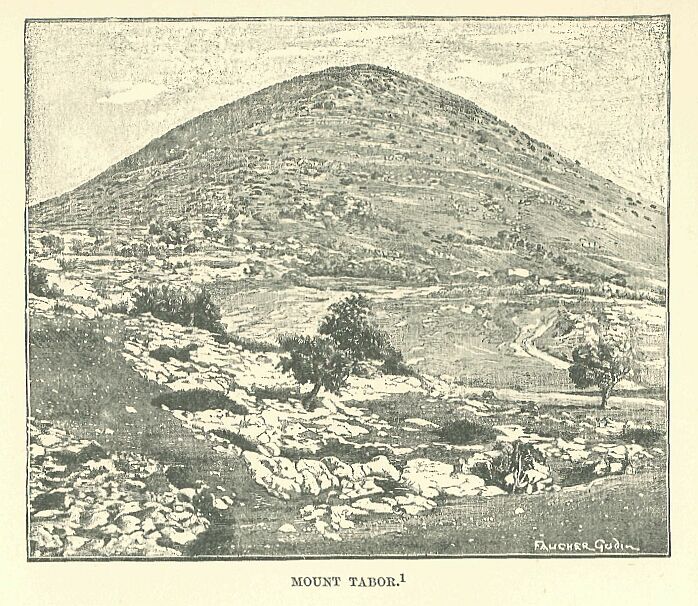
Drawn by Faucher-Gudin, from a photograph by M. C. Alluaud of Limoges.
Manasseh, restricted in its development by the neighbouring Canaanite tribes, was forced to seek a more congenial neighbourhood to the east of the Jordan—not close to Gad, in the land of Gilead, but to the north of the Yarmuk and its northern affluents in the vast region extending to the mountains of the Haurân. The families of Machir and Jair migrated one after the other to the east of the Lake of Gennesaret, while that of Nobah proceeded as far as the brook of Kanah, and thus formed in this direction the extreme outpost of the children of Israel: these families did not form themselves into new tribes, for they were mindful of their affiliation to Manasseh, and continued beyond the river to regard themselves still as his children.* The prosperity of Ephraim and Manasseh, and the daring nature of their exploits, could not fail to draw upon them the antagonism and jealousy of the people on their borders. The Midianites were accustomed almost every year to pass through the region beyond the Jordan which the house of Joseph had recently colonised. Assembling in the springtime at the junction of the Yarmuk with the Jordan, they crossed the latter river, and, spreading over the plains of Mount Tabor, destroyed the growing crops, raided the villages, and pushed, sometimes, their skirmishing parties over hill and dale as far as Gaza.**
* Manasseh was said to have been established beyond the Jordan at the time that Gad and Reuben were in possession of the land of Gilead (Numb, xxxii. 33, 39-42, xxxiv. 14, 15; Dent. iii. 13-15; Josh. xiii. 8, 29-32, xxii.). Earlier traditions placed this event in the period which followed the conquest of Canaan by Joshua. It is not certain that all the families which constituted the half-tribe of Manasseh took their origin from Manasseh: one of them, for example, that of Jair, was regarded as having originated partly from Judah (1 Chron. ii. 21-24). ** Judges vi. 2-6. The inference that they dare not beat wheat in the open follows from ver. 11, where it is said that “Gideon was beating out wheat in his winepress to hide it from the Midianites.”
A perpetual terror reigned wherever they were accustomed to pass*: no one dared beat out wheat or barley in the open air, or lead his herds to pasture far from his home, except under dire necessity; and even on such occasions the inhabitants would, on the slightest alarm, abandon their possessions to take refuge in caves or in strongholds on the mountains.1 During one of these incursions two of their sheikhs encountered some men of noble mien in the vicinity of Tabor, and massacred them without compunction.** The latter were people of Ophrah,*** brethren of a certain Jerubbaal (Gideon) who was head of the powerful family of Abiezer.****
* The history of the Midianite oppression (Judges vi.-viii.) seems to be from two different sources; the second (Judges viii. 4-21), which is also the shortest, is considered by some to represent the more ancient tradition. The double name of the hero, Gideon-Jerubbaal, has led some to assign its elements respectively to Gideon, judge of the western portion of Manasseh, and Jerubbaal, judge of the eastern Manasseh, and to the consequent fusion of the two men in one. ** This is an assumption which follows reasonably from Judges viii. 18, 19. *** The site of the Ophrah of Abiezer is not known for certain, but it would seem from the narrative that it was in the neighbourhood of Shechem. **** The position of Gideon-Jerubbaal as head of the house of Abiezer follows clearly from the narrative; if he is represented in the first part of the account as a man of humble origin (Judges vi. 15, 16), it was to exalt the power of Jahveh, who was accustomed to choose His instruments from amongst the lowly. The name Jerubbaal (1 Sam. xii. 11:2 Sam. xi. 21, where the name is transformed into Jerubbesheth, as Ishbaal and Meribbaal are into Ishbosheth and Mephibosheth respectively), in which “Baal” seems to some not to represent the Canaanite God, but the title Lord as applied to Jahveh, was supposed to mean “Baal fights against him,” and was, therefore, offensive to the orthodox. Kuenen thought it meant “Lord, fight for him!” Renan read it Yarebaal, from the Vulgate form Jerobaal, and translated “He who fears Baal.” Gideon signifies “He who overthrows” in the battle.
Assembling all his people at the call of the trumpet, Jerubbaal chose from among them three hundred of the strongest, with whom he came down unexpectedly upon the raiders, put them to flight in the plain of Jezreel, and followed them beyond the Jordan. Having crossed the river, “faint and yet pursuing,” he approached the men of Succoth, and asked them for bread for himself and his three hundred followers. Their fear of the marauders, however, was so great that the people refused to give him any help, and he had no better success with the people of Penuel whom he encountered a little further on. He did not stop to compel them to accede to his wishes, but swore to inflict an exemplary punishment upon them on his return. The Midianites continued their retreat, in the mean time, “by the way of them that dwelt in tents on the east of Nobah and Jogbehah,” but Jerubbaal came up with them near Karkâr, and discomfited the host. He took vengeance upon the two peoples who had refused to give him bread, and having thus fulfilled his vow, he began to question his prisoners, the two chiefs: “What manner of men were they whom ye slew at Tabor?” “As thou art, so were they; each one resembled the children of a king.” “And he said, They were my brethren, the sons of my mother: as the Lord liveth, if ye had saved them alive, I would not slay you. And he said unto Jether his firstborn, Up, and slay them. But the youth drew not his sword: for he feared, because he was yet a youth.” True Bedawins as they were, the chiefs’ pride revolted at the idea of their being handed over for execution to a child, and they cried to Jerubbaal: “Rise thou, and fall upon us: for as the man is, so is his strength.” From this victory rose the first monarchy among the Israelites. The Midianites, owing to their marauding habits and the amount of tribute which they were accustomed to secure for escorting caravans, were possessed of a considerable quantity of gold, which they lavished on the decoration of their persons: their chiefs were clad in purple mantles, their warriors were loaded with necklaces, bracelets, rings, and ear-rings, and their camels also were not behind their masters in the brilliance of their caparison. The booty which Gideon secured was, therefore, considerable, and, as we learn from the narrative, excited the envy of the Ephraimites, who said: “Why hast thou served us thus, that thou calledst us not, when thou wentest to fight with Midian?” *
* Judges viii. 1-3.
The spoil from the golden ear-rings alone amounted to one thousand seven hundred shekels, as we learn from the narrative, and this treasure in the hands of Jerubbaal was not left unemployed, but was made, doubtless, to contribute something to the prestige he had already acquired: the men of Israel, whom he had just saved from their foes, expressed their gratitude by offering the crown to him and his successors. The mode of life of the Hebrews had been much changed after they had taken up their abode in the mountains of Canaan. The tent had given place to the house, and, like their Canaanite neighbours, they had given themselves up to agricultural pursuits. This change of habits, in bringing about a greater abundance of the necessaries of life than they had been accustomed to, had begotten aspirations which threw into relief the inadequacy of the social organisation, and of the form of government with which they had previously been content. In the case of a horde of nomads, defeat or exile would be of little moment. Should they be obliged by a turn in their affairs to leave their usual haunts, a few days or often a few hours would suffice to enable them to collect their effects together, and set out without trouble, and almost without regret, in search of a new and more favoured home. But with a cultivator of the ground the case would be different: the farm, clearings, and homestead upon which he had spent such arduous and continued labour; the olive trees and vines which had supplied him with oil and wine—everything, in fact, upon which he depended for a livelihood, or which was dependent upon him, would bind him to the soil, and expose his property to disasters likely to be as keenly felt as wounds inflicted on his person. He would feel the need, therefore, of laws to secure to him in time of peace the quiet possession of his wealth, of an army to protect it in time of war, and of a ruler to cause, on the one hand, the laws to be respected, and to become the leader, on the other, of the military forces. Jerubbaal is said to have, in the first instance, refused the crown, but everything goes to prove that he afterwards virtually accepted it. He became, it is true, only a petty king, whose sovereignty was limited to Manasseh, a part of Ephraim, and a few towns, such as Succoth and Penuel, beyond the Jordan. The Canaanite city of Shechem also paid him homage. Like all great chiefs, he had also numerous wives, and he recognised as the national Deity the God to whom he owed his victories.
Out of the spoil taken from the Midianites he formed and set up at Ophrah an ephod, which became, as we learn, “a snare unto him and unto his house,” but he had also erected under a terebinth tree a stone altar to Jahveh-Shalom (“Jehovah is peace”).* This sanctuary, with its altar and ephod, soon acquired great celebrity, and centuries after its foundation it was the object of many pilgrimages from a distance.
Jerubbaal was the father by his Israelite wives of seventy children, and, by a Canaanite woman whom he had taken as a concubine at Shechem, of one son, called Abimelech.**
* The Book of Judges separates the altar from the ephod, placing the erection of the former at the time of the vocation of Gideon (vi. 11-31) and that of the ephod after the victory (viii. 24-27). The sanctuary of Ophrah was possibly in existence before the time of Jerubbaal, and the sanctity of the place may have determined his selection of the spot for placing the altar and ephod there. ** Judges viii. 30, 31.
The succession to the throne would naturally have fallen to one of the seventy, but before this could be arranged, Abimelech “went to Shechem unto his mother’s brethren, and spake with them, and with all the family of the house of his mother’s father, saying, Speak, I pray you, in the ears of all the men of Shechem, Whether is better for you, that all the sons of Jerubbaal, which are threescore and ten persons, rule over you, or that one rule over you? remember also that I am your bone and your flesh.” This advice was well received; it flattered the vanity of the people to think that the new king was to be one of themselves; “their hearts inclined to follow Abimelech; for they said, He is our brother. And they gave him threescore and ten pieces of silver out of the house of Baal-berith (the Lord of the Covenant), wherewith Abimelech hired vain and light fellows, which followed him.... He slew his brethren the sons of Jerubbaal, being threescore and ten persons, upon one stone.” The massacre having been effected, “all the men of Shechem assembled themselves together, and all the house of Millo,* and made Abimelech king, by the oak of the pillar which was in Shechem.” ** He dwelt at Ophrah, in the residence, and near the sanctuary, of his father, and from thence governed the territories constituting the little kingdom of Manasseh, levying tribute upon the vassal villages, and exacting probably tolls from caravans passing through his domain.
* The word “Millo” is a generic term, meaning citadel or stronghold of the city: there was a Millo in every important town, Jerusalem included. ** The “oak of the pillar” was a sacred tree overshadowing probably a cippus: it may have been the tree mentioned in Gen. xxxv. 4, under which Jacob buried the strange gods; or that referred to in Josh. xxiv. 26, under which Joshua set up a stone commemorative of the establishment of the law. Jotham, the youngest son of Gideon, escaped the massacre. As soon as he heard of the election of Abimelech, he ascended Mount Gerizim, and gave out from there the fable of the trees, applying it to the circumstances of the time, and then fled. Some critics think that this fable—which is confessedly old—was inserted in the text at a time when prophetical ideas prevailed and monarchy was not yet accepted.
This condition of things lasted for three years, and then the Shechemites, who had shown themselves so pleased at the idea of having “one of their brethren” as sovereign, found it irksome to pay the taxes levied upon them by him, as if they were in no way related to him. The presence among them of a certain Zebul, the officer and representative of Abimelech, restrained them at first from breaking out into rebellion, but they returned soon to their ancient predatory ways, and demanded ransom for the travellers they might capture even when the latter were in possession of the king’s safe conduct. This was not only an insult to their lord, but a serious blow to his treasury: the merchants who found themselves no longer protected by his guarantee employed elsewhere the sums which would have come into his hands. The king concealed his anger, however; he was not inclined to adopt premature measures, for the place was a strong one, and defeat would seriously weaken his prestige. The people of Shechem, on their part, did not risk an open rupture for fear of the consequences. Gaal, son of Ebed,* a soldier of fortune and of Israelitish blood, arrived upon the scene, attended by his followers: he managed to gain the confidence of the people of Shechem, who celebrated under his protection the feast of the Vintage.
* The name Ebed (“slave,” “servant”) is assumed to have been substituted in the Massorotic text for the original name Jobaal, because of the element Baal in the latter word, which was regarded as that of the strange god, and would thus have the sacrilegious meaning “Jahveh is Baal.” The term of contempt, Ebed, was, according to this view, thus used to replace it.
On this occasion their merrymaking was disturbed by the presence among them of the officer charged with collecting the tithes, and Gaal did not lose the opportunity of stimulating their ire by his ironical speeches: “Who is Abimelech, and who is Shechem, that we should serve him? is not he the son of Jerubbaal? and Zebul his officer? serve ye the men of Hamor the father of Shechem: but why should we serve him? And would to God this people were under my hand! then would I remove Abimelech. And he said to Abimelech, Increase thine army, and come out.” Zebul promptly gave information of this to his master, and invited him to come by night and lie in ambush in the vicinity of the town, “that in the morning, as soon as the sun is up, thou shalt rise early, and set upon the city: and, behold, when he and the people that is with him come out against thee, thou mayest do to them as thou shalt find occasion.” It turned out as he foresaw; the inhabitants of Shechem went out in order to take part in the gathering in of the vintage, while Gaal posted his men at the entering in of the gate of the city. As he looked towards the hills he thought he saw an unusual movement among the trees, and, turning round, said to Zebul, who was close by, “Behold, there come people down from the tops of the mountains. And Zebul said unto him, Thou seest the shadow of the mountains as if they were men.” A moment after he looked in another direction, “and spake again and said, See, there come people down by the middle of the land, and one company cometh by the way of the terebinth of the augurs.” Zebul, seeing the affair turn out so well, threw off the mask, and replied railingly, “Where is now thy mouth, wherewith thou saidst, Who is Abimelech, that we should serve him? is not this the people that thou hast despised? go out, I pray, now, and fight with him.” The King of Manasseh had no difficulty in defeating his adversary, but arresting the pursuit at the gates of the city, he withdrew to the neighbouring village of Arumah.*
* This is now el-Ormeh, i.e.Kharbet el-Eurmah, to the south- west of Nablus.
He trusted that the inhabitants, who had taken no part in the affair, would believe that his wrath had been appeased by the defeat of Gaal; and so, in fact, it turned out: they dismissed their unfortunate champion, and on the morrow returned to their labours as if nothing had occurred.
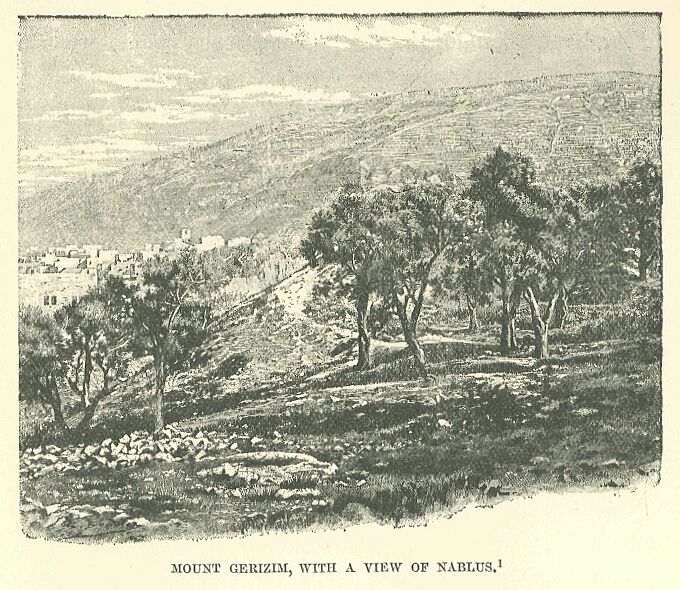
Drawn by Boudier, from a photograph reproduced by the Duc de Luynes.
Abimelech had arranged his Abiezerites in three divisions: one of which made for the gates, while the other two fell upon the scattered labourers in the vineyards. Abimelech then fought against the city and took it, but the chief citizens had taken refuge in “the hold of the house of El-berith.” “Abimelech gat him up to Mount Zalmon, he and all the people that were with him; and Abimelech took an axe in his hand, and cut down a bough from the trees, and took it up, and laid it on his shoulder: and he said unto the people that were with him, What ye have seen me do, make haste, and do as I have done. And all the people likewise cut down every man his bough, and followed Abimelech, and put them to the hold, and set the hold on fire upon them; so that all the men of the tower of Shechem died also, about a thousand men and women.”
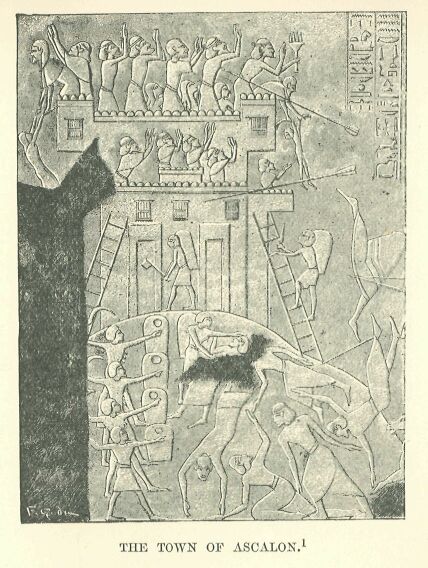
Drawn by Faucher-Gudin, from a bas-relief in the Ramesseum. This is a portion of the picture representing the capture of Ascalon by Ramses II.
This summary vengeance did not, however, prevent other rebellions. Thebez imitated Shechem, and came nigh suffering the same penalty.* The king besieged the city and took it, and was about to burn with fire the tower in which all the people of the city had taken refuge, when a woman threw a millstone down upon his head “and brake his skull.”
* Thebez, now Tubas, the north-east of Nablus.
The narrative tells us that, feeling himself mortally wounded, he called his armour-bearer to him, and said, “Draw thy sword, and kill me, that men say not of me, A woman slew him.” His monarchy ceased with him, and the ancient chronicler recognises in the catastrophe a just punishment for the atrocious crime he had committed in slaying his half-brothers, the seventy children of Jerubbaal.* His fall may be regarded also as the natural issue of his peculiar position: the resources upon which he relied were inadequate to secure to him a supremacy in Israel. Manasseh, now deprived of a chief, and given up to internal dissensions, became still further enfeebled, and an easy prey to its rivals. The divine writings record in several places the success attained by the central tribes in their conflict with their enemies. They describe how a certain Jephthah distinguished himself in freeing Gilead from the Ammonites.**
* Judges ix. 23, 24. “And God sent an evil spirit between Abimelech and the men of Shechem; and the men of Shechem dealt treacherously with Abimelech: that the violence done to the threescore and ten sons of Jerubbaal might come, and that their blood might be laid upon Abimelech their brother, which slew them, and upon the men of Shechem, which strengthened his hands to slay his brethren.” ** The story of Jephthah is contained in chaps, xi., xii. 1- 7, of the Book of Judges. The passage (xi. 12-29) is regarded by some, owing to its faint echo of certain portions of Numb, xx., xxi., to be an interpolation. Jephthah is said to have had Gilead for his father and a harlot for his mother. Various views have been put forward as to the account of his victories over the Midianites, some seeing in it, as well as in the origin of the four days’feast in honour of Jephthah’s daughter, insertions of a later date.
But his triumph led to the loss of his daughter, whom he sacrificed in order to fulfil a vow he had made to Jahveh before the battle.* These were, however, comparatively unimportant episodes in the general history of the Hebrew race. Bedawins from the East, sheikhs of the Midianites, Moabites, and Ammonites—all these marauding peoples of the frontier whose incursions are put on record—gave them continual trouble, and rendered their existence so miserable that they were unable to develop their institutions and attain the permanent freedom after which they aimed. But their real dangers—the risk of perishing altogether, or of falling back into a condition of servitude—did not arise from any of these quarters, but from the Philistines.
* There are two views as to the nature of the sacrifice of Jephthah’s daughter. Some think she was vowed to perpetual virginity, while others consider that she was actually sacrificed.
By a decree of Pharaoh, a new country had been assigned to the remnants of each of the maritime peoples: the towns nearest to Egypt, lying between Raphia and Joppa, were given over to the Philistines, and the forest region and the coast to the north of the Philistines, as far as the Phoenician stations of Dor and Carmel,* were appropriated to the Zakkala. The latter was a military colony, and was chiefly distributed among the five fortresses which commanded the Shephelah.
* We are indebted to the Papyrus Golenischeff for the mention of the position of the Zakkala at the beginning of the XXIst dynasty.
Drawn by Faucher-Gudin, from a “squeeze.”
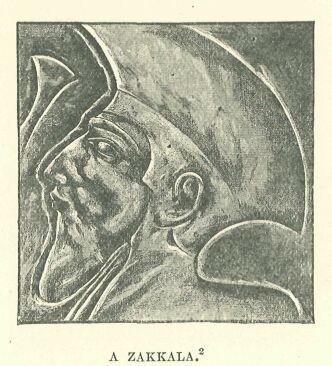
Gaza and Ashdod were separated from the Mediterranean by a line of sand-dunes, and had nothing in the nature of a sheltered port—nothing, in fact, but a “maiuma,” or open roadstead, with a few dwellings and storehouses arranged along the beach on which their boats were drawn up. Ascalon was built on the sea, and its harbour, although well enough suited for the small craft of the ancients, could not have been entered by the most insignificant of our modern ships. The Philistines had here their naval arsenal, where their fleets were fitted out for scouring the Egyptian waters as a marine police, or for piratical expeditions on their own account, when the occasion served, along the coasts of Phoenicia. Ekron and Gath kept watch over the eastern side of the plain at the points where it was most exposed to the attacks of the people of the hills—the Canaanites in the first instance, and afterwards the Hebrews. These foreign warriors soon changed their mode of life in contact with the indigenous inhabitants; daily intercourse, followed up by marriages with the daughters of the land, led to the substitution of the language, manners, and religion of the environing race for those of their mother country. The Zakkala, who were not numerous, it is true, lost everything, even to their name, and it was all that the Philistines could do to preserve their own. At the end of one or two generations, the “colts” of Palestine could only speak the Canaanite tongue, in which a few words of the old Hellenic patois still continued to survive. Their gods were henceforward those of the towns in which they resided, such as Marna and Dagon and Gaza,* Dagon at Ashdod,** Baalzebub at Ekron,*** and Derketô in Ascalon;**** and their mode of worship, with its mingled bloody and obscene rites, followed that of the country.
* Marna, “our lord,” is mentioned alongside Baalzephon in a list of strange gods worshipped at Memphis in the XIXth dynasty. The worship of Dagon at Gaza is mentioned in the story of Samson (Judges xvi. 21-30). ** The temple and statue of Dagon are mentioned in the account of the events following the taking of the ark in 1 Sam. v. 1-7. It is, perhaps, to him that 1 Chron. x. 10 refers, in relating how the Philistines hung up Saul’s arms in the house of their gods, although 1 Sam. xxxi. 10 calls the place the “house of the Ashtoreth.” *** Baalzebub was the god of Ekron (2 Kings i. 2-6), and his name was doubtfully translated “Lord of Flies.” The discovery of the name of the town Zebub on the Tell el- Amarna tablets shows that it means the “Baal of Zebub.” Zebub was situated in the Philistine plains, not far from Ekron. Halévy thinks it may have been a suburb of that town. **** The worship of Derketô or Atergatis at Ascalon is witnessed to by the classical writers.
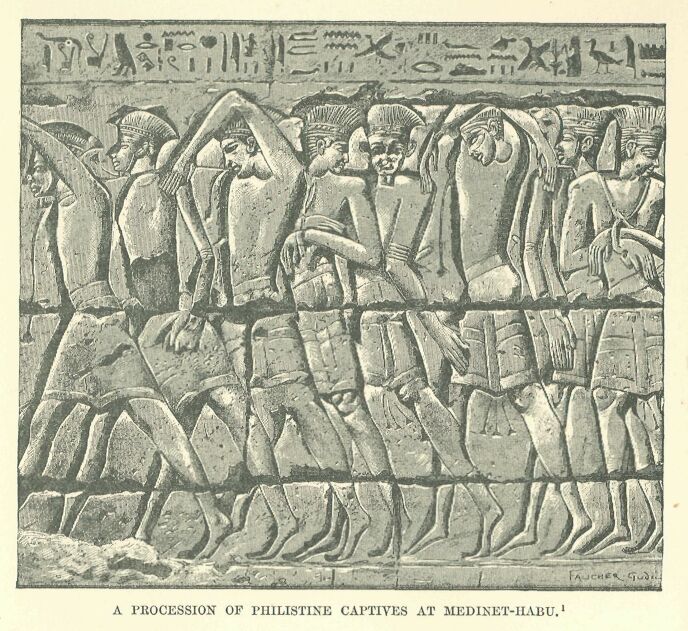
Drawn by Faucher-Gudin, from a photograph by Insinger.
Two things belonging to their past history they still retained—a clear remembrance of their far-off origin, and that warlike temperament which had enabled them to fight their way through many obstacles from the shores of the Ægean to the frontiers of Egypt. They could recall their island of Caphtor,* and their neighbours in their new home were accustomed to bestow upon them the designation of Cretans, of which they themselves were not a little proud.**
* Jer. xlvii. 4 calls them “the remnant of the isle of Caphtor;” Amos (ix. 7) knew that the Lord had brought “the Philistines from Caphtor;” and in Dent. ii. 23 it is related how “the Caphtorim which came forth out of Caphtor destroyed the Avvim, which dwelt in villages as far as Gaza, and dwelt in their stead.” Classical tradition falls in with the sacred record, and ascribes a Cretan origin to the Philistines; it is suggested, therefore, that in Gen. x. 14 the names Casluhim and Caphtorim should be transposed, to bring the verse into harmony with history and other parts of Scripture. ** In an episode in the life of David (1 Sam. xxx. 14), there is mention of the “south of the Cherethites,” which some have made to mean Cretans—that is to say, the region to the south of the Philistines, alongside the territory of Judah, and to the “south of Caleb.” Ezelc. xx. 16 also mentions in juxtaposition with the Philistines the Cherethites, and “the remnant of the sea-coast,” as objects of God’s vengeance for the many evils they had inflicted on Israel. By the Cherethims here, and the Cherethites in Zoph. ii. 5, the Cretans are by some thought to be meant, which would account for their association with the Philistines.
Gaza enjoyed among them a kind of hegemony, alike on account of its strategic position and its favourable situation for commerce, but this supremacy was of very precarious character, and brought with it no right whatever to meddle in the internal affairs of other members of the confederacy. Each of the latter had a chief of its own, a Seren,* and the office of this chief was hereditary in one case at least—Gath, for instance, where there existed a larger Canaanite element than elsewhere, and was there identified with that of “melek,” ** or king.
* The sarnê plishtîm figure in the narrative of the last Philistine campaign against Saul (1 Sam. xxix. 2-4, 7, 9). Their number, five, is expressly mentioned in 1 Sam. vi. 4, 16-18, as well as the names of the towns over which they ruled. ** Achish was King of Gath (1 Sam. xxi. 10, 12, xxvii. 2), and probably Maoch before him.
The five Sarnîm assembled in council to deliberate upon common interests, and to offer sacrifices in the name of the Pentapolis. These chiefs were respectively free to make alliances, or to take the field on their own account, but in matters of common importance they acted together, and took their places each at the head of his own contingent.* Their armies were made up of regiments of skilled archers and of pikemen, to whom were added a body of charioteers made up of the princes and the nobles of the nation. The armour for all alike was the coat of scale mail and the helmet of brass; their weapons consisted of the two-edged battle-axe, the bow, the lance, and a large and heavy sword of bronze or iron.**
* Achish, for example, King of Gath, makes war alone against the pillaging tribes, owing to the intervention of David and his men, without being called to account by the other princes (1 Sam. xxvii. 2-12, xxviii. 1, 2), but as soon as an affair of moment is in contemplation—such as the war against Saul—they demand the dismissal of David, and Achish is obliged to submit to his colleagues acting together (1 Sam. xxix.). ** Philistine archers are mentioned in the battle of Gilboa (1 Sam. xxxi. 3) as well as chariots (2 Sam. i. 6). The horsemen mentioned in the same connexion are regarded by some critics as an interpolation, because they cannot bring themselves to think that the Philistines had cavalry corps in the Xth century B.C. The Philistine arms are described at length in the duel between David and Goliath (1 Sam. xvii. 5 -7, 38, 39). They are in some respects like those of the Homeric heroes.
Their war tactics were probably similar to those of the Egyptians, who were unrivalled in military operations at this period throughout the whole East. Under able leadership, and in positions favourable for the operations of their chariots, the Philistines had nothing to fear from the forces which any of their foes could bring up against them. As to their maritime history, it is certain that in the earliest period, at least, of their sojourn in Syria, as well as in that before their capture by Ramses III., they were successful in sea-fights, but the memory of only one of their expeditions has come down to us: a squadron of theirs having sailed forth from Ascalon somewhere towards the end of the XIIth dynasty,* succeeded in destroying the Sidonian fleet, and pillaging Sidon itself.
* Justinus, xviii. 3, § 5. The memory of this has been preserved, owing to the disputes about precedence which raged in the Greek period between the Phoenician towns. The destruction of Sidon must have allowed Tyre to develop and take the first place.
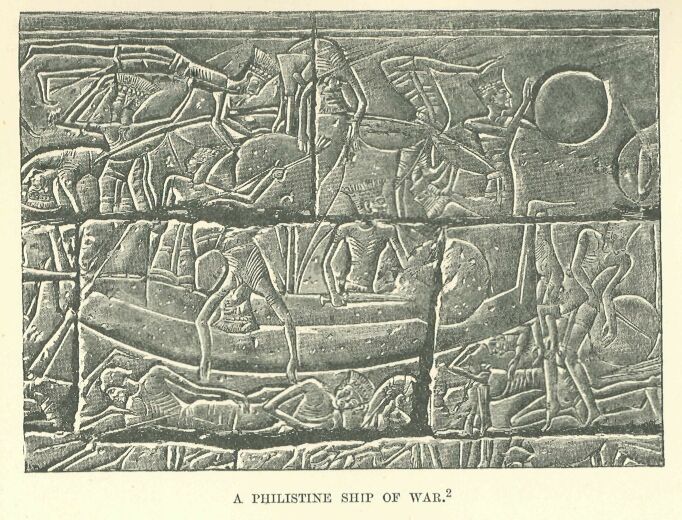
Drawn by Faucher-Gudin, from a photograph by Beato.
But however vigorously they may have plied the occupation of Corsairs at the outset of their career, there was, it would appear, a rapid falling off in their maritime prowess; it was on land, and as soldiers, that they displayed their bravery and gained their fame. Their geographical position, indeed, on the direct and almost only route for caravans passing between Asia and Africa, must have contributed to their success. The number of such caravans was considerable, for although Egypt had ceased to be a conquering nation on account of her feebleness at home, she was still one of the great centres of production, and the most important market of the East. A very great part of her trade with foreign countries was carried on through the mouths of the Nile, and of this commerce the Phoenicians had made themselves masters; the remainder followed the land-routes, and passed continually through the territory of the Philistines. These people were in possession of the tract of land which lay between the Mediterranean and the beginning of the southern desert, forming as it were a narrow passage, into which all the roads leading from the Nile to the Euphrates necessarily converged. The chief of these routes was that which crossed Mount Carmel, near Megiddo, and passed up the valleys of the Litâny and the Orontes. This was met at intervals by other secondary roads, such as that which came from Damascus by way of Tabor and the plain of Jezreel, or those which, starting out from the highland of Gilead, led through the fords of the Lower Jordan to Ekron and Gath respectively. The Philistines charged themselves, after the example and at the instigation of the Egyptians, with the maintenance of the great trunk road which was in their hands, and also with securing safe transit along it, as far as they could post their troops, for those who confided themselves to their care. In exchange for these good offices they exacted the same tolls which had been levied by the Canaanites before them.
In their efforts to put down brigandage, they had been brought into contact with some of the Hebrew clans after the latter had taken possession of Canaan. Judah, in its home among the mountains of the Dead Sea, had become acquainted with the diverse races which were found there, and consequently there had been frequent intermarriages between the Hebrews and these peoples. Some critics have argued from this that the chronicler had this fact in his mind when he assigned a Canaanite wife, Shuah, to the father of the tribe himself. He relates how Judah, having separated from his brethren, “turned in to a certain Adullamite, whose name was Hiram,” and that here he became acquainted with Shuah, by whom he had three sons. With Tamar, the widow of the eldest of the latter, he had accidental intercourse, and two children, Perez and Zerah, the ancestors of numerous families, were born of that union.*
* Gen. xxxviii., where there is a detailed account of Judah’s unions.
Edomites, Arabs, and Midianites were associated with this semi-Canaanite stock—for example, Kain, Caleb, Othniel, Kenaz, Shobal, Ephah, and Jerahmeel, but the Kenites took the first place among them, and played an important part in the history of the conquest of Canaan. It is related how one of their subdivisions, of which Caleb was the eponymous hero, had driven from Hebron the three sons of Anak—Sheshai, Ahiman, and Talmai—and had then promised his daughter Achsah in marriage to him who should capture Debir; this turned out to be his youngest brother Othniel, who captured the city, and at the same time obtained a wife. Hobab, another Kenite, who is represented to have been the brother-in-law of Moses, occupied a position to the south of Arad, in Idumsean territory.* These heterogeneous elements existed alongside each other for a long time without intermingling; they combined, however, now and again to act against a common foe, for we know that the people of Judah aided the tribe of Simeon in the reduction of the city of Zephath;** but they followed an independent course for the most part, and their isolation prevented their obtaining, for a lengthened period, any extension of territory.
* The father-in-law of Moses is called Jethro in Exod. iii. 1, iv. 19, but Raguel in Exod. ii. 18-22. Hobab is the son of Raguel, Numb. x. 29. ** Judges i. 17, where Zephath is the better reading, and not Arad, as has been suggested.
They failed, as at first, in their attempts to subjugate the province of Arad, and in their efforts to capture the fortresses which guarded the caravan routes between Ashdod and the mouth of the Jordan. It is related, however, that they overthrew Adoni-bezek, King of the Jebusites, and that they had dealt with him as he was accustomed to deal with his prisoners. “And Adoni-bezek said, Threescore and ten kings, having their thumbs and their great toes cut off, gathered their meat under my table: as I have done, so God hath requited me.” Although Adoni-bezek had been overthrown, Jerusalem still remained independent, as did also Gibeon. Beeroth, Kirjath-Jearim, Ajalon, Gezer, and the cities of the plain, for the Israelites could not drive out the inhabitants of the valley, because they had chariots of iron, with which the Hebrew foot-soldiers found it difficult to deal.* This independent and isolated group was not at first, however, a subject of anxiety to the masters of the coast, and there is but a bare reference to the exploits of a certain Shamgar, son of Anath, who “smote of the Philistines six hundred men with an ox-goad.” **
* See Josh. ix. 3-27 for an explanation of how these people were allowed afterwards to remain in a subordinate capacity among the children of Israel. ** Judges iii. 31; cf. also Judges v. 6, in which Shamgar is mentioned in the song of Deborah.
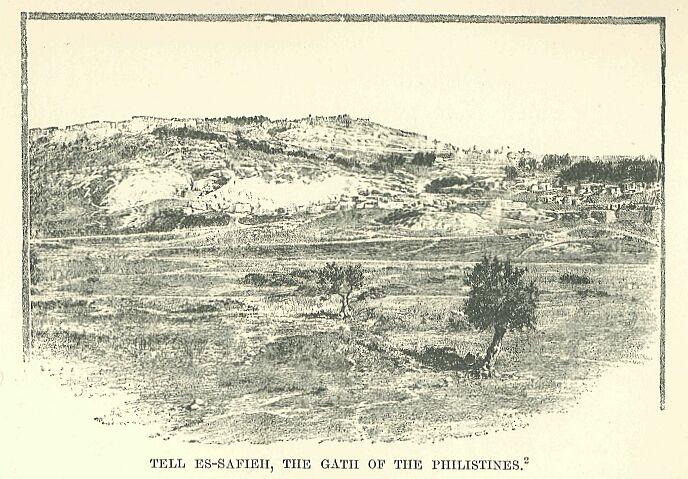
Drawn by Boudier, from photograph No. 265 of the Palestine Exploration Fund.
These cities had also to reckon with Ephraim, and the tribes which had thrown in their lot with her. Dan had cast his eyes upon the northern districts of the Shephelah—which were dependent upon Ekron or Gath—and also upon the semi-Phoenician port of Joppa; but these tribes did not succeed in taking possession of those districts, although they had harassed them from time to time by raids in which the children of Israel did not always come off victorious. One of their chiefs—Samson—had a great reputation among them for his bravery and bodily strength. But the details of his real prowess had been forgotten at an early period. The episodes which have been preserved deal with some of his exploits against the Philistines, and there is a certain humour in the chronicler’s account of the weapons which he employed: “with the jawbone of an ass have I smitten a thousand men;” he burned up their harvest also by letting go three hundred foxes, with torches attached to their tails, among the standing corn of the Philistines. Various events in his career are subsequently narrated; such as his adventure in the house of the harlot at Gaza, when he carried off the gate of the city and the gate-posts “to the top of the mountain that is before Hebron.” By Delilah’s treachery he was finally delivered over to his enemies, who, having put out his eyes, condemned him to grind in the prison-house. On the occasion of a great festival in honour of Dagon, he was brought into the temple to amuse his captors, but while they were making merry at his expense, he took hold of the two pillars against which he was resting, and bowing “himself with all his might,” overturned them, “and the house fell upon the lords, and upon all the people that were therein.” *
* Some learned critics considered Samson to have been a sort of solar deity.
The tribe of Dan at length became weary of these unprofitable struggles, and determined to seek out another and more easily defensible settlement. They sent out five emissaries, therefore, to look out for a new home. While these were passing through the mountains they called upon a certain Michah in the hill-country of Ephraim and lodged there. Here they took counsel of a Levite whom Michah had made his priest, and, in answer to the question whether their journey would be prosperous, he told them to “Go in peace: before the Lord is the way wherein ye go.” Their search turned out successful, for they discovered near the sources of the Jordan the town of Laish, whose people, like the Zidonians, dwelt in security, fearing no trouble. On the report of the emissaries, Dan decided to emigrate: the warriors set out to the number of six hundred, carried off by the way the ephod of Micah and the Levite who served before it, and succeeded in capturing Laish, to which they gave the name of their tribe. “They there set up for themselves the ephod: and Jonathan, the son of Gershom, the son of Moses, he and his sons were priests to the tribe of the Danites until the day of the captivity of the land.” * The tribe of Dan displayed in this advanced post of peril the bravery it had shown on the frontiers of the Shephelah, and showed itself the most bellicose of the tribes of Israel.
* The history of this migration, which is given summarily in Josh. xix. 47, is, as it now stands, a blending of two accounts. The presence of a descendant of Moses as a priest in this local sanctuary probably offended the religious scruples of a copyist, who substituted Manasseh for Moses (Judges xviii. 30), but the correction was not generally accepted. [The R.V. reads “Moses” where the authorised text has “Manasseh.”—Tr.]
It bore out well its character—“Dan is a lion’s whelp that leapeth forth from Bashan” on the Hermon;* “a serpent in the way, an adder in the path, that biteth the horse’s heels, so that his rider falleth backward.” ** The new position they had taken up enabled them to protect Galilee for centuries against the incursions of the Aramaeans.
* See the Blessing of Moses (Dent, xxxiii. 22). ** These are the words used in the Blessing of Jacob (Gen. xlix. 17).
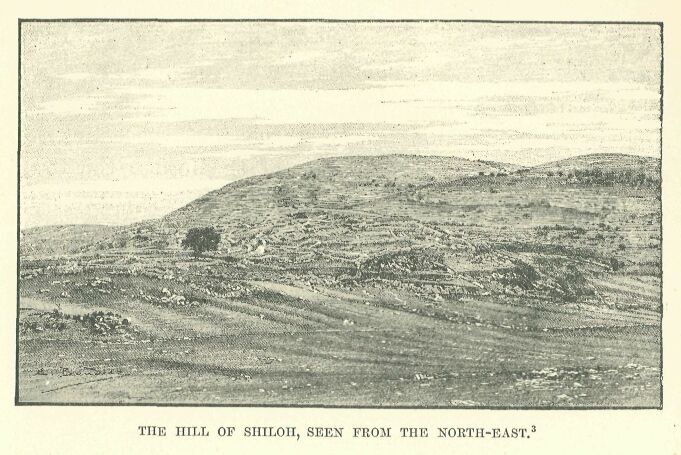
Drawn by Boudier, from photograph No. 100 of the Palestine Exploration Fund.
Their departure, however, left the descendants of Joseph unprotected, with Benjamin as their only bulwark. Benjamin, like Dan, was one of the tribes which contained scarcely more than two or three clans, but compensated for the smallness of their numbers by their energy and tenacity of character: lying to the south of Ephraim, they had developed into a breed of hardy adventurers, skilled in handling the bow and sling, accustomed from childhood to use both hands indifferently, and always ready to set out on any expedition, not only against the Canaanites, but, if need be, against their own kinsfolk.* They had consequently aroused the hatred of both friend and foe, and we read that the remaining tribes at length decreed their destruction; a massacre ensued, from which six hundred Benjamites only escaped to continue the race.** Their territory adjoined on the south that of Jerusalem, the fortress of the Jebusites, and on the west the powerful confederation of which Gibeon was the head. It comprised some half-dozen towns—Ramah, Anathoth, Michmash, and Nob, and thus commanded both sides of the passes leading from the Shephelah into the valley of the Jordan. The Benjamites were in the habit of descending suddenly upon merchants who were making their way to or returning from Gilead, and of robbing them of their wares; sometimes they would make a raid upon the environs of Ekron and Gath, “like a wolf that ravineth:” realising the prediction of Jacob, “in the morning he shall devour the prey, and at even he shall divide the spoil.” ***
* Benjamin signifies, properly speaking, “the Southern.” ** Story of the Lévite of Ephraim (Judges xix.-xxi.). The groundwork of it contains only one historical element. The story of the Lévite is considered by some critics to be of a later date than the rest of the text. *** He is thus characterised in the Blessing of Jacob (Gen. xlix. 27). VOL. VI. X
The Philistines never failed to make reprisals after each raid, and the Benjamites were no match for their heavily armed battalions; but the labyrinth of ravines and narrow gorges into which the Philistines had to penetrate to meet their enemy was a favourable region for guerilla warfare, in which they were no match for their opponents. Peace was never of long duration on this ill-defined borderland, and neither intercourse between one village and another, alliances, nor intermarriage between the two peoples had the effect of interrupting hostilities; even when a truce was made at one locality, the feud would be kept up at other points of contact. All details of this conflict have been lost, and we merely know that it terminated in the defeat of the house of Joseph, a number of whom were enslaved. The ancient sanctuary of Shiloh still continued to be the sacred town of the Hebrews, as it had been under the Canaanites, and the people of Ephraim kept there the ark of Jahveh-Sabaoth, “the Lord of Hosts.” * It was a chest of wood, similar in shape to the shrine which surmounted the sacred barks of the Egyptian divinities, but instead of a prophesying statue, it contained two stones on which, according to the belief of a later age, the law had been engraved.** Yearly festivals were celebrated before it, and it was consulted as an oracle by all the Israelites. Eli, the priest to whose care it was at this time consigned, had earned universal respect by the austerity of his life and by his skill in interpreting the divine oracles.***
* At the very opening of the First Book of Samuel (i. 3), Shiloh is mentioned as being the sanctuary of Jahveh- Sabaoth, Jahveh the Lord of hosts. The tradition preserved in Josh, xviii. 1, removes the date of its establishment as far back as the earliest times of the Israelite conquest. ** The idea that the Tables of the Law were enclosed in the Ark is frequently expressed in Exodus and in subsequent books of the Hexateuch. *** The history of Eli extends over chaps, i.-iv. of the First Book of Samuel; it is incorporated with that of Samuel, and treats only of the events which accompanied the destruction of the sanctuary of Shiloh by the Philistines.
His two sons, on the contrary, took advantage of his extreme age to annoy those who came up to worship, and they were even accused of improper behaviour towards the women who “served at the door of” the tabernacle. They appropriated to themselves a larger portion of the victims than they were entitled to, extracting from the caldron the meat offerings of the faithful after the sacrifice was over by means of flesh-hooks. Their misdeeds were such, that “men abhorred the offering of the Lord,” and yet the reverence for the ark was so great in the minds of the people, that they continued to have recourse to it on every occasion of national danger.* The people of Ephraim and Benjamin having been defeated once between Eben-ezer and Aphek, bore the ark in state to the battle-field, that its presence might inspire them with confidence. The Philistines were alarmed at its advent, and exclaimed, “God is come into the camp. Woe unto us! Who shall deliver us out of the hand of these mighty gods?... Be strong, and quit yourselves like men, O ye Philistines, that ye be not servants unto the Hebrews, as they have been to you.” ** In response to this appeal, their troops fought so boldly that they once more gained a victory. “And there ran a man of Benjamin out of the army, and came to Shiloh the same day with his clothes rent, and with earth upon his head. And when he came, lo, Eli sat upon his seat by the wayside watching: for his heart trembled for the ark of God. And when the man came into the city, and told it, all the city cried out. And when Eli heard the noise of the crying, he said, What meaneth the noise of this tumult? And the man hasted, and came and told Eli. Now Eli was ninety and eight years old; and his eyes were set, that he could not see. And the man said unto Eli, I am he that came out of the army, and I fled to-day out of the army. And he said, How went the matter, my son? And he that brought the tidings answered and said, Israel is fled before the Philistines, and there hath been also a great slaughter among the people, and thy two sons also, Hophni and Phineas, are dead, and the ark of God is taken. And it came to pass, when he made mention of the ark of God, that he fell from off his seat backward by the side of the gate, and his neck brake, and he died: for he was an old man, and heavy.” ***
* Sam. iv. 12-18. ** This is not mentioned in the sacred books; but certain reasons for believing this destruction to have taken place are given by Stade. *** The Philistine garrison at Geba (Gibeah) is mentioned in 1 Sam. xiii. 3, i.
The defeat of Eben-ezer completed, at least for a time, the overthrow of the tribes of Central Canaan. The Philistines destroyed the sanctuary of Shiloh, and placed a garrison at Gibeah to keep the Benjamites in subjection, and to command the route of the Jordan;* it would even appear that they pushed their advance-posts beyond Carmel in order to keep in touch with the independent Canaanite cities such as Megiddo, Taanach, and Bethshan, and to ensure a free use of the various routes leading in the direction of Damascus, Tyre, and Coele-Syria.**
* After the victory at Gilboa, the Philistines exposed the dead bodies of Saul and his sons upon the walls of Bethshan (1 Sam. xxxi. 10, 12), which they would not have been able to do had the inhabitants not been allies or vassals. Friendly relations with Bethshan entailed almost as a matter of course some similar understanding with the cities of the plain of Jezreel. ** 1 Sam. vii. 16, 17. These verses represent, as a matter of fact, all that we know of Samuel anterior to his relations with Saul. This account seems to represent him as exercising merely a restricted influence over the territory of Benjamin and the south of Ephraim. It was not until the prophetic period that, together with Eli, he was made to figure as Judge of all Israel.
The Philistine power continued dominant for at least half a century. The Hebrew chroniclers, scandalised at the prosperity of the heathen, did their best to abridge the time of the Philistine dominion, and interspersed it with Israelitish victories. Just at this time, however, there lived a man who was able to inspire them with fresh hope. He was a priest of Bamah, Samuel, the son of Elkanah, who had acquired the reputation of being a just and wise judge in the towns of Bethel, Gilgal, and Mizpah; “and he judged Israel in all those places, and his return was to Bamah, for there was his house... and he built there an altar unto the Lord.” To this man the whole Israelite nation attributed with pride the deliverance of their race. The sacred writings relate how his mother, the pious Hannah, had obtained his birth from Jahveh after years of childlessness, and had forthwith devoted him to the service of God. She had sent him to Shiloh at the age of three years, and there, clothed in a linen tunic and in a little robe which his mother made for him herself, he ministered before God in the presence of Eli. One night it happened, when the latter was asleep in his place, “and the lamp of God was not yet gone out, and Samuel was laid down to sleep in the temple of the Lord, where the ark of God was, that the Lord called Samuel: and he said, Here am I. And he ran unto Eli, and said, Here am I; for thou calledst me. And he said, I called thee not; lie down again.” Twice again the voice was heard, and at length Eli perceived that it was God who had called the child, and he bade him reply: “Speak, Lord; for Thy servant heareth.” From thenceforward Jahveh was “with him, and did let none of his words fall to the ground. And all Israel from Dan even to Beersheba knew that Samuel was established to be a prophet of the Lord.” Twenty years after the sad death of his master, Samuel felt that the moment had come to throw off the Philistine yoke; he exhorted the people to put away their false gods, and he assembled them at Mizpah to absolve them from their sins. The Philistines, suspicious of this concourse, which boded ill for the maintenance of their authority, arose against him. “And when the children of Israel heard it, they were afraid of the Philistines. And Samuel took a sucking lamb, and offered it for a whole burnt offering unto the Lord: and Samuel cried unto the Lord for Israel, and the Lord answered him.” The Philistines, demoralised by the thunderstorm which ensued, were overcome on the very spot where they had triumphed over the sons of Eli, and fled in disorder to their own country. “Then Samuel took a stone, and set it between Mizpah and Shen, and called the name of it Eben-ezer (the Stone of Help), saying, Hitherto hath the Lord helped us.” He next attacked the Tyrians and the Amorites, and won back from them all the territory they had conquered.* One passage, in which Samuel is not mentioned, tells us how heavily the Philistine yoke had weighed upon the people, and explains their long patience by the fact that their enemies had taken away all their weapons. “Now there was no smith found throughout all the land of Israel: for the Philistines said, Lest the Hebrews make them swords or spears;” and whoever needed to buy or repair the most ordinary agricultural implements was forced to address himself to the Philistine blacksmiths.** The very extremity of the evil worked its own cure. The fear of the Midian-ites had already been the occasion of the ephemeral rule of Jerubbaal and Abimelech; the Philistine tyranny forced first the tribes of Central and then those of Southern Canaan to unite under the leadership of one man. In face of so redoubtable an enemy and so grave a peril a greater effort was required, and the result was proportionate to their increased activity.
* This manner of retaliating against the Philistines for the disaster they had formerly inflicted on Israel, is supposed by some critics to be an addition of a later date, either belonging to the time of the prophets, or to the period when the Jews, without any king or settled government, rallied at Mizpah. According to these scholars, 1 Sam. vii. 2-14 forms part of a biography, written at a time when the foundation of the Benjamite monarchy had not as yet been attributed to Saul. ** 1 Sam. xiii. 20, 21.
The Manassite rule extended at most over two or three clans, but that of Saul and David embraced the Israelite nation.* Benjamin at that time reckoned among its most powerful chiefs a man of ancient and noble family—Saul, the son of Kish—who possessed extensive flocks and considerable property, and was noted for his personal beauty, for “there was not among the children of Israel a goodlier person than he: from his shoulders and upward he was higher than any of the people.” ** He had already reached mature manhood, and had several children, the eldest of whom, Jonathan, was well known as a skilful and brave soldier, while Saul’s reputation was such that his kinsmen beyond Jordan had recourse to his aid as to a hero whose presence would secure victory. The Ammonites had laid siege to Jabesh-Gilead, and the town was on the point of surrendering; Saul came to their help, forced the enemy to raise the siege, and inflicted such a severe lesson upon them, that during the whole of his lifetime they did not again attempt hostilities. He was soon after proclaimed king by the Benjamites, as Jerubbaal had been raised to authority by the Manassites on the morrow of his victory.***
* The beginning of Saul’s reign, up to his meeting with David, will be found in 1 Sam. viii.-xv. We can distinguish the remains of at least two ancient narratives, which the writer of the Book of Samuel has put together in order to form a complete and continuous account. As elsewhere in this work, I have confined myself to accepting the results at which criticism has arrived, without entering into detailed discussions which do not come within the domain of history. ** 1 Sam. ix. 2. In one account he is represented as quite a young man, whose father is still in the prime of life (1 Sam. ix.), but this cannot refer to the time of the Philistine war, where we find him accompanied, at the very outset of his reign, by his son, who is already skilled in the use of weapons. *** 1 Sam. xi. According to the text of the Septuagint, the war against the Ammonites broke out a month after Saul had been secretly anointed by Samuel; his popular proclamation did not take place till after the return from the campaign.