Volume 6 — CHAPTER III—THE HEBREWS AND THE PHILISTINES—DAMASCUS (continued 4)
M. L. McClure translation
They had concluded an alliance with Jeroboam as soon as he established his separate kingdom, and maintained the treaty with his successors, Nadab and Baasha. Asa collected all the gold and silver which was left in the temple of Jerusalem and in his own palace, and sent it to Benhadad, saying, “There is a league between me and thee, between thy father and my father: behold, I have sent unto thee a present of silver and gold; go, break thy league with Baasha, King of Israel, that he may depart from me.” It would seem that Baasha, in his eagerness to complete the fortifications of Ramah, had left his northern frontier undefended. Benhadad accepted the proposal and presents of the King of Judah, invaded Galilee, seized the cities of Ijôn, Dan, and Abel-beth-Maacah, which defended the upper reaches of the Jordan and the Litany, the lowlands of Genesareth, and all the land of Naphtali. Baasha hastily withdrew from Judah, made terms with Benhadad, and settled down in Tirzah for the remainder of his reign;* Asa demolished Eamah, and built the strongholds of Gebah and Mizpah from its ruins.** Benhadad retained the territory he had acquired, and exercised a nominal sovereignty over the two Hebrew kingdoms. Baasha, like Jeroboam, failed to found a lasting dynasty; his son Blah met with the same fate at the hands of Zimri which he himself had meted out to Nadab. As on the former occasion, the army was encamped before Gibbethon, in the country of the Philistines, when the tragedy took place.
* 1 Kings xv. 21, xvi. 6. ** 1 Kings xv. 18-22; of. 2 Ghron. xvi. 2-6.
Elah was at Tirzah, “drinking himself drunk in the house of Arza, which was over the household;” Zimri, who was “captain of half his chariots,” left his post at the front, and assassinated him as he lay intoxicated. The whole family of Baasha perished in the subsequent confusion, but the assassin only survived by seven days the date of his crime. When the troops which he had left behind him in camp heard of what had occurred, they refused to accept him as king, and, choosing Omri in his place, marched against Tirzah. Zimri, finding it was impossible either to win them over to his side or defeat them, set fire to the palace, and perished in the flames. His death did not, however, restore peace to Israel; while one-half of the tribes approved the choice of the army, the other flocked to the standard of Tibni, son of Ginath. War raged between the two factions for four years, and was only ended by the death—whether natural or violent we do not know—of Tibni and his brother Joram.*
* 1 Kings xvi. 8-22; Joram is not mentioned in the Massoretic text, but his name appears in the Septuagint.
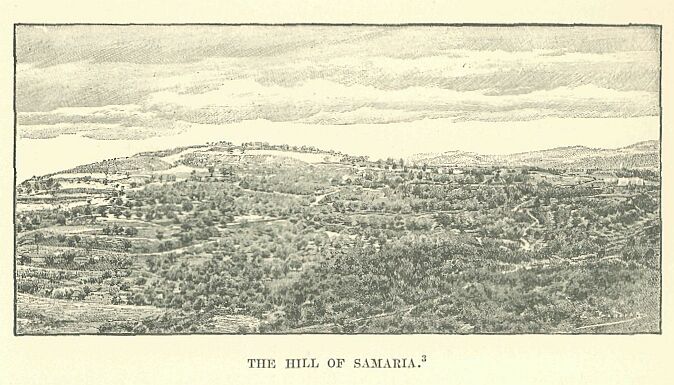
Two dynasties had thus arisen in Israel, and had been swept away by revolutionary outbursts, while at Jerusalem the descendants of David followed one another in unbroken succession. Asa outlived Nadab by eleven years, and we hear nothing of his relations with the neighbouring states during the latter part of his reign. We are merely told that his zeal in the service of the Lord was greater than had been shown by any of his predecessors. He threw down the idols, expelled their priests, and persecuted all those who practised the ancient religions. His grandmother Maacah “had made an abominable image for an asherah;” he cut it down, and burnt it in the valley of the Kedron, and deposed her from the supremacy in the royal household which she had held for three generations. He is, therefore, the first of the kings to receive favourable mention from the orthodox chroniclers of later times, and it is stated that he “did that which was right in the eyes of the Lord, as did David his father.” * Omri proved a warlike monarch, and his reign, though not a long one, was signalised by a decisive crisis in the fortunes of Israel.** The northern tribes had, so far, possessed no settled capital, Shechem, Penuel, and Tirzah having served in turn as residences for the successors of Jeroboam and Baasha. Latterly Tirzah had been accorded a preference over its rivals; but Zimri had burnt the castle there, and the ease with which it had been taken and retaken was not calculated to reassure the head of the new dynasty. Omri turned his attention to a site lying a little to the north-west of Shechem and Mount Ebal, and at that time partly covered by the hamlet of Shomerôn or Shimrôn—our modern Samaria.***
* 1 Kings xv. 11; cf. 2 Ohron. xiv. 2. It is admitted, however, though without any blame being attached to him, that “the high places were not taken away” (1 Kings xv. 14; cf. 2 Chron. xv. 17). ** The Hebrew writer gives the length of his reign as twelve years (1 Kings xvi. 23). Several historians consider this period too brief, and wish to extend it to twenty-four years; I cannot, however, see that there is, so far, any good reason for doubting the approximate accuracy of the Bible figures. *** According to the tradition preserved in 1 Kings xvi. 24, the name of the city comes from Shomer, the man from whom Ahab bought the site.
His choice was a wise and judicious one, as the rapid development of the city soon proved. It lay on the brow of a rounded hill, which rose in the centre of a wide and deep depression, and was connected by a narrow ridge with the surrounding mountains. The valley round it is fertile and well watered, and the mountains are cultivated up to their summits; throughout the whole of Ephraim it would have been difficult to find a site which could compare with it in strength or attractiveness. Omri surrounded his city with substantial ramparts; he built a palace for himself, and a temple in which was enthroned a golden calf similar to those at Dan and Bethel.* A population drawn from other nations besides the Israelites flocked into this well-defended stronghold, and Samaria soon came to be for Israel what Jerusalem already was for Judah, an almost impregnable fortress, in which the sovereign entrenched himself, and round which the nation could rally in times of danger. His contemporaries fully realised the importance of this move on Omri’s part; his name became inseparably connected in their minds with that of Israel. Samaria and the house of Joseph were for them, henceforth, the house of Omri, Bît-Omri, and the name still clung to them long after Omri had died and his family had become extinct.**
* Amos viii. 14, where the sin of Samaria, coupled as it is with the life of the god of Dan and the way of Beersheba, can, as Wellhausen points out, only refer to the image of the calf worshipped at Samaria. ** Shalmaneser II. even goes so far as to describe Jehu, who exterminated the family of Omri, as Jaua ahal Khumri, “Jehu, son of Omri.”
He gained the supremacy over Judah, and forced several of the south-western provinces, which had been in a state of independence since the days of Solomon, to acknowledge his rule; he conquered the country of Medeba, vanquished Kamoshgad, King of Moab, and imposed on him a heavy tribute in sheep and wool.* Against Benhadad in the north-west he was less fortunate. He was forced to surrender to him several of the cities of Gilead—among others Bamoth-gilead, which commanded the fords over the Jabbok and Jordan.**
* Inscription of Meslia, 11. 5-7; cf. 2 Kings iii. 4. ** 1 Kings xx. 34. No names are given in the text, but external evidence proves that they were cities of Persea, and that Ramoth-gilead was one of them.
Drawn by Boudier, from photograph No. 2G of the Palestine Exploration Fund.
He even set apart a special quarter in Samaria for the natives of Damascus, where they could ply their trades and worship their gods without interference. It was a kind of semi-vassalage, from which he was powerless to free himself unaided: he realised this, and looked for help from without; he asked and obtained the hand of Jezebel, daughter of Bthbaal, King of the Sidonians, for Ahab, his heir. Hiram I., the friend of David, had carried the greatness of Tyre to its highest point; after his death, the same spirit of discord which divided the Hebrews made its appearance in Phoenicia. The royal power was not easily maintained over this race of artisans and sailors: Baalbazer, son of Hiram, reigned for six years, and his successor, Abdastart, was killed in a riot after a still briefer enjoyment of power. We know how strong was the influence exercised by foster-mothers in the great families of the Bast; the four sons of Abda-start’s nurse assassinated their foster-brother, and the eldest of them usurped his crown. Supported by the motley crowd of slaves and adventurers which filled the harbours of Phoenicia, they managed to cling to power for twelve years. Their stupid and brutal methods of government produced most disastrous results. A section of the aristocracy emigrated to the colonies across the sea and incited them to rebellion; had this state of things lasted for any time, the Tyrian empire would have been doomed. A revolution led to the removal of the usurper and the restoration of the former dynasty, but did not bring back to the unfortunate city the tranquillity which it sorely needed. The three surviving sons of Baalbezer, Methuastarfc, Astarym, and Phelles followed one another on the throne in rapid succession, the last-named perishing by the hand of his cousin Ethbaal, after a reign of eight months. So far, the Israelites had not attempted to take advantage of these dissensions, but there was always the danger lest one of their kings, less absorbed than his predecessors in the struggle with Judah, might be tempted by the wealth of Phoenicia to lay hands on it. Ethbaal, therefore, eagerly accepted the means of averting this danger by an alliance with the new dynasty offered to him by Omri.*
* 1 Kings xvi. 31, where the historian has Hebraicised the Phonician name Ittobaal into “Ethbaal,” “Baal is with him.” Izebel or Jezebel seems to be an abbreviated form of some name like Baalezbel.
The presence of a Phonician princess at Samaria seems to have had a favourable effect on the city and its inhabitants. The tribes of Northern and Central Palestine had, so far, resisted the march of material civilization which, since the days of Solomon, had carried Judah along with it; they adhered, as a matter of principle, to the rude and simple customs of their ancestors. Jezebel, who from her cradle had been accustomed to all the luxuries and refinements of the Phoenician court, was by no means prepared to dispense with them in her adopted country. By their contact with her, the Israelites—at any rate, the upper and middle classes of them—acquired a certain degree of polish; the royal office assumed a more dignified exterior, and approached more nearly the splendours of the other Syrian monarchies, such as those of Damascus, Hamath, Sidon, Tyre, and even Judah.
Unfortunately, the effect of this material progress was marred by a religious difficulty. Jezebel had been brought up by her father, the high priest of the Sidonian Astarte, as a rigid believer in his faith, and she begged Ahab to permit her to celebrate openly the worship of her national deities. Ere long the Tyrian Baal was installed at Samaria with his asherah, and his votaries had their temples and sacred groves to worship in: their priests and prophets sat at the king’s table. Ahab did not reject the God of his ancestors in order to embrace the religion of his wife—a reproach which was afterwards laid to his door; he remained faithful to Him, and gave the children whom he had by Jezebel names compounded with that of Jahveh, such as Ahaziah, Joram, and Athaliah.*
* 1 Kings xvi. 31-33. Ahaziah and Joram mean respectively “whom Jahveh sustaineth,” and “Jahveh is exalted.” Athaliah may possibly be derived from a Phoenician form, Ailialith or Athlifh, into which the name of Jahveh does not enter.
This was not the first instance of such tolerance in the history of the Israelites: Solomon had granted a similar liberty of conscience to all his foreign wives, and neither Rehoboam nor Abijam had opposed Maacah in her devotion to the Canaanitish idols. But the times were changing, and the altar of Baal could no longer be placed side by side with that of Jahveh without arousing fierce anger and inexorable hatred. Scarce a hundred years had elapsed since the rupture between the tribes, and already one-half of the people were unable to understand how place could be found in the breast of a true Israelite for any other god but Jahveh: Jahveh alone was Lord, for none of the deities worshipped by foreign races under human or animal shapes could compare with Him in might and holiness. From this to the repudiation of all those practices associated with exotic deities, such as the use of idols of wood or metal, the anointing of isolated boulders or circles of rocks, the offering up of prisoners or of the firstborn, was but a step: Asa had already furnished an example of rigid devotion in Judah, and there were many in Israel who shared his views and desired to imitate him. The opposition to what was regarded as apostasy on the part of the king did not come from the official priesthood; the sanctuaries at Dan, at Bethel, at Shiloh, and at Gilgal were prosperous in spite of Jezebel, and this was enough for them. But the influence of the prophets had increased marvellously since the rupture between the kingdoms, and at the very beginning of his reign Ahab was unwise enough to outrage their sense of justice by one of his violent acts: in a transport of rage he had slain a certain Naboth, who had refused to let him have his vineyard in order that he might enlarge the grounds of the palace he was building for himself at Jezreel.* The prophets, as in former times, were divided into schools, the head of each being called its father, the members bearing the title of “the sons of the prophets;” they dwelt in a sort of monastery, each having his own cell, where they ate together, performed their devotional exercises or assembled to listen to the exhortations of their chief prophets:** nor did their sacred office prevent them from marrying.***
* 1 Kings xxi., where the later tradition throws nearly all the blame on Jezebel; whereas in the shorter account, in 2 Kings ix. 25, 26, it is laid entirely on Ahab. ** In 1 Sam. xix. 20, a passage which seems to some to be a later interpolation, mentions a “company of the prophets, prophesying, and Samuel standing as head over them.” Cf. 2 Kings vi. 1-7, where the narrative introduces a congregation of prophets grouped round Elisha. *** 2 Kings iv. 1-7, where an account is given of the miracle worked by Elisha on behalf of “a woman of the wives of the sons of the prophets.”
As a rule, they settled near one of the temples, and lived there on excellent terms with the members of the regular priesthood. Accompanied by musical instruments, they chanted the songs in which the poets of other days extolled the mighty deeds of Jahveh, and obtained from this source the incidents of the semi-religious accounts which they narrated concerning the early history of the people; or, when the spirit moved them, they went about through the land prophesying, either singly, or accompanied by a disciple, or in bands.* The people thronged round them to listen to their hymns or their stories of the heroic age: the great ones of the land, even kings themselves, received visits from them, and endured their reproaches or exhortations with mingled feelings of awe and terror. A few of the prophets took the part of Ahab and Jezebel,** but the majority declared against them, and of these, the most conspicuous, by his forcibleness of speech and action, was Elijah. We do not know of what race or family he came, nor even what he was:*** the incidents of his life which have come down to us seem to be wrapped in a vague legendary grandeur. He appears before Ahab, and tells him that for years to come no rain or dew shall fall on the earth save by his command, and then takes flight into the desert in order to escape the king’s anger.
* 1 Sam. x. 5, where a band of prophets is mentioned “coming down from the high place with a psaltery, and a timbrel, and a pipe, and a harp, before them, prophesying;” cf. ver. 10. In 2 Kings ii. 3-5, bands of the “children of the prophets” come out from Bethel and Jericho to ask Elisha if he knows the fate which awaits Elijah on that very day. ** Cf. the anonymous prophet who encourages Ahab, in the name of Jahveh, to surprise the camp of Benhadad before Samaria (1 Kings xx. 13-15, 22-25, 28); and the prophet Zedekiah, who gives advice contrary to that of his fellow- prophet Micaiah in the council of war held by Ahab with Jehoshaphat, King of Judah, before the attack on Ramobh- gilead (1 Kings xxii. 11, 12, 24). *** The ethnical inscription, “Tishbite,” which we find after his name (1 Kings xvii. 1, xxi. 17), is due to an error on the part of the copyist.
He is there ministered unto by ravens, which bring him bread and meat every night and morning. When the spring from which he drinks dries up, he goes to the house of a widow at Zarephath in the country of Sidon, and there he lives with his hostess for twelve months on a barrel of meal and a cruse of oil which never fail. The widow’s son dies suddenly: he prays to Jahveh and restores him to life; then, still guided by an inspiration from above, he again presents himself before the king. Ahab receives him without resentment, assembles the prophets of Baal, brings them face to face with Elijah on the top of Mount Carmel, and orders them to put an end to the drought by which his kingdom is wasted. The Phoenicians erect an altar and call upon their Baâlîm with loud cries, and gash their arms and bodies with knives, yet cannot bring about the miracle expected of them. Elijah, after mocking at their cries and contortions, at last addresses a prayer to Jahveh, and fire comes down from heaven and consumes the sacrifice in a moment; the people, convinced by the miracle, fall upon the idolaters and massacre them, and the rain shortly afterwards falls in torrents. After this triumph he is said to have fled once more for safety to the desert, and there on Horeb to have had a divine vision. “And, behold, the Lord passed by, and a great and strong wind rent the mountains, and brake in pieces the rocks before the Lord; but the Lord was not in the wind: and after the wind an earthquake; but the Lord was not in the earthquake: and after the earthquake a fire; but the Lord was not in the fire: and after the fire a still small voice. And it was so, when Elijah heard it, that He wrapped his face in his mantle, and went out, and stood in the entering in of the cave. And, behold, there came a voice unto him, and said, ‘What doest thou here, Elijah?’” God then commanded him to anoint Hazael as King of Syria, and Jehu, son of Nimshi, as King over Israel, and Elisha, son of Shaphat, as prophet in his stead, “and him that escapeth from the sword of Hazael shall Jehu slay: and him that escapeth from the sword of Jehu shall Elisha slay.” The sacred writings go on to tell us that the prophet who had held such close converse with the Deity was exempt from the ordinary laws of humanity, and was carried to heaven in a chariot of fire. The account that has come down to us shows the impression of awe left by Elijah on the spirit of his age.*
Ahab was one of the most warlike among the warrior-kings of Israel. He ruled Moab with a strong hand,** kept Judah in subjection,*** and in his conflict with Damascus experienced alternately victory and honourable defeat. Hadadidri [Hadadezer], of whom the Hebrew historians make a second Benhadad,**** had succeeded the conqueror of Baasha.^
* The story of Elijah is found in 1 Kings xvii.-xix., xxi. 17-29, and 2 Kings i., ii. 1-14. ** Inscription of Mesha, 11. 7, 8. *** The subordination of Judah is nowhere explicitly mentioned: it is inferred from the attitude adopted by Jehoshaphat in presence of Ahab (1 Kings xxii. 1, et seq.). **** The Assyrian texts call this Dadidri, Adadidri, which exactly corresponds to the Plebrew form Hadadezer. ^ The information in the Booh of Kings does not tell us at what time during the reign of Ahab his first wars with Hadadezer (Benhadad II.) and the siege of Samaria occurred. The rapid success of Shalmaneser’s campaigns against Damascus, between 854 and 839 B.C., does not allow us to place these events after the invasion of Assyria. Ahab appears, in 854, at the battle of Karkar, as the ally of Benhadad, as I shall show later.
The account of his campaigns in the Hebrew records has only reached us in a seemingly condensed and distorted condition. Israel, strengthened by the exploits of Omri, must have offered him a strenuous resistance, but we know nothing of the causes, nor of the opening scenes of the drama. When the curtain is lifted, the preliminary conflict is over, and the Israelites, closely besieged in Samaria, have no alternative before them but unconditional surrender. This was the first serious attack the city had sustained, and its resistance spoke well for the military foresight of its founder. In Benhadad’s train were thirty-two kings, and horses and chariots innumerable, while his adversary could only oppose to them seven thousand men. Ahab was willing to treat, but the conditions proposed were so outrageous that he broke off the negotiations. We do not know how long the blockade had lasted, when one day the garrison made a sortie in full daylight, and fell upon the Syrian camp; the enemy were panic-stricken, and Benhadad with difficulty escaped on horseback with a handful of men. He resumed hostilities in the following year, but instead of engaging the enemy in the hill-country of Ephraim, where his superior numbers brought him no advantage, he deployed his lines on the plain of Jezreel, near the town of Aphek. His servants had counselled him to change his tactics: “The God of the Hebrews is a God of the hills, therefore they were stronger than we; but let us fight against them in the plain, and surely we shall be stronger than they.” The advice, however, proved futile, for he sustained on the open plain a still more severe defeat than he had met with in the mountains, and the Hebrew historians affirm that he was taken prisoner during the pursuit. The power of Damascus was still formidable, and the captivity of its king had done little to bring the war to an end; Ahab, therefore, did not press his advantage, but received the Syrian monarch “as a brother,” and set him at liberty after concluding with him an offensive and defensive alliance. Israel at this time recovered possession of some of the cities which had been lost under Baasha and Omri, and the Israelites once more enjoyed the right to occupy a particular quarter of Damascus. According to the Hebrew account, this was the retaliation they took for their previous humiliations. It is further stated, in relation to this event, that a certain man of the sons of the prophets, speaking by the word of the Lord, bade one of his companions smite him. Having received a wound, he disguised himself with a bandage over his eyes, and placed himself in the king’s path, “and as the king passed by, he cried unto the king: and he said, Thy servant went out into the midst of the battle; and, behold, a man turned aside, and brought a man unto me, and said, Keep this man: if by any means he be missing, then shall thy life be for his life, or else thou shalt pay a talent of silver. And as thy servant was busy here and there, he was gone. And the King of Israel said unto him, So shall thy judgment be; thyself has decided it. Then he hasted, and took the headband away from his eyes, and the King of Israel discerned him that he was one of the prophets. And he said unto him, Thus saith the Lord, Because thou hast let go out of thy hand the man whom I had devoted to destruction, therefore thy life shall go for his life, and thy people for his people. And the King of Israel went to his house heavy and displeased, and came to Samaria.” This story was in accordance with the popular feeling, and Ahab certainly ought not to have paused till he had exterminated his enemy, could he have done so; but was this actually in his power?
We have no reason to contest the leading facts in this account, or to doubt that Benhadad suffered some reverses before Samaria; but we may perhaps ask whether the check was as serious as we are led to believe, and whether imagination and national vanity did not exaggerate its extent and results. The fortresses of Persea which, according to the treaty, ought to have been restored to Israel, remained in the hands of the people of Damascus, and the loss of Ramoth-gilead continued to be a source of vexation to such of the tribes of Gad and Reuben as followed the fortunes of the house of Omri:* yet these places formed the most important part of Benhadad’s ransom.
* “And the King of Israel said unto his servants, Know ye that Ramoth-gilead is ours, and we be still, and take it not out of the hand of the King of Syria?”
The sole effect of Ahab’s success was to procure for him more lenient treatment; he lost no territory, and perhaps gained a few towns, but he had to sign conditions of peace which made him an acknowledged vassal to the King of Syria.*
* No document as yet proves directly that Ahab was vassal to Benhadad II. The fact seems to follow clearly enough from the account of the battle of Karkar against Shalmaneser II., where the contingent of Ahab of Israel figures among those of the kings who fought for Benhadad II. against the Assyrians.
Damascus still remained the foremost state of Syria, and, if we rightly interpret the scanty information we possess, seemed in a fair way to bring about that unification of the country which neither Hittites, Philistines, nor Hebrews had been able to effect. Situated nearly equidistant from Raphia and Carchemish, on the outskirts of the cultivated region, the city was protected in the rear by the desert, which secured it from invasion on the east and north-east; the dusty plains of the Haurân protected it on the south, and the wooded cliffs of Anti-Lebanon on the west and north-west. It was entrenched within these natural barriers as in a fortress, whence the garrison was able to sally forth at will to attack in force one or other of the surrounding nations: if the city were victorious, its central position made it easy for its rulers to keep watch over and preserve what they had won; if it suffered defeat, the surrounding mountains and deserts formed natural lines of fortification easy to defend against the pursuing foe, but very difficult for the latter to force, and the delay presented by this obstacle gave the inhabitants time to organise their reserves and bring fresh troops into the field. The kings of Damascus at the outset brought under their suzerainty the Aramaean principalities—Argob, Maacah, and Geshur, by which they controlled the Haurân, and Zobah, which secured to them Coele-Syria from Lake Huleh to the Bahr el-Kades. They had taken Upper Galilee from the Hebrews, and subsequently Perasa, as far as the Jabbok, and held in check Israel and the smaller states, Amnion and Moab, which followed in its wake. They exacted tribute from Hamath, the Phoenician Arvad, the lower valley of the Orontes, and from a portion of the Hittites, and demanded contingents from their princes in time of war. Their power was still in its infancy, and its elements were not firmly welded together, but the surrounding peoples were in such a state of weakness and disunion that they might be left out of account as formidable enemies. The only danger that menaced the rising kingdom was the possibility that the two ancient warlike nations, Egypt and Assyria, might shake off their torpor, and reappearing on the scene of their former prowess might attack her before she had consolidated her power by the annexation of Naharaim.
END OF VOL. VI.