Volume 2 / Part 3 — CHAPTER XV SUBJECTS FROM ORDINARY LIFE
Reading edition
Religious subjects—Sacrifices—Funeral scenes—The Drama and burlesques—Athletics—Sport and games—Musical scenes—Trades and occupations—Daily life of women—Wedding scenes—Military and naval subjects—Orientals and Barbarians—Banquets and revels—Miscellaneous subjects—Animals.
It is hardly possible to give within brief limits all the illustrations that the vases afford, either directly or indirectly, of the religious and secular life of the Greeks. It is, however, feasible to classify these subjects under several headings, and to give a list of the most typical and popular in each case. Thus we have:
1. Religious ceremonies and sacrifices.
2. Funeral scenes and offerings at tombs.
3. Subjects connected with the drama.
4. Athletic contests, games and sport, and musical scenes.
5. Trades and occupations.
6. Scenes from daily life of women and children.
7. Military and naval subjects.
8. Oriental and barbarian figures.
9. Miscellaneous subjects and compositions of no particular import.
10. Animals (mostly only decorative).
1. Religious Subjects
These mostly appear in the form of sacrifices, either before a simple altar, or before the statue of some deity, a cult-image, or terminal figure. Thus we have representations of the offering of a bull to Athena,[1534] sacrifices to a primitive image of Dionysos[1535] or to a terminal figure of Hermes,[1536] or a sacrifice or libation to Persephone, Apollo, or other deities.[1537] A procession of six maidens carrying chairs and a boy with game is probably in honour of Artemis[1538]; and in another scene we have the Dioskuri coming to the Theoxenia or feast prepared in their honour.[1539] Many other examples may be found under the heading of the various Olympian deities. In other instances we see the preparations for a sacrifice,[1540] or a procession of figures with victims and sacrificial implements[1541]; the victims are either rams,[1542] bulls,[1543] goats,[1544] or pigs.[1545] Other scenes of sacrifice represent the roasting of a piece of meat held on a spit over a blazing altar[1546]; or two men stand over a large krater on a stand, accompanied by a flute-player.[1547] In many cases the sacrifice is doubtless intended to celebrate a dramatic, agonistic, or other victory.[1548]
Among other religious scenes we have the dedication of a tripod,[1549] religious festival dances,[1550] praying figures,[1551] men or women burning incense over an altar or incense-burner[1552]; or scenes of libation,[1553] a Metragyrtes or mendicant priest praying before devotees,[1554] and a priest examining the entrails of a ram.[1555] An ephebos is initiated and purified by the Διὸς κῴδιον[1556]; oaths are taken over a tomb,[1557] or omens from birds on a tumulus[1558]; and here perhaps may be mentioned a man making a gesture against the evil eye.[1559] There is also a scene illustrative of the Πιθοίγια, an Athenian feast[1560]; and a possible representation of the feast of Adonis, and the “gardens” or pots of flowers exhibited on that occasion.[1561] Lastly, there are scenes relating to votive offerings, such as a figure of a child on a column offered to Athena,[1562] a youth carrying a votive tablet,[1563] and others in which similar votive tablets occur.[1564] The number of scenes which can be shown to relate to Athenian festivals, or bear on Greek religious belief and ritual, might be greatly expanded and multiplied, but at present little has been done in this direction.[1565]
2. Funeral Scenes
Closely connected with these religious subjects are those which played so large a part in the life of the Greeks, and found such a strong reflection in their decorative art—namely, those which relate to the burial and cult of the dead. The relation of Greek vases to the tomb has been discussed elsewhere (Vol. I. p. 141 ff.), and it is sufficient here to repeat that there are only three or four classes of vases which yield undoubted evidence that they were expressly made for funeral purposes, each belonging to a different period of the art.
In the earliest period we have the great Dipylon vases (Vol. I. p. 285), many of which represent funeral processions and rows of mourning women[1566]; these were made for standing outside the tomb. In the B.F. period there are the prothesis-amphorae, made likewise for placing first round the bier and then on the tomb, as plainly shown in one instance[1567]; and in the R.F. period the Athenian white lekythi are decorated almost exclusively with sepulchral scenes. Among the vases of the decadence a whole series of Lucanian and Campanian hydriae and Apulian kraters and amphorae, as well as some late Athenian vases, the Apulian examples being usually of enormous size, equally betray the special purpose for which they were made.
On the B.F. vases the commonest subject is the prothesis or conclamatio, where the body is exposed on the bier and the mourners stand round in attitudes of grief,[1568] a subject also occasionally found on the lekythi.[1569] Elsewhere we have the carrying of the bier to the tomb,[1570] accompanied by warriors, and the depositio or placing of the body therein.[1571] On the vases of this period the tomb invariably assumes the form of a mound (χῶμα or tumulus),[1572] as it appears in some mythical scenes already described.[1573] On the lekythi, on the other hand, the tomb is in the form of a tall plain stele, on a stepped base, crowned with an ornament of acanthus-leaves or a palmette, and wreathed with coloured sashes, while vases and baskets of flowers are sometimes placed on the steps.[1574] On the vases of Southern Italy it is developed either into a tall column with altar-like base,[1575] or into a large shrine or heroön, with columns in front and gabled roof, within which stands the figure of the deceased,[1576] or sometimes an acanthus-plant[1577] or several vases.[1578]
The subjects on the white lekythi and later vases almost invariably take the form of mourners,[1579] or men and women making offerings to the dead, or placing sashes, wreaths, and vases on the tomb.[1580] Or, again, we may note interesting parallels with the Athenian sepulchral reliefs of the fourth century, which are mostly contemporaneous with the vases.[1581] Thus we have “farewell scenes” between a man and woman,[1582] or between two women[1583]; or the equestrian figure of a warrior, as on the famous stele of Dexileos,[1584] or a warrior charging with his spear[1585]; or, again, a hare-hunt at a tomb, perhaps with reference to the occupations of the deceased.[1586] Sometimes the tomb of a warrior is indicated by his armour.[1587] The interior of a tomb is occasionally shown, with a dead boy in it,[1588] or a series of vases,[1589] or as in the story of Polyeidos.[1590] In one instance a group of figures is placed on the top of the tomb.[1591] Mythological figures are sometimes introduced, as Charon ferrying the dead in his bark,[1592] or Hermes Psychopompos[1593]; or the type of Thanatos and Hypnos (or that of Boreas and Zephyros) with Memnon is borrowed for that of a warrior, a youth, or a woman whom they place in the tomb.[1594] Occasionally we see the soul of the deceased as a small flitting winged figure.[1595] On the Italian vases the figure of the deceased usually appears inside the heroön, painted white, as if to indicate a sculptured marble figure: a warrior with armour,[1596] or a youth with his horse or dog,[1597] or pouring a libation from a kantharos.[1598] These heroa are always surrounded by figures of women bearing baskets of offerings, unguent-vases, and wreaths, and by youths as mourners.[1599]
PLATE LV
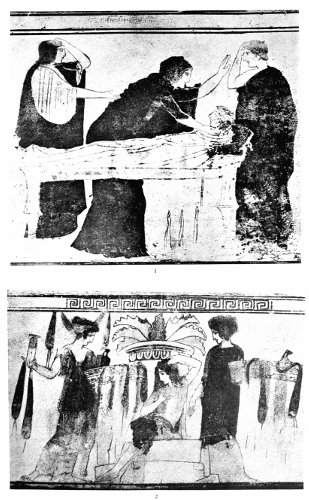
Scenes from Funeral Lekythi (British Museum). 1, Prothesis; 2, Cult of Tomb.
Apart from the under-world scenes already described,[1600] the future life is not illustrated by the vases, except in a curious scene on a B.F. Cyrenaic cup, representing a banquet of the blessed, attended by Sirens.[1601] There is also one single representation of the subject so common on later Greek reliefs—the sepulchral banquet.[1602]
3. The Drama
The relation of vase-paintings to the drama has already been discussed in Chapter XI., in which it has been shown how the tragedies of Euripides and the farces of Rhinthon influenced the artists of Southern Italy. It may, however, be worth while to recapitulate here the actual representations of actors or of scenes taking place on a stage, together with some account of the numerous burlesques of mythical subjects.
On one curious B.F. vase (probably late and imitative) we see a rude representation of a tragic and a comic chorus,[1603] and occasionally on vases of this period we find figures of actors dressed up as birds, or otherwise in comic fashion.[1604] More important in this connection are the fifth-century vases found on the site of the Cabeiric temple at Thebes, several of which have parodies of well-known subjects, such as Odysseus and Kirke, or Peleus bringing the young Achilles to Cheiron.[1605] It seems probable that these scenes are actual reproductions of burlesque performances connected with the worship of the Kabeiri.
We look in vain for representations of scenes from Aristophanes and the Old Comedy, though there are one or two vases which recall (if nothing more) episodes in the Acharnians[1606] and Frogs.[1607] But for the rest, these comic scenes are almost confined to the vases of Southern Italy, especially those made at Paestum, with their presentations of the φλύακες or fourth-century farces. A fairly exhaustive list of these was made some years ago by Heydemann,[1608] and probably requires little emendation as yet; we repeat below a number of the more interesting subjects, and others may be collected from the foregoing pages in which myths are burlesqued (the Judgment of Paris, the apotheosis of Herakles, Oedipus and the Sphinx, etc.).[1609]
(1) Zeus visiting Alkmena: Schreiber-Anderson, 5, 8 = Heydemann, loc. cit. p. 276: cf. B.M. F 150.
(2) Apollo healing the Centaur Cheiron: B.M. F 151.
(3) Herakles at Delphi; Apollo takes refuge on the roof of the temple: Reinach, i. 153, 2 = Rayet and Collignon, p. 318.
(4) Combat of Hephaistos (Daidalos) and Ares (Enyalios): B.M. F 269.
(5) Herakles with the Kerkopes: Schreiber-Anderson, 5, 2 = Heydemann p. 281.
(6) Herakles seizing Auge: Fig. 105, Vol. I. p. 474 = Reinach, i. 123 = Heydemann, p. 279.
(7) Burlesque of the story of Antigone: Reinach, i. 273.
(8) Rape of the Palladion: B.M. F 366.
(9) Death of Priam: Berlin 3045 = Reinach, i. 370, 8.
(10) Odysseus and Kirke: Jatta 901 = Heydemann, p. 271.
(11) Odysseus in Phaeacia: Reinach, i. 153, 1.
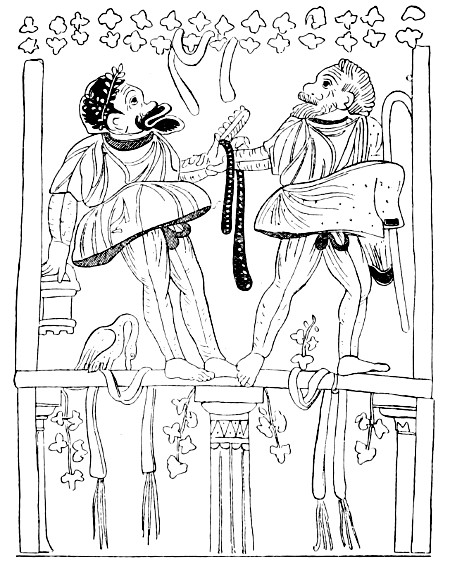
FIG. 134. SCENE FROM A FARCE (BRITISH MUSEUM, F 189).
Other scenes represent single figures, such as Herakles,[1610] or Taras on the dolphin[1611]; or subjects from farces of daily life, such as an actor with a table of cakes[1612] or the drunken return from a revel.[1613] Many scenes, again, have some reference to the Satyric drama, as on the fine vase in Naples, where Dionysos and other figures attend the preparations for a performance of that kind[1614]; or such scenes as that of Hera and Iris attacked by Seileni,[1615] or those relating to adventures of Herakles and Perseus with Satyrs.[1616] Other subjects have no particular significance, such as an actor attired as a Seilenos playing on the flute, or dancing, or with a Sphinx,[1617] groups of actors[1618] (in one case dressing[1619]), a comic actor among Satyrs and Maenads,[1620] and single figures.[1621] Some, which are apparently mythological, defy explanation.[1622]
The influence of Tragedy on vase-paintings is an indirect one, and entirely confined to the vases of Southern Italy on the one hand, and to the plays of Euripides on the other. The subject has been discussed at length elsewhere in this work,[1623] and it is unnecessary here to give a list of the subjects on South Italian vases which can be traced to the influence of Euripides. It has also been pointed out that this influence made itself felt, not only in the actual choice of subjects, but generally in their treatment and arrangement, in the quasi-architectural setting of many scenes, and in the elaborate costumes of the figures.
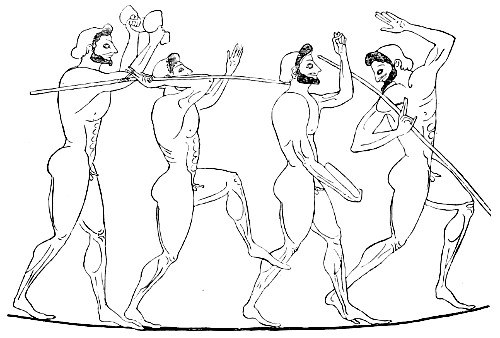
FIG. 135. ATHLETES ENGAGED IN THE PENTATHLON (BRITISH MUSEUM, B 134).
4. Athletics and Sport
From the theatre we naturally turn to the palaestra and gymnasium, which played so important a part in the public and private life of the Greeks, and, like the former, may be said to be vested with a religious significance, as exemplified in the Olympic and other great games. Hardly any class of subject is found so frequently and consistently on the vases. The series of Panathenaic amphorae alone supply instances of every form of athletic exercise in which the Greeks indulged.[1624] Many vases, especially the R.F. kylikes, represent groups of athletes in the palaestra engaged in various exercises, such as boxing, wrestling, running, and leaping[1625]; in other cases we have single groups of boxers[1626] or wrestlers,[1627] or of the παγκράτιον, a somewhat brutal combination of the two.[1628] A boxer is sometimes seen putting on his caestus.[1629] The πένταθλον, which played so important a part in the national games, is not infrequently found, though often only three or four out of the five contests appear.[1630] Here, again, we also find single figures of diskos-throwers[1631] or javelin-throwers,[1632] representations of the long-jump,[1633] and men marking the ground with a pick-axe or poles.[1634] An athlete is seen binding round his javelin the cord or ἀγκύλη by which it was thrown,[1635] and the pick-axe afore-mentioned also appears in such a way as to indicate its general use by athletes—viz. for digging up the ground over which jumps were made, by way of exercising the limbs.[1636] A variation of the javelin contest was one in which the competitors were mounted, and aimed at a shield set up as a target as they rode past.[1637] Other important contests are the foot-race[1638]; the horse-race, generally taken part in by boys (κέλητες)[1639]; the chariot-race[1640]; the torch-race (λαμπαδηδρομία)[1641]; and the race of armed warriors (ὁπλιτοδρομία).[1642] In the latter contest various types may be distinguished: the arming for the race[1643]; the start[1644]; the race itself, with runners turning at the end of the stadion[1645]; the finish[1646]; and a variation in which the runner carried his armour.[1647] On the earlier vases this race is run in full armour; on the later, only with helmets and shields. Frequently the victorious athlete, horseman, or hoplite is seen proclaimed as winner,[1648] and receiving his prize[1649]; also receiving a crown from Nike.[1650]
Among more miscellaneous scenes may be mentioned athletes anointing themselves[1651] and using the strigil[1652]; the κωρυκομαχία or quintain[1653]; an athlete expiring[1654]; a girl-runner wounded in the foot[1655]; men rolling discs[1656]; acrobats[1657] and female tumblers performing contortions over swords, or lifting objects with their feet.[1658] To the list of palaestra scenes may be added those where Nike or another deity appears as patron of the palaestra watching the athletes,[1659] and scenes of ephebi washing or bathing in preparation for or after their contests.[1660] The athletes are often accompanied by trainers, who use a forked stick to direct their movements.[1661] On the later R.F. and the Italian vases it is a regular thing to find on the reverse a roughly painted group of two or three athletes or ephebi, usually wrapped in himatia and conversing together[1662]; in such cases the palaestra is indicated by a pair of jumping-weights or a ball suspended.
Subjects coming under the heading of what we call Sport are not so common, and are practically limited to hunting scenes. They include hare-hunts,[1663] stag-hunts,[1664] wolf-hunts and fox-hunts,[1665] lion-hunts,[1666] and boar-hunts[1667]; in the latter on early B.F. vases the figures often have fancy names, with a reference in some cases to the hunt of the Calydonian boar, which created the type. Some, especially B.F. vases, depict the departure of a hunter for the chase,[1668] or his return loaded with game[1669]; or we see a party of hunters resting (all with fancy names).[1670] A group of youths capturing and taming a bull may also be mentioned here,[1671] and horse-taming is similarly depicted.[1672] We see horses being unharnessed, groomed, and watered,[1673] or exercised,[1674] and a man with a backing horse[1675]; and we may also perhaps include among these subjects scenes representing riding-lessons, a school for ephebi,[1676] or a boy learning to mount a horse.[1677] A favourite subject for the interiors of R.F. cups is that of a young Athenian on horseback,[1678] often in Oriental or Thracian costume (see p. 179).[1679] On the B.F. vases a horseman or a chariot is sometimes depicted in front view, a notable exception to the preference of the time,[1680] and sometimes a three-horse chariot takes the place of the quadriga.[1681] Among miscellaneous chariot-scenes may be mentioned a goddess (?) and a hero mounting chariots,[1682] a girl in a chariot drawn by hinds[1683]; and people travelling in a country cart.[1684]
Among the various Games popular with Greek youths the favourite is, perhaps, that of ball, which was often played by men mounted on each other’s shoulders in two parties, this being known as ἐφεδρισμός[1685]; a rougher variant, in which the ball was omitted and victory was probably gained by overthrowing the opponent pair, was known as ἐγκοτύλη.[1686] Women and children also play at ball, as does Eros.[1687] Equally popular was cock-fighting[1688]; and we also see a group of boys shooting with bow and arrows at a popinjay or figure of a bird.[1689] Of indoor amusements the favourite is the κότταβος, a popular relaxation after a banquet, often seen on kylikes and other R.F. vases.[1690] Other games, more suitable to younger boys, are top-spinning[1691] and bowling a hoop[1692]; others, again, in which boys and girls join, or even occasionally Eros and Satyrs, are the games of morra (micare digitis, or “How many fingers do I hold up?”),[1693] and its variant, the ὤμιλλα, played with knucklebones[1694]; swinging[1695] and see-sawing[1696]; and flying a kite.[1697] A game of similar character to the morra is played by a winged girl, who places her hands over the eyes of a boy in a chair.[1698] The so-called magic wheel, which was twirled on a string, is almost exclusively used by Eros on the vases of Southern Italy.[1699] Children with their toys, such as go-carts, vases of various shapes, etc., are often depicted on the smaller R.F. vases of the fine style, some of which were perhaps actually made for playthings[1700]; and we often see them accompanied by pet dogs, tortoises, and other animals.[1701] Similarly there are representations of birds and beasts kept in cages,[1702] and of grown-up people playing with pets: a youth and girl with a mouse or jerboa,[1703] or a man with a Maltese dog.[1704]
Equal in importance in the eyes of the Greeks was the other great division of their education, μουσική; the wider sense in which they used the word, the culture of the mind as opposed to that of the body (γυμναστικη), admits of including under this heading school scenes as well as musical performances. Among the former is the well-known kylix of Duris in Berlin (Plate XXXIX.),[1705] where a teacher is seen unrolling a manuscript on which appears an epic hexameter (see Chapter XVII.); a pupil is about to write on tablets; and others undergo instruction on the flute and lyre. Elsewhere we see a youth writing on a tablet,[1706] or on his way to school[1707]; a man reading from a roll[1708]; and a vivid representation of a schoolmaster giving a writing lesson.[1709]
Lessons in music,[1710] singing,[1711] and dancing[1712] are by no means infrequently represented, especially on R.F. vases; we have already seen the young Herakles and Iphikles receiving instruction of this kind,[1713] and on the vases both boys and girls take part in the lessons. Dancing scenes include dances of maidens (very common on early B.F. vases), or single figures of dancers[1714]; a girl dancing to the flute or with castanets,[1715] or a youth to the music of a girl[1716]; a woman dancing the Pyrrhic dance in the attire of a warrior,[1717] and a sacred Lydian dancer with her wicker head-dress.[1718] The grotesque dancers on some early B.F. vases appear to be performing the kordax.[1719]
Groups of musicians with no particular signification are often found, generally playing the lyre and flute,[1720] or single figures, such as a lyre-player in female costume,[1721] or in the distinctive ὀρθοστάδιον of the musician.[1722] Other scenes relate to agonistic and musical competitions, which often formed part of the great games; thus we have on some Panathenaic vases and elsewhere contests for victory with the lyre[1723] or flute.[1724] Sometimes the victorious musician appears receiving the prize[1725] or a crown from Nike[1726]; he usually stands on a bema or raised platform. On one vase a poet recites an epic to the sound of the flute; the opening words appear proceeding from his mouth.[1727] On another a man is seen tuning his lyre.[1728] Singing was a common recreation of banqueters or revellers, especially as seen on R.F. vases.[1729]
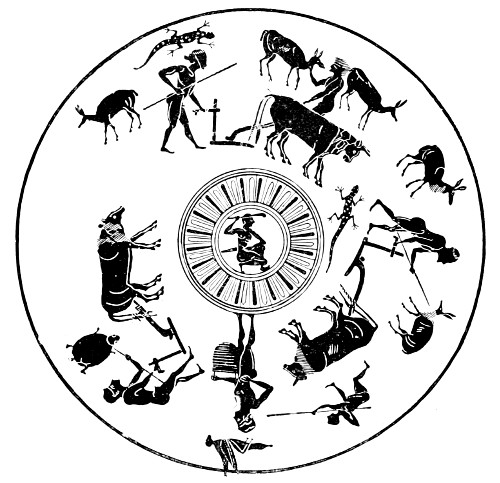
From Baumeister. FIG. 136. AGRICULTURAL SCENES (CUP BY NIKOSTHENES IN BERLIN).
5. Trades and Occupations
The trades and occupations represented on vases are very varied, ranging from mining to shoemaking. The representations of miners in caves which appear on some of the early Corinthian pinakes[1730] most probably refer to the digging out of the clay for the potteries rather than to mining for metals. This seems the more probable when it is taken into consideration that potters’ workshops and furnaces are so frequently depicted in the same series.[1731] Besides these we find later instances of potters turning vases on the wheel,[1732] painting them, or finishing them off,[1733] as already described in a previous chapter: one vase represents the interior of a potter’s workshop with vases in various stages[1734]; another, a man painting the design with a sort of quill.[1735] Young men and girls are depicted negotiating the purchase of completed vases in the shop.[1736] Another of the Corinthian pinakes[1737] represents the exportation of vases in a ship. Metal-work is represented by a well-known R.F. kylix in Berlin,[1738] showing a bronze foundry, with statues in various stages of completion; there are also representations of a smithy,[1739] in some of which writers have seen an allusion to Hephaistos and the Kyklopes (see p. 37). A man is depicted finishing off a bronze helmet,[1740] or carrying a completed terminal figure[1741]; and of similar import is the subject of Athena modelling a horse.[1742]
Agriculture is represented by vases in Berlin and the Louvre with scenes of men ploughing with oxen (Fig. 136) or hoeing, sowers, and mules carrying sacks of grain[1743]; and certain vase-paintings have been interpreted as referring to the digging of a well.[1744] A man is seen cutting down a tree,[1745] and another birds’-nesting.[1746] Shepherds with flocks of sheep and goats are seen on two early Boeotian vases,[1747] and also fishermen,[1748] and men crushing grapes in a wine-press.[1749] The various stages of oil-making include the gathering of the olives from a tree,[1750] the pressing in an oil-press,[1751] and lastly the merchant measuring out and selling his oil.[1752] A butcher is represented cutting up meat,[1753] and also the preparing and cutting up of a tunny-fish,[1754] and the baking of bread[1755]; on a B.F. vase two men weigh goods in a balance[1756]; and the export of the silphium (?) on the Arkesilas vase may also be mentioned here.[1757] Lastly, we have a shoemaker in his shop,[1758] a carpenter working with an adze,[1759] and a boy going to market with two baskets carried on a pole.[1760]
6. Daily Life of Women
Scenes from the daily life of women form our next heading, and we include therewith those relating to marriage or preparations for nuptials, which play so important a part in woman’s life. The “type” of a marriage procession on B.F. vases is, as we have seen (p. 16, and Vol. I. p. 378), liable to be confused with the subject of the marriage of Zeus and Hera; the bride and bridegroom appear in a four-horse chariot, accompanied by persons who, if not deities, at any rate bear similar attributes, such as the caduceus of Hermes or the torches of Artemis (as pronuba).[1761] In scenes of simpler character the wedding party walk in procession or drive in a cart.[1762] On later vases the bride is generally led by the hand by her husband, accompanied as before in appropriate fashion.[1763] We also find scenes representing the bridal pair on their marital couch (lectus genialis),[1764] and the return of the bride after the ceremonies.[1765] Other scenes may possibly represent a betrothal,[1766] a bridal toilet,[1767] or a nuptial sacrifice,[1768] and, finally, the arrival of the bridal pair at their house, with a servant preparing the marriage-bed.[1769]
More common, especially on R.F. vases of the fine style, are scenes taken from the life of the women’s apartments (γυναικωνῖτις),[1770] such as women at their toilet,[1771] spinning wool,[1772] or bleaching linen,[1773] or embroidering.[1774] Under the heading of toilet scenes are included single figures of women arranging their hair,[1775] painting their faces,[1776] fastening on their girdles[1777] or shoes,[1778] or putting clothes in a wardrobe.[1779] They also play with cats or dogs[1780] or pet birds,[1781] and there is a subject identified as a “consolation” scene.[1782] Again, we see women bathing both in private and public baths,[1783] or even swimming[1784]; but in some of these scenes the bath merely forms part of the toilet. Many of these toilet scenes may perhaps be idealised and regarded as groups of Aphrodite, the Graces, etc.[1785]
A favourite subject, but almost confined to the B.F. hydriae, is that of maidens with pitchers on their heads fetching water from a fountain, which is usually in the form of a building with columns and lion’s-head spouts of water; the maidens, five or six in number, carry the empty hydriae flat on their heads, the full ones upright.[1786] Women are sometimes seen in gardens or orchards, gathering fruit[1787] or (on late R.F. vases) frankincense.[1788] Other miscellaneous scenes which cannot be classified are: a woman in bed,[1789] woman with foot-pan,[1790] at a meal,[1791] reading from a scroll,[1792] burning incense,[1793] spinning a top,[1794] balancing a stick,[1795] riding in a mule-car[1796]; two or more women wrapped in one large cloak[1797]; and an accouchement scene.[1798] Those in which children appear include a nurse and child[1799]; a child learning to walk[1800]; a mother, and a child in a high chair[1801]; and a woman beating a child with a slipper[1802]; subjects of children playing with toys, etc., have already been discussed (p. 167). Finally, there are the scenes in which women appear as jugglers[1803] or performing dances in armour,[1804] of which mention has been made; these were probably amusements associated with banquets (see p. 182; also ibid. for banquets in which women, i.e. courtesans, take part).
A very common decoration of vases, especially the inferior ones of Apulia, is that of a woman’s head, either as the main subject or in some subsidiary part of the decoration; these, however, are so common that they hardly call for detailed description.[1805]
7. Military and Naval Subjects
Subjects of a military character on vases are chiefly confined to three—the arming of warriors,[1806] their setting out in chariots, on horseback, or on foot,[1807] and combats of two or more figures.[1808] In all these cases we are confronted with the often-recurring difficulty as to when such subjects have a mythological significance. Especially on B.F. vases, familiar types—such as the departure of Hector or the combat of Achilles and Memnon, to be identified in other cases by inscriptions—occur again and again in the same form, only diversified by the varying number of bystanders, which is generally regulated by the space at the painter’s disposal. Even when names are added they are often of a fanciful kind; and thus, for instance, we find combats between Homeric heroes which have no counterpart in literary record.[1809]
In the scenes of warriors arming we may note certain motives as recurring with more or less frequency—such as that of a warrior putting on his greaves,[1810] helmet,[1811] or cuirass (Fig. 137),[1812] or lacing up his helmet.[1813] Kindred subjects are that of a warrior taking his shield out of his case,[1814] or an archer drawing an arrow from his quiver,[1815] testing an arrow,[1816] or stringing his bow.[1817] We may also note the rarer occurrence of such scenes as the harnessing of a chariot (Frontispiece)[1818] or the equipping of a war-horse.[1819] In the departure scenes the usual type on B.F. vases is that of a four-horse chariot to the right, which the warrior is mounting or has mounted; a woman sometimes give him drink, and an old man stands at the horses’ heads. This “type” is used for the departure of Amphiaraos (cf. Berlin 1655), Hector, or other heroes.[1820] It is sometimes varied by placing the quadriga to the front.[1821] Or, again, the warrior is seen on horseback, accompanied by his groom,[1822] or a company on foot set out in marching array.[1823] On later vases the more usual version is that of a warrior receiving a libation or “stirrup-cup” from a woman before his departure, but the same scenes might be interpreted as referring to his successful return.[1824] Unmistakable instances of the return are those scenes where he receives a crown,[1825] or is brought back as a corpse by his comrades.[1826] There are scenes representing warriors taking oaths or omens at a tomb, or omens by the inspection of the liver of a victim, all before departure for battle[1827]; and single figures are countless, especially inside R.F. kylikes.[1828]
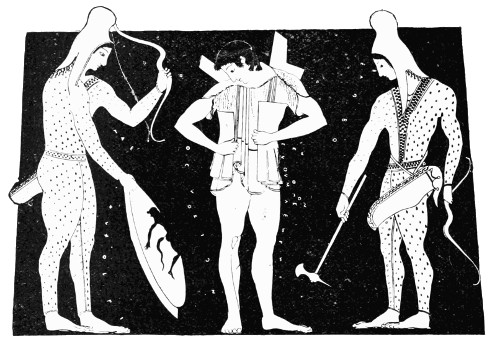
From Hoppin. FIG. 137. WARRIOR ARMING; SCYTHIAN ARCHERS (AMPHORA BY EUTHYMIDES IN MUNICH).
Among the various scenes incident to warfare may be mentioned an ambuscade,[1829] a wounded warrior dragged out of battle,[1830] a warrior protecting himself from darts,[1831] the capture of a prisoner,[1832] warriors carrying dead bodies,[1833] or human heads as trophies of victory.[1834] Besides single figures of warriors, heralds,[1835] trumpeters,[1836] slingers,[1837] and archers[1838] often appear; or representations of the armour of a warrior[1839]; or of the Δοκιμασία or parade of Athenian knights.[1840] Of a somewhat burlesque character is a scene depicting warriors riding on ostriches and dolphins.[1841]
Naval scenes are very rare, but we find occasional early representations of sea-fights,[1842] as on the Dipylon vases, the vessels on which appear to be biremes.[1843] On the B.F. and R.F. vases we find war-galleys[1844] or merchant-vessels,[1845] usually in places suitable for a row of ships—such as the outer edge of a kylix[1846] or the broad rim of a deinos or large bowl.[1847] These are specially common on vases of “mixed” technique. The subject of “keel-hauling,” the punishment administered to refractory sailors, must also find a place here.[1848]
8. Orientals and Barbarians
Oriental figures which can neither be classified as mythological, historical, or genre subjects sometimes appear on vases. We have already made mention of such quasi-mythological subjects as combats of Gryphons with Arimaspi or other figures in Oriental attire.[1849] Phrygian warriors, too, may be seen in some Trojan scenes—such as the sack of Troy or the flight of Aeneas[1850]—but their presence in scenes of departure or combat does not necessarily make the subject mythological.[1851] It is not always easy to identify the nationality of these barbarians, and the names usually given to them—Persian, Phrygian, or Scythian—must in many cases be regarded as somewhat conventional, except where details of costume are unmistakable.[1852]
Archers in Oriental costumes, wearing peaked caps with long lappets, and close-fitting costume of jerkin and trousers (ἀναξυρίδες), stippled over to indicate skin, are seen shooting arrows, on foot or on horseback,[1853] or accompanying the chariots of Greek warriors,[1854] or taking part in general combats[1855]; as also warriors blowing trumpets.[1856] Persian warriors in combat with Greeks appear on R.F. vases of the strong period,[1857] and may have some reference to the historical events of the time. It is even suggested that one is copied from the famous painting by Mikon of the battle of Marathon.[1858] One vase represents a sort of triumphal procession, perhaps of a Persian king, riding on a camel[1859]; and others depict Persians riding.[1860] Those of undoubted historical signification have already been mentioned.[1861] Scythians appear as mounted or unmounted archers,[1862] a Scythian horseman is attacked by a lion,[1863] a Scythian pursues two courtesans,[1864] and there is a curious scene depicting the revels of the Scythian Agathyrsi.[1865] Thracians, in the typical local costume of ζεῖρα (a thick cloak) and ἀλωπεκῆ (a fox-skin cap), appear by themselves or with Orpheus and Boreas[1866]; Thracian horsemen are represented setting out[1867]; and after the conquests of Miltiades the local costume appears to have become fashionable among the Athenian youth, as they are depicted wearing it on some contemporary vases.[1868] The Thracian custom of tattooing is suggested in some of the Orpheus scenes.[1869]
Figures of negroes are not very common on vases, though many of fifth-century date and later are modelled in the form of negroes’ heads; but there is a small class of B.F. alabastra on which they are represented in the traditional barbarian costume of trousers, etc., and are armed with the Oriental battle-axe.[1870] In one case a negro accompanies a camel.[1871] Ethiopians are seen conveying the body of Memnon or an ordinary warrior to his grave,[1872] and one vase represents an Ethiopian with a jug.[1873] A pair of Egyptian combatants can be identified on a fragmentary vase from Daphnae (Defenneh).[1874] Lastly, many of the vases of Southern Italy, especially those of Campania, represent combats or leave-takings of native Osco-Samnite warriors, in their typical costume of triangular cuirass, gaily plumed helmet, and scanty tunic.[1875]
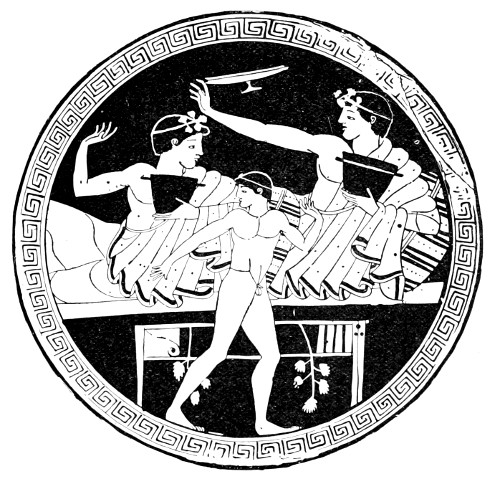
FIG. 138. BANQUETERS PLAYING KOTTABOS (BRITISH MUSEUM, E 70).
9. Banquets and Revels
A group of subjects which play an important part on vases of all periods, especially the height of the R.F. style, but which do not exactly fall under any of the headings so far enumerated, is that of scenes connected with banquets and revels, especially of Athenian ephebi. In the ordinary “type” of banquets at all periods (as in other branches of art) the participants recline on couches on their left elbows, the right arm being free to use, and that hand often holding a drinking-cup or other appropriate attribute.[1876] In this fashion the gods—such as Dionysos, Hermes, or Herakles after his apotheosis—indulge in the pleasures of the banquet and the wine-cup.[1877] There are scenes which represent the preparations for a banquet,[1878] or young men on their way thither[1879]; and in those depicting the feast itself a table is often placed before the couch, on which viands of various kinds are seen[1880]; or the krater (mixing-bowl) stands by, ready for the drinkers to replenish their cups.[1881] Vases are also filled by means of a funnel.[1882] The results of over-indulgence are sometimes realistically indicated on the R.F. cups.[1883] After the drinking-bouts come amusements of various kinds, notably the game of the kottabos.[1884] No instances of this occur before the middle of the R.F. period, and on the cups of that time it is usually only indicated by the manner in which the banqueters twirl their kylikes with a finger crooked in the handle,[1885] preparatory to throwing the remaining drops of liquid at the little figure on the top of the kottabos-stand, the hitting of which caused part of the apparatus to fall with a ringing noise.[1886] On the latest Athenian and many Apulian vases the stand is often represented as well,[1887] not only in position for the game, but borne along by revellers.[1888] It is also carried by Seileni, Maenads, or Eros, and used by Dionysos at his banquets.[1889]
Other amusements take the form of music and dancing. The banqueters themselves play the lyre or flute,[1890] or listen to male and female performers on those instruments,[1891] or a young girl dances for their amusement.[1892] The women jugglers, tumblers, and acrobatic sword-dancers who often appear on late vases[1893] no doubt often contributed to the entertainment of the “gilded youth” of their day. Sometimes a banqueter is represented reclining on his couch and singing, the words in one or two cases being inscribed as proceeding out of his mouth.[1894] Not only men but women are represented banqueting, as on the psykter by Euphronios at Petersburg, which has a group of courtesans.[1895] This character also appears on the R.F. vases at the men’s banquets.[1896]
The κῶμος or revel is equally popular with the banquet. It usually takes the form of a procession of young and elderly men in various unrestrained attitudes,[1897] dancing,[1898] singing,[1899] playing the lyre, flute, or other instruments,[1900] carrying drinking-cups and other vessels,[1901] or balancing them in sportive manner.[1902] Frequently these κῶμος scenes are of a Dionysiac character, the god himself, Seileni, Satyrs, and Maenads taking part,[1903] and sometimes human beings are mingled with them. On a vase of the series connected with the comic stage (Fig. 134, p. 161) a father is seen dragging a drunken youth home from a banquet; but these scenes of rioting are not always necessarily conceived as taking place before or after social festivities. On a red-figured cup at Petersburg the subject of the return from the feast of the Brauronian Dionysos is depicted in most realistic fashion, the revellers indulging in all sorts of buffoonery and fantastic actions, which suggest an Athenian counterpart of modern Bank Holiday amusements[1904]!
To turn to a subject of a quieter character, what may be termed “love scenes” are not uncommon on vases, especially of the later period. On the Apulian vases indeed such subjects are innumerable. The usual type, occasionally found on earlier vases,[1905] is that of a youth and a seated girl exchanging presents, such as mirrors, wreaths, baskets of fruit or jewel-boxes, Eros being frequently present.[1906] Scenes of this kind were originally interpreted somewhat fantastically, as having some reference to the Eleusinian or other mysteries,[1907] an idea which no one would now seriously hold. Similar scenes which have no particular import, such as groups of women, often with Eros, occur on many R.F. vases of the later fine style, especially the pyxides and lekythi.[1908] They are all clearly fanciful, and belong to an age when tastes resembled those of the eighteenth century in their artificiality. There are also some instances, especially on the R.F. vases, where the sentiment is more definitely expressed, and couples are seen embracing or caressing one another in amorous fashion.[1909] It is not necessary to make more than passing allusion to the many vases on which this harmless sentiment is replaced by coarseness and open indecency of treatment, some of which, however, belong to the very finest stage of red-figure painting.
Finally, we may mention here a few subjects of a genre character which seem to defy classification, and yet are sufficiently definite to require separate mention. Such are the scenes so common on the interiors of R.F. kylikes, which represent ephebi in all kinds of attitudes, or carrying all sorts of objects, the great aim of the artist being to find the most suitable design to fill in the circular space.[1910] Thus we have such subjects as a youth putting on a greave or sandals,[1911] carrying a wine-amphora[1912] or a lyre,[1913] playing with castanets,[1914] or pursuing a hare[1915]; reclining at a banquet[1916]; armed with a club or a large stone[1917]; a man leading a leopard,[1918] and a man who seems from his gestures to be treading unawares on a snake[1919]; and others of an athletic or military character, of which mention has already been made. There are also many subjects which appear to have a meaning, yet are not mythological, and cannot be satisfactorily explained; such instances it would, however, hardly be profitable to describe in detail.
10. Animals
The last class of subjects with which this section has to deal is that of animals, as considered apart from human beings, or objects of what modern painters term “still life.” In the historical chapters of this work it has been shown what a large part the animal world played in the decoration of vases down to the sixth century B.C., and also which were the animals most frequently selected for the friezes and other decorations of early vases. Most noteworthy in this respect are the Mycenaean vases (Vol. I. p. 273), with their representations of cuttle-fish (Plate XV.), the nautilus or argonaut,[1920] and other marine subjects. But to these early vases in the present case no further allusion need be made; as subjects they have not as a rule sufficient interest. On the Attic vases of the B.F. and R.F. periods animals rarely form a principal subject on vases, though they still sometimes appear in small friezes on the less important parts of the vase; it may, therefore, be of interest to note a few typical instances in which this feature retains its prominence. Sometimes we have subjects with action: as, for instance, one in which a panther tears a stag, and is attacked by an archer and an armed warrior[1921]; or a lion attacks a panther, a bull, or a deer.[1922] Again, the interior of a B.F. kylix is sometimes filled with an animal subject, such as a wounded stag,[1923] or a deer scratching itself or grazing,[1924] or other animals[1925]; and in a similar position on one R.F. kylix we have an ass with its pack.[1926] Other animal subjects worth mentioning are a sea-serpent,[1927] goats browsing on vines,[1928] a fox caught in a trap,[1929] cats and mice,[1930] the appearance of the swallow.[1931]
There is a class of ware made in Southern Italy which takes the form of flat plates or dishes, decorated with representations of fish and molluscs, such as the pike or mullet, the cuttle-fish and various shell-fish; these were clearly used for eating fish off, and they have in the centre a hollow to receive the sauce.[1932] Friezes of fish are not infrequently found on the vases of Apulia. Animals, especially birds, sometimes appear in friezes on the early Ionic vases, such as geese, quails, or guinea-fowl[1933]; cocks and hens confronted are more common, especially in the B.F. period,[1934] and one late Italian vase has an amusing group of a cock and goose greeting one another with the words, “Ah, the goose!” “Oh, the cock!”[1935]