Volume 2 / Part 3 — CHAPTER XIV HEROIC LEGENDS
Reading edition
Kastor and Polydeukes—Herakles and his twelve labours—Other contests—Relations with deities—Apotheosis—Theseus and his labours—Later scenes of his life—Perseus—Pelops and Bellerophon—Jason and the Argonauts—Theban legends—The Trojan cycle—Peleus and Thetis—The Judgment of Paris—Stories of Telephos and Troilos—Scenes from the Iliad—The death of Achilles and the Fall of Troy—The Odyssey—The Oresteia—Attic and other legends—Orpheus and the Amazons—Monsters—Historical and literary subjects.
In treating of the subject of heroic legends, we propose to deal first with the more prominent heroes, such as Kastor and Polydeukes, Herakles, Theseus, and Perseus, and with the tales of Thebes and Troy; next with the series of myths connected specially with Attica or other localities; then with semi-mythical personages, such as Orpheus and Thamyris, which lead us on to the next division of the subject—scenes connected with Greek history.
Kastor and Polydeukes do not play a very extensive part on vases; and as they are not further characterised than by the petasos and two spears, which are the ordinary equipment of young horsemen, they are not always to be identified with certainty, except in mythological scenes. Among these they appear in the Gigantomachia,[1112] or in company with Herakles are initiated into the lesser mysteries at Agra[1113]; they are also seen at the apotheosis of Herakles.[1114] They are present when Leda discovers the egg laid by Nemesis,[1115] and on two B.F. vases appear with Leda and Tyndareus in a family group[1116]; they are also seen in company with Hermes,[1117] with Paris and Helen,[1118] with Danaos taking refuge in Attica,[1119] in a scene from the Merope of Euripides,[1120] and at the slaying of the Sphinx by Oedipus.[1121] They take part in the hunt of the Calydonian boar,[1122] and in many scenes from the Argonautika, such as the death of Talos,[1123] the punishment of Amykos,[1124] and others of doubtful meaning.[1125] There is more than one representation of their carrying off the Leukippidae,[1126] the best being the beautiful Meidias vase in the British Museum (Plate XLI.), where all the figures are named.[1127] They appear as hunters,[1128] as deified beings present at a Theoxenia (lectisternium), or feast of the gods,[1129] and are crowned by Nike (with stars over their heads).[1130]
Herakles
Of all the heroic legends the most numerous and the most important are those of the Herakleid. They appear on vases of all periods, though in the largest proportion on the black-figured varieties, and include every event in his life, from his birth to his deified life in Olympos. Of the visit of Zeus to his mother Alkmena we have already spoken, as also of her apotheosis.[1131] As an infant we see Herakles engaged in strangling
the serpents sent by Hera, while his brother Iphikles recoils in terror[1132]; later on Hera appears to be reconciled to his existence, for she is actually seen suckling him at her breast.[1133] Next he is carried off by Hermes to Cheiron the Centaur for his education,[1134] and we see him undergoing instruction on the lyre from Linos,[1135] or on his way, accompanied by an old woman carrying his lyre.[1136] By the time when his series of labours begins he is usually represented as a full-grown bearded man, especially on the archaic vases; but he appears in a few instances as a quite youthful beardless figure.
Of all the achievements of Herakles the most famous are the Twelve Labours, to which he was subjected by Hera at the hands of Eurystheus. We find them all represented on vases, with the exception of the cleansing of the Augean stables, which may be presumed to have offered too many difficulties to the painter; it only occurs once in the whole history of Greek art, on a metope at Olympia. The horses of Diomede only occur once, the Keryneian stag thrice, and the Stymphalian birds five times; but the rest may be described as common. In all these scenes Herakles is usually accompanied by Athena; also, but less frequently, by Iolaos and Hermes.
I. The Nemean Lion.
Of this subject we find two “normal” types on B.F. vases,[1137] with one or two abnormal versions; on R.F. vases the treatment is less stereotyped.
B.F. (1) Standing type:—Herakles plunges sword into lion’s neck (both upright): B.M. B 160, B 232, B 621 (Plate XXX.). H. strangles lion: Berlin 1720 = Wiener Vorl. 1888, 6, 3 (Exekias); Wiener Vorl. 1889, 6, 3 (Charitaios).
(2) Crouching type:—Herakles stoops and strangles lion: B.M. B 159, B 199, B 318 (Fig. 125); Petersburg 68 = Wiener Vorl. 1889, 4, 6 (Taleides).
(3) Abnormal:—Lion on its back; Herakles slays it with club: Reinach, ii. 52. Herakles pursues lion: Louvre F 108 = Wiener Vorl. 1890–91, pl. 1, 5 (Nikosthenes).
R.F. (1) Herakles with lion over shoulder about to hurl it on Eurystheus (type borrowed from Erymanthian Boar, see below): B.M. B 193 = Plate XXXII. (Andokides).
(2) Crouching type: Munich 415 = Reinach, i. 150 = Baumeister, i. p. 656, fig. 723; B.M. E 168; Röm. Mitth. v. (1890), pl. 12 = Wiener Vorl. 1890–91, 7, 2 (Nikosthenes, in Boston). See also B.M. E 104 (abnormal).
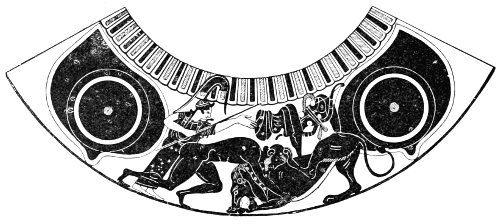
FIG. 125. HERAKLES AND THE NEMEAN LION (BRITISH MUSEUM).
We may also note here a curious B.F. vase, on which Herakles is seen in the forests of Nemea preparing the lion’s skin for his own wear.[1138]
II. The Cretan Bull.
Type: Herakles seizes the bull from the front and ties its legs with a cord.
B.F. B.M. B 309; Berlin 1886, 1898; Helbig, 31; Reinach, ii. 55, 5 = Baumeister, i. p. 660, fig. 727.
R.F. B.M. E 104; Wiener Vorl. 1890–91, pl. 7, 2 (Nikosthenes, in Boston) = Röm. Mitth. v. (1890), p. 324.
Late. Berlin 3145 = Millingen-Reinach, 11; Athens 1931.
See also a very remarkable vase in Forman Sale Cat. No. 305 (now at Boston), where the same subject appears each side, one B.F., the other R.F. (by Andokides).[1139]
III. The Erymanthian Boar (see Klein, Euphronios, p. 87).
(1) The capture:
B.M. B 462; Louvre F 236; Berlin 1981, 2034; Naples 2705 and S.A. 150; Athens 858, 860 (all B.F.).
(2) The bringing back of the boar (Eurystheus absent; Athena usually receives the hero):
B.M. B 447, 492; Cambridge 57; Munich 694; Athens 1097 (all B.F.).
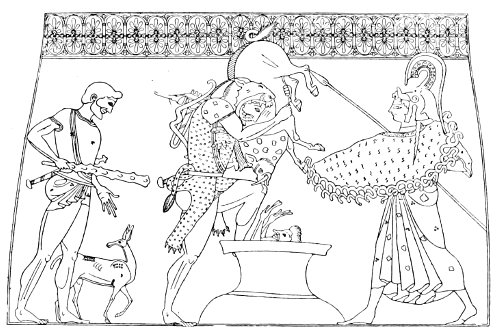
FIG. 126. HERAKLES BRINGING THE BOAR TO EURYSTHEUS (BRITISH MUSEUM).
(3) Herakles hurls the boar upon Eurystheus, who hides himself in a large sunk jar (πίθος):
B.F. B.M. B 161 (Fig. 126); Reinach, ii. 55, 1; Helbig, 37; Louvre F 59, 202.
R.F. B.M. E 44 (Euphronios) = Furtwaengler and Reichhold, pl. 23; Louvre G 17 = Wiener Vorl. 1890, pl. 10.
IV. The Keryneian Stag.
B.F. B.M. B 169, B 231.
R.F. Reinach, i. 233.
A dispute between Apollo and Herakles over a stag (Rein. ii. 56, 3: see p. 34) may perhaps be referred to this subject, as the myth is not otherwise known, but it is more usually Artemis who endeavours to thwart Herakles’ capture.
V. The Stymphalian Birds.
Found only on four B.F. vases (B.M. B 163; Louvre F 387; Arch. Anzeiger, 1892, p. 172; and Munich 1111 = Reinach, ii. 58) and one late example (Reinach, ii. 297). Herakles shoots the birds with bow and arrow.
VI. The Lernaean Hydra.
This subject, occurring only on archaic vases, has no very fixed type; the Hydra has seven or nine heads, and the body of a serpent or of a cuttle-fish. Iolaos sometimes assists Herakles, and in two cases the crab sent by Hera is also visible.
B.F. Early: Reinach, i. 389; Jahrbuch, 1898, pl. 12; Reinach, i. 118 (6) = Louvre E 851.
Later: Reinach, i. 118 (1) = Berlin 1854 (crab); ibid. 118 (3); 118 (5) = Louvre F 386 = Millin-Reinach, ii. 75 (Athena slays crab); Reinach, ii. 53 = Baumeister, i. p. 657, fig. 724; Berlin 1801 = Wiener Vorl. 1889, 7, 3: see also Athens 792 = Heydemann, Gr. Vasenb. pl. 4, 1, where two successive scenes are given.
R.F. Reinach, ii. 76. Hydra has cuttle-fish body and ten or eleven heads.
VII. The Horses of Diomede.
Naples 2506; Reinach, ii. 297 (?).
VIII. The Augean Stables.
Not found on vases.
IX. The Combat with Geryon and Capture of his Cattle.
A very favourite subject on B.F. and early vases, including some of the finest specimens. Geryon is at first winged and only three-headed, then triple-bodied, represented as three armed warriors united,[1140] one or two of whom generally fall wounded. Herakles attacks with bow.
Early B.F. “Proto-Corinthian”: B.M. A 487 = J.H.S. v. p. 176. Chalcidian: B.M. B 155; Bibl. Nat. 202 = Reinach, ii. 58 and 253 = Plate XXII.
Late B.F. B.M. B 156, B 194; Louvre F 53 = Reinach, ii. 59 = Baumeister, i. p. 662, fig. 729 (Exekias); J.H.S. xviii. p. 299, and Bibl. Nat. 223 (abnormal types).
R.F. Munich 337 (Plate XXXVIII.) = Furtwaengler and Reichhold, 22 (Euphronios); Noel des Vergers, Étrurie, pl. 38.
Late. Berlin 3258; Naples 1924 = Millingen-Reinach, 27.
The driving off of the cattle by Herakles is also represented:
B.M. E 104; Reinach, ii. 58, 5; and see Klein, Euphronios, p. 61.
X. The Girdle of Hippolyta.
B.F. B.M. B 533.
Late. Naples 3241 = Reinach, i. 384.
Besides the scenes in which Herakles is evidently capturing the girdle, there are many vases on which he is seen in combat with Hippolyte and other Amazons, such as Andromache or Alkaia, assisted himself by Iolaos or Telamon.
B.F. B.M. B 154, B 426; Louvre E 875; Cambridge 44; Bourguignon Sale Cat. 18 (Exekias); Berlin 3988 = Coll. Sabouroff, i. pl. 49.
R.F. B.M. E 45; Reinach, i. 166; Bibl. Nat. 535 = Reinach, ii. 265; Bologna 322; Reinach, i. 353 = Wiener Vorl. vii. 4, 1 (Duris).
Late. Jatta 423 = Reinach, i. 206.
XI. Fetching Kerberos from Hades.
The various types and methods of representing this subject have been collected in J.H.S. xviii. p. 296; as typical examples may be given:
Early B.F. Louvre E 701 = Reinach, i. 153; Reinach, i. 389, ii. 32.
Late B.F. J.H.S. xviii. p. 295 (in B.M.); Reinach, ii. 69.
R.F. Jahrbuch viii. (1893), pl. 2 (in Berlin) and p. 160 (in Boston).
Late. On several of the “under-world” vases, see p. 68, Nos. 1–4, 11.
XII. Fetching the Golden Apples from the Garden of the Hesperides.
There are two versions of this myth. In one, which seems to be the earlier, Atlas fetches the apples, while Herakles supports the universe for him (see above, p. 75). The vases representing Herakles in the Garden surrounded by the Nymphs (for whom see p. 92) are almost all of the later period:
B.F. Benndorf, Gr. u. Sic. Vasenb. pl. 42, 1.
R.F. B.M. E 224 = Furtwaengler-Reichhold, 8–9 (Plate XLI.).
Late. B.M. F 148; Naples 2873 = Millin-Reinach, i. 3 = Wiener Vorl. viii. 12, 3 (Assteas); and Naples 3255 = Reinach, i. 236 = Baumeister, i. p. 686, fig. 745.
Parody. Athens 1894 = Reinach, i. 506 (?).
Besides the somewhat insignificant part that he plays in the Gigantomachia,[1141] Herakles had several independent combats of his own with gigantic monsters and such-like beings. Of these the most popular subjects are Antaios and Alkyoneus. The legend of Herakles’ wrestling with the former is familiar from Pindar[1142]; on the vases Antaios is not characterised as a giant in size or otherwise, but his mother Gaia is generally present.[1143]
Alkyoneus, on the other hand, is represented as a being of gigantic size, lying asleep in a cave[1144]; a small winged figure which sometimes hovers over him has been interpreted by some as Hypnos (Sleep), but might also be a Κὴρ Θανάτοιο, or harbinger of death.[1145] Herakles generally attacks him with club or bow and arrow, but on one vase is depicted gouging out his eye[1146]; on another he is assisted by Telamon with a stone.[1147] Another giant with whom we find the hero contending is Cacus, whose oxen he carried off. This is a purely Roman myth, and belongs rather to the legends of the Roman Hercules, but curiously enough it finds a place on one Greek vase of Sicilian origin, which represents Cacus in a hut with the oxen and Herakles playing a lyre in triumph.[1148]
One of the commonest subjects connected with Herakles is his combat with Kyknos, the son of Ares, described at length in the Hesiodic Scutum Herculis. It is mostly found on B.F. vases, the usual “type” showing the two combatants supported by Athena and Ares respectively in their chariots, while Zeus appears in the midst to interrupt them.[1149] One late R.F. vase seems to show the preparations for the combat, in the presence of an Amazon, a Fury, and other personages[1150]; another vase, the subsequent attack made on Athena by Ares.[1151]
We find him in combat with Acheloös, the river-god, represented as a bull with the face of a bearded man,[1152] or occasionally, by confusion with a sea-deity, with the body and tail of a fish.[1153] This latter form is assumed by Triton, with whom also the hero contends,[1154] though the myth is unknown in literature. Of similar import is his combat with Nereus, the old man of the sea (Ἁλιος Γέρων), who appears in human form as an aged man[1155]; the “type” employed on B.F. vases is similar to that of Peleus wrestling with Thetis (see below, p. 120), with similar indications of the sea-god’s transformation into animals. In one case an air of humour is imparted to the scene, and Herakles is represented smashing the furniture in Nereus’ house.[1156]
Another important group of subjects is concerned with Herakles’ adventures with the Centaurs, which fall under several headings. Allusion has already been made to his early education by Cheiron, and again we see him paying a visit of a peaceful nature to the aged Pholos, who entertains him by opening a jar of wine.[1157] The smell therefrom attracted the other Centaurs and led to a combat, which we see vividly depicted on many early B.F. vases, on which it was a favourite subject, as also on later ones.[1158] We also find him in combat with particular Centaurs, from whom he rescues a woman carried off by them. Thus we see Hippolyta delivered from Eurytion,[1159] and Deianeira from Nessos[1160] or Dexamenos[1161] (the latter appears on later vases only, and there seems to be no distinction between them in the myth).
Other adventures in which he engages include the freeing of Prometheus from the vulture, which he slays with his bow[1162]; the bringing back of Alkestis from Hades[1163]; the seizure of the Kerkopes, a pair of brigands, whom he carries off head downwards over his shoulders[1164]; and his capture by Busiris in Egypt,[1165] with his escape after slaying the king’s negro attendants.[1166] Among rarer myths may be mentioned the destruction of the vines of Syleus[1167]; a possible representation of his contest in drawing water with Lepreos[1168]; and his combat with Erginos, the king of Orchomenos, and the capture of his heralds.[1169] A vase in Athens, on which he is depicted dragging two Satyrs in a leash,[1170] depicts an unknown myth; as do those which represent him contending with Geras, a personification of Old Age,[1171] and beating a winged Ker with his club.[1172] In company with Athena he attacks an unknown man,[1173] and he is also seen leading a Sphinx.[1174]
Next we turn to the relations between the hero and the Olympian or other deities, which often take the form of disputes or combats. Of these the most famous and important is his capture of the Delphic tripod, for which he fights with Apollo, generally in the presence of Athena and Artemis[1175]; in one instance Herakles is seen in Athena’s chariot, carrying the tripod off with him[1176]; other vases represent the final reconciliation with Apollo.[1177] There is a curious representation of a combat between Herakles and Hera (depicted as the Roman Juno Sospita, wearing a goatskin on her head), with Athena and Poseidon assisting on either side.[1178] Another rare and interesting subject is that of his attack on Helios, whom he interrupts at sunrise to prevent his journey after Geryon’s cattle from becoming known. Herakles is shown waiting for the chariot of the sun-god as it rises from the waves, and preparing to discharge his arrows.[1179] A later stage of the story is illustrated by a fine R.F. vase, where he voyages over the sea in the golden bowl given him by Helios.[1180] Lastly, he defends Hera and Iris against the attacks of a troop of Seileni.[1181] In other scenes where he is associated with the gods, it is in his divine capacity after his apotheosis.
His relations with women are not so frequently depicted but we have at least one representation of his visit to Omphale[1182]; or, again, of his entertainment by Eurytos,[1183] the carrying off of his daughter Iole,[1184] and the subsequent fight with Eurytos.[1185] His rescue of Deianeira from the Centaur has already been alluded to, and there may also be a reference to his carrying her off from her father Oineus.[1186] Hesione is not found with him on vases, but he is seen carrying off Auge[1187]; he is also associated with a Nymph, who may be Nemea.[1188] On one vase he pursues, with amorous intention, a woman, who may possibly be intended for Athena.[1189]
A remarkable vase-painting by Assteas of Paestum depicts Herakles in a fit of madness destroying his children by hurling them on a fire, on which he has already thrown the household furniture; his mother and others look on, expressing various emotions.[1190] In more peaceful mood he is seen grouped with his wife Deianeira and their son Hyllos,[1191] or with Oineus, his father-in-law.[1192]
We now proceed to note a few subjects which do not admit of more exact classification. Herakles is initiated into the lesser mysteries at Agra, together with Kastor and Polydeukes,[1193] and is conducted by Hermes to the revels of the Scythian Agathyrsi (cf. p. 179).[1194] He is also sometimes seen carrying Hades on his back, the latter bearing a large cornucopia[1195]; but the signification of this subject is unknown. He accompanies the Argonauts on their wanderings,[1196] and appears as a single figure shooting from a bow.[1197] He is often represented performing an act of sacrifice, either as a single figure[1198] or in groups, sacrificing a ram or other animal.[1199] Some of these scenes, where he sacrifices to the xoanon of Chryse,[1200] a local Lemnian goddess, must refer to the story of Philoktetes, with which he was connected. Or, again, conversely, we see a statue of Herakles made the subject of offerings from others.[1201] A scene from the story of Antigone (see below, p. 119) is represented as taking place before a shrine, in which stands the deified hero interceding with Kreon for her life.[1202] He also appears as protecting god of Attica,[1203] and also of the palaestra, with reference to his traditional founding of the Olympian games.[1204] Finally, there is a series of subjects which (as in the case with most of the preceding section) may be concerned with Herakles either before or after his apotheosis.
Among these are the numerous vases (especially B.F.) where he is represented as being greeted by Athena or conversing with her,[1205] or receiving a libation from her.[1206] These may either refer to his receiving visits of encouragement from her in the intervals between his labours, or to his reception by her in Olympos (see below). Many vases represent him banqueting, usually in company with Dionysos and other deities.[1207] With Hermes and Iolaos he takes part in a procession accompanied by music[1208]; and he is also represented overcome with wine and forming a subject for mockery,[1209] while Satyrs steal his weapons[1210] (this subject being probably taken from a Satyric drama). Or he is represented bathing at a fountain[1211]; and in one case fishing with Hermes and Poseidon.[1212] He also takes part in the Gigantomachia,[1213] and is present at the birth of Athena,[1214] in both cases by a curious anticipation of his deified character. Exceedingly common are his appearances with a lyre, as Kitharoidos.[1215]
The last scenes of Herakles’ earthly life are his last sacrifice on Mount Kenaion,[1216] the wearing of the poisoned robe which led to his death,[1217] and the subsequent burning of his body on the funeral pyre. The last scene is occasionally combined with his apotheosis; the Hyades quench the flames among which his body is consuming, while the deified hero ascends in the chariot of Athena or Nike to Olympos.[1218]
The vases relating exclusively to his apotheosis fall into two main classes, which admit of more than one sub-division: (1) his ascent into heaven in the chariot of Athena or Nike; (2) his reception in Olympos. The ascent in the chariot of Athena is almost confined to B.F. vases; on those of the R.F. period it rarely occurs; and on the Italian vases her place is usually taken by Nike, who is also represented crowning him with a wreath. On the B.F. vases the “type” is almost invariable (see Plate XXIX.): Herakles mounts the four-horse chariot in which the goddess stands ready; on the farther side of it stand various deities, the commonest being Apollo, Dionysos, and Hebe, with Hermes at the horses’ heads; more rarely Zeus, Hera, and Artemis are seen.[1219] In one or two cases Iolaos acts as charioteer, Athena standing at the side[1220]; or, again, Hebe performs the same office.[1221] On the late red-figured vases the attendant deities are almost limited to Hermes and Eros; the chariot is here usually represented as on its way.[1222]
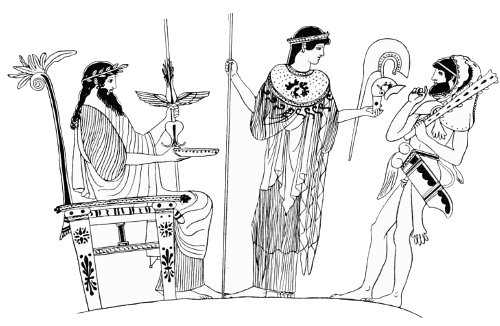
From Arch. Zeit. FIG. 127. RECEPTION OF THE DEIFIED HERAKLES BY ZEUS, FROM A VASE AT PALERMO.
The first stage of the hero’s introduction into Olympos is his introduction to Zeus by Athena, a scene common on both B.F. and R.F. vases (Fig. 127). The attendant deities vary very greatly: Hermes, Apollo, Hebe, and Artemis are most often seen; also Hera, Poseidon, Ares, and Dionysos.[1223] Besides these there are numerous scenes in which he is grouped with various deities, usually Athena and Hermes, but also Poseidon, Ares, Dionysos, and Hebe, apparently in the enjoyment of his new life among the welcoming gods[1224]; and to this group may be added the scenes in which he is crowned by Nike.[1225] The completion of his bliss is the marriage with Hebe, found on two or three fine R.F. vases,[1226] with a numerous company of attendant deities.
The adventures of Theseus, the peculiarly Attic hero, are portrayed on vases of all dates; they are rare on the later kinds, but are most popular on the R.F. vases of the “strong” and “fine” periods, as would naturally be expected at a time when his cult was coming into special prominence in Athens (see Vol. I. p. 418). Of his seven labours the only one commonly found on the B.F. vases is the combat with the Minotaur, but some of the finest R.F. kylikes give a complete series. They are given in the order of his progress from his birthplace Troezen through the Isthmus to Athens. It should be noted that the Cretan legends, which alone are common on the early vases, are clearly older than the more purely Attic.
The first subject to be mentioned in connection with the story of Theseus is that of his father Aigeus consulting the oracle of Themis.[1227] His finding of Aigeus’ sword and sandals beneath the stone (cf. Plate LXII.) is not depicted on vases, but we have a possible representation of his recognition by Aigeus,[1228] and an unintelligible scene where he pursues or attacks his mother Aithra, apparently wielding the newly found sword.[1229]
There are only two R.F. kylikes which give the complete series of adventures, including that in Crete; the Duris kylix in the British Museum (Vol. I., frontisp.) omits two (the bull and Prokrustes), and others give a varying number of scenes, omitting sometimes one, sometimes another. The adventure with Periphetes appears to be confined to literature. We give the list as follows, with the vases on which they may be seen[1230]:
(1) The pine-bender Sinis.
B.F.: Athens 879. R.F.: Reinach, i. 313 (= Naples R.C. 180) and ii. 280.
(2) The sow of Krommyon, sometimes accompanied by a Nymph or old woman, the personification of the locality.
Reinach, i. 459; Noel des Vergers, Étrurie, pl. 14.
(3) The brigand Skiron (in Megara); this scene is usually to be identified by the foot-pan and the tortoise.
Reinach, i. 119.
(4) The wrestling with Kerkyon (at Eleusis).
Reinach, i. 324.
(5) Prokrustes and his bed (near Athens).
B.F.: Athens 879. R.F.: B.M. E 441–42; Athens 1166 = J.H.S. 1889, pl. 1; Millingen-Reinach, 9–10.
(6) The Marathonian bull.
B.F.: Bibl. Nat. 174. R.F.: B.M. E 442; Naples 2865 = Inghirami, Vasi Fitt. 54; Millin-Reinach, i. 43: Noel des Vergers, Étrurie, pl. 35 (in Brussels).
(7) The slaying of the Minotaur.
A very early representation (about 610 B.C.) on the Polledrara hydria in the British Museum (J.H.S. xiv. pl. 7: see Chapter XVIII.).
B.F.: B.M. B 148, B 205; Munich 333 = Reinach, ii. 119 = Wiener Vorl. 1889, 2, 2, and 1155 = Wiener Vorl. iii. 7, 2; Berlin 1698 = Wiener Vorl. iii. 7, 1; Millin-Reinach, ii. 61 (Taleides).
R.F.: B.M. E 441; Helbig, 80 = Reinach, ii. 81 = Baumeister, iii. p. 1790, fig. 1874.
The complete set of seven is to be found on the following:
B.M. E 84, where the scenes are duplicated on the exterior and interior of the kylix; here the Minotaur forms the central scene of the interior.
Ant. Denkm. ii. 1 (kylix by Aeson).
The following are more or less complete:
B.M. E 48 = Frontispiece, Vol. I. (by Duris; five scenes).
Louvre G 104 (Euphronios).
Reinach, i. 528–32.
After the labours on his journey comes the purification of Theseus on reaching Athens.[1231] To this time may perhaps be referred a scene in which he receives a palm-branch from Athena.[1232] There is a subject which cannot be placed in literary tradition, but probably comes in point of time immediately before or after the labours; this is the visit to Poseidon and Amphitrite under the sea, whither he is borne by Triton. It occurs on the beautiful Euphronios kylix in the Louvre (G 104) and elsewhere.[1233]
Next in point of time we have to deal with the story of Theseus’ voyage to Crete and his marriage with and desertion of Ariadne. It begins with a scene in which he bids farewell to Aigeus[1234]; then on his arrival in Crete he slays the Minotaur, as already described. We next see the meeting with Ariadne,[1235] followed by the nuptial ceremonies; the latter scene, together with the subsequent arrival at Delos, and a dance of boys and maidens liberated by Theseus, is vividly depicted on the François vase. His desertion of the sleeping Ariadne in Naxos and the appearance of Dionysos as her consoler form the subjects of two very beautiful R.F. vases[1236]; but the return to Athens and the death of Aigeus are not depicted.
The reign of Theseus at Athens is signalised by his combats with the Amazons and Centaurs. In the former story he carries off their leader Hippolyta as his queen, assisted by his friend Peirithoös[1237]; and in another version it is Antiope whom he overcomes,[1238] or the subject is treated in a more general fashion.[1239] This scene is supposed to take place in Attica; but the story of the Centaurs belongs to Thessaly, the home of Peirithoös. The Centaurs are represented interrupting a banquet, throwing everything into confusion, and carrying off Laodameia and other female victims. It occurs on the François vase, and is treated in a vivid pictorial fashion on several vases of a later period.[1240] The episode of the death of Kaineus (see p. 145) belongs to this group of subjects. To the same period belongs a vase representing the rape of a girl named Korone by Theseus and his friend.[1241] In the story as told by Plutarch (Thes. 31) it was Helene[1242] whom Theseus carried off; curiously enough, a figure thus inscribed is also present on this vase,[1243] as well as Antiope (see above). The rape (as described by Plutarch) was followed by their descent into Hades to seize Persephone. For this they were doomed to punishment, to sit for ever with hands bound behind them[1244]; but in one version Theseus is allowed to depart after a time, as is seen on one of the Apulian under-world vases.[1245] A vase signed by Xenotimos represents Peirithoös seated in a chair holding two spears[1246]; but its mythological significance is open to question.
Closely linked with the story of Theseus is that of the love of Phaidra for Hippolytos and the death of the latter, confined to late Italian vases; but Phaidra has not been certainly identified in any case.[1247] There is, however, an undoubted representation of the appearance of the bull which overthrew Hippolytos’ chariot.[1248]
Next in importance as a hero of Greek legend comes Perseus, born from the golden shower in which Zeus visited Danae (see p. 19). We find representations of the scene so touchingly sung of by Simonides, the placing of Danae and her child in the wooden chest and sending them adrift[1249]; and next we find Perseus as a full-grown youth, about to set forth on his mission of slaying the Gorgon, and receiving from the Naiads the cap, sandals, and wallet, which were to aid him in his quest.[1250] On later vases he receives from Athena the sickle (harpe) with which he slays the monster.[1251] On his way he seizes the eye and tooth of the Graiae, a subject rarely depicted in art.[1252] The actual slaying of the Gorgon[1253] is not so often represented as the subsequent flight of Perseus, generally accompanied by Athena and Hermes[1254]; in one or two instances we see Perseus approaching his victim unobserved.[1255] Other vases depict the headless corpse of Medusa, from which springs the young Chrysaor or Pegasos, and the other two Gorgons, Stheno and Euryale, either pursuing Perseus or remaining with the corpse[1256]; in one instance they appeal to Poseidon for help.[1257]
We next see Perseus arriving at the court of Kepheus to deliver Andromeda[1258]; she is generally represented chained to a column in the palace itself. On other vases he is depicted in the act of slaying the monster, but this is a somewhat rare subject.[1259] Finally, we have the return to Seriphos and the petrifaction of the king Polydektes by showing him the Gorgon’s head.[1260] Perseus is also represented showing the head to Satyrs,[1261] or placing it in the wallet (κίβισις),[1262] or in combat with Maenads[1263]; or, again, he is accompanied by Athena, who holds the Gorgon’s head while he looks at the reflection.[1264] Lastly, on some small R.F. vases, a bust of Perseus is depicted wearing his winged cap.[1265]
The story of Pelops is chiefly connected with Olympia, and his visit to Oinomaos; but the subjects are almost exclusively confined to the later Apulian vases. On one B.F. (Cyrenaic) kylix Pelops is depicted with the winged horses given him by Poseidon,[1266] but this is exceptional. The Olympia scenes include five episodes: (1) the arrival of Pelops at Olympia[1267]; (2) the sacrifice or compact with Oinomaos[1268]; (3) the race[1269]; (4) the death of Myrtilos[1270]; (5) the carrying off of Hippodameia.[1271] Pelops also occurs with Myrtilos and Hippodameia in the under-world.[1272]
The adventures of Bellerophon are not so popular as those of other heroes, especially in the R.F. period. The story told in the sixth Iliad appears in several scenes, beginning with Bellerophon’s taking leave of Proitos[1273]; next we see him delivering the letter with its σήματα λυγρά to Iobates, the king of Lycia,[1274] and then, mounted on Pegasos, slaying the Chimaera.[1275] Subsequent events represented on vases are the death of the perfidious Stheneboia, who falls from the back of Pegasos,[1276] and the marriage of Bellerophon with Philonoë.[1277]
Nor need the story of Meleager detain us long. Scenes from his life are practically confined to the Calydonian boar-hunt, a subject popular at all periods, especially on early vases.[1278] Kastor and Polydeukes, Peleus, and other heroes, together with Atalante, are represented as taking part, as well as Meleager. There is also a vase on which Meleager is represented with the boar’s hide, accompanied by Atalante, Peitho, and Eros.[1279] Other scenes where a boar-hunt is represented, but no names given, or only names of a fanciful kind, may or may not be identified in this way.[1280] There is one vase which appears to represent the death of Meleager.[1281]
The next of the Greek heroes with whom we have to deal is Jason, with whom we must include the whole cycle of subjects relating to the Argonautika—such as the stories of Helle, Phineus, and Talos. The legend of the golden fleece which gave rise to the famous quest of Jason is first illustrated by scenes representing Helle or Phrixos in flight on the ram,[1282] or the former grouped with her mother Nephele and her brother Phrixos,[1283] who accompanied her on her flight. The pursuit of Phrixos and the ram by Ino is also represented.[1284] Lastly, there is a vase which may represent the setting out of Jason.[1285]
In the earlier history of the Argonautic expedition the most interesting subject found on the vases is the story of Phineus, who had been blinded for impiety by Boreas,[1286] and was subsequently deprived of his food by the Harpies until he was delivered by the sons of Boreas, Zetes, and Kalais.[1287] Another event is the chastisement of Amykos by Kastor and Polydeukes,[1288] and a fine vase of “Polygnotan” style in the Louvre represents a group of Argonauts apparently without any special signification.[1289] In all these scenes Kastor and Polydeukes and the Boreades are present together with Jason. There is also a scene which has been interpreted as belonging to the Argonautika: Herakles is represented sacrificing to a statue of Chryse on the island of Lemnos.[1290]
Then we have the arrival of Jason and his companions in Kolchis,[1291] and the subsequent feats performed by the hero—his slaying the dragon[1292] (in one version he enters into its mouth[1293]), his contest with the bull,[1294] and finally the capture of the fleece,[1295] which he is also represented as bringing to Pelias on his return.[1296] The only important event relating to the homeward journey is the death of Talos.[1297]
Among the events of his later life are the boiling of the ram by Medeia,[1298] and the subsequent destruction of the aged Pelias[1299]; the renewal of Jason’s own youth[1300]; the death of his wife Glauke by Medeia’s agency[1301]; and the latter’s slaughter of her children,[1302] with her pursuit by Jason.[1303] Medeia also appears in another connection at Theseus’ leave-taking of his father Aigeus,[1304] and among the Athenian tribal heroes on the vase by Meidias.[1305] Though not necessarily connected with Jason, the funeral games held after the death of Pelias[1306] must also find mention here. Scenes therefrom are represented on more than one vase—such as the chariot-race conducted by Kastor and others in the presence of three judges (Pheres, Akastos, and Argeos), and the wrestling of Peleus and Hippalkimos.[1307] On another Zetes is victorious over Kalais in the foot-race.[1308]
The Theban Legend
The “tale of Thebes” falls into various episodes, more or less connected, especially those which relate to the story of Oedipus and his line.[1309] Conspicuous as founder of the city is the Phoenician Kadmos, whose encounter with the dragon is depicted on vases of various periods. On some he receives from Athena the stone with which he is to slay the monster[1310]; on others he is seen approaching the fountain of Ares, where he was to meet it[1311]; and, lastly, we have the actual slaying of the dragon,[1312] sometimes in the presence of Harmonia and various deities and personified figures, including Thebes. After the slaying of the dragon Kadmos sacrifices to Athena Onka.[1313] The completion of the story is seen in his marriage with Harmonia.[1314] A rarer subject is the punishment of Dirke by her brothers Amphion and Zethos, who tied her to a wild bull[1315]; while a later episode of the story is the pursuit of her sister Antiope by her lover Phokos.[1316]
The story of the Oidipodia is introduced by the subject of Laios (the father) carrying off the young Chrysippos.[1317] Then we have the exposure of the infant Oedipus and his discovery by the shepherd Euphorbos.[1318] Of later events in the life of Oedipus, the only one that attained to any popularity is the slaying of the Sphinx. The actual deed only occurs once,[1319] and the usual “type” is that of Oedipus (usually a young man) standing before the Sphinx, which is seated on a rock or column.[1320] It is not always to be identified with certainty.[1321] In one instance Oedipus is represented with Teiresias[1322]; in another with persons named Sikon and Kalliope—a subject hitherto unexplained.[1323] We need only make passing reference here to a vase supposed to represent the tomb of Oedipus, inscribed with a couplet of verses, at which stand two youths.[1324]
Before continuing the story of the house of Oedipus, we must digress to that of Amphiaraos, the warrior-seer, whose departure from his wife Eriphyle to the Theban War is a favourite subject on vases.[1325] It becomes, in fact, a “type” adopted in ordinary scenes.[1326] We also find on the reverse of one of the vases with this subject the departure of another warrior, perhaps intended for the hero’s son Alkmaion, or for Adrastos.[1327] On an early vase Amphiaraos is seen bringing home Eriphyle in his chariot. The names of his horses, Thoas and Dion, are given.[1328] A curious subject is that of the hero in the bosom of his family, with his wife Eriphyle suckling her son Alkmaion, and a maiden spinning.[1329] His death is represented on one B.F. vase[1330]; on another his slaying of Eriphyle.[1331] Another event is the death of the child Archemoros, caused by a serpent.[1332] A fine late vase in Naples depicts the prothesis or laying out of his body by his mother Eurydike and others.[1333] The subsequent fight of Tydeus and Lykourgos, interrupted by Adrastos, also occurs,[1334] and the reception of the fugitive Tydeus by Adrastos.[1335] Tydeus appears once more as the slayer of Ismene[1336]; but according to another version she and her sister Antigone are attacked by Laodamas when the Epigoni return to Thebes many years later.[1337] We can only point to one possible representation of the combat of Eteokles and Polyneikes on vases,[1338] though it is common enough, e.g. in Etruscan art; but there is at least one representation of Antigone being brought before Kreon after the burial of her brother,[1339] which also forms a burlesque subject on the comic stage.[1340]
The Trojan Cycle
We now come to the story of the Trojan War, linked with which are the events which led up to it and those which immediately followed upon it—such as the Judgment of Paris on the one hand, and the stories of Odysseus and Orestes on the other. These events are so numerous that they require careful classification. They may be divided into three main sections: (1) Ante-Homerica, including the events that led to the war and those that took place during the first nine years of it; (2) Homerica, or the events of the Iliad; (3) Post-Homerica, or the stories of the death of Achilles, the fall of Troy, the Odyssey and other Νοστοί, and the Oresteia. The literary authorities for these events, on the lines of which our classification follows, are discussed elsewhere (p. 4 ff.).
In spite of the warning of Horace that in writing of the story of Troy it is not necessary to begin ab ovo, it is impossible here to avoid reference to the earliest event which bears at all on the subject—namely, the birth of Helen from the egg, which was the result of Zeus’ amour with Nemesis. The subject is referred to on several vases, the moment chosen being that when the egg is found by Leda.[1341] Her husband Tyndareus and her other offspring, Klytaemnestra and the Twin Brethren, are usually present. There is one undoubted instance of the nuptials of Helen and Menelaos.[1342]
The first event, however, which can be regarded as having a direct effect on the outbreak of the war is the marriage of Peleus and Thetis, at which the apple of discord was flung by Eris among the goddesses, and which brought about the birth of the hero of the war, Achilles. In ancient art, especially on vases,[1343] Peleus is depicted forcibly capturing Thetis from the company of her sister Nereids, while she tries to elude him by assuming various shapes, all conventionally indicated in the vase-paintings. Some vases represent the approach of Peleus and his pursuit of Thetis,[1344] the majority the actual struggle (Fig. 128),[1345] and one or two the announcement of the issue to Nereus and the company of Nereids (who are named).[1346]
The next stage is the introduction of Thetis to the Centaur Cheiron by Peleus.[1347] Then we have the celebration of their nuptials, with the assembling of the gods, as described by Catullus, and vividly, if quaintly, depicted on the François vase,[1348] followed in due course by Peleus bringing the young Achilles to be educated by Cheiron,[1349] and his subsequent sojourn in Skyros.[1350] There is one possible representation of the seething of Achilles in the caldron to secure his immortality.[1351]
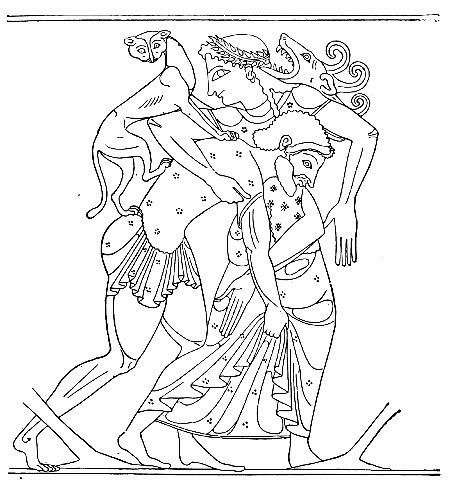
FIG. 128. PELEUS SEIZING THETIS (BRITISH MUSEUM).
The next event is the Judgment of Paris, perhaps of all the scenes from the story of the Trojan War the most popular with the vase-painters of all periods. The story of the forsaken Oenone, in the telling of which Tennyson has familiarised us with the scene of the Judgment, did not appeal to the unromantic Greeks in the same way. We only find one vase on which she is possibly represented.[1352] Curiously enough, the vase-paintings seldom show the central act of the story—the award of the golden apple. In fact, in the earlier examples Paris is omitted altogether, and we only see the three goddesses led in procession by Hermes. One vase, again, represents the preparations of the goddesses for the trial, Athena washing at a fountain and Aphrodite performing her toilet with the assistance of Eros.[1353] The rest may be classified as follows (the order adopted showing a rough chronological development of the type[1354]):
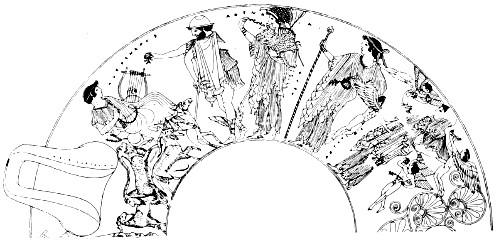
From Wiener Vorlegeblätter FIG. 129. THE JUDGMENT OF PARIS (CUP BY HIERON IN BERLIN).
(1) Hermes leads the three goddesses, Athena alone being characterised; Paris absent. Only on B.F. vases.[1355]
(2) Procession-type preserved, but Paris is present, standing. Type modified on R.F. vases.[1356]
(3) Procession-type; Paris seated; landscape introduced (see Fig. 129).[1357]
(4) Procession-type abandoned; goddesses picturesquely grouped, with attendant figures. Only on R.F. and later vases.[1358] In one instance two stages seem to be represented: first, the goddesses grouped for the Judgment, accompanied by Apollo, Helios, and Selene; secondly, the victorious Aphrodite crowned by Eros.[1359]
Parodied renderings of the subject also occur.[1360]
The reward of Paris for his judgment was, as we know, “the fairest wife in Greece.” Accordingly we next find him arrived at Sparta and carrying off the fair Helen as his bride. The vases (all of the R.F. and late periods) depict him on his arrival at Menelaos’ palace introduced to Helen,[1361] or else we see Helen at her toilet making preparations for her new consort[1362]; next, Paris leads away Helen or carries her off in his chariot,[1363] and finally introduces her to his father Priam on his return home.[1364]
The war having now broken out, we are introduced to the two chief heroes on the Greek side, Achilles and Ajax, as they bid farewell to their family and friends and set out in full equipment. Achilles, accompanied by Patroklos, Menoitios, and other heroes, bids farewell to his parents Peleus and Thetis[1365]; he also pays a farewell visit to his grandfather Nereus, who presents him with a crown,[1366] and receives a valedictory libation from a Nereid.[1367] Again, we see Achilles and Patroklos taking leave of Nestor, accompanied by Antilochos.[1368] Ajax is represented taking leave of Lykos,[1369] and also of his father Telamon[1370]; but as in one of the latter cases the names are wrongly applied on the vase, it may only represent an idealised departure of an ordinary warrior. There is also a vase which represents Nestor arming (putting on a greave) in presence of Euaichme.[1371]
We next find the warriors gathered in Aulis, waiting for the favouring breeze, and whiling away the time (as Euripides describes[1372]) in the game of πεσσοί or draughts, which is played by Ajax and Achilles (names usually given) seated at a raised board in full armour, with the statue of Athena behind them.[1373] There is another variety of the type, in which the presence of Athena seems to have more meaning. Here the two heroes cast lots with dice before the statue, and there may be some reference to the dispute of Ajax and Odysseus for the arms of Achilles, which was settled by Athena.[1374] The story of the sacrifice of Iphigeneia, though popular with poets and painters, for some reason never found its way on to the vases until the influence of great pictures and plays was beginning to make itself felt; and then only appears in one instance, where the transformation into a deer is indicated.[1375] The only other incident of the voyage which concerns us is the halt at Lemnos and the sacrifice to the local goddess Chryse, where Philoktetes is bitten by the serpent and has to be left behind on account of his wound.[1376] This island was also the scene of the carrying off by Achilles of Chryseis, the daughter of Chryses, the priest of the local goddess, of which there is one possible representation.[1377]
Two doubtful references to opening scenes of the war are to be found in a supposed consultation of Zeus with Themis among the Olympian deities,[1378] and a representation of the Greeks formally demanding back Helen,[1379] a demand which of course was not granted. The story of Telephos also belongs to an early stage, and three incidents therefrom are found. In one case he is represented as wounded by the spear of Achilles[1380]; again, entering the Greek camp disguised as a beggar, in order to apply to Agamemnon for aid[1381]; and, lastly, he is seen seizing the infant Orestes, whom he threatens to destroy if his request is not granted.[1382] A R.F. kylix in Boston represents in the interior Odysseus persuading Achilles to heal Telephos’ wound; on the exterior the wounded hero comes, not to Agamemnon’s tent, but to his palace at Mycenae.[1383]
At a much later stage of the war comes the incident of Troilos, a subject which attained to great popularity, especially with the B.F. vase-painters. It falls into five distinct scenes: (1) the departure of Troilos, with his two horses[1384]; (2) the ambuscade of Achilles behind the fountain to which Polyxena comes to draw water[1385]; (3) the flight of Troilos and Polyxena, and pursuit by Achilles[1386]; (4) the death of Troilos[1387]; and (5) the fight over his body.[1388] Of these, the ambuscade and the pursuit are the most commonly represented.
A few incidents which are not to be traced in literature probably belong to the Ante-Homeric period. They are (1) Achilles bandaging the wounded Patroklos, on the well-known Sosias cup[1389]; (2) the wounded Achilles tended by Patroklos and Briseis[1390]; (3) a combat of Hector and Achilles attended by Sarpedon and Phoinix (in one case Phoinix interrupts)[1391]; (4) a general combat of Greeks and Trojans.[1392]
It will be most convenient to deal with the various scenes which can be traced to the Homeric poems (or to co-ordinate traditions) in tabular form, noting where possible the actual passages which they appear to illustrate. But it must be borne in mind that the vase-painter was never an illustrator; he rather looked to literature for suggestions, which he worked out on his own lines, and consequently coincidences with or divergencies from the Homeric text must not be too closely insisted upon.
Book I. 187 ff. The dispute of Agamemnon and Achilles.
Possibly to be identified in such scenes as on B.M. B 327, 397, and E 13; but very doubtful: see below, p. 133, and Robert, Bild u. Lied, p. 213.
320 ff. Agamemnon and Briseis.
Reinach, i. 148 = Baumeister, i. p. 721, fig. 776 (Hieron in Louvre); and see B.M. E 76. Achilles and Briseïs are found grouped together on two R.F. vases, but without any particular allusion: see B.M. E 258 and Helbig, 84 = J.H.S. i. pl. 6 = Reinach, ii. 91.
430 ff. Chryses propitiating Apollo.
Engelmann-Anderson, Atlas to Iliad, iii. 12.
Book II. 50 ff. Agamemnon in council.
B.M. B 149.
212 ff. Thersites insulting Agamemnon.
B.M. E 196.
Book III. 259 ff. Priam setting out in his chariot.
Jahrbuch, iv. (1889), pl. 10.
340 ff. Combat of Menelaos and Paris.
B.M. E 20; Duris kylix in Louvre (Wiener Vorl. vi. 7 = Engelmann-Anderson, vi. 23).
Book V. 95–296. Combat of Diomedes and Pandaros (a reminiscence of).
Berlin 764 = Ant. Denkm. i. pl. 7, fig. 15; and see Hermes, 1901, p. 388; actually here Diomedes and Aeneas fight over the body of Pandaros.
312 ff. Combat of Diomedes and Aeneas, the latter protected by Aphrodite.
B.M. E 73; Tyszkiewicz Coll. pl. 18 (very fine R.F. vase, now in Boston); Reinach, i. 120 = ii. 97 (B.F.).
Book VI. 215 ff. Diomedes and Glaukos exchanging arms.
Stackelberg, pl. 11, 1.
258 ff. (1) Hector arming.
Munich 378 = Reinach, ii. 94 = Furtwaengler and Reichhold, pl. 14.
(2) Hector bidding farewell to Priam and Hecuba.
Helbig, 134 = Reinach, ii. 94 = Engelmann-Anderson, iii. 38.
(3) Hector bidding farewell to Andromache and Astyanax.[1393]
J.H.S. ix. pl. 3 = B.M. E 282; Reinach, ii. 255 = Bibl. Nat. 207.
(4) Departure of Hector.
B.M. B 76, B 235 (?); Louvre E 638 (= Reinach, i. 243), E 642; Reinach, ii. 160; Jahrbuch, iv. (1889), p. 260.
321 ff. Hector conducting Paris to battle.
Bibl. Nat. 207 = Reinach, ii. 255.
Book VII. 162 ff. Combat of Ajax and Hector.
Munich 53; Helbig, 6 = Reinach, i. 104 (see under xiv. 402 ff.); Baumeister, i. pl. 13, figs. 779–80; B.M. E 438 (Smikros); and see Duris kylix in Louvre (Wiener Vorl. vi. 7 = Engelmann-Anderson, vii. 42).
Book VIII. 89 ff. Combat of Hector and Diomedes.
Reinach, ii. 96.
261 ff. Teukros and Ajax son of Telamon.
Robert, in Hermes, 1901, p. 390, mentions a fragment of a Corinthian pinax in Berlin with these two figures, which may either belong to the above passage, or to xii. 370 ff., or to xv. 415 ff.
397 ff. Iris interrupting Athena (see pp. 39, 77).
Reinach, ii. 296.
Book IX. Achilles lying sick (apparently a contaminatio or confusion of ix. 168 ff. and xviii. 35 ff.).[1394]
Jahrbuch, vii. (1892), pl. 1.
173 ff. Embassy of Odysseus and Phoinix to Achilles (R.F. vases only).
B.M. E 56 = Wiener Vorl. C. 3, 3; Berlin 2176 (= Reinach, i. 282), 2326 (= Reinach, i. 431 = Roscher, iii. 658); Millin-Reinach, i. 14; Reinach, i. 148 = Wiener Vorl. C. 6 (Hieron) and 149.
Book X. 330–461. Episode of Dolon; his capture by Odysseus.
Oxford 226; Munich 583 = Jahrbuch, v. (1890), p. 143; Bibl. Nat. 526 = Reinach, i. 89 = Wiener Vorl. v. 5 (Euphronios); Reinach, i. 334 = Petersburg 879; B.M. F 157 = Fig. 130. Dolon as single figure: Reinach, i. 306 = Wiener Vorl. iii. 1.
469–525. Rhesos and his horses.
B.M. B 234–35; Naples 2910 = Baumeister, i. p. 728, fig. 782 (Odysseus and Diomedes with the horses); Wiener Vorl. C. 3, 2.
566 ff. The horses of Rhesos brought to the tent of Diomedes.
Munich 583 = Jahrbuch, v. (1890), p. 146 (a slave waters the horses; another brings drink to Diomedes).
Book XI. The fight at the ships.
Munich 890 = Reinach, ii. 99 = Baumeister, i. p. 729, fig. 783.
Book XIV. Combat of Ajax and Aeneas (? l. 402 ff.).
Reinach, i. 306 = Wiener Vorl. iii. 1; id. i. 104 = Helbig, No. 6 (? see above, under vii. 162 ff.).
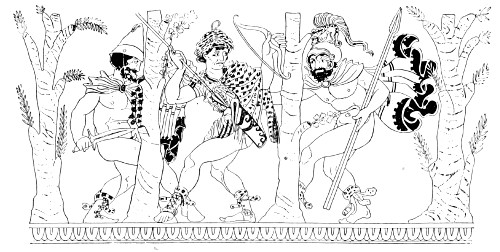
FIG. 130. CAPTURE OF DOLON (LUCANIAN KRATER IN BRITISH MUSEUM).
Book XVI. 666 ff. Sarpedon carried off by Hypnos and Thanatos.
See Louvre F 388; but this scene is hardly to be distinguished from those with Memnon (see below, p. 132).
Book XVII. 60 ff. Combat of Menelaos and Euphorbos, and fight over his body.
B.M. A 749 = Baumeister, i. p. 730, fig. 784[1395]; and see E 20.
123 ff. Combat over body of Patroklos.
Exekias kylix (Munich 339 = Reinach, ii. 36); Reinach, ii. 95; Millin-Reinach, i. 49; Berlin 2264 (Oltos and Euxitheos) = Wiener Vorl. D. 2, 1 = Engelmann-Anderson, xiv. 76.
Book XVIII. 367 ff. (1) Thetis in the smithy of Hephaistos.
Berlin 2294 = Overbeck, Her. Bildw. 18, 6.
(2) Hephaistos polishing Achilles’ shield.
Röm. Mitth. ii. (1887), p. 242.
Book XIX. 1–18. Thetis and the Nereids bringing the armour to Achilles.
(a) Riding on sea-monsters over the waves (all late vases).
B.M. F 69; Jatta 1496 = Reinach, i. 112; Roscher, iii. 221–24; and see Heydemann, Nereiden mit Waffen.
(b) Presenting the weapons to Achilles.
B.M. E 363; Millin-Reinach, i. 14.
364 ff. Achilles arming.
Athens 671 = Wiener Vorl. ii. 6; Overbeck, Her. Bildw. xviii. 4, 7; vase by Amasis at Boston (Report for 1901, No. 5).
Book XXI. 114 ff. Combat of Achilles and Lykaon.
B.M. F 173.
Book XXII. 188 ff. Achilles pursuing Hector round the walls of Troy.
Reinach, ii. 102 (now in Boston: see Museum Report for 1898, No. 42).
209 ff. Zeus weighing the heroes’ souls in his scales.[1396]
B.M. B 639; Bibl. Nat. 385 = Reinach, i. 89; Millin-Reinach, i. 19 = Baumeister, ii. p. 921, fig. 994.
306 ff. Death of Hector.
B.M. E 468; Munich 421; Reinach, ii. 101 = Helbig, 106; Boston Mus. Report for 1899, p. 79, No. 31 (parody). Cf. Millingen, Anc. Uned. Mon. i. 4 = Engelmann-Anderson, Odyss. iii. 15.
437 ff. Andromache suckling Astyanax (compare only).
B.M. E 509.
Book XXIII. 157 ff. Funeral games for Patroklos.
François vase (chariot-race, etc.).
175 ff. Sacrifice of Trojan captives on the pyre of Patroklos.
Naples 3254 = Reinach, i. 187.
Book XXIV. 16 ff. Achilles dragging Hector’s body past the tomb of Patroklos.
B.M. B 543 and Forman Sale Cat. 306 = Reinach, ii. 100 (now in B.M.)[1397]; Berlin 1867 = Reinach, ii. 99; Naples 2746.
141 ff. Achilles offering his hair to the river Spercheios.
B.M. E 555 (?).
448 ff. Priam begging Achilles for the body of Hector; the Achaean princes deliberating over the ransom.
Munich 404 (= Overbeck, Her. Bildw. pl. 20, 3), and 890 (= Reinach, ii. 99); Petersburg 422 = Reinach, i. 138 = Baumeister, i. p. 739, fig. 792; Reinach, i. 172 = Vienna 328; Athens 889 = Ath. Mitth. 1898, pl. 4 (B.F., but poor).
580 ff. Hector’s body carried out to prepare for burial.
Petersburg 422 (as above).
Among the events of the war between the death of Hector and the final fall of Troy, those which relate to the final exploits of Achilles are most prominent, and especially the encounters with Memnon, and with Penthesileia, his death and the events arising out of it. The story of Achilles’ fight with Penthesileia, and the death of the Amazon queen, is less frequently depicted, but there are some very fine examples remaining.[1398] Other representations of Amazons arming, setting out, or in combat may be placed here, but except where Penthesileia is specially indicated it is better to regard them as having no definite reference to the Trojan story.[1399] A remarkable painting on an Apulian amphora depicts the slaying of Thersites by Achilles in the presence of Phoinix and Diomedes. Thersites had insulted Achilles after his slaying of Penthesileia.[1400]
The story of Memnon is related on the vases in several scenes, beginning with his equipment and departure for the fray.[1401] Next we see the great fight of Achilles and Memnon over the body of Antilochos,[1402] at which the respective mothers of the heroes, Thetis and Eos, are usually present as spectators.[1403] The result of the fight was fatal to Memnon, whose body we see carried off by Thanatos and Hypnos,[1404] or by Eos herself,[1405] for burial in his native land. Eos is also represented mourning over him.[1406] The Psychostasia, or weighing of souls by Zeus (see p. 130), has also been referred to this event. The body of Antilochos is finally rescued and carried off by Nestor.[1407]
Lastly, we find a few possible representations of the death of Achilles,[1408] and others, more certainly to be identified, of the battle raging round his body, in which Diomedes is wounded[1409]; also of Ajax carrying the body off out of the battle,[1410] and the subsequent mourning of the Nereids over it.[1411] A representation of the ghost of a warrior, winged and fully armed, flying over a ship,[1412] is to be regarded as that of Achilles, though to what event it alludes is not clear. The dispute over the hero’s armour and the suicide of the disappointed Ajax are introduced by a scene representing the fetching of Neoptolemos, his son, from Skyros, where he bids farewell to Lykomedes and Deidameia[1413]; of the quarrel between Ajax and Odysseus there are also several representations.[1414] It was decided finally by Athena, who is represented presiding over the Greek chiefs as they vote[1415]; or, according to another version, they cast lots before her statue.[1416] The armour is then awarded to Neoptolemos,[1417] who, according to an oracle, was indispensable for the capture of Troy. Ajax goes mad with disappointment, and finally commits suicide by falling on his sword[1418]; the episode of his slaying the sheep is not, however, represented.
The Ἰλίου Πέρσις, or sack of Troy, which is so vividly represented on many of the vases of advanced and late style, may be said to begin with the episode of the seizure of the Palladion by Odysseus and Diomede.[1419] It is rapidly followed by the construction of the wooden horse and its entry into the city.[1420] There is, however, only one certain representation of the death of Laokoön to be traced,[1421] and none of the traitorous Sinon.
Several vases, especially of the later epoch, collect the chief episodes in a frieze or in a series of groups, including the rape of Kassandra by Ajax, son of Oileus, the death of Priam and Astyanax, the recapture of Helen by Menelaos, and the flight of Aeneas; other scenes represented are the leading back of Aithra by Akamas and Demophon, and the sacrifice of Polyxena and subsequent blinding of Polymestor by Hecuba.
I. General.
Berlin 1685 (= Overbeck, Her. Bildw. pl. 26, 1) and 2281; Plate LIV. = Furtwaengler and Reichhold, pl. 25 (Brygos in Louvre); Naples 2422 = Furtwaengler and Reichhold, pl. 34 = Baumeister, i. pl. 14, fig. 795; B.M. F 160, F 278.
II. (a) Ajax seizing Kassandra at the altar of Athena.
B.F. B.M. B 242, 379; Berlin 1698; Roscher, ii. p. 979.
R.F. B.M. E 336, E 470; Reinach, i. 221, 338 = Roscher, ii. pp. 985, 981; Bourguignon Sale Cat. 33.
Late. B.M. F 209; Roscher, ii. p. 983.
(b) Death of Priam and Astyanax.[1422]
(1) Priam only.
B.M. B 241; Röm. Mitth. iii. (1888), pp. 108–9; Reinach, ii. 109; Berlin 3996. [Priam dead in all except second.]
(2) Priam usually seated on altar; Neoptolemos swings body or head of Astyanax.
B.M. B 205; Berlin 2175, 3988; Reinach, i. 221, ii. 109; J.H.S. xiv. pl. 9. [See also under I.]
(3) Andromache or Hecuba with body of Astyanax.
Millin-Reinach, ii. 37 (Lasimos in Louvre; also identified as Archemoros: see p. 118).
(c) Menelaos and Helen.
B.M. E 161, 263; Reinach, i. 437, 3 (Hieron), ii. 34; Helbig, 43 (= Mus. Greg. ii. 49, 2), and ii. p. 325 (= Baumeister, i. p. 746, fig. 798); Millingen, Anc. Uned. Mon. pl. 32; Louvre G 3 (Pamphaios); Reinach, i. 222 = Wiener Vorl. D. 8, 1; Noel des Vergers, Étrurie, iii. pl. 39.
(d) Akamas and Demophon with Aithra.
B.M. B 244 (?), E 458; Overbeck, Her. Bildw. pl. 26, 13.
(e) Flight of Aeneas with family.
B.M. B 173, B 280; Reinach, ii. 110 (= Munich 903), 116, 273; Baumeister, i. p. 31, fig. 32; Helbig, 201 = Mus. Greg. ii. 85, 2; Naples 2481; Bibl. Nat. 261; Louvre F 122 = Wiener Vorl. 1890–91, pl. 5, 1.
(f) Sacrifice of Polyxena.
Plate XXIII. = J.H.S. xviii. pl. 15 (B.M.); Overbeck, Her. Bildw. pl. 27, 19.
(g) Polymestor blinded.
Reinach, i. 91 = Hill, Illustrations of School Classics, p. 170 (now in B.M.).
(h) Ajax stabbing a captive (?).
Reinach, i. 88.
PLATE LIV
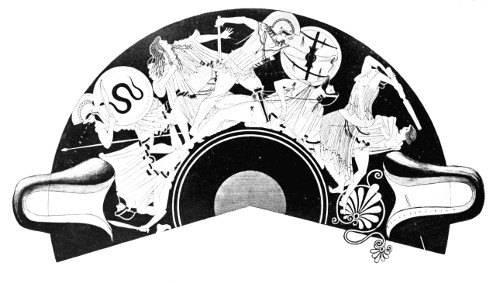
From Furtwaengler and Reichhold. The Sack of Troy; Kylix by Brygos in Louvre.
Among the various adventures described by the Cyclic poets in the Νοστοί, few seem to have found their way into the vase-paintings except the fate of Agamemnon, the interview of Menelaos with Proteus (told in the Odyssey), and, of course, the adventures of Odysseus.
The house of Atreus and its story will be dealt with later under the heading of the Oresteia: we turn now to the Odyssey, scenes from which are surprisingly few in Greek art, and appear to have attracted the painter less than the more stirring events of the Iliad. The following, however, have been identified:
Book II. 94 ff. Penelope at her loom.
Reinach, i. 191.
Book III. 12 ff. Arrival of Telemachos at Nestor’s house in Pylos.
Berlin 3289 = Roscher, iii. 298 = Engelmann-Anderson, iii. 13.
Book IV. 349 ff. The story of Menelaos’ interview with Proteus.
Naples 1767 = Mus. Borb. xiii. 58 = Engelmann-Anderson, iv. 22.
Book V. 228 ff. Odysseus navigating the sea on a raft.
Oxford 262, Cat. pl. 26 (burlesque). See also B.M. E 156 (Odysseus and Leukothea).
Book VI. 126 ff. Nausikaa washing clothes.
Munich 420 = Reinach, ii. 110 = Roscher, s.v.
Alkinoös and Nausikaa (parody).
Reinach, i. 153.
Book IX. 345 ff. Odysseus offering wine to Polyphemos.
Boston Mus. Report, 1899, p. 60.
371 ff. Odysseus putting out the eye of Polyphemos.
Plate XVI. = Helbig, i. p. 435, No. 641 (Aristonoös); Bibl. Nat. 190 = Reinach, i. 64; B.M. B 154; Louvre F 342 = Gaz. Arch. 1887, pl. 1; Berlin 2123; Arch. Anzeiger, 1895, p. 35; Jahrbuch, 1891, pl. 6: see Bolte, Monum. ad Odyss. pert. p. 2.
420 ff. Odysseus escaping under the ram.
B.M. B 407, 502, 687; Karlsruhe 167 = J.H.S. iv. p. 249; Louvre A 482; Reinach, i. 64: see also Ath. Mitth. 1897, pl. 8 (a very early instance); generally, J.H.S. iv. p. 248 ff., and Rev. Arch. xxxi. (1897), p. 28 ff.
Book X. 210 ff. Odysseus and Kirke (see J.H.S. xiii. p. 82).
(a) Arrival of Odysseus.
Reinach, i. 142 = Roscher, ii. 1195.
(b) Transformations of comrades.
Reinach i. 396; Berlin 2342 = ibid. i. 418; Boston Mus. Report, 1899, pp. 59, 61 (both early B.F.).
(c) Odysseus and Kirke.
J.H.S. xiii. pls. 2 (Athens 956), 4 (in B.M.), p. 81 (Oxford 262); and see Reinach, i. 142.
Book XI. 23 ff. Odysseus sacrificing before his visit to Hades.
Bibl. Nat. 422 = Reinach, i. 126 = Baumeister, ii. p. 1040, fig. 1254.
Book XII. 164–200. Odysseus passing the Sirens.
Athens 958 = J.H.S. xiii. pl. 1; B.M. E 440; and see J.H.S. vi. pl. 49, p. 20 (= Louvre F 123); Corinthian aryballos in Boston (Strena Helbigiana, p. 31).
Scenes from the last twelve books are even rarer:
Book XVIII. 35 ff. Odysseus and Iros.
Reinach, ii. 357.
Book XIX. 385 ff. Odysseus recognised by Eurykleia.
Reinach, i. 191.
394 ff. The story of Autolykos.
In connection herewith see Munich 805 = Reinach, i. 277 for a possible representation of the betrothal of Laertes and Antikleia (Hermes, 1898, p. 641; Robert, Homer. Becher, p. 90 ff.; Hyginus, Fab. 201).
Book XXI. 393—XXII. 5 ff. The slaying of the suitors.
Berlin 2588 = Reinach, i. 217.
The scenes from the Oresteia cover roughly the same ground as the great trilogy of Aeschylos, together with the Iphigeneia in Tauris and the Andromache of Euripides. We have first the murder of Agamemnon by Klytaemnestra with her axe.[1423] Next, Elektra making her offerings at the tomb of Agamemnon, sometimes accompanied by her sister Chrysothemis.[1424] It must be borne in mind that the “type” of this scene does not differ in any respect from ordinary scenes of “offering at a stele,” and therefore, where the names are not given or are obviously modern additions, this interpretation is at best a doubtful one. The same applies to the next series of vases, on which Orestes meets Elektra at the tomb[1425]; but there seems to be one undoubted instance of Orestes and Pylades with the urn containing the supposed ashes of the former (cf. Soph. Electra, 1098 ff.).[1426] The next group to be dealt with shows us Orestes slaying Aegisthos,[1427] while Klytaemnestra is held back by Talthybios[1428]; and, finally, the death of Klytaemnestra herself.[1429]
Orestes is then pursued by the Furies,[1430] and seeks refuge at Delphi, where he is purified by Apollo at the Omphalos[1431]; and he is also seen at Athens, where he afterwards sought the protection of Athena.[1432] Other vases, nearly all of late date, and therefore under the influence of the Euripidean tragedy, represent Orestes accompanied by Pylades, arrived at the temple of the Tauric Artemis, where Iphigeneia presents Pylades with the letter.[1433] Lastly, we have the death of Neoptolemos at the hand of Orestes at Delphi.[1434]
Attic Legends
It will now be necessary to deal with sundry isolated subjects, which do not admit of being grouped together round the name of any one great hero or any particular legend. There are, however, a certain number which may perhaps be regarded as having a special connection with Athens, and with these we will begin.[1435] Some of the specially Athenian myths have already been discussed in other connections, notably the story of Theseus (p. 108), the dispute of Athena and Poseidon (p. 24), the sending of Triptolemos (p. 27), and the rape of Kephalos by Eos[1436] and of Oreithyia by Boreas (p. 80). There remain then the following:
(1) The birth of Erichthonios, who is represented as received by Athena from Gaia emerging out of the earth, in the presence of Kekrops and his daughters. It only occurs on the later R.F. vases; the type closely resembles that of the birth of Dionysos (p. 19).
B.M. E 372; Berlin 2537 = Reinach, i. 208 = Wiener Vorl. B. 12; Munich 345 = Reinach, i. 66; and Reinach, i. 113 = Wiener Vorl. iii. 2. Also a scene from the childhood of Erichthonios: B.M. E 788.
(2) The reception of Dionysos in Attica (by Ikarios or Amphiktion).
B 149, B 153, and E 166 in the British Museum appear to refer to this, but not certainly. See above, p. 56.
(3) The story of Tereus and his daughters, Prokne and Philomela.[1437]
(a) Tereus meeting Apate (Deceit); Prokne and Philomela in chariots.
Naples 3233 = Reinach, i. 240.
(b) Prokne and the dumb Philomela:
Reinach, i. 308 (in Louvre).
(c) Aedonaia slaying Itys.
J.H.S. viii. p. 440 (= Munich 799a).
(4) The three sons of Pandion, Lykos, Nisos, and Pallas,[1438] with Orneus the son of Erechtheus.
Reinach, i. 510 = Roscher, ii. 2187.
(5) The death of Prokris by the agency of Kephalos.
B.M. E 477 (with Siren as soul of Prokris or death-deity).
(6) Kreousa defended by Apollo from the attack of Ion.
Reinach, i. 375: cf. Eur. Ion. 1250 ff.
(7) Danaos taking refuge in Attica (?).
Reinach, i. 244 = Wiener Vorl. iii. 4, 2 (in Louvre).
(8) Echelos carrying off Basile.[1439]
Arch. Anzeiger, 1895, p. 39: see p. 27.
(9) The story of Diomos, the eponymous deme-hero (?).
B.M. B 178 = J.H.S. xiii. p. 116.
(10) Kodros, the last king of Athens.
Bologna 273 = Baumeister, iii. p. 1998, fig. 2148 = Jahrbuch, 1898, pl. 4.
The Kodros cup (completely published in Wiener Vorl. i. 4) is decorated with groups of figures intended to illustrate the legendary history of the great Attic families, in accordance with the genealogising tendencies of the period (about 450 B.C.). The outer scenes represent Theseus taking leave of Aigeus, and Ajax taking leave of Lykos; and Aigeus and Ajax (Aias) are eponymous heroes of two Attic tribes. On the Meidias vase in the British Museum[1440] we see a group of Athenian tribal heroes, such as Akamas, Antiochos, Demophon, and Hippothon, together with Medeia, who is also connected with Athens in the Theseus scene of the Kodros cup.
Other isolated myths which occasionally appear on vases, but defy more exact classification, may be briefly recorded here:
(1) Admetos and Alkestis.
Bibl. Nat. 918 = Reinach, i. 395 = Dennis, Etruria2, ii. frontispiece. See also p. 69.
(2) Agamedes and Trophonios as prisoners fed by Augias.
Louvre E 632 = Reinach, i. 349 (see Paus. ix. 37, 5; Ann. dell’ Inst. 1885, p. 130).
(3) Agrios seized by Oineus and bound on the altar.
B.M. F 155: see Anton. Liber. 37 and Vogel, Scenen Eur. Trag. p. 125.
(4) Atalante offering a cup to her antagonist Hippomenes.
R.F. kotyle in B.M.
(5) Atreus and Thyestes (the latter as suppliant in the former’s palace?).
Millingen-Reinach, 23 = Wiener Vorl. B. 4, 1.
(6) Daidalos and Ikaros, flight of.
Naples 1767 = Gaz. Arch. 1884, pls. 1–2.
(7) Glaukos in the tomb brought to life by the seer Polyeidos.
B.M. D 5 = Plate XL.: see Apollod. iii. 3, 1.
(8) Kanake’s suicide.
Reinach, i. 448.
(9) Laios, Keleos, Kerberos, and Aigolios stung by bees when stealing the honey on which the infant Zeus was fed.
B.M. B 177: cf. Anton. Liber. 19 and Roscher, i. p. 154.
(10) Lykourgos destroying his children in a frenzy.
B.M. F 271; Naples 3219 = Reinach, i. 125, and 3237 = Baumeister, ii. pp. 834–35. See also Reinach, i. 333: Lykourgos slaying Thoas; and p. 56.
(11) Melampus healing the daughters of Proitos from their madness at the altar of Artemis Lusia, in the presence of Dionysos.
Naples 1760 = Millingen-Reinach, 52 = Wiener Vorl. B. 4, 3.
(12) Merope (a scene from the tragedy of that name).
Munich 810 = Reinach, i. 363: see Vogel, Scenen Eur. Trag. p. 118.
(13) Pandareos with the golden dog of Zeus, which he stole.
Louvre A 478 = Hermes 1898, p. 638; Bull. de Corr. Hell. 1898, p. 586.
(14) Peleus wrestling with Atalante.
Munich 125 (= Reinach, ii. 120 = Furtwaengler and Reichhold, pl. 31), and 584 = Reinach, ii. 88; Bibl. Nat. 818 = Gaz. Arch. 1880, pl. 14; Micali, Mon. Ined. pl. 41.
(15) Peleus hunting a stag.
Berlin 2538 = Reinach, ii. 162: cf. Apollod. iii. 13, 3.
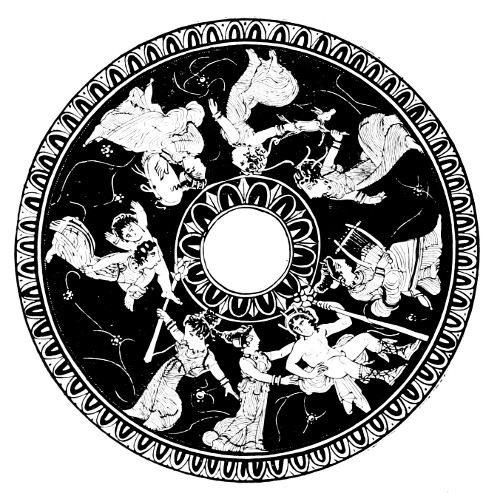
FIG. 131. PENTHEUS SLAIN BY MAENADS (BRITISH MUSEUM).
(16) Pentheus torn to pieces by his mother Agave and the frenzied Maenads.
B.M. E 775 = Fig. 131; Munich 807 = Baumeister, ii. p. 1204, fig. 1396; Jatta 1617 = Müller-Wieseler, Denkmaeler, ii. 37, 436; Jahrbuch, 1892, pl. 5 (and see p. 154); Gaz. Arch. 1879, pls. 4–5 (?).
(17) Phaon with Chryse and Philomele.
Furtwaengler and Reichhold, pl. 59 (vase in Palermo, formerly interpreted as Dionysos and Ariadne: see text, p. 296, for the correct interpretation).
(18) Phineus invoking the gods.
B.M. E 291 = Wiener Vorl. C. 8, 1. For other Phineus scenes, see pp. 81, 115.
(19) The madness of Salmoneus.
Amer. Journ. of Arch. 1899, pl. 4 (interpreted as Athamas): cf. Class. Review, 1903, p. 276 and Harrison, Prolegomena to Gk. Religion, p. 61.
(20) Thoas placed in the chest by Hypsipyle.
Berlin 2300 = Reinach, i. 273: see Ap. Rhod. i. 622, and Hartwig, Meistersch. p. 374.
(21) Aktor and Astyoche (uncertain reference).
Jahrbuch, 1902, pl. 2 (in Boston): see ibid. p. 68, Il. ii. 513 and 658; Schol. in Pind. Ol. vii. 42.
(22) The foundation of Boiae in Laconia by the appearance of a hare.
Reinach, ii. 333 = Inghirami, Vasi Fitt. 120 (this is exceedingly doubtful).
(23) Two boys delivered to a Nymph (unknown myth).
Wiener Vorl. E. 12, 3.
The story of Orpheus often finds a place on vases of the R.F. period,[1441] but is chiefly confined to two episodes, his playing the lyre among a group of Thracians[1442] (the men recognisable by their costume, see p. 179), and his pursuit by the Thracian women[1443] and subsequent death at their hands.[1444] In one scene his head after his death is made use of as an oracle.[1445] He is often present in under-world scenes (see p. 68), but not always in connection with the fetching back of Eurydike.[1446]
Thamyris, a quasi-legendary figure, appears contending with the Muses for pre-eminence with the lyre[1447]; on one fine R.F. vase he is accompanied by Sappho,[1448] who, though strictly an historical personage, appears among the Muses in quasi-mythical guise; he also plays the lyre among Amazons.[1449] Other semi-historical persons enveloped in a cloud of fable are: Taras, the founder of Tarentum[1450]; Midas, who is generally represented with asses’ ears, and is depicted judging the Seilenos who was caught in his rose-garden and is led before him with hands tied[1451]; and Minos, who appears at the slaying of the Minotaur by Theseus,[1452] and in the under-world as one of the judges of souls.[1453]
Nor must we omit to mention the Amazons, who play such a large part on Greek vases; besides their connection with various legendary events, they are often employed purely as decorative figures. Mention has already been made of their combats with Herakles and Theseus, and of the part played by their queen Penthesileia in the Trojan War[1454]; and we also find them in such scenes as the Judgment of Paris[1455] and Herakles’ fight with Kyknos.[1456] They also contend with Gryphons[1457]; and many battle scenes in which they are opposed to Greek warriors may also be here alluded to as not admitting of more definite identification.[1458] They are further represented arming and preparing for the fray,[1459] or setting out on horseback,[1460] or defending a besieged city[1461]; and as decorative figures we see them charging,[1462] stringing bows[1463] and discharging arrows,[1464] blowing a trumpet,[1465] running by the side of a horse or checking a restive animal,[1466] or fastening a shoe[1467]; or in peaceful converse with a Greek warrior,[1468] or else without any distinguishing action.[1469] Nearly all these subjects belong to the R.F. and later periods.
We may conclude this section with an account of the monstrous semi-human, semi-bestial creatures, which play a large part in the decoration of Greek vases, and appear in connection with many legends. Such are the Centaurs, half man, half horse; the Gorgons, winged women with snaky locks; the Harpies, also found on early vases in the form of winged women; and mythical creatures like Pegasos, the Chimaera, or the Minotaur.
The Centaurs, who probably symbolise mountain torrents or other forces of nature, appear (mostly on early vases) in combat with Herakles, either in troops or in single combat, as in the stories of Nessos, Dexamenos, and Eurytion[1470]; or, again, in the scenes so often celebrated in the sculptured friezes and metopes of Greek temples, where they contend with Theseus and Peirithoös,[1471] or with the Thessalian Lapiths.[1472] Among the latter a common episode is the death of Kaineus, whom the Centaurs buried in the earth, showering rocks upon him.[1473] In a more peaceful aspect appear the aged Centaurs, Pholos and Cheiron, especially in the stories of Herakles and Achilles,[1474] both of whom are brought to the latter for their youthful education.[1475] As the friend of Peleus Cheiron often assists at his capture of Thetis.[1476] Centaurs, especially Pholos, are sometimes represented returning from the chase,[1477] or as single decorative figures[1478]; in one case they fight with cocks.[1479] Nike in one or two instances is drawn in her chariot by male or female Centaurs[1480]; and, finally, representations of youthful Centaurs are found, though usually they are middle-aged.[1481]
The Gorgons appear almost exclusively in connection with the Perseus legend,[1482] but are besides frequently found as decorative figures, especially on B.F. vases,[1483] in the running attitude characteristic of archaic art, in one case between two Sphinxes.[1484] Besides these, the head or mask of the Gorgon Medusa, familiar at all periods as a decorative motive of Greek art—first with an ugly and grotesque face, afterwards refined and beautiful—is often found by itself on Greek vases, especially as an interior central ornament of B.F. kylikes.[1485]
Harpies, conventionally associated through the medium of the Roman poets[1486] with the human-headed bird-form which really denotes the Siren, are found invariably on vases in the form of winged women.[1487] They are, as has been elsewhere noted (p. 81), associated with the Boreades[1488] as symbolical of evil and good influences of winds, and probably should be regarded as personifications of the southern breezes (the malevolent influence of which is seen in the sirocco). Traditionally they were supposed to guard the Garden of the Hesperides in Africa, whence the hot baleful winds come. The story of Phineus is probably to be explained on these lines.[1489] A Harpy appears at the recovery of Zeus’ golden dog from Pandareos.[1490]
That the human-headed bird represents a Siren in Greek art is amply attested by the representations of Odysseus’ adventure with the vocal enchantresses.[1491] Their appearance on the so-called Harpy monument of Xanthos, however, shows them in another aspect, that of death-deities[1492]—not necessarily of a violent and rapacious character, as on a vase in Berlin,[1493] but gentle and kindly. So, again, a Siren is represented in connection with a tomb[1494]; and in a scene representing a banquet in Elysium they are depicted crowning the dead.[1495] On some vases we find a Siren playing a flute or a lyre (probably merely fanciful subjects)[1496]; or, again, two Sirens kissing each other.[1497] As mere decorative motives their appearances are countless, and many early vases are modelled in the form of Sirens[1498]; sometimes they have human arms[1499]; in one case a bird’s wings and a fish-tail[1500]; or, again, more anomalously, bearded masculine heads.[1501] More rarely they are seen flying.[1502]
The Sphinx is familiar in the first place as the monster, half woman, half dog, which vexed the city of Thebes till slain by Oedipus; this story is often alluded to on vases,[1503] but many groups of a man and a Sphinx have probably no special meaning.[1504] The Sphinx has sometimes a sepulchral reference,[1505] and is grouped with other figures, such as Atlas[1506] or a Seilenos[1507] (the latter probably a scene from a Satyric drama). Like the Siren, she is exceedingly common as a decorative figure,[1508] especially in the friezes of animals and monsters so dear to the early vase-painters. Her invariable form is that of a winged lion or dog with a woman’s bust.
The Gryphon, a kind of dragon composed of an eagle’s head and lion’s body and legs (occasionally a bird’s), is almost exclusively decorative[1509]; but on the later vases we find the fabulous combat of the Oriental Arimaspi with the Gryphons who guarded the mountain of gold in the Far East (cf. Plate XLII.)[1510]; or, again, they contend with the Amazons,[1511] with Scythians,[1512] or with ordinary Greek warriors.[1513] In one instance an Arimasp woman is seen shooting at a Gryphon of curious type.[1514] Further, they draw the chariots of deities, such as Persephone,[1515] and Dionysos[1516]; and we have already seen Apollo coming on a Gryphon from the Hyperborean regions.[1517]
Pegasos, the winged steed of Bellerophon, and the monster Chimaera which he slew, also appear as decorative figures[1518]; and the former draws the chariots of Apollo and of a woman,[1519] and also appears as a constellation with the moon and stars.[1520] A human-headed monster attacked by a hero seems to have been suggested by the Chimaera on a companion vase.[1521] The Minotaur is generally seen in connection with Theseus, but also appears as a single or decorative figure,[1522] and one vase appears to represent the youthful monster in his mother’s lap.[1523] Other monsters found occasionally on vases are Skylla, who appears, not in connection with the story of Odysseus, but with those of Perseus and Andromeda,[1524] and Phrixos and Helle,[1525] or as a single figure[1526]; and Lamia, a vampire or ogress in the form of a hideous old woman, who is seen undergoing torture from Satyrs,[1527] and in another unexplained scene.[1528] Another type of monster, the serpent-footed giant Typhon, has already been mentioned.[1529] Yet another and a unique type is that of the Nymphs with serpent bodies which protect vines from the attacks of goats.[1530]
Lastly, another creation of fancy, though not strictly mythological, is the ἰππαλεκτρύων or “cock-horse,” a bird with horse’s head, which appears on some B.F. vases ridden by a youth.[1531] This may also be a convenient place for mentioning the common decorative subject of Pygmies fighting with cranes.[1532]
Historical Subjects
The number of vases on which undoubted historical subjects have been discovered is very limited, though the old systems of interpretation exerted much ingenuity in eliciting an historical meaning from many scenes of daily life, with or without names inscribed over the figures. In the instances given below, the names are given in most cases, obviating all doubts. It is worth noting that the subjects chosen are not as a rule those that would most obviously suggest themselves. They fall into two classes, one relating to historical events and persons, the other to literary celebrities:
I. (1) The weighing of silphium by Arkesilas, one of the descendants of Battos, who ruled at Kyrene—probably the second of the name (B.C. 580–550). This scene occurs on a Cyrenaic cup in the Bibliothèque at Paris (Cat. 189: see Vol. I., p. 342, Fig. 92), which is probably a contemporary production.
(2) Kroisos, the king of Lydia, on the funeral pyre (B.C. 545). See above, p. 6.
Fig. 132 = Reinach, i. 85 = Baumeister, ii. p. 796, fig. 860 (in Louvre).
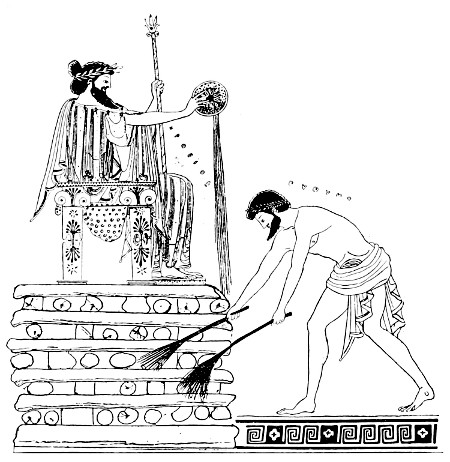
From Baumeister. FIG. 132. KROISOS ON THE FUNERAL PYRE (VASE IN LOUVRE).
(3) Harmodios and Aristogeiton slaying the tyrant Hipparchos (B.C. 510).
B.F.: Arch.-epigr. Mitth. aus Oesterr. iii. (1879), pl. 6. R.F.; Reinach, i. 449; and see a late Panath. amph. in B.M. (B 605).
(4) Diitrephes shot to death with arrows, B.C. 479 (?). See Paus. i. 23, 3, and Frazer’s note.
Bibl. Nat. 299 = Jahrbuch, 1892, p. 185 (but see Reinach, ii. p. 255, and p. 15 under Gigantomachia).
(5) The Persian king and queen.
Helbig, p. 281 = Reinach, i. 275 (see Hartwig, Meistersch. p. 525).
(6) The Persian king hunting.
Petersburg, 1790 = Reinach, i. 23 (Xenophantos): cf. Naples 2992.
(7) Dareios in council, with various deities and personifications as spectators.
Naples 3253 = Reinach, i. 194 = Baumeister, i. pl. 6, fig. 449.
(8) Battle of Greeks and Persians (with spectator-deities, etc.).
Naples 3256 = Reinach, i. 98: see also p. 179; Reinach, ii. 84; Hartwig, Meistersch. pls. 55–56 and p. 518.
(9) Battle of Greeks and Messapians.
Berlin 3264 = Reinach, i. 270.
II. (1) Sappho.
(a) As single figure.
De Witte, Coll. à l’Hôtel Lambert, pl. 3.
(b) With Alkaios.
Fig. 133 = Munich 753 = Baumeister, iii. p. 1543, fig. 1607.
(c) Reading her poems.
Athens 1241 = Dumont-Pottier, pl. 6 = Reinach, i. 526.
(d) In rivalry with Muses.
Jatta 1538 = Reinach, i. 526.
(e) With Eros (named Talas).
Abhandl. d. k. sächs. Gesellsch. viii. (1861), pl. 1, fig. 1: see p. 49.
(2) Aesop.
Helbig, 154 = Jahn, Arch. Beitr. pl. 12, fig. 2.
(3) Anakreon.
B.M. E 18: cf. E 266–67, 314–15; and see generally Jahn, Gr. Dichter auf Vasenb. in Abhandl. d. k. sächs. Gesellsch. viii. (1861), p. 699 ff.
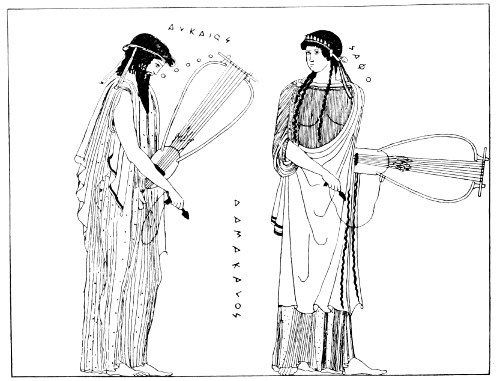
From Baumeister. FIG. 133. ALKAIOS AND SAPPHO (VASE IN MUNICH).
(4) Kydias of Hermione (a lyric poet: cf. Schol. in Ar. Nub. 967) and Nikarchos (a contemporary flute-player) are to be seen, according to Jahn (op. cit. p. 740) on a psykter in the British Museum (E 767), on which these names are inscribed over two revellers; but the identification is exceedingly doubtful. See also Munich 1096 = Jahn, op. cit. pl. 4, fig. 1.
III. Mention should also here be made of the names of historical renown which often appear on R.F. vases with the word καλός (see Vol. I. p. 403, and below, p. 267), such as Alkibiades, Glaukon, Hipparchos, Kleinias, Leagros, Megakles, and Miltiades. The question is dealt with elsewhere, and it has been shown that only in one or two cases—e.g. Leagros, Glaukon, and Kleinias (the father of Alkibiades)—can an identification with the historical personages be certainly maintained; it is, however, of sufficient interest for reference in this chapter, because the inscribed names may in some cases possibly refer to the figures depicted on the vases.[1533]