Chapter VI
Reading edition
DISLEY—A MAY DAY AT LYME—LYME HALL AND THE LEGHS.
Lyme! What a host of memories are conjured up on the very mention of the name! What a world of legend and tradition; what tales of love and gramarye, of chivalry and romance gather round. To cross the threshold of the old mansion is to step back into the shade of vanished centuries; the spirit of the past breathes through the place; and as you pace the tapestried halls and panelled chambers visions of Crescy, of Poictiers, and of Agincourt float before the eye, for the lords of Lyme—men
Stout of heart and steady of hand—
bore their part in many a gallant exploit and in many a daring enterprise in the stirring times of the Edwards and the Henrys. Their dwelling place is a perpetual reminder of the England of yore, and, though its history may be more associated with peace and hospitality than with predatory war and feudal strife, the storied and poetical associations that are interwoven with its annals place it in the forefront of the historic homes of which the fair and fertile county of Chester possesses so many notable examples. Placed, too, in a district remarkable for its natural beauty, and on the very border-land of that great storehouse of English scenery—the Peak of Derbyshire—and withal within easy distance of the great hives of manufacturing industry, no wonder that it should have become one of the favourite resorts of holiday makers.
Why don't those acred sirs Throw up their parks some dozen times a year, And let the people breathe?
asks the Poet Laureate, in a spirit that savours of reproach; but here at least his desire has been anticipated, for by the kindness and liberality of the present worthy representative of the ancient lords of Lyme, not only the park, but the state apartments, with their many historic mementoes, are made accessible alike to peer and peasant, a welcome boon to the sons and daughters of toil, who may obtain health and amusement beneath the tall patrician trees, and intellectual enjoyment in the contemplation of the valued heirlooms and countless treasures that the mansion enshrines.
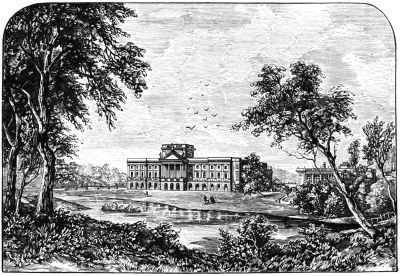
LYME HALL.
Disley is a convenient starting point for our visit; it is within a mile of the park gates, and can be easily reached by road or rail; it possesses, too, one of the pleasantest and cosiest inns in the kingdom, and that, to say the least, is a recommendation. The "Ram's Head," for that is the name, was a noted house of entertainment long ere the shrill whistle of the locomotive had broken in upon the peaceful quietude of this happy valley or a "line" had been thought of. It is a relic of the pleasant old coaching days when the well-appointed Derby "mail" was an institution, and old Burdett, gorgeously apparelled in gold lace and scarlet, awoke the echoes with his bugle to the heart-stirring strains of "The girl I left behind me." Unlike many of its contemporaries, however, it still retains its popularity, and is in as high favour as ever, if we may judge from the numerous pic-nic and pleasure parties, the field flirtations, and what our Yankee cousins irreverently term "bug-hunters," who avail themselves of its hospitality. The house stands away back from the road, with the crest of the Leghs (the ram's head) carved in stone over its ample portal, and in the rear is an old-fashioned but pleasant and well-trimmed garden that a month hence will display quite a world of floral beauty—a tranquil resting place where, beneath the spreading trees or in the quiet shadowy nooks, you can calmly contemplate the natural charms of the surrounding scenery.
Very inviting is the open door of the old hostelrie, but it is the ancestral home of the Leghs that claims our attention at the present moment, and we are not to be lured from our purpose.
The time of our visit is a bright sunny afternoon, and the month that one proverbial for its mirth and gladness; the one of which Milton sings—
The flowery May, who from her green lap throws The yellow cowslip and the pale primrose.
A road leads up from the end of the hotel, and crowning the summit of a gentle eminence that rises on the left is the church, an antiquated structure, grey with the weather strains of more than three centuries, with an embattled tower and a curious porch that looks like an excrescence projecting from the front of it. It was originally a chantry chapel, dedicated to "Our Lady," and built in the earlier part of the Eighth Harry's reign by Sir Piers Legh, of Lyme, a gentleman, a soldier, and a priest, in atonement, as was long believed, and as popular tradition still affirms, for his having slain Sir Thomas Butler, of Bewsey; though trustworthy antiquaries of modern times assure us there is no foundation for the story, inasmuch as Sir Thomas had yielded up the ghost before Sir Piers was born. But this is an age of scepticism and unbelief, a time when our most cherished fancies are in peril of being dispelled by the prosaic logic of facts and the ruthless researches of unimaginative Dryasdusts, who would take as much delight in proving the Swan of Avon to be an impostor as they do in proclaiming that Robin Hood was a myth and "Cinderella and her slipper" only a Scandinavian conception.
A history Handed from ages down; a nurse's tale Which children opened-eyed and mouth'd devour, And thus, as garrulous ignorance relates, We learn it and believe.
The interior of the church well deserves inspection. There are some mementoes of the Leghs though none of ancient date, and the usual complement of sepulchral memorials. There are also some interesting examples of old foreign stained glass, collected by the late Thomas Legh, and placed here in lieu of some of heraldic character that were at the same time removed to the hall, where they may still be seen. But we must defer our examination of the old edifice for another opportunity.
For some little distance the road runs parallel with the railway, which lies below us on the right, and from our elevated position we can overlook the village and the wild expanse of country environed with the long ridges of bleak moorland that stretch away to the Peak country. Though May has come in, there is a chilliness in the atmosphere that reminds us that we have not yet done with the east winds Charles Kingsley affected to delight in, but the coldness is tempered by the warm sunbeams which steal down between the ponderous white cloud peaks that sail majestically overhead, looking like floating islands in an azure sea. What a change the refreshing rains of the last few days have brought about; it seems as if nature had undergone a transformation; Mother Earth has cast aside her russet robe and donned a mantle of brightest emerald. The fruit trees against yon garden wall are just beginning to put forth their snow-white petals, safe we would hope now from being, as is too often the case—
Nipp'd by the lagging rear of winter's frost.
On the wooded bank that rises from the opposite side of the pool which the railway intersects there is abundant evidence that the green is asserting itself over the grey, for—
The dark pine-wood's boughs are seen Fringed tenderly with living green.
The oaks and the ash trees are almost as black and bare as they were in the depth of winter, and there are dark, unrelieved patches here and there, but the golden palm-like foliage depending in graceful festoons from the tall spines of the larches show with distinct vividness; whilst the luminous, almost golden, yellow of the poplars is contrasted by the sombre brown of the limes and birches, whose budding twigs have not yet
Spread out their fan To catch the breezy air.
Presently the road descends, and we continue along a wild old wandering gipsy-haunted lane that looks like an avenue in places where the trees almost meet overhead; the sun-light falls in leafy shadows and works a flickering pattern on every foot of the causeway, and the broad strips of grass on either side encroach upon it as if striving for the mastery. On the sloping meadow breadths the daisy—"day's eye," as the poets loved to call it—with its "golden bosom fringed with snow," displays a little galaxy of star blossoms, and helps to remind us of Chaucer's "Legend of Good Women;" of the unfortunate Margaret of Anjou, who chose it as her device, and whose nobles in the sunshine of her prosperity wore it embroidered upon their robes; and of another Margaret—she of Valois, the friend of Erasmus and of Calvin, the Marguerite of Marguerites, who had it worn in her honour. On the bank sides and beneath the hedgerows the
Dewcup of the frail anemone
peeps above the wreck of last year's vegetation. Here and there the pale primrose may also be seen lifting its delicate blossoms to the passing zephyrs, that prettiest of woodland flowers that folds its shamrock-shaped leaves when "the storm sings in the wind;" the wood sorrel—Alleluya, as the apothecaries of old times were wont to call it—studs the high banks, and if we thrust aside the tall grass and the crumpled leaves and withered bracken that yet remain we may see the young ferns unfolding their Corinthian scrolls.
The sun seems to have the same influence on the birds that it has on leaf and blossom. Every bush and thicket is vocal. Perched on the topmost twig of a spreading lime a thrush makes the welkin ring again with his mellifluous lay, challenging like a troubadour of old the admiration of his lady love, who makes responsive call from her nest near by; and high overhead—a speck in the blue above—a lark rains down his "harmonious madness;" the plaintive wail—"pewit, pewit"—comes clear and strong from the white-breasted plover, anxious to distract our attention from its nest in the thick grass, and from the distant copse the soft, mysterious, dreamy note of the cuckoo proclaims that the long looked for harbinger of summer has at last arrived.
O! Cuckoo, shall I call thee bird, Or but a wandering voice?
Presently our ears are assailed by the merry voices of children, and a troop of youngsters come struggling through a gap in the fence, laden with buttercups and daisies, and laughing and crowing with infantile delight, as they bear their floral treasures away.
A few minutes brings us to the lodge entrance. Here the road forks, and passing through the gate we wind away towards the left, mounting the upper slopes as we advance. To the right the ground falls away, and in the hollow, between us and Elmer Hurst, a tiny rindle threads its way, after performing some little industrial service at the mill higher up. Across the green expanse there is a good sprinkling of trees, oaks and thorns, some of them aged, and wrinkled and weather-beaten enough to have borne the blasts of centuries; lime trees too are plentiful, sufficient to suggest the idea that they had given name to the place, did we not know that the true derivation was from the limes,—i.e., the limits or confines of the county. Eastwards the ground rises in hilly ridges, backed by great treeless wastes of moorland that rise and fall like the heaving billows of a tempestous sea suddenly arrested in their motion—a picture of bleak desolation, the dreariness of which is only relieved by a few patches of plantation, or a clump of storm-rent pines here and there dotting their heathy slopes. The green expanse before us lacks the fertility and richness of detail the southerner is accustomed to, and, when we remember that the park forms part of what was once the great forest of Macclesfield, we are apt to think that the forests of those days but ill accorded with our notions of what a forest should be.
As we round the shoulder of a grassy slope, Lyme Cage comes in sight—a square, grey, tower-like structure of stone, crowning an eminence on the left, that rises to the height of eight hundred and eighty-two feet It is three storeys high, and flanked at each angle with square projections that rise above the roof in the form of turrets, and is surmounted by a cornice and open balustrade. The building is now occupied as a dwelling by one of the shepherds; when it was built, or for what purpose, is not known with certainty, but in all probability it was originally designed, like the hunting tower at Chatsworth, as a place where the ladies of Lyme might enjoy the pleasures of the chase without danger or fatigue, though tradition, which delights in the tragic, assigns a different origin, and, reckoning back its history for centuries, tells us that it was designed for the incarceration of offenders against the forest laws when Lyme Chase was in its glory, and its owners gave short shrift to those who made too free with their venison. The Cage forms a prominent landmark, and from the summit a delightful prospect is obtained in a westerly direction of the great Cheshire plain—a broad, picturesque panorama of villages and undulating meadows and pastures, including the high grounds of Alderley and Bowdon, and extending, when the day is clear, to the Frodsham Hills and Chester, and the line of Welsh mountains beyond. Northward, where the smoke overhangs the landscape, is Stockport, and sweeping round, we catch sight of the tower of Marple Old Church—the new church has not yet got its tower completed—standing, sentinel-like, on the summit of a lofty ridge, and the shadowy peak of Kinderscout—the highest point of the Peak range—rising far behind; while eastwards the view is shut in by Whaley Moor, and the long range of heathery wastes and lonely promontories that enclose the picturesque valley of the Goyt. The sunlight reveals every inequality and every indention that time and storm have furrowed down the hillsides; it brings out, too, an infinite variety of colour that adds an ineffable charm, and we can note the changing effects of the cloud-shadows, as they slowly chase each other across the broad and breezy expanse. A few sheep are cropping the herbage on the uplands, and the "full-uddered kine" are grazing upon the sunny slopes, and luxuriating in the lush pastures below; but the wild cattle for which Lyme was once so famous, are nowhere to be seen, the few that still survive being herded in another and more secluded part of the park.
The Lyme cattle, by the way, deserve a passing note, for, like the Lyme mastiffs, they are accounted among the peculiarities of Cheshire. Thirty years ago there was a considerable number of them, but since then, from various causes, the stock has been reduced, until now only very few remain, and there is danger that they may at no distant date become extinct, a circumstance that would be much to be regretted. These ancient British wild cattle are indigenous, and for centuries past have formed one of the features of Lyme; they are of a sand white colour, with red ears, and in some respects resemble the wild cattle at Chillingham and Chartley, and those at Gisburne, in Yorkshire. Unfortunately little is known about them, but from their peculiarities of form and their immense strength they are evidently of the buffalo type. They are untameable, and could never be brought to herd with the other cattle in the park, though occasionally cross breeds have been obtained, and so unmanageable are they that no keeper can ever approach them, a rifle being necessary whenever they have to be slaughtered for the table. These wild bovines are not, however, without their uses, for it is said that that part of the park in which they are placed, though literally overrun with game, is always secure from the predatory incursions of the poacher.
A treatise on natural history is not, however, our present theme, and so we resume our journeying. The birds are all alive, and are looking alive too, with no end of business which they are striving to get through with all possible alacrity. On the sunny sward below a company of rooks are grubbing away with commendable diligence, gathering food for their young offspring at home. A many-wintered crow who long has "led the clanging rookery home" sits aloft in a tree to give warning of the approach of danger; with quick eye he watches our movements, and as they are pronounced unsatisfactory, the alarm is sounded, when, in an instant, every bird is upon the wing and off in search of pastures new, with a sonorous, dignified cawing that sounds like a chorus of corvine laughter, contrasting oddly with the pert, consequential "jackle" of a self-assertive jackdaw who has attached himself to the community. The green expanses around us, if wanting somewhat in fertility, possess a charm in their natural wildness, and the bright sunlight adds to the sense of beauty. As we advance we notice a few rugged thorns by the wayside that have already put on their attire of fresh green leaves, but the ash trees close by are still nude, reminding us of the poet's pretty imagery—
Delaying, as the tender ash delays To clothe itself when all the woods are green;
and we begin to furbish up our weather wisdom, and speculate as to whether it or the oak will leaf first, for, as the knowing ones tell us—
If the oak's before the ash, We shall only get a splash; If the ash precede the oak, We shall surely get a soak.
A few minutes more and we come to a bend in the road, and then the stately mansion of Lyme, with its long lofty front, unexpectedly bursts upon the view, lying in a deep wooded hollow, and sheltered from the winds by the encircling hills.
Lyme Park was originally included within the bounds of the royal forest of Macclesfield—a vast tract of country that comprised little of wood and much of wilderness—and so continued until the time of Richard II., when it was granted to an ancestor of its present owner. Common report says there was a house here as early as the reign of King John, but the story is unsupported by any existing evidence; if there were a dwelling at all it could only have been a kind of hunting lodge. Certainly there was no "faire hall" existing before the close of the fourteenth century, and the earliest mention we have is in a Rental of the manor in 1466, when there was said to be "one fair hall with a high chamber, a kitchen, a bakehouse, and a brewhouse, with a granary, stable, and bailiff's house, and a fair park surrounded by palings, and divers fields and hays (i.e., hedged enclosures)" of the value of £10 a year.
There is a widespread belief that the manor of Lyme was granted to Sir Piers Legh, commonly called Perkyn a Legh, for his good services at the battle of Crescy, where he is said to have taken prisoner the Count de Tankerville, the Chamberlain of France, and to have relieved the standard of the Black Prince when it was in danger of being captured by the enemy. But as Piers Legh, to whom, with his wife, the grant was made, was not born until 1361, fifteen years after Crescy was fought, it is tolerably certain that he could not have rendered any very distinguished services on that memorable occasion. Yet the story is generally credited. Like many another popular legend, it has floated down through the mists of centuries and become distorted in its transmission through various media. Everybody believes it, and the domestics who show you over the house accept it as unimpeachable history, which to doubt, even, would be rank heresy. They repeat the tradition with variations, with many embellishments, and not a few anachronisms; tell you how the valorous Perkyn a Legh cut down the standard-bearer of the King of France, for that is the popular version, and, if you venture to hint a doubt as to whether that functionary ever was annihilated, will show you the heraldic device of the arm and banner emblazoned on ceiling, wall, and window, and point with confidence and pardonable pride to the armour Sir Perkyn wore on that eventful day, to the golden spurs which the Black Prince gave him when he knighted him upon the field, and, more than all, to the veritable sword, a huge, two-handled blade, with which the doughty deed was done—in their eyes confirmation strong as proofs of Holy Writ. This usually settles the business, even if it fails to carry conviction, though upon one occasion we remember a facetious unbeliever, taking up the ponderous weapon and the parable, exclaiming in the nasal twang which sight-showers seem to think indispensable—
This is the sword of Perkyn a Legh, A blade both true and trusty, That Frenchman's blood was ne'er wiped off; Which makes it look so rusty—
when the stately cicerone strode out of the room, evidently offended at his unbecoming levity.
Poor old Flower, Norroy King of Arms, we fear has much to answer for in giving the stamp of his authority to, and thus perpetuating the fable. But in the days of the maiden Queen the heralds were somewhat credulous genealogists, and much less exacting than their predecessors in the stirring times of the Plantagenet Kings. In 1575, during his "visitation" of Cheshire, Flower was a guest at Lyme, when, influenced possibly by the sumptuous hospitality of his entertainer, he not only allowed the then lord of Lyme the arms his progenitors had borne, but added to them an honourable augmentation in the shape of "an escucheon or shield of augmentacon Sable, replenished with mollets Silver, therein a man's arme bowed, holding in the hand a standard Silver, to be by the sayd Piers and his posterity for ever hereafter borne and to be used as a testimony of his ancestour's good deserts." The "shield of augmentacon," which we now see so profusely displayed at Lyme, was a handsome and well-merited addition to the coat armour of the family, but the garrulous old herald—he was then approaching eighty—in granting it, unfortunately repeated the old story, which ascribed to Sir Piers Legh, instead of to his wife's father, Sir Thomas D'Anyers, the valorous deeds by which Lyme was won, and on the strength of that grant Sir Peter added the following lines to the inscription on the monumental brass of his ancestor, which may still be seen in the Lyme Chapel in Macclesfield Church:—
This Perkin serv'd King Edward the Third and the Black Prince his sonne in all their warres in France and was at the Battle of Cressie, and had Lyme given him for that service.
Raphael Hollinshead, the chronicler, a Cheshire man and a contemporary of Flower, in his work, published in 1577, repeats the statement with much circumstantial detail and an equal lack of accuracy. Describing the scene on that glorious August day, he says:—
When the Constable [of France] understood the good will of the people of the town [to go forth and fight the English outside the town] he was contented to allow them to follow their desire and so forth they went in good order, and made good face to put their lives in hazard; but when they saw the Englishmen approach in good order divided into three battles, and the archers ready to shoot, which they of Caen had not seen before, they were sore afraid and fled away toward the town, without any order or array, for all that the constable could do to stay them. The Englishmen followed, and in the chase slew many and entered the town with their enemies. The Constable and the Earl of Tancarville betook themselves to a tower at the bridge-foot, thinking there to save themselves; but perceiving the place to be of no force, nor able to hold out long, they submitted themselves unto Sir Thomas Holland.
But here he adds:
Whatsoever Froissart doth report of the taking of this tower, and the yielding of these two noble men, it is to be proved that the said Earl of Tancarville was taken by one surnamed Legh, ancestor to Sir Peter Legh now [1577] living, whether in the fight or in the tower, I have not to say; but for the taking of the said Earl and for his other manlike prowess showed there and elsewhere in this journey, King Edward in recompense of his agreeable service, gave to him a lordship in the county of Chester, called Hanley [Lyme Handley] which the said Sir Peter Legh now living doth enjoy and possess as successor and heir to his ancestor, the foresaid Legh, to whom it was so first given.[50]
It is curious how many different versions of this notable incident in England's greatest victory have been given by the old chroniclers, and what a cloud of doubt and mystery they have in consequence created. To the statement that Sir Piers was present at Crescy, Dugdale adds that he acted as standard bearer to the Black Prince on that memorable occasion; equally fallacious is the statement given in Gregson's "Lancashire Fragments" that the augmentation was an honourable addition after the battle of Poictiers, in which he served under the Black Prince, for that battle was fought in 1356, five years before he was born, and two years after Sir Thomas D'Anyers had been laid in his grave. Gregson's statement was doubtless made on the authority of an old pedigree still preserved among the muniments of Lyme, and which, after representing him as receiving a free gift of Lyme and Hanley, for his valuable services at Poictiers, makes a curious mistake by assigning an erroneous day and year as that on which the battle was fought. It is somewhat remarkable that Froissart, who was a witness of many of the scenes he describes, and probably bore a part in the fight at Crescy, makes no mention of either Piers Legh or his father-in-law, Sir Thomas D'Anyers, but ascribes the capture of the Earl of Tankerville to Sir Thomas Holland, a Lancashire knight. He says:—
When the French were put to flight, the English, who spared none, made great havoc among them, which, when the Constable of France, the Earl of Tancarville, and those with them, who had taken refuge within the city gate, saw, they began to fear lest they themselves should fall into the hands of some of the English archers who did not know them. Seeing, therefore, a knight named Sir Thomas Holland, who had but one eye (whom they had formerly known in Prussia and Grenada), coming towards them in company with five or six other knights, they called to him and asked him if he would take them as his prisoners. Upon which Sir Thomas and his company advanced to the gate, and dismounting, ascended to the top with sixteen others, where he found the Constable and the Earl and twenty-five more who surrendered themselves to Sir Thomas.[51]
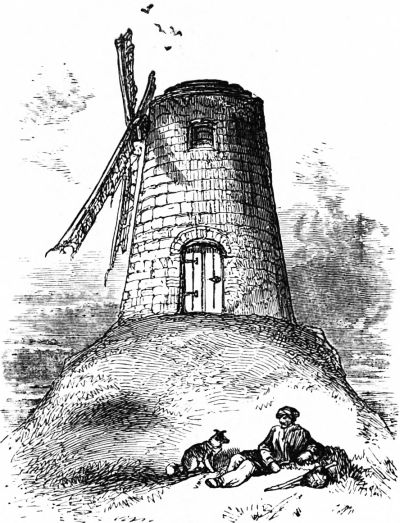
WINDMILL AT CRESCY.
The omission of D'Anyers name may be accounted for by the fact that Sir Thomas Holland, who had married the heiress of Edmund Plantagent—Joan, "The Fair Maid of Kent," the future wife of the Black Prince—had a chief command in the Prince's army, and that Sir Thomas D'Anyers, who, we know, was in the retinue of the gallant young Prince, his engagement to serve being dated 18th May, 1346, may be assumed to have been in Sir Thomas Holland's company, and therefore one of those who ascended the tower and received the Earl of Tankerville's surrender. One thing is very certain; it was at Caen and not at Crescy that the French King's Chamberlain was captured, though it was at the last named place that the stalwart warrior, with his strong right arm, drove back the advancing host, and rescued the standard of the "Boy Prince"—his palatine earl—at the time when King Edward watched his exploits from a neighbouring height, refused his succour, and with more chivalry than sound generalship "bade his boy win his spurs and the honour of the day for himself." Amid all this conflicting evidence, there is one document that has been unearthed by Mr. Beamont, in which the services of Sir Thomas D'Anyers are duly recognised—the original record of the grant of land, made jointly to Sir Peter Legh and Margaret, his wife, which appears on the Cheshire Recognisance Rolls, now preserved in the Rolls Office, London, of which the following is a translation:—
Letters patent to Piers de Legh and Margaret his wife of a certain piece of land called Hanley.
Richard, by the grace of God, King, &c. To all to whom these presents shall come greeting. Know ye that whereas our well-beloved squire Piers de Legh and Margaret his wife the daughter and heir of Sir Thomas D'Anyers, Knight, deceased, have made known to us that our most honourable lord and father, whom God asoyle, for the good and gracious service which the said Thomas had rendered to him, not only by taking prisoner the Chamberlain de Tankerville, but also by rescuing our said father's standard at the battle of Crescy; by his letters patent had granted to the said Thomas forty marks a year out of his manor of Frodsham in the county of Chester, at the feasts of the Annunciation of the Blessed Virgin Mary and St. Michael in equal portions, until our said father should provide him the aforesaid Thomas with lands of the value of £20 a year in some convenient place, to have and to hold to him and his heirs for ever as in the said letters patent of our said lord and father is more fully contained; the which said annuity of forty marks, after the death of the said Thomas, came into our hands (to pay) before any grant of the aforesaid £20 in lands or any part thereof, had been made him according to the tenor of our said father's grant, as the aforesaid Piers and Margaret have given us to understand. Wherefore of our special grace and in consideration as well of what has been recited, as of the good and gracious service which the said Piers hath rendered and will render to us, and because the aforesaid Piers and Margaret are willing to give the said letters patent of our said father of the said annuity of forty marks to the said Thomas into our Exchequer at Chester to be cancelled We have given and granted to the said Piers and the aforesaid Margaret his wife a piece of land and pasture called Hanley, lying in our Forest of Macclesfield in the county of Chester, which aforetime was let to farm at twenty marks a year, as we are given to understand. To have and to hold the same to the aforesaid Piers and Margaret his wife and the heirs male of their bodies lawfully begotten, of us and our heirs by the payment of six pence to us and our heirs yearly at the feast of St. Michael the Archangel for all service in satisfaction of the said £20 of land and notwithstanding that the said piece of land is situated within the demesne of our forest aforesaid. Saving altogether to us and our heirs all oaks growing there, and also sufficient pasture for our deer there, as much as to the extent of land within our forest aforesaid appertaineth. In testimony whereof we have caused these our letters patent to be sealed with the seal of our Exchequer at Chester. Dated at Chester the fourth day of January in the twenty-first year of our reign (1398) By writ of Privy Seal.
In this grant we have incontrovertible evidence of the real hero whose achievements in arms are commemorated on the armorial shield of the Leghs, of Lyme, in itself a notable illustration of the true character and intent of heraldic blazonry. Sir Thomas D'Anyers, who bore himself so bravely at Caen as well as on the field at Crescy, when, if popular story is to be believed, "villainous saltpetre" was first employed and the roar of artillery first heard, fighting by the side of the gallant prince—
Who on the French ground play'd a tragedy, Making defeat on the full power of France; Whilst his most mighty father on a hill Stood smiling to behold his lion's whelp Forage in blood of French nobility—
was the representative of a family who owned lands at Bradley, in Appleton. William D'Anyers, who, in 1291, purchased lands in Daresbury from Henry de Norreys, married Agnes, daughter of Agnes, heir of Richard de Legh, of High Legh, by the first of her three husbands, Richard, younger son of Hugh de Limme, who took the name of Legh after his marriage. By him she had, in addition to a son, William D'Anyers, of Daresbury, Thomas D'Anyers, of Bradley, in Appleton, who, by his first wife, Margaret, daughter of Adam de Tabley, was the father of Sir Thomas D'Anyers, the hero of Crescy, and also of John D'Anyers, of Gropenhall, a soldier who for his services, likewise received a grant from the Crown. Sir Thomas D'Anyers, who must have been early initiated in the exercise of arms, was twice married; by his first wife, Matilda, he had no surviving issue, and at her death he married Isabel, the daughter and heir of Sir William de Baguley and his wife, Clemence, daughter and co-heir of Sir Roger Chedle, alias Sir Roger Dutton, of Chedle in Cheshire, who survived him, and by whom he had an only daughter, Margaret, who became his heir. After the battle of Crescy he appears to have retired to his house at Bradley, but the laurels he had won in his campaigns abroad had helped to shorten his days, and in 1354, while yet comparatively young, he was carried to the grave, having predeceased his father. An inquisition was taken after his death of the lands he held, and the jury found that his daughter, whose name they did not know, was his next heir. His estate, which was never at any time large, had not improved during his absences in the wars, and Margaret D'Anyers, who at the time of his death could only have been very young, succeeded to an inheritance that had become considerably attenuated, for in an extent of the manor the jurors found that "the messuage (Bradley Hall), with its enclosures, which had belonged to Sir Thomas, in Bradley, with the gardens there, was not worth anything; that the dove-house was not worth anything, being destroyed by a weasel; that the fishery in the moat round the house was not worth anything, being destroyed by an otter; but that there were two carucates of land there containing sixty acres, worth sixpence an acre."
Margaret D'Anyers, who was doubly an heiress, having inherited Clifton, Gropenhall, and a moiety of Chedle from her mother, was three times wooed and won. Shortly after her father's death she was taken from her mother by John de Radcliffe, who had obtained a grant of her marriage, and eventually married her himself. There was no issue of the union, and their married life must have been short, for before the month of April, 1382, he had died, and she had again bestowed her hand, her second husband being Sir John Savage, of Clifton. By him she had a son, John Savage, to whom, in 1415, she granted the heraldic coat of D'Anyers, without any difference, together with the white unicorn's head, the crest of her father—a coat he might well be proud of, though it was in reality that which his ancestress, Agnes de Legh, had inherited from her father, Richard de Limme, with the tinctures changed—and this coat continued to be borne by the Savages down to the reign of Elizabeth.[52] Sir John Savage died about the year 1387, and in the following year negotiations were set on foot for a marriage between his widow and Piers, younger son of Robert de Legh, of Adlington, by his second wife, Maud, daughter and heiress of Sir Adam de Norley. As they were within the prohibited degrees of consanguinity, Piers de Legh being descended from Agnes de Legh, by her third husband, William Venables, and his intended bride from the same Agnes, by her first husband, Richard de Limme, a dispensation for the marriage was deemed necessary. This instrument, which bears date November 26th, 1388, was "given in the house of the Carmelite brethren at London," and within a few days of its being granted Margaret D'Anyers, successively the widow of Sir John Radcliffe and Sir John Savage, had become the wife of her kinsman, Piers Legh. Piers Legh was then twenty-seven years of age, and his wife, if not fat, fair, and forty, had at all events reached her thirty-ninth year. They became—he on the paternal, she on the maternal side—the founders of the house of Legh, of Lyme. Piers Legh's mother, as already stated, was the heiress of Sir Adam de Norley, the owner of the manor of that name in Lancashire, and she in her husband's lifetime had executed a deed conveying all her estates in trust for the benefit of her son upon his coming of age, and, in accordance with the custom of the time, Piers Legh on succeeding to his mother's inheritance relinquished his paternal coat and assumed that of Norley—gules, a cross engrailed argent, which has ever since been borne by the Leghs of Lyme, with the addition since Elizabeth's reign of the escutcheon of pretence, which old Flower, the herald, gave them.
Cheshire, which plumes itself on being "the seedplot of nobility," and of possessing a greater number of old county families than any other English shire, boasts no worthier or more ancient stock than the Leghs; their history is closely interwoven with the history of the palatinate, and they claim a high antiquity, tracing their descent in this country back to the time of the Conquest, when an ancestor came over in the retinue of Duke William, the Norman invader. The Leghs of Adlington, of which house was Piers Legh, the founder of the house of Lyme, were descended from Gilbert or le Galliard, the younger son of Eudo or Eules, the second of that name, Earl of Blois, Byre, and Chartres, and the ancestor of Stephen, Earl of Blois, who, on the death of Henry I., usurped the English crown. This Gilbert, who from the patronymic he adopted, Venables (_venator abilis_), we may assume to have been a mighty hunter, was in the retinue of William of Normandy, and for his bravery at Hastings was knighted by the Conqueror upon the battle-field. Afterwards, he had considerable estates bestowed upon him out of the newly-conquered country in requital of his services against Edgar Atheling and the Welsh, and when that singular compound of sensuality and ferocity, Hugh D'Avranches, more generally known as Hugh Lupus, the Conqueror's nephew, was made Earl Palatine of Chester, he conferred upon Gilbert Venables the barony of Kinderton. Sir William Venables, the sixth in descent from this Gilbert, had a younger son, also named William, to whom he gave the manor of Bradwell, near Sandbach. William Venables, the younger, was twice married, his second wife being Agnes, the daughter and heir of Richard de Legh, of the West Hall, in High Legh, and the widow of Richard de Limme or Lymm, the common ancestress of the Leghs of Adlington and the D'Anyers of Bradley. Their son, John de Venables, adopted the name of Legh, the maiden name of his mother, as well as of the place where he was born. He married Ellen de Corona, the great-aunt of Thomas de Corona, the last of the family of that name, who owned the extensive manor of Adlington, and about the year 1299 he purchased the estate of Norbury Booths, near Knutsford, where he fixed his residence. Thomas de Corona does not appear ever to have married; certainly he had no issue, and before his death he settled his estates, when, by an agreement made at Chester, October 7th, 1315, and another dated at "le Bouthes" in the following year, he granted all his lands at Adlington, after his death, to his grand-niece Ellen and her husband, John Legh, for their lives, with remainder to their son, Robert de Legh. Thomas de Corona died about the year 1323, and John Legh must have pre-deceased him, for at the time Ellen de Corona was a widow, and obtained the grant of a pardon from Isabella, queen of Edward II., who styled herself "Lady of Macclesfield," and who had claimed Adlington that it was held of her as of her manor of Macclesfield, and had been alienated without licence.
Ellen Legh survived her husband for the long period of twenty-seven years, and continued in the enjoyment of the manor of Adlington, which had been re-granted to her on the purchase of the pardon before referred to, until her death in 1350, when her son, Robert de Legh, succeeded, in accordance with Thomas de Corona's settlement, and became the ancestor of a family whose direct male heirs held the manor of Adlington for the long period of four hundred years. Robert de Legh was twice married, his first wife being Sybil, daughter of Henry de Honford, of Handforth, and after her death he espoused Matilda, the daughter and heiress of Sir Adam de Norley, of Norley or Northleigh, in Lancashire, who, according to an old MS. pedigree, was his second cousin and very much his junior. The eldest of the two sons of this second marriage was Piers Legh, who, as previously stated, in 1388 became the third husband of his kinswoman, Margaret, daughter and heir of Sir Thomas D'Anyers, the hero of Crescy, and the widow successively of Sir John Radcliffe and Sir John Savage, and from them descended the Leghs of Lyme and the Leghs of Ridge, near Macclesfield.
Concerning the mother of Piers Leigh, an incident is recorded which puts her character in an unfavourable light. Robert de Leigh, her husband, before his death settled certain of his lands in Broome, near Lymm (not Lyme, as is sometimes supposed,), upon two of his sons by his first marriage. He died about the year 1370, and five years afterwards his widow was indicted for having, in conjunction with one Thomas Le Par, forged a settlement in the name of Adam de Kingsley, the trustee, in fraud of her two stepsons and in favour of her own son, Piers Leigh, and his two younger brothers.
Piers Leigh was a person of considerable importance, and held many offices of trust and responsibility. Shortly after his coming of age, in 1382, he was, with his brother John, appointed by Joan, Princess of Wales, once the "Fair Maid of Kent," and the widow of Edward the Black Prince, bailiff of her Manor of Macclesfield, and steward of all her courts within the hundred and forest, an office his father held previously. In the following year he obtained a lease of the herbage of Hanley within the forest, and was entrusted by the Princess with the conduct of her affairs with other of her tenants within the manor and forest. In the following year he had a lease of the herbage of the forest of Macclesfield, and about the same time, the Princess Joan being then dead, he and his brother John were appointed attorneys to serve for the surveyor of the forest of Macclesfield.
In 1387, Richard II., who had then been ten years upon the throne, attained his majority. A self-willed youth, impatient of the restraint which had been imposed upon him while under the guardianship of his three uncles, the Dukes of Lancaster (John o' Gaunt), York, and Gloucester, he determined to free himself from their control. With a view of ingratiating himself with his Cheshire subjects, between whom and the sovereign, from the time when a king's son was first created palatine earl, there had been a close relationship, he made a progress into the county and remained some time at Chester, where he received many marks of popular favour. He confirmed many of the Cheshire men in the offices and emoluments previously conferred upon them by his uncle, John o' Gaunt, who was Constable of Chester and Lord of Halton, and amongst other things confirmed to Piers Leigh the annuity of Cs, which had been made to him by John o' Gaunt's son-in-law, John de Holland. In the following year, however, Piers Legh had the misfortune to fall under the King's displeasure. In that year the real struggle between Richard and his uncle, the Duke of Gloucester, began. Under the pretence of removing the King's favourites, and especially Robert de Vere, Earl of Oxford, whom he had created Duke of Ireland—one of the five obnoxious members who had met at Nottingham, and all of whom had been accused of treason before the King at Westminster—he assembled an army at Highgate, whereupon De Vere fled into the north, and on the authority of the Royal letters summoned the Cheshire forces, and with them, and some auxiliaries from Lancashire, numbering in all about 5,000 men, set out to meet him. The two armies encountered each other at Radcot Bridge, in Oxfordshire, on the 20th of December, and a battle was fought in which the soldiers of the Duke of Ireland were completely routed. The Duke himself only escaped by swimming the Isis, and fled to the north, whence he sought refuge in the Low Countries. Piers Legh would seem either to have shared in the general indignation against De Vere, or to have been brought under the influence of the Duke of Gloucester, for he immediately seized the whole of the Duke of Ireland's movables in Cheshire and lodged them in Chester Castle. Angered at this treatment of his fallen favourite, the humiliated King issued his warrant, dated January 21st, 1388, commanding Piers Legh, under a penalty of £1,000, to surrender and restore the goods he had taken. Whether the mandate was obeyed and the goods and chattels restored is not stated, but probably the difficulty was removed by the death of De Vere, which occurred shortly afterwards.
While these events were transpiring negotiations were set on foot for a marriage, for which a dispensation was obtained, the contracting parties being, as stated, related in the fourth as well as the third degree of consanguinity, and before the year had closed Piers Legh had taken to himself a wife in the person of his kinswoman, Margaret D'Anyers, the widow of Sir John Savage.
By this time, or shortly after, he must have regained the King's favour, for in August, 1390, a commission was issued directing him and others therein named to hear and determine all felonies committed within the borough of Macclesfield, and a second commission empowered him to determine in like manner all felonies, misdemeanours, and breaches of the peace committed within the forest and hundred of Macclesfield. At that time the forest comprised about one-third of the entire hundred, and included within its limits the larger portion of the great parish of Prestbury. It had belonged to the Earls of Chester until the extinction of the local earldom in 1237, when it passed to the Crown, and was thereafter reserved for the Royal hunting and made subject to the forest laws, which were very severe against any who should presume to make free with the King's venison—the killing of a deer being accounted an offence as serious as the killing of a man, and punishable with equal severity.
A further evidence of the renewed confidence of the King is found in the fact that on the 6th April, 1391, Piers Legh was appointed by the Queen Consort—"the good Queen Anne," as she was called by the people—steward of her lands in the Macclesfield Hundred. In the month of August following, he was commanded to arrest all malefactors and disturbers of the peace within the hundred, and made one of the King's justices for the same, with directions to hold three courts itinerant or in eyre, the proceedings at which were of the nature of those at a court of assize, the penalty for non-attendance when summoned thereto being outlawry, with forfeiture of goods. In January, 1395, he was named equitator or rider of the forest, his special duties being to attend the King in person whenever he should hunt in the forest; and this office he had subsequently conferred upon him for life, and also, in conjunction with his brother, that of keeper of the park of Macclesfield.
The struggle for supremacy between Richard and his uncle, the Duke of Gloucester, was now approaching a crisis, and, by a proceeding which resembled very much what is known in modern times as a coup d'état, he resolved to break the power of the turbulent Gloucester and his cabal of nobles. The Duke was surprised in his castle at Plashy, in Essex, hurried on board ship, and conveyed to Calais; at the same time the Earl of Warwick, while enjoying the royal hospitality, was seized and sent to Tintagel Castle, in Cornwall, and, simultaneously, and with equal duplicity, the Earl of Arundel was summoned to a conference, and, while there, arrested and lodged in Carisbrook Castle. A Parliament was immediately summoned to meet at Westminster, at which the fate of the three captive nobles—one a prince of the blood—was to be determined. Great were the preparations made, and a wooden building of large extent was erected near Westminster Hall for the reception of the numerous assembly. On the 17th September, 1397, the Parliament met; the assembly was surrounded by the King's troops, and the Sovereign himself had a body guard, consisting mainly of his Cheshire archers, all of whom wore his cognizance of the White Hart lodged—the badge of his mother, Joan of Kent, which he had adopted—and there is every reason to believe that Piers Legh held a command among the feudal retainers—the archers of the Crown, as they were called—who rendered personal service on that memorable occasion; memorable as the time when the chief objects of the King's displeasure were condemned for high treason and a despotic power established under the sanction of Parliamentary forms. It is worthy of note that in this short-lived Parliament Cheshire was raised to the dignity of a principality, the King adding to his titles that of Prince of Chester; but the honour was not long enjoyed, the Act under which it was created being repealed in the first year of Henry the Fourth's reign.
In the following year Piers Legh had an annuity of Cs granted him by the King, probably as a reward for his services on the occasion just referred to, and about the same time the annuity of forty marks (£26 13s. 4d.) which had been granted to Sir Thomas D'Anyers was exchanged for the lands in Lyme Hanley—an exchange that may be said to have been the foundation of the fortunes of the House of Lyme.
In the succeeding year Richard had again occasion for the services of his trusty Cheshire Archers. To avenge the death of Roger Mortimer, Earl of March, the presumptive heir to his crown, he determined on bringing the kingdom of Ireland to a more perfect subjection. With this view, and for the purpose of increasing the strength of his Cheshire guard, he had a levy made of the archers within the several hundreds of the palatinate qualified to serve, and with these he set sail from Milford Haven on the 4th June, 1399. While he was leading his forces into the Irish bogs and thickets to chastise the presumption of the native chiefs, Henry Bolingbroke, the son of the old Lancastrian duke, John o' Gaunt, who had been banished the kingdom, landed with a force at Ravenspur, in Yorkshire, and marched southwards; castles and towns surrendered to him, and in an incredibly short space of time he had made himself master of half the kingdom. Rebellion had stalked unchecked through the land for weeks before the absent monarch could receive intelligence of Bolingbroke's designs, and ere he could reach the English coast on his return the revolution was accomplished. On the 9th August, little more than a couple of months from the time of his departure, he landed in Wales; a number of his faithful Cheshire men met him on his arrival, though Piers Legh was not of the number, being at the time in command at Chester, and this may have been the occasion when, as the old chronicler says, the Cheshire men exclaimed—"Dycon, slep secury quile we wake, and drede nought quile we lyve sefton; for giff thou hadst wedded Perkyn, daughter of Lye, thou may well holde alone day with any man in Cheshire schire, i' faith." Piers Legh's daughter Margaret was then only in her infancy, but that must have been a matter of small consequence in the days when children were accounted as of marriageable age. The unhappy monarch, with a few followers, wandered from castle to castle, and at length found a resting-place at Conway. Meanwhile the victorious Henry was advancing by rapid marches through Gloucester and Herefordshire towards Shrewsbury, with the intention of occupying Chester, crying, "Havoc and destruction on Cheshire and the Cheshire men." On the 9th August, the day that Richard landed from Ireland, he entered the city and promised peace to the people, a promise, however, that was to be quickly violated, for on the next day he gave orders for the seizure of the King's loving and loyal subject, Sir Piers Legh, who must have been actively defending the interests of his master. Probably he had the command of the castle, though he is said to have been at the time Chief Justice of Chester.[53] Whatever his office his motto was loyal à la mort, and, like Old Adam in "As You Like It," he might have exclaimed—
Master, go on, and I will follow thee To the last gasp with love and loyalty.
To remove an obstacle to the accomplishment of his ambitious designs Bolingbroke hurried him away to execution. His policy, so our greatest dramatist tells us, was to—
Cut off the heads Of all the favourites that the absent King In deputation left behind him, When he was personal in the Irish wars.
And the "absent King" had no greater favourite or more faithful follower than Piers Legh.
The Rev. John Wall, the translator of the French Metrical History of the Deposition of Richard II.[54] in referring to his tragic end, says the King was at the time at Conway; and Daniel, in his "Civil Wars between York and Lancaster," thus alludes to the event:—
Nor thou, magnanimous Legh, must not be left In darkness; for thy rare fidelity To save thy faith content to lose thy head, That reverent head, of good men honoured.
By the order of Bolingbroke, the head of Sir Piers was placed on the highest gate of the city, and there it remained for a time, when it was removed by the Carmelite Monks and buried with his body within their own church. Afterwards it was conveyed to Macclesfield, where, on the south side of the Lyme chancel of the old church, the following epitaph, once cut in stone, but now graven in brass, may still be seen:—
Here lyeth the bodie of Perkyn a Legh That for King Richard the death did die Betrayed for rightevsnes And the bones of Sir Peers his Sonne That with King Henry the fift did wonne In Paris.
To which, as we have previously stated, after old Flower's grant of an heraldic augmentation, Sir Peter Legh in Elizabeth's reign added the apocryphal inscription regarding his doings at Crescy.
For loyally serving his fallen master and King, and while yet a young man, for he was only thirty-eight years of age, thus perished the first of the Lords of Lyme.
The distance between the throne and the grave of a deposed monarch is but short. Bolingbroke, finding himself everywhere enthusiastically received, resolved upon wresting the sceptre from the feeble grasp of his vacillating cousin, and within a few short months of the decapitation of Piers Legh, Richard of Bordeaux had lost both his crown and his life. When the revolution had seated the house of Lancaster upon the throne, Richard, on relinquishing his sovereignty, expressed the hope that his cousin would be "good lord to him," but the hope was delusive. He was deposed in September, and ere the snows of winter had melted his end had been accomplished, either by the pole-axe of the assassin, or the more protracted misery of famine.
Of a verity, those were stirring times, and whatever tenure men might have of their lands they had but little of their heads. Henry gained the throne almost without a struggle, but his daring act of usurpation was but the sowing of the seed which ripened and bore fruit in that "purple testimony of bleeding war," the fierce struggle of the Red and White Roses—a contest which, after having for well nigh half a century filled the country with commotion and drenched it in civil slaughter, left it in a state of exhaustion, with the flower of its nobility destroyed.
Piers Legh had not completed more than ten years of his married life when the unrelenting Bolingbroke caused his head to be placed on the highest pinnacle of the east gate of Chester. His widow, Margaret D'Anyers, survived him nearly thirty years, her death occurring June 24, 1428. The issue of the marriage was, in addition to a daughter, Margaret, who became the wife of Sir John de Ashton, two sons—Peter, who succeeded as heir, and John, who married Alice, daughter and heiress of John Alcock, of Ridge, an estate in the township of Sutton, near Macclesfield, and from them sprang the Leghs of Ridge, Rushall, Stoneleigh, and Stockwell; the last representative of the parent line, Edward Legh, up to the time of his death, which occurred only a few years ago, residing at the Limes, Lewisham, near London.
Peter, the eldest son of Piers Legh, could only have been a youth of some eight summers when his father met his untimely end. If—
Left by his sire, too young such loss to know,
it was well for him that he had a prudent counsellor in the person of his widowed mother. In 1403 she gave him her moiety of Gropenhall, which had been acquired by one of the D'Anyers in marriage with the heiress of Boydell, of Gropenhall and had come to her through failure of male issue in her father's family; and he, thereupon, quartered the arms of Boydell with his paternal coat, an augmentation that has ever since been retained. About the same time he added largely to his possessions by his marriage with Joanna, the daughter and heiress of Sir Gilbert de Haydock, of Haydock, near Newton-le-Willows, a wealthy Lancashire Knight; by this alliance he ultimately acquired the extensive estates of the Haydocks, viz.: Haydock, Bradley, Burtonwood, Warrington, Overford, Sonkey, Bold, Newton, Lowton, Golborne, and Walton-le-Dale, an acquisition that explains the close connection of the Leghs of Lyme with Lancashire. His mother was yet in possession of Lyme, and he therefore fixed his abode at Bradley, in Burtonwood, which became the principal residence of the family and so continued until about the year 1569, when the erection of the present mansion of Lyme was begun. Leyland, the antiquary, writing in the time of Henry VIII., says:—"Syr Perse de Lee hath his place at Bradley in a park two miles from Newton." The old house has long since disappeared, but the picturesque ruins of the arched and buttressed gate tower, which formed the principal approach, with a portion of the bastille above for the detention of offenders and doubtful visitors, still remain, a memorial of its ancient stateliness. The manor continued in possession of the family until after the death of Thomas Peter Legh, of Lyme, when it passed by settlement to his son, the Rev. Peter Legh, incumbent of St. Peter's, Newton, who sold it to the late Samuel Brooks, Esq., of Manchester.
Though Peter Legh was old enough to take to himself a wife it was fortunate for him that he was as yet too young to take part in the stirring scenes that marked the opening years of the usurper's reign, when
The blood of Richard, shed on Pomfret stones,
called for retribution, and the realm was filled with turbulence and disquiet, else he might have shared the fate which befel so many other Cheshire men, who, unable to forget the misfortunes of their former master, met at Sandiway, in Delamere Forest, and joined the valiant Hotspur, renowned in song and story,
Who was sweet Fortune's minion and her pride,
and Glendower, the Welsh chieftain, in their insurrection, when at the market cross of Shrewsbury, after the bloody strife on Hately field, where Falstaff "fought a long hour by Shrewsbury clock," and his ragamuffins got well peppered, the Baron of Kinderton and Sir Richard Vernon, the Baron of Shipbrooke, with the Earl of Worcester, paid the penalty of their revolt with the same horrible barbarities that a hundred years before had been inflicted upon David, Prince of Wales, the brother of Llewellynn.
Henry, Prince of Wales, the whilom roysterer and tavern brawler—Hotspur's "nimble-footed, madcap Harry"—was also Earl of Chester, and passed much of his time within his palatinate. Anxious, as it would seem, to make some amends for the wrongs his
Father made in compassing the crown,
he took the youthful Peter Legh into his favour. By a deed, dated 26 July, 12 Henry IV. (1411), he granted him certain lands in Macclesfield Forest, near to his domain of Lyme, called Heghlegh, together with the office of forester, which had been held by the Hegleghs and Savages successively, designing his gift apparently as a peace-offering and a token of his royal favour, and with a view probably to services that might be rendered him in the future.
On the 20th of March, 1413, the troubled reign of Henry the Fourth drew to a close. The throne of the usurper had proved but a bed of thorns, for no sovereign ever was more harassed by plots and insurrections. The violent animosities and contentions that prevailed during his reign reduced his frame to premature decay, and at the early age of forty-six he breathed his last in the abbot's lodgings at Westminster.
His son and successor, Henry the Fifth, was not slow in observing the dying injunctions of his royal father not to allow the kingdom to remain long at peace lest it should breed intestine commotion. Wise in his generation, he believed that a foreign war might divert the attention of his subjects from a too close examination of the justness of his own pretensions to the crown, and the excuse for such an enterprise was not far to seek. France was at the time in a state of deplorable disorder; and as the victories of Crescy and Poictiers were yet fresh in the memories of the English people and the favourite theme of song and story, France seemed to furnish the opportunity which the new King so greatly desired. Anxious to quarter its lilies with the lions of England, Henry, shortly after his coronation, resolved upon asserting the claim to the crown of that kingdom which his great grandfather, Edward the Third, had urged with so much confidence and success—a crown to which, it must be admitted, he had about as much right as Rob Roy had to the cattle he "lifted," or to the spoils of the raids and forays he engaged in. Parliament made him a liberal grant in aid of the expedition; free gifts were received from the clergy; he borrowed from all who could be prevailed upon to lend, and to procure money pawned his plate, jewels, and even his crown. With much diligence he collected men, arms, provisions, ships, and, in short, everything necessary to enforce his demands and aggrandise himself at the expense of his distracted neighbours.
The armies of the Kings of England in those days were made up of contingents, brought into the field by adventurous spirits, who entered into indenture with the Sovereign to serve in person with a certain number of followers for a fixed period, and on such terms as were agreed upon—men of strong limbs and daring spirit, who were influenced less by the abstract justice of the cause for which they were to fight than the consciousness that they would receive their due share of the gaines de guerre. Copies of many such indentures or contracts between the King and the persons who undertook to provide a stated number of men at arms and archers, as well as with those who agreed to procure carpenters, masons, waggons, bows, arrows, &c., are printed in Rymer's Fœdera, and these documents furnish much interesting information on the military arrangements of the age. Among the persons who entered into such a covenant was Peter Legh, of Bradley and Lyme, and in the muster roll printed in Sir N. Harris Nicolas's "Battle of Agincourt" we find him thus entered:—
Monsr. Piers de Legh, ov sa retenu, Robert Orell Hugh de Orell Thomas Sutton John Pygott George de Asheley.
Those who formed his retinue, were probably archers; the two first named men, apparently Lancashire men, hailing from Orell, near Wigan, and the others, judging by their patronymic, were Cheshire men. Indeed, from the liberal contingents sent up, the two counties seem to have furnished a very large proportion of the eight thousand fighting men who mustered at Southampton. As the rhyming chronicler has it—
They recruited Cheshire and Lancashire, And Derby hills that were so free; Tho' no married man, nor no widow's son, They recruited three thousand men and three.
Great was the bustle and preparation, and exciting were the scenes then witnessed. Michael Drayton, writing three centuries ago, thus describes the separation between those comprising the invading force and their relatives and friends:—
There might a man have seen in ev'ry street, The father bidding farewell to his son; Small children kneeling at their father's feet; The wife with her dear husband ne'er had done: Brother, his brother, with adieu to greet; One friend to take leave of another run; The maiden with her best belov'd to part, Gave him her hand, who took away her heart. The nobler youth, the common rank above, On their curvetting coursers mounted fair; One wore his mistress' garter, one her glove; And he a lock of his dear lady's hair; And he her colours, whom he most did love; There was not one but did some favour wear: And each one took it, on his happy speed, To make it famous for some knightly deed.
Many of those engaged in the expedition entered into arrangements for their wives and families that they might have some safe retreat during their absence; in the case of Peter Legh's wife, however, the probabilities are that she would take up her abode with her widowed mother-in-law, Dame Margaret Legh. On the 7th of August (1415) the Royal standard was unfurled, the trumpets flared, and with all the pomp and circumstance of war, the King and his suite embarked on board the Trinity Royal. The ships cast off their moorings, and Peter Legh, with Fluellen and Williams, and Nym—who was hanged for stealing a "pyx"—a very motley force indeed, drifted slowly down Southampton Water upon their venturous quest. Fifteen hundred vessels were comprised in the fleet, and fifteen hundred sails were set; but more than a week elapsed before the voyage, which can now be made in a few hours, was accomplished, and the vessels had cast anchor in the Seine off Kidecaws (i.e., Chef de Caux), about three miles from Harfleur, a place not unknown in Cheshire annals, for it was a knight of that country who bestowed honours upon the Du Guesclin, when he succeeded in capturing the great Cheshire hero, Sir Hugh Calveley.
After a siege of thirty-six days, Harfleur surrendered to the English King, whose triumph the poet sings:—
He sette a sege, the sothe for to say, To Harflue toune with ryal array; That toune he wan, and made a fray, That Fraunce will rywe 'tyl domesday. Deo gratias Anglia Redde pro victoria.
The victory, however, was dearly bought, for while the siege was proceeding, dysentery broke out in the English camp from the overflowing marshes, and raged with such severity that about five thousand fell victims, among them being Peter Legh's kinsman, Sir Robert de Legh, of Adlington, who died five days after the city surrendered. On the 22nd September, the governor of Harfleur, having failed to obtain succours, opened the gates, exclaiming—
Our expedition hath this day an end. The Dauphin, whom of succours we entreated, Returns us that his powers are not yet ready To raise so great a siege. Therefore, great King, We yield our lives and town to thy soft mercy. Enter our gates, dispose of us and ours, For we are no longer defensible.
The Earl of Dorset was put in possession of the town and garrison, and, after a short rest, Henry moved forward with the remnant of his army towards Calais, intending to ford the Somme at Blanchetaque, where Edward III. had crossed before the battle of Crescy, but on arriving at Maisoncelle, on the evening of the 24th of October, he found an army of fifty thousand men prepared to dispute his further progress, their position being between the woods of Agincourt and Tramecourt. When the day dawned on the morrow, St. Crispin's Day, the two armies were face to face, but for some hours neither made any movement, when at last old Sir Thomas Erpingham, an English knight, grown grey with age and honour, flung his truncheon into the air, and called "Nestrocque" (now strike), and dismounted, and every man advanced shouting the national "Hurrah." The first discharge of the cloth-yard shafts by the Lancashire and Cheshire bowmen threw the enemy's men-at-arms into confusion, their horses became unmanageable, and the fight raged with uncommon fury; the English archers when they had discharged all their arrows, threw away their bows and fought with their swords and bills; the contest becoming more a slaughter than a battle. In three hours the struggle was ended, and more than ten thousand Frenchmen had been made to bite the dust.
Our great dramatist represents Henry as exclaiming just before he entered upon the fight:—
We few, we happy few, we band of brothers: For he to-day that sheds his blood with me Shall be my brother; be he ne'er so vile, This day shall gentle his condition!
Peter Legh was one of the "band of brothers;" he was in the thick of the fight, shed his blood, and for services was knighted and made a banneret upon the field. As an old ballad expresses it:
Than for sothe that knyght comely, In Agincourt feld he faught manly; Thorow grace of God most mighty, He had bothe the felde, and the victory. Deo gratias Anglia Redde pro victoria!
It is very commonly asserted that he died in Paris of the wounds he had received at Agincourt, but the statement can hardly be correct, for six years after the battle was fought his name occurs as party to a marriage settlement, and his death did not take place until 1422.
The wound he received at Agincourt did not incapacitate him from taking part a few years later in a foray that arose out of some quarrel between Sir Peter Dutton of Dutton, in Cheshire, and Sir William Atherton of Atherton, in Lancashire, knight, the two having made inroads on each other's possessions. The circumstance is related by Sir Peter Leycester, who says that—
Great contention fell between Sir Peter Dutton and Sir William Athurton, of Athurton, in Lancashire, insomuch that they made inroads and invasions one upon the other; and the said Sir Piers Dutton and his adherents, to wit, Sir Rafe Bostock of Bostock, Richard Warburton of Budworth, Thomas Warburton of Halton, John Done of Utkinton, junior, John Manley of Manley, Hugh Dutton of Halton, the elder, William Leycester, of Nether-Tabley, Sir Peter Legh of Clifton,[55] and John Carington of Carington, were all sued by Sir William Athurton, for taking away forty of his oxen and forty cows, out of his closes at Athurton, and for beating of his servants. But the variance was composed between them by the award of John Duke of Bedford, Earl of Richmond and Kendal, constable of England, and regent of the kingdom in the absence of Henry the Fifth, dated 9 Aprilis 7 Hen. V. 1419, restitution being awarded on both sides: the horses and saddles taken by Sir William to be restored to Sir Piers Dutton, and the cattel taken by Sir Piers to be restored to the said Sir William.
Our ancestors, it is to be feared, were of a quarrelsome disposition, and, much as we may boast of "the good old times," it must be confessed that they lose much of their charm when from our modern standpoint we begin to examine closely the lives and habits of those who figured in them. There is no reason to suppose that Sir Peter Legh was more disorderly than his neighbours, similar outrages to those committed on Sir William Atherton's lands being then of common occurrence.
Sir Peter Legh was not the man to find happiness in repose. When, in the summer of 1417, the King embarked on his second expedition to France, he again unsheathed his sword and served under the standard of his Sovereign. He had returned to England in 1421, though his stay could only have been very short, for in the following year he was again with the army of the King, and took part in the protracted siege of Meaux, when Henry lost so many of his soldiers by epidemic sickness. The fortress held out for seven months, the garrison only yielding when starved out. In the attack, Sir Peter would seem to have received a wound which eventually proved fatal, his death occurring in Paris on the 22nd June, 1422, a few days after the festivities with which the public entry into that city was celebrated. His body was brought over to England, and buried in the church of Macclesfield, in the rebuilding of which he had in his lifetime been a liberal contributor, as evidenced by the prominent position assigned to his armorial shield on the west front of the tower. Thus the second of the house of Lyme died from the wounds he had received while fighting under the banner of the son and successor of the Lancastrian usurper who had condemned his father to the block for his loyalty to his lawful sovereign and the house of York.
Sir Peter Legh could have been little more than thirty years of age when he died of the honourable wounds he had received while serving under the standard of his king. Among those who had fought by his side at Agincourt was Sir Richard Molineux, of Sefton, a Lancashire knight of considerable wealth and influence.
Sir Richard was himself a widower at the time, and naturally felt compassion for his comrade's widow in her bereavement. His compassion, however, ripened into a warmer feeling; the feeling was mutual, and when the days of mourning were accomplished Sir Peter Legh's youthful relict bestowed her hand upon him, and thus became ancestress of the Earls of Sefton as well as of the Leghs of Lyme. She survived her second husband several years, her death occurring at Croxteth on the 31st of January, 1439. She was buried at Sefton Church, where a stately stone altar-tomb was erected over her remains, which may still be seen with a long Latin inscription upon it, now in part obliterated, but interesting as showing the extent of the possessions which she, as heiress of the house of Haydock, added to the patrimonial lands of the Leghs.
Hic jacet domina Johanna, quonda uxor Petri Legh militis, et postea uxor Richardi Molineux militis, quæ fuit dña de Bradley, Haydoke, et similiter tertiæ Partis villar. de Werington, Mikille Sonke, et Burtonwode ac eciam dña Diversarû parcellarû terrarû et Tenement, infra villas de Newton, Golborn, Lauton, Bold et Walton Le dale. Quæ obiit in festo S. Sulpitii Epi. A. Dni mccccxxxix Cujus animæ ppitietur Deus. Amen.
Sir Peter Legh's only son, who bore his own baptismal appellation, was born at Clifton, near Halton Castle, a seat of the Savages, on the 4th of June, 1415, the eve of the father's departure to engage in the contest at Agincourt, and had therefore just completed his seventh year. When his mother remarried he was removed from Clifton and brought up in the household at Croxteth, where, in addition to his mother's guardianship, he had the advantage of the friendly interest and supervision of the head of the great Lancashire house of Molineux. In 1426 his grandmother, Margaret, D'Anyers, settled a portion of her Cheshire estates upon him, and the remainder, including Lyme, he succeeded to on her death, June 24, 1428. He had then, at the early age of thirteen, become the owner of large territorial estates, and for the better protection of the fair patrimony that had come to him his stepfather in the same year obtained the custody of all his lands in Cheshire until he should be of age, as well as the right of contracting him in marriage, a right he exercised by covenanting to marry him to his own daughter, Margaret, whom he had had by his first wife, Ellen, daughter of Sir William Haryngton, of Hornby. The year 1432 saw the contract carried into effect and the betrothed couple united. Doubtless it was a season of bustle and business, and we may suppose the stately halls of Croxteth to have been crowded with a gay company assembled to witness and do honour to the espousals of the young people.
Four years later he made proof of age, the inquiry being held at Macclesfield, and he was then put in possession of the splendid inheritance which, by their successful marriages, his progenitors had accreted. During his minority his patrimony had been greatly improved under the careful management of his stepfather, and in the critical times in which his earlier life was passed he appears to have acted with much prudence and caution, taking more interest in the development of his estate than in the fierce contests that were then being waged. It was a time when craft and subtlety had gradually superseded the old spirit of chivalry—when strength of arm was of little avail without astuteness of head in shifting from side to side in the changing fortunes of contending parties; and, living in this age of political chaos, the youthful lord of Lyme skilfully contrived to keep neutral between the factions into which the dominant party was split. Though holding no higher rank than that of esquire, his large territorial possessions gave him considerable influence in the two palatine counties; in the Cheshire records his name is of frequent occurrence, and, like many of his ancestors, he had various offices of trust in connection with the hundred and forest of Macclesfield. Though his father had received many marks of favour from, and had died in the service of, the Lancastrian King, he inherited a predilection for the house of York, from the representative of which, Richard II., his grandfather had received many substantial benefits, including the grant of the manor of Lyme. He was too shrewd and cautious, however, to allow his preferences to betray him into any act of open hostility to the reigning sovereign, though his intimate relations with a powerful Lancashire Baron, Henry Holland, Duke of Exeter, who had married the sister of Richard Plantagenet, Duke of York, and who, in opposition to the wishes of Henry VI. and his intrepid wife, Margaret of Anjou, had been made regent during the King's sickness, brought him under suspicion and resulted in a letter being addressed by the King to the Sheriff of Lancashire in 1454, commanding him to deliver letters of Privy Seal to "Thomas Pilkington and Piers Legh, squires," a significant warning which had the desired effect in restraining Peter Legh, for a time at all events, from engaging in any perilous enterprise or openly espousing the cause of either party.
A few years before this he had the misfortune to lose his wife, her death occurring at Bradley, May 13, 1450. She was buried at Winwick, in the chantry chapel which Sir Gilbert Haydock, her husband's maternal ancestor, had founded. In October of the following year Peter Legh again entered the marriage state, his second wife being Elizabeth, the widow of Sir John Pilkington, of Pilkington, and one of the daughters of Edmund Trafford, of Trafford, by his wife, Alice, eldest daughter and co-heir of Sir William Venables, of Bolyn.
The great struggle between the Red and White Roses was now in its birth-throes. The Duke of York had been expelled from the regency; thirsting for revenge, he levied an army in the north and marched to St. Albans, where he found the King's forces encamped in the town, which was assaulted with great fury. The battle lasted but one short hour, but it was disastrous to the cause of Henry; five thousand of his troops were left dead upon the field, among the slain being the Dukes of Somerset and Buckingham, the Earls of Northumberland and Stafford, and Lord Clifford, while the King himself, who during the fight had been wounded in the neck by an arrow, was made prisoner.
The blood shed at St Albans on that fatal 22nd of May, 1455, was the first that flowed in the bitter contest which came to an end only when thirty years had come and gone, when thirteen pitched battles had been fought, and the victory on Bosworth Field had been achieved—a strife so deadly that, as Michael Drayton tells us, the ties of blood and kindred were forgotten, and the nearest relations fought on opposite sides—
Then Dutton Dutton kills, a Done doth kill a Done; A Booth a Booth, and Leigh by Leigh is overthrown; A Venables against a Venables doth stand; A Troutbeck fighteth with a Troutbeck hand to hand; There Molineux doth make a Molineux to die; And Egerton the strength of Egerton doth try.
Peter Legh doubtless rejoiced in the Yorkist victory at St. Albans, but the warning which Henry VI. addressed to him the year before had deterred him from bearing any part in it, and he appears to have acted with equal prudence four years later, when the reconciliation between the Duke of York and Queen Margaret—the "dissimulated unity and concord," as the city chronicler called it—came to an end and civil war broke out afresh. In that year (1459) the Yorkist forces were once more marshalled against those of the King. The Earl of Salisbury raised the standard of the White Rose, and with an army of 5,000 men marched through Cheshire into Staffordshire, almost within sight of Lyme, and then by way of Congleton and Newcastle-under-Lyme to Drayton. Before he could join the Duke he was overtaken by Lord Audley at the head of a superior force of Lancastrians, and on the 23rd September the battle of Blore-heath, where the head of the house of Stanley amused both sides with promises of support without venturing to strike a blow for either, was fought. The struggle was long and sanguinary, but victory again declared in favour of the Yorkists, Henry's adherents leaving 2,400 dead upon the field, many of whom were from Lancashire and Cheshire, among them being the brother of Peter Legh's first wife, Sir Richard Molineux, who fell fighting in the cause to which Peter Legh was in his heart opposed. At Northampton in July of the following year the fortunes of the Yorkists were again in the ascendant, and we read that Queen Margaret and her son, who had sought safety in flight, had a narrow escape of being captured near Chester by a retainer of the Stanleys.
The struggle of the Roses was now at fever heat, and in the short space of a single year no less than three great and bloody battles were fought. Peter Legh's prudence and circumspection failed him; his sympathy with the House of York could no longer be restrained, and, drawing the sword, he openly cast in his lot with the insurgent Yorkists who were then gathering at Sandal Castle in Yorkshire. Margaret of Anjou, repudiating the compromise by which on the death of Henry VI. the Duke of York was to succeed to the crown to the exclusion of her son, collected a numerous army out of Lancashire and Cheshire, and posted herself near Wakefield, whither the Duke of York advanced to meet her, but with a much inferior force. Conceiving that his courage would be compromised if he refused to meet a woman in battle, he, without waiting for his expected reinforcements, risked a contest, hoping by skill and daring to make up for deficiency in numbers. In that bloody fray Peter Legh "fleshed his maiden sword;" he was conspicuous for his valour, and for his daring deeds his princely leader made him a banneret upon the field. But the tide of success had turned; the Yorkists were entirely routed, and the triumph of the Lancastrians was complete. After performing prodigies of valour the Duke of York himself was slain. The Queen, proud of such a trophy, ordered the Duke's head to be struck off and placed upon the gates of York, adorned with a paper crown to indicate the frailty of his claims—
Off with his head, and set it on York gates; So York may overlook the town of York.
An unfeminine speech that did not cause her much feeling of remorse, for afterwards, when gazing upon the terrible spectacle as she entered the city, she exclaimed to Henry—
Welcome, my Lord, to this brave town of York; Yonder's the head of that arch enemy; Does not the object cheer your heart, my lord?
And Lord Clifford—the "Black-faced Clifford," as he has been called—more sanguinary than his Royal mistress, when the battle was over plunged his sword into the breast of the Duke's youngest son, the Earl of Rutland, in revenge, as he alleged, for the death of his father at St. Albans.
If the battle of Wakefield was fatal to the house of York, it proved no less fatal to the victors, for the cruelties perpetrated by the Black Clifford were repaid a few months after with tenfold vengeance at Towton, a contest in which, there is reason to believe, Peter Legh also bore a part. On the 4th of March (1461), the young Duke of York assumed the crown and sceptre, but the ceremonies attendant upon his accession to the throne were few and brief. Queen Margaret was in the field with a powerful army, and on the 12th of March Edward marched out of London northward to give her battle. On the eve of Palm Sunday (March 29th) the opposing forces met on Towton Heath; at four o'clock the battle began; the hours of darkness brought no rest, and through the long night and until the afternoon of the next day, amidst a fall of snow, it raged with unrelenting fury. It was the bloodiest battle in all the wars of the Roses, and when the sun went down thirty-three thousand Englishmen lay dead upon the field. Some of them were buried in the neighbouring church at Saxton, but by far the greater number sleep where they fell, and the red and white roses which bloom on the field of their last strife form their touching and appropriate memorial.
The carnage of this terrible field is appalling. If we are to believe the statements of contemporary writers, for weeks afterwards the blood stood in puddles and stagnated in the gutters.[56] Among the slain was the "Black-faced" Clifford, who slew Rutland at Wakefield, and of those whom the sword spared upon the field not a few fell beneath the headsman's axe. Well might Warwick, dealing out a poetic justice, then say to the victorious Edward—
From off the gates of York fetch down the head— Your father's head which Clifford placed there; Instead whereof let this supply the room, Measure for measure must be answered.
The fate of the Cliffords has been consecrated by the poet. The widow of the "black-faced" lord and her infant boy fled "to the caves and to the brooks;" the child led a solitary life—
On Carrock's side a shepherd boy—
wandering at will through "Mosedale's groves" and in "Blencathra's rugged caves" until the—
Weary time That brought him up to manhood's prime.
When the victory at Bosworth again placed the Lancastrians upon the throne his estates and honours were restored. Though unable to read or write when called to Parliament, he had, during his shepherd life, learnt purer and wiser lessons than those through which his progenitors had brought destruction on themselves.
The triumph at Towton Field broke the hopes of the Lancastrian party, and left Edward unquestionably King. The services which Peter Legh had rendered at Wakefield and elsewhere did not long remain unrewarded; within six weeks of the fight he was appointed governor and constable of the Castle of Rhuddlan in Flintshire, for life, with a salary of £40 a year, and two years later he was made escheater of Flint during the King's pleasure. It was not long before his services were again called in requisition. In 1462 the unconquerable activity of the resolute Queen Margaret had once more inspired the hopes of the Lancastrian party. Having raised an army of adventurers in France, she landed on the northern coasts in October; Edward was quickly at the head of a great force to meet her, and among those who went out with him, on the feast of St. Andrew the Apostle, as we learn from old Stowe the chronicler, was Peter Legh, of Lyme, who appears on the list as "Sir Peirce A'Leigh," and is included among the knights who engaged in the enterprise, from which it is evident that that honour had been conferred upon him either at Towton or immediately after.[57] There was little occasion for his services. On the advance of Edward, Margaret escaped to her ships, which were scattered by a tempest, and a portion of her forces, being cast on Holy Island, were pursued and destroyed.
For a time the country was comparatively tranquil, and Sir Peter Legh, if he did not turn his sword into a pruning hook, was content to lay it aside and repair to his home at Bradley, where he employed his leisure in adorning his mansion and improving his estate. While so engaged he drew up a minute account of the territorial possessions of the family in Lancashire and Cheshire, which is still preserved among the muniments at Lyme. It is closely written in Latin on vellum, and forms a thick volume of 333 folios. That portion which relates to Warrington has been transcribed and translated for the members of the Chetham Society[58] by Mr. William Beamont, and to the same authority we are indebted for the following description of Lyme, which shows that it had been emparked and that a mansion had been erected there as early as 1466:—
Rental of Lyme, its manor and park, with Over Hanley and Nether Hanley in the Forest of Macclesfield, in the parish of Prestbury and county of Chester, belonging to Sir Peter Legh, Knight, at the feasts of the Nativity of St. John the Baptist and St. Martin in winter, written and described on the 29 March in the year of our Lord 1466 and in the sixth of King Edward IV. after the Conquest.
In the first place the said Peter holds the aforesaid manor of Lyme, in the county of Chester, to him, his heirs and assigns for ever; that is to say, one fair hall with a high chamber, a kitchen, a bakehouse, and a brewhouse, with a granary, stable, and a bailiff's house, and a fair Park, surrounded by palings, and divers fields and hays (hedged enclosures) contained in the same park, with the woods, underwoods, meadows, feedings, and pastures thereunto belonging, which are worth to the said Peter xli (£10) a year.
The other lands belonging to the estate are then described, the total rental being set down at £42 9s., but no mention is made of any deer or of the famous wild cattle.
Occupied in more peaceful pursuits, we do not meet with the name of Sir Peter at Hedgeley Moor, at Hexham, or in any other of the contests that occurred in the subsequent years of Edward's reign. In 1468 a sorrow fell upon his home caused by the death of his only son, Peter Legh, which occurred at Macclesfield on the 2nd of August, and on the 4th April, 1474, his second wife was taken from him. Both were buried by the side of his ancestors at Winwick. Four years later he set about the fulfilment of a project he had long had in contemplation, the endowment of the chantry chapel of the Holy Trinity in Winwick Church, which his mother's kinsman, Sir Gilbert de Haydock, had founded. His charter bears date 16th November, and he must then have felt his end approaching, for he died at Bradley on the 27th of the same month at the age of 63; and a few days later, amid the sorrowing regrets of his dependents and neighbours, he was borne to his last resting place in the family chapel to which he had so recently been a liberal benefactor.
Sir Peter Legh's only son, who had predeceased him, and who bore the same baptismal name, married at a very early age a rich Lancashire heiress—Mabel, the elder of the two daughters and co-heirs of James Croft, of Dalton-in-Lonsdale—Sir James Croft, as Flower, the Herald, erroneously styles him—acquiring in right of his wife, as a note to an ancient Latin pedigree of the Leghs expresses it, "the inheritance of the manor of Dalton and ye presentation of ye parsonage of Claughton alternis vicibus," thus greatly enlarging the already extensive possessions of his house. Alison, the sister of Mabel Croft, conveyed her portion in marriage to Geoffrey Middleton, of Middleton in Kirby-Lonsdale. These two ladies were double heiresses, their mother being a heiress of the Butlers, who owned lands in Freckleton, within the parish of Kirkham. The alternate advowson which the Leghs thus acquired remained in their possession until 1807, when it was sold to the Fenwicks, and once more became united with the lordship of the manor.
While Sir Peter Legh was busied in repairing and enlarging the ancestral home at Bradley, his son Peter and his young wife took up their abode at Lowton, an estate inherited from the Haydocks. The times were full of trouble, for though Edward IV. was seated upon the throne, and, as Stowe, the ancient chronicler, solemnly assures us, an angel had come down from heaven and "censed him" when the crown was put upon his head in St Paul's, and the Pontiff had written him a letter of congratulation, the angry billows of civil war were heaving and breaking in different parts of the country and kept the government in continuous alarm. The King's secret marriage with Elizabeth Woodville, the widow of a Lancastrian, led to an estrangement with Warwick which threatened a renewal of internecine strife. The wise caution and far-sighted sagacity which had so often kept Sir Peter Legh from embarking in rash and dangerous enterprises was not exemplified in his son, who, forgetting the traditions of his house, would seem to have fallen under suspicion of favouring the Lancastrians and sympathising with the efforts made by the King-making Warwick to restore the same Henry VI. whom his father had helped to dethrone. Mr. Beamont inclines to the belief that for some imprudent act he had been bound over to keep the peace, and unable to find sureties had been committed to the gaol at Chester. We learn from the Cheshire Records that under date September 8th, 6th Edward IV. (1466), Peter Legh, of Lowton, Esquire, was lodged in the city prison in the custody of Agnes Darby—a fact we commend to the notice of the advocates of women's rights, for women must surely have been exercising their rights when one of them could hold such an important trust. The nature of Peter Legh's offence is not stated, but in an age when knights and gentlemen not unfrequently had recourse to acts of violence in preference to the slow processes of the law, in defence of their fancied rights, it is just possible that it was some such rough-and-ready dispensation of justice and not a political offence that subjected Peter Legh to the ward of Agnes Darby. In any case he must have quickly recovered his liberty and the King's favour as well, for in the following year he was free and had demised to him for a term of six years (18th October, 1467) the King's town of Vaynoll, with the pleas and issues of his court of the town of Rhuddlan, with the tolls of the markets and fairs (excepting the pleas of the Crown), and also the town of Bagilt—then written Baghegre—together with a corn-mill there with its toll and mulcture. His death occurred in the following year at the early age of thirty-five. His widow survived him a few years only, and died at Dalton, in 1474, where she would appear to have been living after his death. Her will, which has been printed by the Chetham Society, bears date 8th July in that year, and in it she names four of her sons, but omits all mention of the fifth, Robert, who is known to have been living in 1527.