Chapter II · (continued 2)
Reading edition
Bishop Stanley was spared one affliction. His youngest son, Charles Edward Stanley, who had entered the service of the Royal Engineers, and was afterwards appointed private secretary to Sir William Denison, Governor of Van Diemen's Land, was suddenly cut off by fever at his official post in Tasmania on the 13th of August, 1849. The news had not reached England at the time of the prelate's decease, and it was not until December that the widowed mother became acquainted with the fact of her son's death. To add to her sorrow, intelligence was received in the course of the following summer that the eldest son, Captain Owen Stanley, had been found dead in his cabin on board ship at Sydney, a few days after receiving the tidings of his father's and his brother's death. The two brothers remain in those distant regions, one in St. George's churchyard, Hobart Town; the other in a secluded spot in the graveyard of St. Leonard's, which Owen Stanley had chosen as his resting-place in the event of his dying in Australia.
Thus, of the three sons of Edward Stanley, only one survived to be a stay and comfort to the widowed mother—Arthur Penhryn Stanley, the profound scholar and the earnest and fearless thinker, who afterwards became Dean of Westminster. Born and brought up in his father's rectory, he to the last retained an affectionate interest in the place where his boyhood was passed; when he had attained to manhood he was in the habit of regularly visiting his old nurse, Ellen Baskerville, and when she died, only a few years ago, he came down from Westminster to read the burial service over her body.
A brief notice of Arthur Stanley's early days may fittingly conclude our notice of Alderley and the Stanleys. The letters already quoted have given us a side glance into the happy home in which his boyhood was passed. Unlike his brothers, who were strong, robust, and full of spirit and adventure, the little Arthur was weak and delicate, thoughtful and reserved in his manner, with a shyness in his disposition that caused him to shun the companionship of other boys of his own age. Mrs. Stanley's happy method of imparting instruction had awakened in his young mind a passion for poetry and romance, and his imagination was stirred by the many weird legends and quaint traditions that gathered around the neighbourhood of his home, and which, though now fast dying from the memories of the inhabitants, were then implicitly believed. His ideas frequently found vent in rhyme, and at the early age of twelve he is said to have written some verses on the occasion of his watching the sun rise from the tower of Alderley church. When nine years of age he was sent to a private school at Seaforth, near Liverpool. Twelve months after his aunt, Maria Leycester, who was on a visit at his father's rectory, wrote to one of the family:—
July, 1825.—You know how dearly I love all these children and it has been such a pleasure to see them all so happy together. Owen, the hero upon whom all their little eyes were fixed, and the delicate Arthur, able to take his own share of boyish amusements with them, and telling out his little store of literary wonders to Charlie and Catherine. School has not transformed him into a rough boy yet. He is a little less shy, but not much. He brought back from school a beautiful prize book for history, of which he is not a little proud; and Mr. Rawson has told several people, unconnected with the Stanleys, that he never had a more amiable, attentive, or clever boy than Arthur Stanley, and that he never has had to find fault with him since he came. My sister finds in examining him, that he not only knows what he has learnt himself, but that he picks up all the knowledge gained by the other boys in their lessons, and can tell what each boy in the school has read, &c. His delight in reading Madoc and Thalaba is excessive.
Again, writing from her father's rectory at Stoke-upon-Terne, under date August 26, 1826, Maria Leycester remarks:—
My Alderley children are more interesting than ever. Arthur is giving Mary quite a literary taste, and is the greatest advantage to her possible, for they are now quite inseparable companions, reading, drawing, and writing together. Arthur has written a poem on the Life of a Peacock Butterfly in the Spenserian stanza, with all the old words, with references to Chaucer, &c., at the bottom of the page.... I never saw anything equal to Arthur's memory and quickness in picking up knowledge; seeming to have just the sort of intuitive sense of everything relating to books that Owen had in ships—and then there is such affection and sweetness of disposition in him.... You will not be tired of all this detail of those so near my heart. It is always such a pleasure to me to write of the rectory, and I can always do it better when I am away from it and it rises before my mental vision.
At the age of thirteen, that is in 1828, Arthur Stanley had his first experience of foreign travel, having in that year accompanied his parents and some other relatives in a tour to Bordeaux and the Pyrenees. The sight of the snow-tipped peaks rising above the masses of cloud filled his mind with wonder, and in a thrill of childish delight he exclaimed, "What shall I do? What shall I do?" In the spring of the following year he was sent to Rugby, where Dr. Arnold had, only a few months before, been appointed to the head-mastership. It was an anxious time for all at the rectory, for the weak, timid, bashful boy, accustomed only to the peaceful seclusion of his native village and the quietude of the private school at Seaforth, was but ill-fitted to cope with the active, strong-limbed youths he would be sure to encounter in a large public school, where might oftentimes takes the place of right, to say nothing of the terrors of prepostors and fagging. Under the judicious training of Dr. Arnold, however, his native diffidence was in a great degree overcome; he began to take his part in the manly exercises in which all Rugbeians were expected to perfect themselves, and made for himself many friends, among them being one who in after life became associated with him by closer ties—the Rev. Charles J. Vaughan, D.D., Master of the Temple, who in 1850 married his youngest sister, Catherine Maria Stanley. We get a glimpse of him during his school life from one of his mother's letters written in February, 1831. She says:—
Charlie writes word from school, "I am very miserable, not that I want anything, except to be at home." Arthur does not mind going half so much. He says he does not know why, but all the boys seem fond of him, and he never gets plagued in any way like the others; his study is left untouched, his things unbroke, his books undisturbed. Charlie is so fond of him and deservedly so. You would have been so pleased one night, when Charlie all of a sudden burst into violent distress at not having finished his French task for the holydays, by Arthur's judicious good nature in showing him how to help himself, entirely leaving what he was about of his own employment.
From a child he had manifested a tender spirit of piety, and it is related on good authority that he was the original Arthur who won the heart of Tom Brown at Rugby, by kneeling down at his little bed in the presence of a rough crowd of boys, and saying his prayers before retiring, the practical effect of which was that several of his schoolfellows who from shame had given up all habit of prayer were emboldened to begin the practice again.
For five years Arthur Stanley was the favourite pupil of Dr. Arnold, but the friendship then formed continued until the great schoolmaster's sudden and memorable death on the eve of his birthday in 1842. In 1834 Stanley entered at University College, Oxford, and was elected a scholar on that foundation in 1837, the year in which his father removed from Alderley to Norwich. On the 7th of June in the same year he recited in the Sheldonian Theatre his Newdegate prize poem, "The gipsies;" his father was a listener, and when he beheld the tumult of applause with which it was received, he burst into tears. In the following year he graduated B.A.; shortly after he proceeded to the higher degree of M.A., and in the Autumn of 1839 was ordained.
It does not come within the scope of this brief sketch to relate in detail his progress at the University, or his career as a divine of the Church of England—they are familiar to everyone. As was truly remarked in a sermon preached in the old church of Alderley by the present rector on the occasion of his death, he "combined in a singular degree not only the excellences of his father and the virtues of his accomplished mother, but he inherited also their combined intellects. It was not, however, so much his high and refined intellect or his graphic writings which endeared him to those who knew him, as the more genial and gentle virtues of his private life." He had the widest sympathies, and he manifested them with remarkable tact and delicacy; indeed, the great work of his life seemed not so much the writing of books or the preaching of sermons as the broadening of the foundations of Christian charity, and the furthering of a spirit of Christian union. Few men were less influenced by theological dogma. He was always ready to draw moral lessons from Christian doctrines, but it is doubtful if he had any very definite conception regarding those doctrines, or subjected them to any serious sifting. It was this loose hold on theology—this indifferentism in regard to inspiration that, while it made him popular among laymen, created a feeling of irritation among those of his brethren who had definite ideas on the most momentous of subjects. To him such questions served mainly as a background to a high morality and wide charity.
With clear calm eye he fronted Faith, and she, Despite the clamorous crowd Smiled, knowing her soul-loyal votary At no slave's altar bowed. With forward glance beyond polemic scope, He scanned the sweep of Time, And everywhere changed looks with blue-eyed Hope, Victress o'er doubt and crime. But inward turning, he, of gentle heart, And spirit, mild as free, Most gladly welcomed, as life's better part, The rule of Charity.
After a brief illness, which was not at first regarded as serious, erysipelas supervened, and shortly before midnight, on Monday, the 18th of July, 1881, in the Deanery House, at Westminster, quietly and without suffering, the spirit winged its flight from earth. On the Monday following his body was deposited in the grave in Henry VII. Chapel, Westminster, where, on the 9th of March, 1876, his wife, Lady Augusta Stanley, had been laid to rest.
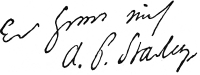
Dean Stanley's visits to Alderley were frequent. The last time he occupied the pulpit of the old church was on the 5th of May, 1878, when he preached before a crowded congregation in aid of the fund for restoring the church. On a more recent visit, though pressed for time, he stopped by the way at the cottage of a suffering parishioner, offered words of comfort and prayer by his bedside—"the same prayer," as he afterwards remarked, "that he had used by the bedside of his own dear wife." His final visit was in the autumn of 1880, on his return from a short sojourn in the Isle of Man, when he visited the rectory and his mother's and sister's grave, accompanied by his friend, the Bishop of Manchester.
