Chapter VI · (continued 2)
Reading edition
It will thus be seen that Sir Peter Legh outlived both his son and his son's widow. After his death in 1478 an Inquisition was taken in accordance with custom, when it was found that Piers Legh, his grandson, then twenty-three years of age, was his next heir. This Piers or Peter, who was the fifth in direct succession bearing the same name, had succeeded to his mother's estates on her death in 1474. Seven years previously, and when he could only have been about twelve years of age, he had, with the consent of his father, been united in marriage, with Ellen, the daughter of Sir John Savage, of Clifton, an alliance that brought him in close connection with the Stanleys, his wife's mother being Katherine, daughter of Thomas Lord Stanley, of Lathom, and sister of the first Earl of Derby. They were in close kinship, and hence it was necessary, to make the marriage valid, to obtain a Papal dispensation, which was accordingly done.
In mediæval times mercenary considerations entered rather largely into matrimonial arrangements, and marriages were frequently contracted at a very early age, the parties most directly concerned being rarely consulted as to the choice of their respective partners, a practice that the then state of the law almost necessitated. Indeed, a prudent father generally deemed it a parental duty to seek out a suitable match for his heir and marry him in his lifetime, lest, in the event of his dying and leaving him unmarried, he might fall into the hands of some greedy courtier, who under pretence of taking care of his lands, but in reality to enrich himself, might obtain his wardship and dispose of him in marriage to the highest bidder without any regard to inclination or mutual liking. This state of things will sufficiently account for Piers Legh, the heir apparent to so large an estate, being married at such an early age.
The name of this Piers is unpleasantly associated with a tragic act alleged to have been committed at Bewsey Hall, near Warrington, the recollection of which tradition, that delights in passion and revenge, has preserved. Much mystery hangs about this terrible deed, and the versions that have come down to us through succeeding ages are manifestly untrue in many particulars, though the main facts are doubtless correct. In the Dodsworth MSS., in the Bodleian Library, the story is told as follows:—
Sir John Boteler, Knight, was slain in his bed by the Lord Stanley's procurement, Sir Piers Legh and Mister Willm Savage joininge with him in that action, corruptinge his servants, his porter settinge a light in a windowe to give knowledge upon the water (i.e. the moat) that was about his house at Bewsaye when the watch that watched about his house at Bewsaye where your way to ... (Bold?) comes, were gone awaye to their own homes and then they came over the moate in lether boates and soe to his chambre where one of his servants called Houlcrofte was slaine, being his chamberlaine, the other brother betrayed his mr. They promised him a great reward and he going with them a way they hanged him at a tree in Bewsaye Park. After this Sir John Boteler's lady pursued those that slewe her husband, and indyted xx men for that sarte (i.e., assault), but being marryed to Lord Gray, he made her suites voyd, for which cause she parted from her husband, the Lord Graye, and came into Lancastershyre and sayd if my Lord wyll not helpe me that I may have my wyll of mine enemies, yet my bodye shall be berryed by him, and she caused a tombe of alabaster to be made where she lyeth upon the right hand of her husband, Sir John Boteler.
Another paper in the Dodsworth collection represents the murder as being perpetrated in the reign of Henry VII., and assigns as the cause of the quarrel the refusal of the Botelers to wear the livery of the Stanleys on the occasion of King Henry's visit to his brother-in-law, the Earl of Derby, in the summer of 1496. The Earl is stated to have sent a messenger to Bewsey desiring its lord to wear "his cloath at that tyme," but, in the absence of Sir John, his lady, with becoming regard for her lord's dignity, said, "She scorned that her husband should wayte on her brother, being as well able to entertayne the King as he was." A note in the Shakerley Papers states that "sir Peter (Legh) slewe sir Thomas Butteler of Bewseye knight, and for the same was forced to build Disley church for his penalty at his own cost and charges 1527." The late Mr. Roby, in his "Traditions of Lancashire," has made the tragedy the theme of one of his legendary lyrics, and describes the struggle with much circumstantial detail; and since then a resident of Warrington, Mr. John Fitchett, in a poem of considerable merit, "Bewsey," has told the story, incorporating in it an incident traditionary in the neighbourhood, though not referred to in the Dodsworth papers—that when the assassins broke into the hall they were resisted by a faithful negro, who was killed in the melée:—
Tradition tells, a faithful negro brav'd Singly their savage rage, and bold oppos'd Their passage to the room where thoughtless slept His dearly honour'd master, till at last, O'erpower'd by numbers, and o'erwhelm'd with wounds, Alas! he nobly fell. Their reeking hands Unsated yet, had still to execute Deeds of black import, and dire schemes of blood: For ah! unarm'd, and in his bed surpris'd, Vilely they butchered the devoted Lord! Meanwhile a servant maid, with pious guile, Bore in her apron, artfully conceal'd, The infant heir; and many a danger brav'd, Saved him uninjured from the ruffian's sword, The Negro's valour fav'ring his escape.
The interest in the story has been rather increased than lessened by the recovery of the ancient ballad of "Sir John Butler," printed by the Early English Text Society from Bishop Percy's folio MS. (v. iii. p. 210). In the following ballad the story as related in the Dodsworth MSS. is adhered to with tolerable accuracy:—
Listen, lords and ladies fair And gentles, to my roundelay. List, youths and maidens debonnaire, To this most doleful tragedy. Of Pincerna, the noble race, That Botiller was yclept, I say; And Bewsey Hall, that goodly place, Where traitors did the Butler slay. Fatal the feud 'tween him and one Whose sister was his wedded wife; The proud Earl Derby, whose false son Did plot to take the Butler's life. Savage by name and nature too, Piers Legh, that pierced all too free, Join'd with Lord Stanley and his crew, And bought the warder's treacherie. A light shone from the warder's tow'r, When all the house lay sunk in sleep, To guide those murd'rers, fell and stour, Across the moat, dark, wide, and deep. In leathern boats they cross'd and then The warder softly oped the gate: Bold fronted them the chamberlain; Holcrofte his master warn'd too late. Him they slew first, and then the Knight, While sleeping, 'neath their daggers bled:— A faithful negro, black as night, Snatcht up the infant heir and fled. The felon porter craved reward For treach'rous guiding in the dark: They paid him; then for his false guard They hung him on a tree i' th' park. In vain they sought—the child was saved; But gallant Butler was no more: That night his wife in London dreamt That Bewsey Hall did swim with gore. When that she learn'd the foul deed done, She pray'd they might have felon's doom; But might 'gainst right the struggle won; Then sigh'd she forth in bitter gloom:— "If by my lord's fell foes and mine "My will in life is thus denied; "And I must live, bereaved, to pine, "Death nor the grave shall us divide," An alabaster tomb she made, To her lov'd husband's mem'ry true; And on her death her corse was laid Close by his side, 'neath aged yew. Mourn for the brave, the fair, and true, Sleeping in love, and hope, and faith; May ruthless ruffians ever rue Their murder foul, brave Butler's death!
The "alabaster tomb" in the Butler Chantry in Warrington parish church still exists, and the effigies of Sir John and his wife are recumbent upon it; and there also is an effigy of the faithful negro reposing near to that of his murdered master, or at least what common report proclaims as such, only that, unfortunately for the story, the darkened figure is that of a former lady of Bewsey, and not the faithful servitor of the Botelers, and is, moreover, believed to have been brought from Warrington Friary, since the time when Randle Holme made his Church Notes in 1640.
The tragic story of Bewsey, which is so involved in obscurity and contradiction, and overlaid with so much legendary exaggeration, has been a cause of perplexity for many a long year to local antiquaries. No one of the alleged actors, no one of the facts, and no one of the causes of the supposed quarrel can be true. Sir John Butler's death occurred before the Earldom of Derby had been conferred on Lord Stanley; when King Henry visited Lathom, the Earl's sister, Sir John Butler's widow, was sleeping her last sleep, and at the time of Sir John's death Piers Legh was a mere child of eight years, so that unless he was very precocious his share in the outrage is purely mythical, and we may therefore dismiss the story of his being sentenced, as a penance for his participation in the murder, to build Disley Church. And yet the story has, doubtless, a foundation in fact, though the actores fabulæ may be phantoms. Sir John Butler died on the 26th of February, 1463; the cause of his death is shrouded in mystery, but that he died by violence is not altogether improbable. In those days, when feuds were rife and outrages of daily occurrence, the crime of murder was held of small account, and one that ofttimes might be expiated by the payment of a sum of money. The Botelers had ranged themselves on the side of the Lancastrians. Lord Stanley, who was a consistent supporter of the party of good luck, was then a Yorkist, as was also his nephew, Piers Legh, and Piers Legh's brother-in-law, William Savage. Was the Boteler, whichever of the family he might be, whose life was sacrificed the victim of some political feud arising out of the contentions of the rival houses of York and Lancaster?
In the summer of 1482 England was in a state of commotion; Edward had quarrelled with James III. of Scotland and concluded a treaty of alliance with the Duke of Albany, the brother of the Scottish King, who was then aspiring to the royal authority, and had agreed to hold Scotland as a fief of England in return for the support that had been promised him. The Duke of Gloucester—so soon to become Richard III.—who was lord of the marches, had the chief command of an invading force and marched northwards. The wily chief of the house of Lathom, Thomas Lord Stanley, commanded the right wing, some 4,000 strong, and Piers Legh, of Lyme and Bradley, who four years before had succeeded to the full enjoyment of his patrimony, buckled on his armour and marched under his banner. By July they had reached the old border town which overlooks the estuary of the silvery Tweed, the scene of so many stirring events—Berwick, which the "meek usurper," Henry VI., had surrendered when he fled to Scotland after his defeat at Towton. The town quickly yielded, but, as the castle held out, Gloucester, unwilling to lose time, marched northwards towards Edinburgh, leaving Lord Stanley and his force to prosecute the siege. On the 24th of August the garrison capitulated, and from that time to the present Berwick has remained severed from the sister kingdom. Peter Legh by his dash and daring gained golden opinions, and gained the right to wear his golden spurs as well, for he was made a banneret on Hutton Field.
Had Gloucester had sufficient discernment he might during that expedition have discovered how little reliance was to be placed on the fidelity of a Stanley. Tradition says that either in going or returning dissensions and jealous bickerings arose between the two commanders; the spirit of hostility spread to the ranks of their followers, and several frays occurred between Richard's and Stanley's men, in one of which, near Salford Bridge, the latter had the best of it and succeeded in capturing one of Gloucester's banners, an incident commemorated in Glover's rhyming chronicle—
Jack of Wigan he did take The Duke of Gloucester's banner, And hung it up in Wigan church A monument of honour.
On the 9th of April in the succeeding year Edward IV. died. Gloucester was at the time at York, and it is said that he attended the minster with a retinue of six hundred knights and esquires to observe the obsequies of his departed brother, and swear fealty to his nephew, the boy-King—Edward V.—the King whose death he was so soon to compass. Having performed these duties he hastened southwards with the intention of intercepting the King before he could reach London, and it is said that on his way he spent a night under Sir Peter Legh's roof at Bradley, when, in the hope, as it would seem, of securing the future services of his host, he granted him an annuity of £10 for life.
On the 6th of July Richard and his Queen, Anne, were crowned at Westminster, when, "the Lord Stanley bare the mace before the King, and my Lady of Richmond (his wife) bare the Queen's train," for the Stanleys were fated to flourish whatever party was in the ascendant. But "uneasy lies the head that wears a crown," especially when the head is that of a usurper, as Richard had painful experience. His cruelties had made him unpopular with the people; the Lancastrian party, which still numbered many adherents, took heart in the hope of being able to displace him and seat Henry of Richmond, Lord Stanley's stepson, upon the throne, and ere long the standard of revolt was raised. In January, 1485, commissions were addressed "to all knights, esquires, gentlemen, and all other of the King's subjects" in the counties of Lancaster and Chester. The Cheshire commission notified all concerned that "the King hath deputed the Lord Stanley, the Lord Strange, and Sir William Stanley to have the rule and leading of all persons appointed to do the King's service when they be warned against the King's rebels, and if any rebels arrived in those parts that then all the power that they could make should be ready to assist the said lords and knight upon their faith and (al) legiances." The Lancashire commission required the "knights, esquires, and gentlemen, and others" of the county "to give their attendance upon the Lords Stanley and Strange to do the King's Grace service against his rebels in whatsover place within this Royaume (realm) they fortuned to tarry." Yet at that very moment Lord Stanley was pledged to Richmond's cause, and as steward of the Royal Household was sending him information of all Richard's plans. Thus did the misguided Crouchback thrust into the hands of the Stanleys the power which, a few short months later, upon the field of Bosworth, was to be used against him with such fatal effect.
The records of Lyme as well as the old annalists and chroniclers are silent as to the part which Sir Peter Legh bore in the great struggle on Redland Heath[59] when the sun of the Plantagenets went down, and the claims of the rival Roses were finally decided;
but we may be well assured that when commissions were addressed to "all the knights, esquires, and gentlemen" of Lancashire and Cheshire, and Lord Stanley was to "have their rule and leading," Sir Peter would not be idle or allow his armour to rust unused. His house owed allegiance to the White Rose. Richard had been his guest at Bradley, and had then conferred an annuity upon him; duty and gratitude should, therefore, equally have bound him to the cause of his Sovereign, but whether he was with the "stout fellows in white surcoats and hoods" who followed his cousin Sir John Savage into the thick of the fight, or in the camp of Lord Stanley, who looked down upon the fray with calculating judgment, beguiling both combatants with promises and assurances of sympathy while waiting to see on which side victory was likely to fall, we have no means of knowing. At ten o'clock on the morning of that memorable 22nd of August, 1485, while the sun, mounting high in the heavens, flashed on pike, and corslet, and helm, and brightened every pennon that lagged in the lazy air, with a great shout and a rattling shower of arrows the fight began. "Lord! how hastily," says Holinshed, "the soldiers buckled their helmets—how quickly the archers bent their bows and frushed their feathers—how readily the billmen shook their bills and proved their staves, ready to approach and join when the terrible trumpet should sound the bloody blast to victory or death." The Duke of Norfolk, who led the van of the royal army, singled out the Earl of Oxford, and engaged him in a personal encounter, for in those days the leaders deemed it a point of honour to fight hand to hand; his vizor was hewn off by a single blow, an arrow from a distance pierced his brain through his broken helmet, and he fell lifeless to the ground. The brave Surrey, hurrying up to avenge the death of his father, was overpowered by Sir John Savage, who led the left wing of Richmond's army, when he requested that his life might be taken to save him from dying by an ignoble hand. He was led to the rear, but lived to be the Surrey of Flodden Field, and the worthy transmitter of "all the blood of all the Howards," But the men whom Richard had loaded with benefits deserted him in the hour of his need with a treachery that proclaimed that the knell of chivalry was rung. Lord Stanley, who three nights before had held a secret interview with Richmond at Atherstone, stirred not a finger, nor moved a man, until the fate of the battle was decided, when he threw off his disguise and charged boldly against his master on his stepson's side. No strategy could now be of avail, and, in the effort of despair, Richard made the final charge upon his rival. Descrying Richmond, he put spurs to his horse, and with lance in rest rushed towards him, when, in the nick of time, Sir William Stanley, "with three thousand tall men," closed in and Richard fell overpowered, with wounds enough to have let out a hundred lives, and murmuring with his last breath, "Treason! Treason! Treason!" The royal army was but a rope of sand, and when the shout went up that Richard King of England had bitten the turf his troops, three-fourths of whom were ready to side with the strongest, rushed in inglorious retreat, the victors following in hot pursuit The fight lasted but two short hours, yet on the morrow many a whimpled dame mourned the loss of her belted lord, and many a sobbing Joan and village Winifred grieved for husband and lover slain at Bosworth Field.
When the fight was ended, Lord Stanley, ever the faithful adherent of the party of good luck, led the descendant of Cadwallader to the slope of the hill at Stoke Golding, ever after called Crown Hill. A knight handed him the battered circlet of gold which adorned the chapeau of estate Richard had worn upon his salade or head piece, and, commanding the attendants to kneel, he placed it on the brow of the victorious Earl and proclaimed him "Conqueror and King." Meanwhile the stripped and mutilated corpse of him who at the morning's rise led a gallant army to assured victory, "trussed like a calf and naked as he came into the world," was flung across a horse and carried in triumph behind a pursuivant at arms to Leicester, where, after being exposed to the gaze of the scornful mob for two hot summer days, it was buried without ceremony in the church of the Gray Friars.
Henry of Richmond came out of the field of Bosworth a victor to ascend the throne of a nation bleeding at every pore, and the leading nobles of which had been swept away. He was not ungrateful. One of his first acts was to seize the estates of the adherents of the fallen Richard. With them he was able to reward his faithful followers, and the originally great possessions of the Stanleys became swollen by enormous grants out of the Yorkists' confiscated lands. The Leghs of Lyme fared but indifferently in comparison; at all events, there is no evidence of Sir Peter having come out of that struggle with any addition to his territorial possessions. On the 14th of January following the houses of York and Lancaster were united by the marriage of the King with Elizabeth of York, and on the 20th of September, with almost undue punctuality, the popular wish was realised in the birth of a Prince—a bud from the peaceful grafting of the White Rose upon the Red—for whom Lord Stanley, or rather Lord Derby, for he had then been elevated to the earldom, was one of the two sponsors.
But the partiality for the house of York was not yet extinguished among the men of Lancashire and Cheshire. As Lord Bacon says, the memory of the ill-fated Richard "lay like lees at the bottom of their hearts, and would come up if the vessel was but stirred;" it was not long before a spirit of resistance began to manifest itself, and Henry found himself threatened with the loss of his ill-gotten sovereignty from a source as unexpected as it was deemed contemptible. In 1487 a youth appeared in Ireland calling himself Edward Plantagenet, Earl of Warwick, but whose real name was Lambert Simnel. He was proclaimed as Edward VI., and the Duchess of Burgundy, favouring the imposture, sent over from Flanders an experienced captain, Martin Swartz, with two thousand men to his aid. In the "merry month of May" they landed on the barren island of Fouldrey, and took possession of the castle—the Peel of Fouldrey, as it was called—a fortress commanding the entrance to Morecambe Bay, which had been built by the monks of Furness as a retreat from the ravages of the Scots. Thence they marched southwards through Yorkshire into Nottinghamshire, where they were joined by Lord Lovel. Henry, with his usual promptitude, hastened to give the insurgents battle; Sir Peter Legh, who had again buckled on his armour, served under the banner of the King, and bravely bore his part in the battle of Stokefield, near Newark, where, on the 6th of June, the two armies were put in array against each other. The issue was quickly decided, and resulted in the complete overthrow of the insurgents, one half of whom were slaughtered. This appears to have been the last military exploit in which Sir Peter Legh had any share. The sword was returned to the scabbard, never again to be unsheathed, the remainder of his days being passed in more peaceful pursuits. It is not unlikely that his abandonment of the profession of arms thus early—for he was only in his thirty-second year when the battle at Stokefield was fought—was caused by the death of his wife, which occurred on the 7th May, 1491, at Bewgenet, a small village in Sussex, where she appears to have been staying, and where her body was buried.
Though wealth and honours were not lavished on Sir Peter Legh in the way they had been on the Stanleys, yet the services he had rendered at Stokefield and elsewhere were not allowed to go entirely unrequited, though it must be admitted that his reward came somewhat late. By letters patent, dated at Lancaster, 3rd March, 20 Henry VII. (1505), he was, in consideration of services he had rendered to the King, as the grant states, appointed successor to the Earl of Derby in the important and lucrative office of seneschal or steward of Blackburnshire, including Tottington, Rochdale, and Clitheroe, within the county of Lancaster—a vast tract of country embracing within its limits the forests of Blackburnshire and Bowland. These forests or chases were extensive wastes inhabited by the roe, the stag, and the wolf, and also the wild ox, which latter is said to have been imported into these northern wilds from the Forest of Blackley, on the confines of Manchester. According to popular tradition, the wild cattle which still constitute one of the peculiarities of Lyme date their existence there from the time that Sir Peter Legh held the seneschalship of Blackburnshire, having, it is said, been conveyed by him from the Lancashire forests to his chase at Lyme.
Sir Peter continued in his office for a period of six years, and with the exception of an occasional lawsuit, when he was supposed to have exceeded his powers, he appears to have discharged the duties of his office to the general satisfaction of both sovereign and subject. In 1511 he resigned his post, the reason for which will hereafter appear. He was then verging upon sixty, and had been a widower twenty years; his sons had all attained to man's estate, and his only daughter had been suitably mated, her husband being Lawrence, son and heir of Sir John Warren, of Poynton. He seems, therefore, to have had a desire to withdraw from the more active duties of life, and to spend his few remaining years in peaceful quietude. The year which followed his wife's death was that in which her brother, Thomas Savage, was made Bishop of Rochester, from which see he was subsequently translated to London, whence he was elevated to the Archbishopric of York, and doubtless his brother-in-law's advice and counsel would be sought. Be that as it may, Sir Peter Legh determined upon entering the Church, and took orders, thenceforward describing himself as "knight and priest," and about the same time he set about the foundation of a chantry chapel upon his estate at Lyme—the present church at Disley. The time was one of much religious energy and life, notwithstanding that the faith might be in a dim lantern and obscured by not a few superstitions and scandals, but it must not be assumed that the only object of Sir Peter Legh's foundation was that prayers might be offered for the dead by the officiating priest. The place was removed from the mother church, which at some seasons would be almost inaccessible, especially to the aged and infirm; it would seem therefore to have been intended more as a kind of oratory or domestic chapel appurtenant to his manor house, and available for the neighbouring population, who would thus have some of the ministrations of religion if not all the public means of grace carried almost to their own doors. In the erection of it he took counsel with the parsons of Wilmslow, Prestwich, and Gawsworth, and also with Mr. Brygges, the master of Sir John Percival's Grammar School at Macclesfield, then just founded; but curiously enough no mention is made of the parson of Stockport, in whose parish it was to be situate, and who would claim sacerdotal superiority. Sir Peter died before his work was completed, but prior to his decease he bound his son by solemn promises to finish the work he had begun. His idea seems to have been to found a kind of Ecclesiastical College, with three priests and two deacons, but unfortunately he did not define the exact character of the foundation he contemplated, and the omission gave rise to protracted litigation and much ill-feeling between the executors under his will and his son and successor. It was of little consequence, however, for within a very few years the Act was passed for the suppression of the minor religious houses, and Sir Peter Legh's chantry chapel at Disley shared the common fate, the various lands and tenements belonging to it being seized into the hands of the King's Commissioners.
Sir Peter, who must have begun to feel the weight of years upon him, made his will in 1521, but omitted to name his executors. In the following year he executed two other wills, the latest of which, dated December 1, 1522, has been printed by Mr. Earwaker from the original in the muniments at Lyme, and is interesting from the very specific directions given respecting his funeral, the ceremonies to be observed at it, the monument to be erected over his remains, and especially the adorning of it "wt a pictor aftr me and my wieff and or Armes," all which his executors carefully observed. Two years after the execution of his last will he is said to have erected the structure known as Lyme Cage, the precursor of the present building, the precise purpose of which it is difficult to define, unless it was intended as a stand from which the ladies of Lyme might, without fatigue, enjoy the pleasures of the chase. About the same time, too, he is found helping in the work of rebuilding the tower of Lyme Church, and inviting the "contributions of all pious persons," without whose help, so the appeal declares, "the parish was not able to finish the work." His death occurred at Lyme, August 11th, 1527, at the ripe age of seventy-two, and in accordance with his testamentary instructions his body was removed for burial by the side of his ancestors in the old church at Winwick, where a sepulchral brass, with the "pictors" of himself and his wife, was placed to his memory, which still remains in a tolerable state of preservation, and which is more than usually interesting on account of the peculiar character of his effigy. He is represented in the plate-armour of the period, with a sword upon his side, and wearing the spurs of knighthood; whilst over the armour of the soldier is represented the chasuble and other vestments of the ecclesiastic. His head is bare, with a tonsured crown denoting his priestly office. His hands are uplifted, though not closed, and between them is a shield of six quarterings. By his side is the effigy of his wife, habited in a long robe, and wearing a headdress with lappets that depend on each side; a girdle encircles her waist, and the hands are uplifted as if in supplication. At their feet are graven the figures of their several children, and there is also this inscription in black-letter characters:—
Orate pro aiab' provi viri, dni Petri Legh, militis, hic tumulati, et dnæ Elene, ux. ejus, filie Johis Savage, militis, cujus quid Elene corpus sepelitr. apud Bewgenett 17° die mensis Maij, anno Domini millesimo cccclxxxxj. Idemq. Petrus, post ipius Elenæ mortem i. Sacerdotem canonice, consecrat obiit apud Lyme i. Hanley xi. die Augusti ao. di mvcxxvij.
Sir Peter Legh had issue five sons and one daughter. His third son, Galfred or Gowther Legh, who resided at Woodcroft, founded the grammar school at Winwick; his will bears date "Apryll 14, 1546," and a lengthy abstract from the original in the registry at York will be found in the "Lancashire Chantries," edited for the Chetham Society by the late Canon Raines.
When Sir Peter Legh's body had been peacefully committed to the grave, and his executors, in accordance with his expressed desire, had provided the sumptuous tomb with its coverings of "marbull" and its "pictors in brass," an inquiry was held before the Escheator of the County of Chester respecting the lands he had held at the time of his death, and it was then found that Peter Legh was his son and heir, and of the age of 48. On the 22nd June, 1528, he had writ of livery granted him of his patrimonial estates, and he then entered upon possession. The document, which is on the Recognizance Rolls of Chester, is a lengthy one, and recites several family deeds and settlements, and gives a clear idea of the extent of the family estates at that time.
Peter Legh had then passed the meridian of life, and had been twice married. His first wife, Jane, daughter of Sir Thomas Gerard, of Bryn, to whom he had been contracted in marriage by his father in 1487, when he was only seven years of age, died on the 5th May, 1510, leaving him two daughters, the eldest of whom, Cicely, had been given in marriage three years previously to Thomas, son of Sir Thomas Boteler, of Bewsey, the match having probably been arranged with the hope of putting an end to the feud that had so long existed between the two families, just as in the year before the contention of the rival houses of York and Lancaster had been terminated by the union of the red and white roses; though if this were the expectation of the promoters of the match their hopes were doomed to disappointment, for the heads of the houses of Lyme and Bewsey had still to appeal very frequently to the law courts for help in the adjustment of their difficulties.
A year or two after the death of his first wife Peter Legh entered into a marriage with Margaret, daughter of Nicholas Tyldesley, and by her he had a numerous family—three sons and seven daughters. He is said to have been afflicted with lameness, the result, it is supposed, of a wound he had received at Flodden, in 1513, when his kinsman Christopher Savage, the valiant mayor, and so many of the burgesses of Macclesfield were numbered among the slain. Possibly the pain and inconvenience experienced from his lameness had tended to sour his temper, for he appears to have been of a more than usually litigious disposition if we may judge from the many occasions in which he figured in the law courts, sometimes at the instance of his neighbours, often in connection with the Botelers, and occasionally to answer charges brought by his father's trustees, who accused him of improperly receiving and retaining the rents and property belonging to the Chantry at Disley, which he had founded. How far these last-named accusations were well founded is not clear. Possibly the religious feelings of the son were not as intense as those of the sire, and hence the neglect of a duty on the delegated performance of which the father had partly rested his hopes of salvation; or it may be that he took a charitable view of things and believed that his father's faults were not of a very flagrant or inexpiable character, and therefore not requiring a continuance of the posthumous invocations he had provided for. Certain it is that when Peter Legh the younger made his own will in anticipation of his approaching end, he made provision for the services of a chaplain who should continue "only for seven years," evidently believing that that period would be sufficient for his probation in the purgatorial region.
Peter Legh ended his days at Bradley on the 4th December, 1541, and on the 24th January following, an inquisition as to his Cheshire estates was taken at Chester, when his eldest son by his second wife, who also bore the name of Peter, and was then aged twenty-eight years, was found to be his heir.
The year in which the battle of Flodden was fought was that in which Peter Legh the younger first saw the light. In 1518, while still an infant, for he was only five years of age, he was united in marriage with his kinswoman, Margaret, daughter of Sir Thomas Gerard, of Bryn, the Church's dispensation having been first obtained—a match that brought him, it may be hoped, more happiness than fell to the lot of his younger sister, Joan Legh, who when six years old was married to his wife's brother, the son and heir of Sir Thomas Gerard, from whom she was afterwards divorced. In May, 1544, two years after he had entered upon his patrimony, he joined the expedition headed by the Earl of Hertford to demand the surrender of the infant Queen of Scotland, whom Henry had intended uniting in marriage with his son, and in this way securing the union of the two kingdoms. The force marched upon Edinburgh, which was speedily captured, pillaged, and burnt. After this rough kind of courtship, and when they had plundered and destroyed the towns and villages in the neighbourhood, the army moved on to Leith, which was also demolished. Before taking ship on their return the Earl of Hertford distributed honours to those who had been conspicuous by their bravery; Peter Legh, of Lyme, was one of them, and was then advanced to the rank of banneret.
After the accession of Edward VI. he was entrusted with the shrievalty of Lancashire, and on the 17th November, 1553, the first year of Queen Mary's reign, he was appointed to the office of sheriff of the county of Chester, and re-appointed to the same office "during pleasure" in the following year, an evidence that he enjoyed the confidence of both sovereigns. The times were, however, troublous. A great religious revolution, the seeds of which had been sown by "the preacher of Lutterworth," attained to maturity in the time of Henry VIII. In the "infant reign" of Edward VI. the Reformation continued to advance with steady step, but at his death his sister Mary ascended the throne, Popery was restored, and many of the people returned to the religious observances of their fathers. The then Earl of Derby, acting upon the maxims of his family, had been able to accommodate himself to the changing circumstances of the times. Though a staunch Protestant under Edward, he became an uncompromising Roman Catholic under Mary, orthodox in every article of the faith except the restitution of the property which he had filched from the Church, and about which his conscience was somewhat tender, restitution being, in his estimation, inconsistent with the traditional canon of "good luck;" his heresies on this head, however, were amply atoned for by his readiness to persecute those who adhered to the reformed doctrines. When George Marsh, the Lancashire martyr, was taken before Justice Barton, at Smithell's Hall, for preaching false doctrine in the church of Dean, the justice sent him to the Earl of Derby, at Lathom, for further examination. "Then was I called," says Marsh, "to my Lord and his council, and was brought into the chamber of presence, where were Sir William Norris, Sir Piers a Lee (Sir Peter Legh), Mr. Sherburn, the parson of Grapnel, Mr. Moore, and others. My Lord asked me whether I was one of those that sowed evil seed and dissension amongst the people; which thing I denied, desiring to know my accusers, and what could be laid against me, but that I could not know. Then he and his counsel would examine me themselves." Sir Peter does not seem to have liked the office of Inquisitor, for, though an active member of Lord Derby's council, he took care to absent himself when Marsh was brought up a second time for examination. Very likely his own religious opinions were a little undecided, and the patience, meekness, and tranquillity of the martyr may have inclined him towards the faith for which so worthy a man was to suffer so terrible a death.
In the year in which Sir Peter was appointed to the shrievalty of Cheshire a general muster of soldiers was ordered from the respective hundreds of the county of Lancaster, and his name occurs in the muster for West Derby as holding a command under the Earl of Derby. Three years later a commission was issued to array, inspect, and exercise all men-at-arms, and men capable of bearing arms, as well archers as horse and foot men, so that they might be arrayed in arms to serve their country in case of need. But all this preparation was of little avail, for, after a short siege of eight days, the fortress of Calais, which had cost the conquerors of Crescy eleven months to acquire, and which for two hundred years had been held as the key to the dominions of the the French King, was surrendered, and England found herself expelled from the continent of Europe. The loss filled the kingdom with murmurs, and overwhelmed the Queen with despair, and at the age of forty-two years she descended childless to the grave, leaving the throne to her half-sister Elizabeth, whose masculine habits and resolute will made her better fitted to wield the sceptre.
In the year of Elizabeth's accession Sir Peter Legh caused the church at Disley to be consecrated for Protestant worship, and dedicated to the Virgin Mary. At the same time he added a peal of bells,[60] one of which bore the following inscription:—
All people may behold and see The works of good Sir Peter Legh.
and, as Bishop Gastrill states in his Notitia, the church was "made parochiall upon a composition between Sir Peter Legh of Lyme and other Inhabitants of Disley, and Sir Edward Warren, Patron of Stockport, and the Inhabitants of that Parish. The Inhabitants of Disley to repair their chapel, and to pay all dues to the mother church (of Stockport)." The building which Sir Peter's grandfather had caused to be erected would seem to have remained unoccupied, for between the legal disputations and the religious commotions that were simultaneously taking place the property intended for the endowment had never been actually conveyed.
Having performed this duty, Sir Peter next set about the improvement of his Cheshire estates, and obtained licence from the Queen to enclose and empark his estate of Lyme, and to have free warren therein, as well as in his adjoining lands. Hitherto the family had resided chiefly at Bradley, a larger and more stately mansion than Lyme, which, if a house of much antiquity, was one of comparatively small dimensions. Sir Peter Legh was a man of considerable culture; he was a scholar and an architect as well as a soldier, and during his time some important additions were made to his Cheshire home. With his love of architecture it was natural he should combine a taste for heraldry, and in the pursuit of this study he received considerable help from William Flower, Norroy King of Arms, who had previously held the post of Chester Herald. About this time Flower was making his "Visitation" of Cheshire; he was a welcome guest at Lyme, and, doubtless, he was equally pleased to find a congenial spirit, for in that age of religious zeal, persecution, and piety there were many who, acting upon St. Paul's advice to Timothy, avoided "giving heed to fables and endless genealogies which minister questions rather than godly edifying," and who were indifferent about preserving their distinctions of rank, and others who had no special taste for the investigations of their descent, and were unable therefore to render the professional herald any substantial help in the elucidation of their family lineage. Very pleasant, no doubt, were the discourses and learned the discussions of those two worthies as they roamed about the chase, wandered over the Knight's Low, or sauntered beneath the shadow of the Lyme Hills. But heralds are human, and are apt to be credulous when dealing with knights and gentlemen possessing kindred tastes and given to hospitality. Flower listened to the story of the former Peter Legh's supposed share in the victory at Crescy, accepted parole evidence, and endorsed the fable, giving it the stamp of official confirmation in the special armorial augmentation—the hand and banner to which we have previously referred—which Sir Peter caused to be so profusely displayed in his mansion; he would seem also to have rendered assistance in the tricking out of the fine series of heraldic shields that were placed in the church of Disley, but which were removed some fifty years ago to grace the windows of the drawing-room at Lyme, where they may still be seen.
But other and more urgent matters demanded the attention of the lord of Lyme. The country was much divided on the subjects of religion and politics, and many of the old county families were anxious to see the Catholic faith re-established. In November, 1569, occurred the "Rising in the North," headed by the Earl of Northumberland.
Earl Percy there his ancyent spread, The half moone shining all soe faire; The Norton's ancyent had the crosse, And the five wounds our Lord did beare.
No sooner was it suppressed than another abortive act of treason occurred. The Earl of Derby was at the head of the lieutenancy of Lancashire and Cheshire, and to guard against any fresh attempt to disturb the public tranquillity, levies of troops, armour, and money were made. Forced loans were also had recourse to—loans that might more correctly have been termed benevolences or compulsory gifts, for they were never intended to be repaid. In April, 1570, a letter under the Privy Seal was sent to Sir Peter Legh, requiring him as the owner of estates in Cheshire to furnish a "loan" of one hundred marks, and simultaneously, as a Lancashire landowner, to lend £100.
On the 24th October, 1572, died Edward, the great and munificent Earl of Derby, with whose death, in the opinion of Camden, "the glory of English hospitality seemed to fall asleep." The funeral obsequies were characterised with a splendour and magnificence that befitted the semi-regal state he had maintained when living. Such a funeral Lancashire had never seen before. The representatives of all the great county families, with their banners and other heraldic insignia, were there. Sir Peter Legh was present as one of the mourners, and was joined with another mourner in offering the deceased Earl's sword. It must have been a sorrowful day for him, for he had enjoyed a large share of the Earl's confidence, and often had they taken counsel together on the great questions that were then occupying the public mind. But the confidence which had been shown by the father was manifested in an equal degree by the son, and the letters still preserved among the Lyme muniments show that Sir Peter Legh's advice and counsel on private, as well as on public questions, was frequently sought by the "great" Earl's successor. In 1585, when the Spaniards were threatening a descent on the English coasts and the alarm of invasion spread through the country, Henry, Earl of Derby, was appointed by the Queen Lord Lieutenant of the two counties of Lancaster and Chester, with power to appoint his own provost marshal, whose duty was to enforce discipline and maintain order among the troops who were to be drilled and trained and kept in readiness to repel the common enemy. Sir Peter Legh owned extensive estates in both counties. He was the tried and trusted friend of the Stanleys, and to him, therefore, was committed the responsible office of provost marshal for the two shires. We next hear of him, in his capacity of "provost marshal and justice of peace for Lancashire and Cheshire," committing one Randolph Norbury—who had been charged with "uttering very heinous words" against the Queen's favourite, the Earl of Leicester, who had succeeded to the Lancashire estates of the Botelers of Bewsey—to the keeper of the Castle of Chester to be detained until he should be discharged by due course of law.
The storm which had long been threatening was now about to burst. The haughty Spaniard, impatient for conquest, and offended at Drake's threatening to "singe his beard," ordered the "Invincible Armada," as he presumptuously phrased it, to be prepared for sea. Great was the preparation and intense the excitement in England. All along the coast anxious watch was kept for days; from tower and turret and from every vantage ground warders scanned the horizon with eager eyes. At length the beacon fires were lit, proclaiming to Englishmen that the enemy was in view, and tongues of flame shot up from every cliff and hill—
For swift to east and swift to west the warning radiance spread— High on St. Michael's Mount it shone—it shone on Beachy Head. Far o'er the deep the Spaniard saw, along each southern shire, Cape beyond cape, in endless range, those twinkling points of fire.
Sir Peter Legh's kinsman, Thomas Legh, of Adlington, was the "stout old sheriff" of Cheshire that year. He himself was still provost marshal of the two palatine counties, and we may be sure at such a time he would be by no means idle. He was too old to again unsheath the sword, but if he were unable to render personal help he could yet render pecuniary aid, and that he readily did, for we read that in response to the Queen's appeal he contributed one hundred pounds—a substantial sum in those days, and a welcome addition to an exchequer by no means overflowing. It was almost his last public act, for before two more winters had passed over his head he had sunk peacefully to his rest, full of years and honours. He died at Lyme, on the 6th December, 1589, at the age of seventy-six; his body was carried to Winwick, and there buried in the family chapel where so many of his race had been laid before him.
What has been truly called the "great Eliza's golden time" seems to have been the golden era of Lyme as it was the golden age of England. The Sir Peter Legh of that day was a scholar as well as a gentleman, a courtier as well as a soldier; brave and generous, graceful and gifted, with a knowledge of the world, and a large experience, united with consummate prudence. He was the friend of Essex and of Leicester, and the trusted counsellor of two successive Earls of Derby; a frequent visitor at Lathom, he was familiar with the semi-regal state and munificence there maintained, and in his own house at Lyme he observed a dignity and bounteous hospitality such as none of his predecessors had equalled. The age was one of growing refinement and general activity of intellect, resulting from the growing opulence of the country. England had recovered from the state of exhaustion in which the Wars of the Roses had left her, and men had more leisure for the cultivation of the elegances of life. While those daring spirits, Drake and Hawkins, and Howard, and Frobisher, were founding our naval supremacy, Sackville and Spencer, and Marlowe and Sidney were calling up a great native literature. Raleigh was in his teens, and in the yeoman's house at Stratford was budding into manhood he who was to
Show, sustain, and nourish all the world.
England had then become a true garden of the Hesperides; musical talent had spread from the Court to the people; literature was cultivated; and the drama, "which taught the unlearned the knowledge of many famous histories," was emerging from childishness into vigorous life, and producing its effect upon the national character. With the great diffusion of wealth men took pleasure and pride in adding to the stateliness and beauty of their permanent abodes. Architecture is said to mark the growth and development of human society, and to express the needs and ideas of changeful centuries. The age of Elizabeth was truly a building age; the day of the gloomy keep, the drawbridge, and the portcullis—the time
When men built less against the elements Than their next neighbours
was passed. Property was secure; and the fortified castle had given place to the stately mansion, and in almost every parish the country gentleman had taken the place of the feudal barons or the mitred abbots who had previously been the owners of vast territorial districts. As William Brown, in his "Pastorals," remarked—
Here on some mount a house of pleasure vaunted, Where once the warring cannon had been planted.
Sir Peter Legh, as we have seen, greatly enlarged, if he did not entirely rebuild, his mansion at Lyme; he greatly improved his estate, and had his demesne emparked, so that the fallow deer which tenanted it could be separated from the wild cattle that roamed over the moorland wastes of Macclesfield Forest. His progenitors for generations had been foresters in fee; he not only enjoyed the privilege, but, as the deputy of the Earl of Derby, exercised various offices in connection with the forest. Hunting was his favourite pastime, and he appears to have been generous in the distribution of game and venison among his friends and neighbours. In the "Shuttleworth Accounts" there are frequent references to Sir Peter's bounty. Thus we read—"Paid for twoe pounds of peper that wente to Lyme when the staggs were sent to London, 5s. 8d.;" "To the keeper at Lyme for killing two staggs, 4s.;" "Unto a man who broughte a shoulder of a stagge from Lyme, xijd.;" "Unto a keeper of Sir Pyeres Legh who brought venison, 5s." Later on we read—"Given unto a mane of Sir Peteres Lyghte which broughte rabettes and pigiones, xijd.;" "To a man of Sir Peter Lyghe, which broughte fisshe to the Smitheles, ijs.;" "To a mane of Sir Peter Lyghe, which broughte a fatte buke to Smytheles, vs.;" "To Lytell Robin which brought smelts from my Ladie Lyge, iiijd.;" "To Sir Peter Lyghe's mane which brought a fatte buke to Smytheles, vis.;" "Sir Peter Lyghe's keeper, which brought the buke to Gawthorpe, xs." In 1584 the great Earl of Leicester, Elizabeth's favourite, is found writing to Sir Peter, thanking him for a hind he had sent, and also for a hound, probably one of the Lyme mastiffs, a breed that was famous it seems even then. We have already said that the lord of Lyme enjoyed the friendship of the Earl of Essex, Leicester's great rival. Essex was a guest at Lyme, and Wilson, the historian, who was in his retinue, in his journal records a curious incident respecting the hunting of the deer on that occasion. He writes:—
Sir Peter Lee, of Lime in Cheshire, invited my Lord one summer to hunt the stagg. And having a great stagg in chase, and many gentlemen in pursuite, the stagg took soyle; and divers (whereof I was one) alighted and stood with swords drawne to have a cut at him at his coming out of the water.
The staggs there being wonderfull fierce and dangerous made us youthes more eager to be at him. But he escaped us all. And it was my misfortune to be hindered of coming near him, the way being sliperie, as by a fall; which gave occasion to some who did not know mee, to speake as if I had falne for feare, which being told mee, I left the stagg, and followed the gentleman who first spoke it. But I found him of that cold temper, that, it seems, his words made an escape from him, as by his denial and repentance it appeared.
But this made mee more violent in persuite of the stagg, to recover my reputation. And I happened to be the only horseman in when the dogs set him up at bay; and approaching nere him on horseback, he broke through the dogs and run at mee, and tore my horse's side with his hornes close to my thigh. Then I quitted my horse, and grew more cunning (for the dogs had set him up again), stealing behind him with my sword and cut his hamstrings, and then got upon his back and cut his throate: which as I was doing, the company came in and blamed my rashness for running such a hazard.
Sir Peter Legh believed that—
The forest music is to hear the hounds Rend the thin air and with a lusty cry Awake the drowsy echo, and confound Their perfect language in a mingled voice.
But though, like Percy, in Chevy Chase, he delighted—
To drive the deer with hound and horn,
hunting the stag was not the only amusement he provided for his friends. The Mysteries and Miracle Plays had then given place to "stage-plays, interludes, and comedies;" though the drama was only in its puling infancy, it was rising into popular favour. My Lord of Leicester had his company of players, who performed before the Queen at the Kenilworth revels in 1575, when the whole country side flocked to the great earl's great castle. Doubtless there was amongst the spectators the bright son of the well-to-do burgess of Stratford, who would probably there received his first impressions of the drama, as he witnessed the rude masques, the storial shows of Gascoigne, and the allegory of the Lady of the Lake. The great Earl of Derby had a company of players in Lancashire, who, according to the Stanley papers, relieved the dulness of the Puritan chaplain's preaching on the Sunday morning by a theatrical performance before the household in the same mansion on the Sunday evening; and Sir Peter Legh, not to be behind hand, had a company of his own. The severe moralists of the age were strongly opposed to stage plays, and accounted them greater abominations than drinking, dicing, bear-baiting, and cock-fighting, and the law defined as "vagabonds" all players who were "not belonging to any baron of this realm, or towards any other person of greater degree." Sir Peter Legh's actors not only performed at Lyme and enlivened the houses of his neighbours, but we read in the Shuttleworth accounts already referred to that in the "Armada" year they appeared at Gawthorpe and were paid for a performance in the hall there. Sir Peter's liberality and munificence added to his popularity, and caused him to be looked up to with reverence and respect as well by his equals as by the common people. As we have said, he died in 1589, at the ripe age of 76; but Dame Margaret, his wife, must have survived him several years, for among the family portraits at Lyme there is one of her, taken in 1595, when she was in her ninetieth year. By her Sir Peter had a numerous issue—five sons and two daughters. The youngest of the two daughters, Margery, married for her first husband Sir Robert Barton, of Smithells, in Lancashire, and concerning their union tradition tells a pathetic story which Mr. Leigh has enshrined in verse and given to the world in his entertaining "Lays and Legends of Cheshire," under the title of "The Loves of Sir Robert Barton and Margery Legh."
Sir Peter Legh outlived his eldest son, also named Peter, who died at Haydock about the year 1570, and was succeeded by his grandson, who bore the same baptismal name. He was born in 1563, and must therefore have been in his twenty-seventh year when he succeeded to the patrimonial lands. While yet a minor he had received a training well fitted to enable him to discharge the duties that would devolve upon him as the owner of extensive estates. He had been a frequent guest of the Earl of Derby, and in the lordly hall of Lathom and at the kingly court of Castle Rushen he acquired a grace and dignity of manner, and at Gray's Inn, where he entered as a student, he gained a knowledge of the laws which in due course he would be called to administer. When a youth of fourteen he acted as page to Henry, Earl of Derby, and held up his train when he made a visit of ceremony to the town of Liverpool, and seven years later he was in the same Earl's suite as "one of his gentlemen waiters," when, as Elizabeth's ambassador, he went to invest the King of France with the Order of the Garter. In September, 1585, four months after he had entered at Gray's Inn, he married Margaret, daughter of Sir Gilbert Gerard, of Bromley, Master of the Rolls. For some cause or other the marriage had been delayed, as the settlement bears date 1st June, 1579. In the following year he was called upon to bear his part in the Great Council of the Nation, being chosen one of the representatives in Parliament for the ancient borough of Wigan, his wife's kinsman, William Gerard, being his co-representative. The time was one of much anxiety, consequent upon the well-founded apprehensions of a Spanish invasion and the decisive indications of plots for the deposition of Elizabeth and the recognition of Mary's claim to the English crown—that in which the fierce indignation in England against the bigoted King of Spain led the Government to break through the superstitious love of peace and boldly encounter Philip on his own territory. In 1589 Mr. Legh was again elected one of the representatives of Wigan, and in the following year his grandfather, Sir Peter Legh, passed to his rest, when he succeeded as next heir male to the family estates. His wealth and social status marked him as a fitting person to be entrusted with the shrievalty of Cheshire, and in 1595 that dignity was conferred upon him. Proud of his ancestry, he was no less proud of the home of his ancestors. His grandfather had rebuilt the mansion at Lyme and spent much of his time there, maintaining great estate; the older mansion of Bradley had in consequence been comparatively neglected and allowed to fall into decay, and in 1597, as appears by an inscription on one of the beams, he set about repairing the ravages which time had made, thoroughly reinstated it, and at the same time adorned the wall of the great staircase with an heraldic shield of eight quarterings, which may be seen at the present day. On the 2nd July, 1598, just a month before the death of the illustrious Lord Burleigh, the hoary minister, in whom
Old experience did attain To something like prophetic strain,
he attended at the Royal Palace in Greenwich, and there received the honour of knighthood at the hands of Queen Elizabeth. Two years later—43 Elizabeth—he was elected to represent the county of Chester in Parliament, in the place of Sir William Beeston of Beeston, Knight, his co-representative being Sir Thomas Holcroft, of Vale Royal, and the same year, having completed the restoration of his house at Bradley, he rendered the like good service to the church which his ancestors had founded at Disley, re-roofing it and putting the fabric in a state of complete repair. While this work was going on he was busied in making important additions to his territorial estate, having entered into a contract with Roger and Hamer Bruche for the purchase of their ancestral domain of Bruche, with the hall and lands pertaining to it, which thenceforward formed part of the Legh estates.
On the 24th March, 1603, the most glorious reign in our country's annals was brought to a close; it was a sad day for "merrie England," for it was that on which, in the royal palace at Richmond, in the seventieth year of her age, and the forty-fifth of her reign, worn out with the cares of State and wearied with the fierce contest between her intensely womanly nature and her sense of duty as the queen of a great people, the most powerful and most beloved monarch in Europe, Queen Elizabeth, lay upon her cushions wrestling with death, and terminated a long life of power, prosperity, and glory. Within three short months of that day death had cast a shadow over the home of Sir Peter Legh. On the 23rd July, 1603, he had the misfortune to lose his wife, the Lady Margaret Legh, who was then in her thirty-third year. She appears to have been staying in London at the time, for her body was buried in the church of Fulham, in Middlesex, where a sumptuous monument with her effigy upon it was erected to her memory, and which may still be seen near the north door of the chancel. She is represented as seated beneath an arched canopy with an infant upon her lap and another by her side. Over the head is a shield of arms, and on the face of the tomb is the following inscription:—
To ye memy. or what else dearer remayneth of yt verteous Lady, La. Margaret Legh, daughter of him yt sometimes was Sir Gilbert Gerrard, Knt. and mr of ye Rolles in ye Highe Court of Chancery, Wife to Sir Peter Legh of Lyme, in ye county of Chester, Kt., and by him ye mother of seven sons, Pierce, Frauncis, Radcliffe, Thomas, Peter, Gilbert, and John, with two daughters, Anne and Catherine; of wch Radcliffe, Gilbert, and John, deceased infants, the rest yet surviving to the happy increase of ther house. The years she enjoyed ye world were 33. yt her husband enjoyed her 17, at which period she yielded her soul to the blessedness of long rest and her body to the earth, July 3rd, 1603. This inscription in ye note of piety and love by her sad husband is here devotedly placed.
Among the family portraits at Lyme there is one in the "state bedroom" of the deceased lady—a full length—"Sir Peter Legh's first lady that was Lord Gerard of Bromley's daughter, master of the rolls." She is represented in the costume of the Elizabethan era, with the large hooped petticoats, ruff, &c.
When James of Scotland was proclaimed as the successor of Elizabeth on the English throne, Sir Peter Legh deemed it expedient to sue out a general pardon; not that he was conscious of having done any wrong, but in those days it was a convenient mode of settling old scores, for by paying a fine into the exchequer a general absolution could be obtained for all sins of omission or commission, real or imaginary.
Having paid his money and obtained the bill of indemnity which enabled him to begin the new reign without a blot, he was free to take unto himself a second wife, and he found a suitable partner in the person of Dorothy Egerton, the daughter of Sir Richard Egerton, of Ridley, and the widow of Richard Brereton, of Worsley, in Lancashire, and Tatton, in Cheshire—the quasi sister of Thomas Egerton Lord Viscount Brackley, Elizabeth's Lord Keeper, and subsequently James the First's famous Lord Chancellor, the progenitor of the Earls and Dukes of Bridgewater that were, and the Earls of Ellesmere, and Lords Egerton of Tatton that are. The marriage settlement, which is among the Lyme deeds, bears date 11th March, 1604, Dame Brereton having then been a widow more than five years, while Sir Peter had been a widower only eight months. The match was in many respects a wise one; the lady was of good birth, richly dowered, kind hearted and benevolent, and, being childless herself, she had the good fortune to gain the affection and respect of Sir Peter's children. A few years after the marriage, Sir Peter, who united with the love of letters a love of art, had her portrait painted as he had previously had those of himself and his first wife. The picture is said, though on somewhat doubtful authority, to be the work of Cornelius Jansen; it is a three-quarters, and one of the finest in the collection at Lyme. The lady is represented as habited in the costume of the time, with a lace ruff and necklace of beads, and a pet dog sitting upon the table by her side. In one corner is depicted a shield, with the arms of Egerton, of Ridley, and three other quarterings, and in the opposite corner is the inscription:— "Ætatissuæ 50, Anno Dni. 1615."
For some years after his second marriage, Sir Peter seems to have led a comparatively uneventful life. When not engaged in the fulfilment of his duties as Lieutenant-governor, or Captain of the Isle of Man, he spent much of his time on his Lancashire and Cheshire estates; Lyme was his favourite residence, and was frequented by the best company, and often the scene of much gaiety and display. The only shadow that darkened his path was cast by his eldest son, Piers, who, while at Magdalene College, Cambridge, appears to have disappointed his hopes, or been guilty of some irregularity that necessitated his sending for him home, being, as he says, "enforced to do so for cause." This was not the only trouble, for about the year 1619 the young man married, presumably without his father's consent, and probably without his knowledge, though the lady was in every way of equal rank with himself, being the daughter of Sir John Saville, of Howley, in Yorkshire, the first Lord Saville of Pontefract. Mr. Beamont inclines to the opinion that the great difference between the political views of the two houses of Lyme and Howley was very likely the reason which occasioned Piers Legh to marry Anne Saville without waiting for his father's consent. Be that as it may, the father was much displeased, an estrangement ensued, and his intercourse with his son was never renewed. Piers Legh's married life seems to have been brief; little is known respecting him, and it is not known with certainty when he died or when he was buried, but it was commonly believed, though erroneously, as will hereafter be seen, that he predeceased his father some years, having by his wife, who survived him many years, one son and three daughters.
Sir Peter Legh attained to a greater age than many of his ancestors; born near the beginning of Elizabeth's reign, it was his lot to serve three successive sovereigns—the Maiden Queen, James the First, and Charles the First—and he appears to have been hale and strong until within a short period of his death, which occurred at Lyme on the 17th February, 1635-6. Three days after, his body was buried at Winwick in accordance with his expressed desire, and from the unusual haste with which the funeral arrangements were carried out it has been surmised that he must have fallen a victim to the plague or some other infectious disease. In his will, which was executed on the 18th January immediately preceding his death, he desired that his body might be buried with little pomp, and a stone with a brass placed over his grave. The brass still remains, the only memorial recording his burial, and bears this inscription:—
Here underneath this stone lyeth buried the body of Sir Peter Legh, Kt., who departed this life, February 17th, 1635. Ætatis suæ 73.
Sir Peter's Inquisition post mortem was taken at Wigan on the 18th April, 1636, and some idea of the extent of the territorial possessions of the family may be gathered from the following list of messuages, mills, lands, wards, rents, &c., in Lancashire, Cheshire, and Westmoreland, given as having been held by him at the time of his death:—Bradley Manor, Burtonwood Manor, Haydock Manor, Bruch Manor, and Hanley Manor; Halton, Pemberton, Norley, Bridgemore, Newton-in-Makerfield, Lawton, Golborne, Fernhead, Hindley, Kenion, Warrington, Sankey Magna and Parva, Overforde, Wolstone, Penketh, Garston, Ollerton, Much Woulton, Much Hoole, Walton-le-Dale, Ulnes Walton, Bretherton, Eccleston-juxta-Crofton, Bold, Childwall, Croston, Poulton, the advowson of Claughton-juxta-Horneby, the church of Shevington, and the church near Prescott. Lands, &c., in Westmorland, Lyme, Grapnall, Disley, Broome, Heatley, Sutton, Marple, Offerton, Norbury, Weyley (Whaley), Macclesfield, Latchford, Warburton, Kettleshulme, and Bridgemoor.
By the same inquisition it was found that Sir Peter Legh's next heir was his grandson, also named Peter, and that he was then of the age of thirteen and upwards. Being a minor, his mother, then describing herself as "Anne Legh, of Ripley in the countie of Yorke, widowe," obtained from the courts of wards and liveries the custody, wardship, and marriage of her son Piers, paying to the King the sum of £2,000 as the consideration. Before he had attained his majority the young Lord of Lyme was chosen as one of the representatives of Newton in the Parliament which assembled at Westminster on the 3rd November, 1640—the most memorable in the annals of England—the Long Parliament, which endured for thirteen years, and which has been the theme of the most extravagant hatred and the most exaggerated praise. He did not, however, long enjoy his senatorial honours, for happening to become involved in one of the quarrels so common in those days, a duel was the result, and he was mortally wounded in the encounter. The affair is thus referred to in "The Perfect Diurnall of Passages in Parliament," under date Friday, January 28th, 1641-2:—
This evening Sir Peter Lee, a member of the House of Commons, was hurt dangerously in a duell by one Master Mansfield.
There is an inaccuracy in styling him "Sir" Peter, for he had not received the honour of knighthood, and there is an error, too, in the name of his antagonist, whom Lord Herbert of Cherbury describes as his nephew, the son of Sir John Browne, and who, he says, "had the fortune to kill one Lee of a great family in Lancashire."[61] He lingered for some days—sufficiently long to enable him to dispose of his affairs, as will be seen by the following copy of his will with the codicil annexed:—
28 January, 1641.—Peter Legh, esqr., being dangerouslie wounded maketh his desires and requests as followeth, viz. The barron of Kinderton to take the moneyes in his trunk which is about 70li. Desired him to speake to his unckle Frauncis to be good to his mother and sisters. Sir Willm. Gerrarde to have his dun nage.
1 February, 1641.—He desireth his unckle Frauncis over and above his owne bountie to his sisters, that he will for his sake give them cli. a peece. To his man Ralph Arnefielde the xiiijli. he oweth him to be made upe xlli. The boy here with him, Myles Leighe vli., his footboy at Blackley vli., and every servant at Blackley xs. a peece. Ralphe Swindells xli. He giveth his greye nage he had of Mr. Brathwates [his sister's husband] to Captain Broughton. His sword at his lodging in towne to Mr. Carrel Mulineux and praieth God he may make better use of it than he hath done, and his case of pistoles. His watche to his aunt Lettice Leigh. His cloathes to his three servants, the boy at Blakeley, Ralphe Arnfield, and Myles Leighe. Desireth his father to see his bodie buried at Winwicke, and Mr. Jones, who hath beene with him at his sickness, to preach at his funerall. To his brother Tom his sword at Blakeley, and a gray nage he bought of the barron. To his father his white mare and best saddle. Praieth his unkele Frauncis to consider the debts he oweth Sir Wm. Gerrarde and all the debts he oweth to others. To his friend Mr. Roger Moston his caen. To his unkele Frauncis the sword that was his grandfather's, his great seale ringe, and his greate fowlinge piece. Desireth his unkle to give his mother cli. a year during her life if she give the porcon in money she hath to his sisters, which if she otherwaies dispose of them cli. in money.
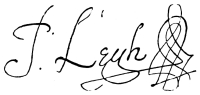
I say my hand.
Witnesses hereof Raphe Assheton K. John Jones Roger Mostyn Tho. Munckas. 1641.
In this will he expressly mentions his father as then living, a statement that is in conflict with the decree of the Court of Wards and Livery of November 22nd, 1624, which represents him as having "dyed in his (father's) displeasure." The later years of the father's life are shrouded in much mystery, and it may be that after the quarrel with Sir Peter Legh he had disappeared, and, being for a time unheard of, was supposed to be dead; certain it is that he was not among the mourners at Sir Peter's funeral at Winwick, in 1635, and he is not named in the inquisition taken after his death, his son being therein named as the heir to his grandfather.
The "unkele Frauncis" whom young Peter Legh so affectionately remembers in his will was the second son of Sir Peter. He resided at Blackley Hall, near Manchester, which, with the demesne, had been conveyed to him in 1636 by Ralph Assheton, of Middleton, "in consideracon of the full somme of two thousand pounds of currant English money."
Peter Legh died on the 2nd February, the day after he had added the codicil to his will. His body was brought from London and interred in the family vault at Winwick, the burial being thus recorded in the parish register:—
1641-2 Feb. 14. Mr. Peter Legh grandchild of Sir Peter Lee of Lime, slaine in London by Mr. Browne, and buried at Winwicke ye 14 day.
Peter had never married, and by this fatality the direct succession to the territorial possessions of the family was broken after having passed uninterruptedly through eleven generations, in every one of which the eldest son bore the name of Peter or Piers.
On the 14th April, 1642, an inquisition was taken at Wigan before the Escheator of Lancashire. It is a lengthy document, and, after reciting many family deeds and settlements, states that Peter Legh had died while under age; that his sisters Frances, Margaret, and Elizabeth were his heirs, and that Francis Legh (of Blackley, his uncle) was heir male of the body of Sir Peter Legh, and then of the age of fifty and more. He did not long enjoy possession of the estates, his death occurring February 2nd, 1643-4. He had to wife Anne, the daughter and heiress of Sir Edward Fenner, of Hampton, in Oxfordshire, knight; but as this lady, who survived, bore him no issue, the estates at his death, reverted to his nephew, Richard Legh, the second surviving son of his brother, the Rev. Thomas Legh, D.D., rector of Sefton and Walton, in Lancashire, by his wife, Lettice, daughter and co-heiress of Sir George Calveley, of Lea, a descendant of Sir Hugh Calveley, the famous Cheshire hero, who fought so gallantly at Auray and Navarette in the days of the third Edward. Born on the 7th May, 1634, Francis Legh was under ten years of age when he succeeded to the family inheritance; his father had been dead five years, but his mother was still living, though she did not survive many years, her death occurring October 14, 1648. Her body was interred in the Lyme Chapel in Macclesfield Church, where, against the east wall, there is a black marble tablet to her memory bearing a long Latin inscription.
It was a fortunate circumstance that Richard Legh, when he so unexpectedly succeeded to the lordship of Lyme and the vast territorial possessions in Lancashire and Westmorland his progenitors had acquired, was too young to be entrusted with the control of his own affairs. He had not completed his tenth year at the time of his uncle's decease. It was an eventful period in England's history: the storm which had so long been gathering upon the political horizon had burst; eighteen months before, the shot which signalled the commencement of the great civil war had been fired at Manchester; Edgehill had been fought; and England's purest patriot had been laid to rest, uncenotaphed but not forgotten, in the church at Great Hampden, beneath the shadow of the Chiltern Hills. Sovereign and subject were separated for ever, and each, wearied of the other, no longer sought for peace; the loud beating of the warlike pulse drowned the faint, decaying traditions of the miseries which had attended the ancient domestic feuds; hostile armies were marching and countermarching; every manor house was put by its owner in a position of defence, and every Englishman declared for King or Parliament and prepared himself for the struggle, never swerving for a moment from what he believed to be the path of honourable, though perilous duty. Amid these political distractions Richard Legh's youthfulness stood him in good stead; too young to take any part in the strife then being waged, he escaped many of the services and exactions he would otherwise have been subjected to had he been suspected of any strong partiality either for the Cavaliers or the Roundheads. On the 7th May, 1655, he attained his majority, and in the following year he was returned as one of the members for Cheshire in the Parliament which assembled at Westminster on the 7th September, 1656, his colleagues in the representation being Sir George Booth, of Dunham; Thomas Marbury, of Marbury; and Peter Brooke, of Mere—a Parliament notable as that in which the ancient privileges were violated on the broadest scale, no member being admitted who could not produce a certificate that he was "approved by his Highness's Council." As Richard Legh was not among the excluded members, he must have satisfied the requirements of the "Council," and been therefore accounted one of the "betrayers of the liberties of England;" but he took little part in the proceedings, and when his name was called on the memorable occasion when it was intended that the Protector should be invested with the powers and the title of King he was reported to have gone away into the country "dangerously sick." After the death of Cromwell, in 1659, and when his son Richard had been proclaimed as his successor in the Protectorate, a new Parliament was called, and Mr. Legh was again returned as one of the members for Cheshire; John Bradshaw, the regicide, being returned with him. It had, however, but a very brief existence. The members assembled on the 29th January (1659); on the 27th April a proclamation was issued dissolving it, and the members returned to their own homes. With the fall of the Parliament fell Richard Cromwell; the sceptre which had proved too heavy for his grasp, was laid aside, and, as Thurloe wrote to Lockhart, he was "excluded from having any share in the Government," and "retired as a private gentleman." Mr. Legh appears to have been concerned in the Royalist insurrection—the "Cheshire Rising," as it was called—which occurred in the following year, when Sir George Booth appeared in arms and obtained possession of the city of Chester, the object being the recall of the exiled Stuarts, and he was for a time incarcerated in York Castle; but the unsuccessful "Rising" was quickly followed by the accomplishment of the design it failed in; Charles was restored to the Crown, and Mr. Legh regained his liberty.
On the 29th May, 1660, Charles the Second passed in triumphal procession through the streets of London. The delirium of joy manifested on that occasion was no mere exuberance of delight, but the expression of the nation's belief that the Government of England had again a solid foundation upon which peace and security, liberty and religion, might be established. Peace and good order being restored, Mr. Legh, who had now attained the age of twenty-six, had time to attend to matters affecting his own domestic happiness. On the 1st January, 1660-1, he took to himself a wife in the person of Elizabeth, one of the daughters of Sir Thomas Chicheley, of Wimpole, in Cambridgeshire, descended from a brother of Archbishop Chicheley, the munificent founder of All Souls', Oxford, and himself Charles the Second's Master of the Ordnance and the Chancellor of the Duchy of Lancaster.
On the 23rd of April following the King was crowned at Westminster, and it is not improbable that Richard Legh and his young bride were among the guests in Westminster Hall on the occasion when Samuel Pepys was so dazzled with the fine hangings, and the brave ladies, and the "musique" of the violins; though they could hardly have been among the "many great gallants, men and women," who laid hold of the garrulous diarist, and would have him drink the King's health upon his knees, kneeling upon a faggot, which he did. Certain it is that the lord of Lyme was in favour with the Court, and when Charles proposed to found the new order of the "Knights of the Royal Oak," in which only those distinguished for their loyalty were to be admitted, his name was placed among those on whom the distinction was proposed to be conferred. The order was, however, soon abolished, "it being wisely judged," as Noble, in his "Memoirs of the Cromwell Family," remarks, "that it was calculated only to keep awake animosities which it was the part of wisdom to lull to sleep."
In the same year Mr. Legh purchased from Sir Thomas Fleetwood the barony of Newton-in-Makerfield, or Newton-in-the-Willows, as it is more generally styled, thus adding considerably to the territorial possessions of his house as well as to his social status in the county. Newton, which in Saxon times was of sufficient importance to give name to one of the hundreds of Lancashire, by virtue of a charter granted in the first year of Elizabeth's reign, had the privilege of returning two members to Parliament conferred upon it, a dignity it retained until disfranchised by the Reform Bill of 1832. The nomination of members was in the Baron of Newton until the year 1620, when the franchise became vested in the burgesses possessing freeholds of the value of 40s. a year and upwards, but this was only a nominal change, for, the burgage tenures being chiefly in the lord of the manor, the election was as much in him after the right came nominally into the hands of the burgesses as it was before, the place continuing to rank among the nomination boroughs until the Reform Act, and thus the Leghs acquired with the barony a seat in the legislature whenever they might choose to seek that honour. Mr. Legh sat as one of the members for the borough in the Convention Parliament of 1660, and again in that which assembled a few days after the King's coronation. In the succeeding year (September 20, 1662) he was appointed a deputy-lieutenant of Cheshire, and on the 26th April the same office in Lancashire was, by the King's command, conferred upon him by the Earl of Bridgewater. It was while holding these offices that Mr. Legh found himself in a position of some difficulty with regard to a distinguished visitor who it was intimated had expressed his intention of becoming a guest at Lyme. The Duke of Monmouth, the eldest of the many illegitimate children of Charles II.—"the Duke whom," as Evelyn says, "for distinction they called the Protestant Duke, though the son of an abandoned woman the people made their idol," had suddenly returned from temporary exile and set up a claim to be considered the legitimate heir to the throne in opposition to the Duke of York, who, on account of his Popish proclivities, the Whigs of the time sought to disinherit. The vanity of the bastard son of Lucy Waters being inflamed by the enthusiastic demonstrations of the people, he made a "glorious progress" through the country, which is referred to by Dryden in his "Absalom and Achitophel," who thus represents the Earl of Shaftesbury as remonstrating with him on his doubts and apprehensions when a crown was within his view:—
Did you for this expose yourself to show, And to the crowd bow popularly low? For this your glorious progress next ordain, With chariots, horsemen, and a numerous train?
Cheshire was among the counties in which he sought to keep alive the political cry by appealing to popular opinion against the dreaded predominance of Popery, and in 1683 we find one of his partisans, Caryll, Lord Molineux, thus writing to Mr. Legh:—"At Chester they are in consternation how to treat the Monmouth Duke. You, I hope, are settled in your resolution of entertaining him when he comes to Lyme, which, I hear, will be very soon." But Mr. Legh was not so "settled;" on the contrary, we find him with two of his brother magistrates busied in taking the depositions of certain individuals respecting the Duke and his progress, and transmitting them to the Secretary of State, for which he received his Majesty's thanks.
Monmouth's progress through Cheshire was attended with considerable tumult, and he is said to have given countenance to riotous assemblies, whose violence was such that they forced open the doors of the Cathedral at Chester, destroyed most of the painted glass, and tore the surplices of the clergy into rags; they also broke the font to pieces, pulled down some of the monuments, attempted to demolish the organ, and committed other outrages. A memoir of his reception in the city mentions several arts to gain popularity not unworthy of notice. The infant of the Mayor was christened Henrietta, Monmouth acting as sponsor, and the following day (August 25, 1683,) it is said that he went to the horse races at Wallasey in Wirral, where he rode his own horse and won the plate, which he presented in the evening to his goddaughter.
While these events were transpiring Mr. Legh occupied himself with rebuilding the old Episcopal chapel of St. Peter on his Newton estate, and providing for the better maintenance of the incumbent. Two years later, on the accession of James II., he was reappointed Deputy-lieutenant of Cheshire, but he did not long retain the office, his death occurring at Lyme on the 31st August, 1687, at the age of 53. His body was removed to Winwick, and there interred in the family vault on the 6th of the following month, when a sermon, entitled "The Christian's Triumph over Death," was preached by the Rev. William Shippen, Rector of Stockport. This sermon, which was afterwards published, contains a brief sketch of his life and character, which Mr. Earwaker, in his "East Cheshire," thus summarises:—
The greatest Excellencies of his Ancestors seem'd to Concenter in his Person. The singular Piety of his Grandfather, Sir Peter; the extraordinary Charity and Benignity of his Uncle, Francis; the Constancy and Fixedness of Religion of his Father; the quickness and Gaiety of Spirit of his Mother. Educated at the University in his "Blooming Youth", and "refined and finished afterwards at City and Court," he was "rendered a most accomplished and useful gentleman both to his Prince and Country." He added "the Parliamentary Burrough and Barony of Newton" to his other estates, and his "Mansion House (Lyme Hall) he so far Rebuilt and Ennobled, partly in Effect, and partly in Design and preparations for its finishing." ... "There was such an Affluence of all things, so great a resort of Persons of Quality, ... that his house might very well be styled a Country Court, and Lime the Palace to the County Palatine of Chester."
He engaged in the Cheshire rising to restore his Exiled Sovereign, though being surprised by the Enemy, he was prevented from appearing in that successful Enterprise, of which both the Palatine Counties (the Stage of the Action) and York Castle (the place of his Imprisonment) are unquestionable Witnesses. "Although he was actually in every Parliament during his whole Reign (i.e., of Charles II.), yet he never joyn'd any Faction in the House." ... "His present Majesty (James II.) in his Royal Progress at Chester heard of his last fatal Indisposition." ... "He never fail'd of his Daily Service in his Domestick Chapel." ... "His Love and Zeal for the Church of England" are shown "in his Parish (Winwick) where he has at his own proper Charges built a Decent and Elegant Chapel, and taken care to Establish a Competent Maintenance for the constant Ministry therein for the Publick Worship of God."
In the church at Winwick there is a handsome monument to his memory with marble busts of himself and his wife, and in the hall at Lyme there are several portraits of both. By his wife, who survived him and retained her widowhood for the long period of forty-one years, he had a family of six sons and seven daughters, all of whom, with the exception of two daughters, Sarah and Anne, who died in infancy, were living at the time of his decease.
Peter Legh, the eldest son, who succeeded, though under age, had been married some few months at the time of his father's death, the lady being his own cousin, Frances, only surviving daughter of Piers Legh, of Bruche, and eventually heiress of her brother of the same name; the Bruche estates thus becoming reunited with the patrimonial lands. Peter Legh, like his father, was a staunch adherent of the Stuarts, and after the abdication of James II. and the "Peaceful Revolution" had placed the Prince and Princess of Orange upon the English throne, it is not surprising that he should have been suspected of entertaining opinions hostile to the reigning family, and of opening communications with the Irish supporters of King James, with a view to the restoration of the exiled monarch. Many Protestant Royalists, whose fathers had fought for Charles the First, although opposed to the designs of James upon the Church, avowed their attachment to his inviolable person and crown, and professed themselves bound by their oath of allegiance, from which, as they affirmed, no personal misconduct of the King could release them. Some of the more enthusiastic armed their tenantry in defence of the Stuarts, and began to prepare themselves, as they had done fifty years before, to unite in rallying round the standard of their legitimate King. Suspicion having been excited by the landing of several Irishmen on the coast, and by the discovery of arms in transit from London to Lancashire, Lord Delamere issued a proclamation summoning the friends of liberty, and the new Government to meet him on Bowdon Downs, a proceeding that served to quell the spirit of disaffection among the Jacobites, and preserve the tranquility of the two counties. At this time an attempt was made by a common informer, one John Lunt, to fix on Mr. Legh the charge of treason, in having, as was alleged, accepted a colonel's commission in King James's service. Mr. Beamont gives the following interesting particulars respecting his arrest and imprisonment:—
On the 19th of July, 1694, while Mr. Legh was still a very young man, a King's messenger, with Lunt, the informer, attended by fourteen Dutch troopers, each wearing a blue cloak, and armed with a case of pistols, arrived at Lyme, where Mr. Legh was living, between the hours of six and seven in the morning. The messenger, with one Oldham, their guide, and two or three of the troopers, immediately ascended the great staircase, and having found Mr. Legh, who was in his dressing-room and not yet dressed, they apprehended him under a Secretary of State's warrant, charging him with high treason. From his dressing-room they led him, attired only in his night gown, to his closet, where were Mr. Lunt and two or three more of the troopers. There the messenger and Mr. Lunt began to search his papers, and continued their search until noon, selecting and putting by from time to time, to be carried away, such of them as they thought fit. The alleged colonel's commission, had it been found, would have raised a damning presumption; and the only wonder is that, like the witness against Spratt, Bishop of Rochester, Lunt, who was evidently aware of this practice, had not so contrived as to hide where it should be found a forged commission somewhere in the house at Lyme. After being allowed to dress himself, Mr. Legh was taken downstairs into the parlour, and there left in charge of two of the troopers, while a search for arms was made in every part of the house; the result, however, must have disappointed the searchers, for, except a case of pistols and a carbine found in Mr. Legh's closet, which they seized and carried away, nothing whatever was found. Their quest being ended, Mr. Legh was taken from his house, and conveyed the same night, guarded by twelve troopers, to Knutsford, Lunt setting his own saddle on one of Mr. Legh's horses and riding away with it. From Knutsford Mr. Legh was conveyed by the troopers to Chester Castle, where he remained a prisoner until about the first of September following, when Lord Molyneux, Sir William Gerard, Sir Thomas Clifton, Philip Langton, Esq., William Blundell, Esq., and some others were conducted to London, guarded by four messengers, and an escort of twenty-one Dutch troopers, commanded by Captain Baker. On arriving at St. Giles's the prisoners were all committed to the custody of the messengers, who, at the end of three days, brought them, by command, before the Duke of Shrewsbury, his Majesty's Principal Secretary of State, when his Grace, having heard and considered the charge against Mr. Legh, remanded him for three days, and then committed him to the Tower on a warrant, of which the following is a copy:—'These are in their Majesty's names to authorise you to receive and take into your custody, the body of Peter Legh, of Lyme, Esquire, herewith sent you, being charged before me for high treason in levying warr against their Majestys, and adhering to their Majesty's enemies; and you are to keep him safe and close until he shall be delivered by due course of law, and for so doing this shall be your warrant. Given at the Court at Whitehall, the 12th September, 1694.—Shrewsbury. The Right Honourable Robert Lucas, Governor-in-Chief of the Tower, or his deputy.'"