III KINGSTON (continued 2)
Reading edition
He was short in stature and somewhat homely in appearance; but he had an intelligent countenance and an habitually sweet smile. He was of a most lovable disposition. Though intensely hospitable he really disliked society and preferred the companionship of a few friends, but he lived continually in harness either social or official. He was 191at all times of his life a poor horseman; he had tried in vain to learn in India, and travelling in the hilly parts of Jamaica must have been a painful task for him. He writes: “I have got some steady horses and ponies which suit me pretty well. Any but steady ones would soon tumble me over a precipice.”
Of his country residence, Highgate, to which he retreated from Spanish Town whenever the calls of office permitted, he wrote, “If climate were everything I should prefer living on this spot to any other that I know in the world.”
Liberal and generous by disposition, he yet succeeded in saving from his official salaries and the interest of his investments a sufficient fortune to have maintained with credit the peerage which had been bestowed upon him.
On his quitting Jamaica the Assembly voted £3000 for the statue, which for many years looked down King street, Kingston, to which spot it had been removed from Spanish Town, where it was originally erected on the site of the present court house, opposite Rodney’s statue. It was originally intended to have a temple and colonnade like Rodney’s, but the funds did not prove sufficient and the scheme was abandoned. In 1898 the statue was removed to make way for a statue of Queen Victoria, when it was placed at the foot of King street, on the pedestal which had for some years supported Bacon’s statue of Rodney during its temporary absence from Spanish Town.
Metcalfe’s statue has proved more enduring than the parish which, formed from parts of St. George and St. Mary and named after him in 1841, was merged into St. Mary in 1867 by Grant’s reduction of the parishes from twenty-two to fourteen. The statue is by Edward Hodges Baily, R.A., a pupil of Flaxman, and a sculptor of high aims and pure ideals, by whom there is also a bust of Metcalfe in the Metcalfe Hall, Calcutta.
He is represented bare-headed, and wearing the insignia of the Bath. The statue on its double pedestal stands too high to be well seen. On the front of the original pedestal is the following inscription, now almost illegible 192from the ground, partly because of its great height and partly because the painting has worn off the letters:
This Statue
is erected in honor of
The Rt. Hon. Sir Charles Theophilus Metcalfe, Bart, K.C.B.
Now Baron Metcalfe
By the grateful inhabitants of Jamaica
in commemoration
of the benefits derived from
his wise, just and beneficial administration
of the government of the island
A.D. 1845.
On the west face are the arms of Jamaica (on which the cross is tricked or instead of gules, and the crest is placed on an esquire’s helmet); on the east those of Metcalfe. On the back is an emblematic design with figures of Justice and Mercy on either side of an altar on which rests an anchor.
On the lower pedestal, erected originally to receive Rodney’s statue, is placed an earthenware tablet (similar to those erected by the Royal Society of Arts in London) which was put up by the Institute of Jamaica in 1892 to record the fact that:
12 feet west of the
centre of the pedestal,
Commander Green,
U.S.N. in 1875 erected the
longitude station of
Kingston and found it to be
5h. 7m. 10·65 s. (76° 47′ 39·8″)
West of Greenwich.
I.J.
The great weight of this lower pedestal enabled the statue to stand the earthquake of 1907 unmoved; while every other statue in Kingston was either thrown down or slued round on its base.
“Selections from the Papers of Lord Metcalfe” contain papers from Jamaica, dealing with such divers subjects as the Conditions of the Island; the Social Condition of the People; the Labour Question; the Stipendiary 193Magistrate; the Governor’s Salary; Reforms of the Judicial System; Advantages of Conciliation; Prison Discipline; the Health of the Troops, and Answers to Addresses from the parishes of St. Catherine, St. Ann and St. Thomas; the Missionary Presbytery and the St. George’s Agricultural Society. The “Addresses” themselves, to the number of thirty-nine from all sections of the community, were published in Jamaica in 1842.
From this volume we learn that the first proposal to erect a statue to Metcalfe in St. Jago de la Vega was made and adopted at a meeting of the inhabitants of St. Catherine held on March 17, 1842, and this was supported by meetings held in many of the parishes. There was, however, a counter proposal to have a statue in Kingston. St. Jago de la Vega won then, but time has brought revenge to Kingston. In 1847 £200 was paid by the Assembly for a temple for the statue of Metcalfe, and they voted “£1500 for its removal and erection” in front of the Assembly Room and Library.
When Colonel Christian Lilly laid out the town of Kingston in 1692, he left in the centre a plaza or square after the Spanish method of colonial town-planning. In the eighteenth century barracks were erected to the north-west corner of this square, and the space to the south was for many years utilised as a parade-ground, as shown in Adolphe Duperly’s view in his “Daguerian Excursions in Jamaica,” published about 1844. Later on the barracks were abandoned by the troops, and they are now utilised for police-court purposes. The ornamental gardens were laid out in 1870 in the centre of the old military parade, whence they became known as the Parade Gardens; a wide space being left as roadway to the south.
At the instance of a Committee appointed to report on the most suitable way to celebrate the Queen’s Diamond Jubilee, £800 was voted by the Legislature in March 1897 for a Statue to Queen Victoria in addition to £700 for local rejoicings.
It was originally intended to place the statue at the front of the block of buildings which was in contemplation; but, 194as retrenchment then interfered with the project, the statue was erected at the top of King’s street, on the base erected for the statue of Lord Metcalfe when it was removed from Spanish Town. Owing to its small size it is to be regretted that the statue was not placed somewhere indoors, or at all events not on so high a pedestal.
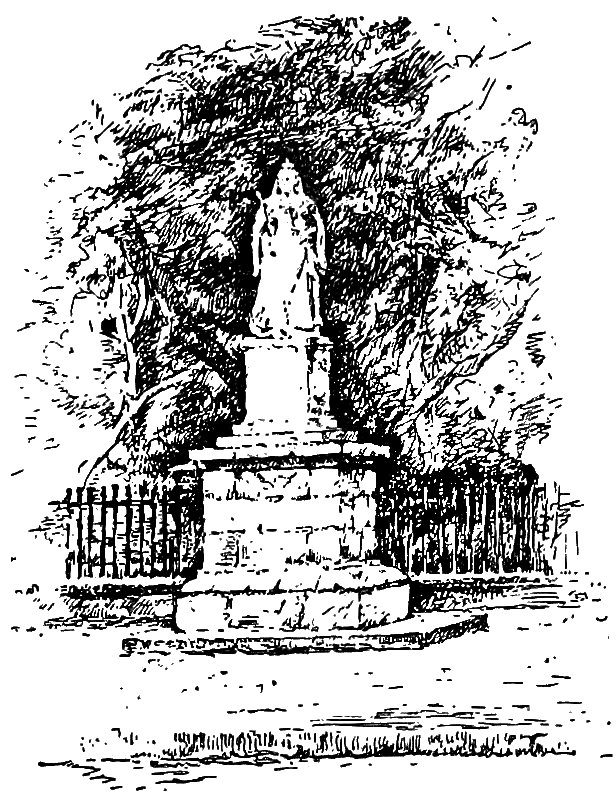
QUEEN VICTORIA’S STATUE
It is a replica of a statue erected in the hall of the Colonial Office at Singapore in connection with the Jubilee of 1887, by E. Edward Geflowski, who exhibited at the Royal Academy from 1867 to 1872.
The statue cost in all about £800. A plaster cast that was used for the unveiling, in connection with the Jubilee rejoicings, is now at King’s House, Spanish Town. Another copy is in the Imperial Institute, London.
In February of 1914 the Victoria League of Jamaica asked the Mayor and Council of Kingston to consider the desirability of re-naming the Parade Gardens the Victoria Park, and suggested that, if they approved, occasion should be taken of the presence of Her Highness Princess Marie Louise of Schleswig-Holstein, the granddaughter of Queen Victoria, on February 4, to ask her Highness to perform the ceremony, as it was felt that it would be well if the memory of Queen Victoria should be perpetuated in the centre of the principal town of the Colony, the more especially as it was in close proximity to the statue of her late Majesty. The Mayor and Council fell in with the suggestion, the consent of the Governor was obtained, and Her Highness the Princess renamed the 195Gardens on February 4. Although the Gardens have been fittingly named after Queen Victoria, dear to the hearts of all Jamaicans, it is to be hoped the surrounding buildings will still retain the name of Parade, and thus help to recall the days when the central part was made gay by many a military uniform.
On the eastern side of the Gardens stands a full-length statue by R. G. Miller, R.A., of Edward Jordan, C.B., “who through a long series of years and in times of danger, fearlessly stood forward as the champion of Emancipation and for the removal of civil disabilities,” erected by public subscription. The statue of another distinguished Jamaican, Dr. Lewis Quier Bowerbank, was erected in the year 1881, on the northern side, by his numerous friends and admirers; but a third statue, that of Father Dupont, a Roman Catholic priest who for many years laboured among the poor of the city, erected at the north-east corner, was destroyed by the earthquake of 1907.
Other monuments of interest in Kingston are a bust portrait of the Rev. John Radcliffe (preacher and poet), in the Scotch church, by Sir Thomas Brock, R.A., erected by public subscription in 1896, which, though buried under the ruins of the porch, escaped serious injury in the earthquake of 1907, and a memorial tablet to the Rev. William James Gardner (Congregational minister and historian) in the Congregational church, North street, erected after his death, which occurred in 1874.
Amongst disused burial-grounds are the Stranger’s Burial-Ground (earliest tomb is dated 1753) and the Spring Path Burial-Ground, both by the Railway Station (earliest tomb is dated 1794); the Baptist Ground, in the Windward Road (earliest tomb dated 1801); the Wesleyan Methodist Cemetery at the corner of Windward Road and Elletson Road (earliest tomb dated 1791); the Jewish Cemetery in Elletson Road (the earliest tomb dated 1797); the Jewish Cemeteries at the south-east and south-west corners of Church and North streets (in the former the earliest tomb dated 1719), all contain monuments of historic interest.
In view of recent interest evinced in the question of 196wharf accommodation it may be well to republish a “List and Situation of the Public Wharves in Kingston, running East and West,” which appeared in the “Columbian Magazine” (Kingston) in 1800—one hundred and fifteen years ago.
I. Welsh & Son’s: bottom of John’s Lane.
I. Harriot’s: between John’s Lane and Duke Street.
G. Douglas & Co., and I. Sewell’s: bottom of Duke Street.
John Davidson’s: between Duke Street and Mark Lane.
Donaldson & Heron, and M’Bean & Bagnold’s: bottom of Mark Lane.
Jaques, Laing, & Ewing’s: between Mark Lane and Church Street.
Duncomb & Pownal, and Bogle & Cathcart’s: bottom of Church Street.
Thomas Hyne’s: between Church Street and Temple Lane.
Kinkhead & Sproull; and Hardy, Pennock & Brittan’s: bottom of Temple Lane.
John West & Co.’s: between Temple Lane and King Street.
Willis & Waterhouse; and Bogle, Jopp & Co.’s: bottom of King Street.
Joseph Teasdale; and I. Robertson & Co.’s: bottom of Peter’s Lane.
Burnett, Stirling & Co.; and W. Cleland’s: bottom of Orange Street.
Cowgill & Co.’s; between Orange Street and Luke Lane.
Henry West & Co.; and Donaldson, Forbes, Grant & Stewart’s: bottom of Luke Lane.
Dick, McCall & Co.’s: between Luke Lane and Princess Street.
Shaw, Holy & Co.; and Lindo & Brothers’: bottom of Princess Street.
Ordnance; and R. Sutherland & Co.’s: bottom of Matthew’s Lane.
W. B. Bryan & Co.; and Fairclough & Barnes’s: bottom of West Street.
Dick, McCall & Co.’s Lumber Wharf: next on the Westward; and further on.
Liddle & Rennie’s.
197