II ST. CATHERINE
Reading edition
The parish of St. Catherine derived its name from the queen of Charles II., who was king of England when the parish was formed. In the first act in which it is mentioned it is correctly spelled Katharine. It consists of what before the passing of law 20 of 1867 constituted the parishes of St. Catherine, St. Dorothy, St. John and St. Thomas-in-the-Vale. St. Thomas-in-the-Vale was probably named after Sir Thomas Lynch. St. Dorothy, Roby, in his “Memorials of the Cathedral Church and Parish of St. Catherine” (1831), conjectures, received its name in compliment to Dorthy Wale, who had probably a large estate there.
Passage Fort, at first known as The Passage, probably so called by the Spaniards as being their place of embarkation from St. Jago de la Vega (Spanish Town), situated at the west end of Kingston harbour, first appears in the annals of Jamaica as the landing-place of a predatory expedition fitted out chiefly in Barbados and St. Kitts in 1642 by a certain Captain William Jackson, of whom little is known but of whose expedition a graphic account is given in a manuscript in the Sloane MSS. in the British Museum entitled: “CXVIII—Mercurius Americanus—A Briefe Journall, or a succinct and true relation of the most Remarkable Passages observed in the Voyage undertaken by Captain William Jackson to the West Indies or Continent of America. Anno Domini, 1642, September 27,” reprinted in “The West India Committee Circular,” May 9, 1911—January 16, 1912. The date, September 27, 1642, it may be mentioned, is the date of sailing, not of the writing of the account.
82Richard Norwood, who was a minister of religion and a school teacher, writing under date May 14, 1645, from Somers Islands, now known as Bermuda, to the Governor and Company of Adventurers to the Somers Islands, alluded to the time when of late the valiant and victorious General Capt. Jackson arrived after his voyage through the West Indies, and added “it was doubtful how things would go.”
After attempts more or less successful on various islands and the Spanish main, Jackson, in the Charles, accompanied by the Dolphin and the Valentine, put into Port Royal harbour on March 25, 1643. After trying the west coast of the harbour, where they perceived “noe passage,” they interrogated some prisoners and were led to Passage Fort “at a place where we found an Old Trench and a storehouse of Timber, lately sett by but not fully finished,” where, after a skirmish with both horse and foot of the enemy, they took the fort and marched past “divers workes,” one of which they dismantled, into Spanish Town. Jackson’s men were so pleased that they wished “to sett by their stacon here”; but the general, bent on robbing the Spaniards, had no taste for bucolic simplicity and gave up the town for “200 Beaves and 10,000 weight of cassavi bread for ye victualling of our ships, besides 20 Beaves every day for ye general expense till our departure and 7,000 pieces of Eight.” After spending sixteen days in “salting up our Beaves” Jackson and his men sailed away, but a few days later took a Spanish frigate “in an Harbour next to that where wee had formerly ridd at ankor,” probably Old Harbour.
The most important event, however, in the history of Passage Fort is the taking of Jamaica by the English in 1655. After an inexcusable failure on Hispaniola (or, to give it its original name, Haiti), due in some measure to silly jealousy between the naval and military authorities, when, to use Venables’s own words, passion usurped the seat of reason, and also to want of care—one might almost say of honesty—on the part of those responsible for the organization of the expedition, Penn and Venables, joint 83commanders of an expedition intended “to assault the Spaniard in the West Indies,” entered what we now call Kingston harbour on May 10, 1655, and anchored at about 11 A.M. On nearing the island it had been proclaimed to the whole army, as a result of the cowardice displayed in the attack on Hispaniola, that whoever should be found to turn his back on the enemy and run away, the next officer (that brought up the rear of that division) should immediately run him through, on penalty of death if he failed to do it.
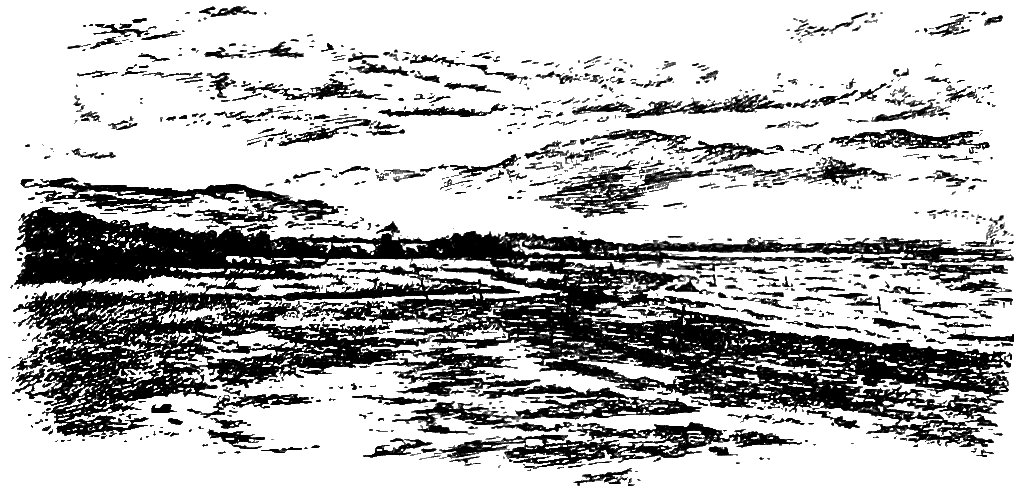
PASSAGE FORT
There were thirty-eight ships in the three squadrons, and about seven thousand troops, without counting the sea regiment, who numbered nearly one thousand more.
A few shots fired into the fort from the Martin (one of the smallest of the fleet, carrying but twelve guns and sixty men), which was run ashore as near the fort as possible, and the landing of the troops, seemed to have sufficed to disperse the Spaniards, whose best soldier, a major, had been disabled by a shot. They left three guns mounted in the fort.
Thus Jamaica was captured by a wretched army without the loss of a man. Colonel Clarke, who had died at sea on the 9th from wounds received at Hispaniola, was buried at Passage Fort on May 11.
84The following account, signed W.B., and written probably by William Burrows, who was Sir William Penn’s chief clerk in the Navy Office after the Restoration, is taken from the journal of the Swiftsure:
The landing-places are two, and are only banks supported with stakes, a matter of twenty yards long towards the water; all the rest being trees and bushes, among which can be no good going ashore. At the more eastward, where we landed, we saw the ordnance the Spaniards left; the army having landed at the other, within that to the westward. A pretty parcel of ground is cleared within the landing-places. About a furlong and a half thence, the way leads into the wood, which continues till within a quarter of a mile of the town; all the way being even, without hills, and a fair path for eight to march abreast. At the issuing out of the wood begins the Savanna, which stretches about, and is very fair and plain to the westward of the town; so that I deemed there might be room enough for 50,000 men to draw up in battalia.
The Rio Cobre has, since the conquest of the island, brought down so much sand and deposited it at its mouth that the site of Passage Fort is now some four or five hundred yards off the sea. In dry weather, it now meanders through a new course which it cut for itself in 1838, across the beach to the harbour, giving no idea of the power which it acquires in the rainy season. Here, as of old, is there “no good going ashore,” the slope of the beach being very gradual.
In “The Present State of Jamaica” (1683) we read: “Going from Port Royal to St. Jago de la Vega, people land at Passage, where a fort was in Col. Doyly’s time, and there is about thirty houses that are storehouses, alehouses, and horse keepers, and hackney coaches; this being the greatest passage in the island, it is two leagues from Port Royal by sea, and six miles from St. Jago by land.”
Totally destroyed by the earthquake of 1692, the village was but partially rebuilt, and was, when Long wrote his history (1774), of small importance, consisting of about fifteen houses, chiefly inhabited by wharfingers, warehouse keepers and the masters of wherries and hackney chaises, which plied with passengers to and from Port Royal and Spanish Town. Large ships could not lie alongside as 85there was not sufficient depth of water; and for this reason it was in a measure superseded by Port Henderson, where the depth of water is greater; but, with the abandonment of Spanish Town as the seat of government, both villages gradually diminished, and Passage Fort is to-day a mere fishing hamlet.
Richard Hill, in his “A Week at Port Royal” (1855), says:
The early maps of Saint Catherine’s show that there have occurred deviations in the course of the Rio Cobre, that are not easily to be reconciled by abundant rains. Antecedent to the discovery of the West Indies, the embouchure of the river was perceptively in the ponds, shut in by the narrow belt of land on which Fort Augusta stands, the river having been at that time more of a surface stream, and striking to the sea due south; the outlet curving northward, and embaying Passage Fort. At the time of the conquest of the island by the English the river flowed in an opposite direction due north, coursing the foot of the Caymanas Mountains, and making the present lagoons in the upper part of that plain its channel, seeking the sea southward, through what is now an independent stream, called the Ferry River (Fresh River). In 1722, in the midst of an extraordinary rain-storm, this channel was suddenly quitted, and a straight line made eastward. The settling waters, as they reached the Harbour of Kingston, impeded by the easterly winds, regurgitated through the lakelet into which they gathered themselves, and digging out the soil at the foot of the mountains, made the present lagoons, increasing the sea-board lands of Hunt’s Bay 3000 feet (three thousand).
In Spanish Town, the ancient capital, although there is nothing to speak to us of the native Arawâk, we can perhaps, better than anywhere else in the island, picture to ourselves the deeds of the Spaniards in the fifteenth and early sixteenth century; and especially the long struggles between the people’s or rather planters’ representatives and the government in the House of Assembly for a century and a half; together with the political and social entertainments at King’s House, as narrated for one short period in the graphic pages of Lady Nugent’s Journal, until, with the removal of the government to Kingston by Sir John Peter Grant, Spanish Town was shorn of its grandeur, to be only revived at rare intervals by such episodes as the consecration of the Bishop of Antigua in 1911.
86Jackson gives the following account of the town in 1643.
The fame of our proceedings in other places had arrived here eight days before us, so that they had time enough to convey all their best household stuff away, leaving nothing behinde them of any value, but onely ye possession of empty houses, with some few chaires, bedsteads, jarres of Mountego, and ye like poore materialls. However, we feasted ourselves this night with Hoggs, Henns, and other good provisions, which wee found in and about ye Towne. This place is called by ye inhabitants Sant Jago de la Vega, being a faire Town, consisting of four or five hundred houses, built for ye most part with canes, overcast with morter and lime, and covered with Tyle. It is beautiful with five or six stately churches and chapples, and one Monastery of Franciscan Fryers, and situated upon descent of a delectable and spacious plaine, on ye North West whereof runneth a pleasant River, whose streame doth empty itself into ye Harbour, distant from hence about four miles Eastward, where our Fleet lay at ankor.
The houses, unlesse it bee in ye Markitt Place, stand somewhat separated one from another, by which means it taketh up farr more roome than thrice ye number of our comparted building in Europe.
The churches and houses of the Spaniards were for the most part destroyed by the Venables’s soldiery in sheer wantonness. But when they began to settle the island, they repaired those which were worth repairing. It is doubtful, however, if much Spanish work exists to-day.
The foundations of St. Jago de la Vega were probably laid by the then viceroy, Diego Columbus, about the year 1523. His son Lewis, created Duke of Veragua, had for a second title Marquis de la Vega, after this town. Hickeringill (writing in 1661) tells us that when the English took the island it contained 2000 houses, sixteen churches and chapels and one abbey, and that of these the English soldiery left but two churches and 500 houses undemolished, but it is thought by Long that this was an exaggeration.
In April 1755 when the penkeepers of St. Catherine, St. John, St. Dorothy and St. Thomas-in-the-Vale petitioned the Assembly against the proposed removal of the courts of justice and public offices to Kingston (the assembly itself being then sitting there) they stated that St. Jago de la Vega then consisted of 499 houses, of a rental value of nearly £20,000, and 866 settled white inhabitants exclusive 87of visitors, and 405 mulattoes and negroes: that there were 472 pens and provision plantations in the neighbourhood, and there were 24,000 inhabitants in the parishes named.
When Doyley, on the death of Brayne in September 1657, found himself in supreme command in the newly acquired island of Jamaica, he set himself resolutely to work to establish the colony on a firm basis. After having successfully repelled three attempts made by Sasi, the last Spanish governor, to retake the island from Hispaniola, he, in August 1660, was met by internal rebellion, got up by Colonel Raymond, who persuaded Colonel Tyson, the gallant commander of the English troops in the last defeat of Sasi a few months earlier, to participate in it.
Of Raymond little is known beyond that Beeston calls him “a discontented reformed officer,” and Long “a factious officer.” Tyson, we know, was not one of those who came out with Venables, but arrived a year later. Leslie tells us that they were “two gentlemen who adhered to the Protector and had a mighty influence on the soldiers.”
In the face of contradictory evidence it is a little difficult to discover the real origin of the outbreak. An interesting contemporary account of it is given by Colonel (afterwards Sir) William Beeston, in a journal kept by him “from his first coming to Jamaica,” and printed from the MSS. now in the British Museum, in “Interesting Tracts relating to the Island of Jamaica ... St. Jago de la Vega, 1800.” He says:
April 27, 1660. At my arrival the people were still as an Army, but without pay, commanded by General Doyley, under whom, as chief ministers, were Major Fairfax and Captain Burroughs; the government was only by a court-martial held once a month at St. Jago, and what disputes General Doyley [gap in the print here] self, who lived very near and private, did not by any means love planting, but hindered those that were willing to plant, by telling them they would be all called off. The people were now healthful, and provisions began to be plenty, and trade to increase; the privateering was carried on, and good prizes often brought in by them....
About this time the rump parliament being again up in England no recruits came for the Army, and they had no pay which made the soldiers deem themselves neglected, and a general expectation 88there was that all would be called off, and the island deserted, there being no news of His Majesty’s happy restoration; this gave occasion to one of the Regiments at Guanaboe, and formerly commanded by Colonel Barrington, but now by Lieutenant-Colonel Tyson, who being set on by a discontented reformed officer called Lieutenant-Colonel Raymond, who lived near him, began to mutiny and set up for themselves, saying, they would live no more as an Army. And accordingly, August 2, they declared they would have the Island settled in Colonies, and make constables and civil officers. These, General Doyley not being able to appease with words, drew some forces to St. Jago to appease them, but was cautious, not being certain but that those he brought if it came to the push, would fail him, and be of the mind of the others; and, therefore, he ordered a ship of Southampton, called the Mary, Captain Richard Tylar, Commander, to lay ready without the fort that if he saw things grow desperate he might embark and leave them; but by sending several messengers to them, and at length Major Richard Hope, of the Liguanea Regiment, he so prevailed with them, telling them the danger if they persisted, and, on the contrary, that if they delivered up the two Lieutenant-Colonels they should all be pardoned, that they promised the next morning to deliver up their officers. Accordingly, in the morning, the soldiers brought down the two Lieutenant-Colonels, and delivered them up; on whom there presently sat a Court-Martial who adjudged them worthy of death, and accordingly, in a very short time, in sight of both parties, they were shot to death. Then the soldiers were all ordered to their several quarters, but were grown so insolent, that the General was forced to give them leave to plunder the houses of Tyson and Raymond in St. Jago, which flushed them to plunder more, even any that they could pretend had any correspondence with those men; and yet after all this, and all the fair words that were given them, it was as much as the General and their Officers could do to keep them from mutinying and to get them to return to their precincts.
Tyson and Raymond were shot on August 3, 1660, tradition says, under the large tamarind tree which still stands in Spanish Town, in Mulberry Garden, now used as a poor-house. August 2 is the date usually given, but Beeston’s account makes it clear that they were shot on “the next morning,” i.e. the 3rd.
Leslie, without giving the source of his information, adds, “Raymond expressed no concern, but died with a haughty kind of Resolution. Tyson behaved in a manner more becoming, and seemed penitent for the part he had acted.” We learn from the “Calendar of State Papers,” that in 89May 1660 an Order in Council was made “To permit Mary Tyson to repair to her husband, Lieut.-Col. Edward Tyson, in Jamaica, in the ship Bear, now bound thither, with accommodation for two maid-servants and one manservant.” Her arrival must have been a sad one. She found her gallant but misguided husband laid in a rebel’s grave.
Long says that Raymond was probably encouraged in his attempt by the knowledge that Doyley was not armed with any express commission or power to punish such offence capitally; and Gardner, thus fortified, says that Doyley’s action was illegal. But Beeston tells us that “the government was only by court-martial,” and this surely implied the right to shoot a rebel. The news of the Restoration reached Jamaica twelve days after the affair, but Doyley did not receive his commission to act as a constitutional governor until February 8, 1661.
Leslie makes the outbreak a Cavalier and Roundhead affair, and Bridges and Hill concur in that view. Gardner, following Beeston, thinks it was mainly due to a desire for a simple civil life. Long says, “Raymond’s object, it has been supposed, was to seize the Government himself; but the real design is not certainly known.” In contradistinction to Beeston, Long tells us that Doyley was “a steady advocate for pursuing the cultivation of the island, to which most of the private men were disinclined.”
The outbreak was probably just as much due to a desire for a more civil form of government than that favoured by Doyley as to any feeling of loyalty to the Stuarts; and the fact that Doyley felt compelled to take precautions for his personal safety in case of defeat may have been dictated as much by fear of the soldiers’ dislike for him as a martinet, as of the antipathy of the Roundhead portion of them to him as a cavalier.
Of the ecclesiastical buildings at St. Jago de la Vega trustworthy records exist only of an abbey, and a chapel of the red cross and a chapel of the white cross. The present Cathedral, the oldest cathedral in the British colonies, stands on the site of the red cross chapel. The 90bases of two piers (Long calls them columns) 8 feet square, part of the entrance to the abbey (which stood to the south of the present parade), were, in Long’s time, standing near the south end of the public offices. They were of brickwork, strongly cemented. He says: “I have seen in this town a great many large stone mouldings for the bases and other parts of columns, which, as well as the sculptures dug out of the ruins of Sevilla Nueva, in St. Ann’s, appeared to have been executed by no mean artist. The Spanish ecclesiastics ... must be allowed some merit in having cultivated the elegances of architecture in these remote parts of the world. Some of their public structures at St. Domingo, the Havannah, La Vera Cruz, Carthagena, Panama, &c., would make a noble figure even in European cities.” Unfortunately it would seem that, judging from his comments on buildings still standing, art criticism was not one of Long’s strong points.
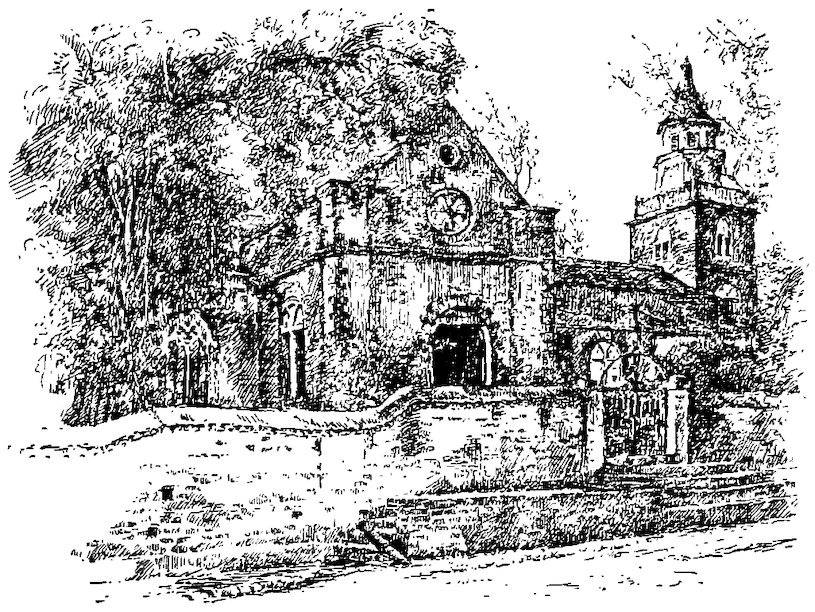
SPANISH-TOWN CATHEDRAL
The original church, erected by the English, probably on the foundations and of the materials of the Spanish 91building, as the parish church of St. Catherine, was thrown down by the hurricane of 1712, and was rebuilt of red brick in 1714, as is stated on a tablet over the entrance door in the tower at the west end:
D. O. M.
This Church Dedicated to ye Service of Almighty God was thrown downe by ye dreadfull Hurricane of August ye 28th Anno Domini MDCCXII., and was by ye Divine Assistance, through ye Piety and at ye expence of ye Parishioners, more beautifully and substantially rebuilt upon its old foundation in ye thirteenth year of ye Reigne of our most gracious Sovereigne Queen Ann and in ye Government of his Excellency the Lord Archibald Hamilton, in the year of our Lord MDCCXIV.
Matthew Gregory, Esqr.
& Church Wardens.
Mr. Beaument Pestell.
Below this on another marble slab is the following inscription:
This tower was erected,
And the above Tablet removed from the inner Wall
In the year MDCCCXVII.
His Grace the Duke of Manchester Governor.
John Lunan, Francis Smith, Churchwardens.
When Long published his History in 1774, the church being without a tower, the congregation was “summoned by a small bell hung in a wooden frame erected in the churchyard.”
Hakewill (1821), one of the few artists who have ever seen the cathedral, calls it “an ancient brick structure of no exterior beauty.” In Roby’s time (1831) the walls were wainscoted, and the roof was coved and ornamented with circles, ovals, and lozenges. In 1843 the letters patent creating Aubrey George Spencer second bishop of Jamaica, created the parish church of St. Catherine the cathedral of the diocese. The chancel was restored and extended in 1853. A chapter was formed in 1899.
The church, which had fallen into disrepair, was restored in 1901, as is duly recorded on the tower, “in commemoration of the glorious reign of her most gracious Majesty Queen Victoria, 1837–1901.” Considerable damage was 92wrought by the earthquake of 1907, and a further restoration was completed during the year 1908.
On state occasions, such as the burial of the governor, the House of Assembly was wont to attend in a body; and the church was, from the taking of the island till the removal of the capital to Kingston in 1866, intimately associated with all the important events in the island’s history, being near both to the House of Assembly and the governor’s residence. Nearly all its celebrated personages were at some time or another within its walls, and many of them are buried within its precincts.
Of its monuments the most important are those to the Earl and Countess of Effingham (d. 1791); the wife of Sir Adam Williamson (d. 1794); and Dr. Brodbelt (d. 1795), all by Bacon; Sir Basil Keith (d. 1777), by J. Wilton, R.A.; the Countess of Elgin (d. 1842), by Sir John Steell; Colonel John Colbeck (d. 1682), who came out with Penn and Venables; William Nedham (d. 1746), four times elected speaker of the Assembly; William Selwyn (d. 1702), governor; Henry Cunningham (d. 1735–6), governor; Sir Thomas Modyford (d. 1679), governor; Elizabeth Modyford (d. 1694), wife successively of Samuel Barry and Sir Nicholas Lawes; Sir Thomas Lynch (d. 1684), governor; Samuel Long (d. 1683), the patriot who, with William Beeston, succeeded in maintaining the privileges of the island as against the restrictions attempted to be imposed by the Earl of Carlisle, acting on instructions from home; Peter Beckford (d. 1710), lieutenant-governor; Major-General James Bannister (d. 1674), at one time governor of Surinam.
When Sir William Trelawny died, the Assembly expended 1000 guineas on his funeral, but no monument or slab marks his last resting-place. Other governors who have died in the island and are without a monument are, the Duke of Albemarle, the Duke of Portland, Sir Nicholas Lawes, General Hunter and General Haldane; the bodies of the two first-named (as was that of Sir Basil Keith) were sent across the Atlantic for interment; but portions of Albemarle’s body were buried under the altar. Inchiquin 93was buried in the church, but there was no memorial of him until the present Lord Inchiquin erected a brass tablet in 1912.
The earliest monument is that to Catherine, wife of Sir Charles Lyttelton (January 1662).
The following plate is in the Cathedral:
Flagon: The Rev. John Lindsay, D.D., Rector; Samuel Howell, James Trowers, Esq., Churchwardens. From the old plate of St. Catherine, Jamaica, 1685. Refashioned 1777. Maker’s name S. W., like that of the maker of a pair of Candlesticks of the year 1759 in Trinity College, Oxford (recorded by Cripps).
2 Patens: On each—The Gift of Susannah Butler, widow, of St. Catherine, Jamaica, 1702. Refashioned 1777. Maker’s name S. W.
2 Patens (Small), with foot. The gift of Mrs. Jane Spencer to the Altar of St. Catherine, Jamaica. Refashioned 1777. Maker’s name S. W.
2 Chalices: On each—The gift of Mrs. Jane Spencer to the Altar of St. Catherine, Jamaica. Refashioned 1777.
Flagon and 2 Cups and 2 Patens: With the year mark 1789. Maker’s name, W. P.
1 Flagon, 2 Chalices and 2 Patens: On each—Presented by Sarah Cole to Trinity Chapel, St. Catherine’s, Jamaica. Christmas, A.D. 1851.
Paten (Small): The gift of Wm. G. Macfarlane, in memory of his sister, Elizabeth E. Jackson, born October 8th, 1819, died Dec. 5th, 1854.
Strainer Spoon: Year mark 1855. Maker’s name G. A.
It is to be regretted that the old plate of 1685 was refashioned in 1777.
The church at Spanish Town is the oldest foundation in the colony, dating from the year of the British occupation, 1655; the next oldest being St. Andrew (Halfway-Tree), dating from 1666, the Alley, 1671, and St. John’s Guanaboa Vale, which dates from 1699.
The Baptismal and Marriage registers date from 1668: the Burial from 1671.
It is interesting to note that one of the earliest bequests recorded in the island was that of Edward Morgan of July 14, 1674, of “his house for a parsonage house” in St. Jago de la Vega.
94In April 1677, the Assembly gave “Thanks to Mr. Howser for his sermon; to be desired to say prayers in the House every morning between six and seven o’clock, who answered that he would give his attendance at that time. Every member not attending prayers to be fined 15d.”
In the following year the Assembly requested Mr. Howser “to say prayers every morning between 6 and 7 o’clock.”
The following is a list of the rectors. Since 1899 they have been ex officio senior canons of the cathedral.
1664–1683—Rev. Henry Howser (d. Dec. 29, 1683).
1683–1700—Rev. Philip Bennett (d. Sept. 5, 1707).
1700–1702—Rev. James Cunningham.
1702–1703–4—Rev. William Alsop (d. Jan. 10, 1703–4).
1704–1720—Richard Tabor (d. April 6, 1720).
1720–1734—Rev. John Scott (d. Nov. 22, 1734).
1735–1748—Rev. Calvin Galpine (d. Aug. 20, 1748).
1748–1764—Rev. John Venn, B.A. (d. April 6, 1764).
1764–1773—Rev. Samuel Griffiths, A.M.
1773–1788—Rev. John Lindsay, D.D. (d. Nov. 3, 1788).
1789–1791—Rev. Alexander Cumine, D.D. (d. July 18, 1791).
1791–1808—Rev. Robert Stanton Woodham, M.A.
1808–1813—Rev. Isaac Mann.
1814–1822—Rev. William Vaughan Hamilton.
1823–1843—Rev. Lewis Bowerbank, A.M.
1843–1857—Rev. Samuel Paynter Musson, D.D.
1857–1864—Rev. G. J. Handfield, M.A.
1864–1868—Rev. Joseph Williams.
1869–1875—Rev. F. S. Bradshaw, LL.D.
1876–1891—Rev. Charles Frederick Douet, A.M. (afterwards Assistant Bishop).
1892–1900—Rev. Canon Edward Jocelyn Wortley.
1901–1904—Rev. Canon Reginald John Ripley.
1904–1908—Rev. Canon John Walton Austin.
1909– —Rev. Canon Samuel Purcell Hendrick, M.A.
Tabor is referred to in “The Groans of Jamaica.”
Of the Rev. John Venn, Bryan Edwards wrote an epitaph beginning:
Beneath this stone lies plain John Venn,
Neither the best, nor the worst of men;
and ending:
To sum in short—yet speak in full—
Our plain John Venn was blunt John Bull.
95Lindsay was ordained in December 1753 in Conduit Street Chapel, Hanover Square, London; he was presented to the rectory of St. Thomas-ye-Vale, Jamaica, in 1768, and was made rector of St. Catherine in 1773; and he was made D.D. by the University of Edinburgh in the same year. He officiated at Spanish Town till his death in 1788. The sermon which he preached at the funeral of Sir Basil Keith, the governor, in 1777, was published. In 1770 he petitioned the House of Assembly to assist him in publishing his collection of “drawings of the most curious and beautiful plants, trees, fruits, birds, insects, fishes,” but received but cold comfort—the House resolving that the drawings “will merit the attention of the curious in natural history.” In 1781 and 1783 he published in “The Gentleman’s Magazine,” “An Examination of the Hypothetical Doctrine of Waterspouts, in Opposition to the Ingenious Speculations of Dr. B. Franklin, of Philadelphia, F.R.S.,” which was reprinted in “The Journal of the Institute of Jamaica,” for December 1897. It is curious that one of his illustrations represents the church of St. Catherine with a tower and spire, for it had not even a tower in 1781. In the Bristol Museum are four volumes of coloured drawings of Jamaica plants and animals made by Lindsay from 1758 to 1771, many of them accompanied by descriptive matter.
The Rev. Robert Stanton Woodham was rector in Nugent’s time, and is frequently mentioned in Lady Nugent’s Journal. She appears to have formed no very high opinion of the clergy of the island.
Dr. Musson, who died in 1857, is the only rector whose resting-place is recorded in the church.
Dr. C. F. Douet was for many years assistant bishop of the diocese—1888–1904. He died in England in 1905. The stained glass window was erected to his memory in 1914, at the same time as the Children’s window over the north door.
After the Rodney memorial, the monument in the cathedral, Spanish Town, erected to the memory of the Earl of Effingham, governor of Jamaica, and his countess, is the most important and the most beautiful 96work by Bacon in Jamaica. It is of marble, and bears the legend “J. Bacon, sculptor, London, 1796.”
On a base stands an urn, decorated with festoons of flowers, and bearing, under an earl’s coronet, the arms of Effingham: Quarterly, 1st gules on a bend between six cross crosslets fitchée argent, an escutcheon or, bearing a demi-lion rampant pierced through the mouth with an arrow within a double tressure flory counterflory of the first. 2nd gules three lions passant guardant in pale or (England) with a label of three points. 3rd checky, or and azure. 4th gules a lion rampant argent. In fess point of the shield a mullet for difference. Supporters two lions rampant. Motto, Virtus mille scuta. Above the urn, hanging on an obelisk which rises from the base of the monument, are represented the Chancellor’s seal, the mace and sword in saltire, and the usual emblematic scales.
On one side of the monument, clasping the urn, is an elegant female figure personifying Jamaica, bearing the crest of the colony, an alligator passant proper, on her zone. On the other side is a lovely boy, his left hand holding an olive branch, resting on a cornucopia full of tropical fruits, and his right hand upon a shield bearing the arms of Jamaica as granted by Charles II, viz,: Argent on a cross gules five pineapples proper. Dexter supporter an Indian female, in her exterior hand a basket of fruit. Sinister, an Indian warrior, in his exterior hand a bow, both plumed, all proper. Crest, an alligator. Motto, Indus uterque serviet uni. The epitaph, written by Bryan Edwards, the historian of the West Indies, and then member of Assembly for Trelawny, is as follows:
To the Memory of
Thomas Earl of Effingham Baron Howard, Captain General and Chief Governor of this Island in the Years 1790 and 1791, and of Catherine his wife. The latter departed this life on the Thirteenth day of October, 1791, in a voyage undertaken for the benefit of her health, in His Majesty’s ship Diana: the former on the 19th of the following month, the third week after the melancholy return of the Diana with the remains of his beloved consort, whom he seemed unwilling to survive, and with whom he was deposited in 97the same grave, thus, united in their lives by the most tender and exalted ties,
He—the fond and indulgent husband,
She—the cheerful and obedient wife—
In their deaths they were not divided.
To perpetuate the remembrance of so illustrious a pattern of conjugal affection, to manifest the public sense of the many public and private virtues of their respected Governor, and to record for the benefit of posterity the Clearness of that sagacity, the extent of that knowledge, and the purity and firmness of that integrity, which rendered his administration the boast and security of a grateful people; the Assembly of Jamaica, having caused the remains of this noble and lamented pair to be interr’d with funeral honours at the public expense, the whole House attending each procession as mourners, as a further testimony of merited esteem, inscribe this monument.
By an Act passed in 1789, burying in churches had been recently prohibited, and a penalty of £500 imposed on any rector permitting such burial; but two bills, dispensing with that Act and indemnifying the Rev. Robert Stanton Woodham, the then lately appointed rector of St. Catherine, from its penalties in the special cases of the Earl and Countess were introduced in the Assembly by Bryan Edwards and passed unanimously.
On November 19 the House “resolved, nem. con., in order to testify the grateful respect which this House entertain of his late Excellency’s merit and virtues, his firm and independent conduct, and the sense they have of the great and universal satisfaction which his mild and equitable administration, in every department, gave to all ranks of people, and the regret which they feel at his loss, that the funeral of the late Earl of Effingham be conducted at the public expense”; and on December 7, 1791, the Assembly voted £500 sterling toward this monument. The monument, together with the two funerals, which were attended by the members of the Assembly, cost the island £8700.
The Rev. Thomas Warren, rector of St. Elizabeth, and domestic chaplain to the governor—the same Thomas Warren who ten years later disgusted Lady Nugent by his toadyism while conducting the service at Black River-preached 98the funeral sermons, which are given in the “Columbian Magazine or Monthly Miscellany” published in Kingston in June 1797.
The Earl and Countess of Effingham arrived at Port Royal on March 17, 1790, in the ship Catherine Countess of Effingham. During his short period of governorship the condition of Jamaica was the cause of some anxiety owing to the nearness of the republican movement in San Domingo; so much so, that during the Christmas holidays of 1791 two ships of war patrolled round the island. The National Assembly of France passed a decree of thanks to the King of Great Britain, to the English nation, and to Lord Effingham, governor of Jamaica, for his generous conduct in relieving the planters of St. Domingo from the horrors of famine, and in furnishing them with arms and military stores against the rebel negroes. It was during Effingham’s governorship that the bread-fruit and other trees were imported from the south seas, and a collection of Jamaica plants was sent home to Kew Gardens.
The House of Assembly addressed the governor on the subject of proposed additional duties by England on sugar and rum, but to their representations the governor made a diplomatic reply.
The Earl’s mother was daughter of Peter Beckford, speaker of the Assembly, and sister to the celebrated lord mayor of London. His wife, whom he married in 1765, was the daughter of Metcalfe Proctor, of Thorpe, near Leeds. They had no children.
Next to the Effingham monument that to the Countess of Elgin is the most interesting from an art point of view.
In April 1841, Elizabeth Mary, the twenty-year-old daughter of Charles Lennox Cumming Bruce, was married to Lord Bruce, the son of the earl of “Elgin Marbles” fame. He had the year before become heir to the earldom through the death of his elder half-brother; and in the July following he was elected member of Parliament for Southampton, and succeeded to the title in the November of the same year (1841), becoming a peer of Scotland without a seat in the House of Lords. In the April of the following 99year he was made governor of Jamaica at the early age of thirty-one years, and there served his apprenticeship to his greater work as governor-general of Canada and viceroy of India. He experienced a period of depression, owing to the effects of emancipation, and of storms and floods; but in spite of difficulties he endeavoured, not without success, to improve the social conditions and develop the industrial resources of the island. The Royal Agricultural Society of Jamaica (later merged into the Royal Society of Arts and Agriculture of Jamaica) and several parochial agricultural associations were established by him; the first batch of coolies arrived from India in 1845, and the railway was opened for traffic in the same year.
On the death of the countess within less than a twelvemonth of her landing, and after a little more than two years of married life, the House of Assembly voted three hundred guineas for a monument to be erected in the cathedral at Spanish Town. It was carved by Sir John Steell, and is inscribed on the back “Jn. Steell, Sculptor, Edinr., 1849.” He is best known for his statues in Edinburgh of Sir Walter Scott and the Prince Consort, and for his colossal statue of Burns in New York. The first-named is said to have been the first marble statue commissioned in Scotland from a native artist; the second secured him his knighthood. Steell in early life patriotically declined Chantrey’s flattering offer to remove from Edinburgh to London, in order that he might devote himself to the improvement of the art of his native country.
His busts are said to be distinguished by great dignity and refinement. These characteristics are evident in his posthumous portrait of Lady Elgin.
The following is the inscription on the monument:
In memory of
Elizabeth Mary, Countess of Elgin and Kincardine, only child of Charles Lennox Cumming Bruce, Esqr., of Roseisle and Kinnaird in Scotland, Member of Parliament for the Counties of Elgin and Nairn, and of Mary Elizabeth Bruce. granddaughter and representative of the distinguished 100Traveller in Abyssinia. Born on the 13th April, 1821, she was married on the 22nd April, 1841, and having accompanied her Husband, His Excellency James Earl of Elgin and Kincardine, to Jamaica, in April, 1842, she died at Craigton, in the Parish of St. Andrew’s, on the 7th June, 1843: Resting with assured faith on the love of her Redeemer, amidst the unspeakable sorrow of her relatives and friends, and the deep lament of the community that had witnessed the rich promise of her early virtues. This monument was erected by the Legislature of the Colony not as a cold tribute of respect due to exalted rank, but to mark the public regret, for distinguished worth and talent, so early lost to her country and her family.
“Blessed are the pure in heart for they shall see God.”
Craigton, used as a mountain residence by the Earl of Elgin, is in the Blue Mountains, by the fourteenth milestone on the driving road to Newcastle.
The following passage from Professor Wrong’s “Earl of Elgin” tells in a few words the sad cause of Lady Elgin’s death:
In April 1842 Lord Elgin left England for Jamaica. On the way he experienced the dramatic and, for him, tragic consequences of shipwreck; the steamer struck on the coral reefs surrounding Turk’s Island, one of the Bahamas, and became a total wreck. No lives were lost, but Lady Elgin received a shock from which she never recovered. When, in the following summer, she died in Jamaica, Lord Elgin was so prostrated by grief that his recovery seemed doubtful. He was left with one infant daughter. From utter loneliness the society of his own kindred saved him; with him were his sister Charlotte, afterwards Lady Charlotte Locker, and his brother Robert, the latter as his Secretary. Though living chiefly at the country house, Craighton (sic), in the Blue Mountains, he did not neglect holding at Spanish Town, then the capital of Jamaica, the receptions and entertainments which must be a heavy burden upon the time and patience of those in high official position. The life was sufficiently monotonous, and after three years he longed for more active employment.
The immediate cause of Lady Elgin’s death was the birth of an infant daughter, who only lived a few hours. Her only surviving child, Elma, married Baron Thurlow.
With regard to the actual spot where the body is interred, we read in the “Morning Journal” of June 1843:
101His Honour, the Chief Justice, the Custos, and several other officials, then proceeded to the selection of a proper place for the sepulture of her Ladyship. The spot they selected was immediately below the Communion Table, in the Cathedral, and in which the remains of the Earl and Countess of Effingham were interred in 1791. The excavation took place under the superintendence of His Honor the Custos, assisted by Mr. Churchwarden M’Anuff; and about five o’clock on Thursday morning the vaulting and arches were complete.
The funeral was attended by all the high officials, civil, naval and military, and by the members of the House of Assembly.
Though the present House of Assembly probably only dates from about the same period as King’s House (1762) or a little later, the Assembly always met (with a slight diversion, in favour of Kingston, under Admiral Knowles in 1755) in Spanish Town, and the old capital was thus associated with the story of the long series of struggles which took place between the people’s representatives and the Crown.
In 1702 the Assembly met at the Queen’s House and at the Court House. In his speech to the Assembly on September 5, 1706, Handasyd said, “That the public building, I mean the Assembly House, being ready to fall, I don’t doubt but you will give orders for the rebuilding of the same.”
In 1728 the Duchess of Portland, widow of the late Governor, gave a portrait of George I to the Assembly. It was hung over the speaker’s chair. One wonders where it now is.
One of the most dramatic incidents which ever happened during a session of the Assembly is that which caused the death of Peter Beckford, a former lieutenant-governor of the colony, the president of the Council, and the first custos of Kingston.
The incident is thus described by Bridges:
During a warm debate in the Assembly on June 8, 1711, on the right of adjournment for a longer period than de die in diem, Peter Beckford, the Speaker (son of the President), repeatedly called to order; and was at length compelled to enforce it by 102adjournment. But irritation had gone so far that, when he rose to quit the chair, the Members drew their swords and held him there, while the obnoxious questions in debate were put and carried. The doors were barred; the uproar was alarming; and the Speaker’s father heard the disturbance in the Council Chamber. He recognised the voice of his son crying aloud for help, and rushed into the Governor’s apartment. Sir Thomas Handasyde seized his sword, ordered the sentinels to follow him, forced the door of the Court House, and dissolved the Assembly in the Queen’s name. But the fray was fatal to the elder Beckford; in his agitation his foot slipped, and he was precipitated down the staircase, and the effects of terror were deadly to his aged frame.
From this account we incidentally learn that the Assembly then had no House of its own and met in the court house, which probably stood where the present court house stands, at the south side of the square; the House of Assembly being on the east side, the King’s House on the west, and Rodney’s memorial on the north. In 1679 the church was first used as a House of Assembly, and was so used occasionally, as well as the court house, till its destruction by hurricane in 1712.
In “A View of the Proceedings of the Assemblies of Jamaica for some years past,” published in London in 1716, occurs a letter dated from Kingston, December 4, 1715, which begins, “The Grand Court is Sitting, as also the Assembly (who as former Assemblies have done in Court time) Sit in the Great Church [at Spanish Town]....”
The speaker alluded to above, Peter Beckford, held that office no less than four times. He will ever be remembered, in Spanish Town at all events, as the founder of Beckford and Smith’s School.
Space will not permit of any detailed reference to the continual struggles which took place between the Assembly and the Governor in Council, or the Assembly and the Crown, for in some cases the Assembly found governors who from the larger knowledge gained by local experience were in sympathy with many of their claims for equitable treatment. But we may perhaps for a moment try to picture to ourselves the scene at the opening of an assembly a hundred years ago. There were then forty-three members representing twenty constituencies or parishes. Of these 103all but a few came from outside Spanish Town, and had perforce to find temporary homes for themselves, their servants, and their horses: and the old capital must have offered a gay appearance. If the member for noble St. James did not drive his own horses it must have cost him some £8 to £10 to post.
It is true that Feurtado mentions ten lodging-houses and six hotels or taverns as existing at the time of the removal of the Government from Spanish Town to Kingston in 1870; but it is somewhat curious that, though travellers and historians have recorded the names of some ten or twelve taverns throughout the colony in the eighteenth century, no mention is made of any such institution of importance in the old capital.
In 1812 the lieutenant-governor was Lieutenant-General Edward Morrison. His secretary was William Bullock, who later, under the Duke of Manchester, became a great pluralist and wielded much power. The speaker of the Assembly was James Lewis, who represented St. Catherine. John Jacques, the mayor, was one of Kingston’s three representatives. St. Andrew sent as one member a James Stewart, Trelawny sent another James Stewart, and Westmoreland a third—which suggests numerous pitfalls for the unwary student of genealogy—while a fourth Stewart, John by name, sat for St. Ann. John Shand, the custos of St. Catherine, represented St. John. One of Vere’s members was J. P. Edwards, while Robert Allwood came up from St. Elizabeth. Hanover was represented by a Scarlett. Portland sent two Minots. The wealthy and powerful Simon Taylor represented St. Thomas-in-the-East, where most of his property lay.
The officers of the Assembly were: Clerk, F. Smith; Serjeant-at-arms and Librarian, John Clement; Chaplain, Isaac Mann (rector of St. Catherine); Printer, A. Aikman; and Doorkeeper, J. Wintle.
104
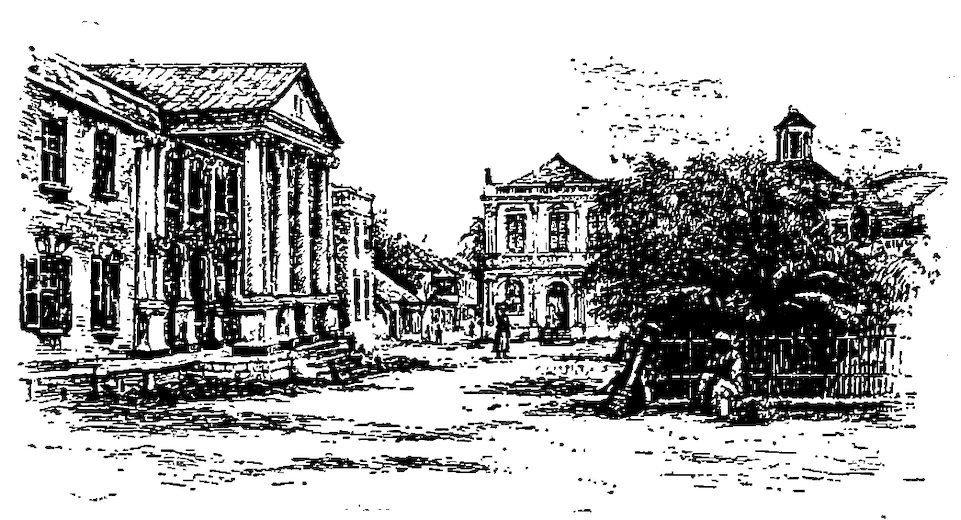
KING’S HOUSE
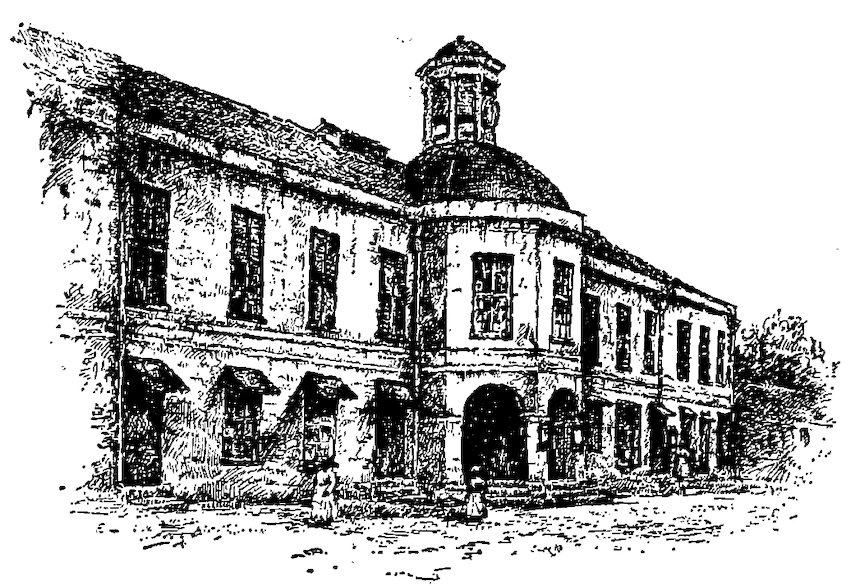
COURT HOUSE
105
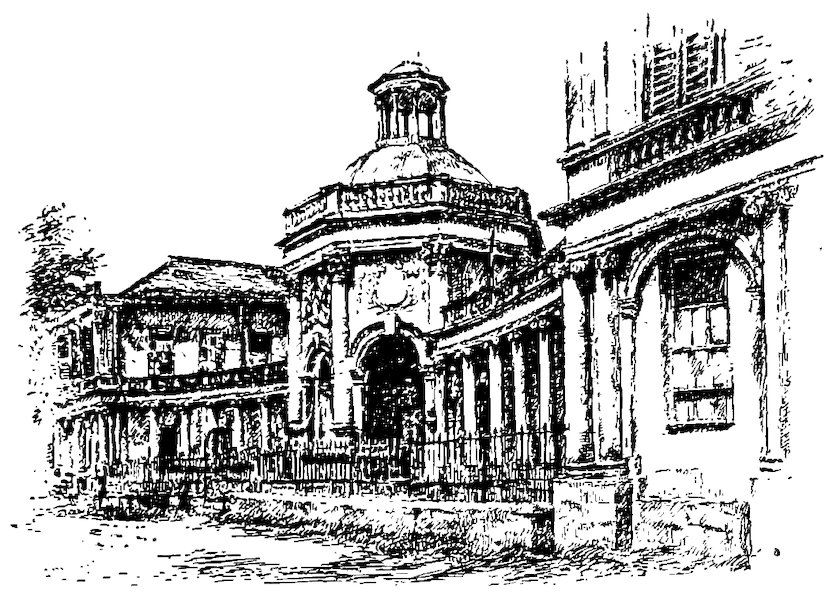
RODNEY MEMORIAL
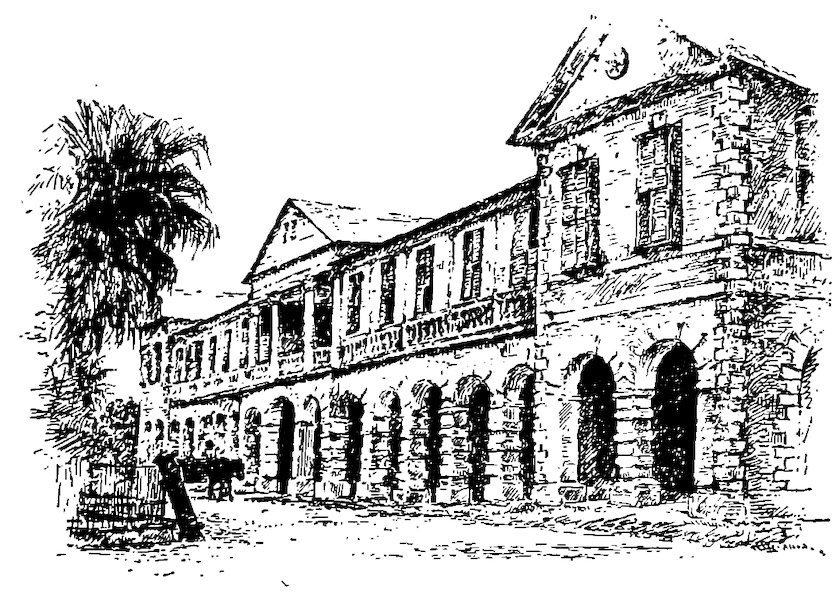
HOUSE OF ASSEMBLY
THE SQUARE, SPANISH TOWN
106The president of the Council, which was not infrequently recruited from the Assembly, was John Lewis, the chief justice, a relative of the well-known “Monk” Lewis; and other members (twelve in all) bore the well-known Jamaica names of Broadbelt, Ross, Pinnock, Cuthbert, Scarlett, Nembhardt and Jackson. Its chaplain was the Rev. John Campbell (rector of St. Andrew). Its librarian was Alexander Dallas, a relation of the author of the “History of the Maroons.” The Assembly opened daily with prayer.
Until 1842, when a new judicature law, which transferred to a vice-chancellor the authority of chancellor, came into force, the governor for the time being was ex-officio chancellor of the island, and sat in a Chancellor’s Court which was held in the Egyptian hall of Ring’s House.
At its first session the House was wont to go over “in grand procession”—the speaker preceded by the macebearer with the mace—to King’s House at 4 P.M. to hear the governor read his speech. They then returned and deliberated on the speech, to which they sent a reply. They formally elected a speaker. He was wont to plead his unworthiness but allowed himself to be over-persuaded, and the governor gave his approval. After the passing of many compliments the pendulum not infrequently swung round to the point of contention and bickering, but many of the Assembly honestly did their best in legislating for the well-being of the colony. To do honour to Sir Henry Barkly the Assembly turned their hall into a ballroom, each member subscribing £10 toward the cost of the entertainment.
In 1853 the House committed to jail, where he was kept for upwards of twenty-four hours, one of the judges of the supreme court, William Stevenson (afterwards governor of Mauritius), for an alleged breach of privilege in writing a letter to the public press, in which he accused them of violating public faith and confiscating the property of public men.
An English merchant describing Jamaica in 1726 says, “Nor is the keeping of a coach and six any more credit than keeping a horse in England, it is so common in the lowlands where the roads will admit”; and, even within the memory of those living, members of the Council and Assembly were 107wont to drive into Spanish Town in style. The late Mr. Judah, in “Old St. Jago” (1894), says:
We come to so late as 1848–49 when Sir Charles Grey was Governor. He rode in a State Coach drawn by four horses, and had outriders as part of his equipage. Besides coachman and groom he had two footmen behind his coach holding, in their dignity, their straps in holders; all in splendid livery. When the Honourable James Gayleard was President of the Council, he rode too in State Coach and pair, with coachman and groom on the box and a footman behind standing with strap and holder, all too in livery. Sir Joshua Rowe, Chief Justice, in his stately barouche with liveried servants. The Honourable William Church Macdougall driving in uniform with high-booted postilion. The Honourable Alexandre Bravo, always arriving in town on the first day of the meeting of the Council, of which he was a member, with four in hand, his wife and then young family inside, himself on the driving box with his son Alexandre, afterwards Major and Acting Governor in one of Her Majesty’s Colonies in Africa, seated beside him; while Mr. Moses Bravo followed with his wife, driving a gay and attractive tandem. “Old Saint Jago” has its traditions, and is full of memories of the old past and the greater days of Jamaica. A hundred of these memories as it were pass before my eyes, and I feel a real pleasure in recalling some of them, associated as they are with the days of my boyhood and my early manhood. I well remember the first day of the inauguration of a new Governor, attended at old King’s House by all the heads of departments and highest officials of the colony. The Lieutenant-Governor, who was always then the Major-General commanding the Forces in this island, and his brilliant staff, the Admiral with his staff, the Commodore on the station—the whole in full dress uniform. The Bishop with his mitre on, and his black silk gown with ample lawn sleeves. The three Archdeacons in their full college dress and honours. The Chief Justice and Puisne Judges in their purple robes. The Registrar in Chancery and Clerk of Patents, gowned in black silk and bearing on a scarlet velvet cushion the insignia in gold of Equity and of his office. The Clerk of the Crown and Supreme Court with parchment scroll surmounted by the British Crown in gold. The Military and Navy in full dress uniform. The foreign Consuls also in uniform—those of Spain, France, Austria, and the Mosquito territory being most conspicuous for their splendour. The three members of “the mixed Commission” (for the adjudication of cases arising out of the slave trade treaties) in their peculiar dress of white kerseymeres trimmed in silver, and their silver-sheathed swords suspended in fine silver chains. The military band of music arriving from the barracks, at the head of the regiment, with standards flying and taking up their position in the present garden on the left hand opposite to the 108front of the King’s House. During the administration of the usual oaths to the new Governor the playing of the National Anthem, and this followed by a salvo of fourteen guns from two field pieces positioned in front of Rodney’s statue, then on its original site, under the dome of the colonnade, at the north side of the public square.
Then there was the opening day of the annual meeting of the Legislature, with almost the like pageantry and with the members of the Privy Council in Windsor uniform, and the members of the Legislative Council, attended by “Black Rod” in full Court dress with his chapeau bras. The entrance of the Governor into the Egyptian Hall of King’s House, in full military dress as Captain-General and Commander-in-Chief, attended by his Secretary in Windsor uniform, and his aide-de-camp in full military dress. The despatch of “Black Rod” by the Governor, summoning the Assembly to attend him in the Council Chamber. The arrival of “Black Rod” at the bar of the Assembly Hall, delivering the message, and his retiring backways, making his obeisance three times to the Chair while retiring. The attendance of the Speaker and the whole House, headed by the Serjeant-at-Arms carrying, with head covered by his chapeau bras, the large gilt mace of the House, and with his ivory-hilted sword at side, while the band plays the grand and stately “God Save the Queen.” These pageantries followed by a grand dinner at King’s House to the Lieutenant-Governor and staff, Admiral and staff, Chief Justice, Bishop, and the high officials of the day.
The mace mentioned above is now in the history gallery in the Institute of Jamaica.
Tradition has it that the old house known as Eagle House, behind the Public Hospital in King street, Spanish Town, was the residence of William O’Brien, second earl of Inchiquin, who was governor of Jamaica in 1690–91–2. Its local name, from the remaining eagle that surmounts one of the gate-posts, is John Crow House; John Crow being the popular designation of the vulture of Jamaica (Cathartes aura).
A discussion on the subject of this house took place in the “Gleaner” newspaper during August and September 1911, with the result that, though some light was thrown on the subject, nothing was settled for certain. Mr. G. F. Judah, whose antiquarian knowledge of Jamaica was unequalled, informed us that his father told him that when he first visited the house as a boy in 1808–9 both eagles were in situ; 109but that when he went to reside in Spanish Town in 1830–31 only one remained; and further that tradition said that it had once been the residence of Sir James de Castillo, the agent of the Assiento Company.
Mr. Judah seemed to think that “Eagle House” is identical with the “Fort House,” which he told us was granted first in 1662 to Sir Charles Lyttelton, deputy governor to Lord Windsor, being the first of the records of Patents in the island, and dating only seven years after the British occupation. Lyttelton sold it to Charles Brayne, who sold it to Sir Thomas Modyford. Modyford’s nephew succeeded to the baronetcy and his executors sold the “Fort House” in 1715 to John Stewart, president of the Council, who had the title to the house confirmed by a special act of the Legislature in 1733. From an act which was passed in 1736 it appears that the Fort House bounded north-east on a street between a storehouse belonging to John Stewart, Esquire, and the dwelling-house formerly belonging to Arnold Brown, Esquire, deceased, to the Parade; south-east on land belong to William Careless, Esquire, deceased; south-west on the town Savanna; and north-west on the land lately belonging to Ursula Hunt, widow, deceased, by indenture.
It was conveyed to Thomas Brayne, descended to his daughter, Mary Elizabeth, wife of Alexander Henderson. They conveyed it to Walter Thomas, and he and his wife conveyed it to John Stewart. Stewart sold it to Robert Delap (nephew of Francis Delap, provost marshal), and the place subsequently fell into the hands of Bogle & Co., of which firm Michael Scott, the well-known author of “Tom Cringle’s Log,” was a member. It then passed successively into the possession of Alexander Young, William Taylor and Robert Nichol. Mr. Oscar Plummer, quoting from manuscripts in his possession, of which however he gave no details, said that various personages—Robert Russell, Andrew Gregory Johnson, and Richard Hill—in the earlier part of the nineteenth century, gave credence to the legend that Eagle House was the residence of the Earl of Inchiquin, and that some of them alluded 110to Eagle House as the Moat House. In this case, although there is no proof, it is quite likely that the legend that Inchiquin inhabited it is true; but it is not likely that much of the old fabric remains, though the present house is of considerable antiquity. There is nothing in all this to aid in the identification of Eagle House with the residence of Lord Inchiquin; but as the rent for the house he occupied was paid to Samuel Bernard, the chief justice, it was probably not identical with Fort House, which, as we have seen, belonged to the Modyfords.
The early life of the Earl of Inchiquin was spent with his father in foreign military service, during which he lost an eye and suffered imprisonment in Algiers. In 1764 he was appointed captain-general of the King’s forces in Africa, and governor and vice-admiral of the royal citadel of Tangier, ceded by the Portuguese to Britain as part of the marriage portion of Catherine of Braganza. He held the post for six years.
Inchiquin welcomed the Prince of Orange in 1688, and in the following year he and his son were attainted by the Irish Parliament of James II, and their estates were sequestrated. He appealed to arms, but was defeated and fled to England.
After the Revolution he was appointed governor of Jamaica. On going to take up office he was allowed £500 in lieu of fifty tons of baggage, and also passage and victuals for seventy-five menial servants. It is interesting to note that on his journey he drew half-pay salary (i.e. at the rate of £1000 a year).
He, after escaping great dangers by sea and a malignant fever brought on board by the soldiers embarked at Plymouth, arrived at Jamaica, accompanied by Lady Inchiquin, on May 31, 1690, in H.M.S. Swan, “so bad a sailor that she is little better than nothing”—the same ship that was “forced over the tops of many houses” in the earthquake of two years later. Inchiquin was sworn in as governor on the same day.
He met with considerable opposition from a portion of the Assembly, whose temper had been ruffled by Albemarle’s 111arbitrary government, and whom he treated in a somewhat tactless manner. That, added to troubles arising from incursions by French cruisers on the seaside plantations—the result of the war—plunderings by the runaway slaves, the original maroons, and an outbreak of slaves in Clarendon, undermined his constitution. Nineteen months of worry were terminated by his death, on Saturday, January 16, 1691–2, “after long indisposition through fever and plague which ended in a flux”; he was buried that night in the parish church at St. Jago de la Vega. Until recently no monument marked the spot. A memorial brass has now, however, been erected in the cathedral by Lord Inchiquin with the following inscription:
In Memory of
William O’Brien, 2nd Earl of Inchiquin
Governor of Jamaica
From 31st May, 1690, till 16th January, 1691–2.
When he died of fever at St. Jago de la Vega,
and was buried in this church
erected in 1912 by Lucius W. XVth Baron Inchiquin.
In connection with his governorship of Tangier, Inchiquin has been described as “a well-meaning impulsive man, devoid of discretion,” and this description seems equally applicable to his Jamaica career.
By his first wife, Lady Margaret Boyle, daughter of the first Earl of Orrery, he had three sons, of whom the third, James, was a member of the Council of Jamaica, Captain of Fort Charles, and chief of an expedition that destroyed French settlements in Hispaniola.
James O’Brien returned to England at his father’s death.
For the first thirty-four years of British occupation, the governors of Jamaica lived partly at Spanish Town and partly at Port Royal. In 1675 the Assembly voted £500 to be employed in buying the house Lord Vaughan lived in at Spanish Town “for the Governor’s use for ever.”
On January 13, 1690, however, the President and Council passed an “Order for hiring a house in Port Royal and for provision for the reception of Lord Inchiquin.”
112On March 27, 1690, they passed an “Order for King’s House to be made ready for Lord Inchiquin,” but the Order does not state whether Port Royal or St. Jago de la Vega was meant, probably the latter.
On June 18 it was resolved that “Their Majesties’ house at St. Jago de la Vega being extremely out of repair and almost ruinous so it is in no manner fit for the reception of His Excellency, it was decided by the Board if His Excellency would be pleased to let it be ordered, and it is hereby ordered that the rent of the house where His Excellency now lives be paid out of their Majesties’ revenue for the island till the other be so repaired or built, that it may be fit for his reception.”
On December 18, 1690, it was “ordered that £600 be allowed for building an addition to the King’s House on Port Royal to be paid out of their Majesties’ revenue for this island.”
On January 28, 1691–2, just after the death of Lord Inchiquin, the Council wrote home to the Lords of Trade and Plantations: “We beg that the Governor’s residence may be fixed at St. Jago de la Vega, which is the most convenient place.”
At a Council meeting on March 15, 1691–2, it was ordered that £250 be paid to Samuel Bernard for “rent of the house the Earl of Inchiquin, late Governor, lived in at the Towne of St. Jago de la Vega.”
On May 9, 1692, just after the earthquake, the Council made an “Order for agreement as to the goods belonging to the late Governor at King’s House, for the accommodation of the next Governor,” and on June 24, they passed an “Order for material for rebuilding King’s House.” This presumably refers to St. Jago de la Vega.
On July 8 of that year the Lords of Trade and Plantations at a meeting at which Beeston, who was then agent for Jamaica in England, and was soon to be appointed lieutenant-governor, was in attendance, resolved that the “King’s House at St. Jago de la Vega should be sold, and the proceeds devoted to the purchase of another house”—at the very time that it was probably being rebuilt.
113On the Earl of Inchiquin’s death, the Government bought of Lady Inchiquin for the use of the Government, goods to the value of £90. These included the “King and Queen’s picture” valued at £20. Where is that picture now?
It is interesting to note that in the contemporary manuscript Council Minutes the name Inchiquin is always spelt phonetically Insiquin.
Sir Hans Sloane studied botany, materia medica, and pharmacy, in England and France. It is said that, before consenting to accompany Albemarle, the newly appointed governor, to Jamaica in 1687, he consulted Sydenham on the subject, and that the father of English medicine told him that he had better drown himself in Rosamond’s Pond, a sheet of water in St. James’s Park, which was then a fashionable resort for intending suicides. He, however, decided to come. While in Jamaica he attended, in addition to the duke’s “numerous family,” many people professionally, including the whilom buccaneering governor, Morgan; making in his reports very frank references to their mode of life.
In fifteen months he collected 800 plants, most of which were new specimens; of these he published, in 1696, his “Catalogus Plantarum.” On April 16, 1691, Evelyn writes: “I went to see Dr. Sloane’s curiosities, being a universal collection of the natural productions of Jamaica, consisting of plants, fruits, corals, minerals, stones, earth, shells, animals and insects, collected with great judgement; several folios of dried plants, and one which had about eighty several sorts of ferns and another of grasses; the Jamaica pepper in branch, leaves, flower, fruit, &c. This collection, with his Journal, and other philosophical and natural discourses and observations, indeed very copious and extraordinary, sufficient to furnish a history of that island, to which I encouraged him.” In 1707 and 1725 Sloane issued two large volumes entitled, “A Voyage to the Islands Madera, Barbados, Nieves, St. Christopher and Jamaica, with the Natural History ... of the last of those Islands,” with many engravings from 114crayon drawings. The work was parodied by the clever but drunken Dr. William King, under the title “The Present State of Physic in the Island of Cajami.”
Sloane’s wife, whom he married in 1695 and who died in 1724, was Elizabeth, daughter of Alderman Langley and widow of Ffulk Rose, of St. Catherine, who from 1675 to 1693 represented first St. Thomas-in-the-Vale, and afterwards St. John, in the House of Assembly.
Soon after the death of his patron, the Duke of Albemarle, Sloane returned to England. In 1693 he was secretary to the Royal Society, of which he edited the transactions for twenty years, contributing twenty-two papers. Of these one was an account of the earthquake of 1692 which destroyed Port Royal, already alluded to. Meantime he practised with great success as a physician. In 1716 he was created a baronet, being the first physician so honoured, and made physician-general to the army; from 1719 to 1735 he was president of the College of Physicians; and in 1727 president of the Royal Society. He bequeathed his books, manuscripts, prints and curiosities (including his Jamaica collections) to the nation, on condition that £20,000 (or less than half of what they had cost him) was paid to his executors. The collection formed the basis of the British Museum. He gave to the Apothecaries Company the freehold of the physic garden at Chelsea, and he assisted to start the Foundling Hospital.
Tradition points to a house (now No. 14), in what has been known as Nugent Street, Spanish Town, for upwards of a century, as the residence of Sloane.
In a MS. scrap book called “The Omnibus, or Jamaica Scrap Book,” in the West India Library of the Institute of Jamaica, dating from about 1840, there is an account of Sir Hans Sloane, wherein it states: “This celebrated naturalist during his stay in Jamaica resided in the old Spanish fronted building which was till about the year 1828 to be discerned in the lane at the back of the King’s House in Spanish Town, and which about that period came by purchase into the hands of a tradesman, who, without any respect to its former possessor, razed it to the ground 115and erected upon the site a blacksmith’s shop and other tradesmen’s offices, at which period some of his etchings, were discovered in a ruined outhouse.” The present building is of a type that has existed in the colony “from time.”
Previous to the building of a King’s House, the governors of Jamaica apparently lived in whatever house they chose. From the following entry in the Council Minutes of June 16, 1684, it would appear that there were in 1683 two King’s Houses, one at Port Royal and one at Spanish Town: “Ordered that His Excellency’s order shall be sufficient warrant for issuing money for the fortifications, repair of the King’s Houses, &c., according to the Act of this country”; and this is confirmed by the accounts of the Receiver-General for 1684–85, which contains references to the “King’s House at Town” [Spanish Town] and the King’s House at Port Royal. In July 1689 it was reported that in the Duke of Albemarle’s time (December 1687 to October 1688) the King’s House at Port Royal had been appointed for a Popish priest, Thomas Churchill, to say Mass in.
In June 1689 Colonel Hender Molesworth, who did not live to take up his position as governor for a second term of office, suggested, in his proposals as to the government of Jamaica, that “it would be well to sell the old King’s House [presumably at Port Royal], and build a new one at Spanish Town”; but in January 1690 it was ordered, as we have seen, that a house should be built in Port Royal, and provision made for the reception of Lord Inchiquin. There was, however, a King’s House at Spanish Town in Beeston’s time. On July 8, 1692, it was decided by the Lords of Trade and Plantations that “the King’s House at St. Jago de la Vega should be sold, and the proceeds devoted to the purchase of another house”; but on July 27, 1693, Beeston wrote home: “I hope also to get them to raise money to put King’s House at St. Jago (where I live) in order, for at present it only protects me from the sun and rain, having no convenience for horses or servants, nor room for but few in a family, and being as common as the highway. 116Nevertheless, my cost of living, for the honour of the Government, is more than double what I am allowed, nor is there money nor like to be yet awhile, to pay me what I am allowed by their Majesty’s.”
In October 1700 he wrote home: “I am also enlarging to more than double the King’s House, which was too little for any indifferent family, and have taken in all the land belonging to it with a bricke wall, and have made aditions of out houses for the reception of servants and for offices, all which will bee finished in a short time, and will be very comodious and useful, tho’ not so beautyfull, being built not one entire fabricke, but by peices.”
There was a Queen’s House when Lord Archibald Hamilton arrived in 1711, but it was in a “ruinous condition” and “could not be made tenable under £2000,” which was voted. The Duke of Portland (1724–6) expended £1544 0s. 1¾d. over the £4000 voted on the then King’s House, but this sum was not refunded to his widow although a committee of the Assembly recommended it.
The original residence of the governors consisted partly of the old Spanish edifice and partly of irregular additions made from time to time by Sir William Beeston and other governors. The Spanish hall of audience was demolished in 1761 to make way for the present building. Of it Long says:
Nothing of art or elegance graced the inside of this hall: it was lined throughout with boards, or rather planks, unequally hewn with an adze, none of them appearing to have undergone the embellishment of the plane; these were rudely nailed to upright posts, which supported the roof. The posts were for the most part crooked, not even squared, and many of them had some remnant of their bark, but they retained for the most part their primitive solidity. The whole of the woodwork, indeed, seemed to have passed through no other hands than those of a clumsy ship-carpenter.
This description might almost apply to the dwellings of the native Arawâks.
The former official residence of the governors of Jamaica, or King’s House, as it is called, stands on the west side of the square. The plan was designed by Craskell, the engineer of the island, and approved during the administration 117of Lieutenant-Governor Henry Moore in 1759–62; but the building was not completed until the arrival of Governor William Henry Lyttelton in 1762.
The expense of building and furnishing amounted to nearly £30,000 currency (or £21,428 sterling), and in Long’s time (circa 1774) it was “thought to be the noblest and best edifice of the kind, either in North America or any of the British colonies in the West Indies.” The façade is about 200 feet long; the freestone used in the construction came from the Hope river course in St. Andrew. The columns supporting the portico are of Portland stone, the pavement of white marble, of which much came out, as ballast, from time to time in the old sugar ships, and is still seen in many a great house and town dwelling. The following is taken from Long’s description of the interior:
Two principal entrances lead through it into the body of the house; the one opens into a lobby, or ante-chamber; the other into the great saloon, or hall of audience, which is well proportioned, the dimensions being about 73 by 30 feet, and the height about 32; from the ceiling, which is coved, hang two brass gilt lustres. A screen of seven large Doric pillars divides the saloon from an upper and lower gallery of communication, which range the whole length on the West side; and the upper one is secured with an elegant entrelas of figured iron work. The East or opposite side of the saloon is finished with Doric pilasters, upon each of which are brass girandoles double-gilt; and between each pilaster, under the windows of the Attic story, are placed, on gilt brackets, the busts of several ancient and modern philosophers and poets, large as life; which being in bronze, the darkness of their complexion naturally suggests the idea of so many Negro Caboceros, exalted to this honourable distinction for some peculiar services rendered to the country. At the North end, over a door which opens into the lobby, is a small moveable orchestra, made to hold a band of music on festive occasions. The furniture below consists of a great number of mahogany chairs and settees, sufficient to accommodate a large company, the room being chiefly used for public audiences, entertainments, balls, and the hearings of chancery and ordinary. At the South end are three folding doors opening into a spacious apartment, in which, by the Governor’s permission, the Council usually meet; whence it has received the name of the Council Chamber....
Monk Lewis, writing in 1834, says: “The Government House is a large clumsy-looking brick building with a 118portico, the stucco of which has suffered by the weather, and it can advance no pretensions to architectural beauty.” And with this criticism one must fain agree.
In Long’s time a new governor was usually feasted for three successive days in Spanish Town; after which he was wont to make a kind of public entry into Kingston, where more festivities were got up in his honour—the two towns vying the one with the other; and Lady Nugent, in her Journal, makes many references to gay doings in King’s House, Spanish Town.
During the reign of Queen Victoria, King’s House—in common with its younger rival in the plain of Liguanea—remained King’s House, and did not permanently change its name to Queen’s House, as did the official residences of other British colonies, although in 1840 the House of Assembly alluded to the Queen’s House.
With the removal of the seat of Government the remaining glory departed from Spanish Town. With the exception of the year 1873, when it was utilised for a little more than twelve months by Queen’s College, of which Grant Allen was one of the staff, and the occupation by a temporary tenant of recent years, King’s House has been practically empty.
Jamaica’s former capital is like one of her bridges, which now and again, through the change of a rivercourse, is left to span a dry passage.
In the palmy days of old the lot of a governor and his wife could not have been altogether a happy one. Lady Nugent writes, under date August 3, 1801, soon after their arrival in the island:
Up at six. A grand breakfast at eight and a council at ten. Lord B[alcarres] set off immediately for his country-house, called The Penn. A salute was fired, and all due honours paid to him, as he drove off. General Nugent then walked in procession to the House of Assembly, and was sworn in as Lieutenant-Governor and Commander-in-Chief. Then another salute was fired, and he came back and held a levee. I remained above stairs until four o’clock, seeing all the proceedings from my windows, or the gallery round the Egyptian Hall. I then went to the drawing-room, and received all the ladies of Spanish Town, &c., the principal officers of the Navy and Army, the members of Council, and a number of the 119gentlemen of the House of Assembly, who had come to compliment the new Governor and his Lady; bowing, curtseying, and making speeches, till six o’clock. The ladies then dined with me in the Ball-room, and the gentlemen with General N. in the Egyptian Hall. My guests were forty in number, with ten gentlemen to carve for us. General N. had three or four times that number with him; but we should not call them our guests, as these dinners were given to us by the public. I must remark the loads of turtle, turkies, hams, and whole kids, that crowded my table, and increased the heat of the climate. The room, too, was filled with black servants; and all the population, I believe, both white and black, were admitted to walk round the table, and stare at me after dinner. They did General N. the same favour, being, I suppose, very curious to see what sort of looking people we were; but their curiosity added most exceedingly to the heat, and, indeed, I never felt anything like it in all my life. At two o’clock all the ladies took their leave, and some of the gentlemen; but General N. left those that remained to enjoy their bottle, and he and I retired to our own apartment, but not to rest, for the garrison gave us a grand serenade, and the house was a scene of dancing, singing, and merriment almost the whole night.
No wonder she writes on the following day “This day we have kept to ourselves.”
Rodney, who was for three and a half years commander-in-chief on the Jamaica station, crowned that service by his ever-memorable victory over De Grasse on April 12, 1782. The early days of that April had been dark indeed for Jamaica. The militia had been called up for the defence of the capital, extra taxation had been imposed to meet the cost of defensive preparations, and the roads had been rendered impassable by the placing of large trees across them. After weeks of doubt and fear, Rodney’s letter, written on the 14th, “between Guadaloupe and Montserrat,” announcing his victory, was received on the 25th, and fear was replaced by rejoicing, which received additional impetus when four days later Rodney himself appeared with his fleet, accompanied by nine prizes, including the famous Ville de Paris.
On February 20, 1783, the House of Assembly resolved to write to the agent of the colony in England, Stephen Fuller, desiring him “to apply to the most eminent artist in England, to prepare an elegant marble statue of Lord 120Rodney, with a handsome pedestal of the same, to be erected in Spanish Town in commemoration of the glorious victory obtained by that gallant commander and the brave officers and seamen serving under him, over the French fleet on April 12, 1782.”
Premiums for designs to be approved by the Royal Academy were to be offered, and the most eminent statuary employed to carry them out.
Instead of an anonymous competition for premiums open to all English sculptors, which would have included the young Flaxman, who had already shown signs of genius, the Council of the Academy directed Bacon, Carlini, Nollekens, Tyler and Wilton to prepare designs. Only Bacon and Tyler sent models, and the work was entrusted to Bacon, who was “at the extraordinary trouble of making two trips to Italy for the purpose of procuring a block of marble large enough for the design.”
We read in Leslie and Taylor’s “Life of Sir Joshua Reynolds,” that the President, “according to Barry (letter to the Dilettanti Society, 1798), was much disappointed at the poor result, complaining that it in some measure defeated the object of those who intrusted the commission to the Academy.” But inasmuch as Bacon was recognised as the best sculptor of the time, it is a little difficult to understand what Sir Joshua expected.
The House of Assembly voted £1000 sterling for the object, but, as is usually the case in such matters, the monument cost them considerably more before it was completed—£5200 in fact; of which £500 was for freight and erection.
The statue did not arrive until 1790; and in that year the inhabitants of Kingston and Port Royal, having heard with concern a report that it was to be erected in Spanish Town, petitioned the House that it might be placed in the Parade in Kingston. The petition says:
Conscious that such an ornament can only be adapted to decorate a place equally conspicuous in point of situation, and convenient with respect to proximity to those harbours which his victory graced, they have anticipated the public approbation of seeing his 121statue erected in the centre of the first commercial town in the West Indies, and, solicitous to improve every advantage of position as well as to add every possible embellishment to this testimony of public gratitude, they, some time ago, subscribed a large sum of money for the purpose of conveying water from the Hope River to the Parade of Kingston, by means of which they propose to form a spacious basin to surround the statue, and have lately subscribed a further considerable sum to assist in erecting it, but are penetrated with the greatest concern, to find a report prevails of its being intended to be placed in Spanish Town.
The petition was rejected by the vote only of the speaker pro tem. (William Blake), the House dividing equally; and a further sum of £3000 was voted for a “proper building” to contain it, in Spanish Town, making an expenditure of £8200. The total cost of Jamaica’s tribute to the great hero (including the public offices which form wings to the colonnade, and £3650 for the purchase of the necessary land) was £30,918 (currency).
This grant for a “proper building” was ill-spent. Memorial statues should be erected “plain for all folk to see.” It is difficult to get a good view of Rodney, placed as he is beneath a low-roofed temple which, fitting as it might be for a statue of Jupiter or Venus, ill accords with the breezy life of a sailor; and if the good people of Kingston had been supported by the Assembly, Rodney’s statue would certainly have looked better in the centre of the Parade. When it was in Kingston temporarily from 1872 to 1889 it was on that barest of bare pedestals at the bottom of King street (to which Lord Metcalfe has once more been relegated) and lacked subsidiary adornment altogether.
Although West, in 1771, broke through tradition in painting in the matter of classic costume, and dared, to the great advantage of Art, to represent Wolfe and his soldiers in their own dress; and Pine painted Rodney himself and his officers as they appeared on board the Formidable in the dress they wore, in sculpture the result was slower, and Rodney was clothed by Bacon in the dress of a Roman, as a matter of course; the fondness on the part of sculptors for classic costume dying hard. Gibson, 122it is said, refused in the middle of the nineteenth century to execute his statue of Sir Robert Peel unless he was allowed to clothe him in a toga. In general treatment Rodney’s statue is not unlike the Augustus Cæsar of the Capitol. He is clad in a short-sleeved tunic (of which the part that should cover the body is by artistic licence omitted), and wears his paludamentum (or cloak) over his right arm, He has no greaves, but wears sandals on his feet. From a torques, or necklace (usually worn by Oriental barbarians) is suspended a Medusa’s head. His left hand, holding a sword-hilt, rests on the ordinary oblong shield of the Romans. His right arm is outstretched, and in his hand is a baton.
On the front panel of the pedestal is the following inscription:
GEORG. BRYDG. RODNEY
BARON RODNEY
NAVAL. PRAEL. VICTORI
PRID. ID. APRILIS
A.D., MDCCLXXXII.
BRITANN. PACEM REST.
D.D.D. S.P.Q. JAMAICENSIS.
Which may be rendered:
TO GEORGE BRYDGES RODNEY
BARON RODNEY
VICTOR IN A SEA FIGHT
ON THE DAY BEFORE THE IDES OF APRIL
IN THE YEAR OF OUR LORD 1782.
HE RESTORED PEACE TO BRITAIN.
THE LEGISLATURE AND THE PEOPLE OF JAMAICA
PRESENTED [THIS MEMORIAL].
On the other three panels are bas-reliefs. On the one side is a representation of Britannia protecting Jamaica, who has a shield bearing the arms of the colony and her foot on a crocodile. The French flag appears to the right. On the other side is a representation of Britannia sitting in her chariot, with her foot on the French flag, in the grasp of a seaman. On her shield is the head of George III. On the back panel is a well-executed bas-relief of the chief feature in the great battle, showing the sterns of the Ville de Paris and the Barfleur.
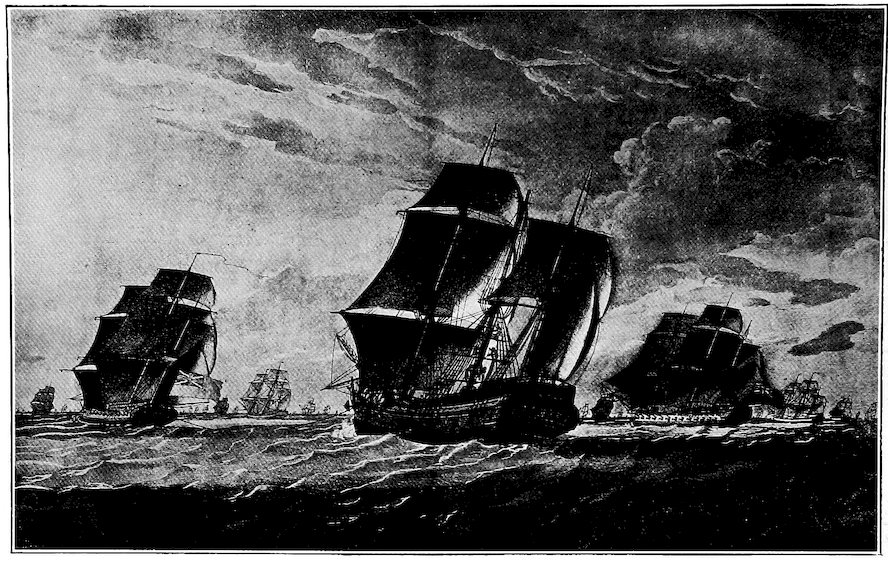
THE “LADY JULIANA” IN TOW OF THE “PALLAS” IN 1782 From an aquatint by Robert Dodd
123In front of the monument, typifying the spoils of war, are two handsome brass cannons, Le Modeste and Le Précipice, founded at Douay in 1748, by Jean Maritz, and bearing the proud legend “Nec pluribus impar”—the motto of Louis XIV.
The initials P. R. and B. E. refer to Philip Redwood (member of the Assembly for St. Catherine, later speaker, and afterwards chief justice), and Bryan Edwards, the historian, who selected the passages from Horace, cut in each side of the pedestal.
Over the front arch of the superstructure is the Rodney coat-of-arms carved in bold relief.
Rodney’s statue is mentioned in Cecil’s “Life of Bacon” as one of his principal works; and it was doubtless through the commission for this work that Bacon gained the orders for the other monuments by him erected in Jamaica—to the Countess of Effingham, Rosa Palmer, Lady Williamson, John Wolmer and others.
In Spanish Town, streets named after governors, are Beckford street, Nugent street, Manchester street, and Conran lane (after General Conran, 1813); the origin of Adelaide street (after the Queen of that name), William street (after the Prince who was later King), Brunswick street (after the Duke of Brunswick), and Nelson lane and Wellington street, are obvious.
Canning lane and Melbourne lane tell of two English prime ministers. In Cochrane lane we have probably a reminiscence of Sir Alexander Cochrane, who was admiral on the Jamaica station in 1814–15. Ellis street tells of the family of Lord Seaford who had properties in the island: the first Lord Seaford having been born in Spanish Town.
Barrett street recalls a family long resident in the island on the North-side.
The parish of St. John, merged in St. Catherine since 1867, dates from the first partition of the island under Modyford in 1664. The old name of Guanaboa is either Arawâk or Spanish, possibly, as Long suggests, a mixture of both, but the prefix gua is suggestive of an aboriginal 124origin. It may perhaps be formed from the Cuban Indian word meaning any kind of palm, or the native Indian word for sour-sop, guabana. Guanaboa occurs as the name of a district in Hayti. The earliest reference to the district in English days is under date July 15, 1661, when the justices of peace of Guanaboa were ordered by the Governor and Council “to nominate a person to sell drink at Cowhides,” and in the map in Hickeringill’s “Jamaica View’d,” published in that year, Guanaboa is one of the four inland names given. In the earlier edition of Slaney’s map of Jamaica of 1678, published by William Berry, there is a church marked at Guanaha, north-west of Spanish-Town, but in the later edition, published by Morden, Guanaha has been erased from the plate. Cowhides is marked on the map which accompanies the “Laws of Jamaica,” of 1684, as a pen for cattle; it probably indicated the place where the skins of the wild cattle were disposed of and possibly survives to-day in Cowpen estate; albeit a spot near Aylmers is still called Cowhide. On August 1 of the same year permission was given to Captain Anthony Collier and Lieutenant Edward Morris “to pen their own with other wild horses for one month, with the assistance of the officers of Guanaboa, to whom half the wild horses are to be delivered.” In 1663–64 to the first Assembly Guanaboa returned two members. One was William Clee, of whom even the erudite Roby has nothing to record. He was not a landowner in 1670. The other was Thomas Freeman, who was later member for St. Thomas-in-the-East, a brother-in-law of Colonel Cope (a member of the Council and colonel of one of the seven regiments, and possibly a kinsman of Colonel Doyley) who lived at Cope Place hard by.
Amongst the representatives whom St. John sent to the Assembly were members of the most noted families in Jamaica history—Aylmer, Beckford, Price, Ayscough, Rose, Brodrick, Kelly, Modd, Fuller, Beach and Shand.
In 1664 when Sir Thomas Modyford wrote home, St. John was one of the seven established parishes. By the survey of the island in 1670, it was shown to have eightythree 125families, and an estimated total population of 996; and a rate of one penny per acre then produced £200 in the parish. The largest landowner was John Styles with 3200 acres. Styles, in a letter to the principal Secretary of State in that year, states that Jamaica “would maintain more people than the whole of England.”
In May 1675 a petition was presented by him “that his land be made a distinct parish under the name of Styles Langley, he having left it by will to Christ Church College, Oxford, from whence he expects it will be supplied with preachers,” and offering to build a church. The petition was refused on the ground that the land, which was at Magatee, was not sufficiently extensive. It was later taken from St. John and made part of St. Thomas-in-the-Vale. Research at Christ Church, Oxford, has failed to reveal any trace of Styles’s bequest.
In 1671 of the four clergymen ministering in Jamaica, at St. John’s was “Mr. Lemmings, an Englishman, lately sent by my Lord of London.” In 1675 “Mr. Lemon” (evidently the same man), “a sober young man and very good preacher,” was minister at Guanaboa. “He has £100 per annum for the parish, and about as much from Colonel Coape for keeping a free school he has erected.”
In 1682 we learn from a very interesting account of the state of the Church in Jamaica, sent to the Bishop of London by Sir Thomas Lynch, who took a keen interest in the cause of religion, that “St. John’s parish or Guanaboa is supplied by Mr. Lemon, who has £100 a year by law. He had some advantages by a school built by Colonel Cope, but on the failure of that and on his marriage to a poor gentleman’s widow he has been a little uneasy. However, since I came he has sold some land I gave him for £500, so that he is in a reasonably good condition. For all I have heard he is a very honest, sober, fair-conditioned man, and esteemed the best preacher in the island. I think he has a parsonage, but the church is decayed, and he preaches in the schoolhouse.” This reference to the decayed condition of the church is, curiously enough, the earliest direct evidence of the existence of a church at Guanaboa, though it was 126probably one of the six churches existing in 1675. It was presumably at all events existing when Richard Guy was buried in 1681, the earliest dated tombstone in the church; but it is curious that there is no mark for a church at Guanaboa in the map of 1684 above referred to. The existing register of baptisms, marriages and burials only goes back as far as 1751. Part of the original fabric probably exists in the present building, which only dates from about 1845, the older church having been burnt down shortly before then.
Roby, in his “History of the Parish of St. James” (1849), says, “In a wood near Aylmer’s in St. John’s, is a monument inscribed, under arms (the colours added) sable, a chevron erminois, between three spear-heads argent, embrued at the points, proper. Crest, a dragon’s head vert, erased gules, holding in its mouth a sinister hand, erect, couped, dropping blood from the wrist, all proper.”
Roby gives the inscription with, marvellous to relate, one or two mistakes, e.g. He for Who in the fourth line; High for Hon. in the tenth; and he corrects the Mason’s Pallidæ into Pallida. It runs as follows:
Near to this Mournfull Marble lies Interr’d the Body of the Hon. Coll. Charles Price who was divested of the Robe of Mortality on the 23d day of May, 1730, Aged 52 years.
Who was a Loving Husband, an Indulgent Parent, a peaceable Neighbour, and a faithful Friend; Just, Charitable, Courteous, Affable to his Inferiors, patient of Injuries and Slow to wrath.
A Man of Integrity, and so firm to his word, that he inviolably preserv’d the same even to the strictest Nicety of Honour; meek he was but truly Brave, and every way fited for his Hon. station, and for a Loyalist was second to none.
He was possessed of such a singular ingaging temper and sincerity of mind, which render’d him a very desirable Companion to all, but more especialy to those who had the happyness of being intimately acquainted with him for he knew no guile neither was deceit found in his heart. If he had any Enemies, they must have been the Sons of Envy, and became such not thro’ any real cause by him given, but from some invidious and Malignant seeds planted and foster’d in their own turbulent and uneasie breasts.