II ST. CATHERINE (continued 2)
Reading edition
To say more of him would be but still to say too little, only that he is now gone to that place which alone knows how to reward those vertues, of which he was here the happy possessor.
127O may we then like him resign our breath,
In life his vertues share, and be like him in Death.
Pallidæ [sic] mors æquo pulsat Pede pauperum Tabernas Regumque Turres.
Lawrence-Archer, in his “Monumental Inscriptions of the British West Indies” (1875), gives the same information as Roby. Nothing is now known of such a tomb near Aylmers, and the tombstone in memory of Price, as quoted by Roby, is now on the floor of the church near the north door; but the tinctures on the arms are quite gone. There is no record of the removal from wood to church. It was evidently subsequent to 1849, but the reference in Lawrence-Archer is no certain proof that it was still in the wood in 1875.
Charles Price was the third son of Francis Price, who came to Jamaica as a captain under Venables. His eldest son, Charles, who achieved much fame in Jamaica and was made a baronet in 1768, and lies buried at Decoy, his estate in St. Mary, will be dealt with under that parish. Charles Price was member for St. John in 1713 and St. James in 1725, but was expelled for non-attendance in the same year. He was custos of St. Catherine. His two sons and six daughters, who all died between 1716 and 1727, lie buried in the church. He left three surviving sons.
Amongst other monuments in the church are those to the following: Richard Guy, who represented in the Assembly “the North-side” (1671–2), St. Ann and St. James in 1673–74, and St. James from 1675 to 1679. In 1676 he patented 1000 acres of which Latium (not Latimer as Lawrence-Archer and Feurtado—after him—have it) in St. John, formed part: George Modd, who represented St. John in the Assembly in 1718, 1719, and 1722, and St. Catherine in 1721, in which year he was speaker; and Colonel Whitgift Aylmer. The arms on his monument are: a cross between four Cornish choughs close; the crest, a Cornish chough rising out of a ducal coronet. From the title “Honourable” it is possible, Roby points out, that he was custos of the precinct of St. Catherine (which comprehended the parish 128of St. John with St. Dorothy and St. Thomas-in-the-Vale), as he does not appear to have been a member of the Council; and although from the arms on his monument it may be inferred that he was of the now noble family of Aylmers, of Balrath, Co. Meath, yet that family was not ennobled until 1718, seventeen years after his decease, when Matthew (second son of Sir Christopher Aylmer, who was created a baronet of Ireland in 1682), rear-admiral of the red, was created Baron Aylmer of Balrath.
The family, which had been long settled in Ireland, is said to have been descended from Aylmer, a Saxon duke of Cornwall, and Sir Gerald Alymer, who, 25 Hen. VIII (1533), was a Baron of the Exchequer in Ireland, was great-great-grandfather to Sir Christopher, the first baronet before mentioned.
The family gave an archbishop to Canterbury, and Whitgift Aylmer is supposed to have descended from Whitgift, archbishop of Canterbury. He was member of Assembly for St. John’s 1673–74, 1677, 1677 again; St. Ann’s 1680–81 and 1687–88; and for St. John’s 1701. The Christian name of his wife was Joyce, as appears from the register of St. Catherine’s, in which parish two of their children were baptized—Mary, June 11, 1669, and John, September 5, 1687. His son was also a member of the Assembly.
The following notice of his election for this parish appears under the date of June 26, 1701.
It appearing by the return of the writs, that Lieutenant-Colonel Whitgift Aylmer was elected for the parish of St. John, and Whitgift Aylmer for the parish of St. James, and it being doubted whether the said Whitgift Aylmer, elected for the parish of St. James, was Colonel Whitgift Aylmer the father or Whitgift Aylmer the son, and a debate thereon, it was put to the vote whether the House understood by the said returns, that Lieutenant-Colonel Whitgift Aylmer or Whitgift Aylmer his son were elected for the parish of St. James.
Resolved, that it was understood by the return to be Whitgift Aylmer the son.
The memory of the family still lives in Aylmers estate hard by.
The parish of St. Dorothy, which was formed out of part 129of Clarendon and part of St. Catherine in 1675, was, on the general reduction of the number of parishes in 1867, merged into St. Catherine.
Old Harbour bay was called by Columbus Puerto de las Vacas, probably because he saw a number of manatees there when he visited it on his homeward way after he had discovered Jamaica.
Bernaldez tells us that:
Thus sailing in a southerly direction they anchored one evening in a bay in a territory where there were many large villages; and the cacique of a very large village which was above the ships came and brought them a quantity of fresh provisions and the admiral gave some of the things which he had on board to him and his followers, and they were much pleased; and the cacique asked whence they came and what the admiral’s name was, and the admiral answered that he was a vassal of the mighty and illustrious sovereigns the king and queen of Castile, his masters, who had sent him to these parts to learn and discover those lands and to do much honour to good men but to destroy the bad. Now he spoke to them by means of his Indian interpreter and the said cacique was much pleased, and he asked the interpreter at great length about things in Spain, and he told him at great length at which the cacique and the other Indians were much astonished and pleased and they stayed there until night, and then took leave of the admiral. Next day the admiral departed, and as he was sailing with a light wind, the cacique came with three canoes and overtook the admiral coming in an orderly and stately manner; one of the canoes was as large as a sea-going ship and was painted all over: the cacique came and his wife and two daughters and two young lads, his sons and five brothers and others who were followers; one of the daughters was 18 years old, and very beautiful; she was quite naked according to the custom of those parts, the other was younger.
In the prow of the canoe stood the standard-bearer of the cacique clad in a mantle of variegated feathers, with a tuft of gay plumes on his head, and bearing in his hand a fluttering white banner. Two Indians with caps or helmets of feathers of uniform shape and colour and their faces painted in a similar manner, beat upon tabors; two others, with hats curiously wrought of green feathers, held trumpets of a fine black wood, ingeniously carved; there were six others, in large hats of white feathers, who appeared to be guards to the cacique.
Having arrived alongside of the admiral’s ship, the cacique entered on board with all his train. He appeared in full regalia. Around his head was a band of small stones of various colours, but principally green, symmetrically arranged, with large white stones 130at intervals, and connected in front by a large jewel of gold. Two plates of gold were suspended to his ears by rings of very small green stones. To a necklace of white beads, of a kind deemed precious by them, was suspended a large plate, in the form of a fleur-de-lys, of guanin, an inferior species of gold; and a girdle of variegated stones, similar to those around his head, completed his regal decorations. His wife was adorned in a similar manner, having also a very small apron of cotton, and bands of the same round her arms and legs. The daughters were without ornaments, excepting the eldest and handsomest, who had a girdle of small stones, from which was suspended a tablet, the size of an ivyleaf, composed of various coloured stones embroidered on network of cotton.
When the cacique entered on board the ship he distributed presents of the productions of his island among the officers and men.
Columbus tells us that Old Harbour was inhabited by the most intelligent and most civilized of all the aborigines that he had met in the Antilles. Later it was called Esquivel, after the Spanish governor who established it as a port for ship-building.
The land on which the Church of St. Dorothy, commonly called Tamarind-tree church, at Old Harbour, was built, was given as a free gift by Colonel Fuller and his wife Catherine Fuller, and also the land and glebe consisting of about 30 acres of land on which the rectory house was built. Colonel Fuller was among the foremost of the Parliamentary officers who came here with Penn and Venables, and received large grants of land, comprising Fuller’s Pen and Thetford in St. Dorothy, and Fuller’s Pen in St. John’s. At a Council meeting held at St. Jago de la Vega, May 9, 1692,
Thomas Scambler Clerke, Minister and Rector of the Parish of St. Dorothy, being at the Board tendered the oaths appointed by Act of Parliament to be taken instead of the oaths of Supremacy and Allegiance, and also to repeat and subscribe the Declaration as by the said Act is Required Peremtarily refuse to take the same ordered that he be from henceforth ipso facto deprived of his said benefice as by the said Act is Directed, and that notice thereof be given to the Churchwardens of the said parish.
On May 19, at a meeting of the council, it was
ordered that the Provost Marshall forthwith take into custody the body of Thomas Scambler Clerke, late Minister and Rector of the 131Parish of St. Dorothy for refusing to take the oaths ... and that the Attorney-General prosecute him thereupon.
Amongst the rectors was the Rev. William Leacock, who was of the Leacock family in Barbados. He gave up the living in 1836–37 and went to America and was the leading divine of the Episcopal church in New Orleans. He was succeeded by the Rev. Charles Hall, the Rev. McAlves, and the Rev. George Wilkinson Rowe, brother of Sir Joshua Rowe, the chief justice of Jamaica, who held the rectory for upwards of 30 years, and the Rev. W. C. McCalla, who commenced the building of the chancel and organ chamber about 1890.
Up to the year 1845–46 the old church was usually called the Old Harbour “barn,” with red brick walls and wooden window shutters. The church was renovated and restored and a belfry was put on the roof by the late Alexander Bravo in the time of the Rev. George W. Rowe.
In the church are monuments to Colonel Thomas Fuller (d. 1690) and John Pusey (d. 1767).
Colebeck Castle, which stands on a ridge of land on the west bank of the Colebeck gully, about a mile and a half to the north-west of Old Harbour town, overlooking the bay, probably dates from the end of the seventeenth century. It must have been the most imposing building of the kind erected in Jamaica. It was evidently at one time partially destroyed by fire. It is rectangular in plan, about 114 feet wide and 90 feet deep, consisting of four three-storied, square, tower-like buildings at each corner, rising to a height of about 40 feet, connected by two-storied arched arcades, consisting on two sides of three arches, on the other sides of five arches. The windows on the ground floor are circular. The walls are formed of stone, filled in between with rubble, with brick quoins and window facings, and are about 2 feet 6 inches thick; at every fourth or fifth course is a course of larger sized bricks. The inside walls have been coated with plaster work. Some of the lintels of doors and windows still remain, and are of bully-wood, as good as when they were first put up. A concrete terrace ran around the castle, with steps at front and back.
132Parts of a projecting wall—at a distance of about 114 feet from the castle on each side, enclosing a square of about 300 feet—about 12 inches thick, still remain, and show crudely-formed loopholes for firing. In some places there is a drop of from 12 to 20 feet on the outside. At each corner of the outer wall was a substantial building some 60 feet square, and underneath three of them were vaulted dungeons. Two dungeons are no higher than 6 feet, 8 feet wide, and 24 feet long, with only one very small aperture low down at one end. The dungeon at another corner measures 60 feet by 20 feet, and is reached by a flight of twenty steps.
To-day the castle is surrounded by bush, and is the abode of bats and owls. On the surrounding property sugar has given place to tobacco.
From his black marble gravestone on the floor of the south transept in the cathedral, we learn that “Collnel John Colbeck of Colbeck in St. Dorothyes was born ye 30th of May, 1630, and came with ye army that conquered this island ye 10th day of May, 1655, where haveing discharged several honble. offices both civill and military with great applause he departed this life ye 22d day of February 1682.”
He was returned member for Old Harbour in the first Assembly of Jamaica, which met on January 20, 1663–64. In 1664, as Sedgwick had prophesied in a letter to Thurloe, the Maroons proved a thorn in the side of the English settlers. Though the main body under Juan de Bolas had surrendered after the defeat of the Spaniards by Doyley, other parties remained in inaccessible retreats, and, augmented by runaway slaves, gave great trouble by intermittent descents on the planters in the interior. Foremost amongst these were the Vermaholis negroes. After the death, in action, of Juan de Bolas, who on surrendering had been made a colonel of the Black regiment, Captain Colebeck, in March 1664, was employed to endeavour to quell them. “He went,” Long tells us, “by sea to the north side, and having gained some advantages over them, he returned, with one who pretended to treat for the rest. This embassy, however, was only calculated to amuse the 133whites, and gain some respite; for they no sooner found themselves in a proper condition, and the white inhabitants lulled into security, than they began to renew hostilities.”
In the survey of Jamaica sent home by Modyford in 1670, under St. Katherine’s parish we read: “John Colebeck (812 acres); Capt. Colebeck and inhabitants (1340 acres).”
In the third Assembly, which met on February 1, 1671–72, Colebeck’s name appears among the representatives of St. Catherine as “Major John Colebeck for Bowers,” Bowers being the district in which Colebeck Castle stands. On February 14 following “the Gentlemen of the Assembly in a body came to the Council and informed the Governor [Sir Thomas Lynch, Lieutenant-Governor] of the sickness of their Speaker, Captain Samuel Long, who recommended unto them Major John Colebeck, with whom they went back to their House and immediately returned their thanks to the Governor for his proposing so fit and able a person to be their Speaker.”
Colebeck remained speaker of the Assembly until Samuel Long was re-elected in May 1673; but on Long’s election to the Council, Colebeck was passed over for the speakership, and Beeston was elected.
In the fourth Assembly, May 10, 1673, Colebeck was again returned under the general head of St. Catherine as chosen specially for Bowers. In the next Assembly, which met on February 13, 1673–74, his name appears as one of the three representatives for St. Catherine generally, the return omitting the former distinctions of one member for St. Jago, another for Sixteen Mile Walk, and a third for Bowers. In the sixth Assembly, April 26, 1675, he was elected for the newly formed parish of St. Dorothy, and continued until his death to represent that parish in every successive assembly, viz. on April 9, 1677, when he had been promoted to the rank of lieutenant-colonel; on September 6, 1677; September 2, 1678; August 19, 1679, when he had attained his colonelcy; and finally on March 19, 1680–81.
In a “Brief Account of the Government of Jamaica,” drawn up in 1680, his name appears fourth on the list of 134justices of the peace for Precinct IV (St. Catherine’s, St. Thomas-in-the-Vale, and St. Dorothy’s), coming after those of Byndloss, Ballard and Long.
In 1679 he was one of a committee of fourteen of the Council and Assembly for the Defence of Jamaica, who signed specific recommendations to the governor for strengthening the breastwork, arming the new works, and providing four fire-ships.
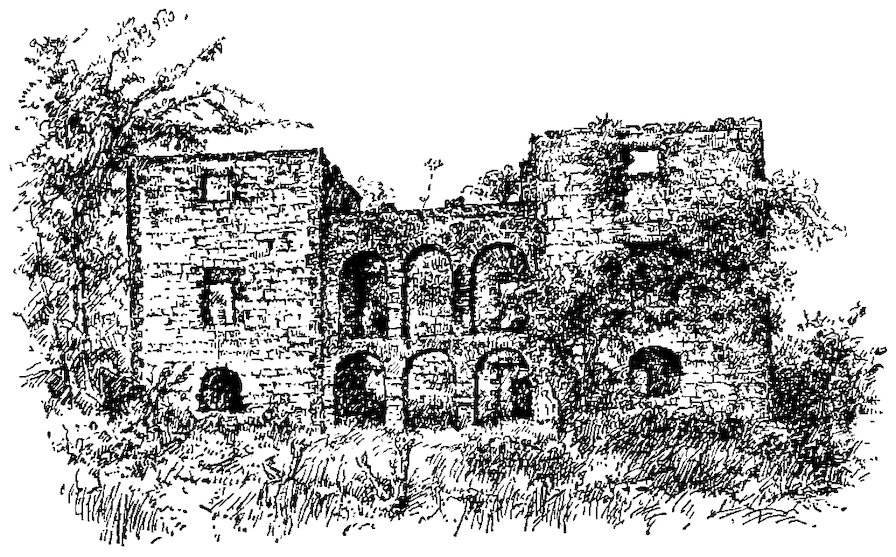
COLEBECK CASTLE
On February 17, 1682, the Lords of Trade and Plantations agreed to recommend, and the King approved, Colonel John Colebeck to be of the Council of Jamaica, in the room of Colonel Whitfield deceased, but he had died before the decision reached Jamaica. His will, dated February 20, was proved on March 15, 1682–83. He does not seem to have had relations for whom he cared, for he named none. He left all his estate, real and personal, to his executors, Hender Molesworth and Samuel Bernard (to each of whom he gave £40), to hold for payment of his just debts and legacies. He bequeathed money to purchase a ring to each of Sir Thomas Lynch, Robert Byndloss and Sir Henry Morgan. He left £20 to Henry Howser, the rector of St. Catherine, to preach his funeral sermon. He left £10 each to Dr. Ross 135and Edmund Duck, the Attorney-General, and £300 to Mrs. Ann Ash; and to every one of “ye Gentlemen of Councill each a ring of 30/- price. To ye church of St. Dorothy’s ye charge of glassing all ye windows and putting in iron barrs.”
After his death, the name of Colebeck does not appear in Jamaica history. As his arms are not given on his tombstone, there is nothing to show whether he came of the Bedfordshire or the Lincolnshire branch of the family; but there is a tradition in the Colbeck family that a member of the Lincolnshire branch at Louth was transported to the West Indies for cutting down an elm tree; that he acquired a fortune, and that his estate went into Chancery.
The principal reminiscence of the great earthquake of 1692 which overthrew Port Royal is the Tomb of Lewis Galdy, which is on the opposite side of Kingston harbour, at Green Bay, where at one time many naval officers were interred. On a brick tomb rests a white marble slab with Galdy’s crest and arms. The arms are a cock, two mullets in chief and a crescent in base. The crest, on an esquire’s helmet, is a plume, and the motto “Dieu sur tout.” The following is the inscription:
Here Lyes the Body of Lewis Galdy, Esq., who departed this life at Port Royal the 22nd December 1739. Aged 80. He was Born at Montpelier in France, but left that Country for his Religion and came to settle in this Island, where he was swallowed up in the Great Earthquake in the year 1692 and by the Providence of God was by another Shock thrown into the Sea, and miraculously saved by swimming until a boat took him up: He lived many years after in great Reputation, Beloved by all who knew him and much lamented at his death.
Lawrence-Archer, in recording this inscription, adds: “Mr. Galdy probably exaggerated the circumstances of his escape, especially as there was no one left to contradict his statement.” There must have been at the time of his death many persons living who could have borne witness to Galdy’s escape. Galdy probably did not write his own epitaph. Moreover, if Lawrence-Archer had experienced an earthquake himself he would not have been so ready to scoff; and the following contemporary accounts all tend to prove 136the truth of the monumental inscription. In the earthquake of 1907 there were many escapes almost as miraculous as Galdy’s.
In “The Truest and Largest Account of the Earthquake in Jamaica, June the 7th, 1692, Written by a Reverend Divine there to his friend in London” (London, 1693) it is stated:
You would admire at the Goodness of God in the Preservation of the residue; some were very miraculously delivered from death, swallowed down into the Bowels of the Earth alive and spewed up again, and saved by the violent Eruption of Water through those Gaps; some (as they say themselves, if they were alive at that time to know what was done to them) were swallowed up in one place, and by the rushing of Waters to and fro by reason of the agitation of the Earth at that time, were cast up again by another Chasm at places far distant.
This account is corroborated by the contemporary account given by Captain Crocket, writing from Port Royal on June 30, 1692. He says:
Several People were Swallow’d up of the Earth, when the Sea breaking in before the Earth could Close, were washed up again and Miraculously saved from Perishings; Others the Earth received up to their Necks, and then Closed upon them and squeez’d them to Death; with their Heads above ground, many of which the Dogs Eat; Multitudes of People Floating up and down, having no Burial.
Also in “A full Account of the Late Dreadful Earthquake at Port Royal in Jamaica, Written in two Letters from the Minister of that Place” (London, 1692), we read:
But no place suffered like Port Royal; where whole Streets were swallowed up by the opening Earth, and the Houses and Inhabitants went down together, some of them were driven up again by the Sea, which arose in those breaches and wonderfully escaped; some were swallowed up to the Neck, and then the Earth shut upon them, and squeezed them to death; and in that manner several are left buried with their Heads above ground, and some Heads the Dogs have eaten, others are covered with Dust and Earth by the people which yet remain in the Place to avoid the stench.
Also in a letter, dated Jamaica, September 20, 1692, quoted by Sir Hans Sloane:
137The Earth when it opened up and swallowed up people, they rose in other streets, some in the middle of the Harbour, and yet saved; though at the same time I believe there was lost about 2000 Whites and Blacks.
Elsewhere in the same letter it says:
She [the anonymous writer’s wife] told me when she felt the House shake, she run out, and called all within to do the same: She was no sooner out but the Sand lifted up; and her Negro Woman grasping about her, they both dropped into the Earth together; and at the same Instant the Water coming in rowled them over and over, till at length they catched hold of a beam, where they hung, till a Boat came from a Spanish Vessel and took them up.
And again, in a letter of July 3, 1693, “Some were swallowed quite down, and cast up again by great Quantities of Water; others went down and were never more seen. These were the smallest openings: Others that were more large swallowed up great Houses, and out of some gapings would issue great Rivers of Water, spouted up a great height into the Air, which seemed to threaten a Deluge to that part of Port-Royal.”
But the most detailed account of all is given in “A Natural History of Nevis and the rest of the English Leeward Charibee Islands in America. With many other Observations on Nature and Art. In Eleven Letters from the Rev. Mr. Smith, sometime Rector of St. John’s, at Nevis, and now Rector of St. Mary’s in Bedford; to the Rev. Mr. Mason, B.D., Woodwardian Professor, and Fellow of Trinity College, in Cambridge, 1745.”
One Mrs. Akers of Nevis was a native of Port Royal in Jamaica, and lived there in the year of our Lord 1692, when the great earthquake made such a dismal havoc and destruction, as will hardly ever be forgotten by the inhabitants of that Island. She told me, ‘That the earth opened wide, swallowed her with many others, and then immediately closed up again’; she said she was in a state of insensibility during her short stay there. It could not exceed the tenth part of a minute before it opened once more to vomit some of them up again. I asked her what might be her thoughts of the matter just the moment before the Earth swallowed her down; and she answered, that imagining herself upon the brink of a boundless Eternity, she put up a short ejaculation to Almighty 138God, begging him to pardon her Sins, and to receive her Soul. The Hiatus she fell into was all Water, so that being very wet she received no other harm, excepting in one of her Cheeks, which grated a little against something that did but just draw blood. This water Hiatus closed again the next moment, catching hold of some people by a Leg, of others by the middle of the Body, and of others some by the Arm &c., detaining them in dismal torture, but immovably fixed in the ground, till they, with almost the whole Town besides, sunk under Water; which happen’d within three minutes after she had got safe on board a Ship then riding at anchor in the Harbour.
Galdy was an affluent merchant of Port Royal, churchwarden from 1726, and member of Assembly for St. Mary, 1707; for Port Royal, 1708–09; for St. George, 1711; for Port Royal again, 1716; and for St. Anne, 1718. He enriched himself by the slave trade, as factor for the Assiento.
Until about the middle of the last century various inns and posting-houses, or taverns, as they were generally called, were kept in Jamaica. Some were rendered unnecessary by the advent of the railway, and some were superseded owing to the more rapid travelling rendered possible by better roads.
Of these the Ferry Inn, formerly the halfway house between Kingston and Spanish Town, has survived hurricane and earthquake, only to live on its departed glory, and no longer as a tavern.
In 1677 “An Act for the Ferry between St. Catherines and St. Andrews” was passed, of which the preamble runs:
Whereas William Parker, of the parish of St. Andrews, Esquire, hath at his particular Charge found out and made a very convenient Way between the Salt and Fresh River in the Parish of St. Andrews and St. Catherines, which will be of great use and advantage to the whole Island, in causing a more near and easie Correspondence with the several Precincts and whereas the said William Parker hath likewise set up and erected a Ferry for the better Accommodation of the said Passage, and whereas the same cannot be maintained without great and constant charges....
In return for the right to demand Toll over the Ferry, Parker was bound to “compleat the said Way and Passage within twelve months from and after the making of this 139Act, and that in all places it be not less than eight foot broad.”
This was one of a batch of laws that was not assented to by the King, and included in the laws passed under the Great Seal of England in 1678, and brought out by Carlisle for the Assembly’s acceptance which was refused. It was repeated in an Act of 1683. An Act of 1699, confirmed in 1703, directed the building of a bridge, and the 1683 Act does not appear in subsequent editions of the laws. The Ferry river—once known as the Lagoon river from its source to the Ferry and thence to its junction with the Salt river as the Fresh river—rises at Governor’s Spring in Ellis’s Caymanas and runs into the Salt river; the united stream then runs into the old course of the Rio Cobre just before it enters Hunt’s Bay in Kingston harbour.
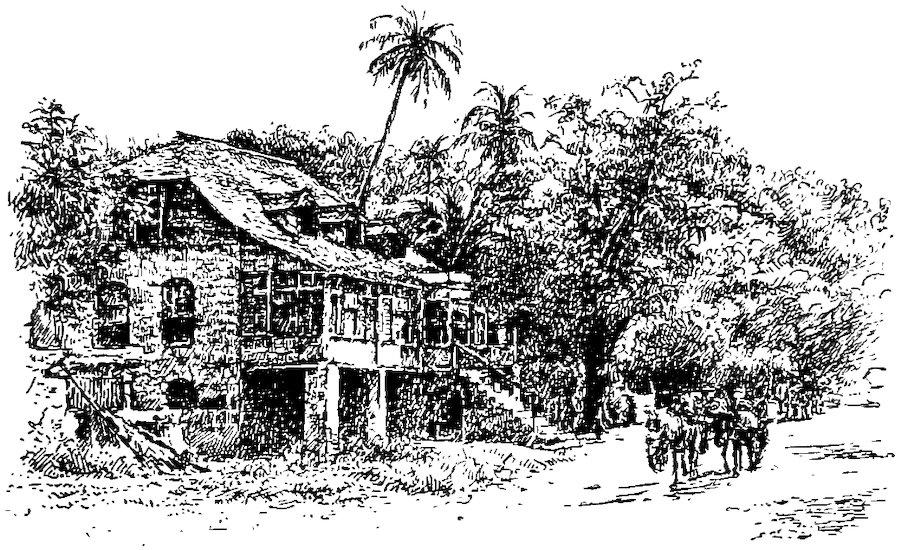
THE FERRY INN
By the Act of 1677, “William Parker, his Heirs and Assigns” were “Impowered and Authorized, for the space and term of fourteen years from the making thereof, to ask, demand, sue for, recover, and receive as a Duty and Toll for the Transporting of any Person over the said Ferry, Seven pence half peny; for every Horse and Man, fifteen pence; for every grown Beast that hath no Rider, seven Pence half peny; for every Sheep, Calf, or Hog, sixpence; 140and that the said William Parker, his Heirs and Assigns, may and shall erect a Tavern or Victualling-house near the said Ferry, and shall not be compelled to renew or pay any License Money for the same.”
Lady Nugent, in her Journal, mentions visits to the Ferry Inn on three occasions, all in 1803; on February 10, when the Governor’s party breakfasted there prior to the review of the St. Andrew’s militia by General Nugent; on May 27, when “most of our family dined at the Ferry House, on the Kingston Road, and our dinner party was very small”; and lastly, on June 13, when she writes: “13th—Sent carriages, soon after 5, into Spanish Town, for the Murphy family, who slept there. Soon after breakfast, General N. set off with Mr. M. in the curricle, to visit the estates between this and Kingston called the Camoens [Caymanas]. After second breakfast Mrs. and the Misses Murphy with me in the sociable. The rest of the party in kittareens, phaetons, and on horseback, all proceded to the Ferry Inn to meet the Admiral and a large party at dinner. We had sent on to order the dinner, a few days before, and all that Jamaica produces was ready to be served up. The poor Admiral however, was so overcome with fatigue and the heat of the day, that he was quite ill, and obliged to leave the table. In consequence we all separated early. Mr. and Mrs. M. went with the Admiral, and are to be his guests till Wednesday. I took my seat in the curricle with General N., and all our young people went in the sociable; and really if it had not been for Sir J. T. Duckworth’s illness it would have been a merry party. As it was I was much entertained; for the Inn is situated on the road between Kingston and Spanish Town, and it was very diverting to see the odd figures and extraordinary equipages constantly passing—kittareens, sulkies, mules, and donkies. Then a host of gentlemen, who were taking their sangaree in the Piazza; and their vulgar buckism amused me very much. Some of them got half tipsy; and then began petitioning me for my interest with his Honour—to redress the grievance of one, to give a place to another, and so forth; in short it was a picture of Hogarth....”
141To-day one can drive by the road and meet perhaps only a few drays, laden with wood or guinea-grass for Kingston, or, it may be, bananas or other agricultural produce. Of the “host of gentlemen” one sees nothing. The Ferry was in the early nineteenth century one of the places where tolls were charged. In the “Royal Gazette” for November 17, 1827, the Lease of the Ferry Toll was advertised for tender.
The records of the House of Assembly contain many references to the grants made in aid of roads, their management and the like. It may be interesting to take the history of the Spanish Town road, which until the advent of the railway was the principal, as typical of the rest.
“An Act for the Highways,” passed in 1681 (the third Act passed by the legislature of the colony) provides “That the Highways be sixty foot wide in standing Wood, forty foot where the Wood is only on one side, and twenty-four foot in open ground.”
The early “Act for the Highways” is alluded to in a slightly later Act (passed before 1695): “For making and Clearing a Publick Road from St. Mary’s and St. George’s into the Parish of St. Andrew’s.”
In 1698 Parker was brought before the House for collecting toll at the Ferry although the law had expired. A Committee to whom the matter was referred, reported that they had
examined the business referred to them by the House, concerning the Ferry between St. Catherine’s and St. Andrews and upon perusal of the Patent granted anno 1682, the whole Committee came to this resolution, viz. That the patent was void and the law expired:
Whereupon the said letters patent and the law being read in the house, it was put to the vote, whether the House would concur to the report of the committee of grievances;
Carried in the affirmative.
Michael Holdsworth and John Moone, esquires, ordered to wait on the Governor and acquaint him of the resolution of the House about the ferry, who returning, reported the delivery of the message, and that the Governor said that he hoped the house would take care to make a law that the benefit of the ferry should go to the two parishes, but that he thought it reasonable that the parish of St. 142Andrew shall have somewhat the more of the benefit, in regard that the road on the other side the ferry is to be maintained by them, which will be chargeable.
Whereupon Michael Holdsworth, Usher Tyrrell, John Walters, John Dove, Emanuel Moreton, William Hall, Jervis Sleigh, and John James, esquires, were appointed a committee to bring in a bill for that purpose.
And in the following year an Act was passed “to oblige the parishes of St. Catherine and St. Andrew to build a bridge over the Rio Cobre.” The bridge was to be at least twelve foot wide.
In October 1723 a Committee of the Assembly, appointed to consider the most effectual means for repairing the public roads, reported:
1. That although the road leading from Spanish-Town to the Parish of St. Andrew were repaired according to the Act of this island directing the repairing the public roads, yet it would be of no effect, unless the Rio Cobre were first cleared.
To which the House agreed....
And a committee was appointed to bring in a bill for repairing the road leading from St. Jago de la Vega to the town of Kingston. The committee was, five days later, ordered to insert a clause for cutting a new channel for the Rio Cobre.
By 1745 the road was known as the Ferry Road, and in that year a Committee of the Assembly was appointed to enquire into matters respecting it.
In 1748 the Assembly again considered the state of the Ferry Road, and passed “An Act to empower Commissioners to keep the Ferry, and erect a toll-gate or turnpike, between St. Catherine’s and St. Andrew’s, to commence at the expiration of an Act entitled An Act for empowering William Peete, Esquire to keep the Ferry, and erect a toll-gate or turnpike between St. Catherine’s and St. Andrew’s, and taking up runaway negroes.”
In 1758 an Act was passed for “Vesting in Trustees a toll to keep the ferry, and erect a toll-gate or turnpike between St. Catherine’s and St. Andrew’s ...” and a similar Act was passed in 1761.
143In 1777 a Committee reported:
4. On consideration of the motion for £4000 to be applied towards carrying on the road from the church in Spanish Town to the church in Kingston, it appears to your Committee, from accounts solemnly attested and rendered in, and also from vouchers produced, that the sum of £2000 granted last session of Assembly, for carrying on the new road from the town of St. Jago de la Vega to the Ferry, in the parish of St. Catherine, and of £2000 for carrying on the new road from the Ferry, in the parish of St. Andrew, to the Town of Kingston, have been all expended on the said roads; your Committee were therefore of opinion, the sum of £4000 now applied for, should be granted: Your Committee have come to two resolutions respecting this road:
1st. Resolved: It is the opinion of this Committee that the road between Spanish Town and Kingston is laid out on too large a scale; that therefore, it ought to be contracted that thirty feet in the centre well paved and gravelled (except in the Salina which ought to be paved forty feet) would answer every purpose to the public, and save a considerable expense.
2nd. Resolved: It is the opinion of this Committee that the salaries allowed to the Superintendent, and his assistants, amounting to about £900 per annum, are too large; and that, in future, they ought to be reduced.
In 1778 an Act was passed “for explaining and amending the several Highway Laws now in force, and rendering the said Laws more effectual.” It was repealed and expired by 1792.
In 1799 an Act “for continuing the Act commonly called the Highways Act for a certain time longer,” was passed, but expired in 1812.
In 1801 a Highway law was passed, but was repealed in 1805.
In 1802 a law was passed “for rendering more effectual the several laws relating to the public road from the church in the town of Saint Jago de la Vega to the church in Kingston,” and “the Trustees of the Ferry Road” were thereby appointed.
In 1815 an Act was passed giving “fuller powers to the Trustees of the Ferry Road,” as it was found that “the present state of the Ferry Road requires that their powers shall be extended, and that prompt and efficacious means should be used to repair and keep the same in good order especially by causing it to be frequently examined.”
144The oldest tablet in the Church of St. Thomas-in-the-Vale at Linstead is that of one Elizabeth Burton, who died in 1742. At the time of the threatened invasion by the French in 1805 the Records of the island were removed to this church, and were protected by a militia guard. The said church was blown down by a hurricane in March 1822, and was shortly afterwards rebuilt. A tower was added to the church in 1830.
The church was destroyed by earthquake on January 14, 1907, and was rebuilt of reinforced concrete with eternit roofing at a total cost of £950 and was consecrated in 1911.
Although the parish of St. Thomas-in-the-Vale dates from 1675, when the author of “The Present State of Jamaica” (published in 1683) wrote his work, its church was not one of the seven churches in the island; the nearest church then being St. John’s, Guanaboa Vale, which had been in existence since 1669. The earliest rector recorded was the Rev. Thomas Garbrand, appointed in 1705. In “The Early English Colonies” (1908), by Mr. Sadler Phillips, is given “A List of the Parishes, Churches and Ministers in Jamaica, April 18th, 1715,” in which is included “St. Thomas-in-the-Vale, a church blown down, Mr. Reinolds.” The Rev. James Reynolds had come out in 1709, sent by the Bishop of London, who since 1702 had had ecclesiastical jurisdiction over Jamaica. In 1798 the rector was the Rev. William Williamson. In 1820 and for some years after the rector was the Rev. William Buston.
Williamsfield, in St. Thomas-in-the-Vale, on the road between St. Mary and Spanish Town, was first settled by Needham, a large proprietor, but was soon purchased by one Harvey from Barbados, who in turn sold it to Daniel Lascelles, brother to the first Baron Harewood. It remained in the Lascelles’ hands for many years. In 1743, Henry Lascelles went to London from Barbados, and being a wealthy man purchased the Harewood estate, carried on business in London as West India merchants with George Maxwell. His son Edwin was created Baron Harewood in 1790.
145At a Council meeting held on July 11, 1692, at St. Jago de la Vega (the first held there after the earthquake) it was “ordered that the Councill meet on Wednesday next at Musqueto Point to view and consider of a place in order to the Building a fortification for to secure the Channell.”
And on August 8 it was “ordered that a fortification be made at Mosquito Point, of the ground &c. fitt to erect the same and that Charles Bouchier, Esq. goe and veiw the same and draw out Plott thereof and the same Returne to this Board.” This was the origin of Fort Augusta.
Long gives the following account of the fort in his time. He makes a strong attack on the policy of fortifying a place which he designates a “still unfinished battery stuck into a quagmire at the entrance of Kingston Harbour,” and says that the immense charges incurred on its behalf had by 1757 helped to cripple the island financially. He says:
This fort mounts eighty-six large guns, kept in excellent order. It contains a large magazine, a house for the commandant, barracks to contain three hundred soldiers, with all convenient offices, and casemates. It was projected to mount one hundred and sixteen guns; but it is not yet compleated. The walls and bastions are built upon piles of the palmeto or thatch-pole tree, which is endued with the property of lasting in water without being liable to erosion by the worm. These were driven down through the loose land, until they reached a firm bed. If the same precaution had been used in constructing the houses of Port Royal, it is probable that the greater part of the town would have survived the earthquake. This fort contains an hospital, besides habitations for the officers, and is looked upon to be an healthy garrison. The neck of sand which joins it to the main is not above fifty or sixty feet wide in most places, and so low, that an enemy could not carry on approaches, on account of the water rising near the surface; and it is flanked by a lagoon, or inlet of water from the harbour, of some extent; for these reasons, and because the ships, in passing up the channel towards Kingston, must come within point-blank shot of a whole line of guns, a governor of this island pronounced it impregnable both by land and sea.
During a storm in 1744 a new fort begun at Mosquito Point was entirely destroyed.
The present fort was erected on Mosquito Point in Kingston Harbour in 1753. On September 13, 1782, the magazine, with three hundred barrels of powder, blew up. 146Amongst the military tombs is that to Major John Sankey Darley, 2nd W.I.R., who was killed in a mutiny of the West India Regiment there in May 1808. Recruits of the 2nd West India Regiment, Chamba and Koromantyn negroes, mutinied on parade, aided by some of the older men. The Lieutenant and Adjutant Ellis was killed on the spot, and Darley died of the wounds he received. The general officer commanding, Carmichael, got into conflict with the House of Assembly by directing his officers not to answer any questions that that body might put to them with reference to the occurrence. Darley was brother to Alderman Darley of Dublin, of Orange notoriety. Carmichael died in 1813 while governor of British Guiana.
Rodney’s Look-out on the Heathshire Hills was shaken down by the earthquake of 1907. It was erected by Rodney while he was admiral on the Jamaica station, (1771–74), for the purpose of keeping a look-out to windward. Port Henderson hard by, is named after a former owner, John Henderson, colonel of militia, who was presented at Court in February 1784. He died at his estate in Scotland in 1811. It was founded in opposition to Passage Fort, as it afforded better accommodation for ships.
Towards the close of the nineteenth century it was the site of a temporary laboratory of marine zoology for students of the Johns Hopkins University.
Lawrencefield is said to have been the residence of Sir Henry Morgan, governor of Jamaica (1673–82). St. Jago Farm is said to be the site of the residence of Sasi, the last of the Spanish Governors. Government Pen was the residence of former governors, and is frequently mentioned in Lady Nugent’s “Journal.” At Caymanas is an Arawâk kitchen-midden·, at Mountain River, St. John’s, some Arawâk rock-carvings, and at Goat Island (in Old Harbour Bay) is a cave with Arawâk remains. At Point Hill are some old barracks which are now used as a police station.
Keith Hall is probably named after Sir Basil Keath, governor in 1774–77, and Sligoville after Peter, Marquis of Sligo, governor in 1834–36.
147