Part 1 — CHAPTER V REAGENTS
Reading edition
Little attention is given in the present work to micro-chemical reactions for the reason that their value has been much overrated in the past. A few reagents will be found useful, however, and these few are given, as well as their special use. They are as follows:
LIST OF REAGENTS
Distilled Water is used in the alcohol, glycerine, and water mixture as a general mounting medium. It is used when warm as a test for inulin and it is used in preparing various reagents.
Glycerine is used in preparing the alcohol, glycerine, and water mixture, in testing for aleurone grains, and as a temporary mounting medium.
Alcohol is used in preparing the alcohol, glycerine, and water mixture, in testing for volatile oils.
Acetic Acid. Both dilute and strong solutions are used in testing for aleurone grains, cystoliths, and crystals of calcium oxalate.
Hydrochloric Acid is used in connection with phloroglucin as a test for lignin and as a test for calcium oxalate.
Ferric Chloride Solution is used as a test for tannin.
Sulphuric Acid is used as a test for calcium oxalate.
Tincture Alkana is used when freshly prepared by macerating the granulated root with alcohol and filtering, as a test for resin.
Sodium Hydroxide. A five per cent solution is used as a test for suberin and as a clearing agent.
Copper Ammonia is used as a test for cellulose.
Ammonical Solution of Potash is used as a test for fixed oils. The solution is a mixture of equal parts of a saturated solution of potassium hydroxide and stronger ammonia.
Oil of Cloves is used as a clearing fluid for sections preparatory to mounting in Canada balsam.
Canada Balsam is used as a permanent mounting medium for dehydrated specimens, and as a cement for ringing slides.
Paraffin is used for general embedding and infiltrating.
Lugol’s Solution is used as a test for starch and for aleurone grains and proteid matters.
Osmic Acid. A two per cent solution is used as a test for fixed oils.
Alcohol, Glycerine, and Water Mixture is used as a temporary mounting medium and as a qualitative test for fixed oils.
Chlorzinc Iodide is used as a test for suberin, lignin, cellulose, and starch.
Analine Chloride is used as a test for lignified cell walls of bast fibres and of stone cells.
Phloroglucin. A one per cent alcoholic solution is used in connection with hydrochloric acid as a test for lignin.
Hæmatoxylin-Delifields is used as a test for cellulose.
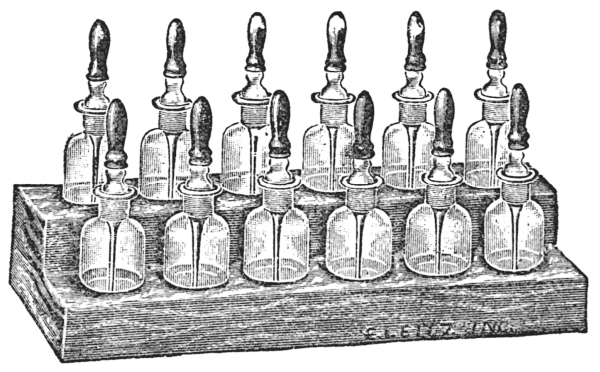
Fig. 38.—Reagent Set
REAGENT SET
Each worker should be provided with a set of reagent bottles (Fig. 38). Such a set may be selected according to the taste of the individual, but experience has shown that a 30 c.c. bottle with a ground-in pipette and a rubber bulb is preferable to other types. In such forms the pipettes are readily cleaned, and the rubber bulbs can be replaced when they become old and brittle. The entire set should be protected from dust by keeping it in a case, the cover of which should be closed when the set is not in use.
MEASURING CYLINDER
In order accurately to measure micro-chemical reagents, it is necessary to have a standard 50 c.c. cylinder (Fig. 39) graduated to c.c.’s. Such a cylinder should form a part of the reagent set.
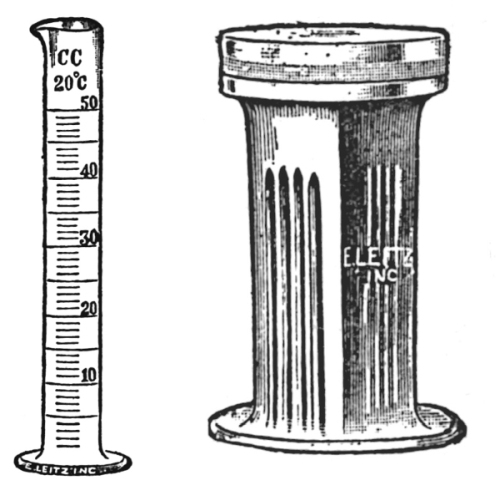
Fig. 39.—Measuring CylinderFig. 40.—Staining Dish
STAINING DISHES
There is a great variety of staining dishes (Fig. 40), but for general histological work a glass staining dish with groves for holding six or more slides and a glass cover is most desirable.