Volume 2 — VIII. MEDICAL HINTS. (continued 3)
Reading edition
Undulant (Malta) Fever.
The term Undulant Fever is applied to Malta Fever partly because the latter is not a good name, as the disease occurs in various parts of the world, and partly because the term Undulant affords a good description of the type of the temperature curve.
Cause.—The organism is a small bacterium, which is found in the blood and tissues. Although theoretically the disease can be spread like enteric fever or dysentery, in practice it is found that it is nearly always conveyed by infected goats’ milk. Goats are apt to harbour the organism and excrete it in their milk. It is also found in certain milk products, such as cream and cheeses which are not allowed to ripen. In addition to man and goats, cows, sheep, horses, mules and dogs, are all liable to natural infection.
Symptoms.—Incubation period 5 to 15 days. The disease begins with headache, malaise, anorexia, and sleeplessness. The patient is usually constipated, and there is tenderness in the splenic region, the spleen being enlarged at an early date. The temperature rises gradually for three or four days in a step-like manner, and then falls by a similar descent, reaching the normal on or about the tenth day. At this early stage bleeding from the nose may occur, and profuse night sweats are not uncommon. The tongue is flabby and coated. When the temperature falls the patient feels better for a few days, but is still apt to suffer from night sweats, and continues to lose flesh. A relapse occurs, and is usually accompanied by joint troubles and sometimes neuralgic pains. A series of febrile waves continues to follow each other at short intervals, and the illness is a very wearisome one, running an average course of 60 to 70 days. It may, however, extend for nearly a year, and in some cases terminates fatally. The long course of the illness results in the patient becoming anæmic, and he often suffers from mental depression. There are irregular forms of the fever which are apt to be puzzling, and it is always well to remember that any cases of prolonged pyrexia from tropical or sub-tropical regions may be Malta fever.
Prophylaxis.—Avoid drinking goats’ milk and eating the local products of such milk. If goats’ milk must be drunk it should be boiled. General hygienic measures are also important, and it should not be forgotten that the organism of the disease is found in urine, which should therefore be disinfected.
Treatment.—This is for the most part entirely symptomatic. Medical attention and good nursing are essential. A vaccine has been introduced and is worth trying, but vaccine treatment is best left to an expert. It is sometimes necessary to give morphia for the joint pains and the neuralgia, but there is a distinct risk of the patient’s acquiring the morphia habit. Sleeplessness, which is often troublesome, should be treated as indicated on page 235.
Urine, Retention of.
Retention of, or inability to pass the water may be caused by stricture, injury, shock, spasm, inflammation of some part of the passage, the effects of drinking, or by chill.
Symptoms.—The bladder is unable to expel its contents and it gets fuller and fuller; it can be felt in its distended condition as a painful, soft swelling in the lower part of the belly, below the navel, underneath the skin and muscles. There may be fever, great pain and constant desire to pass water, with inability to do so. When the bladder becomes greatly distended, there is usually slight dribbling of water, which is somewhat misleading, as the case may be considered, not one of retention but rather of too frequent passing of urine.
Treatment.—Give a saline purge such as Epsom salts, three or four teaspoonfuls, and let the patient sit in a bath of hot water. If not relieved very quickly, then pass a clean catheter into the bladder, and allow it to empty itself (see Catheters, p. 272). After the bladder has been emptied put the patient to bed and give a dose of opium or bromide of potassium to procure rest. When he desires to pass water again let him have another bath, and if this is not effectual, again withdraw the water through a catheter. Patient should be careful to ward off further attacks by avoiding chills, over-drinking, and other exciting causes. If there is inflammation of the bladder, copaiba or sandal-wood capsules should be used; if the urine is irritating, bicarbonate of soda must be given.
Urine, Suppression of.
In this serious condition no urine is secreted by the kidneys, so that on passing a catheter the bladder will be found to be empty.
Causes.—Shock from injury, inflammation and blocking up of the kidneys. Suppression of the urine is a common complication of severe cases of blackwater fever.
Treatment.—Hot baths, hot poultices to the loins, free use of aperients, especially Epsom salts and other saline purges. Bicarbonate of soda in full doses. Keep the skin acting freely by means of sweet nitre, or Warburg’s tincture, or five-grain doses of antipyrine. Injections of hot water into the lower bowel.
Worms.
Worms are introduced into the system chiefly by means of dirty water or imperfectly cooked food.
In the case of hook worms (ankylostomes), contaminated soil is the chief medium of infection.
Of the worms which live in the bowels the most important are the following:
Tape Worms.—These worms may measure many feet in length; and their presence in the body can only be certainly known by the appearance of some of the segments or portions of the worm in the motions although hunger and dyspepsia may be complained of.
Treatment.—Administer a good aperient overnight so as to empty the bowels; after the aperient nothing should be given by the mouth for eight hours, then give sixty to one hundred and twenty drops of the liquid extract of male fern in one ounce of thin gruel, milk, or gum water, and follow this up in four hours by a good meal, and an aperient to remove the worm, which should now be dead.
When the extract of male fern is not available, one tablespoonful of the oil of turpentine may be used in its place.
If later on fresh segments appear in the motions, then the treatment must be repeated.
Round Worm.—The round worm resembles the garden worm and is several inches in length; it may be observed in the vomit but more commonly is seen in the motions. The symptoms are similar to those caused by the tape worm and the treatment is the same, except that, instead of the male fern, two to five grains of santonin should be given in a little milk; and the treatment repeated every other day for a week.
Threadworm.—The threadworm is a small round worm usually measuring less than half an inch in length; it inhabits the lower end of the bowel and causes great heat and itching about the outlet, especially at night.
Treatment.—Wash out the lower bowel and inject into it about a third of a pint of tea, or a similar quantity of water containing one teaspoonful of salt, tannin, or alum; then apply a little mercurial ointment around the outlet to diminish irritation. This should be done every third day till the worms have disappeared from the motions.
The Guinea Worm.—The guinea worm often measures several feet in length; it chiefly causes trouble in the feet, ankles, and legs, where in order to obtain an exit from the body it penetrates the skin, causing a small ulcer at its point of exit.
Usually the presence of the guinea worm is attended with inflammation and the formation of matter.
Prophylaxis.—Infected persons should be kept away from water supplies, and such sources of water supply as wells and water holes should be protected. In areas where guinea worm occurs, all water should be boiled. If this cannot be managed, it should be filtered through a piece of clean cotton cloth, as this will remove from it the small crustacean in which the larva of the guinea worm develops. Another method of treating infected water is by means of permanganate of potash, one ounce to every 2,000 gallons of well water. Caustic potash and quicklime are also effective.
Treatment.—When the worm can be seen at the base of the little ulcer, it may be secured to a piece of match and a small portion may be wound on to the match daily. If attempts are made to forcibly draw it out, it will probably break and violent inflammation will result. During the time that the worm is being wound out, the part should be kept very clean and an antiseptic ointment applied.
There are other methods of treatment, but these can only be carried out under medical supervision.
The Hook Worm.—This is the American name for one or other of the species of ankylostomes which infect man. The disease they cause is known as ankylostomiasis, and it is common in many parts of the world, especially in the tropics. It chiefly affects natives, owing to their habits; but it occurs also in Europeans.
Cause.—Hook worms are small, almost cylindrical worms, which inhabit the human small intestine, to the wall of which they attach themselves by means of their mouths, which are furnished with formidable hooks and lancets. They suck blood, and the symptoms they produce are due in part to loss of blood, in part to the destruction of the lining membrane of the bowel, and possibly also in part to the effects of a poison which they are believed to excrete. Their eggs are passed in the excrement, and develop in the infected soil into larvæ, which are able to penetrate the unbroken skin if they come in contact with it. This is the most important route of infection, but it may occur also by means of infected drinking water and from contaminated food.
Symptoms.—The most marked feature of the disease is anæmia, which is often associated with digestive troubles. Palpitation of the heart and shortness of breath are frequently met with. In bad cases the appetite is disordered or depraved. The patient becomes pot-bellied, and there is swelling, chiefly about the face and ankles. The face is frequently puffy, and the skin assumes a peculiar earthy hue. It should be noted that a very early symptom is what is called ground itch. This is a skin eruption, usually on the feet and legs, due to the irritation caused by the larvæ penetrating the epidermis.
Prophylaxis.—The chief measure consists in preventing contamination of the soil by infected excrement. It is therefore important when camping to make proper provision in the way of latrines. Care must also be taken to prevent the fouling of water and food stuffs, such as vegetables, which are eaten uncooked. It is very dangerous to go about bare-foot in regions where the disease occurs, and camping sites should always be thoroughly cleansed.
Treatment.—Efficient treatment can only be carried out in association with microscopic examination of the stools, and hence all that need here be said is that various worm medicines are employed, of which the most effectual are thymol and oil of chenopodium. These should be administered only under careful medical supervision. The anæmia has to be treated, and in the case of natives a nutritious and easily-digested diet is indicated; for example, for native coolies the following has been recommended: bread 1 pound, milk 2 pints, sugar 2 ounces, 2 eggs, and 4 bananas daily. Ground itch should be treated by an ointment containing zinc oxide and salicylic acid.
The Bilharzia Worm.—This worm, of which there are two species, produces the disease known as Bilharziasis or Schistosomiasis, which occurs in one or other, or both forms, in various parts of the world, but is specially prevalent in Egypt.
Cause.—The worms, which produce either urinary or rectal bilharziasis, live in parts of the human vascular system, where they produce their eggs. These eggs are furnished with spines, and hence cause irritation when lodged in the tissues. In the urinary form the eggs have a terminal spine, in the intestinal form the spine is lateral. These eggs are passed either in the urine or in the excreta and reach water, where they develop into larvæ. The larvæ enter special species of water snails, in which they develop, producing eventually tiny forms known as cercariæ. These cercariæ escape into the water and can penetrate the unbroken skin or intact mucous membrane. They thus get access to the bodies of persons who are bathing in the infected water, or who may drink it. Once in the human body, the blood carries them to the place where they develop into the adult worms, which eventually unite, and then the females begin producing the spined eggs.
Symptoms.—In the urinary form the chief symptom is the passage of bloody urine, which usually shows itself about three months after infection, and is often associated with a good deal of irritation of the bladder and the pipe. The intestinal form may produce various symptoms. Sometimes a condition resembling enteric fever occurs, sometimes one like dysentery. Diarrhœa is common. The condition is chronic and, if untreated, sets up all kinds of secondary effects, which need not be discussed.
Prophylaxis.—Carefully avoid any kind of personal contact with water which may by any possibility be infected from urine or fæces. Bathing, wading, washing in, or drinking any such waters, are all dangerous. Wherever possible, water which may be infected should be boiled. If this cannot be done, sodium bisulphate tablets may be used; two of the 16-grain water-purifying tablets in a quart water-bottle full of water are efficient. Filtration through a Pasteur-Chamberland or Doulton candle is efficient, as it excludes the cercariæ. Bathing water can be rendered safe for immediate use by the addition of undiluted Army cresol in a dilution of 1 in 10,000. If the water is kept overnight, 1 in 90,000 is sufficient, as the storage of water tends to diminish infection.
Treatment.—Certain forms of antimony have been found to cure the condition, but can only be administered by a medical man. Indeed, either form of bilharziasis can be properly treated only under medical supervision. If this is not obtainable, some relief can be afforded by the use of urotropin and sedative drugs.
There are many other worm diseases which afflict man, but no good object would be served by mentioning them in detail. Most of them can be diagnosed with certainty only by a medical man using the microscope, and they all require scientific treatment which is beyond the scope of the ordinary traveller.
Yellow Fever.
This disease, the “Yellow Jack” of naval historians, occurs, so far as is known, only in parts of the New World and on the West Coast of Africa. One attack usually protects permanently against a second.
Cause.—Quite recently the organism has apparently been discovered. It is a corkscrew-shaped parasite which exists in the blood, and which is allied to, though not identical with, the parasites of relapsing fever and tick fever. The infection is conveyed from one patient to another by the mosquito Stegomyia fasciata, which is a black and white insect, commonly known from its striped legs as the tiger mosquito. Incubation period two to five days.
Symptoms.—The onset of the disease is very sudden, the highest temperature being reached almost at once; then follows a period of remission or calm, the pulse becomes abnormally slow, and this stage is usually either succeeded by convalescence, or the symptoms become worse and the patient dies. Some of the symptoms much resemble malaria, but the rapidity of the onset, severe pain in the forehead, eyes, and loins, the early scantiness of the urine, the marked jaundice, the bright eyes, the narrow red tongue, and the absence of pain about the spleen are fairly characteristic.
There is considerable thirst and vomiting, and in bad cases the vomit becomes black, the colour being due to the presence of blood. (In ordinary malaria the vomit is yellow, or in severe cases, such as blackwater fever, it may be of a bright or dark-green colour.) In yellow fever, jaundice is developed about the third day, and tends to increase, whilst in blackwater fever it comes on very early and soon begins to abate.
An important diagnostic sign in yellow fever is found in the fact that the pulse does not increase in rapidity as the temperature rises.
Prophylaxis.—Avoid being bitten by mosquitoes, employing the methods mentioned on pages 206, 207. It must be remembered that Stegomyia fasciata, unlike the anopheline mosquitoes, bites during the day, and therefore it is more difficult to avoid its unwelcome attentions. It usually breeds in the neighbourhood of houses, being what may be called a domestic mosquito; and it is of the greatest importance to abolish all potential breeding places or to protect them from the mosquito. Practically any vessel holding water may become a nursery for Stegomyia, and it is remarkable in what small quantities of water this mosquito will lay her eggs. Patients suffering from the disease must be isolated and kept under a mosquito net or in a mosquito-proof chamber, in order to prevent them from infecting mosquitoes, which they are capable of doing in the early part of the disease.
Treatment.—Open the bowels well by means of calomel, six grains, followed by a saline purge and hot-water enema. Some prefer castor oil in large doses. Give ten grains of bicarbonate of soda three times a day. Give cooling drinks, such as fruit salt. Make the skin act. Apply hot fomentations to the back and mustard leaves to the pit of the stomach.
The question of feeding is very important. During the first two or three days of the fever the patient is better without any food at all. As he recovers his appetite returns, and great care must be exercised about gratifying it. Only the plainest foods in very small quantities should be permitted, the amounts being gradually increased, as otherwise relapses may occur. Stimulants are usually required in the later stages of the fever, but they must be carefully employed as they may tend to increase the vomiting. It is possible that the discovery of the parasite may lead to new and more efficient methods of treating the disease.
MEDICINES, MEDICAL APPLIANCES, ETC.
Weights and Measures.
Solids.
A Grain Symbol Gr.
20 Grains 1 Scruple { weights now rarely used ” ℈
60 Grains 1 Drachm ” ℨ
437.5 Grains 1 Ounce ” ℥
16 Ounces 1 Pound ” ℔
Note.—An ounce weighs not 8 but rather under 7½ drachms.
1 Gramme about 15½ grains.
1 Kilogramme ” 2 lbs. 3¼ ozs.
Liquids.
1 Minim About 1 drop, or 0.06 c.c. Symbol ♏
60 Minims One fluid drachm ” ℨ
8 Fluid drachms (480 Minims) One fluid ounce ” ℥
20 Fluid ounces One pint ” O
1 Cubic centimetre 17 Minims.
A teaspoonful About one fluid drachm.
A dessertspoonful About two fluid drachms.
A tablespoonful About half a fluid ounce.
A wine-glassful About two fluid ounces.
A tumblerful About half a pint.
A litre About a pint and three quarters.
All bottles containing drugs should be doubly labelled, and the labels should be varnished, otherwise they will probably come off in a damp climate. Poisons should be kept in bottles of a special shape.
Drugs in a liquid state are inconvenient for travellers. They are bulky, and require very careful packing and handling.
As far as possible, therefore, compressed drugs should be selected. These must be of good quality.
Tablets are often taken in the solid form, but they will act more quickly and certainly if dissolved or suspended in about an ounce of water.
Some preparations, chiefly those used for preparing lotions, etc., e.g., of chinosol, are also made in compressed form.
In regard to drugs, I have kept well within the maximum dose, so that there may be no trouble on that account. For instance, in certain cases a medical man would give sixty drops of laudanum for a dose, but I advise travellers rarely to give more than sixty drops in twenty-four hours. The urgency of the case must be the guide as to the quantity of the drug to be given. The smallest dose which is effective is the best.
A supply of antiseptic gauze, wool and lint is necessary. The compressed forms are very convenient.
All antiseptic gauzes and other dressings should be very carefully protected from the air in order that their properties may be preserved. They should be wrapped in oiled paper or india-rubber tissue, and kept in a tin box.
A supply of bandages will also be needed. Each bandage should be two inches in width by six feet in length.
Dressing case.—The traveller should provide himself with a surgical dressing case. A suitable one should contain 1 pair of scissors, 1 pair of Spencer Wells’ artery forceps, 1 probe, 1 scoop and grooved director, 1 knife with two blades, 1 small saw with a detachable handle, and a packet containing silk, wire, needles, and pins.
All active poisons mentioned in the following pages are marked with an asterisk (*).
Aloin Co. tablets.—One taken three times a day after meals, in chronic constipation, gradually reduced as bowels become regular.
Alum.—Dose, five to ten grains. Is occasionally used as an internal astringent in the treatment of diarrhœa.
A solution containing five grains to the ounce of water may be used as a mouth wash for bleeding or inflamed gums, as a gargle for relaxed and sore throats, or as a lotion for inflamed eyes.
Ten to twenty ounces of a solution containing five grains to the ounce is sometimes used as an enema to check the diarrhœa in chronic dysentery.
The tablet of alum weighs ten grains.
Ammonia.—Three preparations of ammonia, viz., Sal volatile, Carbonate of ammonia, and Liquor ammoniæ, are extremely valuable as stimulants, and in this respect they are to be preferred to alcohol. All three are similar in their action, and are useful on account of their stimulating effect upon the heart in cases of fainting, or collapse caused by snake-bite, bullet-wound, or other injury; they relieve spasm, and promote sweating in feverish states. They also cause free expectoration, and are therefore useful in the later stages of bronchitis.
The chief objection to these drugs is that their strength is rapidly lost, unless they are kept in well-stoppered bottles, and in the dark.
All preparations of ammonia should be administered in about one ounce of water.
Sal volatile, or aromatic spirit of ammonia.—Dose, twenty to sixty drops for a single administration, or up to thirty drops if repeated frequently. This is the most convenient and pleasant preparation of ammonia, but is bulky. As a local application, it is of service in relieving the pain caused by the bites of certain insects, e.g., mosquitoes and fleas.
Carbonate of ammonia.—Dose, three to ten grains.
Liquor ammoniæ, or solution of ammonia.—Dose, five to twenty drops.
(Note.—This is not the strong solution, which is always labelled “Liq. Ammon. Fort.,” and which is three times stronger than liquor ammoniæ.)
Ammonium chloride.—Dose, five to twenty grains. This drug is chiefly used in congestion of the liver, especially where acute inflammation or abscess is threatened; at times it is useful in neuralgia and chronic bronchitis. It is also used for inflamed and relaxed sore throat, in the form of a gargle, five to ten grains to the ounce of water.
Antipyrine.—Dose, five to ten grains. (Uses as Phenacetin.)
* Araroba, Chrysarobin, or Goa powder.—Is not for internal use. One part of the powder mixed with one of acetic acid and fourteen of lard makes what is known as araroba ointment.
Araroba ointment is useful in many skin diseases, such as psoriasis; it easily destroys the parasites in ringworm, dhobie itch, or kraw kraw. It is a powerful drug, and should be used only in small amounts, for if applied too freely it will cause some inflammation and pain. Care must be taken that it is not rubbed into the eyes.
* Aromatic chalk with opium tablets.—Ten grains three times a day in severe cases of diarrhœa.
* Arsenic.—Dose, one-sixtieth to one-fifteenth of a grain. Is a powerful and poisonous drug, and should be taken with caution. It is useful in chronic malaria, and in anæmia and debility, especially that following an attack of fever.
It is best combined with iron in tablet form—iron and arsenic tablet—two of which may be taken twice a day, after food, for a week. This is a good general tonic.
Aspirin.—Dose 5 to 15 grains. Should be taken with a drink of water. Useful in rheumatic and febrile conditions; often relieves headache and the feeling of discomfort associated with chill. It is apt to be depressing in large doses, and some persons do not tolerate it well. Speaking generally it may be used in those conditions in which salicylate of soda is indicated.
Bismuth carbonate.—Dose, five to twenty grains. Useful in dyspepsia, pain in the stomach, vomiting and diarrhœa. The drug is heavy, and therefore gum or starch water should be used to suspend it.
It is often combined with opium and bicarbonate of soda to check vomiting and diarrhœa.
Bismuth may also be used as a dusting powder.
Boric acid, or boracic acid.—Chiefly used in solution, for its mild antiseptic properties, as a gargle, injection, eye lotion, or mouth wash. On the same account, it is used for washing wounds, or syringing out ulcers, or sore and inflamed ears. It is practically non-poisonous.
Lotions should contain from five to ten grains to the ounce. Boric ointment is a useful dressing for sores, burns, or wounds; it may be made by adding one part of powdered boric acid to nine of vaseline or fat.
Equal parts of finely-powdered boric acid, zinc oxide and starch makes a good dusting powder for moist eczema, bed-sores, chafes, and perspiring feet.
Boric lint (lint impregnated with boric acid) is useful as a dressing for wounds, ulcers, and abrasions.
Boric wool is absorbent cotton-wool impregnated with boric acid, and is the most generally useful antiseptic wool.
Bromides.—The bromides generally used are those of potassium, or ammonium. Dose in either case, five to twenty-five grains. They are sedatives, and are used in convulsions, epilepsy, and delirium; they relieve headache, especially if taken with sal volatile, and may be combined with chloral (see Chloral). The bromide of ammonium is less depressing than the bromide of potassium.
Calcium sulphide, i.e., sulphurated lime.—Dose, a quarter to one grain three times a day. Useful for those who are suffering from boils or carbuncles.
* Calomel, or subchloride of mercury.—Dose, two to five grains. Calomel may be used in almost all cases requiring an aperient; its action will be assisted by giving fruit salt, or citrate of magnesia, four hours later. In cases of insensibility or delirium it is specially useful, for the powder may be placed on the back of the tongue, and it will be swallowed unconsciously.
Four grains of calomel may usually be given with advantage, at the beginning of a malarial attack.
In syphilis, one grain may be given two or three times a day; but its action should be watched, and if it causes salivation, tenderness of the gums, and a coppery taste in the mouth, it should be discontinued until these symptoms disappear.
Camphor.—Dose, two to five grains. Is a stimulant, and an antispasmodic; it helps to calm the nervous system. It is used in cholera and in fevers, and is taken for colds in the head.
Camphor is slightly soluble in water, and this solution makes a cooling lotion, which is useful for inflamed or painful parts. A lump of camphor is a good repellent for sand-flies.
Spirit of camphor consists of one part of camphor in ten of alcohol; the dose is ten to twenty drops.
Camphorated oil consists of one ounce of camphor in four ounces of olive oil, and makes a stimulating liniment for stiff and painful parts. A stronger liniment may be made by adding to this an ounce of spirit, and half to one ounce of solution of ammonia or oil of turpentine.
* Carbolic acid, or phenol.—Dose, one or two grains may be given internally, well diluted, for acute diarrhœa, dysentery, and cholera. Is mostly used as an external application. Carbolic acid acts as a caustic, and may be applied on the end of a match in the case of boils (p. 227). A drop on a piece of cotton-wool applied to a hollow tooth quickly relieves pain.
It is much used as an antiseptic lotion for wounds and foul sores, and for cleansing hands and instruments before operation.
One part in twenty of water makes a strong solution for cleansing instruments and disinfecting dysenteric and other stools.
One part in sixty may be used for sponging or syringing sores and wounds.
One part added to nineteen of olive, or other oil, makes carbolic oil, which is a handy dressing for all kinds of wounds.
One part to nineteen parts of vaseline, or fresh lard, makes carbolic ointment.
Cascara sagrada, extract of.—Dose, two to six grains. Is a valuable aperient, especially in chronic constipation. Cascara tablets, two grains each, are convenient, and one or two should be taken at night.
Cathartic Co. Tablets.—A useful purge in cases of fever or liver derangement. Two or three for a dose when required.
Castor oil.—Dose, one to three tablespoonfuls. It is a good aperient, but is not very convenient for the traveller, as it takes up much space, which could be better used for aperients which are not so bulky, e.g., calomel or cascara. The usual dose of castor oil should be somewhat reduced in the tropics, where it is often not so well borne as in temperate climates.
Note.—The seeds of the castor oil plant should not be eaten, as they are poisonous.
Chinosol is a drug which has many of the advantages of carbolic acid without its poisonous or caustic properties. It is so generally useful that, at any rate for explorers, it will largely replace carbolic acid. It is antiseptic and disinfectant in its action, can be used as a mouth wash or gargle, for sore gums and ulcerated throats; it makes a good lotion for washing the hands, instruments, or wounds, and may be syringed into fresh wounds or into chronic ulcers.
It is put up in the compressed form, each tablet weighing eight and three-quarter grains, and the strength of the solutions here given are calculated strictly from this weight.
One tablet dissolved in a pint of water makes a solution of 1 in 1000 (equal to about 1 in 40, carbolic lotion), which is the most useful for general purposes, such as an antiseptic wash for the hands or for disinfecting surgical instruments.
A tablet in two pints of water makes a solution of 1 in 2000. This may be used for washing fresh wounds, burns, and suppurating surfaces, or as a gargle for sore throat.
As a healing dusting powder, one part of chinosol may be mixed with ten of boric acid, and used in the same manner as iodoform powder.
To disinfect typhoid or dysenteric stools, dissolve four tablets in one pint of water and add the mixture to the vessel containing the motions.
* Chloral.—Dose, five to twenty grains. Relieves restlessness and delirium, and produces sleep. Larger doses than twenty grains should not be given. In severe convulsions, due to certain poisons, e.g., strychnine, twenty grains or more of bromide of potassium may be added to the full dose of chloral, and given either by the mouth or bowel.
* Chloroform.—Dose, one to five drops. Two to four drops can be given with advantage with almost any drug, as a flavouring agent, and on account of its antispasmodic action.
From two to four drops put on a piece of loaf sugar and sucked will often stop sea-sickness or other vomiting.
Spirits of Chloroform, or Chloric Ether, consisting of one part of chloroform in twenty parts of alcohol, is a convenient form in which to administer the drug. It is useful in sea-sickness, cramps and colic, and should be given in doses of twenty drops added to a teaspoonful of water every quarter of an hour, until six such doses have been given.
* Cocaine.—A one per cent. solution may be used to diminish pain in the eye caused by injury or a piece of grit lodging under the lids. Two drops should be applied to the eyeball, and in about two minutes the application may be repeated; in another minute the sensibility of the part will be diminished, and a careful examination may be made for dust or other foreign bodies, which should of course be cautiously removed.
Creosote.—Dose, one to two drops; is best given in a capsule. In many cases of indigestion it gives great relief if administered immediately after food. Creosote applied to a hollow tooth, upon a piece of cotton-wool, will usually relieve the pain.
Cresol.—This is a valuable disinfectant which is found on the market under several names.
* Croton Oil.—Dose, half to one or two drops, mixed with bread crumb or in a pill.
Is a powerful purgative not usually given to Europeans. Native carriers like it. Useful in the case of unconscious patients, given in butter.
Copaiba, Balsam of.—Dose, five to twenty drops three times a day. Is best taken in capsules. It increases the expectoration, and is therefore useful in bronchitis; is a stimulating disinfectant to the urine, bladder and pipe, and is used in gonorrhœa and inflammation of the bladder. It may produce an irritating rash on the skin if taken in too large quantities.
Emetics.—The following are the usual emetics:—
Common salt, two tablespoonfuls in half a pint of water.
Mustard, one tablespoonful ” ”
Ipecacuanha, thirty grains ” ”
Zinc sulphate, thirty grains ” ”
In the absence of any of the above, give copious draughts of tepid water, followed by tickling the back of the throat with the finger or a feather.
Emetine.—The active principle of ipecacuanha. Of great value in amœbic dysentery (p. 187).
Enema.—Nutrient enema:
Two eggs,
Half teaspoonful of salt,
A wine-glassful of milk.
Beat up the eggs, then add the salt and milk, and mix well. Raise the hips and inject slowly through the long tube well up into the bowel.
Nutrient enema:
Benger’s beef jelly, two tablespoonfuls,
Milk, about three ounces.
Warm-water enema. To relieve uneasiness of lower bowel, as in dysentery, piles, etc., half a pint or more of warm water, by the short tube.
Soothing enema. Laudanum, thirty drops; warm water about two ounces. A little thin starch water or gum may be added. Inject through the short tube, and repeat the injection in three hours if patient is not easier.
Quinine enema. Quinine, twenty grains or more; warm water, about two ounces. If the patient does not retain the injection, give a second one within an hour. Select a soluble preparation of quinine, such as the bisulphate or the hydrobromide.
Aperient enema. Lather soap in thirty ounces of warm water, using plenty of soap to make a good solution; or use plain warm water or weak gruel; the addition of one or two tablespoonfuls of oil is of advantage. Inject slowly into the bowel with short tube; if it does not cause uneasiness, inject the whole amount. The injection should be retained as long as possible.
Epsom salts, or sulphate of magnesia. Dose, two teaspoonfuls or more. Is a saline purgative, giving a copious watery motion, rapid in its action, and useful in fevers or congestion of the liver. It also increases the flow of urine.
Recently has been much used in dysentery (p. 189).
Friar’s Balsam.—(Tinct. Benzoin Co.) Dose, thirty drops or more.
Internally is useful as an expectorant in bronchitis. Can also be employed as an inhalation.
Externally, lint soaked with it is an efficient dressing for wounds and sores. When first applied it causes a good deal of smarting, but this soon passes off.
Gall and opium ointment is a useful application for piles.
Gauze, antiseptic. The best dressing for wounds is some form of antiseptic gauze. Cyanide gauze, which is impregnated with cyanide of mercury, is the most generally used.
Ginger, essence of.—Dose, five to twenty drops. It is useful in cases of cramp, colic, and indigestion, especially if combined with five or ten grains of bicarbonate of soda and two or three drops of chloroform.
If there is much pain, ten drops or more of chlorodyne or laudanum may be added.
* Goa powder.—See Araroba.
* Goulard water.—For external use only. Is astringent, and may be used as a lotion for inflamed joints. Is also useful as an injection in gonorrhœa and gleet, as a soothing lotion in herpes, shingles, eczema, discharge from the ear, and itching and chafes of all kinds. It should not be used as an eye lotion.
Goulard water is made by adding one part of Liquor Plumbi Subacetatis Fortis, or Goulard Extract, and one of alcohol to seventy-eight of water.
One of the tablets of the subacetate of lead added to a quarter of a pint of water (distilled when convenient) makes a solution similar to Goulard water.
Gum acacia is used for forming a mucilage with which to suspend such drugs as carbonate of bismuth. One part of gum to three of water should be made and strained before use. Starch may be used for the same purpose.
Hazeline.—Dose, thirty to one hundred and twenty drops. It is a powerful astringent. May be applied freely to bleeding parts, such as the nose, gums, piles, or small wounds. One tablespoonful of hazeline to five of water may be injected into the bowel for bleeding piles. Hazeline snow is an elegant preparation for sunburn and other skin affections.
Ichthyol.—An ointment containing twenty per cent. of ichthyol is very soothing in most skin diseases, such as eczema and psoriasis. The ointment is of service in reducing the pain and swelling of mosquito bites.
Iodide of potassium.—Dose, five to ten grains in the later stages of syphilis.
* Iodine, tincture of.—Dose, two drops in a teaspoonful of water; given every hour, is most valuable for obstinate vomiting.
Used externally, it acts as a counter-irritant, and should not be painted on too freely as it may cause blistering. Does good if painted over swollen joints or enlarged glands, but should not be applied if the skin there is broken. Tincture of iodine may be painted on the chest or over the liver or spleen if there is pain. It is a valuable application for all open, recent wounds, and may be painted freely over and round the raw surface. It relieves the irritation of mosquito bites.
Is very useful in certain diseases of the skin, such as ringworm, kraw kraw, and dhobie itch.
Iodoform powder is a valuable antiseptic, and is used for all kinds of sores, or wounds, in which it rapidly promotes healing. One part of iodoform to eight parts of vaseline makes a good healing ointment.
Ipecacuanha.—Dose, expectorant, half to two grains.
” emetic, fifteen to thirty grains.
” for dysentery, twenty to forty grains or more.
In small doses, e.g., a quarter to half a grain, is a stomachic and may check vomiting.
Was formerly much used in amœbic dysentery (p. 187). Its active principle, emetine, is now employed.
By causing free expectoration, it is very useful in bronchitis, and is then usually combined with ammonia.
Is contained in Dover’s powder, and in this form is useful in coughs and colds, as it helps to cause sweating.
Iron.—Iron is much used on account of its tonic and blood-forming properties. It is especially useful in anæmia following fevers and other exhausting diseases, and it also gives tone to the nervous system.
Most preparations of iron are astringent in their action, some such as the sulphate and perchloride being more so than others; these are, therefore, useful in diarrhœa and in bleeding from the gums and bowel. Iron by its astringent action may cause constipation, and it may be necessary to add a small amount of an aperient, such as Epsom salts, to each dose.
The following preparations are those generally used:—
Tincture or perchloride of iron, or tincture of steel.—Dose, five to fifteen drops in at least an ounce of water. Good blood tonic. Is very astringent, and is therefore useful in internal bleeding and looseness of the bowels. It is of value in erysipelas.
Sulphate of iron.—Dose, one to three grains. Is a powerful astringent and blood tonic, and often does good in checking the looseness of the bowels which remains after an attack of dysentery.
Iron pill or Blaud’s pill.—Dose, five to fifteen grains. Is one of the best tonic preparations of iron, as it is not very astringent. It is put up in tablet form.
Solution of dialysed iron.—Dose, ten to thirty drops. Is a good blood tonic, and, unlike most preparations, is not astringent.
Parrish’s food.—Dose, thirty to a hundred and twenty drops in water. Is a good preparation of iron for children.
Iron and arsenic compound tablets.—A useful tonic in convalescence from malaria, one taken three times a day after meals.
Mercurial ointment forms a useful application in certain skin diseases. As it is rather strong, it should be diluted with two parts of vaseline.
White precipitate, or ammoniated mercurial ointment.—Useful in the case of head lice and several parasitic skin diseases.
Naso-pharyngeal Tablets.—Useful in nasal catarrh and pharyngitis.
* Opium.—Is a valuable drug, but it is also a poison, and great care should be observed in using it. Opium is narcotic and sedative in its action; it relieves pain of all kinds. Useful in diarrhœa, dysentery, cramp and colic. Promotes perspiration and checks vomiting. Sometimes it will cut short a cold or mitigate an attack of malaria.
No preparation containing opium should be given to children without medical advice, and the same is true as regards persons suffering from kidney disease.
The chief preparations containing opium are:—
* Chlorodyne.—The ordinary dose is ten to fifteen drops, but if there is great pain, then even thirty or forty drops may be given, but a second dose should not be administered for three or four hours; if two full doses have been given, do not give a third within at least twelve hours of the second dose, and do not give it at all if the patient is drowsy.
It is best not to give more than forty to sixty drops in twenty-four hours, unless there are very special reasons for giving a larger quantity. Is to be preferred to laudanum, as it is more palatable and more readily stops vomiting.
* Laudanum, or tincture of opium.—The doses and uses are precisely similar to those of chlorodyne. Laudanum has been put up in the compressed form, and is very convenient for transport.
* Dover’s powder, or compound ipecacuanha powder.—Dose five to fifteen grains. It contains opium and a small amount of ipecacuanha. Ten grains of Dover’s powder are equal to about fifteen drops of chlorodyne or laudanum. The tablet is an extremely handy preparation. Dover’s powder is especially useful in coughs and colds, the ipecacuanha it contains assisting the action of the opium. If a patient who is chilled is put to bed at once, kept warm with blankets and hot-water bottles, and is given ten or fifteen grains with a hot drink, he will perspire, and possibly the cold will be cut short.
Peppermint, spirits of.—Dose, five to twenty drops. Is a valuable drug in cases of flatulence and dyspepsia, especially if combined with bicarbonate of soda; it also masks the taste of unpleasant medicines. For children, one drop of the spirit and one grain of bicarbonate of soda may be added to one teaspoonful of water, and this dose may be frequently repeated.
Pepsin tablets, a useful digestive product, taken with food when digestion is weak, or may be used to predigest it.
* Perchloride of mercury tablets, for making lotions for disinfecting wounds, etc.
Phenacetin.—Dose, three to eight grains. Phenacetin is used for headaches, or for reducing the temperature in malaria and other febrile diseases, and to cause sweating. As it is very insoluble, it is best taken in the form of a powder, or in alcohol and hot water.
Potassium, bromide of. See Bromides.
* Potassium permanganate in solid form is a mild caustic, and is the active principle of Condy’s fluid, which contains about eight grains of the drug in one ounce.
It is disinfectant, deodorant, and antiseptic.
One part of this drug is soluble in about twenty parts of water.
One grain gives a purple colour to a gallon of water. Impure water turns the purple rapidly to a brown colour, therefore the permanganate is a rough test for the presence of organic matter in water.
A pale purple solution is useful as a gargle or mouth wash, also as an injection in gonorrhœa; wounds may be cleansed with a similar solution.
It is especially useful in poisoned wounds, such as snake-bites, and should in these cases be injected hypodermically (p. 281).
Is an antidote to poisoning by opium.
Of late years it has been extensively used in the treatment and prevention of cholera. The two-grain tablet is a convenient form for medication.
Purgatives may be divided into the following classes:—
1. Laxatives.
2. Simple purgatives.
3. Drastic purgatives or cathartics.
4. Saline purges.
1. Laxatives slightly stimulate the movements of the bowel, but cause practically no increase of the intestinal secretion. Examples of this class are fruit, wholemeal bread, small doses of castor oil, figs, prunes, etc. These may be given regularly in slight cases of chronic constipation.
2. Simple purges are more powerful than laxatives, and in addition to stimulating the movements of the bowel increase the secretion. The result is a soft, easy motion. Examples: rhubarb, senna, cascara sagrada.
3. Drastic purgatives or cathartics. The drugs cause a profuse flow of the intestinal secretions, and, occasionally, of the bile, with greatly increased bowel movements. They cause a copious watery evacuation, accompanied by a good deal of griping. Examples: calomel, colocynth, aloes, podophyllin, croton oil, jalap and oil of turpentine; of these, podophyllin and aloes cause an increase in the flow of bile, with increased intestinal movements, so they may be said to act directly upon the liver. The result is a profuse, watery, bile-stained motion.
Calomel does not act directly upon the liver, but stimulates the upper part of the bowel, so that its contents are hurried along before the bile can be reabsorbed, and a loose, watery, bile-stained motion ensues.
The most useful purgative of this class is the pill containing colocynth, calomel, and hyoscyamus, of which five to ten grains should be given when there is a furred tongue, constipation, heaviness or weight over the liver, and dyspepsia and loss of appetite.
4. Saline purgatives. These cause a free secretion of the intestinal juices, and a copious motion, proportionate to the size of the dose, is the result. The principal saline purges are Epsom salts (i.e., sulphate of magnesia), Glauber’s salts (i.e., sulphate of soda), seidlitz powder, the various forms of fruit salts, and the aperient mineral waters, such as Rubinat, Hunyadi Janos, etc.
A saline purgative may be given in the morning, to assist the action of an aperient pill administered the previous night.
Saline purgatives are useful, too, in many cases of habitual constipation, and, if necessary, a small dose may be given every morning in a tumbler of warm water.
Quinine.—Quinine is chiefly used for malarial fever, and the urgency of the case must be the guide as to the amount to be administered. It is seldom necessary to give more than ten grains three times a day; at times enormous doses, such as thirty grains three times a day, have been given with advantage, but such doses are rarely necessary, and in the absence of a medical man should never be given.
The administration of quinine sometimes causes headache, deafness, delirium, and partial or even complete blindness. In such cases the dose should be reduced or the drug withheld until these symptoms have disappeared.
It has been stated that quinine causes blackwater fever; this, I believe, is absolutely untrue. I have seen cases of blackwater fever, apparently resulting from the neglect of malarious attacks, which date the commencement of their recovery from the first administration of quinine.
Quinine is best given in solution; the nauseous taste can be somewhat disguised by adding chloroform water or essence of ginger or lime juice to the solution. Many men take the drug in a little beer or spirit for the same purpose.
Quinine pills are, as a rule, very insoluble, therefore they are not suitable for explorers. Quinine in the form of a tablet, or in a capsule, or wrapped in tissue paper, acts well, but even tablets should be cracked or crushed. Sugar-coated products are inadmissible in the tropics.
Sometimes, owing to frequent vomiting or other cause, the quinine administered by the mouth cannot be retained. It must then be given by means of an enema or by injection into the muscles.
If the traveller decides to give an intra-muscular injection of quinine, he should only give five grains at a time. The dose should be added to about a teaspoonful of water which should then be boiled and allowed to cool. The amount of water is of little importance so long as enough is used to dissolve the drug, and keep it in solution when the water is cool enough to be injected. The less fluid, however, injected the better.
Injections are best made deeply into the muscles of the buttock. This is a method best left to a medical man, as there is danger of injuring the sciatic nerve.
The preparations of quinine.—Many preparations of quinine are made; they are all popularly known as quinine, their uses are similar, and the doses are as follows:—
Dose, one to five grains, as a tonic.
” five or more grains as a preventive of malaria.
” five to twenty grains, in fevers.
Sulphate of quinine.—This is the preparation most commonly used; but it is very insoluble in water, and should be given along with a little dilute acid.
Acid sulphate of quinine, sometimes called bisulphate, soluble or neutral sulphate of quinine.
The acid sulphate is much more soluble than the sulphate, and is a more suitable preparation for administration by the mouth or for injection into the bowel.
Hydrochloride of quinine.—Is a very soluble preparation, and contains a large percentage of quinine.
Quinine hydrobromide.—Is more soluble than the sulphate, and less liable to cause headache and other quinine symptoms.
Acid quinine hydrobromide.—Very soluble and non-irritating. Solubility, one in six of water.
Tannate of quinine.—Is a weak preparation, but suitable for children. Solubility, one in ten of water.
Acid quinine hydrochloride, or quinine bihydrochloride.—Is a very soluble preparation, and is suitable for hypodermic injection, but is somewhat expensive.
It is soluble in less than its own weight of water.
For administration by the mouth or bowel, the traveller is advised to take either the hydrochloride or the bisulphate of quinine.
For intra-muscular administration the acid quinine hydrochloride is generally used.
Rhubarb, either in form of compound rhubarb pill, one of the most useful of ordinary aperients, two to four for a dose.
Compound Rhubarb Powder, otherwise known as Gregory’s Powder.
Sandal-wood oil.—Uses and doses as for balsam of copaiba.
Soda, bicarbonate of.—Dose, five to ten grains or more. Five to ten grains dissolved in water may be given twice a day for acidity, flatulence, heartburn. Useful in dysentery to allay irritation of stomach; for this purpose five or ten grains may be given an hour before each dose of ipecacuanha.
If the urine is acid and scalding, give twenty grains three times a day. Bicarbonate of soda is given in cases of blackwater fever when the urine is not sufficient in quantity; in such cases at least twenty grains should be given every six hours.
Soda mint tablets, useful for relieving flatulence, one or two being taken after meals.
Sodium salicylate.—Dose, ten to twenty grains. Relieves pain in rheumatic fever. Lowers temperature. Its action must be carefully watched, as too large doses may cause headache, buzzing in the ears, and even delirium.
Sulphur.—An ointment containing one part of sulphur to nine of lard, grease, or vaseline, makes a useful application for itch and other skin diseases.
Tannin.—Tannin is a powerful astringent, and may be used internally or externally.
In five to ten grain doses it helps to stop diarrhœa, bleeding from stomach, bowel, piles, and bladder. If there is continued bleeding, increase the dose to twenty grains, and repeat it as often as necessary.
Voice tablets, consisting of chlorate of potash, borax and cocaine are useful in cases of sore throat.
Warburg’s tincture.—One tablet is equal to thirty drops of the ordinary tincture. Stronger tablets are also available.
To produce sweating, first open the bowels, then give four to eight of the tablets with a little hot spirit and water. If necessary, repeat the dose in three hours, and in either case withhold if possible food or drink till after this period has elapsed, but if the patient is very thirsty give hot drinks of weak tea or spirit and water. Keep him covered up and put a hot-water bottle in the bed.
Urgency of the case is a guide as to how many tablets ought to be given.
Zinc oxide alone or mixed with an equal quantity of boric acid or starch makes a useful drying dusting powder.
Zinc ointment contains three parts of zinc oxide to seventeen parts of lard or vaseline. This is a most useful application for burns, eczema, chafes and sores.
Sulphate of zinc.—As a prompt emetic, give twenty to thirty grains in half a pint of warm water. If patient does not vomit give a pint or more of warm water and tickle the back of the throat. A second dose of the drug may be given.
Two grains to an ounce of water makes a valuable astringent lotion for gonorrhœa, raw surfaces, ulcers, and inflamed eyes and ears. The strength of this solution may be gradually increased to six grains to the ounce of water.
Temperature Taking, Hypodermic Injection, Baths, Catheters, Stomach Tubes, Enemas, and Poultices.
Pulse, Respiration and Temperature.
Normal pulse rate (adult) about 72 per minute.
Normal respiration rate (adult), 15 to 18 per minute.
Normal temperature, 98.4° F., but varying in health between 97.5° and 99°.
Temperature Taking.
The temperature of the body may be taken in the armpit, the mouth, or the lower part of the bowel.
In the Armpit.—Dry armpit well, put the bulb of the thermometer into it, and press the arm tightly against the body, so that the thermometer will be in close contact with the skin on either side for at least five minutes.
In the Mouth.—Wash the thermometer in an antiseptic solution, dry it and place the bulb well under the tongue and close the lips on the stem; at least three minutes should be allowed. This is a more reliable way of taking the temperature than in the armpit.
In the Bowel.—If the patient is very ill and light-headed, it is not advisable to place the thermometer in the mouth, and when a patient is having a cool bath to reduce his temperature a reading will be needed at least every quarter of an hour; in these cases it is best to pass the end of the thermometer, which has been previously greased, about two inches up the bowel, and to leave it there for at least two and a half minutes.
Do not trust in half-minute or minute thermometers, always allow the full time given above. Before taking a patient’s temperature see that the mercury in the thermometer is shaken down at least as low as 97° F. After the temperature has been taken, note it down carefully, wash the thermometer, and shake the mercury down to 97° F. If the thermometer is washed in hot water, the expanding mercury may break it.
Hypodermic Injection.
The best place to inject is under the skin of the back or chest. The forearm is usually selected, but there are many objections to it. If the injection is made into the leg or arm, the point of the needle should be directed towards the body.
1. Surgical cleanliness must be observed. The hands of the operator and the skin of the patient at the spot chosen for injection must be properly cleaned with an antiseptic lotion, e.g., chinosol (1 in 1000) or carbolic acid (1 in 60). The site of injection may, as an alternative, be painted with iodine which, indeed, is the preferable method.
2. The hypodermic syringe and needle must be perfectly cleaned; if possible they should be boiled, or an antiseptic lotion, or alcohol (brandy or whisky) may be syringed through them.
3. The solution to be injected should be made in a clean, i.e., boiled, spoon, by adding the drug to boiled water.
4. Draw solution into the syringe, hold the syringe with the needle end pointing upwards, so as to allow any air to rise above the fluid, and push the piston up till all air has been driven out and the solution begins to come through the needle.
5. Pinch up the skin where the injection is to be made, push the needle well through and then under it, keeping the point slightly away from the skin until the needle is almost entirely covered. The point of the needle will now lie in the loose tissue—between the skin and the muscle—into which the fluid is to be injected.
6. Holding the needle firmly, slowly press the piston until the required amount has been injected; withdraw the needle slowly, keep the finger over the minute opening in the skin, so as to close it at once, and with another finger rub for a few seconds, where the fluid has been injected, in a direction away from the opening, to assist its absorption.
After giving an injection, wash out the syringe as before, dry needle well, and pass a piece of thin wire through it to keep it open. The needles are sent out with wire in them to keep the fine channel open; of course the wire must be removed before the needle is put on to the syringe.
As strong solutions of permanganate of potash attack the plunger of the piston, when this drug has been injected, the syringe should be well washed with water directly after its use.
Hypodermic tablets.—Solutions for injection are best made from tablets which are specially prepared for the purpose. A hypodermic tablet should be dissolved in about ten drops of hot water, but as each contains a definite amount of the drug, it does not matter in exactly how much water the dose is dissolved. In injecting certain preparations of quinine, which are not easily soluble, so much water may be required that two or three separate injections are necessary; there is no objection to this, the important thing is to have the quinine really dissolved.
Usually only medical men should administer hypodermic injections. Frequently it is not necessary to give a hypodermic injection, for the hypodermic tablet will be absorbed, and act almost as quickly if placed under the tongue.
The traveller may be called upon to use one of the following hypodermic injections:—
Permanganate of potassium. See Snake-bite, p. 281.
Morphia. An injection of a quarter of a grain of morphia may be necessary when there is much pain. The soothing action of opium and chlorodyne is due to this substance.
Strychnine. See Snake-bite, p. 282.
Baths, etc.
Cool Bath.—Lift the patient gently in a blanket into a long bath containing water at about 90° F., add water as cold as can be obtained, keep the water circulating and running out; one boy must pour water on to the head all the time.
If a long bath is not at hand, put a blanket over a waterproof sheet, and let the patient lie on it; get six or eight boys to hold up the edges, and give patient his bath in that way.
A good plan is to dig a shallow trench in the sand and to spread a waterproof in it; it is less difficult then to keep the edges of waterproof up as the patient is lying in a groove. It is not necessary to make the bath really cold if the cool water can be kept running. I have hardly ever been able, in Africa, to get the water below 80° F.
Note the bowel temperature, and as soon as it falls to 101° F., remove the patient from the bath and put him between warm blankets, and feed with some hot soup. If there are any signs of faintness, ammonia, or equal parts of strong spirit and water, must be given. Weak spirit and water has little or no stimulating effect on the heart, therefore, in cases of fainting, shock, exhaustion, or collapse from any cause, give a little spirit, and give it strong.
Wet Pack.—Slip a waterproof under patient, wring a sheet out of cold water and pass it under him and wrap him in it, cover with three or four blankets, and tuck him in. At first he will feel cold and chilly, but soon the surface vessels will dilate, and he will begin to feel hot, and very likely will sweat; keep him in the wet pack with the clothes carefully tucked in round the neck, feet and sides for about half an hour. Then partially dry the patient, and put him into bed between warm blankets and with hot-water bottles, and give hot drinks to encourage perspiration.
Catheters.
At least six silk-webbed catheters should be taken as part of the equipment. The most suitable sizes are, 2, 3, 4, 6, 8, 10. They should be packed in a separate box, and should be kept dry with French chalk or any other dusting powder.
Before use the catheter should lie for at least a quarter of an hour in an antiseptic solution such as chinosol (1 in 1000), and the solution should be frequently syringed through it. The catheter should then be lubricated with eucalyptus, vaseline, or carbolic oil, or, better, with boric acid ointment.
Let the patient lie down, and thoroughly wash the genitals, especially the opening of the pipe, with an antiseptic solution, the operator having carefully cleaned his own hands. Then pass the catheter gently down the pipe and into the bladder. The silk-web catheters are so flexible that unless force is used they can do no harm; begin with a No. 8 size, and if this cannot be passed, try a No. 4.
After use, wash the catheter as before, dry with a soft handkerchief, and dust it with powder. On no account should the catheters be greased when they are being put away. Neglect of cleanly precautions in passing catheters may lead to inflammation of the bladder and even more serious mischief.
Stomach Tube.
The stomach tube consists of a piece of india-rubber tubing about three feet long, with a funnel at one end. The method of passing it is as follows:—The patient’s jaws should be kept apart by a gag such as a piece of stick wrapped in lint placed between the back teeth on either side. The left forefinger should be passed into the patient’s mouth as far as possible and the tongue drawn forward; the rubber tube, oiled or smeared with vaseline or glycerine, should then be passed by the side of the finger and down the throat for about twenty inches, taking care to use no great force. The funnel is then raised and slowly filled with water; when all the water has run down, the funnel is lowered and the liquid in the stomach is drawn out by the syphon action of the tube. The process should be repeated till the water returning from the stomach is clear.
If the patient is unconscious the tube should not be passed except by a doctor.
Enemas.
Enema Syringe.—This is fitted with long and short tube. To use the long tube, slip it over the short one, which will hold it firmly. After use hang it up to drain, dry it well, but do not oil it; carry it loose rather than coiled up, so as to avoid risk of the rubber kinking at the flexed portions of the tube.
To give an enema, the patient should be placed on his left side, and brought close to the edge of the bed, with his knees slightly drawn up towards the belly. The pipe or nozzle of the syringe should be well oiled or smeared with vaseline, and then carefully introduced into the outlet of the bowel, and passed gently upwards for about three inches, great care being taken not to exert any force.
The higher up into the bowel a nutrient or medicinal injection is passed, the more rapidly will it be absorbed; therefore the long tube is to be preferred, and the hips should be raised on a pillow, to assist the patient in retaining the injection.
A nutrient or medicinal enema is usually small in quantity, about two to four ounces, in order to prevent its being rejected by the bowel, and is administered by means of a small ball syringe provided with a long nozzle.
Before giving a medicinal or nutrient enema, it is best to wash the lower bowel with warm water, and always see that the mixture to be injected is warmed to “blood heat.”
Poultices.
Linseed-meal poultice.—Mix four ounces of linseed meal into about half a pint of boiling water, constantly stirring until the mixture is smooth and even. A piece of tow, teased out to the required size, or a piece of linen or thin cloth, is placed upon a table, and the poultice turned out upon it; then spread evenly in a layer about three-quarters of an inch thick, leaving a margin of tow or linen about an inch wide all round. This margin should be folded over, and the poultice applied to the affected part—with the meal next the body.
An Ice poultice is made by mixing pounded ice and sawdust, and enclosing the mixture in a waterproof material such as a mackintosh or gutta-percha.
TREATMENT OF WOUNDS AND INJURIES.
By the late William Henry Crosse, M.D.
In treating wounds, whether large or small, the great essential is absolute cleanliness, not simple cleanliness in the ordinary acceptance of the word, but absolute surgical cleanliness.
In the first place, it is as well to lay down the axiom that all inflammation and other complications of wounds, as suppuration and blood-poisoning, are due to germs, and germs alone. All cleansing operations and antiseptic processes are instituted with the sole idea of preventing the entrance of germs into the wound, either from the hands of the operator, the dressings, instruments, or the skin of the patient.
Antiseptics are chemical substances which have the power of killing germs outright, or so checking their growth that the cells in the blood can easily cope with them. The antiseptics that are mentioned in these notes are carbolic acid, chinosol, permanganate of potash, and boric acid.
Given the antiseptic properties of the substance, it seems a simple thing, by its application, to prevent germs either entering a wound or multiplying there, but in actual practice the germ-free cleanliness of a wound is a difficult thing to procure. The germs are everywhere—on the instruments which cause the wounds, on the skin of the patient, in the sweat glands of the skin, at the roots of the hairs, and on the hands of the operator, especially under the nails. Again, a great obstacle to the free action of antiseptics is grease or oil of all kinds. A fine coating of grease enveloping a germ offers great resistance to the action of antiseptics, and the object of the process of cleansing a wound described below is, first, to remove all the grease, and then to apply the antiseptic to destroy the germs. With care, a clean-cut wound should heal kindly, without the formation of matter.
To clean and dress a Wound.
First cover the wound itself with a small piece of cotton-wool or lint, wrung out in an antiseptic solution; then thoroughly scrub the surrounding skin with warm water and soap (soft soap for preference), using a nail brush which has been previously boiled.
Shave the skin in every case, whether thickly covered with hair or not. This shaving is most important, as it removes all fine grease-coated hairs which might favour the growth of germs, and also scrapes off the surface dirt and dead scales of skin.
After shaving, again scrub with soap and water, and wash the skin with an antiseptic lotion, such as carbolic (1 in 60), or chinosol (1 in 1000).
Having cleansed the skin, now clean up the wound itself. Thoroughly wash the wound with an antiseptic lotion, either rubbed in with lint or wool, or injected with a glass syringe.
All instruments, ligatures and needles should be boiled for at least five minutes in water (to which a little washing-soda may be added with advantage), and should then be dropped into an antiseptic solution. When boiling is not possible, they should be soaked in carbolic lotion, 1 in 30, for ten minutes, and then transferred to 1 in 60.
The hands of the operator must be scrubbed for some minutes with soap and warm water, and then in an antiseptic solution, particular attention being paid to the nails, which should have been cut quite short. Cleanliness of the operator’s hands is the first essential of successful treatment of wounds.
The edges of small, clean-cut wounds may be brought together with adhesive plaster, but larger wounds will need antiseptic silk or gut ligatures to keep the edges applied evenly.
Large ragged wounds, with much bruising; wounds containing dirt, sand, etc., or deep wounds such as those caused by bullets or spears, should not be completely closed. They should be cleansed, as above, dusted with iodoform powder, and a strip of antiseptic gauze arranged so as to reach from the surface of the skin to the deepest part of the wound. This, which serves as a drain for the discharges, should be renewed every day until healing is fairly established. If necessary, a few stitches may be inserted in the more superficial parts of the wound to bring the edges of the skin into contact.
The wound should be dressed with strips of antiseptic gauze, slightly moistened with whichever antiseptic solution is used, and over this should be placed a pad of antiseptic wool, which should be kept firmly and evenly in place by a well-applied bandage.
A wounded limb should be kept at rest, as far as possible, either by sand-bags or a splint.
(In the absence of other antiseptics, the wound, after thorough washing, may be dressed with carbolic oil or Friar’s balsam, or boric or iodoform ointment applied on lint.)
Bleeding or Hæmorrhage.
General oozing from small vessels may be stopped by means of a pad made of a piece of antiseptic wool or gauze, firmly bandaged over the bleeding area.
When a large vessel, whether an artery or a vein, is cut across, profuse bleeding will take place, and immediate steps must be taken to stop this whilst suitable instruments are being obtained. (In bleeding from an artery, the blood spurts out in quick jerking jets; if coming from a vein, the blood flows in a steady continuous stream.) Pressure should therefore be applied, by means of the thumb or thumbs, or a tourniquet,[18] in the course of the vessel, either above or below the injury—nearer to the body than the wound if the bleeding is from an artery (Fig. 3), and beyond the wound if the bleeding is from a vein.
It will be found that the bleeding can be controlled more effectually, and with greater ease, if the vessel is compressed against a neighbouring bone.
No more pressure should be exerted than is just sufficient to stop the flow of blood.
Whilst pressure is being applied, the wound should be cleansed with some antiseptic lotion, and a wedge-shaped pad of antiseptic gauze applied and firmly held in position by a bandage.
Bleeding from the hand or forearm can generally be immediately arrested by forcibly bending up the forearm at the elbow-joint.
If these measures effectually control the bleeding, the pressure should be kept up for an hour or two, after which time it may be cautiously relaxed. If, after the removal of the pressure, the hæmorrhage seems to have ceased (as judged by the pad which has been kept in position not trickling with blood), apply a large pad of wool over the original dressing, and bandage this firmly. Dress the wound very carefully on the third day.
If, on the other hand, in spite of the treatment, the bleeding continues, the pressure must be re-applied, and the cut ends of the bleeding vessel looked for in the wound itself, and either twisted or tied with a silk ligature.
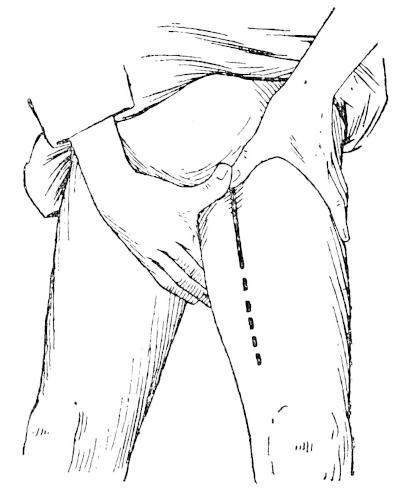
Fig. 3.—Method of Compressing the Main Artery of the Thigh.
To twist a vessel, seize the bleeding point between the blades of the artery forceps, then, by twisting the instrument round three or four times, the vessel will become blocked or closed, and the forceps may be taken off in the course of ten minutes. The other method is to tie the vessel with a silk ligature (previously boiled), making a reef or sailor’s knot, to cut short the ends of the ligature, remove the forceps, and let the vessel fall back into the wound. In any case cleanse the wound, and dress in the manner previously described.
The traveller who has taken the trouble to learn something about the treatment of wounds and severe hæmorrhage will, before his journeys are ended, probably have opportunities of saving the life of a comrade by his skill. Nothing can be more distressing than to see a man die from a hæmorrhage which anyone who has studied the subject a little would be able to control in nine cases out of ten without much difficulty. I therefore earnestly urge all travellers to gain as practical a knowledge of this subject as is possible, before leaving a civilised country.
After-Treatment of Wounds.
A clean-cut wound, which has been completely closed and properly dressed, need not be dressed again until the fourth day; and the stitches need not be removed for seven days.
On the other hand, a ragged or dirty wound, or one in which it has been necessary to insert a piece of gauze for the purpose of drainage, should be syringed out and dressed daily from the first.
The important index to the state of a wound is the patient’s temperature. If, on the third day after the wound was first dressed, the temperature is normal, and subsequently remains so, the wound is probably healing well; but if the patient’s temperature is up to or beyond 100° F., and the part is painful, there is probably some inflammatory change going on in the wound. The dressings should be taken off, and the wound examined. If the surrounding skin is red and shiny, and the limb swollen and tender, some of the stitches should be taken out, and the wound well syringed with an antiseptic lotion. This, with a good purge, such as calomel or Epsom salts, will probably remove all signs of inflammation; but still the wound must be dressed daily. If, however, the temperature still remains high, 100° to 101° F., or more, and the patient is restless and light-headed, all the stitches should be taken out, the wound opened up, and hot fomentations, prepared with an antiseptic lotion, applied every four hours till the temperature comes down. Tonics of quinine and iron should be given.
Erysipelas.
Erysipelas is a diffusely-spreading inflammation of the skin, caused by the presence and activity of germs, which enter through a wounded surface. It is most frequently due to want of cleanliness in the treatment of wounds. Bright’s disease and gout predispose to this complaint.
Symptoms.—The disease begins with a vivid red blush, usually starting from a wound, and which has a great tendency to spread or to move from one part of the limb to another. The edge of the blush is sharply defined, and slightly raised above the surrounding skin; there is stiffness and heat in the part, with fever 103°-104° F., not varying much; rapid pulse, headache, loss of appetite, furred tongue and constipation.
Treatment.—Isolate the patient and administer a good purgative. Give twenty drops of tincture of steel, with five grains of quinine in two ounces of water. Light diet. Stimulants will be necessary. Local treatment: flour, starch, or zinc oxide may be used to dust over the part, or zinc ointment applied on lint. The healthy skin just beyond the advancing edge may be painted with tincture of iodine.
Cellulitis.—Occasionally the infection of the skin by the germs spreads to the tissue beneath, and is then called cellulitis, or phlegmonous erysipelas. In this condition there is more swelling than in simple erysipelas, and the skin is very boggy or doughy, and retains the imprint of a finger pressed upon it. The red blush is not so vivid, being darker and more purple, and there is no well-defined edge. If left untreated, the skin will break down and die, causing extensive destruction of the part.
Treatment.—General treatment the same as for erysipelas. Locally, several incisions, each at least one inch in length, should be made into the swollen tissue where it is most boggy, and right through the skin, care being taken to avoid the larger blood-vessels; then hot fomentations of boric acid (five grains to the ounce) or other antiseptic should be applied, every two or three hours, till the swelling has subsided. The important point in the treatment of swollen and inflamed parts following wounds, when accompanied by continued or rising high temperature, is to relieve tension by making free incisions. Some knowledge of the anatomy of the parts is essential before using the knife. In any case, incisions in the arm or leg should be made parallel to and not across the limb.
Blood-Poisoning.
If a poisoned wound is left without thorough local treatment, the poisons and germs contained in the tissues are taken up by the blood, and cause blood-poisoning. The symptoms of this condition are high temperature, delirium, headache, loss of appetite, vomiting, and occasionally bronchitis and pneumonia. Severe forms of blood-poisoning may lead to the formation of abscesses all over the body, with fatal result.
Treatment.—The general treatment is the same as that described for erysipelas. The local treatment is to thoroughly open up and disinfect the poisoned part.
Bruises.
A bruise should be treated by bathing with cold water, or the frequent application of wet cloths. The addition of Goulard water, gin, methylated spirits, eau de cologne, or vinegar, to the water, is beneficial.
Sprains.
The affected joint should be raised on pillows, and treated in the manner advised for bruises, but if seen immediately after the injury, firm strapping with adhesive plaster and bandaging of the part is often equally serviceable. If inflammation develops, warm fomentations will be found soothing, leeching may be necessary, and free purgation always has a good effect.
The troublesome stiffness which often remains is relieved by friction and kneading with the hand. To regain the use of the joint, it should be gently moved each day; this movement is less painful if it is performed with the joint in hot water.
Poisoned Wounds from Snakes, Animals, and Arrows, etc.
In cases of poisonous snake-bite, the marks of two fangs will usually be found.
Treatment.—Tie a piece of tape, bandage, or cord a couple of inches above the wound, i.e., between the wound and the body; tie another piece still nearer the body, say three inches from the first. Cut across the wound or wounds to encourage free bleeding.
(If a medical man is present, he may think fit to inject anti-venomous serum as an antidote to snake poison.)
Dissolve as much permanganate of potash as possible in about a teaspoonful of water, stirring well to hasten its solution. Inject about five drops of this underneath the skin, on either side of the cut, by means of a hypodermic syringe. Some of the solution may be injected into the wound itself, or even a crystal of the drug may be pressed into the cut, or part of a crushed tablet of the drug.
It is best to keep a small bottle of the strong solution of permanganate always ready.
Give spirits strong, that is, one tablespoonful to one of water; at least four such doses in the first hour. Ammonia may also be given.
If the patient is heavy and stupid, give two tablets of strychnine (one-hundredth of a grain in each) in half a wine-glassful of water, by the mouth; or dissolve two in twenty drops of water, and inject well beneath the skin into the muscles of the back. If there is no improvement within an hour, give two more tablets; and if necessary, one or two more in another hour.
After tying up a limb for a poisonous bite, there will be great pain if the ligatures have been applied tightly; the parts will swell, become very dusky, and if the ligatures are left on too long, the blood supply will be cut off, and the parts will die. Therefore, when the ligatures begin to cause much pain, loosen the one next the injured part for ten seconds, then tie again at or near the same place, and loosen the other one for a similar period, and then re-tie; repeat this about every fifteen minutes. In the course of two hours, both tapes may be taken off. The object of tying up is to prevent much of the poison getting into the system at once.
The first thing is to tie up tightly; next cut freely, and suck or squeeze out as much blood as possible, then treat with drugs.
(It is usually safe to suck a poisoned wound unless there are any abrasions or cracks in the mouth, tongue, gums, or lips, taking care to spit out the poison at once; but the mouth should be washed out immediately afterwards with a light purple solution of permanganate of potash.)
If the wounds are on the face, neck, or other spot which cannot be tied up, then it is best to cut out the part at once and wipe the wound well with the strong solution of permanganate.
In the treatment of snake-bite, pure carbolic acid, ordinary caustic, a red-hot wire, or even a burning stick may be applied to the wounds when permanganate of potash cannot be obtained. In some cases, where no other treatment is available, it is advisable to explode a pinch of gun-powder over the place of injury, or even to blow the parts away with one’s gun.
If a finger or toe is bitten by a snake which is certainly poisonous, and neither drugs nor fire are at hand, it would be best to amputate at once.
Wounds inflicted by poisoned arrows or other weapons, mad dogs, jackals, etc., should be treated in a similar manner to those caused by poisonous snakes.
Drowning.
Death from drowning usually occurs in from two to three minutes after submersion, although people have been revived after a period of five or six minutes under water.
In treating cases of apparent death from drowning, the points to be aimed at are:—
First and immediately, the restoration of the breathing.
Secondly, and after breathing is restored, the promotion of warmth and circulation.
1. To restore the breathing.
Roll the patient on to his face for a few seconds, placing one of his arms under the forehead; wipe away all weeds, mud, etc., from the mouth. (In this position water will more easily escape from the mouth, whilst at the same time the tongue will fall forward, and leave the entrance to the windpipe clear.)
Turn the patient on his back, on a flat surface, with the head a little higher than the feet.
Place a small hard pillow (or a rolled-up coat) under the shoulder-blades.
Draw the patient’s tongue forward, and keep it projecting beyond the lips.
Remove all tight clothing from about the patient’s neck and chest; also braces, belt, etc.
Kneel at the patient’s head, grasp his arms just above the elbows, draw them gently and steadily upwards above his head, and keep them stretched in that position for two seconds (Fig. 4). (By this means air is drawn into the lungs.)
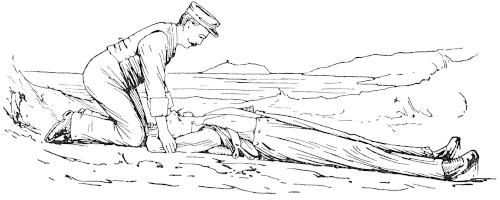
Fig. 4.
Reverse the movement, and press the patient’s arms gently but firmly against the sides of the chest, keeping them in this position for two seconds (Fig. 5). (By this means air is pressed out of the lungs.)
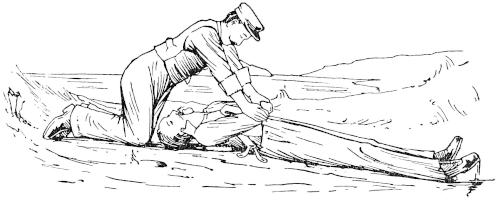
Fig. 5.
Repeat these movements alternately and regularly, about fifteen times a minute, until natural breathing takes place, or as long as there is any hope of saving the patient. It may be necessary to continue the movements for as long as an hour.
While these movements are being carried out the wet clothing may be removed, the body gently dried, and the patient wrapped up in dry blankets.
2. To promote warmth and circulation.
Rub the limbs and body vigorously with dry towels and flannels, always rubbing from the extremities towards the heart.
Apply hot-water bottles, hot flannels, or hot bricks to the feet, armpits, the pit of the stomach, and between the thighs.
Immediately the power of swallowing returns, administer hot coffee, spirits and warm water, etc.
Put the patient to bed between hot blankets as soon as possible.
Fractures.
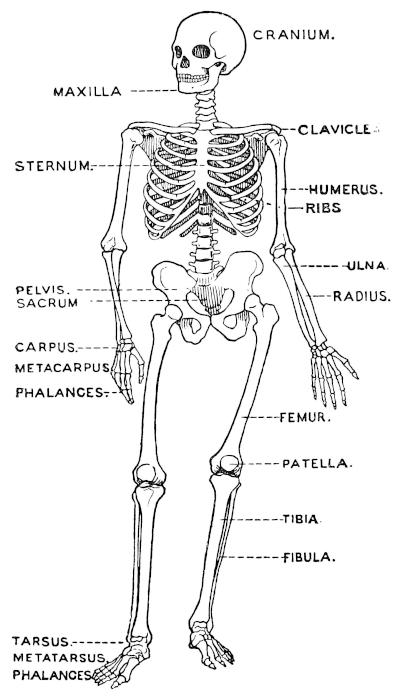
Fig. 6.—Diagram of the Human Skeleton, giving the Names and Positions of the Chief Bones.
A simple fracture is one in which, though the bone or bones are broken, the protecting skin is not broken.
A compound fracture is one in which the skin, etc., is broken or cut across, so that the fracture is more or less exposed to the air. The end of either fragment of the broken bone may protrude through the skin.
A comminuted fracture is one in which the bone is broken into several pieces; such a fracture may be either simple or compound.
In a simple fracture great gentleness should be used in handling the parts, so as not to convert it into a compound fracture; therefore, do not undress the part; rather cut away the clothing.
A fracture which is compound is usually serious, for dirt and germs are liable to be carried into the wound and cause great mischief; in gunshot wounds, dirt or pieces of clothing may be carried into the wound.
The signs of a fracture are, firstly, the patient’s own feelings, e.g., the pain which is caused on handling the part, sudden loss of power, and the sensation of grating. Secondly, on examination, most if not all of the following signs will be observed: inability of patient to move the part below the injury, swelling, unnatural movement below the site of fracture, alteration in appearance of the limb.
In fractures of the upper or lower limb there is usually shortening, the spasmodic action of the muscles causing the broken ends to ride over each other, and the greater the obliquity of the line of fracture the greater will be the shortening and alteration in appearance.
A sensation of grating is usually conveyed to the operator when he attempts to move the parts; sometimes this grating can be heard, as well as felt. Comparison of the injured with the sound limb is of the greatest importance in detecting fractures.
Treatment of Simple Fractures.
Directly a fracture of a limb is made out, a splint or splints of some kind should be applied to keep the parts fairly in position, and to prevent a broken end from being pushed through the skin. Cloths and bandages may be applied firmly round the injured part, and then extemporised splints, such as boards, straight sticks, umbrellas, or bayonets, should be applied and kept in position till the patient is in bed.
Splints suitable to the injury should be now made and well covered with wool, lint, or cloth, special care being taken to pad them well where they are likely to press upon bony prominences, such as the inner or outer ankle. The limb must next be straightened, and any deformity caused by overriding of the fragments must be remedied by steady pulling upon the parts above and below the fracture, in opposite directions, and the parts brought into good position by manipulating the bones at the seat of fracture. The prepared splints, extending well below and above the fracture, are then fitted to the limb with cotton-wool or lint, and secured by bandages.
If there is great swelling and tenderness of a limb, then it is advisable not to apply splints at once. Sand pillows should be made, or stockings nearly filled with sand and their mouths tied, and applied one on either side of the limb, to keep it absolutely still; the painful swelling may be reduced by applying ice or evaporating lotions. When the swelling is somewhat reduced, splints may be applied after proper manipulation.
Whilst the bandages should be firmly applied so as to keep the splints in position, they must not be bound too tightly, otherwise swelling and ulceration may be caused. If there is much pain and swelling after a fracture has been set, it will be necessary to loosen the bandages.
Union of the fractured bones is generally completed in about six weeks.
Collar-bones.—Fracture of the collar-bone should be treated by placing a large wedge-shaped pad (about six inches long, by three in thickness at the upper end) in the armpit, and securing it with tapes tied over the opposite shoulder. The elbow should then be brought forward, and raised and well supported by a broad triangular bandage or handkerchief, used as a sling, and with the ends tied over the opposite shoulder. A flannel or other bandage should then be wound round the chest, so as to secure the arm from accidental movements.
Ribs.—Fracture of the ribs may be treated by wrapping a flannel bandage round the chest pretty tightly, so as to limit the movements of breathing, which are very painful. The flannel should be secured by stitching, and the upper turns should be fixed by broad tapes passed over the shoulders and firmly stitched. Firm strapping of the side with adhesive plaster is still better. For this purpose about six strips of plaster one to two inches wide and eighteen inches long should be applied evenly round the side of the chest; each piece should be overlaid by the next piece above it for about half an inch. To secure rest for the affected side of the chest, the strapping should not only cover the broken bone, but should extend to about three inches above and below it, and should reach well beyond the middle line both in front and behind.
Upper Arm.—Fracture of the upper arm may be treated by the application of several narrow splints reaching from the armpit to the elbow, well padded, and supported in position by a bandage carried from the fingers to the armpit. Care must be taken that the splints on the inner side do not chafe the folds of the armpit. The hand and wrist should then be supported in a sling, but the elbow must be allowed to hang free.
Forearm.—Fractures of the forearm must be treated by two splints, each wider than the limb. The injured limb is allowed to hang down by the side, palm forwards. One splint reaching from the elbow to the finger-tips is applied to the back of the limb; the other is placed on the front, and only reaches from the bend of the elbow to the level of the ball of the thumb. The splints are secured temporarily by a couple of slip knots. Now bend the arm to a right angle, thumb uppermost, and bandage securely from the tips of the fingers up to the elbow.
Thigh.—Fractures of the thigh are serious; they require the patient to be kept in bed till union has been effected, and they are more likely to lead to shortening and permanent lameness if not very carefully treated, and the assistance of a skilled surgeon is urgently needed. A long splint is applied to the outside of the limb, reaching from the armpit to beyond the foot, and secured above by a bandage passing round the body, whilst the foot and leg are firmly bandaged to it below.
Leg.—Fractures of the leg should be treated by applying a splint on each side, long enough to reach from the knee to a little below the sole of the foot. They should be carefully applied with bandages, keeping the great toe in a line with the inner border of the knee-cap. When the accident occurs in the open air, the injured limb should be tied to the sound one, till the patient is brought to a place of security, the toes being prevented from pointing inwards.
Lower Jaw.—Manipulate the parts into their normal position and mould a splint of gutta percha, or other material, as accurately as possible to the lower jaw. If a tooth is loose and prevents the two jaws meeting properly it should be taken out.
Apply the splint and keep it in position by a bandage, which should be split at the chin so as to encircle the point of the jaw; the ends of the bandage are also split as far forward as the angle of the jaw; two ends are tied behind the neck and two over the top of the head, as in the diagram, and these tied ends should be united by a bandage or tapes to keep them in position (Fig. 8).
In the absence of suitable material for making a splint, this bandage alone will have to suffice.
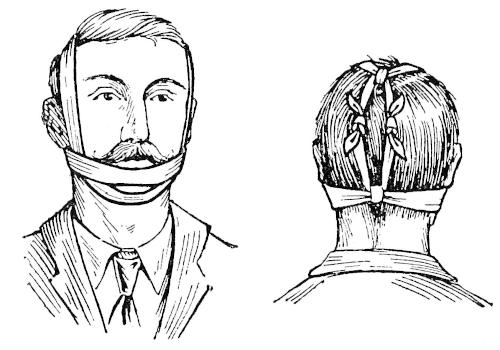
Fig. 7. Fig. 8.
The patient must be fed on slops through a tube passed behind the teeth, or through a passage resulting from the loss of a tooth.
Compound Fractures.—Clean up thoroughly as described in the treatment of wounds. Wash out with an antiseptic solution, dust with iodoform, apply an antiseptic pad. Set the limb in such a manner that the wound can be dressed daily without interfering with the splints.
If the bone is protruding through the wound, it must, if possible, be got back into position. If this cannot be done it may be necessary to saw off the end of the bone to enable the wound to be closed.
If the wound is large, deep, or dirty, it should be stuffed with antiseptic gauze so that free drainage may be allowed, and the gauze should be changed each day.
After-treatment of Fractures.—Gentle movements may be cautiously begun, in the joints above and below the injury, in about three weeks. While these are being carried out, the limb must be firmly supported to avoid interfering with the healing processes going on between the ends of the bones.
Dislocations.
Dislocations nearly always require skilled aid to reduce them.
Shoulder-joint.—Patient cannot raise the arm to his head or perform any other shoulder movements freely. The shoulder is flattened, the elbow sticks out, and the limb is usually lengthened.