Chapter XIV · : Folk Lore
Reading edition
I. The Ram with the Golden Fleece
Once upon a time when a certain hunter went to the mountains to hunt, there came toward him a ram with golden fleece. The hunter took his rifle to shoot it, but the ram rushed at him and, before he could fire, pierced him with its horns and he fell dead. A few days later some of his friends found his body; they knew not who had killed him and they took the body home and interred it. The hunter’s wife hung up the rifle on the wall in her cottage, and when her son grew up he begged his mother to let him take it and go hunting. She, however, would not consent, saying: “You must never ask me again to give you that rifle! It did not save your father’s life, and do you wish that it should be the cause of your death?”
One day, however, the youth took the rifle secretly and went out into the forest to hunt. Very soon the same ram rushed out of a thicket and said: “I killed your father; now it is your turn!” This frightened the youth, and ejaculating: “God help me!” he pressed the trigger of his rifle and, lo! the ram fell dead.
The youth was exceedingly glad to have killed the golden-fleeced ram, for there was not another like it throughout the land. He took off its skin and carried the fleece home, feeling very proud of his prowess. By and by the news spread over the country till it reached the Court, and the king ordered the young hunter to bring him the ram’s skin, so that he might see what kind of beasts were to be found in his forests. When the youth brought the skin to the king, the latter said to him: “Ask whatever you like for this skin, and I will give you what you ask!” But the youth answered: “I would not sell it for anything.”
It happened that the prime minister was an uncle of the young hunter, but he was not his friend; on the contrary, he was his greatest enemy. So he said to the king: “As he does not wish to sell you the skin, set him something to do which is surely impossible!” The king called the youth back and ordered him to plant a vineyard and to bring him, in seven days’ time, some new wine from it. The youth began to weep and implored that he might be excused from such an impossible task; but the king insisted, saying: “If you do not obey me within seven days, your head shall be cut off!”
The Youth finds a Friend
Still weeping, the youth went home and told his mother all about his audience with the king, and she answered: “Did I not tell you, my son, that that rifle would cost you your life?” In deep sorrow and bewilderment the youth went out of the village and walked a long way into the wood. Suddenly a girl appeared before him and asked: “Why do you weep, my brother?” And he answered, somewhat angrily: “Go your way! You cannot help me!” He then went on, but the maiden followed him, and again begged him to tell her the reason of his tears, “for perhaps,” she added, “I may, after all, be able to help you.” Then he stopped and said: “I will tell you, but I know that God alone can help me.” And then he told her all that had happened to him, and about the task he had been set to do. When she heard the story, she said: “Do not fear, my brother, but go and ask the king to say exactly where he would like the vineyard planted, and then have it dug in perfectly straight lines. Next you must go and take a bag with a sprig of basil in it, and lie down to sleep in the place where the vineyard is to be, and in seven days you will see that there are ripe grapes.”
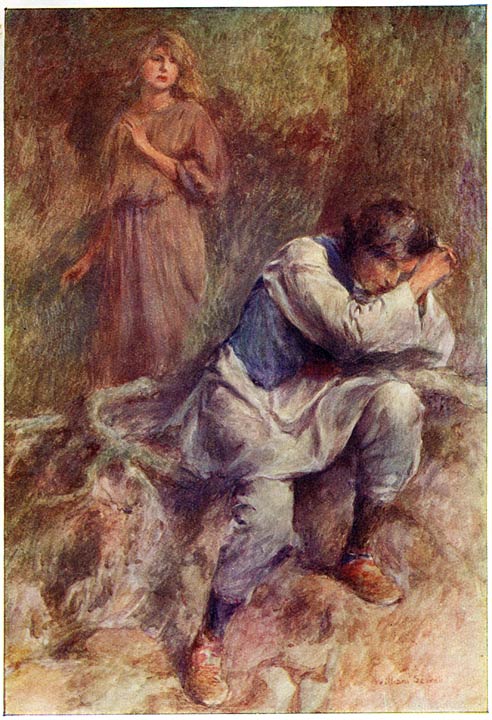
“Why do you weep, my brother?”
He returned home and told his mother how he had met a maiden who had told him to do a ridiculous thing. His mother, however, said earnestly: “Go, go, my son, do as the maiden bade; you cannot be in a worse case anyhow.” So he went to the king as the girl had directed him, and the king gratified his wish. However, he was still very sad when he went to lie down in the indicated place with his sprig of basil.
When he awoke next morning he saw that the vines were already planted; on the second morning they were clothed with leaves; and, by the seventh day, they bore ripe grapes. Notwithstanding the girl’s promise the youth was surprised to find ripe grapes at a time of year when they were nowhere to be found; but he gathered them, made wine, and taking a basketful of the ripe fruit with him, went to the king.
The Second Task
When he reached the palace, the king and the whole court were amazed. The prime minister said: “We must order him to do something absolutely impossible!” and advised the king to command the youth to build a castle of elephants’ tusks.
Upon hearing this cruel order the youth went home weeping and told his mother what had transpired, adding: “This, my mother, is utterly impossible!” But the mother again advised him, and said: “Go, my son, beyond the village; may be you will again meet that maiden!”
The youth obeyed, and, indeed, as soon as he came to the place where he had found the girl before, she appeared before him and said: “You are again sad and tearful, my brother!” And he began to complain of the second impossible task which the king had set him to perform. Hearing this, the girl said: “This will also be easy; but first go to the king and ask him to give you a ship with three hundred barrels of wine and as many kegs of brandy, and also twenty carpenters. Then, when you arrive at such and such a place, which you will find between two mountains, dam the water there, and pour into it all the wine and brandy. Elephants will come down to that spot to drink water, and will get drunk and fall on the ground. Then your carpenters must at once cut off their tusks, and carry them to the place where the king wishes his castle to be built. There you may all lie down to sleep, and within seven days the castle will be ready.”
When the youth heard this, he hurried home, and told his mother all about the plan of the maiden. The mother was quite confident, and counselled her son to do everything as directed by the maiden. So he went to the king and asked him for the ship, the three hundred barrels of wine and brandy, as well as the twenty carpenters; and the king gave him all he wanted. Next he went where the girl had told him, and did everything she had advised. Indeed, the elephants came as was expected, drank, and then duly fell down intoxicated. The carpenters cut off the innumerable tusks, took them to the chosen place, and began building, and in seven days the castle was ready. When the king saw this, he was again amazed, and said to his prime minister: “Now what shall I do with him? He is not an ordinary youth! God alone knows who he is!” Thereupon the officer answered: “Give him one more order, and if he executes it successfully, he will prove that he is a supernatural being.”
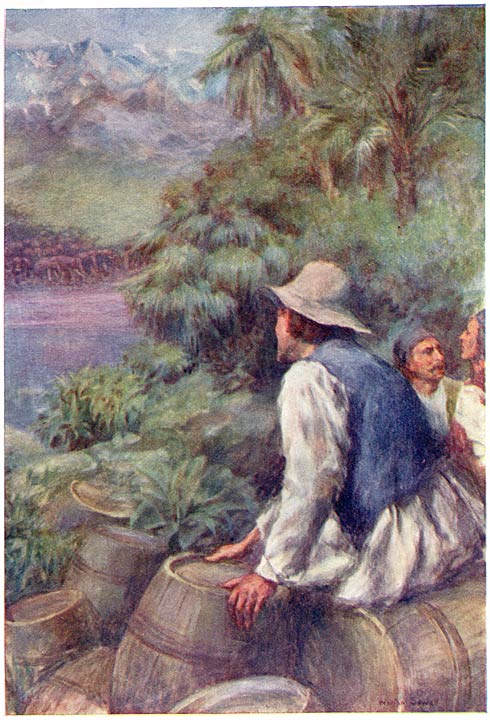
The elephants came as was expected
The Third Task
Thus he again advised the king, who called the youth and said to him: “I command you to go and bring me the princess of a certain kingdom, who is living in such and such a castle. If you do not bring her to me, you will surely lose your life!” When the youth heard this, he went straight to his mother and told her of this new task; whereupon the mother advised him to seek his girl friend once more. He hurried to where beyond the village he had met the girl before, and as he came to the spot she reappeared. She listened intently to the youth’s account of his last visit to the court, and then said: “Go and ask the king to give you a galley; in the galley there must be made twenty shops with different merchandise in each; in each shop there must, also, be a handsome youth to sell the wares. On your voyage you will meet a man who carries an eagle; you must buy his eagle and pay for it whatever price he may ask. Then you will meet a second man, in a boat carrying in his net a carp with golden scales; you must buy the carp at any cost. The third man whom you will meet, will be carrying a dove, which you must also buy. Then you must take a feather from the eagle’s tail, a scale from the carp, and a feather from the left wing of the dove, and give the creatures their freedom. When you reach that distant kingdom and are near the castle in which the princess resides, you must open all shops and order each youth to stand at his door. And the girls who come down to the shore to fetch water are sure to say that no one ever saw a ship loaded with such wonderful and beautiful things in their town before; and then they will go and spread the news all over the place. The news will reach the ears of the princess, who will at once ask her father’s permission to go and visit the galley. When she comes on board with her ladies-in-waiting, you must lead the party from one shop to another, and bring out and exhibit before her all the finest merchandise you have; thus divert her and keep her on board your galley until evening, then you must suddenly set sail; for by that time it will be so dark that your departure will be unnoticed. The princess will have a favourite bird on her shoulder, and, when she perceives that the galley is sailing off, she will turn the bird loose and it will fly to the palace with a message to her father of what has befallen her. When you see that the bird has flown you must burn the eagle’s feather; the eagle will appear, and, when you command it to catch the bird, it will instantly do so. Next, the princess will throw a pebble into the sea, and the galley will immediately be still. Upon this you must burn the scale of the carp at once; the carp will come to you and you must instruct it to find the pebble and swallow it. As soon as this is done, the galley will sail on again. Then you will proceed in peace for a while; but, when you reach a certain spot between two mountains, your galley will be suddenly petrified and you will be greatly alarmed. The princess will then order you to bring her some water of life, whereupon you must burn the feather of the dove, and when the bird appears you must give it a small flask in which it will bring you the elixir, after which your galley will sail on again and you will arrive home with the princess without further adventure.”
The youth returned to his mother and she advised him to do as the girl counselled him. So he went to the king and asked for all that was necessary for his undertaking, and the king again gave him all he asked for.
On his voyage everything was accomplished as the girl had foretold, and he succeeded in bringing home the princess in triumph. The king and his prime minister from the balcony of the palace saw the galley returning, and the prime minister said: “Now you really must have him killed as soon as he lands; otherwise you will never be able to get rid of him!”
When the galley reached the port, the princess first came ashore with her ladies-in-waiting; then the handsome young men who had sold the wares, and finally the youth himself. The king had ordered an executioner to be in readiness, and as soon as the youth stepped on shore he was seized by the king’s servants and his head was chopped off.
It was the king’s intention to espouse the beautiful princess, and, as soon as he saw her, he approached her with compliments and flattery. But the princess would not listen to his honeyed words; she turned away and asked: “Where is my captor, who did so much for me?” And, when she saw that his head had been cut off, she immediately took the small flask and poured some of its contents over the body and, lo! the youth arose in perfect health. When the king and his minister saw this marvellous thing, the latter said: “This young man must now be wiser than ever, for was he not dead, and has he not returned to life?” Whereupon the king, desirous of knowing if it were true that one who has been dead knows all things when he returns to life, ordered the executioner to chop off his head, that the princess might bring him to life again by the power of her wonderful water of life.
But, when the king’s head was off, the princess would not hear of restoring him to life, but immediately wrote to her father, telling him of her love for the youth and declaring her wish to marry him, and described to her father all that had happened. Her father replied, saying that he approved of his daughter’s choice, and he issued a proclamation which stated that, unless the people would elect the youth to be their ruler, he would declare war against them. The men of that country immediately recognized that this would be only just, and so the youth became king, wedded the fair princess, and gave large estates and titles to all the handsome youths who had helped him on his expedition.
Once upon a time there lived a tsar, who had three sons and one daughter. The latter was kept in a cage by her father, for he loved her as he loved his own eyes. When the girl grew up she begged her father’s permission to go out one evening with her brothers, and the tsar granted her wish. No sooner had she left the palace than a dragon flew down, seized the princess and, despite her brothers, disappeared with her into the clouds. The princes hastened to tell their father what had happened, and they implored him to let them go in search of their sister.
Thereupon their unhappy father gave each of them a horse and other necessary equipment for a long journey, and they started out upon their quest. After journeying a long way, they sighted in the distance a pavilion, which was neither in the sky nor on the earth, but was hanging midway between. When they came underneath this, it occurred to them that their sister might be hidden in it, and they began to consider how best they might reach it. Finally they decided that one of them must kill his horse, cut its hide into strips, make a thong, and, fastening one end to an arrow, shoot it from the bow so strongly that it should strike deeply into the framework of the pavilion, thus making a way up which they could climb.
The two younger brothers proposed to the eldest that he should kill his horse, but he refused. Neither would the second brother consent to do so; then the youngest brother, seeing that it could not be helped, killed his horse, made its hide into a lengthy thong, fixed one end to his arrow, and shot straight up to the pavilion, where the arrow stuck firmly.
Next they had to discuss who should climb up the thong; again the two elder brothers refused, so it fell to the youngest to perform this exploit. Being very agile, he soon reached the pavilion; wandering from one room to another, he finally came to an apartment where, to his great joy, he saw his sister sitting with the sleeping dragon’s head on her knee. When the princess beheld her brother, she feared exceedingly for his life, and implored him to escape before the dragon awoke.
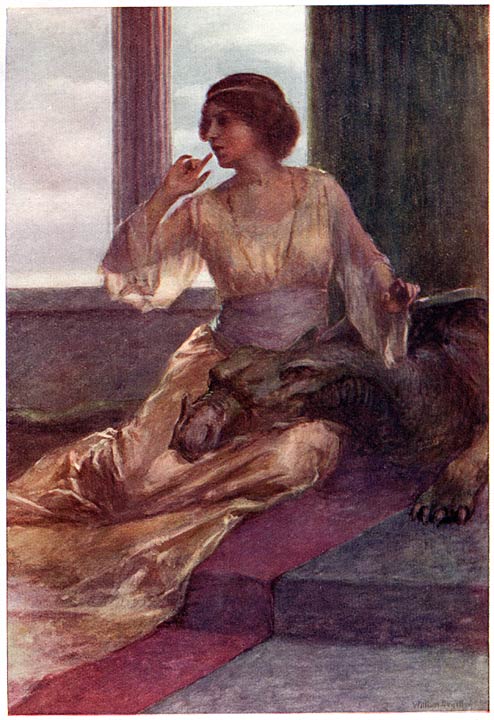
Sitting with the sleeping dragon’s head on her knee
The Prince slays the Dragon
The courageous youth, however, would not obey his sister, but seized his mace and struck the dragon on the head. The monster pointed with one of his claws to the place where he had been struck and said to the maiden: “Something bit me here!” Again the prince raised his mace and delivered a blow upon the monster’s head; but the dragon apparently did not mind, for he pointed again indifferently to the place, saying: “Again something has bitten me!”
The young prince was on the point of striking the third time, when his sister pointed to a spot where only the dragon might receive a mortal wound, and directing his blow upon the place indicated, the dragon instantly succumbed. The princess at once freed herself of the dragon’s head, ran swiftly to kiss her brother, and then was eager to show him the different rooms.
First, she took him into a room in which stood a black steed fastened to a stall and decked with a saddle and harness adorned with pure silver. Next she led him into a second room, where they found a white horse, also ready to be mounted, but its harness was of pure gold. Then she took him into a third room, where was a beautiful Arab steed whose saddle, stirrups and bridle were studded with precious stones.
The princess next conducted her brother to a chamber in which a maiden was sitting at a golden tambourette engaged in embroidering with golden threads. From thence she led him into a second apartment where a girl was spinning gold threads. At last they entered a third room in which a maiden sat threading pearls, and before her, upon a golden plate, was a golden hen with its chickens, sorting the pearls.
Having satisfied his curiosity, the prince returned to the room where he had left the dead dragon, and threw the carcass down to earth; and at the mere sight of the dragon’s body the two brothers were terrified out of their wits. Next the prince slowly let down his sister, and, after her, the three maidens, together with their work. While he was thus engaged he shouted to his brothers and made gestures indicating to whom each of the girls should belong. He reserved for himself the one who had been threading pearls, not forgetting the golden hen and the chickens.
The Perfidy of the Brothers
His brothers, envying the heroism of the young prince and jealous of his successful exploits, were now guilty of a dastardly trick; they cut the thong in order that he might not be able to reach the earth, and taking their sister with all the booty they hurriedly decamped.
On the way home the princes met a shepherd watching his sheep, and they prevailed upon him to disguise himself and to impersonate their youngest brother, ordering their sister and the three maidens to keep strictly their secret.
Some time elapsed, and one day the youngest prince had tidings that his brothers and the disguised shepherd were on the point of marrying the three maidens. This information seems to have been singularly complete, for on the day of his eldest brother’s wedding, mounted on the black steed, he flew down and alighted in front of the church. There he awaited the moment for the procession to come out, and, as his brother was preparing to mount his horse, he approached him swiftly, raised his club and struck him a heavy blow so that he fell instantly. The young prince then remounted the black horse and was instantly transported to the mysterious pavilion.
On the wedding-day of his second brother the feat, this time on the white horse, was repeated, none guessing who the strange aggressor was.
Next came the turn of the shepherd. On the day of his wedding with the third maiden, the young prince, mounted on the Arab, alighted in the churchyard just at the moment when the wedding procession started to return. This time he struck the bridegroom on the head so heavily that he fell dead. The guests hurriedly alighted from their horses and surrounded the prince, who made no attempt to escape, but revealed himself as the third son of their tsar. He told them that the pretended prince, whom he had just sent to the other world, was but a common shepherd, and that his brothers, out of envy, had caused him to remain in the magic pavilion where he had discovered his sister and killed the dragon. All that he said was immediately confirmed by his sister and the three maidens. When the tsar heard this he was very angry with his two elder sons, and drove them for ever from his palace. But as for his valiant youngest son, he united him to the third maiden and left him the crown and all he possessed when he died.
III. Pepelyouga
On a high pasture land, near by an immense precipice, some maidens were occupied in spinning and attending to their grazing cattle, when an old strange-looking man with a white beard reaching down to his girdle approached, and said: “O fair maidens, beware of the abyss, for if one of you should drop her spindle down the cliff, her mother would be turned into a cow that very moment!”
So saying the aged man disappeared, and the girls, bewildered by his words, and discussing the strange incident, approached near to the ravine which had suddenly become interesting to them. They peered curiously over the edge, as though expecting to see some unaccustomed sight, when suddenly the most beautiful of the maidens let her spindle drop from her hand, and ere she could recover it, it was bounding from rock to rock into the depths beneath. When she returned home that evening she found her worst fears realized, for her mother stood before the door transformed into a cow.
A short time later her father married again. His new wife was a widow, and brought a daughter of her own into her new home. This girl was not particularly well-favoured, and her mother immediately began to hate her stepdaughter because of the latter’s good looks. She forebade her henceforth to wash her face, to comb her hair or to change her clothes, and in every way she could think of she sought to make her miserable.
One morning she gave her a bag filled with hemp, saying: “If you do not spin this and make a fine top of it by to-night, you need not return home, for I intend to kill you.”
The poor girl, deeply dejected, walked behind the cattle, industriously spinning as she went, but by noon when the cattle lay down in the shade to rest, she observed that she had made but little progress and she began to weep bitterly.
Now, her mother was driven daily to pasture with the other cows, and seeing her daughter’s tears she drew near and asked why she wept, whereupon the maiden told her all. Then the cow comforted her daughter, saying: “My darling child, be consoled! Let me take the hemp into my mouth and chew it; through my ear a thread will come out. You must take the end of this and wind it into a top.” So this was done; the hemp was soon spun, and when the girl gave it to her stepmother that evening, she was greatly surprised.
Next morning the woman roughly ordered the maiden to spin a still larger bag of hemp, and as the girl, thanks to her mother, spun and wound it all her stepmother, on the following day, gave her twice the quantity to spin. Nevertheless, the girl brought home at night even that unusually large quantity well spun, and her stepmother concluded that the poor girl was not spinning alone, but that other maidens, her friends, were giving her help. Therefore she, next morning, sent her own daughter to spy upon the poor girl and to report what she saw. The girl soon noticed that the cow helped the poor orphan by chewing the hemp, while she drew the thread and wound it on a top, and she ran back home and informed her mother of what she had seen. Upon this, the stepmother insisted that her husband should order that particular cow to be slaughtered. Her husband at first hesitated, but as his wife urged him more and more, he finally decided to do as she wished.
The Promise
On learning what had been decided, the stepdaughter wept more than ever, and when her mother asked what was the matter, she told her tearfully all that had been arranged. Thereupon the cow said to her daughter: “Wipe away your tears, and do not cry any more. When they slaughter me, you must take great care not to eat any of the meat, but after the repast, carefully collect my bones and inter them behind the house under a certain stone; then, should you ever be in need of help, come to my grave and there you will find it.”
The cow was killed, and when the meat was served the poor girl declined to eat of it, pretending that she had no appetite; after the meal she gathered with great care all the bones and buried them on the spot indicated by her mother.
Now, the name of the maiden was ‘Marra,’ but, as she had to do the roughest work of the house, such as carrying water, washing and sweeping, she was called by her stepmother and stepsister ‘Pepelyouga’ (Cinderella). One Sunday, when the stepmother and her daughter had dressed themselves for church, the woman spread about the house the contents of a basketful of millet, and said: “Listen, Pepelyouga; if you do not gather up all this millet and have dinner ready by the time we return from church, I will kill you!”
When they had gone, the poor girl began to weep, reflecting, “As to the dinner I can easily prepare it, but how can I possibly gather up all this millet?” But that very moment she recalled the words of the cow, that, if she ever should be struck by misfortune, she need but walk to the grave behind the house, when she would find instant help there. Immediately she ran out, and, when she approached the grave, lo! a chest was lying on the grave wide open, and inside were beautiful dresses and everything necessary for a lady’s toilet. Two doves were sitting on the lid of the chest, and as the girl drew near, they said to her: “Marra, take from the chest the dress you like the best, clothe yourself and go to church; as to the millet and other work, we ourselves will attend to that and see that everything is in good order!”
Marra goes to Church
Marra needed no second invitation; she took the first silk dress she touched, made her toilet and went to church, where her entrance created quite a sensation. Everybody, men and women, greatly admired her beauty and her costly attire, but they were puzzled as to who she was, and whence she came. A prince happened to be in the church on that day, and he, too, admired the beautiful maiden.
Just before the service ended, the girl stole from the church, went hurriedly home, took off her beautiful clothes and placed them back in the chest, which instantly shut and became invisible. She then rushed to the kitchen, where she discovered that the dinner was quite ready, and that the millet was gathered into the basket. Soon the stepmother came back with her daughter and they were astounded to find the millet gathered up, dinner prepared, and everything else in order. A desire to learn the secret now began to torment the stepmother mightily.
Next Sunday everything happened as before, except that the girl found in the chest a silver dress, and that the prince felt a greater admiration for her, so much so that he was unable, even for a moment, to take his eyes from her.
On the third Sunday, the mother and daughter again prepared to go to church, and, having scattered the millet as before, she repeated her previous threats. As soon as they disappeared, the girl ran straight to her mother’s grave, where she found, as on the previous occasions, the open chest and the same two doves. This time she found a dress made of gold lace, and she hastily clad herself in it and went to church, where she was admired by all, even more than before. As for the tsar’s son, he had come with the intention not to let her this time out of his sight, but to follow and see whither she went. Accordingly, as the service drew near to its close, and the maiden withdrew quietly as before, the enamoured prince followed after her. Marra hurried along, for she had none too much time, and, as she went, one of her golden slippers came off, and she was too agitated to stop and pick it up. The prince, however, who had lost sight of the maiden, saw the slipper and put it in his pocket. Reaching home, Marra took off her golden dress, laid it in the chest, and rushed back to the house.
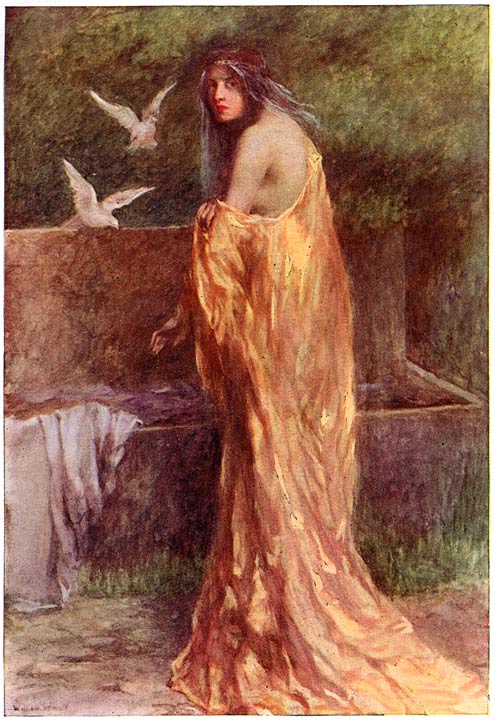
Marra took off her golden dress
The Prince’s Quest
The prince now resolved to go from house to house throughout his father’s realm in search of the owner of the slipper, inviting all fair maidens to try on the golden slipper. But, alas! his efforts seemed to be doomed to failure; for some girls the slipper was too long, for others too short, for others, again, too narrow. There was no one whom it would fit.
Wandering from door to door, the sad prince at length came to the house of Marra’s father. The stepmother was expecting him, and she had hidden her stepdaughter under a large trough in the courtyard. When the prince asked whether she had any daughters, the stepmother answered that she had but one, and she presented the girl to him. The prince requested the girl to try on the slipper, but, squeeze as she would, there was not room in it even for her toes! Thereupon the prince asked whether it was true that there were no other girls in the house, and the stepmother replied that indeed it was quite true.
That very moment a cock flew on to the trough and crowed out lustily: “Kook-oo-ryeh-koooo! Here she is under this very trough!”
The stepmother, enraged, exclaimed: “Sh——! Go away! May an eagle seize you and fly off with you!” The curiosity of the prince was aroused; he approached the trough, lifted it up, and, to his great surprise, there was the maiden whom he had seen thrice in church, clad in the very same golden dress she had last worn, and having only one golden slipper.
When the prince recognized the maiden he was overcome with joy. Quickly he tried the slipper on her dainty foot; it not only fitted her admirably, but it exactly matched the one she already wore on her left foot. He lifted her up tenderly and escorted her to his palace. Later he won her love, and they were happily married.
IV. Animals’ Language
The universality of folk-lore is curiously illustrated in the following tale which is strikingly like a story native to the negroes of Western Africa. In this the hero is granted, as a boon by the King of the Animals, the gift of understanding animal language; he is warned that if he divulges to any that he possesses this gift he will die on the instant; he is made rich by the possession of it; he laughs at a conversation between animals which he overhears; his wife demands to know the cause of his laughter. To this point the two stories are identical, but in the West African tale the man divulges the secret and pays the penalty with his life, whereas the Serbian conclusion is very much less tame, as will be seen.
A wealthy peasant had a shepherd, who served him for a great number of years most honestly and faithfully. One day, as he drove his sheep through a forest to the pasture, he heard a hissing sound, and wondered what it could be. Listening carefully he went nearer and nearer to the spot whence the sound came, and he saw that the forest was on fire and that the hissing proceeded from a snake that was surrounded by flames. The shepherd watched to see what the poor creature would do in its trouble: and when the snake saw the shepherd, it exclaimed from the midst of the flames: “O shepherd, I pray of you, save me from this fire!” Then the shepherd reached out his crook and the snake entwined itself swiftly round the stick, round his arm, on to his shoulders and round his neck.
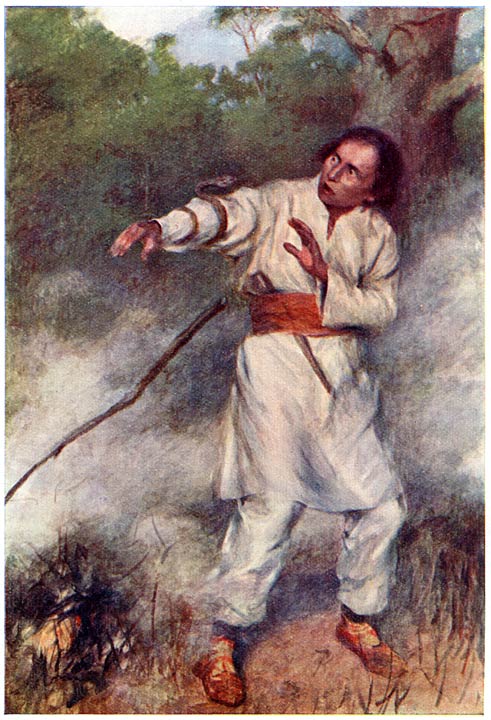
The snake entwined itself swiftly round his arm
When the shepherd realized what was happening he was seized with horror, and cried out: “What are you about to do, ungrateful creature! Did I save your life only to lose my own?” And the snake answered him: “Have no fear, my saviour! But take me to my father’s house! My father is the king of the snake-world.”
The shepherd endeavoured to move the snake to pity and prayed it to excuse him, for he could not leave his sheep. Thereupon the snake said to him: “Be comforted, my friend! Do not trouble about your sheep; nothing amiss will happen to them, but now do hasten to my father’s house!” So the shepherd went with the snake round his neck through the forest, till he came at length to a doorway constructed entirely of serpents. When they came near the gate, the shepherd’s guide hissed to its servants, whereupon all the snakes instantly untwined themselves, leaving a way open for the shepherd, who passed through unmolested. Then the snake said to its preserver: “When we come before my father he will surely give you, as reward for your kindness to me, whatever you may wish: gold, silver and precious stones; but you should not accept anything of that kind. I would advise you to ask for the language of animals. He will undoubtedly be opposed to your wish, but finally he will yield.”
They now entered the apartments of the king, who, with evident relief, inquired: “My son, where have you been all this time?” The reptile then told all about the fire in the forest and of the kindness of the shepherd, who had saved his life. At this the snake-king turned with emotion to the shepherd: “What reward can I give you for having saved the life of my son?” he said. The shepherd answered: “I desire nothing but the power of understanding and speaking the language of animals.” But the monarch said: “That is not for you, for if I give you that power, and you should impart the secret to another, you will instantly die. Therefore choose some other gift.” But the shepherd insisted: “If you wish to reward me, give me the language of animals: if you do not care to gratify my wish, no more need be said; I bid you farewell!” And indeed he turned to go, but the king, seeing his determination, stopped him, exclaiming: “Come here, my friend! Since you so strongly desire the language of animals, the gift shall not be withheld; open your mouth!” The shepherd obeyed, and the snake-king blew into his mouth, and said: “Now, blow into my mouth!” The shepherd did as he was told, and the snake-king blew a second time in the shepherd’s mouth, and then said: “Now you have the language of animals. Go in peace; but be sure not to impart your secret to another, else you will die that very moment!”
The shepherd took leave of his friends and as he returned through the woods he heard and understood everything the birds, plants and other living creatures were saying to each other. When he reached his flock and found all his sheep safe as had been promised, he lay on the grass to rest.
The Buried Treasure
Hardly had he settled himself, than two ravens alighted on a tree near by and began to converse: “If this shepherd knew what is under the spot where that black lamb is lying, he would surely dig in the earth; he would discover a cave full of silver and gold.”
The shepherd at once went to his master and told him of the buried treasure. The latter drove a cart to the place indicated, dug deeply in the earth and lo! he found a cave full of silver and gold, the contents of which he placed in his cart and carried home. This master was an honest and generous man, and he gave the entire treasure to his shepherd, saying: “Take this, my son; it was to you that God gave it! I would advise you to build a house, to marry and start some good business with this gold.”
The shepherd did as his kindly master advised him, and, little by little he multiplied his wealth and became the richest man, not only in his village, but in the whole district. He now hired his own shepherds, cattle-drivers and swineherds to keep his great property in good order. One day, just before Christmas, he said to his wife: “Prepare wine and food, for to-morrow we will go to our farms and feast our servants.” His wife did as he bade, and the next morning they went to their farms, and the master said to his men: “Now come one and all, eat and drink together; as for the sheep I will myself watch them to-night.”
So the kind man went to guard his sheep. About midnight, wolves began to howl and his dogs barked a defiance. Said the wolves in their own language to the dogs: “Can we come and kill the sheep? There will be enough for you also.” Thereupon the dogs answered in their own tongue: “O come by all means, we also would like to have a feast!” But amongst the dogs there was a very old one who had only two teeth left. That faithful animal barked furiously at the wolves: “To the devil with you all! So long as I have these two teeth, you shall not touch my master’s sheep!” And the master heard and understood every word they uttered. Next morning he ordered his servants to kill all his dogs, except the old one. The servants began to implore their master, saying: “Dear master, it is a pity to kill them!” But the master would not suffer any remonstrance, and sternly ordered: “Do as I bid you!” Then he and his wife mounted their horses and started for home, he on a horse and she on a mare. As they journeyed, the horse left the mare a little behind and he neighed, saying: “Hurry up, why do you dawdle behind?” And the mare answered: “Eh, it is not hard for you—you are carrying only your master, and I am carrying a despotic woman whose rules are a burden to the whole household.”
The Importunate Wife
Hearing this, the master turned his head and burst into laughter. His wife noticing his sudden mirth, spurred on her mare, and when she reached her husband she asked him why he had laughed. He answered: “There is no reason, I just laughed.” But the woman was not satisfied with this reply and would not give her husband any peace. He endeavoured in vain to excuse himself, saying: “Don’t keep on asking me; if I tell you the true reason why I laughed, I shall instantly die!” But she did not believe her husband, and the more he refused to tell her, the more she insisted that he should do so, until at last the poor man was worn out by her persistence.
Directly they arrived home, therefore, the man ordered a coffin to be made, and, when it was ready and he had it placed in front of the house-door, he said to his wife: “I shall lie down in this coffin, for the moment I tell you why I laughed, I shall die.” So he laid himself in the coffin, and as he took a last look around, he saw his faithful old dog, coming from the fields. The poor animal approached his master’s coffin and sat near his head howling with grief. When the master saw this, he requested his wife to give it food. The woman brought bread and gave it to the dog, who would not even look at it, still less eat it. The piece of bread attracted a cock, which came forward and began to peck at it; the dog reproached him saying: “You insatiable creature! You think of nothing but food, and you fail to see that our dear master is about to die!”
To this reprimand the cock retorted: “Let him die, since he is such a foolish man! I have a hundred wives, and I gather them all round a grain of corn, which I happen to find; and then, when they have all assembled, I swallow it myself! If any of them should protest, I just peck at them; but he, the fool, is not able to rule a single wife.”
At this the man jumped out of the coffin, took a stick and called to his wife: “Come in the house, wife, and I shall tell you why I laughed!”
Seeing the obvious intention of her husband, the woman begged him to desist, and promised that nevermore would she be curious, or try to pry into his affairs.
V. The Stepmother and her Stepdaughter
Once upon a time there was a girl who lived with her stepmother. The woman hated her stepdaughter exceedingly, because she was more beautiful than her own daughter, whom she had brought with her to the house. She did her utmost to turn the poor girl’s own father against her, and with such success that he soon began to scold and even to hate his own child.
One day the woman said to her husband: “We must send your daughter away. She must go into the world to seek her fortune!” And he answered: “How can we send the poor girl away? Where could she go alone?” But the wicked stepmother replied: “To-morrow you must take her far into the woods, leave her there and hurry home, or I will no longer live with you.”
The unfortunate father at length gave way, and said: “At least prepare the girl something for her journey, that she may not die of hunger.” The stepmother therefore made a cake, and gave it to the girl next morning as she was leaving the house. The man and his daughter trudged on until they were right in the depth of the woods, and then the father stole away and returned home.
The girl, alone in the woods, wandered all the rest of that day in search of a path, but could not find one. Meanwhile it grew darker and darker, and at length she climbed a tree, fearing lest some wild beast should devour her if she remained through the night on the ground. And indeed, all night long the wolves howled under the tree so ravenously that the poor girl, in her nervous terror, could hardly keep from falling.
Next morning she descended the tree and wandered on again in search of some way out, but the more she walked the denser grew the forest, and there seemed to be no end to it. When it grew dark again, she looked about for another suitable tree in the branches of which she might safely pass the night, but suddenly she noticed something shining through the darkness. She thought it might, perhaps, be a dwelling, and she went toward it. And indeed, she came soon to a large fine house, the doors of which were open. She entered, and saw many elegant rooms, in one of which was a large table with lights burning on it. She thought this must be the dwelling of brigands, but she had no fear at all, for she reasoned with herself: “Only rich people need fear robbers; I, a poor simple girl, have nothing to be afraid of; I shall tell them that I am ready to work for them gladly if they will give me something to eat.”
A Strange Dwelling
Suddenly she heard a loud growling, and she was terrified to see a lion coming toward her. The great beast waved his tail in such a friendly manner, and looked so very kind, however, that her courage revived, and she gave him a piece of her cake, which the lion ate; and then he began to lick her hand. This proof of gratitude reassured the girl completely, and she stroked the lion gently, and gave him more of the cake.
All at once the girl heard a great clashing of weapons, and nearly swooned as a creature in a bear-skin entered the room. The cock, the dog, the cat and the lion all ran to meet it, and frisked about it affectionately, showing many signs of pleasure and rejoicing. She, poor creature, did not think this strange being could be anything but cruel, and expected it would spring upon her and devour her. But the seeming monster threw the bear-skin from its head and shoulders, and at once the whole room gleamed with the magnificence of its golden garments. The girl almost lost her senses when she saw before her a handsome man of noble appearance. He approached her and said: “Do not fear! I am not a lawless man, I am the tsar’s son; and when I wish to hunt, I usually come here, disguised in this bear-skin, lest the people should recognize me. Save you, no one knows that I am a man; people think I am an apparition, and flee from me. No one dares to pass near this house, still less to enter it, for it is known that I dwell in it. You are the first who has ventured to come in; probably you knew that I was not a ghost?”
Thereupon the girl told the prince all about her wicked stepmother, and declared that she knew nothing of this dwelling or who lived in it. When the young prince heard her story, moved with indignation and pity, he said: “Your stepmother hated you, but God loved you. I love you very much, too, and if you feel you could return my love, I would like to marry you—will you be my wife?” “Yes,” replied the maiden.
Next morning the prince took the girl to his father’s palace and they were married. After some time the prince’s bride begged to be allowed to go and pay a visit to her father. The prince gladly allowed her to do as she wished, and donning a fine robe embroidered with gold she went to her old home. Her father happened to be absent, and her stepmother, seeing her coming, feared that she had come to revenge herself; therefore she hurried out to meet her, saying: “You see now that I sent you on the road of happiness?” The stepdaughter embraced the woman and kissed her; she also embraced her stepsister. Then she sat down to await her father’s return, but at length, as he did not come, she was compelled reluctantly to leave without seeing him. On going away she gave much money to her stepmother, nevertheless when she had got some distance from the house, the ungrateful woman steathily shook her fist at her, muttering: “Wait a little, you accursed creature, you shall certainly not be the only one so elegantly dressed; to-morrow I shall send my own daughter the same way!”
The Envy of the Stepmother
The husband did not return until late in the evening, when his wife met him, saying: “Listen, husband! I propose that my own daughter should be sent out into the world that she may also seek her fortune; for your girl came back to visit us to-day and lo! she was glittering in gold.” The man sighed and agreed.
Next morning the woman prepared for her daughter several cakes and some roast meat and sent her with the father into the forest. The unfortunate man guided her as he had led his own daughter, into the heart of the forest, and then stole off leaving her alone. When the girl saw that her father had disappeared she walked on slowly through the woods, till she came to the gates of the same house in which her stepsister had found happiness. She entered, closed the door and resolved not to open it for anybody. Then she took a cake out of her bag and began her meal. Meanwhile the cock, the dog and the cat came in, and began to frisk about her playfully expecting that she would give them something to eat, but she exclaimed angrily: “Get away, you ugly creatures! I have hardly enough for myself; I will not give you any!” Then she began to beat them; whereat the dog howled, and the lion, hearing his friend’s lamentation, rushed in furiously and killed the unkind girl.
Next morning the prince rode out with his wife to hunt. They came to the house, and saw what had happened, and when the princess recognized her stepsister’s dress, she gathered up the torn garment and carried it to her father’s house. This time she found her father at home, and he was indeed very happy to learn that his dear daughter was married to a handsome prince. When, however, he heard what had befallen his wife’s daughter he was sad indeed, and exclaimed: “Her mother has deserved this punishment from the hand of God, because she hated you without reason. She is at the well, I will go and tell her the sad news.”
When his wife heard what had happened, she said: “O husband! I cannot bear the sight of your daughter; let us kill both her and the tsar’s son! Do this thing or I will jump at once into the well.” The man indignantly answered: “Well then, jump! I shall not murder my own child!”
And the wicked woman said: “If you cannot kill her, I cannot bear to look at her!” Thereupon she jumped into the well and was killed.
VI. Justice and Injustice
Some time later the two brothers met by chance on a road, and the younger saluted the elder thus: “God help you, brother!” And the elder answered: “May God send you a misfortune! Why do you for ever mention the name of God to me? Injustice is better than justice.” Thereupon the good brother said: “I wager that injustice is not better than justice!”
So they laid as a wager one hundred tzechins and agreed to accept the decision of the first passer-by whom they should happen to meet. Riding on a little farther they met Satan, who had disguised himself as a monk, and they requested him to decide their contest. Satan immediately answered that injustice is better than justice; so the just brother lost one hundred tzechins. Then they made another wager in the same sum, and again a third; and each time the Devil—differently disguised on each occasion—pronounced for injustice. Finally the good brother lost even his horse; but he was quite unconvinced and he reflected: “Ah, well! I have lost all my tzechins, it is true, but I have still my eyes, and I shall wager my eyes this time.” So they made the bet once more, but the unjust brother did not even wait anybody’s arbitration, he took out his poniard and pierced his brother’s eyes, saying: “Now, let justice help you, when you have no eyes!”
The poor youth said to his cruel brother: “I have lost my eyes for the sake of God’s justice, but I pray you, my brother, give me a little water in a vessel that I may wash my wounds and take me under the pine-tree, near the spring!” The unjust brother did as he was asked and then departed.
The Healing Water
The unfortunate youth sat without moving until late in the night, when some veele came to the spring to bathe, and he heard one of them say to her sisters: “Do you know, O sisters, that the royal princess suffers from leprosy, and the king, her father, has consulted all the famous physicians, but no one can cure her? But if the king knew the healing qualities of this water, he would surely take a little and bathe his daughter with it, and she would recover perfect health.” When the cocks began to crow, the veele disappeared and the prince crept to the spring to test its wonderful properties. He bathed his eyes, and lo! his sight was instantly restored; then he filled his vessel with the water, and hurried to the king, whose daughter was suffering from leprosy. Arriving at the palace he told the officers on guard that he could cure the princess in a day and a night. The officers informed the king, who at once allowed him to try his method and the suffering princess was restored. This pleased the king so much that he gave the young prince half of his kingdom, as well as his daughter for his wife. So the just brother became the king’s son-in-law, and a Councillor of State.
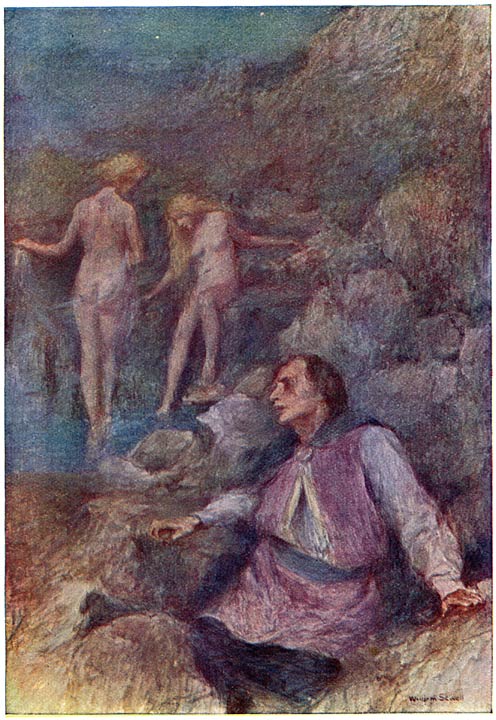
The veele came to the spring to bathe
The tidings of this great event spread all over the kingdom, and finally came to the ears of the unjust prince. He thought that his brother must have found his good fortune under the pine-tree, so he went there himself to try his luck. Arrived there, he pierced his own eyes. Late in the night, the veele came to bathe, and the prince heard them discuss with astonishment the recovery of the royal princess. “Some one must have spied upon us,” said one of them, “when we discussed about the qualities which this water possesses; perhaps somebody is watching us even now. Let us look around us!” When they came under the pine-tree, they found there the young man who had come seeking good fortune, and they immediately tore him into four.
And thus was the wicked prince recompensed for his injustice.
VII. He Who Asks Little Receives Much
Once upon a time there lived three brothers, who instead of much property had only a pear-tree. Each would watch that tree in turn, whilst the other two went away from home to work for hire. One night God sent His angel to see how the brothers lived, and, should they be in misery, to improve their position. The angel came disguised as a beggar, and when he found one of the brothers watching the tree, he went forward and asked him for a pear. The youth plucked some of the fruit from his own part of the tree, handed them to the beggar, and said: “Accept these pears from my share of the tree, but I cannot give you those belonging to my brothers.” The angel took the fruit, thanked the youth, and disappeared.
The next day it was the turn of the second brother to watch the fruit, and the angel, again in the semblance of a beggar, came and asked for a pear. This brother likewise gave from his own part of the tree, saying: “Take these, they are my own; but of those belonging to my brothers I dare not offer you.” The angel took the fruit gratefully and departed.
The third brother had a similar experience.
When the fourth day came, the angel disguised himself as a monk, and came very early so that he could find all three brothers at home, and he said to the youths: “Come with me, I shall improve your state of life,” whereupon they obeyed without question.
Soon they arrived at a river where the water was flowing in torrents, and the angel asked the eldest brother: “What would you like to have?” He answered: “I should like all this water to be changed into wine and to belong to me.” The angel made the sign of the cross with his stick, and lo! wine was flowing instead of water, and that very moment there appeared on the banks of the streamlet many barrels, and men filling them with wine; in one word, there was a whole village. Then the angel turned again to the young man and said: “Here is what you wished; farewell!” and he continued his journey with the others.
The three went on till they came to a field where they saw numbers of doves, and the angel asked the second brother: “Now, what is it that you would like?” And he answered: “I should like all these doves to be changed into sheep, and to be mine!” The angel again made the sign of the cross in the air, and lo! sheep instead of doves covered the field. Suddenly there appeared many dairies; maidens were busy milking the sheep, others pouring out the milk, others again making cream. There was also a slaughter-house, and men busy, some cutting the meat into joints, others weighing it, others again selling the meat and receiving the money for it. Then the angel said: “Here is all you wished for; farewell!”
The angel now proceeded with the youngest brother, and having crossed the field he asked him what he would like to have. The young man answered: “I should consider myself the happiest of men if God were graciously pleased to grant me a wife of pure Christian blood!” Thereupon the angel replied: “Oh, that is rather difficult to find; in the whole world there are but three such women, two of whom are married. The youngest is a maid, it is true, but she is already sought in marriage by two wooers.”
When the next morning dawned, lo! grapes hung in clusters on the vine dedicated to the poor man. So the tsar could not refuse his daughter to the youngest brother. After the marriage, the angel led the young couple to the forest, where he left them for a full year.
The Angel Returns
Then God sent again His angel, saying: “Go down to earth and see how those poor ones are living now: if they are in misery, it may be you will be able to improve their condition!” The angel obeyed immediately, and disguising himself again as a beggar, he went first to the eldest brother and asked him for a glass of wine. But the rich man refused, saying: “If I were to give every one a glass of wine, there would be none left for myself!” Upon this the angel made the sign of the cross with his stick, and the stream began instantly to flow with water as before. Then he turned to the man and said: “This was not for you; go back under the pear-tree and continue to guard it!”
Then the angel went on to the second brother, whose fields were covered with sheep, and asked him for a slice of cheese; but the rich man refused, saying: “If I were to give everybody a slice of cheese, there would be none left for myself!” Again the angel made the sign of the cross with his stick, and lo! all the sheep turned instantly into doves, who flew away. Then he said to the second brother: “Of a surety that was not for you, go under the pear-tree and watch it!”
Finally the angel went to the youngest brother in order to see how he was living, and found him with his wife in the forest, dwelling as a poor man in a hut. He begged to be admitted into their hut, and to pass the night there. They welcomed him very cordially, but they explained that they could not entertain him as well as they would like to do. “We are,” they added, “very poor people.” To which the angel answered: “Do not speak so, I shall be quite content with what you have!” They wondered then what to do, for there was no corn in their hut to make real bread; they usually ground the bark of certain trees and made bread from it. Such bread the wife now made for their guest, and placed it in the oven to bake. When she came later to inspect her baking, she was pleasantly surprised to find a fine loaf of real bread.
When the couple saw this wonder they lifted their hands toward heaven and gave thanks: “We thank thee, O God! that we are now able to entertain our guest!” After they had placed the bread before their guest, they brought a vessel of water, and lo! when they came to drink, they found it was wine.
Then the angel once more made the sign of the cross with his stick over the hut, and on that spot instantly rose a beautiful palace, containing an abundance of everything. Then the angel blessed the couple and disappeared. The modest and pious man and woman lived there happily ever after.
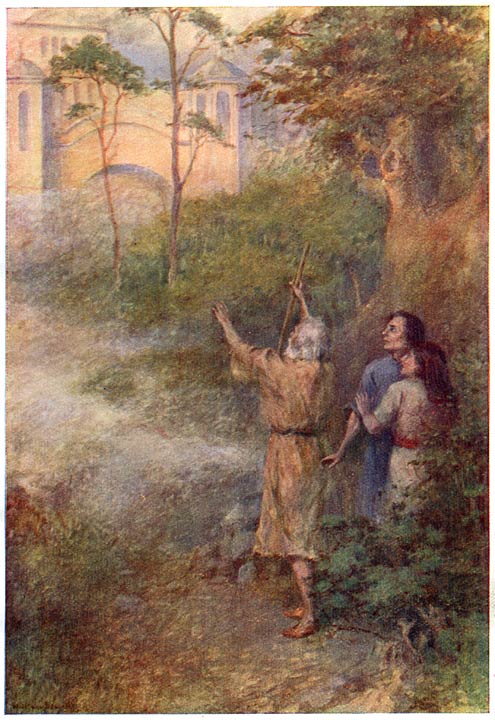
On that spot instantly rose a beautiful palace
VIII. Bash Tchelik or Real Steel
There lived once a tsar who had three sons and three daughters. When old age overtook him and the hour came for him to die he called his children to him, and desired his sons to give their sisters to the first wooers who might ask them in marriage. “Do as I tell you,” added the dying tsar, “or dread my curse!”
Shortly after the tsar had passed away there came one night a fearful knocking at the palace gate, so that the whole building shook, and a great roaring, screaming, and blowing was heard; it seemed as if the palace was assailed by some awful tempest. All the courtiers were seized with unspeakable fear, and suddenly a voice from outside was heard: “O princes, open the door!” Thereupon the eldest brother exclaimed: “Do not open!” The second brother added: “Do not open for anything!” But the youngest brother said: “I must open the door!” and he sprang to the door and flung it open. As he did so something came in, but the brothers could see only a bright light, out of which proceeded these urgent words: “I have come to ask your eldest sister in marriage, and to take her away this moment; for I have no time to lose, neither shall I come a second time to demand her! Answer quickly, will you give her or not? That is what I must know.”
The eldest brother answered: “I will not give her. I cannot see you, and do not know who you are or even whence you came. To-night is the first time I have heard your voice, and you insist upon taking my sister away at once. Should I not know where I could visit my sister sometimes?”
The second brother also said: “I will not consent that my sister should be taken away to-night!”
The moment the princess passed over the threshold every one in the palace fell to the ground in terror, so fearsome was the lightning and so loud the peals of thunder. The whole building shook as if about to fall. The storm, however, passed and daybreak came. That morning close search was made to see if any trace could be found of the strange visitant or the way it had gone; but, alas! all their efforts were vain.
The second night, about the same time, a similar noise was heard again round the palace, and a voice at the door exclaimed: “O princes, open the door!”
Seized with fear they dared not disobey. Then the pitiless voice spake again: “Give me your second sister; I have come to ask her in marriage!”
The eldest brother protested: “I will not consent!” The second brother said: “I will not give away our sister!” But the youngest brother was willing. “I will give her!” said he; “have you already forgotten what our father commanded at the hour of his death?”
Thereupon the youngest prince took his sister by the hand and presented her to the unseen visitor, saying: “Take her, may she be loyal and dutiful to you!” So the visitant departed with the princess, and next morning no trace of him could be found.
The third night at the same hour the earth quaked and the palace rocked on its foundations, so mighty was the tumult around it. And again a mysterious voice was heard from without. The princes opened the door, and the unseen presence entered and said: “I come to ask your youngest sister in marriage!” The two elder brothers exclaimed simultaneously: “We will not give our sister by night; we must know to whom we are giving her, so that we may visit her when we wish to do so!” But once more the youngest brother exclaimed: “I will give her, if you will not! Have you, then, forgotten what our father told us? It is not so very long ago!” So saying, he took the maiden and presented her to the invisible power, saying: “Take her with you! And may she bring you joy and happiness!”
The Princes set Out
Next morning the brothers debated the fate of their sisters, and sorrow filled their hearts. “Great Heaven!” they said, “what a mighty wonder! We know not what has befallen our sisters; neither do we know where they have gone nor whom they have married!” At length they decided to go in search of their beloved sisters, and making the necessary preparations for their journey they set out on the quest.
They journeyed for some time and then lost their way in a dense forest, in which they wandered for a whole day. When darkness fell, they agreed that they must pass the night at some place where they could find water, so when they came to a lake, they decided to pass the night there, and sat down to eat. When they were ready to compose themselves to sleep, the eldest proposed to his brothers that they should sleep while he kept guard. So the two younger brothers went to sleep, and the eldest watched.
About midnight the lake became agitated, and the watcher was seized with horror when he saw in the middle of it something moving straight toward him. As it came nearer, he saw clearly that it was a monstrous alligator with two huge ears. The monster attacked the prince with all its strength, but the gallant young man received it on the point of his sword and swiftly cleft its head asunder. Then he cut off the ears, placed them in his bag, but threw the carcass back into the lake. Soon after this, morning broke; but the two younger brothers slept quietly on, unconscious of their brother’s exploit.
In due time the prince awakened the young men and, without mentioning what had happened, he recommended that they should continue their journey. They travelled the whole day long and, having again lost their way in another dense forest, they decided to pass the coming night by a small lake, and they quickly made a fire. After they had eaten, the second brother said: “To-night you two sleep, and I shall watch.” And so the eldest and the youngest brothers slept, while the second kept guard.
Suddenly the water of the lake began to stir, and lo! an alligator with two heads appeared and rushed furiously upon the three brothers. But the second brother was no coward; he gave the monster a fearful blow with his gleaming sabre and the alligator fell dead. Then the prince cut off its four ears, placed them in his bag, and threw the horrible carcass into the lake. The two sleeping brothers knew nothing of all this and slept till sun-rise. Then the gallant prince exclaimed: “Get up, my brothers, it is high time!” And they instantly arose, and prepared to continue their journey, without knowing whither they should go.
A great fear seized their hearts when they found themselves in a horrible desert; they wandered in this for three long days, and, as their food was consumed, they feared now lest they should die of hunger in this strange land, which seemed to have no end. Then they addressed their fervent prayers to the Almighty that He might be pleased to afford them some guidance, and lo! they saw at length a large sheet of water. Great was now their joy, and they took counsel with each other and agreed to pass the night on the shores of that lake.
Having quenched their thirst, they made a bright fire, and when the hour for sleep approached, the youngest brother proposed: “To-night it is my turn; you two go to sleep and I shall watch!” So the two elder brothers went to sleep, and the youngest brother kept awake, looking sharply about him, often casting his eyes over the lake. Toward midnight he noticed a disturbance in the water, and as he looked in wonder the lake grew so agitated that a wave overflowed the shore and nearly extinguished the fire. The next moment a horrible alligator with three heads appeared and rushed furiously on the brothers, obviously intending to devour them. But the youngest prince was no less brave than his two brothers; he unsheathed his sword, and as the monster came on with jaws wide agape, he gave it three fearful blows in rapid succession, slashing off its three heads. Then he cut off the six ears and placed them in his bag, and threw the body and the heads back into the lake.
The Nine Giants
Meantime the fire had smouldered out, and having no materials with which to make a fresh fire, and not wishing to awake his brothers, the prince went a short distance into the desert in the hope of finding some fuel, but without success. He climbed upon a rock, and looking around he saw at length the glare of a fire. As it seemed that the fire was not very far off, he decided to go and get brands with which to relight his own fire. So he descended from the rock and hastening for some time through the desert, he came at last to a cave in which he saw nine giants sitting round a big fire and roasting on spits two men, one on each side. Upon the fire there stood a caldron full of the limbs of men.
When the prince saw all this, he was seized with horror, and would readily have gone back, but it was too late. So he saluted the giants thus: “Good evening, my comrades, I have been in search of you for a long time!” They welcomed him in a friendly manner and returned the greeting, saying: “May God favour you, since you are one of us!” The wily prince added: “Why, I shall remain one of your faithful friends for ever, and would give my life for your sake!” “Eh!” exclaimed the giants, “since you intend to join us, no doubt you are ready to eat man’s flesh, and to join our company when we go in search of prey?” Thereupon the tsar’s son answered: “Most decidedly! I shall do willingly everything that you, yourselves, do.” Hearing this the giants retorted: “That is well for you then! Come and sit here with us!” Then the whole company, sitting round the fire, and taking the meat out of the caldron, began to eat. The tsar’s son pretended to eat, but he deceived them cleverly, for instead of eating he threw the meat behind him.
After supper the giants exclaimed: “Now let us go to hunt, for we must have something to eat to-morrow!” So they started out, all nine of them, the prince being the tenth of the party. “Come with us,” said the giants to the prince, “we will go to a neighbouring city in which lives a tsar: for from that city we have been supplying ourselves with food for many years!” When they arrived at that place, the giants uprooted two fir-trees, and, reaching the walls of the city, they placed one tree against it and ordered the prince: “Go up to the top of the wall, and we will hand you the second tree, which you will fix on the other side of the wall, so that we can climb down the stem of it into the city.” The prince obeyed, and, when he was on the top of the wall, he said: “I do not know how to do it, I am not familiar with this place, and I cannot manage to throw the tree over the wall; please come up, one of you, and show me how to do it!” Thereupon one of the giants climbed up, took the top of the tree and threw the stem over the wall, holding fast the highest branch in his hands. The prince utilised this opportunity to draw his sword, and, unseen by those below, with one stroke he cut off the giant’s head, and pushed his body over the wall. Then he said to the others: “Now come up one by one, so that I can let you down into the city as I did our first comrade.” The giants, suspecting nothing, climbed up one after the other; and the prince cut off their heads till he had killed the whole nine. Then he slowly descended the pine-tree and reached the ground within the city walls.
Walking through the streets he was surprised to see no living soul there, and the whole city seemed to be deserted! So he reasoned to himself: “Those ugly giants must have annihilated all the inhabitants of this city!”
The Sleeping Princess
He continued wandering about till he saw at length a very tall tower, through one of the vent-holes of which shone a light. He opened the door and went straight to the room from which he judged the light to have come. It was magnificently decorated with gold and velvet, and lying on a resplendent couch, was a maiden sleeping. The girl was exceedingly beautiful, and as the prince devoured her with his eyes he was horrified to see a snake on the wall; it poised its hideous head with the obvious intention of striking the girl on her forehead between the eyes, but the prince rushed swiftly forward with drawn poniard and pierced the serpent’s head so that it was nailed to the wall, exclaiming as he did so: “May God grant that my poniard cannot be drawn out of the wall by any hand but mine!” He then hurried away, climbing the city wall by the same way as he had come. When he arrived at the giants’ cave, he took a brand from the fire, and hastened to the place where he had left his brothers, and found them still sleeping. He made a fresh fire, and, as meantime the sun had risen, he now awoke his brothers and they immediately continued their journey. That same day they came to a road which led to the city of which we have heard. It was the custom of the tsar who lived in that city to walk abroad every morning and to lament the great destruction of his people by the giants. His greatest anxiety was lest his only daughter would one day be their prey. On this particular morning he walked unusually early through the streets, which were all empty. After a time he came to a part of the city wall against which the tall pine-tree of the giants leaned. He approached closely and found the bodies of the nine giants, the terrible enemies of his people, lying upon the ground with their heads cut off. When the tsar saw this wonder he rejoiced exceedingly, and the people soon gathered around him and prayed that God might grant happiness and long life to the hero who had killed the giants. At that very moment servants came hurriedly from the palace and informed the tsar that a snake had very nearly caused the death of his daughter. Hearing this the tsar ran to his daughter, and entering her room he was amazed to see a large, hideous serpent nailed to the wall. He tried at once to pluck out the poniard, but was not able to do so.
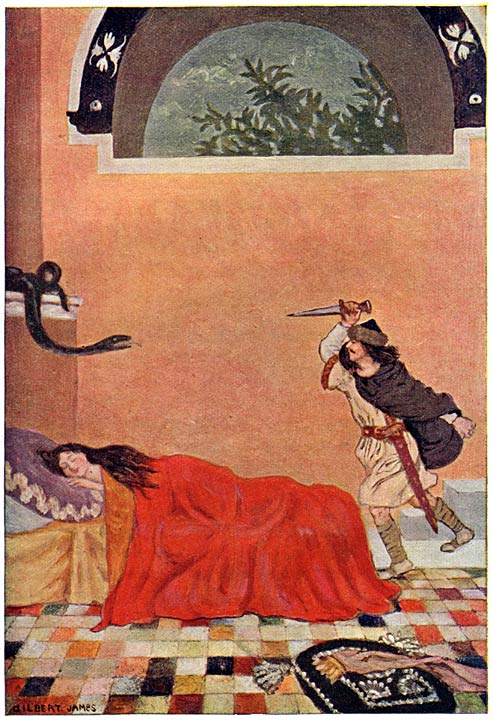
He was horrified to see a snake on the wall
Then the tsar issued a proclamation throughout his vast empire to the effect that if the hero who had killed the nine giants and pierced the snake would come to court he should receive great gifts and the hand of the tsar’s daughter in marriage. This proclamation spread quickly all over the land, and by the tsar’s orders, in every inn on the principal roads an official was stationed whose duty it was to ask every traveller if he had heard of the hero who had killed the nine giants. If any man should know anything about the matter, he was at once to come before the tsar and tell what he knew, and was to be rewarded. And the tsar’s commands were strictly carried out.
After some time the three princes in search of their sisters came to pass the night at one of the inns of that country, and, after supper, they began an animated conversation with the inn-keeper, in the course of which the witty host boasted of his exploits, and at length asked the princes: “Tell me now, what heroic deeds have you young men performed?”
Thereupon the eldest brother started thus: “When my brothers and I set out on our expedition in search of our sisters, we decided to pass the first night on the shores of a lake in the midst of a deserted forest. There I proposed that my brothers should go to sleep while I remained to keep watch. As soon as they fell asleep, a terrible alligator rose from the lake to devour my brothers, but I received it on the point of my sword and cleft its hideous head asunder: if you do not believe, here are the ears of the monster!” Saying this, the eldest brother took out of his bag the ears of the alligator and placed them on the table.
When the second brother heard this, he said: “And I was on guard, my brothers, while you were sleeping the second night; and from the lake appeared an alligator with two heads. I rushed at it with my sword and cut off both its heads: if you do not believe me, see! here are the four ears of the monster!” Saying this, he produced the ears from his bag and placed them on the table to the great astonishment of the listeners.
The Hero Found
But the youngest brother kept silent. And the inn-keeper asked him: “By my faith, young man, your brothers are veritable heroes, let us hear whether you have performed any heroic exploit?” Then the youngest brother began to relate: “I have also done a little. When we arrived at the shores of a lake on the third night in that desert to pass the night, you, my brothers, went to rest, and I remained awake to keep watch. About midnight, the lake was greatly agitated and an alligator with three heads rushed out with the intention of swallowing you, but I received it on the point of my sword and successfully cleft its three heads asunder: if you do not believe me, see! here are the six ears of the monster!” This astounded even his brothers, and the young man continued: “Meantime our fire was extinguished, and I went in search of fuel. Wandering over the desert, I came across nine giants ...” and so he proceeded to relate to them all his surprising deeds. When the story came to an end the inn-keeper hurried off and told everything to the tsar, who gave him money and ordered that the brothers should be brought to him. When they appeared the tsar asked the youngest prince: “Is it really you who have done all those wonders in my city, and saved the life of my only daughter?” “Yes, your Majesty!” answered the prince. Thereupon the tsar moved with great joy and gratitude, gave his daughter in marriage to the gallant prince and appointed him his prime minister. As to his brothers, the tsar said: “If you wish to remain with your brother, I shall find you wives and shall order castles to be built for you!” But the two princes thanked his Majesty and declared that they were already married and that they wished to continue their search for their lost sisters.
The tsar approved of this resolution, and having been supplied with two mules loaded with gold the two brothers said their farewells and departed. The youngest brother soon began to think of his three sisters; he would have been sorry to leave his wife to go in search of them, and in any case the tsar, his father-in-law, would not permit him to leave the court. Nevertheless the prince wasted away slowly in grief for his sisters.
One day the tsar went forth to hunt, and said to the prince: “Remain in the palace, and take these nine keys and keep them in your pocket. You can open three or four rooms with those keys, there you will find unbounded gold, silver and precious stones. In fact, if you wish to do so, you can open even the eight rooms, but do not dare to open the ninth. Ill indeed will be your fate if you do!”
Bash Tchelik
As soon as the tsar had left the palace, the young prince began to open the doors, one after the other, of all the eight rooms, and truly he saw much gold, silver and other precious things. At length he came to the ninth room, and reasoned to himself: “I have survived many extraordinary adventures, nothing ever surprised me; why should I now be afraid to venture into this room?” Saying this, he opened the door, and what do you think he saw there? In the middle of the room stood a strange man, whose legs were bound in iron up to the knees and his arms up to the elbows; in the four corners of the room there were chains fastened to thick beams, and all the chains met in a ring round the man’s neck, so that he could not make the slightest movement. In front of him was a fountain from which the water streamed through a golden pipe into a golden basin. Near him stood a golden mug, incrusted with precious stones. Despite his longing to drink the water, the man could not move to reach the mug. When the prince saw all this, he was indeed astounded, and drew back, but the man groaned: “For heaven’s sake, come to me!” The prince approached him and the man said: “Do a good deed! Give me now a cup of water, and know for certain, that I will reward you with another life!”
The prince thought within himself: “Is there anything better than to possess two lives?” So he took the mug, filled it with water, and handed it to the man, who drank eagerly. Then the prince asked him: “Tell me now, what is your name?” The man answered: “My name is Bash Tchelik (Real Steel).” The prince made a movement toward the door, but the man again implored him: “Give me another mug of water, and I shall give you a second life!” The prince thought: “Now, if he gives me a second life, I shall have, together with my own, three lives! This will be quite wonderful!” So he again filled the mug and handed it to the strange prisoner, who emptied it greedily. The prince turned toward the door, but the man exclaimed: “O hero, do not go! Come back a moment! Since you have done two good deeds, do yet a third, and I will give you a third life as reward. Take this mug, fill it with water, and pour it over my head!”
The prince had no desire to refuse; he filled the cup with water, and poured it over the man’s head. No sooner had he done this than Bash Tchelik broke the iron chains around his neck, jumped up with the speed of lightning, and, lo! he had wings. He rushed through the door before the surprised prince could make a movement, and, having snatched up the daughter of the tsar, the wife of his deliverer, he flew into the air and disappeared.
When the tsar returned from the hunt, his son-in-law told him all that had happened, and the tsar was indeed greatly saddened, and exclaimed: “Why did you do this? Did I not tell you not to open the ninth room?” The prince humbly answered: “Do not be angry, I shall go in search of Bash Tchelik, for I must fetch my wife.” But the tsar tried to dissuade him, saying: “Do not go, for anything in the world! You do not yet know this man; it cost me many an army before I succeeded in taking him prisoner. Remain in peace where you are, and I will find for you a still better wife than my daughter was, and rest assured that I shall continue to love you as my own son!” However, the young prince would not listen to his father-in-law’s advice, but took money for his travelling expenses, saddled a horse and went in search of Bash Tchelik.
The Prince finds his Sister
Some time later the young man came to a city. From the window of a castle a girl cried out: “O prince, alight from your charger and come into our courtyard!” The prince did as he was invited; the girl met him in the courtyard, and he was greatly astonished to recognize in her his eldest sister. They embraced and kissed each other, and his sister said: “Come within, my brother.” When they were inside, the prince asked his sister who her husband was, and she answered: “I have married the king of dragons, and he has sworn that he will kill my brothers the first time he comes across them. Therefore, I will hide you, and shall ask him first what he would do to you if you appeared. Should he declare that he would do you no harm, I would tell him of your presence.” So she hid both her brother and his horse. Toward evening the dragon flew home, and the whole castle shone. As soon as he entered, he called his wife: “My dear, there is a smell of human bones! Tell me at once who is here!” She answered: “There is nobody!” But the dragon added: “That cannot be!” Then his wife asked him: “Please answer truly, would you harm my brothers if one of them should come here to see me?” And the king of dragons said: “Your eldest and your second brother I would slaughter and roast, but your youngest brother I would not harm.” Then she said: “My youngest brother, and your brother-in-law, is here.” Thereupon the king said: “Let him come in.” And when the prince appeared, the king of dragons stretched forth his arms, embraced his brother-in-law, and said: “Welcome, O brother!” And the prince answered: “I hope you are well?” Then they related to each other all their adventures from beginning to end, and sat down to supper.
At length the prince told his brother-in-law that he was searching for Bash Tchelik, and the dragon advised him, saying, “Do not go any further! I will tell you all about him; the very day when he escaped from his prison, I met him with five thousand of my dragons, and, after a severe battle, he escaped victorious. So you see, there is slender hope for you, alone, to overpower him. Therefore I advise you, as a friend, to abandon your plan, and return home in peace; and if you are in need of money I will give you any amount of it.” But the prince answered: “I thank you very much for all your good wishes and advice, but I cannot do otherwise than go in search of Bash Tchelik!” And he thought: “Why should I not do so, since I have three superfluous lives?”
When the king of dragons saw that he could not dissuade the prince, he handed a feather he was wearing to him, and said: “Take this, and if you are ever in need of my help, you have only to burn it, and I will come at once to your aid with all my forces.” The prince thankfully took the feather and started once more in pursuit of Bash Tchelik.
The Second Sister
Wandering for some time he came at length to another city, and, as he was riding under the tower of a magnificent castle, a window opened and he heard a voice calling him: “Alight from your steed, O prince, and come into our courtyard!” The prince complied immediately, and when he entered the courtyard, he was greatly surprised to see his second sister, who threw herself into his arms, weeping for joy. Then she showed her brother into her private apartment, and he asked: “To whom are you married, sister dear?” And she answered: “My husband is the king of the eagles.” When the king returned home his loving wife welcomed him, but he exclaimed at once: “Who is the daring man now in my castle? Tell me directly!” She lied and said: “No one!” Then they began their supper, and the princess asked her husband: “Tell me truly, would you do any harm to my brothers if one of them should dare to come here to see me?” And the eagle-king answered: “As to your eldest and your second brother, I declare that I would kill them; but your third brother I would welcome and help as much as I could.” Then she took heart and told him: “Here is my youngest brother, and your brother-in-law, who has come to see us!” Then the king ordered his servants to bring the prince before him, and when the servants obeyed and the prince appeared, he stood up and embraced and kissed his brother-in-law, saying: “Welcome, my dear brother-in-law!” And the prince, touched by his kindness, answered most courteously: “Thank you, my brother! I hope you are well!” The king at once bade him be seated at table, and after supper the prince related his wonderful adventures, and finished by telling them about his search for Bash Tchelik. Hearing this, the eagle-king counselled his brother-in-law most urgently to give up his hazardous plan, adding: “Leave that fiend alone, O dear brother-in-law! I would advise you to remain here; you will find everything you desire in my castle.” But the adventurous prince would not listen to this advice for a moment, and on the morrow he prepared to resume his search for Bash Tchelik. Then the eagle-king, seeing that the prince’s resolution was unshakable, plucked out of his garment a beautiful feather, handed it to his brother-in-law, and said: “Take this feather, O brother, and if you ever should need my help you will have but to burn it, and I will at once come to your aid with the whole of my army.” The prince accepted the feather most gratefully, took his leave, and went away in pursuit of his enemy.
The Third Sister
After some time he came to a third city, in which he found in the same manner his youngest sister. She was married to the king of the falcons, who also welcomed him in a friendly manner, and gave him a feather to burn in case of need.
The Prince finds his Wife
After wandering from one place to another, he finally found his wife in a cave. When his wife saw him she exclaimed: “How in the world did you come here, my dear husband?” And he told her all about his adventures and said: “Let us flee together, my wife!” But she replied: “How could we flee, when Bash Tchelik will surely overtake us: he would kill you, and he would take me back and punish me.” Nevertheless, the prince, knowing well that he had three additional lives, persuaded his wife to go with him.
No sooner had they left the cavern than Bash Tchelik heard of their departure and hurried after them. In a short time he reached them, took back the princess, and reproached the prince; “O prince, you have stolen your wife! This time I forgive you, because I recollect having granted you three lives. So you can go, but if you dare come again for your wife I shall kill you!” Thereupon Bash Tchelik disappeared with the princess, and her husband remained to wonder what he should do next. At length he decided to try his luck again, and when he was near the cave he chose a moment when Bash Tchelik was absent, and again took away his wife. But Bash Tchelik again learnt of their departure quickly, and in a short time reached them again. Now he drew his bow at the prince, saying: “Do you prefer to be shot by this arrow, or to be beheaded by my sabre?” The prince asked to be pardoned again, and Bash Tchelik forgave him, saying: “I pardon you this time also, but know surely that should you dare come again to take away your wife I shall kill you without mercy.”
The prince tried his luck yet a third time, and, being again caught by Bash Tchelik, once more implored to be pardoned. Because he had given him of his own free will three lives, Bash Tchelik listened to his plea, but said: “Be warned; do not risk losing the one life God gave you!”