Chapter XIV · : Folk Lore (continued 2)
Reading edition
The prince, seeing that against such a power he could do nothing, started homeward, pondering in his mind, however, how he could free his wife from Bash Tchelik. Suddenly an idea came to him: he recalled what his brothers-in-law had said when giving him a feather from their garments. So he thought: “I must go once more and try to rescue my wife; if I come to any harm I will burn the feathers and my brothers-in-law will come to my aid.”
Thereupon the prince returned to the cave of Bash Tchelik, and his wife was greatly surprised to see him and exclaimed: “So, you are tired of life, since you have come back a fourth time for me!” But the prince showed his wife the feathers and explained their uses, and prevailed upon her to try once more to escape. No sooner had they left the cavern, however, than Bash Tchelik rushed after them shouting: “Stop, prince! You cannot escape me!” The prince, seeing that they were in imminent peril, hastily burnt all three feathers, and when Bash Tchelik came up with drawn sabre ready to kill him, oh! what a mighty wonder! At the same moment came flying to the rescue the dragon-king with his host of dragons, the eagle-king with all his fierce eagles, and the falcon-king with all his falcons. One and all fell furiously upon Bash Tchelik, but despite the shedding of much blood Bash Tchelik seemed to be invincible, and at length he seized the princess and fled.
After the battle the three brothers-in-law found the prince dead, and immediately decided to recall him to life. They asked three dragons which of them could bring, in the shortest possible time, some water from the Jordan. The first said: “I could bring it in half an hour!” The second declared: “I will bring it in ten minutes!” The third asserted: “I can bring it in nine seconds!” Thereupon the king dispatched the third dragon, and, indeed, he used all his fiery might and returned in nine seconds. The king took the healing water, poured it upon the gaping wounds of their brother-in-law, and, as they did so, the wounds were healed up and the prince sprang to his feet alive.
Then the kings counselled him: “Since you have been saved from death go home in peace.” But the prince declared that he would once more try to regain his beloved wife. The kings endeavoured to dissuade him, saying: “Do not go, for you will be lost if you do! You know well that you have now only the one life which God gave you.” But the prince would not listen. Thereupon the kings said: “Since it cannot be otherwise, then go! But do not vainly think to flee with your wife! Request your wife to ask Bash Tchelik where his strength lies, and then come and tell us, in order that we may help you to conquer him.”
The Secret of Strength
This time the prince went stealthily to the cavern and, as counselled by the kings, told his wife to inquire from Bash Tchelik wherein lay his strength. When Bash Tchelik returned home that evening, the princess asked: “I pray you, tell me where lies your strength?” Bash Tchelik, hearing this laughed and said: “My strength is in my sabre!” The princess knelt before the sabre and began to pray. Thereupon Bash Tchelik burst into louder laughter, exclaiming: “O foolish woman! My strength is not in my sabre, but in my bow and my arrows!” Then the princess knelt before the bow and the arrows, and Bash Tchelik, shouting with laughter, said: “O foolish woman! My strength is neither in my bow nor in my arrows! But tell me who instructed you to ask me where my force lies? If your husband were alive I could guess it was he who demanded it!” But the princess protested that no one urged her, and he believed what she said.
After some time the prince came, and when his wife told him that she could not learn anything from Bash Tchelik, he said: “Try again!” and went away.
When Bash Tchelik returned home the princess began again to ask him to tell the secret of his strength. Then he answered: “Since you esteem my heroism so much, I will tell you the truth about it.” And he began: “Far away from here is a high mountain, in that mountain there lives a fox, in the fox is a heart, in that heart there lives a bird: in that bird lies my whole strength. But it is very hard to catch that fox, for it can turn itself into anything!”
Next morning, when Bash Tchelik left the cave, the prince came and learned the secret from his wife. Then he went straight to his brothers-in-law who, upon hearing his tale, went at once with him to find the mountain. This they were not long in doing, and they loosed eagles to chase the fox, whereat the fox quickly ran into a lake and there it transformed itself into a six-winged duck. Then the falcons flew to the duck and it mounted into the clouds. Seeing this, the dragons pursued it; the duck changed again into a fox; the other eagles surrounded it, and at length it was caught.
Then the three kings ordered the fox to be cut open and its heart taken out. This done, they made a great fire and from the fox’s heart took a bird which they threw into the fire, and it was burnt to death. So perished Bash Tchelik, and thus did the prince finally regain his beloved and loyal wife.
IX. The Golden Apple-tree and the Nine Peahens
Once there was a king who had three sons. In the garden of the palace grew a golden apple-tree, which, in one and the same night would blossom and bear ripe fruit. But during the night a thief would come and pluck the golden apples, and none could detect him. One day the king deliberating with his sons, said: “I would give much to know what happens to the fruit of our apple-tree!” Thereupon the eldest son answered: “I will mount guard to-night under the apple-tree, and we will see who gathers the fruit.”
When evening came, the prince laid himself under the apple-tree to watch; but as the apples ripened, he fell asleep and did not wake until next morning, when the apples had vanished. He told his father what had happened, and his brother, the second son, then offered to keep guard that night. But he had no more success than his elder brother.
It was now the turn of the youngest son to try his luck, and, when night came on, he placed a bed under the tree, and lay down and went to sleep. About midnight he awoke and glanced at the apple-tree. And lo! the apples were just ripening and the whole castle was lit up with their shining. At that moment nine peahens flew to the tree and settled on its branches, where eight remained to pluck the fruit. The ninth, however, flew to the ground and was instantly transformed into a maiden so beautiful that one might in vain search for her equal throughout the kingdom.
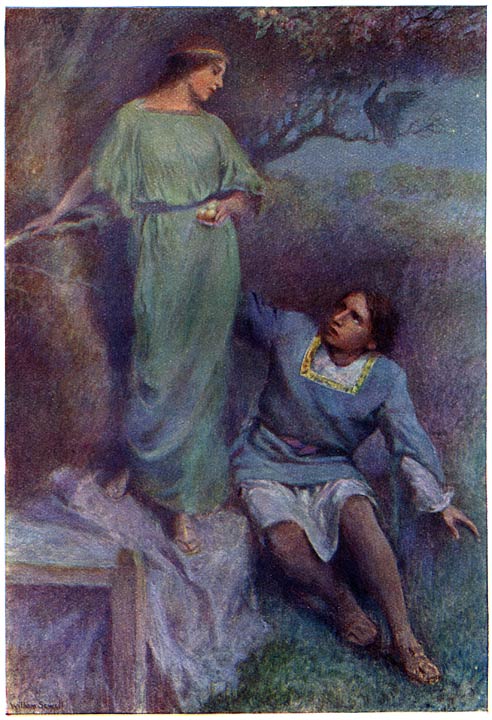
The pea-hen instantly turned into a maiden
The prince immediately fell madly in love with his visitor and the fair maiden was not at all unwilling to stay and converse with the young man. An hour or two soon passed but at last the maiden said that she might stay no longer. She thanked the prince for the apples which her sisters had plucked, but he asked that they would give him at least one to carry home.
The maiden smiled sweetly and handed the young man two apples, one for himself, the other for his father, the king. She then turned again into a peahen, joined her sisters and all flew away.
Next morning the prince carried the two apples to his father. The king, very pleased, praised his son, and on the following night, the happy prince placed himself under the tree, as before, next morning again bringing two apples to his father. After this had happened for several nights, his two brothers grew envious, because they had not been able to do what he had done. Then a wicked old woman offered her services to the malcontent princes, promising that she would reveal the secret to them. So on the next evening the old woman stole softly under the bed of the young prince and hid herself there. Soon afterward the prince came and at once went to sleep just as before. When midnight came, lo! the peahens flew down as usual; eight of them settling on the branches of the apple-tree, but the ninth, descending on the bed of the prince, instantly turned into a maiden. The old woman, seeing this strange metamorphosis, crept softly near and cut off a lock of the maiden’s hair, whereupon the girl immediately arose, changed again into a peahen, and disappeared together with her sisters. Then the young prince jumped up and wondering what had been the reason for the sudden departure of his beloved began to look around. He then saw the old woman, dragged her from under his bed, and ordered his servants to fasten her to the tails of four horses and so to destroy her.
But the peahens never came again, to the great sorrow of the prince, and for all that he mourned and wept.
Weeping will not move any mountain, and at length the prince resolved to go through the wide world in search of his sweetheart and not return home until he had found her. As a good son, he asked leave of his father who tried hard to make him give up such a hazardous scheme and promised him a much more beautiful bride in his own vast kingdom—for he was very sure that any maiden would be glad to marry such a valiant prince.
The Prince’s Quest
But all his fatherly advice was vain, so the king finally allowed his son to do what his heart bade, and the sorrowful prince departed with only one servant to seek his love. Journeying on for a long time, he came at length to the shore of a large lake, near which was a magnificent castle in which there lived a very old woman, a queen, with her only daughter. The prince implored the aged queen, “I pray thee, grandmother, tell me what you can about the nine golden peahens?” The queen answered: “O, my son, I know those peahens well, for they come every day at noon to this lake and bathe. But had you not better forget the peahens, and rather consider this beautiful girl, she is my daughter and will inherit my wealth and treasures, and you can share all with her.” But the prince, impatient to find the peahens, did not even listen to what the queen was saying. Seeing his indifference, the old lady bribed his servant and gave him a pair of bellows, saying: “Do you see this? When you go to-morrow to the lake, blow secretly behind your master’s neck, and he will fall asleep and will not be able to speak to the peahens.”
The faithless servant agreed to do exactly as the queen bade, and when they went to the lake, he used the first favourable occasion and blew with the bellows behind his poor master’s neck, whereupon the prince fell so soundly asleep that he resembled a dead man. Soon after, the eight peahens flew to the lake, and the ninth alighted on the prince’s horse and began to embrace him, saying: “Arise, sweetheart! Arise, beloved one! Ah, do!” Alas! the poor prince remained as if dead. Then after the peahens had bathed, all disappeared.
Shortly after their departure the prince woke up and asked his servant: “What has happened? Have they been here?” The servant answered that they had indeed been there; that eight of them bathed in the lake, while the ninth caressed and kissed him, trying to arouse him from slumber. Hearing this, the poor prince was so angry that he was almost ready to kill himself.
Next morning the same thing happened. But on this occasion the peahen bade the servant tell the prince that she would come again the following day for the last time. When the third day dawned the prince went again to the lake, and fearing to fall asleep he decided to gallop along the marge instead of pacing slowly as before. His deceitful servant, however, pursuing him closely, again found an opportunity for using the bellows, and yet again the prince fell asleep.
Shortly afterward the peahens came; eight of them went as usual to bathe, and the ninth alighted on the prince’s horse and tried to awaken him. She embraced him and spoke thus: “Awake, my darling! Sweetheart, arise! Ah, my soul!” But her efforts were futile; the prince was sleeping as if he were dead. Then she said to the servant: “When thy master awakes tell him to cut off the head of the nail; then only he may be able to find me again.”
Saying this the peahen disappeared with her sisters, and they had hardly disappeared when the prince awoke and asked his servant: “Have they been here?” And the malicious fellow answered: “Yes; the one who alighted on your horse ordered me to tell you that, if you wish to find her again, you must first cut off the head of the nail.” Hearing this the prince unsheathed his sword and struck off his faithless servant’s head.
The Quest Resumed
The prince now resumed his pilgrimage alone, and after long journeying he came to a mountain where he met a hermit, who offered hospitality to him. In the course of conversation the prince asked his host whether he knew anything about the nine peahens; the hermit replied: “O my son, you are really fortunate! God himself has shown you the right way. From here to their dwelling is but half a day’s walk; to-morrow I will point you the way.”
The prince rose very early the next morning, prepared himself for the journey, thanked the hermit for giving him shelter, and went on as he was directed. He came to a large gate, and, passing through it, he turned to the right; toward noon he observed some white walls, the sight of which rejoiced him very much. Arriving at this castle he asked the way to the palace of the nine peahens, and proceeding he soon came to it. He was, of course, challenged by the guards, who asked his name and whence he came. When the queen heard that he had arrived, she was overwhelmed with joy, and turning into a maiden she ran swiftly to the gate and led the prince into the palace.
There was great feasting and rejoicing when, later, their nuptials were solemnized, and after the wedding the prince remained within the palace and lived in peace.
Now one day the queen went for a walk in the palace grounds accompanied by an attendant, the prince remaining in the palace. Before starting the queen gave her spouse the keys of twelve cellars, saying: “You may go into the cellars, all but one; do not on any account go into the twelfth; you must not even open the door!”
The prince soon began to speculate upon what there could possibly be in the twelfth cellar; and having opened one cellar after the other, he stood hesitatingly at the door of the twelfth. He who hesitates is lost, and so the prince finally inserted the key in the lock and the next moment had passed into the forbidden place. In the middle of the floor was a huge cask bound tightly round with three strong iron hoops. The bung-hole was open and from within the cask came a muffled voice which said: “I pray thee, brother, give me a drink of water, else I shall die of thirst!” The prince took a glass of water and poured it through the bung-hole; immediately one hoop burst. Then the voice spake again: “O brother give me more water lest I should die of thirst!” The good-hearted prince emptied a second glass into the cask, and a second hoop instantly came asunder. Again the voice implored: “O brother, give me yet a third glass! I am still consumed by thirst!” The prince made haste to gratify the unseen speaker, and as he poured in the water the third hoop burst, the cask fell in pieces, and a great dragon struggled out from the wreck, rushed through the door and flew into the open. Very soon he fell in with the queen, who was on her way back to the palace, and carried her off. Her attendant, affrighted, rushed to the prince with the intelligence, and the news came as a thunderbolt.
For a time the prince was as one distraught, but then he became more calm and he resolved to set out again in search of his beloved queen. In his wanderings he came to a river, and, walking along its bank, he noticed in a little hole a small fish leaping and struggling. When the fish saw the prince it began to beseech him piteously: “Be my brother-in-God! Throw me back into the stream; some day I may, perhaps, be useful to you! But be sure to take a scale from me, and when you are in need of help rub it gently.” The prince picked up the fish, took a scale from it, and threw the poor creature into the water; then he carefully wrapped the scale in his handkerchief.
Continuing his wanderings, he came to a place where he saw a fox caught in an iron trap, and the animal addressed him, saying: “Be my brother-in-God! Release me, I pray, from this cruel trap; and some day, perhaps, I may be helpful to you. Only take a hair from my brush, and, if you are in need, rub it gently!” The prince took a hair from the fox’s tail and set him free. Journeying on, he came upon a wolf caught in a trap. And the wolf besought him in these words: “Be my brother-in-God, and release me! One day you may need my help, therefore, take just one hair from my coat, and if you should ever need my assistance, you will have but to rub it a little!” This likewise the prince did.
Some days elapsed and then, as the prince went wearily on his way, he met a man in the mountains, to whom he said: “O my brother-in-God! Can you direct me to the castle of the king of the dragons?” Luckily the man knew of this castle and was able to tell the way to it; he also informed the prince exactly how long the journey would take.
The Prince finds his Wife
The prince thanked the stranger and continued his journey with fresh vigour until he came to where the king of the dragons lived. He entered the castle boldly and found his wife there; after their first joy of meeting, they began to consider how they could escape. Finally, they took swift horses from the stables, but they had hardly set out before the dragon came back. When he found that the queen had escaped, he took counsel with his courser: “What do you advise? Shall we first eat and drink, or shall we pursue at once!” The horse answered: “Let us first refresh ourselves, for we shall surely catch them.” After the meal, the dragon mounted his horse and in a very few minutes they reached the fugitives. Then he seized the queen and said to the prince: “Go in peace! I pardon you this time, because you released me from that cellar: but do not venture to cross my path again, for you will not be forgiven a second time.”
The poor prince started sadly on his way, but he soon found that he could not abandon his wife. Whatever the cost he must make another attempt to rescue her, and so he retraced his steps, and on the following day entered the castle again and found his wife in tears. It was evident that they must use guile if they were to elude the magical powers of the dragon-king, and after they had thought upon the matter, the prince said: “When the dragon comes home to-night, ask where he got his horse; perchance I may be able to procure a steed that is equally swift: only then could we hopefully make another attempt to escape.” Saying this he left his wife for a time. When the dragon-king returned, the queen began to caress him and to pleasantly converse; at length she said: “How I admire your fine horse! Certainly he is of no ordinary breed! Where did you find such a swift courser?” And the dragon-king replied: “Ah! his like is not to be got by every one! In a certain mountain lives an old woman, who has in her stables twelve wondrous horses; none could easily tell which is the finest! But in a corner stands one that is apparently leprous; he is, in fact, the best of the stable, and whoever becomes his master, may ride even higher than the clouds. My steed is a brother of those horses, and if anyone would get a horse from that old woman he must serve her for three days. She has a mare and a foal, and he who is her servant must tend them for three days and three nights; if he succeeds in guarding them and returns them to the old woman, he is entitled to choose a horse from her stable. But, if the servant does not watch well over the mare and its foal, he will indeed lose his life.”
The old Woman and her Horses
Next morning, when the dragon had left the castle, the prince came and the queen told him what she had heard. Hastily bidding his wife farewell, he went with all speed to the mountain, and finding the old woman, he said to her: “God help you, grandmother!” And she returned the greeting: “May God help you also, my son! What good wind brought you here, and what do you wish?” He answered: “I should like to serve you.” Thereupon the old woman said: “Very well, my son! If you successfully watch my mare and its foal for three days, I shall reward you with a horse which you yourself are at liberty to choose from my stable; but if you do not keep them safe, you must die.”
Then she led the prince into her courtyard, where he saw stakes all around placed close together, and on each save one was stuck a human head. The one stake kept shouting out to the old woman: “Give me a head, O grandmother! Give me a head!” The old woman said: “All these are heads of those who once served me; they did not succeed in keeping my mare and its foal safe, so they had to pay with their heads!” But the prince was not to be frightened at what he saw, and he readily accepted the old woman’s conditions.
When evening came, he mounted the mare and rode it to pasture, the foal following. He remained seated on the mare, but, toward midnight, he dozed a little and finally fell fast asleep. When he awoke he saw, to his great consternation, that he was sitting upon the trunk of a tree holding the mare’s bridle in his hand. He sprang down and went immediately in search of the tricky animal. Soon he came to a river, the sight of which reminded him of the little fish, and taking the scale from his handkerchief, he rubbed it gently between his fingers, when lo! the fish instantly appeared and asked: “What is the matter, my brother-in-God?” The prince answered: “My mare has fled, and I do not know where to look for her!” And the fish answered: “Here she is with us, turned into a fish, and her foal into a small one! Strike once upon the water with the bridle and shout: ‘Doora! Mare of the old woman!’”
The prince did as the fish told him; at once the mare and her foal came out of the water; he bridled the mare, mounted and rode home; the young foal trotting after. The old woman brought the prince some food without a word; then she took the mare into the stable, beat her with a poker, and said: “Did I not tell you to go down among the fish?” The mare answered: “I have been down to the fish, but the fish are his friends and they betrayed me to him.” Thereupon the old woman said: “To-night you go among the foxes!”
When evening came, the prince mounted the mare again and rode to the field, the foal following its mother. He determined again to remain in the saddle and to keep watch, but, toward midnight, he was again overcome by drowsiness and became unconscious. When he awoke next morning, lo! he was seated on a tree-trunk holding fast the bridle. This alarmed him greatly, and he looked here and he looked there. But search as he would, he could find no trace of the mare and her foal. Then he remembered his friend the fox, and taking the hair from the fox’s tail out of his handkerchief, he rubbed it gently between his fingers, and the fox instantly stood before him. “What is the matter, my brother-in-God?” said he. The prince complained of his misfortune, saying that he had hopelessly lost his mare. The fox soon reassured him: “The mare is with us, changed to a fox, and her foal into a cub; just strike once with the bridle on the earth, and shout out ‘Doora, the old woman’s mare!’” He did so, and sure enough the mare at once appeared before him with the foal. So he bridled her and mounted, and when he reached home the old woman gave him food, and took the mare to the stable and beat her with a poker, saying: “Why did you not turn into a fox, you disobedient creature?” And the mare protested: “I did turn into a fox; but the foxes are his friends, so they betrayed me!” At this the old woman commanded: “Next time you go to the wolves!”
When evening came the prince set out on the mare and the same things befell as before. He found himself, the next morning, sitting on a tree-trunk, and this time he called the wolf, who said: “The mare of the old woman is with us in the likeness of a she-wolf, and the foal of a wolf’s cub; strike the ground once with the bridle and exclaim: ‘Doora! the mare of the old woman!’” The prince did as the wolf counselled, and the mare reappeared with her foal standing behind her.
He mounted once again and proceeded to the old woman’s house, where, on his arrival, he found her preparing a meal. Having set food before him, she took the mare to the stable and beat her with a poker. “Did I not tell you to go to the wolves, you wretched creature?” she scolded. But the mare protested again, saying: “I did go to the wolves, but they are also his friends and they betrayed me!” Then the old woman went back to the house and the prince said to her: “Well, grandmother, I think I have served you honestly; now I hope you will give me what you promised me!” The old woman replied: “O my son, verily a promise must be fulfilled! Come to the stable; there are twelve horses; you are at liberty to choose whichever you like best!”
The Prince’s Choice
Thereupon the prince said firmly: “Well, why should I be particular? Give me the leprous horse, standing in that corner.” The old woman tried by all means in her power to deter him from taking that ugly horse, saying: “Why be so foolish as to take that leprous jade when you can have a fine horse?” But the prince kept to his choice, and said: “Give me rather the one I selected, as it was agreed between us!”
The old woman, seeing that he would not yield, gave way, and the prince took leave of her and led away his choice. When they came to a forest he curried and groomed the horse, and it shone as if its skin were of pure gold. Then he mounted, and, the horse flying like a bird, they reached the dragon-king’s castle in a few seconds.
The prince immediately entered and greeted the queen with: “Hasten, all is ready for our flight!” The queen was ready, and in a few seconds they were speeding away, swift as the wind, on the back of the wonderful horse.
Shortly after they had gone, the dragon-king came home, and finding that the queen had again disappeared, he addressed the following words to his horse: “What shall we do now? Shall we refresh ourselves, or shall we go after the fugitives at once?” And his horse replied: “We may do as you will, but we shall never reach them!”
Upon hearing this the dragon-king at once flung himself upon his horse and they were gone in a flash. After a time the prince looked behind him and saw the dragon-king in the distance. He urged his horse, but it said: “Be not afraid! There is no need to run quicker.” But the dragon-king drew nearer, so close that his horse was able to speak thus to its brother: “O brother dear, tarry, I beseech you! else I shall perish in running at this speed!” But the prince’s horse answered: “Nay, why be so foolish as to carry that monster? Fling up your hoofs and throw him against a rock, then come with me!” At these words the dragon-king’s horse shook its head, curved its back, and kicked up its hoofs so furiously that its rider was flung on to a rock and killed. Seeing this, the prince’s horse stood still, its brother trotted up, and the queen mounted on it. So they arrived happily in her own land, where they lived and ruled in great prosperity ever after.
X. The Bird Maiden
There was once a king who had an only son, whom, when he had grown up, he sent abroad to seek a suitable wife. The prince set out on his journey, but, although he travelled over the whole world, he did not succeed in finding a bride. Finally, after having exhausted his patience and his purse, he decided to die, and, that there should not remain any trace of him, he climbed a high mountain, intending to throw himself from the summit. He was on the point of jumping from the pinnacle, when a voice uttered these mysterious words: “Stop! Stop! O man! Do not kill yourself, for the sake of three hundred and sixty-five which are in the year!”
The prince endeavoured in vain to discover whence the voice came, and, seeing no one, he asked: “Who are you that speak to me? Show yourself! If you knew of my troubles, you would surely not hinder me!” Thereupon an old man appeared, with hair as white as snow, and said to the unfortunate prince: “I am well aware of all you suffer; but listen to me. Do you see yonder high hill?” The king’s son answered: “Yes, indeed.” “Very well,” continued the old man, “seated day and night in the same spot on the summit of that hill there is an old woman with golden hair, and she holds a bird in her lap. He who succeeds in securing that bird will be the happiest man in the world. But if you wish to try your luck you must be cautious; you must approach the old woman quietly, and, before she sees you, you must take her by the hair. Should she see you before you seize her, you will be turned to stone then and there, just as it has happened to many young men whom you will see there in the form of blocks of marble.”
The Old Witch
When the prince heard these words, he reflected: “It is all one to me; I shall go, and, if I succeed in seizing her, so much the better for me; but if she should see me before I catch her, I can but die, as I had already resolved to do.” So he thanked the old man, and went cheerfully to try his luck. He soon climbed the other hill and saw the old woman, whom he approached very warily from behind. Fortunately the old woman was absorbed in playing with the bird, and so the prince was able to get quite near without being perceived. Then he sprang suddenly forward and seized the old woman by her golden hair; whereupon she screamed so loudly that the whole hill shook as with an earthquake. But the courageous prince held her fast. Then the old woman exclaimed: “Release me, and ask whatever you wish!” And the prince answered: “I will do so if you let me have that bird, and if you at once recall to life all these young men whom you have bewitched.” The old woman was forced to consent, and she gave up the bird. Then from her lips she breathed a blue wind toward the petrified figures, so that instantly they became living men once more. The noble prince expressed the joy in his heart by kissing the bird in his hands, whereupon it was transformed into a most beautiful girl, whom, it appeared, the enchantress had bewitched in order to lure young men to a horrid fate. The king’s son was so pleased with his companion that he promptly fell in love with her. On their way from that place the maiden gave him a stick, and told him that it would do everything he might wish. Presently the prince wished that he had the wherewithal to travel as befitted a prince and his bride; he struck a rock with the stick, and out poured a torrent of golden coins, from which they took all they needed for their journey. When they came to a river, the prince touched the water with his stick, and a dry path appeared, upon which they crossed dryshod. A little farther on they were attacked by a pack of wolves, but the prince protected his bride with his stick, and one by one the wolves were turned into ants.
And many other adventures they had, but in the end they arrived safely at the prince’s home. Then they married and they lived happily ever after.
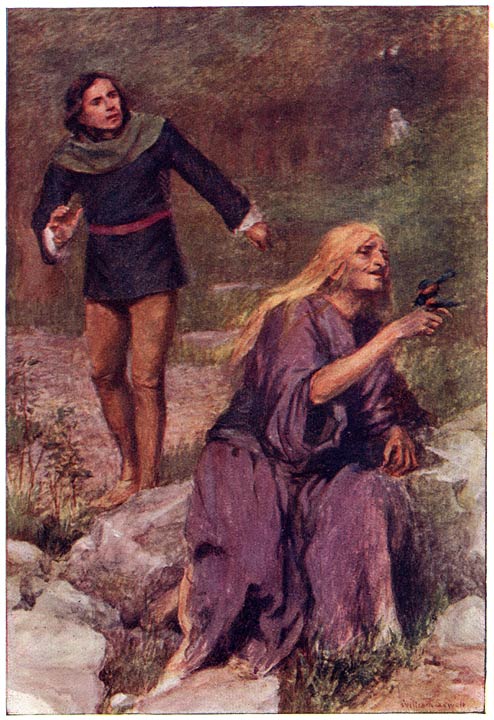
The old woman was absorbed in playing with the bird
XI. Lying for a Wager
When the boy came to a mill, he was therefore disappointed to find that the miller was beardless.
“God bless you, Beardless!” saluted the boy.
“May God help you!” returned the miller.
“May I grind my corn here?” asked the boy.
“Yes, why not?” responded the beardless one, “my corn will be soon ground; you can then grind yours as long as you please.”
But the boy, remembering his father’s warning, left this mill and went to another up the brook. But Beardless took some grain and, hurrying by a shorter way, reached the second mill first and put some of his corn there to be ground. When the boy arrived and saw that the miller was again a beardless man, he hastened to a third mill; but again Beardless hurried by a short cut, and reached it before the boy. He did the same at a fourth mill, so that the boy concluded that all millers are beardless men. He therefore put down his sack, and when the corn of Beardless was ground he took his turn at the mill. When all of his grain had been ground Beardless proposed: “Listen, my boy! Let us make a loaf of your flour.”
The boy had not forgotten his father’s injunction to have nothing to do with beardless millers, but as he saw no way out of it, he accepted the proposal. So Beardless now took all the flour, mixed it with water, which the boy brought him, and thus made a very large loaf. Then they fired the oven and baked the loaf, which, when finished, they placed against the wall.
Then the miller proposed: “Listen, my boy! If we were now to divide this loaf between us, there would be little enough for either of us, let us therefore tell each other stories, and whoever tells the greatest lie shall have the whole loaf for himself.”
The boy reflected a little and, seeing no way of helping himself, said: “Very well, but you must begin.”
Then Beardless told various stories till he got quite tired. Then the boy said: “Eh, my dear Beardless, it is a pity if you do not know any more, for what you have said is really nothing; only listen, and I shall tell you now the real truth.”
The Boy’s Story
“In my young days, when I was an old man, we possessed many beehives, and I used to count the bees every morning; I counted them easily enough, but I could never contrive to count the beehives. Well, one morning, as I was counting the bees, I was greatly surprised to find that the best bee was missing, so I saddled a cock, mounted it, and started in search of my bee. I traced it to the sea-shore, and saw that it had gone over the sea, so I decided to follow it. When I had crossed the water, I discovered that a peasant had caught my bee; he was ploughing his fields with it and was about to sow millet. So I exclaimed: ‘That is my bee! How did you get it?’ And the ploughman answered: ‘Brother, if this is really your bee, come here and take it!’ So I went to him and he gave me back my bee, and a sack full of millet on account of the services my bee had rendered him. Then I put the sack on my back, and moved the saddle from the cock to the bee. Then I mounted, and led the cock behind me that it might rest a little. As I was crossing the sea, one of the strings of my sack burst, and all the millet poured into the water. When I had got across, it was already night, so I alighted and let the bee loose to graze; as to the cock, I fastened him near me, and gave him some hay. After that I laid myself down to sleep. When I rose next morning, great was my surprise to see that during the night, the wolves had slaughtered and devoured my bee; and the honey was spread about the valley, knee-deep and ankle-deep on the hills. Then I was puzzled to know in what vessel I could gather up all the honey. Meantime I remembered I had a little axe with me, so I went into the woods to catch a beast, in order to make a bag of its skin. When I reached the forest, I saw two deer dancing on one leg; so I threw my axe, broke their only leg and caught them both. From those two deer I drew three skins and made a bag of each, and in them gathered up all the honey. Then I loaded the cock with the bags and hurried homeward. When I arrived home I found that my father had just been born, and I was told to go to heaven to fetch some holy water. I did not know how to get there, but as I pondered the matter I remembered the millet which had fallen into the sea. I went back to that place and found that the grain had grown up quite to heaven, for the place where it had fallen was rather damp, so I climbed up by one of the stems. Upon reaching heaven I found that the millet had ripened, and an angel had harvested the grain and had made a loaf of it, and was eating it with some warm milk. I greeted him, saying: ‘God bless you!’ The angel responded: ‘May God help you!’ and gave me some holy water. On my way back I found that there had been a great rain, so that the sea had risen so high that my millet was carried away! I was frightened as to how I should descend again to earth, but at length I remembered that I had long hair—it is so long that when I am standing upright it reaches down to the ground, and when I sit it reaches to my ears. Well, I took out my knife and cut off one hair after another, tying them end to end as I descended on them. Meantime darkness overtook me before I got to the bottom, and so I decided to make a large knot and to pass the night on it. But what was I to do without a fire! The tinder-box I had with me, but I had no wood. Suddenly I remembered that I had in my vest a sewing needle, so I found it, split it and made a big fire, which warmed me nicely; then I laid myself down to sleep. When I fell asleep, unfortunately a flame burnt the hair through, and, head over heels, I fell to the ground, and sank into the earth up to my girdle. I moved about to see how I could get out, and, when I found that I was tightly interred, I hurried home for a spade and came back and dug myself out. As soon as I was freed, I took the holy water and started for home. When I arrived reapers were working in the field. It was such a hot day, that I feared the poor men would burn to death, and called to them: ‘Why do you not bring here our mare which is two days’ journey long and half a day broad, and on whose back large willows are growing; she could make some shade where you are working?’ My father hearing this, quickly brought the mare, and the reapers continued working in the shade. Then I took a jug in which to fetch some water. When I came to the well, I found the water was quite frozen, so I took my head off and broke the ice with it; then I filled the jug and carried the water to the reapers. When they saw me they asked me: ‘Where is your head?’ I lifted my hand, and, to my great surprise, my head was not upon my shoulders, and then I remembered having left it by the well. I went back at once, but found that a fox was there before me, and was busy devouring my head. I approached slowly and struck the beast fiercely with my foot, so that in great fear, it dropped a little book. This I picked up and on opening it, found written in it these words: ‘The whole loaf is for thee, and Beardless is to get nothing!’”
Saying this, the boy took hold of the loaf and made off. As for Beardless, he was speechless, and remained gazing after the boy in astonishment.
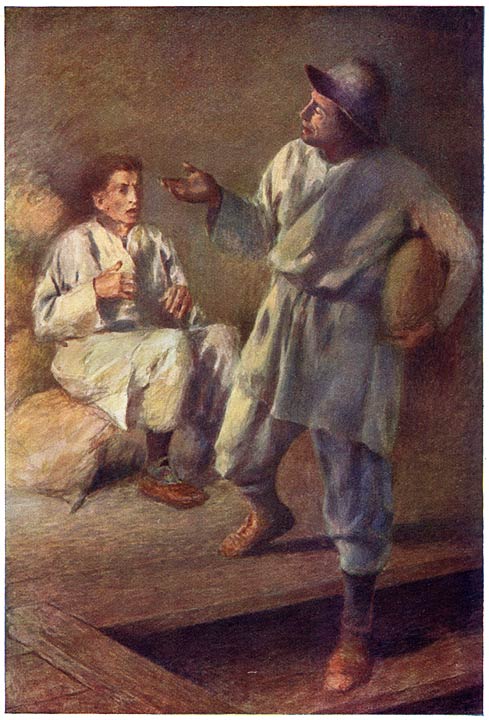
“The whole loaf is for thee, and beardless is to get nothing!”
XII. The Maiden Wiser than the Tsar
Long ago there lived an old man, who dwelt in a poor cottage. He possessed one thing only in the world, and that was a daughter who was so wise that she could teach even her old father.
One day the man went to the tsar to beg, and the tsar, astonished at his cultivated speech, asked him whence he came and who had taught him to converse so well. He told the tsar where he lived, and that it was his daughter who had taught him to speak with eloquence.
“And where was your daughter taught?” asked the tsar.
“God and our poverty have made her wise,” answered the poor man.
Thereupon the tsar gave him thirty eggs and said: “Take these to your daughter, and command her in my name to bring forth chickens from them. If she does this successfully I will give her rich presents, but if she fails you shall be tortured.”
The poor man, weeping, returned to his cottage and told all this to his daughter. The maiden saw at once that the eggs which the tsar had sent were boiled, and bade her father rest while she considered what was to be done. Then while the old man was sleeping the girl filled a pot with water and boiled some beans.
Next morning she woke her father and begged him to take a plough and oxen and plough near the road where the tsar would pass. “When you see him coming,” said she, “take a handful of beans, and while you are sowing them you must shout: ‘Go on, my oxen, and may God grant that the boiled beans may bear fruit!’ Then,” she went on, “when the tsar asks you, ‘How can you expect boiled beans to bear fruit?’ answer him: ‘just as from boiled eggs one can produce chicks!’”
The old man did as his daughter told him, and went forth to plough. When he saw the tsar he took out a handful of beans, and exclaimed: “Go on, my oxen! And may God grant that the boiled beans may bear fruit!” Upon hearing these words the tsar stopped his carriage, and said to the man: “My poor fellow, how can you expect boiled beans to bear fruit?”
“Just as from boiled eggs one can produce chicks!” answered the apparently simple old man.
The tsar laughed and passed on, but he had recognized the old man, and guessed that his daughter had instructed him to say this. He therefore sent officers to bring the peasant into his presence. When the old man came, the tsar gave him a bunch of flax, saying: “Take this, and make out of it all the sails necessary for a ship; if you do not, you shall lose your life.”
The poor man took the flax with great fear, and went home in tears to tell his daughter of his new task. The wise maiden soothed him, and said that if he would rest she would contrive some plan. Next morning she gave her father a small piece of wood, and bade him take it to the tsar with the demand that from it should be made all the necessary tools for spinning and weaving, that he should thereby be enabled to execute his Majesty’s order. The old man obeyed, and when the tsar heard the extraordinary request he was greatly astounded at the astuteness of the girl, and, not to be outdone, he took a small glass, saying: “Take this little glass to your daughter, and tell her she must empty the sea with it, so that dry land shall be where the ocean now is.”
The old man went home heavily to tell this to his daughter. But the girl again reassured him, and next morning she gave him a pound of tow, saying: “Take this to the tsar and say, that when with this tow he dams the sources of all rivers and streams I will dry up the sea.”
The Tsar Sends for the Girl
The father went back to the tsar and told him what his daughter had said, and the tsar, seeing that the girl was wiser than himself, ordered that she should be brought before him. When she appeared the tsar asked her: “Can you guess what it is that can be heard at the greatest distance?” and the girl answered: “Your Majesty, there are two things: the thunder and the lie can be heard at the greatest distance!”
The astonished tsar grasped his beard, and, turning to his attendants, exclaimed: “Guess what my beard is worth?” Some said so much, others again so much; but the maiden observed to the tsar that none of his courtiers had guessed right. “His Majesty’s beard is worth as much as three summer rains,” she said. The tsar, more astonished than ever, said: “The maiden has guessed rightly!” Then he asked her to become his wife, for “I love you,” said he. The girl had become enamoured of the tsar, and she bowed low before him and said: “Your glorious Majesty! Let it be as you wish! But I pray that your Majesty may be graciously pleased to write with your own hand on a piece of parchment that should you or any of your courtiers ever be displeased with me, and in consequence banish me from the palace, I shall be allowed to take with me any one thing which I like best.”
The tsar gladly consented, wrote out this declaration and affixed his signature.
Some years passed by happily but there came at last a day when the tsar was offended with the tsarina and he said angrily: “You shall be no longer my wife, I command you to leave my palace!”
The tsarina answered dutifully: “O most glorious tsar, I will obey; permit me to pass but one night in the palace, and to-morrow I will depart.”
To this the tsar assented.
That evening, at supper, the tsarina mixed certain herbs in wine and gave the cup to the tsar, saying: “Drink, O most glorious tsar! And be of good cheer! I am to go away, but, believe me, I shall be happier than when I first met you!”
The tsar, having drunk the potion fell asleep. Then the tsarina who had a coach in readiness, placed the tsar in it and carried him off to her father’s cottage.
When his Majesty awoke next morning and saw that he was in a cottage, he exclaimed: “Who brought me here?”
“I did,” answered the tsarina.
The tsar protested, saying: “How have you dared do so? Did I not tell you that you are no longer my wife?”
Instead of answering the tsarina produced the parchment containing the tsar’s promise and he could not find a word to say.
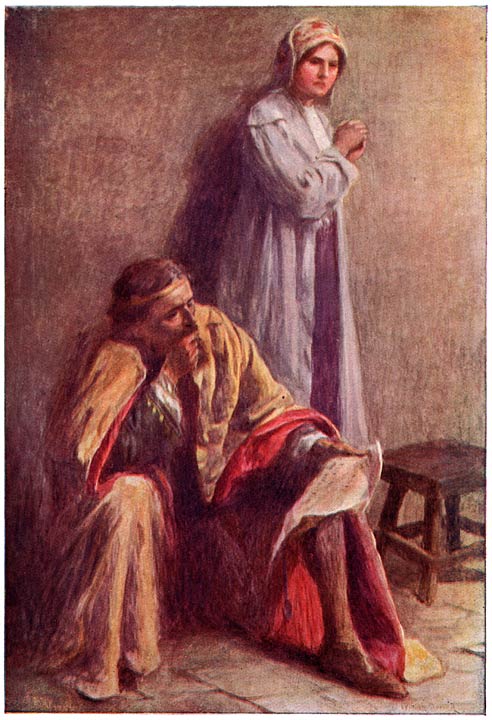
He could not find a word to say
Then the tsarina said: “As you see, you promised that should I be banished from your palace I should be at liberty to take with me that which I liked best!”
Hearing this, the tsar’s love for his spouse returned, he took her in his arms, and they returned to the palace together.
XIII. Good Deeds Never Perish
Once upon a time there lived a man and woman who had one son. When the boy grew up his parents endeavoured to give him a suitable education which would be useful in his after life. He was a good, quiet boy, and above all he feared God. After he had completed his studies, his father intrusted him with a galley laden with various goods, so that he might trade with distant countries, and be the support of his parents’ old age.
The First Voyage
On his first voyage he one day met with a Turkish ship, in which he heard weeping. So he called to the sailors on the Turkish vessel: “I pray you, tell me why there is such sorrow on board your ship!” And they answered: “We have many slaves whom we have captured in various parts of the world, and those who are chained are weeping and lamenting.” Thereupon the young man said: “Pray, O brethren, ask your captain if he will allow me to ransom the slaves for a sum of money?” The sailors gladly called their captain, who was willing to bargain, and in the end the young man gave his ship with all its cargo to the Turk, in exchange for his vessel containing the slaves.
The young man asked each slave whence he came, and gave to all their freedom, and said that each might return to his own country.
Among the slaves was an old woman who held a most beautiful maiden by the arm. When he asked whence they came, the old woman answered through her tears: “We come from a far-away country. This young girl is the only daughter of the tsar, whom I have brought up from her infancy. One unlucky day she was walking in the palace gardens, and wandered to a lonely spot, where those accursed Turks saw her and seized her. She began to scream, and I, who happened to be near, ran to help her, but alas! I could not save her, and the Turks carried us both on board this galley.” Then the good nurse and the beautiful girl, not knowing the way to their own country, and having no means of returning thither, implored the young man to take them with him. And this he was quite willing to do; indeed, he had immediately fallen in love with the princess, and he now married the poor homeless maiden, and, together with her and the old woman, returned home.
On their arrival, his father asked where his galley and its cargo were, and he told him how he had ransomed the slaves and set them at liberty. “This girl,” said he, “is the daughter of a tsar, and this old woman is her nurse; as they could not return to their country I took them with me, and I have married the maiden.” Thereupon his father grew very angry, and said: “O foolish son, what have you done? Why did you dispose so stupidly of my property without my permission?” and he drove him out of the house.
Fortunately for the young man, a good neighbour offered him hospitality, and, with his wife and her old nurse, he resided for a long time near by, endeavouring, through the influence of his mother and friends, to persuade his father to forgive him.
The Second Voyage
After some time the father relented, and received his son again in his house, together with his young wife and her nurse. Soon after, he purchased a second galley, larger and finer than the first, and loaded it with merchandise wherewith his son might trade to great profit, if so be that he were wise.
The young man sailed in this new vessel, leaving his wife and her nurse in the house of his parents, and soon came to a certain city, where he beheld a sorrowful sight. He saw soldiers busied in seizing poor peasants and throwing them into prison, and he asked: “Why, brethren, are you showing such cruelty to these unfortunate people?” And the soldiers replied: “Because they have not paid the tsar’s taxes.” The young man at once went to the officer and said: “I pray you, tell me how much these poor people must pay.” The officer told him the amount due, and, without hesitation, the young man sold his galley and the cargo, and discharged the debts of all the prisoners. He now returned home, and, falling at the feet of his father, he told him the story and begged that he might be forgiven. But his father grew exceedingly angry this time, and drove him away from his house.
What could the unhappy son do in this fresh trouble? How could he beg, he whose parents were so well-to-do? Old friends of the family again used their influence with his father, urging that he should take pity on his son and receive him back, “for,” said they, “it is certain that suffering has made him wiser, and that he will never again act so foolishly.” At length his father yielded, took him again into his house, and prepared a third galley for him, much larger and finer than the two former ones.
The Third Voyage
The young man was overjoyed at his good fortune, and he had the portrait of his beloved wife painted on the helm, and that of the old nurse on the stern. When all the preparations for a new voyage were completed, he took leave of his parents, his wife, and other members of the family, and weighed anchor. After sailing for some time he arrived at a great city, in which there lived a tsar, and, dropping anchor, he fired his guns as a salute to the city. Toward evening the tsar sent one of his ministers to learn who the stranger was and whence he came, and to inform him that his master would come at nine o’clock next morning to visit the galley. The minister was astounded to see on the helm the portrait of the imperial princess—whom the tsar had promised to him in marriage when she was still a child—and on the stern that of the old nurse; but he did not make any remark, nor did he tell anyone at the palace what he had seen. At nine o’clock next morning the tsar came on board the galley with his ministers, and, as he paced the deck, conversing with the captain, he also saw the portrait of the maiden painted on the helm and that of the old woman on the stern, and he recognized at once the features of his only daughter and her nurse, whom the Turks had captured. At once he conceived the hope that his beloved child was alive and well, but he could not trust himself to speak, so great was his emotion. Composing himself as best he could, he invited the captain to come at two o’clock that afternoon to his palace, intending to question him, hoping thus to confirm the hopes of his heart.
Punctually at two o’clock the captain appeared at the palace, and the tsar at once began to question him in a roundabout manner as to the maiden whose portrait he had seen on the helm of his galley. Was she one of his relations, and, if so, in what degree? He was also curious concerning the old woman whose likeness was painted on the stern.
The young captain guessed at once that the tsar must be his wife’s father, and he related to him word by word all his adventures, not omitting to say that, having found that the young maiden and her nurse had forgotten the way back to their country, he had taken pity on them and later had espoused the maiden. Hearing this the tsar exclaimed: “That girl is my only child and the old woman is her nurse; hasten and bring my daughter here that I may see her once more before I die. Bring here also your parents and all your family; your father will be my brother and your mother my sister, for you are my son and the heir to my crown. Go and sell all your property and come that we may live together in my palace!” Then he called the tsarina, his wife, and all his ministers, that they might hear the joyful news, and there was great joy in the court.
After this the tsar gave the captain a magnificent ship requesting him to leave his own galley behind. The young man was, of course, very grateful, but he said: “O glorious tsar! My parents will not believe me, if you do not send one of your ministers to accompany me.” Thereupon the tsar appointed as his companion for the voyage, the very minister to whom he had formerly promised his daughter in marriage.
The captain’s father was greatly surprised to see his son return so soon and in such a magnificent ship. Then the young man related to his father and others all that had happened, and the imperial minister confirmed all his statements. When the princess saw the minister she exclaimed joyfully: “Yes, indeed, all that he has said is true; this is my father’s minister, who was to be my betrothed.” Then the man and his family sold all their property and went on board the ship.
The Treacherous Minister
Now the minister was a wicked man, and he had formed a design to kill the young husband of the princess that he might espouse her and one day become tsar. Accordingly during the voyage he called the young man on deck one night to confer with him. The captain had a quiet conscience and did not suspect evil, wherefore he was entirely unprepared when the minister seized him and threw him swiftly overboard. The ship was sailing fast; it was impossible that he could reach it, so he fell gradually behind. By great good luck he was very near to land and soon he was cast ashore by the waves. But, alas! this land was but a bare uninhabited rock.
Meantime the minister had stolen back to his cabin and next morning when it was found that the captain had disappeared, all began to weep and wail, thinking that he had fallen overboard in the night and been drowned. His family would not be consoled, more especially his wife, who loved him so much. When they arrived at the tsar’s palace and reported that the young man had been accidentally drowned, the entire court mourned with them.
For fifteen days the tsar’s unhappy son-in-law was condemned to a bare subsistence upon the scanty grass which grew upon the rocky islet. His skin was tanned by the hot sun and his garments became soiled and torn, so that no one could have recognized him. On the morrow of the fifteenth day, he had the good fortune to perceive an old man on the shore, leaning on a stick, engaged in fishing. He began at once to hail the old man and to beseech him to help him off the rock. The old fisherman said: “I will save you, if you will pay me!” “How can I pay you,” answered the castaway, “when, as you see, I have only these rags, and nothing more?” “Oh, as for that,” replied the old man, “you can write and sign a promise to give me a half of everything that you may ever possess.” The young man gladly made this promise. Then the old man produced writing materials and the young man signed the agreement, after which they both sailed in the old man’s fishing boat to the mainland. After that the young man wandered from house to house and from village to village, a barefoot beggar, in rags, sunburnt, and hungry.
The Young Man’s Return
After thirty days’ journeying, good luck led him to the city of the tsar and he sat him down, staff in hand, at the gates of the palace, still wearing on his finger his wedding-ring, on which was engraved his name and that of his wife. The servants of the tsar, pitying his sad plight, offered him shelter for the night in the palace and gave him to eat fragments from their own dinner. Next morning he went to the garden of the palace, but the gardener came and drove him away, saying that the tsar and his family were soon coming by. He moved from that spot and sat down in a corner on the grass, when suddenly he saw the tsar walking with his own mother and father, who had remained at the court as the tsar’s guests, and his beloved wife walking arm in arm with his enemy, the minister. He did not yet wish to reveal himself, but as the tsar and his train passed by and gave him alms, he stretched out his hand to receive it and the wedding-ring upon his finger caught the princess’s eye. She recognized it at once, but it was incredible that the beggar could be her husband, and she said to him: “Pray, give me your hand that I may see your ring!” The minister protested, but the princess did not pay any attention to him, and proceeded to examine the ring, to find there her own name and that of her husband. Her heart was greatly agitated at the sight, but she made an effort to control her feelings and said nothing. Upon her return to the palace she appeared before her father and told him what she had seen. “Please send for him,” said she, “and we may find out how the ring came into his possession!” The tsar immediately sent an attendant to fetch the beggar. The order was executed at once, and, when the stranger appeared the tsar asked him his name, whence he came, and in what manner he obtained the ring. The unfortunate young man could no longer maintain his disguise, so telling the tsar who he was, he went on to relate all his adventures since the minister treacherously threw him into the sea. “Behold!” said he at last, “Our gracious Lord and my right-dealing has brought me back to my parents and my wife.” Almost beside themselves for joy, the tsar called for the young man’s parents and imparted to them the good news. Who could express the joy of the aged couple when they identified their son? Words fail, also, to describe adequately the rejoicing which filled the hearts of the entire court. The servants prepared perfumed baths for the young man and brought him sumptuous new garments. The tsar gave orders that he should be crowned as tsar, and for several days there were wonderful festivities, in which the whole city joined; everywhere was singing, dancing and feasting. The old tsar summoned the wicked minister to appear before his son-in-law, to be dealt with according to his will. But the young tsar had a kind heart, so he forgave him upon the condition that he should leave the tsardom without delay, and never come back during his reign.
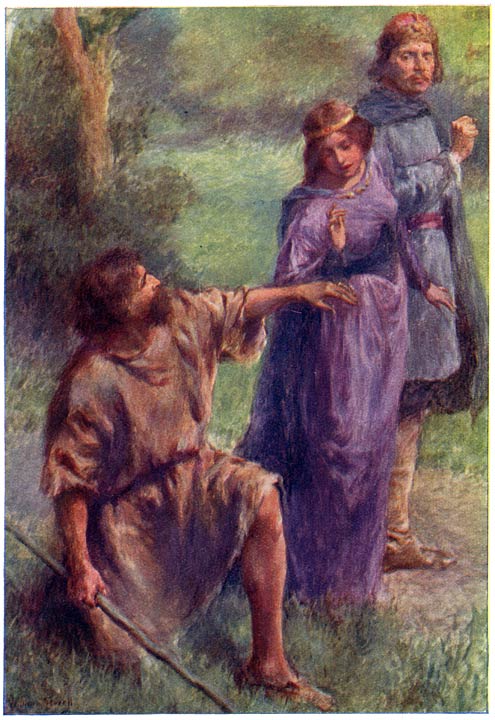
“Pray, give me your hand that I may see your ring!”
The new tsar had hardly began to rule, when the old fisherman who had saved him from the rocky isle came and craved audience. The tsar at once received his deliverer who produced the written promise. “Very well, old man,” said the tsar; “to-day I am ruler, but I will as readily fulfil my word as if I were a beggar with little to share; so let us divide my possessions in two equal parts.” Then the tsar took the books and began to divide the cities, saying: “This is for you—this is for me.” So he marked all on a map, till the whole tsardom was divided between them, from the greatest city to the poorest hut.
When the tsar had finished the old man said: “Take all back! I am not a man of this world; I am an angel from God, who sent me to save you on account of your good deeds. Now reign and be happy, and may you live long in complete prosperity!” So saying, he vanished suddenly, and the young tsar ruled in great happiness ever after.
XIV. He Whom God Helps No One Can Harm
Once upon a time there lived a man and his wife, and they were blessed with three sons. The youngest son was the most handsome, and he possessed a better heart than his brothers, who thought him a fool. When the three brothers had arrived at the man’s estate, they came together to their father, each of them asking permission to marry. The father was embarrassed with this sudden wish of his sons, and said he would first take counsel with his wife as to his answer.
The First Quest
A few days later the man called his sons together and told them to go to the neighbouring town and seek for employment. “He who brings me the finest rug will obtain my permission to marry first,” he said.
The brothers started off to the neighbouring town together. On the way the two elder brothers began to make fun of the youngest, mocking his simplicity, and finally they forced him to take a different road.
Abandoned by his malicious brothers, the young man prayed God to grant him good fortune. At length he came to a lake, on the further shore of which was a magnificent castle. The castle belonged to the daughter of a tyrannous and cruel prince who had died long ago. The young princess was uncommonly beautiful, and many a suitor had come there to ask for her hand. The suitors were always made very welcome, but when they went to their rooms at night the late master of the castle would invariably come as a vampire and suffocate them.
As the youngest brother stood upon the shore wondering how to cross the lake, the princess noticed him from her window and at once gave an order to the servants to take a boat and bring the young man before her. When he appeared he was a little confused, but the noble maiden reassured him with some kind words—for he had, indeed, made a good impression upon her and she liked him at first sight. She asked him whence he came and where he intended to go, and the young man told her all about his father’s command.
When the princess heard that, she said to the young man: “You will remain here for the night, and to-morrow morning we will see what we can do about your rug.”
After they had supped, the princess conducted her guest to a green room, and bidding him “good-night,” said: “This is your room. Do not be alarmed if during the night anything unusual should appear to disturb you.”
Being a simple youth, he could not even close his eyes, so deep was the impression made by the beautiful things which surrounded him, when suddenly, toward midnight, there was a great noise. In the midst of the commotion he heard distinctly a mysterious voice whisper: “This youth will inherit the princely crown, no one can do him harm!” The young man took refuge in earnest prayer, and, when day dawned, he arose safe and sound.
When the princess awoke, she sent a servant to summon the young man to her presence, and he was greatly astonished to find the young man alive; so also was the princess and every one in the castle.
After breakfast the princess gave her guest a rich rug, saying: “Take this rug to your father, and if he desires aught else you have only to come back.” The young man thanked his fair hostess and with a deep bow took his leave of her.
When he arrived home he found his two brothers already there; they were showing their father the rugs they had brought. When the youngest exhibited his they were astounded, and exclaimed: “How did you get hold of such a costly rug? You must have stolen it!”
The Second Quest
At length the father, in order to quieten them, said: “Go once more into the world, and he who brings back a chain long enough to encircle our house nine times shall have my permission to marry first!” Thus the father succeeded in pacifying his sons. The two elder brothers went their way, and the youngest hurried back to the princess. When he appeared she asked him: “What has your father ordered you to do now?” And he answered: “That each of us should bring a chain long enough to encircle our house nine times.” The princess again made him welcome and, after supper, she showed him into a yellow room, saying: “Somebody will come again to frighten you during the night, but you must not pay any attention to him, and to-morrow we will see what we can do about your chain.”
And sure enough, about midnight there came many ghosts dancing round his bed and making fearful noises, but he followed the advice of the princess and remained calm and quiet. Next morning a servant came once more to conduct him to the princess, and, after breakfast, she gave him a fine box, saying: “Take this to your father, and if he should desire anything more, you have but to come to me.” The young man thanked her, and took his leave.
Again he found that his brothers had reached home first with their chains, but these were not long enough to encircle the house even once, and they were greatly astonished when their youngest brother produced from the box the princess had given an enormous gold chain of the required length. Filled with envy, they exclaimed: “You will ruin the reputation of our house, for you must have stolen this chain!”
The Third Quest
At length the father, tired of their jangling, sent them away, saying: “Go; bring each of you his sweetheart, and I will give you permission to marry.” Thereupon the two elder brothers went joyfully to fetch the girls they loved, and the youngest hurried away to the princess to tell her what was now his father’s desire. When she heard, the princess said: “You must pass a third night here, and then we shall see what we can do.”
So, after supping together, she took him into a red room. During the night he heard again a blood-curdling noise, and from the darkness a mysterious voice said: “This young man is about to take possession of my estates and crown!” He was assaulted by ghosts and vampires, and was dragged from his bed; but through all the young man strove earnestly in prayer, and God saved him.
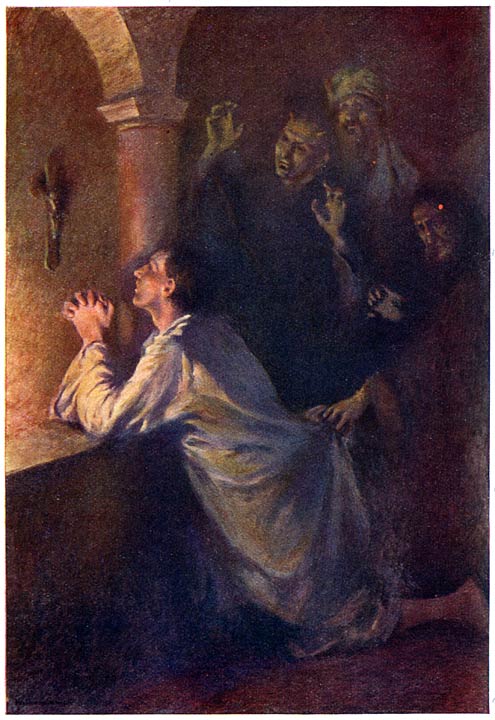
The young man strove earnestly in prayer
Next morning when he appeared before the princess, she congratulated him on his bravery, and declared that he had won her love. The young man was overwhelmed with happiness, for although he would never have dared to reveal the secret of his heart, he also loved the princess. A barber was now summoned to attend upon the young man, and a tailor to dress him like a prince. This done, the couple went together to the castle chapel and were wedded.
A few days later they drove to the young man’s village, and as they stopped outside his home they heard great rejoicing and music, whereat they understood that his two elder brothers were celebrating their marriage feasts. The youngest brother knocked on the gate, and when his father came he did not recognize his son in the richly attired prince who stood before him. He was surprised that such distinguished guests should pay him a visit, and still more so when the prince said: “Good man, will you give us your hospitality for to-night?” The father answered: “Most gladly, but we are having festivities in our house, and I fear that these common people will disturb you with their singing and music.” To this the young prince said: “Oh, no; it would please me to see the peasants feasting, and my wife would like it even more than I.”
They now entered the house, and as the hostess curtsied deeply before them the prince congratulated her, saying: “How happy you must be to see your two sons wedded on the same day!” The woman sighed. “Ah,” said she, “on one hand I have joy and on the other mourning: I had a third son, who went out in the world, and who knows what ill fate may have befallen him?”
After a time the young prince found an opportunity to step into his old room, and put on one of his old suits over his costly attire. He then returned to the room where the feast was spread and stood behind the door. Soon his two brothers saw him, and they called out: “Come here, father, and see your much-praised son, who went and stole like a thief!” The father turned, and seeing the young man, he exclaimed: “Where have you been for so long, and where is your sweetheart?”
Then the youngest son said: “Do not reproach me; all is well with me and with you!” As he spake he took off his old garments and stood revealed in his princely dress. Then he told his story and introduced his wife to his parents.
The brothers now expressed contrition for their conduct, and received the prince’s pardon, after which they all embraced; the feasting was renewed, and the festivities went on for several days. Finally the young prince distributed amongst his father and brothers large portions of his new lands, and they all lived long and happily together.
Once upon a time, a long while ago, there lived in a very far-off country, a young nobleman who was so exceedingly poor that all his property was an old castle, a handsome horse, a trusty hound, and a good rifle.
This nobleman spent all his time in hunting and shooting, and lived entirely on the produce of the chase.
One day he mounted his well-kept horse and rode off to the neighbouring forest, accompanied, as usual, by his faithful hound. When he came to the forest he dismounted, fastened his horse securely to a young tree, and then went deep into the thicket in search of game. The hound ran on at a distance before his master, and the horse remained all alone, grazing quietly. Now it happened that a hungry fox came by that way and, seeing how well-fed and well-trimmed the horse was, stopped a while to admire him. By and by she was so charmed with the handsome horse, that she lay down in the grass near him to bear him company.
Some time afterward the young nobleman came back out of the forest, carrying a stag that he had killed, and was extremely surprised to see the fox lying so near his horse. So he raised his rifle with the intention of shooting her; but the fox ran up to him quickly and said, “Do not kill me! Take me with you, and I will serve you faithfully. I will take care of your fine horse whilst you are in the forest.”
The fox spoke so pitifully that the nobleman was sorry for her, and agreed to her proposal. Thereupon he mounted his horse, placed the stag he had shot before him, and rode back to his old castle, followed closely by his hound and his new servant, the fox.
When the young nobleman prepared his supper, he did not forget to give the fox a due share, and she congratulated herself that she was never likely to be hungry again, at least so long as she served so skilful a hunter.
The next morning the nobleman went out again to the chase; the fox also accompanied him. When the young man dismounted and bound his horse, as usual, to a tree, the fox lay down near it to keep it company.
Now, whilst the hunter was far off in the depth of the forest looking for game, a hungry bear came by the place where the horse was tied, and, seeing how invitingly fat it looked, ran up to kill it. The fox hereupon sprang up and begged the bear not to hurt the horse, telling him if he was hungry he had only to wait patiently until her master came back from the forest, and then she was quite sure that the good nobleman would take him also to his castle and feed him, and care for him, as he did for his horse, his hound, and herself.
The bear pondered over the matter very wisely and deeply for some time, and at length resolved to follow the fox’s advice. Accordingly he lay down quietly near the horse, and waited for the return of the huntsman. When the young noble came out of the forest he was greatly surprised to see so large a bear near his horse, and, dropping the stag he had shot from his shoulders, he raised his trusty rifle and was about to shoot the beast. The fox, however, ran up to the huntsman and entreated him to spare the bear’s life, and to take him, also, into his service. This the nobleman agreed to do; and, mounting his horse, rode back to his castle, followed by the hound, the fox, and the bear.
The next morning, when the young man had gone again with his dog into the forest, and the fox and the bear lay quietly near the horse, a hungry wolf, seeing the horse, sprang out of a thicket to kill it. The fox and the bear, however, jumped up quickly and begged him not to hurt the animal, telling him to what a good master it belonged, and that they were sure, if he would only wait, he also would be taken into the same service, and would be well cared for. Thereupon the wolf, hungry though he was, thought it best to accept their counsel, and he also lay down with them in the grass until their master come out of the forest.
You can imagine how surprised the young nobleman was when he saw a great gaunt wolf lying so near his horse! However, when the fox had explained the matter to him, he consented to take the wolf also into his service. Thus it happened that this day he rode home followed by the dog, the fox, the bear, and the wolf. As they were all hungry, the stag he had killed was not too large to furnish their suppers that night, and their breakfasts next morning. Not many days afterward a mouse was added to the company, and after that a mole begged so hard for admission that the good nobleman could not find in his heart to refuse her. Last of all came the great bird, the kumrekusha—so strong a bird that she can carry in her claws a horse with his rider! Soon after a hare was added to the company, and the nobleman took great care of all his animals and fed them regularly and well, so that they were all exceedingly fond of him.
The Animals’ Council
One day the fox said to the bear, “My good Bruin, pray run into the forest and bring me a nice large log, on which I can sit whilst I preside at a very important council we are going to hold.”
Bruin, who had a great respect for the quick wit and good management of the fox, went out at once to seek the log, and soon came back bringing a heavy one, with which the fox expressed herself quite satisfied. Then she called all the animals about her, and, having mounted the log, addressed them in these words:
“You know all of you, my friends, how very kind and good a master we have. But, though he is very kind, he is also very lonely. I propose, therefore, that we find a fitting wife for him.”
The assembly was evidently well pleased with this idea, and responded unanimously, “Very good, indeed, if we only knew any girl worthy to be the wife of our master; which, however, we do not.”
Then the fox said, “I know that the king has a most beautiful daughter, and I think it will be a good thing to take her for our lord; and therefore I propose, further, that our friend the kumrekusha should fly at once to the king’s palace, and hover about there until the princess comes out to take her walk. Then she must catch her up at once, and bring her here.”
As the kumrekusha was glad to do anything for her kind master, she flew away at once, without even waiting to hear the decision of the assembly on this proposal.
Just before evening set in, the princess came out to walk before her father’s palace: whereupon the great bird seized her and placed her gently on her outspread wings, and thus carried her off swiftly to the young nobleman’s castle.
The king was exceedingly grieved when he heard that his daughter had been carried off, and sent out everywhere proclamations promising rich rewards to any one who should bring her back, or even tell him where he might look for her. For a long time, however, all his promises were of no avail, for no one in the kingdom knew anything at all about the princess.
At last, however, when the king was well-nigh in despair, an old gipsy woman came to the palace and asked the king, “What will you give me if I bring back to you your daughter, the princess?”
The king answered quickly, “I will gladly give you whatever you like to ask, if only you bring me back my daughter!”
Then the old gipsy went back to her hut in the forest, and tried all her magical spells to find out where the princess was. At last she found out that she was living in an old castle, in a very distant country, with a young nobleman who had married her.
The Magic Carpet
The gipsy was greatly pleased when she knew this, and taking a whip in her hand seated herself at once in the middle of a small carpet, and lashed it with her whip. Then the carpet rose up from the ground and bore her swiftly through the air, toward the far country where the young nobleman lived, in his lonely old castle, with his beautiful wife, and all his faithful company of beasts.
When the gipsy came near the castle she made the carpet descend on the grass among some tress, and leaving it there went to look about until she could meet the princess walking about the grounds. By and by the beautiful young lady came out of the castle, and immediately the ugly old woman went up to her, and began to fawn on her and to tell her all kinds of strange stories. Indeed, she was such a good story-teller that the princess grew quite tired of walking before she was tired of listening; so, seeing the soft carpet lying nicely on the green grass, she sat down on it to rest awhile. The moment she was seated the cunning old gipsy sat down by her, and, seizing her whip, lashed the carpet furiously. In the next minute the princess found herself borne upon the carpet far away from her husband’s castle, and before long the gipsy made it descend into the garden of the king’s palace.
You can easily guess how glad he was to see his lost daughter, and how he generously gave the gipsy even more than she asked as a reward. Then the king made the princess live from that time in a very secluded tower with only two waiting-women, so afraid was he lest she would again be stolen from him.
Meanwhile the fox, seeing how miserable and melancholy her young master appeared after his wife had so strangely been taken from him, and having heard of the great precautions which the king was using in order to prevent the princess being carried off again, summoned once more all the animals to a general council.
When all of them were gathered about her, the fox thus began: “You know all of you, my dear friends, how happily our kind master was married; but you know, also, that his wife has been unhappily stolen from him, and that he is now far worse off than he was before we found the princess for him. Then he was lonely; now he is more than lonely—he is desolate! This being the case, it is clearly our duty, as his faithful servants, to try in some way to bring her back to him. This, however, is not a very easy matter, seeing that the king has placed his daughter for safety in a strong tower. Nevertheless, I do not despair, and my plan is this: I will turn myself into a beautiful cat, and play about in the palace gardens under the windows of the tower in which the princess lives. I dare say she will long for me greatly the moment she sees me, and will send her waiting-women down to catch me and take me up to her. But I will take good care that the maids do not catch me, so that, at last, the princess will forget her father’s orders not to leave the tower, and will come down herself into the gardens to see if she may not be more successful. I will then make believe to let her catch me, and at this moment our friend, the kumrekusha, who must be hovering over about the palace, must fly down quickly, seize the princess, and carry her off as before. In this way, my dear friends, I hope we shall be able to bring back to our kind master his beautiful wife. Do you approve of my plan?”
Of course, the assembly were only too glad to have such a wise counsellor, and to be able to prove their gratitude to their considerate master. So the fox ran up to the kumrekusha, who flew away with her under her wing, both being equally eager to carry out the project, and thus to bring back the old cheerful look to the face of their lord.
When the kumrekusha came to the tower wherein the princess dwelt she set the fox down quietly among the trees, where it at once changed into a most beautiful cat, and commenced to play all sorts of graceful antics under the window at which the princess sat. The cat was striped all over the body with many different colours, and before long the king’s daughter noticed her, and sent down her two women to catch her and bring her up in the tower.
The two waiting-women came down into the garden, and called, “Pussy! pussy!” in their sweetest voices; they offered her bread and milk, but they offered it all in vain. The cat sprang merrily about the garden, and ran round and round them, but would on no account consent to be caught.
At length the princess, who stood watching them at one of the windows of her tower, became impatient, and descended herself into the garden, saying petulantly, “You only frighten the cat; let me try to catch her!” As she approached the cat, who seemed now willing to be caught, the kumrekusha darted down quickly, seized the princess by the waist, and carried her high up into the air.
The frightened waiting-women ran to report to the king what had happened to the princess; whereupon the king immediately let loose all his greyhounds to seize the cat which had been the cause of his daughter’s being carried off a second time. The dogs followed the cat closely, and were on the point of catching her, when she, just in the nick of time, saw a cave with a very narrow entrance and ran into it for shelter. There the dogs tried to follow her, or to widen the mouth of the cave with their claws, but all in vain; so, after barking a long time very furiously, they at length grew weary, and stole back ashamed and afraid to the king’s stables.
When all the greyhounds were out of sight the cat changed herself back into a fox, and ran off in a straight line toward the castle, where she found her young master very joyful, for the kumrekusha had already brought back to him his beautiful wife.
The King makes War on the Animals
Now the king was exceedingly angry to think that he had again lost his daughter, and he was all the more angry to think that such poor creatures as a bird and a cat had succeeded in carrying her off after all his precautions. So, in his great wrath, he resolved to make a general war on the animals, and entirely exterminate them.
To this end he gathered together a very large army, and determined to be himself their leader. The news of the king’s intention spread swiftly over the whole kingdom, whereupon for the third time the fox called together all her friends—the bear, the wolf, the kumrekusha, the mouse, the mole, and the hare—to a general council.
When all were assembled the fox addressed them thus: “My friends, the king has declared war against us, and intends to destroy us all. Now it is our duty to defend ourselves in the best way we can. Let us each see what number of animals we are able to muster. How many of your brother bears do you think you can bring to our help, my good Bruin?”
The bear got up as quickly as he could on his hind legs and called out, “I am sure I can bring a hundred.”
“And how many of your friends can you bring, my good wolf?” asked the fox anxiously.
“I can bring at least five hundred wolves with me,” said the wolf with an air of importance.
The fox nodded her satisfaction and continued, “And what can you do for us, dear master hare?”
“Well, I think, I can bring about eight hundred,” said the hare cautiously.
“And what can you do, you dear little mouse?”
“Oh, I can certainly bring three thousand mice.”
“Very well, indeed!—and you Mr. Mole?”
“I am sure I can gather eight thousand.”
“And now what number do you think you can bring us, my great friend, kumrekusha?”
“I fear not more than two or three hundred, at the very best,” said the kumrekusha sadly.
“Very good; now all of you go at once and collect your friends; when you have brought all you can, we will decide what is to be done,” said the fox; whereupon the council broke up, and the animals dispersed in different directions throughout the forest.
Not very long after, very unusual noises were heard in the neighbourhood of the castle. There was a great shaking of trees; and the growling of bears and the short sharp barking of wolves broke the usual quiet of the forest. The army of animals was gathering from all sides at the appointed place. When all were gathered together the fox explained to them her plans in these words: “When the king’s army stops on its march to rest the first night, then you, bears and wolves, must be prepared to attack and kill all the horses. If, notwithstanding this, the army proceeds farther, you mice must be ready to bite and destroy all the saddle-straps and belts while the soldiers are resting the second night, and you hares must gnaw through the ropes with which the men draw the cannon. If the king still persists in his march, you moles must go the third night and dig out the earth under the road they will take the next day, and must make a ditch full fifteen yards in breadth and twenty yards in depth all round their camp. Next morning, when the army begins to march over this ground which has been hollowed out, you kumrekushas must throw down on them from above heavy stones while the earth will give way under them.”