Chapter XLIV · STORAGE BATTERIES (continued 2)
Reading edition
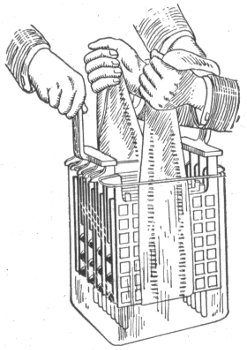
Fig. 1,167.—Illustrating method of placing plates in glass jars.
Ques. What should be done in case of sulphation?
Ans. Charge the battery below the maximum rate, necessarily prolonging the charge, until the plates assume the proper color. This is a tedious task, but it must not be hastened, as rapid charging will cause serious buckling.
NOTE.—How to destroy acid vapor in storage battery rooms: The best remedy is a good system of thorough and rapid ventilation; failing this the evil effect of the acid may be minimized by the fumes of a powerful alkali such as ammonia, which will readily combine with the sulphuric acid to form sulphate of ammonia, an inert and harmless salt. If the use of liquid ammonia be objectionable, the granulated carbonate of ammonia will do equally well. The ammonia fumes are best obtained by placing dilute ammonia in shallow dishes, so that an extensive evaporating surface is obtained. In the same way the corroding dew which is so frequently deposited on the lugs and connectors of storage battery elements may readily be neutralized by the application of a solution of ammonia, or even common washing soda. A good method of protecting metal work in battery rooms is to smear it over evenly with vaseline.
The charging should be done at low rates. Discharge should not be carried below 1.8 volts per cell, and the charging current should be stopped when each cell shows 2.4 volts.
If the plates be in a very bad condition, a little of the white sulphate deposit on each of the positive plates may be removed with a stick, thus exposing a part of the good surface to the action of the electrolyte.
If the positive plates cannot be restored to their proper color as directed, it is cheaper to replace them by a new set, rather than to attempt their recovery by means of reversals.
Electrical Data on "National" Cells
(Size of plate 4⅞" × 8⅝")
Number of Plates per cell 5 7 9 11
Discharge in amperes {for 4 hours 12 18 24 30
{for 5 hours 10¼ 15¼ 20½ 25½
{for 6 hours 9¼ 13¾ 18½ 23
Ampere hour capacity {at 4 hour rate 48 72 96 120
{at 5 hour rate 51 76 102 127
{at 6 hour rate 55 83 110 138
Outside measurements of rubber jar, in inches {Length 1⅞ 2⅝ 3⅜ 43/16
{Width 55/16 55/16 55/16 55/16
{Height 11¾ 11¾ 11¾ 11¾
Weight of cell complete, in lbs 14¼ 19¼ 24¼ 29¾
Weight of electrolyte, in lbs 1 2 3½ 5
Lack of Capacity.—This is usually due to the clogging of the pores in the plate with sulphate which is invisible because the surface of the plate is maintained in proper condition but the interior portions of the active material have not been thoroughly reduced. To correct this condition, the battery should be given a prolonged overcharge at low current rates, say about one fourth the normal 8 hour charging rate.
NOTE.—Oxide of lead, litharge, or plumbic oxide is sometimes found native as lead ochre, and may be artificially made by heating the carbonate or nitrate. It is usually prepared on a larger scale by heating the lead in air. When the metal is only moderately heated, the oxide forms a yellow powder which is known as massicot, but at a higher temperature the oxide melts, and on cooling, it forms a brownish scaly mass, which is called flake litharge. The scaly pieces are afterwards ground between stones under water, forming buff or levegated litharge. The litharge of commerce often has a reddish yellow color, due to the presence of some of the red oxide of lead, and frequently from one to three per cent. of finely divided metallic lead is found mixed with it. When heated to dull redness litharge assumes a dark brown color, and becomes yellow again on cooling. At a bright red heat it fuses and readily attacks clay crucibles, forming silicate of lead. Litharge is a most powerful base, and has a strong tendency to form basic salts. Hot solution of alkalies, as potash or soda, readily dissolve it, and on cooling, it crystalizes out in the form of beautiful pink crystals.
Falling off in the capacity may be caused by a dry cell, due to a leaking jar; some or all of the cells may be in a state of incomplete charge, due to the battery having been run too low and not sufficiently charged; or the plates may be short circuited, either by the sediment (deposit in the bottom of the jar) getting up to the bottom of the plates or by something that has fallen into the cell.
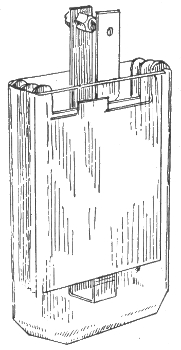
Electrical Data on "American" Cells Normal Capacity Number of 30 volt Tungsten lamps that can be run with 16 cells in series for 2, 4, 6 or 8 hours Ampere hours 2 hours 4 hours 6 hours 8 hours 40 14 9 8 7 60 17 14 12 10 80 28 18 15 14 120 42 27 24 21 160 57 37 31 28 20 71 45 40 35 250 88 56 50 44 300 106 70 60 52 350 124 81 71 62 400 142 91 81 71 Fig. 1,168.—"American" cell.
Ques. What action takes place when a battery stands idle for some time?
Ans. It loses part of its charge, due to local losses in the cells.
Ques. How should batteries be treated, when used but occasionally?
Ans. If a battery is not to be used for several days, it should first be fully charged before standing; if it continue idle, a freshening charge should be given every two weeks, continuing the charge when the cells begin to gas freely.
Ques. What should be done in case of lack of capacity?
Ans. If the current consumption be normal, there may be poor connections or trouble in the battery; there may be a dry cell, due to a leaking jar; some or all of the cells may be in a state of incomplete charge, due to the battery having been run too low and not sufficiently charged, or the plates may be short circuited, either by the sediment (deposit in the bottom of the jar) getting up to the bottom of the plates or by something that has fallen into the cell.
Electrical Data on "Autex" Cells
(Standard plates; size, 5¾" x 8⅝")
Number of Plates 7 9 11 13 15 17 19 21
Discharge in Amperes for 4 hours 21 28 35 42 49 56 63 70
Outside Measurements Rubber Jars in inches. {Length 2¾ 3½ 4¼ 5 5¾ 6½ 7¼ 8
{Width 6⅛ 6⅛ 6⅛ 6⅛ 6⅛ 6⅛ 6⅛ 6⅛
{Height 12⅜ 12⅜ 12⅜ 12⅜ 12⅜ 12⅜ 12⅜ 12⅜
Weight in Pounds {Element 15¾ 20¼ 24¼ 29¾ 34 38½ 43 47½
{Electrolyte 4½ 5 5¾ 6¼ 7 7¾ 8½ 9¾
{Complete Cell 22 28 34¼ 40½ 47 53¼ 59½ 66
NOTE.—Peroxide of lead, pure oxide or plumbic dioxide is the true active material in all forms of lead storage cell. This lead salt is found native as the mineral plattnerite. It is a heavy lead ore, forming black, lustrous, six sided prisms. It may be prepared from the red oxide by boiling it in fine powder, with nitric acid diluted with five parts of water, or by treating the carbonate when suspended in water with a stream of chlorine gas, and then thoroughly washing and drying it. It is reduced to a lower oxide on heating or by exposure to bright sunlight. This salt readily imparts oxygen to other substances; it becomes heated to redness when thrown into sulphuric dioxide, and takes fire when triturated with sulphur—hence this oxide is a common ingredient in lucifer match composition. When used in primary or secondary batteries it readily imparts its oxygen to nascent hydrogen, forming water, and thus it acts as a powerful depolarizer. When robbed of its oxygen, it readily becomes reoxidized, if subjected to the action of nascent oxygen liberated by the electrolytic decomposition of water.
If the trouble cannot be located by the eye, connect the battery in series, and discharge it at the normal rate, through suitable resistance. If a suitable rheostat be not available, a water resistance may be used.
This consists of a receptacle (which must not be of metal) filled with very weak acid solution or salt water in which are suspended two metal plates, which are connected, by wires through an ammeter.
Electrical Data on "Autex" Cells
(Light weight plates; size, 5¾" × 8⅝")
Number of Plates 7 9 11 13 15 17 19 21 23 25
Discharge in Amperes for 5 hours 15¾ 21 26¼ 31½ 36¾ 42 47¼ 52½ 57¾ 63
Outside Measurements Rubber Jars in in. {Length 129/32 27/16 331/32 3½ 41/32 49/16 53/32 5⅜ 65/32 611/16
{Width 6⅛ 6⅛ 6⅛ 6⅛ 6⅛ 6⅛ 6⅛ 6⅛ 6⅛ 6⅛
{Height 12⅜ 12⅜ 12⅜ 12⅜ 12⅜ 12⅜ 12⅜ 12⅜ 12⅜ 12⅜
Weight in Pounds {Element 11½ 14¾ 18 21¼ 24½ 27¾ 31 34¼ 37¼ 40½
{Electrolyte 2¼ 2½ 3 3¾ 4¼ 4¼ 5½ 6 6¾ 7¼
{Comp. Cell 15¾ 20 24¼ 28½ 33¼ 38 42 46¼ 51½ 56
The current may be regulated by altering the distance between the plates or by varying the strength of the solution. As the discharge progresses, the voltage will gradually decrease and it should be frequently read at the battery terminals. When it shows a sudden drop, the voltage of each cell should be read with a low reading voltmeter.
While the readings are being taken, the discharge rate should be kept constant and the discharge continued until the majority of the cells read 1.70 volts; those reading less should be noted. The discharge should be followed by a charge until the cells which read 1.70 volts are up; then the low cells should be cut out, examined and the trouble remedied.
NOTE.—How to prevent lead poisoning. Workmen employed in the manufacture of lead or lead salts are always liable to lead poisoning, both by inhaling the dust and by contact of the materials with the hands. Various preventives for this have been employed, and of these, the most simple seems to be a careful washing of the hands in petroleum. It is said that three washings a day are sufficient to prevent all serious danger of poisoning. The benzole in the petroleum appears to scour the skin and remove the loose lead dust, and the fatty substance in the oil fills up the pores of the skin and prevents the absorption of the deleterious salts. The employment of petroleum has given such good results that it has been proposed to use this material as a guard against poisoning in other industries where the salts of copper or mercury are employed.
Ques. What causes low specific gravity when there are no short circuits?
Ans. 1, sloppage or a leaky jar (the loss having been replaced with water alone), 2, insufficient charge, 3, over discharge, or 4, a combination of these abuses. Any of these mean that there is acid in combination with the plates.
In this case the acid should be brought out into the electrolyte by a long charge at a quarter of the normal discharge rate.
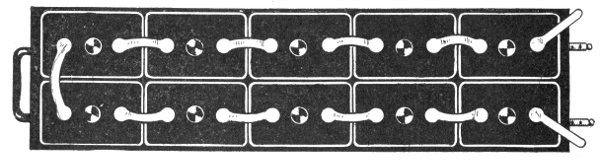
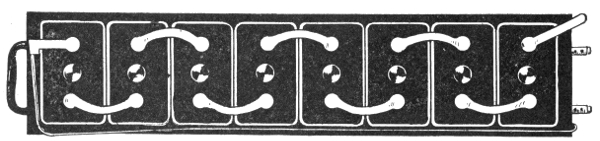
Figs. 1,169 and 1,170.—The "National" storage battery; views showing methods of assembling cells. Fig 1,169, end assembling; fig 1,170, side assembling.
Ques. How should weak cells be treated?
Ans. They should be grouped by themselves and charged as a separate battery, care being taken that the positive strap of one cell, is connected to the negative strap of the adjoining cell and that the charging connections are properly made. If there be not sufficient resistance in the charging rheostat to reduce the current to the proper point, a water resistance should be used.
NOTE.—Pole testing paper. Make a thin solution of white starch and soak strips of thin white blotting paper in it, and set aside in a clean, dry place to dry. Dissolve ½ oz. of potassium iodide in one pint of water. Immerse the strips in the solution for a few seconds and again dry. This paper, when moistened and used in the usual way, turns violet at the positive pole.
While a cell is being treated, when possible, the cover should be removed (if sealed, the compound can be loosened by using a hot putty knife).
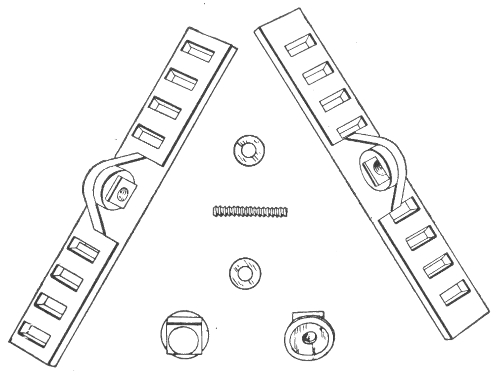
Figs. 1,171 to 1,177.—"National" battery bolt connector and parts. The connector is equipped with grease cups and antimonious lead washers.
Disconnecting Cells.—The best method of disconnecting cells assembled with pillar straps, for the purpose of replacing broken jars, cleaning or taking out of commission, is to use a five-eighth inch twist drill, in a carpenter's brace, boring down into the top of the pillar about one-quarter inch; then pull off the connector sleeve from the pillar. By following this method, all parts may be used again.
When cells are equipped with top straps, the straps should be cut with a sharp knife or chisel midway between the cells.
Taking Batteries out of Commission.—Where a battery is to be out of service for several months, and it is not convenient to give it the freshening charge every two weeks, it should be taken out of commission.
COMPARISON OF THE BAUMÉ AND SPECIFIC GRAVITY
SCALES AT 60° FAHRENHEIT
Degrees Baume Specific Gravity Degrees Baume Specific Gravity Degrees Baume Specific Gravity Degrees Baume Specific Gravity
0 1.000 17 1.133 34 1.306 51 1.542
1 1.007 18 1.142 35 1.318 52 1.559
2 1.014 19 1.151 36 1.330 53 1.576
3 1.021 20 1.160 37 1.342 54 1.593
4 1.028 21 1.169 38 1.355 55 1.611
5 1.036 22 1.179 39 1.368 56 1.629
6 1.043 23 1.188 40 1.381 57 1.648
7 1.051 24 1.198 41 1.394 58 1.666
8 1.058 25 1.208 42 1.408 59 1.686
9 1.066 26 1.218 43 1.421 60 1.707
10 1.074 27 1.229 44 1.436 61 1.726
11 1.082 28 1.239 45 1.450 62 1.747
12 1.090 29 1.250 46 1.465 63 1.768
13 1.098 30 1.261 47 1.479 64 1.790
14 1.107 31 1.272 48 1.495 65 1.812
15 1.115 32 1.283 49 1.510 66 1.835
16 1.124 33 1.295 50 1.526
NOTE.—The characteristic properties of concentrated sulphuric acid are very marked. Its freedom from odor, oily appearance, and its great weight, distinguish it from other liquids. The pure concentrated commercial acid has a density which usually reaches 1.842, and its boiling point is about 640° F. The absolutely pure acid is perfectly colorless, but usually even that used in laboratories has a peculiar grayish color, due to slight traces of organic matter. Sulphuric acid is exceedingly hydroscopic, and when exposed to the air it rapidly increases in bulk, owing to absorption of atmospheric moisture.
NOTE.—Clamps not made of metal similar to that of the connecting strips, frequently give trouble from the galvanic action due to the contact of dissimilar metals in the presence of moisture which causes the destruction of either the connecting strip or the clamp. Such troubles can be avoided by placing a thin strip of sheet zinc between the lead strip and the clamp. Under these circumstances the zinc will crumble away, and can be replaced without much inconvenience and very little expense, while the clamps and connecting strips will remain uninjured.
Strength of Dilute Sulphuric Acid
of
Different Densities at 59° Fahr.
Per cent. of Sulphuric Acid Specific Gravity Per cent. of Sulphuric Acid Specific Gravity
100 1.842 23 1.167
40 1.306 22 1.159
31 1.231 21 1.151
30 1.223 20 1.144
29 1.215 19 1.136
28 1.206 18 1.129
27 1.198 17 1.121
26 1.190 16 1.116
25 1.172 15 1.106
24 1.174 14 1.098
Ques. Describe the method of taking a battery out of commission.
Ans. The battery is charged in the usual manner, until the specific gravity of the electrolyte of every cell has stopped rising over a period of one hour (if there be any low cells, due to short circuits or other cause, they should be put in condition before the charge is started, so that they will receive the full benefit of it). The cells may now be disconnected and covers and elements removed from the jars, (if sealed, the compound is loosened with a hot putty knife). The elements are placed on their sides with the plates slightly spread apart at the bottom, the separators withdrawn, and the positive and negative groups pulled apart. The electrolyte is washed off with a gentle stream of water and the plates allowed to drain and dry.7 The positive plates are ready to be put away. When dry, the negatives are completely immersed in electrolyte (of about 1.275 specific gravity), and allowed to soak for three or four hours. The jars may be used for this purpose. After rinsing and drying, they are ready to be put away; wash also the rubber separators.
Wood separators, after having been in service, will not stand much handling and had better be thrown away. If it be thought worth while to keep them, they must be immersed in water or weak electrolyte, and in re-assembling, the electrolyte must be put into the cells immediately, as wet wood separators must not stand exposed to the air.
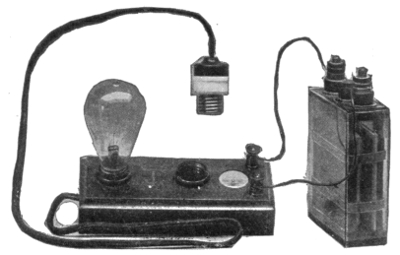
Fig. 1,178.—The "Witham" charging board, for charging from any electric outlet on a direct current system. The instrument shows the direction of the current, and the candle power of the lamps used as resistance indicates approximately the strength of the current passing. Operation: From any convenient electric light fitting remove one of the lamps, replacing it by the plug attached to the flexible cord. Screw the lamp into one of the sockets on the charging board. Connect a wire to each binding post, and before joining up to the battery, hold the ends of the two wires together. The lamp will then light up and the indicator needle will point to that binding post which must be connected to the positive (+) terminal of the battery. The other binding post must, of course, be connected to the negative (-) of the battery. The charging current can be increased by inserting another lamp into the second socket on the charging board and by using lamps of higher candle power. If, when the lamp lights up, the indicator needle do not point to one of the binding posts, but retain its position midway, then the current is an alternating one and will not charge the battery.
Ques. What precaution should be taken with the jars?
Ans. They should be thoroughly cleaned with fresh water, no sediment being allowed to remain.
Putting Batteries into Commission.—When re-assembling a battery, it should be treated in the same manner as if it were new and the regular instructions for assembling and putting a new battery into commission followed.
Cleaning Jars.—The jars should be thoroughly cleaned with fresh water, no sediment being allowed to remain.
Table of Voltage Change as Affected by Discharge Rate
8
8 hour rate .05 volt
6 " " .065 "
4 " " .09 "
3 " " .11 "
2 " " .14 "
1½ " " .18 "
1 " " .21 "
Condensed Rules for the Proper Care of Batteries.—The following general instructions should be followed in the care and maintenance of batteries:
1. A battery must always be charged with "direct" current and in the right direction.
2. Be careful to charge at the proper rates and to give the right amount of charge; do not undercharge or overcharge to an excessive degree.
3. Do not bring a naked flame near the battery while charging or immediately afterwards.
4. Do not overdischarge.
5. Do not allow the battery to stand completely discharged.
6. Voltage readings should be taken only when the battery is charging or discharging; if taken when the battery is standing idle they are of little or no value.
7. Do not allow the battery temperature to exceed 110° Fahr.
8. Keep the electrolyte at the proper height above the top of the plates and at the proper specific gravity. Use only pure water to replace loss by evaporation. In preparing the electrolyte never pour water into the acid.
9. Keep the cells free from dirt and all foreign substances, both solid and liquid.
10. Keep the battery and all connections clean; keep all bolted connections tight.
11. If there be lack of capacity in a battery, due to low cells, do not delay in locating and bringing them back to condition.
12. Do not allow sediment to get up to the plates.