Volume 1 / Part 1 — PART I.
Reading edition
The present paper reports the beginnings of an investigation designed to throw light on the psychological basis of our æsthetic pleasure in unequal division. It is confined to horizontal division. Owing to the prestige of the golden section, that is, of that division of the simple line which gives a short part bearing the same ratio to the long part that the latter bears to the whole line, experimentation of this sort has been fettered. Investigators have confined their efforts to statistical records of approximations to, or deviations from, the golden section. This exalts it into a possible æsthetic norm. But such a gratuitous supposition, by limiting the inquiry to the verification of this norm, distorts the results, tempting one to forget the provisional nature of the assumption, and to consider divergence from the golden section as an error, instead of another example, merely, of unequal division. We have, as a matter of fact, on one hand, investigations that do not verify the golden section, and, on the other hand, a series of attempts to account for our pleasure in it, as if it were, beyond dispute, the norm. In this way the statistical inquiries have been narrowed in scope, and interpretation retarded and misdirected. Statistically our aim should be to ascertain within how wide limits æsthetically pleasing unequal divisions fall; and an interpretative principle must be flexible enough to include persistent variations from any hypothetical norm, unless they can be otherwise accounted for. If it is not forced on us, we have, in either case, nothing to do with the golden section.
Since Fechner, the chief investigation in the æsthetics of simple forms is that of Witmer, in 1893.1 Only a small part of his work relates to horizontal division, but enough to show what seems to me a radical defect in statistical method, namely, that of accepting a general average of the average judgments of the several subjects, as 'the most pleasing relation' or 'the most pleasing proportion.'2 Such a total average may fall wholly without the range of judgments of every subject concerned, and tells us nothing certain about the specific judgments of any one. Even in the case of the individual subject, if he shows in the course of long experimentation that he has two distinct sets of judgments, it is not valid to say that his real norm lies between the two; much less when several subjects are concerned. If averages are data to be psychophysically explained, they must fall well within actual individual ranges of judgment, else they correspond to no empirically determinable psychophysical processes. Each individual is a locus of possible æsthetic satisfactions. Since such a locus is our ultimate basis for interpretation, it is inept to choose, as 'the most pleasing proportion,' one that may have no correspondent empirical reference. The normal or ideal individual, which such a norm implies, is not a psychophysical entity which may serve as a basis of explanation, but a mathematical construction.
This criticism would apply to judgments of unequal division on either side the center of a horizontal line. It would apply all the more to any general average of judgments including both sides, for, as we shall soon see, the judgments of individuals differ materially on the two sides, and this difference itself may demand its explanation. And if we should include within this average, judgments above and below the center of a vertical line, we should have under one heading four distinct sets of averages, each of which, in the individual cases, might show important variations from the others, and therefore require some variation of explanation. And yet that great leveller, the general average, has obliterated these vital differences, and is recorded as indicating the 'most pleasing proportion.'3 That such an average falls near the golden section is immaterial. Witmer himself, as we shall see,4 does not set much store by this coincidence as a starting point for explanation, since he is averse to any mathematical interpretation, but he does consider the average in question representative of the most pleasing division.
I shall now, before proceeding to the details of the experiment to be recorded, review, very briefly, former interpretative tendencies. Zeising found that the golden section satisfied his demand for unity and infinity in the same beautiful object.5 In the golden section, says Wundt,6 there is a unity involving the whole; it is therefore more beautiful than symmetry, according to the æsthetic principle that that unification of spatial forms which occurs without marked effort, which, however, embraces the greater manifold, is the more pleasing. But to me this manifold, to be æsthetic, must be a sensible manifold, and it is still a question whether the golden section set of relations has an actual correlate in sensations. Witmer,7 however, wrote, at the conclusion of his careful researches, that scientific æsthetics allows no more exact statement, in interpretation of the golden section, than that it forms 'die rechte Mitte' between a too great and a too small variety. Nine years later, in 1902, he says8 that the preference for proportion over symmetry is not a demand for an equality of ratios, but merely for greater variety, and that 'the amount of unlikeness or variety that is pleasing will depend upon the general character of the object, and upon the individual's grade of intelligence and æsthetic taste.' Külpe9 sees in the golden section 'a special case of the constancy of the relative sensible discrimination, or of Weber's law.' The division of a line at the golden section produces 'apparently equal differences' between minor and major, and major and whole. It is 'the pleasingness of apparently equal differences.'
These citations show, in brief form, the history of the interpretation of our pleasure in unequal division. Zeising and Wundt were alike in error in taking the golden section as the norm. Zeising used it to support a philosophical theory of the beautiful. Wundt and others too hastily conclude that the mathematical ratios, intellectually discriminated, are also sensibly discriminated, and form thus the basis of our æsthetic pleasure. An extension of this principle would make our pleasure in any arrangement of forms depend on the mathematical relations of their parts. We should, of course, have no special reason for choosing one set of relationships rather than another, nor for halting at any intricacy of formulæ. But we cannot make experimental æsthetics a branch of applied mathematics. A theory, if we are to have psychological explanation at all, must be pertinent to actual psychic experience. Witmer, while avoiding and condemning mathematical explanation, does not attempt to push interpretation beyond the honored category of unity in variety, which is applicable to anything, and, in principle, is akin to Zeising's unity and infinity. We wish to know what actual psychophysical functionings correspond to this unity in variety. Külpe's interpretation is such an attempt, but it seems clear that Weber's law cannot be applied to the division at the golden section. It would require of us to estimate the difference between the long side and the short side to be equal to that of the long side and the whole. A glance at the division shows that such complex estimation would compare incomparable facts, since the short and the long parts are separated, while the long part is inclosed in the whole. Besides, such an interpretation could not apply to divisions widely variant from the golden section.
This paper, as I said, reports but the beginnings of an investigation into unequal division, confined as it is to results obtained from the division of a simple horizontal line, and to variations introduced as hints towards interpretation. The tests were made in a partially darkened room. The apparatus rested on a table of ordinary height, the part exposed to the subject consisting of an upright screen, 45 cm. high by 61 cm. broad, covered with black cardboard, approximately in the center of which was a horizontal opening of considerable size, backed by opal glass. Between the glass and the cardboard, flush with the edges of the opening so that no stray light could get through, a cardboard slide was inserted from behind, into which was cut the exposed figure. A covered electric light illuminated the figure with a yellowish-white light, so that all the subject saw, besides a dim outline of the apparatus and the walls of the room, was the illuminated figure. An upright strip of steel, 1½ mm. wide, movable in either direction horizontally by means of strings, and controlled by the subject, who sat about four feet in front of the table, divided the horizontal line at any point. On the line, of course, this appeared as a movable dot. The line itself was arbitrarily made 160 mm. long, and 1½ mm. wide. The subject was asked to divide the line unequally at the most pleasing place, moving the divider from one end slowly to the other, far enough to pass outside any pleasing range, or, perhaps, quite off the line; then, having seen the divider at all points of the line, he moved it back to that position which appealed to him as most pleasing. Record having been made of this, by means of a millimeter scale, the subject, without again going off the line, moved to the pleasing position on the other side of the center. He then moved the divider wholly off the line, and made two more judgments, beginning his movement from the other end of the line. These four judgments usually sufficed for the simple line for one experiment. In the course of the experimentation each of nine subjects gave thirty-six such judgments on either side the center, or seventy-two in all.
In Fig. 1, I have represented graphically the results of these judgments. The letters at the left, with the exception of X, mark the subjects. Beginning with the most extreme judgments on either side the center, I have erected modes to represent the number of judgments made within each ensuing five millimeters, the number in each case being denoted by the figure at the top of the mode. The two vertical dot-and-dash lines represent the means of the several averages of all the subjects, or the total averages. The short lines, dropped from each of the horizontals, mark the individual averages of the divisions either side the center, and at X these have been concentrated into one line. Subject E obviously shows two pretty distinct fields of choice, so that it would have been inaccurate to condense them all into one average. I have therefore given two on each side the center, in each case subsuming the judgments represented by the four end modes under one average. In all, sixty judgments were made by E on each half the line. Letter E¹ represents the first thirty-six; E² the full number. A comparison of the two shows how easily averages shift; how suddenly judgments may concentrate in one region after having been for months fairly uniformly distributed. The introduction of one more subject might have varied the total averages by several points. Table I. shows the various averages and mean variations in tabular form.
TABLE I.
Left.Right.
Div.M.V.Div.M.V.
A542.6503.4
B464.5495.7
C751.8711.6
D624.4564.1
E¹5710.7608.7
F692.6691.6
G653.7642.7
H723.8672.1
J461.9481.3
————
Total603.9593.5
Golden Section = 61.1.
¹These are E's general averages on 36 judgments. Fig. 1, however, represents two averages on each side the center, for which the figures are, on the left, 43 with M.V. 3.6; and 66 with M.V. 5.3. On the right, 49, M.V. 3.1; and 67, M.V. 2.7. For the full sixty judgments, his total average was 63 on the left, and 65 on the right, with mean variations of 9.8 and 7.1 respectively. The four that E² in Fig. 1 shows graphically were, for the left, 43 with M.V. 3.6; and 68, M.V. 5.1. On the right, 49, M.V. 3.1; and 69, M.V. 3.4.
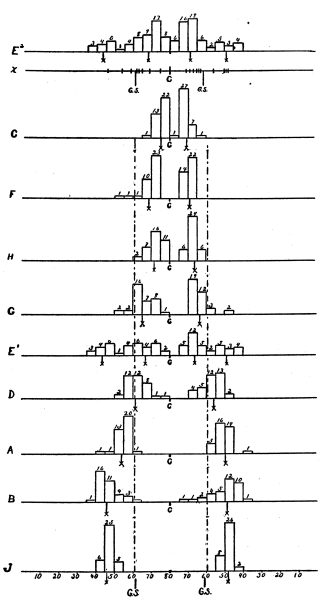
Fig. 1.
Results such as are given in Fig. 1, appear to warrant the criticism of former experimentation. Starting with the golden section, we find the two lines representing the total averages running surprisingly close to it. This line, however, out of a possible eighteen chances, only twice (subjects D and G) falls wholly within the mode representing the maximum number of judgments of any single subject. In six cases (C twice, F, H, J twice) it falls wholly without any mode whatever; and in seven (A, B twice, E, F, G, H) within modes very near the minimum. Glancing for a moment at the individual averages, we see that none coincides with the total (although D is very near), and that out of eighteen, only four (D twice, G twice) come within five millimeters of the general average, while eight (B, C, J twice each, F, H) lie between ten and fifteen millimeters away. The two total averages (although near the golden section), are thus chiefly conspicuous in showing those regions of the line that were avoided as not beautiful. Within a range of ninety millimeters, divided into eighteen sections of five millimeters each, there are ten such sections (50 mm.) each of which represents the maximum of some one subject. The range of maximum judgments is thus about one third the whole line. From such wide limits it is, I think, a methodological error to pick out some single point, and maintain that any explanation whatever of the divisions there made interprets adequately our pleasure in unequal division. Can, above all, the golden section, which in only two cases (D, G) falls within the maximum mode; in five (A, C, F, J twice) entirely outside all modes, and in no single instance within the maximum on both sides the center—can this seriously play the role of æsthetic norm?
I may state here, briefly, the results of several sets of judgments on lines of the same length as the first but wider, and on other lines of the same width but shorter. There were not enough judgments in either case to make an exact comparison of averages valuable, but in three successively shorter lines, only one subject out of eight varied in a constant direction, making his divisions, as the line grew shorter, absolutely nearer the ends. He himself felt, in fact, that he kept about the same absolute position on the line, regardless of the successive shortenings, made by covering up the ends. This I found to be practically true, and it accounts for the increasing variation toward the ends. Further, with all the subjects but one, two out of three pairs of averages (one pair for each length of line) bore the same relative positions to the center as in the normal line. That is, if the average was nearer the center on the left than on the right, then the same held true for the smaller lines. Not only this. With one exception, the positions of the averages of the various subjects, when considered relatively to one another, stood the same in the shorter lines, in two cases out of three. In short, not only did the pair of averages of each subject on each of the shorter lines retain the same relative positions as in the normal line, but the zone of preference of any subject bore the same relation to that of any other. Such approximations are near enough, perhaps, to warrant the statement that the absolute length of line makes no appreciable difference in the æsthetic judgment. In the wider lines the agreement of the judgments with those of the normal line was, as might be expected, still closer. In these tests only six subjects were used. As in the former case, however, E was here the exception, his averages being appreciably nearer the center than in the original line. But his judgments of this line, taken during the same period, were so much on the central tack that a comparison of them with those of the wider lines shows very close similarity. The following table will show how E's judgments varied constantly towards the center:
AVERAGE.
L.R.
1. Twenty-one judgments (11 on L. and 10 on R.) during experimentation on I¹, I², etc., but not on same days.6465
2. Twenty at different times, but immediately before judging on I¹, I², etc.6971
3. Eighteen similar judgments, but immediately after judging on I¹, I², etc.7271
4. Twelve taken after all experimentation with I¹, I², etc., had ceased.7169
The measurements are always from the ends of the line. It looks as if the judgments in (3) were pushed further to the center by being immediately preceded by those on the shorter and the wider lines, but those in (1) and (2) differ markedly, and yet were under no such influences.
From the work on the simple line, with its variations in width and length, these conclusions seem to me of interest. (1) The records offer no one division that can be validly taken to represent 'the most pleasing proportion' and from which interpretation may issue. (2) With one exception (E) the subjects, while differing widely from one another in elasticity of judgment, confined themselves severally to pretty constant regions of choice, which hold, relatively, for different lengths and widths of line. (3) Towards the extremities judgments seldom stray beyond a point that would divide the line into fourths, but they approach the center very closely. Most of the subjects, however, found a slight remove from the center disagreeable. (4) Introspectively the subjects were ordinarily aware of a range within which judgments might give equal pleasure, although a slight disturbance of any particular judgment would usually be recognized as a departure from the point of maximum pleasingness. This feeling of potential elasticity of judgment, combined with that of certainty in regard to any particular instance, demands—when the other results are also kept in mind—an interpretative theory to take account of every judgment, and forbids it to seize on an average as the basis of explanation for judgments that persist in maintaining their æsthetic autonomy.
I shall now proceed to the interpretative part of the paper. Bilateral symmetry has long been recognized as a primary principle in æsthetic composition. We inveterately seek to arrange the elements of a figure so as to secure, horizontally, on either side of a central point of reference, an objective equivalence of lines and masses. At one extreme this may be the rigid mathematical symmetry of geometrically similar halves; at the other, an intricate system of compensations in which size on one side is balanced by distance on the other, elaboration of design by mass, and so on. Physiologically speaking, there is here a corresponding equality of muscular innervations, a setting free of bilaterally equal organic energies. Introspection will localize the basis of these in seemingly equal eye movements, in a strain of the head from side to side, as one half the field is regarded, or the other, and in the tendency of one half the body towards a massed horizontal movement, which is nevertheless held in check by a similar impulse, on the part of the other half, in the opposite direction, so that equilibrium results. The psychic accompaniment is a feeling of balance; the mind is æsthetically satisfied, at rest. And through whatever bewildering variety of elements in the figure, it is this simple bilateral equivalence that brings us to æsthetic rest. If, however, the symmetry is not good, if we find a gap in design where we expected a filling, the accustomed equilibrium of the organism does not result; psychically there is lack of balance, and the object is æsthetically painful. We seem to have, then, in symmetry, three aspects. First, the objective quantitative equality of sides; second, a corresponding equivalence of bilaterally disposed organic energies, brought into equilibrium because acting in opposite directions; third, a feeling of balance, which is, in symmetry, our æsthetic satisfaction.
It would be possible, as I have intimated, to arrange a series of symmetrical figures in which the first would show simple geometrical reduplication of one side by the other, obvious at a glance; and the last, such a qualitative variety of compensating elements that only painstaking experimentation could make apparent what elements balanced others. The second, through its more subtle exemplification of the rule of quantitative equivalence, might be called a higher order of symmetry. Suppose now that we find given, objects which, æsthetically pleasing, nevertheless present, on one side of a point of reference, or center of division, elements that actually have none corresponding to them on the other; where there is not, in short, objective bilateral equivalence, however subtly manifested, but, rather, a complete lack of compensation, a striking asymmetry. The simplest, most convincing case of this is the horizontal straight line, unequally divided. Must we, because of the lack of objective equality of sides, also say that the bilaterally equivalent muscular innervations are likewise lacking, and that our pleasure consequently does not arise from the feeling of balance? A new aspect of psychophysical æsthetics thus presents itself. Must we invoke a new principle for horizontal unequal division, or is it but a subtly disguised variation of the more familiar symmetry? And in vertical unequal division, what principle governs? A further paper will deal with vertical division. The present paper, as I have said, offers a theory for the horizontal.
To this end, there were introduced, along with the simple line figures already described, more varied ones, designed to suggest interpretation. One whole class of figures was tried and discarded because the variations, being introduced at the ends of the simple line, suggested at once the up-and-down balance of the lever about the division point as a fulcrum, and became, therefore, instances of simple symmetry. The parallel between such figures and the simple line failed, also, in the lack of homogeneity on either side the division point in the former, so that the figure did not appear to center at, or issue from the point of division, but rather to terminate or concentrate in the end variations. A class of figures that obviated both these difficulties was finally adopted and adhered to throughout the work. As exposed, the figures were as long as the simple line, but of varying widths. On one side, by means of horizontal parallels, the horizontality of the original line was emphasized, while on the other there were introduced various patterns (fillings). Each figure was movable to the right or the left, behind a stationary opening 160 mm. in length, so that one side might be shortened to any desired degree and the other at the same time lengthened, the total length remaining constant. In this way the division point (the junction of the two sides) could be made to occupy any position on the figure. The figures were also reversible, in order to present the variety-filling on the right or the left.
If it were found that such a filling in one figure varied from one in another so that it obviously presented more than the other of some clearly distinguishable element, and yielded divisions in which it occupied constantly a shorter space than the other, then we could, theoretically, shorten the divisions at will by adding to the filling in the one respect. If this were true it would be evident that what we demand is an equivalence of fillings—a shorter length being made equivalent to the longer horizontal parallels by the addition of more of the element in which the two short fillings essentially differ. It would then be a fair inference that the different lengths allotted by the various subjects to the short division of the simple line result from varying degrees of substitution of the element, reduced to its simplest terms, in which our filling varied. Unequal division would thus be an instance of bilateral symmetry.
The thought is plausible. For, in regarding the short part of the line with the long still in vision, one would be likely, from the æsthetic tendency to introduce symmetry into the arrangement of objects, to be irritated by the discrepant inequality of the two lengths, and, in order to obtain the equality, would attribute an added significance to the short length. If the assumption of bilateral equivalence underlying this is correct, then the repetition, in quantitative terms, on one side, of what we have on the other, constitutes the unity in the horizontal disposition of æsthetic elements; a unity receptive to an almost infinite variety of actual visual forms—quantitative identity in qualitative diversity. If presented material resists objective symmetrical arrangement (which gives, with the minimum expenditure of energy, the corresponding bilateral equivalence of organic energies) we obtain our organic equivalence in supplementing the weaker part by a contribution of energies for which it presents no obvious visual, or objective, basis. From this there results, by reaction, an objective equivalence, for the psychic correlate of the additional energies freed is an attribution to the weaker part, in order to secure this feeling of balance, of some added qualities, which at first it did not appear to have. In the case of the simple line the lack of objective symmetry that everywhere meets us is represented by an unequal division. The enhanced significance acquired by the shorter part, and its psychophysical basis, will engage us further in the introspection of the subjects, and in the final paragraph of the paper. In general, however, the phenomenon that we found in the division of the line—the variety of divisions given by any one object, and the variations among the several subjects—is easily accounted for by the suggested theory, for the different subjects merely exemplify more fixedly the shifting psychophysical states of any one subject.
In all, five sets of the corrected figures were used. Only the second, however, and the fifth (chronologically speaking) appeared indubitably to isolate one element above others, and gave uniform results. But time lacked to develop the fifth sufficiently to warrant positive statement. Certain uniformities appeared, nevertheless, in all the sets, and find due mention in the ensuing discussion. The two figures of the second set are shown in Fig. 2. Variation No. III. shows a design similar to that of No. II., but with its parts set more closely together and offering, therefore, a greater complexity. In Table II. are given the average divisions of the nine subjects. The total length of the figure was, as usual, 160 mm. Varying numbers of judgments were made on the different subjects.
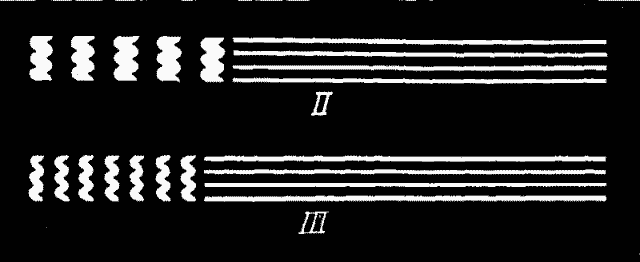
Fig. 2.
TABLE II.
No. I.No. II.No. I. (reversed).No. II. (reversed).
L.R.L.R.R.L.R.L.
A550480590500
B590440630520
C580560520500
D600560600550
E7459736574607567
F6167606665646265
G6464626863645367
H7668756466736771
J490410500420
————————
Total.6164576561655467
With the complex fillings at the left, it will be seen, firstly, that in every case the left judgment on No. III. is less than that on No. II. With the figures reversed, the right judgments on No. III. are less than on No. II., with the exception of subjects E and H. Secondly, four of the subjects only (E, F, G and H) had judgments also on the side which gave the complex filling the larger space; to E, F and G, these were secondary preferences; to H they were always primary. Thirdly, the judgments on No. III. are less, in spite of the fact that the larger component parts of No. II., might be taken as additional weight to that side of the line, and given, therefore, the shorter space, according to the principle of the lever.
The subjects, then, that appear not to substantiate our suggested theory are E and H, who in the reversed figures give the shorter space to the less complex filling, and F and G, who, together with E and H, have always secondary judgments that allot to either complex filling a larger space than to the simple horizontal. Consider, first, subjects E and H. For each, the difference in division of II. and III. is in any case very slight. Further, subject E, in judgments where the complex filling exceeds the horizontal parallels in length, still gives the more complex of the two fillings markedly the shorter space, showing, apparently, that its additional complexity works there in accord with the theory. There was, according to his introspection, another principle at work. As a figure, he emphatically preferred II. to III. The filling of II. made up, he found, by its greater interest, for lack of length. He here secured a balance, in which the interest of the complex material compensated for the greater extent of the simpler horizontals. This accounts for its small variation from III., and even for its occupying the smaller space. But in judgments giving the two complex fillings the larger space, the more interesting material exceeded in extent the less interesting. In such divisions the balance was no longer uppermost in mind, but the desire to get as much as possible of the interesting filling. To this end the horizontal parallels were shortened as far as they could be without becoming insignificant. But unless some element of balance were there (although not present to introspection) each complex filling, when up for judgment, would have been pushed to the same limit. It, therefore, does seem, in cases where the complex fillings occupied a larger space than the horizontals, that the subject, not trying consciously to secure a balance of interests, was influenced more purely by the factor of complexity, and that his judgments lend support to our theory.
Subject H was the only subject who consistently preferred to have all complex fillings occupy the larger space. Introspection invariably revealed the same principle of procedure—he strove to get as much of the interesting material as he could. He thought, therefore, that in every case he moved the complex filling to that limit of the pleasing range that he found on the simple line, which would yield him most of the filling. Balance did not appear prominent in his introspection. A glance, however, at the results shows that his introspection is contradicted. For he maintains approximately the same division on the right in all the figures, whether reversed or not, and similarly on the left. The average on the right for all four is 67; on the left it is 74. Comparing these with the averages on the simple line, we see that the right averages coincide exactly, while the left but slightly differ. I suspect, indeed, that the fillings did not mean much to H, except that they were 'interesting' or 'uninteresting'; that aside from this he was really abstracting from the filling and making the same judgments that he would make on the simple line. Since he was continually aware that they fell within the 'pleasing range' on the simple line, this conclusion is the more plausible.
Perhaps these remarks account for the respective uniformities of the judgments of E and H, and their departure from the tendency of the other subjects to give the more complex filling constantly the shorter space. But subjects F and G also had judgments (secondary with both of them) giving to the complex filling a larger extent than to the parallels. With them one of two principles, I think, applies: The judgments are either instances of abstraction from the filling, as with H, or one of simpler gravity or vertical balance, as distinguished from the horizontal equivalence which I conceive to be at the basis of the other divisions. With F it is likely to be the latter, since the divisions of the figures under discussion do not approach very closely those of the simple line, and because introspectively he found that the divisions giving the complex the larger space were 'balance' divisions, while the others were determined with 'reference to the character of the fillings.' From G I had no introspection, and the approximation of his judgments to those he gave for the simple line make it probable that with him the changes in the character of the filling had little significance. The average of his judgments in which the complex filling held the greater space is 66, while the averages on the simple line were 65 on the left, and 64 on the right. And, in general, abstraction from filling was easy, and to be guarded against. Subject C, in the course of the work, confessed to it, quite unsolicited, and corrected himself by giving thenceforth all complex fillings much smaller space than before. Two others noticed that it was particularly hard not to abstract. Further, none of the four subjects mentioned (with that possible exception of E) showed a sensitiveness similar to that of the other five.
With the exception of H, and in accord with the constant practice of the other five, these subjects, too, occasionally found no pleasing division in which the complex filling preponderated in length over the horizontals. It was uniformly true, furthermore, in every variation introduced in the course of the investigation, involving a complex and a simple filling, that all the nine subjects but H preferred the complex in the shorter space; that five refused any divisions offering it in the larger space; that these five showed more sensitiveness to differences in the character of fillings; and that with one exception (C) the divisions of the simple line which these subjects gave were nearer the ends than those of the others. It surely seems plausible that those most endowed with æsthetic sensitiveness would find a division near the center more unequal than one nearer the end; for one side only slightly shorter than the other would at once seem to mean the same thing to them, and yet, because of the obvious difference in length, be something markedly different, and they would therefore demand a part short enough to give them sharp qualitative difference, with, however, in some way, quantitative equivalence. When the short part is too long, it is overcharged with significance, it strives to be two things at once and yet neither in its fulness.
We thus return to the simple line. I have considered a series of judgments on it, and a series on two different figures, varying in the degree of complexity presented, in one of their fillings. It remains very briefly to see if the introspection on the simple line furnishes further warrant for carrying the complexities over into the simple line and so giving additional validity to the outlined theory of substitution. The following phrases are from introspective notes.
A. Sweep wanted over long part. More attention to short. Significance of whole in short. Certainly a concentration of interest in the short. Short is efficacious. Long means rest; short is the center of things. Long, an effortless activity; short, a more strenuous activity. When complex fillings are introduced, subject is helped out; does not have to put so much into the short division. In simple line, subject introduces the concentration. In complex figures the concentration is objectified. In equal division subject has little to do with it; the unequal depends on the subject—it calls for appreciation. Center of references is the division point, and the eye movements to right and left begin here, and here return. The line centers there. The balance is a horizontal affair.
B. Center a more reposing division. Chief attention to division point, with side excursions to right and left, when refreshment of perception is needed. The balance is horizontal and not vertical.
C. A balance with variety, or without symmetry. Centers at division point and wants sweep over long part. More concentration on short part. Subjective activity there—an introduction of energy. A contraction of the muscles used in active attention. Long side easier, takes care of itself, self-poised. Line centers at division point. Active with short division. Introduces activity, which is equivalent to the filling that the complex figures have; in these the introduced activity is objectified—made graphic.
D. Focal point at division point: wants the interesting things in a picture to occupy the left (when short division is also on left). Short division the more interesting and means greater complication. When the pleasing division is made, eyes move first over long and then over short. Division point the center of real reference from which movements are made.
E. No reference to center in making judgments; hurries over center. All portions of simple line of equal interest; but in unequal division the short gets a non-apparent importance, for the line is then a scheme for the representation of materials of different interest values. When the division is too short, the imagination refuses to give it the proportionally greater importance that it would demand. When too long it is too near equality. In enjoying line, the division point is fixed, with shifts of attention from side to side. An underlying intellectual assignment of more value to short side, and then the sense-pleasure comes; the two sides have then an equality.
F. Middle vulgar, common, prosaic; unequal lively. Prefers the lively. Eyes rest on division point, moving to the end of long and then of short. Ease, simplicity and restfulness are proper to the long part of complex figures. Short part of simple line looks wider, brighter and more important than long.
G. Unequal better than equal. Eye likes movement over long and then over short. Subject interested only in division point. Short part gives the æsthetic quality to the line.
H. Center not wanted. Division point the center of interest. (No further noteworthy introspection from H, but concerning complex figures he said that he wanted simple or the compact on the short, and the interesting on the long.)
These introspective notes were given at different times, and any repetitions serve only to show constancy. The subjects were usually very certain of their introspection. In general it appears to me to warrant these three statements: (1) That the center of interest is the division point, whence eye-movements, or innervations involving, perhaps, the whole motor system, are made to either side. (2) That there is some sort of balance or equivalence obtained (a bilateral symmetry), which is not, however, a vertical balance—that is, one of weights pulling downwards, according to the principle of the lever. All the subjects repudiated the suggestion of vertical balance. (3) That the long side means ease and simplicity, and represents graphically exactly what it means; that the short side means greater intensity, concentration, or complexity, and that this is substituted by the subject; the short division, unlike the long, means something that it does not graphically represent.
So much for the relation between what is objectively given and the significance subjectively attributed to it. There remains still the translation into psychophysical terms. The results on the complex figures (showing that a division may be shortened by making the innervations on that side increasingly more involved) lend plausibility to the interpretation that the additional significance is, in visual terms, a greater intricacy or difficulty of eye-movement, actual or reproduced; or, in more general terms, a greater tension of the entire motor system. In such figures the psychophysical conditions for our pleasure in the unequal division of the simple horizontal line are merely graphically symbolized, not necessarily duplicated. On page 553 I roughly suggested what occurs in regarding the unequally divided line. More exactly, this: the long section of the line gives a free sweep of the eyes from the division point, the center, to the end; or again, a free innervation of the motor system. The sweep the subject makes sure of. Then, with that as standard, the æsthetic impulse is to secure an equal and similar movement, from the center, in the opposite direction. It is checked, however, by the end point of the short side. The result is the innervation of antagonistic muscles, by which the impression is intensified. For any given subject, then, the pleasing unequal division is at that point which causes quantitatively equal physiological discharges, consisting of the simple movement, on one hand, and, on the other, the same kind of movement, compounded with the additional innervation of the antagonists resulting from the resistance of the end point. Since, when the characteristic movements are being made for one side, the other is always in simultaneous vision, the sweep receives, by contrast, further accentuation, and the innervation of antagonists doubtless begins as soon as movement on the short side is begun. The whole of the short movement is, therefore, really a resultant of the tendency to sweep and this necessary innervation of antagonists. The correlate of the equivalent innervations is equal sensations of energy of movement coming from the two sides. Hence the feeling of balance. Hence (from the lack of unimpeded movement on the short side) the feeling there of 'intensity,' or 'concentration,' or 'greater significance.' Hence, too, the 'ease,' the 'simplicity,' the 'placidity' of the long side.
As in traditional symmetry, the element of unity or identity, in unequal division, is a repetition, in quantitative terms, on one side, of what is given on the other. In the simple line the equal division gives us obviously exact objective repetition, so that the psychophysical correlates are more easily inferred, while the unequal offers apparently no compensation. But the psychophysical contribution of energies is not gratuitous. The function of the increment of length on one side, which in the centrally divided line makes the divisions equal, is assumed in unequal division by the end point of the short side; the uniform motor innervations in the former become, in the latter, the additional innervation of antagonists, which gives the equality. The two are separated only in degree. The latter may truly be called, however, a symmetry of a higher order, because objectively the disposition of its elements is not graphically obvious, and psychophysically, the quantitative unity is attained through a greater variety of processes. Thus, in complex works of art, what at first appears to be an unsymmetrical composition, is, if beautiful, only a subtle symmetry. There is present, of course, an arithmetically unequal division of horizontal extent, aside from the filling. But our pleasure in this, without filling, has been seen to be also a pleasure in symmetry. We have, then, the symmetry of equally divided extents and of unequally divided extents. They have in common bilateral equivalence of psychophysical processes; the nature of these differs. In both the principle of unity is the same. The variety through which it works is different.