Volume 1 — THE STRUCTURE OF SIMPLE RHYTHM FORMS.
Reading edition
BY ROBERT MACDOUGALL.
I. PROBLEMS AND METHODS OF EXPERIMENTATION.
The investigation of the problems presented by the psychological phenomena of rhythm has of late years occupied much attention and been pushed in a variety of different directions. Some researches have been concerned with an analysis of rhythm as an immediate subjective experience, involving factors of perception, reaction, memory, feeling, and the like; others have had to do with the specific objective conditions under which this experience arises, and the effect of changes in the relations of these factors; still others have sought to coördinate the rhythm experience with more general laws of activity in the organism, as the condition of most effective action, and to affiliate its complex phenomena upon simpler laws of physiological activity and repose; while a fourth group has undertaken a description of that historical process which has resulted in the establishment of artistic rhythm-types, and has sought to formulate the laws of their construction.1
This differentiation has already made such progress as to constitute the general topic a field within which specialization is called for, instead of an attempt to treat the phenomenon as a whole. It is the purpose of this paper to describe a set of experiments having to do with the second of these problems, the constitution of objective rhythm forms. In the determination of such forms it is, of course, impossible to avoid the employment of terms descriptive of the immediate experience of rhythm as a psychological process, or to overlook the constant connection which exists between the two groups of facts. The rhythm form is not objectively definable as a stable type of stimulation existing in and for itself; the discrimination of true and false relations among its elements depends on the immediate report of the consciousness in which it appears. The artistic form is such only in virtue of its arousing in the observer that peculiar quality of feeling expressed in calling the series of sensory stimuli rhythmically pleasing, or equivalent, or perfect. In no other way than as thus dependent on the appeal which their impression makes to the æsthetic consciousness can we conceive of the development and establishment of fixed forms of combination and sequence among those types of sensory stimulation which arouse in us the pleasurable experience of rhythm. The artistic rhythm form cannot be defined as constituted of periods which are 'chronometrically proportionate,' or mathematically simple. It is not such in virtue of any physical relations which may obtain among its constituents, though it may be dependent on such conditions in consequence of the subordination to physical laws of the organic activities of the human individual. The view must be subjectively objective throughout.
The need for simplicity and exactness has led to the very general employment of material as barely sensorial as could be devised for the carrying on of experiments upon rhythm. Rich tones and complex combinations of them are to be avoided, for these qualities are themselves immediate sources of pleasure, and the introduction of them into the material of experimentation inevitably confuses the analysis which the observer is called upon to make of his experience and of the sources of his pleasure in it. Still more objectionable than the presence of such complex musical tones in an investigation of rhythm is the introduction of the symbols of rational speech in concrete poetical forms. This element can be only a hindrance to the perception of pure rhythmical relations, in virtue of the immediate interest which the images called up by the verbal signs possess, and further, in view of the fact that the connections of significant thought impose upon the purely rhythmical formulation of the series of stimulations an unrelated and antagonistic principle of grouping, namely, the logical relations which the various members of the series bear to one another.
The demand for a simplification of the material which supports the rhythm experience, for the purpose of obtaining a more exact control over the conditions of experimentation, has been met by the invention of a variety of devices whereby the sequences of music, song and poetical speech have been replaced by elementary conventional symbols as the vehicle of the rhythmical impression or expression. On the one side there has commonly been substituted for musical tones and rhythmical speech the most simple, sharply limited and controllable sounds possible, namely, those due to the action of a telephone receiver, to the vibrations of a tuning-fork placed before the aperture of a resonator, or to the strokes of metallic hammers falling on their anvils. On the other side, the form of the reproduced rhythm has been clarified by the substitution of the finger for the voice in a series of simple motor reactions beaten out on a more or less resonant medium; by the use—when the voice is employed—of conventional verbal symbols instead of the elements of significant speech; and—where actual verse has been spoken—by a treatment of the words in formal staccato scansion, or by the beating of time throughout the utterance. The last of these methods is a halting between two courses which casts doubt on the results as characteristic of either type of activity. There is no question that the rhythmic forms of recitative poetry differ vastly from those of instrumental music and chanted speech. The measures of spoken verse are elastic and full of changefulness, while those of music and the chant maintain a very decided constancy of relations. The latter present determinable types of grouping and succession, while it is questionable whether the forms of relationship in spoken verse can ever be considered apart from the emotion of the moment. In so far as the rhythmic form which these differing modes of expression embody are to be made the subject of experimental investigation their characteristic structures should be kept intact as objects of analysis in independent experiments, instead of being combined (and modified) in a single process.
The apparatus employed in the course of the present investigation consisted of four different pieces of mechanism, one affording the vehicle of expression throughout the series of reproduced rhythms, the others providing the auditory material of the various rhythms apperceived but not designedly reproduced. The first of these consisted of a shallow Marey tambour, placed horizontally upon a table with its rubber film upwards, and connected by means of rubber-tubing with a pneumographic pen in contact with the revolving drum of a kymograph. A Deprez electric marker, aligned with the pneumographic stylus, afforded a time record in quarter seconds. Upon this tambour, placed within comfortable reach of the reactor's hand, the various rhythm types were beaten out. The impact of the finger-tip on the tense surface of the drum gave forth a faint and pleasing but at the same time clearly discernible and distinctly limited sound, which responded with audible variations of intensity to the differing stresses involved in the process of tapping, and which I have considered preferable to the short, sharp stroke of the Kraepelin mouth-key employed by Ebhardt. The rate of revolution in the drum was so adjusted to the normal range of excursion in the pneumographic pen as to give sharp definition to every change of direction in the curve, which hence allowed of exact measurements of temporal and intensive phases in the successive rhythm groups. These measurements were made to limits of 1.0 mm. in the latter direction and of 0.5 mm. in the former.2
The second piece of apparatus consisted of an ordinary metronome adjusted to beat at rates of 60, 90, and 120 strokes per minute. This instrument was used in a set of preliminary experiments designed to test the capacity of the various subjects for keeping time by finger reaction with a regular series of auditory stimulations.
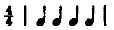
The third piece of apparatus consisted of an arrangement for producing a series of sounds and silences, variable at will in absolute rate, in duration, and, within restricted limits, in intensity, by the interruptions of an electrical current, into the circuit of which had been introduced a telephone receiver and a rheostat. Portions of the periphery of a thin metallic disc were cut away so as to leave at accurately spaced intervals, larger or smaller extents of the original boundary. This toothed wheel was then mounted on the driving-shaft of an Elbs gravity motor and set in motion. Electrical connections and interruptions were made by contact with the edge of a platinum slip placed at an inclination to the disc's tangent, and so as to bear lightly on the passing teeth or surfaces. The changes in form of a mercury globule, consequent on the adhesion of the liquid to the passing teeth, made it impossible to use the latter medium. The absolute rate of succession in the series of sounds was controlled by varying the magnitudes of the driving weights and the resistance of the governing fans of the motor. As the relation of sounds and intervals for any disc was unalterable, a number of such wheels were prepared corresponding to the various numerical groups and temporal sequences examined—one, for example, having the relations expressed in the musical symbol ; another having that represented in the symbol and so on. Variations in intensity were obtained by mounting a second series of contacts on the same shaft and in alignment with those already described. The number of these secondary contacts was less than that of the primary connections, their teeth corresponding to every second or third of those. The connections made by these contacts were with a second loop, which also contained within its circuit the telephone receiver by which the sounds were produced. The rheostatic resistances introduced into this second circuit were made to depart more or less from that of the first, according as it was desired to introduce a greater or slighter periodic accent into the series. This mechanism was designed for the purpose of determining the characteristic sequences of long and short elements in the rhythm group.

The fourth piece of apparatus consisted essentially of a horizontal steel shaft having rigidly attached to it a series of metallic anvils, fifteen in number, on which, as the shaft revolved, the members of a group of steel hammers could be made to fall in succession from the same or different heights. The various parts of the mechanism and their connections may be readily understood by reference to the illustration in Plate VIII. On the right, supported upon two metal standards and resting in doubly pivoted bearings, appears the anvil-bearing shaft. On a series of shallow grooves cut into this shaft are mounted loose brass collars, two of which are visible on the hither end of the shaft. The anvils, the parts and attachments of which are shown in the smaller objects lying on the table at the base of the apparatus, consist of a cylinder of steel partly immersed in a shallow brass cup and made fast to it by means of a thumb-screw. This cup carries a threaded bolt, by which it may be attached to the main shaft at any position on its circumference by screwing through a hole drilled in the collar. The adjustment of the anvils about the shaft may be changed in a moment by the simple movement of loosening and tightening the thumb-screw constituted by the anvil and its bolt. The device by which the extent of the hammer-fall is controlled consists of cam-shaped sheets of thin wood mounted within parallel grooves on opposite sides of the loose collars and clamped to the anvils by the resistance of two wedge-shaped flanges of metal carried on the anvil bolt and acting against the sides of slots cut into the sheets of wood at opposite sides. The periphery of these sheets of wood—as exhibited by that one lying beside the loose anvils on the table—is in the form of a spiral which unfolds in every case from a point on the uniform level of the anvils, and which, by variations in the grade of ascent, rises in the course of a revolution about its center to the different altitudes required for the fall of the hammers. These heights were scaled in inches and fractions, and the series employed in these experiments was as follows: 1/8, 2/8, 3/8, 5/8, 7/8, 15/8, 24/8 inch. Upon a corresponding pair of standards, seen at the left of the illustration, is mounted a slender steel shaft bearing a series of sections of brass tubing, on which, in rigid sockets, are carried the shafts of a set of hammers corresponding in number and position to the anvils of the main axis. By means of a second shaft borne upon two connected arms and pivoted at the summit of the standards the whole group of hammers may at any moment be raised from contact with the cams of the main shaft and the series of sounds be brought to a close without interrupting the action of the motor or of the remainder of the apparatus. By this means phases of acceleration and retardation in the series, due to initial increase in velocity and its final decrease as the movement ceases, are avoided. The pairs of vertical guides which appear on this gearing-shaft and enclose the handles of the several hammers are designed to prevent injury to the insertions of the hammer shafts in their sockets in case of accidental dislocations of the heads in arranging the apparatus. This mechanism was driven by an electrical motor with an interposed reducing gear.
Psychological Review. Monograph Supplement, 17. Plate VIII.
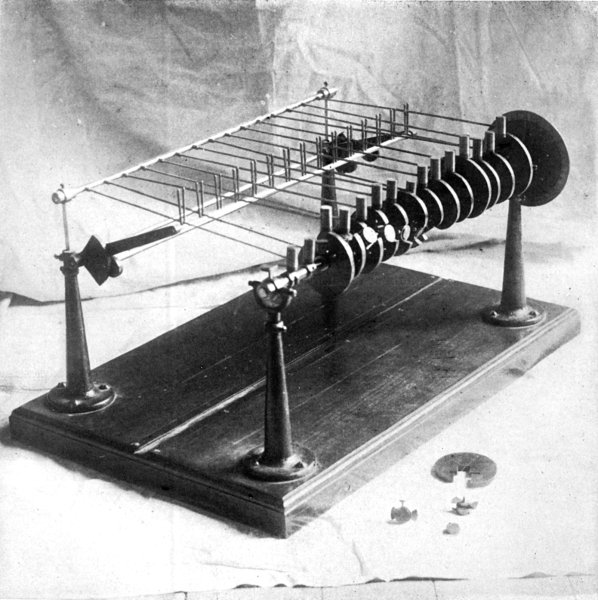
Opposite p. 314.
The intervals between the successive hammer-strokes are controlled in the following way: on the inner face of the group of pulleys mounted on the main shaft of the mechanism (this gang of pulleys appears at the extreme right in the illustration) is made fast a protractor scaled in half degrees. Upon the frame of the standard supporting these pulleys is rigidly screwed an index of metal which passes continuously over the face of the scale as the shaft revolves. The points of attachment (about the shaft) of the cams are determined by bringing the point of fall of each cam in succession into alignment with this fixed index, after the shaft has been turned through the desired arc of its revolution and made fast by means of the thumb-screw seen in the illustration at the near end of the shaft. Thus, if three strokes of uniform intensity are to be given at equal intervals apart and in continuous succession, the points of fall of the hammers will be adjusted at equal angular distances from one another, for example, at 360°, 240°, and 120°; if the temporal relations desired be in the ratios 2:1:1, the arrangement will be 360°, 180°, 90°; if in the ratios 5:4:3, it will be 360°, 210°, 90°; and so on. If double this number of hammers be used in a continuous series the angular distances between the points of fall of the successive hammers will of course be one half of those given above, and if nine, twelve, or fifteen hammers be used they will be proportionately less.
An interruption of any desired relative length may be introduced between repetitions of the series by restricting the distribution of angular distances among the cams to the requisite fraction of the whole revolution. Thus, if an interruption equal to the duration included between the first and last hammer-falls of the series be desired, the indices of position in the three cases described above will become: 360°, 270°, 180°; 360°, 240°, 180°, and 360°, 260°, 180°. In the case of series in which the heights of fall of the various hammers are not uniform, a special adjustment must be superimposed upon the method of distribution just described. The fall of the hammer occupies an appreciable time, the duration of which varies with the distance through which the hammer passes. The result, therefore, of an adjustment of the cams on the basis adopted when the height of fall is uniform for all would appear in a reduction of the interval following the sound produced by a hammer falling from a greater height than the rest, and the amount of this shortening would increase with every addition to the distance through which the hammer must pass in its fall. In these experiments such lags were corrected by determining empirically the angular magnitude of the variation from its calculated position necessary, in the case of each higher member of the series of distances, to make the stroke of the hammer on its anvil simultaneous with that of the shortest fall. These fixed amounts were then added to the indices of position of the several cams in each arrangement of intervals employed in the experiments.
This apparatus answers a variety of needs in practical manipulation very satisfactorily. Changes in adjustment are easily and quickly made, in regard to intensity, interval and absolute rate. If desired, the gradation of intensities here employed may be refined to the threshold of perceptibility, or beyond it.
The possible variations of absolute rate and of relative intervals within the series were vastly more numerous than the practical conditions of experimentation called for. In two directions the adaptability of the mechanism was found to be restricted. The durations of the sounds could not be varied as were the intervals between them, and all questions concerning the results of such changes were therefore put aside; and, secondly, the hammers and anvils, though fashioned from the same stuff and turned to identical shapes and weights, could not be made to ring qualitatively alike; and these differences, though slight, were sufficiently great to become the basis of discrimination between successive sounds and of the recognition upon their recurrence of particular hammer-strokes, thereby constituting new points of unification for the series of sounds. When the objective differences of intensity were marked, these minor qualitative variations were unregarded; but when the stresses introduced were weak, as in a series composed of 3/8-, 2/8-, 2/8-inch hammer-falls, they became sufficiently great to confuse or transform the apparent grouping of the rhythmical series; for a qualitative difference between two sounds, though imperceptible when comparison is made after a single occurrence of each, may readily become the subconscious basis for a unification of the pair into a rhythmical group when several repetitions of them take place.
In such an investigation as this the qualification of the subject-observer should be an important consideration. The susceptibility to pleasurable and painful affection by rhythmical and arrhythmical relations among successive sensory stimuli varies within wide limits from individual to individual. It is of equal importance to know how far consonance exists between the experiences of a variety of individuals. If the objective conditions of the rhythm experience differ significantly from person to person it is useless to seek for rhythm forms, or to speak of the laws of rhythmical sequence. Consensus of opinion among a variety of participators is the only foundation upon which one can base the determination of objective forms of any practical value. It is as necessary to have many subjects as to have good ones. In the investigation here reported on, work extended over the two academic years of 1898-1900. Fourteen persons in all took part, whose ages ranged from twenty-three to thirty-nine years. Of these, five were musically trained, four of whom were also possessed of good rhythmic perception; of the remaining nine, seven were good or fair subjects, two rather poor. All of these had had previous training in experimental science and nine were experienced subjects in psychological work.
II. THE ELEMENTARY CONDITIONS OF THE APPEARANCE OF THE RHYTHM IMPRESSION.
The objective conditions necessary to the arousal of an impression of rhythm are three in number: (a) Recurrence; (b) Accentuation; (c) Rate.
(a) Recurrence.—The element of repetition is essential; the impression of rhythm never arises from the presentation of a single rhythmical unit, however proportioned or perfect. It does appear adequately and at once with the first recurrence of that unit. If the rhythm be a complex one, involving the coördination of primary groups in larger unities, the full apprehension of its form will, of course, arise only when the largest synthetic group which it contains has been completed; but an impression of rhythm, though not of the form finally involved, will have appeared with the first repetition of the simplest rhythmical unit which enters into the composition. It is conceivable that the presentation of a single, unrepeated rhythmical unit, especially if well-defined and familiar, should originate a rhythmical impression; but in such a case the sensory material which supports the impression of rhythm is not contained in the objective series but only suggested by it. The familiar group of sounds initiates a rhythmic process which depends for its existence on the continued repetition, in the form of some subjective accentuation, of the unit originally presented.
The rhythmical form, in all such cases, is adequately and perfectly apprehended through a single expression of the sequence.3 It lacks nothing for its completion; repetition can add no more to it, and is, indeed, in strict terms, inconceivable; for by its very recurrence it is differentiated from the initial presentation, and combines organically with the latter to produce a more highly synthetic form. And however often this process be repeated, each repetition of the original sequence will have become an element functionally unique and locally unalterable in the last and highest synthesis which the whole series presents.
Rhythmical forms are not in themselves rhythms; they must initiate the factor of movement in order that the impression of rhythm shall arise. Rhythmical forms are constantly occurring in our perceptional experience. Wherever a group of homogeneous elements, so related as to exhibit intensive subordination, is presented under certain temporal conditions, potential rhythm forms appear. It is a mere accident whether they are or are not apprehended as actual rhythm forms. If the sequence be repeated—though but once—during the continuance of a single attention attitude, its rhythmical quality will ordinarily be perceived, the rhythmic movement will be started. If the sequence be not thus repeated, the presentation is unlikely to arouse the process and initiate the experience of rhythm, but it is quite capable of so doing. The form of the rhythm is thus wholly independent of the movement, on which the actual impression of rhythm in every case depends; and it may be presented apart from any experience of rhythm.
There is properly no repetition of identical sequences in rhythm. Practically no rhythm to which the æsthetic subject gives expression, or which he apprehends in a series of stimulations, is constituted of the unvaried repetition of a single elementary form, the measures, for example. Variation, subordination, synthesis, are present in every rhythmical sequence. The regular succession is interrupted by variant groups; points of initiation in the form of redundant syllables, points of finality in the form of syncopated measures, are introduced periodically, making the rhythm form a complex one, the full set of relations involved being represented only by the complete succession of elements contained between any one such point of initiation and its return.

(b) Accentuation.—The second condition for the appearance of the rhythm impression is the periodic accentuation of certain elements in the series of sensory impressions or motor reactions of which that rhythm is composed. The mechanism of such accentuation is indifferent; any type of variation in the accented elements from the rest of the series which induces the characteristic process of rhythmic accentuation—by subjective emphasis, recurrent waves of attention, or what not—suffices to produce an impression of rhythm. It is commonly said that only intensive variations are necessary; but such types of differentiation are not invariably depended on for the production of the rhythmic impression. Indeed, though most frequently the basis of such effects, for sufficient reasons, this type of variation is neither more nor less constant and essential than other forms of departure from the line of indifference, which forms are ordinarily said to be variable and inessential. For the existence of rhythm depends, not on any particular type of periodical variation in the sensory series, but on the recurrent accentuation, under special temporal conditions, of periodic elements within such a series; and any recurrent change in quality—using this term to describe the total group of attributes which constitutes the sensorial character of the elements involved—which suffices to make the element in which it occurs the recipient of such accentuation, will serve as a basis for the production of a rhythmical impression. It is the fact of periodical differentiation, not its particular direction, which is important. Further, as we know, when such types of variation are wholly absent from the series, certain elements may receive periodical accentuation in dependence on phases of the attention process itself, and a subjective but perfectly real and adequate rhythm arise.
In this sense those who interpret rhythm as fundamentally dependent on the maintenance of certain temporal relations are correct. The accentuation must be rhythmically renewed, but the sensory incentives to such renewals are absolutely indifferent, and any given one of the several varieties of change ordinarily incorporated into rhythm may be absent from the series without affecting its perfection as a rhythmical sequence. In piano playing the accentual points of a passage may be given by notes struck in the bass register while unaccented elements are supplied from the upper octaves; in orchestral compositions a like opposition of heavy to light brasses, of cello to violin, of cymbals to triangle, is employed to produce rhythmical effects, the change being one in timbre, combined or uncombined with pitch variations; and in all percussive instruments, such as the drum and cymbals, the rhythmic impression depends solely on intensive variations. The peculiar rhythmic function does not lie in these elements, but in a process to which any one of them indifferently may give rise. When that process is aroused, or that effect produced, the rhythmic impression has been made, no matter what the mechanism may have been.
The single objective condition, then, which is necessary to the appearance of an impression of rhythm is the maintenance of specific temporal relations among the elements of the series of sensations which supports it. It is true that the subjective experience of rhythm involves always two factors, periodicity and accentuation; the latter, however, is very readily, and under certain conditions inevitably, supplied by the apperceptive subject if the former be given, while if the temporal conditions be not fulfilled (and the subject cannot create them) no impression of rhythm is possible. The contributed accent is always a temporally rhythmical one, and if the recurrence of the elements of the objective series opposes the phases of subjective accentuation the rhythm absolutely falls to the ground. Of the two points of view, then, that is the more faithful to the facts which asserts that rhythm is dependent upon the maintenance of fixed temporal intervals. These two elements cannot be discriminated as forming the objective and subjective conditions of rhythm respectively. Both are involved in the subjective experience and both find their realization in objective expressions, definable and measurable.
(c) Rate.—The appearance of the impression of rhythm is intimately dependent on special conditions of duration in the intervals separating the successive elements of the series. There appears in this connection a definite superior limit to the absolute rate at which the elements may succeed one another, beyond which the rapidity cannot be increased without either (a) destroying altogether the perception of rhythm in the series or (b) transforming the structure of the rhythmical sequence by the substitution of composite groups for the single elements of the original series as units of rhythmic construction; and a less clearly marked inferior limit, below which the series of stimulations fails wholly to arouse the impression of rhythm. But the limits imposed by these conditions, again, are coördinated with certain other variables. The values of the thresholds are dependent, in the first place, on the presence or absence of objective accentuation. If such accents be present in the series, the position of the limits is still a function of the intensive preponderance of the accented over the unaccented elements of the group. Further, it is related to the active or passive attitude of the æsthetic subject on whom the rhythmical impression is made, and there appear also important individual variations in the values of the limits.
When the succession falls below a certain rate no impression of rhythm arises. The successive elements appear isolated; each is apprehended as a single impression, and the perception of intensive and temporal relations is gotten by the ordinary process of discrimination involved when any past experience is compared with a present one. In the apprehension of rhythm the case is altogether different. There is no such comparison of a present with a past experience; the whole group of elements constituting the rhythmic unit is present to consciousness as a single experience; the first of its elements has never fallen out of consciousness before the final member appears, and the awareness of intensive differences and temporal segregation is as immediate a fact of sensory apprehension as is the perception of the musical qualities of the sounds themselves.
The absolute value of this lower limit varies from individual to individual. In the experience of some persons the successive members of the series may be separated by intervals as great as one and one half (possibly two) seconds, while yet the impression is distinctly one of rhythm; in that of others the rhythm dies out before half of that interval has been reached. With these subjects the apprehension at this stage is a secondary one, the elements of the successive groups being held together by means of some conventional symbolism, as the imagery of beating bells or swinging pendulums. A certain voluminousness is indispensable to the support of such slow measures. The limit is reached sooner when the series of sounds is given by the fall of hammers on their anvils than when a resonant body like a bell is struck, or a continuous sound is produced upon a pipe or a reed.
In these cases, also, the limit is not sharply defined. The rhythmical impression gradually dies out, and the point at which it disappears may be shifted up or down the line, according as the æsthetic subject is more or less attentive, more or less in the mood to enjoy or create rhythm, more passive or more active in his attitude toward the series of stimulations which supports the rhythmical impression. The attention of the subject counts for much, and this distinction—of involuntary from voluntary rhythmization—which has been made chiefly in connection with the phenomenon of subjective rhythm, runs also through all appreciation of rhythms which depend on actual objective factors. A series of sounds given with such slowness that at one time, when passively heard, it fails to produce any impression of rhythm, may very well support the experience on another occasion, if the subject try to hold a specific rhythm form in mind and to find it in the series of sounds. In such cases attention creates the rhythm which without it would fail to appear. But we must not confuse the nature of this fact and imagine that the perception that the relations of a certain succession fulfil the the form of a rhythmical sequence has created the rhythmical impression for the apperceiving mind. It has done nothing of the kind. In the case referred to the rhythm appears because the rhythmical impression is produced, not because the fact of rhythmical form in the succession is perceived. The capacity of the will is strictly limited in this regard and the observer is as really subject to time conditions in his effortful construction as in his effortless apprehension. The rhythmically constructive attitude does not destroy the existence of limits to the rate at which the series must take place, but only displaces their positions.
A similar displacement occurs if the periodic accentuations within the series be increased or decreased in intensity. The impression of rhythm from a strongly accented series persists longer, as retardation of its rate proceeds, than does that of a weakly accented series; the rhythm of a weakly accented series, longer than that of a uniform succession. The sensation, in the case of a greater intensive accent, is not only stronger but also more persistent than in that of a weaker, so that the members of a series of loud sounds succeeding one another at any given rate appear to follow in more rapid succession than when the sounds are faint. But the threshold at which the intervals between successive sounds become too great to arouse any impression of rhythm does not depend solely on the absolute loudness of the sounds involved; it is a function also of the degree of accentuation which the successive measures possess. The greater the accentuation the more extended is the temporal series which will hold together as a single rhythmic group.
This relation appears also in the changes presented in beaten rhythms, the unit-groups of which undergo a progressive increase in the number of their components. The temporal values of these groups do not remain constant, but manifest a slight increase in total duration as the number of component beats is increased, though this increase is but a fraction of the proportional time-value of the added beats. Parallel with this increase in the time-value of the unit-group goes an increase in the preponderance of the accented element over the intensity of the other members of the group. Just as, therefore, in rhythms that are heard, the greatest temporal values of the simple group are mediated by accents of the highest intensity, so in expressed rhythms those groups having the greatest time-values are marked by the strongest accentuation.
Above the superior limit a rhythm impression may persist, but neither by an increase in the number of elements which the unit group contains, nor by an increase in the rate at which these units follow one another in consciousness. The nature of the unit itself is transformed, and a totally new adjustment is made to the material of apprehension. When the number of impressions exceeds eight or ten a second—subject to individual variations—the rhythmical consciousness is unable longer to follow the individual beats, a period of confusion ensues, until, as the rate continues to increase, the situation is suddenly clarified by the appearance of a new rhythm superimposed on the old, having as its elements the structural units of the preceding rhythm. The rate at which the elements of this new rhythm succeed one another, instead of being more rapid than the old, has become relatively slow, and simple groups replace the previous large and complex ones. Thus, at twelve beats per second the rhythms heard by the subjects in these experiments were of either two, three or four beats, the elements entering into each of these constituent beats being severally three and four in number, as follows:
TABLE I.
Simple Trochaic,fourbeats per second:
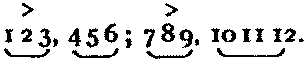
Dipodic Trochaic,""
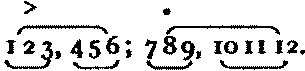
Simple Dactylic,three"

The only impression of rhythm here received was of a trochaic or dactylic measure, depending upon an accent which characterized a group and not a single beat, and which recurred only twice or thrice a second. Sometimes the subjects were wholly unaware that the elements of the rhythm were not simple, a most significant fact, and frequently the number reported present was one half of the actual number given. During the continuance of such a series the rhythm form changes frequently in the apprehension of the individual subject from one to another of the types described above.
It cannot be too strongly insisted on that the perception of rhythm is an impression, an immediate affection of consciousness depending on a particular kind of sensory experience; it is never a construction, a reflective perception that certain relations of intensity, duration, or what not, do obtain. If the perception of rhythm in a series of impressions were dependent on intellectual analysis and discrimination, the existence of such temporal limits as are actually found would be inconceivable and absurd. So long as the perception of the uniformity or proportion of time-relations were possible, together with the discrimination of the regular recurrence in the series of points of accentuation, the perception of rhythm should persist, however great or small might be the absolute intervals which separated the successive members of the series. If it were the conception of a certain form of relation, instead of the reception of a particular impression, which was involved, we should realize a rhythm which extended over hours or days, or which was comprehended in the fraction of a second, as readily as those which actually affect us.
The rate at which the elements of a series succeed one another affects the constitution of the unit groups of which the rhythmical sequence is composed. The faster the rate, the larger is the number of impressions which enter into each group. The first to appear in subjective rhythm, as the rate is increased from a speed too slow for any impression of rhythm to arise, are invariably groups of two beats; then come three-beat groups, or a synthesis of the two-beat groups into four, with major and minor accents; and finally six-and eight-beat groups appear. When objective accentuation is present a similar series of changes is manifested, the process here depending on a composition of the unit-groups into higher orders, and not involving the serial addition of new elements to the group.
The time relations of such smaller and larger units are dependent on the relative inertia of the mechanism involved. A definite subjective rhythm period undoubtedly appears; but its constancy is not maintained absolutely, either in the process of subjective rhythmization or in the reproduction of ideal forms. Its manifestation is subject to the special conditions imposed on it by such apprehension or expression. The failure to make this distinction is certain to confuse one's conception of the temporal rhythmic unit and its period. The variations of this period present different curves in the two cases of subjective rhythmization and motor expression of definite rhythm forms. In the former the absolute duration of the unit-group suffers progressive decrease as the rate of succession among the stimuli is accelerated; in the latter a series of extensions of its total duration takes place as the number of elements composing the unit is increased. The series of relative values for units of from two to eight constituents which the finger reactions presented in this investigation is given in the following table:
TABLE II.
No. of Elements.Proportional Duration.
Two,1.000
Three,1.109
Four,1.817
Five,1.761
Six,2.196
Seven,2.583
Eight,2.590
This progressive extension of the rhythm period is to be explained by the mechanical conditions imposed on the expression of rhythm by processes of muscular contraction and release. Were it possible freely to increase the rate of such successive innervations, we should expect to find a much greater constancy in the whole period occupied by the series of reactions which composes the unit. The comparatively unsatisfactory quality of these larger series, and the resolution of them into subgroups described elsewhere in this paper, are due to this inability to accommodate the series of motor reactions to the subjective rhythm period.
On the other hand, the temporal value of the unit which appears as the result of subjective rhythmization undergoes a progressive decrease in absolute magnitude as the rate of succession among the undifferentiated stimuli is accelerated. The series of values for units containing from two to eleven constituents is given in the following table:
TABLE III.
No. of Elements.Duration in Seconds.
Two,2.00
Three,1.75
Four,1.66
Seven,1.75
Nine,1.50
Eleven,0.97
If the time-value of the simple rhythm group here depended solely on the relation of the successive stimuli to the subjective rhythm period, no progressive diminution should be presented, for in proportion as the absolute value of the separating intervals decreases the true nature of this period should be more clearly manifested. It is scarcely to be doubted that the complexity of its content is likewise a determinant of the temporal value of this period, and that to this factor is to be attributed the changes which are here presented.4
In subjective rhythmization the number of elements which compose the unit is dependent solely on the relation of the subjective rhythm period to the rate of succession among such elements. In objective rhythm, as has been pointed out, a free treatment of the material is rendered impossible by the determination of specific points of increased stress, in virtue of which a new unit of change appears, namely, the whole period elapsing from any one occurrence of accentuation to its return.
But this is not the sole determinant of the numerical limits of the simple group in such objective rhythms. The structural unit must indeed adhere to the scheme given by the period of the recurrent accentuation; but the point at which simple successions of this figure give place to complex structures (at which is replaced by , for example) may conceivably be hastened or retarded by other factors than that of the simple rate of succession. The degrees of segregation and accentuation which characterize the rhythmic unit are elements which may thus affect the higher synthesis. Increase in either of these directions gives greater definition to the rhythmic figure and should tend to preserve the simple group in consciousness. The latter relation was not made the subject of special investigation in this research. The former was taken up at a single point. The sounds were two in number, alternately accented and unaccented, produced by hammer-falls of 7/8 and 1/8 inch respectively. These were given at three rates of succession, and three different degrees of segregation were compared together. In the following table is given, for six subjects, the average number of elements entering into the group-form, simple or complex, under which the rhythm was apprehended:

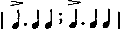
TABLE IV.
Ratio of Beat-intervalValue in Seconds of Average Interval,
to Group-interval. 5/123/122/12
1.000: 1.4003.55.39.0
1.000: 1.0004.05.49.6
1.000: 0.7145.28.410.8
The quantitative relations presented by these figures are consistent throughout. For every rate of speed the average rhythmic group is smallest when the interval separating the successive groups is at its maximum; it is largest when this interval is at its minimum; while in each case a median value is presented by the relation of uniformity among the intervals. In the second as well as the first of the ratios included in the foregoing table the interval which separates adjacent groups is felt to be distinctly longer than that internal to the group; in the third the relative durations of the two intervals are those which support psychological uniformity. In the latter case, in consequence of the freer passage from group to group, the continuity of the rhythmical series is more perfectly preserved than in the former, and the integration of its elements into higher syntheses more extended.
The extension of the numerical limits of the rhythm group in subjective rhythm which appear in consequence of progressive acceleration in the rate of succession is given for a series of six different values of the separating intervals in the following table, the figures of which represent the average for six observers:
TABLE V.
HIGHEST UNITS WHICH APPEAR.
Value of interval in secs.:12/127/125/123/122/121/12
No. of el's in rhythm group:2.53.04.07.09.011.0
Average duration of group:2.5001.7501.6661.7501.500 0.917
SIMPLE UNITS.
No. of els. in simplest group:2.52.32.93.74.75.0
Duration of simplest group:2.501.341.210.920.780.41
The rate of increase here presented in the number of elements is not sufficiently rapid to counterbalance the acceleration of speed and maintain a constancy in the duration of the group. The greatest value of this period is coördinated with the slowest rate of succession, the lowest with the most rapid. As the speed increases, the duration of the rhythmic unit is shortened. Its average duration for all rates here included is 1.680 sec., or, without the first of the series (one-second intervals, at which only two of the observers received the impression of rhythm), 1.516 sec. These values are not for the simplest combinations, but for the highest synthetical unit which was immediately apprehended in the series of stimulations. This compounding becomes more pronounced as the rate of succession is accelerated, but even at intervals of 5/12 and 7/12 sec. it is the characteristic mode of apprehension.
The number of elements in the simple groups of which these higher units are composed, and their average duration, are also given in the table. These likewise show a progressive increase in number, but of a much slower rate than that manifested by the total synthesis of elements. That is to say, in subjective rhythm as well as in objectively figured series, subordinate rhythmical differences in the material sink out of consciousness less rapidly than the inclusion of fresh elements takes place; in other words, the organic complexity of the rhythmic unit increases with every acceleration in the rate of succession. The duration of these simple structural groups, as may be inferred, decreases with such acceleration, but at a much more rapid rate than is the case with the total reach of rhythmical apprehension, the value of that unit which appears in connection with the highest speed here included being less than half a second. The 'liveliness' of such rapid measures is thus a resultant of several factors. It is not a consequence solely of the more rapid rate at which the individual stimuli succeed one another, but depends also on the shortening of the periods of both these rhythmical units and on the progressive divergence of the simple from the complex group.
The influence of the rate of succession on the rhythmical unit is not confined to its segregation from adjacent groups, but affects the internal configuration of the measure as well. With every acceleration in rate the relative preponderance of the interval following the accented element (in rhythms having initial stress) increases; as the rate is retarded, smaller and smaller degrees of difference in the values of accented and unaccented intervals are discriminated. In this regard the influence of reduction in the absolute value of the separating intervals is analogous to that of increased accentuation within the group. In fast tempos and with high degrees of emphasis the interval following the initial accent is relatively longer, that following the unaccented relatively shorter, than at slow tempos and with weak emphasis. This is but another way of expressing the fact that as the elements of the auditory series succeed one another more and more slowly the impression of rhythm fades out and that as their succession increases in rapidity the impression becomes more and more pronounced. The following table presents these relations in a quantitative form for trochaic rhythm. The figures represent the number of times the second, or group interval, was judged to be greater than, equal to, or less than the first or internal interval of the group. Three rates were compared together, having average intervals of 5/12, 3/12 and 2/12 sec. Six observers took part, but only a small number of judgments was made by each, to which fact is probably to be attributed the irregularities of form which appear in the various curves:
TABLE VI.
Ratio of 1st to 2d Interval.5/123/122/12
+=-+=-+=-
1.000: 1.05795.00.05.0100.00.00.0100.00.00.0
1.000: 1.00094.75.30.086.010.53.587.512.50.0
1.000: 0.89540.060.00.046.249.63.374.118.57.4
1.000: 0.84641.050.09.039.454.66.040.052.08.0
1.000: 0.80020.060.020.013.070.017.053.846.20.0
1.000: 0.75629.423.547.121.843.434.828.072.00.0
Av. for all ratios,53.333.113.551.138.010.863.933.52.6
Within the limits of its appearance, as the figures just presented indicate, the force, definition and persistency of the rhythmical impression do not continue uniform. At the lowest rates at which rhythm appears the integration of the successive groups is weak and their segregation indistinct. As the rate increases the definition of the rhythmic form grows more precise, group is separated from group by greater apparent intervals, and the accentuation of the groups becomes more pronounced. In subjective rhythmization of an undifferentiated series, likewise, the impression of segregation and periodic accentuation grows more forcible and dominating as the rate increases. The sensitiveness to form and dynamic value in the successive groups also increases up to a certain point in the process of acceleration. As expressed in the capacity to discriminate departures from formal equivalence among the groups, this function reached its maximum, for those concerned in this investigation, at rates varying individually from 0.3 sec. to 0.6 sec. in the value of their intervals.
It is in virtue of its nature as an impression, as opposed to a construction, that every structural unit, and every rhythmical sequence into which it enters, possesses a distinct individual quality, by which it is immediately apprehended and discriminated from other forms, as the face of an acquaintance is remembered and identified without detailed knowledge of the character of any feature it possesses. For what persists from the reception of a rhythm impression and becomes the basis of future recognition and reproduction of it, is not the number of beats in a unit or sequence, nor the absolute or relative intensity of the components of the group; it is the quality of the groups as individuals, and the form of the sequence as a whole. The phrase and verse are as vividly conceived as the unit group; the stanza or the passage is apprehended as immediately and simply as the bar or the measure. Of the number and relation of the individual beats constituting a rhythmical sequence there is no awareness whatever on the part of the æsthetic subject. I say this without qualification. So long as the rhythmical impression endures the analytic unit is lost sight of, the synthetic unit, or group, is apprehended as a simple experience. When the rhythm function is thoroughly established, when the structural form is well integrated or familiar, it becomes well-nigh impossible to return to the analytic attitude and discern the actual temporal and intensive relations which enter into the rhythm. Even the quality of the organic units may lapse from distinct consciousness, and only a feeling of the form of the whole sequence remain. The Gestaltsqualität of the passage or the stanza is thus frequently appreciated and reproduced without an awareness of its sequential relations, though with the keenest sense of what is necessary to, or inconsistent with, its structure; so that the slightest deviation from its form is remarked and the whole sequence accurately reproduced.
In order to isolate and exhibit the tendency toward rhythmization in regularly repeated motor reactions, one should examine series of similar movements made at different rates both as an accompaniment to a recurrent auditory stimulus and as free expressions of the motor impulse independent of such objective control. In the former of these cases the series of stimuli should be undifferentiated in quality as well as uniform in time. The rhythm which appears in such a case will contradict the phases of an objective series which prescribes its form, and the evidence of its existence, presented under such adverse conditions, should be indubitable.
As preliminary to their special work the members of the experimental group were tested in regard to the promptness and regularity of their reactions (by finger flexion) in accompanying a periodically recurrent stimulus given by the beating of a metronome; records were taken also of their capacity to estimate and maintain constant time relations by freely tapping at intervals of one, two and five seconds. Of the latter type of reaction the records show that a temporal grouping of the reactions is presented in every rate of tapping. This, owing to the large absolute intervals, is uniformly in groups of two, the first member of which is of shorter, the second of longer duration. There is likewise an intensive differentiation of the alternate reactions. Thus a double rhythmical treatment appears, but while with intervals of two seconds the phases of temporal and intensive rhythm coincide, at rates of one and five seconds they are opposed, that is, the accentuation falls on the initial reaction which is followed by the shorter interval. This doubtlessly marks the emergence of that tendency to initial accentuation which was subsequently found to prevail in all expression of rhythm.
The types of reaction which these records afford leave no doubt that a fuller investigation of the matter would show the constant presence, in all such forms of activity, of a rhythmical automatization of the series. The special problems which such an investigation should first resolve, relate to the dependence of the amount of rhythmical differentiation on the rate of succession among the reactions; the relation of the form of this reaction series to factors of attention and control; and the significance, in connection with the process of rhythmization, of auditory stimuli produced by and accompanying the reaction series, that is, the comparison of soundless and sounded reactions.
In the second set of experiments the reactor was directed simply to accompany the beating of a metronome by a light tapping with the forefinger on a rubber-surfaced tambour connected with a pneumographic registering pen, with which was aligned an electrical time-marker also actuated by the metronome. Three rates of tapping were adopted, 60, 90 and 120 beats per minute. No specific instructions were given as to direction or keenness of attention on the part of the reactor; the most natural and simple accompaniment was desired. Occasionally, for comparison, the reactor was directed to attend closely to each successive beat as it occurred.
Certain questions as to the applicability of the material here interpreted to the point in question, and as to its relation to the objective conditions of experimentation, must be met at the outset. The first of these is as to the actual uniformity of the metronome series. Objective determination of its temporal regularity is unnecessary (in so far as such a determination looks toward an explanation of the form of tapping by reference to inequality in the metronomic intervals). That the rhythmical phases which appear in the accompaniment are not due to inequality in the stimulation intervals, is shown by the reversal of relations between the metronome and its accompaniment which occur in the midst of a continuous series of taps. To speak roughly, a break occurs every twentieth beat. I do not refer to minor irregularities occurring within the single group but not affecting the form of the rhythmical accompaniment. The latter appeared with surprising rarity, but when found were included in the continuous calculation of averages. But in every score or so of beats a stroke out of series would be interpolated, giving the form | 1 >2 1 2 >1 |; the accompaniment being coördinated during the second portion of the whole series with opposite phases of the metronome from those with which its elements were connected in the earlier part. Moreover, the dependence of this grouping of the sounds on subjective attitudes may readily be made to appear. When attention is turned keenly on the process its phases of rhythmical differentiation decline; when the accompaniment becomes mechanical they mount in value. When the observer tries to mark the ticking as accurately as possible, not only does the index of his motor reactions become more constant, but the sounds of the instrument likewise appear more uniform. The observers report also that at one and the same time they are aware of the regularity of the metronome and the rhythmical nature of their tapping, while yet the conviction remains that the accompaniment has been in time with the beats. Furthermore, if the phases of ticking in the metronome were temporarily unlike, the motor accompaniment by a series of observers, if accurate, should reproduce the time-values of the process, and if inaccurate, should present only an increase of the mean variation, without altering the characteristic relations of the two phases. On the other hand, if the series be uniform and subjectively rhythmized by the hearer, there should be expected definite perversions of the objective relations, presenting a series of increasing departures from the original in proportion as the tendency to rhythmize varied from individual to individual.
On the other hand, a rhythm is already presented in the sounds of the metronome, occasioned by the qualitative differentiation of the members of each pair of ticks, a variation which it was impossible to eliminate and which must be borne in mind in estimating the following results.
Five reactors took part in the experiment, the results of which are tabulated in the following pages. The figures are based on series of one hundred reactions for each subject, fifty accompaniments to each swing and return of the metronome pendulum. When taken in series of ten successive pairs of reactions, five repetitions of the series will be given as the basis of each average. The quantitative results are stated in Tables VII.-XIV., which present the proportional values of the time intervals elapsing between the successive reactions of an accompaniment to the strokes of a metronome beating at the rates of 60, 90 and 120 per minute.
TABLE VII.
I. AVERAGES ACCORDING TO REACTORS OF ALL RATES FOR BOTH PHASES.
(a) In Series of Ten Successive Pairs of Beats.
Subject.IIIIIIIVVVIVIIVIIIIXX
J.1.0001.0051.0221.0531.0441.1161.0581.0611.0551.052
K.1.0001.0271.0571.1111.0931.0861.0741.0961.0931.071
N.1.0001.0321.0620.9901.0090.9801.0191.0401.0671.040
Aver.1.0001.0211.0471.0511.0491.0611.0501.0661.0721.054
TABLE VIII.
(b) First and Second Halves of the Preceding Combined in Series of Five.
Subject.IIIIIIIVV
J.1.0581.0311.0411.0541.048
K.1.0431.0501.0761.1021.082
N.0.9901.0251.0511.0281.024
Aver.1.0301.0351.0561.0611.051
TABLE IX.
AVERAGES OF ALL RATES AND SUBJECTS ACCORDING TO PHASES OF METRONOME.
(a) In Series of Ten Successive Reactions in Accompaniment of Each Phase.
Phase.IIIIIIIVVVIVIIVIIIIXX
First,1.0001.0551.1021.0971.0821.0661.0531.1231.1201.074
Second,1.0000.9880.9921.0071.0161.0551.0151.0091.0241.001
TABLE X.
(b) First and Second Halves of the Preceding Combined in Series of Five.
Phase.IIIIIIIVV
First,1.0331.0541.1121.1081.078
Second,1.0271.0011.0001.0151.008
TABLE XI.
AVERAGES OF ALL SUBJECTS ACCORDING TO RATES AND PHASES OF METRONOME.
(a) First Phase, Series of Ten Successive Reactions.
Rate.IIIIIIIVVVIVIIVIIIIXX
601.0001.1681.2391.2691.2371.2091.2651.2431.2371.229
901.0001.0481.0631.0951.0861.0691.1021.1271.1681.095
1201.0001.0040.9421.0431.0570.9780.9491.0651.0650.967
TABLE XII.
(b) Second Phase, Series of Ten Successive Reactions.
Rate.IIIIIIIVVVIVIIVIIIIXX
601.0000.9630.9420.9471.0090.6950.9930.9951.0230.996
901.0000.8930.9871.0181.0361.0050.9951.0000.9771.000
1201.0001.0000.9901.0481.0401.0070.9861.0301.0370.962
TABLE XIII.
AVERAGES OF ALL SUBJECTS AND BOTH PHASES OF METRONOME ACCORDING TO RATES.
(a) In Series of Ten.
Rate.IIIIIIIVVVIVIIVIIIIXX
601.0001.0651.1401.1081.1230.9521.1291.1191.1301.112
901.0000.9701.0251.0561.0611.0371.0481.0631.0721.047
1201.0001.0000.9901.0481.0401.0070.9861.0301.0370.962
TABLE XIV.
(b) Above Combined in Series of Five.
Rate.IIIIIIIVV
600.9761.0971.1291.1191.117
901.0181.0091.0441.0591.054
1201.0030.9931.0101.0421.001
In the following table (XV.) is presented the average proportional duration of the intervals separating the successive reactions of these subjects to the stimulations given by the alternate swing and return of the pendulum.
TABLE XV.
Subject.Rate: 60.Rate: 90.Rate: 120.
B.0.744 : 1.0000.870 : 1.0000.773 : 1.000
J.0.730 : 1.0000.737 : 1.0000.748 : 1.000
K.0.696 : 1.0000.728 : 1.0000.737 : 1.000
N.0.526 : 1.0000.844 : 1.0000.893 : 1.000
The corresponding intensive values, as measured by the excursion of the recording pen, are as follows:
TABLE XVI.
Subject.Rate: 60.Rate: 90.Rate: 120.
B.(1.066 : 1.000)0.918 : 1.000(1.010 : 1.000)
J.0.938 : 1.0000.943 : 1.0000.946 : 1.000
K.0.970 : 1.0000.949 : 1.000(1.034 : 1.000)
N.0.883 : 1.0000.900 : 1.0000.950 : 1.000
These figures present a double process of rhythmic differentiation, intensively into stronger and weaker beats, and temporally into longer and shorter intervals. The accentuation of alternate elements has an objective provocative in the qualitative unlikeness of the ticks given by the swing and return of the pendulum. This phase is, however, neither so clearly marked nor so constant as the temporal grouping of the reactions. In three cases the accent swings over to the shorter interval, which, according to the report of the subjects, formed the initial member of the group when such grouping came to subjective notice. This latter tendency appears most pronounced at the fastest rate of reaction, and perhaps indicates a tendency at rapid tempos to prefer trochaic forms of rhythm. In temporal grouping the coördination of results with the succession of rates presents an exception only in the case of one subject (XV. B, Rate 120), and the various observers form a series in which the rhythmizing tendency becomes more and more pronounced.
Combining the reactions of the various subjects, the average for all shows an accentuation of the longer interval, as follows:
TABLE XVII.
Rate.Temp. Diff.Intens. Diff.
600.674 : 1.0000.714 : 1.000
900.795 : 1.0000.927 : 1.000
1200.788 : 1.0000.985 : 1.000
The rhythmical differentiation of phases is greatest at the slowest tempo included in the series, namely, one beat per second, and it declines as the rate of succession increases. It is impossible from this curve to say, however, that the subjective rhythmization of uniform material becomes more pronounced in proportion as the intervals between the successive stimulations increase. Below a certain rapidity the series of sounds fails wholly to provoke the rhythmizing tendency; and it is conceivable that a change in the direction of the curve may occur at a point beyond the limits included within these data.
The introduction from time to time of a single extra tap, with the effect of transposing the relations of the motor accompaniment to the phases of the metronome, has been here interpreted as arising from a periodically recurring adjustment of the reaction process to the auditory series which it accompanies, and from which it has gradually diverged. The departure is in the form of a slow retardation, the return is a swift acceleration. The retardation does not always continue until a point is reached at which a beat is dropped from, or an extra one introduced into, the series. In the course of a set of reactions which presents no interpolation of extra-serial beats periodic retardation and acceleration of the tapping take place. This tertiary rhythm, superimposed on the differentiation of simple phases, has, as regards the forms involved in the present experiments, a period of ten single beats or five measures.
From the fact that this rhythm recurs again and again without the introduction of an extra-serial beat it is possible to infer the relation of its alternate phases to the actual rate of the metronome. Since the most rapid succession included was two beats per second, it is hardly conceivable that the reactor lost count of the beats in the course of his tapping. If, therefore, the motor series in general parallels the auditory, the retardations below the actual metronome rate must be compensated by periods of acceleration above it. Regarded in this light it becomes questionable if what has been called the process of readjustment really represents an effort to restore an equilibrium between motor and auditory processes after an involuntary divergence. I believe the contrasting phases are fundamental, and that the changes represent a free, rhythmical accompaniment of the objective periods, which themselves involve no such recurrent differentiation.
Of the existence of higher rhythmic forms evidence will be afforded by a comparison of the total durations of the first and second five-groups included in the decimal series. Difference of some kind is of course to be looked for; equivalence between the groups would only be accidental, and inequality, apart from amount and constancy, is insignificant. In the results here presented the differentiation is, in the first place, of considerable value, the average duration of the first of these groups bearing to the second the relation of 1.000:1.028.
Secondly, this differentiation in the time-values of the respective groups is constant for all the subjects participating. The ratios in their several cases are annexed:
TABLE XVIII.
Subject.Ratio.
J.1.000 : 1.042
K.1.000 : 1.025
N.1.000 : 1.010
It is perhaps significant that the extent of this differentiation—and inferably the definition of rhythmical synthesis—corresponds to the reported musical aptitudes of the subjects; J. is musically trained, K. is fond of music but little trained, N. is without musical inclination.
The relations of these larger rhythmical series repeat those of their constituent groups—the first is shorter, the second longer. The two sets of ratios are brought together for comparison in the annexed table:
TABLE XIX.
Subject.Unit-Groups.Five Groups.
J.1.000 : 1.3541.000 : 1.042
K.1.000 : 1.3881.000 : 1.025
N.1.000 : 1.3261.000 : 1.010
It is to be noted here, as in the case of beating out specific rhythms, that the index of differentiation is greater in simple than in complex groups, the ratios for all subjects being, in simple groups, 1.000:1.356, and in series of five, 1.000:1.026.
There is thus present in the process of mechanically accompanying a series of regularly recurring auditory stimuli a complex rhythmization in the forms, first, of a differentiation of alternate intervals, and secondly, of a synthesis of these in larger structures, a process here traced to the third degree, but which may very well extend to the composition of still more comprehensive groups. The process of reaction is permeated through and through by rhythmical differentiation of phases, in which the feeling for unity and equivalence must hold fast through really vast periods as the long slow phases swing back and forth, upon which takes place a swift and yet swifter oscillation of rhythmical values as the unit groups become more limited, until the opposition of single elements is reached.
III. THE CHARACTERISTICS OF THE RHYTHMICAL UNIT.
A. The Number of Elements in the Group and its Limits.
The number of elements which the rhythmical group contains is related, in the first place, to the rate of succession among the elements of the sequence. This connection has already been discussed in so far as it bears on the forms of grouping which appear in an undifferentiated series of sounds in consequence of variations in the absolute magnitude of the intervals which separate the successive stimuli. In such a case the number of elements which enter into the unit depends solely on the rate of succession. The unit presents a continuous series of changes from the lowest to the highest number of constituents which the simple group can possibly contain, and the synthesis of elements itself changes from a succession of simple forms to structures involving complex subordination of the third and even fourth degree, without other change in the objective series than variations in tempo.
When objectively defined rhythm types are presented, or expression is given to a rhythm subjectively defined by ideal forms, these simple relations no longer hold. Acceleration or retardation of speed does not unconditionally affect the number of elements which the rhythm group contains. In the rhythmization of an undifferentiated series the recurrence of accentuation depends solely on subjective conditions, the temporal relations of which can be displaced only within the limits of single intervals; for example, if a trochaic rhythm characterizes a given tempo, the rhythm type persists under conditions of progressive acceleration only in so far as the total duration of the two intervals composing the unit approximates more closely to the subjective rhythm period than does that of three such intervals. When, in consequence of the continued reduction of the separating intervals, the latter duration presents the closer approximation, the previous rhythm form is overthrown, accentuation attaches to every third instead of to alternate elements, and a dactylic rhythm replaces the trochaic.
In objective rhythms, on the other hand, the determination of specific points of increased stress makes it impossible thus to shift the accentuation back and forth by increments of single intervals. The unit of displacement becomes the whole period intervening between any two adjacent points of accentuation. The rhythm form in such cases is displaced, not by those of proximately greater units, but only by such as present multiples of its own simple groups. Acceleration of the speed at which a simple trochaic succession is presented results thus, first, in a more rapid trochaic tempo, until the duration of two rhythm groups approaches more nearly to the period of subjective rhythmization, when—the fundamental trochaism persisting—the previous simple succession is replaced by a dipodic structure in which the phases of major and minor accentuation correspond to the elementary opposition of accented and unaccented phases. In the same way a triplicated structure replaces the dipodic as the acceleration still continues; and likewise of the dactylic forms.
We may say, then, that the relations of rate to complexity of structure present the same fundamental phenomena in subjective rhythmization and objectively determined types, the unit of change only differing characteristically in the two cases. The wider range of subjective adjustment in the latter over the former experience is due to the increased positive incentive to a rhythmical organic accompaniment afforded by the periodic reinforcement of the objective stimulus.
An investigation of the limits of simple rhythmical groups is not concerned with the solution of the question as to the extent to which a reactor can carry the process of prolonging the series of elements integrated through subordination to a single dominant accentuation. The nature of such limits is not to be determined by the introspective results of experiments in which the observer has endeavored to hold together the largest possible number of elements in a simple group. When such an attempt is made a wholly artificial set of conditions, and presumably of mechanisms, is introduced, which makes the experiment valueless in solving the present problem. Both the direction and the form of attention are adverse to the detection of rhythmical complications under such conditions. Attention is directed away from the observation of secondary accents and toward the realization of a rhythm form having but two simple phases, the first of which is composed of a single element, while within the latter fall all the rest of the group. Such conditions are the worst possible for the determination of the limits of simple rhythm groups; for the observer is predisposed from the outset to regard the whole group of elements lying within the second phase as undifferentiated. Thus the conditions are such as to postpone the recognition of secondary accents far beyond the point at which they naturally arise.
But further, such an attempt to extend the numerical scope of simple rhythm groups also tends to transform and disguise the mechanism by which secondary stresses are produced, and thereby to create the illusion of an extended simple series which does not exist. For we have no right to assume that the process of periodic accentuation in such a series, identical in function though it be, involves always the same form of differentiation in the rhythmical material. If the primary accentuation be given through a finger reaction, the fixating of that specific form of change will predispose toward an overlooking of secondary emphases depending on minor motor reactions of a different sort. The variety of such substitutional mechanisms is very great, and includes variations in the local relations of the finger reaction, movements of the head, eyes, jaws, throat, tongue, etc., local strains produced by simultaneous innervation of flexor and extensor muscles, counting processes, visual images, and changes in ideal significance and relation of the various members of the group. Any one of these may be seized upon to mediate the synthesis of elements and thus become an unperceived secondary accentuation.
Our problem is to determine at what point formal complication of the rhythmical unit tends naturally to arise. How large may such a group become and still remain fundamentally simple, without reduplication of accentual or temporal differentiation? The determination of such limits must be made on the basis of quantitative comparison of the reactions which enter into larger and smaller rhythmical series, on the one hand, and, on the other, of the types of structure which appear in subjective rhythmization and the apprehension of objective rhythms the forms of which are antecedently unknown to the hearer. The evidence from subjective rhythms is inconclusive. The prevailing types are of two and three beats. Higher forms appear which are introspectively simple, but introspection is absolutely unable to solve the problem as to the possible composite nature of these extended series. The fact that they are confined to even numbers, the multiples of two, and to such odd-numbered series as are multiples of three, without the appearance of the higher primes, indicates the existence in all these groups of secondary accentuation, and the resolution of their forms into structures which are fundamentally complications of units of two and three elements only. The process of positive accentuation which appears in every higher rhythmical series, and underlying its secondary changes exhibits the same reduction of their elementary structure to double and triple groups, has been described elsewhere in this report. Here it is in place to point out certain indirect evidence of the same process of resolution as manifested in the treatment of longer series of elements.
The breaking up of such series into subgroups may not be an explicitly conscious process, while yet its presence is indispensable in giving rhythmical form to the material. One indication of such undiscriminated rhythmical modification is the need of making or avoiding pauses between adjacent rhythmical groups according as the number of their constituents varies. Thus, in rhythms having units of five, seven, and nine beats such a pause was imperative to preserve the rhythmical form, and the attempt to eliminate it was followed by confusion in the series; while in the case of rhythms having units of six, eight, and ten beats such a pause was inadmissible. This is the consistent report of the subjects engaged in the present investigation; it is corroborated by the results of a quantitative comparison of the intervals presented by the various series of reactions. The values of the intervals separating adjacent groups for a series of such higher rhythms are given in Table XX. as proportions of those following the initial, accented reaction.
TABLE XX.
Rhythm.Initial Interval.Final Interval.
Five-Beat,1.0001.386
Six"1.0000.919
Seven"1.0001.422
Eight"1.0001.000
Nine"1.0001.732
Ten"1.0001.014
The alternate rhythms of this series fall into two distinct groups in virtue of the sharply contrasted values of their final intervals or group pauses. The increased length of this interval in the odd-numbered rhythms is unquestionably due to a subdivision of the so-called unit into two parts, the first of which is formally complete, while the latter is syncopated. In the case of five-beat rhythms, this subdivision is into threes, the first three of the five beats which compose the so-called unit forming the primary subgroup, while the final two beats, together with a pause functionally equivalent to an additional beat and interval, make up the second, the system being such as is expressed in the following notation: The pause at the close of the group is indispensable, because on its presence depends the maintenance of equivalence between the successive three-groups. On the other hand, the introduction of a similar pause at the close of a six-beat group is inadmissible, because the subdivision is into three-beat groups, each of which is complete, so that the addition of a final pause would utterly unbalance the first and second members of the composite group, which would then be represented by the following notation: that is, a three-group would alternate with a four-group, the elements of which present the same simple time relations, and the rhythm, in consequence, would be destroyed. The same conditions require or prevent the introduction of a final pause in the case of the remaining rhythm forms.
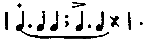
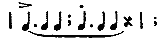
The progressive increase in the value of the final interval, which will be observed in both the odd-and even-numbered rhythms, is probably to be attributed to a gradual decline in the integration of the successive groups into a well-defined rhythmical sequence.
This subdivision of material into two simple phases penetrates all rhythmical structuring. The fundamental fact in the constitution of the rhythmical unit is the antithesis of two phases which we call the accented and the unaccented. In the three-beat group as in the two-beat, and in all more complex grouping, the primary analysis of material is into these two phases. The number of discriminable elements which enter each phase depends on the whole constitution of the group, for this duality of aspect is carried onward from its point of origin in the primary rhythm group throughout the most complex combination of elements, in which the accented phase may comprise an indefinitely great number of simple elements, thus: etc. An indication of this process of differentiation into major and minor phases appears in the form of rhythm groups containing upwards of four elements. In these the tendency is, as one observer expresses it, 'to consider the first two beats as a group by themselves, with the others trailing off in a monotonous row behind.' As the series of elements thus bound up as a unit is extended, the number of beats which are crowded into the primary subgroup also increases. When the attempt was made to unite eleven or twelve reactions in a single group, the first four beats were thus taken together, with the rest trailing off as before. It is evident that the lowest groups with which attention concerned itself here were composed of four beats, and that the actual form of the (nominally) unitary series of eleven beats was as follows:


The subscripts are added in the notation given above because it is to be doubted if a strictly simple four-beat rhythm is ever met with. Of the four types producible in such rhythm forms by variation in the accentual position, three have been found, in the course of the present investigation, to present a fundamental dichotomy into units of two beats. Only one, that characterized by secondary accentuation, has no such discriminable quality of phases. Of this form two things are to be noted: first, that it is unstable and tends constantly to revert to that with initial stress, with consequent appearance of secondary accentuation; and second, that as a permanent form it presents the relations of a triple rhythm with a grace note prefixed.
The presence of this tendency to break up the four-rhythm into subgroups of two beats explains a variety of peculiarities in the records of this investigation. The four-beat rhythm with final accent is found most pleasant at the close of a rhythmical sequence. The possibility of including it in a continuous series depends on having the final interval of 'just the right length.' If one keeps in mind that a secondary initial accent characterizes this rhythm form, the value required in this final interval is explained by the resolution of the whole group into two units of three beats each, the latter of the two being syncopated. The pause is of 'just the right length' when it is functionally equal to two unaccented elements with their succeeding intervals, as follows: .

Likewise in four-rhythms characterized by initial stress there appears a tendency to accent the final beat of the group, as well as that to accent the third. Such a series of four may therefore break up in either of two ways, into on a basis of two-beat units, or into on a basis of three-beat units.

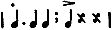
The persistence of these simple equivalences appears also in the treatment of syncopated measures and of supplementary or displaced accents. Of the form one reactor says, and his description may stand for all, "This deliberate introduction of a third accent on the last beat is almost impossible for me to keep. The single group is easy enough and rather agreeable, but in a succession of groups the secondarily accented third beat comes against the first of the next group with a very disagreeable effect." This is the case where no pause intervenes between the groups, in which case the rhythm is destroyed by the suppression, in each alternate simple group, of the unaccented phase; thus, alone is pleasant, because it becomes , but in combination with preceding and succeeding groups it is disagreeable, because it becomes in reality , etc. A long pause between the groups destroys this disagreeableness, since the lacking phase of the second subgroup is then restored and the rhythm follows its normal course.


The amphibrachic form, , is more difficult to maintain than either the dactylic or the trochaic, and in a continuous series tends to pass over into one of these, usually the former. 'With sufficient pause,' the reactors report, 'to allow the attitude to die away,' it is easily got. The same inability to maintain this form in consciousness appears when a continuous series of clicks is given, every third of which is louder than the rest. Even when the beginning of the series is made coincident with the initial phase of the amphibrachic group the rhythmic type slips over into the dactylic, in spite of effort. In this, as in the preceding type of reaction, if the interval separating adjacent groups be lengthened, the rhythm is maintained without trouble. The 'dying away' of the attitude lies really in such an arrangement of the intervals as will formally complete a phrase made up of simple two-beat units.

The positive evidence which this investigation affords, points to the existence of factors of composition in all rhythms of more than three beats; and a variety of peculiarities which the results present can be explained—and in my estimation explained only—on the basis of such an assumption. I conclude, therefore, that strictly stated the numerical limit of simple rhythm groups is very soon reached; that only two rhythmical units exist, of two and three beats respectively; that in all longer series a resolution into factors of one of these types takes place; and, finally, that the subordination of higher rhythmical quantities of every grade involves these simple relations, of which, as the scope of the synthesis increases, the opposition of simple alternate phases tends more and more to predominate over triplicated structures.
Variation in the number of elements which enter into the rhythmic unit does not affect the sense of equivalence between successive groups, so long as the numerical increase does not reach a point at which it lessens the definiteness of the unit itself. For the purpose of testing this relation the reactors beat out a series of rhythm forms from 'one-beat' rhythms to those in which the group consisted of seven, eight and nine elements, and in which the units were either identical with one another or were made up of alternately larger and smaller numbers of elements. Two questions were to be answered in each case; the manner in which these various changes affected the sense of rhythmical equivalence in the alternate groups, and the variations in affective quality which these changes introduced into the experience. With the former of these problems we are here concerned. From 'one-beat' to four-beat rhythms the increase in number of constituents in no way affects the sense of rhythmical equivalence. Beyond this point there is a distinct falling off. 'The first part of the rhythm begins to fade away before the end of the second,' says one; and another: 'The series then reverts to a monotonous succession without feeling of rhythm.' This decline marks those groups composed of an odd number of elements much earlier and more strongly than those which contain an even number. The sense of equivalence has fallen off at five and practically disappears at seven beats, while groups of six and eight retain a fairly definite value as units in a rhythmical sequence. This peculiar relation must be due to the subconscious resolution of the larger symmetrical groups into smaller units of three and four constituents respectively.
Likewise the introduction of variations in the figure of the group—that is, in the number of elements which enter into the groups to be compared, the distribution of time values within them, the position of accents, rests, and the like—does not in any way affect the sense of equivalence between the unlike units. Against a group of two, three, four, or even five elements may be balanced a syncopated measure which contains but one constituent, with the sense of full rhythmical equivalence in the functional values of the two types. Indeed, in the case of five-beat rhythms the definition of values is greater when such opposition finds place than when the five-beat group is continuously repeated. This is to be explained doubtlessly by the more definite integration into a higher rhythmical unity which is afforded under the former conditions.
The number and the distribution of elements are factors variable at will, and are so treated in both musical and poetical expression. The condition which cannot be transgressed is the maintenance of strict temporal relations in the succession of total groups which constitute the rhythmical sequence. These relations are, indeed, not invariable for either the single interval or the duration of the whole group, but they are fixed functions of the dynamic values of these elements and units. Two identically figured groups (e.g., ), no more possess rhythmically substitutionary values than does the opposition of a single beat to an extended series (e.g., ) , apart from this factor of temporal proportion. Those groups which are identical in figure must also be uniform in duration if they are to enter as substitutionary groups into a rhythmical sequence.5 When the acatalectic type is alternately departed from and returned to in the course of the rhythmical sequence, the metrical equivalents must present total time-values which, while differing from that of the full measure in direction and degree, in dependence on the whole form of their structure, maintain similar fixed relations to the primary type. The changes which these flexible quantities undergo will here only be indicated. If the substitutionary groups be of different figures, that which comprises the larger number of elements will occupy the greater time, that which contains fewer, the less.
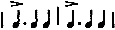

I do not forget the work of other observers, such as Brücke, who finds that dactyls which appear among trochees are of less duration than the latter, nor do I impugn their results. The rhythmical measure cannot be treated as an isolated unit; it must always be considered in its structural relations to the rhythmical sequence of which it forms a part. Every non-conforming measure is unquestionably affected by the prevailing type of the rhythmical sequence in which it occurs. Brücke points out the converse fact that those trochees and iambs are longest which appear in dactylic or other four-measures; but this ignores the complexity of the conditions on which the character of these intrusive types depends. The time-values of such variants are also dependent on the numerical preponderance of the typical form in the whole series. When a single divergent form appears in the sequence the dynamic relations of the two types is different from that which obtains when the numbers of the two approach equality, and the effect of the prevailing form on it is proportionally greater. Secondly, the character of such variants is dependent on the subordinate configuration of the sequence in which they appear, and on their specific functions within such minor rhythmical figures. The relative value of a single dactyl occurring in an iambic pentameter line cannot be predicated of cases in which the two forms alternate with each other throughout the verse. Not only does each type here approximate the other, but each is affected by its structural relation to the proximately higher group which the two alternating measures compose. Thirdly, the quantitative values of these varying forms is related to their logical significance in the verse and the degree of accentuation which they receive. Importance and emphasis increase the duration of the measure; the lack of either shortens it. In this last factor, I believe, lies the explanation of the extreme brevity of dactyls appearing in three-rhythms. When a specific rhythm type is departed from, for the purpose of giving emphasis to a logically or metrically important measure, the change is characteristically in the direction of syncopation. Such forms, as has been said elsewhere, mark nodes of natural accentuation and emphasis. Hence, the dactyl introduced into an iambic or trochaic verse, which, so far as concerns mere number of elements, tends to be extended, may, in virtue of its characteristic lack of accentuation and significance, be contracted below the value of the prevailing three-rhythm. Conversely the trochee introduced into a dactylic sequence, in consequence of its natural accentuation or importance, may exceed in time-value the typical four-rhythm forms among which it appears. The detailed examination of the relation of temporal variations to numerical predominance in the series, to subordinate structural organization, and to logical accentuation, in our common rhythms, is a matter of importance for the general investigation which remains still to be carried out. In so far as the consideration of these factors entered into the experimental work of the present research, such quantitative time relations are given in the following table, the two types in all cases occurring in simple alternation:
TABLE XXI.
Rhythm.1st Meas.2d Meas.Rhythm.1st Meas.2d Meas.
1.0001.0911.0001.140
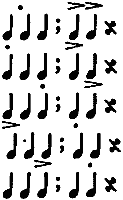
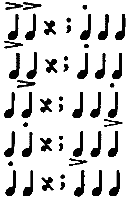
1.0001.1591.0001.021
1.0001.0251.0001.267
1.0000.9841.0001.112
1.0000.7661.0001.119
As the disparity in numerical constitution increases, so will also the divergence in time-value of the two groups concerned. When differentiation into major and minor phases is present, the duration of the former will be greater than that of the latter. Hence, in consequence of the combination of these two factors—e.g., in a syncopated measure of unusual emphasis—the characteristic time-values may be inverted, and the briefer duration attach to that unit which comprises the greater number of elements. Intensive values cannot take the place of temporal values in rhythm; the time form is fundamental. Through all variations its equivalences must be adhered to. Stress makes rhythm only when its recurrence is at regular intervals. The number of subordinate factors which combine with the accented element to make the group is quite indifferent. But whether few or many, or whether that element on which stress falls stands alone (as it may), the total time values of the successive groups must be sensibly equivalent. When a secondary element is absent its place must be supplied by a rest of equivalent time-value. If these proper temporal conditions be not observed no device of intensive accentuation will avail to produce the impression of metrical equivalence among the successive groups.
B. The Distribution of Elements Within the Group.
(a) The Distribution of Intensities.
In the analysis of the internal constitution of the rhythmic unit, as in other parts of this work, the investigation follows two distinct lines, involving the relations of rhythm as apprehended, on the one hand, and the relations of rhythm as expressed, on the other; the results in the two cases will be presented separately. A word as to the method of presentation is necessary. The fact that in connection with each experiment a group of questions was answered gives rise to some difficulty in planning the statement of results. It is a simple matter to describe a particular set of experiments and to tell all the facts which were learned from them; but it is not logical, since one observation may have concerned the number of elements in the rhythmic unit, another their internal distribution, and a third their coalescence in a higher unity. On the other hand, the statement of each of these in its own proper connection would necessitate the repetition of some description, however meager, of the conditions of experimentation in connection with each item. For economy's sake, therefore, a compromise has been made between reporting results according to distribution of material and according to distribution of topics. The evidence of higher grouping, for example, which is afforded by variations in duration and phases of intensity in alternate measures, will be found appended to the sections on these respective classes of material.
In all the following sections the hammer-clang apparatus formed the mechanism of experimentation in sensory rhythms, while in reactive rhythms simple finger-tapping was employed.
In comparing the variations in stress which the rhythmical material presents, the average intensities of reaction for the whole group has been computed, as well as the intensities of the single reactions which compose it. This has been done chiefly in view of the unstable intensive configuration of the group and the small amount of material on which the figures are based. The term is relative; in ascertaining the relations of intensity among the several members of the group, at least ten successive repetitions, and in a large part of the work fifty, have been averaged. This is sufficient to give a clear preponderance in the results to those characteristics which are really permanent tendencies in the rhythmical expression. This is especially true in virtue of the fact that throughout these experiments the subject underwent preliminary training until the series of reactions could be easily carried out, before any record of the process was taken. But when such material is analyzed in larger and smaller series of successive groups the number of reactions on which each average is based becomes reduced by one half, three quarters, and so on. In such a case the prevailing intensive relations are liable to be interfered with and transformed by the following factor of variation. When a wrong intensity has accidentally been given to a particular reaction there is observable a tendency to compensate the error by increasing the intensity of the following reaction or reactions. This indicates, perhaps, the presence of a sense of the intensive value of the whole group as a unity, and an attempt to maintain its proper relations unchanged, in spite of the failure to make exact coördination among the components. But such a process of compensation, the disappearance of which is to be looked for in any long series, may transpose the relative values of the accented elements in two adjacent groups when only a small number of reactions is taken into account, and make that seem to receive the major stress which should theoretically receive the minor, and which, moreover, does actually receive such a minor stress when the value of the whole group is regarded, and not solely that member which receives the formal accentuation.
The quantitative analysis of intensive relations begins with triple rhythms, since its original object was to compare the relative stresses of the unaccented elements of the rhythmic group. These values for the three forms separately are given in Table XXII., in which the value of the accented element in each case is represented by unity.
TABLE XXII.
Rhythm.1st Beat.2d Beat.3d Beat.
Dactylic,1.0000.4360.349
Amphibrachic,0.4881.0000.549
Anapæstic,0.4790.4841.000
The dactylic form is characterized by a progressive decline in intensity throughout the series of elements which constitute the group. The rate of decrease, however, is not continuous. There is a marked separation into two grades of intensity, the element receiving accentual stress standing alone, those which possess no accent falling together in a single natural group, as shown in the following ratios: first interval to third, 1.000:0.349; second interval to third, 1.000:0.879. One cannot say, therefore, that in such a rhythmic form there are two quantities present, an accented element and two undifferentiated elements which are unaccented. For the average is not based on a confused series of individual records, but is consistently represented by three out of four subjects, the fourth reversing the relations of the second and third elements, but approximating more closely to equivalence than any other reactor (the proportional values for this subject are 1.000; 0.443; 0.461). Moreover, this reactor was the only musically trained subject of the group, and one in whom the capacity for adhering to the logical instructions of the experiment appears decidedly highest.
In the amphibrachic form the average again shows three degrees of intensity, three out of four subjects conforming to the same type, while the fourth reverses the relative values of the first and third intervals. The initial element is the weakest of the group, and the final of median intensity, the relation for all subjects being in the ratio, 1.000:1.124. The amphibrachic measure begins weakly and ends strongly, and thus approximates, we may say, to the iambic type.
In the anapæstic form the three degrees of intensity are still maintained, three out of four subjects giving consistent results; and the order of relative values is the simple converse of the dactylic. There is presented in each case a single curve; the dactyl moves continuously away from an initial accent in an unbroken decrescendo, the anapæst moves continuously toward a final accent in an unbroken crescendo. But in the anapæstic form as well as in the dactylic there is a clear duality in the arrangement of elements within the group, since the two unaccented beats fall, as before, into one natural group, while the accented element is set apart by its widely differentiated magnitude. The ratios follow: first interval to second, 1.000:1.009; first interval to third, 1.000:2.084.