Volume 1 / Part 1 — HABIT FORMATION IN THE CRAWFISH CAMBARUS AFFINIS.1
Reading edition
HABIT FORMATION IN THE CRAWFISH CAMBARUS AFFINIS.1
BY ROBERT M. YERKES AND GURRY E. HUGGINS.
This paper is an account of some experiments made for the purpose of testing the ability of the crawfish to profit by experience. It is well known that most vertebrates are able to learn, but of the invertebrates there are several classes which have not as yet been tested.
The only experimental study of habit formation in a crustacean which we have found is that of Albrecht Bethe2 on the crab, Carcinus maenas. In his excellent paper on the structure of the nervous system of Carcinus Bethe calls attention to a few experiments which he made to determine, as he puts it, whether the crab possesses psychic processes. The following are the observations made by him. Experiment I. A crab was placed in a basin which contained in its darkest corner an Eledone (a Cephalopod). The crab at once moved into the dark region because of its instinct to hide, and was seized by the Eledone and drawn under its mantle. The experimenter then quickly freed the crab from its enemy and returned it to the other end of the basin. But again the crab returned to the dark and was seized. This was repeated with one animal five times and with another six times without the least evidence that the crabs profited by their experiences with the Eledone. Experiment 2. Crabs in an aquarium were baited with meat. The experimenter held his hand above the food and each time the hungry crab seized it he caught the animal and maltreated it, thus trying to teach the crabs that meat meant danger. But as in the previous experiment several repetitions of the experience failed to teach the crabs that the hand should be avoided. From these observations Bethe concludes that Carcinus has no 'psychic qualities' (i.e., is unable to profit by experience), but is a reflex machine.
Bethe's first test is unsatisfactory because the crabs have a strong tendency to hide from the experimenter in the darkest corner. Hence, if an association was formed, there would necessarily be a conflict of impulses, and the region in which the animal would remain would depend upon the relative strengths of its fear of the experimenter and of the Eledone. This objection is not so weighty, however, as is that which must obviously be made to the number of observations upon which the conclusions are based. Five or even twenty-five repetitions of such an experiment would be an inadequate basis for the statements made by Bethe. At least a hundred trials should have been made. The same objection holds in case of the second experiment. In all probability Bethe's statements were made in the light of long and close observation of the life habits of Carcinus; we do not wish, therefore, to deny the value of his observations, but before accepting his conclusions it is our purpose to make a more thorough test of the ability of crustaceans to learn.
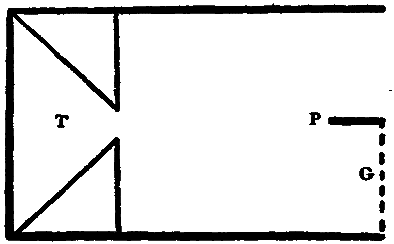
Fig. 1. Ground Plan of Labyrinth. T, triangular compartment from which animal was started; P, partition at exit; G, glass plate closing one exit passage. Scale 1/6.
For determining whether the crawfish is able to learn a simple form of the labyrinth method was employed. A wooden box (Fig. 1) 35 cm. long, 24 cm. wide and 15 cm. deep, with one end open, and at the other end a triangular compartment which communicated with the main portion of the box by an opening 5 cm. wide, served as an experiment box. At the open end of this box a partition (P) 6 cm. long divided the opening into two passages of equal width. Either of these passages could be closed with a glass plate (G), and the subject thus forced to escape from the box by the choice of a certain passage. This box, during the experiments, was placed in the aquarium in which the animals lived. In order to facilitate the movement of the crawfish toward the water, the open end was placed on a level with the water in the aquarium, and the other end was raised so that the box made an angle of 6° with the horizontal.
Experiments were made under uniform conditions, as follows. A subject was taken from the aquarium and placed in a dry jar for about five minutes, in order to increase the desire to return to the water; it was then put into the triangular space of the experiment box and allowed to find its way to the aquarium. Only one choice of direction was necessary in this, namely, at the opening where one of the passages was closed. That the animal should not be disturbed during the experiment the observer stood motionless immediately behind the box.
Before the glass plate was introduced a preliminary series of tests was made to see whether the animals had any tendency to go to one side on account of inequality of illumination, of the action of gravity, or any other stimulus which might not be apparent to the experimenter. Three subjects were used, with the results tabulated.
Exit by Right PassageExit by Left Passage.
No. 164
No. 273
No. 3 3 7
1614
Since there were more cases of exit by the right-hand passage, it was closed with the glass plate, and a series of experiments made to determine whether the crawfish would learn to avoid the blocked passage and escape to the aquarium by the most direct path. Between March 13 and April 14 each of the three animals was given sixty trials, an average of two a day. In Table I. the results of these trials are arranged in groups of ten, according to the choice of passages at the exit. Whenever an animal moved beyond the level of the partition (P) on the side of the closed passage the trial was counted in favor of the closed passage, even though the animal turned back before touching the glass plate and escaped by the open passage.
TABLE I.
HABIT FORMATION IN THE CRAWFISH.¹
Experiments.No. 1No. 2No. 3TotalsPer cent
OpenClosedOpenClosedOpenClosedOpenClosedOpen
1-10825528151550.0
11-20468264181260.0
21-3063²828222775.8
31-4091828225583.3
41-5082827323776.6
51-60100829127390.0
TEST OF PERMANENCY OF HABIT AFTER 14 DAYS' REST.
61-7064828222873.3
(1-10)
71-8064827321970.0
(11-20)
¹The experiments of this table were made by F.D. Bosworth.
²One trial in which the subject failed to return to the water within thirty minutes.
In these experiments there is a gradual increase in the number of correct choices (i.e., choice of the 'open' passage) from 50 per cent. for the first ten trials to 90 per cent. for the last ten (trials 51-60). The test of permanency, made after two weeks, shows that the habit persisted.
Although the observations just recorded indicate the ability of the crawfish to learn a simple habit, it seems desirable to test the matter more carefully under somewhat different conditions. For in the experiments described the animals were allowed to go through the box day after day without any change in the floor over which they passed, and as it was noted that they frequently applied their antennae to the bottom of the box as they moved along, it is possible that they were merely following a path marked by an odor or by moistness due to the previous trips. To discover whether this was really the case experiments were made in which the box was thoroughly washed out after each trip.
The nature of the test in the experiments now to be recorded is the same as the preceding, but a new box was used. Fig. 2 is the floor plan and side view of this apparatus. It was 44.5 cm. long, 23.5 cm. wide and 20 cm. deep. The partition at the exit was 8.5 cm. in length. Instead of placing this apparatus in the aquarium, as was done in the previous experiments, a tray containing sand and water was used to receive the animals as they escaped from the box. The angle of inclination was also changed to 7°. For the triangular space in which the animals were started in the preceding tests a rectangular box was substituted, and from this an opening 8 cm. wide by 5 cm. deep gave access to the main compartment of the box.
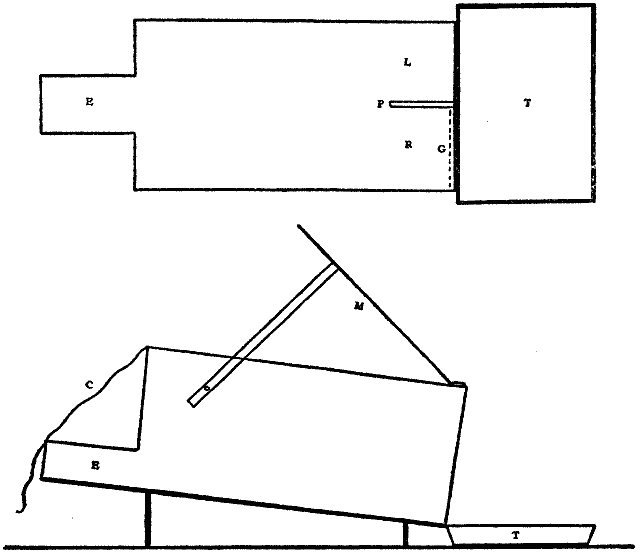
Fig. 2. Floor Plan and Side View of Labyrinth Number 2. E, entrance chamber from which animal was started; C, cloth covering E; M, mirror; T, tray containing sand and water; G, glass plate; P, partition; R, right exit passage; L, left exit passage. Scale 1/8.
A large healthy crawfish was selected and subjected to tests in this apparatus in series of ten experiments given in quick succession. One series a day was given. After each test the floor was washed; as a result the experiments were separated from one another by a three-minute interval, and each series occupied from thirty minutes to an hour. Table II. gives in groups of five these series of ten observations each. The groups, indicated by Roman numerals, run from I. to IX., there being, therefore, 450 experiments in all. Groups I. and II., or the first 100 experiments, were made without having either of the exit passages closed, in order to see whether the animal would develop a habit of going out by one side or the other. It did very quickly, as a matter of fact, get into the habit of using the left passage (L.). The last sixty experiments (Groups I. and II.) show not a single case of escape by the right passage. The left passage was now closed. Group III. gives the result. The time column (i.e., the third column of the table) gives for each series of observations the average time in seconds occupied by the animal in escaping from the box. It is to be noted that the closing of the Left passage caused an increase in the time from 30.9 seconds for the last series of the second group to 90 seconds for the first series of the third group. In this there is unmistakable evidence of the influence of the change in conditions. The animal after a very few experiences under the new conditions began going to the Right in most cases; and after 250 experiences it had ceased to make mistakes. Group VII. indicates only one mistake in fifty choices.
TABLE II.
HABIT FORMATION AND THE MODIFICATION OF HABITS IN THE CRAWFISH.
Results in Series of Ten.Avs. in Groups of 50.
SeriesL.R.Time.L.R.L.R.Time.
Group I.19145Per Cent.
23769
39120
44672
51031
——
3515703047.4
II.11029
21030
31030
41028.8
51030.9
——
5010030
…………
III.146902
22889.21
31936.71
428512
519432
———
10407208062
…………
IV.1371241
228445
328374
41034
5281
———
94111188260
…………
V.110442
210354
337763
428507
519504
———
64420128851
…………
VI.128452
210415
31941.87
41032.77
5108
———
3472969440
…………
VII.119394
210387
31030.73
410426
510484
———
1492429839.5
…………
VIII.1821471
29126
382492
491382
59141
———
4375861460.2
…………
IX.11941
228391
31029
41947
519321109038
———
5452
The dotted lines at the beginning of groups indicate the closed passage.
At the beginning of Group VIII. the Right instead of the Left passage was closed in order to test the ability of the animal to change its newly formed habit. As a result of this change in the conditions the animal almost immediately began going to the Left. What is most significant, however, is the fact that in the first trial after the change it was completely confused and spent over fifteen minutes wandering about, and trying to escape by the old way (Fig. 4 represents the path taken). At the end of the preceding group the time of a trip was about 48 seconds, while for the first ten trips of Group VIII. the time increased to 147 seconds. This remarkable increase is due almost entirely to the great length of time of the first trip, in which the animal thoroughly explored the whole of the box and made persistent efforts to get out by the Right passage as it had been accustomed to do. It is at the same time noteworthy that the average time for the second series of Group VIII. is only 26 seconds.
For Group IX. the conditions were again reversed, this time the Left passage being closed. Here the first trial was one of long and careful exploration, but thereafter no more mistakes were made in the first series, and in the group of fifty tests there were only five wrong choices.
The fifth column, R. L. and L. R., of Table II. contains cases in which the subject started toward one side and then changed its course before reaching the partition. In Group III., for instance, when the Left passage was closed, the subject started toward the Left seven times, but in each case changed to the Right before reaching the partition. This is the best evidence of the importance of vision that these experiments furnish.
The first experiments on habit formation proved conclusively that the crawfish is able to learn. The observations which have just been described prove that the labyrinth habit is not merely the following of a path by the senses of smell, taste or touch, but that other sensory data, in the absence of those mentioned, direct the animals. So far as these experiments go there appear to be at least four sensory factors of importance in the formation of a simple labyrinth habit: the chemical sense, touch, vision and the muscle sense. That the chemical sense and touch are valuable guiding senses is evident from even superficial observation, and of the importance of vision and the muscle sense we are certain from the experimental evidence at hand.
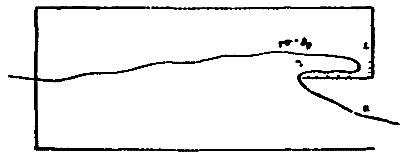
Fig. 3. Path taken by crawfish while being trained to avoid the left passage. Marks along the glass plate and partition indicate contact by the antennae and chelæ.
Of the significance of the sensations due to the 'direction of turning' in these habits the best evidence that is furnished by this work is that of the following observations. In case of the tests of Table II. the subject was, after 100 preliminary tests, trained by 250 experiences to escape by the Right-hand passage. Now, in Groups III. to VII., the subject's usual manner of getting out of the closed passage, when by a wrong choice it happened to get into it, was to draw back on the curled abdomen, after the antennae and chelæ had touched the glass plate, and then move the chelæ slowly along the Right wall of the partition until it came to the upper end; it would then walk around the partition and out by the open passage. Fig. 3 represents such a course. In Group VIII. the Right passage was closed, instead of the Left as previously. The first time the animal tried to get out of the box after this change in the conditions it walked directly into the Right passage. Finding this closed it at once turned to the Right, as it had been accustomed to do when it came in contact with the glass plate, and moved along the side of the box just as it did in trying to get around the end of the partition. The path taken by the crawfish in this experiment is represented in Fig. 4. It is very complex, for the animal wandered about more than fifteen minutes before escaping.
The experiment just described to show the importance of the tendency to turn in a certain direction was the first one of the first series after the change in conditions. When given its second chance in this series the subject escaped directly by the Left passage in 33 seconds, and for the three following trips the time was respectively 25, 25 and 30 seconds.
Upon the experimental evidence presented we base the conclusion that crawfish are able to profit by experience in much the same way that insects do, but far more slowly.
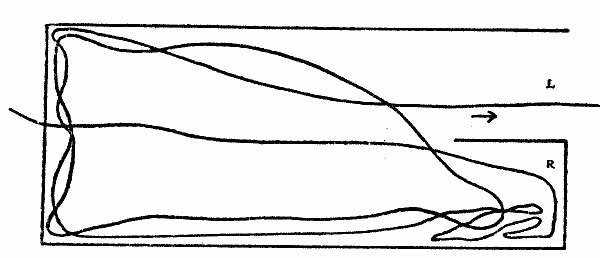
Fig. 4. Path taken by crawfish which had been trained to avoid the Left passage, when the Right passage was closed. Showing turning to the right as in Fig. 3.
It was thought that a study of the way in which crawfish right themselves when placed upon their backs on a smooth surface might furnish further evidence concerning the ability of the animals to profit by experience.
Dearborn3 from some observations of his concludes that there is no one method by which an individual usually rights itself, and, furthermore, that the animals cannot be trained to any one method. His experiments, like Bethe's, are too few to warrant any conclusions as to the possibility of habit formation.
For the following experiments the subject was placed on its back on a smooth surface in the air and permitted to turn over in any way it could. Our purpose was to determine (1) whether there was any marked tendency to turn in a certain way, (2) whether if such was not the case a tendency could be developed by changing the conditions, and (3) how alteration in the conditions of the test would affect the turning.
A great many records were taken, but we shall give in detail only a representative series. In Table III., 557 tests made upon four subjects have been arranged in four groups for convenience of comparison of the conditions at different periods of the training process. Each of these groups, if perfect, would contain 40 tests for each of the four subjects, but as a result of accidents II., III., and IV. are incomplete.
TABLE III.
RE-TURNING OF CRAWFISH.
Group.Number of Animal.L.R.Time in Seconds.Tests.
Per cent.
I.222.577.514.640
342.557.52.640
452.847.24.338
1644.555.522.545
—————————
40.659.410.8163
II.228725043
332686.250
4—1006.840
1631.368.739.342
—————————
22.877.225.6175
III.22.597.546.540
—————
420805.540
1641591549
—————————
21.278.822129
IV.22984150
—————
432.567.57.340
—————————
17832490
Group I., representing 163 tests, shows 59 per cent. to the right, with a time interval of 10.8 seconds (i.e., the time occupied in turning). Group II. shows 77 per cent. to the right; and so throughout the table there is an increase in the number of returnings to the right. These figures at first sight seem to indicate the formation of a habit, but in such case we would expect, also, a shortening of the time of turning. It may be, however, that the animals were gradually developing a tendency to turn in the easiest manner, and that at the same time they were becoming more accustomed to the unusual position and were no longer so strongly stimulated, when placed on their backs, to attempt to right themselves.
All the subjects were measured and weighed in order to discover whether there were inequalities of the two sides of the body which would make it easier to turn to the one side than to the other. The chelæ were measured from the inner angle of the joint of the protopodite to the angle of articulation with the dactylopodite. The carapace was measured on each side, from the anterior margin of the cephalic groove to the posterior extremity of the lateral edge. The median length of the carapace was taken, from the tip of the rostrum to the posterior edge, and the length of the abdomen was taken from this point to the edge of the telson. These measurements, together with the weights of three of the subjects, are given in the accompanying table.
TABLE IV.
MEASUREMENTS OF CRAWFISH.
Chelæ.Carapace.Abdomen.Weight.
Left.Right.Left.Right.Median.
No. 2,9.810.038.238.747.348.129.7
No. 4,7.77.733.633.839.442.317.7
No. 16,12.512.437.637.646.453.236.2
Since these measurements indicate slightly greater size on the right it is very probable that we have in this fact an explanation of the tendency to turn to that side.
To test the effect of a change in the conditions, No. 16 was tried on a surface slanted at an angle of 1° 12'. Upon this surface the subject was each time so placed that the slant would favor turning to the right. Under these conditions No. 16 gave the following results in two series of tests. In the first series, consisting of 46 turns, 82.6 per cent. were to the right, and the average time for turning was 17.4 seconds; in the second series, of 41 tests, there were 97.5 per cent, to the right, with an average time of 2.5 seconds. We have here an immediate change in the animal's method of re-turning caused by a slight change in the conditions. The subject was now tested again on a level surface, with the result that in 49 tests only 59 per cent. were toward the right, and the time was 15 seconds.
SUMMARY.
1. Experiments with crawfish prove that they are able to learn simple labyrinth habits. They profit by experience rather slowly, from fifty to one hundred experiences being necessary to cause a perfect association.
2. In the crawfish the chief factors in the formation of such habits are the chemical sense (probably both smell and taste), touch, sight and the muscular sensations resulting from the direction of turning. The animals are able to learn a path when the possibility of following a scent is excluded.
3. The ease with which a simple labyrinth habit may be modified depends upon the number of experiences the animal has had; the more familiar the animal is with the situation, the more quickly it changes its habits. If the habit is one involving the choice of one of two passages, reversal of the conditions confuses the subject much more the first time than in subsequent cases.
4. Crawfish right themselves, when placed on their backs, by the easiest method; and this is found to depend usually upon the relative weight of the two sides of the body. When placed upon a surface which is not level they take advantage, after a few experiences, of the inclination by turning toward the lower side.