"The Wanderings of a Wayward Boy" (continued 5)
Reading edition
Only a couple of strong bamboos of great length, and between them a sheet of grass-cloth, add to this a rude pillow stuffed with withered moss, and the whole is complete.
It was a long and a slow journey which they started on next morning, before even the stars had paled before the advancing beams of the sun. But ere ever he had set behind the western hills it had been safely accomplished.
And so by degrees, as Harry’s strength could bear it, stage after stage of the return march was got over and at length, to the invalid’s inexpressible joy, they arrived once more at the banks of the lake of the hundred isles. Walda quickly gathered together an immense heap of withered grass, and quickly had it on flame; then he put on top of it green branches, so that a dense volume of white-blue smoke rose up on the evening air.
They saw it from the king’s island.
King Googagoo—they have strange names, these chiefs of the interior, the repetition of syllables and even words in names is very common—King Googagoo himself came to meet Harry in his barge, but he brought no retinue. He was a very simple king.
As soon as he landed Walda, Peela, and Popa went and threw themselves on their faces in front of his majesty, burying their knives in the earth as they did so. Nor did they rise until he had thrice touched each one with the flat of his spear.
He now went speedily towards Harry, and scanned him very anxiously.
Harry smiled feebly, and held out a hand which the king took and pressed.
“My son has been ill,” he said, “my son has been at the door of the cave of death. No matter, he lives; my son will soon be well. The king will make him well; he shall eat honey and milk, and drink of the blood of she-goats until he is once more strong.”
When landed at the island, the king led the way to his own tent, and Harry was brought here and laid on a bed or dais covered with lions’ skins.
As he shivered with cold, a fire was lit in the middle of the floor. The smoke found its way up almost spirally, and out through a hole in the roof, over which was placed a triple fan kept in constant motion by slaves without.
Another warm lion’s skin was spread over Harry, Somali Jack prepared him a decoction of boiled milk mixed with honey and some pleasant bitter herb. After swallowing this Harry remembered seeing the king squatting on a mat by the fire, and his own boys in a corner; he noticed that whenever any one entered the tent his majesty lifted a beckoning finger, warning them to keep silence. He remembered little more that day, for he fell into a soothing perspiration, and soon after into a deep and dreamless sleep.
It was broad daylight when he wakened, and he felt so much better that he even attempted to rise. It was then he noticed how feeble and weak he was.
Whether or not the bitter medicine mingled with the warm and honeyed milk partook of the nature of an opiate or not, Harry had no means of ascertaining, but for nearly three days he did little else but sleep—and perspire during the intervals of taking nourishment.
He was aware, however, that the great kind-hearted king was almost constantly in the tent, and that he moved about on tiptoe, and talked in whispers, never failing to lift his finger and shake it at any one who entered.
Sometimes an amazon came in and looked at Harry, then smiled a grim smile and retired, and once a terrible-looking old man with triangular teeth like Walda’s put in an appearance. He had a fowl in his arm, which after many strange antics—that showed he was working a fetish—he slew. He then dipped his finger in the blood and smeared Harry’s forehead.
After this another fowl was brought to him, and he then made motions with his hand and arm over the patient, of a semi-mesmeric kind, or as if he were drawing something invisible towards the fowl in his arms. The latter was immediately after chased out of the tent, and from the noise out of doors it was evidently being hunted out of the enclosure entirely.
Next morning a cocoanut shell full of pure warm blood was handed to him; this was not unpleasant to drink, and was repeated three times a day, and day after day for a week. (The blood-cure is not unknown in Europe, but I believe some of the African tribes used it ages and ages ago.—G.S.)
Every hour now, almost, Harry felt himself getting stronger. He was soon able to sit up for hours, then the king exhibited all the exuberant joy of a child of six. With his own hands he brought his patient a small dish of delightfully curried chicken and rice, and as Harry ate it King Googagoo laughed till his black, fat sides shook again.
With returning health came returning hope and happiness, and when, leaning on the king’s arm, Harry made his first venture out of doors it seemed for all the world like going into a new world. Everything was so inexpressibly bright and lovely, the drooping palm trees, the banana groves the greenest of the green, the splendid flowers that grew everywhere, the bright-plumaged birds, the cloudless sky, the blue and placid lake, and the purple hills on the far horizon. It was all like a beautiful dream, it was all a scene of enchantment, and to breathe the balmy air was verily life itself.
How grateful he felt to this simple-minded king; ah! yes, and how grateful to the Great Father above, who had spared his life, and brought him safely through countless dangers.
Harry soon found the air was almost too strong for him, it flushed his cheeks and quickened his breathing, so he retired again, and was almost immediately after asleep on his lion-skin couch.
Next evening a hammock was slung for him near the fire, and lying there he found himself strong enough to entertain the king with a little music on the concertina, which “through thick and thin” Raggy had kept possession of.
Only some sweet old-fashioned Scottish lilts he played, but they pleased his majesty immensely, and after each he rubbed his hands and said, “Lobo! Lobo! Lobo!”
Could Harry now tell him more of the story of the world?
Yes, Harry could and would. He laid the concertina gently down by his side, and, turning half round to where the king was squatting, began to tell him through Raggy the simple Bible story of the creation.
Raggy had heard it all before, and was quite capable of translating it.
Next night Harry was even stronger; King Googagoo brought into the tent quite a crowd of his favourite amazons, and the young historian had to begin at the beginning again.
To have seen the boy preacher leaning half up in his hammock as he told in earnest language his wondrous tale, and the innocent looks of the simple king with the firelight playing over his face, and the background of terrible-looking but listening amazons, would have suggested a picture to many an artist which might have made him famous.
The story of Joseph seemed, next to that of Eden’s garden, particularly to interest his hearers, and many an interjection, many a marvelling “Lobo?” did the king utter while Harry spoke through Raggy.
His remarks, too, were innocent, not to say childish, but very much to the point.
Almost every night for weeks Harry had to tell the Bible and New Testament tale. And one day, when now nearly strong again, he was gratified to find the king himself repeating the story to his people.
And they seemed spellbound.
Harry determined to make the islands his home for many months to come.
Meanwhile scouts were employed to scour the country in many different directions, and endeavour if possible to find out the whereabouts or news at least of the white men.
For a very long time they were unsuccessful. At last, however, much to Harry’s joy, one man returned, bringing with him a vague rumour that he had heard of five men belonging to a foreign country, who lived at the court of a chief not very far from the lakes, but in the fastnesses of a mountain-studded wilderness. So fierce and terrible was this chief reported to be that no one would dare to enter his territory. If any one did—so it was said—he would assuredly be crucified, or hoisted by the heels into a sapling tree, there to hang in the sun until the great grey kites ate the flesh from off his bones.
News of an equally important nature was soon after brought by another and probably braver scout. He had entered the chief’s wild country, he had even seen and conversed with one of the white men, and found out that there were six more in captivity, and that until now they had given up all hopes of ever being able to regain their freedom.
King Googagoo was as much delighted with the news as was Harry.
And the king, moreover, now showed all the fierce impetuosity of his nature.
He smote the ground with the staff of his spear.
“I will go,” he cried, “with all the strength of my amazons and fight this king, and deliver your friends from bondage.”
But Harry saw that whatever was to be done must be done with care and caution. For failure would mean the death—probably by torture—of the unfortunate white captives.
To please King Googagoo he at once accepted his assistance, but said they must prepare.
“All the men of war and all the amazons,” replied the king, “are at your disposal. You have brought everlasting joy to my heart, do with us what you will.”
Harry at once set about operations. He held a great review in one of the largest islands. Every man, he found, was a soldier, but they were sadly deficient in armour of an effective kind. Spears there were, though, in abundance—nothing else save these and knives.
Then it occurred to Harry to regularly drill them as sailors are drilled on shore, in companies, in squares of various kinds, and in battalions or—impis.
He guessed, rightly too, that the fine old Highland triangle-formation would do well with these people. (Note 1.) So he taught them that.
But his teaching did not end here. He must furnish his little army with some weapon far more effective than either dagger or spear; so he set himself to think.
How he wished he had but a hundred rifles and ammunition! But wishes in this case were vain enough.
Why not bows and arrows?
Why not, indeed. The idea struck him as he lay in bed one night, and so excited him that he did not steep a wink till nearly sunrise.
He was up betimes all the same, and made haste to communicate his notion to the king.
His majesty was delighted, as, indeed, he was with all Harry’s proposals. So that very day a branch was cut from a species of yew-tree, and with the aid of a string composed of hide the first rude bow was made.
This was improved upon day after day. The king’s forgemen and artificers were summoned, and after many trials of different kinds of wood for the bows and for the arrows, a very useful and very deadly kind of Cross-bow was eventually fashioned and duly approved of by the king.
The arrow-heads presented the greatest difficulty, but this was finally got over, and they fell upon a plan of not only forging good serviceable, ones, but of fastening them on so that the arrow itself would break before the head could come off.
King Googagoo’s, people now went in for the study of war in downright earnest, and gradually the army was supplied with finely-made cross-bows.
Many months went on in these preparations. Meanwhile the arts of peace were not forgotten. Googagoo’s men were very far ahead of any other tribe that ever Harry in his wanderings had met, in the pursuits of agriculture. There grew on many of the islands immense fields of paddy, or rice, and fields of sugarcane, all of which were duly hoed with hard wood instruments, and duly watered by hand in season.
They were so close to the water, and there were so many field hands, that any complicated system of irrigation was not required.
Harry taught this simple, innocent and frugal people many useful hints.
His youthful education, and the lessons honest Andrew had taught him when quite a boy, now came in very handy indeed, which only shows that no lad, whatever his position in life, should hesitate to learn a trade.
Harry, assisted by Raggy and Jack, made chairs for the king’s tent, and an extra couch. He also made rude but useful candlesticks, and with the fat of goats and pigs rude and useful candles to place in them; so that when the rainy season returned, it was quite a treat to sit in the palace tent with lights burning, and read, tell stories, and sing songs till it was time to go to bed.
The king was so easily pleased, so good-tempered, and so generally jolly, that Harry really could not help liking him.
He also proved a very apt pupil, and before his guest had been fully four months in his island, could speak fairly good English.
So all went well, but the trouble was on ahead. Harry often thought of that, and it gave him many and many an anxious moment.
One day a scout returned from the mainland with news of so startling a nature that—that I cannot do better than defer it for another chapter.
Note 1. The Scottish Highlanders of old used almost invariably to charge in this fashion; as the triangular phalanx neared the foe, pistols were fired, then dashed among them, claymores were then drawn, and while wild slogans rent the air, the charge was delivered, with a vigour and aim that made success all but certain.
Book Four—Chapter Four.
King Kara-Kara’s Armada—The Battle on the Lake—Terrible fighting.
Briefly stated, the news which the scout had brought from the mainland was to the effect that King Kara-Kara, who held the white men at his court as slaves, having heard of the prosperity and wealth of the king of the hundred isles, and that he also owned a white slave, had determined to invade the island territory.
From the hill-top, at a safe distance, this scout had beheld Kara-Kara’s camp with his own eyes, and he assured King Googagoo that the army was a well-armed and a vast one, and that they were already busily engaged in cutting down trees and making dug-outs. (Note 1.)
“So,” said Harry, “the tables are turned. Instead of our making war on Kara-Kara, Kara-Kara is going to make war upon us.”
“Let them come,” replied Googagoo, “I care not; you have taught me to put my trust in Heaven. I do so, and feel sure that the Great Eye which looks upon us from beyond the clouds, will keep us safe and give us the victory.”
Although there were now thunderstorms and rain almost every day, Harry made himself busier with his little army than ever.
He picked out the best, quickest, and boldest men for officers—and I need hardly say that both Walda and Somali Jack had high appointments—and he kept drilling the men and amazons from morning till night.
Nor did he forget the commissariat This was to be very simple—little else, in fact, save dates and rice and water.
Often now of a night great fires could be seen gleaming among the wooded hills on the distant horizon, showing plainly enough that King Kara-Kara’s men were far from idle.
So the time wore on, and the wet season passed; the lake was no longer lashed into foam by driving squalls, but slept as peacefully under the blue sky as if waves had never yet been invented.
Harry was now wholly ready for action, and he had almost made up his mind to carry the war into the enemy’s country before he had time to attack the islands.
The king and he had a long palaver over the particulars of this plan. His majesty had very great faith in his navy.
“My boys,” he said, “can fight as well on the water as they and my brave amazons can do on shore. Let them come. We will cripple them, sink them, then the work of utterly destroying them on their own shore will be easy indeed.”
Harry, on second thoughts, would have preferred surprising Kara-Kara by night, but he acquiesced in the king’s wishes.
They would be ready, therefore, and wait. How or when would the enemy come? By night or by day? and in what formation?
Tall signal-posts were built on every island, to give warning of the approach of the foe, and round every isle sentinels were stationed day and night, with great fires built and ready to light.
For there was no saying from what direction the attack might be made. In all probability they would steal round the lake under the shadow of the land, and under the cover of the darkness, and attack Googagoo at the place where he was most vulnerable.
More than once, in the starlight, small canoes had been detected gliding about at night, but were speedily chased and put to flight. They were spies without a doubt.
The island fleet had been by no means a first-class one, consisting for the most part of large dug-outs with outriggers, like great gates at each side This last certainly gave them extra stability and prevented their turning over, but it greatly lessened their speed.
Even the flagship, which the king’s barge might well be called, was rather an unwieldy craft. She was the only one that had sailing power, and that was merely a clumsy square sail, on one centre mast.
But Harry had gone in for naval reform—as far as practicable, and with all the enthusiasm of a British sailor.
He had the men—for every one of these islanders was amphibious in a manner of speaking—what he wanted was the ships.
Some new boats were accordingly made of a light wood that had been cut down years ago. He made these broader in the beam, so that he managed to dispense with the abominable way-stopping outriggers. Seven in all of these were constructed, the bottoms being made shapely and smooth, the sides light and thin, and the whole arrangement capable of double the speed.
These new boats were to contain a crew of picked archers, the very best shots in his little army, which consisted of eight thousand men all told. There were also one thousand amazons.
Harry, in the forthcoming expedition to the mainland, wanted to leave these women folks—“leave the ladies”—that is how he politely worded it—at home. But the king, who was to command in person, would not hear of such a thing. They were his body-guard, and so go they must.
Attention was now turned to the royal barge, and she lay bottom upwards for a week to be strengthened by skin and pieces of thin iron, so that when she was again launched, she looked a sturdy, useful craft indeed.
Extra oars or paddles were placed in every war-boat, and spears and daggers innumerable.
Between a few of the islands, and quite out of view of the enemy, a great naval review was held, and everything passed off in a most satisfactory way.
Still, by taking away the outriggers Harry had considerably increased the risk of capsizing in his boats. So he took the matter into still more serious consideration, the result of which was that he constructed a small fleet of special war-boats, each one consisting of two of the ordinary dug-outs lashed together side by side, and he found to his great joy that even these had as much speed in them as the clumsy outrigger canoes.
The islanders were now ready for battle either by land or water.
Scouts were sent to the hills to spy out the doings of the enemy.
They returned with tidings to the effect that they had over two hundred large dug-outs afloat, and that each of these had outriggers. That their army consisted of nearly 20,000 warriors, armed with spears, and clubs, and broad knives.
It was only a question now of time, so Harry waited. He himself was to command in the naval engagement, the king would be otherwise engaged as we shall presently see.
Whether it was that King Kara-Kara did not possess much ingenuity, or was a staunch Conservative of the old school, or trusted entirely to his great numbers and power, I know not; certain it is, however, that he chose to make the attack upon the islanders in the simplest fashion possible.
He put to sea one morning early with all his fleet of over one hundred and fifty large boats, each containing about twenty oarsmen and warriors, and in three extended lines began slowly pulling towards Googagoo’s private island.
Harry saw through his tactics at once, for after all war is very much like a game of draughts, and skill goes a long way, while the more you can guess your opponent’s thoughts the surer you are of victory: so Harry rightly guessed that Kara-Kara’s plan of action was first to capture the island king’s palace and stronghold, king and all, then take the other islands one by one.
“It is a very pretty arrangement,” said Harry to his host, “if it can be successfully carried out.”
“Let them try,” cried the king, who was dressed in his war clothes, with spear, and sword, and short stout battle-axe, and really looked imposing.
“Let them come on; I am now burning for the fight.”
“So am I,” cried Harry, laughing and spitting in his hand—the hand that held a drawn ship’s cutlass.
“I go away into my tent now to pray,” continued the king. “Then I make my army kneel and pray. Oh, I do not fear. See, the clouds are rolling up and hiding the sun. The sun fears to look on the battle: but the Eye, the Eye that will guide us to victory, is far beyond the sun. Your Book tells me so.”
“It is,” said Harry, solemnly. “Good-bye.”
Then he shook hands with the king and hurried away to action.
He had had a skiff of great speed built expressly for this great day. His oarsmen were two, with a child to steer, and Somali Jack with the rifles in the stern sheets.
There were only fifty cartridges left!
On came Kara’s great fleet.
They had three miles and over to row, and they were allowed to do more than two-thirds of the distance before ever Harry ordered his boats to shove off to meet them.
Greatly to his surprise and joy he noticed that the enemy’s boats were far too much crowded to permit anything like freedom of action among the men.
“That scores one for us,” he said to himself.
The swift boats were now ordered off. These—as already stated—were manned with archers, and were now told to meet and harass the foe with clouds of arrows, but on no condition to close with them.
They were to hang on both flanks of the approaching fleet, and fire low, well, and steadily. These were in command of Walda.
The king’s barge was next ordered out. She was manned by thirty of the bravest and biggest of the islanders, and each had, in addition to a spear, a ponderous battle-axe.
Her duty was to capsize the enemy’s boats by seizing the outriggers, or at least to try to do so.
Away sped the archery boats with just one wild hurrah! and to see the swiftness with which they bounded along to meet Kara-Kara’s fleet considerably astonished its sailors. They were still more astonished however, when, while still about two hundred yards distant, the archery boats divided into two lines, one skimming along each flank and pouring in a murderous fire of arrows.
It was evident the foe was taken aback. Men were being pierced through body and head, and falling dead in all quarters.
A side movement was made by the enemy with the view of crushing the venomous little archery boats. But Walda’s voice was now heard shouting, “Boro! Boro!” (back! back!) high over the din of the battle.
The enemy now saw the inutility of any flank movement, and once more advanced in lines, redoubling their efforts to reach the island.
King Googagoo’s barge got round and advanced in the rear, and then out came Harry with his fleet.
He took his time.
There was no need for hurry, it was to be a hand-to-hand engagement, and the longer that cloud of arrows fell on the foe the better. The more fatigued the enemy the more chance would Googagoo’s fleet have of coming off triumphant.
At last the hostile canoes met with a terrible rush.
By Harry’s orders the outriggers were to be cut away from Kara-Kara’s boats as soon as possible, and every effort made to capsize them. But above all were they to beware of getting their own double boats boarded and carried by storm.
The battle now raged with terrible fury. Boat after boat of the enemy had her outriggers hacked away and got capsized.
Harry was here, there, and everywhere, shouting orders, guiding and encouraging his fleet.
He was a fleet in himself—the very genius of the battle.
The commander of the hostile canoes was a huge savage, who stood in the bows of a large canoe and shouted his orders in a voice so sonorous that it was heard everywhere. He seemed to bear a charmed life, for again and again Somali Jack fired at him, but no bullet found a billet in that fierce giant’s body.
But canoe after canoe—by this captain’s orders—was detached to attack Harry’s boat, for well the fellow knew that could he but silence our hero the battle would soon be won.
Each and all of the boats sent on this detached duty came to grief. In vain spears were hurled towards the skiff, for Jack’s rifle instantly came into deadly play, and at close quarters he liberally drilled them by twos.
On the other hand, the archers were not idle, and any boat that got out of line was their particular prey.
The fiercest fighting of all raged around the king’s bark with its giant seamen. Its captain was a man of herculean strength and all a savage’s wild ferocity. Wielding aloft a mighty battle-axe he dealt death and destruction around him wherever he went. Many a canoe the barge capsized. Many were the attempts made to board her, not only from the warlike canoes, but by the drowning wretches in the lake; the latter were ruthlessly hacked down, the former hurled back bleeding into the water or into their dug-outs.
At last the barge found itself inside the enemy’s line, and alongside the stalwart commander’s big canoe.
In a moment the outriggers at one side were broken into splinters, then the giants found themselves face to face, Kara-Kara’s naval commander having leaped, panther-fashion, on board the barge and closed with its captain.
It was a fearful tussle while it lasted, but soon the giant rose bleeding but triumphant, and Kara-Kara’s chief lay dead with his head hanging over the gunnel of the boat.
Then the barge fought its way back into the open water, and the battle was continued boat to boat and breast to breast.
But it was soon evident to Harry that, deprived of their captain, the enemy were getting the worst of it and giving way.
Presently oars were seized by the foe, their dead and even their wounded were pitched into the lake, and the retreat began.
Harry at once called off his men. He meant to cripple, if not destroy, the foe in a way that would save the lives of his own fellows. The double boats fell back at once, and the enemy, or what remained of them—for at least five hundred must have fallen in this terrible melée—commenced pulling away with might and main towards their own camp on the distant shore.
“Follow and harass them halfway to their own shore.”
This was the order given to the archers.
I draw a veil over the terrible scene that followed.
The blood of the archers was up. All their savage nature was on flame.
They saw red, so to speak, and red enough they made it for those unhappy boats.
Not only halfway towards their own shore, but nearly all the way did they chase them, until their arrows were completely expended.
Then back came the archer-fleet, having hardly lost a single man.
Back they came, bending merrily to their paddles and singing some wild chant that mingled strangely with the scream of the carrion birds that now nearly darkened the air, or, perching upon the floating bodies, had already begun their fearful feast.
Note 1. Dug-out—a kind of large canoe made from a single tree hollowed by hatchet and fire.
Book Four—Chapter Five.
The Battle on the Mainland—Death or Victory.
From an elevated plateau on his private island, King Googagoo had witnessed all the battle. His whole army stood around him, ready, if need should be, to repel the enemy.
But the enemy were beaten, routed, and almost annihilated.
Harry had always been a hero with this kindly-hearted king, now he was almost a god.
“You are a great man!” the king shouted, rushing to meet and shake him by the hand. “Oh, brother, what should I have done but for you! Our warriors would have been tortured, burned, slain, and our wives and little ones dragged away into a captivity worse than death.”
Harry pointed skywards.
“Yes, yes, I know,” cried the king. “It was the Eye; I knew He would give us the victory.”
“Stay,” said Harry, seriously, “I fear the worst fighting is still before us. On shore I mean, for hardly will the enemy care to or dare to attack you by water again. We must land this very evening. The foe is now beaten and demoralised, let us follow up our success without a moment’s delay.”
And so it was arranged.
The wounded were seen to, and as soon as the sun went down, which he did in a flood of calm beauty that night, just as if no bloodshed, grief, and murder was on the earth, the expedition started.
It started not in boats altogether, but along the strange sunken natural roadway, where from the shore Harry had first seen the king’s barge moving apparently of its own accord. Had the enemy known of this expedition from the hundred islands, things might have turned out differently from what they had done.
Enough men and amazons were left to defend the island in case of a repulse, the boats took the arms of all sorts and the provisions, the men themselves walked through the water or swam.
By midnight the whole army to the number of nearly seven thousand, all included, stood on the shore, and the boats were hauled up and hidden among the trees.
Raggy had been left at home in charge of the island, and a very proud Raggy he was in consequence.
“I nebber was a king befoh,” he said to himself, as he strutted about and gave orders to the Amazons, any one of which might have laid him cross-knees and flogged him. “I nebber was a king befoh, and now I means to be one king all over.”
If being a king all over meant occupying Googagoo’s tent, being led out to dinner precisely as his majesty had been, and eating as much curry as he could get down, then undoubtedly Raggy was a king all over.
Long before the dawn appeared in the east, Googagoo’s army had commenced the march towards the enemy’s camp, guided by Walda.
At the king’s right hand was Harry, who was generalissimo in all but name. His majesty might fight well, but he could hardly be expected to direct the manoeuvres of a great battle so well as a British officer.
By daybreak Harry had drawn up his men in battle array on the brow of a hill, almost within stone’s throw of the enemy’s big camp beneath.
In numbers Kara-Kara’s men were as three to one of Harry’s army, but, having vantage ground, the latter hoped to provoke the foe to attack.
In this they were disappointed, for although there was skirmishing, as the day went on, between the outposts, nothing serious occurred; King Kara-Kara made no attempt to storm and capture the hill. His motto seemed to be “Wait.”
By twelve o’clock Googagoo’s patience was exhausted.
“I love to fight,” he said to Harry, “but to lie idle with the spear in my hand is not good for Googagoo. Let it be now.”
Then Harry, after visiting all his lines, speaking words of encouragement and issuing commands, gave the order to advance, he himself leading in person, sword in hand.
Kara’s army lay at arms, in vast squares or impis, along a wide and sparsely wooded valley, Harry’s hill being on the east of him, the lake to the north, and a dense forest land behind and to the west. It was a difficult position to attack, but they had come here to fight and must face every odds.
It must also be to a great extent a hand-to-hand engagement.
Now unlike a battle with guns and rifles, a fight of the nature Googagoo was now to engage in could not be of long duration. Harry knew that, and resolved to make his onset as telling as possible. He had two advantages over Kara: his men were well drilled, and they possessed a most deadly weapon in the cross-bow.
At the very moment the signal of advance was given by Harry, wild shouting arose from the ranks of the enemy, accompanied by the rattle of tom-toms and the blaring of innumerable chanters. But the foe showed no intention of coming on, so the Googagoo men and amazons marched steadily to meet them.
There was no racing or shouting. To have run would have meant to lose wind, and Harry knew well the value of breath in a hand-to-hand fight. A movement was first made towards the south with the view of out-flanking the enemy. This had the desired effect, and Kara’s swarms now came on in that direction.
Harry threw his archery-men out in skirmishing order now, in two lines, and the orders were to advance steadily to within a hundred yards of the enemy, then commence firing, one line supporting the other, but the whole army falling back towards the hills as the foe advanced.
This was to prevent the latter closing, when of course the cross-bows would be of no more use.
The battle began, and for a time raged on two sides, the amazons having partially out-flanked the foe. The army as at present might be represented by the capital letter L, the short limb being the side facing southwards and fronting the terrible amazons, the long limb the main body of Kara’s army driving back—as they thought—Googagoo’s archers towards the hills.
But while this driving back process was taking place, Harry’s side was not losing a man, while the field was soon strewn with the dead and wounded of the enemy.
The latter began to stop short and waver, the arrows poured in upon them in clouds, and for a time victory appeared to be inclining towards the side of the island king.
Soon, however, Kara-Kara himself was seen running along behind his lines and shouting wild words of command to his men.
Their charge was now redoubled in fury as well as in speed, and it became at once evident to Harry that the cross-bows would in a few minutes more become useless in line, and his ranks be broken by the enemy through force of numbers.
He quickly, therefore, formed up into two English squares with the Scottish triangle in the centre, both he and the king being inside the latter.
Hardly had he done so, ere the impis of the savage foe closed on them, those on the outsides of each phalanx receiving the shock at spear’s point, while archers from the interior poured in a steady fire from their murderous cross-bows.
The Karaites fell back after a time, defeated and foiled, and Harry’s triangle then charged into their very midst, delivering by far and away the most furious and successful charge of the day.
For a time now it seemed to be a drawn battle.
It might have been well, now for Harry had he retreated farther, and probably gained the eastern hills, for, excited by fighting, Kara’s army would undoubtedly have followed them.
He did not, however, and in less than an hour he lost all opportunity of fever being able to do so.
On came the enemy once again, and this time they managed completely to surround Googagoo’s army.
Not his amazons, though; these fought with spear and axe in the rear of the enemy, and it is quite impossible to describe the terrible fury of each of their onsets.
For three long hours the battle raged.
The sun was now beginning to decline. The enemy seemed as determined as ferocious, and as numerous as before, while Googagoo’s ranks were sadly thinned.
They still kept their stand, however, against all the odds that Kara could fling in front of them.
Fight they must.
It was victory or death with them.
For defeat meant annihilation, it meant that not one man or amazon would ever return to the islands to tell the terrible tale, and that the islands themselves would soon have to capitulate, and come under the sway of the cruel King Kara-Kara.
The sun began to decline towards the western woods, but still the battle raged on. The words of Scott came into Harry’s head even now as he saw his brave fellows falling on all sides.
“What ’vails the vain knight-errand’s brand? Oh! Douglas, for thy leading wand! Fierce Randolph for thy speed! Oh! for one hour of Wallace wight, Or well-skilled Bruce to rule the fight, And cry Saint Andrew and our right.”
The battle raged on.
One of Harry’s squares had already been broken, and it being impossible to re-form again, the men had fought their way through the cloud of savages around them and joined the ranks of the amazons.
Hope was beginning to fade even from Harry’s heart.
He could not bear to hear the plaint of poor King Googagoo.
“Where is He who fights for the right?” he was saying.
“Where is the Eye who beholds all things?”
Where is the Eye? Look. Whither shall we look? Look far away towards the western horizon yonder. Are those the crimson clouds that herald the sunset? No, they are too low down on the plain, and a rolling canopy of blue is rising up and meeting the sun.
The southern woods are all on fire. The battlefield itself is soon—
“Wreathed in sable smoke.”
And out from the fire, it would seem, there now rushes an enemy that King Kara-Kara has but little reckoned on meeting.
No wonder he withdraws his men from the sadly weakened phalanxes of the island king, and tries to make his way southwards.
Here he is opposed by the stern fierce amazons, and their ranks are soon strengthened by a cloud of savages, spear-armed, who rush up behind them and fall upon the enemy in their front.
“Scarcely can they see their foes, Until at weapon’s point they close, They close in clouds of dust and smoke, With sword-sway and with lance’s thrust; And such a yell is there Of sudden and portentous birth, As if men fought upon the earth, And fiends in upper air; Oh! life and death are in the shout, Recoil and rally, charge and rout, And triumph and despair.”
Neither King Googagoo nor Harry could tell what the meaning of this sudden attack on the ranks of Kara-Kara meant. It seemed like an interposition of Providence. So, indeed, they both considered it, and doubtless they were right.
Meanwhile Kara’s army, now sadly thinned, fought like veritable fiends.
Escape there seemed none.
The hills to the east were guarded by the island men, there was the lake behind them, the new foe in front, and the woods in the west were all ablaze.
The route was soon complete and the carnage dreadful to contemplate.
So terrible are these fights between African kings that it is no exaggeration to say, that out of all the thousands that Kara-Kara had brought into the field hardly one thousand escaped alive, and they had to force their way through the burning forest, many falling by fire who had come scathless from the field.
King Kara-Kara was among the killed.
He was found, next day, in the midst of a heap of the bodies of those who had rallied round him to the last—
“His back to the field, and his feet to the foe.”
In his hand he still clasped the spear he would never use again.
“Reckless of life, he’d desperate fought, And fallen on the plain; And well in death his trusty brand, Firm clenched within his manly hand, Beseemed the monarch slain.”
Book Four—Chapter Six.
The Mystery Explained—After the Battle—Death of Somali Jack.
Before we can understand the seeming mystery that clings to the end of the last chapter of this tale, we must go a little way back, both as regards time and space.
All the men Harry had with him in the unfortunate scuttled dhow at the time she was beached were taken, along with little Raggy, by the so-called brother of Mahmoud into the far interior of Africa, and there sold or bartered away as slaves, and, as we already know, Suliemon made what dealers term “a pretty penny” out of the nefarious transaction.
Escape for the poor fellows so banished seemed impossible, for, although they had had an idea, from the appearance of the sun and stars, that they had been all the time journeying steadily west, with either a little angle of south or of north in it, so cruelly long had the route been, so terrible had been their hardships, and so great their dangers, that the idea of returning was considered by them as entirely out of the question. Hope did not quite forsake them, however, but they had no means of communicating with the outer world—that is, the world beyond this dark continent. Occasionally they cut letters in the hides of the wild beasts that had been slain, as these skins often found their way to the markets of Zanzibar and Lamoo.
Who knows, they told each other, but some one may see these letters, and come to our assistance!
But alas! though the letters were seen, and marvelled at and talked about, no government, either English or French, deemed it worth while to send a search and relief expedition.
Yet those ten poor fellows had wives and little ones, had sisters and brothers, and fathers and mothers at home, who were, like Harry’s parents, mourning for them as dead.
The lives of cruelty and indignity which they had led, during all these long dark dreary months and years, it is not my intention to describe. Suffice it to say that these men were the abject slaves of a brutal king, compelled to eat of the most loathsome garbage and to live in a state of almost nudity. No wonder that already four of their number had passed away. Their bodies, shocking to relate, were not even buried, but thrown into the jungle for the wild dogs to gnaw and the ants to eat.
The others lived, including Nicholls the bo’s’n.
Ah! often and often had they wished to die.
The only pleasure of their lives, if pleasure it could be called, was that at night they were not separated, but kept in one common prison, strictly guarded by armed sentinels.
Then in the dark they used to talk of the dear old days at sea, and of their homes far away in peaceful England.
More than once during the time of their captivity King Kara-Kara had been on the war-path against the drunken old ’Ngaloo, and the former had been the victor, although he had not followed up his triumph, as he used to threaten he would do, and annihilate ’Ngaloo and his people.
The two kings hated each other with a true and everlasting hatred, and the same may be said of their followers or people.
A day of rejoicing came at last, though, to the poor white slaves, and that was when the island scout had bravely forced his way into camp, and given them news of their officer Harry.
Then the king their master got word, somehow or other, of all the prosperity of honest Googagoo, and determined at once that he would make war upon him and utterly spoil and harry him.
So he called his men of war together, and made all preparations for the campaign which we have seen to end so disastrously for this ambitious monarch. He reckoned without his host in a manner of speaking—at all events he did not take King ’Ngaloo into account. He kept the sentinels on the hills and slipped away northwards at the dead of night.
Now ’Ngaloo had recently had a visit from a band of Somalis under the guidance of an Arab, who had brought him gifts of rum and beads. ’Ngaloo gave the beads to his wives to hang around their fat necks, their wrists, arms, and ankles, and his wives were happy in consequence, and even submitted with patience and smiles to be pulled around the palace tent by the king’s horrid tongs. But ’Ngaloo stuck to the rum.
He never knew quite clearly what he was about as long as his him lasted, but he was not a fool for all that; and when one day a sentinel reported that the towns and camp of Kara-Kara were very still and almost deserted—
“Oh!” said the king, “old Kara’s away after something. Ha! ha! ha! now is the chance for me! But I wonder where he has gone to.”
These rival kings had one thing in common, a certain superstition not unusual among some African potentates; they thought it unlucky to make war the one upon the other without some cause. These causes, however, were easily found; if they could not be found, then they could be manufactured for the occasion.
’Ngaloo determined to manufacture one now. So he went to bed, not to sleep, for he ordered his prime minister to squat on the floor close to his dais and hand him rum as he wanted it.
’Ngaloo preferred drinking like this, it saved him the trouble of tumbling about.
He lay awake nearly all night thinking and laughing and giggling to himself. Once he caught his prime minister napping, and gave him a back-hander with his tongs, which effectually kept him awake for some time to come.
In the morning ’Ngaloo called three of his people to him, and sent them away across the hills with a message for King Kara-Kara. It was to the following effect, though I cannot give the exact words:
“Will King Kara-Kara be good enough to cross the mountains with his army, and visit his dear brother King ’Ngaloo, the mighty monarch of the whole universal earth, who will have the greatest pleasure in pulling King Kara-Kara’s nose with his gilded tongs, and the nose of every man in his army.”
Off went the three men, and delivered their message, and off went their heads just three minutes afterwards. For though King Kara-Kara was far away, he had left a lord-lieutenant behind him.
It did not matter about the messengers having their heads off, they were first on the list, at all events, for the next human sacrifice, and a day or two back or fore could not hurt. But as they did not return, the fact formed a casus belli, and gave ’Ngaloo just the opportunity he wished for.
So he put on his war clothes, hung his tongs in his girdle beside his dagger, took his spear in his hand, summoned all his army, and marched over the borders, five thousand strong, with tom-toms beating and chanters braying, and in two days’ time had entered the Kara-Kara territory.
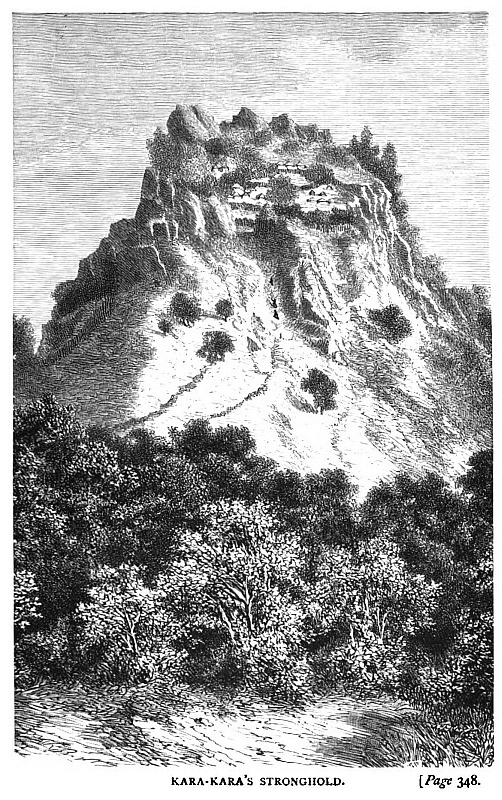
He captured every one he could, only those that were not worth capturing he made short work of. Then he burned all his enemy’s towns and villages, and having left a thousand men to lay siege to an inaccessible mountain, on the top of which, with the white prisoners, the lord-lieutenant had made his camp, ’Ngaloo with the rest of his savage army followed his foe up to the lake side, and it was fortunate he had arrived in time, as we have seen in the last chapter.
The remnant of Kara-Kara’s beaten army hied them back to their own country, only to find it laid waste by fire and sword; so they fled away into the wilderness, and joined other tribes with whom they had been friendly before this.
Having both fought on one side, and both assisted each other in annihilating the unfortunate Kara-Kara, ’Ngaloo and Googagoo naturally became very friendly.
Both armies bivouacked that night on the battlefield, and the wounded were attended to. These, however, owing to the brutal customs of African warfare, were very few, for ’Ngaloo’s men in the moonlight ran a-muck all across the blood-stained field, and ruthlessly slew all those who showed the slightest signs of life.
Next morning was a sad one for Harry, for his faithful Somali Jack, who had served him so long and so faithfully, who had nursed him in sickness, and more than once saved his life, breathed his last in his arms shortly after sunrise.
He had been terribly wounded in the battle, and nothing could save the poor fellow.
Quite conscious he was to the last, and conscious, too, that his end was drawing near, though neither he nor Harry knew it was so very nigh.
Some duty or other demanded Harry’s presence in another part of the field, but Jack said—
“Do not go and leave me now, dear master; stay with me a little time.”
“I will stay; I will not go—poor Jack,” replied Harry. And he sat down beside the dying Indian, and took his head in his lap.
Harry often thought of this last interview with his Somali servant afterwards, and how thankful he always felt, when he did so, that he had not gone away and left Jack. Had he done that he would not have seen the last of him, or heard his dying words.
These, however, were few, for Jack was weak and his voice feeble, and his breath coming in gasps. He lay some time quiet, then—
“I have so much to say,” he almost whispered; “but I forget, and I am cold—so cold.”
“I have a brother in Brava.”
Harry thought he said mother.
“You have a mother, Jack?”
“No; no mother—a brother. See him; tell him how I died, how I lived. Tell him about heaven and all things good, as you have told me.”
“Raggy—he will miss poor Jack.”
There was a long interval of silence. Jack’s eyes were closed now, and Harry thought he slept. But he opened them presently.
Then he put his cold damp hand in Harry’s. “Master,” he said, “you have given me life.”
“Oh, Jack!” said Harry, “I fear it is far beyond my skill to give you life.”
“But you have given me life—light and life. I was but a savage. You have told me of Him who can love even a savage.”
“Yes, yes, Jack; He loves you. He will receive you.”
“Say ‘The Vale,’” Jack murmured.
Harry knew what he meant, and repeated a verse or two, in metre, of that beautiful psalm that has given comfort to many a soul in sorrow.
The last verse that Jack could have heard was the fourth:
“Yea, though I walk thro’ death’s dark vale, Yet will I fear none ill, For Thou art with me; and Thy rod And staff me comfort still.”
There were just a few long-drawn sobs at intervals, then Harry sat watching to see if he would sigh again.
But a minute passed, and Jack sighed no more. Harry gently closed the eyes.
Then he sat for a time, biting his lip till it almost bled; but all to no purpose, his sorrow would find vent.
And knowing all we do, can we wonder at Harry’s grief?
Can we wonder that he bent over that faithful Jack, and that the scalding tears fell from his eyes upon the poor dead face?
Book Four—Chapter Seven.
The Fight on the Hill—Reunion—“The Greatest King in all the world”—Home Again.
This is a busy, work-a-day world, events will not tarry, nor will duty wait even upon grief, and no sooner had Harry and his party dug a grave and laid poor Somali Jack to his long rest in a cotton-tree grove, than he had to hurry off to camp again.
It was the morning of another day, a bright and beautiful day, birds sang in the bush, or went flitting from branch to branch, displaying their rainbow colours, as happy and careless as if there were no sorrow in the world.
But other birds there were—kites and fierce-looking corvidae, with horrid-looking vultures, that went sailing lazily round in the sky, alighting every moment on some dead body—to gorge. And gorge they would, until unable either to walk, or fly.
And what they leave of the corpses on the battlefield the ants, whose great hills and homes can be counted by the score, will speedily devour.
At night, too, when the vultures have gone to roost on the scorched and blackened branches of the burned forest, wild dogs and hyaenas will come in crowds to the awful feast.
Then rains and dews will fall and wash the bones, and the sun’s bright beams will bleach them, till in time nought will be left in the field of that fearful fight except blanched skulls and snow-white skeletons.
Ah, boys! where is the glory of war when the fight is fought, when the battle is over, and the victory won? Look upon that silent, bone-strewn plain and tell me where.
As naturally as if he had been voted into it, did Harry now quietly and coolly assume command of the whole army, both Googagoo’s and ’Ngaloo’s. The latter king he could not respect, albeit it was through his instrumentality that they had all escaped utter annihilation. He tried to feel grateful to ’Ngaloo, but it was impossible, he really could not help observing that the great chief had a selfish, grasping, and grovelling mind. There were times, indeed, that he could scarcely feel civil to the savage.
And no wonder. ’Ngaloo, after looking for a long time at Harry’s actions, and admiring his bustling but well-trained activity, came, and with cool audacity made a proposition to him. It was couched in the following terms:
“We soon go back now to my beautiful land among the mountains. I am a great king now. I have been a great king all my life. I am now twice a great king, because I shall reign over all the rich land and woods of my dear brother King Kara-Kara, whose confounded dead nose I pulled on the battlefield. So there is no king in the world so great now as ’Ngaloo. Come, then, and live with me. I will make of you a big chief. I will cut the head of my prime minister off, and you shall reign in his stead, and have all his wives as slaves—”
It was precisely at this point that Harry interrupted the king’s poetical harangue.
Harry simply said—
“Bosh!”
Very emphatically he said it, too. Then he wheeled right round and proceeded with his duty.
’Ngaloo went away then, somewhat crestfallen; but he had a private commissariat of his own, and he found some rum there, so he consoled himself with that.
A few hours afterwards, ’Ngaloo might have been seen marching about among Harry’s troops, with a sottish kind of a smile on his face.
’Ngaloo was taking lessons in modern warfare. He told Harry, when he met him, that he meant to remodel his own army upon the principles of Googagoo’s.
The cross-bows greatly took his fancy. So did the amazons.
He could not tire looking at them, and as soon as he got home, he said, he would arm and drill every one of his wives, and make amazons of them.
“And if they do not be good soldiers,” he added, “why, there is the tongs.”
He snapped that weapon as he spoke, and cackled and laughed as if he had said something very clever and witty.
The next stupid thing that ’Ngaloo did was to take Harry by the arm, and tell him with a burst of confidence, which was no doubt meant to be very friendly, that when they returned to King Kara-Kara’s, and captured the white slaves, Harry should have no less than two of them, and that he, ’Ngaloo, would only keep four to himself.
Harry burst out laughing in the great king’s face; but instead of being offended, ’Ngaloo was delighted, for he thought that Generalissimo Harry Milvaine was pleasedly acquiescing in his pretty little arrangement.
’Ngaloo was so delighted that he must needs go and help himself to another dose of his brain-devouring rum or fire-water.
Then he turned his attentions towards Googagoo. He made this honest king a very long speech indeed, laudatory of his own exceeding greatness, and of the comparative insignificance of every other king and chief in creation.
To all of this Googagoo listened with the politeness and urbanity inseparable from his nature.
But the king of the hundred islands, in a return speech, reminded ’Ngaloo that however great and glorious we were in this world, we must all die one day and go to another, where the Great Spirit would judge us according to the deeds done in the flesh, or forgive us if we trusted the Son that He had long, long ago sent to save us.
Alas! ’Ngaloo was not much impressed by the earnest words of Googagoo. He was silent for a short time, as if in deep thought; then he spoke to the following effect:
“Very likely all you say is true; but I suppose in the next world I will be just as big a chief, and have more territory than I have in this. For,” he added, “there is no getting over the greatness of ’Ngaloo.”
It took the united armies a whole week to reach King Kara-Kara’s country.
Harry had taken the precaution to keep his people quite separate and well in advance of ’Ngaloo’s, and gave strict orders to Walda and his other officers to watch for the slightest signs of, treachery on the part of ’Ngaloo.
Our hero mistrusted him, and perhaps he had reason; but, on the other hand, he need not have done so either, for “the greatest king in all the world” was so frequently overcome by frequent applications to his fire-water commissariat, that he had to be carried in a grass-cloth hammock nearly all the way.
It was forest land mostly which they traversed, woods filled with chattering monkeys and bright-winged silent birds, woods in which lions roared and hyaenas laughed all night long, woods often dripping with dank dews, and at times so dark by day that it was difficult to find a way through them.
But anon they would come to open glades and glens among the hills and mountains, with clear streams rippling through them, in which many a lusty trout gambolled and fed, with sweet bird-voices and the murmur of insect life, making music in the air, every creature happy and busy, because of the sunshine that gladdened all.
They came at last to the foot of the mountain or conical hill, where Harry’s unhappy shipmates were imprisoned.
Some slight show of resistance was made by those beneath, while those at the top and on guard rolled down great stones and rocks upon them.
But Harry’s brave fellows, he himself at the head of them—he well knew how to climb a hill—took the place with one wild determined rush.
Many of the assaulters were wounded and some were killed with the descending stones, so that their savage instincts got the better of their judgment, and in spite of all that Harry could do, an ugly scene of carnage took place as soon as the fort was captured. Harry had found his men at last. And not a whit too soon, for at the very moment when, waving his victorious sword on high, he scaled the last parapet, they were being ordered out for instant execution.
Ordered out? From what? Out, dear reader, from one of the most loathsome dungeons it is possible to imagine, dark, slimy, dismal, and filled with noisome vapours, a dungeon that for months they had shared with centipedes and slimy, slow-creeping lizards.
And all this time their food had been only raw cassava root and a modicum of half-putrid water.
And now Harry Milvaine, their beloved officer, stood in their midst.
They had not forgotten their discipline, for each and all touched their brows by way of salute.
“My poor fellows?” said Harry, his voice half-choked with emotion.
It was the first kind words they had heard for years. No wonder they broke down, and that those once sturdy British sailors—babies now in their very weakness—sobbed over Harry’s hands or hugged him in their feeble arms.
Harry had been telling Walda that, in all probability, there would be a quarrel with ’Ngaloo about his shipmates, the survivors of the Bunting’s men, and that there would possibly be some fighting.
“But,” said Walda, “I know the people of King ’Ngaloo well; they do not love fighting, they would rather cross the hills to their own homes.”
“Yes, true, Walda; but the king—the king. Remember that he rules over them, and if he bids them fight, then fight they must, and will.”
“Ah! the king!” replied the wily Walda. “Yes, to be sure, only they will not fight if he does not order them to do so.”
“No, Walda. But why do you smile? Now you are laughing outright. What amuses you, Walda?”
“Not anything much,” said Walda, “but—leave the king to me.”
Harry with his men and Googagoo’s army were to start the very next morning, against all odds, however fearful these might be; so, to be ready for any emergency, he drew his people well to the north, at some distance from those of ’Ngaloo’s. And then they camped all night ready armed.
But Walda had managed matters very prettily. He had sat up with King ’Ngaloo nearly all night, telling him wonderful stories of his own invention, and every now and again helping his majesty to another dose of his beloved fire-water.
The consequence of all this was, that when Googagoo and Harry went to bid him goodbye next morning in the hammock where he still lay, they found him rather forgetful of all recent events, but otherwise in a most amiable mood indeed.
The king said farewell at least a dozen times.
He shook hands with each of his visitors more than a dozen times.
And his last words were these:
“’Ngaloo is the greatest king in all the world. Don’t forget ’Ngaloo. Come again and see the greatest king in all the world. Don’t forget Ngaloo.”
“I’m not likely to,” said Harry, shaking hands again.
Then away he went, laughing.
And the march northwards was commenced at once.
Two of the men of the Bunting had to be carried a great part of the way, but they got stronger and stronger as the time went on, and could soon both stand and walk.
They found the boats precisely where they had left them, and in a few hours all were back once more—though sadly thinned in ranks—at their homes in the hundred islands.
Raggy, rejoiced beyond measure, met them at the beach. He was not content with shaking hands with his old messmates; shaking hands was slow work.
Raggy must dance. And dance he did, a regular sailor’s hornpipe.
“As sure as I’m alive, by Heaven’s mercy,” said Nicholls, the bo’s’n, “I think I could dance a bit myself.”
“And so do I,” cried another sailor.
And they both joined Raggy.
It was as merry a hornpipe as ever was seen.
No wonder the king cried “Lobo! Lobo!” and laughed till the tears gushed out of his eyes, or that the welkin rang with the admiring shouts of the sturdy amazons.
Then Raggy, who had reigned here so long and so well, resigned his regency, and in a day or two more all the old, quiet life had settled down upon the islands.
For a whole month longer Harry and his men lived with this innocent king; then, the strength of his men being now thoroughly recruited, they all said farewell to the good King Googagoo, with many regrets, and commenced the long and tedious march to the eastern coast, which they reached at last safe and sound, having met only the usual exciting adventures, and come through all the hardships incidental to African travel.
Dear young readers, I have little more to do now, except to say “Goodbye.” I sincerely trust that, while I do my best in my tales to interest and instruct you, no one can accuse me of painting the life of the sailor wanderer in too rosy colours. I speak and write from my own experience of sea-life and of other lands. And—yes, I will confess it, I love the sea, and ever did.
Here are some lines I wrote in a journal of mine many years ago:—
“While I write all is peace within and around our barque. I am sitting in my little cabin. It is a summer’s evening. Yonder is my bed; the port-hole close by my snowy pillow is open, and playfully through it steals the soft cool breeze of evening, and wantonly lifts and flutters the blue silken curtains. Not far off I can catch glimpses of the wooded hills and flowery vales of a sunny land. It is the rosy shores of Persia, and every night the light wind that blows over it is laden with the sweet breath of its flowers; while between there lies the ocean, asleep, and quiet, and still, and beautiful with the tints of reflected clouds. Often in the cool night that succeeds a day of heat have I lain awake for hours, fanned by the breath of the sea, gazing on the watery world beneath and beyond me, and the silvery moon and glittering stars that waft my thoughts homewards, till sleep stole gently down on a moonbeam and wafted me away to dreamland.”
Thus I wrote when a young man. Thus I still do feel.
The first glimpse that one catches of the chalky shores of old England after a long cruise thrills every nerve in his heart with hope and joy. To experience even this it is worth while going to sea.
Probably some such thoughts as these stole through the mind of Harry Milvaine as his homeward bound vessel came in sight of land.
His passage had been a good one all the way from Zanzibar to the Cape, and from the Cape to Southampton.
If the thought of presenting himself at Beaufort Hall without first writing ever came into his head at all, it was speedily banished. Pleasant surprises are very well under certain circumstances, but they may be so painfully pleasant as to be positively dangerous, for joy can kill as well as cure.
So Harry telegraphed and wrote, and waited anxiously for the return letter.
It came in good time.
With a beating heart he tore it open.
All were well. Even his old dog Eily was mentioned by his mother—for of course the letter was from her—in terms of affection.
“She knows you are coming,” she wrote, “and whenever I mention your name rushes to the gate to look, and barks in a kind of half-joyful, half-hysterical way that is most peculiar.”
Harry is back in the Highlands at last. He has come a good two hours earlier than he expected. But he does not mind that He likes to walk slowly on towards the home of his boyhood. Every little cottage, every hill—the hills are all heather-clad, for the summer’s bloom bedecks them—every wood, ay, every tree recalls some sweet memory of the bygone.
He is still within half a mile of Beaufort when he sees a dog.
It is his own.
It is Eily.
She has been out hunting for stoats at the hedge-foot.
He calls her by name. She stops and stares, bewildered for a moment, then with a few joyful bounds she is at him. She is at him, and on him, and round him, and round him all at once apparently.
Her dear old master risen from the dead!! She can hardly believe her eyes, and is fain to stand a little way off and bark at him for very joy. Then off she flies homewards, to tell that she has found her master.
So that Harry’s father, bareheaded and with his newspaper in his hand, but hale and hearty as of yore, and Harry’s mother, more fragile and older-looking, are both at the gate to welcome him.
And behind them comes old Yonitch to shake her dear boy by the hand.
Harry has a companion, whom he now introduces, and he is no less a personage than Raggy himself.
I think everybody is half afraid of Raggy at first, but Raggy smiles so pleasantly, and laughs with such ringing joy, that he is soon at home, and even Yonitch and Eily forgive him for being so dreadfully black.
That last line is meant to be left to the reader’s own translation. It represents exclamations of wonder and joy at Harry’s long story, and questions asked and answered, and a deal more I have no space to mention.
Eily and Harry went that same evening for a ramble in the forest. They found it just the same. The birds were there, and the bees were there, and the rabbits and weasels and squirrels were there—but poor Towsie the bull was gone.
They walked home round by Andrew’s cottage.
Andrew came rushing to his little gate and held Harry’s hand as if in a vice, while he pulled him in and seated him in a chair.
Then Harry had all his story to tell over again.
And honest Andrew listened and listened; frequently his eyes would become moist with tears, when he immediately took a large pinch of snuff, for shy, sly Andrew wanted to make believe that it was the snuff that made his eyes swim, and not downright emotion.
“Man! man!” was Andrew’s frequent exclamation, “only to think o’ seein’ you back again among us!”
“Look!” he said, when Harry finished speaking for the time being. “Look!”
Harry looked. Andrew had a tall hat in his hand. It was gloomily bedecked with weepers of crape, as big almost as those worn by hearse-drivers.
“That’s my Sunday’s hat,” said Andrew; “and I’ve worn it, as you see it, every sabbath since the terrible day when Captain Wayland came here and told us we would never see you more.”
“But I’ll take them off now,” he added, joyfully.
Honest Andrew did so, folded them up, and put them carefully away in a drawer. Then he heaved a big sigh and took another pinch of snuff.
It was very gratifying to Harry’s feelings to find that his little garden and boy’s bungalow, where the swallow that Eily brought him told the story of Africa, had been carefully tended and kept up inside and out.
This was Andrew’s doings.
Harry has had many wanderings since then, both by sea and land, but adventures such as those he came through on the dark continent come but once in a lifetime.
He has been a gallant and good officer.
He has done his duty.
Ah! there is a halo around the head of every one who does his duty, be that duty high or be it humble.
Harry Milvaine now holds a good appointment in a dockyard, and his leave is always spent in the Highlands, and honest Andrew and he are as good friends as ever.
Though no longer a boy, Raggy is still his faithful servant.
But Harry has promised his mother that ere long he will take leave of the service and settle down at home. He will have a flagstaff, however, he says, towering high and mast-like up from the green garden lawn, and proudly on that staff will flutter—
“The flag that braved a thousand years The battle and the breeze.”
The End.
|
Book 1 Chapter 1
| |
Book 1 Chapter 2
| |
Book 1 Chapter 3
| |
Book 1 Chapter 4
| |
Book 1 Chapter 5
| |
Book 1 Chapter 6
| |
Book 1 Chapter 7
| |
Book 2 Chapter 1
| |
Book 2 Chapter 2
| |
Book 2 Chapter 3
| |
Book 2 Chapter 4
| |
Book 2 Chapter 5
| |
Book 2 Chapter 6
| |
Book 2 Chapter 7
| |
Book 3 Chapter 1
| |
Book 3 Chapter 2
| |
Book 3 Chapter 3
| |
Book 3 Chapter 4
| |
Book 3 Chapter 5
| |
Book 3 Chapter 6
| |
Book 3 Chapter 7
| |
Book 4 Chapter 1
| |
Book 4 Chapter 2
| |
Book 4 Chapter 3
| |
Book 4 Chapter 4
| |
Book 4 Chapter 5
| |
Book 4 Chapter 6
| |
Book 4 Chapter 7
|