"The Wanderings of a Wayward Boy" (continued 2)
Reading edition
He lay down in bed and slept soundly for hours. But the stars were still shining thickly when he awoke and looked out of the window.
There was snow on the ground, hard, crisp snow.
Harry lit his candle, then he got out his small writing-case, and, after some time and considerable pains, succeeded in writing a letter, which he carefully folded and addressed.
Young though he was—with his tiny fowling-piece—a gift from one of his uncles—the boy could tumble either rabbit or hare, or bring down a bird on the wing, but he was not particularly clever with the pen. I wish I could say that he was.
He now got a small bag out of the cupboard, and into this he put a change of clothes. Having washed and dressed, he was ready for the road.
He opened his door quietly, and walked silently along the passage, boots in hand. He had to pass his mother’s room door. His heart beat high, it thumped against his ribs so that he could almost hear it. How he would have liked to have gone in, and kissed his dear mother good-bye! But he dared not.
Not until he was quite out of doors among the snow did he put on his boots. Eily, not knowing him, made a rush, barking and fiercely growling.
“Hush, Eily! hush!” he cried; “it’s me, it’s Harry, your master.”
Eily changed her tune now, and also her attitude. The hair that had been standing up all along her back was smoothed down at once, and as the boy bent to tie his boots she licked his hands and cheek. The poor dog seemed really to know that something more than usual was in the wind.
There was a glimmer of light in the east, but the stars everywhere else were still very bright.
Harry stood up.
Eily sat motionless, looking eagerly up into his face, and her eyes sparkled in the starlight.
She was waiting for her master’s invitation to go along with him. One word would have been enough to have sent her wild with joy.
“Where can he be going?” she was asking herself. “Not surely to the forest at this time of night! But wherever he goes, I’ll go too.”
“Eily,” said the boy, seriously, even sadly, “I’m going away, far, far away.”
The dog listened, never moving ear nor tail.
“And, Eily, you cannot come with me, dear, dear doggie.”
Eily threw herself at his feet, or rather fell; she looked lost in grief.
He patted her kindly.
This only made matters worse. She thought he was relenting, that his words had been only spoken in fun. She jumped up, sprang on his shoulder, licked his ear, then went gambolling round and round him, and so made her way to the gate.
It was very apparent, however, that all these antics were assumed, there was no joy at the dog’s heart. She was but trying to overcome her master’s scruples to take her along with him.
Harry followed her to the gate.
“It must not be, Eily,” he said again; “I’m going where you cannot come. But I will come back, remember that.”
His hand was on her head, and he was gazing earnestly down at her.
“Yes, I’ll come back in a few months, and you will meet me, oh! so joyfully. Then we’ll roam and rove and run in the beautiful forest once more, and fish by the river, and shoot on the moorland and hill. Goodbye, Eily. Be good, and watch. Good-bye, goodbye.”
A great tear fell on Eily’s mane as he bent down and kissed her brow.
Eily stood there by the gate in the starlight, watching the dark retreating figure of her beloved young master, until a distant corner hid him from view, and she could see him no more.
Then she threw herself down on the snow; and, reader, if you could have heard the big, sobbing sigh she gave, you would believe with me, that the mind of a dog is sometimes almost human, and their griefs and sorrows very real.
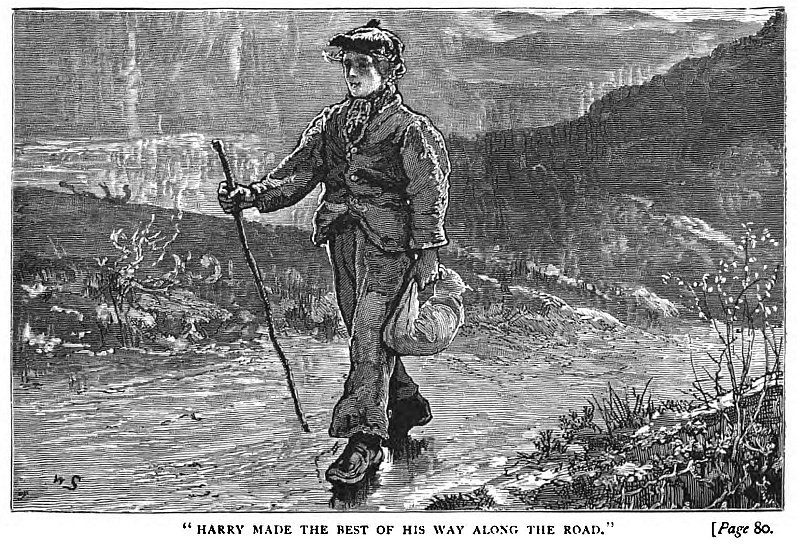
Hastily brushing the tears from his eyes, Harry made the best of his way along the road, not daring to look behind him, lest his feelings should overcome him.
He kept repeating to himself the words he had heard his uncle make use of the evening before. This kept his courage up. When he had gone about a mile he left the main road and turned into a field. A little winding church-path soon brought him to a wooded hollow, where there was a very tiny cottage and garden.
He opened the gate and entered.
He went straight to the right-hand window, and, wetting his forefinger, rubbed it up and down on the pane.
The noise it made was enough to awaken some one inside, for presently there was a cough, and a voice said—
“Who’s there?”
“It is I, Andrew: rise, I want to speak to you.”
“Man! is it you, Harry? I’ll be out in a jiffy.”
And sure enough a light was struck and a candle lit. Harry could see poor faithful Andrew hurrying on his clothes, and in two minutes more he had opened the door and admitted his young friend.
“Man! Harry,” he said, “you scared me. You are early on the road. Have ye traps set in the forest? D’ye want me to go wi’ ye?”
“No such luck, Andrew,” replied the boy. “I’ve no traps set. I won’t see the forest for many a long day again.”
“Haud your tongue, man!” cried Andrew, looking very serious and pretending to be angry. “Haud your tongue. Are ye takin’ leave o’ your reason? What have ye in that bag? Why are ye no dressed in the kilt, but in your Sunday braws?”
Then Harry told him all—told him of the determination he had for many a day to go to sea, and of the conversation he had overheard on the previous evening.
Andrew used all the arguments he could think of or muster to dissuade him from his purpose, and enlarged upon the many dangers to be encountered on the stormy main, as he called it, but all to no purpose.
“Mind ye,” said Andrew, “I’ve been to sea myself, and know something about it.”
Honest, innocent Andrew, all the experience he had of the stormy main was what he had gained in a six hours’ voyage betwixt Granton and Aberdeen.
But when Andrew found that nothing which he could adduce made the slightest impression on his young friend, he pulled out his snuff-horn, took two enormously large pinches, and sat down in silence to look at Harry.
The boy pulled out a letter from his breast-pocket.
“This is for my dear mother,” he said. “Give it to her to-day. Tell her how sorry I was to go away. Tell her—tell her—.”
Here the boy fairly broke down, and sobbed as if his heart would break.
My hero crying? Yes, I do not feel shame for him either. The soldier or sailor, ere journeying far away to foreign lands, is none the less brave if he does pause on the brow of the hill, and, looking back to his little cottage in the glen, drop a tear.
Do you remember the words of the beautiful song—
“Mid pleasures and palaces tho’ we may roam, Be it ever so humble, there’s no place like home; A charm from the skies seems to hallow us there, Which, seek thro’ the world, is ne’er met elsewhere. “An exile from home, splendour dazzles in vain, Oh! give me my lowly thatched cottage again! The birds singing gaily that came at my call, And give me the peace of mind dearer than all?”
Andrew, when he saw Harry crying, felt very much inclined to join him. There was a big lump in his throat that he could hardly gulp down. But then Andrew was a bit simple.
Harry jumped up presently and took two or three strides up and down the floor of the little room, and so mastered his grief.
“It won’t be for such a very long time, you know, Andrew,” he said.
“No,” said Andrew, brightening up. “And I’ll look after your garden, Harry.”
“Thank you, Andrew, and the turning lathe and the tools?”
“I’ll see to them. You’ll find them all as bright as new pins on your return.”
“And my pets, Andrew?”
“Yes.”
“Well, look after those too. Sell them all as soon as you can—rats, mice, guinea-pigs, and pigeons, and all.”
“Yes.”
“And, Andrew, keep the money you get for them to buy snuff.”
“Good-bye, Andrew.”
“Good-bye. Mind you take care of yourself.”
“I’ll do that for my mother’s sake.”
Andrew pressed Harry’s soft hand between his two horny palms for just a moment.
“God bless you, Harry!” he muttered.
He could not trust himself to say more, his heart was too full.
Then away went Harry, grasping his stick in his hand and trudging on manfully over the hills, with his face to the east.
By and by the sun rose, and with it rose Harry’s spirits. He thought no more of the past. That was gone. He felt a man now; he felt he had a future before him, and on this alone he permitted his thoughts to rest.
Now I do not mean to vindicate that which my hero has done—quite the reverse. Obedience to the wishes of his parents is a boy’s first duty.
Still, I cannot help thinking that my young hero had a bold heart in his breast.
See him now, with the sun glinting down on his ruddy face, on which is a smile, and on his stalwart figure; he is more like a boy of fifteen than a child under twelve. How firm his tread on the crisp and dazzling snow, how square his shoulders, how springy and lithe his gait and movement! No, I’m not ashamed of my hero. Hear him. He is singing—
“There is many a man of the Cameron clan That has followed his chief to the field, And sworn to support him or die by his side, For a Cameron never can yield. “The moon has arisen, it shines on that path, Now trod by the gallant and true— High, high are their hopes, for their chieftain has said, That whatever men dare they can do. I hear the pibroch, sounding, sounding, Deep o’er the mountains and glens, While light-springing footsteps are trampling the heath— ’Tis the march of the Cameron men.”
Poor brave, but rather wayward, boy! the gallant ship is even now lying in Lerwick Bay that soon shall bear him far o’er Arctic seas.
Book Two—Chapter One.
A Life on the Ocean Wave.
Harry in a Queer Position.
Very picturesque and beautiful does the Greenland fleet of the sealers and whalers appear from any of the neighbouring hills which enclosed Lerwick Sound in their midst, giving it the appearance of some great Highland lake. The dark blue rippling water is to-day—as Harry gazes on it—studded with threescore gallant ships, many of them steamers, but each and all having tall and tapering masts. Then the bare, treeless, rugged mountains; the romantic little town with its time-worn fort; the boats flitting hither and thither like birds on the water, and lofty Ben Brassa—capped in snow—looking down upon all, form a scene of impressive beauty and quiet grandeur that once beheld is not easily forgotten.
The town, however, like many others in this world, looks immensely better at a distance than it does upon close inspection. The streets, or rather lanes, are close and confined. Indeed, there is but one principal street, which is transversed by a multitude of lanes, which on one side lead down to the sea, and on the other scramble up a steep hill. And in the rainy season these lanes are converted into brawling streams which pour their roaring floods down into the tide-way.
The houses in the street are built in the Danish or Scandinavian style, and are mostly built with their gables to the front, while at every ten or twelve yards’ distance, one of these buildings stands threateningly forth across the path in a thus-far-shalt-thou-go sort of fashion, giving to the street a very awkward appearance, and on dark nights seriously endangering the noses of the pedestrians.
Harry had come by steamboat from Aberdeen, to which fair granite city he had trudged all the way on foot. He had to harbour his funds, rich and all though he thought himself, and I believe that during all that long, weary walk to the city, he subsisted almost entirely on bread and cheese washed down with milk. But he was young and strong and hardy.
He had taken steerage fare to Lerwick, and no sooner had he ensconced himself on the locker than he fell sound asleep, and never lifted his head for twelve whole hours.
In most books of travel by sea the author says nothing about seasickness. This is something very real and very dreadful nevertheless. There is no cure for it, nor ever will be, till the world is at an end. Only its effects can be mitigated by fresh air and exercise on deck. One must fight the fearful malady, and, as you fight it, it will flee from you. Intending sailor-boys would do well to remember this.
The passage to Lerwick had been a stormy one; unable to remain below, owing to the heat and the unsavoury nature of the atmosphere, Harry had gone on deck. It was night, but there was never a star to be seen, only the blackness of darkness overhead, pierced by the white light that streamed from the funnel, only the wild waves on every side, their white crests flashing and shimmering here and there as if they were living monsters. Sometimes one would hit the ship with a dull, dreary thud, and the spray would dash on board, and anon the steamer would duck her head and ship a great green sea that came tumbling aft, carrying everything movable before it, and drenching every one to the skin whom it met in its passage.
Poor Harry was too sick and ill to care much what became of him.
He had crawled in under a tarpaulin, and there, with his head on a coil of ropes, fallen soundly asleep once more.
It was a painful first experience of the sea, and to tell you the truth, even at the expense of my young hero’s reputation, more than once he almost wished he had not left his Highland home. Almost, but not quite.
And now here he was standing looking down from a hill-top, and wishing himself safe and sound on board one of these stately Greenland ships. But how to get there?
That was the difficulty.
There was no great hurry for a week. He had secured cheap lodgings in a quiet private house, so he must keep still and think fortune might favour him.
The object of the captains of these Greenland whalers in lying for a time at Lerwick is to ship additional hands, for here they can be obtained at a cheaper rate than in Scotland.
All day the streets were crowded to excess with seamen, and at night the place was like a bedlam newly let loose. It was not a pleasant scene to look upon.
Now Harry Milvaine had read so much, that he knew quite a deal about the manners and customs of seafarers, and also of the laws that govern ships, their masters, and their crews.
“If I go straight to the captain of some ship,” he said to himself, “and ask him to take me, then, instead of taking me, he will hand me over to the authorities, and they will send me home. That would not do.”
For a moment, but only a moment, it crossed his mind to become a stowaway.
But there was something most abhorrent in the idea. A mean, sneaking stowaway! Never.
“I’ll do things in a gentlemanly kind of way, whatever happens,” he said to himself.
Well, anyhow, he would go and buy some addition to his outfit. He had read books about Greenland, and he knew what to purchase. Everything must be rough and warm.
When he had made his purchases he found he had only thirty shillings remaining of all his savings.
As he was bargaining for a pair of thick mitts a gentleman entered the shop and bade the young woman who had been serving Harry a kindly good morning.
“What can I do for you to-day, Captain Hardy?” asked the woman, with a smile.
“Ah! well,” returned the captain, “I really didn’t want anything, you know. Just looked in to have a peep at your pretty face, that’s all.”
“Oh, Captain Hardy, you’re not a bit changed since you were here last season.”
“No, Miss Mitford, no; the seasons may change, but Captain Hardy—never. Well, I’ll have a couple of pairs of worsted gloves; no fingers in them, only a thumb.”
“Anything else?”
“Come, now to think of it, May-day will come before many months, and—”
“Oh, sly Captain Hardy,” said Miss Mitford, with a bit of a blush, “you want some ribbons to hang on the garland (Note 1). Now I daresay you have quite a pocketful, the gifts of other young ladies.”
“’Pon honour, Miss Mitford, I—”
“No more, Captain Hardy. There?” she added, handing him a little packet, “they are of all the new colours, too.”
“Well, well, well, I daresay they are delightfully pretty, but I’m sure I sha’n’t remember the names of one-half of them.”
“And when do you sail?”
“Oh, I was going to tell you. The Inuita is going first this year. Will be first among the seals, Miss Mitford, and first home.”
“And I trust with a full ship.”
“God bless you for saying that, my birdie. Well, we’re off the day after to-morrow at four o’clock. Good-bye; come and see you again before I sail.”
And off dashed Captain Hardy of the good ship Inuita.
A great kindly-eyed man he was, with an enormous brown beard, which I daresay he oiled, for it glittered in the winter sunshine like the back of a boatman beetle.
“One of the best-hearted men that ever lived,” said Miss Mitford to Harry, as soon as he was gone; “strict in discipline, though; but his officers and men all love him, and he has the same first mate every year. May Providence protect the dear man, for he has a wild and stormy sea to cross!”
Harry soon after left the shop.
“The Inuita,” he said to himself—“the Inuita, Captain Hardy, sails the day after to-morrow at four o’clock. Well, I’ll try, and if I fail, then—I must fail, that’s all.”
This was on a Thursday, next day was Friday. On this day it is supposed to be unlucky to sail. At all events, Captain Hardy did not mean to. Not that he was superstitious, but his men might be, and sure enough, if they afterwards came to grief in any way, they would lose heart and make such remarks as the following:
“Nothing more than we could have expected.”
“What luck could happen to us, when we sailed on a Friday?”
Captain Hardy was a man who always kept a promise and an appointment. He had told his mate that he would sail on Saturday at two in the afternoon, and his mate got all ready long before that time.
The captain was dining with friends on shore.
About half-past one a boat with two lazy-looking Shetland men pulled off to the ship.
“Well,” cried Mr Menzies, the mate, “bright young men you are! Why weren’t you here at twelve o’clock, eh? There, don’t answer; for’ard with you. Don’t dare to speak, or I’ll take a belaying-pin to you.”
About a quarter before two another boat was seen coming off.
“More Shetlanders, I suppose,” said the mate to the spectioneer.
“I don’t think so. There is only the boatman and a lad, and the lad has an oar. You never see a Shetlander take an oar, if he can help it.”
“By gum! though,” cried the mate, enthusiastically, “that youngster does pull nimbly. Why he feathers his oar like one of an Oxford eight!”
“He seems a genteel lad,” replied the spectioneer; “but it won’t do to tell him he rows well. Make him too proud, and spoil him.”
“Trust me,” said the mate, with a grim smile. “I’ll talk to him in quite a different fashion.”
He lowered his brows as he spoke, and tried to look old and fierce.
“Boat there!” he shouted, as she was nearly alongside.
“Ay, ay, sir,” sang Harry, standing up and saluting.
Harry believed this was the correct thing to do, and he was not very far wrong.
“What do you mean, sir, by coming here at this time of day? The orders were, Mr Young Griffin, that every one should be on board by ten o’clock this forenoon; and look you here, I’ve a jolly good mind to bundle you on shore again, bag and baggage.”
“Don’t, sir,” began Harry; “I wish to—”
“Don’t answer me. Up you tumble. Here, one o’ you greenhorns, standing there with your fingers in your mouths, up with the boy’s bag, and send it below.”
“If you please, sir, I want to speak with the captain, I—”
“Oh, you do, do you?” sneered the mate, in a mocking tone. “He wants to speak to the captain, does he? Perhaps he wants to make a complaint, and say the first mate scolded him. Never been to sea before, poor boy. Has he brought his feather-bed and his night-cap, and a bottle of hot water to put at his feet? A pretty ticket you’d be to go and speak to the captain.”
“But, sir, I—”
“Don’t answer me,” cried the mate, talking now in a loud, commanding voice. “If you say as much as one word more, or half a word, I’ll rope’s-end you within an inch of your life. Now for’ard you fly. Down below till we’re clear off. You are no use on deck. Only have your toes tramped.”
Harry opened his mouth to speak.
The mate made a rush for a rope.
Harry ran, and dived down the fore-hatch.
There was a little old man poking the huge galley fire and stirring soup with a ladle at one and the same time. He had no more hair on his head than the lid of a copper kettle, and he did not wear a cap either.
“Are you the cook?” said Harry.
“No, I’m the doctor.” (Greenlandmen usually call the cook “doctor.”)
“Well, doctor,” began Harry, “I want to tell you something. I’m in a very queer position—”
“Don’t bother me!” roared the grim old man, turning so fiercely round on him, ladle in hand, that Harry started and quaked with fear. “Don’t bother me,” he roared, “or I’ll pop you into the boiling copper, then you’ll be in a queerer position.”
Harry fell back. He did not know well what to do. So he went and sat down on a locker.
Presently past came a young sailor.
“I say, common sailor!” cried Harry.
The youth turned sharply round.
“I’m in a queer position.”
The youth pulled him clean off the locker and threw him straight across the deck, where he lay nearly stunned and doubled up.
“That’s a queerer position, ain’t it, eh? Well, don’t you come for to go to call me a common sailor again, drat ye.”
A great mastiff dog came along and licked Harry’s face, and then lay down beside him. Harry put an arm round the noble dog’s neck and patted and caressed him.
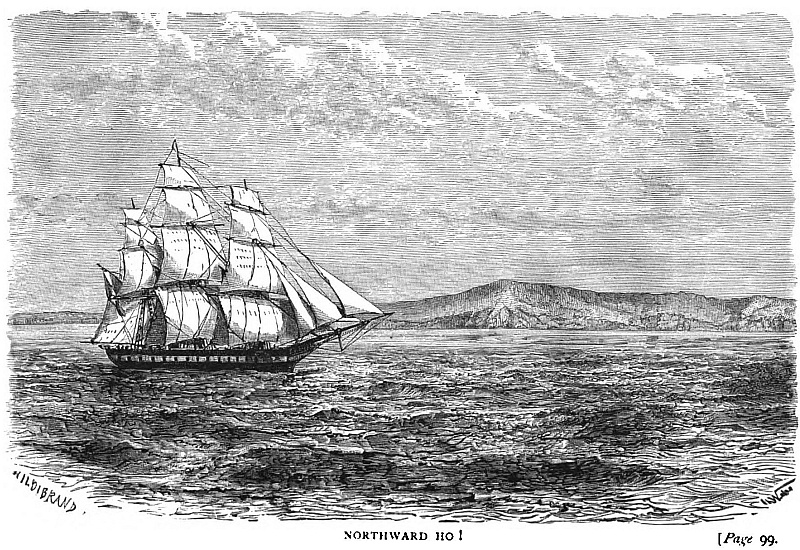
By and by there arose on deck an immense noise and shouting, rattling of chains, and trampling of feet, and high above all this din the merry notes of a fiddle and a fife, playing lively airs. (When heaving windlass or capstan in Greenland ships the fiddler is nearly always ordered to play.)
Said Harry to himself, “It is evident they are having a dance, and no doubt they will keep it up quite a long time. Well, there is little chance of the ship sailing to-night. By and by I’ll slip quietly up and go straight to the captain’s cabin and tell him all and ask him to take me.”
Then he began to think of home, of his mother and father, of Eily and of Andrew—and in a few minutes, lo and behold! our hero was fast asleep.
When he awoke it was inky dark where he lay, only at some distance he could see the glimmer of the galley fire, and see the old, bald cook moving about at his duties.
The great dog still lay beside him, and some kind hand had thrown a rug over the pair of them.
But the vessel was no longer still, she was slowly pitching and rolling, in a way that told Harry, novice though he was, that they were at sea.
There was no noise on deck now, only occasionally the steady tread of heavy footsteps was audible, or the flop-flap of canvas, or a quick, sharp word of command, followed by an “Ay, ay, sir,” and the rattling of the rudder-chains.
“Heaven help me!” said Harry to himself. “I was in a queer position before, I’m in a queerer now. Oh! dear me, dear me, I’ll be taken for a stowaway.”
This thought so overcame him, that he almost burst into tears.
Some time afterwards there came towards him with a lantern a red-haired and red-bearded little man. He had a kind and smiling face. He bent down, and Harry sat up on his elbow.
“Don’t move, my sonny,” he said. “You’ll be a bit sick, I suppose?”
“No.”
“No? Well, I’ve brought you a bit of a sandwich, and I don’t know whose watch you’re in, but we always give green hands some days’ grace. I’m the second mate, and I advise you not to turn out to-night, but just to eat your supper and lie still till eight bells in the morning watch.”
“But oh, sir,” cried Harry, “I’m in such a queer position!”
“I’ll remedy that,” said the second mate.
Away he went, and in a minute back he came again, and in his hand a huge flock pillow. This he placed under Harry’s head and shoulders.
“There,” he said, “that’s a better position. Keep still and you won’t get sick, and Harold there will keep you warm.”
“Is the dog’s name Harold?”
“Yes, boy.”
“And mine is Harry. How strange!”
“Well, there are two of you. Good-night, sonny.” And off went the fiery-whiskered but kindly little second mate.
Note 1. In Greenland ships, on May-day, there is great rejoicing, and a garland bedecked with ribbons—every one contributing—is hung from the stays high aloft.
Book Two—Chapter Two.
First Experiences of Life at Sea.
Harry awoke next morning cold and shivering; his companion, Harold, the mastiff, had left him. He started up. It was broad daylight, and the men were having breakfast, and chaffing and laughing, and all as happy as sailors can be.
It was not long before he noticed his friend the second mate coming below, so he started up and went to meet him.
“What cheer, my sonny!” said Wilson—for that was his name.
“Come along through to the half-deck,” he continued, “and have some coffee. That’ll put you straight.”
He led Harry on deck.
The sea seemed mountains high. Great green waves, with combing, curling tops, that every moment threatened the good ship with destruction, so it seemed to Harry.
“What an awful sea?”
“Awful sea, sonny?” laughed Mr Wilson. “Call that an awful sea? Ha! ha! Wait a bit, my boy.”
They went down another ladder into the second officer’s quarters. Here also lived the spectioneer or third mate, the carpenter, and the cooper, and an extra gunner.
A rough kind of a cabin, with a table in the middle a stove with a roaring fire in it, and bunks all round.
“Mates,” said Mr Wilson, “this is the youngster I was speaking about; I’m going to have him in my watch. He doesn’t know much; in fact, I don’t think he knows he’s born yet.”
“What’s your name, sonny?”
“Harold Milvaine.”
“Well, Harold Milvaine, have some breakfast; you look as white as a churchyard deserter.”
“Because—because I’ve such a dreadful story to tell you.”
“Well, eat first.”
Harry did so, and felt better.
“Now sit down on the locker, put your toes to the fire. That’s right. Now, heave round with this dreadful yarn of yours. Listen, mates.”
Without a moment’s hesitation, though looking very serious, Harry told them all his story from the commencement.
“Well,” said the mate, “it isn’t so very dreadful after all, but I think you ought to see Captain Hardy at once. What say you, mates?”
“That’s right,” said the carpenter; “I’d go at once.”
The captain was in his cabin, and kindly bade them both sit down.
Then, at the instigation of the second mate, Harry told all his story over again.
“A plain, unvarnished tale,” said Captain Hardy, when he had finished. “There is truth in the lad’s eyes, Mr Wilson. But tell me, youngster, why did you not explain to the mate the purpose for which you came on board?”
“He would not let me say one single word, sir.”
“True enough,” said the mate, coming out of his state-room laughing. “The boy is right, sir; I took him for some hand you had engaged and sent him flying for’ard.”
“But look here, lad, when you heard us stamping round and heaving in the anchor, why did you not come up and speak to me? I would have put you on shore again at once.”
“Oh, thank you, sir, but I didn’t know. I heard music, and I thought you were all dancing, and wouldn’t sail till Monday, and then—I fell asleep.”
“Ha! ha! ha! there will be little dancing in our heads, boy, till we’re full to the hatches with skins and blubber; then we’ll dance, won’t we, Wilson?”
“That we will, sir.”
“Well, well, boy, it is curious. I’m half inclined to be angry, but I daresay you couldn’t help it. And I don’t know what to do with you.”
“Oh, I don’t want wages; only just let me remain in the ship.”
“Let you remain in the ship? Why, what else can I do? We’ll never touch land again, lad, till we go back to Lerwick. Do you think I’d pitch you overboard as they did Jonah?”
“As for wages,” he continued, “nobody stops in my ship that isn’t paid. But tell me now, I seem to know your face—have I seen you before?”
“I saw you at Miss Mitford’s, sir.”
“Whew-w-w,” whistled the captain, “that accounts for the milk in the cocoanut.”
“She gave you some beautiful rib—”
“That’ll do, boy, that’ll do,” cried Captain Hardy, interrupting him. “Well I’ll rate you as second steward, and as you say you want to learn to be a sailor you can join the second mate’s watch.”
“I’ll have him, sir,” said Wilson, briskly.
Harry’s heart was too full to speak, but from that moment he determined to do his duty and prove his gratitude.
Duty! what a sacred thing it is, and how noble the man or boy who never shirks it, be that duty what it may!
Duty—though thy lot be lowly, God’s broad arrow though art seen, Making very triflers holy, And exalting what were mean; In this thought the poor may revel, That, obeying Duty’s word, Lowliness is on a level With my lady or my lord.
Captain Hardy soon found out Harry’s worth. He could trust him implicitly, for the boy was far too manly to tell a falsehood, even to hide a fault.
The worthy captain, however, seemed really astonished when the boy told him he was not twelve years of age.
He had guessed him at nearly sixteen.
“Never mind,” he said, with a smile, “you’ve been growing too fast, you’ve been growing to the length. The cold will alter that, and you’ll grow to the breadth.”
Cold? It was indeed cold, and the farther north the good ship went the colder it got, the more fiercely blew the wind, and the higher and wilder were the seas. Harry slept in a bunk in the half-deck, and used to amuse his mates by telling them stories, composed on the spot; he had an excellent imagination, and on these occasions made good use of it.
The fire was kept in all the livelong night, but, notwithstanding, the bunks and the counterpane used to be thickly snowed over long before morning with the frozen breath of the sleepers.
The days were terribly short, and the nights dark and gloomy in the extreme.
About a week after the good ship sailed she fell in with streams, first of wet snow, then of small pieces of ice that cannonaded against the ship’s side with a terrific noise.
Now the crow’s nest or look-out barrel was hoisted at the main-truck.
Harry astonished the second mate, and every one who saw him, by getting up to this giddy altitude the very second day.
The captain had been up there for hours and sang down for a cup of coffee.
The steward was too much of a landsman to venture, so Harry volunteered.
“My sonny,” said Wilson, “you’ll break your neck.”
“I’ve climbed trees as tall as that in Benbuie forest,” was Harry’s reply.
The warm coffee was put in a tin bottle, and up Harry spun with it. Hand over hand he went with all the agility of a monkey.
He sat in the nest till the captain had finished. Sat delightedly too, for the sea-scape, visible all around, was splendid, and he had a feeling that he was flying in the air with no ship beneath him whatever, as happy and free as the wild sea-birds that were whirling and screaming around him in the sky. The lovely sea-gulls, the malleys, the dusky skuas, and the snow-white sea-swallows—they charmed Harry beyond measure.
But a fierce gale of wind blew from the north-east, and lying to, the Inuita was drifted away off from the ice and far, far out of her course.
This gale continued for ten days off and on. Boats were smashed, a top-mast carried away, the bulwarks were splintered, and two poor fellows were washed overboard.
Their cries for assistance—the assistance that none could render them—were heart-rending. They were both strong swimmers, which only made the bitterness of death ten times more bitter.
But the sky cleared at last, the wind blew fair, and in ten days more they had sighted the main pack of ice lying to the north and east of the lonely island of Jan Mayen. Named after its discoverer—rugged, rocky, and snowy—it rises boldly from the frozen sea, and after forming a number of smaller hills, or rather mountains, shoots abruptly into the clear icy sky to a height of 6,000 feet, shaped like a cone or an immense loaf of sugar. Although volcanic fires once have gleamed from the lofty summit of this mountain, old King Winter now sits here alone, Vulcan has deserted him, without leaving him a spark to heat his toes. This is indeed the throne of King Winter, and looking down, his cold eye scans his icy region, stretching for many and many a mile over the Greenland sea. On this isle of desolation few have ever trod, and the few who have visited it have no desire to return. Around its crags flutters the snow-bird, and the ice-bear crouches in his den among its rocks; the great black seal, the sea-horse, and the lonely walrus float around it, or find shelter near it from the storm or tempest; but nothing else of life is ever found on its deserted and inhospitable shores.
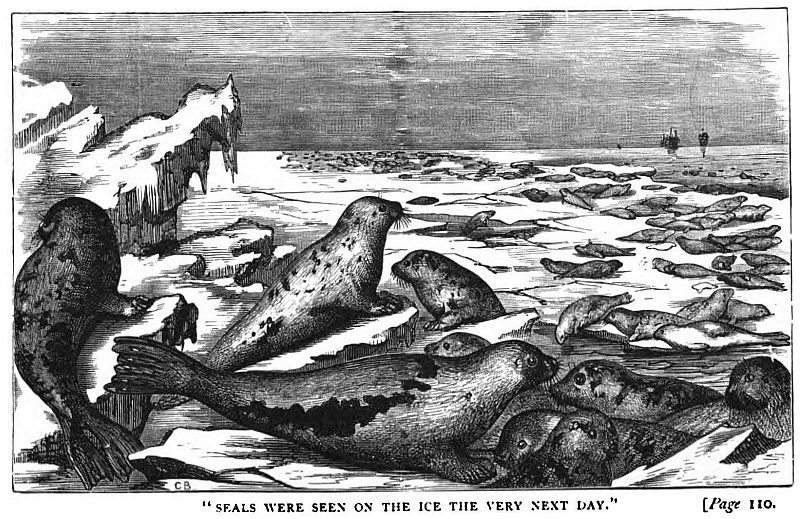
Seals were seen on the ice the very next day, and the work of destruction commenced. It was a sickening scene. So thought young Harry.
Many years ago the present writer described it in the following language:
Great is the cruelty practised during young sealing. Seldom do the men take time to kill the creatures they catch, but set about flaying them alive, and a young seal is so much more pretty and innocent-looking than even a lamb. This they say they do to save time, but could they not kill so many seals first, say a thousand, and then commence to flay those first struck, which would then be quite dead? As an experiment, I have seen the flayed body, red and quivering, thrown into the sea, and seen it swim with its own mother beside it. This is no exaggeration, and any sealer will tell you the same. It is strange why the sight of blood should stimulate men to acts of cruelty; but it is none the less a fact, for I have seen men on these occasions behaving with all the brutality of wild beasts.
One could not easily fancy a scene more impressive and wild than that which is presented by the crews of a few ships at work on the ice. The incessant moaning of the innocent victims, mingled with the laugh and joke of their murderers; the timid and affrighted, although loving look of the mothers, so different from the earnest, blood-thirsty stare of the authors of their grief. Some are flaying; some are stabbing; some are dragging the fruits of their labour towards the ships; and some are drinking at the ship’s side; but over all there is blood—blood on the decks, blood on the bulwarks; the men’s hands are steeped in it, and the blood is dripping from their clothes. The snow—the beautiful snow, which but yesterday sparkled and glittered in the sunshine, as only the snows of Greenland can, to-day is deluged in blood. Nothing but blood, blood wherever we look! The meat which the men are eating and the glass from which they are drinking are bloody; and the very rudder-wheel has been touched by bloody hands. But then there is joy in that bloody scene—joy to master and joy to man; and the sight of the blood proves a stimulant for still greater exertions and more cruelty.
Yes, it is years since I wrote in this strain, but the cruelties go on now as then. Oh! boys of happy England, raise your voices whenever opportunity occurs against cruelty and against oppression of every kind, whether against the tyranny that crushes the poor that the rich may live luxuriously, or cowardly crime that ties a helpless dog or cat to the vivisection table.
Harry managed to endear himself to all hands. He was, indeed, the favourite of the ship. But he did not neglect his education; Mr Wilson was a good teacher of practical navigation and practical ship’s work, and in a month or two he had made a man of Harry, or a sailor at all events.
Captain Hardy soon found out that the boy could shoot, so he gave him a short, light double-barrelled rifle, and Harry used to go out regularly to stalk seals, when the old sealing commenced. Dangerous work at times, and our hero had more than one ducking by slipping into the sea between the icebergs.
The dog Harold always went with the boy Harry, and although mastiffs are not called water-dogs, still on one occasion, when his young master fell into the sea, dog Harold sprang after him, and supported him until assistance came.
Harry’s opportunity of proving his gratitude came soon after this.
While out walking one day with the dog, they were suddenly startled by the awful roar of a huge bear. The brute appeared immediately after from behind a hummock of ice, and prepared for instant action.
The great mastiff’s hair stood on end with rage, from skull to tail. He gave Bruin no time to think, but sprang at once for his throat.
It was indeed an unequal contest, and would speedily have been all over had not young Harry shown both pluck and presence of mind. He rushed forward, and, biding his chance, fired both barrels of his rifle at once into the bear’s neck behind the ear.
He actually clapped the muzzle there before he drew the triggers.
What mattered it that the recoil threw him on his back, Bruin was slain, and Harold the dog was saved, though sadly wounded and torn.
Before the month of May the Inuita had a good voyage on board. She continued, however, to follow the old seals north as far round as Spitzbergen. The character of the ice now entirely changed: instead of fields of flat floe, with hummocks here and there, which put Harry in mind, as he traversed them, of a Highland moorland in mid-winter, there were pieces large enough to have crushed a ship as big as Saint Paul’s Cathedral.
The mountains, too, on the islands among which the Inuita sailed were rugged and grand in the extreme, and the colours displayed from the terraced cliffs of ice and rock, when the sun shone on them, were more resplendent than any pen or pencil could describe.
Around these islands were walruses in abundance, and many fell to the guns.
Going shoreward one day over the thick bay ice, to enjoy with Mr Wilson and some others some sport among the bears, Harry, who was foremost, was startled beyond measure to notice the ice ahead first heave, then crack and splinter, while a moment afterwards a head, more awful than a nightmare, was protruded.
Harry’s fear—if fear it could be called—was however but momentarily: next moment his rifle was at the shoulder, and the monster paid his life as the penalty for his curiosity.
In a month the Inuita was—what her captain wished her to be—full to the hatches with blubber and skins.
Then all sail was set for merry England.
There was nothing but joy now on board, nothing but jollity and fun.
The men had a ball almost every night, with singing and story-telling to follow.
“I do believe, my dear boy,” said Captain Hardy to Harry one evening, “that you have brought all the luck on board. Well, now, I’m going to tell you a secret.”
“I don’t want you to, you know.”
“Oh, but I want to tell somebody,” said the captain, “and it may as well be you. It is this: As soon as I get my ship cleared and paid off at Hull, I am going straight back to Lerwick to ask Miss Mitford if she will be my wife.”
“Oh, I’m sure she will be glad to!” Harry said.
“Tell me, boy, what makes you think so?”
“Well, because she told me you were the best man in the service, and the tears were in her eyes when she said so.”
“God bless you for these words, dear lad. And you’ll come and see us sometimes, won’t you? I’m going to leave the sea and settle down in a pretty little farm near Hull.”
“That I will, gladly,” said Harry.
In course of time the ship arrived safely in harbour. Her owners were delighted at Captain Hardy’s success, and made him a very handsome present.
Some weeks after this, when the Inuita was dismantled and lying in dock, Hardy, with Harry and Harold the mastiff, suddenly appeared at Beaufort Hall.
I leave the reader to imagine the joy that their presence elicited. But it was quite affecting to see how his mother pressed her boy to her breast, while the tears chased each other over her cheeks.
Eily went wild with joy, and when honest Andrew met his friend Harry again, and shook him by the hand, he could not speak, so much was he affected, and he had to take five or six enormous pinches of snuff by way of accounting for the moisture in his eyes.
Captain Hardy was a welcome guest at Beaufort Hall for many days.
“Your dear boy,” he said, “has had a terribly rough first experience of a life on the ocean wave, but he has braved it well, and that is more than many boys of his age would have done. But I tell you what it is,” he added, “Harry Milvaine will be a sailor.”
“I fear so,” said his mother, sadly.
“Ah, my dear lady, there is many a worse profession than that of an honest sailor.”
“But the dangers of the deep are so great, Captain Hardy.”
“Dangers of the deep?” repeated this kindly-hearted sailor. “Ay, and there are dangers on the dry land as well. Think of your terrible railway smashes, to say nothing, madam, of the tiles and chimney-pots that go flying about on a stormy day.”
Mrs Milvaine could not keep from smiling.
But our wilful, wayward Harry had it all his own way, and three months after this he was treading the decks of a Royal Navy training ship, a bold and brisk-looking naval cadet.
From the training ship, in good time, after having passed a very creditable examination indeed, he was duly entered into the grand old service.
His first ship—if ship it could be called—was H.M. gunboat, the Bunting.
Harry was going to a part of the world where he was bound soon to get the gilt rubbed off his dirk.
Book Two—Chapter Three.
H.M. Gunboat “Bunting” in Chase—A Dark Night’s Dismal Work.
It was a night of inky darkness. All day it had been squally, with a more or less steady breeze blowing between each squall, and the sea had been greatly troubled; but now the wind had nearly fallen, the waves were crestless, foamless, but still they tossed and tumbled about so that the motion on board Her Majesty’s gunboat the Bunting was anything but an agreeable one. There could be but little danger, however, for she was well off the land, pretty far out, indeed, in the Indian Ocean.
Every now and then there was the growling of distant thunder; every now and then a bright flash of lurid lightning. But between these flashes was a darkness that could be felt, and never a star was visible. Nor could there be, for at sunset the clouds seemed a good mile thick.
The Bunting had been in chase most of the afternoon, but nightfall put an end to it.
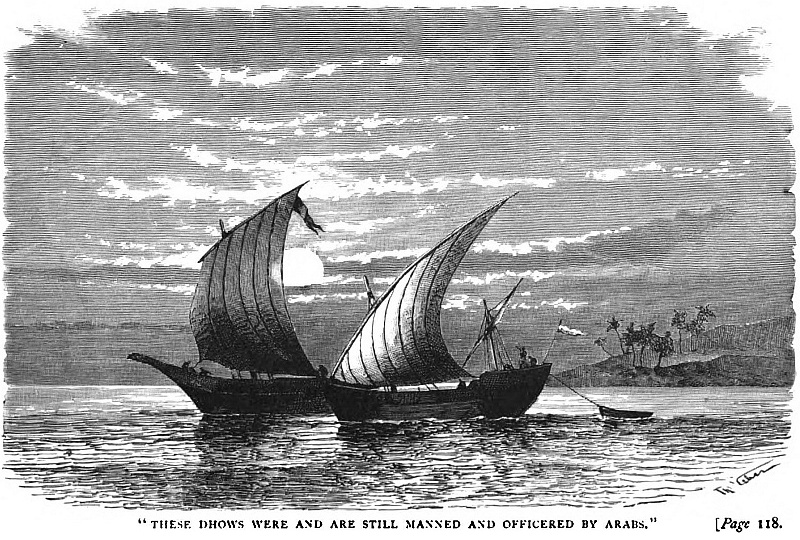
It was in the days—not so long ago—when Said Maja reigned Sultan of Zanzibar, and all the coast line from near Delagoa Bay in the south to beyond Bareda in the north was more or less his sea-board. It was in the days when the slave trade in this strange wild city of the coast was flourishing in all its glory, the Sultan having liberty from our government to take slaves from any one portion of his dominions to another. Hundreds of dhows, nay, but thousands, then covered that portion of the Indian Ocean which laves the forest shores of Eastern Africa. They were either laden with slaves, or returning empty to fetch another cargo.
Our cruisers boarded all they met, but it was but seldom one fell into our hands as a prize, for these cruel and reckless dealers in human flesh found no difficulty in obtaining a permit from the Sultan’s ministers to carry on their inhuman traffic. A bribe was all that was necessary, and the words, “Household slaves of H.M. the Sultan,” in the certificate, were all that was necessary to set British law and British cruisers at defiance.
These dhows were and are still manned and officered by Arabs—gentlemen Arabs they term themselves. Many of these men are exceedingly handsome. I have often admired them in the slave market, both the old and the young. Let me try to describe them:
Here, then, is a young gentleman Arab, probably about twenty-five years of age.
He wears a kind of gilded night-dress of snow-white linen, which reaches some distance below the knee; around the waist of this is a gilded and jewelled sword-belt, supporting a splendid sword, and probably jewelled pistols. Over this linen garment may be a little jacket of crimson with gold braid, worn loose, and hardly visible, because over all is an immense flowing toga of camel’s hair of some dark colour. This is also worn open.
On the head is a gigantic turban, gilded or even jewelled, and the naked feet are placed in beautiful sandals.
He is very tall, lithe, wiry, and stately, and his face is goodly to behold, his nose being well chiselled, and mouth not large.
His colour is usually white or brown, though sometimes black, and dark hair in beautiful ringlets, escaping from under the turban, flows down nearly to the waist.
In his hand he bears a tall spear, on which he leans or touches the ground withal when walking, as a Highland mountaineer does with his long crook.
The carriage and walk of this Arab is grace itself, and gives the individual a noble and majestic appearance, which it is difficult to describe.
Except the Scottish costume, I know of no dress half so picturesque as that of the gentleman Arab and slave-owner.
But here is an old gentleman. Is he bent and decrepit? Nay, but sturdy and stately as his son, he walks with the same bold grace, is dressed in the same fashion, keeps quite as firm a hold of his spear, and could draw his powerful sword and wield it with equal if not greater skill and agility.
But his long beard and moustache are as white as the paper on which I am writing. His brow is wrinkled, and the eyes that glint and glare from beneath the bushy eye-brows are as quick and fierce as those of a golden eagle.
Those Arabs hate the English with a deadly hatred. Even the sight of a blue-jacket makes them scowl. I have passed—more than once—a doorway in Zanzibar, in which one of these men stood, and I have seen him gnash his teeth at the sight of my uniform, and finger his sword or knife, nervously, restlessly, as if he hardly could keep from plucking it out and plunging it into my heart.
It was in pursuit of one of the dhows manned by such gentleman Arabs that the Bunting had been all the previous afternoon.
Had the wind fallen earlier, this dhow would soon have been a prize; but as it did not, she had shown them a clean pair of heels, and might now be anywhere.
That she was a slaver without papers there was not a doubt, and well laden too, for she was deep in the water.
I am going to make a terrible statement, but it is a true one, and if it only has the effect of causing even one of my readers to hate slavery half as much as I do, it will not be made in vain.
Just then, as American traders in crossing the Atlantic, when a dangerous gale comes on, lighten the ship by throwing the cattle overboard, so, at times, do these gentleman Arabs lighten their dhows when chased.
It is a terrible sight to see poor oxen hoisted up in straps with block and tackle and whirled into the storm-lashed ocean. O God, how mournfully they moan, how they seem to plead for mercy! That moan once heard can never, never be forgotten.
The loading of a slave-ship is a terrible sight, but ah! the ruthless cruelty of lightening a dhow of slaves. They are got up one by one or two by two. Children, poor young girls and boys, are pitched screaming into the sea, probably to be devoured by sharks next moment. And sharks speedily come to a feast of blood of this kind.
But whether men or women—if they struggle, and sometimes whether they struggle or not—they are ruthlessly slain on the deck before being thrown overboard. The knife across the neck is used for this terrible butchery. I have been told by eye-witnesses, themselves prisoners, and expecting every minute that their turn would come, that the victims are handed on deck to those who do the work, and that these latter think less about it than a farm servant does of killing a fowl, sometimes laughing and joking with their companions the while; and if telling a story of any kind, they do not even permit the murder they are committing from interrupting their discourse for a single moment.
It is far more unpleasant for me to write these lines than it can possibly be for any one to read them.
“I think,” said Mr Dewar, the navigating sub-lieutenant, as he entered the captain’s cabin after a preliminary service tap at the door—“I think I’ve done all for the best, and done right, sir.”
“Well?” replied Captain Wayland—captain by courtesy, remember, for he really was but a first lieutenant by rank, though in command of the bold and saucy Bunting. He was seated now in his beautiful little saloon, which was situated right aft, right abaft the gun-room or ward-room—the Bunting had, of course, only one living deck, under that being the holds, and above it the main or upper deck, with no other covering except the sky, and now and then a sun awning. This last was not only a luxury but a positive necessity in these seas, where the sun blisters the paint, causes the pitch in the seams to bubble and boil, and takes the skin as effectually off one’s face as if a red-hot iron were passed over it.
I have called Captain Wayland’s quarters a beautiful little saloon. So it was, but do not imagine, dear reader, that the Lords Commissioners of the Admiralty had anything to do with the decorating of it. No, they supplied a table, cushioned lockers, and a few chairs, also cushioned, but so hot and clumsy that sitting on one was like sitting on a large linseed-meal poultice.
Captain Wayland returned them to the dockyard, and bought himself others that could boast of elegance and comfort; he re-painted his saloon, too, and hung a few tasteful pictures in it and no end of curtains, to say nothing of a great punkah over the table, which was waving back and fore now, the propelling power being a little curly-headed nigger-boy who squatted in a far-off corner, string in hand.
“Well, sir,” replied Mr Dewar, in answer to the captain’s single word of inquiry, “I’ve douced every glim.”
“In mercy’s name,” cried the captain, “do speak English, Mr Dewar!”
“Well, sir, pardon me, I quite forgot myself, but really we’ve got into a slangy habit in the ward-room; the only one who does speak decent English is young Milvaine, and he is a Highland Scotchman.”
“Sit down,” said the captain, “and have a glass of claret. You’ll find it good.”
“Raggy Muffin!” he continued, turning half round in his easy chair.
The nigger-boy let go the punkah string and sprang to his feet.
“Raggy Muffin stand befoh you, sah!” he said, bowing his towsie head.
“Right, Raggy. Now bring a bottle of claret.”
“Right you are, sah. I fetchee he plenty quick.”
“And I’ll bring myself to an anchor,” said Mr Dewar, “and have a glass of grog with pleasure.”
Respect of person was not the crowning virtue of this warlike youth.
The captain fidgeted uneasily.
“Well, sir, I’ve douced—I mean I’ve put out all lights. I have men in the chains—not that we’re likely to fall in with shoal water here, you know—”
“Oh, bother, you’re right to be safe. The Wasp ran aground in about this same place. Well, who’s watch is it?”
“Young Milvaine’s.”
“Right, we’re safe.”
Mr Dewar looked at Captain Wayland for a few moments.
“You believe in that youngster, sir?” he asked.
“I do. He’s faithful, bold, or rather brave—”
“Yes, sir, he’s as plucky as a bantam. He thrashed big Crawford the first day he came on board. Crawford has been good-natured ever since. He showed fine fighting form when we brushed against those Arabs above ’Mbasa, and he jumped overboard, you know, and saved Raggy’s life off the Quillimane river.”
“Raggy die some day for Massa Milvaine,” put in the nigger-boy.
“Hush, Raggy, when your betters are talking.”
“Raggy die all same, though,” the boy persisted.
“The young scamp will have the last word. Yes, Mr Dewar, young Milvaine ought to have a medal for that; but, poor fellow, he won’t, though I’m told there were sharks about by the dozen.”
“I saw it all,” said young Dewar. “It was my cap that fell off, just before we crossed the bar. Raggy made a plunge for it, and over he went; Milvaine threw off his coat, and over he went. The coolness of the beggar, too, amused me.”
“Don’t say ‘beggar.’”
“Well, ‘fellow.’ There was a basking shark in the offing, with its fin above the water, and a bird perching on it like a starling on the back of a sheep. The cap—the very one I wear now, sir—was between this brute and Milvaine, but no sooner had he got Raggy—cockerty-koosie, as he called it—on his shoulder, than he swam away out and seized the cap with his teeth, then handed it to Raggy. And the young monkey put it on, too. We picked him up just in time, for the sharks looked hungry, and angry as well.”
Mr Dewar helped himself to another half-tumbler full of claret.
“There is a wine-glass at your elbow,” said the captain, with a mild kind of a smile.
“Bother the wine-glass!” replied the middy. “Pardon me, sir, but I’d have to fill it so often. My dear Captain Wayland, there’s no more pith and fooshion in this stuff than there is in sour buttermilk.”
The captain laughed outright. Mr Dewar was an officer of a very old and obsolete type.
“Why, my dear sir, that is my very best claret. Claret Lagrange, Mr Dewar; I paid seventy-five shillings a dozen for it.”
“Raggy,” he added; “bring the rum, Raggy.”
“Try a drop of that, then.”
“Ah! that indeed, captain,” exclaimed Mr Dewar, with beaming eyes. “That’s a drop o’ real ship’s.”
He was moderate, though, but he smacked his lips. “I feel in famous form now,” he said. “I hope we’ll come up with that rascally dhow before long. With my good sword now, Captain Wayland, and a brace of colts, I think—”
At this moment Midshipman Milvaine—our Harry—entered, cap in hand.
He has greatly improved since we last saw him, almost a giant, with a bright and fearless eye and a most handsome face and agile figure. His shoulders are square and broad. He is very pliant in the waist; indeed, the body above the hips seems to move independent of hips or legs. Harry had now been four years in the service, and was but little over sixteen years of age.
“Anything occurred, Mr Milvaine?”
“Yes, sir, something is occurring, something terrible, murder or mutiny. The night is now very still, and the stars are out I can’t see anything, but from away over yonder, two or three points off the port bow, there is fearful screaming, and I can even hear splashing in the water.”
Captain Wayland sprang up, so did young Dewar.
“The scoundrels!” cried the former. “It is the dhow. They are lightening ship to get away from us with the morning breeze.”
“Mr Milvaine,” he added, hurriedly, “we’ll go to quarters. Do not sound the bugle.—Let all be done quietly. Keep her, Mr Milvaine, straight for the sounds you hear, and tell the engineers to go ahead at full speed.”
“The moon will rise in half an hour,” said Harry.
“Thank Heaven for that,” was the captain’s reply.
For the boats of a small ship like the Bunting to board a heavily armed fighting dhow like the one they had been giving chase to, is no mean exploit even by day: by night such an adventure requires both tact and skill and determination as well.
But the thing has been done before, and it was going to be tried again now.
The captain himself went on deck.
There was already a faint glimmer of light from the rising moon on the south-eastern sky.
But the sea was all as silent as the grave; there was the rattling of the revolving screw and the noise of the rushing, bubbling, lapping waves as the vessel cleaved her way through them. Further than this, for the space of many minutes, sound there was none.
“In what direction did you say you heard the cries?” asked Captain Wayland of young Harry Milvaine.
“We are steering straight for it now, sir, and—”
Suddenly he was interrupted. From a point still a little on the port bow, and apparently a mile distant, came a series of screams, so mournful, so pleading, so pitiful, as almost to freeze one’s blood.
“Ah-h! Oh-h-h! Oh! Oh! Oo-oo-ok!”
The last cry was wildly despairing, and cut suddenly short, as I have tried to describe, by the letters “ok.”
A moment or two afterwards there came across the water the sound of a plash, and next minute there was a repetition of the dreadful yells and cries.
The captain took two or three hasty turns up and down the deck. He was a very humane and kindly-hearted officer.
“I hardly know what to do for the best,” he said.
“Suppose, sir,” replied Mr Dewar, whom he seemed to be addressing, “we fire a gun to let her know we are near?”
“No,” replied the captain; “there is still wind enough, and time enough, for her to escape in the dark. We’ll keep on yet a short time. Stand by to lower the boats. They are already armed?”
“Yes, sir.”
“Escape in the dark!” muttered the captain to himself through his set teeth. “Dark indeed will be the work as soon as our lads get on board of this fiend’s ship.”
Book Two—Chapter Four.
Life in a Gunboat—The Captain’s Birthday.
Mr Dewar had charge of the first cutter, Mr Mavers, sub-lieutenant, of the second, and Harry himself commanded the whaler.
These were all the boats told off for the fight, about five-and-thirty men all told.
Five-and-thirty men? Yes, but they were five-and-thirty broad-shouldered British blue-jackets, armed with cutlass and revolver. And what is it, pray, that blue-jackets will not dare, ay, and do as well as dare?
Even Dr Scott and the other officers had left their swords behind them, preferring the ship’s cutlass.
Every man had stripped to the waist before starting, for the night was sultry and hot.
The boats were silently lowered before they came in sight of the dhow, therefore before the dhow could see the Bunting.
With muffled oars, nearer and nearer they sweep to the spot from whence the sounds proceed.
The whaler, being lighter, well-manned and well-steered by Harry, took the lead.
The Bunting came slowly on after the boats.
But behold! the latter are seen from the dhow’s decks, and lights spring up at once, and a rattling volley flies harmlessly over the heads of our advancing heroes. At the same time it is evident that boarding-nets are being quickly placed along the bulwarks of the slaver.
In a few minutes the whaler is at the bows of the dhow. This was unprotected by netting, and low in the water, for the vessel was deep. Harry was the first to spring on board, followed instantly by his fellows.
He speedily parried an ugly thrust made at his throat by a spear, and next moment his assailant fell on his face with a gash on his neck and his life’s blood welling away. For a few seconds this part of the dhow bristled with spears, and one or two of Harry’s men succumbed to the lunges and fell to the deck.
But the Arabs retreated before the charge, fighting for every inch of deck, however.
Meanwhile the cutters were boarding. They were cutters in more ways than one, for they had not only to defend themselves against spear-lunging, but to slash through the netting.
A bright white light now gleamed over the dhow’s deck. The Bunting was nearly alongside, and burning lights.
It was well this was so, for on the deck of that slave dhow stood fully seventy as brave Arabs as ever drew a sword or carried a spear.
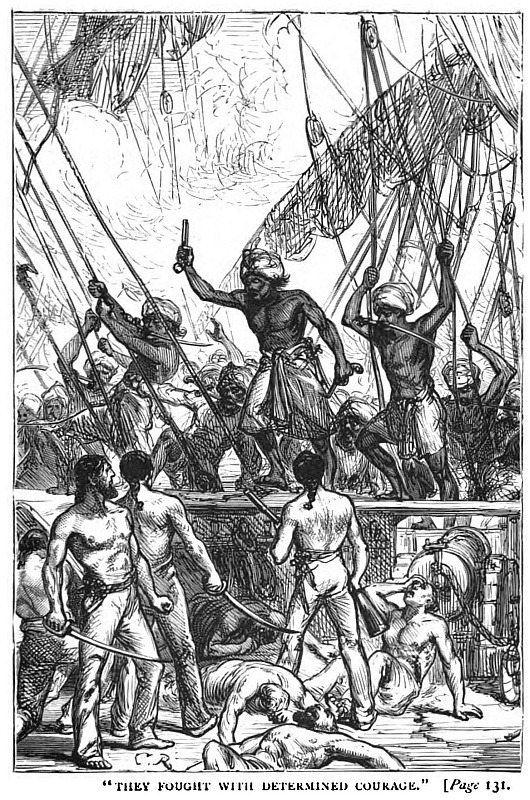
They went down before our blue-jackets, nevertheless, in twos and threes. The modern colt is a glorious weapon when held in a cool hand and backed by a steady eye.
Their very numbers told against these Arabs, but they fought well and desperately, for they were fighting with the pirate-rope around their necks. Arab dhows who fire on our British cruisers are treated as pirates, and, when taken red-handed, have a short shrift and a long drop.
That they fought with determined courage cannot be gainsaid—gentlemen Arabs always do—but they have not the bull-dog pluck of our fellows. They cannot hang on, so to speak; they lack what is technically called “stay.” Nor were they fighting in a good cause, and they knew it.
They knew or felt that they could not, if killed, walk straight from that blood-slippery battle-deck into the paradise of Mahomed.
Add to this that their weapons were far inferior to ours. Their spears were easily shivered, and even their swords; while their pistols could scarcely be called arms of precision.
So after a brave but ineffectual attempt to stem the wild, stern rush of our British blue-jackets, they fell back towards the poop, so huddled together that the fire of our men riddled two at a time. They finally sought refuge in the poop saloon, and even down below among the remainder of those poor trembling slaves who had not been butchered or forced to walk the plank.
Many were driven overboard, or preferred the deadly plunge into the ocean to falling into the hands of the British.
The captain surrendered his sword, standing by the mainmast. He was a tall and somewhat swarthy Arab, and spoke good English.
“Slay me now, if so minded, you infidel dogs,” he shouted, “or keep me to satiate your revenge?”
Meanwhile, up rose the moon—a vermilion moon—a moon that seemed to stain all the waves with long quivering ribbons of blood, and the shadows of the two ships were cast darkling on the water far to the west.
A wretched half-caste Arab was found skulking under the poop, and dragged forth by one of the Bunting’s men. He had not been in the fight, yet he had a most terrible appearance.
He was very black and ferocious-looking, dressed only in one white cotton garment, with a rope for a girdle, from which dangled an ugly knife.
This fiend in human form was dabbled in blood; his face, hands, bare arms, and all the front of his garment were wet with gore. He had been the butcher of the innocent slaves.
He was dragged forth and dragged forward, but suddenly, with an unearthly yell, he sprang from the sailor’s grasp, and next moment had leapt into the sea.
He was watched for a few moments swimming quickly away from the ship, then a strange commotion was seen near him, and the wretch threw up his arms and disappeared.
He had been dragged under by the sharks.
It is through no love of the sensational I pen these lines, reader, nor describe the capture of this blood-stained dhow. The story is almost from the life, and I deem it not wrong that my young readers should know something of the horrors of the slave trade.
Two hundred living slaves were found in the hold of the dhow, many dead were among the living, and many dying. And it will never be known in this world how many poor creatures were butchered or thrown overboard to lighten the ship.
The vessel was condemned at Zanzibar, and taken away out to sea and set on fire. Nothing was taken out of her except a few shields and spears that the men got by way of curios. She was simply burned, and sank hissing and flaming beneath the waves.
The slaves were liberated. Well, even their liberty was something. But that would not restore them their far-off happy homes amid the wild and beautiful scenery in the African interior: no, nor restore them their friends and kindred. Henceforward they must languish in a foreign land.
“What became of the captain of the dhow?” I fancy I hear some of my readers ask. Have I not, I reply, given you horrors enough in this chapter? But, nevertheless, I will tell you. He and five others were hanged. This end was at all events less revolting than an Arab execution as sometimes carried out. Fancy five political offenders tied hand and foot, and placed on their backs all in a row in the prison yard, an Arab executioner with a sharp sword leisurely stepping from one to another and half-beheading them!
It was a very lovely morning. Harry came on the quarter-deck just as a great gun was fired from the bows of the Bunting; making every window in the front part of the town rattle, and multiplying its echo among the distant coral islands. That gun told the condemned men that their day had come.
“What a lovely morning!” said Harry to Mavers, who was leaning over the bows, looking seaward and eastward where the sun was silvering a broad belt of long rippling wavelets.
“Charming,” replied Mavers; “but bother it all, Milvaine, old man, I fell asleep last night thinking about those poor beggars that have to die this morning.”
“So did I,” said Harry, “and I dreamt about them.”
“You see,” continued Mavers, “it is one thing dying sword in hand on a battle-deck, and another being coolly hanged. But notwithstanding, Milvaine, don’t let us fall into the blues over the matter; the villains richly deserve their fate.”
“Yes,” he added, after a pause, “it is a lovely morning. What a beautiful world it would be if there was neither sin nor sorrow in it!”
The doctor joined them. He was a young man of a somewhat poetical temperament, curiously blended with an intense love for anatomy and post-mortems, and a very good fellow on the whole.
“Talking about the condemned criminals? Eh?” he said. Then he laughed such a happy laugh.
“I’m going to post-mortem them. Will you come and see the operation?”
“Horrible—no!”
“Oh, it is all for the good of science. Shall I describe it?”
“No, no, no?” cried Harry.
“Then come below to breakfast, boys.”
“Why,” said Mavers, “you’ve almost taken away my appetite.”
“And mine too,” said Harry Milvaine.
“Stay,” exclaimed the doctor, “I will restore it. Listen.”
He threw himself into an attitude as he spoke.
“Sweetly, oh, sweetly the morning breaks With roseate streaks, Like the first faint blush on a maiden’s cheeks. Alas! that ever so fair a sun As that which its course has now begun Should gild with rays, so light and free, That dismal dark-frowning gallows-tree.”
“I’m not sure,” said Mavers, laughing, “that you haven’t made matters worse. But come along, we’ll go below, anyhow.”
The Bunting, as her name implies, was only a little bit of a gunboat, but to the slave-dealing dhows she became the scourge of the seas in the Indian Ocean, all the way south from Delagoa Bay, to Brava and Magadoxa in the north.
She was always appearing where least expected, sometimes far out at sea, at other times inland on rivers or wooded creeks. She could sail as well as any dhow, and that is saying a good deal, and she could steam well also.
Many a prize fell to her lot, many a cutting-out expedition the boats had, and right bravely they did their work. So the prize money that would fall to the share of even the ordinary seamen when the commission was completed, would be rather more than a trifle.
On Saturday nights, when, after dancing for a time to the merry tunes the doctor played on his fiddle, the sailors would assemble round the fo’c’s’le to smoke their pipes and quaff the modest drop of rum they had saved to toast their sweethearts and wives in, they might be heard building castles in the air as to what they would do with their prize money.
Perhaps the conversation would be somewhat as follows:—
“I’m going to pour all my prize money into my old mother’s lap straight away as soon as I gets it.”
“Ah! well, Jack, you have a mother, I hain’t, but I’ll give mine to my Soosie. My eye! maties, but she’s a slick fine lass. Talk about a figure! Soosie’s is the finest ever you saw. Blow’d if two arms would meet round her waist, fact I tells ye, mates. I’ve seen a rye-nosser-oss with not ’arf so fine a figure as Soosie’s got.”
“But,” another would say, “I’m going to keep all my prize money in the bank till I serves my time out in the service; then I’ll take a public-house.”
“That’s my ambition too, Bill.”
“Yes, and ain’t it a proper ambition too?”
“That it be.”
“And if ever any of you old chums drops round to see Jack behind his bar counter—ahem! my eye! maties, won’t I be glad to see you just! Won’t I get out the longest clay pipe in the shanty, and the best nigger head! And won’t I draw ye a drop o’ summut as will make all the ’air on your ’eads stand straight up like a frightful porkeypine’s! And maybe there won’t be much to pay for it either?”
It will be noted from the above conversation that the aims in life of the British man-o’-war sailor are seldom of a very exalted character.
But even in the little ward-room prize money was not altogether left out of count in conversation on Saturday nights.
“I believe,” said the doctor once, “I shall have over a thousand pounds when I get home. I think I’ll cut the service, buy a shore practice, and settle down.”
“Bah!” cried Mavers, “you’re too old a sailor for that, Mr Sawbones. Don’t talk twaddle. Take out your old fiddle and give us a tune.”
The worthy medico never required two biddings to make him obey a behest like this.
Out would come the violin, and his messmates would speedily be in dreamland as they listened; for the doctor played well on that king of instruments.
Songs were sure to follow, during which very often the door would open, and there would be seen standing smiling the captain himself.
You may be sure that room was speedily made for him, and so these happy evenings would pass away till eight bells (twelve o’clock) rang out Ding-ding, ding-ding, ding-ding, ding-ding—that is the way they went, and this warned every one it was time to turn in.
The Bunting could not be said to be a very well-found ship, as far as the officers’ mess was concerned. There is as much difference usually between the mess in a gunboat and a flagship as between that of a humble cottage and a lord mayor’s mansion.
So the Buntings, as the other ships called them, roughed it rather. They could have bought nice things about big towns like the city of the Cape, or even at Zanzibar, but they had only the ship’s cook, and the steward was a half-caste Portuguese, whose only strong point was an excellent curry, into which, however, he often slipped more garlic that was palatable to English tastes.
For three more years the Bunting carried it with a high hand among the slavers on the Eastern coast. Even Harry himself now began to long for home, and to see his dear mother and father again.
Letters came but about once in three months, and the mail never failed to bring Harry a bundle that kept him reading for a week, because he read them all over and over again, put them aside for days, took them out once more, and again read them.
His old friend Andrew’s letters were always comical, and his good-natured, simple face invariably rose up before our hero’s mind’s eye as he perused them.
Even his old dominie did not forget Harry. By almost every mail now the Buntings expected a letter from their lordships ordering them home.
It came at last, and, strange to say, it came on. Captain Wayland’s birthday.
“Putting both events together, boys,” said the doctor to his messmates, “I really don’t think we can do better than invite the skipper to dinner.”
“Good?” cried Harry.
“Hurrah!” cried another.
“Steward!” cried Dewar.
“Ess, sir; Ise here, sir.”
“Well, come here, you dingy son of a Portuguese cook.”
The steward threw his apron over his left shoulder and entered from the steerage.
“Can you give us a ripping good feed to-night, and have it all on the table smart at half-past six?”
“Let me see, sir,” said the steward, placing a forefinger on the corner of his mouth and looking profoundly wise. “What I would propose, sir, would be diss ting.”
“Well?—out with it.”
“Der is French Charlie on shore here.”
The ship, by the bye, was lying off the Sultan’s Palace, in the roadstead at Zanzibar.
“Yes—French Charlie?”
“Well, sir, he cook one excellent dinner, and wait too; and myself, sir, vill make de curry.”
“Very well, steward, but mind this, if there be one-sixth of a grain of garlic in the whole boiling of it, you shall swing at the yard’s arm.”
“Ver goot, sir.”
“Now, off with you on shore, and give your orders. Don’t forget to be off in time. Take the dingy and bring off quickly a boat-load of flowers and green stuff.”
Mr Dewar was just as quick at work as he was with his tongue and sword, and both of the latter, it was universally allowed, he could make the best of.
He was ably supported on this occasion by the whole strength of the mess, including Simmonds, the clerk—they were but five in all—and the engineer himself.
The captain cheerfully accepted the invitation, and proposed to the surgeon that forward in the course of the evening they should splice the main-brace.
The doctor assented with alacrity, and the ship’s stores thus expended were afterwards put down as sick-bay comforts.
The steward was off in good time, with foliage and flowers. Then a huge awning was rigged on deck, and lined with flags and candles stuck amidst the flowers, and branching bayonets and cutlasses.
The steward did his duty nobly; so did French Charlie.
For once there smoked on the tables of the Bunting a banquet that the Sultan himself would have enjoyed.
The toast of the evening, after the loyal ones, was of course Captain Wayland; and that gentleman replied in the neatest little speech that had ever been heard on the deck of a man-o’-war.
The dessert on the table deserves especial notice. No place in the world can vie with Zanzibar for its fruit, and here were samples of probably a score of different sorts, almost unknown in England. The pine-apples were especially delightful, appealing to eye, to scent, and taste all at once. But probably the king of fruits was the mango. If this is indeed Eve’s apple, one can hardly wonder our first parent fell. The trees these grow on in the forest of this beautiful isle of the sea are a picture. Fancy an enormous chestnut with its branches weighted to the ground with fragrant fruit somewhat like peaches, but each as big as a cocoanut!
The sides of the deck-tent were decorated with flowers, but on the table itself stood the choicest of all. Shall I describe them? I cannot, for—
Here my muse her wings must cower, ’Twere far indeed beyond her power To praise enough e’en one sweet flower.
When dessert had been done moderate justice to, then the end of the curtain was drawn aside, the steward brought up the “sick-bay comforts,” and in due form the main-brace was spliced; and every man as he raised the cup to his lips wished long life and prosperity to their jolly captain.
After this there was a wild hurrah! and in the very midst of it the doctor started playing.
Well, some of my readers may have seen sham sailors dancing on the stage. But never on any stage is such wild footing witnessed as that which graces the deck of a man-of-war on a night like the present.
But everything has an end. The men retired at last to the bows and fo’c’s’le to talk of home and spin yarns till long past midnight.
Meanwhile the officers once more surrounded the festive board, and after a few songs story-telling commenced.
As one at least of the yarns spun was not devoid of humour, I do not think I need apologise for repeating it.
It was the doctor’s yarn.
He helped himself to an orange and a mango and a handful of nuts and raisins, to pare, to eat, to crack, and to pick, because the truth is the doctor was a Scotchman, and Scotchmen never talk half so well as when they are doing something, if it be only whittling a stick.
“Ahem!” began the doctor, clearing his throat.
“Attention, gentlemen,” said Mr Dewar, the president.
Book Two—Chapter Five.
The Surgeon’s Yarn.
“You must know, then,” said Dr Scott, “that though I do not vouch for the absolute truth of this story, the reason is that I was not myself one of the actors therein. But I have it on what I call indisputable authority, for old Brackenbury, who is the principal hero, told it to me one evening in his little place down in sunny Devonshire. And I do not believe that Brackenbury ever told an untrue tale in his life.
“A funny old fellow was Brackenbury, and it seemed to me that he must always have been old—must have been born old. He wasn’t a handsome man, nor had he a pretty face; his nearest and dearest wouldn’t have said he had. Yet, gentlemen, it is truly wonderful what a change for the better the play of a good-natured smile throws over even the plainest countenance. And Brackenbury used to smile from his very heart. Then he had such honest, truthful eyes that you couldn’t have helped liking the man.
“But to my tale, as Burns says.
“Goodness knows how long ago it is, but Brackenbury was then about in his prime, and commanded a fine vessel, that, after discharging a mixed cargo at Sydney, was ordered on a kind of a mixed cruise round to San Francisco, which was only a small village then, but had the gold fever rampant. Here he had to take on board specie, with a gentleman as supercargo. They were then to slip southwards along the western shores of South America, calling at Callao for goods from Lima, and so onwards round the Horn and home.
“I don’t think that Brackenbury and the supercargo, Mr O’Brady, liked each other over much. There was a natural jealousy between them. Brackenbury looked upon O’Brady as a kind of spy on his actions, and O’Brady didn’t like Brackenbury’s airs, as he was pleased to call them.
“Never mind, they were shipmates and messmates, and they settled down together as well as they could.
“Lima was in those days a hot place, socially speaking, but Brackenbury and his supercargo found themselves most hospitably treated. There was one tall, dark, handsome gentleman, called Pedro Dolosa, whom they frequently met at dinner-parties, who used to smoke much with them and hob-nob in the cool verandahs after dessert. He took to them very much apparently, and they were both flattered by his attention, for was he not a count, Le Comte Pedro de Dolosa? That was his tally complete.
“Brackenbury opened his heart to him; O’Brady was jealous, and opened his heart still more wide to Le Comte Pedro de Dolosa; and these two old fools did what they had no right to do—they told this strange count what their cargo was.
“However, the Adelaide left Callao at last, and after encountering a gale that blew them a long way out of their course, they lost their reckoning; but one day they found themselves pretty close to the shore again, and, the weather being now fine, they managed to find out their whereabouts.
“They were south the line, and on a lovely coast.
“‘I move,’ said Brackenbury, ‘that we enjoy ourselves a bit; I’m fond of shooting and botany.’
“‘So am I,’ replied O’Brady.
“Now more than once they had seen a very pretty little yacht careering about, as if watching them, but they had no suspicion of anything like foul play.
“It was seen again and again after this, but when one day it stood away in through an island-bound creek—
“‘I’ll bet a penny,’ said Brackenbury, ‘that that is some English lord out on the sport; what’s sauce for the goose is sauce for the gander, let’s follow him.’
“‘Agreed,’ said O’Brady.
“And so they did.
“They soon found themselves in an unusually romantic spot. A little bay it was, with a native village at the head of it, which looked imposing as seen from the sea. Then there was a beautiful river meandering down through a well-wooded, rolling valley, and far inland were hills and mountains.
“The yacht lay there at anchor, but she had hoisted Spanish colours. Next morning at breakfast—
“‘I feel unusually young this morning,’ said Brackenbury.
“‘So do I,’ replied O’Brady. ‘It’s the air, I suppose, but I do feel as gay as a lark.’
“‘Suppose we have a little lark, then, all by ourselves up in this valley—eh? What say? A kind of private picnic?’
“‘Is it safe?’
“‘Yes, safe as anything. We’ll take a few blue-jackets with us and a big hamper.’
“‘Well, I’m with you,’ said O’Brady, briskly.
“The spot looked so sweetly peaceful. Who could ever have dreamed that danger lurked in those lovely woods? The whole scene was more like one in our own delightful Devonshire than in the wilds of South America.
“Nor had the usual crowd of boats surrounded the vessel, and when the gig from the Adelaide landed the supercargo and captain, so well clad were the natives, and so peaceful did they seem, that Brackenbury felt half inclined to apologise to them for his armed escort.
“Two padres met them and saluted, and when told the errand that had brought them on shore, at once agreed to escort them to the head of the valley, where, the padres assured their illustrious visitors, there was the finest scenery in the world. This interpreter was a tall Chilian, a by-no-means prepossessing fellow either. He was enveloped in a kind of blanket cloak, carried a pole in his hand, and wore a broad, peak-crowned sombrero of very greasy straw. His pointed beard and long black locks were greasy also. In fact he was altogether grim and greasy, and his speech was too oily to be pleasant.
“The coach that the padres had provided was apparently about a hundred years old, but the four horses attached to it seemed fit for anything.
“They took their seats at last, the padres crowded in beside them, and the great hamper was put up on top, the Chilian interpreter sat down beside the driver, and away they rumbled and rattled.
“Rumbled? Yes, rumbled; that is the exact word. Brackenbury and O’Brady had never got such a shaking and jolting before. But the higher up the valley the coach went, the grander grew the scenery. Every now and then at a turn of the road, away beneath them they caught glimpses of the green glen basking in the summer sunshine, the river gliding through it like a silver thread, falling at last into the bright blue bay, where lay the ship with its little white boats floating peacefully astern.
“But the scene grew wilder still, and oh! what a wealth of woodland beauty was all around them, covering the tops of the round hills, climbing halfway up the sides of precipitous mountains, clinging over cliffs and waterfalls, and fringing lovely lakes, the water of which was so pellucid that the sandy bottom was seen yards and yards from the shore.
“Anon the coach would plunge into a wood of pines and mimosa, draped in the most gorgeous of creeping flowers, while down beneath lovely snow-white heather showed in charming contrast to the mantle of scarlet and green, that half hid the sun from them.
“It was well into the afternoon before the coach drew up at the ruins of an ancient monastery, and our pleasure-seekers descended. Close by was a splendid waterfall; it came foaming down from a precipice in a gorge, and descended past them into a gloomy pool that looked dark as midnight, so far beneath was it.
“But the thunders of the falling cataract shook the ground on which the two sailors stood gazing almost awestruck. Far beneath was a forest glen that bore terrible evidence to the fury of a recent storm.
“And now the lunch was spread on the green grass, and the padres waxed quite merry over it. O’Brady had never seen priests drink wine before, as these fellows did, and he now began to entertain a suspicion that they were not quite what they pretended to be. He could not now help wondering at their own folly in trusting themselves so far inland without having brought the blue-jackets to protect them.
“‘Why,’ said Brackenbury, starting up at last, ‘the sun is almost setting. We must be going. Where are the horses?’
“‘The horses,’ cried the Chilian, suddenly showing a pistol, ‘are round the corner, and our way now lies up the valley.’
“Both Brackenbury and O’Brady attempted to draw revolvers, but were immediately surrounded and disarmed by a crowd of cut-throat Chilians, who sprang from a neighbouring thicket.
“‘What means this indignity?’ shouted Brackenbury, purple with rage.
“‘It means, gentlemen,’ said the Chilian, ‘dat you are now de preesoners of Le Comte Pedro de Dolosa.’
“‘Pedro de Dolosa!’ cried O’Brady, aghast. ‘Curses on our folly! we are ruined men! This count is a bandit.’
“‘Your master shall live to rue this outrage!’ cried Brackenbury, as he and his companion, with cords around their wrists, were dragged away and thrust into the carriage.
“Their companions, the two sham padres, had now quite altered in their bearing towards their prisoners. They talked and laughed with each other, and although neither Brackenbury nor O’Brady knew the exact meaning of the words, their looks and smiles of derision were easily enough translated.
“At sunset the carriage stopped, and the villainous-looking interpreter informed the two officers that they were already in bed, and must remain there all night.
“So they made the best of a bad job and slumbered away in their respective corners till daylight. If ever during the night any thought of escape rose in their minds, one glance out at the carriage windows, where the vigilant and fierce-looking armed sentries stood statue-like in the starlight, was enough to banish it.
“The journey was resumed at daybreak, and continued without intermission until they arrived at this very place. Here the carriage was stopped, and they were ordered to descend.
“Standing like an equestrian statue at the edge of the forest was a tall, dark, armed man on horseback. As soon as the officers alighted he rode forward, and, taking off his sombrero, bowed until his face almost touched his splendid horse’s mane.
“The face was Dolosa’s.
“‘Is it really yourself, then, you robber chief?’ cried the bold captain of the Adelaide.
“‘It is I,’ was the answer—‘Le Comte Pedro de Dolosa. But let me advise you to study civility while in my power. We know not the meaning of the term robber chief. Beware how you provoke me!’
“All the horses were now taken out of the carriage, except one. This was blindfolded and led to the very brink of the terrible precipice. Then a shout was raised, the whip descended with force across the poor doomed animals’ flanks, they made a plunge forward, and next moment carriage and all had disappeared.
“Dolosa turned laughingly round to his prisoners.
“‘Now, gentlemen,’ he said, ‘you see what has happened; I’m sorry to inform you, you will have to walk all the rest of the way to my little cottage among the mountains. Good-bye, my men will see you safe.’
“And away rode the robber chief.
“‘What does the destruction of the carriage mean, I wonder?’ said O’Brady.
“‘Without doubt,’ replied Brackenbury, ‘it is to put our fellows off the scent.’
“Brackenbury was right for once in his lifetime.
“The march inland was soon resumed by the officers and their captors. A little distance farther on and the road ended in a series of narrow footpaths, like the tracks of deer or other wild animals. These led in different directions into the forest, and one was chosen by the leader of the band. They walked in single file, and care was apparently taken to destroy all trail.
“All that day the journey was continued, through jungle and forest, across streams, and up through dreary glens, till, as night fell, they found themselves at the gate of an ancient wall. It was opened to admit them, and immediately re-closed with a ponderous bang.
“In a quarter of an hour afterwards they were issued into a kind of armoury, and thence into a lofty and well-lighted supper-room.
“Tired and weary from wandering in forest wilds, here had they arrived, and suddenly found themselves plunged into the very midst of luxury of every imaginable kind. A room with gilded cornices and hand-painted roof, carpets soft as cushions, furniture as chaste and refined as modern art could produce, servants in livery to wait on them, and a supper-table laid out with viands the most tempting, and wines from every part of the world.
“They fell to like wise and hungry men, and did justice to the good things set before them.
“They supped alone, the count never appeared.
“After a few hours a servant came to conduct them to their bed-chamber, and they followed him in silence.
“The servant was as silent as they were.
“He showed them the room, pointed to the beds, and left them in the dark.
“This wasn’t pleasant, nor was it pleasant to hear the key turned in the door.
“But there was no help for it.”
Book Two—Chapter Six.
The Surgeon’s Yarn Continued—The Pleasant Home of a Robber chief—Face to Face with Death.
“The poet Daniel calls sleep ‘son of the sable night,’ and brother to Death.
“‘Care charmer sleep, son of the sable night, Brother to Death, in silent darkness born.’
“I might add that sleep is also the brother to sorrow and care, and a kind and gentle brother he is.
“No sooner had Captain Brackenbury and his supercargo, O’Brady, been shown to their apartment on that memorable night, and left in the dark, than—
“‘Well, Brackenbury,’ said O’Brady, ‘here’s a nice wind-up to a windy day. But I vote we make the best of a bad job. I’m dog-tired and as sleepy as an old owl. I’m going to turn in, even if I have to turn out in the morning to get my head taken off.’