"The Wanderings of a Wayward Boy" (continued 3)
Reading edition
“‘So shall I,’ replied Brackenbury. ‘But what an uncivil brute of a black servant that is! Why, he might as well have left the light!’
“‘No doubt he’s acting according to orders, my friend,’ said O’Brady. ‘And duty is duty, of course, on board a ship or out of it.’
“‘Oh yes,’ Brackenbury acquiesced, ‘duty is duty, as you say. But can you find the head of your bed?’
“‘Yes, mine is towards the fireplace, and yours is towards the door.’
“‘Good-night,’ said Brackenbury.
“‘Umph!’ grunted O’Brady, for he was all but asleep already.
“‘Hark!’ cried Brackenbury, a few minutes after. ‘Are you asleep, O’Brady?’
“‘No, I’m listening. Hush!’
“Had anyone come into the apartment with a light just then, they would have seen both men sitting bolt upright in bed, with not only their eyes, but even their mouths open.
“‘I heard footsteps in the passage,’ hissed Brackenbury; ‘they surely can’t be going to hang us to-night!’
“His voice was somewhat shaky.
“‘Hang us! no! Nonsense, Brackenbury! Dolosa knows much better than to hang us. You’re not afraid, are you?’
“‘Hark!’ was the reply; ‘but now I heard a whisper. It seems in the room. Sure you locked the door? You see, O’Brady, that with a sword in my hand, in daylight, and with my foot on my own quarter-deck, I’m fit for anything. But I’m not a rat, jigger me if I am. I believe Dolosa would do anything. Now those monster niggers of his, what would hinder half a dozen of them from smothering us, time about, with a feather-bed? Ugh! fancy a feather-bed on top of you, and half a dozen hulking black murderers on top o’ that. Ugh, I say!’
“The sound of whispering and of footsteps had ceased, but both officers still sat up, straining their ears.
“O’Brady laughed low. ‘Bedad, Brackenbury, it wouldn’t take half a dozen hulking niggers to cook your goose. I guess two would do it, bedad, I do; Honolulu!’ The last word was almost shrieked.
“‘Goodness be near us!’ cried Brackenbury, now fairly chattering with fear. ‘What is the matter, my friend?’
“‘My hand,’ replied O’Brady, ‘was lying over the edge of the bed, and a cold nose touched it. Egad! Brackenbury, it did give me the shivers!’
“‘Hullo!’ cried Brackenbury next. ‘What’s this? Murder! Police! Guard! Fire!’ he roared.
“Then Captain Brackenbury became suddenly quiet.
“‘What is it at all, at all? Speak, friend, speak! Are the niggers killing you? Have they smothered you alive? Are you dead entirely? Speak, then!’
“But his friend did not answer immediately; when he did reply, O’Brady was more puzzled than ever, and would have given a whole month’s pay for a farthing box of matches, or half a second’s light from a purser’s dip, just to see what his companion in darkness and misery was about.
“‘My pretty darling, then,’ Brackenbury was saying, in a fond and wheedling voice. ‘Come into my arms, then, you cosy-mosy little pet. Now, now then, now then, now!’
“‘Brackenbury,’ cried O’Brady, ‘what are you saying? Is it leave of your seven senses you’re taking? Have the trials of the day been too much for you? Or is it asleep and dreaming you are?’
“‘Ha! ha! ha!’ laughed the captain. ‘’Pon my soul, O’Brady, I’m astonished at you, being afraid of a mongoose. Ha! ha! ha!’
“‘A mongoose! eh? What? Who’s afraid?’ spluttered O’Brady.
“‘Yes, a mongoose! That was the cold nose you felt. It jumped on top of my bed, it is now nestling round my neck. Darling, then, pretty pet!’
“‘Very well explained,’ said the old captain, ‘very well indeed. Quite accounts for the milk in the cocoanut. Good-night—good-night!’
“Both awoke at the same moment next morning, sat up in their beds—facing each other—and rubbed their eyes. They gave one glance up at the tall window, through which the sunlight was streaming in many-coloured rays, then rubbed their eyes, then looked at each other again.
“‘I couldn’t make out where I was for a moment,’ said O’Brady.
“‘Nor I,’ replied Brackenbury.
“There was a knock at the door.
“‘Can I come in, geentlemans?’ said a voice with a strong foreign accent.
“‘Pull the latch,’ said O’Brady, seeing that his companion hesitated.
“Brackenbury did as told, and a servant glided into the room, a dark little pale-faced Portuguese.
“‘I bring you de water for shave,’ he said, mildly. ‘Also de navája, what you call it, de knife for rasp. Shall I rasp you?’
“‘Thanks, no,’ said both; ‘we will prefer to rasp ourselves.’
“‘Vell den, geentlemans, I have also for you de complimentes of de great Count de Dolosa, and he will be mooch please to see you at breekwust. In one leetle half-hour de gong veel soun’, den I come again and conduct you to de breekwust-room.’
“‘By the way,’ cried Brackenbury, as the polite little man was about to leave, ‘what is your name?’
“‘Name, señor? si señor, my name ees Marco.’
“‘Here’s an odd half-sovereign I’ve got no use for, Marco.’
“‘Gracias!’ muttered Marco, slipping the coin into his waistcoat pocket.
“‘Now, Marco,’ continued Brackenbury, ‘you’re a kind-hearted sort of a chap, I know.’
“‘Si, señor, hombre de chapa.’ (man of sense.)
“‘Yes; well, have you heard anything about us? No preparations to hang us, or anything of that sort, is there, Marco?’
“Marco came in again, and quietly closed the door. Then he listened a moment.
“‘See, geentlemans,’ he said, ‘I veel not tell a false-dad. You veel die—perhaps. Perhaps you veel not.’
“‘Well,’ grunted O’Brady, ‘we could have guessed as much. Thank you for nothing. Give him another yellow boy, Brackenbury, I’ll pay you some day—perhaps.’
“The additional coin made Marco smile.
“‘Now,’ he said, ‘I tell you all de trut’. De trut’ is dis: you veel not die for two tree week. Suppose your people pay plenty libertad monies for you, den you not die at all. Suppose dey not veel pay de plenty mooch libertad monies, and suppose, instead, de coome and fight here, den you die ver’ quick indeed.’
“‘Thank you, thank you!’ cried O’Brady. ‘Give him one more yellow boy, Brackenbury.’
“‘Dash my buttons, sir,’ said Brackenbury, ‘how free you can make with other people’s cash, O’Brady!’
“Marco retired, smiling sweetly on his third yellow boy, and the two officers began to think of getting up.
“‘Ahem!’ said Brackenbury.
“‘What?’ said O’Brady.
“‘I’m a little shy,’ said Brackenbury, ‘in dressing in the same apartment with any one else. Ahem! did you ever know, O’Brady, that I wore a wig?’
“‘No,’ grunted O’Brady. ‘’Pon my soul, you’re as shy as a girl, Brackenbury. I ain’t shy. Now look here, did it ever strike you that I had a glass eye?’
“‘Well, no—ahem!—I’ve noticed, though, that you squinted a bit. Fact is, to put it straight, I’ve observed you looking very steadily at the main-truck with one eye, and apparently looking at the compass with the other. Ha! ha! ha!’
“‘Well, what does it matter?’ said O’Brady. ‘I’m going on for sixty years of age, man.’
“‘And I,’ said Brackenbury, ‘am precious near fifty—’
“‘Just on the other side o’ the hedge, eh? Ha! ha! You gay young dog. Look here!’ he continued, ‘perhaps you wouldn’t believe it, but I have a cork leg!’
“‘Well,’ cried Brackenbury, springing out of bed and preparing to shave, ‘I’m glad we’ve both made a clean breast of it.’
“They both laughed hearty now; fact is, they felt lighter in spirits since Marco told them there was no immediate cause for apprehension.
“And Brackenbury pulled out his false teeth, and O’Brady pulled out his, and Brackenbury threw his wig on the top of his bed, and appeared in all the beauty of his baldness, while O’Brady laid his glass eye on the table, and brandished his cork leg by way of showing the captain what he could do with it.
“Silly old fogies, weren’t they? But by the time the gong went roaring and clanging through the halls they were both dressed and waiting for Marco.
“This individual glided silently on in front of them; for the carpets in the corridors were as soft as moss itself.
“‘Splendid mansion it looks in daylight, don’t it?’ whispered O’Brady. ‘What a noble corridor! Just look at those chandeliers, look at the stained windows, and those frescoes! Must have cost a power o’ money, eh?’
“‘Didn’t cost him much, I expect,’ muttered his friend. ‘You forget you’re not in a hotel, but in the house of a robber chief.’
“‘Hush, hush, hush! not so loud, please; every whisper is heard in this strange place.’
“Black servants or slaves, with white garments, squatted here and there in the hall, pulling punkah strings, and rolling chalk-white eyes at the two officers as they passed. They came at length to an immensely tall door. At each side of it stood a sentry, dressed in blue and scarlet—niggers both, savage-looking, armed to the teeth, and over six feet high.
“They each pulled back a curtain, and our friends found themselves in the breakfast-room.
“Three great windows looked out upon a noble park, in which were strange and beautiful trees, marble figures, miniature lakes, gushing fountains, and many a lovely bird and curious quadruped.
“Dressed in a crimson gown, the folds of which he grasped in one hand across his chest, the count himself advanced to meet them. He stopped halfway and bowed low.
“‘I hope my guests slept well?’ he said.
“The breakfast was eaten in silence almost. Afterwards—
“‘Gentlemen,’ said the count, ‘let us understand each other. You are my prisoners—’
“‘Our time may come,’ interrupted Brackenbury.
“‘You are a bold man to talk thus. I have but to hold up a finger and you would be dragged hence and strangled. But you are my guests as well as prisoners. If ransomed you will leave this house unharmed. If not—’
“‘You will kill us, eh?’
“Dolosa shrugged his shoulders.
“‘’Tis the fortune of war,’ he said.
“An hour or two after dinner on the same night Dolosa was lounging on the broad terrace along with his prisoner guests. A round moon was mirrored in a lake some distance beneath them, where antlered deer could be seen drinking; stars were shining in the sky, and on earth as well, for fireflies flitted refulgent from bush to bush.
“Hidden somewhere behind the foliage of an upper balcony was a string band that had been discoursing music of a strange, half-wild, but dreamy nature that accorded well with scene and time. The music had just died away, and there was nothing to be heard but an occasional plash in the lake, the hum of insects, and the steady hiss of the gushing fountains.
“‘’Pon my word,’ said Brackenbury, who had dined well, ‘you have a very nice little place here. Pity you’re such a rase—’
“‘A what—eh?’ said Dolosa, quietly, interrupting him.
“‘A recluse, I mean.’
“Dolosa smiled, and resumed his cigar.
“‘I feel sure,’ continued Brackenbury, ‘that we will be ransomed, but if not you wouldn’t hang us, would you? Eh, Count? No, no; I’m sure you wouldn’t. You’re much too good a fellow for that.’
“Dolosa laughed.
“‘Oh, no!’ he replied, ‘of course not. You wouldn’t hang me at the yard-arm if you had me on the Adelaide, eh, captain? No, no; I’m sure you wouldn’t. You’re much too good a fellow for that.’
“‘Ah, my friends,’ he added, ‘business is business. Now if my fellows return from your ship to-morrow with an unsatisfactory answer, I shall cut off both your ears, captain, and send them; then your nose. That’s business. Have another cigar?’
“But poor Brackenbury was far too sick at heart to smoke any more.
“At bedtime that night two immensely tall negroes entered the room silently and stood waiting for orders.
“‘Why don’t you speak, eh?’ said Brackenbury.
“Both suddenly knelt in front of Brackenbury and opened great, red, cavernous mouths.
“‘Why,’ cried O’Brady, aghast, ‘never a tongue have they between the pair of them! Horrible! Shut your mouths, ye sturgeons! Here, put us to bed. We come all in pieces, you know. You’ll see.’
“And now Brackenbury pulled out his teeth. O’Brady did the same.
“The blackamoors looked scared.
“Then Brackenbury took off his wig and threw it on the bed.
“Both negroes glared at him.
“O’Brady quietly removed a glass eye and placed it on the table.
“The negroes edged towards the door.
“But it is the last straw that breaks the camel’s back. The last straw in this case was O’Brady’s cork leg. When he sat down and whipped that off, the blackamoors rushed headlong to the door and fled howling along the corridor.
“Then Marco came in, all smiles and politeness.
“‘They will neever, neever come again,’ said Marco, laughing, when Dolosa’s guests explained what had happened.
“Two mornings after this the crisis came, for Marco politely informed them that the first officer of the Adelaide had refused to hand over the specie to ransom his captain.
“‘So,’ said Marco, ‘one of you veel have de ears cut off dis morning. But neever mind, geentlemans, neever mind,’ he added, consolingly.
“Dolosa was as polite as if nothing were about to happen. It was a breakfast fit for a king, but, singular to say, neither Brackenbury nor O’Brady had the least bit of appetite. They felt sick at heart with the shadow of some coming evil.
“They retired soon after to their room, but hardly had they entered ere the urbane Marco glided in and tapped each on the shoulder.
“He pointed smilingly to his own ears with his two thumbs.
“‘De time is coome, geentlemans,’ he said; ‘but it is nodings, geentlemans. Neever mind, neever mind.’
“‘But I do mind,’ spluttered Brackenbury. ‘Confound it all, even if we don’t bleed to death right away, what will our wives say to us when we return to them with no more ears than an adder? I tell you, Marco, your master is a diabolical scoundrel.’
“‘Hush! hush! capitan,’ cried Marco. ‘Do not speak so. De walls have ears.’
“‘Yes, and I want to keep mine.’
“‘See, see,’ continued Marco, as two stalwart blacks opened the door and beckoned to the unfortunate prisoners.
“The courtyard into which they were led was a gloomy one indeed, surrounded by high bare walls on three sides, with a cliff on the other going sheer down to the river’s side black and dismal.
“Le Comte Pedro de Dolosa lifted his hat.
“‘So sorry to trouble you, gentlemen,’ he said, ‘but the case is urgent. Who comes first?’
“He pointed to the executioners as he spoke. They were the same negroes who had led them to the yard.
“Brackenbury confessed afterwards that he now felt as pale as death. It did not tend to restore his equanimity to observe one hulking negro heating an iron to redness in a charcoal stove. This he knew was to cauterise the awful wound after the ear had been severed.
“‘Who comes first?’ repeated the count, sharply.
“‘Captain Brackenbury, of course,’ said O’Brady. ‘He has the honour to be captain of the ship.’
“‘No, no, no!’ cried Brackenbury; ‘you first, O’Brady; honour be hanged, you’re ten years older than I. Age before honour any day.’
“‘Gentlemen,’ said Dolosa, ‘as you cannot agree, I will solve the difficulty. Captain Brackenbury, stand forw—’
“He never finished the sentence.
“Such a yell suddenly rang through and around his mansion, accompanied by the clashing of swords and cracking of pistols. It was—
“‘As if men fought upon the earth, And fiends in upper air.’
“‘Hurrah!’ cried Brackenbury. ‘Our ears are saved.’
“‘Off with them—quick,’ cried Dolosa, ‘to the dungeon, and garrote them both.’
“He pulled a pistol from his belt as he spoke and rushed away to join the melée.
“Meanwhile the black giants—not the two whom they had so frightened in their bedroom—hurried Brackenbury and O’Brady along a corridor.
“But little did they know the mettle that O’Brady was made of.
“All at once he stopped short. He quickly bent down, and, to the utter astonishment of his would-be executioners, he undid a leg.
“That leg, Brackenbury said, was a good old-fashioned one, and of considerable weight.
“Before the hulking negroes recovered their fright, one was felled to the ground.
“‘Poor old O’Brady,’ said Brackenbury, while telling the story, ‘tumbled on top of him, but I got the leg, and with it I quickly smashed the other. In less than a minute both were senseless, and we bound them hand and foot with the very cords they would have strangled us with.’
“Dolosa was shot, his house was fired, for the Adelaide’s men had come in time.
“In two weeks more Brackenbury told me the Adelaide had rounded the Horn, and was bearing merrily up for home, with a spanking breeze and stunsails set. For ships could sail in those days.”
Everybody thanked the doctor for his story, and now, as it was wearing late, as they had passed—
“The wee short hour ayout the twal.”
Good-nights were said, and hands were shaken, and in half an hour all but those on watch were sound asleep or dreaming of their far-off homes.
The southern stars were very bright; there was not a sound to be heard save the lapping of the waves at the ship’s side, the far-off beating of the eternal tom-toms, or the occasional shrill shriek of an Arab sentinel walking his rounds within the palace walls.
Book Two—Chapter Seven.
Caught Aback in a White Squall—on a Reef in Mid Ocean—The Lost Dhow.
The Bunting had orders to take dispatches for the East India station before bearing up for England by way of the Cape, for the Suez Canal was not yet open.
To be sure they would much have preferred to turn southwards at once.
But after all a month or so more could make but little difference after so long a commission—they had been away from England now nearly five long years.
On the very next day, however, after the dinner-party, steam was got up, and the Bunting departed from Zanzibar.
How merrily the men worked now! How cheerfully they sang! Everybody seemed in better temper than his neighbour. For were they not, virtually speaking, homeward bound.
“If we do happen to come across another prize you know,” said Captain Wayland to Mr Dewar, “we won’t say no to her, will we?”
“That we won’t, sir,” was the laughing reply; “the more the merrier, and it won’t be my fault if a good outlook isn’t kept both by night and day.”
Sailors love the sea, and quite delight, as the old song tells us, in—
“A wet sheet and a flowing sail.”
But there are times when even a sailor may feel weary on the ocean. My experience leads me to believe that so long as a ship is positively doing something, and going somewhere in particular, Jack-a-tar is perfectly contented and happy. In such a case—a sailing ship on a long voyage, for example—if the wind blows dead ahead, dead in the good chip’s eye, Jack may feel thrown back a bit in his reckoning, but he eats and sleeps and doesn’t say much, he has got to work to windward, and this brings out all the craft’s good sailing capacity. If it blows a gale in a wrong direction—well, she is laid to, and however rough the weather be, Jack comforts himself and his mates with the assurance that it can’t go on blowing in the same direction for ever. Neither it does; and no sooner is the vessel lying her course again, with her stem cleaving through the blue water, than Jack begins to sing, like a blackbird just let loose from a pie.
If the ship gets caught in a tornado, then there is so much to do that there is really no time for grumbling.
But what Jack can not stand, with anything like equanimity, is inaction. Being in the doldrums, for instance, on or about the line.
“As idle as a painted ship Upon a painted ocean.”
In such a case Jack does growl, and, in my humble opinion, no one has a better right to do so.
The day after that joyful evening described in last chapter, when, by this time, the men had not only read their letters o’er and o’er, but had almost got them by heart, as the long row of white palatial-looking buildings that forms the frontage of that strange city, Zanzibar, was left behind, and the greenery of trees was presently lost to view, the men’s spirits grew buoyant indeed. For fires were now ordered to be banked, as a breeze sprang up—quickly, too, as breezes are wont to in these latitudes.
Sail was set, pretty close hauled she had to be, but away went the Bunting nevertheless, cutting through the bright sparkling water like a knife. It was a wind to make the heart of a true sailor jump for joy. It cut the pyramidal heads of the waves off, and the spray so formed glittered in the sunshine like showers of molten silver; it sang rather than roared through the rigging, it kept the vane extended like a railway signal arm, it kept the pennant in a constant state of flutter, it kept the sails all full and free from wrinkle, and every sheet as taut as a fiddle-string. It was a “ripping” breeze, a happy bracing breeze, a breeze that gave one strength of nerve and muscle, and light and joy of mind.
The officers were all on deck, from the captain to the clerk, walking rapidly up and down as if doing a record or winning a bet.
The breeze continued for days till, indeed, the ship was degrees north of the line.
But one lovely night, with a clear sky and the moon shimmering on the wave crests, and dyeing the water with streaks like molten gold, it fell calm. The wind went away as suddenly almost as it had sprung up.
There were men in the chains. Every now and then their voices rang up from near the bows in that mournful kind of chant that none can forget who have ever heard it “And a half fi—ive.”
“And a quarter less six.” And so on. They had just come over an ugly bit of shoal water, and from the mast-head, where Harry himself—it was his watch—had gone to view the situation, he could notice that there were patches of the same kind of coral shoals almost everywhere around.
It was an ugly situation. He could not help wishing that the wind had continued but a little longer, or that it would again spring up from the same quarter. But there were the sails flapping sometimes in one direction, sometimes in another, and taking desperate pulls and jerks at the sheets, causing the Bunting to kick about in a manner that was far from agreeable.
Harry was just about to order sail to be taken in, for he knew not in what direction the wind would come from.
He had already taken the liberty of rousing the sleeping engineer, and telling him to get up steam with all possible speed.
“Hands, shorten sail!”
“Ready about.”
For the wind seemed now commencing to blow from off the land.
He ran up to the maintop once more to take a view of the situation.
Heavens! what was coming yonder? Away on the horizon a long bank of snow-white fog or foam, high as poplar trees it seemed; and as he listened for a moment spellbound, he could hear a distant roar like that which breakers make on a sandy beach on a windless, frosty night in winter, only more continuous. It was the scourge of the Indian Ocean. It was the dreaded white squall.
It came on in foam and fury, lightning even playing athwart and behind it.
“All hands on deck!” roared Harry. In his excitement he hardly knew what he was saying. “Stand by to let go everything! Hard a port!”
Everything indeed! Hardly had he spoken ere the squall was on them, the wind roaring like a den of wild beasts, the sea around them like a maelstrom, ropes snapped like worsted threads, sails in ribbons, and rattling like platoon fire, blocks adrift, sheets streaming like pennants, and the canvas that held out-bellying to the dreadful blast and carrying the vessel astern at the rate of knots.
Caught aback in a white squall! no situation can be more dangerous or appalling! Well for them was it that the Bunting was long and low and rakish; a brig would have gone down stern first, giving those on board hardly time to utter a prayer.
For five long minutes astern she sped. Two men were knocked down dangerously wounded, and washed into the lee scuppers, where they would have been drowned, but for the almost superhuman exertions of the surgeon and steward.
Five long minutes, but see, good seamanship has triumphed! She is round at last, all sail off that could be got off. She is scudding almost under bare poles—scudding whither?
Scudding straight apparently to destruction. Through the mist and the rain that swallows the moonlight, they cannot make out a reef that lies right ahead of them, till she is on it, till she rasps and bumps, till every man is thrown flat on deck, and the man pitched over the wheel.
It is all up with the Bunting!
Ah! many a half-despairing prayer went heavenward then, many a half-smothered cry for mercy from Him to whom all things are possible, and who holds the sea in the hollow of His hand.
Bending over his bleeding patients down below in the steerage, the doctor never ceases his work, albeit the ship has struck, and the seas are making a clear breach over, albeit he is up to the ankles in the water that is pouring down green through the hatchway.
The steward is frantic.
Little Raggy in the captain’s cabin, to whom Harry himself had taken pains to teach the things of a better life and a better world, is on his knees.
“O! big Fader in heaven,” he is saying, “don’t let de ship sinkee for true. Dis chile no want to die to-night. De waves make plenty much bobbery, de masts dey break and fall. Take us out ob de gulp (gulph). Lor, take us out ob de gulp, and save us for true.”
It is all up with the Bunting, is it?
No, for even now from away to windward yonder, unseen by those on board, comes the bore, the hurricane wave. High as houses is it, fleet almost as the wind itself, onward it rolls, downward it comes; and now it is on the reef, it lifts the ship aloft as gently, as easily as a mother lifts her baby and bears her away to safety.
Almost immediately afterwards the fury of the squall is completely spent, the waves no longer break on board, nor the foam and the froth, and the spume. Men can see each other now, and hear each other talk, and orders are given by the captain himself to cut away the wreck, for the foremast has gone five feet above the board.
Half an hour afterwards steam was up, and all was still around the ship, while in the sky calmly shone the moon and stars. But a narrow escape indeed it had been for the good little vessel and the gallant crew that were in her. Though not scathless, the ship had escaped destruction on the reef in that terrible hurricane-squall.
“If ever,” said Captain Wayland, solemnly, “we have had cause for thankfulness to that great Being who rules on earth and sea, it is this night.”
The captain was standing near the wheel with uncovered head and upturned gaze, the soft light of the moon falling on his face.
There was something very beautiful in this simple, silent, thankful adoration; both the doctor and Dewar, who were standing not far off, felt its influence. Ay, and rough old sailors, who had weathered many a storm and braved many a danger, bared their heads even as the captain did, and breathed that little word that means so much—“Amen?”
The loss of her foremast did not improve the appearance of the Bunting, but as they would now complete the voyage under steam, and repair damages at Calcutta, it did not matter very much.
She was kept more in towards the low sandy coast, for north here never a tree or shrub may be seen, while away down south of the line the ocean is edged with a cloudland of green, the leafy mangroves growing on the beach—yes, and in the water itself.
Low sandy hills, and mountains and rocks beyond. Sometimes they come in sight of a squalid Somali-Arab village, but there was no inducement to land.
But see, what is that stealing out round the point? A dhow, and a very large one; a two-masted vessel.
She notices the Bunting as soon as they notice her, and immediately puts about and stands away northward before the breeze.
This is suspicious, and the Bunting gives chase. The dhow has a four miles’ start and goes swinging along at a wonderful rate.
“Go ahead at full speed,” is the order.
The Bunting is gaining on the dhow, but in another hour it will be dark.
Mr Dewar slips slyly down below. He goes to the store-room, and a few minutes afterwards he appears at the engine-room door, bearing in his arms half a side of fat bacon.
He winks to the engineer. The latter cuts off a huge junk and sticks it in the fire.
“If you’d like Raggy to come and sit on the safety valve,” says Mr Dewar, “I’ll send him.”
The engineer laughs heartily at the idea, and answers—
“The fat’ll do the job,” Mr Dewar, “without poor Raggy.”
So it does, and just as the sun is dropping like a red-hot cannon-ball into the sea, and turning the waves to blood, the first shot goes roaring through the rigging of that doomed dhow.
Another and another follow, still she cracks on. Then a shell or two are fired and burst right over her.
The Arabs cannot stand that. They lower sails at once.
But behold! almost at the same moment a boat leaves the dhow, and impelled by sturdy arms goes bounding away shoreward.
“Ah!” says Captain Wayland, “the Arabs won’t stop to reckon with us, and they will soon be where we can’t follow them.”
“Never mind,” replies Mr Dewar, laughing, “we’ll have the prize.”
“And, sir,” he adds, “it is all owing to a bit of fat.”
“All through what, Mr Dewar?”
“A bit of fat, sir. I’ll tell you again, and beg forgiveness in due form.”
The saloon of this huge dhow was furnished with truly oriental magnificence.
Lamps, mirrors, carpets, curtains, ottomans, and bijouterie, all in taste, all luxurious in the extreme.
The hold was filled to the hatches with moaning, pining slaves.
Hardly was there enough rice on board her to keep them alive for even a three weeks’ voyage, and scarcely water enough to keep them out of agony for a week.
But all this was changed now. The poor creatures were had up in batches, their irons were knocked off, they were washed and fed. Finally, everything was made clean and comfortable for them below, and when all was done that could be done, a prize crew was put on board, under the command of Harry Milvaine, and the dhow and the Bunting parted company with three ringing cheers three times repeated.
The gunboat steamed away north and by east, while the dhow spread her great wings to the breeze and went tacking away for Zanzibar.
Just two months after this, the Bunting was nearing Symon’s Town, all having gone as merrily with her, since leaving Calcutta, as marriage bells. Dr Scott and Dewar were chaffing each other, as they very frequently did.
The doctor had a long string floating overboard from the stern, and every now and then he caught and hauled on board a Cape pigeon, which he had managed by skilful manoeuvring to entangle with his tackle.
He had them running about the deck to the number of twenty or more.
“What are you going to do with all these birds?” asked Dewar. “You silly old Sawbones!”
“I’m merely catching them for sport, you mouldy old logarithm,” replied Scott. “I’ll let them off again presently, that will be more sport.”
“Strange, isn’t it, my dear Dr Fungus,” said Dewar, “that they can’t fly away after they once alight on deck?”
“Not at all,” returned the surgeon, “not at all strange, Mr Five-knots-an-hour; the explanation is simple. They are attacked by mal de mer—seasickness, you know—”
“Yes, yes, I know that much French, Mr Sawbones.”
“Well, old Binnacle-lamp, I’m glad you do know something. The birds get seasick and can’t fly, and don’t care much what becomes of themselves.”
“Humph!” said Mr Dewar, walking away laughing. “Very little is fun to fools—beg pardon, doctor, I mean to foolosophers.”
In another twenty-four hours the saucy little Bunting was lying safely at anchor in Symon’s Bay. And what a lovely place is this same bay with its surrounding scenery! Oh! the beauty, the summer beauty, the spring and autumn beauty of those grand old hills that mirror their purple heath-clad heads in the placid waters of that enchanting bay! How gorgeous the flowers that blaze on its trees, how golden the sands on which the waves break in streaks of snowy foam! Its very rocks are tinted, and bronzed with the sunshine of ages, even its most barren spots, where, high up among the mountains, the soil peeps through, are rich in brooms and lichen-grey, for Time himself has been the artist here.
Captain Wayland had half, or nearly wholly expected to find Midshipman Milvaine here waiting for him. He was quite uneasy when a steamer straight from Zanzibar and Seychelles came in, and reported that no slave dhow with a prize crew had been seen at the former town.
The Bunting lay at Symon’s Bay a fortnight, and during that time, first a French man-o’-war, and next an English trading steamer arrived from Zanzibar straight away. But still no tidings of the missing dhow.
The Bunting then bore up for home, arriving in good time in Plymouth Sound, duly reported herself, and in less than a week was paid off.
Captain Wayland took the pains to go all the way to the Highlands of Scotland to report correctly the story of the dhow.
He was most hospitably received, and did not get away for nearly three weeks.
Both Harry’s parents were plunged into grief at the captain’s tidings, but his reason for coming north was to make the best of matters that he could, and he left them at last resigned and hopeful, Harry’s mother especially assuring him that she felt certain her son would turn up again safely and soon.
But alas! and alas! weeks flew by, and months passed into a year, and a year into long years, but no tidings ever were received of that lost dhow and her unhappy crew.
Then hope died out of even the mother’s heart, and she even began to look old, and grow grey under the pressure of her woeful grief.
Book Three—Chapter One.
Alone in the Wilderness.
’Tis Justice, not Revenge.
“Call it not revenge, my brother; say it is but an act of justice, stern justice, and I am with you.”
“Allah is great, Allah is good,” replied the Arab whom his companion had addressed as brother.
They were both talking in their own language, a language at once so forcible and flowery, that all attempts to render it into English ends but in a poverty-stricken paraphrase.
“Yes, Allah is good.”
The difference between the two speakers was very remarkable. They were brothers only by courtesy.
One sat on the edge of a kind of wooden sofa or dais; in front of him was a small table of Hindoo manufacture, on which there stood a brown earthenware water chatty, some glasses, and a bottle of sherbet (Note 1). He was fair in skin, delicate in complexion, with a mild and almost benevolent aspect. He was unarmed, and though he wore the usual dress of an Arab gentleman, over all he wore a cloak of green camel’s hair, probably denoting him to be a scion of the great prophet.
The other Arab was tall, stately, swarthy, nay, but almost black. He was armed cap-a-pie, and ever as he spoke he strode rapidly up and down the floor of the room. A large apartment it was, in an upper room of a great square flat-roofed house in Brava, a village or town close by the sea, and some distance north of the line.
The room had no signs of luxury or even comfort about it, and no more furniture than a gaol. The walls were of clay, and unadorned except by creeping lizards; the one little window looked out towards the ocean, and a long reef of rocks that lay like a gigantic breakwater—from north to south—about a mile out.
There were a few clouds in the sky that looked like gigantic ostrich feathers; now and then these would flit across the sun, casting patches of green shade on the otherwise blue sea.
That a breeze was blowing, or had been blowing far away out, and far away eastwards, was evident enough, even on the beach at Brava, for here the breakers were as tall as trees, they came curling onwards with the fleetness of desert horses, with the strength of a thousand cataracts, then broke on the sands with a noise like thunder, retreating again in a chaos of brown froth, with a hurtling, sucking sound, as if they would fain draw the very town itself into their grasp.
On the beach itself “the boys” were at play.
What was their play? What was their game? Was it football, tip-cat, or modest marbles? Not quite.
Just behold them in imagination, as I have done in reality. There cannot be fewer than a hundred of those boys scattered in groups all along the shore. Tall, lank, sharp-featured lads of all ages, from twelve to twenty. Naked they are except for the smallest of cummerbunds, and the sun is glittering on their well-greased skins.
Black? No, not quite black, rather of the colour of tarnished copper, their mouths are small and cruel-like, their features sharp and well-defined, their eyes twinkling with ill-concealed cunning and malice, and their heads surmounted by great hassocks of hair, in which clay has been mixed to make it stand well out. They use clay for the same purpose as ladies of civilisation used the perfumed bandoline.
They are Somali Indians, of the lowest caste, if, indeed, there be any caste among them.
Here are two engaged in what seems a mortal combat, a deadly duel. They are standing confronting each other at a distance of some twenty or thirty paces. Each is armed with a little round shield, made from the hardened skin of a water buffalo’s hump, and studded with big brass nails. Each holds in his hand a long and deadly-looking spear—not a broad-bladed one, this latter being only used for hand-to-hand fighting. The game is that each may hurl his spear at the other when and how he pleases. The other has either to dodge it or receive its point on the small strong shield. The quick, rapid, snake-like movements of the body, and the strange but graceful attitudes assumed, are truly wonderful to behold. The agility of these Indians, their skill in parrying and strength in hurling these deadly spears if once witnessed can never be forgotten.
But wounds are not unfrequent, and on rare occasions a spear may pierce the body of a friendly antagonist. Blood is staunched by styptics, which Arab merchants vend them, and if a lad is slain, he does not obtain the comfort of a coroner’s inquest, he is simply buried in the sand, or even exposed on the beach itself. Then at night wild dogs come and quarrel and fight over his remains, crabs creep up out of the sea to the awful feast, and what the dogs and crabs leave is speedily disposed of by colonies of ants. So the bones are picked clean enough; for a time they lie bleaching in the sun, till the tide comes up and gradually buries them in the soft sand.
Look again. Here are some half a dozen younger boys—guiltless of clothing of any sort; they have been playing in the sea, dashing in under the breakers with the speed of eels, and coming up far beyond in smooth but rolling water, disappearing under the surface, and remaining under for long minutes, bobbing up again, riding in upon the very curling sharp crests of the breakers themselves, and being floated and rolled up upon the beach in the smother of surf and spume, laughing, yelling, and turning head over heels with delight. And now they are fighting with bones, or pelting each other with them, laughing and yelling as loudly as ever.
Just one other tableau. Two tall youths engaged in a frenzied combat with Somali swords, terrible-looking long knives, as broad almost as a spade. The swiftness of stroke and parry or shield is truly marvellous; but at last, as if by a single accord, the awful knives and eke the shields are cast aside, and they clutch each other with deadly grip and fierce: they fight for the throats. See, they are both rolling on the sand, but one at last is victorious, his talonlike, long bony fingers have closed upon his adversary’s neck. He beats his head against the sand, till eyeballs and tongue protrude, then he slowly rises, and retreats a pace or two, still with his eyes on his supposed foe. He feels backwards with his hand till he touches a sword, he seizes it, and with a yell springs forward again and stands triumphant over his fallen fellow, the deadly knife just grazing his neck. Will he strike? No, for here the combat ends. By and by the vanquished Indian lad will gasp and sigh, and presently rise, slowly and feebly, and creeping seawards, refresh himself with a dip beneath the waves.
But to return to the room where the Arabs are.
“They do tell me at Zanzibar,” said the dark and soldier Arab, “that in Europe they place machines beneath the waves, which, if a ship do but strike, she is blown to death and destruction. Could we not import these? Money would not be wanting, and you, Mahmoud, have the key to good foreign society. Oh I fancy the glory of blowing up a British cruiser—!”
“Talk not thus,” was the reply, “nor let us even dream of forsaking the form in which our fathers fought. With sword and spear, and Allah’s help, they conquered the North, they overran the West, and laid even the might of Spain in the dust. Let us bide our time. Long has it been dark, but the dawn will come. A prophet will arise. He will conquer the world in Allah’s name, and every man, woman, or child who adopts not the true faith will be put to the knife.”
“Oh! these will be glorious times, Mahmoud.”
“Gloat not over them, Suliemon. It is still with the spirit of revenge you speak. Think of future wars and executions as but necessities, the darkness of the inevitable clouds, that will be dispelled by the glorious rising sun of peace and joy.”
“Revenge,” muttered Suliemon, through his set teeth. “Curb not my feelings, Mahmoud. They are just. Think what I have suffered from British cruisers. Thrice have they run me on shore, twice have they burned my dhows. To-day I would be wealthy but for them. Curses on them, I say!” he thundered, half drawing his sword, and sending it ringing back into the sheath again.
“Stay, brother, stay; I will not sit and hear such exclamations. Allah is good, but tempt him not, or he may leave you to a fate worse than that which befel your own brother in Zanzibar.”
“Yes, my brother was hanged, hanged at the hands of those infidel dogs. Oh! Mahmoud, Mahmoud, can you wonder if I sometimes forget myself, forget your teaching, and loose grip of our religion? My wife, too, Mahmoud, chased on shore—death by jungle fever. Would you have me forget that also, Mahmoud?”
“Yes,” said Mahmoud, solemnly; “I’d have you forget even that.”
Suliemon was standing by the little window, gazing seawards, and as Mahmoud spoke the last word—
“Look, look!” he shouted, or almost yelled. “It is she—it is my dhow—deep, deep, in the water—scudding northwards before the breeze; they are going to beach her ere she sinks—Allah! Allah be praised! I’ll have my wish!”
He girded his sword-belt more tightly as he spoke, and, without even a word of farewell to Mahmoud, rushed out, and down the Stone stairs. They ended in a little narrow lane which conducted him to the sands.
At once, on his appearance, all games were stopped. The boys dropped their bones, the young men sheathed their swords and shouldered their spears, and next minute he was surrounded. They knew by the face of their warlike chief he had something of much importance to communicate.
His words were brief and to the point. “Fifty of you I want,” he said. “You, Saleedin,” he continued, “will be captain. Be well-armed, bring irons and surf-boats, and carry with you water, boiled rice, and dates. Bid your friends farewell, the journey may be a long one.
“Saleedin, keep along on the brow of the hill, but keep the boys out of sight behind, keep abreast of yonder dhow, and when she is beached come quickly to me: I shall be on the shore.”
Right well had the captain of the double-masted slave dhow—captured by the Bunting—played his game. Right well and right cleverly.
As speedily as possible the dhow had been put in charge of Harry Milvaine; probably three hours had scarcely elapsed ere she and the gunboat parted company.
Knowing well that he could rely on his men, Harry retired about eleven o’clock to the beautiful saloon, and having caused Doomah, the Arab interpreter and spy who was acting steward, to light the lamps, he threw himself on a couch and gave way to thought. He did not feel at all inclined to sleep, and somehow or other, he, to-night, felt under the shadow of a cloud of melancholy. He could not account for it, he was seldom otherwise than light and bright and happy.
Being a Highlander, he was naturally somewhat superstitious.
“I would give worlds,” he said to himself, “to know what is doing at home to-night, and to be sure that my dear mother and father are well. Dear old father, sitting even now, perhaps, smoking his everlasting meerschaum behind his Scotsman. And mother—reading. Oh! would I could sit beside her for a moment, and tell her how often her boy thinks of her!”
Then all the events of his young days rose up before his mind—his governess and Towsie Jock; he laughed, melancholy though he was, when he thought of that night in the tree—his garden, his summer-house, and pets, and his dear friend Andrew.
He touched a gong and Doomah appeared.
“Are you sleepy?”
“No, sir, I not sleepy.”
“Then come and tell me a story—the story of your life.”
“Ah! dat is not mooch, sir. Plenty time I be in action. I have many wounds from Arab guns.”
“Because you’re a spy, you know.”
“A spy, sir! Not I, sir. No, I am interpreter; I fight in de interests of de Breetish Queen of England.”
“Well, well, have it so.”
“Pah! I no care dat mooch for de Arabs. Pah! When dey catch me den dey kill me. What matter? Some day all die. I am happy, I have one, two, tree wife, and dey all love Doomah, ebery one mooch more dan de oder. And when I go home I shall marry Number 4. Ha! ha!”
Doomah kept talking to Harry till all his melancholy had almost if not quite gone.
It was now about four bells in the middle watch, and Harry was thinking of sleep, when the curtain was drawn aside and Nicholls the bo’s’n entered. He was Harry’s lieutenant.
“Sorry to say, sir, the ship is leaking like a sieve, sir.”
“That is bad news, Nicholls,” said Harry, starting up.
“It be, sir; but what makes matters worse is that I believe she is scuttled.”
“But there were no signs of leakage before we parted with the Bunting.”
“No, indeed, sir, these rascally slaver Arabs know what they are about. The scuttling was filled up with paper, sure to come out after she had a few hours of way on her.”
“This is serious indeed. Think you—can we keep her afloat till we reach Zanzibar?”
“If we could pump, yes.”
“Well, rig the pump.”
“It is gone, sir. Doubtless thrown overboard.”
“That is indeed serious, Mr Nicholls.”
By daybreak the breeze had freshened considerably, but veered a bit, and was now dead ahead. The water had gained so much that the slaves had all to be taken on deck. Bailing was kept up, but seemed to do comparatively little good.
Harry walked up and down the deck for some time in deep thought. At last he called Mr Nicholls.
“Put her about,” he said, “she’ll make less water, then we will try to run for Magadoxa. We know the Parsee merchant there. And the Somalis are civil.”
“As civil,” said Nicholls, “as Somalis can be, when you are not standing under the lee of British bayonets. Trust a Somali and make friends with a fiend.”
The dhow went round with terrible flapping of her enormous sails, and much creaking of blocks, her great wings almost dragging the vessel on her beam ends.
But she went fast enough now. Dhows do fly before the wind, and, water-logged though this vessel was, her speed was marvellous.
She was far out at sea, however, and soon had to be hauled closer to the wind in order to gain the shore.
By midday they were about fifteen miles south of Brava, but the wind was falling, and the dhow now fast filling. They staggered past the ancient little town, but all hopes of reaching Magadoxa soon fled, and it became evident to every one that they must soon beach her or sink.
The coast here is most dangerous, owing to the number of sunken rocks, and to the long stretches of shallow water—water on which the breakers sometimes run mountains high, as the saying is, but where between the waves the bottom was everywhere close to the surface. Only the native surf-boats could get over shoals like these.
Looking for a place on a lee-shore on which to beach a vessel is sad work, and trying to the nerves; you may pass a fairly good spot, thinking to come to a better; you may go farther and fare worse.
Harry’s, however, was a decided character, and when he came, some ten miles to the north of Brava, to a spot where the breakers did not seem to run extremely high—
“Here it must be, Nicholls. Stand by to lower both our boats.”
“Starboard, as hard as she’ll go.”
Up went the tiller, round came her head, and a minute afterwards she struck with such fearful violence on a coral rock, that her masts, none of the strongest, went thundering over the side.
“We must try to save the slaves first, Nicholls.”
“That will we, sir. Never a white man should cease to work until these poor abject creatures are safely on shore.”
“Bravo! Nicholls. Well spoken, my brave man! I will not forget you when opportunity offers.”
Harry cast his eyes shorewards, the breakers were thundering on the beach, but no one was visible except a solitary armed Arab.
“Lower away the boats. Gently.”
The dhow was already bumping fearfully on the reef and rapidly going to pieces.
To stand on deck without clinging to bulwarks or rigging was impossible. The condition of the slaves was now pitiable in the extreme. They were huddled together, buried together, one might say, in one long cluster, dying, smothering each other, and drowning in the lee scuppers, for the sea was breaking clean over the wrecked and dismasted dhow.
Our fellows—bold blue-jackets—took them one by one as they came; they had almost to lift them down into the boats, so utterly prostrated with fear were they.
At last a boat got clear away.
Hardly had they left the dhow’s side, when high over the moaning and cries of the poor negroes, high over the sound of roaring tumbling waves and broken hissing water, arose a shout of triumph, and looking in the direction from which it proceeded, Harry could see the previously all but deserted beach swarming with armed and naked Indians.
The boat rode in on the top of a breaker, and was speedily seized and hauled up high and dry. The men were roped and thrown on their backs, and the slaves placed in a corner among rocks and guarded by spear-armed Somalis.
Then surf-boats were launched, and speedily got alongside the dhow.
Thinking nothing about his own safety, Harry was nevertheless glad to see that the slaves were being taken off, and saved from a watery grave, whatever their ultimate fate might be.
His men and himself were rowed on shore in the last boat that left that doomed slave dhow.
In this boat sat that grim dark Arab I have introduced to the reader at the commencement of this chapter.
For some time he sat sternly regarding Harry. The young Highlander returned the gaze with interest.
“Would you not like,” he said at last, “to know your fate?”
“No. And if it be death, I know how to face it.”
“It is death. It is justice, not revenge. I am Suliemon. I was captain of that dhow. Now you know all and can prepare.”
Like his poor men, Harry was bound hands and feet and placed by their side, fully exposed to the fierce glare of the tropical sun.
How very long the day seemed! But the evening came at last. Then great fires were lighted on the beach, the flare falling far athwart the waves, and giving the breaking waters the appearance of newly drawn blood.
The scene was wild in the extreme; only the pen of a Dickens and the pencil of a Rembrandt could have done justice to it. The trembling group of slaves—the waves had sadly thinned their ranks—lying, squatting, or standing on the sands, the poor white men, with pained, sad faces, the rude cords cutting into ankles and wrists, the wild gesticulating armed Indians, and the tall figure in white gliding, ghostlike, here, there, and everywhere.
One of the boats belonging to the Bunting was now carried to the rear, and on his back across the thwarts, still bound, Harry was placed. Dry wood was piled beneath him. Dry wood was piled all round the boat.
He shut his eyes and commended himself to Heaven. Even then he thought of his poor father and mother far away in their bonnie Highland home, and he prayed that they might never know the fate that had befallen him.
The Indians formed themselves into a fiendish circle, and danced, yelling, around him, brandishing sword and spear.
But the dark Arab commanded silence.
“Your hour has come,” he said, solemnly.
“This,” he added, “is justice, not revenge.”
Note 1. What is called sherbet on the Eastern shore of Africa is a fruit syrup of most delicious flavour and odour. It is mixed with water and drunk as a beverage. Certainly a great improvement on the eau sucre of our ancestors.
Book Three—Chapter Two.
Harry is Made a Slave—The Journey Inland—Escape.
As he spoke these dread words the dark-skinned Arab seized a lighted torch from an Indian, and was about to apply it to the pyre, when his arm was struck upwards, and the torch alighted harmlessly on the soft sand.
It was Mahmoud who had struck the blow.
For a moment the two men stood confronting each other. Even Mahmoud now had a drawn sword in his hand.
“For his worthless life,” cried the latter, “I care not, but for your eternal welfare, brother, I do. I have saved you from a deadly sin. Take not thus rashly away the life you cannot give.”
“Back!” he shouted to the Somali Indians, and they shrank cowering and silent before the wrath of this strange being whom they called a prophet.
With a sharp knife he now severed Harry’s cords, and bade him stand up.
“You are my prisoner,” said Mahmoud in good English; “you are my slave. If you make no attempt to escape, you shall be comparatively free; attempt to fly, and—”
He tapped the hilt of his sword as he spoke, and Harry knew only too well what was meant.
He passed a sleepless night until within an hour or two of morning, when he dozed off into a pained and dreamful slumber, from which he was roused at daybreak by Mahmoud himself. To his great surprise and grief, the beach was almost deserted. Some armed Indians still lay near the white ashes of the dead fires, but his men, the other Arab, and all the rest of the Somalis were gone.
“Eat,” said Mahmoud, “you have far to go.” He placed a dish of fragrant curry before him as he spoke, and Harry partook of it mechanically.
“Where am I to be taken to?” he inquired of this warlike priest.
“Ask nothing,” was the reply. “I have saved your life, be thankful to Allah. Prepare to march.”
Surrounded by armed, grinning Somalis, many bearing parcels on their heads, with Mahmoud trudging on in front, the journey was commenced, straight away across the sandy hills, where only here and there some little tuft of grass or some pale green weed was growing.
At the top of the ridge Harry, in spite of his guard, paused for a moment to look back. Never, he thought, had the sea looked more lovely. Save where in whitish yellow patches the coral shoals were showing, the whole surface, unrippled by a wavelet, was of a deep cerulean blue. Here and there a shark’s fin made the water tremble, and here and there a white bird floated.
“Oh,” he thought, “could he only be as free as one of those happy sea-birds! But never again,” he sighed; “no, never again!”
Even in the morning the sun was fiercely hot, but towards noon it became almost insupportable, and Harry was glad indeed when green things appeared at last, and the halt was made in the shade of a little forest land—a kind of oasis in a barren desert. Here was a cool spring and a few cocoanut trees.
Some of the Somalis climbed these as one climbs a ladder, holding on like monkeys to little stirrup-like steps that ran all up one side of the trees. They then cut and threw down some of the greenest, and Harry, in grief though he was, was glad enough to regale himself on the proffered fruit. They were filled principally with “milk,” for the nut itself was hardly yet formed, otherwise than as a transparent jelly.
It may interest some of my young readers to know how the water or milk of the cocoanut is got at, after the great nut has been thrown to the ground by the monkey-like boy in the tree.
Cocoanut trees grow all over the tropical world, and their appearance must be familiar to every one—immensely tall stems with feathery-like tops formed of great palmate leaves. The stems are hardly as thick as an ordinary larch, and they are seldom altogether straight. Close to the tree-top, and in under the leaves, as if to hide from the blazing sun, grow the nuts. When large enough for use one or two are culled. The nut itself is covered by the thick, green husk—that which Sally scrubs the kitchen floor with at home here in England; it is young now, however, but tough enough. The “nigger” at the tree-foot, who has been very careful to look after his own nut while the fruit came tumbling down, now thrusts a stake pointed at both ends into the ground; against the protruding point he strikes the top of the cocoanut with all his force again and again till he has forced open a portion of husk. Then his knife comes into play, and presently he has quite cut away the top of the husk and nut as well, for the shell is still soft. Then he hands you the cool green cup, and before drinking you look inside and see only water with just a little clear jelly adhering to the inside of the shell. You drink and drink and drink again—there is probably about a pint and a quarter of it. Oh, how sweet, how cold—yes, cold—how delicious it is! Probably after you have drunk all the water, you may care to eat some of the jelly, which you scoop out with your knife the best way you can. Well, you will confess when you try it that you never really tasted cocoanut before. Neither Christmas pudding, nor custard, nor anything ever you ate in life is anything to be compared to it.
Yes, the cocoanut tree is well suited to the climate in which it grows; it is a God-gift to the native and to travellers from foreign lands. I may add that it is chiefly near the sea you find the cocoanut tree, for it is a thirsty soul. And no wonder. Look at those broad, green leaves expanded to the sun, from which the sap must be constantly evaporating.
When cruising on the shores of Africa in open boats, towards evening we used to look out for a part of the coast, where we saw cocoanut trees rearing their nodding heads high in air. There we used to land, certain that we would find native huts and human beings at the foot of them, from whom we could buy fowls to make our cock-a-leekie soup and stew, previously to pulling off from the shore and lying at anchor to wait the coming morn.
All this is a digression, still I have no doubt it will be found interesting to some, and the others are welcome to skip it.
After a few hours of grateful rest, on went the caravan, Mahmoud himself at its head, trudging steadily, sturdily along, his eyes for the most part cast on the ground, and leaning on his spear. He never deigned to address a word to Harry—not that Harry cared much for that, for his back was turned to the sea, he was leaving all he cared for in the world, and going into exile, going he knew not whither. His prospects were as dreary as the scenery around him, and what is more heartless to behold than a barren plain stretching away apparently to the illimitable, without hill and with hardly rising ground, stunted bushes here and there, and beneath one’s feet the everlasting scrubby, “benty,” half-scorched grass? He thought this day would never end, that the sun would never decline towards the hazy horizon. But it did at last. It went round and stared them in the face; then it seemed to sink more rapidly, and finally—all a blaze of purple red—it went down.
The short twilight was occupied by Mahmoud and his yellow-skinned minions in preparing for the night’s bivouac.
Wood was collected, a clearing was found on which to build a fire, and by and by supper was cooked.
Then Mahmoud retired to prayers!
He took a little carpet, and, going to a distance away, knelt down, then threw himself on his face in a devotion which I doubt not was sincere enough. We ought not to despise the Mahometan religion, nor any religion, for any religion is better than none. Oh! woe is me for the boy or girl who retires to bed without having first felt grateful for the past, and commended his or her soul to Him for the night!
Harry Milvaine did not forget to pray.
No, he did not; and, like a Scotch boy, he always concluded his devotions with our Lord’s Prayer; but ah! how hard he thought it to-night to breathe those words, “Thy will be done”! It seemed that Heaven itself had deserted him.
For Harry was very low in spirits.
Whither did his thoughts revert? Home, of course. It was a pleasure to think of the dear ones far away, even although something seemed to whisper to him that he would never see them more.
Presently he fell into a kind of stupor. He had collected the withered grass in his immediate neighbourhood and formed it into a sort of pillow, and on this his head lay.
When he awoke—if he really had been asleep—the moon was shining very bright and clearly, the camp-fire had died to red shining embers, around it in various positions lay the Somali Indians, not far off was Mahmoud himself, while beside Harry’s grass pillow, leaning on his rifle, stood the sentinel. This rifle had belonged to one of Harry’s own men, so had the belt and well-filled pouch.
Harry raised himself on his elbow.
The sentinel never moved. There was a deep, death-like stillness over all the place, broken only now and then by the eldritch laugh of some prowling hyaena.
For a moment thoughts of escape came into Harry’s mind. He was unfettered; he was, indeed, on a kind of parole. In so far only as this: the Arab Mahmoud had told him he should be free from fetters unless he attempted to escape; if he did so, he would either be shot down at once, or, if captured alive, manacled as a slave. Harry’s answer had been bold enough.
“I accept parole,” he had said, “on those conditions, and if I attempt to escape you may shoot me.”
He sat up now and looked about him. The sentinel moved a few paces off and stood ready. But hearing his prisoner cough, and observing his perfect nonchalance, he stood at ease once more. Harry threw himself back. He shuddered a little, for dew was falling, and the night air was chill. Instead of sleeping it was his purpose now to think, but his thoughts soon resolved themselves into confused and ugly dreams, in which scenes on board ship were strangely mixed up and jumbled with those of his life at home and at school.
When he awoke again it was broad daylight, and all the camp was astir.
He ate his breakfast of boiled rice and dates in silence, and shortly after this a start was made.
Another long weary day.
Another weary night.
What the caravan suffered most from was the want of water. It was small in quantity and of such wretched quality, being thick, dark, and smelling, that Harry turned from his short allowance in loathing and disgust.
The route was ever inland, day after day. Knowing what he did of the country, Harry thought it strange they were following no direct road or caravan path. Sometimes they bore a little south, at other times almost directly north.
It was evident enough, however, that Mahmoud, their bold and stern leader, knew what he was about, and knew the country he was traversing, for he never failed to find water, without which a journey in this strange land is an impossibility.
The thought of escaping—the wish to escape—grew and grew in Harry’s mind till it formed itself into a fixed resolve.
He would have carried it out at the earliest moment had he deemed it prudent, but there was the want of water to be considered. What good escaping, only to perish miserably in the wilderness? He would wait till the country became less barren.
The caravan in its route inland forded more than one broad stream. By the banks of these they sometimes journeyed for many miles, rested by day or camped at night.
Where, Harry often wondered, were his poor men? What fate was theirs, and what would his own fate be?
That he was to be sold into slavery, he had little, if any, doubt; and the truth was rendered more patent to him one evening by overhearing a conversation in Swahili between two of the Somalis. It referred to him, and mention was repeatedly made of the name of a great chief called ’Ngaloo, a name he had never heard before.
“Perhaps,” thought Harry, “my men, too, are being driven to this king’s country, though by a different route.”
But this was improbable. Had he believed it at all likely he would have gone on patiently with his captors, and have shared the fortune of the poor fellows, whether that might be death or slavery.
No, he determined to escape.
His chance came sooner than he had anticipated.
The caravan was encamped one night by the banks of a stream—a deep and ugly stream it was, its banks bordered by gigantic euphorbia trees or shrubs, so shapeless and ugly, that betwixt Harry and the moonlight they looked living uncanny things, and it needed but little imagination on his part to make them wave their arms and make motions that were both fantastic and fiend-like.
Harry was lying with his eyes half-shut looking at them when suddenly the sentinel bent down and gazed for a moment earnestly into his face. Suspecting something, but not knowing what, he pretended to sleep, breathing heavily, with an occasional sob or sigh, but ready to spring in a moment if foul play were meant.
The sentinel now left his side and strode away on tiptoe—though with many a stealthy backward glance—around the sleeping caravan. He went so far as to touch several of the Somali Indians with his foot. But when a Somali does sleep it takes a deal to rouse him. Seemingly satisfied, he came back and had one other look at Harry, then walked straight away to the river’s brink.
He was only going to quench his thirst after all, but well he knew that to have been found but five yards from his post would have cost him his life. No wonder he was careful. Harry’s mind was made up in a moment, and more quickly than lightning’s flash. How fast one must think on occasions like the present! He sprang lightly but silently to his feet the very moment he saw the Somali deposit his rifle and shot-belt on the bank and bend down towards a pool.
Next minute Harry, exerting all his young strength, had seized and flung him far into the stream.
A plash by night in an African river is but little likely to awake any one encamped by its banks. So far Harry was safe, but would the Indian give the alarm?
He did not wait to think, he only snatched up the weapons and the shot-belt and darted away like a red deer swiftly along the riverside. He wondered to hear no shout.
The truth is, the Somali sentinel feared to give it; to him it would have meant death, whatever it might be to Harry.
But looking round shortly, he was hardly surprised to find he was hotly pursued by the sentinel. He ran on for about two hundred yards farther, and, on looking round again, he noticed that the Somali was fast gaining on him. So Harry stopped.
His Highland blood was up.
“I won’t run from one man,” he said, “neither will I kill him; I’ll give him a throw, though, if he likes, after the manner of Donald Dinnie.”
So he stood and waited.
He had not long to wait. The Indian had divested himself of the linen jacket he wore, and next moment confronted him, panting, but with gleaming eyes and on murder intent. That is, murder if he could manage it quietly.
“Halt!” cried Harry, in Swahili, as he came to the charge. “No farther, or you die!”
The rest of his speech to the Somali he continued, partly in Swahili, partly in English, the former language being rather meagre in phraseology. But this is the gist of what he did say:
“I could kill you if I liked. It would be mean, however. Now take your time and get your breath, then if you like I’ll give it to you English fashion.”
He paused, and the Somali stood there glaring and foaming with fury.
After a minute—
“Time’s up,” said Harry, and, taking two or three paces to the rear, he threw rifle and shot-belt on the ground; then, pointing to them—
“Touch these, my friend, if you dare,” he said.
No two biddings did the Somali require. He sprang towards the rifle as springs the jungle cat on its prey. Harry’s blow was finely planted, and I am sure that Indian must have imagined, for the time being, that there were considerably more stars in the sky than ever he had seen before.
He rose and flew at Harry. He flew but to fall, and he rose and rose again, only to fall and fall again!
Harry could not help admiring his pluck.
He was conquered at last, though.
Then, getting up, half stunned, from the grass, he extended his arms towards Harry.
“Kill me,” he said, “kill me, but not thus. Kill me with the English sword, for if I go back to my people without my prisoner, they will kill me with fire.”
“Come to think of it, my good fellow,” said Harry, “there need be no killing in the matter. You can’t go back. Come with me. The tables are turned: you shall now be the slave, I the master. I will be good and kind to you if you are faithful; if not, I will let the daylight into you.”
The reply of the savage was affecting enough. He bowed himself to the earth first; then, still on his knees, took Harry’s right hand and bent his head until his brow touched it.
“That will do, my good fellow. I don’t care for palaver, you know. But let us have action. Now you shall prove how far you are willing to serve me. Go back to your fellows, a rascally crew they are, and fetch another rifle and more ammunition, and just a little provisions if you can.”
The Somali knew what he meant, even if he did not understand precisely all that was said.
He was up and away in a moment.
Harry Milvaine waited and listened. He thought the time would never pass. Would the Somali be true or be treacherous? He might rouse his sleeping companions, and, while he was still standing here in the broad staring light of the moon, stealthily surround and re-capture him.
The very thought made him change his ground. He drew himself away under the shade of some mimosa trees and waited there.
At last a single figure, armed with a rifle and carrying a bag, drew up in the clearing that Harry had left, and looked about him in some surprise. It was Harry’s ex-foe.
Harry soon joined him.
“You have stayed long,” he said.
“I have plenty of ammunition, something to eat, and the rifle, and—”
“Well, and what else?”
“Nothing else,” said the Indian, showing a row of teeth like alabaster; “I have floated all the rest of the ammunition down stream.”
“You are clever, but hark! did you not hear some sound? I believe they are stirring.”
“No, no, that was a lion miles away.”
“Come, then, lead on.”
“Which way?”
“West. They are sure to think I have gone in the direction of the coast.”
“Come, then.”
And away went Nanungamanoo. And by daybreak they were many, many miles from the camp of Mahmoud.
Book Three—Chapter Three.
A Chapter of Surprises—A Mysterious Pack, and a Mysterious Appearance.
Danger sharpens one’s wits. It makes the old young again, and the young old—in judgment.
Harry was no fool from the commencement, and he now reasoned rightly enough, that Mahmoud with his savage caravan, as soon as he missed the runaways, would naturally conclude that they had gone back towards the coast.
This, however, was precisely the thing that Harry had no present intention of doing. And why? it may be asked. Ought he not to be glad of the freedom he had once more obtained, and make the best of his way to some friendly village or town by the sea-shore? Perhaps; but then Harry was a wayward youth. He was wayward and headstrong, but on this occasion I think he had right on his side.
“I cannot and will not return,” he said to himself, “without making some effort to find my poor fellows—if, indeed, they be still alive. Besides, this is a strange and a lovely land, and there are strange adventures to be met with. I must see a little of it while I am here.”
You will notice, reader, that hope was already throwing its glamour over the poor lad’s mind. He dearly loved nature, but while being dragged away as a prisoner, although some parts of the country through which he passed had been charming enough, he could not bear to gaze on their beauty while he was a slave.
Flowers grew in abundance on many parts of the plains; they grew in patches, in beds of gorgeous colour, here, there, and everywhere—pale blue, dark blue, yellow, crimson, and modest brown; they carpetted the ground, and even trailed up over and beautified the stunted scrub bushes. As Burns hath it, these flowers—
“Sprang wanton to be pressed.”
At another time their sunlit glory would have dazzled him, now they had seemed to mock him in his misery, and he had crushed them under foot.
Great birds sailed majestically and slowly overhead, or flew with that lazy indifference peculiar to some of the African species, ascending some distance, then letting themselves fall again, putting no more exertion into the action of flight than was absolutely necessary, but sauntering along through the air, as it were. Never mind, they were happy, and Harry had hated them because they were so happy—and free. Long after the caravan had left the coast, sea-birds even came floating round them.
“Come away, Harry!” they seemed to scream. “Come away—away—away!”
They were happy too. Oh, he had thought, if he could only be as free, and had their lithesome, lissom wings!
Monster butterflies like painted fans, browns, vermilions, and ultramarines hovered indolently over the flowers. How they appeared to enjoy the sunshine!
Even the bronzy green or black beetles that moved about among the grass or over the bare patches of ground had something to do, something to engross their minds, thoroughly to the exclusion of every other consideration in life.
As for the lovely sea-green lizards with broad arrows of crimson on their shoulders, they simply squatted, panting, on stones, or lay along reed-stalks, making the very most of life and sunshine; while as for the giant cicadas, their happiness considerably interfered with the business of their little lives, because they were so very, very, very happy that they had to stop about every two minutes to sing.
But now, why Harry was free and as happy as any of them—at present, at all events.
As he trudged along in the moonlight he could not help making a little joke to himself.
“Go back!” he said, half aloud. “No, Scotchmen never go back.”
Well, then, Mahmoud, after retreating for some distance towards the coast, would no doubt resume his journey. Of this Harry felt sure enough, because Nanungamanoo told his new master, before they had gone very far that night, that the Arab priest was on his way to a far distant country, quite unknown to any other trader, there to purchase a gang of slaves from a king, who would sell his people for fire-water.
“The scoundrels!” said Harry.
“Yes, sahib.”
“Both I mean; both king and priest. I’d tie them neck to neck and drown them as one drowns kittens.”
“Yes, sahib.”
“And no one else knows of this territory?”
“No white man, sahib.”
“The villain! A little nest of his own that he robs periodically. A happy hunting-ground all to himself. So you think Mahmoud will shortly come on this way?”
“Sure to, sahib.”
Harry considered a short time, then—
“Well, Nanungamanoo, my good fellow, it won’t do to get in front of him. He would soon find our trail.”
“Yes, sahib, and kill us with fire.”
“Would he now? That would not be pleasant, Nanungamanoo. By the way, Nanungamanoo, what an awful name you have! Excuse me, Nanungamanoo, but we must really try to find you a shorter. Do you understand, Mr Nanungamanoo? We’ll boil that name of yours down, or extract the essence of it and let you have that. But touching this pretty priest, this amiable individual, who hesitates not to buy poor slaves for rum, although he is far too good to fight for them. He’ll be along this way in a day or two. Now I greatly object to be hurried, especially when I am out upon a little pleasure trip like the present—ha! ha! I don’t think for a moment that either an Arab or any of you Somali fellows are half so clever at picking up a trail as your genuine North American backwoods Indian; but then, you know, even an Arab or a Somali couldn’t go past the mark of an old camp-fire without smelling a rat. Do you understand, Mr Nanungamanoo?—bother your name, it’s a regular twice-round the clock business!”
“I understand,” replied Nanungamanoo, “much that you say even in English.”
“Well, Mr Nanungamanoo, if you behave yourself and are long with me, I’ll put you to school and teach you myself—good English. But,” continued Harry, “we must have this angelic Mahmoud on ahead of us. So if you can find a place to hide, we will let him pass and give him a fair start. For, as you say that you know this route well, and no other, we must be content to keep it for some time to come at all events.”
“Yes, sahib; and I know the place to hide. Come.”
“I’ll follow as fast as you like, Mr Nanungamanoo. But, first and foremost, just let us see what you have in that bundle of yours—to eat, I mean. I haven’t really felt so genuinely hungry since I was taken prisoner. My eyes! Nanungamanoo, what a size your bundle is! You seem to have looted the whole camp.”
The Somali laid down the burden and prepared to open it. It was wrapped in a kind of coarse blue-striped cloth, much admired by certain tribes of savages.
They had reached a patch of high clearing in the jungle, the moon was shining very brightly, so, although there were lions about, there was very little fear of an attack, these gentry much preferring to catch their foes unawares and by daylight.
The Somali undid his bundle precisely like a packman of olden times, showing off the wares he had for sale.
“This is the food,” he said.
“What! dry rice? Why, my good fellow, I’m not a fowl.”
“Fowl—yes, yes,” cried Nanungamanoo, the first words he had spoken in English. “Here is fowl and rice curry.”
“Ha! glorious!” cried Harry. “Capitally cooked too, done to a turn, tastes delicious. Have a bit yourself, old man. No doubt Mahmoud had intended this for his own little breakfast. I feel double the individual now, Nanungamanoo,” said Harry, after he had done ample justice to the viands of his late lord and master, “double the individual. Now suppose we proceed to investigate still further the contents of your mysterious pack? That’s the ammunition, is it? A goodly lot too! But what is in that other pack? There are wheels within wheels, and packs within packs, my clever Nanungamanoo. You are afraid to touch it—to open it. Give it to me, I will.”
So saying he quickly undid the lashing.
“Why,” he continued in astonishment, as he lifted the things up one by one, “my own best uniform jacket—two pairs of white duck pants—my Sunday-go-meeting pairs—one—two—three—four flannel shirts, my best ones too—a pair of canvas shoes—a packet of new uniform buttons, and a yard of gold lace—three cakes of eating chocolate, and a box of cough drops that old Yonitch gave me as a parting gift. Why, Nanungamanoo, as sure as we’re squatting here, and the moon shining down over us both, that old thief has been and gone and robbed my sea-chest! I see his little game, Nanungamanoo: he was taking these things of mine away into the interior to that happy hunting-ground of his, to swop them away along with myself to the drunken old king for slaves. Yes, and they would have stripped me of the uniform I now wear, and given me an old cow’s hide instead with the horns stuck over my brow and the tail hanging down behind. Oh! Mr Mahmoud, but I have spoiled your fun. But there they are, goodness be praised, and I must not be too hard on old Mahmie after all, for he did save my life.”
Nanungamanoo laughed a sneering laugh.
“You were too valuable to burn,” he said.
“Do you really suppose then, my worthy Nanungamanoo, that Mahmoud looked upon the matter as a commercial transaction?”
“Now you speak Hindustanee. I do not know.”
“Never mind, make up the bundle again, and let us trudge. From the position of the moon it must be getting on towards morning.”
Nanungamanoo held up three fingers and proceeded with his work.
“Three o’clock, is it? Well, heave round, let us up anchor and be off.”
After re-establishing his valuable pack, Nanungamanoo carefully collected the bones of the feast and threw them under a bush, and was proceeding to obliterate the marks they had made on the withered grass by raising it again with his foot, when a twig cracked in a neighbouring thicket. Both Harry and Nanungamanoo speedily clutched their rifles.
Almost immediately after a black and nearly naked figure emerged slowly into the moonlight, and stood at some little distance, holding up one arm across his face as if to protect it from the blow of the bullet Nanungamanoo would have fired, but Harry thrust his arm up.
Then Raggy Muffin advanced.
“Golla-mussy, massa! What for you want to shoot poor Raggy?”
“But, Raggy,” cried Harry, “in the name of mystery how came you here?”
“I came, massa, to cut your cords ob bondage, all same as de little mouse cut de cords ob de great big lion.”
“But where did you come from, Raggy? Sit down, poor boy, your cheeks are thin, sit down and pick a bone.”
“No, no, massa, not here, not here. Dey am all alive in Mahmoud’s camp, I can ’ssure you ob dat.”
“You came through there?”
“I came to cut your cords ob bondage, massa.”
“Well?”
“Well, den I see dat de bird hab flown.”
“Yes, Raggy.”
“Den I pick up ebery ting I see lying about handy, massa. Den I follow your trail.”
“Ha! ha! ha! So you’ve been looting too, have you? Well, Raggy, get your parcel and let us be off. Lead on, Nanungamanoo.”
“La! massa,” said Raggy, grinning all over, “suppose I hab one long name like dat nigger, I cut it all up into leetle pieces, and hab one for ebery day in de week.”
The march was now recommenced.
The Somali trode gingerly on ahead, picking his way through the flowery sward, as if afraid to leave the slightest trail.
Harry and Raggy came up behind.
It was evident the Somali was now making a détour; at all events they shortly found themselves at the river, which was here broad and shallow. This they forded, taking care to keep their packs and rifles dry.
Into a weird-looking bit of forest they now plunged.
A weird-looking forest indeed. Every tree seemed an ogre in the moonlight. Yet the air was heavily odorous with the sweet breath of some species of mimosa bloom, and the ground was for the most part free from undergrowth.
The forest grew darker and darker as they proceeded, and they could hear a lion growl in the distance. He was far away, yet Harry clutched his rifle and drew little Raggy close up to his side.
He was not sorry when the moonlight shone down on them once more through the branches of a baobab tree. Here they stopped to breathe.
On again, and now the way began to ascend, still in the forest, and still comparatively in the gloom.
Up and up and up they went. It was quite a mountain for this district. At last the trees and then the bushes deserted them; then they were on the bluff, and Harry turned round to look.
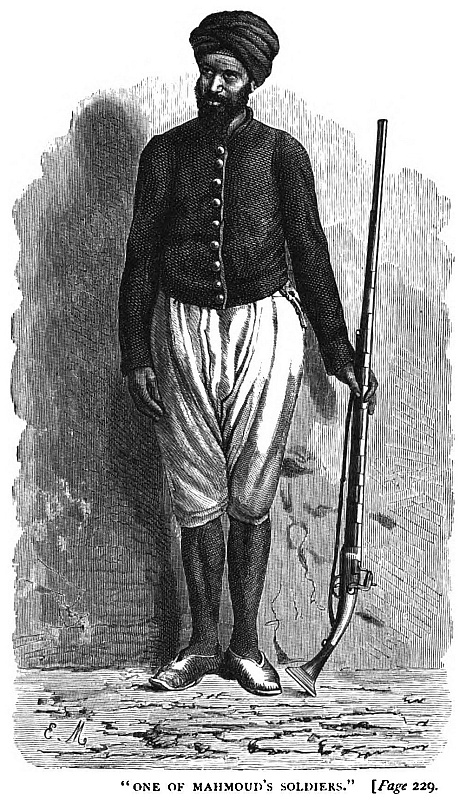
Why, away down yonder—close under them it appeared—they could see the blazing camp-fire of Mahmoud’s caravan.
“Are we not too near, Nanungamanoo?”
“No. They will not stir till daylight Arabs are not brave at night. When they do start they will go towards the sun. We will wait and watch and see.”
And so it fell out, for no sooner had the clouds begun to turn bright yellow and crimson than the stir commenced in the camp.
Somalis ran hither and thither, it is true.
The babel of voices was terrible.
Mahmoud himself was here, there, and everywhere, and the whacks he freely dealt his soldiers with a bamboo cane were audible even to our friends on the hill-top. But when all was said and done, the caravan started back towards the coast, and in a few minutes there was silence all over the beautiful landscape.
Book Three—Chapter Four.
In African Wilds—Adventure with a Lion.
A little way down the hill, and looking towards the north, was a cave in the rocks, and a cool delightful corner our friends found it, soon as the sun “got some weigh” on him, and his beams no longer slanted over the plain.
While Raggy was eating his modest breakfast Harry went some distance apart, and, taking out a little Book—it was a gift from his mother—he read a portion where a leaf was turned down.
Seems funny that a boy should carry a Bible with him, does it not? Well, reader, I can tell you this much: I have known many and many a sailor boy do so, and I never found that they were a bit the worse for it.
Mind you this, I have no patience with superstition, and I do hate cant; nor do I for a moment mean to say that our Book acts as a kind of amulet: but putting the matter in a plain, practical, common sense kind of a way, you and I have both immortal souls, you know, and we want to be guided how to save them. Well, the Book tells us the way. But that is not all. In times of danger—and a sailor comes across these pretty often—a blink into the Bible often gives a fellow heartening. You open it probably at the very passage that does so, and, even if you do not, you know where to find such passage.
And this does do good. Oh! I have proved it over and over again. I have a little old Book there that I have carried about the world for years and years. It has many a dog’s-ear, but they are intentional, for each one marks a passage, and to every dog’s-ear a story is attached. All point to little crumbs of comfort I have had in scenes of danger or even pestilence—here and there in many lands. Some day, if spared, I mean to write the story of this particular old Book of mine, and I do not think it will be devoid of interest to those who may care to peruse it.
But there! I am digressing, and I humbly beg my readers pardon; it was all owing to Harry’s getting away, in behind that bit of tangled scrub, in order to perform his morning devotions. Well, the truth is he did feel very, very grateful to be free.
But stay, will he be able to retain that freedom? And this brings me back to my tale.
He went back to the place where he had left Raggy enjoying the leg of a fowl.
The boy was sitting near the mouth of the cave.
“Enjoyed it, Raggy?”
“Ah!” and Raggy smacked his lips and rolled his eyes, “he am plenty much sweet, massa.”
“There’s a wing there too, Raggy. There you are, have that.”
“Tank you, massa. You am bery good, massa.”
I dare say Raggy would have eaten a whole fowl had it been offered to him. After all African fowls are not very big, nor very fat; but very matter-of-fact and self-possessed—that is their moral character.
I have gone into an African village in the evening, just as the fowls were all going to roost in the trees, my object being to buy half a dozen for the pot. As soon as the natives were convinced that the white man had not come to eat a baby, but that he really wanted to buy “tuck-tuck-chow-chow,” and had copper money in his hand to pay for the dainty, then all hands would turn out, and such a hunt you never saw, and such fluttering of wings and skraiching. I have felt sorry for the fowls.
When I got what I wanted, the rest of the “tuck-tucks” would go quietly to roost again as if nothing had happened. I envy such equanimity.
I remember that two fowls got loose in the boat once. It was blowing stiff, and the white spray was dashing over us. Well, any other birds would have jumped overboard. Not so these African fowls. They simply got on the gun’ale, and, as soon as the squall was over, coolly commenced to arrange their feathers. This regard for personal appearance in a scene of such danger—for they must have known they were going to pot—is something that one does not know whether most to admire or wonder at.
Having fully satisfied the needs of nature, Raggy was prepared to give some little account of his adventures. Briefly they were as follows, and in Raggy’s own language.
“You see, massa, befoh de sun rise on dat drefful night on de shore, de Somali Indians, all plenty well-armed, plenty big knife, plenty spear and gun, dey come and wake all our poor blue-jackets. ‘Come quiet,’ dey say; ‘suppose you make bobbery, den we kill you quick.’ Dey tak us all away behind de sandhills, and I tink first and fohmost dey am goin’ to obfuscate us.”
“Suffocate us you mean, Raggy.”
“All de same meaning, massa. But dey tie our arms till de blood tingle all down de fingers, and dey tie us roun’ de neck till we all feel chickey-chokey, and our eyes want to bust and relieve demselves. Den away we all go. I look back, and see dat poor massa not follow, and my heart am bery sad. Ober de hills and de plains we walk. Poor white man’s feet soon get tire and blister all, and in two tree day dey walk all de same’s one chicken on de stove-top. Dey Somalis and de big Arab—he one bad, bad man—dey talk. Dey not tink I understand what dey say. Dey speak ob where dey am going to de country ob King Kara-Kara, to sell all de men for slabes and get a tousand niggers foh ’em. Den dey speak ob you. You, dey say, am wo’th de lot Raggy heah all, and listen, and tink, and I want to set you free. One day one man he fall sick—one ohdinary seaman, massa, name is Davis—he fall bery, bery sick. Den de Arab soldier look at him and look at him. You nebah get well, he say. Den he take him by de two leg and pull him along de grass to a bush; and oh! it was drefful, massa, to heah poor Davis crying for mussy ’cause he hab a wife and piccaninnies at home, he tole ’em. No mussy in dat Arab’s eye. No mussy in his heart, he take de ugly spear and stab—stab—stab—Poor Davis jes say ‘Oh!’ once or twice, den he die. Plenty oder men sick after dis, but dey not lie down. Dey jes walk on weary, weary. Byemby we come to wells. Den de men get better. But Raggy hab eno’ ob dis. He steal away at night. How de lion roah in de jungle, and how de tiger (the leopard is frequently so called in Africa) jump about, and de wild hyaenas come out in de moonlight and laugh at poor Raggy. Raggy’s heart bery full ob feah. But he no say much. Suppose dey only laugh, dat not hurt much. Suppose dey bite, den Raggy die. I walk and walk foh days. I not hab much food. But I catch de mole and de mouse, I eatee he plenty quick. Den byemby I come to Mahmoud’s trail, and I follow on and up till one day I see de caravan on de hill, den I lie and sleep till night Massa knows all de rest.”