Part 3 — TOM FAIRWEATHER'S VOYAGE UP THE TIGRIS.
Reading edition
BY LIEUTENANT E. W. STURDY.
The Blosse Lynch is the largest boat on the Tigris, being built somewhat on the model of the American river steamers, and on the Blosse Lynch Tom Fairweather was embarked on a trip from Bassorah to Bagdad.
Bagdad, the City of the Caliphs, is five hundred miles from Bassorah, first up the Shatt-el-Arab, and then against the swift current of the Tigris, which runs at the rate of five miles an hour.
This voyage generally lasts three days, but sometimes, when the river is low and the nights dark, it is impossible to steam by night at all, or to go fast even by day. But Tom seemed born to good fortune and the fair weather which his name bespoke. The steamer sped on her way favored in all respects.
Tom's father had been to Bagdad before, and did not care to go again, so Tom was put under the charge of Lieutenant Jollytarre, who had decided to make the trip, although he, too, had made it already.
Such a motley throng on deck! There were keen-eyed swarthy Arabs of the desert, and black-eyed, russet-hued Arabs of the Gulf (the Persian Gulf, be it understood); there were Mussulmans from India on a pilgrimage to Kerbela; Jews of Bagdad returning to their homes after a business visit to Bassorah; there were Christians of Bagdad and Christians of Mosul. To be sure, these latter looked as unlike the ordinary Christian of Tom's acquaintance as possible, in their flowing robes and bright colors. But then Christianity and trousers and frock-coats are not altogether inseparable. Besides, there were Arab women, closely veiled, squatted about the deck. Sometimes the veils fell, and displayed the adornment of rings in the noses of these fair Arabians, blue lines elegantly tattooed on their chins and foreheads and across their lips.
You may fancy that it was a source of endless amusement to Tom to observe these different groups. Orientals are a tranquil set, and the quaint figures about the deck of the steamer changed their positions but seldom throughout the day; they smoked their caldeoous and drank their coffee seated on carpets and mats, and only stirred at the hour of prayer.
"Ain't it queer to see them saying their prayers right out before everybody?" commented Tom.
"Yes, it is," agreed the Lieutenant.
Presently they began to approach Kumah.
"What's this other river?" demanded Tom.
"This is the junction of the Euphrates and Tigris, fifty miles above Bassorah."
"Why, isn't this the Garden of Eden? I think my father told me that the Garden of Eden was at Kumah."
"Well, he was right." Here Mr. Jollytarre hailed an Arab who had just come on board to peddle his wares, consisting of curiosities and relics.
The Arab stood in front of Tom, gravely offering him a small branch of a tree. His English was so bad, however, that Tom was forced to turn to Mr. Jollytarre for an interpretation.
"He says that is a branch from the original tree which bore the forbidden fruit."
"Good gracious, you don't say so!" And Tom forthwith purchased the branch, paying two or three prices for it, of course.
Then the peddler jumped ashore, and they left Kumah behind them.
Afterward, for hours and hours a monotonous stretch of lowlands was the only landscape. The river-banks were so low that the wash from the steamer went over and watered the grass. Here and there were rice fields cultivated by the Arabs, and where the land was drier green corn waved, but not a tree broke the dead level of the landscape.
"What are those?" cried Tom, pointing to some animals playing among the reeds. "Oh yes, I see now—pigs; wild pigs, I suppose? And those birds are pelicans, are they not—there, in those pools? How snowy white they are!"
"I was a youngster when I made this trip before," said the Lieutenant. "It was my first cruise. I shall never forget shooting at a lion and two lionesses which had climbed to the top of a bank, where they lay high and dry. I hit the lion at the first shot, whereupon he plunged and reared, and then charged desperately in the direction of the steamer. At the second shot he rolled over dead into the water. But he showed fight, I tell you, and the fury of the three animals was something to be remembered. After the lion was hit, one of the lionesses jumped into the water and swam for the steamer. She was killed alongside."
"And the other lioness?"
"I regret to state she turned tail. I have always supposed she had cubs at home."
"Hello!" cried Tom, "what's that? Some one firing on shore. Look!"
Mr. Jollytarre used his field-glass. The Captain of the Blosse Lynch sauntered up with his glass. On the banks of the river were two men firing at each other, one on either side, using the steamer apparently as a screen.
"Some of my crew tell me that those are two brothers," said the Captain, "who are fighting for the supremacy of their tribe. They keep up with us pretty well, don't they? Now look at that rascal shooting at that other fellow across the bow of the boat. By Jove! he's hit him. The man's down. Two or three men are running up to him and carrying him off. It's a dangerous country," continued the Captain, "and a bad lot of tribes all along here. They are always giving trouble, robbing grain and cargo boats at every opportunity."
Every ten or twenty miles the vessel would steam by an Arab settlement, or rather encampment, where nothing could be ruder than the huts built of mats and reeds.
The Arab boys of these villages would run along the banks shouting to the passengers, who would throw them apples and onions and cabbages. The sight of this sport fascinated Tom, who first begged a cabbage of the steward, and then hurled it toward the shore. It fell midway, however, into the water, whereupon the boys set up a shout of baffled expectation. But in the next moment two or three of them had sprung in after the precious gift, swimming fearlessly, regardless of the swift current and the wash of the steamer.
"The grown-ups are at it now," cried Mr. Jollytarre. "Look, Tom, look!"
As he spoke three men and a woman plunged into the river and exerted all their energies to seize upon a handful of onions which some of the crew just then threw overboard. Loaded with their booty they swam ashore satisfied.
As they proceeded on their way the aspect of the country improved greatly. Little towns built of sun-dried bricks replaced the former villages of reeds and mats. Among the dwellers on the Upper Tigris are Bedouins who had wandered thither in the dry season to water their flocks, and had settled there.
A PARTY OF WANDERING BEDOUINS.
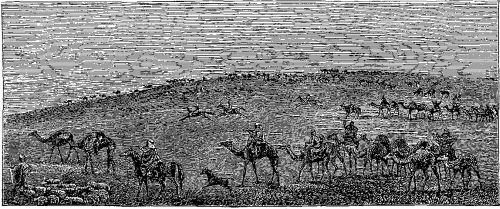
Have you all heard of the Bedouins of the desert? At certain seasons the desert is an arid waste, where flocks would perish of thirst. Many Bedouins, who had thus found their way to the river-banks, and had staid on, became farmers there. Some of them in the course of time would wander off to Bagdad or some other great town in search of employment, and thus these wanderers would cease to be the Bedouins of the desert.
Tom became thoroughly interested in all this. He looked with curiosity at the farmer Bedouins. Presently he saw a party of them mounted upon camels ("ships of the desert") steering their way along the river-bank.
"There's one queer thing," Tom said, looking about him on the steamer's deck. "Did you ever see so many blind people together before, Mr. Jollytarre? I mean blind of one eye. I never saw anything like it. What do you suppose is the cause?"
"Diseases of the eye are very common here on account, I suppose, of the glare of the sun on these hot plains. They have a way of using tobacco juice as a remedy for these diseases, which only makes them worse. The native doctors put out many an eye by this treatment. The patient is lucky if he escapes with even one good one. The natives have great confidence in the European doctors, and look upon them as magicians—that is, unless they propose to cut off an arm or a leg. That they won't submit to; they would rather die. The loss of an eye is evidently a trifling matter."
"That accounts for the Three Calenders," said Tom, "You remember those Three Calenders in the Arabian Nights? They were princes' sons, each blind of the right eye, who all met at the gates of Bagdad together. Now I've always thought it so very remarkable—all three blind of the same eye, all three princes, all meeting at the same place."
"What you might call a coincidence, or rather three of them. I always used to think that story hard to swallow myself, but since I've seen these Eastern folks in the flesh, I find it easier to believe. In fact, I have been told that it would be a very singular circumstance if three individuals came together at Bagdad, or any other town in the neighborhood, who could count six eyes among them."
So they went on their way, coming nearer and nearer to Bagdad. Five hours from their destination they came to the ruins of two cities, the "Twin Cities of the Arabs"—Seleucia and Ctesiphon.
Seleucia was built on the western bank of the Tigris, by Seleucus, one of Alexander's generals. After the death of Alexander his vast empire was divided between four of his generals, and the grand division called Syria fell to the share of Seleucus. This included part of ancient Assyria, and therefore the venerable city of Babylon, which was at one time the greatest city in the world. As Seleucia rose into power it gradually took the place of Babylon, which fell into decay in its turn.
Ctesiphon was built opposite Seleucia on the other bank, and was the capital of the Parthian Empire, its royal palace being one of the wonders of the ancient world.
Kingdoms were bowled up and down in those days just as they are now, and in this way Ctesiphon was sacked by the Arabs, when, a few years after the death of Mohammed, they prostrated the Persian kingdom.
"CÆSAR'S ARCH" AT CTESIPHON.
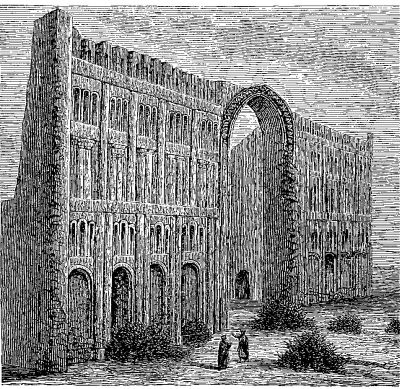
The wonderful royal palace was destroyed and its glories scattered. One marvellous carpet in particular, which covered the Hall of Audience, was sent to the Caliph Omar as a trophy worthy of him alone. He had it cut up and divided among the captors, and it was of course ruined.
Tom and Mr. Jollytarre wandered through the ruins of Ctesiphon, talking of these things.
"At one time," said Mr. Jollytarre, "they were rebuilding, or rather refounding, Bagdad, in the time of a caliph called Almansur. He determined to use the devastated palace of Ctesiphon as a quarry for materials. He ordered the famous building to be entirely demolished for this purpose; but it was found to be impossible to carry out his orders, the pile was so stupendous. There is 'Cæsar's Arch,' for instance, which has escaped the destroyer's hand. The height and span of this arch are said to be unequalled in the world."
But Tom heaved a sigh. "I should have liked to see that carpet," he said.
"Yes, so should I. I hardly think carpet-makers of the East have improved since that day. They improve slowly out here. I don't believe things have altered much since Alexander's day."
"Those round boats, for instance," said Tom.
"So much for the 'Twin Cities of the Arabs,'" said the Lieutenant, as they embarked once more on the Blosse Lynch. "Tom, I wonder your small head does not burst with all the sights you have seen and the wonders you have heard since we left Bassorah."
"Most of it goes in one ear and out the other," replied Tom, frankly.
At night-fall of the third day they reached Bagdad, but it was too late to go on shore.