Part 3 — FIVE LITTLE ANGELS.
Reading edition
Five little angels singing on high; Five little angels drop from the sky.
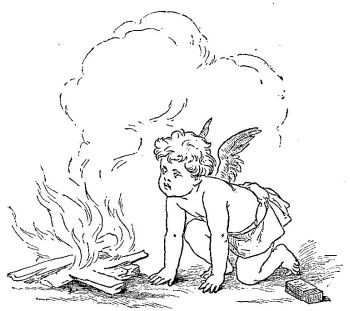
The first to blow the fire ran;
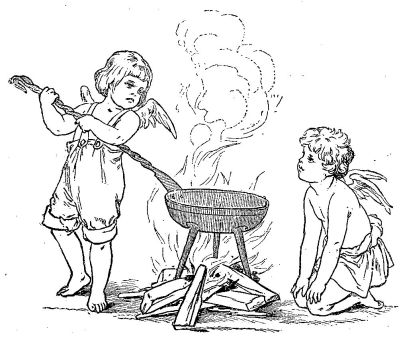
The second then put on the pan;
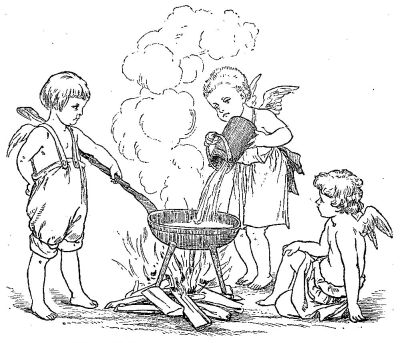
The third poured in the porridge nice;
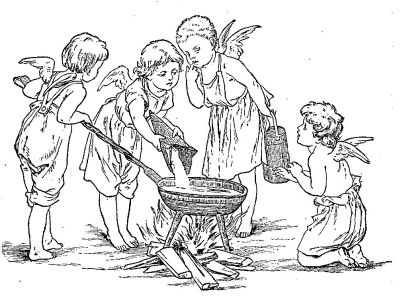
The fourth put in the salt and spice;
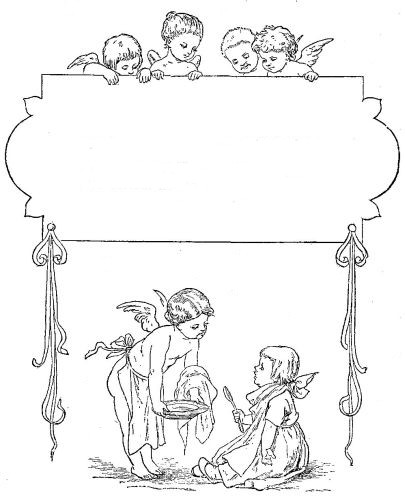
The fifth then brought it in a plate, And, smiling, said to little Kate: Your supper's very hot, I fear; Be careful not to burn you, dear!

Two little cousins were going to school the other day, and as they passed my window I watched their faces. One of the boys, whose name was Harold, looked very happy. I was as sure as though he had told me so that he had been helped by a pair of twin fairies who are always very busy at this time of the year. The two little creatures flit from one school-room to another, and the boys and girls whom they assist may be known by several signs. They hold their heads up bravely, they walk with light steps, and they are never seen to frown or pout. I was sure by Harold's eyes that he and the fairies I mean were close friends.
Edgar, the other boy, went to school with an air which gave me pain. I was not at all surprised to hear him say that he had a cross teacher, and that he did not like his lessons, and could not learn them. Poor fellow! A naughty fairy had captured him, and I put on my spectacles and took my knitting while I thought of a plan to set him free from her power.
The fairies who help children at school are bright-eyed creatures, who teach you two things—the first is how to hold fast, the second is how to hold on. Fairy Holdfast will not let her friends look at a half-dozen things at once. She says, "Now, my boys and girls, ten times one is ten. Think of that, and of nothing else. Look, straight at the teacher if in the class-room; look straight at the book if it is study hour. I will hover about, and keep everybody who wants to bother you out of sight."
Fairy Holdon says, sweetly, "Dear little ones, Rome was not built in a day. One brick at a time, and the house is completed. One day at a time, and the century is finished. One lesson at a time, perfectly learned, and the little boy becomes a great scholar."
Some people call the Fairy Holdfast Attention, and the Fairy Holdon Diligence, but I think the other names are prettier and much easier to remember, don't you?
As for the wicked fairy who is the foe of all good boys and girls, her name is Fairy Scatterbrain, though some people call her Idleness. She is not nearly so strong as the kind fairies I have been talking about, and if you make an effort to snap the threads she weaves about you, they will break like spiders' webs. Only, you must make the effort. Nobody can do it for you.
I intend to whisper this secret to Edgar on the first opportunity.
New Brighton, Staten Island.
I am nine years old. I live with my papa and mamma in the country. I have a little pug-dog whose name is Beauty, and I have a canary-bird and a young rabbit. The canary-bird's name is Buttercup, and the rabbit's name is Muff. I am going to tell you about the way in which I caught Muff. I was out walking with my teacher and my brother and another little boy and girl, and we went up to the woods, when all of a sudden I caught sight of a little brown thing in the bushes, and then I saw that it was a young rabbit, and I called my little friends to try and catch it, and at last the little boy succeeded in doing so. We took it home and put it in a box, in which we laid some straw.
My brother is eight years old. He has a bicycle, and he rides very well. He began to ride when he was six years old.
Julie B. R.
Fort Bowie, Arizona Territory.
This is my second letter to Young People. The first was written some time ago from Fort Apache. Most girls tell of their pets, but as I have only a pair of pigeons and a little "burro" (which is Mexican for donkey), I'll tell about our trip from Fort Apache to this place. We left Apache early on the morning of June 28, and arrived here on the afternoon of July 9, having travelled in an ambulance drawn by six stout mules. The road was very rough in some places, but the scenery was beautiful, especially when crossing the mountains. We passed by the graves of the men killed by Indians last May. In one grave there were five bodies. We also saw the charred remains of a wagon, to which the Indians had tied men and then burned them. We had a detail of sixteen soldiers, or we should have been very much afraid. We camped each night, and I thought how surprised Eastern people would have been had they seen us sitting outside the tents after supper, singing, in this wild country. I'll write again some time, and tell about this funny little fort—that is, if we stay here long enough.
Bessie G.
Your letter would not have been too long, dear, had you told about the fort before you concluded it. Little correspondents need not fear making descriptive letters too long.
"I want to look wise," said Maud, one day; "I want to look clever and wise." "Oho!" said the Owl, as he sat on a spray, And blinked, as in solemn surprise, "You had better by far remain as you are, And learn to be clever and wise." Then echoed the birds as they sat in a row, "You hear what he says; you'd better, you know, Just learn to be clever and wise."
AN ALPHABET.
A is an apple, so rosy and sweet!
B is a butternut dropped at your feet.
C is a crow flying over the hill,
D is a duck in the pond by the mill.
E is an egg that the hen hid away;
F is a fan for a very warm day.
G is a golden-rod lifting a plume,
H is a honey-bee kissing its bloom.
I is an icicle, sharp as a spear;
J is a juniper, green all the year.
K is a katydid, singing at dusk;
L is a lily, much sweeter than musk.
M is a mouse peeping out of her hole;
N is a napkin in tight little roll.
O is an owl, looking solemn and wise;
P is a pussy, with fun in her eyes.
Q is a question that children may ask;
R is a recess when ended your task.
S is a sugar-plum ever so nice;
T is a tooth biting it in a trice.
U is an usher, to find you a place;
V is a violet hiding her face.
W is a wren, with a dear little nest;
X is the gladness that fills her wee breast.
Y is Young People you all love so well;
Z is for Zoe, who reads it to Nell.
Some little folks may think it odd that X stands for gladness. When they are older, and study algebra, they will find out that X is put for a quantity that is not known. Nobody can tell just how very glad a little mother-bird feels over her fledgelings.
Knoxville, Illinois.
I like so well to read the letters from other little boys and girls that I thought I would like to write you one. I have two dogs: their names are Prince and Gip. Prince is a shepherd dog, but can not scent so well as Gip, who is a rat terrier; so Prince coaxes Gip to go rabbit-hunting with him, and scent and catch the rabbits, when Prince eats them. Gip does not always like to do the work and let Prince have all the enjoyment, and sometimes runs back after they get started, but Prince will rub his nose, pat, and coax until Gip will finally go. I have two ducks, and they sit on nests close together, and divide the eggs between them. I have also a cat named Bessie; she had a kitten, but it died. I have a little sister named "Tot." I have taken Harper's Young People ever since it first started, and I think "Toby Tyler" was the best story of all. I am in the country visiting, and my auntie is writing this letter for me, as I am only six years old, and can not write. I have been riding on horseback, chasing the cows and pigs, catching chickens for auntie, drinking all the milk I want, and having a real good time. I have not seen any letters from the Knoxville girls and boys; so I hope you will print this, and let me surprise my papa, who prints papers too.
Sterling H. C.
This is a very nice letter, only, dear Sterling, I am sorry those dogs hunt and eat the poor rabbits, and if I were their little master, I would stop such work if I could. The ducks are much kinder than the dogs, in my opinion.
Ellensburg, Oregon.
Will you publish a letter from a little girl who lives away off on the Pacific coast, where no one is ever advised to "go West"? I am six years old. Papa subscribed for the Young People last winter, and it was so long coming that we began to fear that the money had been lost, when at last four numbers came all at once, and on my birthday at that. We live at the mouth of Rogue River. There is a large salmon cannery here, and a great many men are employed during the fishing season. A long time ago this place was called Gold Beach, on account of the very rich mines here. Sometimes we walk on the beach and gather moss and shells. From the front door we can see steamers passing up and down the coast, and can watch the fishing-boats. Last summer papa took me to San Francisco, and I enjoyed the trip very much. I have two brothers, Bertie and Harry, and a sister Pearl, and I am the oldest of them all. I have a number of dolls, and a kitten named Jessie. Bertie's kitten is named Daisy. We all think ever so much of Young People. I have a little friend named Clarence, who is going to subscribe. I can not read much myself, but mamma reads to us. Mamma is writing at my dictation, but she says we must "boil it down," or you will not even read my letter. I think that of all the subscribers in the United States, none live so far West as your little Oregonian friend,
May W.
The next time I cross the East River and see the busy steamboats going to and fro, I shall think of May watching the ships and steamers from her front door. How nice it was to have your first numbers of Young People arrive on your birthday, almost as though it had been planned to give you them for a birthday present.
We think the following letter from a lad of twelve will interest many other wide-awake boys who have never had the pleasure of seeing what goes on in a navy-yard. We will be pleased to hear from our young correspondent again:
I live in the Boston Navy-Yard. I thought it would be interesting to the readers of Harper's Young People to hear something in regard to navy-yards in general. I have lived in two yards, and have visited several others. I think the Boston Navy-Yard by far the most interesting. In it is a rope factory which is 1300 feet long. All kinds of rope are made here. It is not only interesting but instructive to watch the process. First the hemp is combed and twisted into strands, then these strands are twisted into sections of rope, then three or four sections are twisted together to form a complete rope. Wire rope is also made here, which is used for stationary rigging. A manila rope was on exhibition at the Centennial which was made in this yard, the circumference of which was 28 inches; this was the largest rope ever made. The dry-dock is another very interesting feature of this yard. It is a place where ships float in for repairs. After they are in, gates are closed, and the water pumped out by a powerful steam-pump, leaving the ship high and dry, so that even her bottom can be repaired without the aid of divers. The dimensions of this dry-dock are 403 feet long, 99 feet wide, and 32 feet deep. It was begun July 10, 1827, and opened June 24, 1833, and cost $677,000.
Porter.
Round Mountain, Alabama.
I want to tell you about our nurse's wedding, and I want you to put my letter in your dear little paper; but before I begin I must tell you that we live away out in the country in Alabama. We moved here from Augusta two years ago. Papa has an iron furnace here. There are about two hundred cabins all around the furnace. Our house is called the "Big House"; it stands off by itself.
Well, when Cinda (that is nurse's name) told mamma she was going to be married, mamma gave her lots of nice things for a wedding supper, and told Cinda she could be married on our big piazza. Cinda was so happy, and was not cross a bit that day, and when she bathed us did not get a bit of soap in our eyes.
Cinda is nearly forty years old, and mamma says her name is most appropriate (for she is as black as a cinder). Her husband "to be" was ten years younger than she, but he did not seem to mind that, for he had been begging Cinda a long time to marry him. When the hour came, mamma and some lady visitors went to the piazza. The friends of the bride and groom were there too. Then Cinda and Albert came on the piazza.
Cinda wore a black cashmere dress and white gloves, and flowers in her hair and at her neck. We children thought she looked so nicely. When Mr. W—— asked Albert if he took Cinda to be his wife, and would protect and support her, Albert just hollered out, "You bet I will, boss"; and then Mr. W—— said they were "man and wife." Then they went to one of the cabins, and had their supper and a nice time.
Bolling S.
Dobb's Ferry, New York.
I send a receipt which I made myself this morning, and I hope you will print it. Here it is:
Pop-corn Candy.—Pop some corn; then fill a patty-pan or some small tin with the corn, and pour two tea-spoonfuls of molasses over it. Put it on the range for five minutes, and then let it cool. You will find it very nice.
Isabel N.
Santa Barbara, California.
About two months ago I went to Los Angeles. There were seventeen in the party, and we had a very nice time. I should like to tell you about all we saw and did, but as that would take all the room in the Post-office Box, I will just tell you about something I saw in Los Angeles. We visited an old Hungarian, whose business was training mocking-birds and raising flowers for market. He had about one hundred large birds, and in a box by themselves a dozen or more young birds. He placed their food on the end of a stick, and put it through the wires of the cages, and each one would stretch out his wings to keep the others away while eating it. When he came to the little ones, they all opened their mouths, and then they did look funny enough, for their throats are bright yellow, and one could see little except mouths. He teaches them to whistle tunes very sweetly. When they can not learn to sing, he turns them out; but they stay near by, and he feeds them. There was one bird near our camp that sang all night. The man had eleven dogs, and bought two sacks of flour and two dollars' worth of meat a month for them. He said he loved birds, dogs, and flowers better than human beings. We were gone from home two weeks, and saw a great deal of Southern California.
Emily G. B.
Baton Rouge, Louisiana.
I don't know how to write, so mamma is writing this for me. I have all the Harper's Young Peoples for last year, and all for this year. I keep my books and papers in a trunk, and once a week I dust them all. The colored Odd-Fellows had a procession last week. They wore black broadcloth suits and tall beaver hats. Some rode on horseback, and they had on sashes, and looked so nice. They had some beautiful flags and banners, and one of them had the biggest axe over his shoulder I ever saw. I like to read the children's letters in the Post-office Box. We have two pets—a Maltese cat named Charley, and a big horse named Rex. Good-by.
Arthur B.
The Odd-Fellows must have looked quite brilliant and imposing with their sashes and banners. I am glad you save all your papers so carefully. You may always refer to a number when you wish, which is a great convenience.
Brooklyn, New York.
I am a little girl seven years old, and I asked mamma to write this for me.
I have one brother nine years old; he is away in the country, while I staid at home.
I have ten dolls I play with. The prettiest one is a French doll named Edna. I have a baby doll with a long white dress and a cap on, and I love her ever so much. Then I have a Japanese doll, called Wingy Wing Foo, like the one in the story in one of your papers.
I have one little black kittie, with white feet, and she has a red ribbon on her neck with a bell on, so I can tell where she is. Her name is Widdy.
I like to hear about all the little girls and their pets, so thought I would write and tell you of mine. I hope you can print this. I should like it so much.
Mott Haven, New York.
I am sorry the story about Mr. Stubbs's brother is ended, and still more sorry that Abner is dead.
I have been in the country, and climbed the mountains at Highland Falls, and I brought home with me two lovely sunflowers, the first I ever saw, though I will be ten years old next month.
Lottie S. S.
Around and around a dusty little room
Went a very little maiden with a very big broom.
And she said, "Oh, I could make it so tidy and so trig,
Were I a little bigger and my broom not quite so big!"
Pass Christian, Mississippi.
As I see that you receive letters from all parts of the country, I thought you would like to have one from this place. I am one of five boys in a family. We all enjoy reading the paper, even to my little sister, although she can only look at the pictures. We get it regularly every week. We have a pair of goats and a wagon. They resemble Rocky Mountain goats. We have a harness to fit our goats, so that we are able to drive a double team. Their names are Jack and Billy. They are snow white. The place I live in is large and shady. It is situated on a lake, in which we bathe. We are fifty-eight miles from New Orleans, where my father is in business. We have also a pony which we ride. Her name is Fate, and she is very gentle.
Sydney H.
I would like very much to see your goats, which are, no doubt, as well-behaved as they are beautiful. I hope you feed them generously, and never let them work too hard in their pretty harness.
San Francisco, California.
I live in San Francisco, and often go out to ride to the Cliff House. It is very funny to watch the sea-lions on the rocks, which are called Seal Rocks. We were there the other day when a tug-boat came close to the rocks and blew a whistle. The seals took alarm, and it was very comical to see them make their way into the sea two by two. We went to the Persidio, and through the fort. We saw cannons, of which there are a great many. The walls are about six feet thick. The cannons are all pointed out of little windows, and are on tracks so that they can be placed in any position. We went to the top of the fort, and saw a little boat go through the Golden Gate. I have read Harper's Young People for two years. I look forward to Thursday with great pleasure, for that is the day when it comes.
Daisy H.
Netherwood, Ilkley, England.
I am a little boy ten years old, and my real home is in Wisconsin, U. S. Mamma and I are staying here with grandmamma. We are to return in October. We are going to Paris to-morrow, and from there to London, where I hope to visit the Tower and other places of importance. I wish I could give you a little of my diary which I kept at sea, some of which I think would be interesting. I have taken your paper ever since the first number in 1881, and have liked it very much. I like "Mr. Stubbs's Brother" especially, and long each week for the paper which my father sends from America.
J. E. McC.
Perhaps you will keep a diary on the voyage home. If so, you may send me some quotations from it when you are again at your home in Wisconsin. I hope you are writing a little every day about the sights which to you are new and interesting in the Old World.
Marie G. L.—There is no charge for the publication of exchanges. Each person should pay the postage or expressage upon the articles which he or she sends. As to which should forward articles first, the Postmistress can not decide. In every case trouble would be saved, and misunderstanding and disappointment would be prevented, if exchangers would follow the advice always given at the head of the columns devoted to their interest and pleasure. Write first to the person with whom you wish to exchange your treasures, and await a reply before you send anything. This should always be done.
C. Y. P. R. U.
A curious Chinese Custom.—The people who live in the southern part of China are said to observe, once a year, a festival to which all look forward almost as eagerly as Americans do to the Fourth of July. It is called the Filial Porridge festival. Instead of boiling rice by itself on that day, sugar, seeds, fruit, dried dates, and other things are cooked with the rice, making a dish which is almost black in color and very thick. This porridge is placed in bowls, and is set before the ancestral tablets and household gods which one finds in every Chinese house. Here it is left for a time, with incense and candles burning beside it. After a while, when the souls of the departed ancestors are supposed to have consumed all they wish, the family are at liberty to eat the remainder. Children who are married, and away from home, make and send a dish of this porridge to their parents if they possibly can. After the filial porridge has been eaten, the boys and girls amuse themselves by firing off crackers, playing merry games, and having a pleasant time.
This is a pretty story about a terrier, is it not? A hungry boy called at a house in Rochester, and asked for something to eat. He was told that there was nothing, but he pleaded with the servant, saying, "Give me only a piece of bread."
The dog, who had been standing by the domestic, suddenly ran away, and in a moment returned, carrying in her mouth a large piece of bread, which had been given to her for her breakfast. Going straight to the boy, she laid it down at his feet, looking up at him, and motioning with her head and paws, as if to bid him take it.
Du Chaillu, in his beautiful stories of travel in Scandinavia related in The Land of the Midnight Sun, tells about being driven through the country by young girls. He says:
"At every station I had a young girl for a driver, and these children of the North seemed not in the least afraid of me. My first driver's name was Ida Catharina. She gave me a silver ring, and was delighted when she saw it on my finger. I promised to bring her a gold one the following winter, and I kept my word. She was glad indeed when, at the end of the drive, I gave her a silver piece. Another driver, twelve years old, was named Ida Carolina. The tire of one of our wheels became loose, but she was equal to the emergency. She alighted, blocked the wheel with a stone, went to a farm-house and borrowed a few nails and a hammer, and with the help of a farmer, made everything right in a few minutes. She did not seem in the least put out by the accident. She chatted with me all the time though I did not then understand what she said, for I did not then know the Finnish language. She was a little beauty, with large blue eyes, thick fair hair, and rosy cheeks. From early life children are here taught to depend upon themselves."
We would call the attention of the C. Y. P. R. U. this week to the very interesting article on "Corals," by Miss Sarah Cooper, and to Lieutenant E. W. Sturdy's account of "Tom Fairweather's Voyage up the Tigris."
PUZZLES FROM YOUNG CONTRIBUTORS.
No. 1.
FOUR WORD SQUARES.
1.—1. The time to rest. 2. A lounger. 3. A dell. 4. A fence. 5. Very large plants.
2.—1. A musical instrument. 2. A false god. 3. To defeat. 4. A girl's name.
3.—1. An imaginary monster. 2. Profit. 3. A husk. 4. To challenge.
4.—1. Air in motion. 2. A thought. 3. Close. 4. To brave.
A. L. W.
No. 2.
DOUBLE ACROSTIC.
1. A crawling animal. 2. A chemical substance. 3. A Swiss patriot. 4. A girl's name. 5. Destructive animals. Primals and finals spell the name of manufactories which are beautiful objects in a landscape.
Benjamin L.
No. 3.
FIVE DIAMONDS.—(To Eureka).
1.—1. A letter. 2. A meadow. 3. A fruit. 4. A unit. 5. A letter.
2.—1. A letter. 2. Part of a verb. 3. A color. 4. A fish. 5. A letter.
Count No Account.
3.—1. A letter. 2. A tavern. 3. To bring on. 4. A fruit. 5. A letter.
4.—1. A letter. 2. To increase. 3. Peculiar form of expression. 4. A point. 5. A letter.
5.—1. A vowel. 2. Permit. 3. A planet. 4. A utensil. 5. A letter.
Christine and Gretchen.
No. 4.
CHARADE.
My first is the lightest of things, without doubt.
My second we would not be always without.
My whole you will find as a great prize is reckoned
By people who are a long way from my second.
ANSWERS TO PUZZLES IN No. 147.
No. 1.
DN
FINPAD
DIGITNAVAL
NIBDAN
TL
STC
GAGPETOLD
SAPIDTENORCLARE
GINTONDRY
DRE
No. 2.
APE
SHE
TIE
SLY
MAY
IDA
RED
ILL
SPY
SHY
LIE
DAY
No. 3.
SlaY
TogA
EconomiC
AccomplisH
MelT
No. 4.
Cowl.
Correct answers to puzzles have been received from "Christine and Gretchen," Naomi Schultz, John Burr, Arthur Folsom, "Eureka," Sydney Heineman, Benjamin Lowenthal, E. C. DeWitt, "Lodestar," "Sunshade," Eddie S. Hequembourg, Daisy R., Louise Redwood, Archie McManus, Tom Rayburn, Elsie Lee, Maggie Murphy, Ella Hurd, Edith Maynard, Mollie Price, Puss Keeler, Richie Jenkins, Jesse Oppenheimer, Fred Lott, Hugh McAlister, "Al Bert," Rosa Lennox, W. A. W., Emma Christie, "Ye Owls," David Heinemann, Frank C. Farrow, G. Ritter, "Gazetta," "C. De Gangue," Alice W., and John Selim.
[For Exchanges, see 2d and 3d pages of cover.]
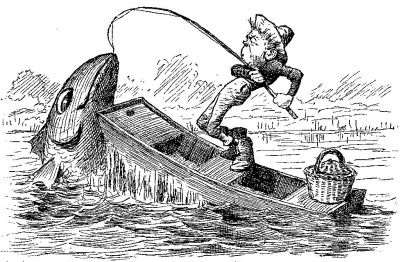
"A LITTLE TOO MUCH FISH."