CORALS.
Reading edition
BY SARAH COOPER.
Most boys and girls like corals. They are so common and easily obtained that I hope each of you will lay aside your reading just here, and hunt up a piece, no matter how small, that we may examine it carefully, and see what we can find out about it. You must find, however, a piece of the natural coral, just as it was brought up out of the sea, and not an elegant and polished piece such as is made into ear-rings and brooches and long strings of beads to adorn the necks of ladies and little folk.
What makes this bit of natural coral so rough? The first glance will convince you that those curious pits and little cups on the surface mean something; and when we remember that all the corals which reach us are the skeletons of former living animals, they interest us at once.
Few of us, perhaps, will ever be so fortunate as to see living corals, since they grow principally in the deep water of warm oceans. The higher the temperature, the greater the variety and profusion of the coral. During life the skeleton is covered with soft flesh, the surface of which is thickly studded with star-like animals called polyps. In this way millions of polyps are sometimes clustered together in one community. As they wave their delicate tentacles of white, green, or rose color, they are said to be very beautiful, especially if seen in the bright sunlight through water that is clear and still.
Fig. 1.—Branching Coral Alive, with Polyps Expanded.
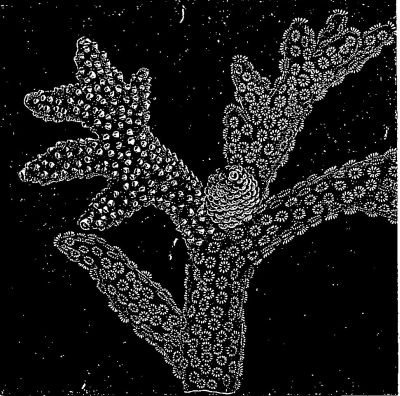
In Fig. 1 is shown a piece of living coral with the polyps expanded. The flesh has been removed from the upper branch on the left that we may see the skeleton. Let us suppose that the specimens we have selected for study are of this kind. Each of the tiny cups on the surface was once the frame-work of a separate polyp, and we shall find that its interior is divided by a number of partitions which do not quite reach the centre. Look into the cups with your microscopes,[2] and you will find them very beautiful. One set of partition-walls reaches almost to the centre, and between these walls are shorter ones. These give us a clew to the kind of animal that has lived here, and they will at once remind you of the partitions in the sea-anemone, as shown in Fig. 2 in the article on "Sea-Anemones," published in Young People No. 143. Indeed, the whole structure of a coral polyp is similar to that of an anemone, and we can now easily imagine the stomach of the polyp hanging down in the opening left between those delicate partitions. Coral polyps differ from sea-anemones, however, in three important ways—they have hard skeletons, they can not move about, and they usually grow in clusters.
When young, coral polyps are little jelly-like animals which swim about in the water. After they have chosen a resting-place, and the stomach and tentacles have grown, hard particles of lime, which they have drawn in from the sea-water, settle in their flesh to form a circular cup as well as the partitions inside. In this way the polyps soon acquire a solid frame, the soft parts being the stomach, the fringe of tentacles, and the fleshy mass covering the skeleton and the internal partitions. They can draw the tentacles entirely within the body, as the anemone does. Like the anemone they also have lasso-cells for capturing their food.
Should it be a branching coral whose history we are tracing, it will now begin to bud from the sides. The buds will grow into branches, throwing out other buds, somewhat as plants do, until we have an elegantly branching colony. Each bud is a new polyp, and remains attached to the branch from which it sprang. Although the polyps in such a community have separate mouths and stomachs, there is a close connection between them, and a free circulation of fluids through the soft flesh.
As in other families one generation passes away and another takes its place, so in large branches of coral the lower and older portions may be dead, and living polyps will be found only at the ends of the branches. Corals seem to be delicate creatures, as they will not flourish under adverse circumstances. They require water of a certain depth, and they die immediately if exposed to the sun or to cold weather.
Besides increasing by budding, corals increase rapidly by eggs. Their eggs are pear-shaped, transparent bodies, covered with cilia, which are in constant motion, and which row the jelly-like lumps through the water. The parents, you remember, are firmly rooted to some object, but their little ones are gifted for a time with the power of motion. They may well enjoy the privilege while it lasts, for it is their only chance of exploring their ocean home. Presently they must settle down like other sedate corals. But it is in this manner that the young polyps are distributed through the ocean instead of growing in a crowded colony around the parent.
You will often hear coral spoken of as having been built by an insect, and you will see at once that this is far from correct. Coral polyps are very different from insects, and their skeletons grow, much as ours do, inside of the animal; so we can not say they have been built. All such animals as coral polyps, which have the mouth in the centre, with other parts radiating from it, are called "Radiates."
Besides these branching corals which resemble trees and shrubs, some grow in solid masses without sending off branches. Others assume the shape of graceful vases; all of these are gayly decked with star-like polyps of varied colors. Does it not seem to you as if the ocean was one vast store-house of beautiful things?
Fig. 2.—Mushroom Coral.
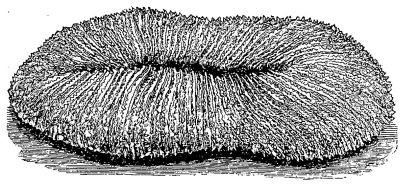
The mushroom coral (Fig. 2) looks indeed like a large mushroom, although you will notice that the leaflets are on the upper surface instead of being underneath, as they are in the vegetable mushroom. This coral is the skeleton of one huge polyp, and we see the depression in the centre corresponding to the little cups on most other corals.
Fig. 3—Organ-pipe Coral.
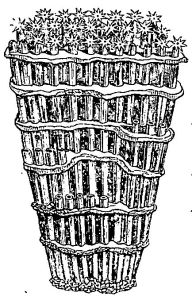
The organ-pipe coral consists of lovely crimson tubes standing upright, and connected at short distances by thin flat plates, which give it the appearance of being several stories in height. These plates may be distinctly seen in Fig. 3. When alive, a little polyp protrudes from the top of each tube, and being of a bright purple color, it makes a striking contrast with the crimson tube.
Fig. 4.—Fragment of Red Coral with Polyps.
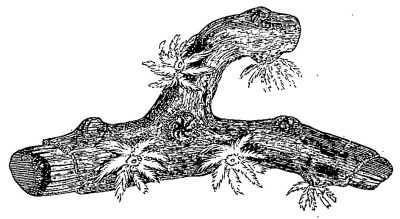
Red coral, which is used for jewelry, grows in a bushy form on rocks at the bottom of the Mediterranean and Red Seas. The fleshy mass of this coral is colored red by the numerous red spicules it contains, while the polyps are pure white. The whole resembles a pretty red shrub spotted over with sparkling white flowers. The spicules in the centre of the branches form a solid stem, which takes a fine polish. Underneath the flesh the surface of the coral is marked with deep grooves, which are canals for the circulation of water. These grooves are shown at both ends of the branch in Fig. 4. They are always removed in polishing.
Red coral is generally obtained by fishermen, who drop into the water heavy wooden crosses to which strong nets are attached. As the boat moves slowly forward, the crosses are raised and lowered to break off the coral branches. The apparatus is then lifted from the water, and the fragments of coral which have become entangled in the net are carefully removed. There are many shops in Italy where the coral is polished and cut into various ornaments. Delicate rose-colored corals are considered very choice and elegant, but the natives of India prefer blood-red ones, which contrast finely with their dark rich complexions. Corals are their favorite ornaments, and large quantities are imported every year.