THE GARDENS.
Reading edition
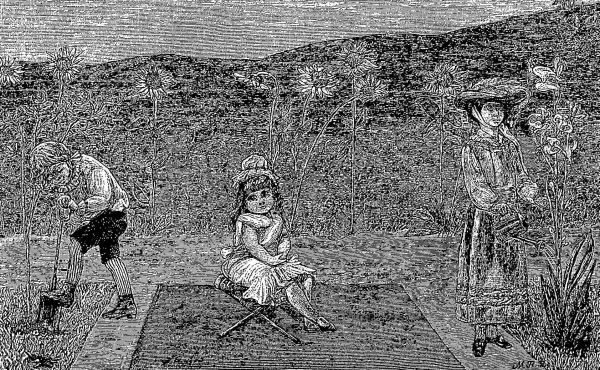
Three children and three gardens In this picture you may see; One has planted a lily, And one a red-rose tree. And one in the earth with a little stick Has written her name, and then quite thick The seeds of the water-cress has laid In the little track the stick has made. And here she sits with folded hands— In this picture you may see What a very patient little girl This little girl must be. And if you'd like to know her name, Why, when the cresses grow, You can see as well as she, And then her name you'll know.
THE THREE GARDENS.

Our first letter this week comes from a young lady who writes to the Natural History Society. All the way from Japan came a letter from a bright boy describing the Feast of Lanterns in his far-off home. We think the same boy, if he would, could tell us something about mission work in Nagasaki. Every letter we print is interesting, and we are very sorry that you can not enjoy the letters we have had to keep to ourselves. We are glad that so many of you like Our Post-office Box.
Watertown, New York.
Good-morning, boys and girls! How are you progressing with your studies in natural history? Have you been successful in finding facts for your societies, and securing specimens for their collections? No doubt those who spent vacation away from home brought back many trophies which will be greatly valued. Have you added some of them to a cabinet where all the members of your society can enjoy them? Those of you who have staid at home, plodding on in the same old paths, have you noticed anything wonderful there? Surely there is no place where God is not, and where His works may not be studied. Sometimes children make fine and well-arranged collections not only of flowers, but of leaves, ferns, and mosses, some varieties of which can be obtained in all parts of our country.
One branch of natural history which is full of instruction is often neglected. I refer to the study of insects. Not only may butterflies and moths lay claim to beauty, but many beetles, flies, spiders, and worms. "Ugh!" says some little girl—"spiders and worms! The horrid things! Who ever heard of their being beautiful?" Little sister, have you been walking all this time with your eyes shut, so that you have not seen their velvet coats of many colors, ringed, streaked, and speckled? If you would but stop and watch them in the trades they follow and the houses they build, instead of running with fright or turning away in disgust, you would find them more interesting than you now imagine they can be.
I have a friend who has for a few months past been studying entomology. She has used her fernery, covering the top with mosquito bar, as a cage for worms, and there we have fed them with the leaves of the plants on which they were found, and have been quite delighted with their transformations. She had two green ones, with black bands running around them, dotted with orange. They were found on celery. We watched one hang itself to a piece of apple-tree branch put in for that purpose; saw it spin a small, thick patch of web, hook its hind-feet into it, then pull with all its might, apparently to see if the web was strong. After that it spun a silken cord for its back, attaching the ends to the bark, holding up its fore-feet and passing it back and forth over them to make it long enough. It then passed its head through the loop so made, and wriggled itself in. In about thirty-six hours the skin split on the back, and it slipped it off, unhooking its tail, and hooking it into the web again; and after repeating the operation of pulling, the little creature settled down for a long nap. As the skin came off, he looked like an entirely different fellow, both in shape and color. He is now a chrysalis, without legs or a distinctly defined head; in color, light gray, with brown stripes running lengthwise; there is also a delicate trace of wings. We are now looking for his last change, which will be to a dark swallow-tailed butterfly, spotted with yellow, blue, and orange.
All parts of the cabbage butterfly, even its eyes, can be clearly traced in the chrysalis.
Another worm, pale green, very large, nearly like the tomato-worm, laid himself away in the earth in one corner of the fernery, there to change into a pupa, and remain until spring, when he will become a pretty moth—ash-color and pink, with brown spots. It will measure over three inches when the wings are spread.
A stupid-looking bug, somewhat like a May-beetle without wings, was also put into the cage. It soon attached itself to the branch, split open its back, and out came a lace-winged cicada, wrongly called a locust. You would be surprised to see how much larger it was than the case out of which it came.
Have any of you ever watched the wrigglers in your mother's barrel of rain-water, and have you seen them change to mosquitoes? If not, keep your eyes open early in the morning, is the advice of
Mary P.
Jericho, Long Island.
I live on Long Island, not very far from where Harper's Young People is published.
My sister Annie and I started for school two weeks ago. We have a new teacher, and we like her very much.
The only pets we have are three cats, Tiny, Daisy, and Lillie. Tiny is the nicest. We think they are all pretty smart. I suppose all who have pets think the same.
I am eleven years old. We have a piano, and take music lessons. I am a little farther along than Annie, so I teach her. I have no teacher now, but hope I shall soon have one. I like music very much.
I like "Tim and Tip" very much. "Toby Tyler" was splendid. I hope Jimmy Brown will favor us with another account of his misfortunes soon.
Maggie J. L.
How charming it is for you to be able to teach Annie what you have learned! You will find that your doing this will help you to become a finer performer yourself. We like to hear of girls who believe in helping along.
Bayou Vermilion, Louisiana.
I live on the bank of Vermilion River, in Louisiana, nine miles from Abbeville. I have been taking your paper for seven months. I have two little sisters and one little brother. I have a pet 'coon. It is a cunning little animal. When my little sister has a piece of bread in her hand, and he sees her, he comes and takes it away from her, and will then run and hide. I like "Toby Tyler," and I like "Tim and Tip" also.
Frank C. R.
Liverpool, England.
A lady sends me Harper's Young People every week from New York. I read all the stories, and I like "The Cruise of the 'Ghost'" and "Aunt Ruth's Temptation" better than any of the others. I have two little sisters who like pets. They have two pretty canaries, and between us we have a darling dog, a collie, and we call him Bruno.
Gussie L.
Fort Cameron, Utah Territory.
I saw a large spider this morning. When I first observed it, it had already woven a large web in the corner of the windows and had attached it by long braces to a rustic lounge beneath the window. As I was watching it, a house-fly became entangled in the web. As it was struggling to free itself, the spider saw it, ran up to the spot where it was caught, seized and covered it with a slimy stuff, after which it proceeded to eat the fly up. It had a very small head, and a body the size of a small marble. It had four feelers curved over its head, and four legs, in three colors, red, white, and black, and covered with a kind of fur.
William L.
What you supposed to be feelers were legs, spiders having eight legs, and no wings nor antennæ. If you could have looked at the threads of your spider's web through a microscope, you would have seen that each thread was composed of hundreds of fine strands. Inside the spider's body are bags filled with a gummy substance, out of which these strands are drawn through several knobs, called spinnerets, each of which is full of exceedingly tiny tubes, a thousand of them taking up about as much space as the point of a pin. The spider usually covers its victim, as yours did the fly, with a sticky substance, and if it is not very hungry it hangs it up for future use. Spiders live both out doors and in, and some of them select very splendid habitations. King Solomon said, "The spider taketh hold with her hands, and is in kings' palaces." A spider once saved the life of Robert Bruce of Scotland by weaving a web over the mouth of a cave where he had taken refuge from his enemies. They saw it, and concluded there was no one inside. Spiders belong to the order of articulate animals, though they breathe like insects. There is another peculiarity about the garden spider, which you may have an opportunity of watching. The liquid silk of which a spider weaves its web is slowly secreted, and the spider never wastes it. So spiders do not spin or mend their webs when it is likely to rain, and if you see them with plenty of work on hand, you may take it as a sign of fine weather.
Alton, Illinois.
I am seven years old, and I like the stories in Young People very much, especially "Toby Tyler" and "Phil's Fairies." I like "Tim and Tip" too. My little brother cried when mamma read how Captain Pratt whipped Tim. I felt sorry too, and hope Tim won't stay with him long. My little brother is five years old, and his name is Clay. We have three cats. The old cat's name is Spot, and the two kittens are called Browny and Blacky.
Ethel B.
Nagasaki, Japan.
As some of my little friends in America have asked me to write them about some Japanese festival through Harper's Young People, I will tell them about the "Feast of Lanterns," which has just passed. The Japanese call it Bon mat suri. It took place on the 13th, 14th, and 15th evenings of the August moon. The first night is not of so great importance as the other two, for then they only light the graves of those who have died during the past year. Nagasaki is right down among hills, and the grave-yards are on their sides. Some of them are quite covered with graves. On the festival evenings they light up the grave-yards with lanterns. Sometimes one grave has from twenty to thirty lanterns, and as they are very close together, you can imagine how pretty it looks. They hang the lanterns on bamboo frames, which are made by sticking two or three bamboos in the ground and fastening others across them. The Japanese think that on these nights the spirits of their ancestors come from heaven to see them, and so they make a feast for the spirits, and offer food and wine. On the third night the spirits are sent back to heaven in boats made of straw, containing food and wine. They also have lanterns on the boats. They first parade the boats around the city, after which they carry them down to the bay, and wade out into the water as far as they can, then set fire to them, and push them off. The spirits are supposed to go to heaven in the flames and smoke. This is the end of the "Feast of Lanterns."
J. Provost S.
I heartily indorse the suggestion made by John W. S. in No. 97, and have wondered much that the young people, who seem to be such enthusiastic collectors of all sorts of things, did not think of adding the beautiful things of the insect world to their cabinets.
I advertised to exchange stamps for insects early in the spring, thinking that the bright boys and girls whose letters appear in the Post-office Box would be just the ones to help me with my collection, but I have had very few responses.
It is a pity there are so few books on the subject in simple language, and I hope some of our writers will be kind enough to interest the children in this branch of science. I know by experience that it is a very fascinating study.
Will John B. T. please tell us how he preserves spiders for the cabinet?
H. H. K.
Jefferson County, Kentucky.
I am a little boy almost eight years old. We live in Jefferson County, near Louisville, Kentucky, one of the prettiest cities in the United States. Papa gets Harper's Young People for us every week. I have two dear little brothers, Luddie and Charlie, and the sweetest little sister six months old. She can pat a cake, and laugh when she sees us boys coming, for we have lots of fun together. Her name is Annie Estelle. We have four kittens—Flossy, Tabby, Dot, and Snow. I have a fine dog named Tip. Papa says he will be a watch-dog when he grows up, but he does not look much like it now, for I can hide him in my hat. We have a calf named Bob. We do not play with him much for fear he may butt us. We are going up to our grandfather's next week on a visit, papa, mamma, and all of us, and we intend to take Tip. Mamma says this letter is long enough, so good-by.
Willie R. B.
Pluton Cañon, California.
I live in Oakland, and have come to Pluton Cañon to camp. There is a high cliff across the road from where we are camping, and every once in a while the stones come rattling down.
Every evening I see a cunning little gray squirrel running down to get a drink of water.
Just below the cliff there is a large and swift stream, which has a great many fish in it, and where I saw a whirlpool the first day I came here. There is a rock on the cliff which looks just like a man laughing.
I have a brother who to-day started with me to get some pine gum. We had to cross the stream to get it. When we were about to cross it, a wasp stung my brother twice, and me once.
Louisa L. S.
Slate Hill, New York.
My kitten's name is Tricksy, and she deserves the name, for she is full of play, and as cunning as she can be. There is an old cat that comes prowling around every night to get something to eat. We have to drive her away, or else she will come into the house. The other night our puss knew that mamma did not want the old cat to come in the house, so she ran after her and chased her off. I think puss has caught eight mice and one meadow-mole.
We have a cow named Daisy, two horses, named Billy and Fanny, and two pigs, named Grunt and Squeal.
Please tell Jimmy Brown to write about some more of his troubles, and ask him if he never has anything to be glad about.
I can not tell which of the stories in Young People I like best, but papa thinks Jimmy Brown's sad tales are the best.
Elsie M. K.
Westminster, Maryland.
I would like to tell the readers of Harper's Young People about my goat Dixie. He is almost white, and very large and strong, and can haul a barrel of flour from the dépôt, a half-mile off. I have a nice strong wagon and harness. I curry him, and treat him like a horse. I take the girls out riding, and often carry vegetables from place to place for our friends. Everybody knows Dixie. He loves mamma, and will follow her anywhere for bread, of which he is very fond; but he likes sister Mary best of all. My cousin says he is worth between twenty and thirty dollars, and I think so too. He walked into the parlor one day.
Willie T. S. (aged 5).
Philadelphia, Pennsylvania.
In No. 94 I saw a communication about white mice, signed "L. B. G." I have five, two of which I raised by hand. The mother had six little ones, and died when they were a few days old. A neighbor told me to dip a small piece of washed muslin in warm milk. I rolled one end of it into a small point so that they could suck it, and I fed them every two hours for a week and a half, holding the little mouse in one hand and the rag in the other, and squeezing the rag so that the milk would run into the tiny mouth. I sometimes leave my mice on the table to play. One day, when they had been out of their box several hours, I wanted to shut them in it again, and one was missing. I looked all over, but could not find it; so I set a trap overnight, and in the morning there was little Sallie safely caught. I have two pet dogs, Gyp and Tiny.
Fred K. M.
George L. W. may be sure we are glad that the truant bird found its way home again; and Bertha B. need not be afraid of the waste-basket: her grandfather did well to give their town its pretty Indian name. Loula and Bessie M. sent beautiful little letters; and don't we wish we could see Beauty and Topsy, and go with the girls to watch Ponto swim? We have a canary named Dick at our house. Yes, Roy S., your way of growing is more comfortable for a boy than the slipping off your skin would be. Thanks to Willie B. H. for letting us read the two pretty stanzas, although we can not make room for them in Our Post-office Box. Thanks, too, to Lilian E. W. H. for her verses. Joseph T. F., Jennie B., M. K., B. K., Percy P. E., and Ray B. have sent entertaining letters. Dear little Blanche E. H. printed her letter beautifully. Did that best of grandmas show her how? We could not have formed the characters more plainly.
L. G. B.—The best bicycle for your use is probably a "Youth's Mustang," with a front wheel of thirty-six inches in diameter. Go to 597 Washington Street, Boston, for it.
Frank B.—Apply to the nearest dealer in birds, gold-fish, etc., for white mice. You would not have to pay expressage if you purchased them in this way, but if you obtained them from a boy who had white mice to spare, or from any private source, you would, of course, pay their travelling expenses.
Bessie L.—In pressing flowers the most necessary thing is to select perfect specimens, and then laying them carefully between smooth sheets of paper, press them down with a heavy weight. Change the paper frequently. There is a way of preserving flowers by placing them stems upward in a dish, and pouring fine white sand upon them till they are entirely covered. Leave them a few days, and then remove the sand. This method is recommended for autumn flowers.
Mary Anderson, owing to prolonged illness, withdraws from our exchange list. Several correspondents complain of careless writers who forget to sign their names or state where they live!
C. Y.
Dear Editor of the Chautauqua Column,—It gives me pleasure to learn that the Harpers have decided to publish a series of articles in the Young People as Required Reading for the new Chautauqua Reading Union, and that you are to open a correspondence through your Post-office Department with our C. Y.'s in all parts of the land.
Were we in the auditorium at Chautauqua, under the shadow of the great trees, or in the amphitheatre, I should call for the "Chautauqua Salute" in honor of the Harpers; and then in the evening, the amphitheatre or auditorium all ablaze with the splendors of the electric light, I would make "the white lilies bloom" in another "Chautauqua Salute" to you.
As it is, I am delighted to recognize the honor thus conferred upon our new Chautauqua movement in behalf of pure, elevating, refining reading among young people.
Readers of Harper's Young People who desire to become regular members of the Chautauqua Union, to have their names recorded in our huge book, and to receive the president's annual address, memoranda, and other documents, should address me at Plainfield, New Jersey, sending their names and post-office address, not forgetting to inclose nine cents in postage stamps.
Yours truly, J. H. Vincent, President C. Y.
A WORD TO OUR READERS.
Enter Postmistress. You need not be surprised to see a meditative and rather important look on her face. You have read the letter of the Rev. J. H. Vincent, D.D., so we have only to tell you that the Postmistress has become much interested in the host of young people to whom Chautauqua is a dear and honored name. She would like to gather them around her. She has heard that they wish to know about the world they live in, the history of the past, and the treasures of literature. This column, which will hereafter be headed C. Y. P. R. U., is to be bright and cheery. It will touch on many subjects, and vary from week to week as may be necessary. The Editor will give her and you at least one column every week in Our Post-office Box, and you may write to her on any subject you please—etiquette, household ways, social duties, what to do and how to act in company. Consult the Postmistress. Some may feel dissatisfied with their present positions, and anxious to prepare for wider usefulness; see what the Postmistress thinks of the situation. Some of you may find charming, wise, and witty bits of verse and prose in your reading: slip them, neatly copied, into an envelope, and send them to her.
Address your letters for this column to
The Postmistress, Care of Harper & Brothers, Franklin Square, N. Y.
Contributions received for Young People's Cot in Holy Innocent's Ward, St. Mary's Free Hospital for Children, 407 West Thirty-fourth Street, New York. The next list will appear November 1:
F. D. W.$3.00
Clarence Cook, Flat Rock, Mich..25
"One of the Sick Ones," Bryn Mawr1.00
Emila and Stanley Mitchell, Miamiville, Ohio2.00
Charlie, Clare, and Fred Ray, Wabash, Ind..30
Russell Grinnell, Providence, R. I..68
Helen E. Villard and brother, Dobbs Ferry25.00
Ned Bishop, St. Louis.50
"In Memoriam," —— Bishop, St. Louis2.00
Monroe J. Rathbone, Parkersburg, W. Va..27
Wilfred Hostetter, Alleghany City2.00
Fletcher, A. H., Inland, Ohio1.00
Gracie Blakeslee, ——.25
Fred, Edith, and Robbie Caton, Fort Bennett, Dakota1.00
Marian Wallace, Bennetville, S. C..10
Charlie G. Halliday, ——, N. Y.1.00
Willie C. Chipman, Spring Hill.25
Mary Appleton, Boonton, N. J..50
"D.," Elmira, N. Y..25
Nellie Littlehale, Stockton, Cal.2.50
Mollie W. Franklin, Vicksburg, Mich..25
Helena ——, Boonton, N. J.5.00
Fannie T. Metzgar, Butternut, Wis..25
Helen Savery, Fort Cameron, Utah.25
William Savery, Fort Cameron, Utah.75
M. D. L., Madison, N. J.1.00
Percy and Guy Wilson, Fort Randall, Dakota1.00
Maud Russell, New Haven, Conn..25
——, Refugio, Texas1.00
Annie Louise Huck, Dunning's Bridge, Tex.1.00
Carrie and Helen Yardley, Lockhaven, Penn..75
Lee Gray Wilson, Water Valley, Miss..27
Edmond Genis, Terre Haute, Ind.1.00
Bessie M. Morris, Lexington Avenue, N. Y.1.00
May H. Wilson, Columbus, Ohio.55
Carlotta and Lulu R. Keep, Smith's Hill, Cal.1.00
Allan Carpenter, Fort Dodge, Iowa.10
Ally J. Dent, Columbia, S. C..10
Collected by Florence Woodcock, Morgan City, La.:
Louisa Davis$0.25
Arthur St. Clair.25
May Woodcock.25
Charles Woodcock.25
Willie Crawford.10
Joanna Luker.10
Anonymously contributed2.053.25
Kate's "Little Kate," Brooklyn5.00
Myrtle and Walter Wells, Oswayo, Penn.1.00
Charles A. Lutz, Cane Spring Dépôt, Ky.1.00
K. E. S., Philadelphia.10
Vena L. Haskin, Portland, Me.1.00
Da Walker, Butte City, Montana1.00
Mathilde Neil, Philadelphia.50
Nellie T. Willets, Westbury, L. I..50
Samuel Willets, Westbury, L. I..50
Alice W. Titus, Westbury, L. I..50
Minnie W. Titus, Westbury, L. I..50
Edna Pearl Lisk and Philip Clyde Lisk, Grahamville, Fla..25
May Blakeslee, ——, Kan..25
J. B. Senior, Niagara, Ont..36
John R. Blake, Seabright, N. J.1.00
Mabel and Harry Wheeler, Birmingham, Ala.2.00
Perly D. Temple, Blue Earth, Minn..15
From six readers of Harper's Young People, Convent Station, N. J.2.00
"Elliot," Bangor, Me.1.00
Virgie McLain, Nassau, Bahamas.30
Birdie Dorman, Carthage, Ohio.25
Alice Ward, Carthage, Ohio.25
Nellie Nelson, Cold Spring, N. Y..25
Sadie Nichols, St. Joseph, La..50
Abbie Louise Bendel, Greenville, N. Y..25
L. D. C., Chicago.25
Mary and George Hamlin, Willimantic, Conn.1.00
Anna and Levi Paxson, Reading, Penn.1.00
Florence and Nellie Bates, Winchester, N. C.1.00
Alice Perkins, Rising Sun, Ind..25
May Lilian Bishop, New Haven1.00
—— Wilkeson, Washington1.00
Ina Giles, Rugby, Tenn..25
Etta Giles, Rugby, Tenn..25
Horace Giles, Rugby, Tenn..05
L. D. C., Chicago2.00
Oliver Meeker, Puyallup, Wash. Ter..50
Edna Bean, Puyallup, Wash. Ter..15
Harry Campbell, Puyallup, Wash. Ter..25
Alida Spining, Puyallup, Wash. Ter..10
Susy Wilson, Puyallup, Wash. Ter..25
Alice Winkler, Puyallup, Wash. Ter..10
A Friend, Puyallup, Wash. Ter..50
Bertha Sherwood, Puyallup, Wash. Ter..15
———-
Total$93.08
Amount previously acknowledged45.53
———-
Total, September 14, 1881$138.61
=======
E. A. Fanshawe, Treasurer.
Contributions for the Cot should be sent to Miss E. A. Fanshawe, 43 New Street, New York.
We select for publication a few of the letters received during the last month by the Treasurer of St. Mary's Free Hospital.
St. Louis, Missouri.
Here are fifty cents out of my bank for the Harper's Young People's Cot, and mamma sends two dollars for my little sister who is dead.
I like my paper ever so much, and I hope all the little boys and girls who read it will send some money for the cot.
Ned Bishop.
Niagara, Ontario, Canada.
I saw your letter about the Young People's Cot, and I thought I would send a little, which I earned myself. I made some little boats and sold them in the store, and I now send thirty-six cents, and will send some more after a while.
J. B. Senior.
Cane Spring Dépôt, Kentucky.
I saw your letter in Young People about Young People's Cot, and sold my chickens, and received $1, which I inclose.
Charles A. Lutz.
Blue Earth City, Minnesota.
I am a little girl eleven years old. I take Harper's Young People; have taken it ever since the first number, and like it very much. I picked up blocks for papa, and got fifteen cents, which I am going to send to you for the Young People's Cot. I wish it were more.
Perly D. Temple.
Providence, Rhode Island.
I send you the money that I have earned picking berries for my mamma. It is for the Young People's Cot. I am six years old.
Russell Grinnell.
New Haven, Connecticut.
Little May Lilian Bishop wishes to send $1 toward the Young People's Cot, 50 cents being from her own small savings and 50 being the prize taken by her doll at a doll show last week.
Winchester, North Carolina.
My sister Nellie and I wrote a letter some months ago for the Post-office Box, but it was not published. I now write again to send one dollar for the Hospital Cot. Nellie is North at school now, but half of the money sent is hers. Mamma gives us all the surplus eggs, and we sell these and have the money to do with as we please. We have over one hundred chickens, young and old; they are quite tame. One rooster was so large that we harnessed him to a small cart. I have a little gold mine with a tunnel, pump, windlass, and a small rubber doll to go down in the bucket. I am nine years old.
Florence Julia Bates.
I hope that you will succeed in getting a real nice cot. Here is twenty-five cents that I have earned myself by helping my mamma, as she has not been well.
May Blakeslee.
Correct answers to puzzles have been received from "Castor and Pollux," George Sylvester, George McLaughlin, "Young America," Nellie Brainerd, Emma Roehm, Agnes G. F., "Florence Nightingale," Willie B. H., Maggie J. Laurie, T. M. Armstrong, Maud Williams.
PUZZLES FROM YOUNG CONTRIBUTORS.
No. 1.
HALF-SQUARE.
1. The Christian name of one of our most honored Presidents. 2. Supports. 3. A runner. 4. Single spots. 5. A pronoun. 6. A consonant.
WORD SQUARE.
1. A bird. 2. To infer. 3. Nips. 4. Sluggish. 5. Homes without hands.
Claude.
No. 2.
ENIGMA.
My first is in fork, but not in knife.
My second is in guitar, but not in fife.
My third is in chain, but not in locket.
My fourth is in fire-works, and also in rocket.
My fifth is in early, and also in late.
My sixth is in pencil, and also in slate.
And when you have uttered my musical word,
You will find that my whole is a beautiful bird.
Lula.
No. 3.
TWO DIAMONDS.
1.—1. A letter. 2. A verb. 3. A fruit. 4. An abbreviation of a boy's name. 5. A letter.
2.—1. A letter. 2. A part of the body. 3. A retreat. 4. A wild flower. 5. A musical term. 6. A track. 7. A letter.
Lula.
ANSWERS TO PUZZLES IN No. 98.
No. 1.
Clothes-horse. Sun-shade.
No. 2.
Locust. Sirena.
No. 3.
SV
RUMTIN
SUGARVIPER
MAYNET
RR
[For exchanges, see third page of cover.]