THE BOY WHO COULD NOT BE HURT.
Reading edition
BY DAVID KER.
I.
Many many years ago, about the time that Hendrick Hudson was smoking his first pipe with the Manhattan Indians on the site of New York, a group of school-boys were assembled one quiet summer evening in front of a house in the quiet little Swedish village of Hornelen.
"That's where the nest is, up there by the corner of the highest window," said one. "But who's to get it?"
"Oh! can't you really, Karl?" piped a poor little pale-faced cripple in the centre of the group. "That's just the egg I've been wanting ever so long. Can't you get it somehow?"
"I wish I could, little one, if only for your sake; but I've tried it twice, and got nothing but a good tumble for my pains."
"And so has Austrian Moritz here—haven't you, old fellow?" cried another, clapping the shoulder of a slim, dark-haired boy, who was spending his holidays at Hornelen with one of his father's Swedish friends.
"True enough," said Moritz von Arnheim, with a grimace. "But here comes Johnny Banner, and he'll do it if any one can."
"Hurrah for the boy who can't be hurt!" shouted several voices, as a big square-built lad, with a bold, bluff, sunburned face, joined the group. "Why, Johnny, man, how dusty you are!"
"And so would you be, if you'd just been run over by a wagon," grunted Johnny.
"Run over by a wagon!" echoed the boys, staring.
"Just so. You see, I was up in the big elm yonder, having a swing on one of the boughs, when Farmer Jansen, not seeing me, let fly at a rook that had perched there, and put a charge of shot through my cap. Look here;" and he held up the riddled cap to view.
"Another escape, I declare," laughed Moritz. "We shall have to call you 'Jack-of-Nine-Lives,' at this rate."
"So then, as you may think," pursued Johnny, "I came down again faster than I went up, and got into the road just in time to meet old Nils, the carrier, rattling along at his usual slap-dash pace. In trying to avoid him, I slipped and fell right before the cart, and horse and cart and all went merrily over me. Luckily, I had fallen lengthwise, so that the wheels went on each side of me, and here I am, all right."
"Well, old boy," cried Karl, "here's another chance for you. Try if you can get those eggs up yonder for little Olaf. None of us can."
The words were hardly spoken, when Banner was over the fence, and the next moment he was seen scrambling up the side of the house by the notches which time and weather had made in the masonry. Once he slipped, and came down with a run; but he only set his hard mouth a little more firmly, and went to work again. Inch by inch he worked his way upward, the boys holding their breath as they watched him, until at length a general shout proclaimed that he had got a firm hold of the ivy.
Once there, the rest was easy. Another minute brought him within reach of the nest, and the eggs were carefully stowed away in a kind of pouch in the breast of his jacket.
Just then the village school-master came by, and seeing what was going on, cried, indignantly,
"You cruel boy! it would serve you right if you were to fall and injure yourself."
The words were truer than he intended, for Banner, startled by the shout, lost his hold and fell headlong to the ground. A cry of horror burst from the lookers-on, who were all over the fence in an instant, and the old teacher, dismayed at the effect of his rebuke, was not the hindmost. But to their amazement they found that "the boy who could not be hurt" had deserved his name once more. He had alighted upon a heap of straw, and though stunned and slightly bruised, was otherwise not a whit the worse.
"All right, boys," said he, faintly, "the eggs aren't broken, anyhow. Here, Olaf." And he put his prize into the trembling hands of the little cripple, who was crying bitterly.
"God bless thee, my brave lad!" said the old teacher, losing all his anger in honest admiration of the boy's courage. "Thou art one who will be heard of yet."
II.
"Stand firm, lads! we'll beat them yet," shouted a tall handsome man in the uniform of an Austrian Colonel, who was doing his best to keep his men steady in the crisis of one of the hardest battles of the Thirty Years' War.
Few of his old playmates would have recognized little Moritz von Arnheim in that bearded face and towering figure; but it was he nevertheless, and the soldiers who were pressing him so hard were men from the very part of Sweden where he had once spent his holidays.
"Forward, my Swedes!" roared a tremendous voice from the other side, and through the rolling smoke in front broke a long line of glittering pike-heads and stern faces, sweeping down upon them like a mighty sea. There was a crash and a terrible cry, and the Austrian ranks were rolled together like leaves before the wind.
Foremost among the Swedes, as they swept onward with a joyous cheer, was a big red-bearded man with the plumed hat of a General, whose face every Austrian leader already knew to his cost.
"Here's that fellow again," growled the Colonel. "He shan't escape this time, anyhow."
He discharged his pistol full at the General's broad breast, but the ball glanced off as if from a rock, and the next moment Colonel Von Arnheim and his horse were rolling in the dust together, under the very feet of the Swedish pikemen.
"Don't hurt him, on your lives!" roared the General. "Take him to my tent, and keep him safe till I come."
"Ha!" muttered the Colonel, "I ought to know that voice. A strange adventure, truly, if this be indeed he!"
But all his doubts were ended a few hours later when the Swedish General came striding into the tent, and holding out his huge brown hand, said, with a broad grin,
"Do you know me, friend Moritz?"
"John Banner, sure enough!" cried Von Arnheim, grasping the offered hand cordially. "Well, I see you're still 'the boy who can't be hurt,' for I'm certain I saw my bullet hit you right on the breast."
"Hitting's not killing," answered Banner, throwing open his uniform, and showing a breastplate of fine steel underneath. "I've had many a narrower escape than that since I climbed for the nest at Hornelen."
"Well, speaking for myself, I'm very glad you have escaped," said the Colonel; "but for the sake of Austria and the imperial flag, I rather wish that heap of straw hadn't been there."
Banner answered with a hearty laugh, and the two old comrades, thus strangely reunited, spent a very merry evening together.
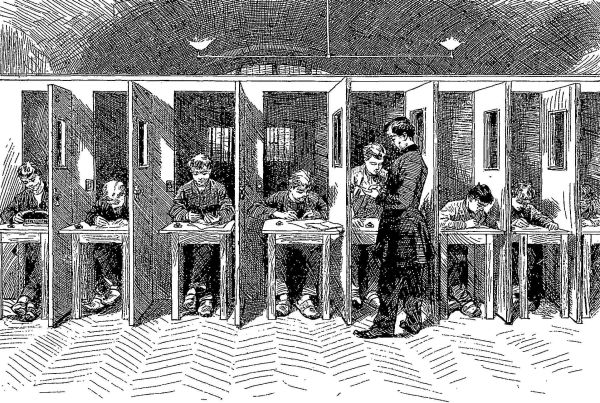
A SCHOOL FOR YOUTHFUL PRISONERS IN MAZAS, PARIS.