ANDREW JACKSON WASHINGTON JONES.
Reading edition
AS BLACK AS BLACK COULD BE.
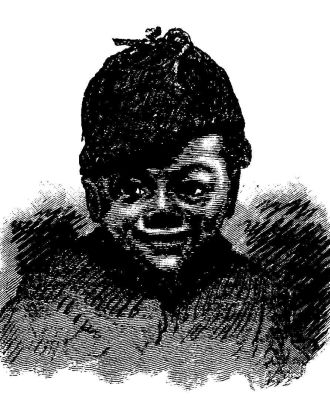
Andrew was quite as black a little colored boy as if he had been well painted, and his mammy was in the habit of telling him that he was as lazy as he was black, a fact which Andrew Jackson never took the trouble to deny.
He had not a very clear idea of the proper definition of the word lazy; but even though he never made any attempt to correct the error into which his mother had fallen, he believed he could point out at least a dozen boys who were really indolent, while he was only what might be called tired.
He looked upon such work as carrying wood and water as something especially adapted to cultivate the muscles of older people, but decidedly injurious to boys of his age. Therefore whenever he saw anything at home which indicated the possibility of his being set at work, he always had immediate and urgent business which called him as far away as he felt able to walk, and he could go a long distance, however warm the day, when he believed he was fleeing from labor.
But one day Andrew Jackson Washington Jones's father came home with a very long and stout willow switch in his hand, and told the ever-tired little darky that it was his intention to "use it upon his back, shuah," if a certain pile of wood was not split and into the shed by sunset.
Andrew would have turned pale if his skin had not been quite so dark, for from the way his father spoke, he was quite certain he would be just cruel enough to carry his threat into execution; and he went out by the wood-pile wondering which would be the hardest—to do the work or receive the promised whipping.
He had just made up his mind that he would rather have the willow cut up by his back than to cut that pile of wood with the dull axe, while all the other boys were out cat-fishing; and he was already smarting from anticipation when another and more horrible thought came to him. He would probably not only be obliged to feel the willow, but to do the work also, and he was discouraged.
"Daddy'll lick me fo' a fac', an' mammy will tear round drefful till it's done," he said, musingly, and he shivered at the thought. "Dar's gwine to be no rest fo' dis chile till dat yere wood am cut."
If Andrew had only ceased discussing matters with himself then, and set to work in earnest on that unlucky wood-pile, all would have been well, and one little colored boy would not have been missing from home that night. But he continued the discussion until he had decided to do the task, and afterward concluded that he could, by trying remarkably hard, catch just one cat-fish, and yet have the wood in the shed before the sun got through work and went to bed.
"Keep remembrancin' dis yere switch," cried his mother, when she saw him feel of the axe, then put his best bone clappers in his pocket, and start in the direction of the wharves.
Andrew nodded his head and shrugged his shoulders as if he had it ever before his eyes, but hurried on.
If he had attacked the wood-pile with half the energy that he started for the cat-fish, all would have been well with both him and the wood, for he walked along at a really rapid rate, considering how tired he always was.
At the wharves he saw none of his friends, but a steamer was there taking on freight, and to Andrew's mind it would be quite as interesting to examine her as to catch three or even four cat-fish.
His wanderings on board, unchecked by any of the officers because there was a possibility he might be a passenger, led him to the furnace-room, which was entirely deserted. A cozy seat made of rough boards was just beside the open door of the furnace, from which the heat was escaping in very welcome quantities, and Andrew popped into it, smiling as he thought of the difference between cutting the wood and sitting there where he was so thoroughly comfortable.
"Talk 'bout dat yere wood-pile," he muttered, and then he was sound asleep, while the light of the glowing coals played about his face, causing it to assume all shades from a light bronze to an intense black.
ASLEEP IN THE FURNACE-ROOM.
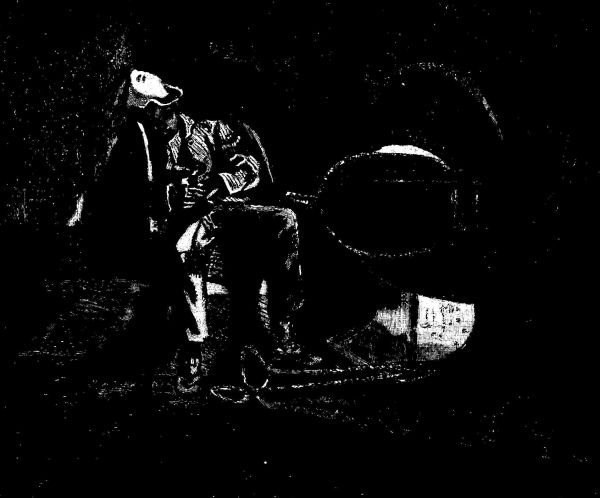
No boy ever slept more soundly than did Andrew Jackson Washington Jones then, and none ever awoke more quickly than he when a heavy hand was laid upon his shoulder, and he was pushed on to the iron floor in anything rather than a gentle manner.
"G-'way from me, g'way—" and then he stopped speaking that he might open his mouth wide with astonishment as he saw a man, a very big, stout man, looking at him angrily.
"What are you doing here?" asked the big party, whom Andrew would have known to be the fireman, if he had been better acquainted with steamboat life.
"I's gwine cat-fishin' fur a spell," said the boy, his eyes opening wide as he closed his mouth to speak.
"Cat-fishin'! Perhaps you're runnin' this craft, and are goin' to take her out on a fishin' cruise?"
The sneer which accompanied the words was lost on the boy, as, suddenly thinking of the neglected work, he replied, in a dazed sort of way:
"Daddy's gwine to lick me now fo' a fac'."
"He won't do it half as quick as I will," roared the fireman, evidently enraged by the astonished way in which the boy stared at him, his eyes seeming to increase in size each moment.
Before Andrew Jackson Washington Jones had any idea as to what was about to be done, the man had seized him by the collar of his jacket, and he felt blows compared with which those from the willow switch would have been pleasure.
"Now shovel over that coal," shouted the man, as he released his hold of Andrew Jackson's collar so suddenly that the boy spun around against the iron-clad sides of the room like a top in a box.
"Mammy says I's to come right back," blubbered Andrew, as he rubbed coal dust over his face in his efforts to wipe his eyes.
"It'll be quite a spell before you do get back, for the steamer left the dock ten minutes ago."
"Den I mus' shinny along, fur I carn't stay here," said Andrew, hurriedly, as he started toward the door.
"Come back here," and the man made sure he would obey by catching him by the jacket, and pulling him toward him. "Didn't you hear me say that the boat had left the dock? We're two miles away by this time."
"Wha—wha—wha'll I do?" and Andrew Jackson burst into a fresh flood of tears, as the most lonely feeling he ever had in his life came over him.
"You'll take hold of that shovel and exercise it as lively as you know how," replied the man, and from the way in which he spoke Andrew did not think it prudent to make any objections.
Shovelling coal in the hot furnace-room of a steamer is work by the side of which almost any other seems like mere play, and if Andrew Jackson Washington Jones could suddenly have been carried back to that wood-pile he would have attacked it with an energy that would have astonished his mother.
But he was not there, which was his own fault, and he was obliged to shovel coal, which was the fault of the ill-natured fireman, both of which facts made of Andrew Jackson as miserable a little colored boy as ever strayed into mischief for the sake of a few cat-fish.
For nearly two hours—and he would not have been surprised had he been told two days had passed—he shovelled coal, while the perspiration rolled down in streams from his face, and to add to his misery he lost his valued clappers through the grating. Then the fireman said:
"Now, then, boy, we're going to stop pretty soon, and you'd better get on deck if you want to go ashore; for you're only about twenty miles from home now, and at the next stopping-place you'll be fifty miles away."
Andrew dropped that shovel as if it had suddenly become hot, and when the steamer stopped he was the first person who landed, having carelessly stepped on the mate's foot, and been thrown ashore by him before the gang plank was out.
The moment he was fairly on his feet he started up the pier toward the town at a speed that would have persuaded his mother he had a fit, could she have seen him, and it was not until he got into the very centre of the village that he attempted to form any plan as to the future.
There he was, twenty miles from home, without any money, and his clappers lost. His hands were blistered, his clothes covered with cinders and coal dust, and he was more thoroughly hungry and tired than he ever remembered being before.
He looked down the road which a gentleman told him led to his home, and as he thought of that wood-pile twenty miles away, it seemed as if it would have been happiness indeed if he could only be there cutting it up and carrying it into the shed. He was hungry too, wonderfully hungry, but fortunately an old lady gave him two doughnuts and three crackers after she heard his story, and then she told him he was a cruel, wicked boy for not having done as his father had commanded him.
He knew it was necessary for him to trudge along if he ever wanted to get home, and every lazy bone in his body rebelled against the exercise.
He walked and walked until he thought he must have gone fully a hundred and seventeen miles, and yet there was no sign of a town, while it had grown as dark as it well could be on a moonlight night.
He sat down by the side of the road to rest, but he heard so many strange noises, and fancied he saw so many horrible things, that he was forced to go on again, although his legs were so tired it seemed as if they would drop from his body, and his feet were very sore.
There was one thing he could do, which was to cry, and he set about that work with more real energy than he had ever set about anything before.
He roared so that the woods fairly rang with the echoes, and the night birds peered out very carefully to see what the matter was. But all his crying did not take him one inch nearer home, and the sound of his own voice actually frightened him.
After he had walked what ought to have been another hundred miles, and thought he should surely die from fatigue, he heard sounds in the rear which caused his heart to stand almost still, while he expected every moment to be killed and scalped.
No such fearful fate awaited him, however, for the horrible noise he heard was simply the driver of an ox-team singing to cheer himself on his journey.
It was singular how sweet that music sounded after Andrew knew what it was, and he ran back to meet the team rather than wait for it to come to him.
The oxen and the man were going directly past his home, though it would, of course, be some time before they reached there, and the boy who went for cat-fish rather than chop wood was to be allowed to ride over all level places in the road, and down hill. Up hill he must walk, for the load was heavy, and the patient oxen had about all they could draw without him.
If the driver of that team was to be believed, Andrew Jackson had walked about four miles; but the boy felt certain that either the man was mistaken or was wickedly concealing the truth.
The journey was not ended until noon of the next day, and it surely seemed as if it had been all up hill, so often was Andrew called upon to get down and walk.
His father and mother were both out hunting for him when he arrived home, and the way he made that wood fly, tired and hungry though he was, should have been a caution to any lazy boy. It was all cut and in the shed when his parents got home, but nevertheless the willow switch was well worn, and from that day forth Andrew Jackson Washington Jones was nearly, if not quite, cured of being lazy.