"TO COVENTRY."
Reading edition
BY ADA CARLETON STODDARD.
It was down at the old Towle dam that the trouble began, on a still Saturday when the clouds hung close and soft and gray, threatening rain. It was just the right kind of an afternoon for fishing, so the four lively boys who went climbing about over rocks and decaying timbers to drop a line every now and then in some dark, inviting nook, agreed without a shadow of doubt.
"There ain't a place on the Duxnekeag stream where the trout like to stay so well," remarked Wat Emerson, in a satisfied under-tone.
Mel Berry glanced fondly toward the edge of the stream where a dozen nice trout strung on an alder twig were anchored in a shallow pool.
"We never come here that we don't get a good mess," said he. "See, Wat, I'm going to try 'em down there."
"I was just going there myself," said Clint Parsons, who had been quietly winding up his line.
"You didn't say so."
"But I meant to all the same."
"Well, it's my chance, of course, now," said Mel, with quite a little air of victory; "I said so first."
So he did; and so, without another word, he baited his hook daintily and went forward. There was an aperture in the earth-work of the dam, over which a timber had fallen, and this upon another, leaving a space scarcely wide enough to admit the head and shoulders of a good-sized boy; but Mel stretched himself flat and wormed himself partially under the timber, and dropped his hook down into the still, shadowy water below. It was seized on the instant. Mel, startled and joyful, caught a glimpse of what seemed to him the largest fish he had ever seen. He pulled on his line, gently at first, and then with all the strength he could muster. The water was splashed into foam.
"Grab hold of my feet, boys!" yelled Mel in great agitation. "He'll have me in head first. He's a whale—a reg'lar whale; but I'll get him if the hook holds on, and it ought to—it's my biggest one."
The hook held; the boys, who were watching, almost wild with excitement, seized Mel's feet; there was a short, sharp struggle between fish and boy, and then a shout as Mel, red-faced and triumphant, emerged from his voluntary imprisonment.
"Hooray! I've got him! Look, boys! I'll bet a six-pence he'll weigh over three pounds. He pulled like a savage."
"Wouldn't wonder," said Clint, as they all gathered around to take a good look at the fish, which was truly an unusually large one. "I'm glad you've got him, Mel, but I wish 'twas me, because I've promised Judge Holden's wife a mess, and I've only got seven. She said she'd give me a dollar for a good big string."
"Well, I wouldn't sell this catch for a good deal more'n one dollar," returned Mel, and he held up for an admiring view the fish with its shining speckled sides. "He's quiet enough," said he, "since I rapped him with my jackknife handle."
"Isn't he a beauty?"
Yes, he was a beauty, but the boys didn't care to say so more than once or twice, and presently Mel carried his prize off to where his string of trout was floating, and placed it with the rest. But the afternoon's luck seemed to have turned with the taking of the large fish, for during the next hour scarcely a nibble rewarded the patience of the anglers.
"This never'll do," said Clint Parsons at last. "I'm going up the stream a little ways. Don't any of you fellows come."
He set off over the stones on his bare brown feet, with his fishing-rod across his shoulder, turning as he went a merry brown face back toward the group on the old dam.
"I wouldn't sell my fish," said Mel, shaking his line gently, "but Clint is always thinking of money."
"He has to," returned Eb; "his folks are awful poor since his father died, you know. But I like him, though, first-rate."
"So do I. He's smart as chain-lightning, too, and he's always ready to help a fellow when he gets stuck on one of those doubled-up, mixed-up, complex, compounded, connected-by-the-word-'of' fractions."
"And you're the fellow that's always getting stuck," laughed Eb.
Only Mel said nothing, though he frowned slightly as he went on drawing his hook carefully back and forth through the water. In truth, he and the boy who had just disappeared behind a clump of alder were not always on the best of terms. At this moment there were some very bitter thoughts afloat in Mel's mind. It seemed to him that Clint, who had lived in Barham but little more than a year, was surely usurping his own place in the hearts of his boy friends, as he had already done in his classes at school.
Mel spoke at last, beginning to wind up his line. "The fish won't bite here now," said he. "We might as well go down the stream, since Clint has forbid us going up."
"He was only in fun," said Eb; but all the same, having first assured themselves that their trout were safe, and likely to remain so, they strolled off down the stream, fishing as they went.
No doubt the fish had become wary, for our three friends met with little success. Clint was waiting for them when they returned, standing on the highest point of the old dam, and he swung his straw hat vigorously as soon as he discovered them.
"I've got one to match yours," cried he to Mel, displaying, as he spoke, his string of trout, to which he had added four or five, one of them an uncommonly fine one. "Isn't he a beauty, now?"
"Larger than Mel's, I think," said Eb, examining the fish critically. "That string ought to fetch more than a dollar, Clint."
Mel came up at this moment with a very black face. "I think this joke's been carried far enough," said he. "I came pretty near losing all the rest of my fish by means of it. You left the stringer loose."
"THE THREE WALKED AWAY UP THE PATH."
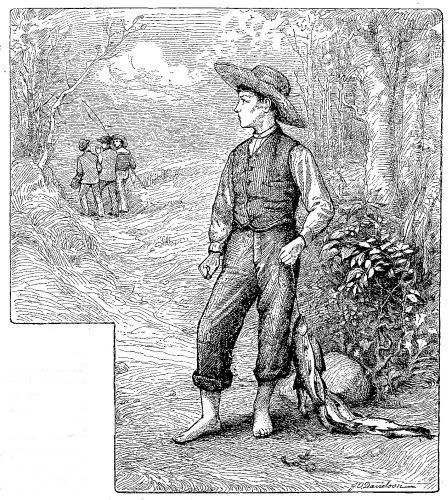
Clint turned upon him like a flash. "What do you mean?" he asked.
"You know well enough what I mean," cried Mel. "My fish is gone, and of course I know this is the one. Eb and Wat'll say so too, won't you, boys?"
"I thought it looked larger than yours," said Eb, his eyes growing big with amazement, "but I don't know."
"Well, I know," said Clint, slowly, "that I caught this fish in the deep hole under the big willow, and I thought then 'twas a mate for Mel's."
"Pretty close mate," said Mel, with a little sneer.
"It's well played, Clint," laughed Wat, "but you see you can't fool me. You'd better own up, now, like a good boy."
Clint's face glowed with sudden fire. "I've told you the truth, whether you believe it or not," said he. "But Mel can have my fish if he wants it."
"No," said Mel, briefly; "if it's worth taking, it's worth keeping. Come, boys, let's go." And then the three walked away up the path which led through the woods to the highway, leaving Clint standing alone there with clinched hands and a swelling heart, and tears of angry mortification burning in his eyes.
And that was how the boys of Barham came to send Clint Parsons to Coventry.
"When he's a-mind to own up, and say he's sorry and won't do such a thing again," said they, "we'll take him back."
But there wasn't the least danger of Clint's confessing, if indeed he had anything to confess. He went about his daily duties as usual, and if his merry whistle was a whit less merry because of the changed atmosphere, made manifest by averted eyes and cold side-glances and covert allusions to "that scaley trick," not one of the forty boys in Barham knew it.
It was the next Saturday, just a week after the loss of the big trout, when old Davy Parmalee came to saw wood for Mr. Berry; and Mel, for want of anything more important to occupy his attention, went out to watch him work and talk with him a little. And Davy was quite ready to rest his saw in the log and himself on it.
"Now did any o' ye boys be down to the old dam a-fishing last Saturday a week?" he asked. "Did any o' ye hook a big trout and drop him again?"
"No-o," said Mel, catching his breath. "I don't think any of us did."
"Well, I found sech a one floatin' front o' my camp in an eddy, a Sunday mornin'," said Davy, "an' I guessed likely 'nough one o' ye boys lost him. He was a whopper, I tell ye, and hooked through the jaw. Must 'a ben somebody lost him. Anyhow, he made me a good solid breakfast."
"I wouldn't wonder," said Mel; and then he stood studying the earth at his feet for a long, long time.
"Davy," said he at length—"Davy, if you won't tell anybody else what you've just told me, I'll give you a pound of the best tobacco we've got in the store."
And the old man answered, briskly puffing away at his black clay pipe, "I ain't no call to tell it nowhere's I knows on; an' I won't ef ye say so. I'll be gretly obliged to ye for the 'backer, too."
"For it might have been somebody else that lost the fish," Mel reasoned with his conscience. "Anyhow, I can't own up 'twas mine—the boys would all be down on me so, and puff Clint Parson's up to the sky. I—can't—do—it. I don't believe 'twas mine anyway—I don't!"
So he passed it by and kept the secret; and so time went on, bringing the long summer vacation to a close.
"We ought to do something out of common to-morrow to end up with," said Mel, who, with a baker's dozen of his chums, was eating early apples on the shady side of Mr. Gerry's orchard wall. "What shall it be?"
"We might go fishing," said somebody.
"Mel won't; he's afraid of losing his biggest trout."
"No, I'm not," said Mel, quite soberly. "I say, fellows, what if Clint Parsons didn't take that fish after all?"
"Then I'd say we'd used him awfully mean," declared Wat Emerson, tossing a sops-o'-wine core over the wall. "And we'd be a set of scoundrels, and you'd be the biggest one amongst us, Mel."
"But he did, didn't he?"
"Looks about like it," answered Mel. "Say we go up on Tank's Island and cook our own dinners. Uncle Ben Sperry's bateau'll hold us all, and there's a sandy bottom at the head of the island—just the place for a swim."
"But it isn't half a mile from the Falls."
"Well, there isn't any danger; let's go."
"Don't tell any of the other fellows," said Mel; "the bateau won't hold any more."
But next morning they found the party was to be increased by two, because Mel could not withstand the pleadings of his small twin brothers.
"Both of 'em won't take up much room," said Mel; "and mother's put in some extra food for them."
The day was fair as a late summer day could be; and the boys made the island without a bit of difficulty. It was much less than half a mile to where the Meduxnekeag tumbled over a high rocky ledge, and the current set strongly in that direction; but there were six pairs of stout arms working at the oars and paddles, and the bateau went straight from the mainland to the island. When it was reached and the boat made fast, the boys immediately set about kindling a fire; and then they scattered around to wait while Eb prepared dinner, which he did with scarcely a mishap.
Eb had just announced that everything was ready, when they all heard a loud ringing call:
"Help! Help, here! Help!"
"It sounds—like Clint Parsons!" cried Wat; and just at that moment it seemed to Mel Berry that his heart stopped beating.
"Oh, boys!" he screamed, "where are the twins! I haven't thought— Oh, Eb!"
But Eb was already running with all possible speed down the island to the spot where the boat had been left; and after him presently raced a crowd of wild-eyed boys, each of whom felt instinctively that the boat was gone, the Berry twins were gone, and that the boat and the Berry twins had gone together.
It was just as they expected. As they reached the shore they saw the boat swinging with the current far down the stream, and only a short distance above the Falls. It was making no progress, however, and the boy whose cry for help they had heard was standing erect in the bow; and very soon the boys on the island saw that a line was attached to the boat and made fast to a large old elm-tree on the river-bank.
At that moment a cheery voice came over the water:
"All—right! Haul—us—ashore!"
"It is Clint," cried Eb, throwing off his vest in a hurry. "Boys, I'm going to take my swim now."
He plunged into the stream, followed by one boy and another until there was a line of bobbing heads between the island and the shore. As soon as they reached the mainland they went plunging along the bank until they came to the elm-tree, and there they seized the tow-line and began pulling in the bateau hand over hand, aided now by a pair of oars at the other end of the line.
How they worked!—worked with set teeth, and scarlet, sweaty faces, because the heavy boat pulled so hard against the stream. But they gained slowly; the line slackened, and coil after coil was twisted about the elm-tree; it was at any rate only a question of time. So the moment came when Clint Parsons, brown-faced and bare-footed, as on that memorable Saturday afternoon, handed the Berry twins out of the bateau, and stepped out after them, and every boy on the bank there stood breathless, and wondered in his heart what Mel would do and say.
They had not long to wait. Mel's face flamed, and he hesitated, but only for an instant, before he caught Clint's hand.
"Oh, Clint," he cried, chokingly, "how can I ever thank you! To think of it all, and now you've risked—Oh, Clint, you've risked your life—" and then he broke down, and began to cry, because he could not help it.
"No," said Clint, as the other boys gathered around with eager questions, "I didn't risk my life. I wasn't really in any danger. I saw the boys just about as soon as they got the boat adrift—you see, I was picking rocks in Mr. Barrow's pasture there—and I didn't know what to do until I remembered seeing this tow-line hanging up in the granary. So I got it as quick's I could, and swam out, and headed the boat off. I nearly missed it, and I'm as glad as any of you that I didn't. But I'd have been safe enough anyway. It wasn't any risk. The twins were having a nice time," Clint laughed, looking down at the brace of black-eyed six-year-olds. "They didn't think much about the Falls."
"But without you they would have gone over," and Mel shuddered at the horrible thought.
"Never mind; they're all right now, and don't say anything more about it."
"I've got more'n that to say," said Mel, suddenly and steadily. "I suppose you'll all hate me, but I can't help it; I've tried to tell you time and again, but I couldn't, I was such a coward. Boys, Clint didn't take my fish, and I've known he didn't ever since the week after I lost it. Old Davy Parmalee found it floating in the stream, and I hired him not to say anything about it. And—and I hope you'll forgive me, Clint, and all of you."
Clint's sun-browned face was all aglow. "I'm glad you've told," said he. "I knew you would some time. But I never would myself, though I knew, because I was going across lots by your father's back yard the day you and old Davy were talking about the fish."
"Oh, Clint!"
"Why didn't you tell?"
"You wouldn't have believed, me if I had," said Clint, with a sunny smile. "So I waited for Mel to get ready to tell. I knew he would some time."
"I feel like a dreadful wretch," said Mel, trying to laugh, but making a miserable failure of it, "and I'm—"
"I'll tell you what," put in Eb Gerry, "let's shake hands all around and call it square, and never say another word about it."
"Agreed."
So that was the way it ended. The boys shook hands until their arms were lame, and laughed and cheered uproariously; and Clint got leave of absence for the rest of the day, and they all went back to the island again—all but Mel, who had, he said, to go home with the twins.
But the boys thought there was something more in the wind, and they were sure of it when Mel met them as they were going home with a score of boys harnessed into his father's carriage, which was fairly covered with green waving boughs. And into the carriage, in spite of all his remonstrance, the merry crowd lifted Clint Parsons. And they trotted away with him in triumph to the village, where everybody laughed and cheered them, though a good many people didn't quite know what it was all about.
So they brought Clint back from Coventry with a coach and a good many more than four; and I do not know that there are two better friends in Barham this minute than Clint Parsons and Mel Berry.