OUR POST-OFFICE BOX.
Reading edition
With this number Volume III. of Harper's Young People reaches its conclusion. Next week we shall begin Volume IV.
It has given us very great pleasure to learn from the little people who have written to the Post-office Box how delighted they have been with the beautiful pictures, fascinating serials, droll sketches, and amusing short stories which Harper's Young People has brought them so regularly.
We have tried to forget nobody. The big brothers have found tales of adventure and experiments in science for their special entertainment. The young ladies have been provided with useful hints for the work-table, and suggestions for novel and pretty things in home decoration. The wee tots have had silvery jingles and funny rhymes. The keen-witted little fellows and the clever girls who like to crack such nuts have had plenty to do in making or solving the puzzles which have been given in every number. Occasional pieces of music have tempted the little pianists and vocalists of the future. The Wiggles continue to stimulate the skill of little artists.
Nothing has gratified the publishers more than their success in satisfying careful parents and teachers who desire to furnish their young folks with wholesome, sprightly, and interesting reading. The private letters which they have received from many sources, as well as the unanimous verdict of the press, encourage them to persevere in making Young People better and better, so that the future may be as brilliant as the past has been promising.
The Post-office Box is a very popular department with all our readers. Its columns are open to all, and are lovingly and carefully edited from week to week. It affords the children an opportunity to see and hear how life is conducted in different places. To older eyes it presents captivating pictures of child life, and of the delights of children everywhere—in the city, on the farm, abroad, in school, on the lonely outpost in the far West, and around the mother's knee in the happy home.
The Exchange Department is educational, and while it assists our young readers in adding to their collections, it enables them to learn something practically of geography and history, and puts at their disposal one more resource against idleness and the mischief it bring in its train.
Our next volume will be brighter and more attractive than any which has preceded it. We have many good things in store, and we shall spare neither pains nor expense to make Harper's Young People the leading weekly periodical in the world for English-speaking children.
The price—$1.50 per year—places it within the means of all. We hope our present subscribers will try to obtain new ones. Boys and girls can do this by simply showing the paper to their friends. Our list is a very long one now, but we wish to make it longer, for the larger the number of subscribers, the fuller of entertainment and instruction, of beauty and fun, can we afford to make Young People.
Let everybody, therefore, join hands with us, and help along. The beginning of a new volume is a good time to subscribe.
Scenery Hill, Pennsylvania.
I am a little boy nine years old. I have three little sisters; their names are Margie, Jessie, and Nellie. Margie is six years old, Jessie is five, and Nellie is three. I live at West Alexandria, Penn. My papa is a school-teacher, and I go to school. Now I am on a visit at my auntie's, and have been for the last three months. They have no little boy here, so I have plenty to do and a little time to play. I have made a Noah's Ark out of stiff paper. My auntie is helping me make the animals. We take the paper double, gum the pattern on, leaving the head or back joined, and when done they will stand upright. I have been taking Young People two years, and like it very much. Auntie gave it to me for a present. I did not like the way "Mr. Stubbs's Brother" ended.
W. S. H.
The kind lady who sends us this story of her pet squirrel will always find a corner ready for her in the Post-office Box. We have not forgotten about the motherly hen of which she wrote us once before—the hen who spread her warm wings over a brood of kittens. The Postmistress thinks she never heard of anything prettier than the incident in this letter about the squirrel who tucked her naughty baby in under the maple leaves:
OUR PET SQUIRREL.
One summer morning, several years ago, we found a gray squirrel sitting on the arbor by the door, and though a stranger to our house, she was not at all disturbed by our presence, but seemed quite at home. All day she played on the trees and fences, coming nearer and nearer, as if to show us that she was not at all afraid, but quite used to society. In a few days my little boy and she had become good friends. She would sit on his knee and eat nuts and biscuit, but all the while watching him with her bright eyes ready to spring away, for notwithstanding her pretty gentle ways she never permitted any one to touch her. She certainly feared being captured; and I have no doubt she had been a pet, and kept in a cage, and had run away to taste the sweets of liberty. So we never interfered with her, and after a while she went to housekeeping in a cozy corner under the roof of the lodge, and one happy day out she came with three little squirrels. Oh, what frolics that mother and her children had! Such racing and chasing across the lawn, and over the fences, and up in the trees, springing from branch to branch, and sitting up so cunningly, to eat their treasures of nuts and seeds! They, were very naughty too, and would peep into the nests of the robins, and the old birds would chase them, and whip them with their wings.
The young squirrels never became tame, but the mother grew more and more familiar, and very saucy she was too. When the servants came down in the morning, she was always waiting for them by the kitchen door, impatient for her breakfast; and she would run back and forth, jump on the table, and tease the cook until she gave her something to eat. She was very fond of sweet-potatoes, and would help herself liberally, and would carry off the end of a loaf of bread half as large as herself.
As the young ones grew up they made nests for themselves, but they were never half as wise as their mother, and gave us lots of trouble—filling up a pipe-hole with sticks and straws, gnawing their way into the loft, and tearing into shreds everything their pretty hands could hold or their sharp teeth destroy, and racing over the roof at "peep of day" like a troop of tiny cavalry.
One pair made a home in the crotch of an old apple-tree, and raised a little family. One afternoon we found that a little one had strayed into a tree close by the window; it was after sunset, and bedtime for squirrels, but the little thing had nestled down between two of the branches, and would not move. The young mother was greatly distressed; she pushed and pulled, but no, the little one would not stir. After a while she ran away, and returned with a bunch of maple leaves in her mouth, which she spread over the baby, patting them down with her hands; this she did many times until the little truant was closely covered, and then ran off to where her good children were safely curled down for the night. When we came down in the morning the leafy coverlid was off, and the little one gone.
But no matter how cunning were the young squirrels, the dear old mother was always our favorite. Many little families she raised in the corner under the roof; but after three years of her happy life a swelling came on her throat, and she could not eat. She must have suffered very much; and she would come to us many times a day as if for relief, but all we could do was to talk to her, and call her pet names.
One day she came into the hall and jumped on my little boy's knee: for the first time she allowed him to stroke and caress her. She was very gentle, and did everything but talk; and it seemed as if we ought to have understood that it was her farewell. We offered her food, but she was very weak, and at length went away, and we never saw her again. No doubt she left us to die. Dear little Bunnie! I wonder if you knew how much we loved you!
F. T. C.
Stockport, New York.
I saw the comet, for the first time, about two weeks ago. I think that there is something very funny about them—the way that they rise and set, just like suns with a tail. My father says he thought when he was a boy that they were angels flying with all their glory spread out behind them, and again that they were a world on its way to destruction. There is a parish school here. I go to it. I study arithmetic, geography, spelling, reading, writing, and then there is a catechism class which I belong to. There is the Agassiz Association, which I belong to also. The teacher, Mr. H., is president of this. But I must stop now. So good-by.
Robbie V. R. R.
If you were not a nineteenth-century boy, Robbie, but instead had lived three or four hundred years ago, you would have been terribly afraid of so splendid a comet as the one which we have all been gazing at lately with so much wonder and delight. In the Middle Ages the appearance of a comet was thought to be a sign of some dreadful evil which would shortly come to pass, and old and young were thankful when the mysterious orb was no longer to be seen in the sky.
Brandy Station, Virginia.
I have a little sister named Emily, and one day she was very thirsty, and she put her hands around the pitcher and said, "You sweet water!" We have three little cousins visiting us now; we have a very nice time playing together. My brother Frankie was very proud of his letter. We are going to commence school very soon now. We have had a good many peaches this year, not in our orchard, but out on the farm. Good-by, for dinner is ready.
Rena L. S.
Farley, Virginia.
I see all the little boys and girls are writing about their pets. I have a pet dog; he is an immense dog. His color is chestnut brown. I am trying to tie him, but his neck is so big that every time I tie him he slips the collar off. I tied it so tightly that it choked him, but he slipped it. I wish somebody would tell me how to tie him. The pet duck I told you of before takes care of a pet chicken that belongs to my sister Rena.
Frank S., Jun.
I could never have the heart to tie so splendid a dog. I would allow him his liberty if I were you, Frank. But if any of the boys can think of a way to help you, they may write to the Post-office Box and give their method. Only never tie any poor animal so tightly that you choke him. We would not like such treatment ourselves.
Walton, New York.
Dear Postmistress,—I thought I would write to you, and tell you about a nice visit we had from friends. Cousin Temple and I played cars with my blocks, and when we got tired of playing cars we played circus with a tin cow and a horse on springs, and then we picked up leaves, and Temple got a whole bagful of them to carry to Michigan with him. I send a Wiggle to you. Good-by.
Helen R. S.
You must have had grand times, dear, especially playing circus. I hope nothing was broken. Your Wiggle came safely.
Lambertville, New Jersey.
I thought I would tell you about my pet, but he is dead now. He was a cat, and the nicest cat I ever had. He played hide-and-seek with me, and tag, and a good many other things. We think he was poisoned. I have a brother who takes your paper, and I take it to school, and the teacher reads the stories to the boys and girls. I like Jimmy Brown's stories ever so much. I would like him to come and see me.
Mary R.
Philadelphia, Pennsylvania.
I am a little girl. I live out in the country during the summer; papa has a lovely summer home there. We have lovely flowers all around our house. I have a pet cat; if I sit down to my lunch, she will come and sit beside me, and will cry until I give her her lunch, and then she will come up and rub against my skirts, as much as to say, "Thanks." I have also a dog. We have hot-houses with lovely rare plants in them.
Julia L.
Clifton, Staten Island.
We have written to Young People once before, and our letter was not printed. We have ten dolls and four cats, which latter mamma thinks are entirely too many. They are quite a happy family—grandmother, mother, and two kittens—one of which we found in the garden, and it makes quite a nice playmate for the other. We send you two Wiggle pictures; they are the first we have tried. We like Jimmy Brown's stories very much, and wish he would write oftener.
Laura and Marion L. Q.
The Wiggles were duly given to our artist. I agree with your mamma that four cats are three too many, but I do not expect that you will think as I do.
The rhymes which follow were "made up" by a little woman of six, and I think they are very good for one so young:
IN THE BARN.
Once Nellie said to Susie: "It's no fun Playing in this very hot sun, Let's go and play with little Rover— She is nice, with her puppies all; You take your shade hat out of the clover, And I will take my parasol." Then all at once, as they said this, Came walking along their Uncle Bliss. "Why, children, where are you going this hot day?" "Oh, we are going into the barn to play." "Then, children, I must say good-day— I hope you'll have fine fun among the hay; Though I must go, I'll send down Joe, And you and she will have fun, I know. Tell Rover to take care of you, Don't let the calf eat up your shoe; Now once more I say adieu, And come each and give a kiss To your old loving Uncle Bliss." They went to the barn and opened the door. There they saw Rover curled up on the floor, She wanted them to see her puppies three, And held out her little black paw. Suddenly they heard a noise—oh, where were the boys?— In came walking the oxen and all the cows, Which frightened the children so they hid in the mows; The dog then did bark and sent them away, And the children came crawling out of the hay. Then, as the day grew dim and dark, And the little dog had ceased to bark, They said to each other good-night, And hurried to bed by candle-light, And soon were tucked all snug in bed, And on top of each pillow lay a little head. J. W. K.
And here is another verselet by a six-year-old:
Brooklyn, New York.
I have a little sister Agnes six years old, who wrote this verse about a cat we had, called Romeo, and I think it is so good that I hope you will print it with this letter in Harper's Young People.
Maud.
There dwelt once in a Brooklyn town A little cat with fur; Sometimes he would lick himself, And sometimes he would purr; His breast was as white as snow, And this cat's name was Romeo.
Our next letter is from a wide-awake little fellow who will remember when his hair is gray how he saw the President driving through Boston streets. Who knows but that O. D. may one day himself be a Governor or a President. I am very sure that a good many future statesmen are among the boy readers of Young People:
Boston, Massachusetts.
I saw the President last Wednesday when he came to Boston. He rode in a carriage drawn by four white horses. By his side sat Governor Long, and in the front of the carriage was the President's son. The escort was two companies of lancers. All the way down Dover Street the people were packed; it was nothing but cheers all the way. The President was then driven to the Common; a salute was fired as he went through the Charles Street gate. He staid on the Common for about one hour. As he came up Beacon Street there were people all along the State-house railing. I never saw so many people in my life. The Governor kept talking to the President all along Beacon Street. The President was tired, I think, of having to bow so many times, for he bowed every time the people cheered.
The procession then went down School Street into Washington Street, and into Dock Square. The best thing of all was when it stopped on Commercial Street. He called a bootblack up to his carriage, shook hands with him, asked him his name, and where he lived.
Do all boys and girls know how envelopes are made? Well, I will tell you. First 350 sheets of paper are put in a press. Then a knife in the shape of the envelope is put upon the paper; then the knife is pressed through the paper, and when they are taken out of the press they are in the shape of an envelope. Next they have to be gummed, then folded, and then they are ready for use.
O. D.
Zelienople, Pennsylvania.
I never have seen a letter in Young People from this place, so I thought I would write one. I was eleven years old the 20th of August; it was on Sunday, and I was born on Sunday. I have two sisters and one brother. His name is Willie, and for a long time he called himself Wibbo Pitto. He is four years old. He often says he wishes it was the day for Harper's "Lung" People to come. I have a dear little sister almost two years old; her name is Mary. She puts an o to nearly everything. Our horse's name is Billy, and she calls him Billo. My other sister's name is Lizzie, and she is nine years old. I was at the Centennial at Hannastown, Westmoreland County, in this State, on July 13. One hundred years ago it was burned by the Indians. I have an uncle living there now. I am taking music lessons now, and my teacher says I play very well. Papa gave me Harper's Young People for a New-year's present, and I like it very much. I like to read the Post-office Box.
Blanche C.
Green Bay, Wisconsin.
Will you please tell me if I can get the back numbers of "Mr. Stubbs's Brother," and how much they will cost, from No. 127 to 133, both inclusive, and from 136 to 140, both inclusive? And please tell me what a girl who is fourteen years old, and goes to school five days in the week, can do to earn money. Please answer through your paper, and oblige
Mary E. B.
You may procure the numbers you mention by writing to Messrs. Harper & Brothers. They will cost 48 cents.
I would advise a girl of your age to study hard, and prepare herself to earn money in future, rather than to try to earn it while going to school. You might earn some, however, as a young friend of mine did, by crocheting little sacques and socks for a store. She did this in leisure moments, and was very well paid. If you know how to darn and patch very neatly, you might do that on Saturday afternoons for some busy housekeeper, who would pay you for your work. If I knew more about what you have learned to do, I could give you better advice.
Tell you what to make for Christmas, Daisy, Belle, and Theo? I am glad, dear little girls, that you are beginning thus early to think what pretty and useful gifts you may contrive.
One needs a great deal of time to make presents, which must, of course, be secrets from those they are intended for until the happy day arrives. Half the pleasure of Christmas consists in its beautiful surprises.
No gifts are more highly prized than those young people make with their own hands. It is so delightful, as one looks at a pretty or a useful thing, to see and feel that weeks and weeks ago a dear and loving child put her own occupations aside that she might give a token of affection to a darling mother or a sweet elder sister.
It is always a good plan to find out what people would like or are in need of. If you listen, you may some morning hear mamma say, "How I wish I had a pretty breakfast cap or a little shawl to throw over my shoulders." Perhaps papa will wish, as he is cutting the leaves of his magazine with his pen-knife, that he had a proper paper-knife. Grandma may be in want of a work-basket to hold her knitting. Alice may greatly desire a music-roll. Brother Artie, who often takes little journeys, would find a use for a pretty contrivance which you could make of burlaps and work with worsted—a sort of dressing-case to hold combs, brushes, and razors, the whole rolling up and taking a very little space in his travelling-bag.
For little children no more useful present can be thought of than a scrap-book. I have seen some very lovely ones, in which all the pages were filled with the advertisement cards and pictures which you are so fond of collecting. I heard of a puzzle scrap-book not long ago. A young lady made it by cutting out and pasting in order the enigmas, square words, diamonds, and conundrums which she found in the papers and magazines taken at her house. This sort of scrap-book would please a bright, quick-witted boy, and by means of it a family could find a great deal of fun on a winter evening.
How could you make a paper-cutter? Very easily if you know how to paint, as many of you do. Take a smooth slender piece of white-wood, and paint on it a bunch of violets, an ivy leaf, or something else that is pretty.
It is sometimes very pleasant for the boys and girls in a family to form a little club, and adding what money they have, join together in making a nice present to papa or mamma. Remember, dears, it is not the cost of a gift that makes people value it; it is the love it shows on the part of the giver.
Next week I will tell you of two or three other pretty things.
To New Readers.—We wish to call the attention of our new readers to a little matter which, while very small indeed to each of them individually, becomes an affair of importance to the Messrs. Harper & Brothers, who receive many hundreds of letters every day. All letters should be fully prepaid at the rate of three cents per half-ounce. No letter containing writing, even if only a signature, is carried by the Post-office Department from one city or town to another for one cent, or for two cents. Three cents is necessary on the very shortest letter, and if not paid in full by the sender, the deficiency must be made up by the receiver. Please pay attention to this when writing to the publishers of your favorite Young People.
PUZZLES FROM YOUNG CONTRIBUTORS.
No. 1.
FOUR WORD SQUARES.
1.—1. A tree. 2. A period of time. 3. Low. 4. To perceive.
2.—1. A rustic. 2. A thought. 3. Not distant. 4. Gloomy.
Neptune.
3.—1. An animal. 2. Liquors. 3. To gather. 4. To look closely.
4.—1. A bird. 2. Anger. 3. A monster. 4. To lament.
Aubery.
No. 2.
THREE DIAMONDS.
1.—1. A letter. 2. A vessel. 3. An Asiatic peninsula. 4. Minstrels. 5. Wants. 6. A Latin root meaning skill. 7. A letter.
Neptune.
2.—1. A letter. 2. A small and busy insect. 3. A surgical instrument. 4. A boat. 5. A poetic friend of Mr. Pickwick. 6. Stiff. 7. An article useful in cold weather. 8. A poisonous reptile. 9. A letter.
C. F. H.
3.—1. A letter. 2. An abbreviation. 3. Savory. 4. Figurative. 5. More refined. 6. A fish found in the Severn River. 7. A letter.
Vogiene.
No. 3.
ENIGMA.
First is in learn, not in school.
Second in smart, not in fool.
Third is in fast, not in slow.
Fourth is in buzzard, not in crow.
Fifth is in crayon, not in chalk.
Sixth is in run, not in walk.
The whole is the name of a river known
To all who its course on the map have shown.
C. W. S.
ANSWERS TO PUZZLES IN No. 154.
No. 1.
LJ
TUNPAP
TENORPANED
LUNATICJANITOR
NOTEDPETIT
RIDDOT
CR
N
NIP
NEGRO
NIGGARD
PRATE
ORE
D
No. 2.
TWONEWHAT
WEDEWEAWE
ODEWENTEN
No. 3.
Saratoga.
The answer to "Who Was He, and What Did He Invent?" on page 816 of No. 155 is George Stephenson.
Correct answers to puzzles have been received from E. C. DeWitt, Charles H. Weigle, Aubery, Lulu Laidlaw, "W. H. Eat," Edward F. Stewart, Henry Berlan, Jun., A. G. C. B., Frank D. Brewster, A. Bloomingdale, Robin Dyke, Eva Richie, Lou Fairley, Ambrose Edgewood, "Junebug," Roy Dodd, Michael T., Abe Secor, Carrie F., "Rose-in-Bloom," "Lodestar," "Two Dromios."
[For Exchanges, see 2d and 3d pages of cover.]
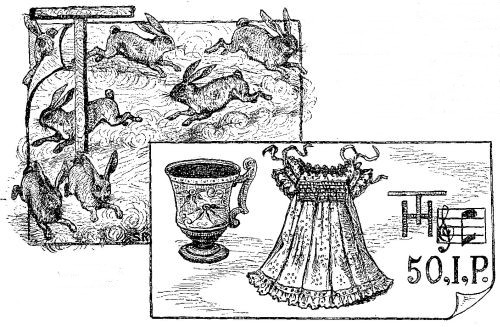
REBUS.