LANDING A RIVER-HORSE.
Reading edition
BY WILLIAM O. STODDARD.
"'What were we there for?'" said Uncle Marbury. "Why, we wanted to kill a hippopotamus."
"Was Mr. Lloyd a great hunter too?" asked Cal.
"Yes; he'd hunted all sorts of wild animals, and so had I. We could each say we'd killed lions and tigers and elephants, but we had never before gone after any hippopotami."
"Hippopotamuses? Were there any there?"
"That's where they belong. But don't say 'musses.' One is a hippopotamus. I killed five while I was there, and as soon as I had two of them, they were hippopotami."
"My!" exclaimed Robert, "I never heard that before."
Cal had his school atlas out on the table, and his finger was already pushing along up the west coast of Africa.
"There's Angola."
"Now find the river Coanza. There's any number of them, and they're all alike. Where are my spectacles?"
"I've got it," said Cal. "Was that where you found 'em?"
"They live along all those rivers. The banks are all woods and swamps and mud, and the rivers are just about fit for river-horses to wallow in."
"River-horses!" exclaimed Rob, who was staring at a cut of one in his Natural History. "He's no more like a horse than this house is."
"Well, no," said Uncle Marbury; "there isn't much horse about them, but they spend most of their time in the river, so half their name is correct. The first one I killed tipped over all our boats, so we had to swim for it."
"Did he get a bite at any of you?"
"It wasn't his fault that he didn't. We found out that fishing for river-horses was a serious piece of business."
"Fish for them? What! with a hook and line?"
KILLING A HIPPOPOTAMUS IN WESTERN AFRICA.
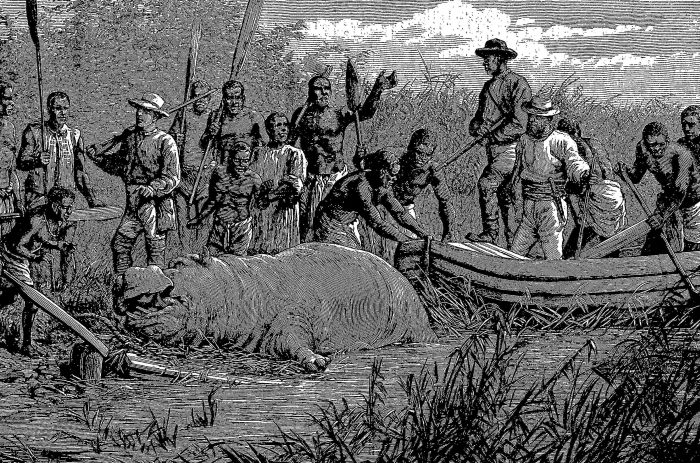
"Not exactly. It was a good deal more like fishing for whales. Mr. Lloyd and I went after them with a lot of black hunters. We took our guns, and they took their harpoons, and such a time as we had you never saw."
Cal and Rob were getting a good deal waked up on the river-horse question, and their mother dropped her book in her lap, although she had heard that story once or twice before.
"Now, boys," she said, "don't interrupt your uncle. Let him tell it all his own way."
Cal and Rob looked at each other. Cal had at least three questions in his mouth, and Bob had two, all ready to ask, but they shut their lips hard, and Rob took a tight grip of his chair, so he shouldn't let go of those questions.
Uncle Marbury leaned back in his Sleepy Hollow chair, and went right on:
"The black men go for them in boats, with harpoons that they make themselves. They take a stout pole, of a hard, heavy wood that grows there, and cut it to about ten or twelve feet long and three or four inches thick. That's the shaft of the harpoon. The head is made of a tough piece of iron, thicker than my finger, and about a foot long. It has a barbed spear-head at the end, and when those barbs get under the tough hide of a hippopotamus, all the plunging and struggling he can do won't make them pull out.
"They bore a hole in the end of the pole just big enough to take in a few inches of the iron foot of the barbed head, and it fits loosely, so it'll come out. That's just what they want it to do. I'll tell you why. Just as soon as a hippopotamus is wounded, he turns to bite at the thing that hurt him, and if his great jaws and sharp teeth shut down on a piece of wood, they'd grind it to splinters, no matter how hard and strong it might be. If it was a rope, they'd cut it right off, and the hunters would lose their harpoon and their game too. So they leave the iron head loose, to come out, and fasten it to the pole by a sort of long band that is made of ever so many tough strong cords, not very large, any one of them, and these slip around among the teeth, and if some of them do get cut off, there are always enough left to hold by.
"The other end of the pole has a long rope, like a whale line, tied to it, and that is coiled up in the boat, and they let it run out or pull it in, just as they see fit.
"We had two of those harpoons in each of our boats, and all of the black men had spears, and Lloyd and I had double-barrelled rifles, and our first river-horse was almost too much for us in spite of them all."
"Did he fight hard?"
"Calvin!" said his mother.
"I'll tell you. Lloyd and I had a good yawl boat we had brought with us, and half a dozen black men to paddle, and there were two canoes, each with three black men in it, but we didn't bring any canoes home. Mr. Lloyd and I and my black servant were the only men in those boats that had any clothes on to speak of.
"Now, you see, boys, the hippopotami are a good deal like you—they have favorite spots along the river where they go in swimming, and sometimes a good many will go in together, and have a good bath of mud and water. The black hunters find out these places, but it wouldn't do to go straight for them. You'd only scare them away if you did that.
"Mr. Lloyd and I let the black hunters do things their own way; and they had made our camp, the night before, two good miles above one of these wallowing-places. So, when we started, we let the boat and the two canoes float down with the current, just steering them a little, and you never saw so many men keep so still. It was dreadfully warm, and we'd have envied the black men if it hadn't been for the mosquitoes. They didn't seem to mind them, but we were glad enough there were some spots on us where the ugly little scamps couldn't bite to do any harm. I believe, though, that my black servant would have stripped off his clothes if he hadn't been so proud of them. Suddenly one of the black hunters in my boat put his hand on my arm, and pointed at something a little ahead of the canoe on the left.
"It was something big and black coming slowly up through the water. A little pair of ears very wide apart; then the great eyes that seemed to stick right out; then the nose—there was no use in asking whose head that was. Just enough of his body followed above the surface to give the black hunter in the prow of that canoe a fair mark for his harpoon. He was close up when he threw it; and he drove it in good and deep, now I tell you. I felt sure it would stick, but it must have astonished that river-horse. He gave a tremendous angry sort of grunt and a great jump, and the head of the harpoon came out of the socket, just as it was meant to, and off he started down stream. He pulled that canoe along fast enough, and the rest of us paddled for dear life.
"I tried hard to get a shot at him, and so did Lloyd, whenever any of him showed above water, but our bullets must have glanced from his hard wet hide, if any of them hit him, and I'm not half sure they did.
"You've no idea at what a rate he managed to travel. It was hot work to keep anywhere near him. We wanted him to go ashore or into shallow water, where we could get at him. They're a good deal more dangerous in the water than they are out of it.
"He was more scared than hurt, though, and he didn't care a copper what we wanted; but in one of his turns he gave me a chance to put a rifle-bullet into his side."
"Did it kill him?" Both boys had spoken at once.
"No, it didn't kill him, but it made him angry, and just then one of the black hunters drove a spear into him.
"Then the fight began. He was furious with pain, and didn't seem to care any more for spears and bullets after that than I did for the mosquitoes. He dived and rose, and dived and rose, and tried every way to get at us, and the black men had to ply their paddles more than their spears.
"He snorted and squealed with rage, and made the water fairly foam for a few minutes, and then he tried a piece of cunning. He swam around under water for nearly a minute, and the harpoon rope was out so loose and long that we couldn't keep very close track of him.
"Suddenly the black hunters in one of the canoes gave a frightened yell, and sprang out. I saw a great gaping pair of jaws shutting down over the side of that canoe, and they crunched it in pieces as easily as you would bite through a brittle ginger-snap. He had spoiled the canoe at one bite, and then he dashed fiercely around in all directions, looking for the men. They swam well, but he'd have caught some of them if it hadn't been that the harpoon in him belonged to the other canoe, and the crew of that were hauling on it with all their might. The upset men scrambled into my boat, and Lloyd and I got some shots at the hippopotamus that weakened him. It was well we did, for they pulled too hard on the harpoon rope, and got too near, and in a moment more they too were in the river, and their canoe was being bitten to splinters. It was hard and dangerous work to save those men, but we did it, and our yawl was terribly crowded when they were all in. It began to look like a doubtful fight, for we had lost hold of the harpoon rope; but the hippopotamus had managed to bring us all nearer the bank, where the water was not so deep, and he had no notion of running now. He stood at bay a minute or so later, half out of water, and the black hunters sprang out, and went at him with their spears like heroes. I never saw such daring fellows; but Mr. Lloyd and I were doing all we could with our rifles, and the river-horse hardly knew which way to turn. Something was hitting him from every direction. I was just beginning to wonder if he could be killed at all, when he made a sudden turn and a rush, and over went our boat, and we too were sprawling in the river. I must say I felt a little queer when I went under; but when I got my head out again, there was the hippopotamus within ten feet of me, his mouth wide open for a bite, but staggering and falling over on his side.
"He went right to the bottom, but we didn't lose him. Some of the black men righted our boat, and some dived and searched for the guns and things, and found them, and some of them worked away at the hippopotamus till they got a strong rope hitched around his lower jaw. Then we all tugged and pulled till we had him half out of water, at the shore of the river. He was an enormous fellow, and more like a big black hog than like any horse I ever saw."
"Did the natives carry him home?" asked Cal.
"Well, yes, a good part of him. But they cooked and ate him first. They built a big fire on the bank, and kept on cutting off slices and roasting and broiling till I wondered when they'd stop."