HOW TOM JONES LOST HIS PROMOTION.
Reading edition
BY MRS. FRANK McCARTHY.
Tom Jones began to wheeze and sneeze last spring, and pretty soon a cough set in that alarmed his mamma, and she was just making up her mind to send for the family physician, when Tom was seized one morning with a fit of coughing which ended in a prolonged, unmistakable whoop. No Indian on the war-path ever seemed better satisfied with a whoop than Mrs. Jones did with this one of Tom's.
"Why, Tommy's got the whooping-cough!" she exclaimed, joyfully, to her husband.
"Does a legacy usually come with it?" said Mr. Jones.
"Well, it's a comfort to know it isn't anything settling on his lungs," replied Mrs. Jones. "He's got to have whooping-cough some time, and it's a good time to have it now, when the warm weather is coming. Now we needn't wait for vacation to go to the country."
"You are in luck, Tom," said Mr. Jones. "You can take a long legal holiday, and need not play hookey any more."
"Catch me taking a holiday till the rest of the boys do, and you'll catch a weasel asleep: Joe Brown ain't going to get ahead of me," said Tom, whose father knew he never "played hookey."
"But, my son, you don't want to give away the whooping-cough? It's something nice to keep; you mustn't be too generous with it."
"There's nothing stingy about me," said Tom, who, in truth, was a whole-souled little fellow, always sharing what he had with his playmates. "If it's a good time to have it, why can't I go and give it to the whole class?"
"There's a prejudice against people being too generous," said Mr. Jones; and patting Tom's head, he went off to business.
Tom gathered up his books, but his mamma explained to him that he couldn't go to school with whooping-cough.
"How long does this thing last?" said Tom, impatiently.
"Oh, quite a while," said Mrs. Jones, cheerfully—"two or three months, perhaps."
"Two or three months," echoed Tom, with dismay. "Why, Joe Brown'll be away ahead of me by that time, and I sha'n't be promoted!"
"Well, never mind, dear," said his mamma; "it can't be helped, you know. You'll have to have it some time, and it's a good time to have it now."
Mrs. Jones began humming a tune, and went up stairs to pack her trunks, not dreaming of the tempest that raged in the bosom of her son Tom. He threw down his books, put both elbows on the table, and let his chin fall into his hands. It was all he could do to keep up with Joe Brown now. Joe was a sickly fellow, but he had great pluck and perseverance, and would do his examples with a handkerchief tied around his head—to keep it together, as he said. He lost many days by sickness, but always made it up by extra work, and the extra brains that he had stored away somewhere in that rickety noddle of his. Tom admired him and loved him. They had been neighbors, chums, and classmates as long as he could remember. Their wood sheds joined at the back of their yards, and every morning each climbed up to have a long talk with the other about the boy-business of the day. Tom admired and loved Joe, but he feared him too. Joe's delicate health and extra brains about struck a balance with Tom's rugged constitution and average intellect; but how about these extra months of whooping-cough? These would leave fearful odds on Joe's side. Tom could never catch up with him again—never! It was mean. It was hard. It was not to be borne. Why couldn't Joe get the pesky old whooping-cough too? But Tom thought of Joe's hollow cheeks and sunken eyes, and put that temptation away from him. He made up his mind he would caution Joe at once, and ran out to Bridget for a yellow rag that he had seen about the kitchen. Taking it out to the wood shed, he hoisted it upon a hastily improvised pulley.
"What's that?" said Joe, who had been waiting for Tom.
"I'm in quarantine," shouted Tom. "Don't breathe this way. You know that cough of mine? Well, it's whooping-cough!"
Joe darted back. "Gracious!" he said; "I wouldn't have it for anything. I couldn't go to school. I'd lose all chance of promotion."
"That's my case exactly," said Tom, bitterly.
"It's too bad, Tom," called Joe, keeping well out of breathing distance. "But I say, old fellow, you can study all the same, you know. You're a sturdy chap; it won't hinder you. It would knock me higher than a kite. I can't afford to lose any flesh and blood. I'm next door to a skeleton now."
Tom remembered that. He was glad then he had hoisted the quarantine flag.
Joe went on shouting: "I'll keep you posted in the lessons, Tom, so you won't fall behind. I'll stick to you like bees-wax. Eh, Tom, is that all right?"
"All right," called Tom.
The quarter bell rang. Joe and Tom parted for many a day. Tom went out to his grandfather's farm with his mother, and Joe went to school.
To an indifferent observer it would seem that there was no comparison between Tom's luck and Joe's. To have a grandfather was a good deal, in the first place; Joe hadn't any. He hadn't even a father. But to have a grandfather that owned a farm! Here was what you might call downright good fortune. Tom did enjoy it. His whooping-cough was of a light variety, and didn't disturb him much. But he was all the while thinking of the boys fighting away at those examples, and how much easier it was to puzzle them out in the class-room than out there in the haymow. There was so much to distract a fellow. If the boys at school made as much fuss over doing a sum as the hens did about laying an egg, they'd drive the teacher mad. Then the swallows went circling around the top of the barn until it made a body's head swim, and that young rascal of a colt gnawed the manger, and kicked and coaxed to go afield with Tom, and if ever there did happen to be a lull in the racket, something in that hay made a fellow so sleepy—must have been some poppies dried in that grass. And, worst of all, Joe Brown had turned traitor. He had been as good as his word at first, and had kept Tom posted right along; but for more than a month he hadn't sent him a line. It was so hard to plod along almost in the dark. His father helped him when he came out on Saturdays, and Tom didn't give up. He studied on out of spite; but it was harder work for a boy with a heart like Tom's to strive for spite than love. Tom felt that he might perhaps pass with the rest of the boys, and keep abreast with Joe Brown after all, but there wasn't much comfort in it.
His father took him back to the city the last week in June, and on the night of his arrival Tom went out to the wood shed to have it out with Joe. He made up his mind to tell him what he thought of him, and never speak to him again; but he felt very miserable over it, very miserable indeed.
Bridget was out there splitting wood, and called to Tom as he began to climb:
"You needn't rache up to see the boy beyant. He'll climb no more. He's lyin' in bed these three weeks, and they say he's wastin' away. That nasty 'hoopin'-cough wint bad wid the poor little craythur."
"Whooping-cough!" cried Tom. "Did Joe get it?"
"Av coorse he did, wid all the rest of the gossoons; but it wint wrong wid poor Joe's windpipe, bad luck to it, and ruined him intirely."
Tom ran out in the street. He felt so sorry, and so glad—so sorry Joe was sick, and so glad he was true. His heart leaped up to think he had found his friend again, and then sank because what Bridget said had given him a nameless fear. The very first boy Tom met told him the doctor said he didn't think Joe Brown would live to go to school again.
Tom ran in to his father, with so pale a face that it frightened Mr. Jones; but he was Tom's confidant, as well as his father, and soothed and comforted him.
"Come," he said, taking Tom by the hand, "let's go around and see Joe."
They found him in bed, and as white as the wall he was propped against. He held out his wasted hand to Tom. "You've come back in time for the examination," he said, with a little bitterness in his smile. "You've got all the odds now, Tom; go in and win. I told you this thing would cripple me. I'll never tackle an example again."
Tom grew almost as pale as Joe, and looked imploringly at his father. Big tears rolled out of Mrs. Brown's eyes.
"He's all I have in the world," whispered the poor widow to Mr. Jones.
"Well, please God, madam," said Mr. Jones, "Joe will be all right yet. With your permission we'll get him out in the country on Tom's grandfather's farm. What he wants is country air and rest, and to give up this wicked struggle for supremacy. There's a better victory, my boys, than that with a mathematical problem—to do the best you can, and bid godspeed to the one that can honestly do better. There are some things far better than a class promotion, and you'll find them out there on the farm: health, contentment—"
"And the jolliest colt you ever saw, Joe," broke in Tom, "and no end to dogs and pigeons."
Joe began to look so much brighter and better. "Wait till you go back and pass the examination, Tom," he said. "I've been awfully mean and envious of you; but I'd take as much pride in it now as you would."
"Wait till you're able to go with me," said Tom. "I've been mean and envious too; but we'll begin all over again, Joe, in grandpop's barn."
So the boys went back to the country together, and Tom lost his promotion; but when Joe was able to first set his foot in Tom's grandfather's barn, and see that colt, Tom was one of the happiest fellows in the world.
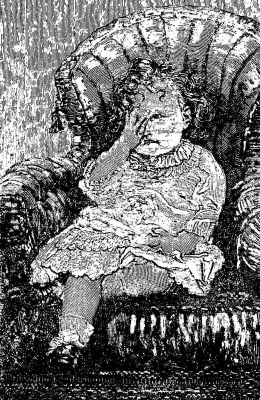
BASHFUL. From a Photograph by Singhi ("Binghamton's Fotografer").
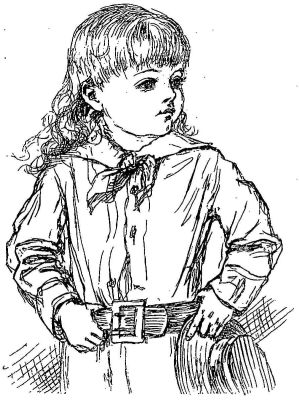
Oh, Charley would a sailor be, And live for aye on the bright blue sea— Yo ho!