Chapter VII
Reading edition
The next morning the sky was gray, and filled with flying clouds. The wind was blowing fresh and cold from the northwest, and the boys shivered, until their morning bath set their blood racing through their veins.
"What do you think of the weather, Tom?" asked Charley, as they were drinking their coffee.
"I don't think much of it," interrupted Joe. "It isn't half as good as the weather we had last summer."
"Junior officers will please not give their opinions until they are asked for," said the young Captain, in his severest official manner.
"I think," replied Tom, "that we're going to have a windy day, and I shouldn't be surprised if it rained before night."
"Not unless the wind backs around to the southwest," said Charley. "I think it will blow hard; but it doesn't very often rain with a northwest wind."
"Never mind if it doesn't rain," said Joe; "we'll get wet somehow, you can be sure."
"I think," said Charley, "that we'd better get up our anchor right away, for after awhile it may blow so hard that we'll have to run into some harbor for the rest of the day."
The Ghost's jib and mainsail were set, and with the wind on her port quarter she began to pile up the foam under her bow. In spite of the gloomy appearance of the sky and water, the speed of the boat put the boys in high spirits. The bay was covered with white caps, and in some places there was quite a heavy sea; but as the Ghost was running before it, no spray came on board, and Joe, in spite of his conviction that he must get wet, was dry and comfortable. The wind steadily increased, and before long Charley saw the necessity of reefing. So he brought the boat with her head to the wind, let go the anchor, and lowered the sails.
"Do you mean to say that we've got to anchor every time we reef?" asked Harry, as he was knotting the reef-points of the mainsail.
"It isn't necessary to anchor. We could put in a reef if we had no anchor with us; but with as much wind as we have now, it makes the work of reefing a good deal easier if we are lying at anchor."
"Why couldn't we reef while the boat is running under her jib?" inquired Tom.
"You can't tie the reef-points unless the sail is down, and you can't get the sail down while the boat is before the wind, and the sail is full. We could throw her head up into the wind, and get the sail down, and then let her run off under the jib until we get through reefing; but then we'd have to haul down the jib, and pull her head around with an oar, before we could set the mainsail again. Anchoring saves a whole lot of trouble, and there is no reason why we shouldn't anchor when we are where the anchor will take bottom."
With the reefed mainsail the Ghost behaved better than she had done. She rolled less, and steered more easily. The boys were delighted with the way in which she raced over the water, but occasionally, when they looked at the curling seas which followed her, and seemed to just miss breaking over her stern, they were a little uneasy.
"There is no danger from those seas as long as we can carry all this sail," remarked Charley. "The boat is moving faster than they are, and they can't overtake her."
But it was soon evident that sail would have to be shortened again. The wind was now blowing a gale, and not a sail was visible on the bay. Charley did not care to come to an anchor, for he had noticed a point of land about a mile ahead, and intended to run under the lee of it, and put in a second reef. So he was about to order Joe to slack the peak halyards, when, without the slightest warning, the Ghost's mast went over the side with a tremendous crash, tearing up part of the deck, and very nearly dragging Joe overboard with the halyards, which caught him around the neck.
"Keep cool, boys," cried Charley. "Let go the anchor, and then get hold of the jib, and try to drag it in clear of the wreck."
A few vigorous pulls brought the jib on deck, where it was thrown into the cockpit, and an effort was then made to get the spars alongside, and lash them together. The boys worked hard, but the weight of the mainsail, soaked as it was with water, made their efforts unsuccessful. While they were still working, the sea suddenly swept the wreck away from them, and to their dismay they found that the one rope which had attached it to the boat had parted, and that the mast and mainsail had started on an independent cruise. Harry would have jumped overboard in chase of it, but Charley forbade him, and assured his comrades that the wreck would drift quietly across to the beach, where they could find it after the wind went down.
"And have we got to stay here all day?" exclaimed Harry. "I don't like the notion at all. Why shouldn't we drift down to the beach after the wreck?"
"Because the seas would fill us full of water long before we could get there. I'm not sure, though, but what we can sail there."
"I'd like to know how we can set a sail without a mast?" said Harry.
"Suppose you and Tom take hold of the ends of a rubber blanket, and stand one on each side of the deck, so as to spread the blanket out as wide as possible. Joe could stand between you, and let the blanket blow right against him. If you fellows could hold it, I believe we could run down to the beach in a very little while."
"Come on," exclaimed Harry; "let's try it. I'll get out a blanket, while somebody gets up the anchor."
"And I'll try to get her round before the wind with an oar," said Charley. "Be ready with the blanket as soon as I give you the word. You must stand up near the bow, about the same place where the mast used to stand. Now, are you ready with that anchor, Tom?"
"Ready, sir."
"Then up with it as quick as you can. Now go forward with that blanket, and the minute I get her head off a little, help her to swing clear round before the wind."
"UNDER A HEAVY PRESS OF INDIA-RUBBER BLANKET."
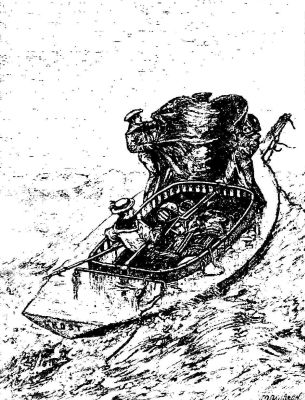
The crew obeyed orders perfectly, and in a very few minutes the Ghost was running under a heavy press of India rubber blanket for the distant beach. She had fully two miles to go, but as she was sailing fast enough to keep out of the way of the sea, there was no doubt that she would cross the bay safely. It took all the strength which Harry and Tom possessed to hold the blanket, while poor Joe, with his back braced against it, had the satisfaction of knowing that if it blew out of the boys' hands, it would carry him overboard.
As they approached the shore, having passed the drifting spars on the way, the prospect was not encouraging. The sea was breaking heavily on the low edge of the meadow which lay between the bay and the sand-hills of the beach, and there was no cove into which the boat could be run. There was nothing to be done but to anchor and wait for pleasant weather. Accordingly, the blanket was taken in, and the anchor dropped about thirty yards from the shore.
"Now if the anchor holds as it ought to," said Charley, "we are all right."
"And if it doesn't hold," said Harry, "we shall be all wrong. It's going to hold, though, for there's a good sandy bottom here."
"I wish it was a mud bottom," said Charley. "The anchor would hold twice as well in mud. However, I'm not afraid that we shall drift, unless it blows a regular hurricane."
"Now's the time to mend the deck," remarked Tom. "We've got nothing else to do."
"What in the world made that mast go overboard?" asked Joe. "It didn't break, did it?"
"No," answered Charley. "Either something gave way at the step, or else it wasn't properly stepped. We ought to have made absolutely sure that we had stepped it right that day we got through Coney Island Creek. We weren't careful enough about it, and this is the way we are paid for it."
There were some small pieces of pine board stowed away in the boat, which Harry had taken along in order to split them up for kindling wood. With the aid of the few tools which the boys had brought with them, they contrived to mend the deck, so that with the help of a piece of canvas and a little white lead it would shed water. An ugly scar remained to show where the mast had torn its way out; but for all practical purposes the deck was as good as ever.
This work finished, dinner was made ready, and the boys began to think that riding out a gale at anchor was not half so tiresome as they had supposed it would be.
"There are our spars at last," exclaimed Joe. "I had made up my mind that they had missed the way, and had given up looking for us."
"There they are, sure enough," said Charley, "and a great deal too near us. First thing we know they will drift right down on us." So saying, he sprang forward and seized the cable, with the hope of giving the boat a sheer that would keep her out of the way of the wreck.
He was too late, for the spars drifted against the cable, and their weight, added to that of the boat, was more than the anchor could hold. The Ghost began to drift slowly toward the shore. Nothing could be done, and the boys could only wait for the inevitable moment when the boat would strike.
"I told you I was bound to get wet some time to-day," said Joe. "You see I was right."
"Let's be glad that we've nothing worse than a wetting to dread," said Charley. "The water can't be more than three or four feet deep here, and we couldn't drown ourselves if we were to try. Why, it isn't up to my waist," he added, as he measured the depth with an oar. "Come, let's get overboard, and shove those spars out of the way. We may save the boat from going ashore yet."
They all instantly sprang overboard, and tugged manfully at the wreck; but it was too heavy and unwieldy for them, and they were too near the shore. The Ghost struck while they were still in the water, and the sea instantly began to break over her.
"No help for it, boys," said Charley, cheerfully. "We're shipwrecked, and we must grin and bear it. Hurry up, and let's get these spars out of the way, and perhaps we can tow the boat off again."
The spars were finally shoved away from the boat, and then the boys tried to get her afloat by hauling at the cable, and by putting their backs against her and shoving with all their might. It was all in vain. She was hard and fast on the shore, and could not be moved.
Such things as could be easily taken out of her were carried ashore, to prevent them from getting any more wet than they already were. The mast, with the boom, gaff, and sail attached, was then dragged ashore, and the sail spread out to dry. While this work was in progress, Charley had noticed that the wind was gradually changing its direction, and was evidently about to back to the southwest. Before the afternoon was over it had done so, and as a result, the sea ceased to break on the shore where the Ghost was lying, and she was finally got afloat, and bailed out.
"We're going to have rain before dark," said Charley. "I can feel it in the air. We'd better rig up our cabin, and get the things on board again, before the rain catches us. If we don't take care, Joe will get wet again."
"No, he won't," replied Joe. "He can't get any wetter than he is. Do you know, boys, I believe I'm getting to be like a sponge. I shouldn't wonder if I weighed two hundred pounds, with all the water that has soaked into me since the cruise began."
The Ghost, in the position in which she was now lying, was to a great extent sheltered from the gale by the sand-hills, and it seemed to the boys as if the wind had gone down. So strongly did Harry insist that the gale had blown itself out, that Charley proposed that they should all walk over to the sand-hills, which were not more than an eighth of a mile distant, and settle the question whether the wind had gone down, or was, as he asserted, blowing as hard as ever. So they made their way through the rank beach grass, and climbed the sand-hills. The first blast of wind convinced them that the gale had increased rather than diminished. The sea was a magnificent sight, and the surf was breaking on the beach with a noise like thunder. There were only two sails visible in the distant horizon, and the sky in the southwest was black with approaching rain. There could be no doubt that a wild and terrible night was at hand, and the boys went back to the boat feeling awed at the might of the elements, and somewhat oppressed by a feeling of loneliness and helplessness.
They had everything in order before the rain reached them, and though it came down in sheets, they managed to keep dry. They were not sleepy, and so they talked over the events of the day as they lay in their narrow but warm and comfortable cabin.
"By-the-bye, Charley, we haven't heard you say anything about Nina to-day," said Harry, mischievously.
"Who's Nina?" said Charley. "Oh, I remember—the girl we met yesterday. Why, what should I say about her?"
"Oh, nothing; only I was thinking that you'd probably forgotten all about her. Now Joe thinks that it would be a nice thing to get her to come on a cruise with us."
"That's nonsense. She couldn't go without her mother, and her mother wouldn't go without her father. We'd have to get a regular yacht, with state-rooms, and all that. Don't let's talk about girls, Tom. Did you ever see a canoe?"
"I've seen birches, if that's what you mean."
"No; I mean a wooden cruising canoe, such as the fellows that belong to the American Canoe Club have. Do you know that you can sail or paddle anywhere in a canoe, and sleep in it at night? That's the sort of thing to cruise in."
"I've seen one," said Joe. "It was a perfect beauty, all decked over, and with water-tight compartments to carry things in, and two masts. If you'll believe it, the whole thing, masts and all, didn't weigh over seventy pounds."
"Now if we had canoes," continued Charley, "we could cruise in any kind of water. We could come down a shallow river all full of rapids, or we could sail in deep water, and keep dry in any sort of sea. I'd like nothing better than a canoe cruise, and I wish you'd all think about trying it next summer."
The conversation was successfully turned from girls to canoes, and the boys discussed canoes and canoeing until they finally fell asleep, with the rain beating heavily on their canvas covering, and rattling like a constant shower of peas on the deck. They had been asleep for several hours when they were suddenly awakened by the heavy report of a cannon, fired apparently but a little distance from them.