WONDERS OF CONEY ISLAND.
Reading edition
BY A. W. ROBERTS.
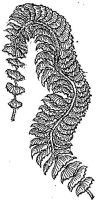
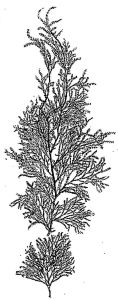
Fig. 1.—Sertularia.
If grown-up folks and young people who are desirous of becoming acquainted with the marine wonder-land of Coney Island will take a stroll along the beach, starting from the Iron Tower and proceeding a mile toward Norton's Point, I'll promise them that their constant exclamations will be, "I wonder what it is!" as they meet with one after another of the many curious marine objects that are to be found along the two upper lines of drift.
For years I have seen visitors (both old and young) on the island poke at and destroy with their canes, sticks, and wooden shovels hundreds of beautiful and interesting objects that had been cast up by the ocean, in their efforts to determine what they were.
Some time ago I visited the island for the special purpose of writing up and illustrating some of the most common objects that can be obtained in an hour or two's' collecting.
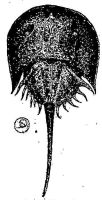
Fig. 2.—King-Crab.
One of the handsomest and most abundant of all sertularians to be found on the island is shown in Fig. 1. Sertularians consist of hydroid communities which build up the beautiful structure shown in the illustration, which is generally called by excursionists "sea-moss" and sea-weed, though it is not a moss at all, nor is it a sea-weed, but is an animal product built up by immense numbers of minute and beautifully formed creatures known to naturalists as hydroids. From these hydroids are created the transparent jelly-fish we see floating in the ocean. After gathering the sertularia it should be washed in warm soap suds to clean it; when nearly dry it can be pressed in the leaves of a book just as ferns are treated. I have often gathered it on the island two feet long, and have used it with evergreens for Christmas decorations. It is said to be an excellent material for canaries when building their nests, as it contains both salt and lime.
Fig. 3.—Squid.
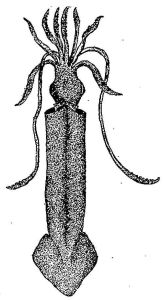
Fig. 2 is the horseshoe-crab, also called the king-crab, from the fact of its being the largest of all crabs on our coast. This crab is common on sandy shores, where it partially buries itself below the surface of the sand when in search of food. In the illustration is shown the egg of the king-crab one-third larger than life. Some few days before the egg of the crab hatches out, the young crab is seen tumbling about inside of the transparent shell of the egg. King-crabs lay their eggs in the sand on sand-bars that are exposed to the action of the sun during the low tide.
Fig. 4.—Egg Cluster of Squid.
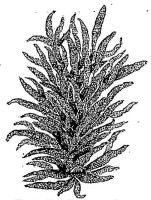
Fig. 3 is the squid, also called the ink-pot, from the fact that when in danger he ejects a stream of ink-like fluid, which forms a black cloud in the water about him; through this he escapes from his enemies.
Fig. 4 is a cluster of squid eggs. The egg masses of the squid are always to be found on the island during the months of May and June. The eggs are inclosed in an elongated pod-shaped mass of jelly which, when held up to the light, reveals the outline of a number of small translucent eggs of a light yellow color. From fifty to one hundred of the pod-shaped jelly masses occur in one cluster. The great wonder is how one small squid can lay so great a mass of eggs.
Fig. 5.—Natica.
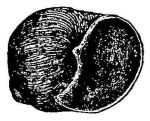
Fig. 5 is one of the commonest shells on Coney Island, particularly after a storm, and is known as the natica. It lives on the sand-bars below low-water mark, where it feeds on the surf or skimmer clam by boring a hole through the hard shell of the clam with its tongue, which is coated with numerous fine teeth.
Fig. 6.—Natica Egg Case.
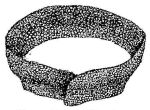
Fig. 6 is the egg case of the natica, of which thousands are cast on the shore every summer. This egg case is often known as the "mermaid collar," on account of its striking resemblance to a collar. This curious object is composed of grains of white and black sand fastened together with a soft and transparent glue, of which the natica seems to possess a very large supply. How the collar is so regularly and smoothly formed out of the sand is still a mystery to naturalists.
Fig. 7.—Coney Island Skimmer Clam.
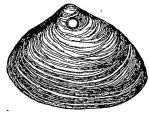
Fig. 7 is the skimmer clam, or surf clam; it is to be found on the entire length of the outside beach of Coney Island where the water is clear, and exposed to the constant action of the waves. There it constructs a burrow two or three feet deep. Sometimes, after an unusually low tide, it is left exposed one or two inches above the sand, when, if cautiously approached, it may be drawn out with a sudden jerk, but if alarmed, it will penetrate the sand quicker than it can be followed. Thousands of these clams are taken home by visitors to the island for the purpose of cooking, but when opened are found to be so full of fine sand that they are useless. It received the name of skimmer clam from the Dutch settlers, who used the empty shells for skimming their milk. On the beak, or highest point of the shell, is shown (in the drawing) a round hole made by the natica.
Fig. 8.—Egg of Skate.
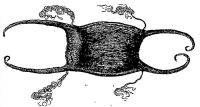
Fig. 8 is the egg of our common skate; the four hair-like appendages attached to the sides are tangles composed of a fine silk-like material. The skate, after laying an egg, takes it in her mouth and carries it to the nearest broken oyster or clam shell, and entangles or fastens it by means of the silk-like appendages, otherwise it would be driven ashore on the first storm.
Fig. 9.—Eggs of Whelk.
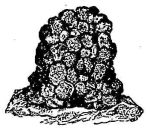
Fig. 9 is a mass of the eggs of the whelk, one of our deep-water shell-fish, the empty shell of which is seldom cast on the Coney Island shore, but the masses of eggs come ashore in large quantities, particularly after storms, when they are broken from their stone anchorages.
Fig. 10 is a string of the egg cases of the periwinkle shell, which is one of the largest shells inhabiting the waters of Coney Island. The eggs are contained in a soft leathery case of a light yellow color, about the size of a two-cent piece, but much thicker. Each case contains from one hundred and fifty to two hundred eggs. These strings of eggs vary from one to two feet in length.
Fig. 10.—Eggs of Periwinkle.