Chapter XI
Reading edition
Charley, leaving his companions near the fore-rigging, went out and loosed the jib and flying-jib, and when this was done, returned and showed them where the halyards were. The flying-jib was hoisted without much difficulty, but the jib was heavier, and the boys found it necessary to take the halyards to a "gypsy," which is something like a small windlass, with the aid of which the obstinate sail was soon hoisted. The sheets were then trimmed flat, and the pressure of the wind on the sails forced the brig's head around so that she no longer lay with her broadside to the wind and sea. The foretopmast stay-sail had evidently been set during the gale, for it had been blown away, and nothing remained of it but a few shreds clinging to the bolt-ropes.
Charley next went aloft and loosed the foretopsail. The brig was an old-fashioned affair, and had the old-fashioned single topsails, so the sail was rather a large one for four boys to handle. They, however, succeeded in sheeting it home, and then, with the help of the "gypsy," managed to hoist the yard. All the yards had been squared before the brig was abandoned, and she had swung around so far that the topsail filled, after a fashion, as soon as it was set. Sending Joe aft to the wheel, and telling him to keep the brig directly before the wind, Charley again went aloft and loosed the fore-top-gallant-sail, which was small enough to be sheeted home and hoisted up by Charley, Tom, and Harry, without Joe's help. With the help of these two sails, the vessel began to move slowly through the water. Her rate of speed was certainly not very great, but it was sufficient to give steerage-way to her—at least so Charley thought. But as the brig showed a great apparent unwillingness to keep on her course, and acted very much like a drunken man who staggers from one side of the pavement to the other, he went aft to see what was the matter.
"I'm glad you've come," said Joe. "I'm afraid I don't exactly understand steering with the wheel. Which way do you turn it if you want her head to turn to starboard?"
"You roll the wheel over to starboard, and that ports the helm," replied Charley.
"Then I've been doing just the opposite," exclaimed Joe, "and that's the reason why I couldn't do anything with her. It's lucky I found out what was the matter before any harm was done."
"I'll come back presently," said Charley, "and give you a lesson in steering. I must go now and try to get the foresail on her."
The foresail was set after a long struggle. The breeze was now very light, but the three square sails drew well, and the brig was certainly making a full knot an hour. The jib and flying-jib were of course of no use now that the vessel was directly before the wind, but Charley decided to let them alone, as they were doing no harm, and as a slight change in the direction of the wind would bring them into use again. The boys were now so tired that they decided to rest and have something to eat before resuming work.
A search for provisions did not prove very successful. There was a lot of dried cod-fish in a box in the maintop, where nobody but Charley would have dreamed of looking for it, and there was salt beef of very uninviting appearance in the harness-cask near the foremast. In the galley were a few biscuits, which did not appear to have been spoiled by sea-water, but there was nothing else to eat on board the vessel. Below the deck, the brig seemed to be nearly full of water—so full, at least, that there was no possibility of going below. As nobody was anxious to eat dried cod-fish or raw salt beef, Harry said he would go on board the Ghost and bring a supply of provisions that would give the boys a comfortable lunch.
He went to the main-chains, to which the rope that held the Ghost had been made fast, but to his surprise it was not there. Thinking that he had made a mistake, and looked on the wrong side of the vessel, he turned to cross the deck. As he did so, he uttered a cry that startled his companions. "The Ghost has gone!" he cried. "There she is, a mile astern." She had not been fastened securely, and had gone adrift while the boys were making sail.
"We must turn right back and get her," exclaimed Harry. "Don't let's lose a minute's time."
"Can we go back after her?" asked Tom.
Charley thought a moment, and answered: "We can't. That is, I don't think it's possible."
"Why not?" asked Harry.
"We'll try it; but there's very little wind, and I don't believe we can beat to windward with this water-logged craft, especially as she hasn't any maintopsail. Run forward, boys, and let go the fore-top-gallant halyards, and then try to haul up the foresail. I'll have to come, though, and show you where the ropes are."
SETTING SAIL ON THE BRIG.
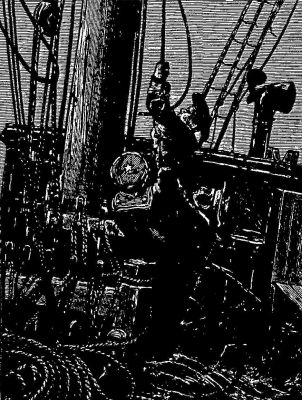
The foresail was brailed up, and the head-sheets were let go, and then Charley ran aloft as quick as he could, and loosed the main-top-gallant-sail, which the boys set as well as they could with the topsail-yard down on the cap. They then set the spanker, and hoisted the maintopmast stay-sail.
"Now come with me," said Charley, "and we'll see if we can brace the head-yards up." They hauled at the port forebrace with all their might, but found they could only swing the yard a short distance. "It's perfectly hopeless, boys," said Charley. "We can't do it."
"Can't we take the rope to the gypsy or the capstan?" said Harry. "I'm sure we could get the yard round then."
"Perhaps we could," answered Charley, "but we can never tack the brig in that way. It would take us an hour every time, and then it would be of no use. We must give the Ghost up, for it's an absolute impossibility for us to work this vessel two miles to windward, and we are at least two miles from the Ghost now. However, we'll brace the yards up a little, and steer her a little more north. All the sails will draw then, and we'll get on a little faster."
With infinite labor the yards were braced up by taking all the lower and topsail braces to the capstan. The fore-top-gallant-yard was once more hoisted, and the foresail set. Joe was told to keep her N.N.W., and with all the sails drawing, she really made a visible wake in the water. The Ghost gradually faded from sight until she completely vanished.
Harry went aloft to the maintop and brought down a cod-fish, on which the boys made what was either a late dinner or an early supper. They were so hungry that it did not taste bad, and they agreed that there might be worse things than dried cod-fish eaten raw. Charley hurried through with his meal, for he was anxious to make preparations for the night. He found that there was oil enough in the brig's lamps to burn during one night, and he trimmed them and made them ready for lighting. He went aloft to the main-royal-yard and looked for land, but he could see none, and there was not a sail in sight except two that were dimly visible on the far horizon. Then he came down, and finding that he had some matches in his pocket, he took a big knife that he found in the galley, split up a shelf, and started a fire, with which he meant to boil a piece of beef. The decks had been quite dry ever since the brig had been got before the wind, and the sea was going down every hour. There was nothing more that the young Captain could do for the safety of the vessel which had so strangely come under his command.
As he went aft to where the boys were gathered around the wheel, Tom said to him: "Charley, I know it is my fault that we lost the boat. I thought I had her fast, so that it was impossible for her to get away, but I didn't."
"I am the one that is most to blame," replied Charley. "I induced you all to stay on the brig, instead of taking the compass and going about our business. But there's no use in worrying ourselves about what can't be helped."
"Do you really think now that we can get her into port?" demanded Harry.
"I think it depends entirely on the wind. If the wind continues to be fair, and especially if it freshens a little, I believe we can't help getting her as far as Sandy Hook, or somewhere, within hail of a steam-tug. We can't be more than thirty or thirty-five miles from land, and as soon as we get a little nearer the coast, we shall be right in the track of the European steam-ships."
"Is there any danger of her sinking?" asked Tom.
"Not for a long while yet. We ought to keep a signal of distress flying, though, for I'd like to have some vessel lend us two or three men to help us work her. Look in that locker aft of the wheel, Tom, and see if there isn't an ensign in it."
Tom looked as directed, and found a French flag.
"Now I'd like to know," said Charley, in a disgusted tone of voice, "how we can set a French ensign upside down. It's a sign of distress to set our ensign union down, but this thing hasn't any union. We'll have to hoist it half way up, and I suppose that will look mournful enough to attract anybody's attention. What I'm afraid of," continued Charley, "is that the wind will change, and come out ahead. It's very light, and it keeps shifting back and forth three or four points, as if it didn't know its own mind. However, if we do have a headwind, somebody will take us off the brig, and carry us to New York."
"I'm not complaining, I want you to understand," remarked Joe. "I'm perfectly dry, and I never complain unless I'm wet. But if I'm to do all the steering, I'd like to know it beforehand."
"I beg your pardon, Joe," exclaimed Charley. "I forgot that you've been at the wheel nearly four hours. Tom, will you take the wheel, while I hoist the ensign and attend to a few other little things?"
Tom took the wheel, and Joe explained to him the difference between steering with a wheel and steering with a tiller. After setting the ensign, Charley went forward and lighted the side lights. Then he put a piece of beef in the kettle to boil, and split up the cook's bench with which to replenish the fire. Finally he coiled all the halyards down on deck, so that there would be no trouble in letting them go in a hurry, and then he rejoined his companions.
"We have had no regular watches to-day," he remarked, "for we had to have all hands on deck to make sail. It's now nearly eight o'clock, and as everything seems all right, Joe and I will turn in till twelve o'clock. You will steer, Tom, while Harry will go forward, and keep a look-out. Do you know how to strike the hours on the bell?"
"I learned that long ago," replied Tom.
"Then take my watch, and strike the bell every half-hour. Harry, when you hear four bells, come aft and take the wheel, and let Tom go on the look-out. By-the-bye, I forgot about the binnacle lamp."
There proved to be plenty of oil in it, and it was soon trimmed and lighted. Charley noticed that the brig was heading nearly west.
"The wind is getting round," he said, rather gloomily, "and I'm afraid we shall have it back in the northwest again. Boys, we've got to brace the yards up before anybody turns in."
This time the yards were braced up as sharp as the boys could brace them, and a full hour was consumed in this hard labor. It was now possible to keep the brig nearly on her course; but knowing that the wind would probably go still further around, Charley told Tom not to trouble himself about the compass, but to keep her as close to the wind as possible, and to call him in case the wind should get into the northwest. At nine o'clock Charley and Joe went into the galley, and lying down near the fire, went to sleep.
At twelve o'clock the starboard watch was called. The wind was now unmistakably ahead, and the brig was heading nearly southwest. Tom explained that he had been able to keep her heading nearly west until about half past eleven, and that he had not thought it worth while to deprive Charley of half an hour of sleep by calling him before twelve. Charley thanked him, but gently reminded him that he had been ordered to call the Captain the moment the wind got into the northwest, and that it was his duty to obey orders strictly.
"I shall want you and Harry to help brail up the top-gallant-sails," said Charley. "As long as we can't keep our course, we don't want to carry any more sail than is necessary. We'll haul down the flying-jib, and haul up the top-gallant-sails, but we won't try to furl them till day-light."
The top-gallant yards were dropped and squared, and the sails brailed up. Charley went out and furled the flying-jib, and then Tom and Harry went into the galley to sleep. Joe took his station on the forecastle, where he walked up and down to keep himself awake, and Charley was left alone at the wheel.
The more he thought the matter over, the more he was convinced that he had not been rash in undertaking to navigate the brig. Had the wind continued fair, the boys could almost certainly have brought her near enough to Sandy Hook to meet a steam-tug. Could they have succeeded in this, they would have made a large sum of money, perhaps as much as eight or ten thousand dollars, and Charley himself would have gained a great deal of credit in the eyes of his naval superiors. The brig, water-logged as she was, seemed to be about as safe as the leaky Ghost, and there was much more chance that the brig would be seen by some passing vessel, and her crew taken off, than there was that so small a boat as the Ghost would meet with help. Unfortunately the change in the wind had made it apparently impossible for the boys to bring the brig into port; but Charley felt sure that in the course of the next day they would be taken off in case they wanted to abandon her. So finding that his conscience acquitted him of having rashly led his companions into danger, he felt peaceful and happy, and steered the brig as cheerfully as if he were steering the Ghost in the Great South Bay.