HOW FAR CAN YOU SWIM?
Reading edition
BY WILLIAM O. STODDARD.
"Look here, Sime, old Purdy might have told us he'd taken away his oars."
"Well, yes; but there was a kind of a grin on his face when he told us we might have it. Not another loose boat!"
It was a solemn fact. Every skiff along the beach but "old Purdy's" was fastened by chain and padlock and stake, to express the objections of its owner against its use by stray boys.
"No fun going in for a swim in this shallow water. Only a wading place."
"Barry, there's a board. That'll do for us. We can paddle her out far enough."
It was a lost fragment of clapboard about four feet long, and with no house to it. Nobody could guess how it got there; but in three minutes more the clumsy flat-bottomed skiff was being slowly propelled away from the beach, out toward the deeper water of the lake.
Sime Hopkins and Barry Gilmore had reached, to judge from the remarks they made, that precise point in their aquatic practice when your common small boy 'long-shore swimming is a thing to be looked down upon, and a lake of some size, or a section of the Atlantic, was required for any fun of theirs.
The day was warm, the water as smooth as a pane of glass, and there was a faint haze over the sky. The very model of a day for a perfect swim.
The boat, too, had evidently been built for it. She was broad enough not to tip too easily if you were climbing in, and the wide seat at each end was just the arrangement for diving.
"This'll do, Sime. Pity we didn't bring an anchor."
"Water's a hundred feet deep out here. How far are we from shore?"
"Don't know. Maybe it's half a mile. Maybe it's more. Could you swim it?"
"Guess not, Barry. Perhaps I could. But I don't care to try. Not unless the boat came along. A fellow's legs might give out, or he might take a cramp."
"My legs would peg out, sure, long before I got there."
They were a very good pair for a boy of fifteen, and in a moment more they were in the air, as he sprang from the stern of the boat, and went in, capitally well, head first.
"That was a good header," shouted Sime. "I'm coming."
Come he did, and they found the water just about right for them. Not a trace of a chill in it, in spite of the fact that the lake was largely supplied by springs from the bottom. Out there, of course, there could be no weeds to catch their feet in, and there was very little to be suggested by way of improvement.
"'Fore we get too tired, Barry, let's try a longer swim."
"Come on. Only don't let's go too far."
They were headed toward the shore, and they were not looking back, when Barry exclaimed: "There's a ripple, Sime. The wind's rising."
"Barry, look at the boat!"
"She's drifting out. The wind's off shore."
The boys looked at each other for a moment with very serious faces; but they were brave fellows, and there was no time for hesitation.
"She isn't so very far, Sime."
"But she's drifting. No telling how far she'll go. We mustn't risk it."
"Shore's too far. Can't do it. We can catch the boat."
"The wind's rising, Barry."
"Choose, Sime—shore or boat."
"Shore for me. Choose for yourself. See how she drifts!"
"You can't reach the shore, Sime. Besides, I want my clothes. I'm going for the boat."
"No time to talk. Good-by, Barry."
Sime Hopkins felt a great sob rising as he struck out for the shore, and it was every bit as much on Barry's account as on his own, but he had to choke it down.
"Straight swimming now, and no nonsense. How plainly I can see the city!"
That is, he could see the steeples of it, some two miles from the shore he hoped to reach; and below them, he knew, were the roofs of houses, and under the roofs of two of those houses were Barry Gilmore's mother and his own.
Steadily, regularly, without a motion too much or a pull too hard—for he was thinking very closely what it was best to do in such a case—Sime swam on, until a dull feeling in his arms warned him of coming weariness.
"On my back now for a few rods. It'll change the work, and rest me. I can see the boat, but I can't see Barry. The wind is blowing harder."
All that time, however, Barry had been doing precisely what his friend had done, only that he had watched more anxiously the increasing ripple on the water.
"She isn't so very far," he had said to himself at first. "I do wish Sime had come with me. He can't reach that shore, swim his best. It'll be an awful thing to tell."
A couple of minutes later he was muttering: "That was a harder puff. How she does drift! Seems to me I don't get an inch nearer. If it blows much worse, I'll have to follow her to the upper end of the lake."
That was nearly six miles away, and the thought of it made the warm water he was swimming in seem several degrees colder. Barry's lips closed hard, and his teeth set against each other, and he measured his every stroke to make it tell.
Then his turn came to try a "back swim and a rest," and he too said: "I can see the shore and the city, but I can't get a glimpse of Sime. There! isn't that his head?—that black thing? Guess it is; it's moving. Yes, it's him!"
It was indeed the back of Sime's head, but the boy under it was saying to himself: "The shore's as far away as it ever was: I'd no idea we had paddled out such a distance. Reach it? I will reach it. Never swam so far in my life, but I must reach it."
Still, it was getting to be weary work, and before him lay what seemed an interminable reach of glittering ripples. He was breathing hard, his arms and legs were moving with less force than at first, and his progress through the water was slower and slower.
"Can I do it? It's got to be done. I'll tread water a moment for a change. I can't see Barry. Hurrah! it's the shallows!"
As he dropped his feet they came down upon smooth sand, for all that end of the lake was a very gentle slope from the beach. The water was up to his neck, but the bottom was there, and Sime's heart bounded with a great throb of relief.
"Barry? I must wade in fast now. No boat when I get there; no help."
It was a forlorn outlook, and Sime even thought for a moment of all his clothing away out there in the skiff. Then he thought of Barry Gilmore, and hardly anything else, until the increasing shallowness of the water enabled him to wade faster, and then to break into what was almost a run. It was a great splash at all events, and Sime was quickly shouting to some one on the beach a half-breathless account of Barry's danger.
"Why didn't ye wait for the oars? I was a-comin' down with 'em. Wanted a swim myself, and thought I'd fool ye a little. What! Barry a-swimmin' after the skiff? There's Jim Burr's boat. Quick! jump in!"
"It's locked."
"Locked? Well, I'll jest unlock it."
The key Purdy used was of limestone, and it may have weighed twenty pounds. It "opened Jim Burr's padlock for good and all," while Sime was getting in; and then how Purdy did row!
"We'll be too late."
"Shut up, Sime. Don't talk to me. It's jest awful."
It came very near it, for Barry Gilmore's brave, earnest face was getting white when he at last discovered that he was really drawing nearer the runaway boat.
"The wind is rising. I'm almost gone. Couldn't swim two rods further."
Yes, the wind was indeed blowing harder, but the direction of it had been for some time changing, as it is apt to do before a summer storm. The first "surface current" of air had lost its breath, and the stronger blast which was really to bring the cloud and rain was coming from the other way. So was the skiff it caught and carried along, and Barry hardly understood it.
"I'm swimming pretty fast yet, in spite of everything. Wish I knew about Sime. Just a little further."
Oh, how difficult were those last few strokes! When Barry faintly rested one hand upon the gunwale of the skiff, it required a great effort to lift the other beside it.
"I can't climb in, now I've got here. What shall I do?"
Of course he could not have climbed in, if he had been obliged to lift himself all the way up, but every ounce of weight he put upon the side of the boat brought it down further and further, until it was hardly two inches above the roughening water.
"Now for it!" All the strength he had left went into that last effort, and then Barry was lying on the bottom of the boat, with his wet head on the shining front of Sime Hopkins's shirt bosom.
He did not try to guess how long he lay there. Even after he could have moved, he had no heart to lift his head and look toward the shore.
At last, just after he had covered his eyes with both hands, there came upon his ears the sound of oars, as if some very zealous rower were pulling for a prize in some regatta, and behind that sound was another, as if some fellow had suddenly burst out crying.
A heavy "bump" against the side of the skiff.
"Here he is! Oh, Barry!"
"Sime, is that you? Don't say a word, Sime—I can't."
It was some little time before either of them could say much, but they had both learned just about how far they could swim; and old Purdy sat there in his stolen boat, his rough face all one redness and radiance. All even he could find to say was,
"Ain't I glad! Jim Burr won't mind my bustin' of his lock a mite; but I'll git him another."
GOING TO MAKE AN AFTERNOON CALL.
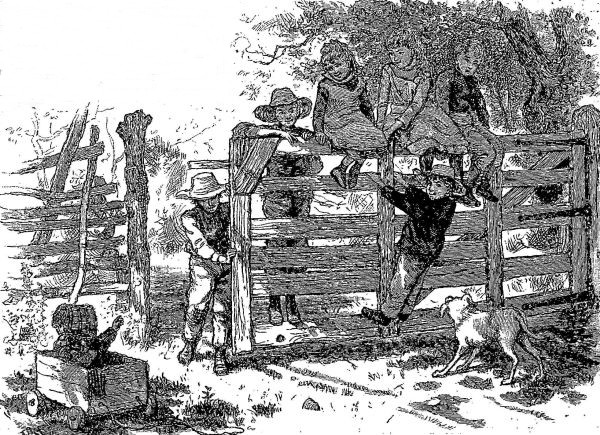
SWINGING ON THE GATE.—Drawn by S. G. McCutcheon.