KITTY'S DREAM.
Reading edition
Little Kitty Martin Had a vision in her slumbers Of little cherub kitty cats In most prodigious numbers. They looked just like her own gray pets— She saw them all quite clearly; And still she wasn't frightened, Because she loved them dearly.

Ever so many letters, which the Postmistress reads with great pleasure, have to be left out of Our Post-office Box every week. The little writers must not be discouraged, but try again. The Postmistress has many a hearty laugh over droll letters for which she can not find room in print; and sometimes she cries, all by herself, over some that are sorrowful, wishing so much that she could help the dear children who have troubles of their own to bear.
Butternut, Wisconsin.
I live on a beautiful lake five miles long, but I do not know quite how wide. Our mountain-ash tree has been just lovely, all in bloom. I wish I could send you all the flowers I have seen this summer. What kind of a school-house do you think I go to? A little log-cabin—not hewed logs either—with unplaned seats and desks, and a floor which has large cracks in it. We have a "scoop roof," and for a teacher's desk we have a large box, and for a water bench only a block of wood. There are two windows and one door. We had in the city a red brick school-house, and everything was very nice there. Oh! I forgot to tell you how many scholars we have—six girls and three boys. My sister Fannie and I both go. I would like to have a photograph of you, the one who likes to darn stockings, for I do too. Our lake is pretty rough to-day.
Kate Belle M.
Well, dear, there are more luxurious school-houses than yours, but some of the best and greatest men our country has ever had, and those whose names we most honor, attended just such plain, homely little school-houses. It is the sort of teaching and of learning which goes on in school which is of the most importance. A dunce would not gain much on a velvet carpet and at a rose-wood desk, and a bright, diligent girl may learn much that is worth knowing, even in a rough, unplaned building. I think that you girls and boys might coax your papas and big brothers to plant vines and shrubs around the school-house, and make a garden in front of it. The teacher's desk might be covered with maroon-colored muslin, on which bright pictures might be pasted. Wreaths of evergreen, and after a while garlands of autumn leaves, might be hung upon the bare walls. Train some German ivy, which grows rapidly, around the windows. If I were there, I could help you make the place pretty I am sure. I am glad you are fond of darning stockings, but I can not send you my photograph, because I am one of the people who never happen to get a good likeness when I sit down before the camera.
I have been sick a long time, and am not able to get out of bed, so I have not much to do but read or paste stamps in my book, when I have them. One of my friends lends me Harper's Young People. I would like to exchange an Indian, a Hong-Kong, a Cape of Good Hope, or a Brazilian stamp, for a 10, 24, 30, or 90 cent of the 1869 issue, the 24 or 90 cent of the 1870-71 issue of U.S. stamps, or the 10, 30, or 90 cent unpaid letter stamps, or any of the U.S. periodical, State, Navy, or Treasury Department stamps except the lowest denominations.
D. J. Haines, Cheltenham, Montgomery Co., Penn.
Brooklyn, New York.
I am not a girl, but a boy ten years old. I saw in Our Post-office Box of No. 139 a letter from a little girl who wanted to know what kind of a pet she should have. I think a bird or a cat would be the thing. I wish the Postmistress would please tell Jimmy Brown to write some more of his stories.
Joseph A. B.
Chicago, Illinois.
It is very nice where I live. There are trees in front of every house on the block. We have cool winds from Lake Michigan. Chicago has a great many gardens, and it is called the Garden City of the West. I have three pets. Their mother is a rat terrier; her name is Fanny. I like them very much. They have their eyes open already. They are very fat, and have little feet that can hardly carry their bodies about. I go to school, and learn reading, arithmetic, geography, spelling, and writing. I am just half-way through the school. This is a very large school; it has twenty rooms in it. There is a building in Chicago that is eleven stories high. We will have vacation in a few days, and then all the school-children will be glad. We boys go down to the lake and bathe ourselves, and have a jolly time. We are allowed to fish in Humboldt Park on Saturday; I go there almost every Saturday. It has a very clear lake; there are sunfish, trout, and bull-heads in it.
Alvin H.
Of course you are now in the full tide of vacation. Is Saturday the only day when the boys are allowed to fish, or do you go to the Park on other days, now that school is over for a while?
Detroit, Michigan.
We have a canary-bird, and a dog, and some chickens. The dog's name is Dan, and he chases the chickens all over the yard. We have the darlingest baby you ever did see. She is so sweet! She loves the chickens. I am nine years old.
R. J. R.
LITTLE PATTY.
Cross little Patty sat under a tree, As fretful as ever a child could be. "Keep still!" to a singing-bird she said; "You are out of tune, and you hurt my head." "Do stop!" she cried, to a dancing brook. A lamb and a pussy cat came to look At cross little Patty beneath the tree, As fretful as ever a child could be. The pussy cat wondered to see her pout, And the frisky lambkin skipped about; But the brook tripped on over stones and moss, And never found out that Patty was cross. The bird in the tree-top sang away, And these were the words she meant to say: "You poor little girl, why can't you see That there's nothing at all the matter with me? "Mend your manners, my dearie, soon, Or you'll find the whole world out of tune." Somehow the wind in the leafy tree, And the rippling water so wild and free, The bird on the bough, and the snow-white lamb, And the gentle pussy so mild and calm, Made Patty ashamed of her naughty mood; She shook herself well, and said, "I'll be good." And, presto! the Patty beneath the tree Was just as sweet as a child could be.
Brandy Station, Virginia.
I am nine years old, but will soon be ten. I thought I would tell Kate E. what pet to get. I think a pony would be very nice. I have written to Harper's Young People several times, but my letters never have been printed. I hope you will print this. My sister was taken sick yesterday. I have no pets, but my sister Emily has a pet cat. It is very cunning. Papa is having the porch fixed up. Good-by.
Rena Louisa S.
Eden, Dakota Territory.
My papa came here thirteen years ago, when only savages inhabited this part of Dakota. I can remember, when a very small child, how the Indians used to come to our house, and beg for corn and fresh meat, for we used to kill lots of pigs. Papa named this town. Eden is situated in the southeastern part of Dakota, on the Big Sioux River, fifty miles above Sioux City. I have only one sister, nine years old, and I am eleven. Mamma promised me a birthday party, but as I have an invalid grandpa, and my birthday comes in the cold, cold month of December, and we could not go out-of-doors to play, mamma said I might have a lawn party instead this summer, as we have a beautiful grove to play in. I have taken Harper's Young People for nearly two years, and am very much pleased with it.
M. Elsie W.
Howe, Illinois.
I am a little boy nearly seven years old. I have never been at school, but recite my lessons at home. I have one Maltese cat I call John Crawford, and another Jerusha (I call her Jerry for short). Jerry has two little kittens; they are just as funny as they can be. I have a shepherd dog named Jack; he and the cats and kittens eat from the same dish, and do not quarrel one bit. Then I have a cow and two little calves, and two colts. My colts are named Dick and Daisy; they are one year old, and my papa says I may ride them next fall. The last, and almost the least, is my little pig Bessie. Papa says my brother Jo and I will bankrupt him yet feeding our stock. Jo is my only brother; he is thirteen. My papa has been real sick almost a year; he expects to go to the sea-shore this summer.
I do hope you will print this letter. I have not seen any from this part of Illinois. If you do, in my next I will tell you about a rat-hunt my grandpapa and I had. I like Harper's Young People best of all.
Charlie W.
Des Moines, Iowa.
I am a little girl ten years old. I have lived in Des Moines for nearly one year. I do not like Des Moines very much. I have written three letters to Young People, but as none of them have been published, I thought I would write again. On the 18th of June a cyclone passed here, and on the 22d of June a cyclone passed not far from our house, and mamma said it would have been here if it had not been for the rain. In Kansas, when they see a cyclone coming, they all go to large holes in the ground, and stay there until it is all over, and then they come out again to their houses. I have a cousin in Germany, and she takes Harper's Young People too. I have been taking it ever since the first number. I am very glad that the vacation months have come, it has been so warm here ever since the 1st of June.
E. K.
Jacksonville, Illinois.
Ma says I may write a letter too, As many of the little boys and girls do; So I will try and write, and see How it will look in poetry. I'm a little girl just twice six and one, With this world's work just begun. My father is a farmer, and bridge-builder too, So, you have guessed wisely, there is plenty to do. We all help to plant, to dig, and to hoe; To be sure, in time we've plenty to mow; For of all good times for children to play, The best of all is on hay-making day. Now 'tis our old house I must tell you about: 'Twas built for a tavern, all on a stage route; Great trees of walnut were cut and hauled, And placed together firmly to make these old walls; It looks very old and ancient to some, But yet it is a very dear and comfortable home. My grandpa says, near sixty years ago or more He made latches and hinges for these very doors. The things that were made then were made to wear, But now things of that kind you'll find very rare. He had his shop where he could get the breeze, And he hung his bellows between two trees, But now his locks are silvery and gray, And his house is the best place for children to play. Dear Postmistress, should you be weary and need rest, The best of all places is near the Athens of the West. We take Harper's Young People, think it grand indeed, And take great pleasure when your stories we read. If you will please print my letter, I will close by signing my name.
Ninetta.
I wonder if I can match this poetical letter by some jingles. Let me try:
An epistle, dear Netta, so charmingly rhymed, For weather like this I think very well timed. I'm glad that at grandpa's, when lessons are done, Yourself and your friends can have plenty of fun. And I hope you will try to be thorough, my dear, So that your work, like his, may last many a year.
Baltimore, Maryland.
I look forward to the day Harper's Young People comes with very much pleasure. The stories are very amusing, and the letters are very nice indeed. All seem to like "Mr. Stubbs's Brother" very much. I like it too. I am nine years old, and I have had three birds. One poisoned itself eating the leaves of the trumpet-vine; another broke its leg; the other died a natural death. And now my other little bird is living, and is very tame. I have never written to Harper's Young People before, but I hope my first trial will be successful.
Lydia D. D.
Mineola, Texas.
I am a little girl seven years old. I want to tell you about my pets. I have two kitties; one is named Tabby, the other is named Jumbo. I did have a little rabbit, but Tabby caught it and ate it. I can play four tunes on the organ. As this is my first, please publish it.
Annie H. N.
Plainfield, New Jersey.
I have only taken Young People a little while, and I like it very much. I have a little sister named Alice, and a little cousin named Marie. One day Alice did something that Marie did not like, and looking up in Alice's face, she said, "Lallie, you make me nervous." Grandma gave me a year's subscription of Young People for a philopena present, and my uncle gave me a bound copy for the year 1881.
E. U. O.
Cambridge, Massachusetts.
I went to New York with mamma to see my grandpa, and had a good time. I liked the elevated railroad very much; I wasn't afraid at all. I went to Central Park, and saw some monkeys, birds, buffaloes, a polar bear, and lots of other things. One bird picked the other bird's feathers out. A man put his finger right in the buffalo's mouth, and another man let the birds eat pea-nuts out of his mouth. I used to have curls, and they were cut off when I was in New York. My sister thinks I look like a monkey, but I think I look nice. We are all going to Barnum's Circus to see Jumbo. I saw the picture of him in the paper that you send us. My sister wrote this letter for me, because I couldn't print it good enough.
George L. W.
Marengo, Illinois.
I am twelve years old, and live on a farm of one hundred and one acres. I have lots of fun on the farm. I have a few pets; they are rabbits, tame canaries, a dog, a cow, and a little calf. I had a horse, or one that I called mine. One day my dog Fido—for that is his name—went into the barn to catch rats, and he got caught in a steel trap, and it took two of us to set him free, and his foot was almost crushed.
John R. W.
I am very sorry for Fido's misfortune.
CHERRIES.
Under the tree the farmer said, Smiling, and shaking his wise old head: "Cherries are ripe! but then, you know, There's the grass to cut and the corn to hoe; We can gather the cherries any day. But when the sun shines we must make our hay. To-night, when the work has all been done, We'll muster the boys, for fruit and fun." Up in the tree a robin said, Perking and cocking his saucy head: "Cherries are ripe! and so to-day We'll gather them while you make the hay; For we are the boys with no corn to hoe, No cows to milk, and no grass to mow." At night the farmer said: "Here's a trick! Those roguish robins have had their pick."
Peoli, Ohio.
I live in the country, and we have many kinds of birds, but I want you to tell me why they change so. A few years ago there were lots of peewees and wrens. Now there are none of them at all, and the birds that used to be so shy are building close by, the redbird in the bushes near the front door, the winter king in a hole in an old peach-tree by the back door. There is going to be a picnic just a few rods from our house. I am ten years old, and have no little brothers or sisters. I have two brothers. One is married; the other is older than I. He can draw nice pictures of our house and barn, and lots of other things. We have two canaries, and they go to setting as soon as they lay one egg. We have had lots of pets. One was a crow, which could do the most mischievous things, and was very funny. We have only a dog named Bran, some kittens, and a pet lamb. Bran will stand with his mouth open for Fred to milk in it, and sit before us on a horse to ride. I have a cousin Nelly coming to spend vacation with me. We shall have bathing-dresses, and will play in the brook. There is not enough water to swim in. I wish there was.
Robba M.
The new birds must have driven the wrens and peewees away to find other homes. Perhaps you may be able to coax them back again.
A few Sundays ago, while service was in progress in the Presbyterian church at Rome, New York, what should walk demurely up the aisle but a little gray kitten. She stood on the pulpit steps, and looked at the boys and girls, who were in quite a flutter for fear somebody would say "scat," or pick kitty up and carry her out-doors. But nobody troubled her, and presently the little thing jumped up to one of the chairs in front of the pulpit, laid her head on her paws, and fell asleep. There she staid until church was out.
N. P. G.—Messrs. Harper & Brother's will send Toby Tyler, or any other volume on their list, to any address on receipt of the published price. It is necessary only to direct your order to Harper & Brothers, Franklin Square, New York. Letters designed for the various periodicals, or for any department in either of them, should be addressed in the same way.
A Subscriber.—I can not recommend any manual on the subject to which you refer. A few lessons from a good teacher are indispensable.
A lady of Yonkers, New York, lately sent to the Flower Mission in New York City two thousand clove pinks tied in bunches of fifty each. On account of their sweet, spicy fragrance these were sent to the blind sufferers in hospitals.
Little lovers of birds will send their good wishes to the kind Mr. and Mrs. Robin of whom this pretty story is told. A gentleman in Milton, Massachusetts, owns a mocking-bird, whose cage hangs under the piazza. Near by is a nest containing young robins. The parent birds are busy all day bringing worms to their young family. Twice, says the observer, the robins have been seen to pause on their way to their brood, and drop worms through the bars of the cage to the little prisoner.
Elsie G.—Your cat is really a gifted creature, but if I were papa, I would not like him to be quite so familiar. Did you ever dress him up with a paper cap, and a ruff around his neck?
Gertie and Lottie B.—Such a century plant as yours is a treasure worth owning.
Bessie H. B.—I am glad that you find it a pleasant occupation to help mamma in her garden. You forgot to tell me what you are raising besides strawberries. Did they turn out well, and repay you for your labor?
Count Rumford.—The ball of the foot must be on the pedal of the bicycle.
Max L.—The story of "Mr. Stubbs's Brother" began in Harper's Young People, Vol. III., No. 127, published April 4, 1882.
C. Y. P. R. U.
Great Paul.—Great Paul is an enormous bell which was cast for St. Paul's, in London, and has lately been hung in its belfry. It measures ten feet across the mouth, and weighs sixteen tons. You may imagine what deep tones will issue from this immense bell when it is rung on occasions of joy or grief. Large as Great Paul is, however, there are bigger bells in the world. The largest one in actual use is at Moscow, and it weighs nearly a hundred and thirty tons. The next largest is in Pekin, where there is a bell which weighs fifty tons. At Notre Dame, in Paris, there is a bell which weighs seventeen tons. The true test of a bell is its strength of sound. How far can you hear it? is the question, not how heavy it may be. High up in the steeple and on an elevation a bell ought to be heard for miles. In old times the bells summoned the people to gatherings called folk-motes. If anything of importance was to be decided, if an enemy's ship appeared in the offing, or there were rumors of an invasion on the coast, the solemn call of the bell hurried the men to a council. On the bell of St. Mary's, at Oxford, this line is inscribed, "Keepe tyme in anye case."
Arab Bread.—It is made of coarse flour resembling our Graham flour, and the loaves, which are very thin, are round, and about fifteen inches in diameter. It is placed on the table in piles, and is broken by those who wish to partake of it, not cut in slices like our bread.
Flo.—You are quite right in asking the Postmistress about any little thing that puzzles you. If you and cousin Theodore are both going up-stairs, you must let him go first. In going down-stairs he should step aside and let you go before him. Introduce your little visitor to your mother, mentioning mamma's name first.
A pleasant amusement in summer, when people are coming and going, is found in the game of Preferences. It is played in this manner:
Keep a blank book of sufficient size on the parlor table, and ask each guest to write out answers to the following questions:
Who is your favorite hero in history?
Who is your favorite heroine in history?
Who is your favorite King in history?
Who is your favorite Queen in history?
What is your favorite male Christian name?
What is your favorite female Christian name?
What is your favorite flower?
What is your favorite color?
What is your favorite style of music?
What is your favorite style of climate?
What is your favorite study?
What is your favorite exercise?
What is your favorite book? etc., etc.
We would call the attention of the C. Y. P. R. U. to Mrs. Helen Conant's admirable article on "Catching Butterflies." Not only does it contain clear and simple directions for making a collection of these beautiful insects, but much is to be learned from it of their various characteristics and habits. There is a most interesting article on travel by Lieutenant E. W. Sturdy, entitled "Tom Fairweather goes to Bassorah, the Home of Sindbad the Sailor." The boys and girls both may learn a valuable lesson of presence of mind and heroism from the little incident told under the title of "A Brave Boy."
PUZZLES FROM YOUNG CONTRIBUTORS.
No. 1.
NUMERICAL ENIGMA.
I am composed of 13 letters and 2 words. My name is known to all lovers of art.
My 1, 2, 7, 7 is a manufactory.
My 1, 2, 7, 6 is a measure of distance.
My 8, 9, 10, 6, 7 is a messenger.
My 1, 5, 1, 1, 5 is a sweet word.
My 1, 5, 2, 7 is a defense.
My 5, 9, 9, 2, 6 is a girl's name.
My 4, 13 is an exclamation.
My 2, 3, 11 is used both in summer and winter.
George E.
No. 2.
FIVE EASY DIAMONDS.
1.—1. A letter. 2. A bed. 3. A friend. 4. A beverage. 5. A letter.
2.—1. A letter. 2. A speck. 3. A shelter. 4. A number. 5. A letter.
Edgar S.
3.—1. In sauce. 2. A trap. 3. A number. 4. Another number. 5. In snow.
4.—1. In chicks. 2. A vessel. 3. A darling. 4. Something good to eat. 5. In ducks.
5.—1. A letter. 2. A limb. 3. A state. 4. An opening. 5. A letter.
R. B. B.
No. 3.
BEHEADINGS.
1.
1. I am a metal; behead me, and I am infirm.
2. I am a garment; behead me, and I am a grain.
3. I am something to use; behead me, and I am elevated.
4. I am not good; behead me, I am not out.
5. I am a flavor; behead me, and I am a fluid.
6. I am part of the body: behead me, and I am a part of speech.
7. I am a boy's name; behead me, and I am a color; again, and I am again a boy's name.
Helen U. G.
2.
1. I am part of an apple; beheaded, I am a metal.
2. I am useful around the fire; beheaded, I am a home.
3. I am part of time; beheaded, I am necessary to hearing.
4. I am sometimes used for bad boys; beheaded, I am a familiar sound.
5. I am something to wear; beheaded, I am a useful implement.
Georgie.
3.
1. I am in a lady's work-stand; behead me, and I am out-of-doors.
2. I am a clever device; behead me, and I stand in the field.
3. I am a medicine; behead me, I am under-foot.
Madge.
No. 4.
TRANSPOSITION.
A redyra clpea dlowu eb sith htrea, Rewe ethre on tilelt elpoep ni ti; Eht gnos fo ilef lduow eols sti htrim, Erwe ethre on lichnerd ot ebign ti.
ANSWERS TO PUZZLES IN No. 139.
No. 1.
WASTESAINT
ADORNAIMER
SOLIDIMAGE
TRICENEGUS
ENDERTRESS
No. 2.
Buckram.
No. 3.
Harper's Young People. Harp. Eagle. You. Sugar. Poe.
No. 4.
JesC
UnA
LeavE
IvieS
UnA
SteameR
No. 5.
ADS
ICELIEDUE
ACORNDIARYSUNNY
ERAERREND
NYY
Correct answers to puzzles have been received from "Fay," "Fern Heather," Lucie Timpson, Emil Hirsh, Eddie S. Hequembourg, Annie Meeker, Maud Mary Chambers, Florence V. Williams, Benjamin Smith, Lottie Hope, Ernest Pullen, Norman Cary, Elsie, "Rose-bud," "Fuss and Feathers," "Bright Eyes," C. J. C., Leslie Meigs, "Empire City," Annis Temple, John P. Mott, Emma Ray, Louise Prescott, Guy Paynter, Viola C., Ray M., Evarts Folsom, Etta Wheelock, and Flossie Dean.
[For Exchanges, see 2d and 3d pages of cover.]
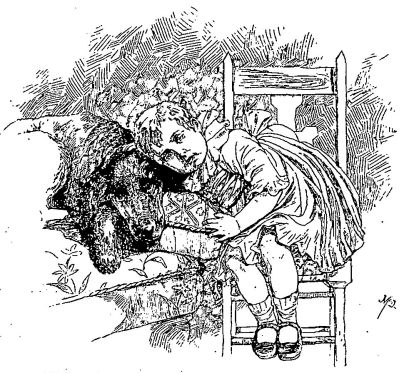
THE PLAYMATES.—From a Photograph by Singhi.
THE FOX'S DINNER PARTY.
BY F. CASSIDY.
One of the funniest animal stories I ever heard was lately told by a sober Quaker gentleman from New Jersey, who said it was related to him by the eye-witness himself. He was one day in a field near a stream, where several geese were swimming. Presently he observed one of them disappear under water with a sudden jerk. While he looked for her to rise again he saw a fox emerge from the water, and trot off to the woods with the unfortunate goose in his mouth.
The fox chanced to go in a direction where it was easy to watch his movements. He carried his burden to a recess under an overhanging rock. Here he scratched away a mass of dry leaves, made a hole, hid his treasure within, and covered it up very carefully. Then off he went to the stream again, entered behind the flock of geese, and floated noiselessly along, with merely the tip of his nose visible above the surface. But this time he was not so fortunate in his manœuvre. The geese by some means took the alarm, and flew away with a loud cackling.
The fox, finding himself defeated, walked off in the direction opposite to the place where his victim was buried. The man went to the place, uncovered the hole, put the goose in his basket, replaced the leaves carefully, and stood patiently at a distance to watch further proceedings. The sly thief soon returned with another fox, whom he had apparently invited to dine with him. They trotted along right merrily, swinging their tails, snuffing the air, and smacking their lips in expectation of a rich repast.
When they arrived under the rocks, Reynard eagerly scratched away the leaves; but, lo! his dinner had disappeared. He looked at his companion, and plainly saw by his countenance that he more than doubted whether any goose was ever there at all. Appearances were certainly very much against the host. His tail slunk between his legs, and he held his head down, looking sideways, with a timid glance, at his disappointed companion. Indignant at what he supposed to be an attempt to get up a character for generosity on false pretenses, the offended guest seized his unlucky associate and cuffed him most unmercifully. Poor Reynard bore the infliction with the utmost patience and sneaked off, as if aware that he received no more than might naturally be expected under the peculiar circumstances.
PARLOR MAGIC.
HOW TO MAKE A QUARTER PASS INTO A BALL OF WORSTED.
Procure a ball of worsted, and also a piece of tin about three inches long and about an inch and a quarter broad, and turn up one-eighth of an inch of it on each side at an angle inward, and roll the worsted round this piece of tin until you make a ball, taking care to leave that part of the ball where one end of the tin slide is open so as to enable you to drop the quarter into it.
The ball of worsted is now placed on the table, and having borrowed a quarter, which you get the owner to mark, you turn to the table, and take up the worsted ball, dropping the marked quarter quickly down the slide or tube, which you then secretly withdraw from the ball. Now turn to the audience, and show them the ball of worsted (the hole where the tube was taken from will not be visible), and hold up a quarter (another one) which you have had secreted in your right hand until now, or which you can have fastened to an elastic attached to the inside of your sleeve, and inform them you will pass the coin into the ball.
Now get one of the company to cover the ball of worsted with a tumbler; hold up the quarter, and say, "Presto, go, fly!" then pretend to throw the quarter to the ball. Give one end of the worsted to the company to unwind, when the marked quarter will be found in the centre of the ball.
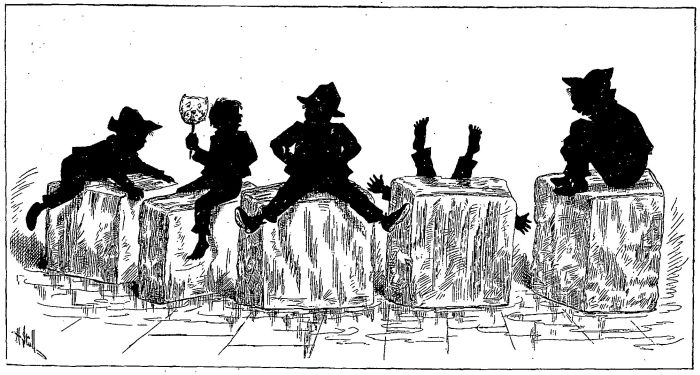
THE THERMOMETER AT 100°—ENJOYING FREE(ZE) SEATS.