JOB'S TURKEY.
Reading edition
BY J. R. GALBRAITH.
"De ole speckle hane's done gone en keel ober, missus. Wot's we gwine ter do wid de young turkey?"
These words were addressed to me one fine spring morning by a small and very black boy, whose name was Job. Job always took a great interest in the poultry, and, indeed, was of no little assistance to me in its care. To be sure, he sometimes caused a great deal of trouble, when the chickens were hatching, by his great anxiety to know how they were getting on. He would lift up the hens to see if the little chicks were all out of their shells, and would even try to assist them in breaking the latter open, by which kind-hearted operation he invariably caused their death.
The speckled hen to which he referred that morning had been so unfortunate as to lose all her brood of young turkeys except one, and now she herself was dead. What to do with the young turkey was indeed a puzzling question. It was too young to take care of itself, and none of the other hens would take it, because their broods were not of the same age.
"Well, Job," I said, "I really do not know what we will do with the poor little thing: there is no mother for it."
"Dat's so," said Job; "but it make me feel moughty bad ter see dat leetle turkey a-cryin' roun' de dade hane. De ole rooster-cock he go er crowin' roun' jes ez big ez ef nuffin ain't done gone en happen. Oh, he's a precious vilyen, is dat same ole rooster-cock!"
I reflected a few moments, and then I said, "Job, you may have that little turkey, and when it gets big enough to sell, you can have the money all for your own."
"You don't mean dat, do you, missus?"
"Yes."
"Well, den, dat ar turkey ain't gwine ter die, not ef dis chile kin help it."
Any one who is familiar with poultry knows what delicate little things young turkeys are, and how difficult they are to raise under the most favorable circumstances. What, then, were Job's chances? Not one in a thousand.
JOB WATCHING HIS TURKEY.
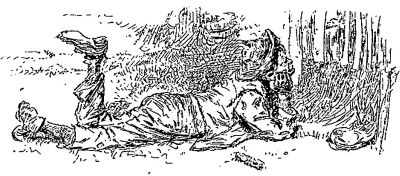
Job went at once and put the young turkey in a coop by itself. He then procured some soft grass, with which he covered the floor; and having placed some water and food where the little thing could get at them, he spent the remainder of the day in lying on the ground before the coop, looking in at his new possession.
That night when I went out to superintend the feeding of the young chickens, which duty had devolved upon Job, he informed me that it was necessary to be very careful in regard to the rooster, and from what he said I inferred that he believed that fowl entertained some wicked scheme against not only all the young of its own kind, but all young poultry in general.
"De ole rooster-cock," said Job, as we paused before the coop that held the young turkey, "he come up en look through de slats at dat ar turkey—he did, sho. I hez ter keep a moughty close watch out, I duz. 'Member de time w'en he picked de young goslin' en de leetle chicken ter def, kaze dey wanted ter foller him. He'd do jes dat ar way wid de turkey ef he had half a chance. Oh, he's a precious vilyen, is dat same ole rooster-cock!"
To the surprise of us all, Job's turkey lived to be a full-grown bird, and, unlike the traditional Job's turkey, grew as plump and fat as any turkey need wish to be.
Yes, it lived and grew fat, but perhaps, after all, it was an unenviable kind of life, for it lost that which is the pride of all young gobblers—its tail. There was not a single feather of it left. Job in catching it had so often pulled out so many tail feathers that at last they were all gone.
Nor was this the only trial it had to bear. Job was continually shutting it up, and then changing his mind and letting it out again. One morning, when his mother was picking geese, Job caught his turkey, and gave it to his grandmother to hold until he could fix a coop to put it in. His grandmother, who was entirely blind, thinking that it was a goose, picked almost every feather from its body.
One day Job's father invited a few friends to take dinner with him. The dinner was to be given on the Fourth of July, and Job was very much afraid that his turkey would be sacrificed to the occasion.
"I's moughty feerd dat pap is gwine ter kill dat turkey," he said. "Ef he do, I won't hab no way ter git no money, kaze I won't hab nuffin ter sell w'en de hux'er comes roun'. I hope you won't let him kill dat turkey, missus, he am sich a fine gobbler. Ef 'twas de ole rooster-cock I wo'dn't keer, kaze eberybody knows he ain't no 'count. All he duz is ter walk roun' en 'tend like he's foun' suthin, en scratch up de groun'. Ef he'd git inter de yard, he'd scratch up all de flowers—he wo'd, sho."
"Oh, I guess he'll hardly kill your turkey, Job," I said, trying to re-assure him.
"I don' know," said Job; "I's feerd he will. Yuther day Elder Sales wuz ter our house, en a-readin' outer de Bible 'bout Job. Pap he tole me ter lissen how de man wot I woz named after wuz 'flicted. Den presently he axed de elder whar wuz de passage wot tole 'bout 'Job's turkey.' De elder said he didn't know jes zactly, but he 'lowed he'd soon fin' it. Dey look en dey look, but dey didn't fin' whar 'twas. 'Well,' sez pap atter a while, 'I knows a boy wot's got a turkey, ennyhow, en it's dat ar Job dar; en a moughty fine fat one too. It'll make a good ros' fer us some dese yere days.'"
From a remark that I overheard Old Dick make, I found that he actually did intend to kill Job's turkey. It was too bad, after the trouble the boy had taken to raise it. So that evening when I saw Old Dick, I told him not to kill Job's turkey, and that I would give him one. He bowed and made a great to-do thanking me.
"I'll kill de turkey to-morrow ebenin', so's ter hab it all ready in good season."
Job, who had been weeding a flower bed near by, came up just in time to hear this, and I noticed a peculiar expression on his face, but thought nothing of it at the time. Old Dick then made a low bow, and making Job do the same, the two departed in the direction of their cabin.
Everything went on as usual until about dusk the next day, when Old Dick made his appearance at the sitting-room window, and informed me that Job was missing.
"I's looked ebery whar, high en low, en I can't fin' de po' boy no'ers," he said.
"Oh, he will turn up before long; don't be frightened," I said. "Very likely he has climbed up into the haymow and fallen asleep. You remember we found him there once."
"I clar, missus, I's done look all fro de barn; but I'll go look agin ef yer say so. I 'members now I didn't look in de ole mangers in de wagon-house; but I don't reckon he'd git in dem hardly."
I went about my work, having little doubt but that Job would turn up all right, as he always had done before. But in a few minutes, happening to glance out of the window, I saw Old Dick running toward the house, having lost his hat, and making wild gestures with his arms. As soon as he caught sight of me he commenced to cry: "Oh, missus! Oh! oh! oh! Joby's done gone en fell in de barn well."
I ran out to him at once. "You must be mistaken," I said.
"Oh dear no, missus; I wisht I wuz. De bucket wuz hangin' down de well, en I jes let it down inter de water, thinkin' I'd draw up a leetle, w'en I heerd him a-splashin' roun' down dar."
"It was only the bucket when it struck the water."
"Oh no, 'twan't; I drawed de bucket up, en could atterwa'ds hear de po' boy. Can't nobody help me git him out? De po' boy is drownin' down dar—he is sho'. Whar is Mr. Williams? Oh, missus, whar is Mr. Williams?"
Great excitement ensued. Dinah, the cook, having seen Old Dick come running toward the house, had come out to see what was the matter. Now she ran back to my husband's study, and addressed him in these words. "De Lord help us, Marster Williams, Job's done gone en fell in de barn well."
He jumped up at once, and came running out in his dressing-gown, which, being of light material, was taken up by the wind and floated out behind him like a streamer. We three repaired to the well, where Old Dick had preceded us. Dinah was armed with the rolling-pin, my husband had the notes of a prospective sermon in his hands, which were scattered to the four winds, and I had some fancy-work, which, in my excitement, I had forgotten to lay aside. Truly we were well equipped for extricating a drowning boy from a well.
When we arrived at the well, it had begun to grow dark, and when we looked down into it, it appeared a deep black hole that might extend to the centre of the earth. Old Dick was leaning over the frame gazing into the dark depths below.
"Joby," he cried, "jes keep yo' hade 'bove water till we git down to yer. Hole onter de stones on de side, Joby. Does yer hear me, honey?"
No response from the well.
"Joby," he cried, in a louder voice, "does yer hear me?"
This was succeeded by a confused splashing at the bottom of the well.
"Oh, de po' boy!" cried Old Dick, wringing his hands; "he'll be drown', sho! Joby, o-o-oh, Joby, does yer hear me, honey?"
"HE WOULD HAVE PITCHED HEADLONG INTO THE WELL."
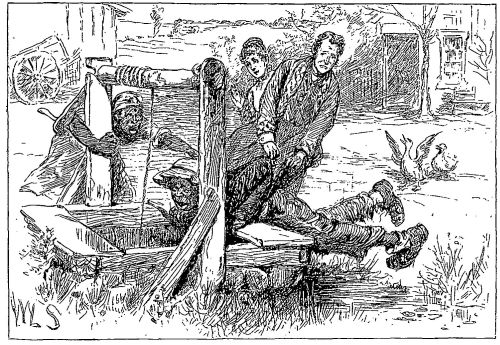
Here Old Dick leaned so far over the well frame that if Mr. Williams had not caught him he would have pitched headlong into the well.
Mr. Williams, having detached the rope from the bucket, fastened it around his waist, and telling Old Dick to hold on to the crank and let the rope unwind slowly, began to descend into the well, holding on to the sides with his hands and feet.
"Oh, dear me!" muttered Old Dick, as he unwound the rope; "ef he wuz ter lose his holt, en de cord wuz ter break, wot wo'd become ob po' Joby den?"
"Here he is!" Mr. Williams cried from the bottom of the well.
"Dade, I reckon?" said Old Dick.
"No," said Mr. Williams; "for a wonder he is alive. Wind up the rope, Richard."
Old Dick slowly wound up the rope. We were leaning over the well frame, peering anxiously into its black depths, when Mr. Williams came in sight, bearing in his arms poor Job? No. What? Job's turkey.
Dinah and I shouted with laughter, but Old Dick looked more distressed than ever.
"Where's Joby?" he cried. "You ain't gone en lef him dade at de bottom ob de well?"
"No," said Mr. Williams; "he is not there."
Old Dick could not seem to realize this at first. When he did, his features broadened into a smile. "Well, I thought," he said. Then he suddenly became grave again, as he remembered that, after all, we had not found Job.
We hunted all over the premises, and Old Dick went around to the neighbors and made inquiries, but it was all in vain. Job was nowhere to be found.
The next day, as I was passing through an unoccupied room at the back part of the house, I thought I heard a noise, like something falling, in a long disused closet. I opened the door to see what it was. All that I could see was a pair of bright eyes peering out from the cave-like blackness of the closet. I started back in fear.
"Don't be skeered, missus."
"Job!" I cried.
The boy tumbled out on to the floor at my feet.
"Don't whip me, missus, please don't whip me."
"Whip you, Job? of course not."
"Is de turkey alibe, missus?"
"Yes. What ever put it into your head to play such a trick as this?"
"Well, yer see, missus, I heerd pap say he wuz gwine ter kill dat turkey las' night. I had tole him 'twa'n't no fittin' time ob year ter eat turkey, but he boun' ter kill it er bust. Well, I seed dat dar wuz water nuff drawd fer de hoss, en I jes cotch dat turkey, en chuck him in de well bucket tight, so he can't git out, en let him down de well."
When Old Dick was informed of Job's whereabouts it was with great difficulty that I prevailed upon him not to whip the boy. He, however, at length consented to let him off that time.
"But ef eber I heers ob sich cuttins up agin I'll larrop him sho. A pirty-lookin' creeter he is, a-skeerin' his mammy en me half outen our senses!"
Job's turkey lived without any more adventures until he sold it for a good price to the huxter. He took the money and bought himself a pair of red-top boots, and when he put them on and walked about the yard he was indeed a happy boy.