CATCHING BUTTERFLIES.
Reading edition
BY HELEN S. CONANT.
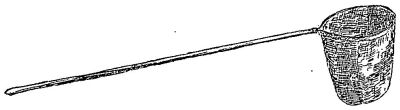
The boy or girl who wishes to form a valuable and pretty collection of butterflies must set about it in the right way. The first thing is to prepare a net. The brass rings with handles sold by all dealers in sportsmen's goods for landing-nets for fish will answer the purpose, but any ingenious boy can make his own frame. Get a smooth, light hoop about fifteen inches in diameter. If you can not find one small enough, make it from a barrel hoop. Bind the hoop firmly to a rod about three feet long. Now go to mamma and ask her to cut out a round piece of mosquito netting about three-quarters of a yard in diameter, and fasten it to the hoop. Now the net is ready.
The permanent case for your specimens must be a neat shallow box of some pretty wood, with a glass cover. Thin pieces of cork should be glued on the bottom at intervals, according to the size of your butterflies, upon these the insects are mounted by a slender pin which runs through the body. When the case is full, it should be sealed air-tight, for if there is the finest crack, moths will get in and ruin your collection.
You can not take your case to the fields, so you must have some small paper boxes in which you can mount your specimens until the wings are dry, and they are ready to place in the case.
The best thing for a youthful naturalist to use to kill the butterfly is ether. As it evaporates very quickly, it does not injure the color or texture of the beautiful insect, and it ends the life of the butterfly instantly, and without giving pain. There are other things often used by naturalists, such as cyanide of potassium, but they are dangerous chemicals for little folks to handle, and we recommend ether as being safe, and sure to kill the butterfly.
Now swing your net over your shoulder, take the ether which should be in a bottle with a glass stopper to prevent evaporation, the box for mounting specimens, and some fine pins, and let us start out in search of butterflies. We will go first for some of the large ones that fly about the fields and by the road-side.
Down in the old lane by the stone wall is a great clump of milkweed (Asclepias syriaca), and in June there were some big black, white, and yellow caterpillars crawling about among the leaves. Two weeks ago they changed into green chrysalides spotted with black and gold, and it is time now to look for the great Danias archippus butterflies, which will come out of the chrysalides in these hot July days. Yes, there is one now perched on the Asclepias, its large wings opening and shutting in the sun. Go softly, for it is a shy fellow. A quick throw of the net, and—off goes the butterfly sailing away across the sunny field. Hurry over the wall and give chase after it. The boy who would intrap a butterfly must follow where it leads, and stop neither for walls, ditches, nor swamps, or the prize will be lost. There are few butterflies so strong on the wing as the Archippus. But it is worn out at last, and stops to rest for an instant on a field lily—a fatal instant for the butterfly, for now the net descends skillfully, and the great insect is fluttering in its meshes. Gather the net carefully in your hand so that the creature will have no room to flutter and break its wings. Now pour a very little ether on its head—two drops are enough—and it lies motionless. As the Archippus is a very strong fellow—you have already, perhaps, felt the tight grip of its tiny feet on your finger—it may be necessary to repeat the dose of ether, but for ordinary butterflies one dose is sufficient.
Take the dead insect in your hand, touching the wings as little as possible, as the delicate down is easily injured, and passing a pin through its body, fasten it in the bottom of your box. Open the wings carefully, and arrange them at once while they are soft and flexible. A pin fastened between the wings, not through them, will hold them in place until they are dry.
Examine the Archippus carefully, for it is a very beautiful creature. Its wings expand over four inches. They are tawny orange veined with black, and with a black border ornamented with rows of white dots. On the front border of the fore-wings are several yellow and white spots. The under side of the wings is deep yellow, veined and bordered the same as the upper side. Be very careful not to injure the antennas, or feelers, which project from the head; they are very delicate and easily broken. But do not be discouraged if your first attempt to mount and arrange a butterfly is unsuccessful. The first butterfly will no doubt be a forlorn-looking creature, its wings twisted and broken. Persevere, and your fingers will soon become skillful, and you will arrange the wings as neatly as an experienced naturalist could do it.
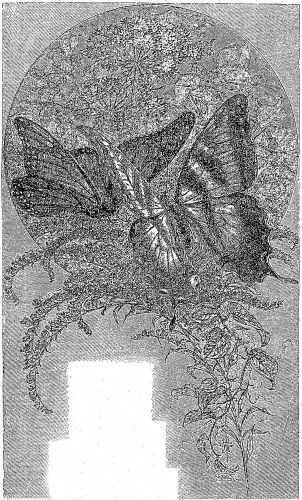
The dark butterfly in the background of the engraving is an Archippus, and the large one in front, with bands crossing its wings, and with little tails on its hind-wings, is the Papilio turnus—a brilliant yellow butterfly marked with black and blue. The latter is usually found in old apple orchards. It leaves the chrysalis early in June, which is the best time to capture it, as the specimens found fluttering about late in the season are too faded and dilapidated to be valuable in a collection. But there is another very beautiful member of this same family called Papilio asterias, which may be found in country gardens all through the month of July. It is usually fluttering over sweet-scented phlox and parley beds, because it is on these plants that it deposits its eggs, from which the caterpillar, commonly known as the parley worm, is hatched. The papilio asterias is a large butterfly, with black velvety wings, dotted with yellow on the margin. The hind-wings are tailed like those of the Papilio turnus, and ornamented with seven blue spots between two rows of yellow spots, and at the hind angle with an orange-colored eye with a black centre.
There are two pretty butterflies of the genus Nymphalis, which are found all through the summer. The Nymphalis disippe is very similar in color and markings to the great Archippus, but it is much smaller, as its wings expand only about three inches. Look for it near willows and poplars, for it is on those trees that its caterpillar lives and forms its chrysalis.
Its sister, the Nymphalis ephestion, is a creature entirely different in appearance. The caterpillars and chrysalides of both are similar, but, except in size and form of the wings, the gorgeous orange and black Disippe bears no resemblance to the Ephestion in its suit of dark navy blue with black and white trimmings.
Another beautiful butterfly is the Argynnis idalia. Its hind-wings are blue-black, with two rows of cream-colored and orange spots, while the fore-wings, which expand over three inches, are tawny-orange spotted with black. The under side of its wings, like those of nearly all butterflies of the genus Argynnis, is ornamented with silvery spots in a black border. The Idalia loves grassy fields and way-side flowers, and is not difficult to capture.
The tiny butterfly with bluish-brown and copper-colored wings ornamented with black, which is found in great numbers all through the summer fluttering over the grass and white clover by the road-side, is the Lycæna americana; and the small yellow butterfly with black markings on its wings, which flies in such quantities over clover fields that a single throw of the net will often intrap a dozen, is the Colias philodice. These two are the most common of our small butterflies, although there are many more you will find in your rambles through woods and fields. There are the skippers (Hesperiadæ), of which there are said to be more than eighty varieties, that fly near the ground with a jerking motion, as if they were skipping instead of flying from flower to flower. A peculiarity of the skipper is that when at rest it erects only the fore-wings, the hind pair remaining horizontal like those of a moth.
During the latter part of summer a family of delicate brown butterflies may be seen in the shady woods fluttering about beds of fern and moss. They, are called Hipparchians, and are the only butterflies which love shade better than sunshine. Their wings are very fragile, and the net should be thrown over them as gently as possible, as they are broken and ruined by careless handling. The Hipparchia alope is one of the largest of this pretty family. Its brown wings expand a little over two inches. Near the margin of the fore-wings is a broad yellow band in which are two round black spots with a blue centre. The Hipparchia eurytris is a delicate little beauty. It is smaller than the Alope, and each of its little pale brown wings is ornamented with two black spots with a tiny lead-colored centre.
Through the summer and autumn there are so many butterflies fluttering away their short lives in the sunshine that a description of them all would fill many pages of Young People. But catch all the different kinds you can find, and preserve them carefully; and if you have no good illustrated text-book in the country, you can obtain one next winter, and spend many long evenings in classifying your collection, and studying the habits of these pretty inhabitants of the fields and woods.
A SWEET KISS FROM DOLLY.