TOBOGGANING.
Reading edition
BY B. HARDWICKE.
This sport, under different names, is popular both in Canada and Russia. Before Nihilism had terrified a great part of the life and gayety out of the Russian court, it was a popular pastime even among members of the imperial family.
As soon as the Neva was frozen over sufficiently to bear the weight, two immense piers of solid ice were built at distances of about a quarter to half a mile apart. On one side there was a flight of steps to the top, and on the other a precipitous descent at about an angle of forty-five degrees. The sport consisted in descending this incline in a small sleigh, or toboggan. The pilot and his one or more passengers having descended the first incline, ascended the steps of the other pier on foot, and made the return journey. The trip was repeated back and forth until the parties were weary of the sport.
THE TOBOGGAN.
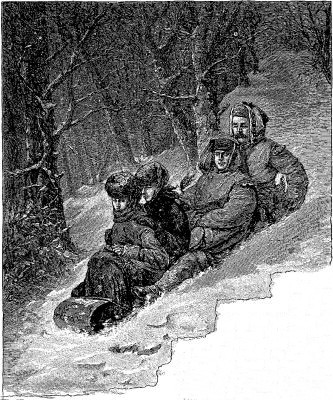
A toboggan may accommodate three or four persons, as shown in our picture, but the smaller sleighs made to hold only two are more common in Russia. A very slight movement suffices to guide the toboggan, or to throw it out of its course. The steering is done by the occupant of the back seat. An inexperienced pilot, finding his toboggan careering toward the right, is apt to put too much force into his efforts to change its course, and so upset both himself and his passengers. The toboggan responds to the slightest touch. A stick of wood is sometimes used in the guiding, but it can be readily done by the hand.
To enjoy a toboggan ride it is necessary to be well skilled in the art of guiding the sleigh, or to have great confidence in the person who is to do the steering. By the time the toboggan has reached the level, it has acquired velocity sufficient to carry it a very long distance.
In Canada, where some people who are not fond of cold weather assert that the winters are "thirteen months long," tobogganing is a most popular sport. While the nights are enlivened with balls, hops, and concerts, the days are devoted to snow-shoeing excursions and tobogganing parties, in which all, both sexes and all ages, join, and which brighten the hill-slopes and river-banks throughout the dominion.
The Canadian toboggan proper is a light curved slip of birch bark, daintily painted or embroidered in quaint Indian style, which glides down the icy slope with delicious swiftness, and, skillfully guided, carries its occupant far along the level ground at the base. In some places in Canada there are courses of wood erected, and during the long winters the sport can be frequently enjoyed.
There is just danger enough in tobogganing to make it exciting. An incautious guide may upset his passengers or run into another toboggan. The pace being from thirty to sixty miles an hour, a collision may result in some serious bruises. In most places the course chosen is some natural declivity where the undulations may be smoothed down so that the incline is even. Water is sometimes poured down the slope and allowed to freeze, so as to increase the slipperiness of the surface.
If any of our readers should have an opportunity of indulging in the sport, they will do well to bear in mind our advice, and if they undertake to act as pilots, must be very careful not to get excited. The fun which boys in the United States call coasting is only tobogganing on a small scale; but the prepared course and the long run of the sleigh on the level make the pastime much more exciting. Toboggans are sold at all the large general stores in Montreal and Toronto. There is very little demand for them in New York, but they may be obtained through a firm in William Street, New York.