EXPERIMENTS WITH ELECTRICITY.
Reading edition
Fig. 1.
This mysterious "agent," as people call it for want of a better word, can be produced in the easiest fashion, and some of its ways studied with the simplest kind of apparatus, constructed of articles that lie close at hand.
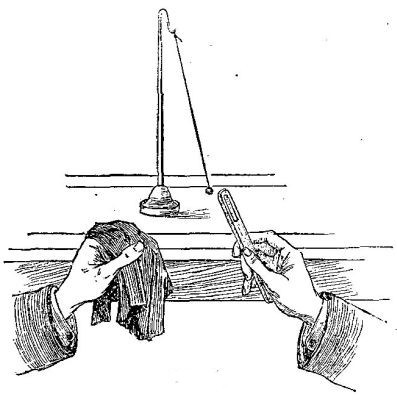
If we rub a stick of sealing-wax with a piece of cloth, we shall see that it will attract some small fragments of paper placed near it. Nothing is easier than to construct a small pendulum to show with perfect clearness the wonder of electric attraction. A piece of iron is fixed on a wooden pedestal, and holds a thread of silk, to the end of which is fastened a little ball cut out of a piece of cork. The stick of sealing-wax, after being rubbed with the cloth, will attract the ball, as shown in Fig. 1.
Fig. 2.
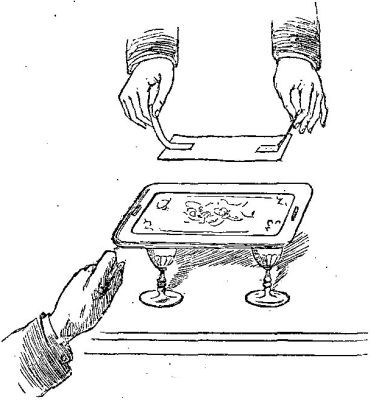
Fig. 3.
We can easily construct other electrical apparatus. Take a lacquered tea-tray about a foot long, and cut out a sheet of thick wrapping paper so that it will lie over all the level portion of the tray. At each side of this sheet of paper fix two bands of paper, as in Fig. 2, so as to serve as handles. The tea-tray should be placed upon two tumblers to support it and to insulate it, glass being a "non-conductor." By a non-conductor is meant a substance that will not convey electricity, or allow it to pass away.
Now rub the thick packing-paper over a hot fire or a stove until it is thoroughly dry, and as hot as possible without charring. When this has been done, place it quickly upon a wooden table, and rub it rapidly with as dry and hard a clothes-brush as can be obtained. Place the paper upon the tray; touch the tray with the knuckle, and draw away the paper by the handles fixed to it (see Fig. 2); a spark will result. Then if the paper be replaced upon the tray, and the hand again presented, the same result will follow. This may be done five or six times, at least, with success.
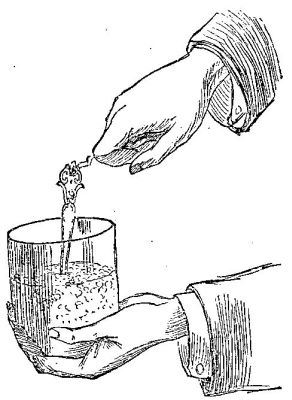
We have in this tea-tray and its paper covering a real electric machine. How can we manage to provide a Leyden-jar (so named from its inventor, Muschenbrock, of Leyden) to contain our electricity? Nothing is more easy. Let us take a tumbler, and partly fill it with shot; insert into the glass a tea-spoon, and if all the articles are quite dry, we shall possess a Leyden-jar.
To charge the jar we must work our other machine. While one person lifts off the paper as directed, another must hold the glass to the edge of the tray, and touch the corner with the tea-spoon; the spark will then enter the "jar." We can thus charge the jar as we please, and by presenting the finger, as in Fig. 3, we shall obtain a discharge from it.
FUN ON THE ICE—"KEEPING THE POT BOILING."