FUN AND PICTURES.
Reading edition
BY CHARLES BARNARD.
Within a year or two there has been introduced into this country a new set of tools for girls and boys that will not only enable them to procure a great deal of useful information, but lots of downright fun as well.
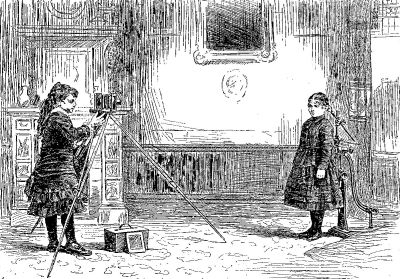
The first thing necessary is a small wooden box painted black, and having a brass tube placed in one side. In this brass tube is a lens. You see what that is. It is a camera. With the camera is a set of sticks, hinged in the middle, and called a tripod. When folded up, it makes a neat package that can be carried in the hand. When opened and set up, the camera is placed on top, and kept in place by a screw.
There is also a little cap for the tube of the camera, and two, or even more flat little wooden boxes, with openings at each end, closed by wooden slides. There is also a small pocket-lantern that gives a red light. Before we can do any work we must buy some sensitive plates. These come in packages of a dozen each, wrapped in black paper. They are called gelatine plates, and sometimes dry plates. They are so sensitive that the smallest ray of white light would ruin them at once. We must open the package, therefore, by the light of our lantern in a dark room when we come to put our plates in the little wooden boxes. Say we take two and put them back to back; that gives us a chance to take four pictures.
It is a bright sunny day. Let us start for some fun and pictures. Ah! there's a girl knitting on the door-step under a grape-vine. She is busy, and sits quite still. We set the camera up before her. Point the brass tube at her, and draw out the bellows at the back of the camera. We have with us two sheets of pasteboard bound together at the edges, like a book, with black cloth. Hold this before the ground glass on the camera and look between the leaves or sheets of pasteboard. There is a picture of the girl. It is upside down, and a little dim and hazy. The first we can not help, and by moving the bellows in or out we change the picture until each twig and leaf is sharp and clear on the glass.
Now take off the ground glass very carefully, and place one of the wooden boxes in its place, taking care to put the two handles at the right, and to fasten the box to the camera by the clasp on top. Softly now! Do not stir the camera. Put on the cap, and carefully draw out the slide in the box next the camera. Steady. Take off the cap, and wait six seconds. Put on the cap, and put the slide in the box again. "Much obliged, little girl. We will send you your picture to-morrow." After that we see a boy fishing, a rose-bush in full bloom, and a pretty house by the pond, and we have a shot in the same way at each.
GIRLS TAKING EACH OTHER'S PHOTOGRAPHS.
Among other things we bought with the camera were three shallow pans and four paper boxes containing dry chemicals, together with a few cents' worth of oxalic acid in dry powder, a little sulphuric acid in a bottle, and a bottle of dry bromide of ammonia. We shall also find a small pair of scales and weights useful.
Now for work. Open the box marked neutral oxalate of potash, and weigh out two ounces, and put it in a bottle with six ounces of hot water. Then to this add a few grains of the oxalic acid. For measuring the water we use a glass graduate. From the box marked protosulphate of iron weigh out two ounces, and put it in a bottle with six ounces of hot water. To this add six drops of sulphuric acid. Let them stand until they are cool. From the box marked hyposulphite of soda take one ounce, and from the box marked alum two ounces, and put the chemicals in bottles containing six ounces of cold water each. Lastly, weigh out one hundred and twenty grains of the bromide of ammonia, and mix with two ounces of cold water. Pour the first two mixtures into clean bottles, taking care to keep back the sediment. For convenience, we will call the bottle of oxalate of potash No. 1, the iron mixture No. 2, the hyposulphite of soda No. 3, and the alum No. 4.
After supper we will light the lantern, open our picture game-bag, and see what we have captured. On the table we place the three pans, the numbered bottles, and bromide of ammonia, which is called the "restrainer." Now measure out one ounce of No. 1, and put it in one pan. Then add one-quarter ounce of No. 2, and a few drops of the "restrainer." In another pan pour enough of No. 3 to cover the bottom, and in the third some of No. 4.
Open one of the boxes, and take out a plate. Hold it right side up for a moment in a bowl of cold water, and then drop it lightly into the pan containing Nos. 1 and 2. Hold the pan in front of the lamp, and gently rock it up and down. Why, look at that! See that black spot on the plate. There's another in the corner. Oh, that's the sky. There are two more spots. That is—yes, that's the girl's dress. There's her face, and those two small spots are her hands.
Now wash the plate at the sink, and place it in the pan containing No. 4 for a moment. Then take it out, and put it in the pan containing No. 3. How strange! The picture is fading away. No. That's all right. Wait a moment, and then hold it up to the light. There it is, with the white film quite faded away. Give it one more washing, and place it in No. 4 for five minutes. Take the other plates and treat them each in the same way.
Next day we find that our four plates are regular photographic negatives, and if we take them to the photographer, he will give us prints of them at a very low price. Keep the negative, for if it is a very pretty one, you can have as many prints made as you wish. Another and cheaper way is to print them yourself. We buy a little picture-frame having a movable back, and called a printing-frame. We place in this one of the negatives, with the smooth side out, and lay over it a piece of paper called ferroprussiate paper, or sensitive paper, and locking the back of the frame, we put it in the bright sunshine for three or four minutes. Then we open the frame in a shaded room, and taking out the paper, we put it in a pail of water in a dark closet, and leave it floating there for half an hour. When we open the closet, we take out the paper, and hang it up to dry in the dark. When it is dry, there is the picture, in blue and white.
Any boy or girl twelve years old can do this work. The new tools cost only a few dollars, and they bring a great deal of fun, and in a little while a whole gallery of pictures.
P.S.—Don't forget to send the picture to the girl as we promised.