PERIL AND PRIVATION.
Reading edition
BY JAMES PAYN.
I.—ON THE KEYS OF HONDURAS.
Most readers know well the adventures of what real personage the admirable story of Robinson Crusoe was founded; and in the history of disaster connected with the sea there are the materials of ten such tales, had we only another Defoe to write them. Still, not even the mind of that master of fiction, the man of all others who knew how "to paint the thing that is not as the thing that is," could have conceived such events as it is now my purpose to describe. His fine sense of what was life-like would have resented them as being too amazing and extraordinary to have happened to the same person, and that too on a single voyage.
To be seized by pirates; to become one of them by force; to escape at the peril of one's life, but only to find one's self upon an uninhabited island, "remote from the track of navigation," and to remain there for sixteen months alone—seems too sensational to be crowded into three years of existence. Yet these things happened to Philip Ashton, an Englishman, little more than a century and a half ago.
The schooner which Ashton, who hailed from Salem, Massachusetts, was on board was seized in Port Rossaway by the famous—or infamous—Ned Low. In The Lives of Highwaymen and Robbers, which I am sorry to say was one of my favorite books when I was a boy, the story of Low's life is told, but his behavior in pirate life is not described. Ashton gives some curious particulars of it. In some respects this "bold bad" rover of the seas was by no means so black as he is painted. For example, on our hero's being carried on board Low's vessel, "which had two great guns, four swivels, and about forty men," that gentleman comes up to him with a pistol in each hand, with the inquiry, "Are you a married man?"
Terrified, not without reason, "lest there should be any hidden meaning in his words," Ashton did not reply. He did not know whether it would be wiser to say he was married or a bachelor. You see, it was very important to make a favorable impression.
"'YOU DOG, WHY DON'T YOU ANSWER?' CRIED LOW."
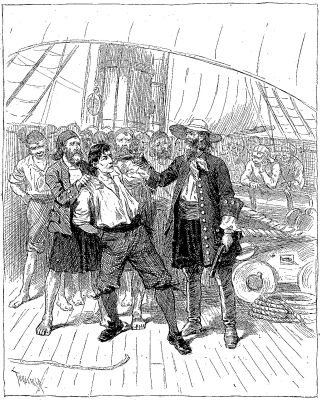
"You dog, why don't you answer?" cried Low, cocking one of the pistols and putting it to the other's ear. Thus compelled, and yet not knowing what to say, Ashton hesitated no longer, but did what he might have done at firsthand which is always the best thing to do—he told the truth.
"I am a bachelor," he said, whereupon Low appeared to be satisfied, and turned away.
The fact was that this scoundrel, who seemed so heartless, had had a wife of his own, whom he had loved tenderly, but who was dead. She had left him a child, now in the care of trustworthy people at Boston, for whom he felt such tenderness that on any mention of him, in quieter moments—that is, "when he was not drinking or revelling"—he would sit down and shed tears. Judging others by himself, he would never impress in his service married men, who had ties, such as a wife and children, to render them desirous of leaving it.
Moreover, Low would never suffer his men to work on Sunday. What is still more strange, Ashton tells us that he has even "seen some of them sit down to read a good book upon that day."
For all that, he had to join the ship's company, and become a pirate like them, or die. His name was accordingly entered on their books; whereas, when opportunity offered, the married men who had been captured were put on shore.
Ashton was sometimes fired at, and slashed with cutlasses, upon the supposition—which was quite a correct one—that he was planning how to escape. Otherwise he was not, on the whole, ill-treated. He assisted, much against his own will, in the capture of many vessels.
Though very successful in her depredations, the pirate ship was at one time pursued by The Mermaid, an English man-of-war, when Ashton's feelings were more uncomfortable than they had ever been, "for I concluded that we should certainly be taken, and that I, being found in such company, should be hung with the rest, so true are the words of Solomon, 'A companion of fools shall be destroyed.'"
However, one of the ship's men showed Low a sand bar over which his vessel could pass and The Mermaid could not.
"So we escaped the gallows on this occasion." Nor was it only hanging that was to be feared, for it was proposed by these desperate fellows that in case their capture became certain, they should "set foot to foot and blow out each other's brains"—a suggestion which, though he pretended to approve of it, did not please Ashton.
There was now a plot among the more honest portion of the crew to overpower the rest. It was unfortunately discovered, and one Farrington Spriggs, the second in command, informed Ashton that he should "swing like a dog at the yard-arm," as being one of the conspirators. To this our hero meekly replied that he had had no intention of injuring any one on board, but should be glad if he could be allowed to go away quietly.
Perhaps this soft answer had the effect of turning away Mr. Farrington Spriggs's wrath, for Ashton presently remarks, "In the end this flame was quenched, and, through the goodness of Providence, I escaped destruction."
About this time they were in the Bay of Honduras, which is full of small wooded islands, generally known in that part of the world as "keys."
At one of these, which lay altogether out of the track of ships, the pirate touched for water, and the long-boat was sent ashore with casks to get a supply. Low had sworn that Ashton "should never set foot on shore again," but that chieftain was not on board at the time, and the cooper, who was in charge of the boat, granted his request to go with the party. As to running away, there was nowhere, as he reflected, for the man to run to.
When they first landed, Ashton made himself very busy in helping to get the casks out of the boat and in rolling them to the spring; but presently he began to stroll along the beach, picking up shells. On getting out of musket-shot, he made for a thick wood.
"Where are you going?" cried the cooper.
"Only for cocoa-nuts," was Ashton's reply, pointing to where some were hanging.
When once out of sight he ran as fast as the thickness of the bushes and his naked feet permitted him. His clothing was "an Osnaburgh frock and trousers and a knitted cap, but neither shirt, shoes, stockings, nor anything else."
The wood was so thick that he could hear the voices of the party while he himself was quite invisible and secure.
When they had filled their casks they hallooed for him loudly; and then said to one another, "The dog"—they always called him the dog—"is lost in the wood, and can't get out again." In a short time they put off without him.
Then came reflections very similar to those we read in Robinson Crusoe: "Thus was I left on a desolate island, destitute of all help, and remote from the track of navigators, but, compared with the state and society I had quitted, I considered the wilderness hospitable and the solitude interesting. True, I was in a place there was no means of leaving; my clothing was scanty, and it was impossible to procure a supply. With the trifling exception of cocoa-nuts, I was altogether destitute of provisions, nor could I tell how my life was to be supported. But as it had pleased God to grant my wishes in being liberated from those whose occupation was to devise mischief against their neighbors, I resolved to account every hardship light."
In five days the pirate vessel set sail without him, and Philip Ashton found himself alone.